How things have changed: The ongoing relationship between the Peabody Institute and The Phillipian

Contributed by Adam Way

This blog is the culmination of work done by Independent Researcher/Volunteer Adam Way to explore how the Peabody Institute has been portrayed by Phillips Academy students in The Phillipian over the years. Adam shared two previous blog posts about his work (Combing Through the Phillipian and Combing Through The Phillipian: End of an Era) and recently completed the project. His final blog is a summary of what he learned.

 The relationship between The Phillipian and the Peabody Institute has existed since the Institute’s founding back in 1901, and while the strength of that relationship has waxed and waned, it has persisted nonetheless. During my time combing through over a century’s worth of The Phillipian issues, I have noticed a few substantial changes, mainly the amount of coverage that the Peabody Institute received, the type of coverage, and the student’s view of Peabody.

The first major difference that appears when looking through The Phillipian archives is that the number of times that the Peabody is addressed/mentioned decreases drastically towards the present. In 1910, the Peabody Institute, then the Department of Archaeology, was mentioned 153 times throughout the year, with the following years yielding similar results. A significant amount of the times that the Peabody Institute was mentioned in these early years can be attributed to the existence of extracurriculars that took place within the building. Events such as meetings of the Banjo or Drama clubs and other such student activities that took place in the Peabody make up a large portion of mentions, while the rest is composed of articles detailing the academic work and scholarship being conducted by the Institute.

April 15, 1916

The constant high volume of mentions during the early years of the Peabody Institute, unfortunately, do not last forever. It appears that the turning point was, more or less, when Warren K. Moorehead retired from his position as director and was replaced by Douglas Byers. While the overall number of yearly mentions had been on a steady decline since the beginning of the century, the number had remained relatively consistent and the articles were primarily focused on academic work and lectures at the Peabody Institute. This changed when Byers and curator Fred Johnson took over, as it appears that these two did not have as close of a relationship with the The Phillipian as Moorehead did. This trend continued, and arguably was exacerbated under Richard “Scotty” MacNeish. I believe that this divide can be attributed to a shift in focus from teaching in the classroom to fieldwork, as all three of these former directors placed a heavy emphasis on fieldwork, while there was a lack of a consistent archaeology and/or anthropology class during this period (with other factors playing into that decision like student interest). Luckily, in the time since MacNeish, the Peabody Institute has regained a stronger, and more frequent, presence in the The Phillipian.
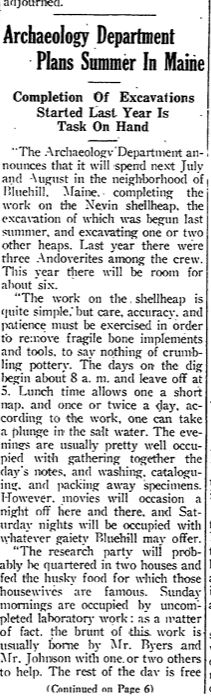
April 3, 1937

The next major change that I noticed while conducting this research, was that the type of coverage that the Peabody received changed over the years. Initially, I noticed this change through the club announcements. As time went on, the number of clubs using the Peabody, or at least publishing that they were in The Phillipian, was declining. Nothing about this appeared to be out of the ordinary as clubs moved to other buildings and Peabody House was constructed for the purpose of holding social events and clubs. The part that seemed strange to me was when members of the Peabody staff and faculty would leave without a single mention of their departure and only a brief mention when their replacement had been found, as was the case with Dick Drennan in 1977. However, as time progressed, the type of coverage in this area also shifted. Not only was there an article detailing the departure of the previous director, Malinda Stafford Blustain, but there was a subsequent article about the hiring of her replacement, Ryan Wheeler. It appears that the relationship between the The Phillipian and the Peabody Institute is steadily returning to its former strength.

The last major change that I have noticed is the waxing and waning of student interest in the Peabody Institute over the years. As with the other two variables that changed over time, student interest seemed to peek early on before dropping drastically as time progressed. After Moorehead’s departure and the subsequent drop in attention received from The Phillipian, the Peabody became increasingly referred to as a “hidden gem” and “unused asset.” There were even pieces written as a joke that say a student died of boredom due to their visit to the Peabody. Pieces like these are written in good fun, however, it does highlight the disparity between how involved students once were and how involved they are now. As with the other two changes that I noticed, this too is changing for the better in recent years. While there are still joke articles, there are fewer instances where the Peabody is labeled as an “unused asset.” There appears to have been a positive reception of student travel programs in the recent past as well as current lectures and other programs offered by the Peabody Institute.
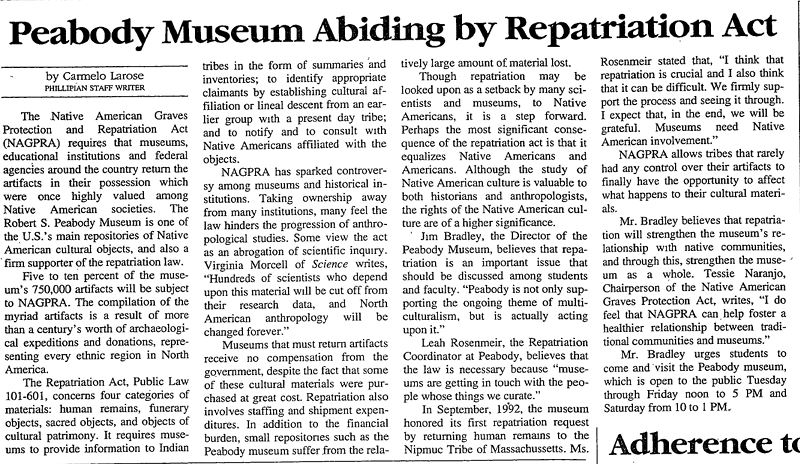
October 7, 1994

While my time combing through The Phillipian has come to a close, I am glad to see that the Robert S. Peabody Institute of Archaeology is making a resurgence within the paper. The records showed that the institution has been through some difficult times and yet has prevailed and is strengthening its place within the Academy and student life.
Student Volunteer Voices

Contributed by Elizabeth Reppas, Anthony Chung Yin Woo and John Bergman-McCool

Here at the Peabody, we are fortunate to have students assist us with collections-related projects. Work duty is the primary avenue for students to help our small staff, but we also rely on non-work duty students who volunteer in various ways during their free time. As we prepare for building renovations, work duty assignments have been canceled at the Peabody for the academic year. However, a few dedicated student volunteers have continued to come each week to help us as we approach the start of construction. We’ve asked them to share a bit about their experiences:

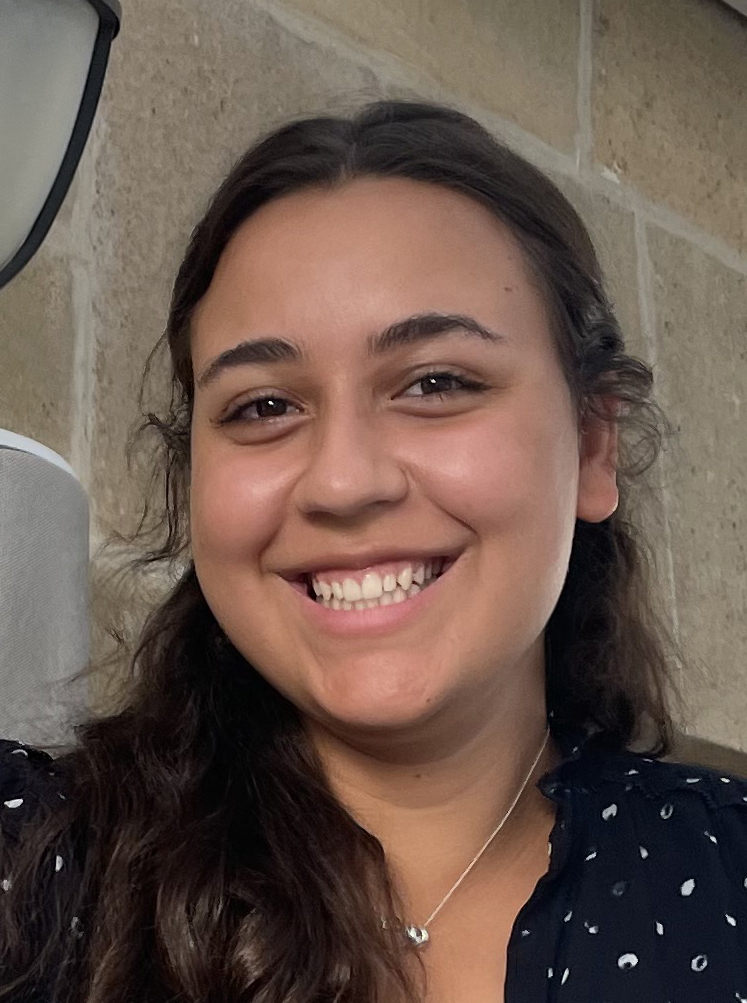
Hi! I am Elizabeth Reppas, and I am a three-year senior from Washington DC. I have always really loved visiting museums and learning how they work, so when I learned that I could volunteer at the Peabody Institute, I was very interested. I have been volunteering since the winter of my upper year and have gotten to help with a range of projects from organizing objects to creating an exhibit.

I first started helping with inventory like labelling and sorting objects. As I learned more about the artifacts, I got the chance to help curate an exhibit with projectile points and textiles from Tamaulipas Mexico for one of the exhibit cases. I helped with all things from choosing the objects and photos for the case to writing the explanations and putting the pieces together. I finished off the year with that exhibit, which was up on display for reunion weekend. It was particularly meaningful because it was in honor of Maya Cointreau ’92 supported by her classmates. Now, this year, I have helped with smaller projects like putting together an interactive activity for the Andover Historical Society and reviewing new objects, but I have mostly been helping to sort and organize the collections as the Peabody gets ready for its renovations.

I have loved these past two years working at the Peabody. I have learned a lot about archeology and how objects are excavated. I have also gotten to learn more about Andover and places around us since many of the Peabody’s artifacts come from nearby. And lastly, and for the reason I initially joined, I have gotten to learn more about collections: taking care of objects, doing inventory, and learning about ethically acquiring, maintaining, and displaying artifacts. Overall, I love the time I have spent volunteering and am excited for what is to come with the Peabody.

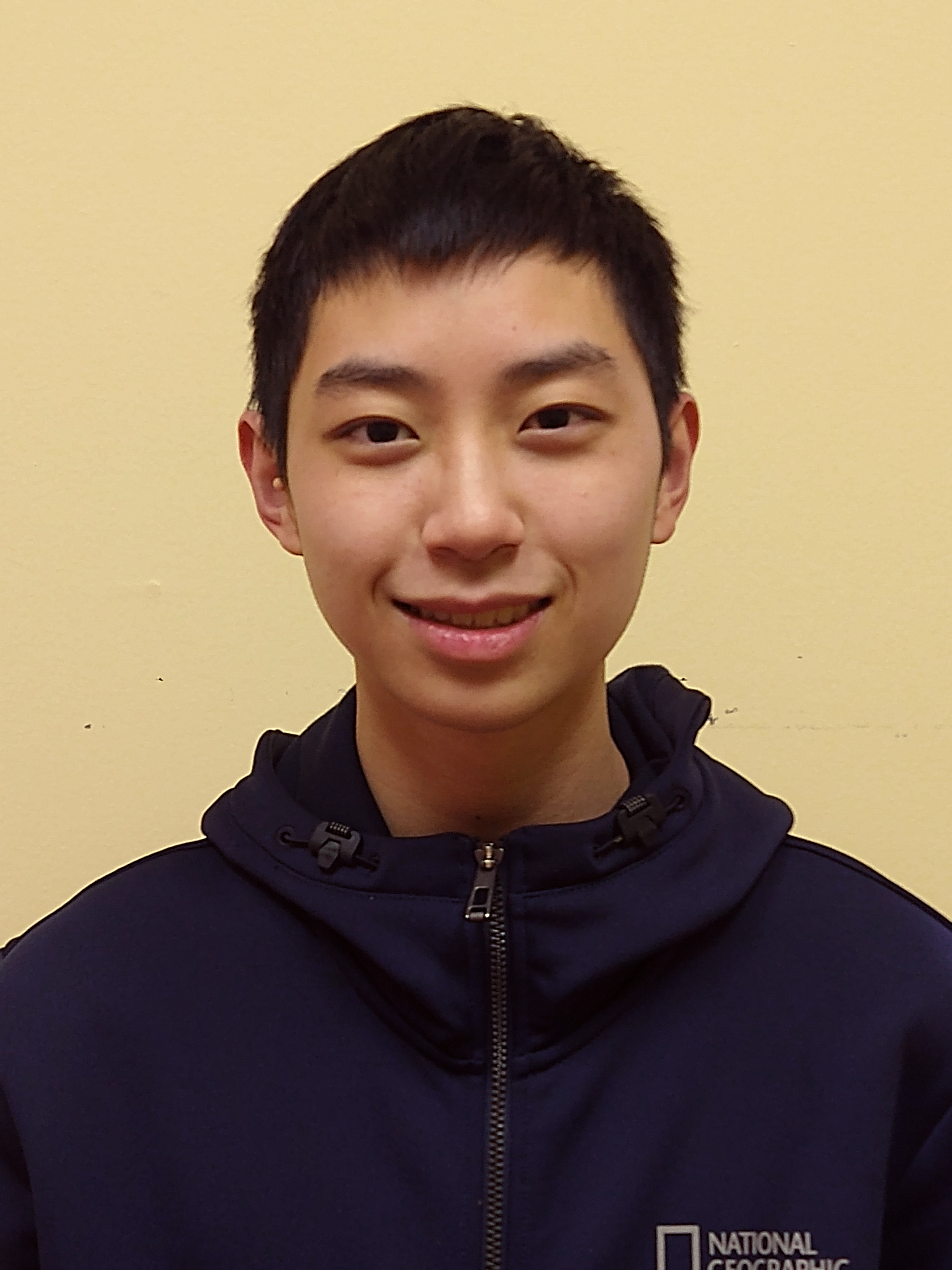
I’m Anthony and I’m a Phillips Academy student volunteering at the Peabody. Currently, I’m an eleventh grader living in Tucker House on campus, though I call the city of Hong Kong my home.

Since tenth grade, I’ve been involved with the Peabody, first through the work duty program, then by reaching out to become a student volunteer. The work I do at the Peabody varies a lot, which involves hands-on tasks such as sorting through artifacts, rehousing them in small Ziploc bags, and climbing up rickety wooden ladders to correctly label the new archival boxes in their respective bays, all as part of the rehousing project at the Peabody. Other work that I’ve done at the Peabody includes writing condition reports for artifacts that are used in classes as well as packaging old pamphlets for storage. More recently, I was involved with calculating and measuring the space required for to move all the boxes from the basement to the first floor, in preparation for the renovation work that will soon commence in the building.

To me, the Peabody has always been a place where I am able to take my mind off class work and come into close contact with items from decades, centuries, or perhaps epochs ago. Having visited a fair amount of museums before, it was eye opening for me to see the massive logistical challenges and the large amount of work that the Peabody staff and volunteers have to put into overcoming these challenges, along with digitizing artifact data and developing strict procedures to categorize and label the objects. My experiences at the Peabody have allowed me to better appreciate the people who work in the field of taking care of objects that are historically and culturally significant, particularly as we investigate the previously silenced histories of subjugated people across the globe.

The Repatriation Project by ProPublica

For more than a year, a dedicated reporting team at ProPublica has been exploring NAGPRA and repatriation.  They have been investigating what is behind the overall slow return of ancestral remains back to descendant communities.  Their work has culminated in The Repatriation Project:

America’s Biggest Museums Fail to Return Native American Human Remains

The remains of more than 100,000 Native Americans are held by prestigious U.S. institutions, despite a 1990 law meant to return them to tribal nations. Here’s how the ancestors were stolen — and how tribes are working to get them back.

Behind ProPublica’s Reporting on Repatriation

Our reporters answer frequently asked questions about The Repatriation Project from leaders and citizens of tribal nations.

Does Your Local Museum or University Still Have Native American Remains?

Three decades after legislation pushed for the return of Native American remains to Indigenous communities, many of the nation’s top museums and universities still have thousands of human remains in their collections. Check on institutions near you.

They also compiled a database that allows you to explore information related to individual institutions and tribes.  For example, you can see where the statistics place the Peabody Institute on repatriation.  There is always more work to be done and I hope you can watch those numbers change over the next few months.

I am excited to see where they take the project next!