From Stone Tools to Spreadsheets at the Peabody

Contributed by Sophia Lazar ‘26

Who knew that a statistics class could lead you to timing the cataloging of artifacts? That is exactly what happened to our group this spring, and we are so glad it did.

We are a group of Phillips Academy upperclassmen and seniors: Meara Wang, Jay Jung, Ayush Gupta, Tasnia Begum, and I, Sophia Lazar. We are enrolled in Mr. Noureddine El Alam’s Project-Based Statistics class, where students apply statistical methods to solve real-world problems for real partners. Rather than solely working through textbook exercises, we take on actual projects with organizations and institutions, gathering data, running analyses, and presenting findings that can make a tangible difference. Past classes have partnered with places like the Addison Gallery of American Art and the PA Admissions Office, and when Mr. El Alam introduced the Peabody as an option, our team knew right away that it was the one for us. We wanted to work on something that genuinely inspired us, and the Peabody fit perfectly.

Our project centers on a question the Peabody has been grappling with: how long would it actually take to bring the museum’s artifact catalog up to an excellent standard, and what would better staffing make possible? To answer that, we needed data on the cataloging process itself, specifically how long it takes to catalog different types of artifacts. That meant a visit to the Peabody’s temporary location, where John Bergman-McCool and Marla Taylor walked us through a hands-on mock session. Because working directly with the real collection is not always feasible, John and Marla guided us through a range of representative mock artifacts so we could time the process across different object types and gather enough data points for a meaningful analysis. It was hands-on, eye-opening, and honestly a lot of fun.

With that data in hand, we are now building a statistical model to estimate how long a full cataloging effort would take under different staffing scenarios. The idea is to take our timing measurements, account for the variety of artifact types in the collection, and project out what various levels of staffing could realistically accomplish over time. The final report will go directly to the Peabody, and we hope it gives them something genuinely useful as they plan for the future.

What surprised me most was how much I came to care about the outcome. When you walk through a collection and realize just how much history is sitting there, waiting to be properly documented and shared with the world, the stakes feel very real. We came into this wanting to do meaningful work, and we are leaving with a much deeper appreciation for everything that goes into preserving and making accessible our shared cultural heritage. We hope our work makes a real difference!

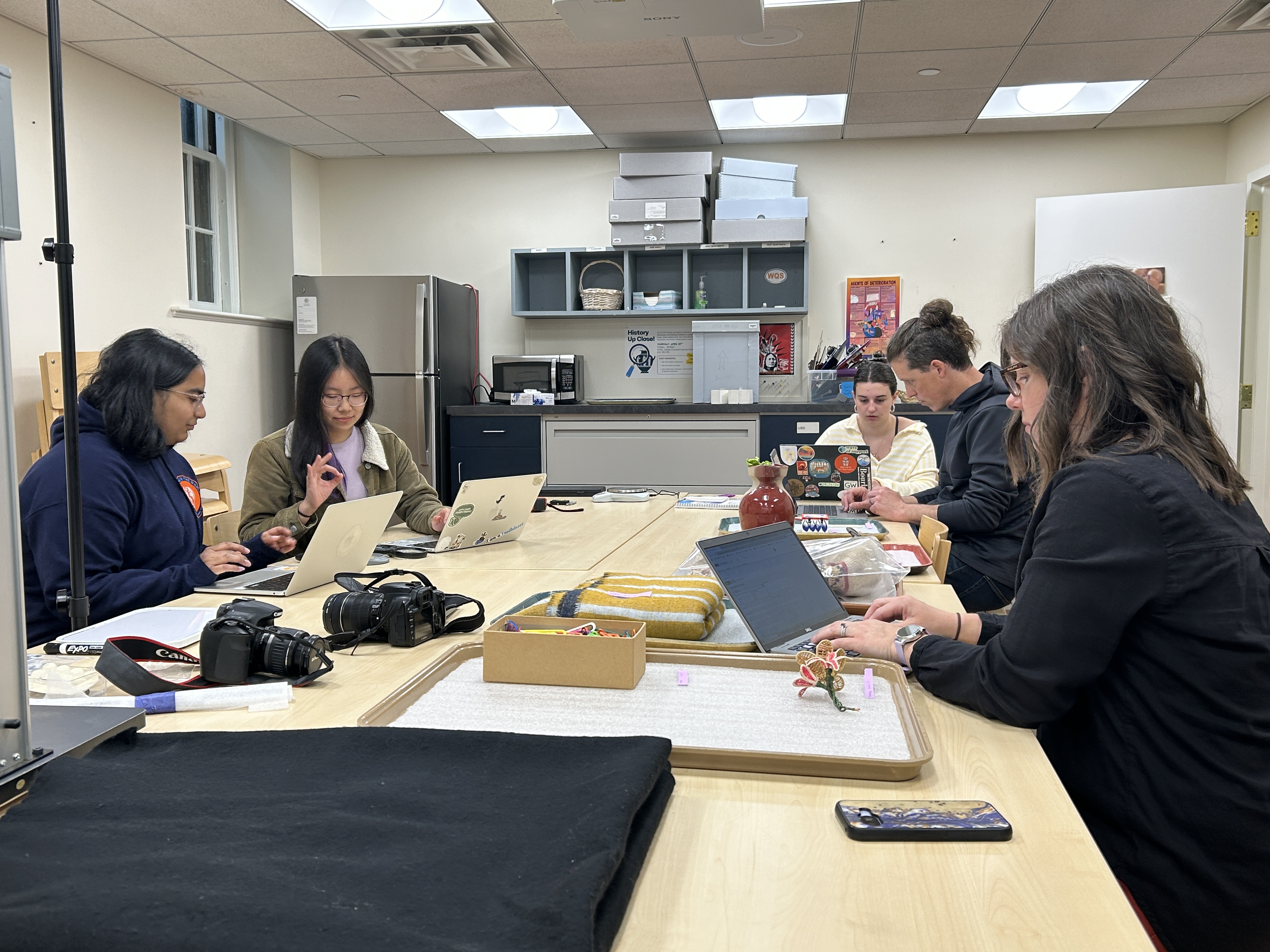
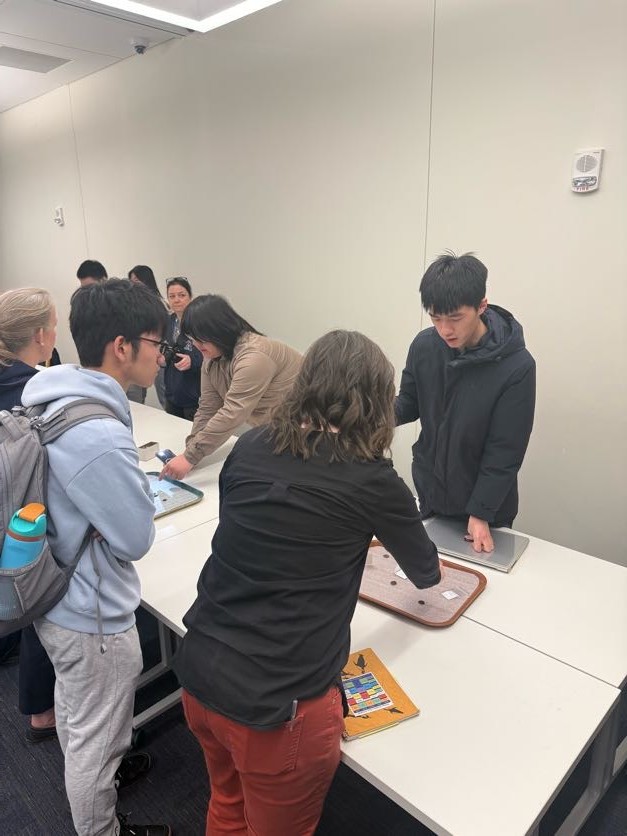
a group of five people sitting around a large table covered in objects, typing on computers
The team together at the Peabody’s temporary location during our data collection session.
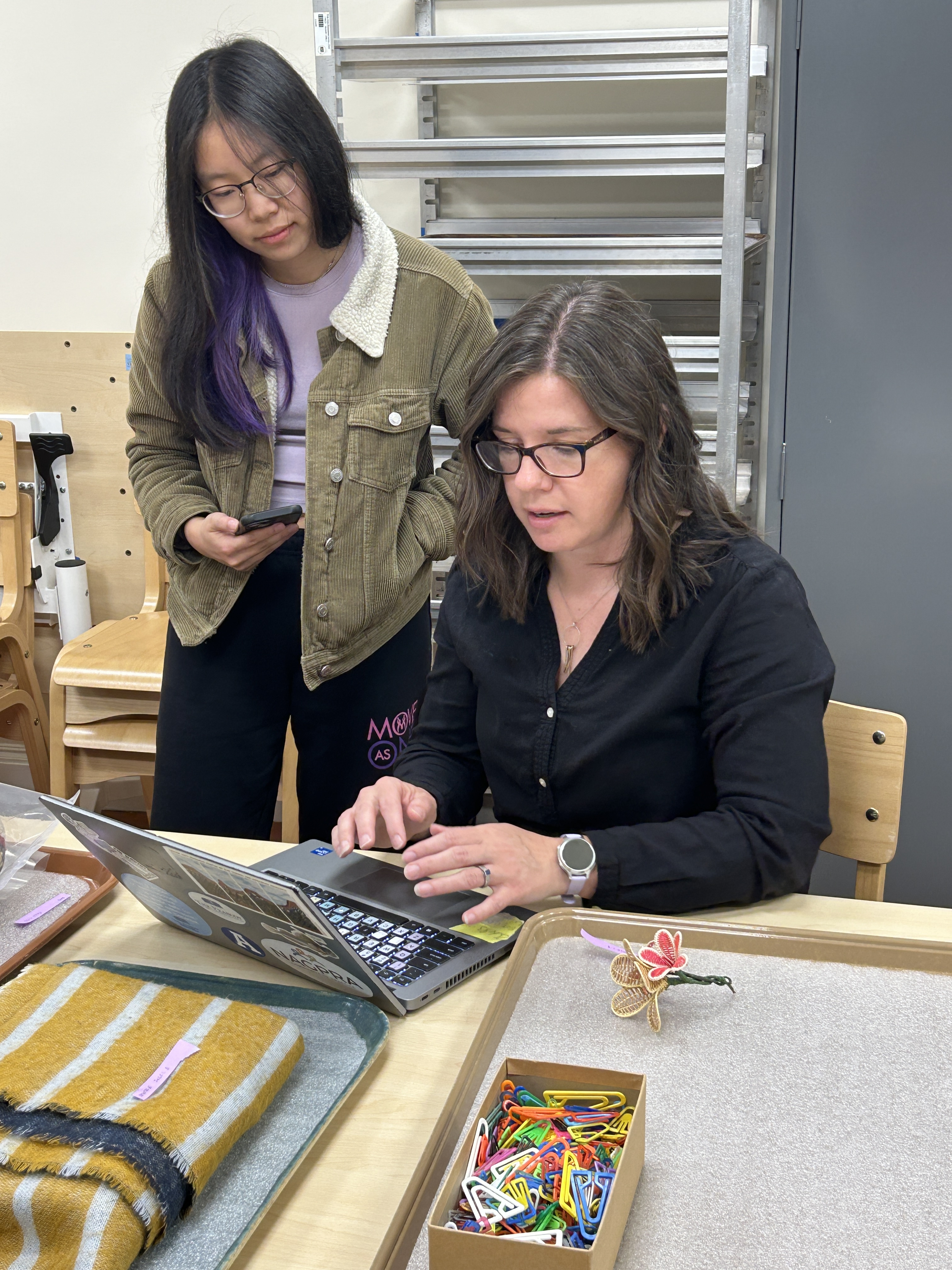
a woman sitting at a table with objects in front of her, typing on her laptop and talking to another woman standing behind her and looking over her shoulder
Marla Taylor walking Meara through the steps of cataloging a mock artifact.

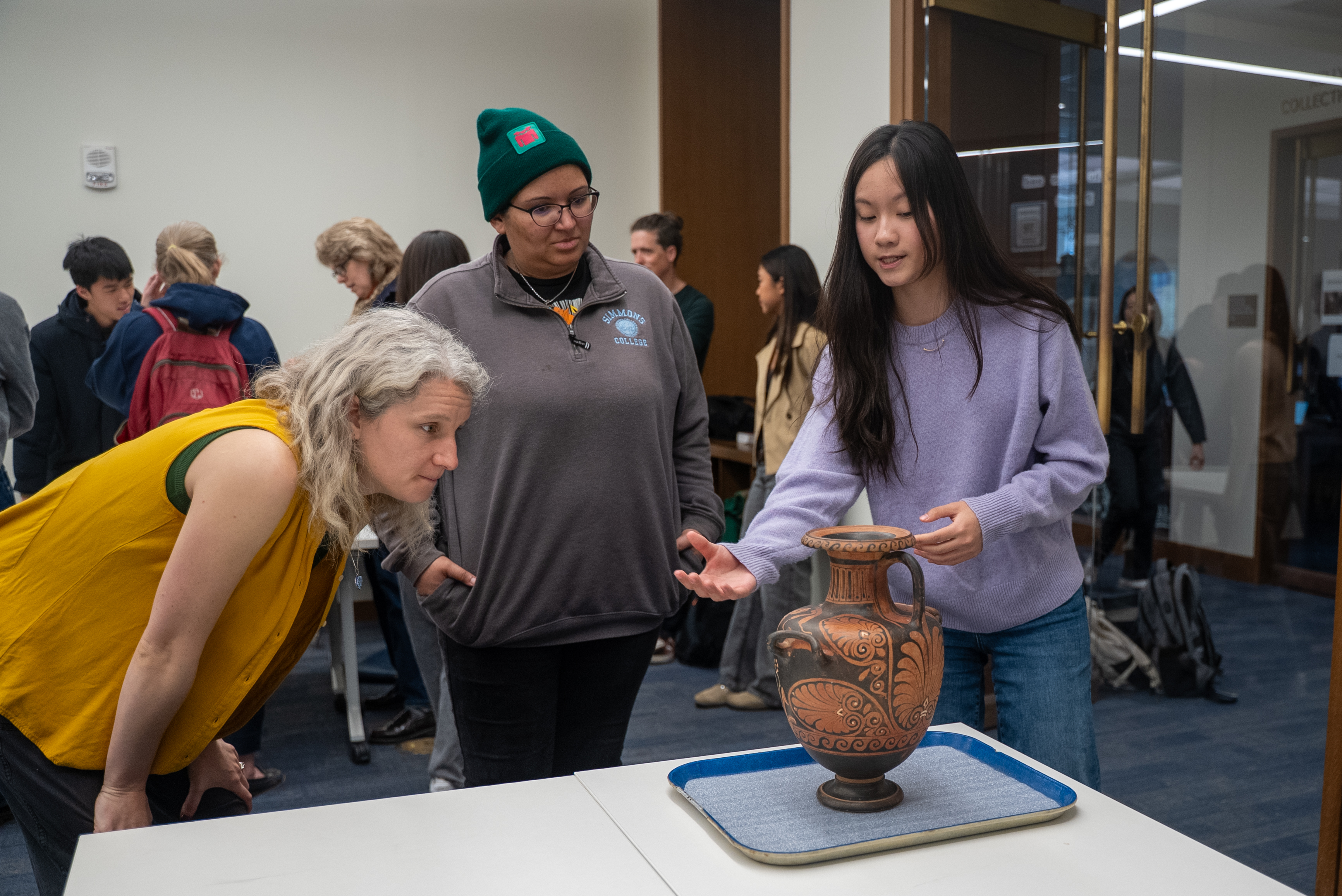
A Dove, an Omphalos, and a Mystery: What’s on This Hydria?

Contributed by Selene Xu ‘27

In the fall of 2024, I reached out to Dr. Ryan Wheeler to learn more about the collection of Ancient Mediterranean artifacts that I knew were housed at the Peabody. I didn’t yet know the extent of what the collection contained, or what sort of project I might want to take on, but I knew I wanted to learn more, and that I wanted to help the Peabody learn more, too, by enhancing its catalog records. Dr. Wheeler shared with me a catalog of the objects that the Peabody houses, including a folder with all their photographs. After taking a quick look, I found myself drawn to this hydria:

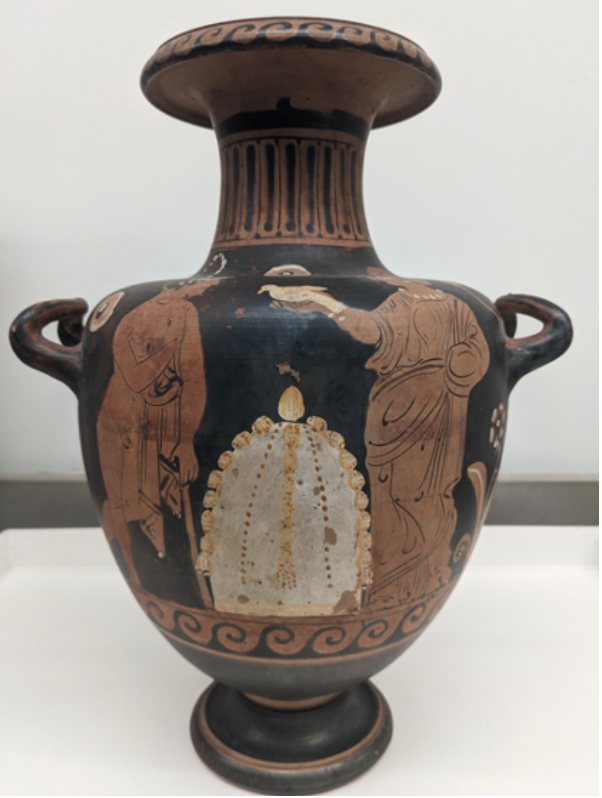
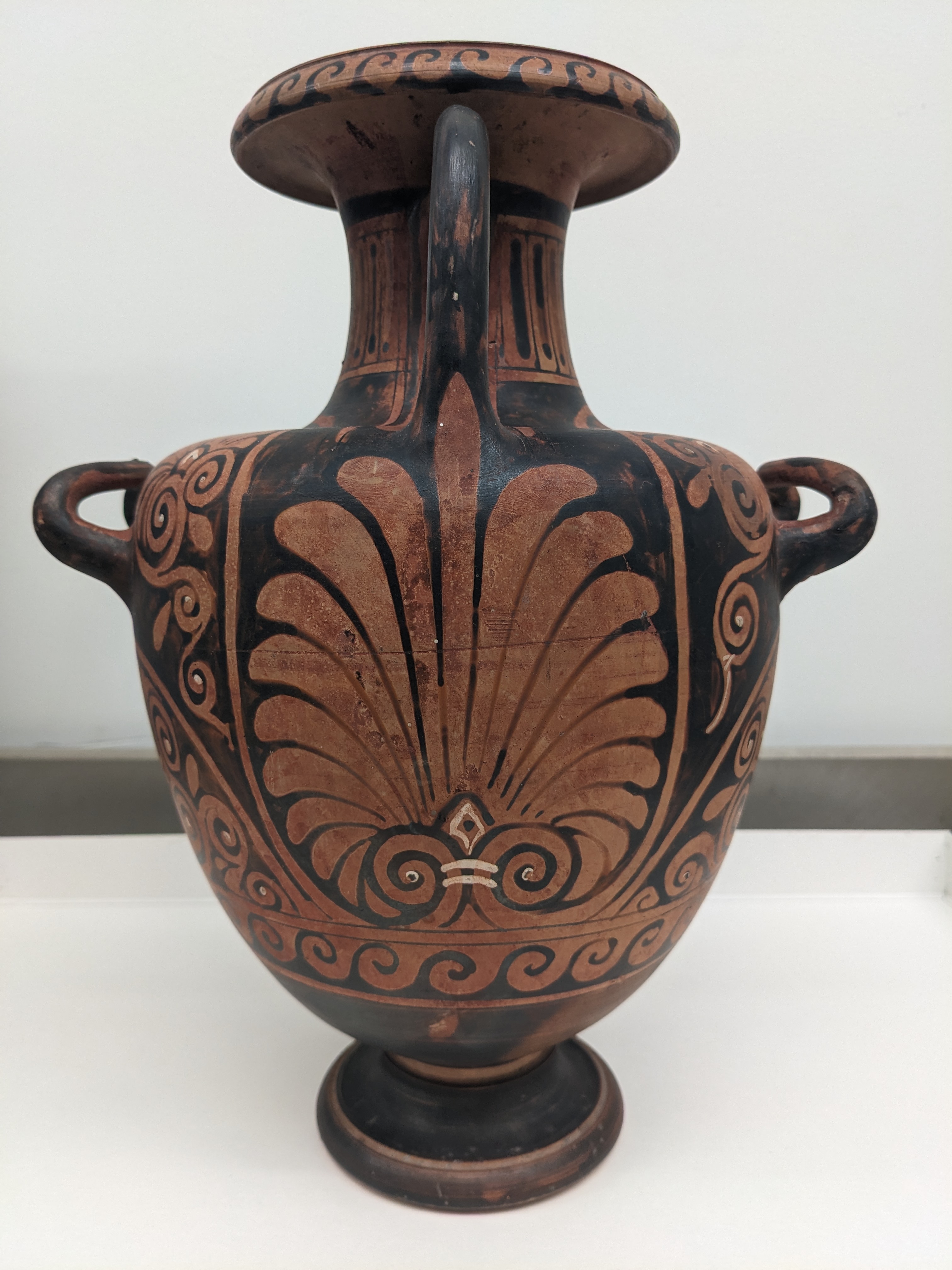
Hydria (jug) housed at the Peabody Institute, 1989.984.4.2.

This is where I chose to focus my independent research. Initial identification of the Ancient Mediterranean collections at the Peabody was provided by Dr. Laure Marest, then a curator at the Museum of Fine Arts, Boston. She described 1989.984.4.2 as a “hydria (jug) with a man and a woman holding a dove above an omphalos”, made from red-figure ceramics, dating to the late 4th century BCE, and attributed to the Hellenistic period in the Campanian region. This served as my starting point, and the direction for my research: to learn more about this type of pottery, and to identify who this man and woman might be.

I began by researching the history and evolution of Hellenistic vessels (ceramic containers produced during the Hellenistic period, roughly from the late 4th to the 1st centuries B.C.E., used for practical, ritual, or decorative purposes), from proto-geometric and geometric techniques to black-figure and, finally, red-figure, the technique used for this artifact. Red-figure pottery eventually took precedence over black-figure because it allowed artists to leave figures in the clay’s natural red while painting the background black. Instead of laboriously incising details, artists could draw them more freely, making the technique better suited to naturalistic depictions of anatomy, garments, and emotion. I also researched the different types of Attic pottery, or pottery produced in the region of Attica, Greece, especially in Athens, which became a major center of Greek vase production. These forms included hydriai, lekythoi, amphorae, kraters, and many more. In doing so, I learned that a hydria is a three-handled water jar, typically with two horizontal handles for lifting and one vertical handle for pouring.

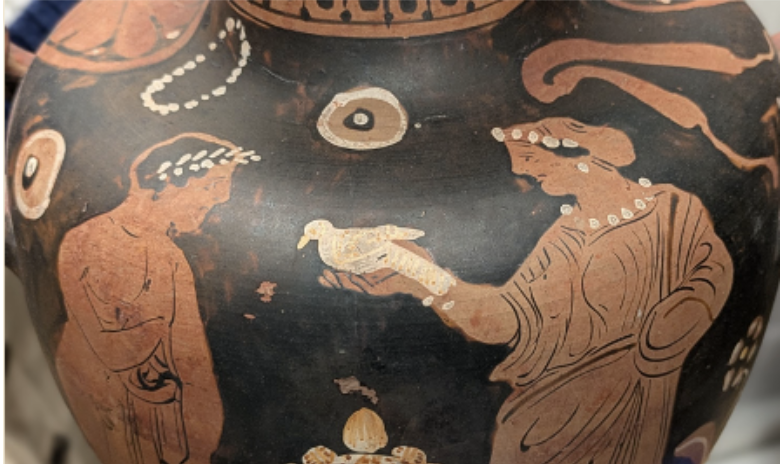
Understanding the broader historical and artistic context of the pot assisted my hypotheses of the figures’ identities. Since the woman on the right is holding a dove, I predicted that she was Aphrodite, the goddess of love and beauty, whose sacred animal is the dove. After finding more vessels online with Aphrodite depicted and comparing them with the illustration on this pot, I was confident that the well-decorated lady with her hair tied in a bunch, open beaded cap, earrings, necklace, and bracelets was Aphrodite.

close up image of a painting on a greek vessel, showing a woman holding a dove out toward a man wearing a laurel wreath
A closer view of the front of the hydria’s shoulder, with the now-identified Aphrodite.

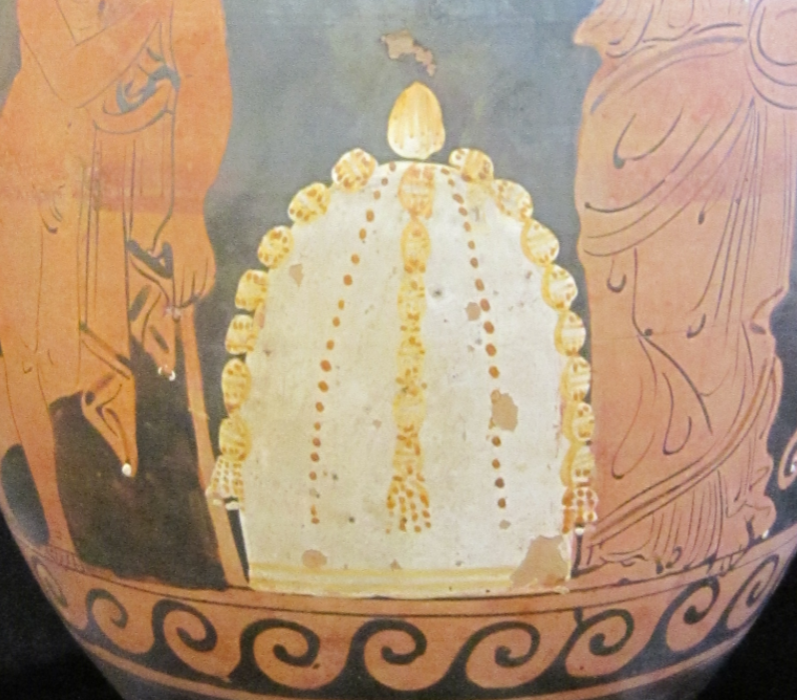
Then came the most challenging part: identifying the man on the left of the hydria. At first glance, there was nothing symbolic about the figure, except that he stood casually beside Aphrodite, showing no sign of reverence typically expected toward a goddess, therefore implying that he may be a god himself. I searched online databases and museum collections for depictions of various gods on Attic pottery and for their characteristics. Then, I remembered, too, that Dr. Marest had described the large object in between Aphrodite and this man as an “omphalos.”  Originating from the Ancient Greek word “ὀμφαλός,” meaning “navel,” an omphalos symbolizes the center of the world, glory, and birth and death in the Classical and Hellenistic periods. I later learned that the omphalos was also a marble monument discovered at Delphi, Greece, a religious sanctuary dedicated to Apollo.

close up image of a painting on a greek vessel, showing an omphalos
Close up on the omphalos.

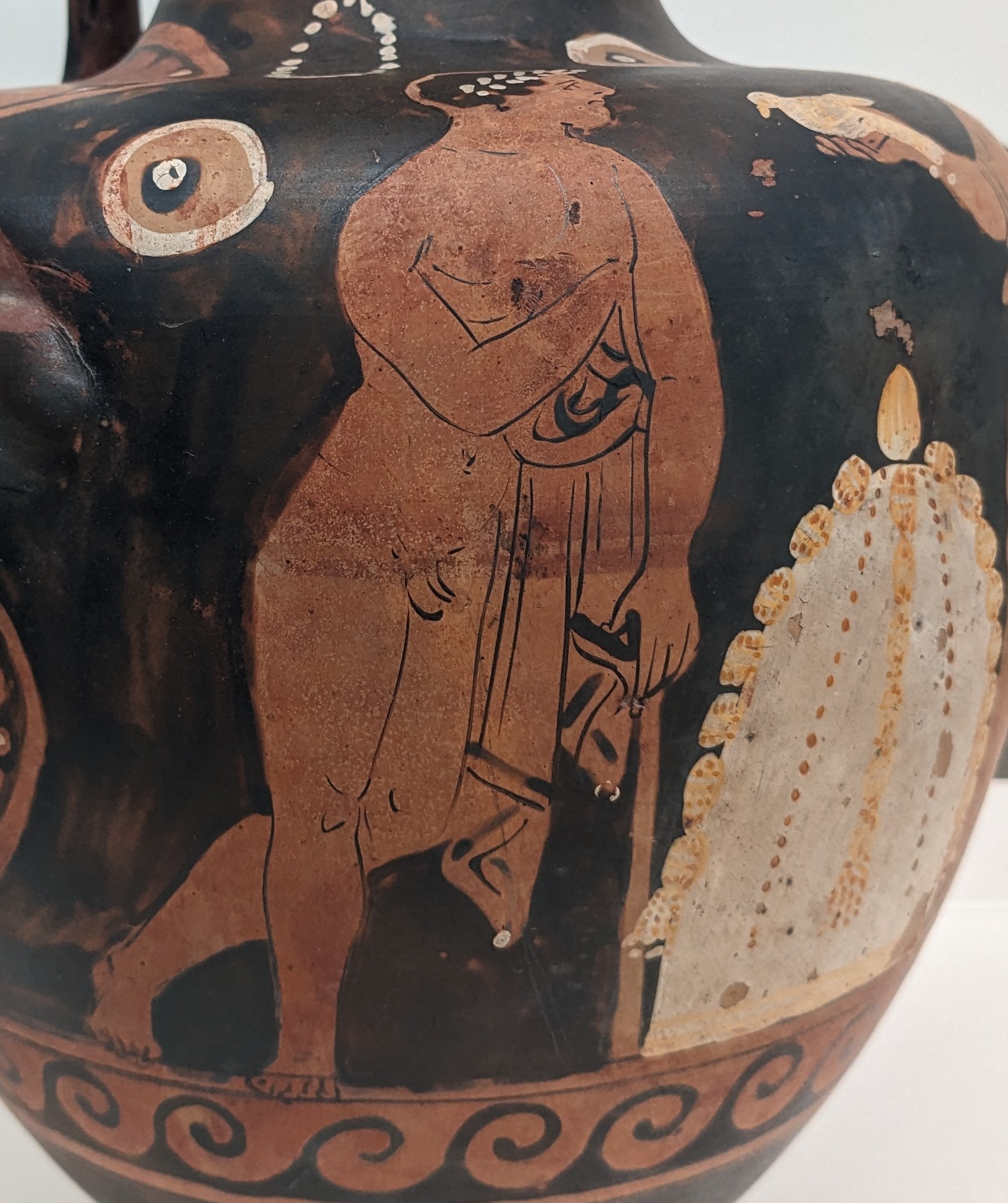
Thinking about the relationship between the omphalos and Apollo, the fact that fillets (decorative bands of cloth often used as religious offerings), which adorn the omphalos, were often offered by worshippers consulting Apollo’s oracle, and the laurel wreath commonly worn by the nude Apollo, I suspected that this man could be Apollo. After researching more vessels online with depictions of Apollo, I found various similarities in the iconography, such as Apollo holding a staff in a print at the British Museum.

close up image of a painting on an ancient greek vessel, showing a man wearing a laurel wreath and leaning on a staff
A laurel wreath, a staff, and an omphalos with fillets.

I wrote up my findings for the Peabody Institute and created slides of my research to present my findings to others. After coordinating with Dr. Lainie Schultz (Peabody Institute), Dr. Elizabeth Meyer (Instructor, Phillips Academy Classics Department), and Dr. Paige Roberts (Director, Phillips Academy Archives and Special Collections), I am so grateful to have had the opportunity to present my findings in person at the “History Up Close” event on April 30th, open to the Phillips Academy campus. The excitement of this experience also came from learning from the audience, many of whom asked very thoughtful questions about not only the iconography on the hydria but also the iconology, which gave me clearer next steps for my research.

three people standing around an ancient greek pot, looking and discussing
Selene presenting her research at the “History Up Close” event. Photo by Jessie Wallner.

Never would I have thought that I would have this amazing opportunity as a high schooler. I am also extremely grateful that this experience sparked my interest in archaeology, inspiring me to expand my research on Attic pottery even beyond the Peabody.

New Leadership and New Initiatives at the Andover Anthropological Society

Contributed by Aaron Bai ’27 and Barrett Kim ’27

Hi, I’m Aaron Bai, and I’m an upper (11th grader) at Phillips Academy. I’ve always been interested in history and the humanities. As a child, I would spend hours in the school library reading books on mythology and history from cultures all around the world. As I grew older, I would read and even write about interesting topics in my free time, from the Garamantes during the Roman Empire to modern extremism in the Sahel. I have come to believe that only through studying human culture and society throughout its history can we better understand who we are and how we came to be. Though the present may differ considerably from the days of Lucius Cincinnatus or George Washington, for instance, their legacies and the similarities in the challenges and decisions we face make it such that uncovering their stories unmasks more of our own.

Following my interests, I chose to work at the Peabody for my work-duty requirement during my lower year (10th grade). This turned out to be a great decision— I had the rare opportunity to help organize, document, and analyze the Peabody’s vast collection of artifacts, from Neolithic stone tools to Native American ceramics. Working closely with these objects allowed me to engage directly with material history and learn the stories behind them in a unique and deeply meaningful way. This year, with work duty completed, I have continued to volunteer at the Peabody every week, helping research and document its collection of coinage from the Ancient Mediterranean, which serves as an amazing window into the societies and belief systems of the ancient world.

Given my interest in anthropology, I joined the Andover Anthropological Society last year, a student club here on campus, and later applied to take on a leadership position. Now serving as co-president of the club, I hope to raise awareness of this remarkable resource at our school and expand opportunities for students to engage with the Peabody and the collections there, whether through open houses, workshops, or research projects. It may even be worthwhile exploring engagement beyond the student body, such as inviting local schools to participate in open houses or lectures. In any case, I am very excited and look forward to working with the Peabody on these initiatives.

A group of people standing around tables, looking at coins laid out on trays and talking.
Aaron sharing his coin research with members of the Phillips Academy campus.

My name is Barrett Kim, and I’m an upper (11th grader) at Phillips Academy interested in biological sciences, though what draws me most isn’t exclusively the science, but the philosophical questions of how we got here.

I came across anthropology very spontaneously. A friend mentioned a research project through the Andover Anthropological Society, specifically exploring gender dynamics in Indigenous artifacts. Their hard work and insightful research immediately fascinated me. Around the same time, I was reading Orwell, Bradbury, and Salinger, writers who kept returning to the same warning: societies fail when they forget their own past. Anthropology felt like the applied, real-life version of the messages those books portrayed. If you want to understand where humans are going, you must understand where we’ve been. Anthropology turned out to be the perfect intersection of biology and sociology, two fields most people treat as completely separate.

Coming into Phillips Academy, I had no idea what anthropology was; however, after exploring the field and its importance, I felt like I had to help share what I learned. This desire to inspire others made me pursue a leadership role with the club and the Peabody Institute, not because I had everything figured out, but because I wanted to guide others into learning anthropology’s importance.

Looking ahead, I’m really excited to work with the Peabody. We have a professional archaeological institute on our campus, and most students walk right past it. Next year I want to help encourage students to use this valuable resource to explore our past and shape the understanding of our futures. Working with Aaron, we envision a place where genuine questions can be passionately explored, and where the work we do helps expand people’s worldviews.

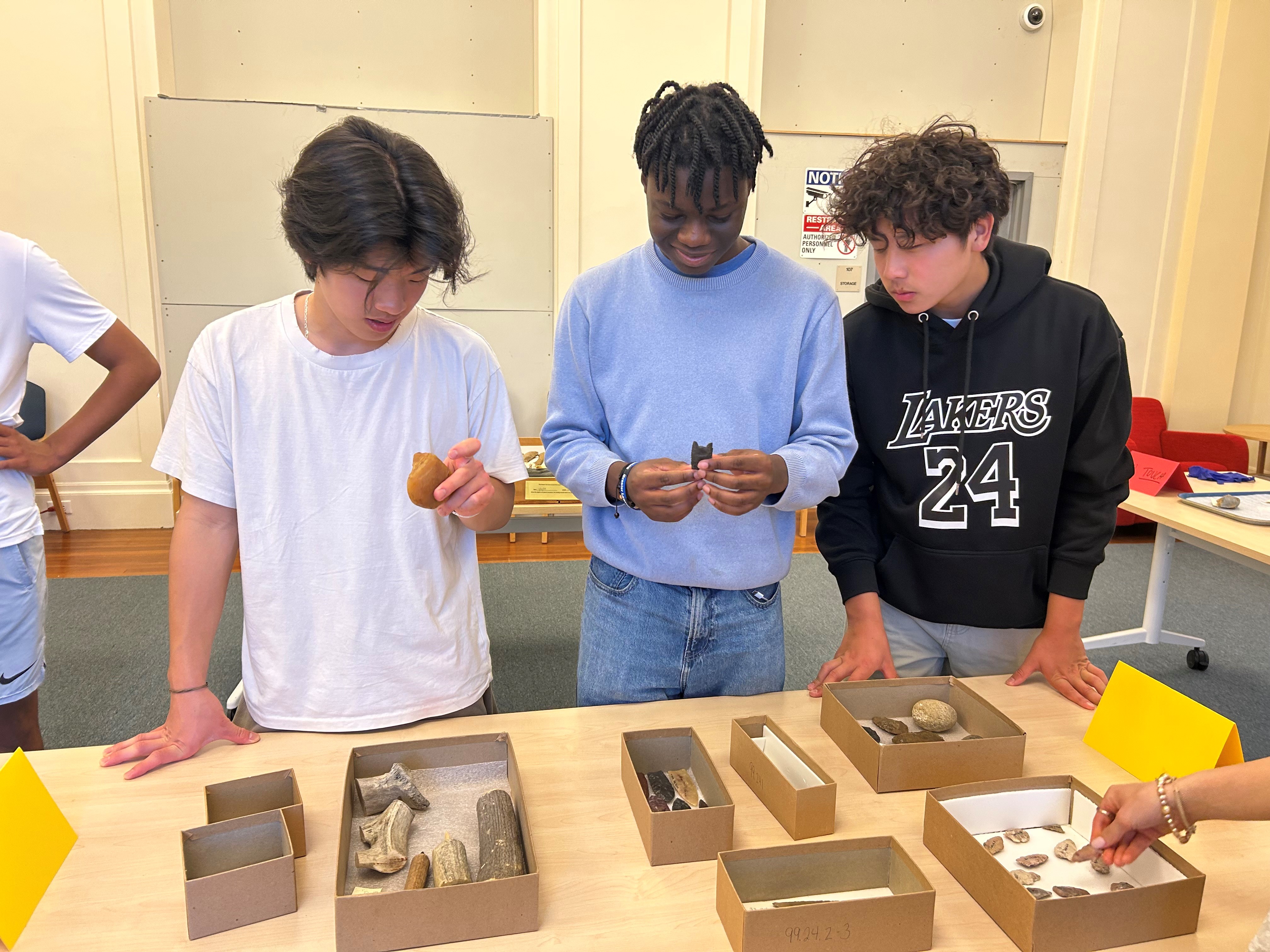
Three young men standing in a row at a table, looking at ancient collections of bone and stone.
Barrett (left) at a Peabody event organized by the Phillips Academy Biology Club.

Why We Started the AAS Blog

Contributed by Jack Angelo ’26

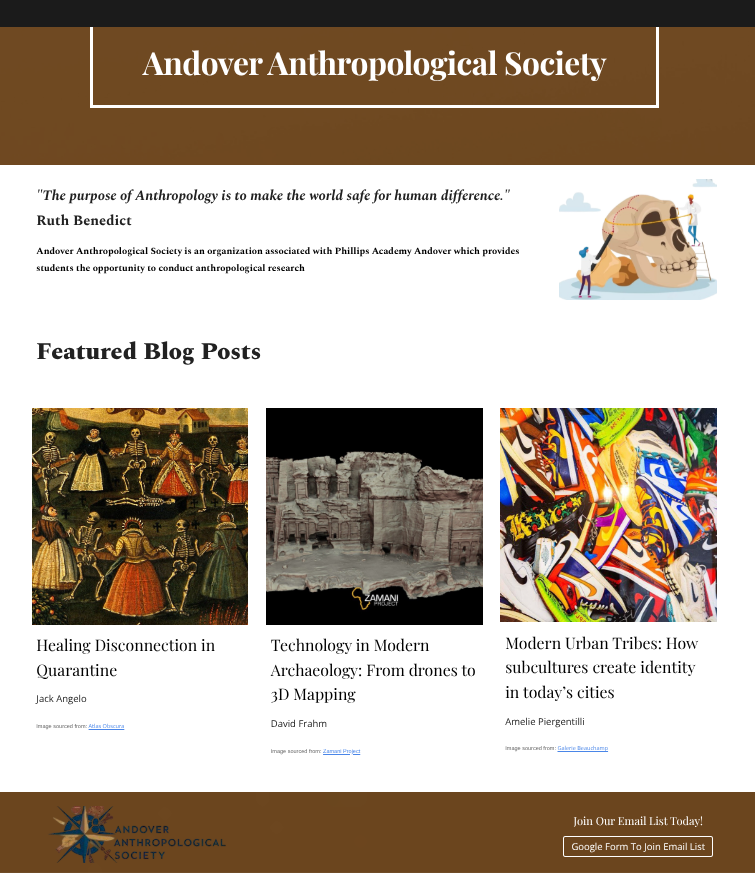
Homepage of the AAS blog site

My name is Jack Angelo and I am a board member and Blog Lead in Andover’s Anthropological Society, a student club we created here at Phillips Academy last year. I first became interested in Anthropology because of the many different topics it could cover, allowing someone to perform curiosity-based research about whatever subject matter interests them. When the other board members and I created the club, we knew most of our members’ research and curiosity would be directed towards our more major projects working in tandem with the Peabody Institute. But, understanding that the larger, focused research projects did not allow total intellectual freedom for the whole club, and that it did not spread our club’s messaging to the whole campus, we decided to create the Andover Anthropological Society Blog Site.

Our blog has now run for almost nine months and has served as an amazing display of the various topics our members are interested in, such as Corporate Consumerism in America, The Rise of Digital Tribalism, and the History of Art in Quarantine. Each post reflects what genuinely interests our writers, allowing people to contribute to the club without having to take part in our larger projects. In this way, the blog has developed into exactly the kind of free representational space we hoped for.

Additionally, the blog is a public source for anybody to read to understand our club’s messaging or to just further their interest in anthropology. We wanted to make sure that what we’re doing in AAS isn’t limited to the people who show up to meetings. By putting our work online, we’re giving the whole Andover community access to the topics we’re exploring and the research our members are doing. If someone’s curious about anthropology but doesn’t know where to start, or if they just want to read about a specific topic, the blog is there for them.

Ultimately, the AAS Blog is about making anthropology accessible. We wanted to create something that anyone could engage with, regardless of whether they’re in the club or have any background in the field. By keeping our work public and covering topics that connect to everyday life, we’ve built a resource that’s open to the entire Andover community.

A ‘Key’ Find at the Samuel Phillips Jr. Mansion House, 2025 Excavations.

Contributed by Katie Lincoln

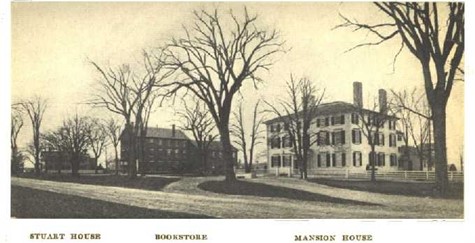
Almost every summer since 2016, young archaeologists from Phillips Academy’s summer session program embark on a mission to excavate the site of the eighteenth century Samuel Philips Jr. Mansion House, located on the West Quad of campus. The infamous Mansion House was built in 1782 by the academy’s founder and stood for 105 years, before burning down in 1887. News articles from the period suggest that the demise of the Mansion House was a result of arson; many speculating that the proprietor, Charles Carter, started the fire. During its long period of occupation, the Mansion House served as not only a home, but later an inn and tavern for students, community members, and travelers. The site’s long history and relatively undisturbed context creates an ideal setting for archaeological excavation and student learning.

Over the past seven years, students have succeeded in discovering portions of the house, including multiple chimneys and a basement feature. This year, students set out with high expectations, choosing to place four excavation units in spaces just outside of the Mansion and two units in the southwest portion of the quad, near the sites of historic outbuildings, a nineteenth century printing house, and an early nineteenth century pathway.

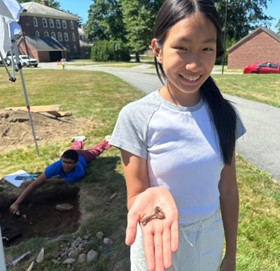
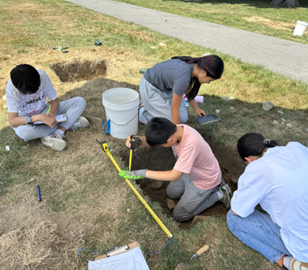
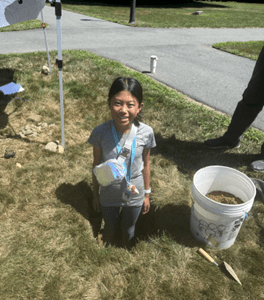
Students in each excavation team had a blast taking turns performing the primary tasks of an archaeologist: digging, screening, measuring, and note-taking. Many, if not all, students even got to unearth artifacts from their units! Some of our favorites included a small ferrous key, an impressed glass tumbler, and half a pair of scissors which all came from the two excavation units placed in the southwest portion of the quad.

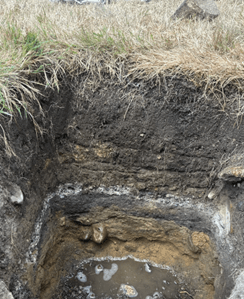
Further excavation in this area revealed a feature relating to the historic pathway present on early nineteenth century maps of campus. Pictured below is a dense, gravelly layer of soil discovered at 40 cm. This layer, interpreted here as the pathway, was intermixed with nineteenth century materials including glass, brick fragments, and some ceramic.

Students excavating the other four units in the northern portion of the quad found shallow cultural layers followed by a sterile C horizon, between 20 and 35 cm. While the artifact density of these units was limited, students still enjoyed finding an abundance of brick, metal nails, and some small ceramic fragments. The very shallow deposits found in these units informed the team that no building activity likely occurred in these areas. Additionally, the relatively low artifact density suggests that these areas were not regularly used like in a dooryard or garden area.

Overall, students in the 2025 field program successfully applied archaeological methods to ‘unlock’ more of the mysteries surrounding the Samuel Phillips Jr. Mansion House. This year’s field season serves to inform of the deep cultural deposits in the southwest portion of the quad and the significant research potential it could provide for future field seasons.

Thanks to the entire student field crew and cheers to a wonderful field season!

Pecos Eagle Bone Flutes: Past, present, and future

Contributed by Alberto Agudo (’25)

I stumbled upon the Pecos bone flutes on a bright September afternoon that was supposed to be about beaver pelts and fur trade ledgers. My history class had followed Ms. Doheny to the Robert S. Peabody Institute for a lecture, but after the talk I lingered and asked the speaker, Dr. Lainie Schultz, whether the museum kept any musical instruments. That single question carried me into the archives, where Curator Marla Taylor opened a drawer and revealed two slender bones—one golden eagle, one hawk—pierced and polished, flutes waiting in perfect silence.

Music has framed my life since I was four in Madrid: first as a hobby, then as devotion, from my early passion for Romantic music to the shimmering modernism of Debussy, whose Masques I played at fifteen beneath the stone arches of Dubrovnik’s Rector’s Palace. Yet nothing in my previous musical experience had prepared me for the quiet authority of these flutes. Their accession records were almost empty, their makers unnamed, but the Tribal Historic Preservation Officer of Jemez Pueblo had granted permission for their study. Phillips Academy’s Abbot Independent Scholar program let me transform my curiosity into a full-term research project under the supervision of Dr. Schultz and Dr. Elizabeth Aureden from the music department.

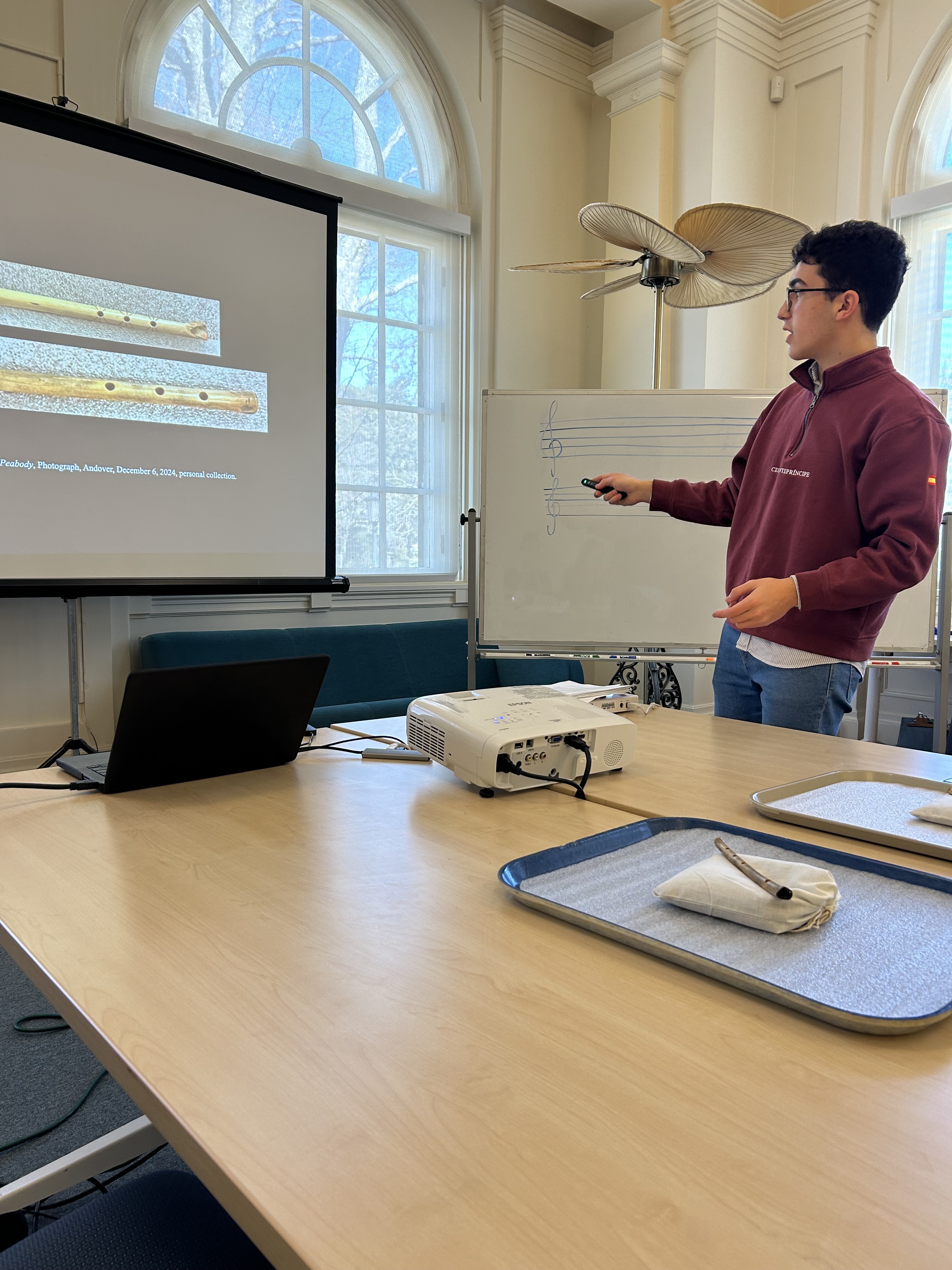
The work began with patient looking. The eagle bone flute—just under twenty centimeters—bears four clean finger-holes; the hawk bone flute is shorter, its stops conical and ringed by three tiny oblique grooves. My initial efforts left me frustrated—despite my solid musical background, I couldn’t answer any of my research questions. Guided by Indigenous scholars, I began to understand the silence and endless questions as a wise teacher. By combining archival materials with present-day Indigenous resources, chiefly from Jemez musician Marlon Magdalena, I built a relationship with the eagle bone flute and experienced the music as something much deeper than pure sound.

In his song “Eagle’s Blessings,” which I shared during my presentation to the Massachusetts Archaeological Society in April, Marlon brings the flute to life. When I first heard it, I was nearing the end of my research, which had been mostly historical and archival. I had tried to learn about other Indigenous music, but this performance tied everything together. Throughout the term, I feared profaning the cultural or religious significance of the eagle bone flute. I understood its sacredness, and as a religious person involved in interfaith activities, I recognize the importance of respecting religious artifacts.

Marlon’s explanation before he played brought everything into focus. He explained that eagle bones are sacred, held only by tribal members and used to lift prayers skyward. When he played, I felt how, through his breath, he gave life back to the eagle and honored her. Suddenly, the silence became understandable. Even though I could not draw solid scientific conclusions, I forged a connection I will never forget.

This project has awakened a passion for ethnomusicology that I am now exploring with the music department, under the guidance of Ms. Ángela Varo-Moreno, studying the presence of LGBTQ+ subcultures in techno music. I would like to end by thanking everyone at the Peabody, at Phillips Academy Andover, and at Pecos and Jemez Pueblos—and other Indigenous communities—who have safeguarded the knowledge that reached me and made this project possible. It has been a gift I will always keep in my heart.

Alberto presenting his final project at the Peabody, finishing up his independent study.

More Than Metal: What’s Really on a Coin?

Contributed by Patrick Zheng ‘28

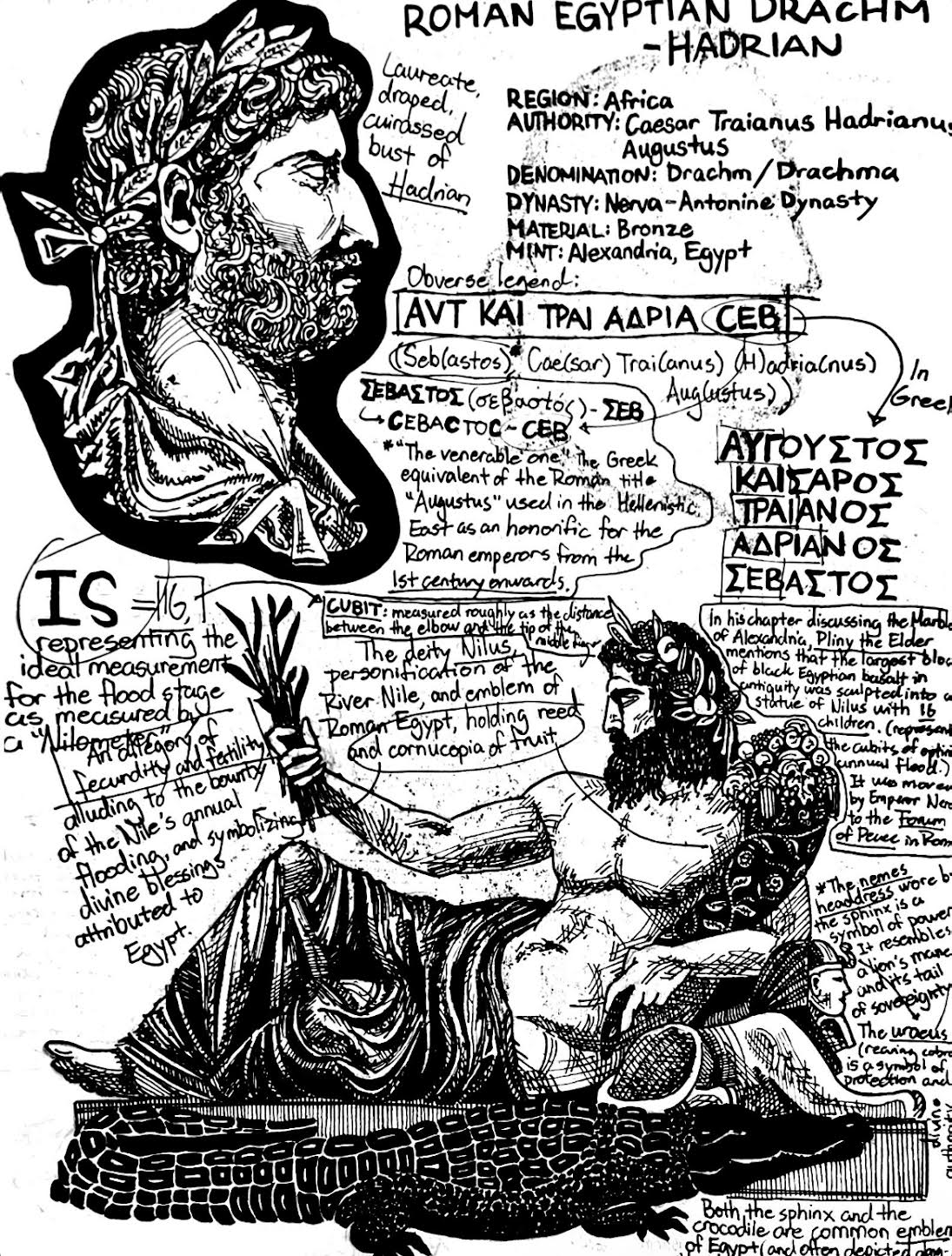
Every Wednesday, I come to the Peabody Institute to be in the company of pharaohs and emperors, not through books but from 2000-year-old coins held in the institute’s collections. I help to identify these coins and record observations into the Peabody’s catalogue system. I’m extremely fortunate to experience “living history” from these remnants of ancient Rome, Hellenistic Egypt, and the Byzantine world.

As the mass media of the ancient world, coins carried big messages. The images depicting rulers, gods, animals, or symbols were carefully chosen and deeply meaningful. Every coin has a story to tell about culture and politics. Together, they offer new perspectives on historical events that we thought we already understood.

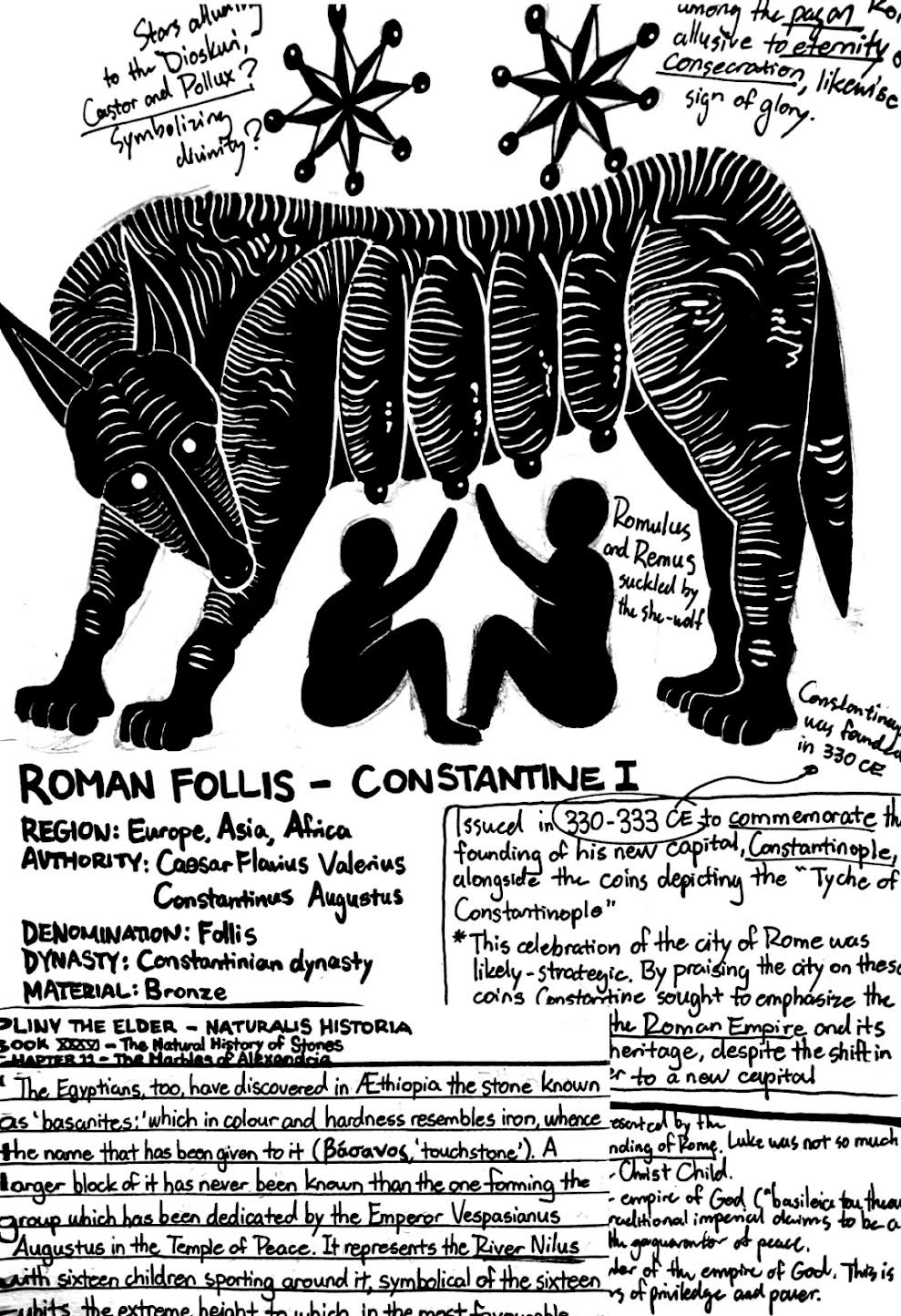
From my notes. Left: sketches and notes of a coin showing Rome’s foundation myth to commemorate Constantinople’s founding under Constantine (Rome reborn). Right: Roman coin minted in Egypt during Hadrian’s reign depicting the River Nile as a reclining deity.

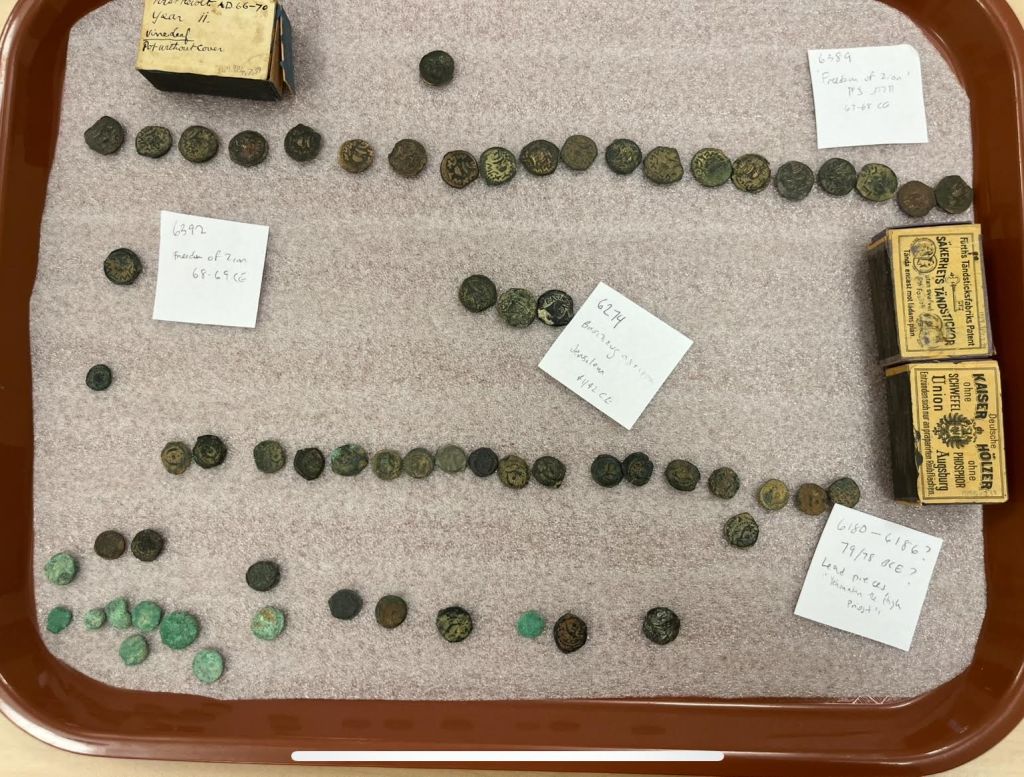
I first became involved in this research when I met Dr. Elena Dugan, who teaches Religion and Philosophy at Phillips Academy Andover, and was researching Jewish coins that dated back 2,000 years. These coins were struck for only four years, 66-70 CE, during which time, the Jewish population in modern-day Israel rebelled against their Roman occupiers. Long after their war against the Romans and their eventual defeat, their cry of freedom endured as inscriptions on these coins, surpassing even the Romans themselves. Dr. Dugan quite literally held the legacies of these men and women in her hands. How extraordinary is that!

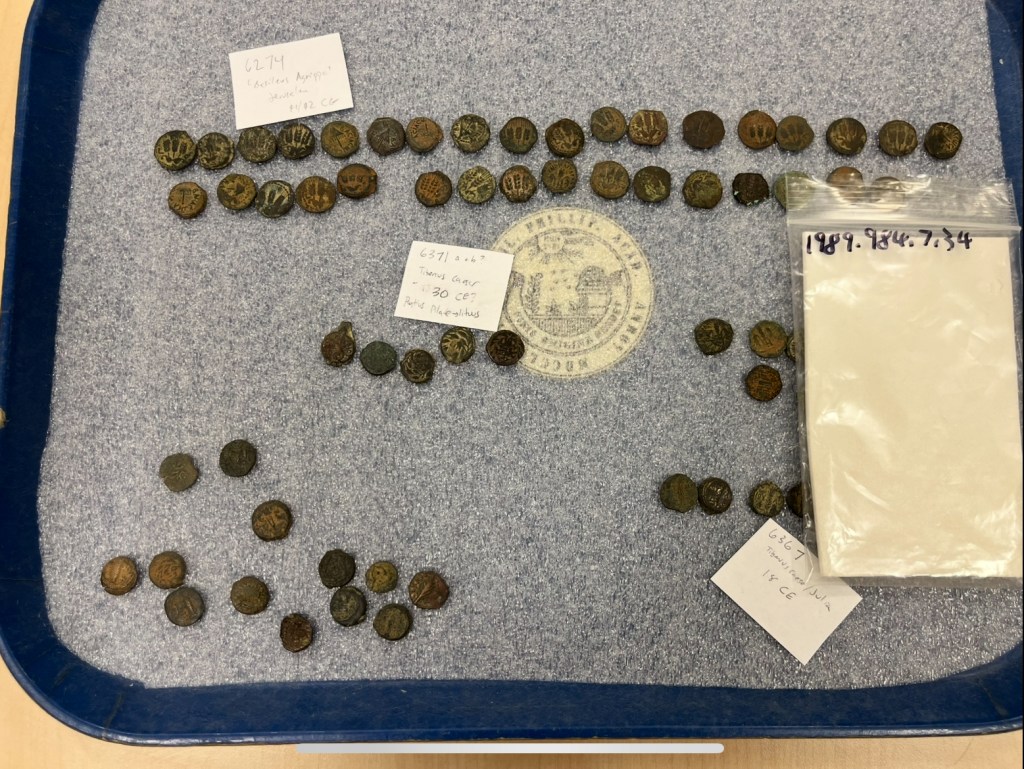
Top: Coins with inscriptions calling for the “Freedom of Zion,” along with coins minted during the times of King Herod Agrippa I and Yehonatan the High Priest. Bottom: Biblical coins of Pontius Pilate and Emperor Tiberius.

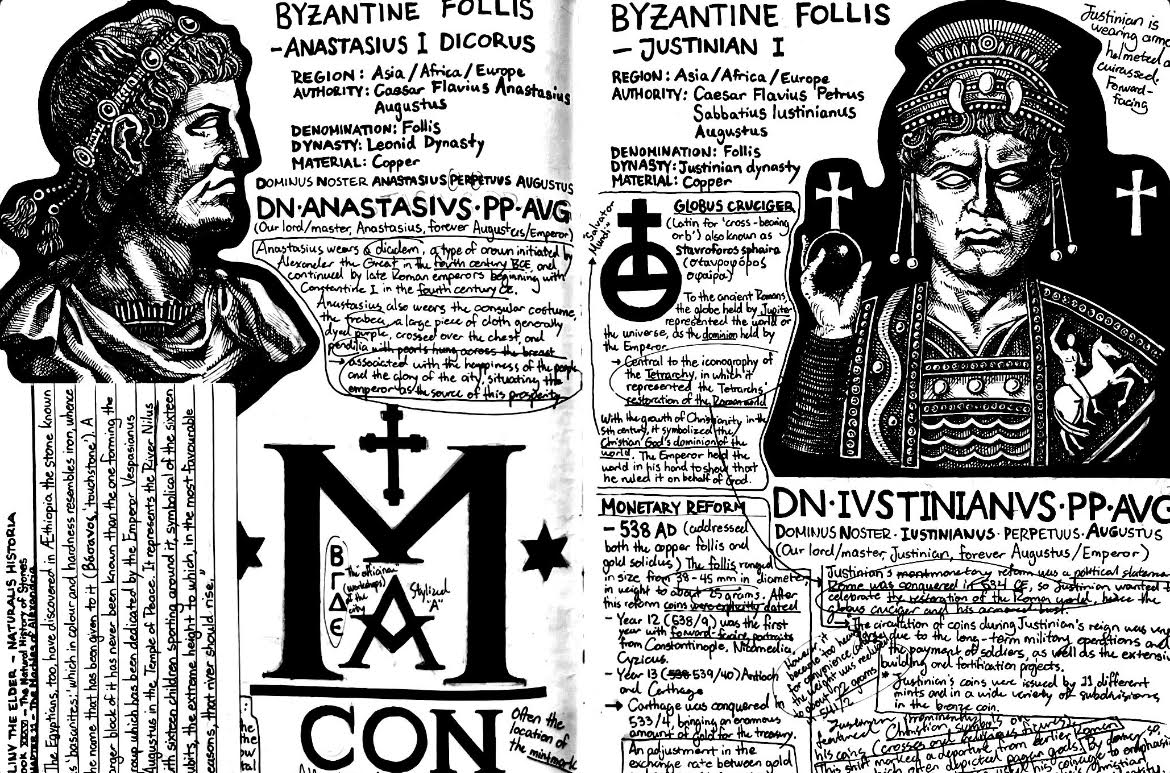
I would soon uncover such stories myself. Through Byzantine coins within the Peabody’s collections, I came to appreciate the story of Justinian, a Roman emperor bold enough to dream big. He dreamed of restoring the Roman Empire, which by his time was territorially less than half of its former glory. He dreamed of a reunified Mediterranean and the spread of Christianity. Fueled by determination, he led years of campaigns until the city of Rome was once again truly part of the empire.

But the dream didn’t last. Enemies in the East drew his attention away from Rome and the West, which was soon lost again. Any last hope was swept away by a devastating plague, which killed half of the Roman population (now every time I pick up one of Justinian’s coins, I feel an urge to wash my hands!). Rome’s wealth was drained, and Justinian lost his new territories as quickly as he gained them. In the end, he sadly died believing his dream had failed.

But it hadn’t. Though Justinian didn’t expand Rome’s borders, he redefined her identity. His image on coins, boldly facing his audience and clad in armor, was copied by every emperor who followed. He had inspired others to dream. Alongside his portrait appeared Christian symbols, marking Rome’s turn from her pagan past toward new ideals. Never again would she reach the heights Justinian had brought her to.

If all that remains of him and his dream are coins and a few lines in a textbook, then so be it. But let’s not forget them!

Left: Emperor Anastasius depicted in traditional imperial dress with a diadem and toga. Right: Depiction of Emperor Justinian facing the audience, fully in armor, and holding the globe and cross. While Anastasius followed strong traditions, Justinian was more than eager to distinguish himself.

This experience has strengthened my love for history. It has brought me closer to people in the distant past and their values. Their love of liberty. Their audacity to dream. These values stir a certain nostalgia in me, and suddenly, these people don’t feel so distant after all. Their worlds may have disappeared, but they are far from forgotten. It’s hard to believe that such an experience can come from objects that measure less than my pinky finger. But, after all, conveying messages is also a coin’s purpose, alongside economic ones. 

This journey has truly expanded my curiosity and built my understanding of history. I’m incredibly grateful to the Peabody Institute for not only allowing an inexperienced ninth grader to interact with these priceless artifacts but also for patiently teaching me the research process, providing the right tools, and encouraging me to share my story. 

What a highlight this has been as part of my school year! I’ll be sure to return on many more Wednesdays!

The Beginnings of the Andover Anthropological Society

Contributed by Isabel Djerejian ‘26

Last spring, I was new to Phillips Academy. I’d just arrived on campus, still figuring out where I fit in, still mapping the place out in my head. One thing that kept catching my eye was this mysterious building I passed every week on my way to the music department. It looked… important. But quiet. Tucked away. That building was the Peabody Institute.

It was mid-renovation then and closed to visitors, but every time I walked by, I’d find myself wondering what was inside. What kind of objects were hidden away behind those walls? What kind of people once used them? It sent me spiraling in the best way.

I started doing some research and realized that while the Peabody is this incredible institution with a deep collection of cultural material, it wasn’t very connected to student life. Almost hidden in plain sight. And that just felt like a missed opportunity. I wanted to find a way to change that.

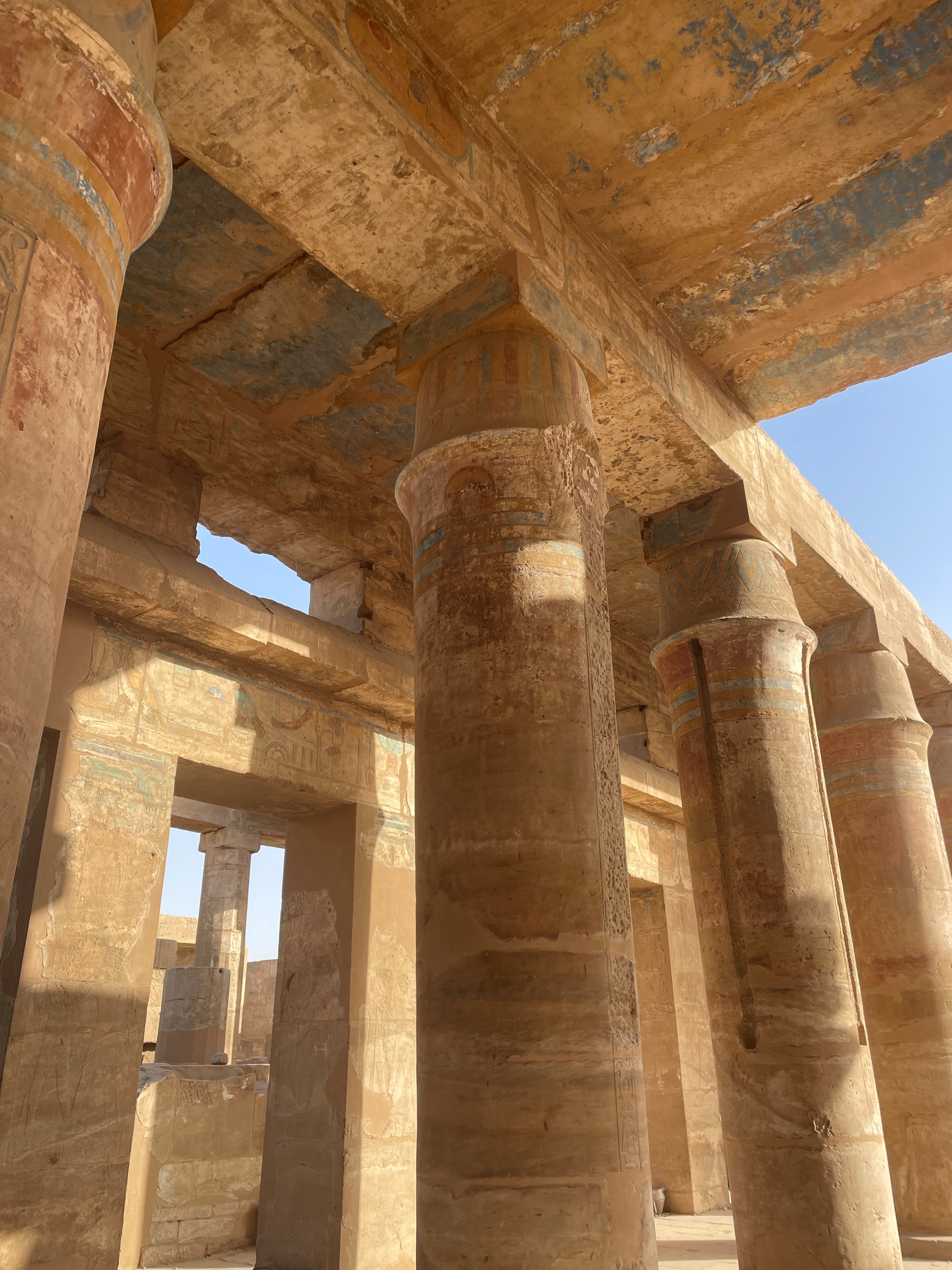
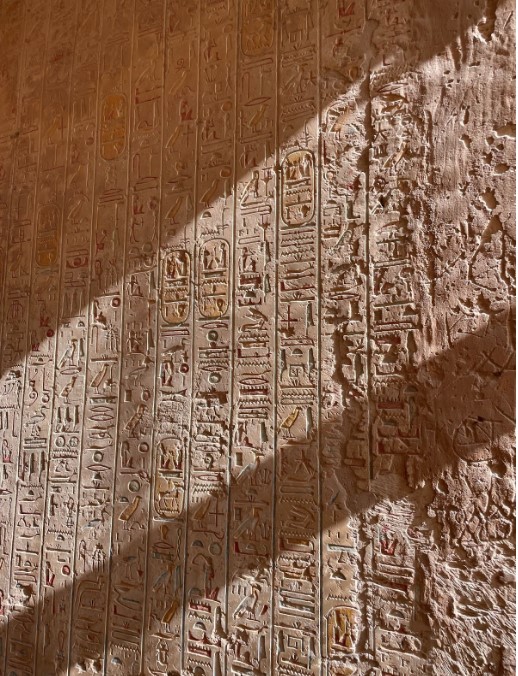
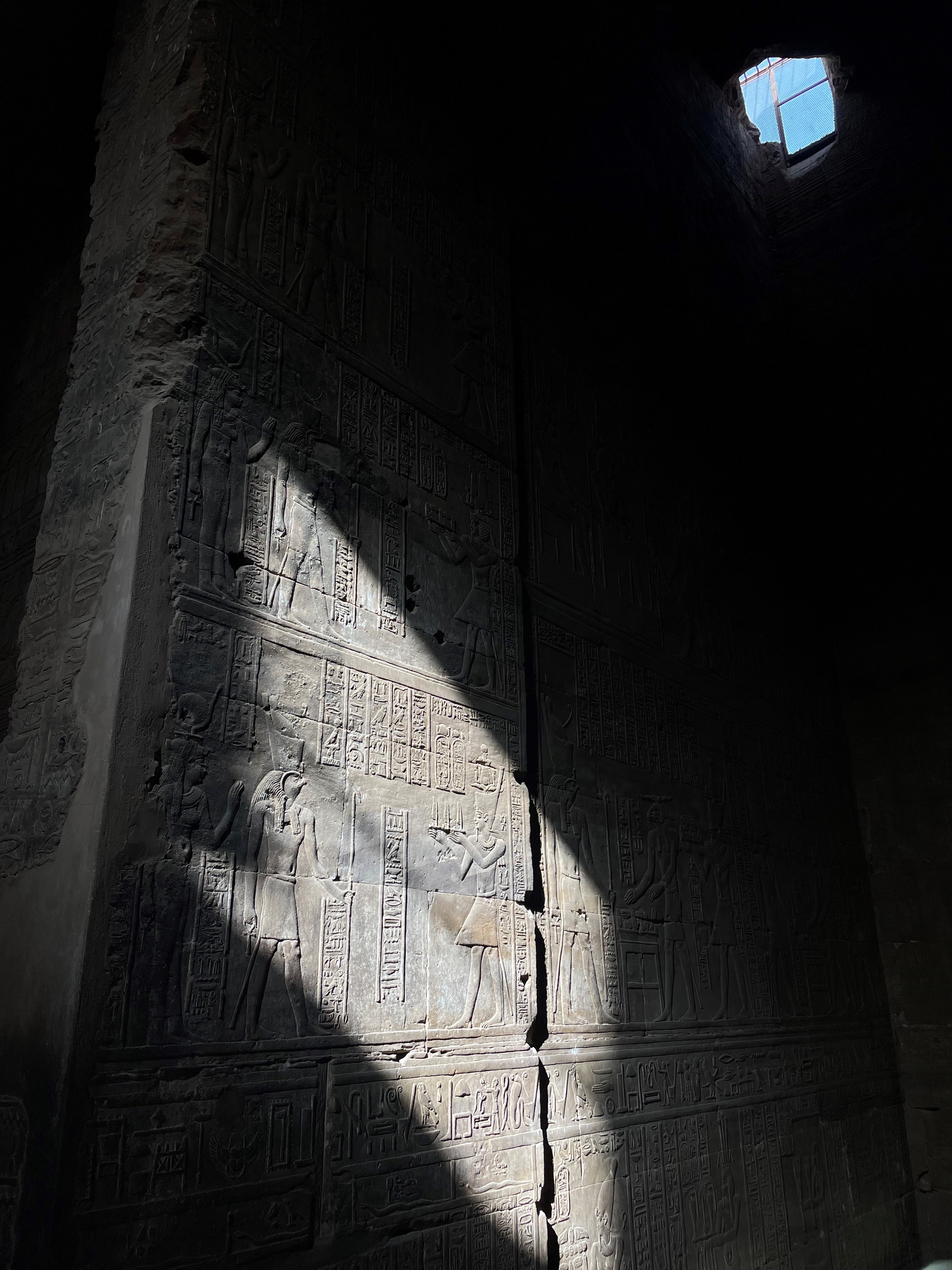
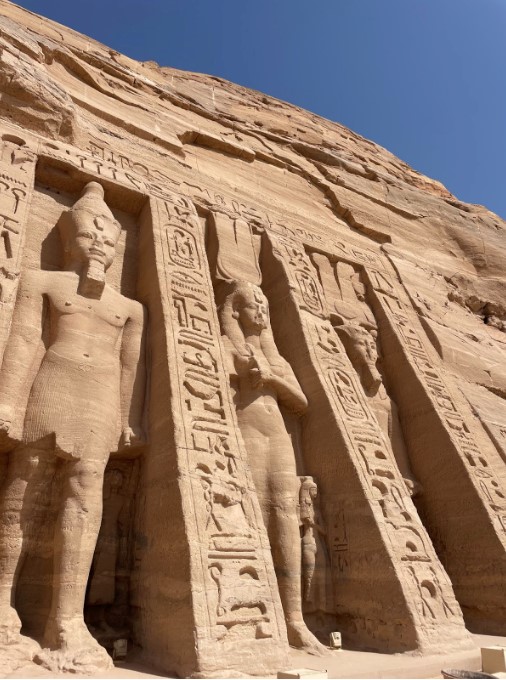
This idea took deeper root over the summer, especially after I visited Egypt. I’ve always been interested in anthropology, but that trip sparked something new in me: an obsession with archaeology. There’s something magical about holding, or even just seeing, an artifact that someone used hundreds of years ago. Imagining their life, their world, their hopes or rituals. In those moments, I feel connected to something bigger: a lineage of humans that came before and will come after. It feels like time folds in on itself.

So I reached out to the Peabody over the summer and asked if there was a way students could get more involved. We came up with the idea for a club, and when I returned to campus in the fall, I asked my friend Elliot Weir to help me lead it. That’s how the Andover Anthropological Society was born.

But the story doesn’t really start there. My fascination with culture and human behavior goes way back. I grew up in a family of nomads—the product of two people who seemed to be in constant motion. I’m an Armenian New Yorker, but I moved to Hong Kong when I was young, then to Miami, and spent years bouncing between Brazil, Europe, and the U.S. These days, my dad is based in Riyadh, so Saudi Arabia feels like another kind of home.

All this movement, this third culture existence, has taught me that “home” isn’t always a place. It’s a mindset, a perspective, a lens you carry with you. It’s made me deeply curious about how people live, how they think, and how history shapes identity. Whether it’s thinking about how Armenians process collective trauma, or how gender roles are shifting in Saudi Arabia, I’m drawn to the stories that sit under the surface. Anthropology, to me, is a way of making sense of it all.

And that’s what the Andover Anthropological Society is about. Yes, we work with artifacts. Yes, we meet weekly at the Peabody and dig into real collections and archival files. But more than anything, we’re trying to connect—to the past, to different worldviews, and to each other.

If you’re someone who finds joy in questioning things, in imagining the lives behind the objects, or in just getting a little lost in the mysteries of human culture, you’re always welcome. The Peabody may have looked quiet last spring, but it’s anything but.

Why some of our members joined:

“I decided to join the Andover Anthropological Society because studying anthropology yields a greater understanding of yourself and the world around you. In the same way that books can inform you on lives you’ve never lived, anthropology enables you to understand cultures you have never interacted with, providing perspective on your own culture and appreciation for others’.” – A.J. McQuide ‘26

“I am a junior [9th grader] from Miami, and I joined the Anthropological Society because I am interested in learning and understanding how human societies and cultures develop. I was inspired to join this club by my visit to my country-of-origin, Armenia. In Armenia, I traveled across the country visiting and seeing historical landmarks and ancient artifacts. This visit sparked a desire to understand what role these places and items played in my ancestors’ lives as well as other peoples’.” – Sebastian Djerejian ‘28

“I am an upper [11th grader] from North Andover. I knew that the Peabody was an amazing resource with many Native American artifacts that I had never seen before. I wanted to explore these collections through the Andover Anthropological Society.” – Elliot Weir ‘26

“In middle school we had a guest speaker come in to talk about how humans developed technologically, and to me that was such an interesting idea. How did we discover so much of what we know? So, for a long time, I have been interested in anthropology but hadn’t had any spaces to pursue it, which is why I was happy to join the anthropology club here at Andover.” – David Frahm ‘26

“I am a new upper [11th grader] from Verona, Italy. I joined the Anthropology club because I wanted to develop skills to be able to identify artifacts more efficiently. I’m especially interested in exploring how specific objects were used differently across the United States, and what they can reveal about the daily lives of the people who made and used them.” – Amelie Piergentili ‘26

“I am an upper [11th grader] from London, UK, and I am thrilled to say that I am a part of Andover Anthropology club. I frequently looked at the Peabody Museum as an incredible resource that I longed to explore – Anthropological Society gave this to me.” – Isabella Mazzi ‘26

“I am an upper from London, England and was always interested in History and discovering how we got to where we are now. I love connecting with different cultures and meeting new people interested in the same things I am so the Anthropology club offered an incredible way to do just this.” – Katerina Browder ‘26

Non Sibi Spirit at the Core of the Peabody Institute Lessons

A Dialogue Between Director for Advancement Initiatives, Jennifer Pieroni, and former Peabody Institute Work Duty student and current Peabody Advisory Board member, Ben William Burke ’11.

Archaeology isn’t just about uncovering and studying ancient items—at Andover, it’s about shaping a more informed, ethical, and engaged society. By learning archaeology, Andover students gain experiences to understand the world better, think critically, and contribute meaningfully to the future by better understanding the past.

At a recent Peabody Institute meeting, I met Ben William Burke ’11, whose enthusiasm for the Peabody was inspiring. As a new member of the Andover community, I wanted to understand why the Peabody had left such an indelible mark on Ben and why he continues to support it today.

By email, Ben shared: “As a work duty student at The Peabody, I received unparalleled access to its extensive collection and cultural immersion programs. These experiences brought me face to face with — and taught me the value of — perspectives different from mine. In those moments, I was challenged to understand before correcting, to empathize before judging, and to build on the past in a way that respects it.

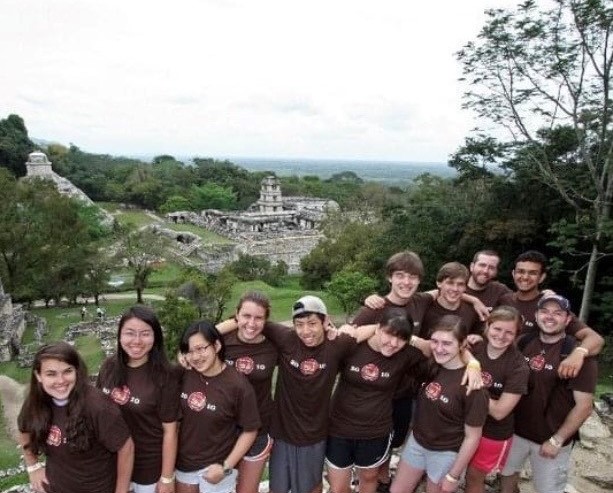
Ben Burke ’11 (Back row, third from the right) on the BALAM student trip. This was a multi-week cultural immersion and archaeological adventure through the greater Yucatán Peninsula sponsored by the Peabody Institute.

Today’s Andover students gain the transformational learning opportunity of being a part of an organization that leads in the field of repatriation and reflects Non Sibi by teaching students that archaeology is not just about personal discovery but about responsibility: to the past, to descendant communities, and future generations. Through hands-on study, students engage in meaningful, ethical work prioritizing respect over self-interest.

Ben noted, “There is not an avenue in my life that isn’t positively affected by The Peabody’s lessons in empathy and respect. I support The Peabody because I understand the value in learning to value other’s perspectives – especially when they are different from my own.”

Supporting the Peabody means investing in education that shapes responsible scholars and professionals. By supporting the Peabody with an annual gift, you can help elevate a place where teaching and learning are deeply connected to respect, collaboration, and cultural preservation. Join us in ensuring that the study of archaeology serves our Andover students and also society as a whole.

Leather, Buttons, and Brick…Oh My! 2024 ‘Dig This!’ excavations go off without a hitch!

Contributed by Katie Lincoln

As Phillips Academy’s Lower School Institute (LSI) Dig This! course comes to the end of its seventh field season, students and instructors are so excited to share stories of the many artifacts they discovered at the school’s very own excavation site. At the start of the 2024 season, students were introduced to the story of the Mansion House, an eighteenth century home which belonged to the founder of the academy, and now lies buried underneath the lawn of the West Quad on Phillips Academy campus. The Mansion House stood on the property for 105 years before being burned down through an act of arson, which was never solved or prosecuted. The remains of the house laid just centimeters underneath the surface of the quad for a little over 100 years before LSI’s summer session course began the long process of meticulously digging it up.

After being introduced to the legacy of the Mansion House and its past excavations, the 2024 archaeology crew set out to build upon this research by investigating parts of the site which have never been previously tested. Specifically, six teams were each assigned a 1 X 1 meter unit and asked to investigate a given region of the West Quad, whether it be just outside of the Mansion House walls, in the area suspected to hold a nineteenth century privy, or the very place where a neighboring nineteenth century printing house was known to have stood. Equipped with shovels, trowels, and screens, the six teams got to work and all quickly began to gather archaeological data.

While no team this summer unearthed ash layers relating to the infamous 1887 fire, which resulted in the destruction of the Mansion House, several groups discovered an abundance of charcoal and burned brick. Additionally, the two groups assigned to dig in the hypothesized privy, EU 2404+2405, uncovered a plethora of cultural materials, including a button, many ceramic shards, and faunal bones. Specifically, a small black glass button, which was unearthed in EU2405, became of great interest to the students. Because black glass beads were only in fashion during the ten-year period when England’s Queen Victoria was in mourning, the button students found can be dated to that decade between 1861 to 1870. How exciting!

Students stationed in the area believed to be where the nineteenth century printing house once stood uncovered a considerable amount of leather. It is unknown if this leather came from shoes or book bindings, however the find itself is incredible given how well the material preserved over time!

Despite the fact that the 2024 Dig This! crew did not uncover any features relating to the Mansion House, privy, or printing house, students still reveled in the amount of cultural material found and were very excited to show it off at their LSI student exhibition. Students specifically enjoyed the opportunity to set up an archaeology simulation, where they explained the process of digging and let others take a stab at excavating exciting treasures in the form of candy!

Cheers to another amazing summer of learning in the dirt!