I know what I did this summer

Contributed by Kyra Smith and Cyrus Marion

Hi my name is Kyra Smith and I was one of the curatorial assistants at the Peabody this summer! I’m a recent archaeology master’s graduate from Boston University where I focused on Indigenous archaeologies, food sovereignty, and the archaeology of the South Pacific Islands. Having previously worked in the archaeology department of another museum in undergrad, I was thrilled to apply for this position as a curatorial assistant, especially at an institution that is so dedicated to NAGPRA. I was so invested in the position I had my family ship me my sister’s 1998 Toyota Camry from Washington State- which in the state of Massachusetts counts as an Antique Vehicle! 

Working at the Peabody over these last ten weeks has been an exercise in flexibility, learning as we go along, and exposure to things we’ve never seen or interacted with before. There are so many things I could write about, but the story I want to share as my time here comes to an end is how the Peabody got its own pet mammoth.

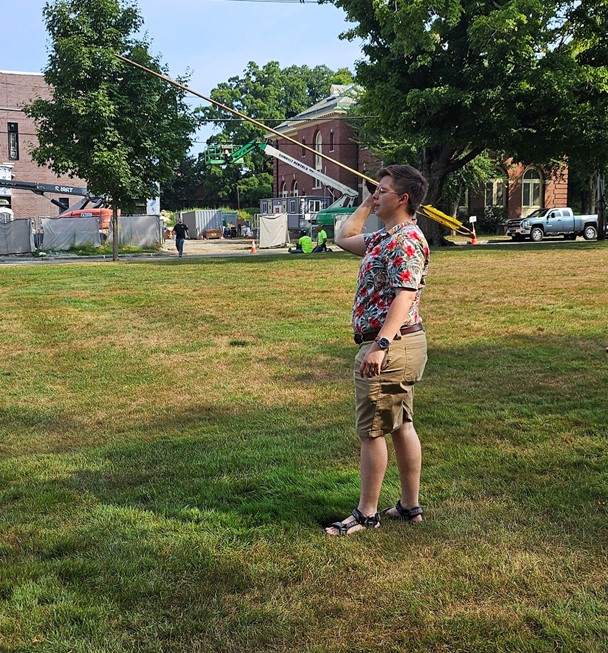
On a particularly hot and humid Friday, I finally got to use an atlatl for the first time. Ever since undergrad I have heard professors and archaeologists talk about atlatls, and even how they used to take students to try throwing them in previous years. Ever since then I have been biding my time until the opportunity arose- and oh was it worth the wait.

John, Cyrus, and I went out onto the Vista bright and early before it got too hot, and John took us through the basics. If you have ever used one of those plastic arms to play fetch with your dog- it’s nothing like that at all, which I learned very quickly. I imagine it was quite the sight for the construction workers on break in the shade of a nearby tree to see us attempting to throw the arrows taller than we were with varying degrees of success. After Cyrus and I (sort of) got the hang of it we were going to do target practice at the international standard target, but sadly that had to wait as the aforementioned construction workers were still under that tree which was too close to the target for comfort.
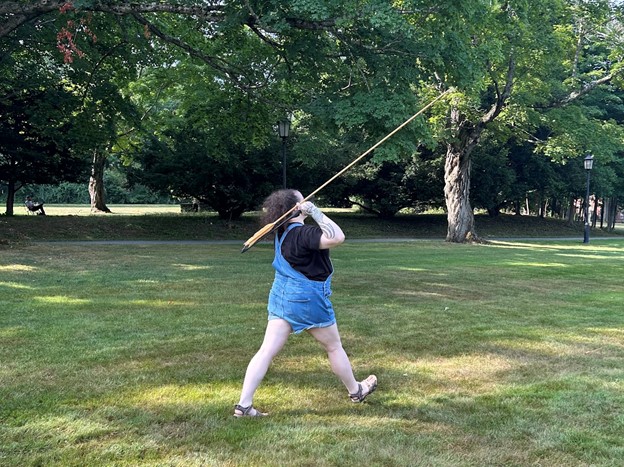
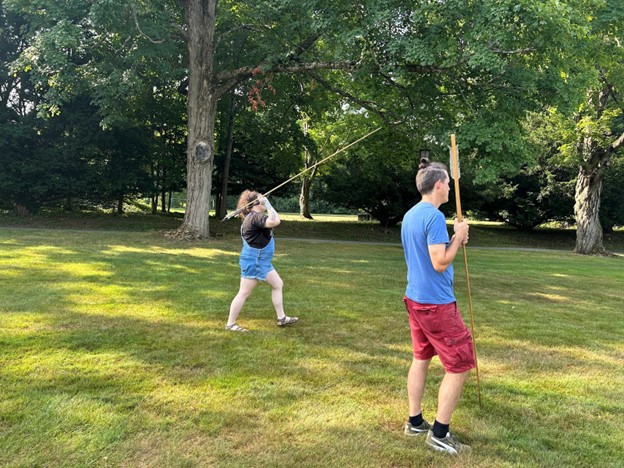
So, we went back inside to rest our arms and cool down, and by then an idea had begun to form. One that was inspired by our conversations about whether we were successful hunters of our theoretical mammoth/mastodon. That idea would have to wait because about an hour later we went back out to try aiming the arrows instead of attempting to throw them as far as humanly possible. It is much easier to attempt to throw them as far as humanly possible than it is to hit a large, completely still target. Still, Cyrus and I were able to land a couple hits each on the actual target and not into the bush next to it, and we called that a win. We may never know if we were skilled enough at throwing the atlatl to take on a mammoth, so instead I made a mammoth for the museum.

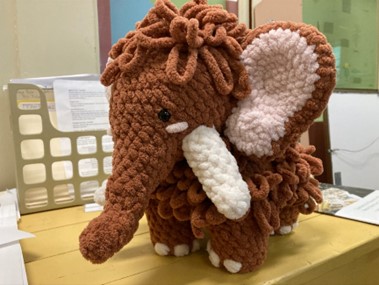
In my free time, when I’m not at the Peabody, I learned how to crochet amigurumi, which is a Japanese name for a style of stuffed crochet animals. That weekend after we threw the atlatls, I found a pattern online and spent some time crocheting a mammoth to be a mascot and companion at the museum. And thus, Josie was born! She was named by Marla, and now lives at the Peabody, where Marla promises she will never be used as target practice when throwing atlatls. For anyone else interested in crocheting or amigurumi, I got the pattern for Josie from CrochetGrove on Etsy. 
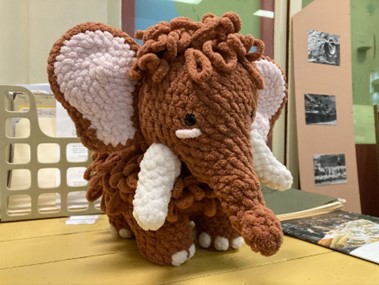
Josie also represents one of my favorite aspects of working in a museum, as they are fundamentally institutions created for the purpose of preserving and storing information, things, and stories for perpetuity, there will always be a record of my impact whether it’s the work I did, the things I made, or the stuffed mammoths I created. Sure, the things I’m doing may not be monumental, but they are fundamental things that have left a trail of my action on parts of the museum like the catalog, or the new housing for artifacts with my initials on it, and the drawers in the collections storage where Cyrus and I curated and displayed artifacts from all over the world so that the museum and its staff can better tell the stories of the materials they care for. It’s a reminder of how much the little things mean in the greater scheme of things. 

*******************************************

As Kyra aptly said in their post above, the Peabody Institute provided plenty of opportunities to expand our creative and intellectual spirit. As a Historical Archaeology graduate student at UMass Boston, I had minor collections experience and applied to the summer curatorial assistant position to undergo formal museum collections training. Having admired the Peabody Institute’s commitment to NAGPRA and tTribal relations for years, I was eager to witness the processes and procedures that go into the day-to-day work. However, what I was not expecting was the range of creations and artifacts I would be interacting with. My archaeological background is rooted in the Northeast United States and focuses on environmental analysis, so my mind was blown when one of our first tasks was rehousing ancient botanical remains from Tehuacán Valley, Mexico. Coming face-to-face to some of the world’s oldest domesticated maize was an experience I will never forget.
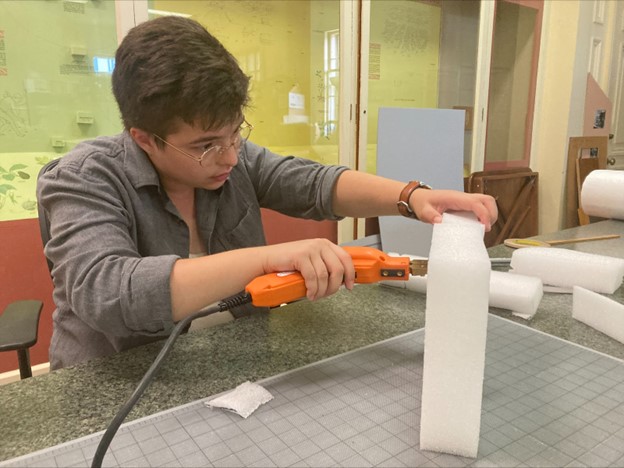
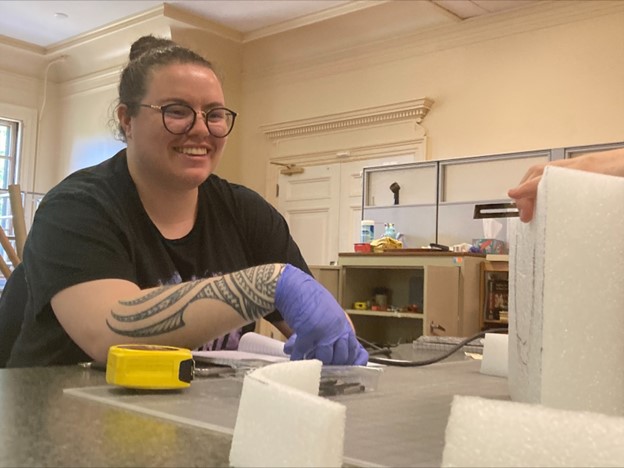
Kyra and I spent a lot of time with ceramics, lithics, and textiles from regions we were pretty unfamiliar with. Despite our lack of regional understanding, the Peabody staff always provided context and demonstrated deep respect for all creations. As we created mounts for modern Guatemalan and ancient Peruvian textiles we learned their patterns and language; as I rehoused lithics I would consider the generational knowledge and studied craftsmanship it would take to form them. Creating spaces to house and display archaeological and ethnographic creations ranging from the Lucy Foster household in Andover to Meso-America to Paleolithic Europe was an honor and I am proud to have contributed to the updated collection spaces and stories the Peabody staff can tell.

The Peabody Institute has a very storied past that was illuminated through organizing both the library and Eugene Winter’s archive. As it was founded in 1901 with contributions from many different kinds of archaeologists, the library seems to contain the entire history and complicated legacy of North American archaeology. In addition to the library, Eugene Winter, Honorary Curator and lifelong contributor to the Peabody, had left behind an archive after his passing. Kyra and I spent some time exploring his legacy through the resources, photographs, and ephemera he had designated important enough to keep. Interacting with both the collections, library and archives created an meta-institutional feedback loop as a reminder that working in archaeology requires positionality, empathy, and acceptance of “not-knowing.” We will never be able to alter the decisions made in the past, but we can always alter our perspectives in the present and contribute to a future that centers people and not only their “things.”

As Kyra noted, working at the Peabody for the past ten weeks might not have been monumental to its legacy, but the work that has been completed by the longer-term staff is monumental to the field. The Peabody staff have taught me fundamental collection management skills that are coated in careful consideration, empathy, and a desire to create a better future that I am extremely grateful to inherit.
Flexible Restructuring

Contributed by Nick Andrusin

The Peabody has taught many lessons over the years, so we have a lot of teaching instruments and old plans laying around. When we get contacted by an instructor here at Phillips Academy, we dive into those piles to see what can be used and how! This is what happened very recently with our Trade Connections lesson.

The opportunity arrived when history fellow Anna Green asked us to do a few lessons for her history 100B class. She was looking for a lesson to fit into her student’s final project, a presentation on various Native American cultures from South to North America. We sat down with her one day and sketched out what this lesson could look like and what we could incorporate.

We have a previously existing lesson known as Trade Connections that we last taught in December 2022. This lesson features objects from 4 different regions of the Americas (Mesoamerica, Andes, American Southwest and American Southeast) and discuss how these societies traded and interacted with each other over the millennia. So, for this new version we focused on 8 objects that represent the areas for the assignment. In addition, we made sure that both ancient and modern examples from these cultures were included, showing that there are forms of continuation with these Indigenous groups.

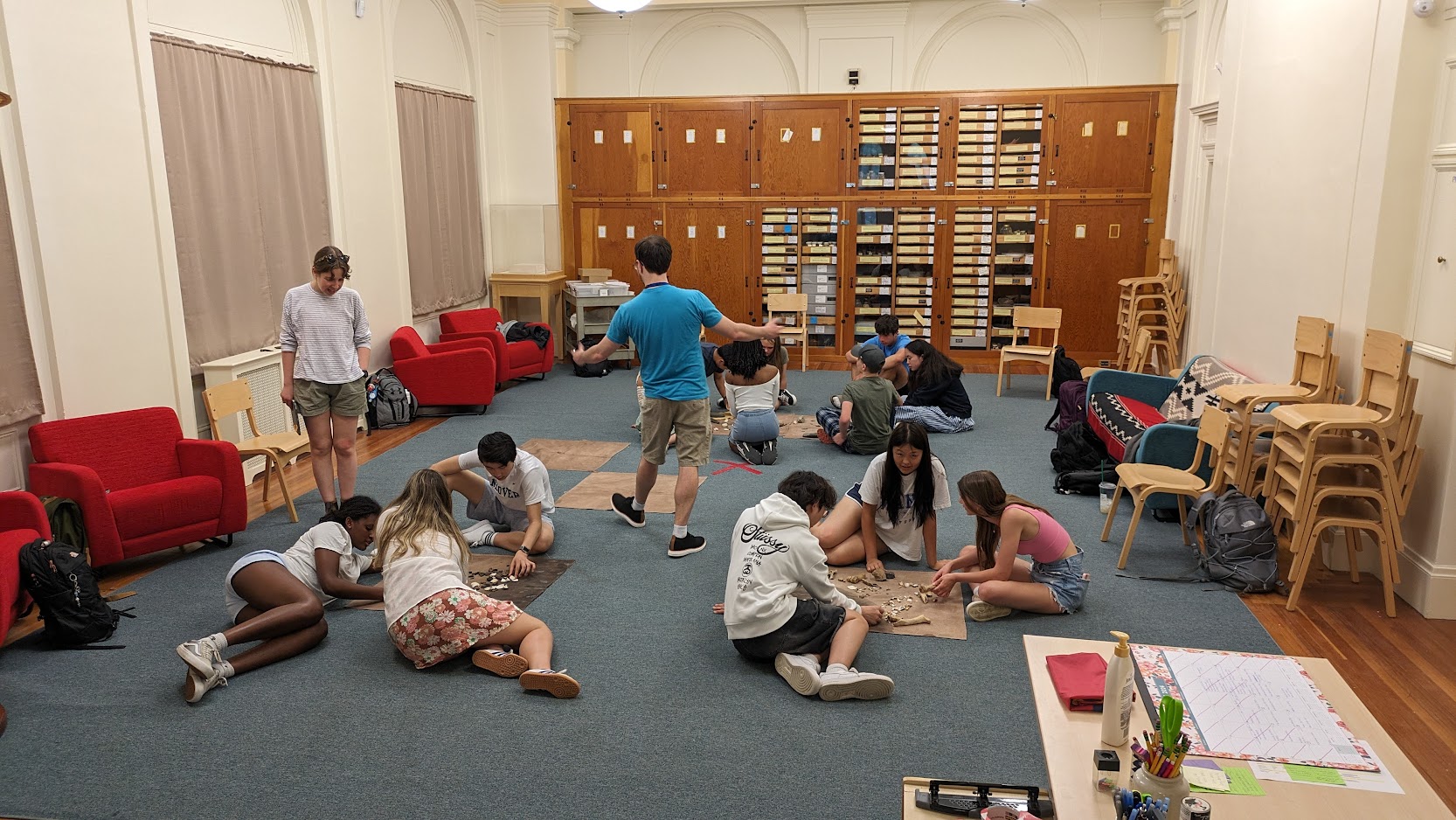
But we didn’t stop at just substitutions of objects. We wanted students to practice basic object interaction so they could approach looking at artifacts in a way that they may not have done before. To do that we broke out the tried-and-true Tarps exercise, which basically give them a crash course in item handling and simple archaeology. Here we set up a mock dig site complete with objects used for different purposes (pottery making, cooking, etc.) and have the students use there critical thinking skills to evaluate what the objects are and areas are used for based on how they found them (kitchen, stone tool workshop, etc.).

(shoulda’ been a conductor…)

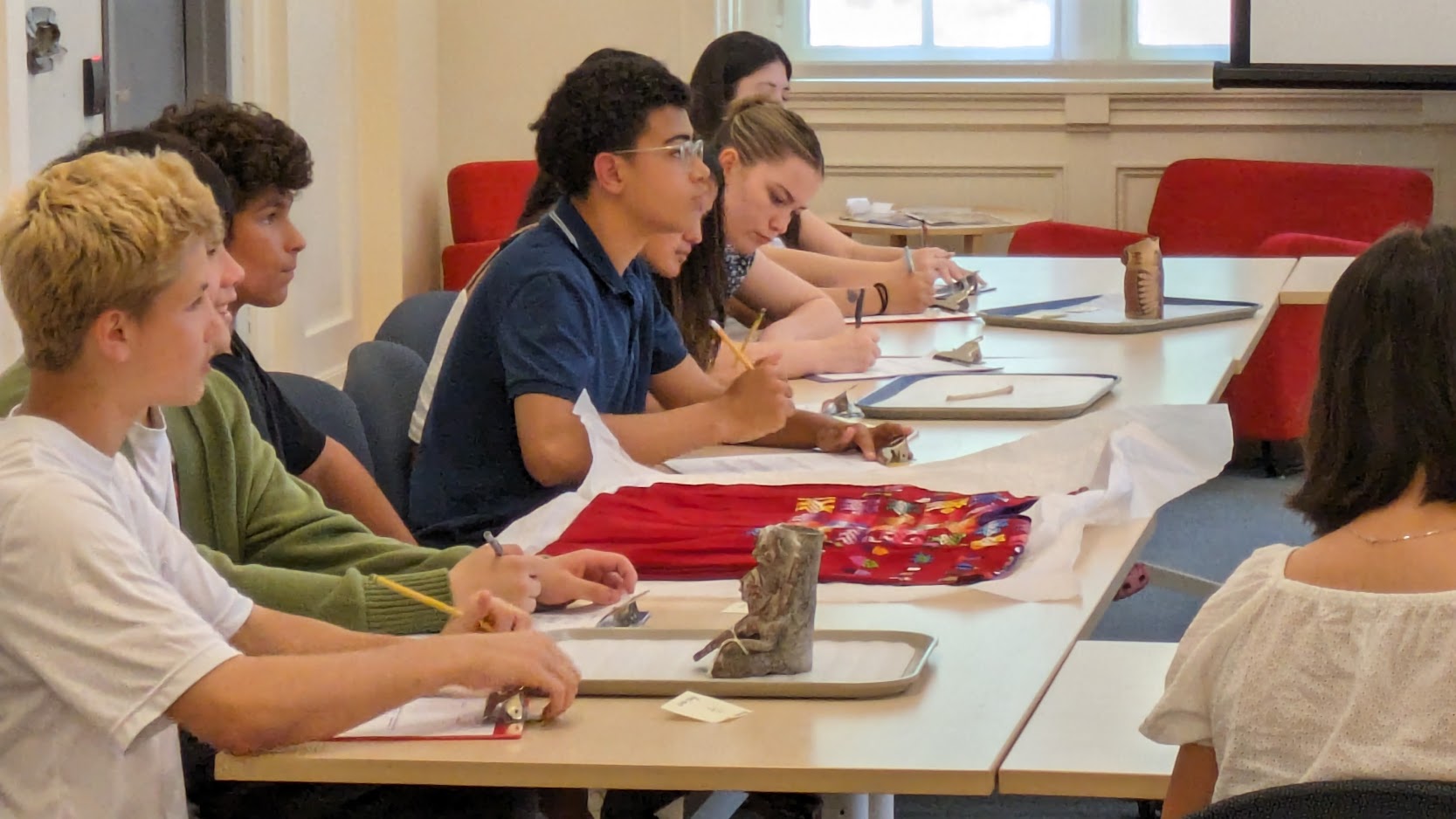
After completing the Tarps exercise, students apply their newly acquired knowledge and skills to study of the objects from Mesoamerica, the Andes, American Southwest and American Southeast. We asked them to write down their observations of the object, what are its potential uses, what does it tell you about the culture, was it made by ancient or modern individuals, etc. The students then use this knowledge to pick and research an object on their own for their final project.

It was great revamping an older lesson and making it available for today’s classes at Phillips Academy!

What’s that in the back of the closet…

Contributed by Nick Andrusin

Sometimes you find a neat thing while cleaning. Everyone has experienced this in one form or another. A missing phone charger, an old book, a hat you haven’t seen in months, etc. This happens at Phillips Academy too, but instead of an old DVD or a lost sweater…it’s an entire archeological collection.

In early 2023 Peabody Institute became the caretaker for an old collection know as the PA Classical Collection, formerly stored by the campus facilities office along with paintings, furniture, and china. It includes art and antiquities from in and around the Mediterranean region, dating from the late Bronze Age to the modern day, including items like ancient Greek pottery, Roman glassware, Late Egyptian masks, and coins from the Islamic Caliphate. Phillips Academy asked the Peabody Institute if we could house and look after the collection.

(They all arrived in boxes like this one)

We believe the collection came to the Academy sometime in the early 1940s, as there were some photographs and labels from that time, and indications there had been an exhibition at the Addison Gallery of American Art. It also seems like the collection went into storage sometime in the 1980s. Meaning this material had not seen the light of day in around 40 years. These are all best guesses, as there was a very short paper trail associated with the collection. Parts of its provenance are unknown.

With the help of a few volunteers and students, we spent time in 2023 working with the material. Unpacking items one at a time, photographing each item, and assigning catalog numbers. Each item was originally wrapped in bubble wrap and tissue paper(!) so we upgraded storage to modern museum standards (well, as best we could do while the building was under construction).

(Much better than bubble wrap and duct tape older than me!)

Once the collection was better documented and houses, we wanted to know exactly what we had. While the staff here is very knowledgeable, ancient antiquities are a bit outside our wheelhouse   an expert classic world art and antiquities, was invited to provide basic identification and dates for each item. Most of the collection was authentic to our surprise, with only a few reproductions.

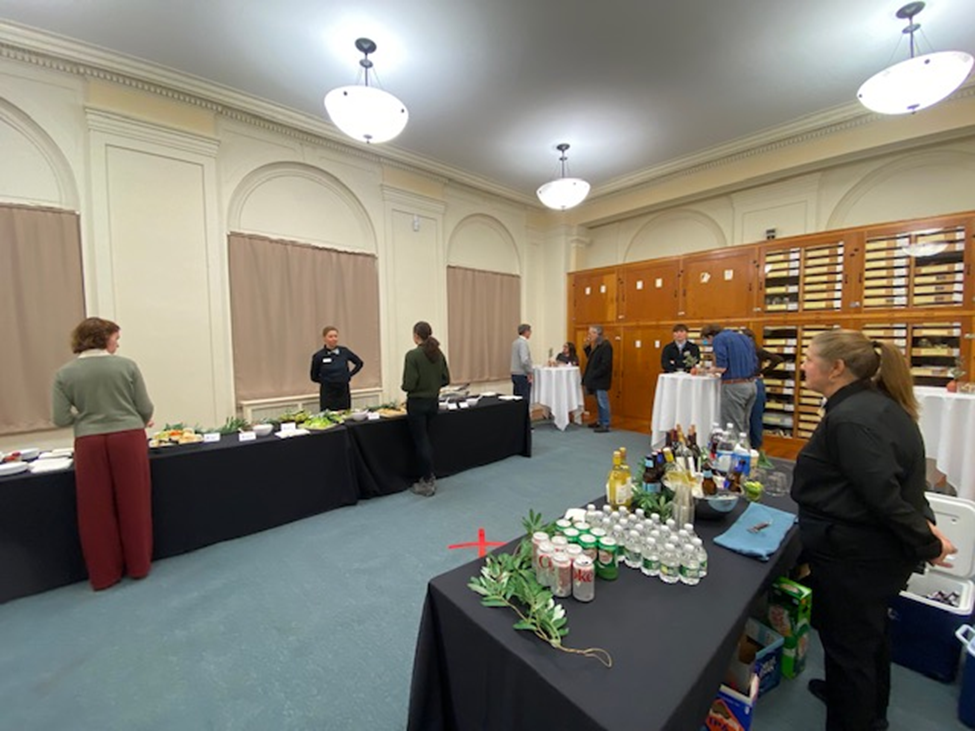
So, we had all these items roughly identified, and properly stored, now what? Well, naturally we threw a party. The building had recently reopened after construction had (mostly) finished and we used the Hornblower Galley to host an open house. Mediterranean food, and exhibit labels, and the campus community helped us have a grand old evening showing off the new/old collection.

(that’s me in the gray!)

The Peabody Institute is now making the PA Classical Collection available for use in classes. While the Peabody has no specific lessons plans associated with this collection, our hope is for teachers to incorporate items they are interested in into their existing classes, be it art, language, history, etc. We have already had some success in bringing items to Latin classes! It’s nice that a collection once shown at PA is about to rejoin the community, adding historical context and facilitating learning for a whole new generation of students. This whole blog isn’t just about the collection though, it’s really a cautionary tale about the importance of deep cleaning, you never know what might be back there!

Peabody Volunteer Spotlight: Meet Richard

Contributed by Richard Davis

Almost five years ago, I began volunteering at the Peabody Institute. I remember speaking with Peabody Curator of Collections, Marla Taylor, one evening after an evening presentation there and, as they say, the rest is history. In my time there, I think I’ve seen every possible iteration of projectile point imaginable – and there have been many – but what resonates most for me are the stories behind almost every object I’ve handled.

The museum has an important collection of approximately 600,000 objects essentially from North, Central, and South America. It is unlikely that I’ll get to see or work with every one. So far, I have helped catalog 12,000 year old bones from a cave in Peru where South American agriculture is believed to have started, reshelved a couple of dozen hominid skull casts, been taught the rudiments of differentiating mere stones from artifacts that were used for a myriad of tasks, and more.

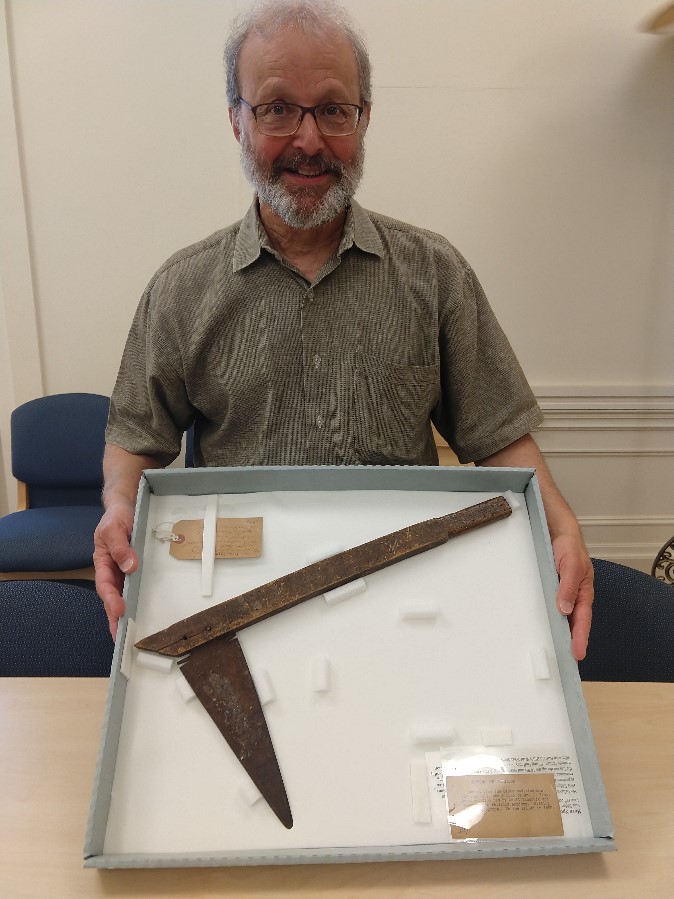
How I ended up there is a longer story, but on one of several tours, a tomahawk that was found after the Battle of Little Big Horn was shown to me. It was made from a table leg and a piece of metal from another object that was pounded into its newer, more lethal form. My son thought that was pretty compelling and asked for a photo of me with that object – the museum and I willingly complied.

Peabody Volunteer, Richard, with a tomahawk from the Battle of Little Big Horn.

I recently was examining an object that I couldn’t identify – as with many things my neophyte status should suggest – and I asked my ‘boss’ what it might be. You need to understand that the folks at the museum have seen and handled many such objects, so when they get excited by one, I figure it has some particular traction. Marla said – “Oh – that’s really cool,” so I paid close attention.

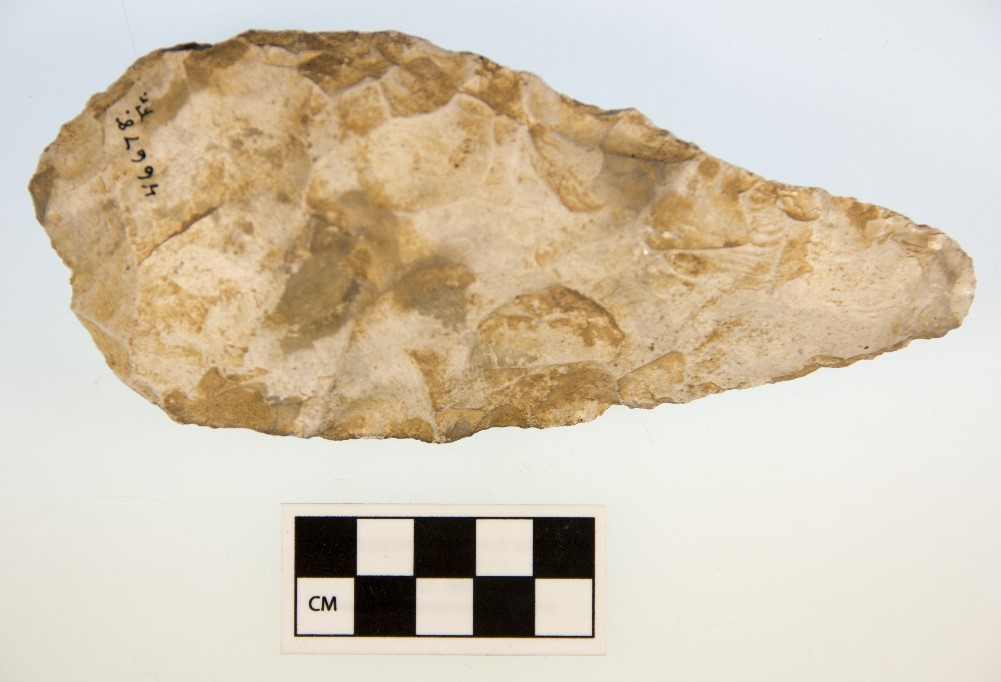
She said that it was made of flint – it was both very fine grained and smooth, except for some obvious flakes that had seemed to have been worked by somebody – something. Further, she said she knew that it came from a particular region in France and proceeded to pull up a Google search that clearly matched the object I held – a stone hand axe. So far, so good.

Next to the photo and a map were the characters ‘1MYA’ – which, I had to ask about. They, of course, meant 1 Million Years Ago. So – in my hand, I held a hand axe from France that was picked up, engineered, and used by somebody, something about one million years ago!

A stone hand axe from France, circa 1 Million Years Ago.

I went home and found myself puzzling over the object and its age. I can’t keep straight Homo sapiens, Australopithecus, Neanderthal, or any of those beings and ages, but I felt pretty sure that Homo sapiens didn’t go back that far. And after e-mailing Marla the next day, I was assured that indeed, it wasn’t of Homo sapiens origin – it was Home erectus – dating back to that 1MYA descriptor.

So – in short, I’ve had the privilege – for it is that – of holding an object, made by an ancient being for whatever purpose he or she felt necessary. I’m assuming that they weren’t thinking that it would be cool if it ended up in museum someday. They were using it to be sure they ate that night and survived long enough, so that we H. sapiens would have a go in their future.

So – long story short – it’s pretty much not only educational and worthwhile, but lots of fun volunteering at the Peabody.

After five years, I continue to enjoy and feel productive with my time at the Peabody – enmeshed with interesting objects with compelling stories, but more importantly with an amazing group of staff, colleagues, and friends. To a one, they are intelligent, patient (no job need be done in haste or unsafely), generous in both time and knowledge, and tolerant of my quirky humor and often bad puns. It doesn’t get any better.

Beyond Work Duty

Contributed by Peabody Student Volunteer, Anthony Chung Yin Woo

In the fall term of tenth grade, I first joined the Peabody as a work duty student before returning as a student volunteer during my upper senior year. Working at the Peabody has given me an in depth behind the scenes look into running a museum, exposing me to the challenges in caring for a collection. When participating in preparation works for the building renovation project last winter, I learned about some of the technical complexities that museum workers have to go through in order to responsibly safeguard the collection. Having had the great opportunity to attend the Peabody Board of Advisors meeting in the fall as a student representative, I was also exposed to some of the administrative complexities behind museum work.

A complete revamp of the basement area meant that we had to come up with creative solutions when it came to temporarily rehousing the collection within museum premises. Armed with a tape measure and a rough floor plan, we navigated all protruding columns and bulky built in radiators in the southern first floor gallery to mark up the approximate location for a separated temporary storage space with individual climate monitoring, while maintaining the required three foot hallway for access to the fire exit located at the back of the building. Additionally, previously underutilized spaces had to be optimized to fit in more durable, weather resistant objects, allowing me to foray into the expansive attic as I removed sawhorses and large glass tubes from the basement.

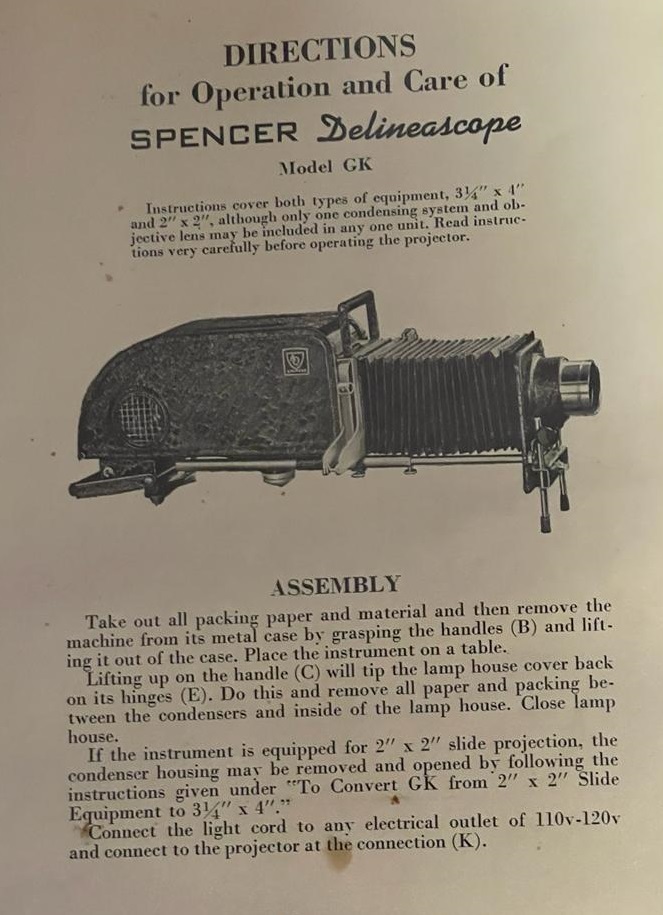
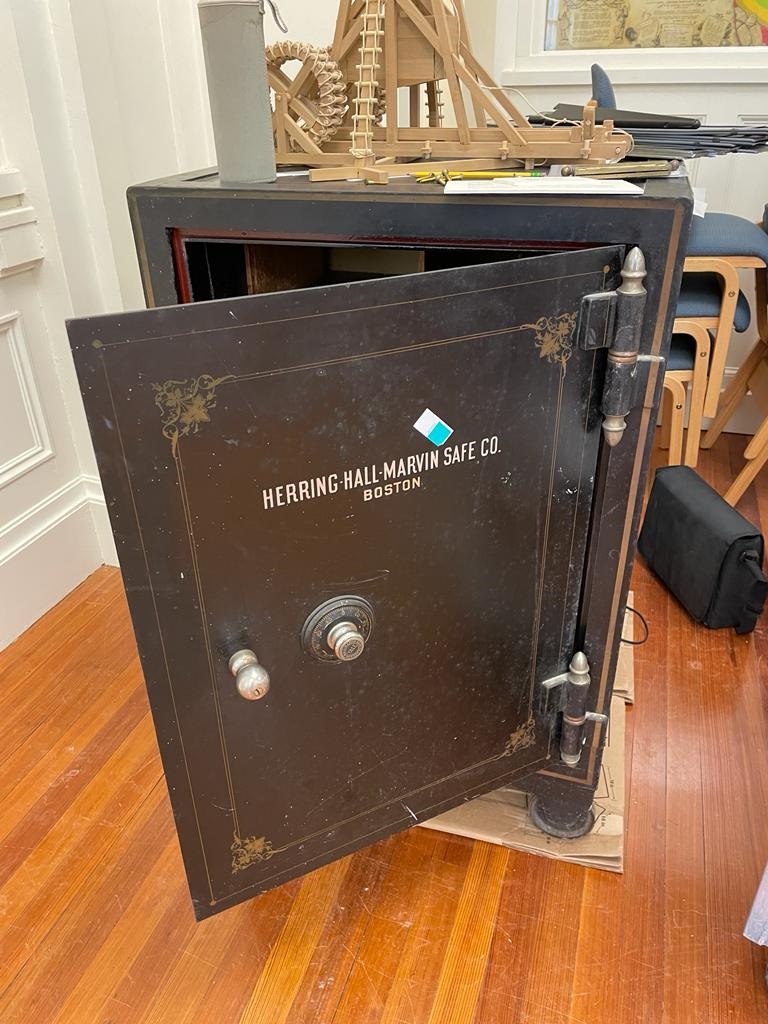
In spite of the physically and mentally draining task of completely clearing out the basement, moments of excitement rewarded me throughout the process. Under the empty wooden bays, for example, I found tiny matchboxes from the 1940s, cool items which alluded to the museum’s own history. A Spencer Delineascope, manufactured by Bell and Howell found in the basement, spoke to the great advancements made in projection technology since the 1930s, as the bulky object was moved slowly up the stairs. Only when it was removed from the little room under the stairs to the basement was when I could truly appreciate the size of the museum’s safe and its obsolescence in a time when the entire collection was kept behind locked doors.

Direction Booklet for the Peabody’s Delineascope
The Peabody’s old safe.

Learning about the 3D printed replicas of the intricate molding on the gallery ceilings also made me appreciate the museum as a historically significant space itself, allowing me to understand that preserving the space’s spirit through attention to detail was crucial even as the building is physically altered to facilitate better learning in the future through greater accessibility.

Attending the Peabody Advisory Committee meeting allowed me to better contextualize my work as a volunteer as I watched experts across disciplines partake in the collaborative process of museum governance. It was especially interesting for me to hear about the cross-institutional connections brought by Hopi artist Ramson Lomatewama, and I was particularly happy to share my experience at the communal fused-glass making workshop, which was enthusiastically attended by both faculty members and students. Going through items on the agenda, such as the adoption of a new mission statement, as well as the advisory board’s renaming (form the Peabody Advisory Committee to Peabody Board of Advisors), while less captivating than the discussion on the Peabody’s educational program and future student engagement opportunities, were nevertheless just as relevant to the student experience. As I look forward to returning to the updated building on Main Street in the winter, both as a student volunteer and as a member of this year’s Human Origins cohort, I am constantly reminded of the care demonstrated by the Peabody’s staff as well as the Peabody Board of Advisors towards the collection, the museum, and the greater community as a whole, manifested in the meticulous attention to word choice in the advisory board’s mission statement drafting process.

My fused glass piece before kiln firing.

Summer School

Contributed by Nick Andrusin

I already did 6 years of school, what’s one more class! This summer I had the opportunity to do some professional development with the Peabody, and I was more than happy to take advantage of the chance to learn something new. Museum Study LLC is a service that offers online courses and virtual lectures on a variety of museum related topics, from collections management to administration.

Museum Study online professional development – Home

After some painful humming and hawing (I was informed I can only do one at a time…Marla…) I decided on Foundations of Community Engagement, taught by the awesome Dr. Shannyn Palmer.

Museum Study Instructor Shannyn Palmer

My background is in public history, and part of my role at the Peabody is engaging with the community, so it was a good fit. The class lasted for the month of July and was virtual. Each week involved multiple readings on how different museums have incorporated community engagement, how it’s been done successfully (or unsuccessfully in a few cases), and the philosophy behind ethical engagement with museum communities. We would have questions and assignments to fill out, and then we would meet once a week virtually to discuss what we learned. The class was small, but the conversations were interesting, with participants from a variety of museums.

Just what is community engagement? Well, not to use a circular definition, but it’s how a museum engages with its communities. How much, what methods, which groups specifically, etc. The particulars will vary from project to project, but it all centers on connecting, collaborating, and co-creating with the group. Not just having them sign off on the project but allowing them the opportunity to be meaningfully involved in the planning and/or execution. Again, depending on the specific context of the exhibit or project. A big aspect of the class was the idea that this is not a perfect science and there is no one size fits all solution. It’s something that needs to be practiced and adapted to different situations. If a museum is doing an exhibit on a specific local community for example, that community should be involved from the outset, and at multiple levels of the project. Otherwise, what little involvement they do have may be tokenistic and the exhibit could be inauthentic or potentially offensive.

As largely public institutions, museums live and breathe on how well they engage their communities. Therefore, this engagement being ethical and non-tokenistic is a big deal. Between the modern-day ramifications of white supremacy and colonization, as well as the Covid-19 pandemic, museums are at a bit of an impasse. Questions about whom museums serve and what they should and shouldn’t do are becoming more common. Their roles are evolving as they determine their purpose. Ethical community engagement is the right way to ensure the museum is not failing the groups and individuals served.

The Peabody is an interesting museum in this case, because we haven’t created exhibits for the last couple of decades. Therefore, our community doesn’t really include your typical idea of museum visitors. However, the students and faculty of Phillips Academy absolutely fit the definition of our community. As well as the Native communities we work with during repatriation. Ergo when the Peabody does community engagement, we seek to collaborate with these groups in balanced and effective ways.

Overall, it was an interesting class with a great professor! I am very grateful to the Peabody for the chance at some professional development!  This was just a taste of what it offered; one blog is far too short to go into detail on everything. If I piqued your curiosity, you will just have to check out the class for yourself….

Map Quest

The Peabody has recently acquired several examples of Indigenous art, with the goal of enriching our education collection. Raven Makes Gallery is an art gallery based in Sisters, Oregon, dedicated seeking to “work directly with artists to bring American Indian, or Native American, First Nations and Alaska Native art to the unique setting of Central Oregon and cultivate a deeper awareness about fine artists and their communities.”

The Gallery features original pieces made primarily by Indigenous artists from North America, but also has pieces that come from Indigenous people all over the world. It’s an amazing gallery and their website is definitely worth poking around for those who are interested.

Native American Art Gallery – Raven Makes Gallery

Super cool stuff, right? Here’s where we come in. This year the gallery presented “The Homeland Collection, year three.” It was a collection of 88 antique maps (think like, nineteenth century settler maps) that served as a canvas for 22 Indigenous artists from all over the world to incorporate into their own work. The Peabody purchased two of these pieces!

The Homelands Collection, 3rd Ed, Raven Makes Gallery Exhibit– Homelands Collection

The maps are a powerful visual representation of re-indigenization/decolonization in artwork. Maps are interesting to look at, but there are questions: what is the reason they are made, who are they made for, who are they made by? Maps like those in the Raven Makes Gallery collection may have been designed with settlers and land prospectors in mind. The maps were used to impose colonizer culture and world views on Indigenous people. The illustrated borders would have had little to no input by Native communities, on land that they were the stewards of to begin with. So, this project has been an opportunity to shift the narrative. Turning tools of colonization into a representation of decolonization. Flipping it on its head! A physical reminder that Native people have been here for at least tens of thousands of years before these maps were “needed.”

The Peabody has a large collection of items from Alaska and the Southwest, so these two pieces made the most sense to grab. We are excited to have the opportunity to support Native artists and strengthen our education collection! We hope to use these to create interesting conversations about the creation and usage of maps in our history!

The first is Isuqwiq Pisuraa (Hunting Seals) II by Heather Johnston (Alutiiq). The map is an 1827 depiction of south-western Alaska by Philippe Vandermaelen, showing the routes of artic explorers in the late 1700s.

The second piece is Kachinas’ Territory by Wilmer Kay (Hopi). The map is an 1862 depiction of the Southwest made during the Civil War by A.J. Johnson.

Here’s the Dirt on Andover Summer’s Dig This! 2023

Contributed by Mikala Hardie

This summer, 23 young archaeologists set out to investigate one of the first buildings constructed by Samuel Phillips Jr. after he founded Phillips Academy. During the first week of the Andover Summer program, the students of the Lower School’s Dig This course were introduced to the story of the Mansion House and the mysterious fire that destroyed it in 1887. According to primary accounts, the fire seemed to have started in two different places in the house. This account was made even more suspicious by sources that said the caretakers, Mr. and Mrs. Carter, had their bags packed the day of the fire and walked away with insurance money. With this interesting piece of information, the students were excited to uncover more clues about the Mansion House and the people who inhabited it. The students worked in groups of 3 to 4 at six excavation units. These units were spread across the site in areas that, using past excavation results and Ground Penetrating Radar maps, had a good chance of finding evidence of the Mansion House.

Figure 1. Commemorative Plaque of the Mansion House

The first day of excavations was met with enthusiasm, apprehension, and later exhaustion as the students realized how much work goes into opening a unit. Nonetheless, we persevered and by the end of the first week of excavations many groups had already finished Level 1. Some had even found glass and metal artifacts which, of course, created healthy competition between groups and motivated the students as they continued in the second week of excavations.

Figure 2. Two students working in Excavation Unit 1

During the second week, things got interesting. The students working in Excavation Unit 5 came across an 1802 “Draped Bust” Liberty penny which caused a ripple of excitement for both the students and the instructors. This coin gave an important terminus post quem (TPQ) for the level and showed the students how old the artifacts we were finding really were.

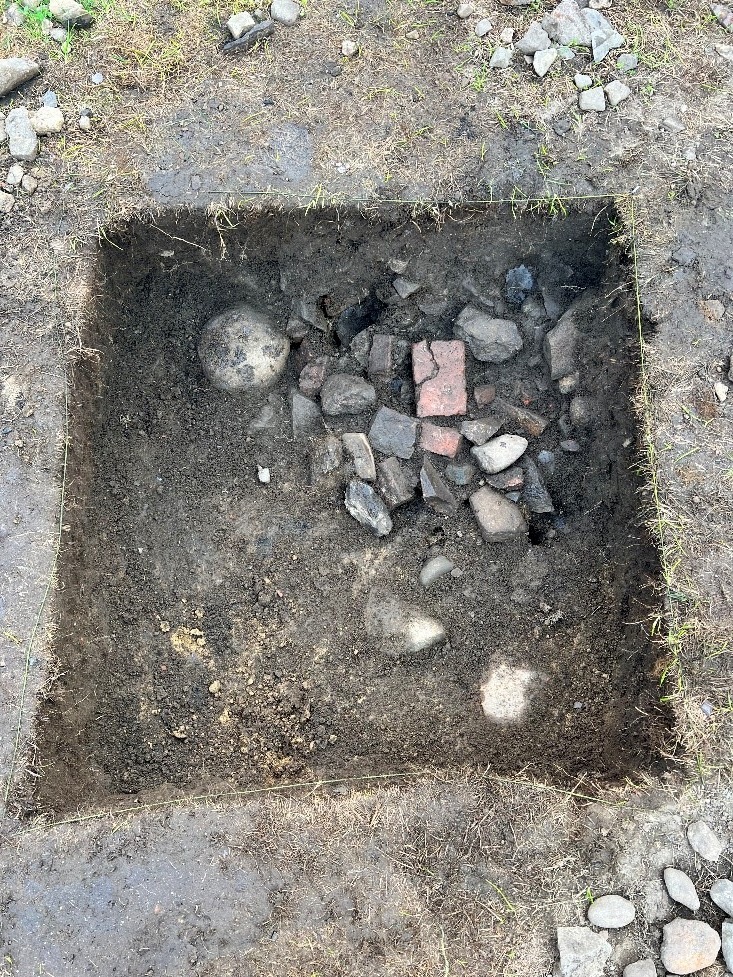
Additionally, in Excavation Unit 2 Level 2, a brick feature began to reveal itself in the northeast corner. This unit was placed near a 2018 excavation unit that uncovered part of a chimney, so it is likely these features were related and Unit 2 uncovered another part of the chimney which helps in understanding how large the chimneys would have been and the layout of the Mansion House. The images below show the brick feature when it began to be discovered in Level 2 and the brick feature in Level 3 before backfilling.

The third and final week of excavations supported the archaeological adage that you always find the most interesting stuff right before you’re going to leave a project. This week, two new features were discovered. One was in Excavation Unit 6, which was intended to find one of the foundational walls of the structure. This feature also included a brick, though it is unclear if it relates to another chimney of the house. There was also a large stone and some smaller stones found near it, though, likely not enough to constitute a foundational wall of the building.

Figure 5. Students working in Excavation Unit 6

That being said, one of the biggest finds of the project included a huge rectangular stone with other large stones overlapping it. This feature was found in Excavation Unit 1 which was placed north of Excavation Unit 2 in the hopes of uncovering part of the foundation of the house. Given the size of the stone and the overlapping rock around it, it is pretty likely that this feature relates to the foundation or a wall of the Mansion House. On the last day of excavations this unit surprised us further by containing a large amount of metal artifacts in the southwest corner of the unit. A fork, a hinge, a handle, and a plethora of other artifacts were uncovered in the last level of this unit. We probably could have found more in the next level if we didn’t have to backfill the next day. This unit is definitely one to revisit in future years!

Figure 6. Stone feature in Excavation Unit 1 Level 3.

While neither unit contained a feature, Excavation Unit 3 and Excavation Unit 4 contained a lot of charcoal and mortar. Excavation Unit 3 specifically had extremely dark, somewhat ashy soil which was likely due to the fire. Ideally future Dig This! classes will uncover more of this ashy, dark soil and the data can be compiled to give a better understanding of how the fire destroyed the mansion house.

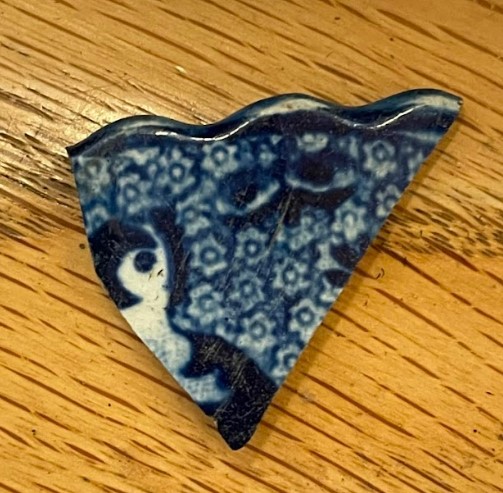
During the last week of the course, the students were busy washing their artifacts and picking a few to display at their end of the year exhibition. These artifacts included a locking mechanism, large nails, blue transfer print ceramics, a marble, a hinge, and a fork! All of the artifacts found during this summer’s course were transferred to the Peabody Institute to be cataloged and analyzed with the rest of the Mansion House artifacts.

Overall, the students had a great summer excavating the Mansion House and learning how to be archaeologists by following proper archaeological methods and recording techniques. I look forward to seeing what next summer’s Dig This class will find!

Peabody Volunteer Spotlight: Meet Mike

Contributed by Mike Agostino

Hello, my name is Mike Agostino and I am a volunteer here at the Peabody Institute of Archeology. I am a recently retired scientist from the field of bioinformatics. My work in this field, for over 30 years, concerned the analysis of gene and protein sequences. I love the field so much that I am presently an instructor on the subject for the Harvard Extension School. I am also writing the second edition of a textbook I published on this topic more than 12 years ago.

Peabody volunteer, Mike, analyzes various projectile points in the Peabody collection.

As a resident of Andover, I frequently went past the Peabody and often wondered what treasures it held. When a good friend, Richard Davis, said he volunteered here and told me about the work, I immediately wanted to join him. To say this is a dream come true is not an exaggeration. I have always been interested in archaeology and spent many years looking down on the ground for the artifacts people said were all around us. But I never found any! To work with and learn about dozens, if not hundreds of specimens each day is amazing. As I hold these objects in my hands, I try to imagine their history: was it careful fabrication by an adult expert, or was it made during a learning period of a youngster? Was it used to bring home a meal, build a boat or dwelling, or for the creation of clothes? Did it come from local stone, or did it travel many miles to be found at a new locale? My imagination is further enhanced or tempered by the kind and knowledgeable staff of the Peabody who are training and patiently helping me identify what is in my hand. I have only been at the Peabody for less than two years and there is so much to learn!

After years as a scientist, I feel right at home with my principal responsibilities: the careful handling, description, cataloging, and storage of the specimens. Attention to detail is absolutely required and very satisfying. We record their identities, or best guesses because many are just fragments. The intact specimens are something to behold. Some arrowheads or axes are impossibly beautiful, and the precision of shaping and symmetry with such a hard material is just astounding. The skills of the people, past and present, are just amazing.

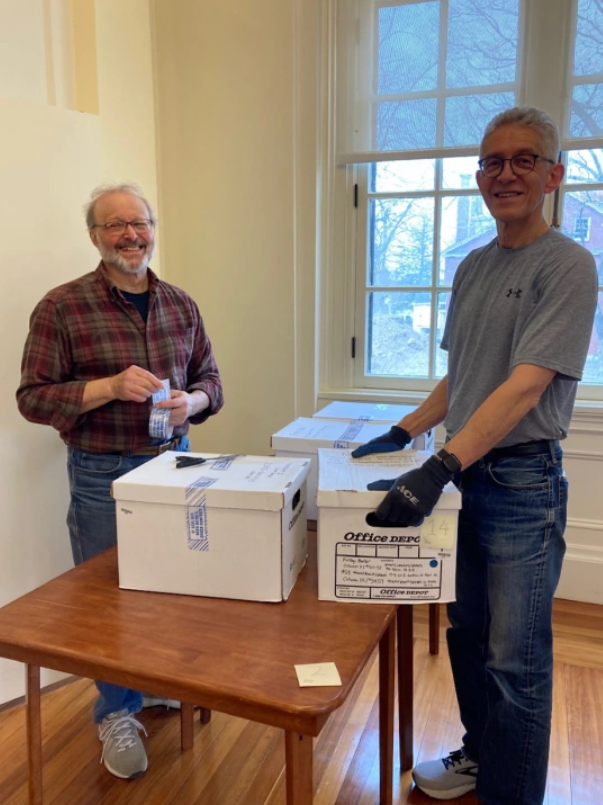
Peabody volunteers, Richard (left) and Mike (right), moving boxes for the Peabody’s building project.

I have also helped with activities associated with the huge renovation project of the building (for pictures and updates, see the blog postings by Marla Taylor). I am impressed with how everyone has remained calm considering hundreds of boxes, and specimens too large for boxes, had to be carefully moved up one or two floors from the basement to temporary locations elsewhere in the building. With the absence of an elevator, I helped move many boxes up the stairs out of harm’s way. My smart watch said I went up 80 flights of stairs one day! And I am only there one day a week, so the staff had a monumental challenge. We are now waiting for the renovations to be completed and then we will return the specimens to a much-improved setting. Even with the new elevator, reshelving hundreds of boxes won’t be easy, but I am looking forward to the project and the “new” institute.

Summer Session Selections

Contributed by Nick Andrusin

We may be down (the road, on Abbot campus) but were not out! As everyone on campus has probably seen there is a big ol’ fence surrounding the Peabody Institute, concealing dirt mountains, front loaders, and a bunch of contractors. This has been going on since April, boy time flies! Despite being out of the building for the last several months (and for several months to follow) we are still here and still part of teaching and learning at Phillips Academy, albeit in a more restricted fashion. Most recently, our director Ryan Wheeler and I helped out the Andover Summer Session with a few different classes. Supplementing the classes with knowledge and items from our collection to enhance the learning of the summer students. 

One class was Ella Houlihan’s Intro to Bio class. The students were learning about human evolution, and the Peabody has just the collection to help teach this topic. We brought over about 15 skull casts from all over the hominid family tree and tasked the students to develop their own traits, categories, and potential connections. From there we went over what scientist use to group skulls and layout the human family tree. Pointing out that it’s all rather complicated and even the professionals do not agree.

Students analyze various skull casts in a class activity

We also helped teach a couple classes in Dr. Tessa Hite’s class Mapping our World: The Art and Science Behind Maps. We went over the basic history of Andover, how it moved from Indigenous proprietorship to English ownership. To tie into that we covered concepts of colonization and decolonization, how one culture or society can impose themselves onto another and how efforts are undertaken to amend this. From there we had the students use maps to compare European versus Native American town names (think Mattapoisett vs Andover) and then research the original Indigenous place names. This was done to prompt questions such as “What does, or doesn’t this map tell us” Or “why does it feel empty with Native based town names?” This was done to get the students thinking about the reasoning behind the way the maps are set up and used.

The Peabody is more than happy to help in classes whenever we have an opportunity! Even with more restricted access to the collection, we can get creative and pull something together, as long as you don’t mind the dust!