Biface Cache Research

Contributed by Bonnie Sousa

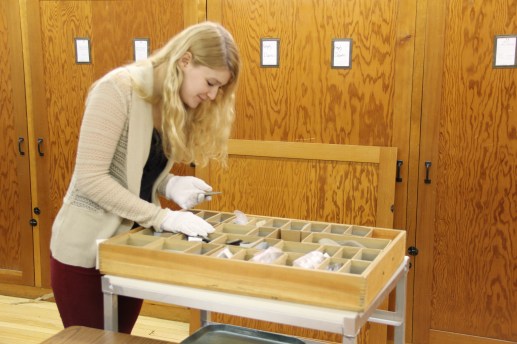
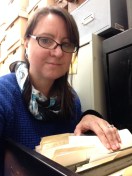
Abigail Gamble, a student at the University of Massachusetts, Amherst, visited the Peabody to examine stone tools for her senior thesis.  She looked at several stone blades from an archaeological site in Andover for her comparative study of blades in the Northeast.   The museum acquired the artifacts from collector Arthur Hofmann in the early 1940s.

Gamble,Abigail_March2016

A Westerwald Chamber Pot

Contributed by Quinn Rosefsky (Phillips Academy Class of 1959)

As a Peabody Museum volunteer for the past 6 ½ years, I have had the rare opportunity to help staff members with a variety of unique and exciting tasks. Today, I was introduced to a bit of our Colonial history. The object in question is a rather attractive example of its kind, a chamber pot that survived intact from early Colonial days, preserved in a drawer in the Peabody’s basement storage. See the full catalog record online at http://bit.ly/1XVnQd3. Aside from the intrigue of its nearly pristine condition, there is the question of date of manufacture. The Boston City Archaeologist, Joe Bagley, points out that the chamber pot may be from a 1630s well on Boston’s Congress Street. Several avenues of inquiry are open, including details of the well’s exploration and if the well was ultimately used as a privy and refuse dump, a common trajectory for such a feature. But in order to take a stand on the dating issue we need to have an appreciation of the phases of use and manufacture of such pots.


The earliest chamber pots date from at least the sixth century B.C. in Greece. In the past four to five hundred years chamber pots were found in nearly every household, usually stored under beds but sometimes in dining rooms. English and Colonial lead-glazed earthenware chamber pots came in a variety of colors: brown, green, red, orange, tortoiseshell, gray, and black. There were also stoneware pots, and some of the more striking ones are known as Westerwald or Rhenish Gray (1575-1725), followed by Debased Westerwald (1725-1775), and then American Westerwald (1730s). In the eighteenth century, these pots were mass-produced.

Not to be ignored were chamber pots made of metal, the earliest example being from 1545. It was possible to assess a person’s wealth by whether or not they had silver or pewter chamber pots. But the English Civil War of the 1640s temporarily spoiled this method because the Royalists conscripted silver and pewter to make silver coinage to fund their war efforts, a practical, if unhygienic way to pay off debt using dirty money without resorting to taxes.

A chamber pot might have a tame inscription, “Break Me Not I Pray in Your Hast for I to Non will Give Destast.” Some showed less decorum, “Oh Dear Me What Do I See.”

The chamber pot at the Peabody is gray, salt-glazed stoneware with cobalt blue cordons beneath the rim and above the base. In remarkable condition, the pot measures 6 ¾” wide at the opening and 6” high. There are no pithy inscriptions, but two cobalt blue bellicose lions, each one crowned, and three stamped rosettes, each filled with four spades and a central diamond, are eye-catching. These lions and rosettes have been “sprigged on,” meaning attached with separately molded designs. The rim tapers upward to a narrow “seat.” For dating purposes, it appears that mid-eighteenth century pots had wider rims. Extending out from the rim is a ribbed handle attached in a manner so that the pot won’t tip. There are no “makers” marks or dates. But comparing the chamber pot under examination with a very similar Westerwald example dated 1632 found in Ivor Noël Hume’s 2001 book, If These Pots Could Talk: Collecting 2,000 Years of British Household Pottery, we see many similarities, including the tapering of the opening, rosettes, and the sprig-applied crowned lions. A valid case can be made for a 1630s date given the similarities with Noël Hume’s text and its preservation in the Congress Street well. But there are other dating possibilities that need to be considered.

With the accession to the throne of England of William and Mary, whose reign spanned the years 1689 to 1702, they brought with them a passion for what was called the Rhenish or Westerwald chamber pot, originating in the Rhineland district of Germany. The style and patterns were very close to what we have at the Peabody, examples of what were called “grès-de-flandres.” By 1710, large supplies of these gray stoneware chamber pots with their sprig-mounted lions and rosettes were being shipped to England. Over the next fifty years, this style of chamber pot was found in most British and Colonial homes. Eventually variations were produced on both sides of the Atlantic, satisfying a combination of hygienic, commercial, and political needs. Later versions of Colonial chamber pots had variations in the rosettes, including a profile relief of George III sprigged onto the side. What better way to pay daily homage to the monarch?

So which date do we choose? In order to settle the debate, I would be happy to fly to Amsterdam with the Peabody’s Westerwald chamber pot tucked under my arm (in bubble wrap) to compare it with the one from Noël Hume’s book. As there is no inflammatory profile of George III, I doubt I would have any difficulties in case the plane had to make an emergency landing at Heathrow Airport. But budget constraints are likely to apply to such a trip and less costly research methods would pertain, such as having a debate amongst archaeological scholars. Whatever the outcome, we have the satisfaction of knowing that this chamber pot, however humble and utilitarian, played a role in the origins of Congress Street prior to its transformation into a thriving financial district.


3D Scanning Artifacts: How Does it Work?

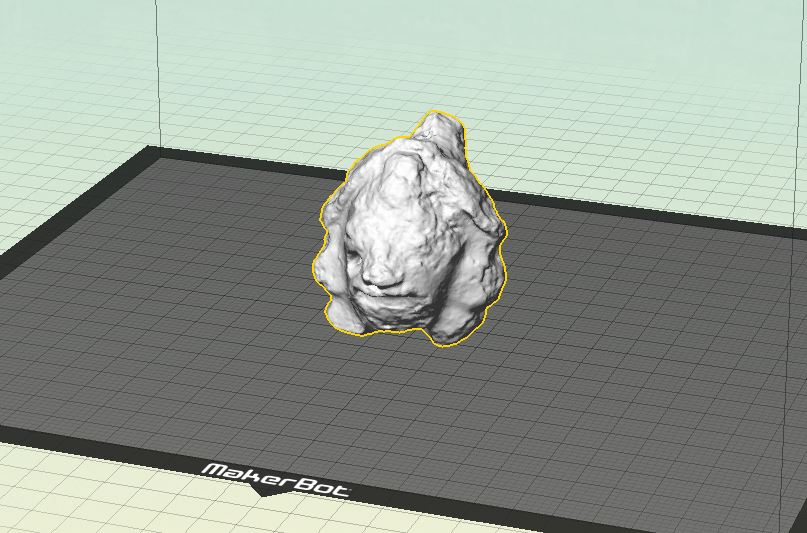
Image of 3D scan in the 3D printing software

Contributed by Claudia Wessner, Makerspace Coordinator and Library Experience Designer

Huge progress has been made in the collaborative project between The Nest, the makerspace at Phillips Academy, and the Peabody Museum! From the first day we received the Next Engine 3D Scanner, we had hopes of testing out this new technology in a fun and interesting way. After talking to Marla Taylor, we both thought it was a no brainer to form a collaboration between the museum, the makerspace and a group of work duty students (Alana Gudinas ’16, Jacob Boudreau ’16, Mia LaRocca ’16, and Sarah Schmaier ’16) to further explore the scanning possibilities.

In a previous post, Marla discussed the parameters in which the artifacts were selected. Once we brought the artifacts over to the Nest, we were able to make custom stands for two of the three artifacts so that they would be stable on the scanner. Then we got to work!

So, how does it work?

Before the scanning starts, we set up preferences such as resolution, color mode, and the number of incremental scans, as well as positioning the object in the camera’s field of view. The higher the desired resolution, the longer the scanning process will take.  Most of the objects we scanned took around one hour.

Collage of photos showing the lasers during the scanning process
Lasers scan the artifact

The scanner begins by taking a 2D image of the object then shoots out an array of red laser beams to capture the depth and texture of the object. Next, it completes a series of slow incremental rotations, based on the level of resolution selected, and performs the same 2D/3D rendering for each increment.  The Next Engine software slowly builds the 3D model before your eyes as it layers the data captured by the scanner.

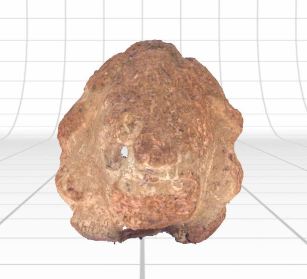
Image of 3D scan of artifact
Fully rendered 3D model from the scan

After the scanning is complete, the 3-dimensional model of the artifact appears in the Next Engine software. Depending on how the artifact is scanned, there may be some holes in the model. This would be where the lasers may not have been able to reach, such as the top or the bottom of the artifact. There are ways to avoid holes by completing several scans of the same object (top, bottom, full 360) and then fusing them together. This is something I am looking forward to experimenting with in the future, but for our initial exploration we did a single scan.

In order to fill the holes in our model, I “polished” it using the Next Engine software. The program will automatically find and select holes in the model. Then you can use a paintbrush tool to select the areas in which you’d like to fill.  This can also take some time and experimentation, especially with very high resolution scans where image rendering can use a lot of computing power.

Once the editing of the model is complete, it is ready to prepare for printing by saving it as a .stl file and opening it in the Makerbot Desktop software. In the software you can scale, rotate, and place your object in the desired location on the build plate. You can also preview how long the print will take.  This artifact, which was approximately four inches tall, took about 5 hours to print.

Image of 3D scan in the 3D printing software
The 3D scan is ready to print

The Makerbot 3D printer uses a material called PLA that is stored in a spool in the back of the machine. The PLA is heated in an extruder and lays down very thin layers of material to build the object from the bottom up. Think of it like a glorified glue gun! The makerbot will automatically add “support material” that will support the object as it is printing so that everything stays intact. Once it is finished printing, any support material easily breaks off from the print.

Image of the 3D printed artifact
The 3D printed artifact!

We are so excited about the results of our project! We are looking forward to scanning more artifacts in the Peabody collection and refining our skills with this new technology! Stay tuned!

A Day in the Life at the Peabody Museum

Contributed by Bonnie Sousa, Registrar/Senior Collections Manager

When I mention to people outside of the museum world that I am in collections management and registration, some think I work for a collections agency. In fact, museuSousa,Bonniem collections management and registration involves physical and intellectual control of artifact collections and includes such activities as cataloging, inventorying, and storing artifacts; accessioning (the formal process of taking items into the collections); managing loans; answering research and reproduction queries; and working on the museum’s Native American Graves Protection and Repatriation Act (NAGPRA) inventory, to name a few.

And at a small museum like the Peabody, the list of responsibilities grows to include additional activities. Not typically mentioned in job descriptions, but still important in the goal of reaching professional standards, are such unglamorous tasks as emptying dehumidifiers in artifact storage spaces, handling early morning calls from the alarm company regarding power outages at the building, and removing food trash at the end of the day so that insects and other pests are not attracted to the artifacts. To give you a better idea of what’s involved in collections management and registration at the Peabody, here is a list of a few behind the scenes tasks I performed on a typical day recently:

Morning:
Answered e-mail queries—Some of the queries we receive are from textbook publishers asking for CornCobs_MacNeish_Tehuacanpermission to use images from the Peabody’s collections. To date, our most received request is for this image of the evolution of corn from the excavations of Richard “Scotty” MacNeish in the Tehuacán Valley of Mexico. Many college-level, introduction to archaeology textbooks feature this image.

Renewed our loan to the Visitor Center at the Pueblo of Jemez—The Peabody has several ongoing loans to other museums, Native American tribes, a national park, and a public high school. On loan to the Visitor Center at the Pueblo of Jemez are artifacts from their ancestral site, Pecos Pueblo.

Put away artifacts for a Phillips Academy history class on westward expansion – Artifacts from the Peabody are regularly used in classes taught at the Peabody. Our PastPerfect collections management database allows us to create lists that work perfectly for pulling artifacts to ensure that we can locate them and put them back in the right spot.

Afternoon:
Entered catalog records into the Peabody’s database for artifacts from the Mansion Inn, a site in Wayland, Mass. — We recently learned that items from this site must be listed on the museumCatalog Cards’s NAGPRA inventory. Assembling an inventory begins with compiling existing documentation and records and ensuring that all artifacts are entered into the museum’s database. Our next steps will be to contact tribal officials to let them know we hold these collections, and National NAGPRA, a Cultural Resources program of the National Park Service, to update the museum’s inventories. After consulting with tribal officials and submitting drafts to National NAGPRA, a Notice of Inventory Completion will be published in the Federal Register.
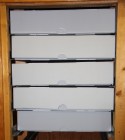
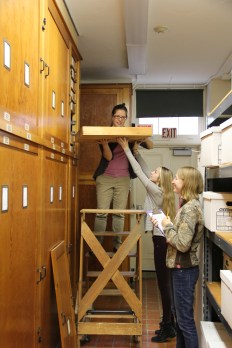
Updated storage locations for textile artifacts—I have two volunteers who have been trained to inspect and vacuum textile collections for pest damage as part of a comprehensive pest management program. When textile artifacts have been inspected and vacuumed after undergoing low temperature treatment to eliminate any potential pests, their storage locations must be updated to ensure we can find them in the future.

Backed up our PastPerfect collections management database before heading home—Regular backups of data are important so that recent information added about the artifacts is not lost.

As you can see, one of the most rewarding benefits of working in museum collections is the wide variety of work that needs to be done, and I’ve really only touched the surface here. There is never a dull moment, and the nature of the work keeps me on my toes. I wouldn’t have it any other way.

Box Us In! Abbot Academy Association Funds Archival Boxes for Peabody Collections

SampleBoxes2                 SampleBoxes

Contributed by Bonnie Sousa

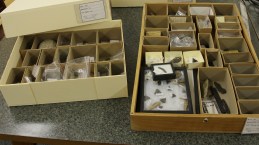
Peabody archaeology collections storage will undergo an ambitious upgrade made possible by a grant from the Abbot Academy Association, continuing Abbot’s tradition of boldness, innovation, and caring. The Peabody Museum received $45,746 to fund 3,000 archival boxes to replace deteriorating wooden drawers where collections are currently housed. Boxes eliminate contamination from wood debris in addition to improving accessibility and portability. Heavy or large artifacts such as stone axes and ceramic vessels will be stored on open shelving.

The project will be split over three years and will use the museum’s existing workforce of Phillips Academy work duty students, college interns, and adult and student volunteers guided by the collections management team of Marla Taylor and Bonnie Sousa. Archival boxes are a first step in a broader collections storage plan to consolidate museum collections and improve environmental conditions.

Storage_Marla&Students

The Language of Baskets

Contributed by Catherine K. Hunter

Hunter,Catherine_11.17.2015

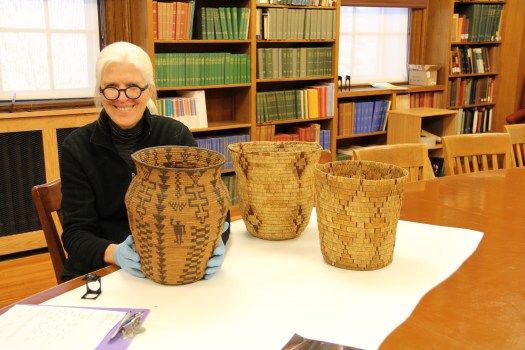
What can be coiled, plaited, twined, or sewn in the form of a tray, bowl, bottle, cone, or trunk using tree barks or splints, river cane, pine needles, or grasses? If you are familiar with this vocabulary, you will know the answer: Native American basketry. What you may not know is that the Peabody Museum houses more than 350 examples of Native American basketry, including fragments of ancient woven sandals, 19th- and 20th-century utilitarian and ceremonial forms, and a few examples by recognized 21st-century artists.

In my current capacity as a volunteer at the Peabody, I am collaborating with the museum’s registrar and senior collections manager, Bonnie Sousa, on conducting a thorough inventory of the Peabody’s Native American basketry collection. For this project, we are attempting to combine for each example a description of forms, techniques, and materials; identification of people/culture and geographic region; and data from museum records. The first 35 examples I examined include plaited ash-splint storage baskets from the Northeast with distinctive stamped and painted designs; twill-plaited trunks and trays from the Southeast made with natural, dyed orange and brown river cane splints; and a variety of trays of coiled grasses and pine needles.

My first volunteer position was in the 1970s at Harvard University’s Peabody Museum following a recommendation by my mentor, Joanne Segal Brandford, who subsequently published the museum’s basket collection. After studying and teaching fiber arts and design at the University of California, Berkeley, Brandford worked as a researcher, curator, teacher, and fiber artist. Why baskets? In the following paragraph, she succinctly describes the foundation for a career of exploration:

Baskets are often linked to domesticity and smallness, the implication being that these qualities preclude significant artwork. I could counter with basket-shrines made for ritual, or I could point to house-sized baskets (used, indeed, as houses) and so I could ‘elevate’ baskets with religious significance or architectural scale. But all such uses/meanings refer to our humanity, and consequently to ourselves and to our families, to life, and to death. What can be more meaningful for an artist working in fiber, than to honor the basket, with its myriad human associations?

BASKETS: Redefining Volume and Meaning (1993). The University of Hawaii, Art Gallery, Honolulu, Hawaii. Pat Hickman, Curator

[AUTHOR BIO]

Catherine K. Hunter is an independent museum consultant whose career began in the Department of Textiles at the Museum of Fine Arts in Boston. She has always been interested in the study of basketry and recently wrote feature articles about contemporary Native American and American artists for the National Basketry Organization.