Bushels of Baskets

Contributed by Samantha Hixson

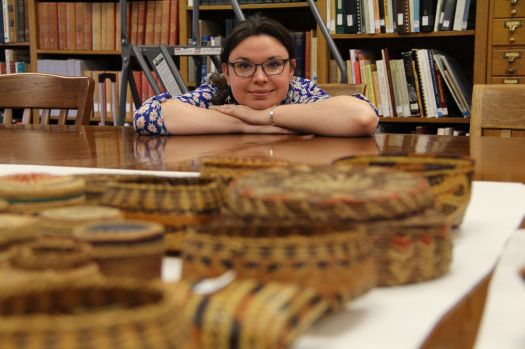
Though the Peabody is small by museum standards we are mighty, especially when it comes to our baskets.  With close to 400 baskets, the Peabody collection covers all major geographical regions and tribal communities of North America, and spans over 200 years.  Baskets from notable artists like Molly Neptune Parker (Maine) and Clara Darden (Louisiana) help to support and curate these artists’ work, and are examples of continued and evolving traditions within Native communities.

One of my first large projects at the Peabody was to completely catalog, inventory, and rehouse this great collection.  The purpose of this was twofold:

First, it was important to consolidate our records regarding these baskets.  Museums are full of information, and it’s usually in five different places! By gathering what we know, and putting it all in one place, we not only gain better control over this knowledge, but we make it more accessible to museum staff, researchers, and students.  The convenience of this newfound accessibility encourages more use in the classroom and more research by professionals, giving these baskets the attention they deserve.

Secondly, by revamping the basket organization and rehousing, we are better able to care for these objects and their specific needs.  Although baskets aren’t usually as fragile as most people fear, they still require some TLC.  By creating storage mounts that are custom designed to each basket, we are able to provide more support to the object, especially when it is being moved and shifted around during handling.  Within our ethnographic storage, space is at a premium, so another byproduct of the rehousing was the space it opened up.  We were able to clear seven shelves!

basket elf
Basket Elf in natural habitat

Happy baskets, happy collection staff.

To see previous work done with the baskets by Catherine Hunter, check out these previous blogs!

Language of Baskets

Baskets Explored

The Macaw Factor

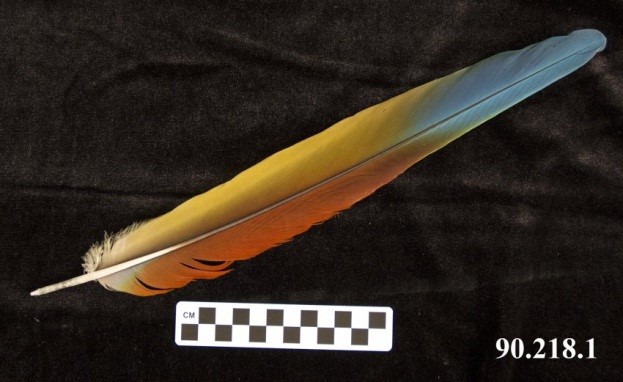
Macaw feather from the Peabody collection

Contributed by Quinn Rosefsky

This blog represents the sixth entry in a blog series – Peabody 25 – that will delve into the history of the Peabody Museum through objects in our collection. A new post will be out with each newsletter, so keep your eyes peeled for the Peabody 25 tag!

Overview of Chaco Canyon, New Mexico

At the Robert S. Peabody Museum, it seems as though there is almost no limit to the range of phenomena one can explore. When the topic Chaco Canyon was suggested, I thought looking at trade routes would be interesting. It quickly became clear that what I was about to enter was the world of a great culture which I thought had mysteriously “disappeared” about 800 years ago. What I quickly learned was that these people, the “Ancestral Puebloans,” had not disappeared. Research has shown that the Puebloans had adapted to climate change in the area by dispersing. “Today, twenty Puebloan groups in New Mexico, as well as the Hopi in Arizona, claim Chaco as their ancestral homeland and are tied to this place through oral traditions and clan lineages. A number of Navajo clans are also affiliated with Chacoan sites through their traditional stories.” (National Park Service: https://www.nps.gov/chcu/faqs.htm)

Chaco Canyon, located on a section of the Colorado Plateau in northwest New Mexico, was home to the Chacoan culture which flourished from AD 1000 to 1150. A UNESCO World Heritage Site, the people who lived there were very sophisticated. They used astronomical alignments, geometry, and impressive building techniques, allowing for multi-storied masonry houses.  They had a complex road system stretching hundreds of miles, linking Chaco to other communities. One of their buildings, four or five stories high, Pueblo Bonito, contained about 650 rooms.

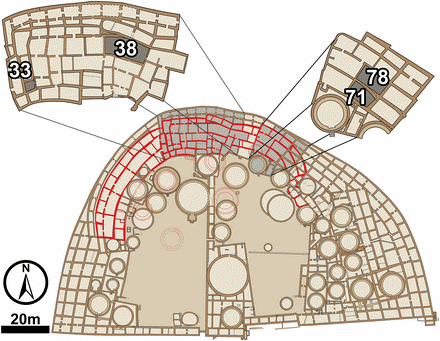
Plan view of Pueblo Bonito
Plan view of Pueblo Bonito with the earliest construction highlighted in red. The locations of the elite burial crypt, room 33, and the three rooms with dated macaw samples are highlighted. From Adam Watson and colleagues’ article on Chaco macaws in Proceedings of the National Academy of Sciences Vol. 112(27): http://www.pnas.org/content/112/27/8238)

The Chacoans traded with people in the Mongollon and Hohokam regions to the south and with people from Mexico and Central America.  Long-distance travel by Ancestral Puebloan people was common and among the goods they acquired were turquoise, seashells, copper and chocolate, none of which were found locally. They also traded for scarlet macaws, a bird with a natural habitat 1000 miles to the south.


The Robert S. Peabody Museum has several “modern” macaw tail feathers in its collection, one of which is shown below. Preserved feathers  from 1000 years ago would be quite rare.

Scarlet macaws measure about thirty-two inches long, of which more than half is a pointed tail. They can live up to seventy-five years and eat mostly fruits, nuts and seeds. We know macaws, essentially large parrots, as intelligent birds that are quick to echo our deepest secrets using speech, a magical quality, especially because macaws have no vocal cords. That parrots are rated among the top five in the animal world for intelligence and cognition should come as no surprise. It is likely that the people of Chaco Canyon would have been awed by such an animal.

Scarlet macaws are native to the gulf coast of Mexico, Central America, and South America. The question to ask is for what purpose macaws were brought back to Pueblo Bonito?

Thirty four macaws were recovered from Pueblo Bonito and other sites in Chaco Canyon. Room 33 (see illustration above) was used as a burial crypt for 200-250 years. Macaws were found in rooms 38, 71, and 78. Archaeologist Adam Watson and his colleagues postulated that scarlet macaws were a powerful cosmological symbol and that their presence from the early tenth century reinforced and stimulated a rising social inequality. Those who possessed the birds had access to key cosmological beings and forces as well as links with far distant cultural groups. There is little doubt that the ability of the birds to speak played into this perception.

What is currently exciting is how recent radiocarbon dating of scarlet macaw skeletons from Chaco Canyon has given further insight into the question of their presence. What has been shown is that, based on acquisition and control of valued items such as chocolate and macaws, an elite class at the top of a social and political hierarchy dominated Chacoan life. (Watson et al. 2015)

What the elites achieved and their importance is amply demonstrated in their “great houses” and the acquisition of “exotic” goods from distant regions (ibid.) Included in these exotic goods were macaws. Feathers from macaws were found on prayer sticks, costumes, and masks. According to Watson and his colleagues,“…the flight of or just the appearance of certain birds or the use of their feathers is believed to motivate the fall of rain or snow, as well as the seasons, the sunshine, and the heat.”

Originally, it was believed that trade in items such as macaws at Chaco dated from around AD 1040. With radiocarbon dating done in 2010 on skeletal remains of the macaws from Pueblo Bonito, the dates of the florescence have been moved back to AD 775-875.

Whether or not the macaws were brought back to Pueblo Bonito in single journeys or in successive stages has been debated extensively. Some have raised the possibility that macaws were also bred locally in Chaco Canyon itself, although the arid region is not a natural habitat for such birds. The discovery of breeding pens, perches, bones, and eggshell fragments has led to speculation about on site breeding, but evidence suggests such macaws did not reach maturity.

“There are no indications that the people of Pueblo Bonito bred scarlet macaws. Only one of the sample birds was of breeding age and none were exceptionally young. There is also no mention of eggshells in any of the excavation notes, although one room where many of the bird remains were found was probably an aviary.” (“Scarlet macaws point to early complexity at Chaco Canyon.” A’ndrea Elyse Messer, 2015: http://news.psu.edu/story/361255/2015/06/22/research/scarlet-macaws-point-early-complexity-chaco-canyon).

One of many phenomena to explore at the Peabody, the scarlet macaw feathers represent a tangible example of extensive trade routes present in the New World prior to European contact.

Girl Power! in the Archaeological Record

Contributed by Samantha Hixson

Follow these links to read some awesome stories of how women are helping unlock the secrets of the archaeological record.

Elite ‘Dynasty’ at Chaco Canyon Got It’s Power From One Woman, DNA Shows

Once again DNA analysis of sites is opening up our understanding of how societies operated historically.  By testing bone samples from Room 33 in Pueblo Bonito of Chaco Canyon, scientists were able to shed more light on the inner workings of power, class, wealth and status of ancestral Puebloans, and the major role women played within these.

New Discoveries from Cahokia’s ‘Beaded Burial’ May Rewrite Story of Ancient American City

Mound 72 of the Cahokia culture complex, when originally excavated in 1967, was thought to be a shining example of a burial of elite male warriors.  Fast forward almost 50 years and imagine archaeologist’s surprise when one third of the skeletons found were in fact female!  These findings call into question the idea that Cahokia was a male warrior-led patriarchy.

Grave of Disabled Young Woman Reveals Touching Tale of Care in Prehistoric Arizona

The excavation of young Hohokam woman’s grave is an example of what the excavators and author call the “Bioarchaeology of care.”  The young woman, who lived about 800 years ago had scoliosis, rickets, and tuberculosis. Through looking at this site, archaeologists are able learn more about the community in which the girl lived, and how they supported and cared for her, giving a decidedly human lens to a science that can sometimes become disconnected.

This Week in Links

Indiana Jones looks at golden idol.

Contributed by Samantha Hixson


This week it seemed there were a lot of great links discussing new and exciting things happening within the world of archaeology.  Here are just a few that we found:

Ancient DNA reveals genetic legacy of pandemics in the Americas

This article talks about the role of diseases in shaping the genetic diversity of contemporary Native American communities.  Historically these effects were documented by written accounts with little to no physical evidence since most European introduced diseases leave no evidence on bone.  Recent breakthroughs in DNA markers, however, have been able to physically prove the evolutionary effects of these pandemics.

Archaeologists discover man whose tongue was replaced by a stone

This article is a great example of how archaeologists are able to create and test hypothesis when attempting to solve puzzles encountered while excavating.

Teeth of Irish famine victims reveal scientific markers for starvation

An interesting article that not only highlights the use of modern science in investigating historic traumas, but a great example of how important cultural context is both historically and in a contemporary lens.

Cask from the past: archaeologists discover 5,000-year-old beer recipe

Not only is this a super cool article talking about the first example of in situ beer making in China, but also a great example of how archaeologists are able to extrapolate larger and further reaching conclusions from a small snap shot of the past.

Welcome Samantha!

Contributed by Samantha Hixson

Hello everyone,

My name is Samantha Hixson and I am the new collections assistant here at the Peabody. I come to you from New Mexico where the weather is warm and has left me completely unprepared for New England winters (although Marla and Lindsay promise that they’ll get me through it).

I have previously worked at the Museum of Indian Arts and Culture in Santa Fe, New Mexico as well as the Smithsonian Institution’s National Museum of the American Indian in Washington, DC. It’s these places that got me excited to work within museums, focusing specifically on Native American collections. So you can imagine how excited I was when I was hired to work at the Peabody, it’s the perfect job for me! I’ve also had some other very interesting archaeological/ethnographic experiences, but those are for other posts.

I’ve started getting my feet wet in a couple projects already (with the promise of a lot more to come) and am most excited about the re-housing of the collection as well the Adopt A Drawer program. I think it’s great that these collections are getting new homes and more personal interactions, however brief.

If you’re in the neighborhood of the museum, come stop by; I’d love to meet you!

The new Peabody Collections Assistant, Samantha Hixson

No “Orphaned” Artifacts

This blog represents the first entry in a blog new series – Peabody 25 – that will delve into the history of the Peabody Museum through objects in our collection.  A new post will be out with each newsletter, so keep your eyes peeled for the Peabody 25 tag!

Contributed by Quinn Rosefsky  (Phillips Academy Class of ’59)

Robert Singleton Peabody (1837-1904) grew up in Muskingum County, Ohio—just outside of Zanesville—but attended an eastern boarding school—Phillips Academy—to graduate in 1857. After law school at Harvard he established a lucrative legal practice in Vermont before relocating to the Germantown area of Philadelphia. During much of his life, Robert nurtured an interest in archaeology and Native Americans and worked to amass a personal collection of artifacts. In 1866, Robert’s uncle, George Peabody (known as the father of modern philanthropy) gifted PA with funds to establish a “scientific department” to encourage scientific discourse be incorporated into the curriculum. At the turn of the 20th century, Robert sought to revitalize his uncle’s good intentions by re-establishing a program for the sciences, specifically archaeology.

The archives of the Peabody Museum contain the letters and documents that reveal the evolution of Robert’s intentions. The primary correspondence is between Robert Peabody and Warren K. Moorehead. Moorehead was the man responsible for building, cataloging, and maintaining Robert’s artifact collection and would ultimately become the first curator of the Department of Archaeology at Phillips Academy.

Peabody then wrote in a letter dated March 3, 1898, that he was impressed with Moorehead’s cataloguing of the substantial collection Peabody had amassed (nearly 50,000 artifacts), which were “of sufficient value, to be cared for.” Adding, “I have known too well the fate of those Orphaned collections placed at the Mercy of a cold world…” Although what Peabody then proposed was to establish a department of archaeology, he also wrote that the financial situation at the time was not good. He was likely referring to the Panic of 1893, during which 500 banks closed and 15,000 businesses failed. The ensuing financial depression lasted from 1893 to 1898. Peabody’s conclusion was: “…I will not deliberately, add another to the list of failures…I want to make assurance doubly sure, if I go into it at all.”

Nevertheless, Moorehead’s letter to Peabody on April 4, 1898, continued to press the issue. He had spoken to the wife of Dr. Wilson, a Curator of Anthropology at the Smithsonian Institute, and conveyed her response to Peabody: “…It is fortunate for Andover and the public at large that you conceived the idea of preserving archaeological relics.”

The archives have a gap in the sequence of letters, but it is clear that Robert S. Peabody had been having discussions with Dr. Cecil F. P.  Bancroft (1839-1901), Andover’s fifth headmaster. Bancroft agreed to help push the project forward with the school’s Board of Trustees. By November 11, 1900, planning was well-advanced.

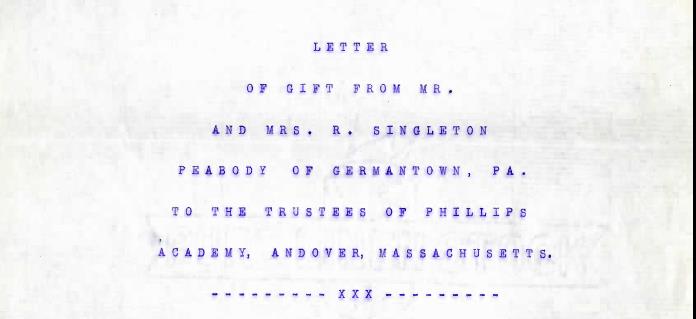
In a letter dated March 6, 1901 from Peabody to the Trustees of Phillips Academy, the amount and purpose of the donation were laid out. Specifically, Peabody wished his collection to have a home for preservation, the establishment of a Department of Archaeology which would be “self-supporting and independent.” Furthermore, this Department should be “disconnected from any other branch of Phillips Academy.” As for the museum itself, “…(it) should be, as far as consistent, tasteful and attractive on its exterior, with good proportions, not too high, and within, light and cheerful as possible, with some simple and tasteful decoration—as tinted walls, etc.” Peabody went on to propose that Moorehead be the first curator because “…Professor Moorehead knows every specimen in the collection, and its history.” Peabody also stipulated, “…that the building/museum be a pleasant place where students might find an agreeable relaxation during the broken events which occur in the lives of the most closely pressed.” In other words, the building would serve not only as a museum but as a social center.

It was no surprise that the amount of the gift to Andover, indicated in a letter dated March 8, 1901 from Peabody to Bancroft, was related to the amount given previously by his uncle in 1866. George Peabody had also dedicated the same amount—$150,000—to aid in founding the Peabody Museum of Archaeology and Ethnology at Harvard and the Yale Peabody Museum of Natural History. To differentiate himself from his uncle, Robert pointed out that his gift would also include a collection of artifacts. These artifacts amounted to one hundred thirty-two boxes containing nearly 50,000 items insured for $35,000 at the time of transportation by rail on July 10, 1901 from Philadelphia to Warren K. Moorehead in Andover. The actual endowment, anonymous by design, included $100,000 for the Peabody Foundation and $50,000 for the building. This amount would grow substantially at Peabody’s death, as he willed the residue and remainder of his estate to Phillips Academy in March, 1902. The total gift amounted to at least $500,000—approximately $12 to $13 million by today’s standards.

What did $50,000 buy in 1901? The future architect for Boston’s Museum of Fine Arts, Guy Lowell, was hired and he submitted plans for the projected museum at Phillips Academy. By the end of October, 1901, ground-breaking began on the site where formerly the First Classroom Building, the Farrar House, and then the Churchill House had been located. The building was completed in less than two years and was dedicated on March 28, 1903, the event was  memorialized in the mid-April 1903 edition of The Phillipian.“The building was tastefully decorated with potted palms and flowers…Mr. Frederick W. Putnam, L.L.D, professor of Ethnology and Archaeology at Harvard, said that students would learn to reason more for themselves, and would depend more upon their own powers than upon text books.”

Student Reflection – Alex Hagler ’16

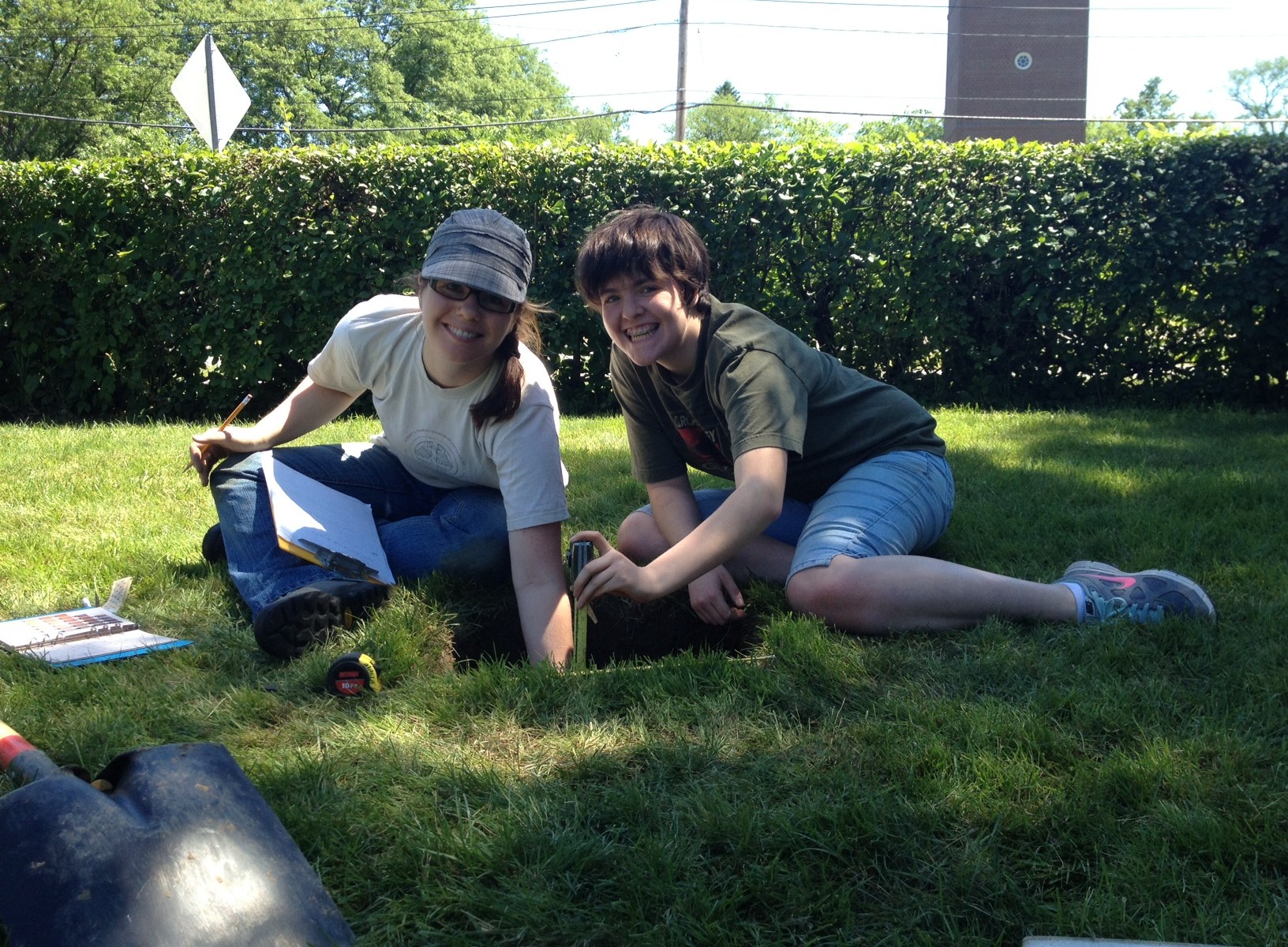
Alex and Marla excavated on campus

Contributed by Alex Hagler ’16

I began working at the Peabody in sixth grade, under the brilliant supervision of Lindsay Randall. I was introduced to the behind-the-scenes workings of a museum, cataloging artifacts, organizing photos, preparing materials for classes, all the jobs of a high school work duty student. It amazed me, and still does, that, despite my young age, I was treated just about the same as any other work duty student. I was given the trust of the people I worked with at the museum, and that trust has remained to this day. Because of that, I have had wonderful, momentous occasions at the Peabody. I represented the Peabody at the 2014 Alumni Reunion Weekend, and I presented the findings of my own independent research project to the Massachusetts Archaeological Society, to name only two. I have enjoyed the constant support of the people with whom I have worked all these years, and so the Peabody has become like a second home to me.

Now, as a graduating senior, I look back on my years at the Peabody. I find that I am mostly content, with only some minor regrets, namely that I have yet to see the floppy disk I was promised way back in sixth grade. But beyond that, I find that I am overwhelmed, reflecting on how I have changed over my years working here. At the beginning, I was nervous, hesitantly exploring the Peabody for the very first time, just starting to explore my new found interest in history. At the end, I am confident, not only in that I have made smart and responsible choices during my time here, but also in that I will continue to do so for the rest of my life. And I have the Peabody to thank for that.

Interested to read more student reflections?  Visit here and here for more perspectives.

Student Reflection – Alana Gudinas ’16

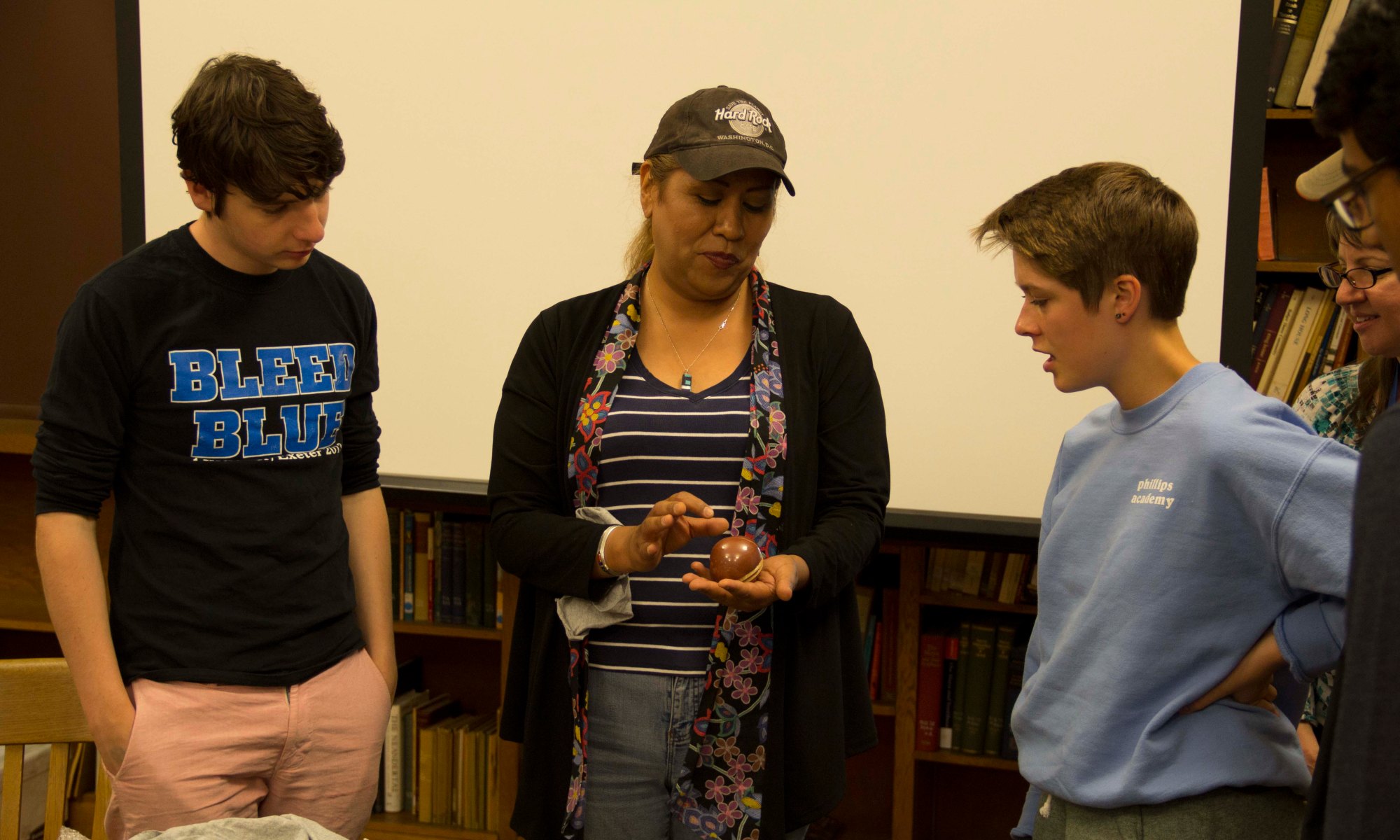
Alana and other work duty students learn about Pueblo pottery from Dominique Toya

Contributed by Alana Gudinas ’16

I started work duty at the Peabody in the beginning of my 10th grade year, mainly because it seemed like the most interesting job to do on campus. How many other high school students have the opportunity to help out at a renowned archaeological museum just a short walk’s away? That year I did a lot of of boring, but necessary, work cataloging objects and essentially entering data into computers. What made doing this so amazing, however, was the fact that I was handling objects that were often thousands of years old, all with their own history and archaeological context. I worked in the same room as Marla and Lindsay, both who shared with me a lot of information about what we were working with and why. This experience I had my sophomore year made me passionate about history and archaeology and want to dive in even deeper.

I did, in fact, become more involved in the Peabody these last two years, through listening to speakers that came to the Peabody for Massachusetts Archaeological Society meetings (and even giving a presentation myself at one of them), meeting the incredibly special artists (such as Dominique and Maxine Toya), teachers, and scholars who visit the museum, and taking a history class the fall term of this year that met in the museum classroom. Having such extensive access and exposure to the Peabody the past three years has instilled in me a love and appreciation for archaeology and all the people involved in the field. I feel that I have learned so much not only about the archaeological and historical background of various objects, but also about the nature of the two fields in general and how they are used in a museum setting. I am endlessly thankful for this experience.

Interested to read more student reflections?  Visit here and here for more perspectives.

Student Reflection – Jacob Boudreau ’16

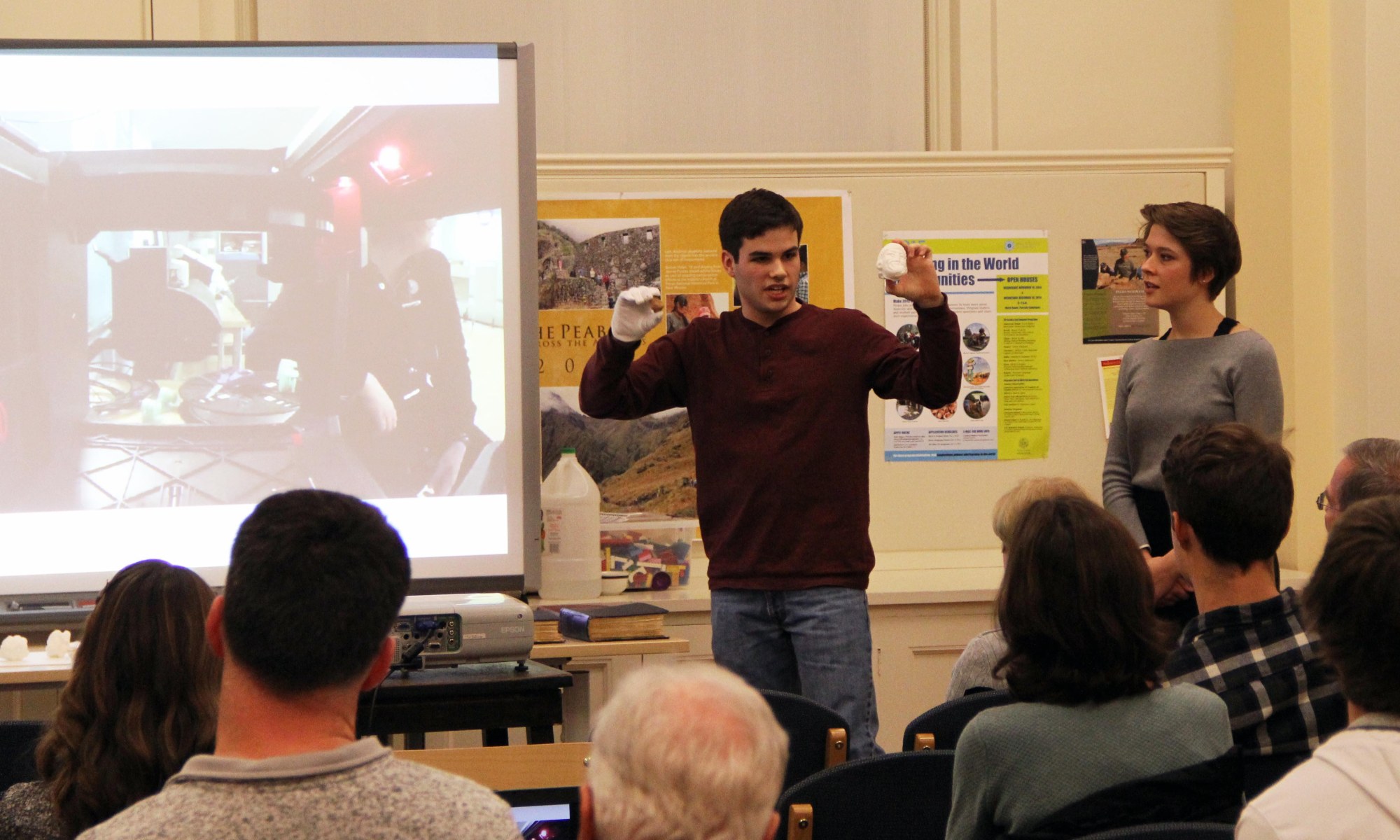
Image of student presenter

Contributed by Jacob Boudreau ’16

I didn’t know what to expect when I started work-duty at the Peabody. I don’t remember choosing to be in it. I didn’t know much at all about archaeology. By my third week of work-duty, I was convinced that archaeology (at the Peabody at least) was nothing but the glorified study of rocks. I was disappointed that I would be stuck inside categorizing rocks for 45 minutes a week, instead of doing one of the quick and easy 5-minute-per-week work-duties.

Those first few weeks, however, are not summary of my time at the Peabody. My time at the Peabody has taught me a lot about archaeology—what it is, what the various aspects of it are, what goes on behind the scenes—and it has imbued me with a deeper appreciation for the discipline. I have learned how artifacts are excavated; how they are stored, cataloged, and inventoried; how one handles delicate artifacts, creates displays for them, records when they are taken out for a class or put back into storage. All of these things I learned during work duty through experience – it was all hands-on. The other work-duty students and I weren’t simply there ticking off check-boxes on a clipboard while the museum staff did the “real work.” We all got the chance to engage directly with the artifacts in the various ways I listed above.

The best part of work-duty at the Peabody is all of the people I get to work with. Each term I work with a new team of students, which is a lot of fun. I really enjoy working with Marla as she always makes the tasks interesting and engaging and talks to us more like adults or friends than high school students.

The highlight of my time at the Peabody was the term that my work-duty group 3D scanned and printed selected artifacts, and then presented our results and research on the topic at a MAS meeting. I’m a math and science guy, and I was thrilled when Marla announced the plans for the term to us. We cooperated with Ms. Wessner from the makerspace and her work-duty students to learn how to scan and print the artifacts we had chosen. We each then presented on a specific part of the project: one student on how we selected the artifacts to print, me on how we scanned and printed them, and two students on the implications of the 3D replication of artifacts. (We also got to eat a lot of food at the meeting.) It just goes to show how interdisciplinary work at the Peabody can be.

Interested to read more student reflections?  Visit here and here for more perspectives.

Neponset Paleoindian Preform

Contributed by Quinn Rosefsky

While most of us have seen “arrowheads,” making sense of the complex world of Paleoindian lithic points is a challenge. The process of manufacture, flint knapping: the shaping of flint, chert, obsidian or other conchoidal fracturing stone through the process of lithic reduction (using a hand-tool pressure-flaking process) demonstrates a highly-advanced knowledge of how flint fractures when struck in specific locations on its surface. That the process has been in use for over 10,000 years commands respect for the fine hand coordination, skill, and thought-processes of individuals using this tool-making method. The example we are examining, a Neponset preform, is representative of the post-Clovis Folsom era.

Paleoindian biface from Neponset site, Massachusetts

About 12,000 years ago on the sandy shoreline of a partially drained glacial lake near what is now Canton, Massachusetts, a flint knapper, a Paleoindian using flint from Mt. Jasper over two hundred miles away in New Hampshire, stopped work on our preform. We can presume that something had gone wrong, resulting in the flint fracturing before it could be transformed into a tool, a projectile point, specifically a spear point. Call it quality control.

New England had three distinct point styles, each named after sites where they were found: Bull Brook, Neponset, and Nicholas. Materials came from three major sources: Munsungan, Maine (chert); Mt. Jasper, New Hampshire (rhyolite); and Hathaway, Vermont (chert). The Neponset site was found at the time of construction of a segment of I-95 not far from Canton. The work done by Stanley Buzarewicz, first in the early 1970s, and then in conjunction with Fred Carty in the late 1970s and early 1980s, yielded a variety of artifacts. In a 100 square meter area the archaeologists found ten fluted points and fragments; two miniature points and drills; thirty channel flakes and fragments; ten bifaces including preforms and fragments; eight leaf-shaped bifaces; and three biface edge fragments.

The findings were thoroughly categorized, including channel flakes because these provided direct evidence that a fluted channel had been created. Fluting refers to distinctive channels knapped into both the obverse and reverse of the point. The ones found at Neponset are distinguished from fluted points found at Bull Brook and Nicholas by stylistic elements. Neponset flutes run more than half the length of the point; have an average length of 6 cm; and are slightly tapered towards the base with flared ears.

The preform point, excavated on May 26, 1979, was described in Fred Carty and Arthur Spiess’s article The Neponset Paleoindian Site in Massachusetts published in Archaeology of Eastern North America, Vol 20 (Fall 1992, pp. 19-37). Made from Neponset rhyolite, it is a dark gray, glassy, nearly opaque material.  In these two pieces—now glued together making it whole again—this specimen was the largest preform found at the Neponset site, weighting 30.31 grams.  It measures 106.2 mm long, 36.6 mm wide at the widest point, and has a 6.2 mm deep basal indentation. The specimen was a final stage preform, meaning it had not yet reached the point where its maker would add the flute and finish its base. For whatever reason the point never reached its final form, we are witnesses to that moment in time, over 10,000 years ago, when a living person made the conscious decision not to complete a task.