We may be down (the road, on Abbot campus) but were not out! As everyone on campus has probably seen there is a big ol’ fence surrounding the Peabody Institute, concealing dirt mountains, front loaders, and a bunch of contractors. This has been going on since April, boy time flies! Despite being out of the building for the last several months (and for several months to follow) we are still here and still part of teaching and learning at Phillips Academy, albeit in a more restricted fashion. Most recently, our director Ryan Wheeler and I helped out the Andover Summer Session with a few different classes. Supplementing the classes with knowledge and items from our collection to enhance the learning of the summer students.
One class was Ella Houlihan’s Intro to Bio class. The students were learning about human evolution, and the Peabody has just the collection to help teach this topic. We brought over about 15 skull casts from all over the hominid family tree and tasked the students to develop their own traits, categories, and potential connections. From there we went over what scientist use to group skulls and layout the human family tree. Pointing out that it’s all rather complicated and even the professionals do not agree.
Students analyze various skull casts in a class activity
We also helped teach a couple classes in Dr. Tessa Hite’s class Mapping our World: The Art and Science Behind Maps. We went over the basic history of Andover, how it moved from Indigenous proprietorship to English ownership. To tie into that we covered concepts of colonization and decolonization, how one culture or society can impose themselves onto another and how efforts are undertaken to amend this. From there we had the students use maps to compare European versus Native American town names (think Mattapoisett vs Andover) and then research the original Indigenous place names. This was done to prompt questions such as “What does, or doesn’t this map tell us” Or “why does it feel empty with Native based town names?” This was done to get the students thinking about the reasoning behind the way the maps are set up and used.
The Peabody is more than happy to help in classes whenever we have an opportunity! Even with more restricted access to the collection, we can get creative and pull something together, as long as you don’t mind the dust!
One cool thing about the Peabody is the varied types of experiences and interests of the people working here. It’s what makes the blog so interesting! For years now, Peabody employees have been making regular blog posts on whatever topic they can think of. From interesting insights into the museum world, to personal interests of the writer, there is always something to look forward to every month.
With new blog posts coming out on such a regular basis, it can be easy to forget that there is quite an accumulation of interesting articles on the Peabody’s website. One can read posts going back to the fall of 2015! While helping to archive the blog, I’ve been reading a lot of fascinating pages, making notes of ones that I found particularly interesting. Creating this was the logical next step, a look back, a spotlight on blogs past. My own blog about blogs!
Note: I am limiting my self to five entries, but this list could easily be three times longer!
Ever since reading The Age of Vikings by Anders Winroth I’ve had a big interest in medieval Scandinavian history. The Vikings and their contemporaries have such a fascinating history, and maintain a strong footprint in popular culture. So imagine my surprise when I found a blog about Viking material at the Peabody!…well, sort of. You should look for yourself!
In teaching a few different classes at the Peabody, the concept of corn comes up quite a bit. Especially since it was a focus of former director Richard “Scotty” MacNeish. When one student asked about why corn spread so far and wide, I recall answering in a jovial way “well you see, humans LOVE corn, and will take any opportunity to grow it!” This blog post is a fascinating dive into the history of this staple crop.
At a glance, the history of archeology (and similar fields) seems very frontloaded with men. However, it’s not hard to find plenty of women heavily involved. Maybe not quite as visible, but just as important, if not more so. This blog post goes into the history of women involved with the Peabody!
Due to the nature of museums, strange tales often go hand and hand with their history, and the Peabody is not lacking in this department. This blog post discusses an interesting one, a theft in the 80s that struck multiple New England museums! If you are interested in a mini crime drama, complete with information on its resolution, this one is worth a look.
I’m a person who would consider themselves an avid “gamer,” as well as one with a background in public history (basically, historical engagement outside of a classroom). Therefore, when I see a game, or a blog post in this case, that combines my two interests, there is no way I am not going to talk about it! This post talks about the game “Never Alone,” developed by Upper One Games and originally released in late 2014. The game was about an Iñupiat girl who goes on an adventure with a fox, based on a traditional Iñupiat tale. The game was made in cooperation with Cook Inlet tribal council, and features…well I don’t want to spoil the post too much! Take a look for yourself!
This blog is the culmination of work done by Independent Researcher/Volunteer Adam Way to explore how the Peabody Institute has been portrayed by Phillips Academy students in The Phillipian over the years. Adam shared two previous blog posts about his work (Combing Through the Phillipianand Combing Through The Phillipian: End of an Era) and recently completed the project. His final blog is a summary of what he learned.
The relationship between The Phillipian and the Peabody Institute has existed since the Institute’s founding back in 1901, and while the strength of that relationship has waxed and waned, it has persisted nonetheless. During my time combing through over a century’s worth of The Phillipian issues, I have noticed a few substantial changes, mainly the amount of coverage that the Peabody Institute received, the type of coverage, and the student’s view of Peabody.
The first major difference that appears when looking through The Phillipian archives is that the number of times that the Peabody is addressed/mentioned decreases drastically towards the present. In 1910, the Peabody Institute, then the Department of Archaeology, was mentioned 153 times throughout the year, with the following years yielding similar results. A significant amount of the times that the Peabody Institute was mentioned in these early years can be attributed to the existence of extracurriculars that took place within the building. Events such as meetings of the Banjo or Drama clubs and other such student activities that took place in the Peabody make up a large portion of mentions, while the rest is composed of articles detailing the academic work and scholarship being conducted by the Institute.
April 15, 1916
The constant high volume of mentions during the early years of the Peabody Institute, unfortunately, do not last forever. It appears that the turning point was, more or less, when Warren K. Moorehead retired from his position as director and was replaced by Douglas Byers. While the overall number of yearly mentions had been on a steady decline since the beginning of the century, the number had remained relatively consistent and the articles were primarily focused on academic work and lectures at the Peabody Institute. This changed when Byers and curator Fred Johnson took over, as it appears that these two did not have as close of a relationship with the ThePhillipian as Moorehead did. This trend continued, and arguably was exacerbated under Richard “Scotty” MacNeish. I believe that this divide can be attributed to a shift in focus from teaching in the classroom to fieldwork, as all three of these former directors placed a heavy emphasis on fieldwork, while there was a lack of a consistent archaeology and/or anthropology class during this period (with other factors playing into that decision like student interest). Luckily, in the time since MacNeish, the Peabody Institute has regained a stronger, and more frequent, presence in the The Phillipian.
April 3, 1937
The next major change that I noticed while conducting this research, was that the type of coverage that the Peabody received changed over the years. Initially, I noticed this change through the club announcements. As time went on, the number of clubs using the Peabody, or at least publishing that they were in The Phillipian, was declining. Nothing about this appeared to be out of the ordinary as clubs moved to other buildings and Peabody House was constructed for the purpose of holding social events and clubs. The part that seemed strange to me was when members of the Peabody staff and faculty would leave without a single mention of their departure and only a brief mention when their replacement had been found, as was the case with Dick Drennan in 1977. However, as time progressed, the type of coverage in this area also shifted. Not only was there an article detailing the departure of the previous director, Malinda Stafford Blustain, but there was a subsequent article about the hiring of her replacement, Ryan Wheeler. It appears that the relationship between the The Phillipian and the Peabody Institute is steadily returning to its former strength.
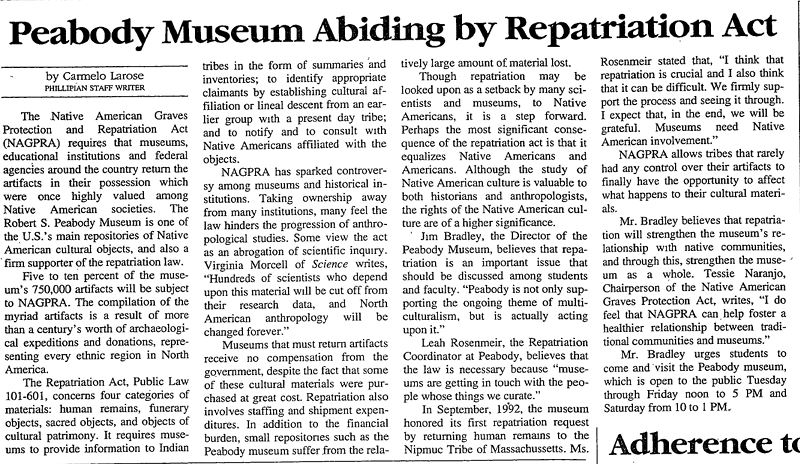
The last major change that I have noticed is the waxing and waning of student interest in the Peabody Institute over the years. As with the other two variables that changed over time, student interest seemed to peek early on before dropping drastically as time progressed. After Moorehead’s departure and the subsequent drop in attention received from The Phillipian, the Peabody became increasingly referred to as a “hidden gem” and “unused asset.” There were even pieces written as a joke that say a student died of boredom due to their visit to the Peabody. Pieces like these are written in good fun, however, it does highlight the disparity between how involved students once were and how involved they are now. As with the other two changes that I noticed, this too is changing for the better in recent years. While there are still joke articles, there are fewer instances where the Peabody is labeled as an “unused asset.” There appears to have been a positive reception of student travel programs in the recent past as well as current lectures and other programs offered by the Peabody Institute.
October 7, 1994
While my time combing through The Phillipian has come to a close, I am glad to see that the Robert S. Peabody Institute of Archaeology is making a resurgence within the paper. The records showed that the institution has been through some difficult times and yet has prevailed and is strengthening its place within the Academy and student life.
Hi! My name is Nicholas Andrusin (or just Nick), and I am the new Temporary Educator/Collections Assistant at the Robert S. Peabody Institute of Archaeology! I began in early November, and I am so excited to be a part of the Peabody and work with the staff! In this position I will be helping with the ongoing renovation project and teaching lessons.
Before moving to North Reading , MA in August 2022 I was living in Rochester, NY, where I earned a master’s degree in history at SUNY Brockport with a focus on public history. There I spent time as an intern at the Rochester Museum and Science Center where I helped them with their own storage renovation project. As well as helping the Rochester city historian create their Stonewall: 50 Years Out exhibit for the 50th anniversary of the Stonewall riots.
This position at the Peabody feels made for me! So far, I have been helping with a variety of collections related projects. From cataloging, to getting measurements of storage space, to rehousing objects into proper storages containers for the eventual move, they are exactly the kinds of tasks I love doing. In addition, I have also been helping to teach lessons to Phillips Academy students! From Tarps, which simulate a basic archaeological dig, to lectures on the Taíno people, the group who discovered Christopher Columbus. It has been a pleasure to flex my teaching muscles!
(that’s me in the gray hoodie!)
Museums have always been of huge interest to me, and I am fortunate enough to have had a small hand in helping several of them over the years, the Peabody being the most recent and exciting! I am so thankful and delighted to be a part of this team, and I cannot wait to see what the future holds.
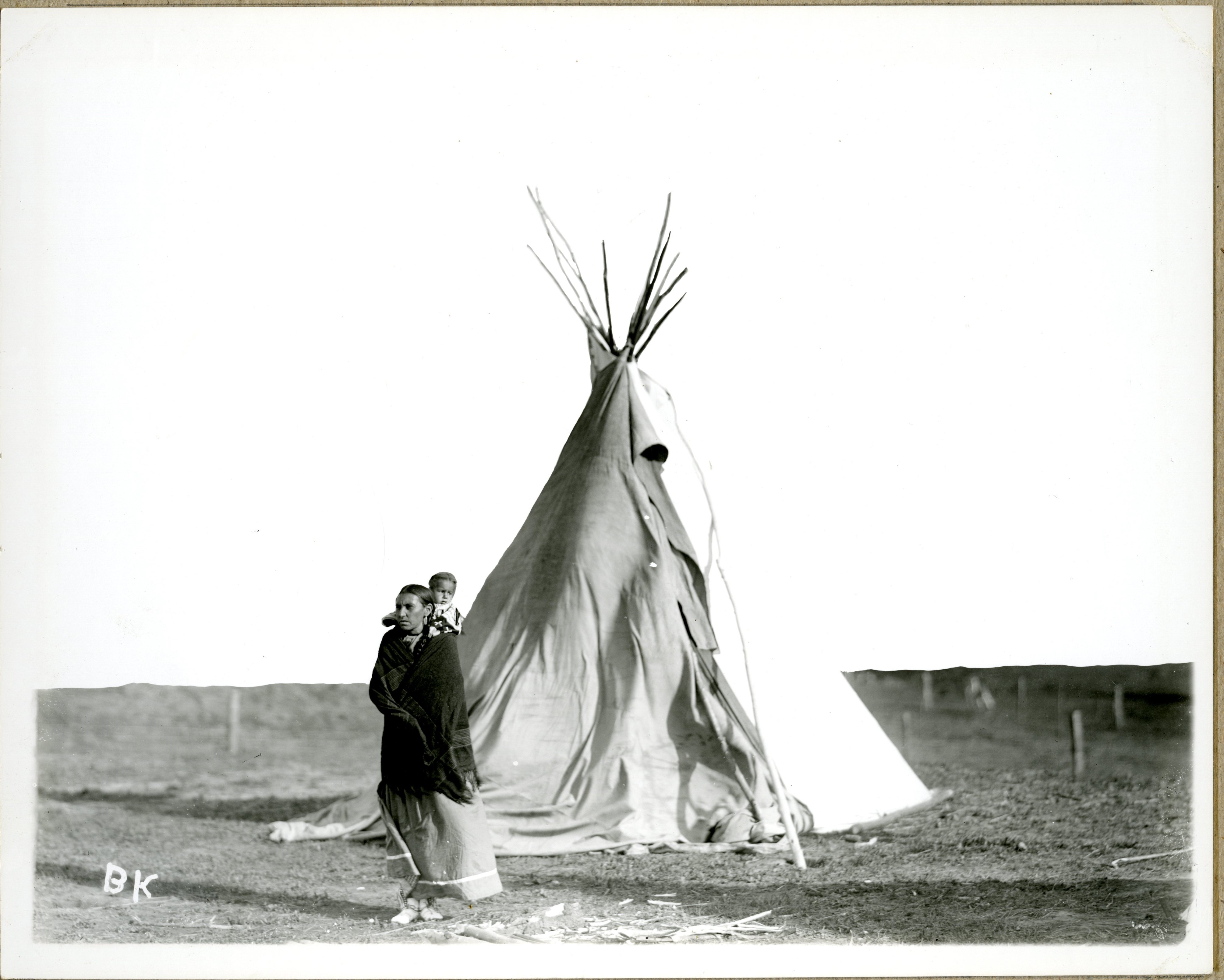
My name is Deirdre Hutchison, and I am currently studying for my B.A. in history at UMass Lowell. As part of a semester internship, I had the opportunity to research the provenance of several unidentified Native American photographs held by the Robert S. Peabody Institute of Archaeology. My first blog outlined initial findings and potential areas of investigation. To summarize that blog, the photos, mounted on board, illustrate a 1905 event at the 101 Ranch in Oklahoma.
As I navigated various connections, photographer James B. Kent became a more prominent fixture of my research. Kent was a regular photographer at the 101 Ranch, and the Millers tapped him to design and compile the souvenir booklet for “Oklahoma’s Gala Day” at the ranch on June 11, 1905. –. Kent, it seems, was an integral part of photography at the 101 Ranch, ultimately becoming the head of the moving pictures department by 1927.
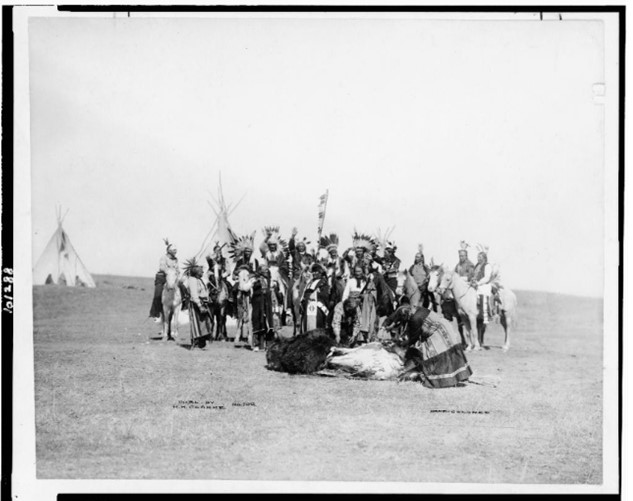
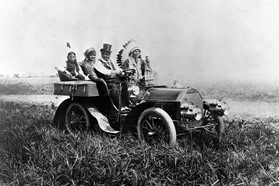
The 101 Ranch souvenir booklet is discussed by Michael Wallis in his book The Real Wild West. According to Wallis, it contains multiple images taken by Kent – including the picture of Geronimo skinning a buffalo held by the Peabody (discussed in my previous blog). The booklet also contains one of the most famous images of Geronimo, “Geronimo in an Automobile.” . Working with the archival staff at the Gilcrease Museum in Tulsa, I hope to view the images to confirm Kent’s pictures and perhaps discern other possible photo matches.
Isolating Kent’s work is relevant because he was not the only photographer working at the famous extravaganza on June 11, 1905. The Millers masterfully orchestrated spectacle – 65,000 people attended – could not be supported by just one photographer. Multiple photographers were present capturing various promotional images at the behest of the brothers. This is immediately evident in the Library of Congress photo of “Geronimo Skinning a Buffalo” that identifies O. Drum as the photographer. The strikingly similar images of the Peabody and the Library of Congress differ in only small ways. It seems a bank of photographers captured the same scene, each image similar, but slightly different: a person with a head facing a different direction, an extra person, women bending, or a western-clad gentleman caught talking with those being prepped for the publicity shoot.
Another name that kept popping up in my research and commonly associated with a broad range of images, including Kent’s, was the publisher H. H. Clarke. Not only did Clarke produce black and white photographs, but he also manufactured color versions for global distribution, and several of his postcards bear the notation Made in Germany. Clarke’s color versions are considered unique as he employed a hand-coloring technique rather than standard lithography. Other examples of this work are at the Cherokee Strip Museum (Cheryl DeJager, Cherokee Strip Museum, personal communication).
Printed in Germany , published by H.H. Clarke. Personal collection of Deirdre HutchisonUnidentified photograph from the Peabody Institute
Although Clarke published images by Kent and other photographers, establishing a direct link between them is difficult. However, sifting through metadata across several institutions, I discovered interesting connections that explore the publishing and manufacture of images onto postcards. For example, in the early twentieth century, professional and amateur photographers could sell their negatives directly to distributors such as Clarke or major publishing houses such as The Albertype Company. The Library of Congress cites Albertype and Clarke for one of two images listed of Geronimo in a car.
Clarke published three photos I initially matched with the Library of Congress. However, with only a thumbnail view available, I could not say with conviction they were identical to the Peabody images. After corresponding with the Prints and Photographs Division at the Library of Congress, enlarged views are now accessible online which allowed me to confirm that two photos were identical to those at the Peabody, but a discrepancy arose with the third. A close inspection reveals small but salient differences between the image at the Peabody and the one at the Library of Congress. For example, in the Peabody image, women are standing over the buffalo, but in the Library of Congress, they are bending over. Furthermore, in the Peabody image, a man stands to the buffalo’s left with his back to the camera, notable for his western-style suit, boots, and derby hat. Kent was known for always wearing his signature derby hat, leading me to speculate he was directing the people for the staged photograph and was caught on camera by another photographer.
Ponca Indian Scouts, Library of CongressPonca Indian Scouts, Peabody Institute
When I started this project, I naively thought I would find solid evidence pertaining to Warren Moorehead’s acquisition of the images. As the museum’s first curator and renowned Native American expert, I thought, how could there not be a connection? Yet, every avenue of research proved fruitless with Moorehead. The narrative unfolded around the Miller Brothers, James “Bennie” Kent, and H. H. Clarke. The interconnectedness of these people provided many answers; the photographs were staged publicity images, taken at the 101 Ranch and predominantly early 1900s. Unraveling this fascinating story has been immensely rewarding, yet it seemed unlikely I would find any correlation between the images and their arrival at the museum.
Despite this disappointment, potential connections with the Peabody Institute and theories of acquisition emerged when reviewing my data, though initially not with Moorehead. Ernest Whitworth Marland was in business with the Millers and became Governor of Oklahoma. Frank Phillips of Phillips Oil was also involved with the Millers and the 101 Ranch. Both men were natives of Pennsylvania, as was Robert S. Peabody. Each man was wealthy, prominent, and quite conceivably moved in the same upper echelons of society. It is possible either of these could have passed photographs to Moorehead or the Peabody. Considering the student body of Phillips Academy, any alum could have given the images as a donation to their alma mater. Equally so, any faculty member may have been gifted the photos. All of these are plausible scenarios. However, another tenuous link emerged, excitedly leading me back to Moorehead. The collections description for the three Library of Congress images mentioned earlier notes that they are mounted photographs, as are the ones at the Peabody.
Another facet that piqued my interest was the descriptions accompanying records at the National Archives. “Geronimo in a Car” is cited as taken on June 11, 1905, at the Millers’ Oklahoma Gala Day, along with other images; all are 8×10 or larger, just like the Peabody images. Although far from compelling, there are commonalities.
What I found most compelling with the National Archives photo of “Geronimo in a Car” was that it states a copy was sent to the Office of the Commissioner of Indian Affairs. The Office of Indian Affairs later became the Bureau of Indian Affairs. Moorehead was appointed to the board of commissioners for the Bureau of Indian Affairs by President Roosevelt in 1908.
Geronimo Driving a Car. Oklahoma Gala Day, June 11, 1905. Wall Street Journal
As an emerging historian, I like to focus on facts. Unfortunately, facts can be notoriously distorted by time, memory, and absent material evidence. However, the absence of proof does not equate to the absence of the action. Although I had discounted Moorehead as the conduit, I have circled back and believe he is a strong acquisition candidate based on my latest discoveries. That particular mystery may never be solved, but it does not detract from the powerful narrative of Native American presence and treatment in mainstream society in the early twentieth century.
My name is Deirdre Hutchison and I am currently studying for my B.A. in history at UMass Lowell. One of the things I love most about college is delving into archival research, unraveling forgotten stories, and the thrill when making connections that reveal new pieces of information, or even reshape the original context.
Recently I came across Warren K. Moorehead through his publication “The Merrimack Archaeological Survey.” Intrigued by this contradictory personality, I was excited to get the opportunity to do an internship at the Peabody and expand my knowledge on his work. Given my previous exposure and interest, curator Marla Taylor suggested I work on identifying information on approximately 30-50 photographs at the Peabody. The collection depicts ethnographic images of Native Americans. My objective was to discover how these images came to the museum, what was the purpose of the photos, and who may own the copyright. Given the magnitude of the search, it made sense to focus initially on only a few photographs. Several images had dates (early 20th century), captions with “101 Ranch, Oklahoma”, tribal names, and even a photographer name. Collectively, this seemed to occur during Moorehead’s tenure, and thus the investigation began with the Peabody’s first curator.
An example of one of the photographs being researched
As I eagerly navigated box after box of Moorehead records, I felt sure it was only a matter of time before I would make a connection between the man and the photos. After combing through his publications, correspondence centered on Oklahoma and the early 1900s, and hundreds of lantern slides later, a different narrative was emerging, though no less intriguing. Despite the vast array of articles, records and collections at the museum, disappointingly, no connection could yet be found between Moorehead and these early images. Details on the named photographer, Kent Chandler of OK, proved equally elusive. However, as we all learn in high school, never underestimate the importance of a comma. With no comma between Kent and Chandler on the photograph mount, I assumed it was his full name. Further digging finally revealed a gentleman named James Kent who lived in Chandler and worked with the 101 Ranch in OK.
Miller Brothers 101 Ranch (19276.76, Oklahoma Historical Society)Pawnee Bill and Zack Miller on Horseback at the Miller Brothers 101 Ranch, Oklahoma.
My next investigative step was the Library of Congress. For three of the photos held at the Peabody I found a match. Excitedly I noticed the details confirmed those at the Peabody – the photos were of the Ponca tribe and taken at the 101 Ranch in Bliss, OK. However, I now had another new piece of key information, the publisher was H.H.Clarke. Investigation into the 101 Ranch revealed the Miller Brothers, famed for their wild west shows for decades, as the brainchild behind the images. Further insight came from a bio on the Oklahoma Historical Society of photographer James B. Kent, revealing he was a resident photographer for the Miller Brothers.
Despite making headway, H.H. Clarke, the publisher of the images, also proved difficult to trace. Finally, I found a reference to publishers H.H. Clarke on the Cherokee Strip Museum website in Perry, Oklahoma. Clarke and his wife operated a small newspaper and native curio store but also had a sideline in publishing postcards. Once again, up popped the 101 Ranch as the backdrop for many of their postcards. All roads keep circling back to the Miller Brothers. It seems they had quite the operation! The Oklahoma Historical Society has an interesting documentary from c.1950 that highlights the magnitude of the activities of the brothers and the ranch which can be watched here.
At the “Oklahoma Gala day” exhibit in 1905, the Millers had their ranch hands and Native Americans demonstrate their skills and featured the incarcerated Geronimo killing a buffalo as a special attraction.
Geronimo skinning a buffalo from the Peabody’s image collection – a similar image to the one in the Library of Congress yet with notable differences
It appears the brothers showcased many Native Americans performing a range of similar publicity stunts. Kent was one of their preferred photographers for these staged events and H.H. Clarke often published them.
How the images came to the Peabody is still not clear. However, I hope I can uncover more information from the archives of the Oklahoma Historical Society which has a great deal of information on the Millers and the ranch.
There is no doubt headway has been made on the purpose of the photos. As I navigate the vast empire of the Miller brothers, propaganda, and unashamedly, profit, seem to be the key factors in their relationship with Native American photos. The question stills remains of how the images came to the Peabody. As I move through the next few weeks, I am hoping to find a link between the Miller brothers, 101 Ranch, and the Peabody. At the same time, establishing who has reproduction rights on the images that I have identified will be key to achieving my goals. As with any historical research, and in the absence of records, there are no guarantees. However, I hope to get as close to the truth as one can and there is no doubt that this journey is as exiting as the destination. More to come…
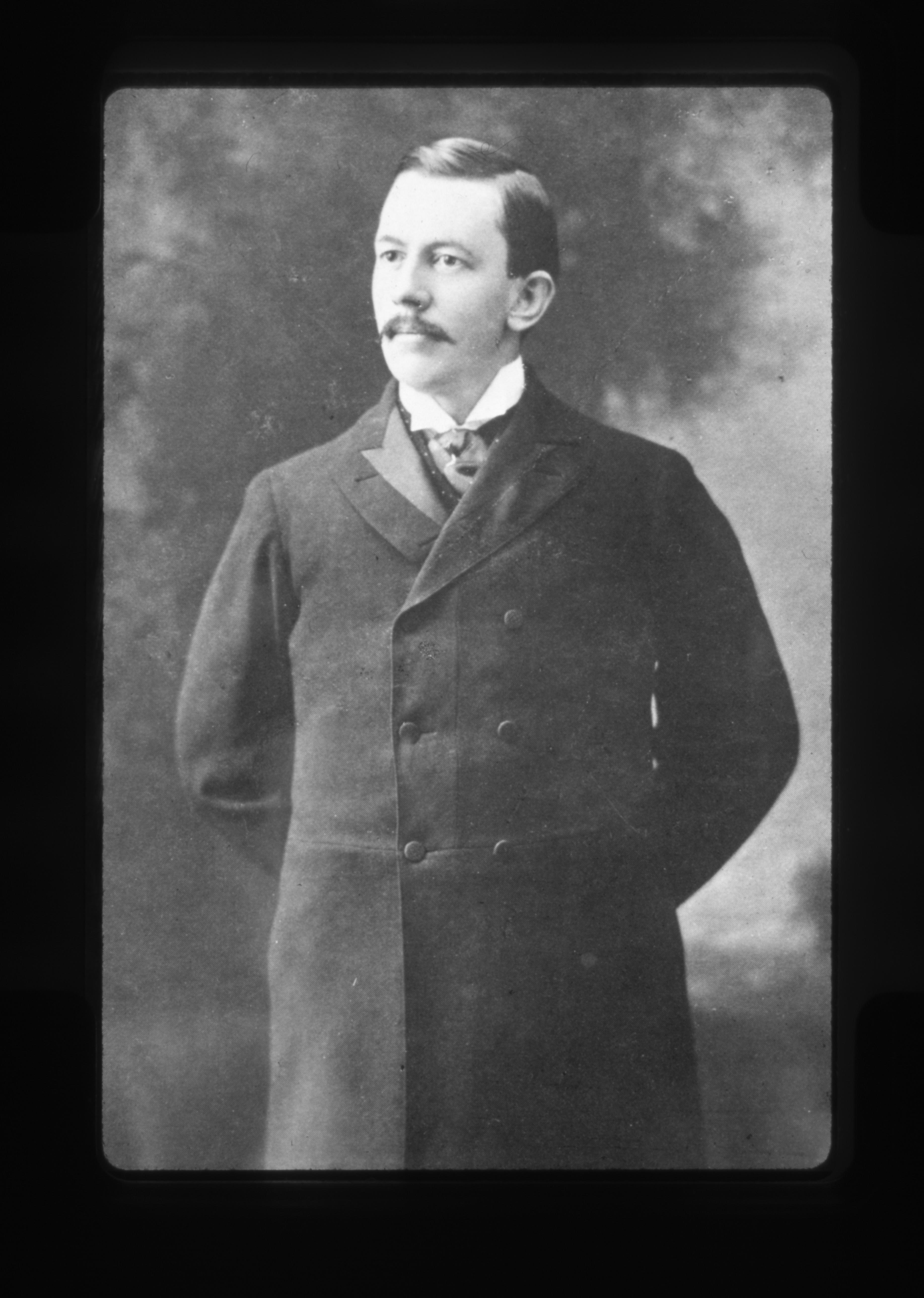
In the June 17, 1938 issue of The Phillipian, it was announced that Dr. Warren King Moorehead would be leaving his post as Director of the Department of Archaeology. This brought about the end of a long and prosperous career that saw Moorehead become an integral part of the Phillips Andover community and a major contributor to the field of archaeology as a whole.
Portrait of Warren K. Moorehead, 1898
Moorehead began his career in the 1880s when he studied at Denison University before becoming an assistant at the Smithsonian Institution and later the curator of the Ohio Archaeological and Historical Society (now the Ohio History Connection). He joined the Department of Archaeology at Phillips Andover at its inception in 1901 and was appointed as the first curator. In fact, he worked closely with Robert S. Peabody, the Department’s founder, to develop the idea of such an institution. During his time as part of the Department, Moorehead received a Master of Arts from Dartmouth and was made a Doctor of Science in 1927 by Oglethorpe University and again in 1930 by Denison University. He became the director of the Department after Dr. Charles Peabody stepped down in 1924.
The article that announces Dr. Moorehead’s retirement is not particularly long but does highlight some of the important aspects of his career. The article spends a majority of its content on his education and on his path to becoming the director. The article does include some of his other accomplishments, such as a partial list of publications, and a mention about his work with the US Board of Indian Commissioners. The article concludes by saying that his position within the archaeology community is undisputed and that he will be travelling to Europe with his wife for the summer.
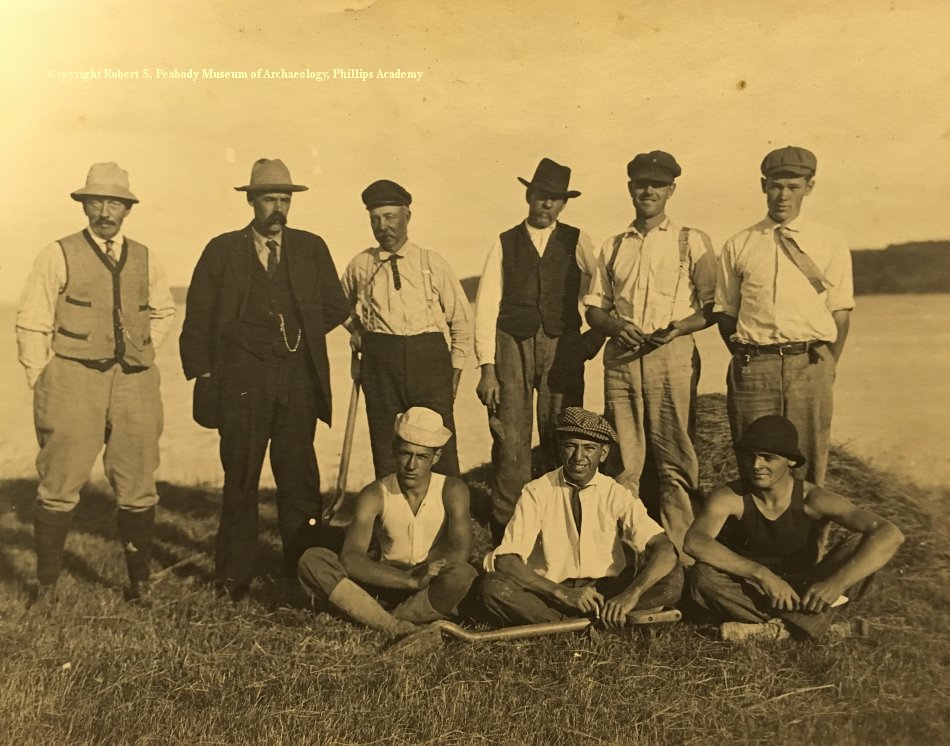
Warren K. Moorehead (far left) with an excavation group
Personally I was surprised with how Moorehead’s departure was presented in The Phillipian, particularly the brevity in which they describe his career. In the numerous issues of The Phillipian throughout the years that I have researched, it became clear just how much Moorehead fought for the rights of Native Americans and how he fought to bring the injustices committed against them to light. This was a frequently recurring topic for Moorehead and yet receives one sentence in his retirement article. This also occurs with his numerous archaeological discoveries from across the country. A significant aspect of Moorehead’s career was his participation in and leadership of numerous excavations and expeditions over the years and, unfortunately, that aspect receives little attention in this article, such as his work throughout New England, the Midwest, and Southeast. Although his methods do not meet today’s standards, Moorehead made multiple important contributions to the field that went unmentioned in his retirement article.
I think that the reason I was so surprised was that the reception that Moorehead received in this article differs from most of his other appearances in The Phillipian. Many of the articles that featured Moorehead over the years went into a fair amount of detail. Whether it was discussing a lecture or one of his expeditions, the reader was usually given more information. Moorehead was seemingly respected and well liked by the students, as evidenced in numerous articles praising his lectures, yet the announcement of his retirement is rather straightforward and relatively unemotional. One possible reason for this could be declining student interest in the Department over the few years prior to his retirement and his habit of giving very similar lectures every year. Moorehead’s sendoff did not mirror his depiction in previous issues of The Phillipian.
Warren King Moorehead was a staple of the Department of Archaeology from its inception in 1901 until his retirement in 1938 having served as both the curator and then as the director. He retired at the age of 72 and spent his brief retirement with his family before passing in January of 1939.
Check out the following Peabody blogs for more information and history about Warren K. Moorehead.
After I’ve spent nearly two years (minus five months of remote work) working to complete the inventory of the Peabody collection, we are so close to finishing! It has been a long process which wouldn’t have been possible without one thing: podcasts.
During those long hours cataloguing in the Peabody, it can get very quiet—and sometimes slightly creepy when you’re working alone in the basement of an old building which tends to make strange noises. Enter: podcasts, which not only help to pass the time but drown out any creepy noises or the sounds of disembodied footsteps coming from upstairs.
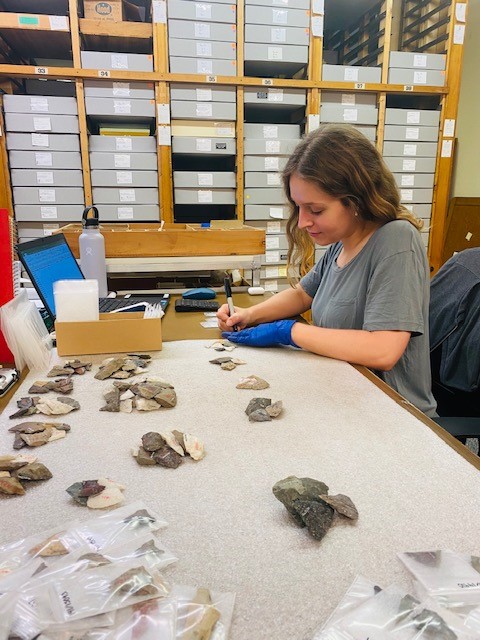
Here I am cataloguing and rehousing material in the Peabody Collection.
I had never listened to a podcast before working here, but now I can definitively say I am a podcast aficionado! I’ve spent the last two years listening to a wide variety of podcasts from beginning to end—some of which had six years’ worth of episodes to catch up on. I’d now like to share them with you in case anyone is in need of hundreds (possibly thousands, but I don’t want to do that math) of hours of listening material.
As a disclaimer, some of these podcasts do use explicit language so I have written an (E) next to each title which indicates that the podcast does use explicit language.
This podcast tells some of the darker stories from American history, from little known tales like the rainmaker who flooded San Diego to the only successful coup d’états to date. You’ll definitely learn some interesting stories that didn’t make it into our history books as kids.
Hosts Scott and Forrest investigate all things mysterious in this (sometimes very long) podcast. From strange disappearances to ghost stories to UFOs to Bigfoot and all things in between, they do incredibly deep dives to investigate evidence for and against these curious tales. The Peabody’s own Warren Moorehead was even mentioned in an episode exploring the legends of giants (if you haven’t already, check out the blog post I wrote about it). Two of my favorite topics they’ve covered are the disappearance of Amelia Earhart and the Dyatlov Pass incident.
This interview show features inanimate objects as guests, who tell their life stories and what it’s like to live like them. One of my favorite episodes is Lillian, a Song and Chioke, who was a grain of sand in his first episode, before being transformed into a pane of glass for his second episode.
This 12-episode immersive podcast series follows the investigation of Ryan Bailey, who is accidentally thrust into the secret world of mythical faeries. Join her as she unearths more of their secrets and the agency that is supposedly charged with protecting them.
In this weekly podcast, host Jonathan Van Ness (one of the hosts of TV show Queer Eye) sits down with an expert to talk about anything and everything he is curious about. Topics include politics, animals, social justice, history, and pretty much anything else you could think of. My favorite episodes are the ones where he explores the ancient histories of the Mediterranean, Egypt, China, and Mesoamerica. He has also done two very interesting episodes titled “How has the U.S. disrupted Native American food sources?” and “How are contemporary Native Americans thriving?”. With such a broad range of topics, there’s something for everyone and Jonathan’s hilarious quips and dynamic personality make it so fun to listen to.
This podcast tells the most entertaining and enraging stories from Greek and Roman mythology, told casually, sarcastically, and from a contemporary lens. Host Liv focuses on not only the wild things the Gods did, but also the rampant mistreatment of the women present in these stories. She also has very interesting conversations with authors and classicists to talk about their perceptions of the myths. Some of my favorite episodes are the series on Cupid and Psyche and the Medusa episodes.
In this bi-weekly podcast, host Aaron tells true-life scary stories. In these dark historical tales, he explores mysterious creatures, tragic events, and unusual happenings. Due to the success of the podcast, it was actually adapted into several books and a TV series!
From serial killers to disappearances, hosts John and Daryn break down these cases while Matt the Bartender mixes up drinks, making a heavy subject a little more palatable with their sense of humor. Unfortunately this podcast is no longer making new episodes, however there’s four years of weekly episodes for your listening pleasure!
This podcast features the stories of some of the most fascinating nobles and royals in history. Host Dana tells tales of tyrants, ill-fated love affairs, family drama, bad decisions, murder, and so much more. My favorite episode is titled “From Poland with Love” about noblewoman turned World War II spy, Krystyna Skarbek, but all of the episodes are incredibly interesting and paint a different picture of some royals than what you may have learned growing up.
In this weekly podcast, hosts Sara and Danny break down crimes of all kinds—murders, disappearances, cults, scams, and conspiracies—with a healthy dose of humor. My favorite episodes are the ones exploring cults, especially lesser-known cults, such as the Yellow Deli Cult and the Love Has Won Cult.
Hosts Katie and Nathan tell the stories of queens (and sometimes mistresses and other noblewomen) from history, from the well-known like Mary, Queen of Scots, to the lesser-known like Ranavalona. Their stories trace these women’s lives from birth to death, through tragedy and triumph, despite the unfortunate lack of information that was kept about some of these women. As a disclaimer, the first few episodes are actually very hard to listen to because of poor audio quality (they were still figuring things out!), so maybe skip ahead a few episodes if it bothers you. Some of the most interesting episodes in my opinion are on Sayyida Al Hurra, Boudica, and Victoria Woodhull.
In this true crime podcast, hosts John and Daryn (previously from Martinis and Murder) have rebranded and are back to tell more stories of disturbing crimes that leave us shaken, complete with their drinks and sense of humor.
Host Kate takes listeners on a time-travelling journey through history, one era at a time. She explores what life would have been like for women during these times, both the famous ones and the obscure. If you’ve ever wondered what ancient Romans ate for breakfast, what a day in the life of a Civil War nurse was like, or what the beauty routine of an ancient Egyptian was, then this is the podcast for you! I just finished all the episodes and am absolutely obsessed with it. I only wish there were more episodes for me to listen to!
In this immersive podcast experience set in a creepy old library, host Miranda Merrick and her dear friend Mr. Darling tell stories of the shadowy, mysterious, and macabre. From bog bodies to ancient books and curses, and from poison to demons, this podcast is perfect for anyone looking for something a little spooky.
In this eight-part series, host Anne travels to her hometown of Springfield, Missouri to follow up on an unsolved crime. On June 7, 1992, Sherrill Levitt, her daughter Suzie Streeter, and Suzie’s friend Stacy McCall all disappeared from Sherrill’s home, seemingly without a trace. Nearly thirty years later, there are still no answers for the women’s families. Follow Anne as she traces the stories of these women and how their disappearance changed this small town in the Ozarks forever.
This story-based podcast explores a new unexplained mystery each week, taking listeners on a journey through the strange and often eerie. Through bizarre tales of time-slips, mysterious disappearances, unexplained deaths, dabblings in the occult, and so much more, host Richard examines the nature of reality and the human condition. Some of the most interesting episodes in my opinion are “The Last Flight” about the disappearance of Frederick Valentich, and “When the Snow Melts” about the Dyatlov Pass incident (Astonishing Legends also did a deep dive on both of these topics in their podcast).
The Vanished (generally not explicit but some episodes do include explicit language)
This true crime podcast covers the stories of missing persons, generally lesser-known ones who may not have gotten much attention in the media. Going beyond conventional news reports, host Marissa dives into the story of each missing person, including interviews with family members, friends, and law enforcement. This podcast can be very sad to listen to but, like the host, I believe it’s important to keep the stories of these people alive so that hopefully one day their family can get closure.
Hosts Mike and Sarah reconsider past events or people that have been miscast or misrepresented in the public imagination and/or by the media, all with some sarcasm and a great sense of humor. This show has really changed my perception of so many things I thought I knew, from maligned women of the ‘90s to stranger danger. I love all of the episodes so it is very hard to pick any favorites, however some of the most interesting are “Human Trafficking”, “Tonya Harding”, “Political Correctness”, and the series on Princess Diana. I think this is probably my favorite podcast out of all I’ve listened to so I highly recommend it!
I hope that in sharing all of these with you, you can find something new and interesting to listen to and perhaps will learn some new things!
My name is Adam Way. I am currently a graduate student at the University of New Hampshire and am working towards my Master’s Degree in Museum Studies. This summer I am working as an independent researcher for the Peabody Institute looking through old Phillipians to see how the Institution has been perceived and presented by Phillips Academy students over time.
This is me on the Cadir Hoyuk archaeological site located in central Turkey in 2018.
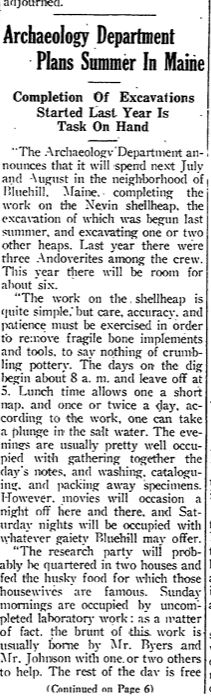
In the modern day, there are a number of factors that determine the best place for an artifact or specimen, whether it is in a museum, either private or public, or with the people for which the item has cultural significance. This, of course, has not always been the case. For a long time, the mentality regarding the storage, display, and ownership of artifacts was similar to that expressed in Indiana Jones and the Last Crusade: “It belongs in a museum.” This mind set and practice is certainly present during the early years of the Archaeology Department, now the Peabody Institute, and is reflected in the publication of its various acquisitions in the Phillipian.
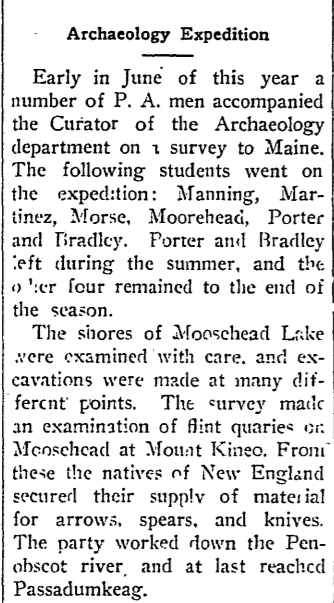
There are numerous ways that a museum or institution, such as the Peabody, can increase the size of its collections. These methods include donations, purchasing and exchanging of collections, and conducting archaeological expeditions. Through these methods, the Peabody was able to amass a collection of around 81,000 specimens within its first twelve years of operation (according to the Founders’ Day issue of the Phillipian from Oct 11, 1913).
Phillipian Article, October 11, 1913
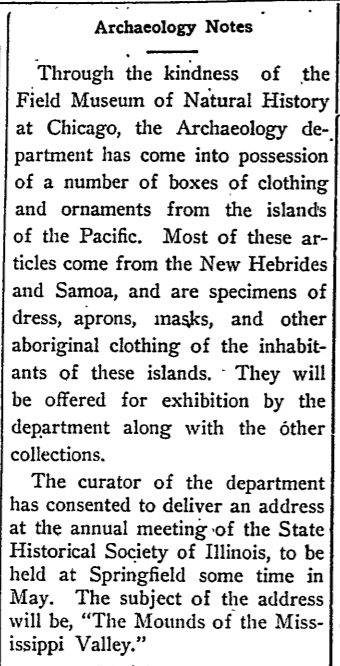
While looking through the issues of the Phillipian, it quickly became clear to me that two of these methods of acquisition occurred more often than the third – donations and purchases/exchanges. Donations played a key role during the early years of the Archaeology Department and its collections as they allowed for the collections to grow without draining their available funds. The Department received donations from both individuals with private collections as well as from other organizations. This can be seen in instances like the gift from the Field Museum of Natural History in Chicago, where a sizable donation of clothing and ornaments from the Pacific Islands was made in March of 1910 (although these are not currently present in the Peabody’s collection). While donations like this did occur, it was much more common for individuals to make donations from their own private collections. These gifts tended to be smaller in size but would still dramatically impact the total collections due to the overall volume.
Phillipian Article, March 12, 1910
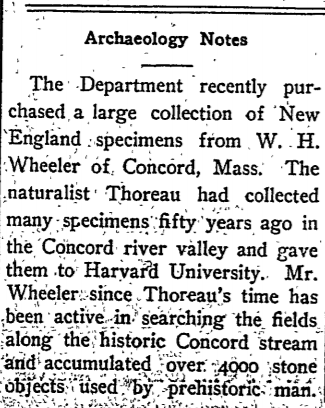
The other means of acquisition that occurred often was the act of purchasing collections or engaging in a trade. For example, In the Feb 1 issue of 1913, it was announced that Moorehead had traveled to Yarmouth, Maine to secure a collection from an Arthur Marks, Esq. By securing this collection, Moorehead added roughly 2000 specimens to the Department’s total collection. This was also only a few months after they had purchased another collection from W.H. Wheeler of Concord, MA. The Wheeler collection consisted of over 4000 objects from around New England and was the largest single purchase by the Department in the region.
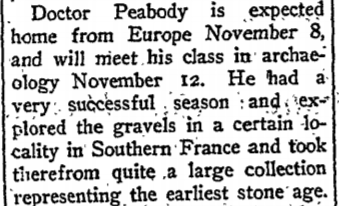
The last way that the Department expands their collection is through sponsored archaeological expeditions. This method of acquiring new specimens definitely occurs less often than the other two methods, especially at first, but becomes more frequent as time goes on. According to the articles in the Phillipian, the specimens retrieved from archaeological digs was fairly limited at first. They mainly came from Moorehead and Peabody’s research expeditions, both throughout the States and in Europe. It was mentioned several times that both men shipped collections of varying sizes back from Southern France. The number of domestic digs did increase as the years went on as Moorehead started a yearly expedition to Maine that brought in roughly 1000 specimens in the first year alone (1912). This specific expedition would prove fruitful for Moorehead as he returned many times in the coming years. In addition to Moorehead’s expeditions, there would also be collection trips where a member of the Department would be sent to a region, such as Eastern Massachusetts, and would be tasked with finding artifacts from old sites. These trips were quite common and could bring in up to 8000 artifacts in one year (1912-13).
From what I have seen in the Phillipian’s coverage of the ever-expanding collection, these methods of adding to the total collections of the Department contributed roughly the same amount. The amount of donations and purchases of collections far outnumber the number of archaeological expeditions; however, they are often much smaller in size. The balance of these three methods is subject to change as I have only read what has happened in the early years of the Department. It is nonetheless impressive how the Department was able to amass such a large collection in such a small amount of time.
After months of cold temperatures and snow storms I’m sure we’re all looking forward to spring and warmer weather! This year the first day of spring, or the spring equinox, takes place on March 20th. To some, equinoxes mark nothing more than seasons passing by. But to others, they were and still are an important time for celebration.
For many Indigenous cultures around the world, the spring equinox is an important time for not only practical, but also ceremonial purposes. Equinoxes were traditionally used to determine what animals would be available for hunting, when to plant and harvest crops, and they marked periods of migration for nomadic groups.
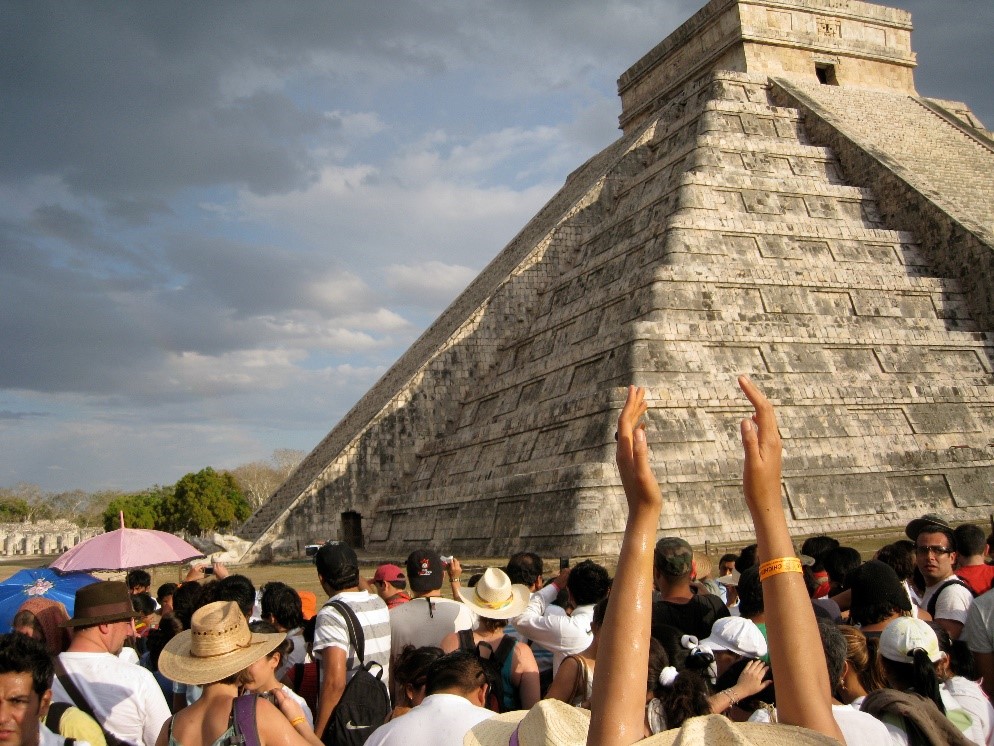
The equinox is marked differently by Indigenous nations around the world, but because tracking the sun’s movements was essential for survival, some cultures found ways to do so in the form of solar calendars. The Maya calendar is perhaps the most well-known of these but there were many others. The Mayans also created other ways to track the sun. The Pyramid of Kulkulkan (or El Castillo) at the site of Chichén Itzá in the Yucatán Peninsula, displays a serpent along the staircase during the equinox. Many still flock to the site on the equinox to see the serpent today.
Image showing the descent of Kulkulkan at Chichén Itzá, March 21st 2009. Image courtesy of Bmamlin, Public Domain, via Wikimedia Commons.
At the prehistoric site of Cahokia in Illinois, archaeologists in the 1960s discovered pits arranged into five large circles. Fragments of wood inside the pits indicated that sacred red cedar wood had been used as posts. Archaeologists dubbed this area as “Woodhenge” after realizing that some of the posts act as seasonal markers, marking the solstices and equinoxes. On the day of the spring equinox, the post marking this event aligns with Monk’s Mound (the largest Pre-Columbian earthwork in the Americas and the residence of the leader of Cahokia), where the sun emerges from behind the mound.
An artist’s conception of Woodhenge at sunrise, circa 1000 CE. Image courtesy of Herb Roe, Public Domain, via Wikimedia Commons
The reconstructed Woodhenge at the site of Cahokia, 2010. Image courtesy of Ryan Wheeler.
Ryan Wheeler visiting the reconstructed Woodhenge at the site of Cahokia, 2010. Image courtesy of Ryan Wheeler.
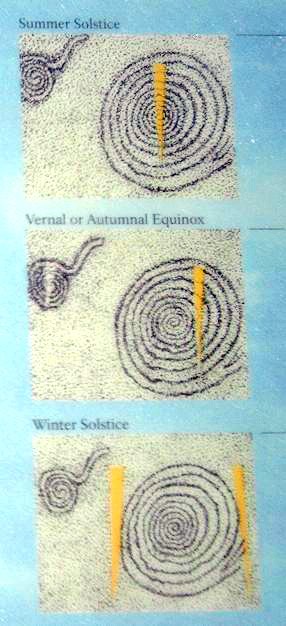
Another example of using the sun to create certain images is found at the site of Chaco Canyon in New Mexico. At the top of the Fajada Butte are two spirals etched into the rock which on the equinox, are sliced by a dagger of sunlight, called the “Sun Dagger.” Unfortunately the rocks on the butte have shifted, possibly due to human traffic at the site, and now the sunlit images no longer appear. At other areas of the Chaco Canyon site, interred bird bones have been discovered, and archaeologists believe these were the result of sacrificing scarlet macaws during the equinox. Due to their red and yellow feathers, these birds were associated with the sun and fire, and it is thought that sacrificing them during the equinox was a symbolic way of ending the winter season. This was also a common practice among groups throughout the Southwest and Northern Mexico.
Fajade Butte in 2015. Image courtesy of Rationalobserver, Public Domain, via Wikimedia Commons.
A diagram of the sunlit areas that were present during equinoxes and solstices at Fajada Butte. The spring, or vernal equinox, is in the center. Image courtesy of Nationalparks, Public Domain, via Wikimedia Commons.
In the Anishinaabe tradition, spring is celebrated as the beginning of their new year. Known as the Sugar Moon, this was the time when maple sap would start to run from the trees. Maple sap is considered to have important medicinal properties to the Anishinaabe as it balanced the blood.
Spring traditions in many native cultures are inextricably linked to the sun and moon, as the beginning of spring is marked by the equinox. It was a time symbolic of balance, because during the equinox day and night are of equal length. Spring has also historically symbolized rebirth and growth. It is the time when the earth is awakening from its winter slumber, and the life cycle is beginning again. Animals come out of hibernation and plants begin to bloom and grow again. Many traditions that have grown out of the equinox are based around this idea of balance and new beginnings.
Spring was also recognized by many Native American groups as a time to gather together and make decisions about their communities. It was a time to discuss which groups travelled where, what to do about hostile tribes, and where they could find resources. Today, many Indigenous groups still hold spring equinox gatherings and celebrations, which generally include music, dancing, ritual ceremonies, arts and crafts, and a feast of traditional dishes.
While spring traditions may look different to everyone, I think most can agree that it is a time of growth and fresh starts. With the upcoming season we have a lot to look forward to. We get to smell the fresh, clean air after a spring rain and watch flowers start to bloom. And let’s not forget about spring cleaning! Hopefully warmer weather and fun spring activities are right around the corner!