
Contributed by Selene Xu ‘27
In the fall of 2024, I reached out to Dr. Ryan Wheeler to learn more about the collection of Ancient Mediterranean artifacts that I knew were housed at the Peabody. I didn’t yet know the extent of what the collection contained, or what sort of project I might want to take on, but I knew I wanted to learn more, and that I wanted to help the Peabody learn more, too, by enhancing its catalog records. Dr. Wheeler shared with me a catalog of the objects that the Peabody houses, including a folder with all their photographs. After taking a quick look, I found myself drawn to this hydria:
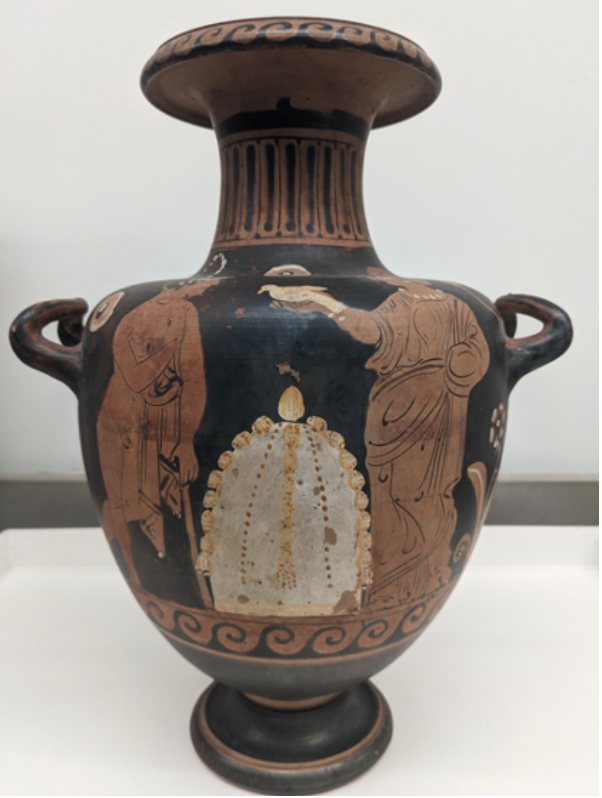
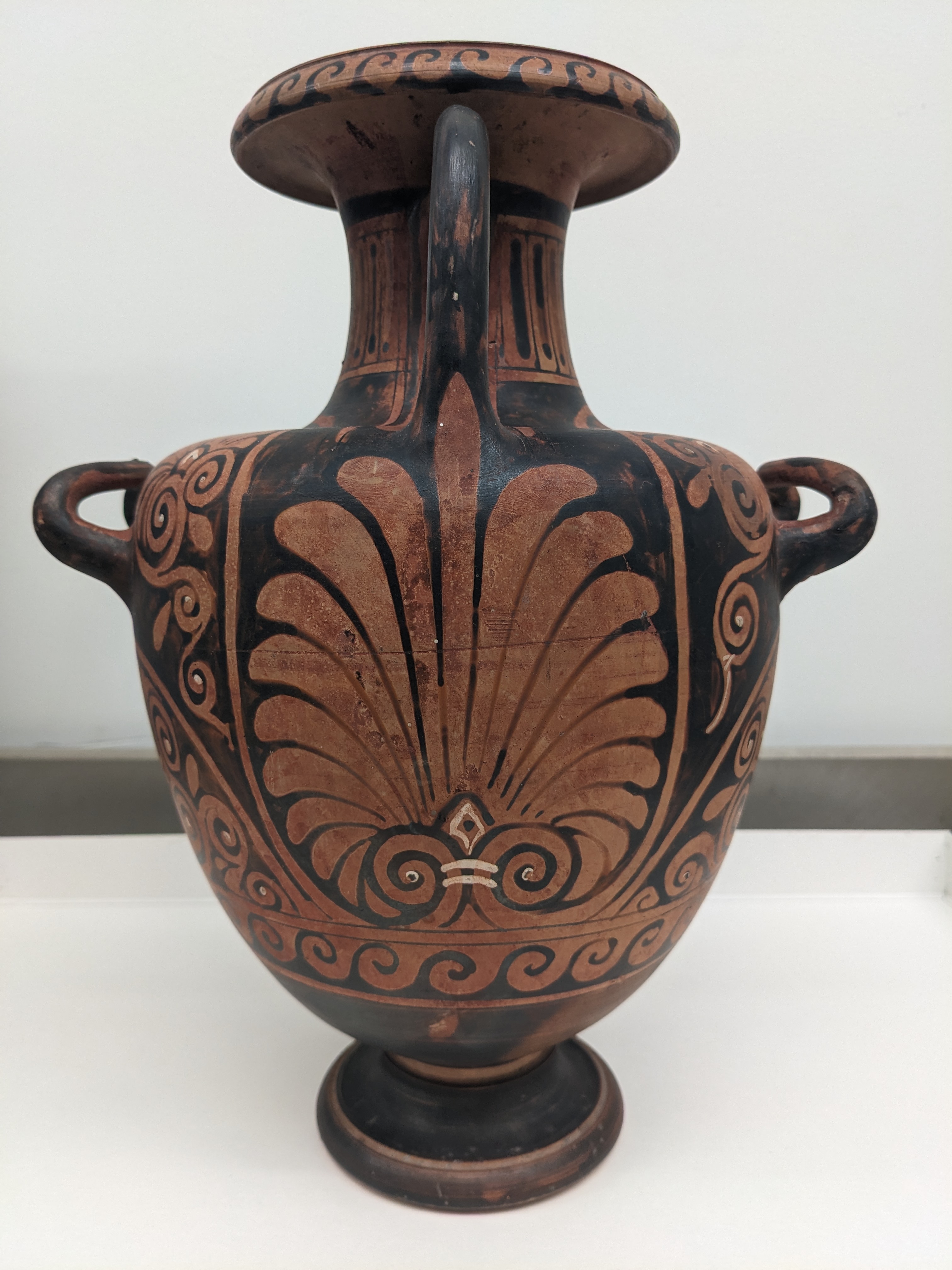
Hydria (jug) housed at the Peabody Institute, 1989.984.4.2.
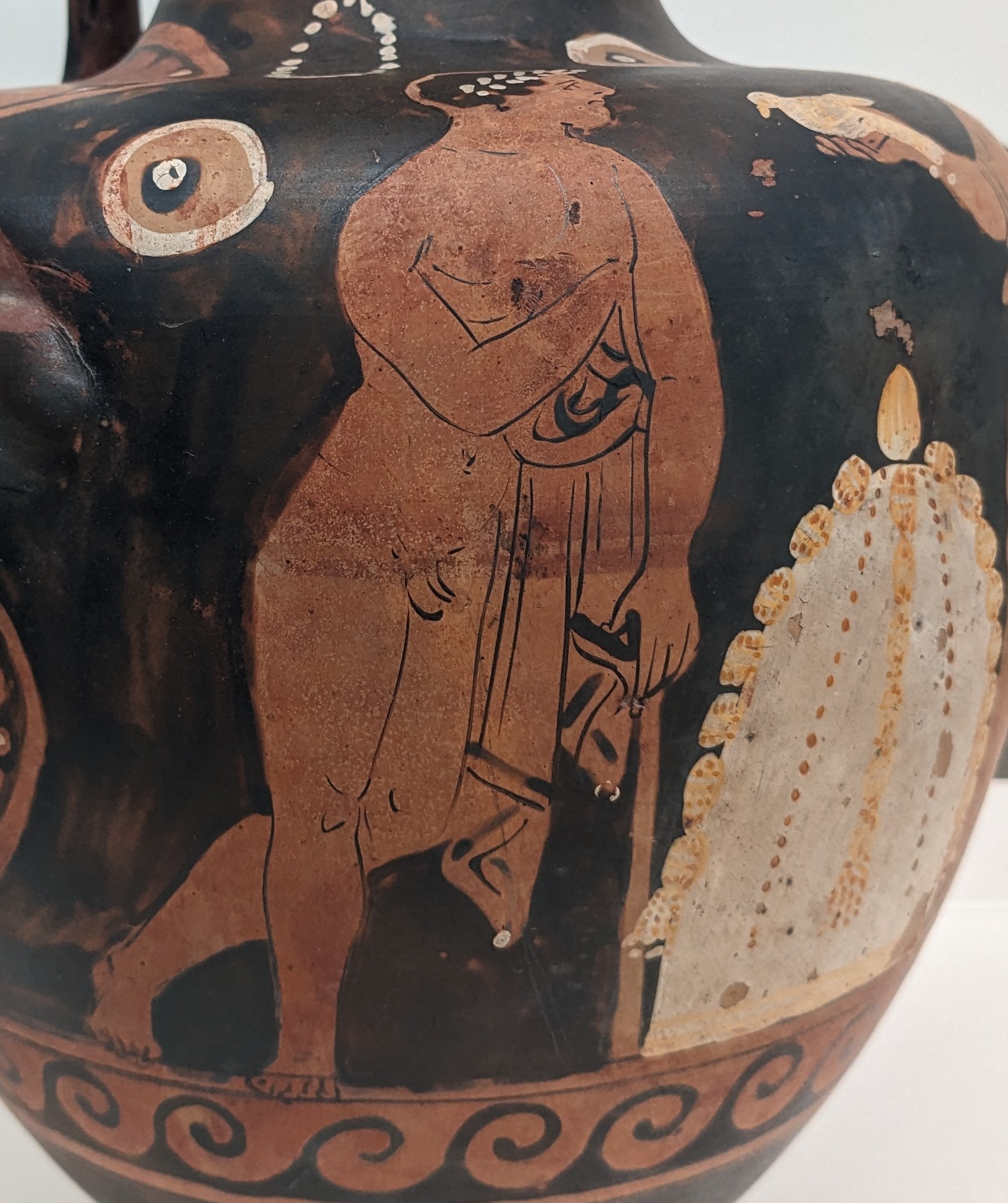
This is where I chose to focus my independent research. Initial identification of the Ancient Mediterranean collections at the Peabody was provided by Dr. Laure Marest, then a curator at the Museum of Fine Arts, Boston. She described 1989.984.4.2 as a “hydria (jug) with a man and a woman holding a dove above an omphalos”, made from red-figure ceramics, dating to the late 4th century BCE, and attributed to the Hellenistic period in the Campanian region. This served as my starting point, and the direction for my research: to learn more about this type of pottery, and to identify who this man and woman might be.
I began by researching the history and evolution of Hellenistic vessels (ceramic containers produced during the Hellenistic period, roughly from the late 4th to the 1st centuries B.C.E., used for practical, ritual, or decorative purposes), from proto-geometric and geometric techniques to black-figure and, finally, red-figure, the technique used for this artifact. Red-figure pottery eventually took precedence over black-figure because it allowed artists to leave figures in the clay’s natural red while painting the background black. Instead of laboriously incising details, artists could draw them more freely, making the technique better suited to naturalistic depictions of anatomy, garments, and emotion. I also researched the different types of Attic pottery, or pottery produced in the region of Attica, Greece, especially in Athens, which became a major center of Greek vase production. These forms included hydriai, lekythoi, amphorae, kraters, and many more. In doing so, I learned that a hydria is a three-handled water jar, typically with two horizontal handles for lifting and one vertical handle for pouring.
Understanding the broader historical and artistic context of the pot assisted my hypotheses of the figures’ identities. Since the woman on the right is holding a dove, I predicted that she was Aphrodite, the goddess of love and beauty, whose sacred animal is the dove. After finding more vessels online with Aphrodite depicted and comparing them with the illustration on this pot, I was confident that the well-decorated lady with her hair tied in a bunch, open beaded cap, earrings, necklace, and bracelets was Aphrodite.
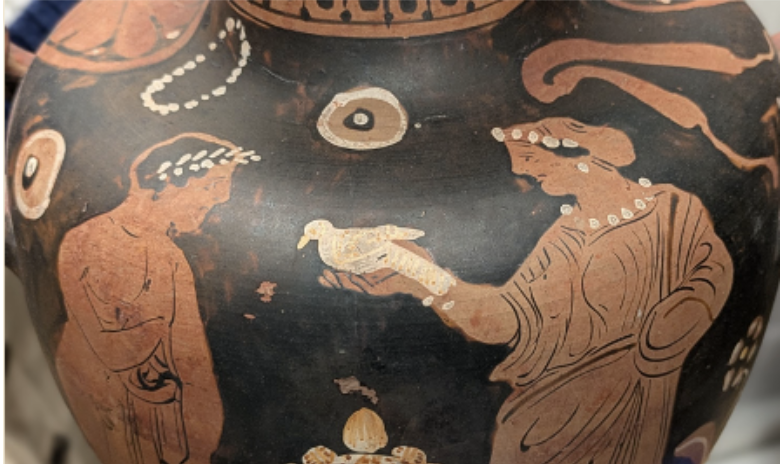
Then came the most challenging part: identifying the man on the left of the hydria. At first glance, there was nothing symbolic about the figure, except that he stood casually beside Aphrodite, showing no sign of reverence typically expected toward a goddess, therefore implying that he may be a god himself. I searched online databases and museum collections for depictions of various gods on Attic pottery and for their characteristics. Then, I remembered, too, that Dr. Marest had described the large object in between Aphrodite and this man as an “omphalos.” Originating from the Ancient Greek word “ὀμφαλός,” meaning “navel,” an omphalos symbolizes the center of the world, glory, and birth and death in the Classical and Hellenistic periods. I later learned that the omphalos was also a marble monument discovered at Delphi, Greece, a religious sanctuary dedicated to Apollo.
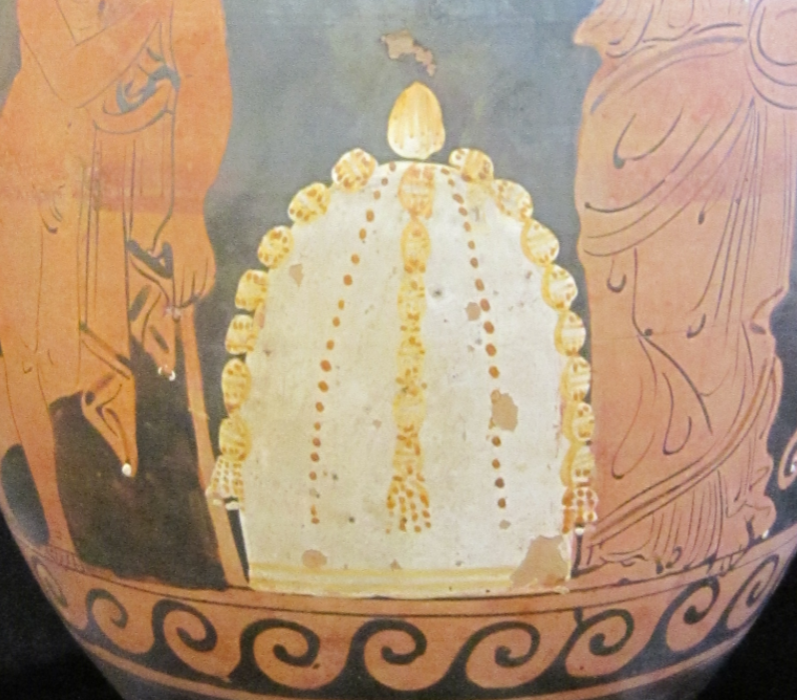
Thinking about the relationship between the omphalos and Apollo, the fact that fillets (decorative bands of cloth often used as religious offerings), which adorn the omphalos, were often offered by worshippers consulting Apollo’s oracle, and the laurel wreath commonly worn by the nude Apollo, I suspected that this man could be Apollo. After researching more vessels online with depictions of Apollo, I found various similarities in the iconography, such as Apollo holding a staff in a print at the British Museum.
I wrote up my findings for the Peabody Institute and created slides of my research to present my findings to others. After coordinating with Dr. Lainie Schultz (Peabody Institute), Dr. Elizabeth Meyer (Instructor, Phillips Academy Classics Department), and Dr. Paige Roberts (Director, Phillips Academy Archives and Special Collections), I am so grateful to have had the opportunity to present my findings in person at the “History Up Close” event on April 30th, open to the Phillips Academy campus. The excitement of this experience also came from learning from the audience, many of whom asked very thoughtful questions about not only the iconography on the hydria but also the iconology, which gave me clearer next steps for my research.
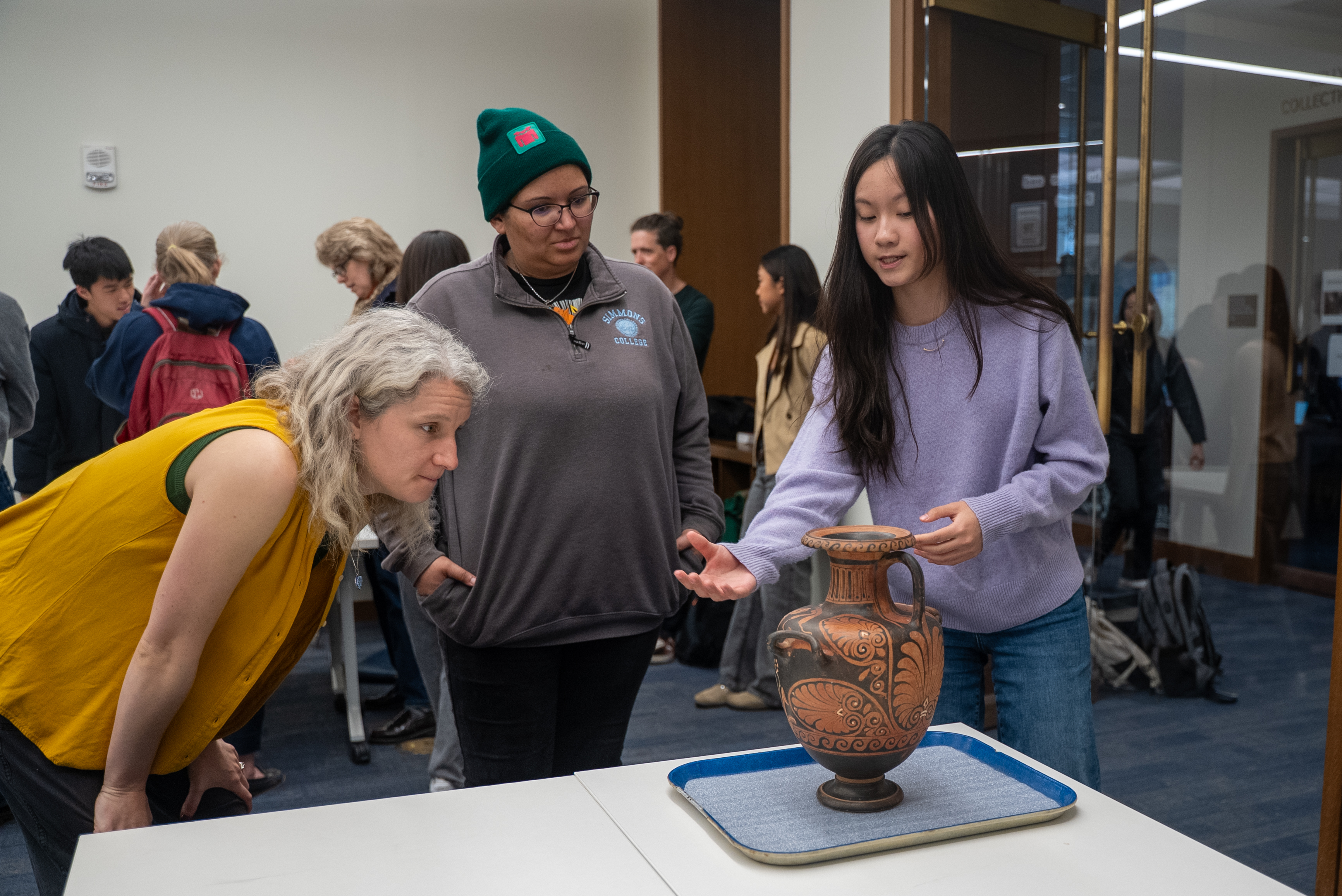
Never would I have thought that I would have this amazing opportunity as a high schooler. I am also extremely grateful that this experience sparked my interest in archaeology, inspiring me to expand my research on Attic pottery even beyond the Peabody.

