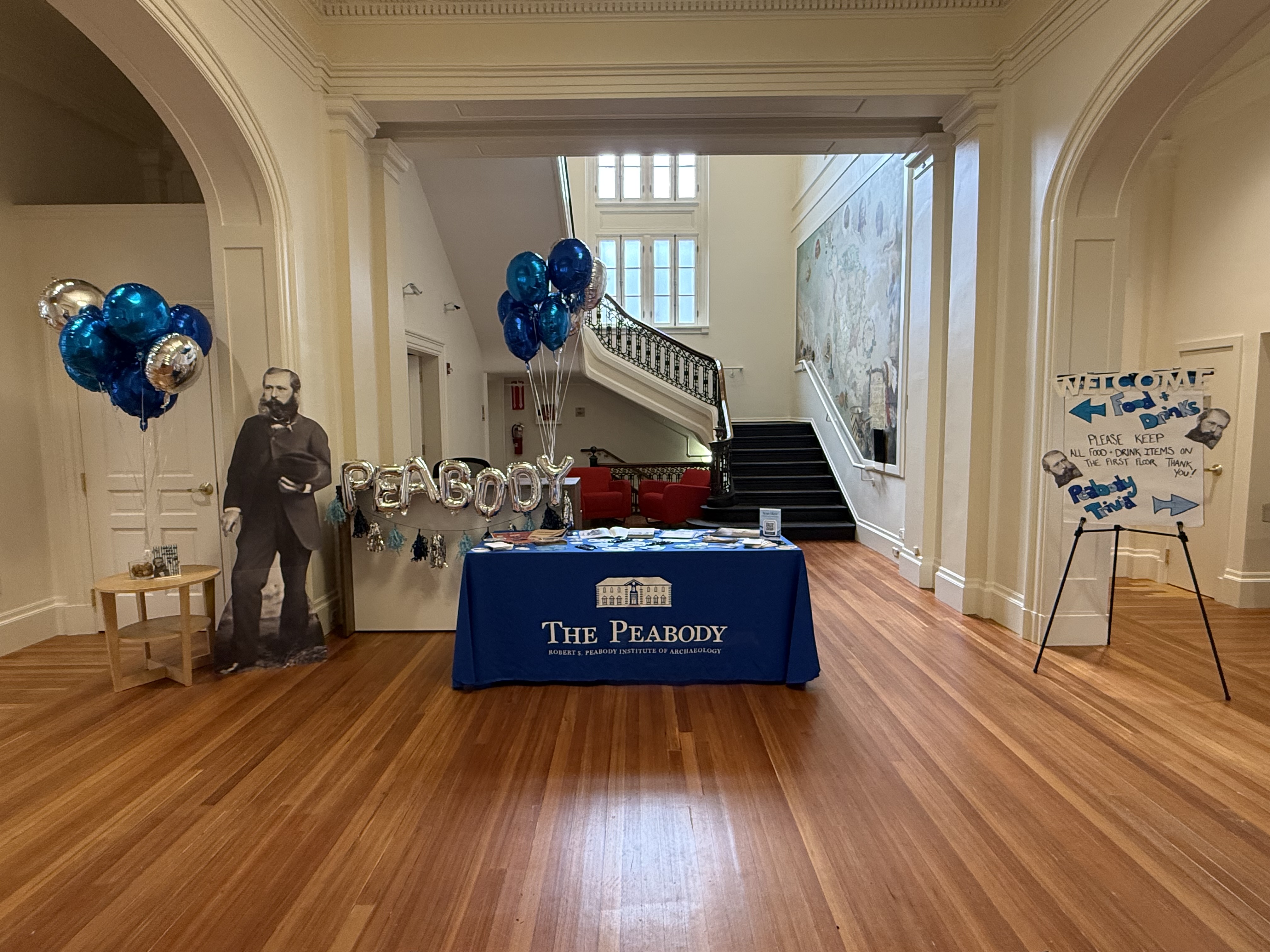
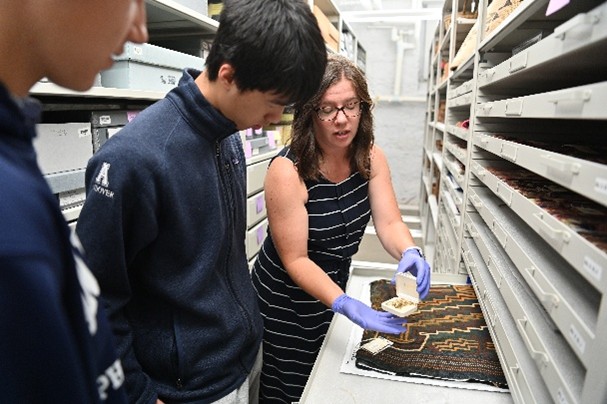
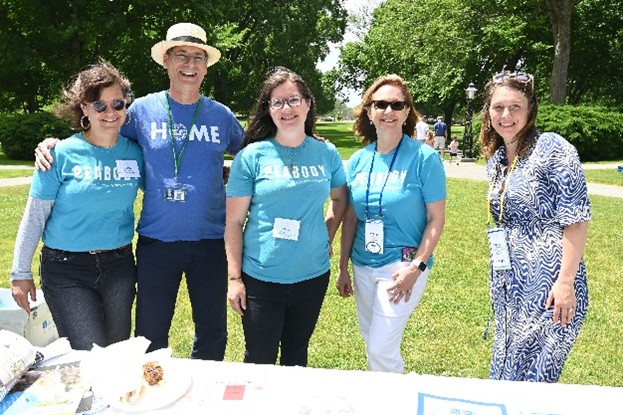
This October, the Peabody held an open house for the Phillips Academy community. The event gave students, faculty, and staff an opportunity to explore the Peabody’s newly renovated spaces and celebrate the completion of the Peabody Building Project.
Planning for the building renovation began over a decade ago, with an initial focus on inventory and rehousing collections to prepare for the actual renovation. Phase 1 began early in 2023, with milestones in spring and near completion in December 2023. Phase 2 commenced in January 2026, with a goal of improving climate, accessibility, safety, and functionality.
For highlights of the renovated building, check out this cool video created by the Phillips Academy communications team – Peabody Renovation Highlights
Thank you to everyone who supported the Peabody during the building renovation work. We are grateful for all you have done. We did it!
This series is a dedicated spotlight designed to share Peabody highlights and recognize and celebrate the exceptional work, unique achievements, and dedication of our Peabody team members.
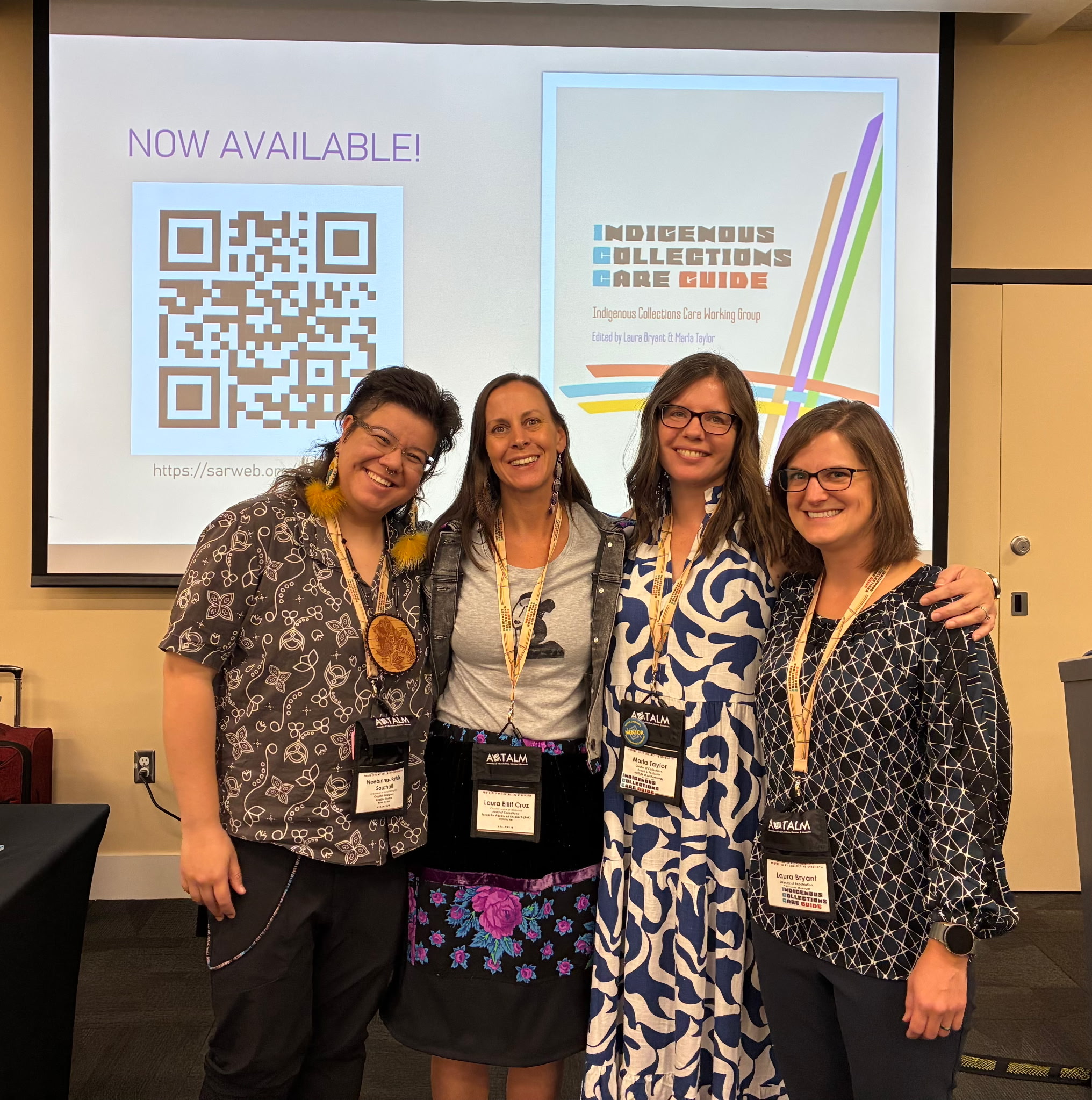
The Indigenous Collection Care Guide & Upcoming Webinars
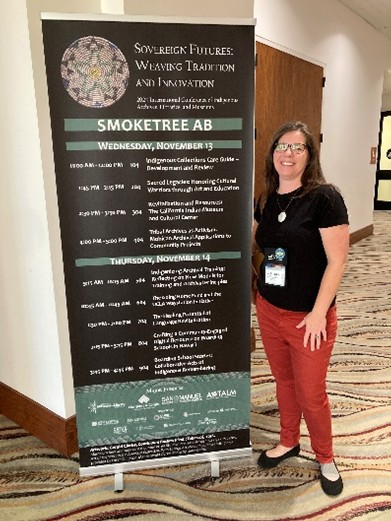
The ICC Guide is officially a hit! Marla and the ICC team have been spreading the word with lots of webinars and conference presentations. Follow this link if you want to learn more about the ICC Guide, how it was created, and how it can impact museum practice:
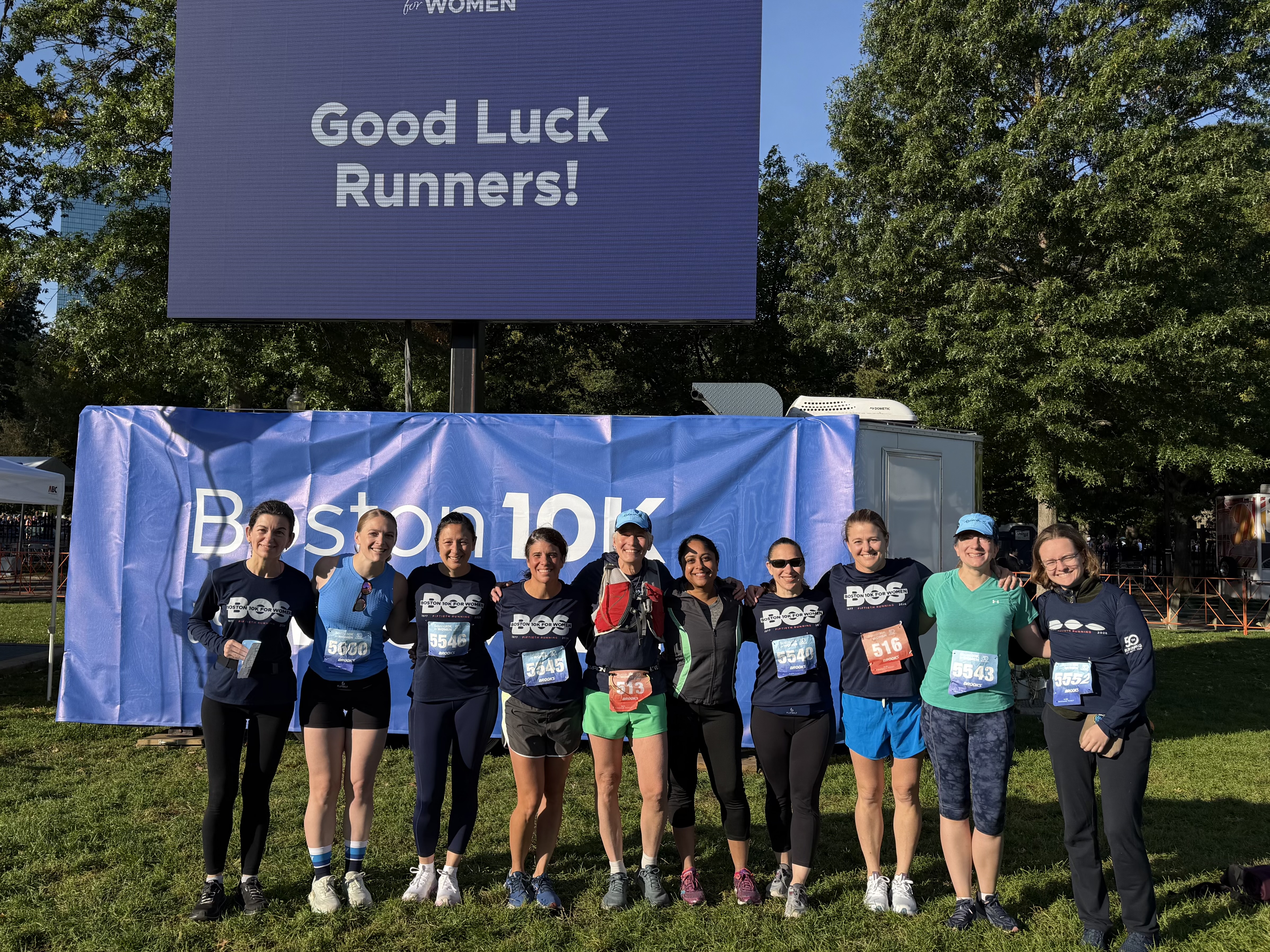
Peabody & PA Representation at the Boston Women’s 10K Race
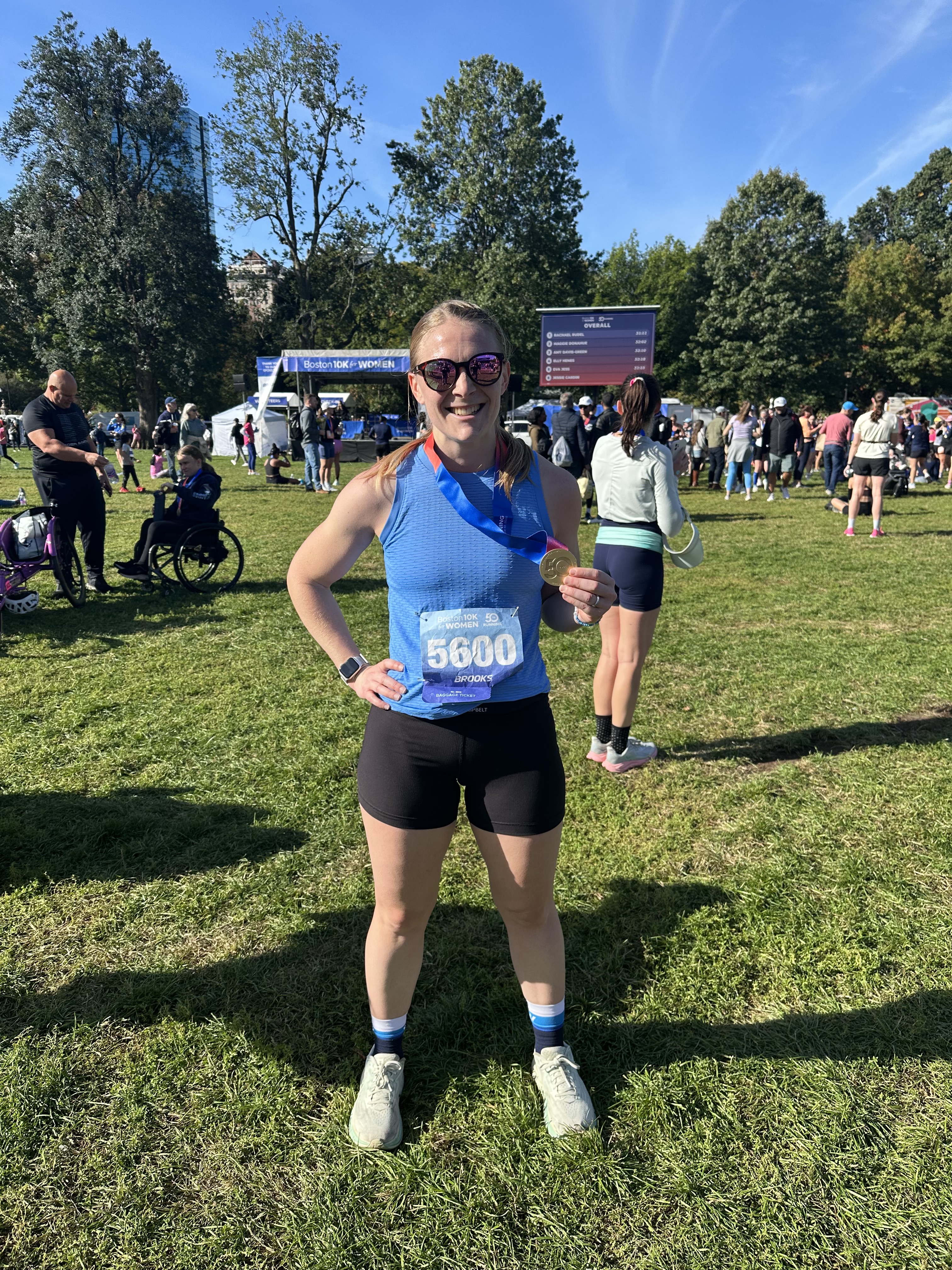
The Peabody’s Emma Lavoie joined several staff colleagues representing Phillips Academy in the 50th running of the Boston Women’s 10K Race this month. The event saw over 7,000 participants! Thank you to the PA Head of School’s office for supporting this opportunity.
Inman Painting in the Addison’s America in the Making Exhibition
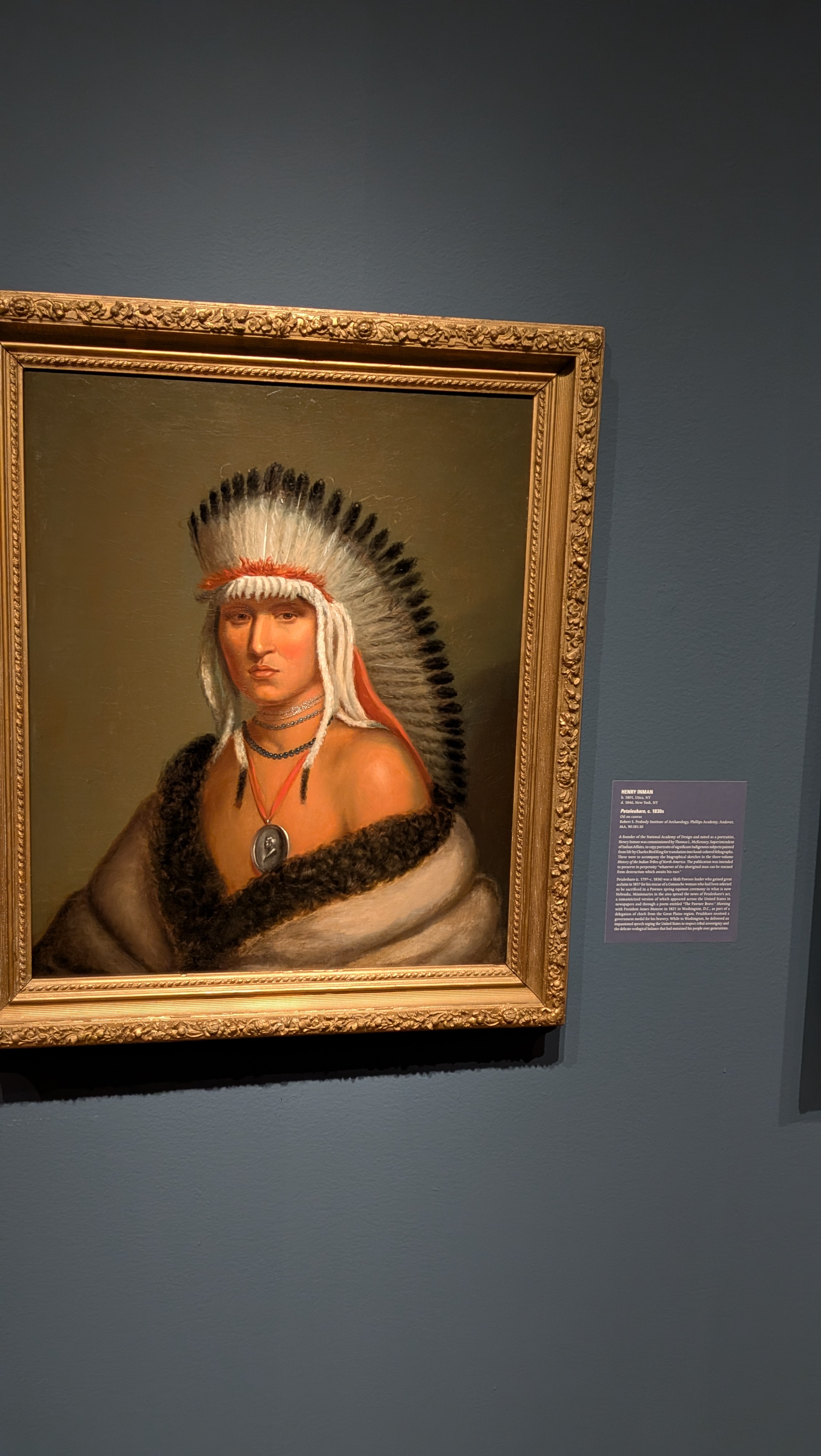
Make sure you visit the Addison Gallery of American Art’s exhibition America in the Making (September 8, 2026-January 31, 2027). The show marks the 250th anniversary of the Declaration of Independence and includes an extraordinary array of “greatest hits” from the Addison’s permanent collection. Be on the lookout for Henry Inman’s painting of Skidi Pawnee chief Petelesharo, on loan from the Robert S. Peabody Institute of Archaeology. Petelesharo is one of three Inman portraits held by the Peabody Institute.
Every summer departments across Phillips Academy host Scholar programs – an opportunity for rising 11th and 12th graders to conduct an independent research project of their choosing, with support from a faculty or staff advisor. Interested students submit their research proposals the winter prior; selected applicants use the spring to prepare any resources they require; and summer is spent immersed in the work. This past year, the Peabody Institute joined PA’s cohort of hosts, mentoring our first annual Peabody Scholar. Below, George Richardson gives us an insider account of the experience…–Lainie Schultz
What do teary-eyed Snapchat stories, ham-and-spinach omelets, and Raye’s My 21st Century Blues have in common? These were just a few of the many coping methods that got me through the 41-page paper that would be known as The Settler’s New Clothes: Coachella, Follower Counts, “Boho-Chic,” and the Dual Dispossession of Indigenous Regalia. Wordy? I know.
Before I detail those drawn-out Thursday nights spent mulling over whether wearing a headdress at Coachella is appropriation or appreciation, let me take you back to the beginning. No, not the first stage of research, the true beginning: my inbox.
It all started with an Outlook notification inviting me to a Scholar Information Session. The main attraction? Free pizza. The dining hall was looking particularly unappetizing that evening, so with an empty stomach and low expectations, I climbed the treacherous stairs of the Oliver Wendell Holmes Library to the Tang Institute. Naturally, I sat near the front, well within arm’s reach of the greasy American delicacy that would fuel my attention span for the next hour.
When the meeting ended, we broke out into interest groups: OWHL, Brace Center for Gender Studies, PA Sustainability Coalition, or, best of all, the Peabody. Why pick the Peabody, might you ask? Honestly, my odds looked best there since I was only competing against 5 other people. A few months later, an email confirmed it: I had the job.
Jump to the start of my research. I knew I wanted to explore cultural appropriation at music festivals, but I had zero direction. So, naturally, I procrastinated on TikTok. The algorithm gods were clearly watching, because the very first video on my feed was influencer Natalie Reynolds showing off her 2025 Coachella outfit, which she proudly described as having an “Indian vibe.”
Just like that, my project was born: Non-Native festivalgoers wearing Native American headdresses. I hopped out of bed, opened a Google Doc, and started outlining.
What followed was a complete blur. Between 10 AM Monday check-ins with Dr. Schultz and endless late-night dives into the Internet Archive and JSTOR, I became utterly consumed. Narrowing the scope, though, was a nightmare. Every new journal article tempted me to change my entire thesis. There were moments I genuinely wondered: Am I moving the needle here, or is this just going to read like another non-Native person culture-policing?
To break through that anxiety, I completely reframed my approach. I stopped focusing on individual festivalgoers and instead landed at the crossroads of TikTok recommendation algorithms and the Indian Arts and Crafts Act of 1990. By centering the paper on corporate platform designs and statutory compliance rather than ethics, I gave myself the space to critique systemic exploitation without playing into polarized rhetoric.
Despite that triumph, with three weeks left before the final deadline, I realized my current draft couldn’t be saved. So, I opened a fresh doc and turned to the Dangerous Writing App (it deletes your work if you stop typing for 5 seconds). That panic-fueled session birthed a raw 3-page outline. Over the next week, mostly between 3 AM and 8 AM, that outline ballooned into a 17-page draft. Two weeks of refining and addressing Dr. Schultz’s feedback later, I had a paper.
The final step was formatting: setting it to Times New Roman and hitting double-space. Instantly, what had felt like a standard draft transformed into a 41-page short story of everything I could possibly utter on the subject.
Looking back, the Scholar process was entirely worth it. The level of research and writing feedback is unlike anything else I’ve done inside or outside Andover. Sure, there were days my entire schedule was swallowed by the paper, and days when muttering the word “draft” near me would put you at serious health risk. But if you’re ever considering applying (whether pizza is your primary motive or not), do it. If only for the pure satisfaction of hitting double-space at the end. Thank you.
Title inspiration from Green, Rayna. “The Tribe Called Wannabee: Playing Indian in America and Europe.”Folklore99 (1988): 30-55.
Contributed by Katie Lincoln, Andover Summer Session Archaeologist
If you were to ask an archaeologist what the hardest part of the job is, you might expect them to answer with something physically demanding, like digging holes or spending late nights cleaning and classifying artifacts.
For many archaeologists, however, the hardest part of our jobs is translating tiny fragments of material culture into stories about people from the past – and finding ourselves in those stories along the way.
For example, how can one small ceramic fragment say something about those who made and used it? What can the presence or absence of certain objects change how we think about people? How do we know that our conclusions are correct and culturally sensitive?
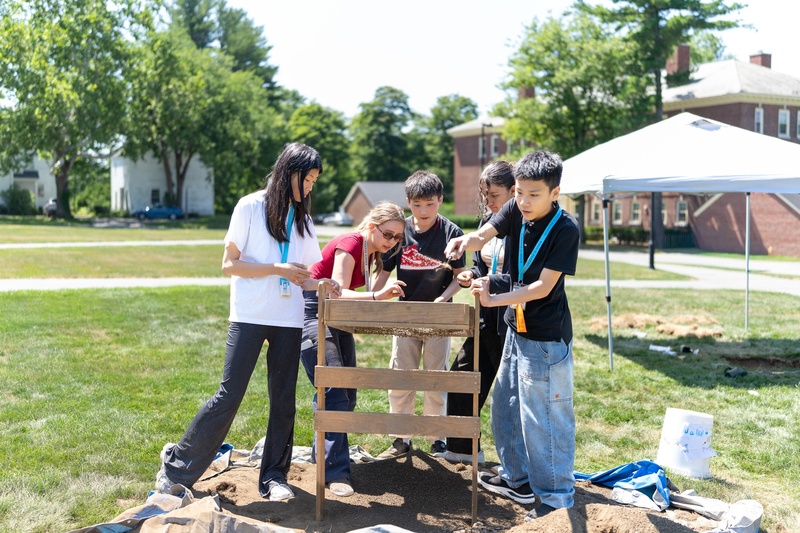
Phillips Academy Summer Session students grappled with these questions as they embarked on their own archaeological dig this past July. Tasked with excavating a Revolutionary War-era mansion belonging to Phillips Academy’s founder, Samuel Phillips Jr., students took on the responsibility of collecting artifact data and interpreting it – both in their final written assignments and in their final exhibition. At every step, they were asked not just to identify what they found, but to imagine the students, staff, and community members who came before them and left these things behind.
Katie Lincoln close-looking at excavated objects with students
Over the course of their four-week-long excavation on Phillips Academy’s West Quad, students uncovered a wide variety of artifacts. As part of an assignment new to the Dig This! course this year, students were asked to use an artifact to make a broad interpretation about past life in Andover, at Phillips Academy, or at the Mansion House – and, in doing so, to draw a line between their own experience as students and the experience of the students whose lives they were piecing back together.
Their presentations exceeded expectations, revealing just how closely these summer session students came to identify with nineteenth and twentieth century Andover residents.
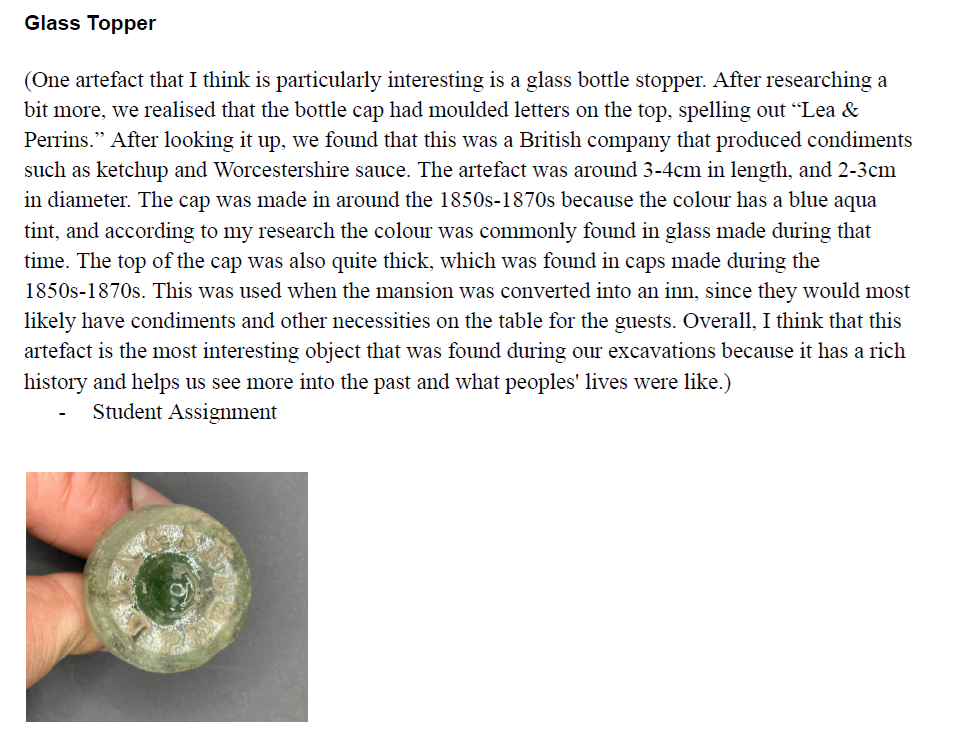
Example of a student assignment
Pencil ends and early twentieth-century print type, for instance, became evidence of a shared reality: students worked hard, even in their dorms, whether in 1926 or 2026. Looking at the worn-down pencils, our students recognized their own late nights in someone else’s.
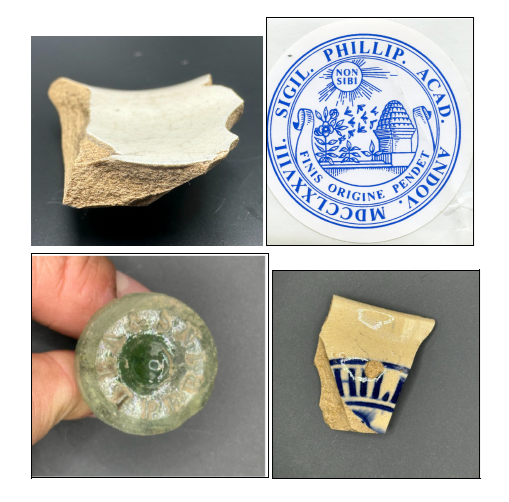
A ceramic sherd with “HILL” transfer-printed on it told a similar story. Interpreted as nineteenth-century refined earthenware, likely part of a mug decorated with the Phillips Academy school seal, it was paired with a Worcestershire sauce bottle cap and various other glass artifacts. Students read this cluster of objects as evidence of meals shared at the Mansion House when it functioned as an inn and tavern – and imagined nineteenth-century Phillips students gathered there with friends and neighbors. Students identified that this experience was not so different from how they themselves might share a meal at Paresky Commons after a long day.
Overall, this summer’s excavation was a success. Students learned and mastered archaeological field methods including site mapping, artifact identification, and field paperwork. Most importantly, however, students learned how to use artifacts to speak to past peoples and experiences. More than that, they learned how to pull apart historical narratives and find themselves inside them – recognizing a fellow student’s hard work, worry, and routine across a gap of one or two hundred years.
We thank the students of the 2026 Mansion House Field Crew, and we look forward to incorporating more interpretive analysis in future iterations of the Dig This! Course.
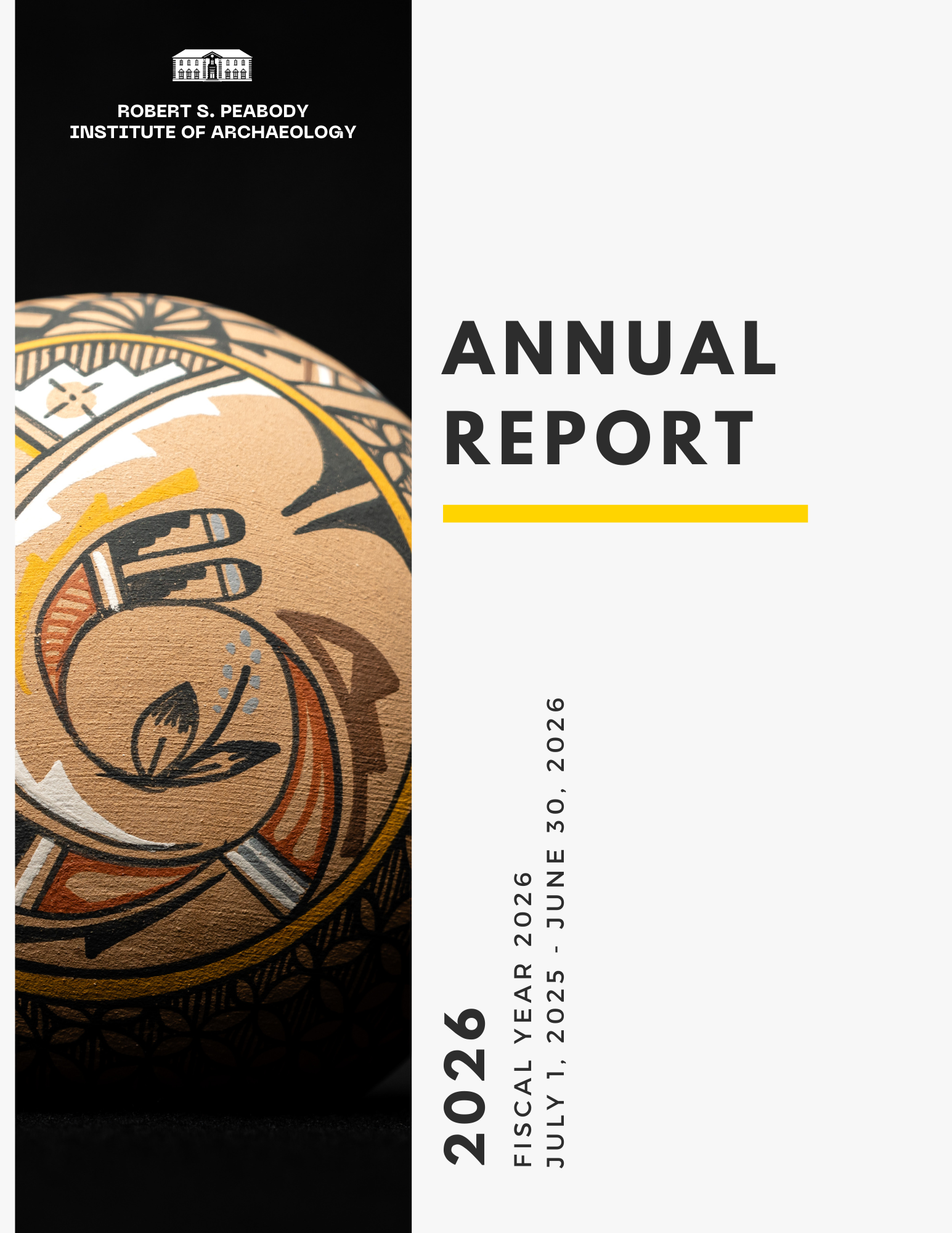
The Peabody’s annual report for fiscal year 2026 is LIVE!
This year marks an extraordinary milestone in our history as we proudly celebrate our 125th anniversary. For more than a century, the Robert S. Peabody Institute of Archaeology has inspired student interest, fostered appreciation for Native American cultures, and supported archaeological research. This landmark anniversary offers us the opportunity to look back with gratitude on our history, while looking forward to a vibrant future.
Fiscal Year 2026 has been a historic chapter of transformation, most notably distinguished by the successful completion of the Peabody building project and renovations. This major undertaking has revitalized our physical spaces, blending our historic architectural legacy with modern, accessible, and innovative facilities designed to serve student generations to come. From enhanced programming spaces to upgraded infrastructure, these improvements ensure that our physical home matches the excellence of the services and experiences we deliver every day.
None of these achievements would have been possible without the dedication of our staff, generosity of our donors, and the steadfast support of volunteers and community partners. You can read our full report HERE!
Contributed by Emma Lavoie (and Friends of the Peabody)
Ahhh summer! Whether you’re on the beach, enjoying a hike or walk through nature, taking a drive with the windows down, or a staycation in your backyard – nothing beats a day in the sun.
And there isn’t a better companion for your summer adventures than music! From nostalgic tracks to newest releases, the Peabody shares its “Songs of Summer” playlist to keep your summer vibes going. Enjoy our playlist here!
“This is one of my two favorite songs from my favorite band that stirs up ample memories of fun times and fun drives with family and friends. With fast and upbeat guitar riffs and classic Jim Morrison “whoos,” there is no better song to play too loudly with the car windows (or better yet drop top) down and the wind in your hair.”
– Donny Slater, PA Faculty & Peabody Board of Advisors Member
“Great Big Sea was the sound of my college years and is forever tied to fun, friendship, adventure, and a good time. Thelive versionis a MUST and I strongly recommend seeking out the live version for all their music.”
“Every time I hear it, I’m instantly reminded of summers growing up in Rhode Island. It was always playing while we were camping, out on the boat, or spending the day at the beach. It brings back all those carefree summer memories and never fails to put me in a good mood.”
– Danielle Akin, PA Capital Project Manager (Peabody Building Renovation)
“I’ve been wearing my Love and Rockets t-shirt a lot this summer and getting a ton of reactions from strangers in the street. None of them seems to notice, though, that my t-shirt is of the comic book, not the British rock band.”
“Full of expansive, 80’s inspired new wave soundscapes, this album takes me back to a time when summer stretched out forever and was full of possibilities. It’s a perfect complement to any trip with open roads and breathtaking landscapes.”
– John Bergman-McCool, Peabody Collections Coordinator
“New release just in time for the summer by one of my favorite bands. I’d describe this brotherly rock group as ‘new generation Led Zeppelin’ with classic bluesy riff-rock and Plant-esque vocal delivery. Whether you’re on the beach or out for a drive, this song represents restless energy, a sense of youth chaos, and the beautiful nature of seizing a moment.”
Who knew that a statistics class could lead you to timing the cataloging of artifacts? That is exactly what happened to our group this spring, and we are so glad it did.
We are a group of Phillips Academy upperclassmen and seniors: Meara Wang, Jay Jung, Ayush Gupta, Tasnia Begum, and I, Sophia Lazar. We are enrolled in Mr. Noureddine El Alam’s Project-Based Statistics class, where students apply statistical methods to solve real-world problems for real partners. Rather than solely working through textbook exercises, we take on actual projects with organizations and institutions, gathering data, running analyses, and presenting findings that can make a tangible difference. Past classes have partnered with places like the Addison Gallery of American Art and the PA Admissions Office, and when Mr. El Alam introduced the Peabody as an option, our team knew right away that it was the one for us. We wanted to work on something that genuinely inspired us, and the Peabody fit perfectly.
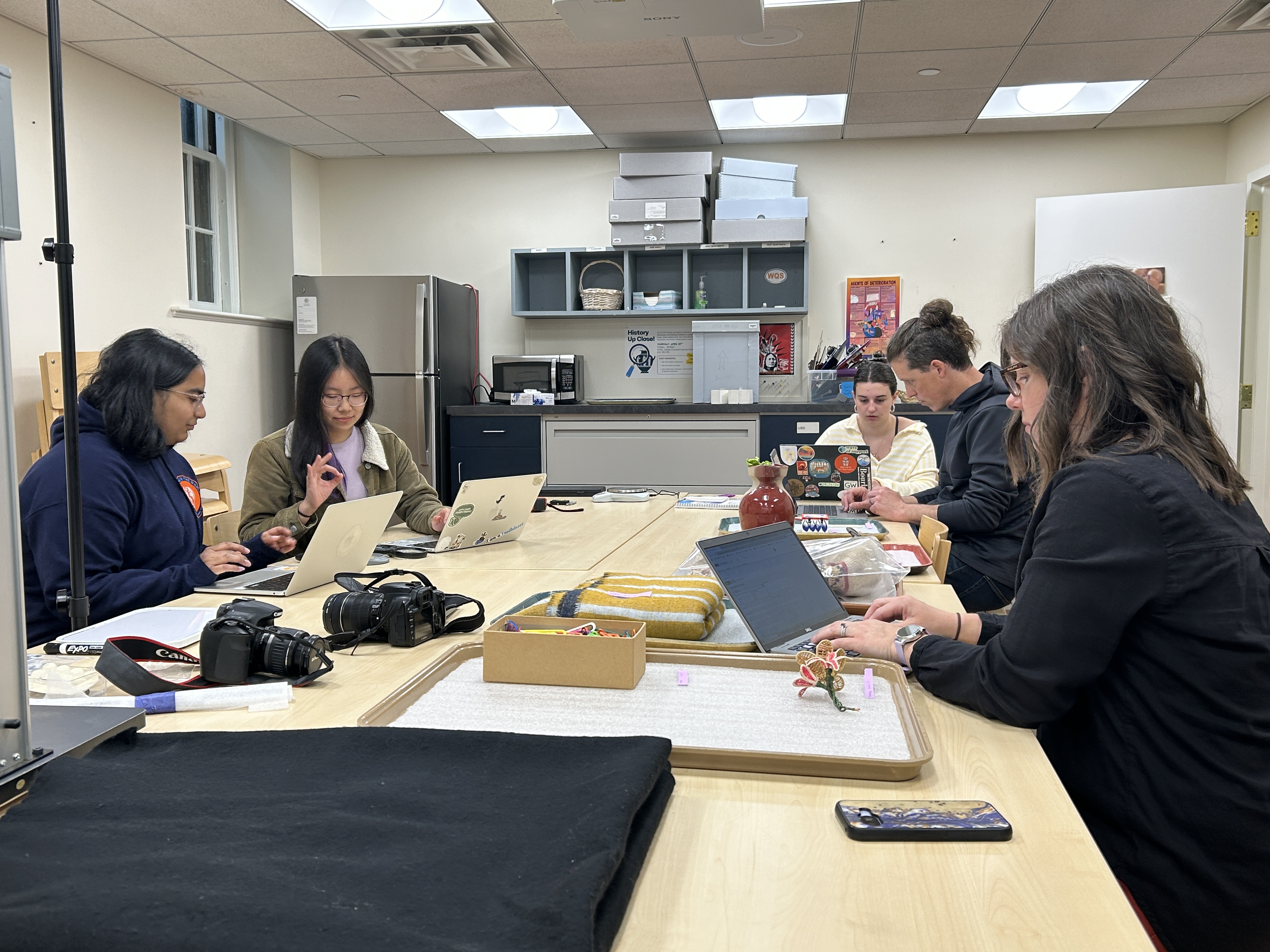
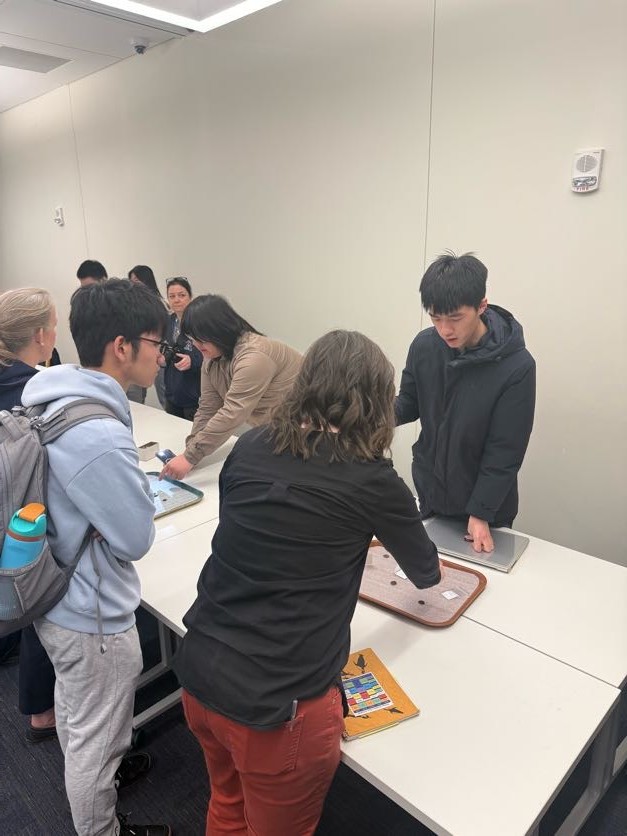
Our project centers on a question the Peabody has been grappling with: how long would it actually take to bring the museum’s artifact catalog up to an excellent standard, and what would better staffing make possible? To answer that, we needed data on the cataloging process itself, specifically how long it takes to catalog different types of artifacts. That meant a visit to the Peabody’s temporary location, where John Bergman-McCool and Marla Taylor walked us through a hands-on mock session. Because working directly with the real collection is not always feasible, John and Marla guided us through a range of representative mock artifacts so we could time the process across different object types and gather enough data points for a meaningful analysis. It was hands-on, eye-opening, and honestly a lot of fun.
With that data in hand, we are now building a statistical model to estimate how long a full cataloging effort would take under different staffing scenarios. The idea is to take our timing measurements, account for the variety of artifact types in the collection, and project out what various levels of staffing could realistically accomplish over time. The final report will go directly to the Peabody, and we hope it gives them something genuinely useful as they plan for the future.
What surprised me most was how much I came to care about the outcome. When you walk through a collection and realize just how much history is sitting there, waiting to be properly documented and shared with the world, the stakes feel very real. We came into this wanting to do meaningful work, and we are leaving with a much deeper appreciation for everything that goes into preserving and making accessible our shared cultural heritage. We hope our work makes a real difference!
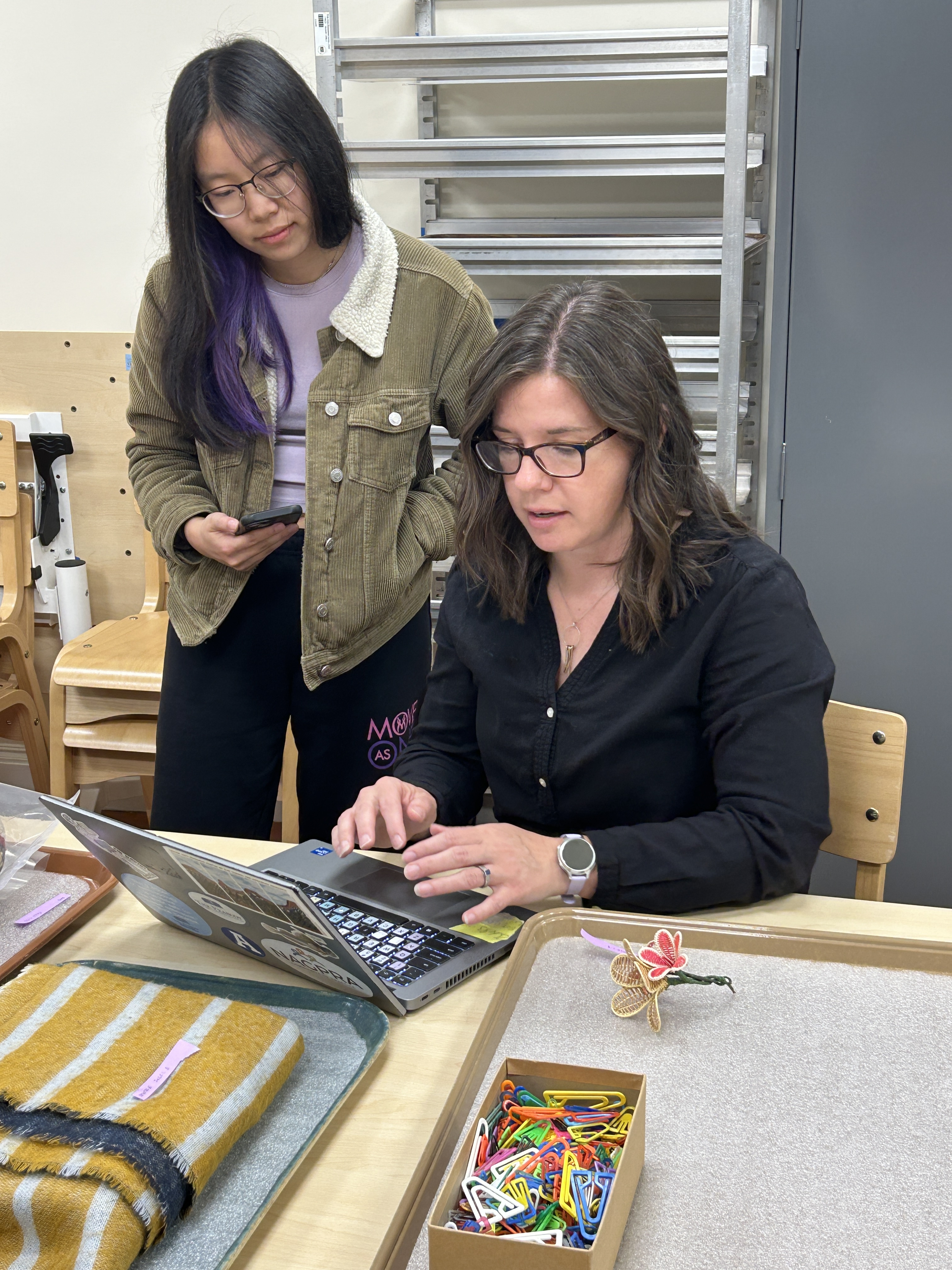
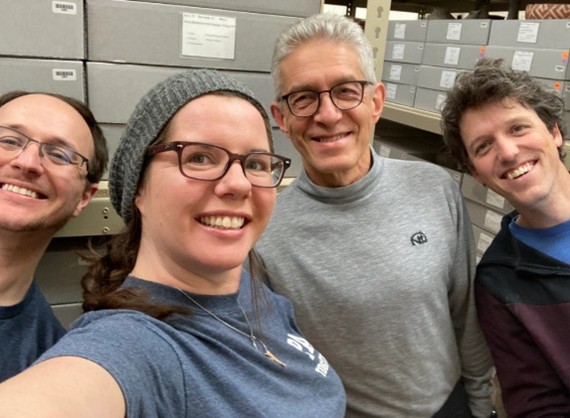
The team together at the Peabody’s temporary location during our data collection session.Marla Taylor walking Meara through the steps of cataloging a mock artifact.
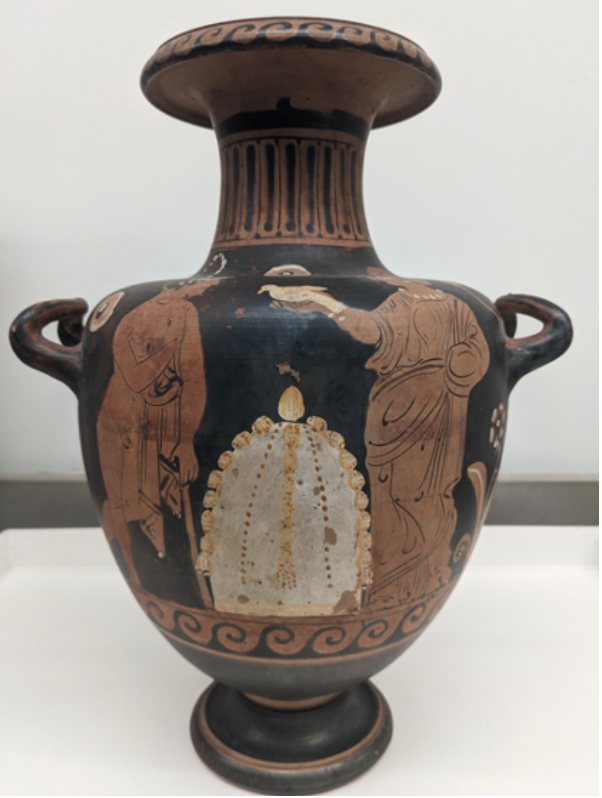
In the fall of 2024, I reached out to Dr. Ryan Wheeler to learn more about the collection of Ancient Mediterranean artifacts that I knew were housed at the Peabody. I didn’t yet know the extent of what the collection contained, or what sort of project I might want to take on, but I knew I wanted to learn more, and that I wanted to help the Peabody learn more, too, by enhancing its catalog records. Dr. Wheeler shared with me a catalog of the objects that the Peabody houses, including a folder with all their photographs. After taking a quick look, I found myself drawn to this hydria:
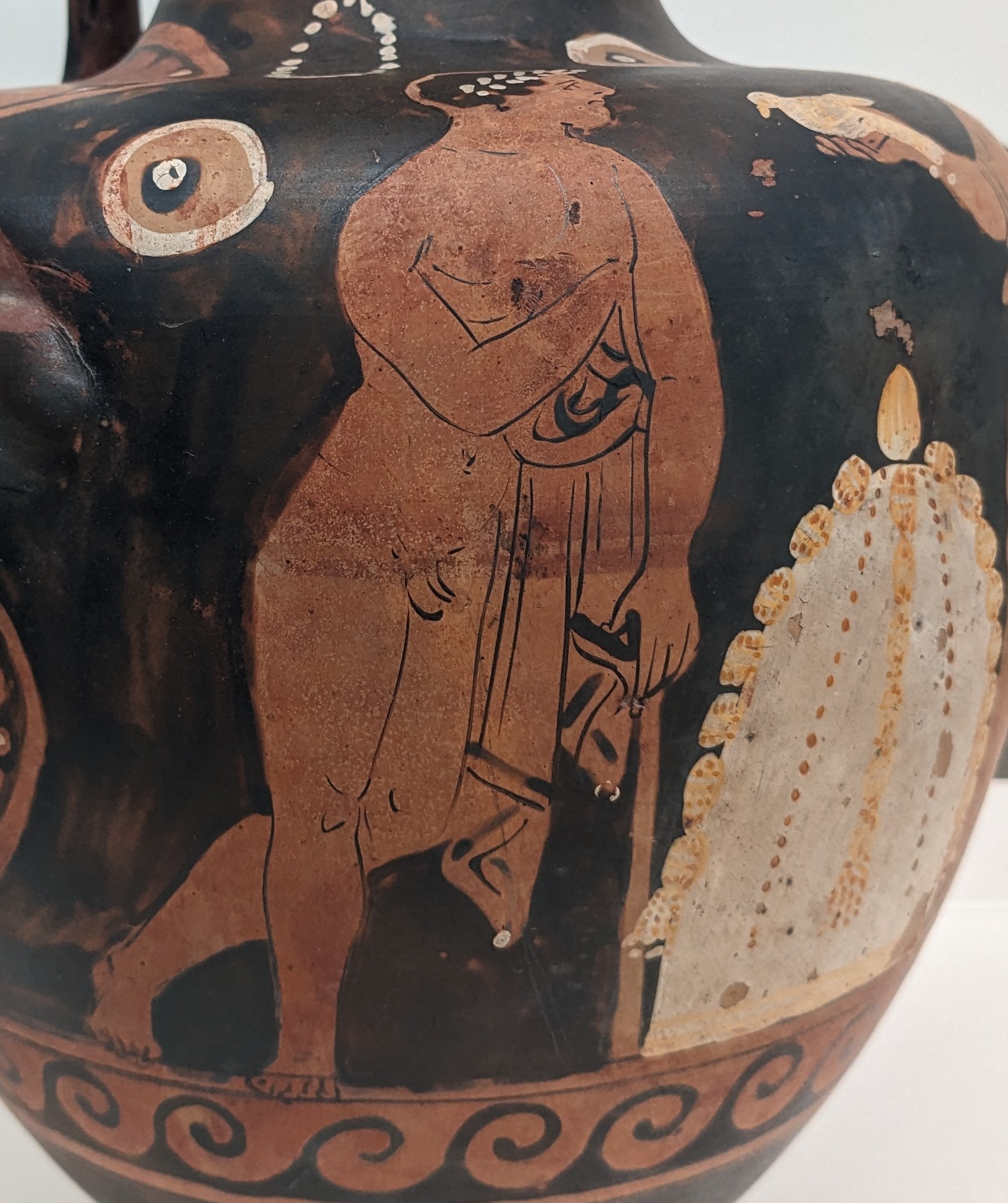
Hydria (jug) housed at the Peabody Institute, 1989.984.4.2.
This is where I chose to focus my independent research. Initial identification of the Ancient Mediterranean collections at the Peabody was provided by Dr. Laure Marest, then a curator at the Museum of Fine Arts, Boston. She described 1989.984.4.2 as a “hydria (jug) with a man and a woman holding a dove above an omphalos”, made from red-figure ceramics, dating to the late 4th century BCE, and attributed to the Hellenistic period in the Campanian region. This served as my starting point, and the direction for my research: to learn more about this type of pottery, and to identify who this man and woman might be.
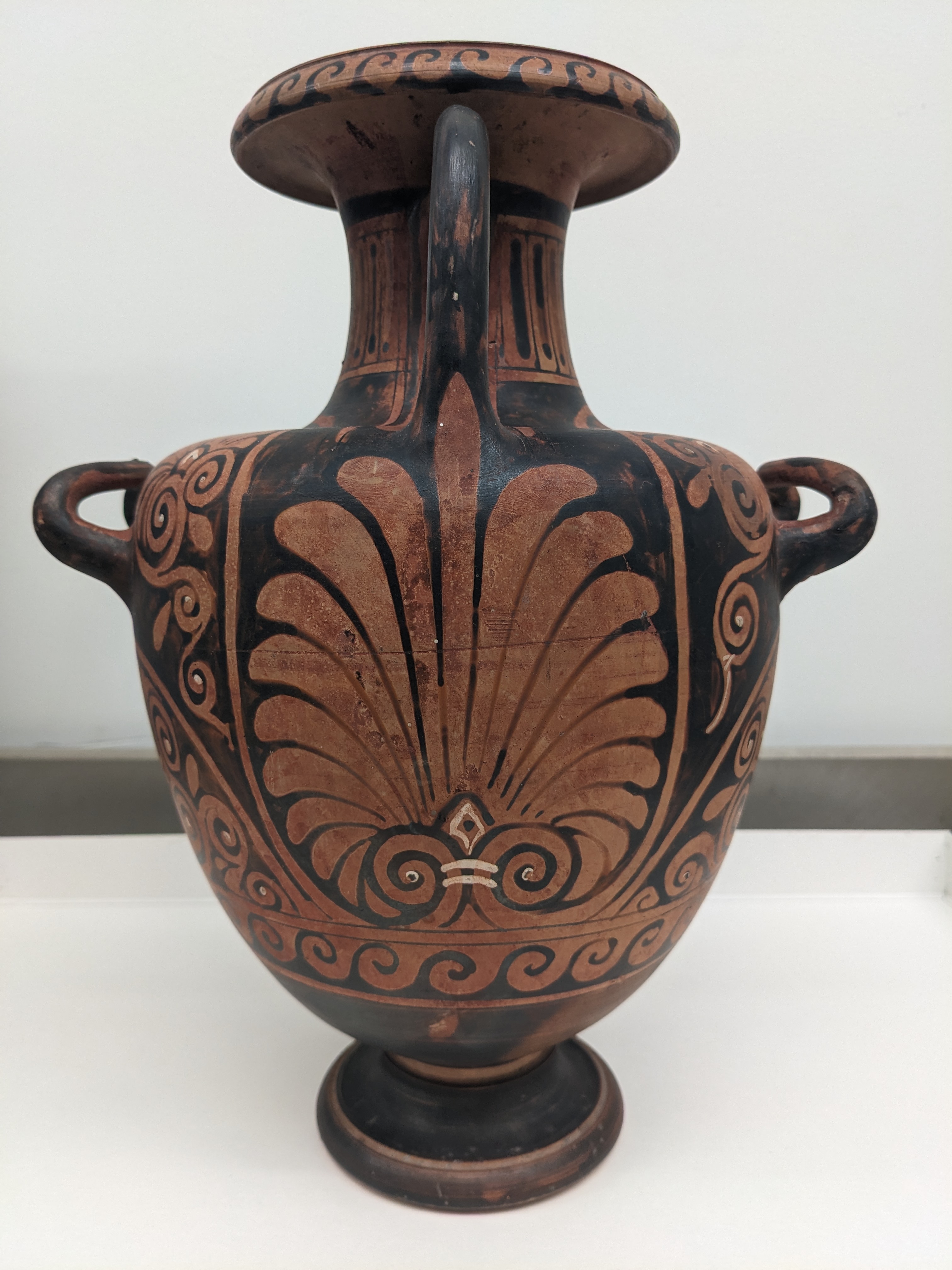
I began by researching the history and evolution of Hellenistic vessels (ceramic containers produced during the Hellenistic period, roughly from the late 4th to the 1st centuries B.C.E., used for practical, ritual, or decorative purposes), from proto-geometric and geometric techniques to black-figure and, finally, red-figure, the technique used for this artifact. Red-figure pottery eventually took precedence over black-figure because it allowed artists to leave figures in the clay’s natural red while painting the background black. Instead of laboriously incising details, artists could draw them more freely, making the technique better suited to naturalistic depictions of anatomy, garments, and emotion. I also researched the different types of Attic pottery, or pottery produced in the region of Attica, Greece, especially in Athens, which became a major center of Greek vase production. These forms included hydriai, lekythoi, amphorae, kraters, and many more. In doing so, I learned that a hydria is a three-handled water jar, typically with two horizontal handles for lifting and one vertical handle for pouring.
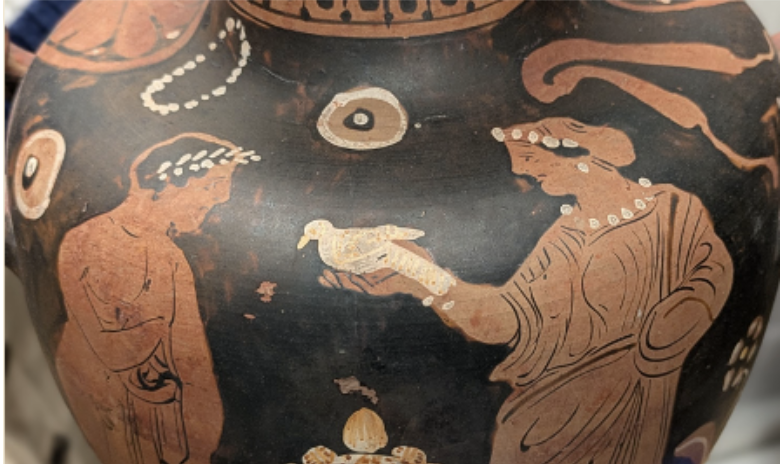
Understanding the broader historical and artistic context of the pot assisted my hypotheses of the figures’ identities. Since the woman on the right is holding a dove, I predicted that she was Aphrodite, the goddess of love and beauty, whose sacred animal is the dove. After finding more vessels online with Aphrodite depicted and comparing them with the illustration on this pot, I was confident that the well-decorated lady with her hair tied in a bunch, open beaded cap, earrings, necklace, and bracelets was Aphrodite.
A closer view of the front of the hydria’s shoulder, with the now-identified Aphrodite.
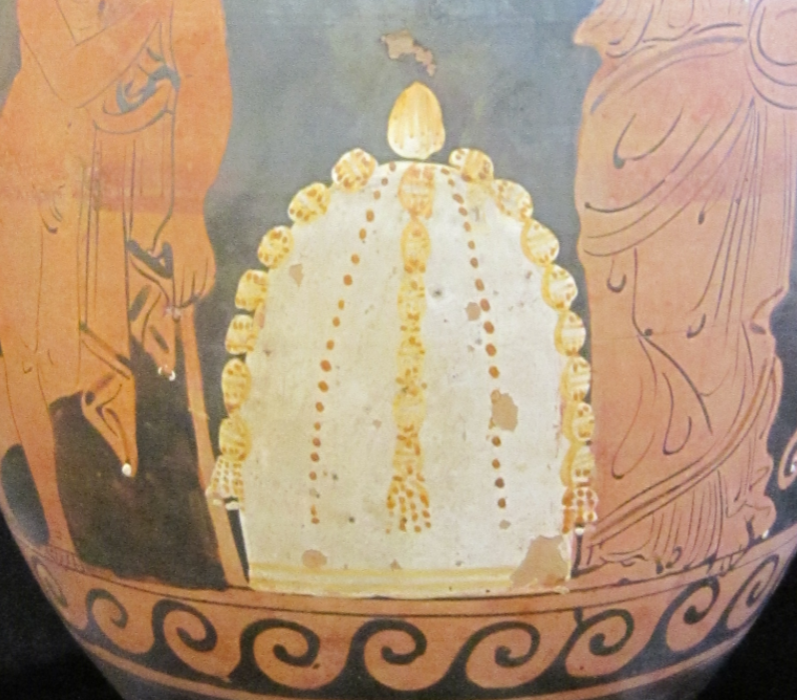
Then came the most challenging part: identifying the man on the left of the hydria. At first glance, there was nothing symbolic about the figure, except that he stood casually beside Aphrodite, showing no sign of reverence typically expected toward a goddess, therefore implying that he may be a god himself. I searched online databases and museum collections for depictions of various gods on Attic pottery and for their characteristics. Then, I remembered, too, that Dr. Marest had described the large object in between Aphrodite and this man as an “omphalos.” Originating from the Ancient Greek word “ὀμφαλός,” meaning “navel,” an omphalos symbolizes the center of the world, glory, and birth and death in the Classical and Hellenistic periods. I later learned that the omphalos was also a marble monument discovered at Delphi, Greece, a religious sanctuary dedicated to Apollo.
Close up on the omphalos.
Thinking about the relationship between the omphalos and Apollo, the fact that fillets (decorative bands of cloth often used as religious offerings), which adorn the omphalos, were often offered by worshippers consulting Apollo’s oracle, and the laurel wreath commonly worn by the nude Apollo, I suspected that this man could be Apollo. After researching more vessels online with depictions of Apollo, I found various similarities in the iconography, such as Apollo holding a staff in a print at the British Museum.
A laurel wreath, a staff, and an omphalos with fillets.
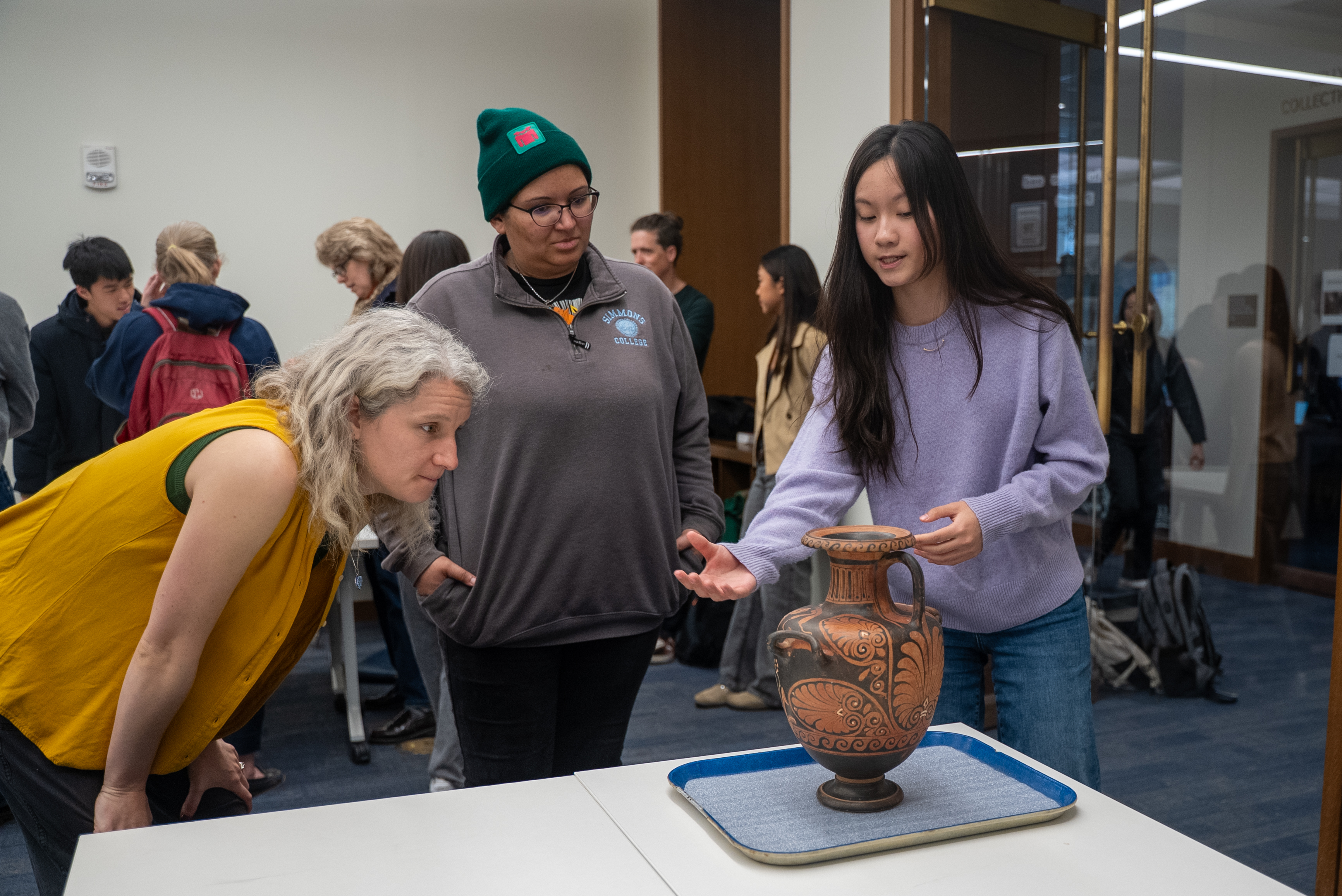
I wrote up my findings for the Peabody Institute and created slides of my research to present my findings to others. After coordinating with Dr. Lainie Schultz (Peabody Institute), Dr. Elizabeth Meyer (Instructor, Phillips Academy Classics Department), and Dr. Paige Roberts (Director, Phillips Academy Archives and Special Collections), I am so grateful to have had the opportunity to present my findings in person at the “History Up Close” event on April 30th, open to the Phillips Academy campus. The excitement of this experience also came from learning from the audience, many of whom asked very thoughtful questions about not only the iconography on the hydria but also the iconology, which gave me clearer next steps for my research.
Selene presenting her research at the “History Up Close” event. Photo by Jessie Wallner.
Never would I have thought that I would have this amazing opportunity as a high schooler. I am also extremely grateful that this experience sparked my interest in archaeology, inspiring me to expand my research on Attic pottery even beyond the Peabody.
Hi, I’m Aaron Bai, and I’m an upper (11th grader) at Phillips Academy. I’ve always been interested in history and the humanities. As a child, I would spend hours in the school library reading books on mythology and history from cultures all around the world. As I grew older, I would read and even write about interesting topics in my free time, from the Garamantes during the Roman Empire to modern extremism in the Sahel. I have come to believe that only through studying human culture and society throughout its history can we better understand who we are and how we came to be. Though the present may differ considerably from the days of Lucius Cincinnatus or George Washington, for instance, their legacies and the similarities in the challenges and decisions we face make it such that uncovering their stories unmasks more of our own.
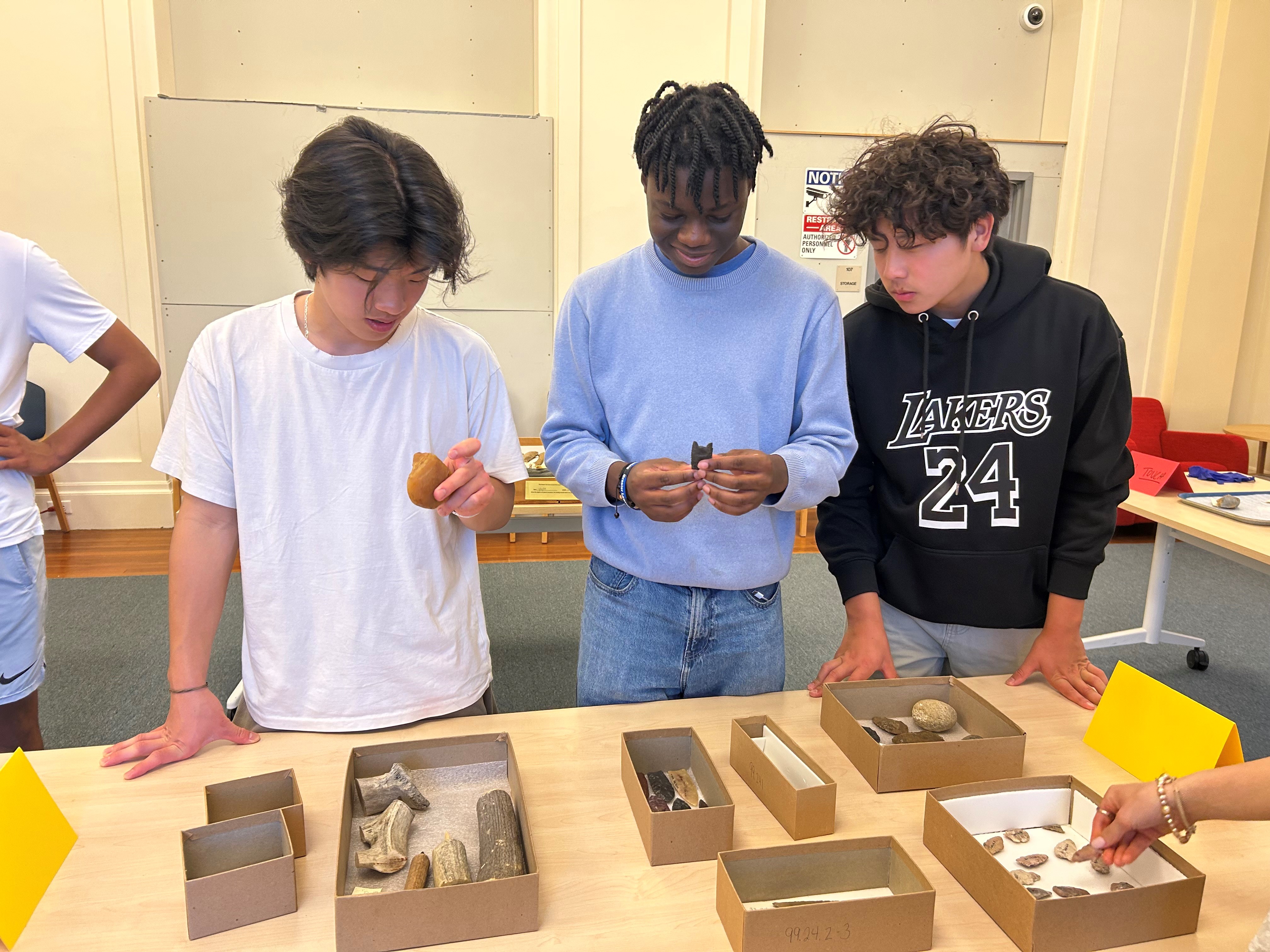
Following my interests, I chose to work at the Peabody for my work-duty requirement during my lower year (10th grade). This turned out to be a great decision— I had the rare opportunity to help organize, document, and analyze the Peabody’s vast collection of artifacts, from Neolithic stone tools to Native American ceramics. Working closely with these objects allowed me to engage directly with material history and learn the stories behind them in a unique and deeply meaningful way. This year, with work duty completed, I have continued to volunteer at the Peabody every week, helping research and document its collection of coinage from the Ancient Mediterranean, which serves as an amazing window into the societies and belief systems of the ancient world.
Given my interest in anthropology, I joined the Andover Anthropological Society last year, a student club here on campus, and later applied to take on a leadership position. Now serving as co-president of the club, I hope to raise awareness of this remarkable resource at our school and expand opportunities for students to engage with the Peabody and the collections there, whether through open houses, workshops, or research projects. It may even be worthwhile exploring engagement beyond the student body, such as inviting local schools to participate in open houses or lectures. In any case, I am very excited and look forward to working with the Peabody on these initiatives.
Aaron sharing his coin research with members of the Phillips Academy campus.
My name is Barrett Kim, and I’m an upper (11th grader) at Phillips Academy interested in biological sciences, though what draws me most isn’t exclusively the science, but the philosophical questions of how we got here.
I came across anthropology very spontaneously. A friend mentioned a research project through the Andover Anthropological Society, specifically exploring gender dynamics in Indigenous artifacts. Their hard work and insightful research immediately fascinated me. Around the same time, I was reading Orwell, Bradbury, and Salinger, writers who kept returning to the same warning: societies fail when they forget their own past. Anthropology felt like the applied, real-life version of the messages those books portrayed. If you want to understand where humans are going, you must understand where we’ve been. Anthropology turned out to be the perfect intersection of biology and sociology, two fields most people treat as completely separate.
Coming into Phillips Academy, I had no idea what anthropology was; however, after exploring the field and its importance, I felt like I had to help share what I learned. This desire to inspire others made me pursue a leadership role with the club and the Peabody Institute, not because I had everything figured out, but because I wanted to guide others into learning anthropology’s importance.
Looking ahead, I’m really excited to work with the Peabody. We have a professional archaeological institute on our campus, and most students walk right past it. Next year I want to help encourage students to use this valuable resource to explore our past and shape the understanding of our futures. Working with Aaron, we envision a place where genuine questions can be passionately explored, and where the work we do helps expand people’s worldviews.
Barrett (left) at a Peabody event organized by the Phillips Academy Biology Club.
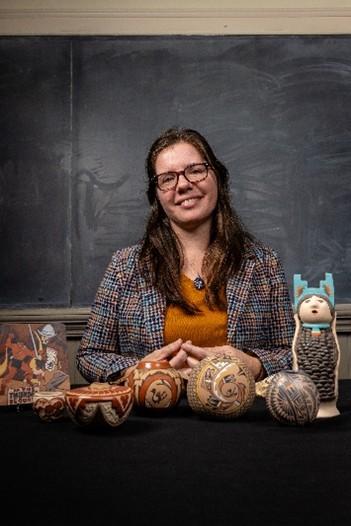
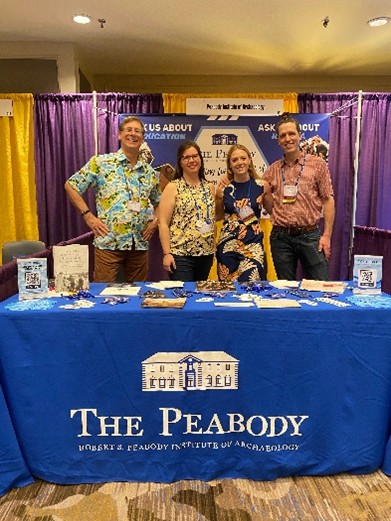
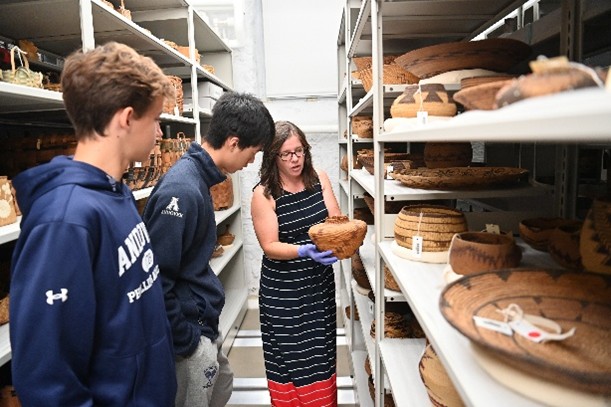
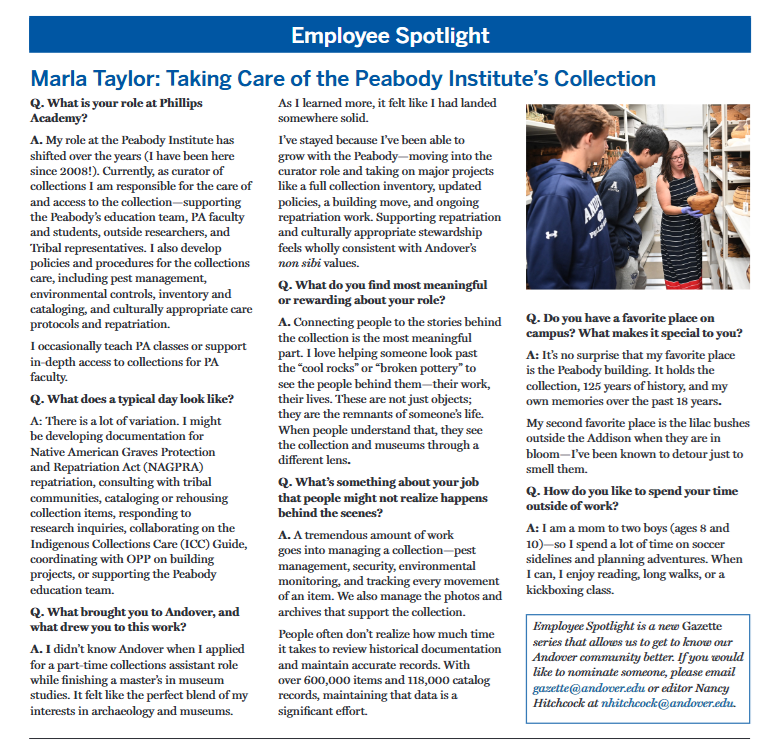
This month our Peabody Curator of Collections, Marla Taylor, was featured in Phillips Academy’s “Employee Spotlight” section of the campus community Gazette – a weekly internal newsletter for Phillips Academy faculty and staff.
Each week, a member of the PA campus community is nominated and selected to share details about their role and work. We are excited to see one of our Peabody staff members highlighted and are grateful for all the support Marla has contributed in the 18+ years she has been with the Peabody and Phillips Academy.
Check out the article below and congratulations to Marla for being featured!