From Stone Tools to Spreadsheets at the Peabody

Contributed by Sophia Lazar ‘26

Who knew that a statistics class could lead you to timing the cataloging of artifacts? That is exactly what happened to our group this spring, and we are so glad it did.
We are a group of Phillips Academy upperclassmen and seniors: Meara Wang, Jay Jung, Ayush Gupta, Tasnia Begum, and I, Sophia Lazar. We are enrolled in Mr. Noureddine El Alam’s Project-Based Statistics class, where students apply statistical methods to solve real-world problems for real partners. Rather than solely working through textbook exercises, we take on actual projects with organizations and institutions, gathering data, running analyses, and presenting findings that can make a tangible difference. Past classes have partnered with places like the Addison Gallery of American Art and the PA Admissions Office, and when Mr. El Alam introduced the Peabody as an option, our team knew right away that it was the one for us. We wanted to work on something that genuinely inspired us, and the Peabody fit perfectly.

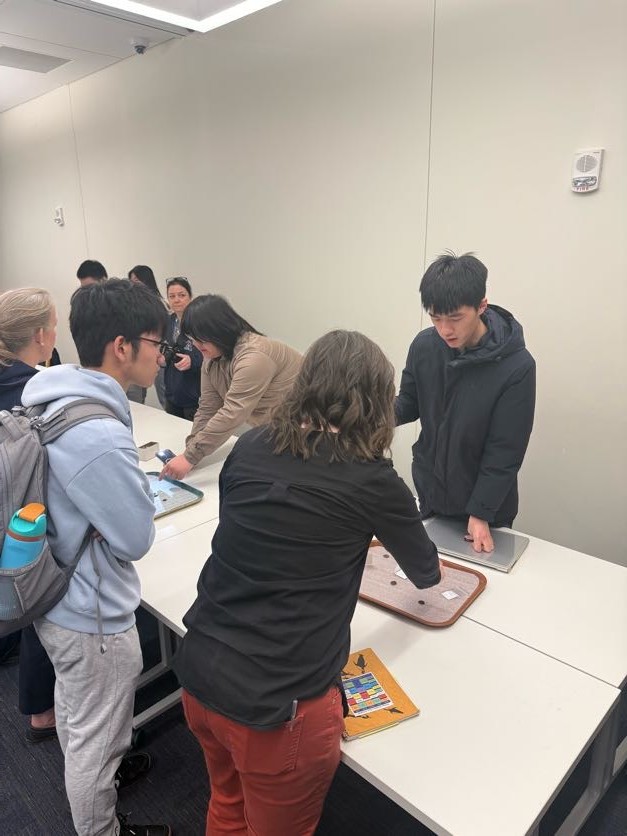
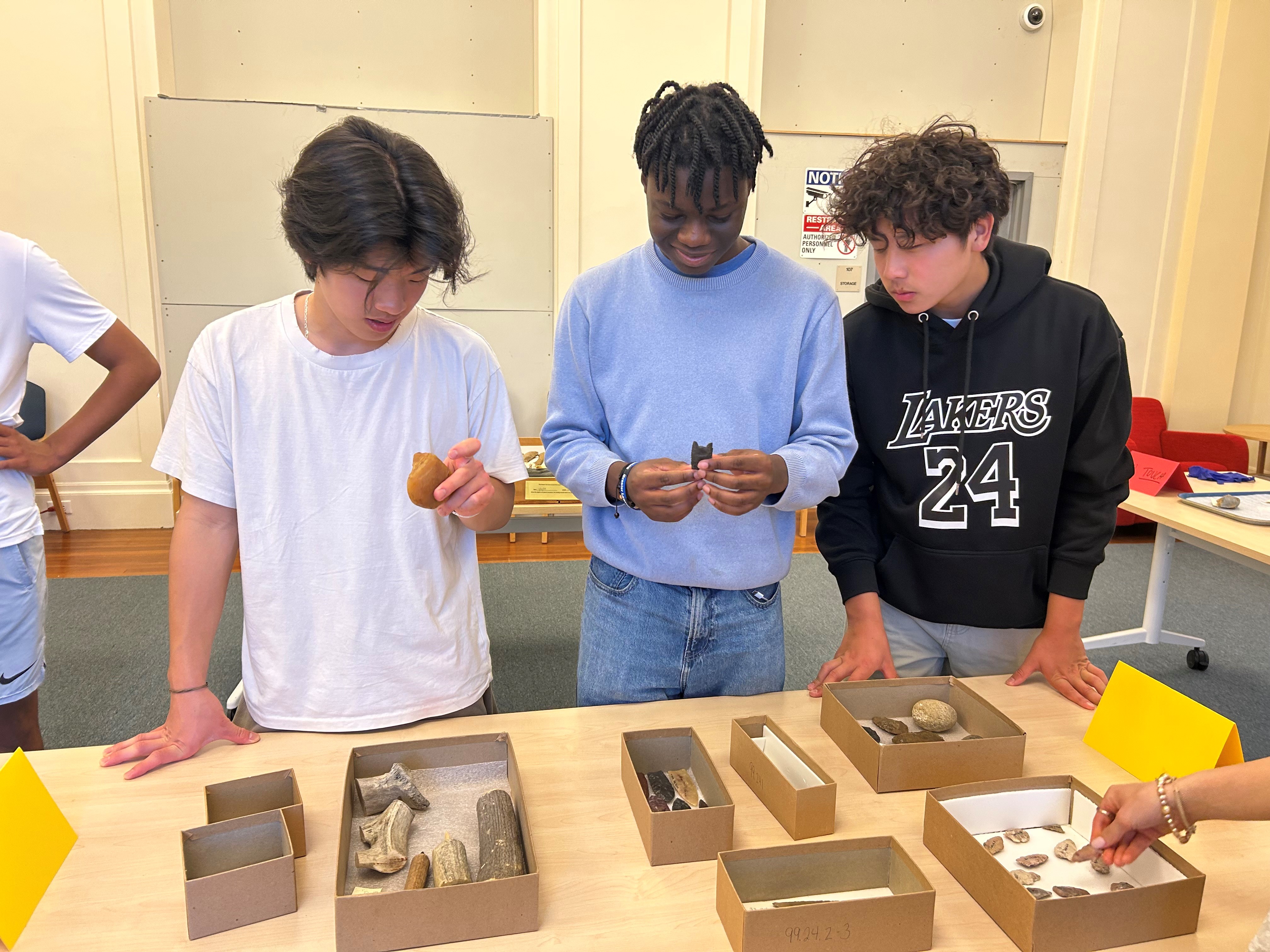
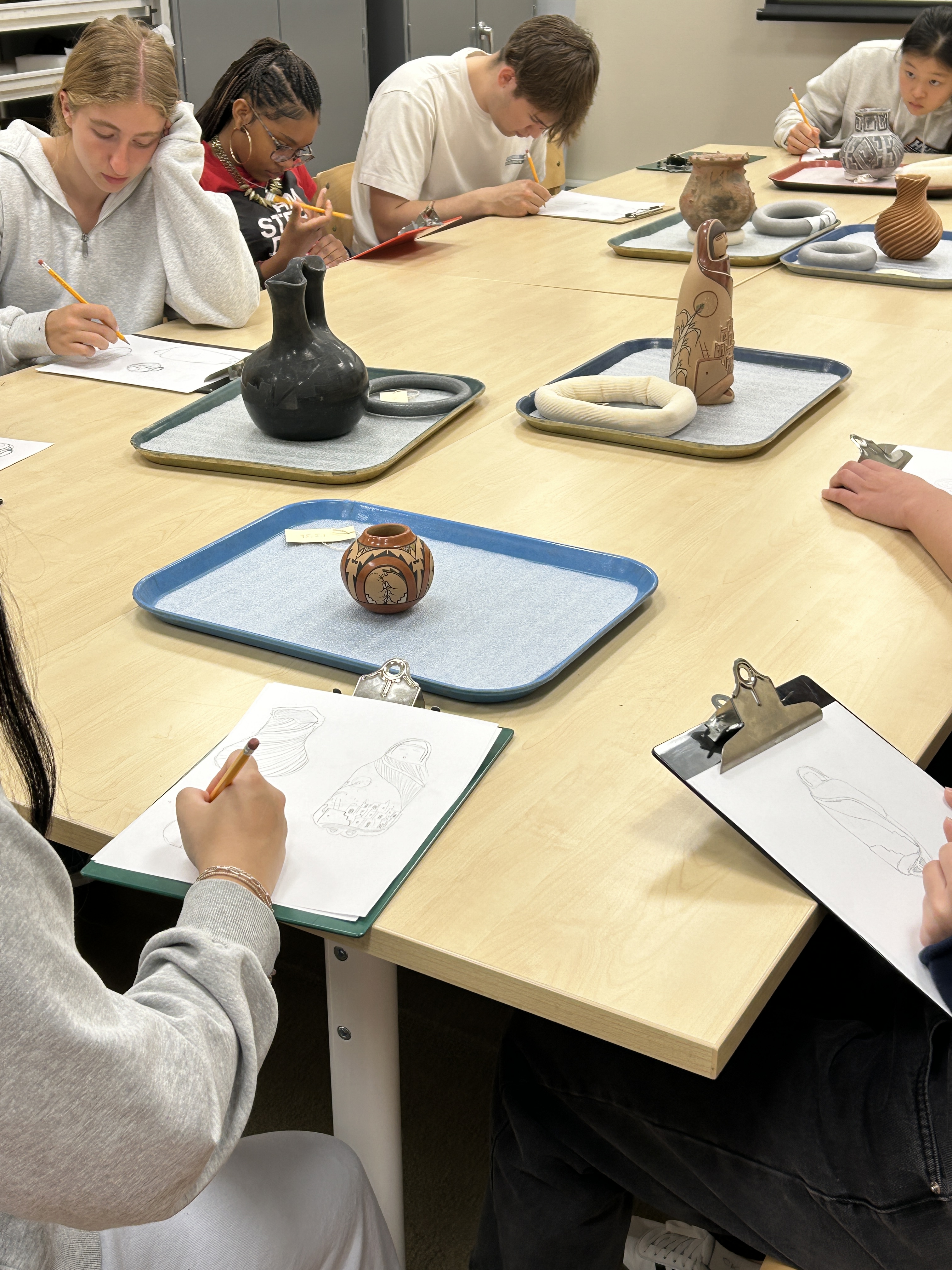
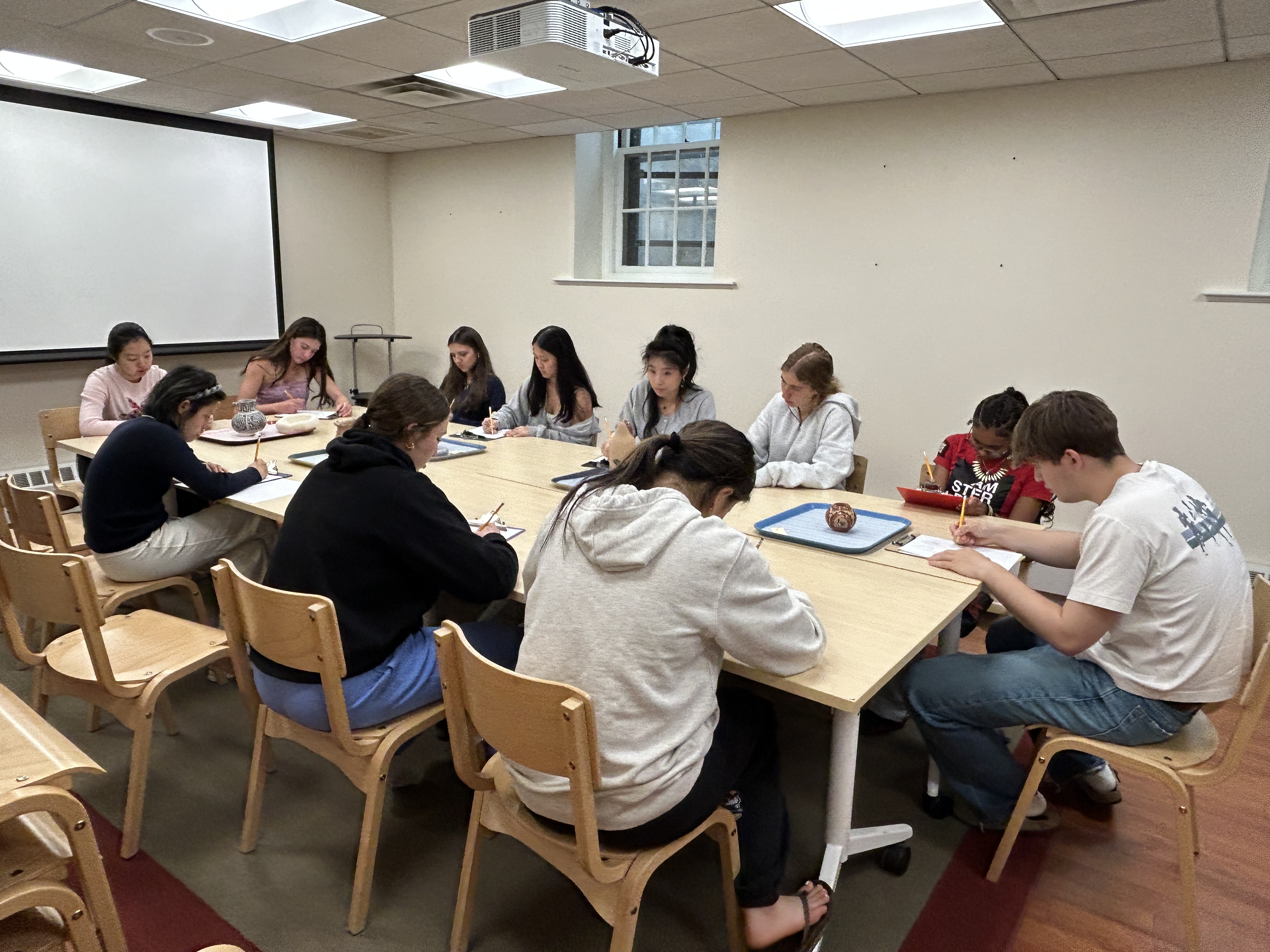
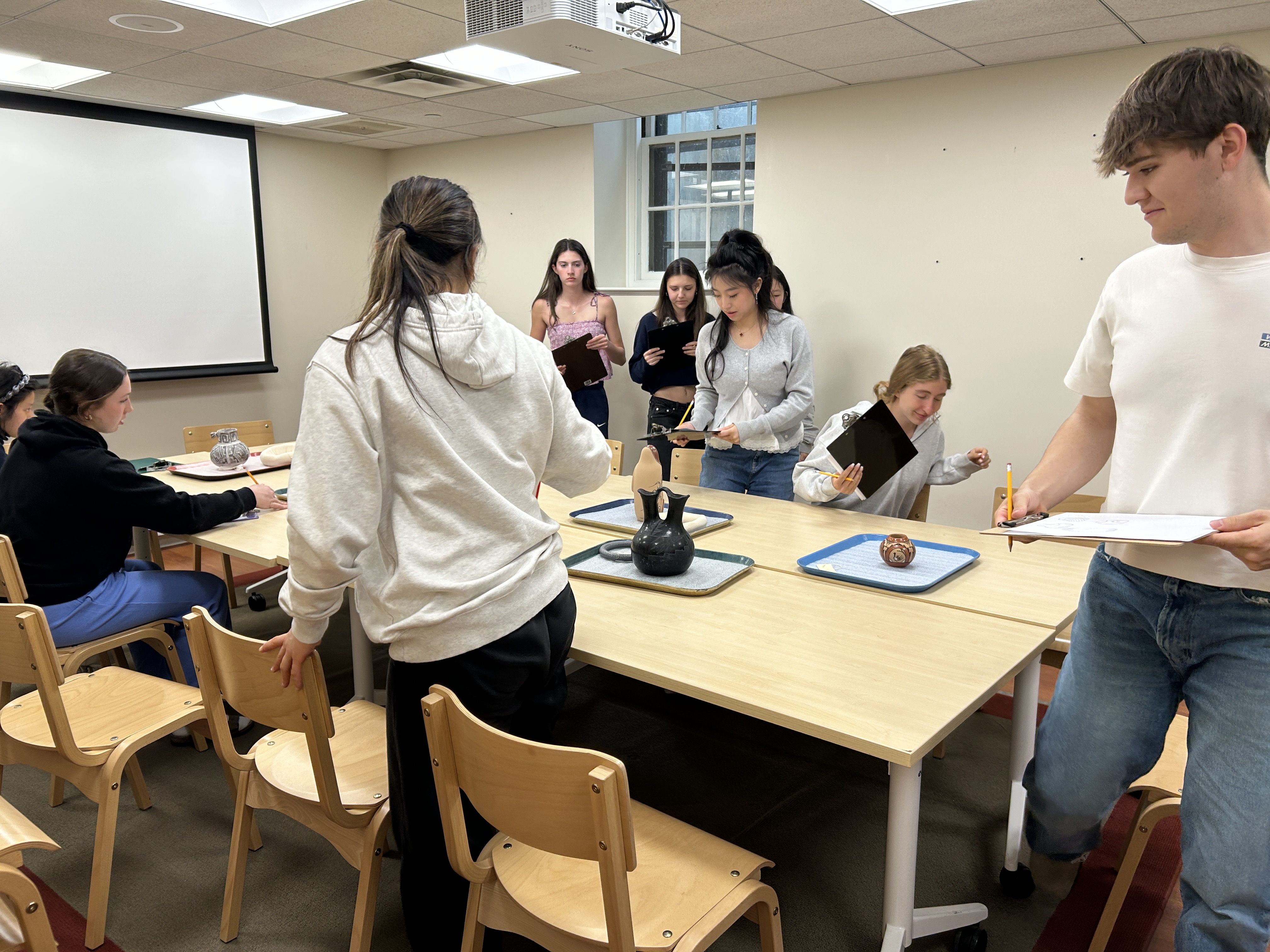
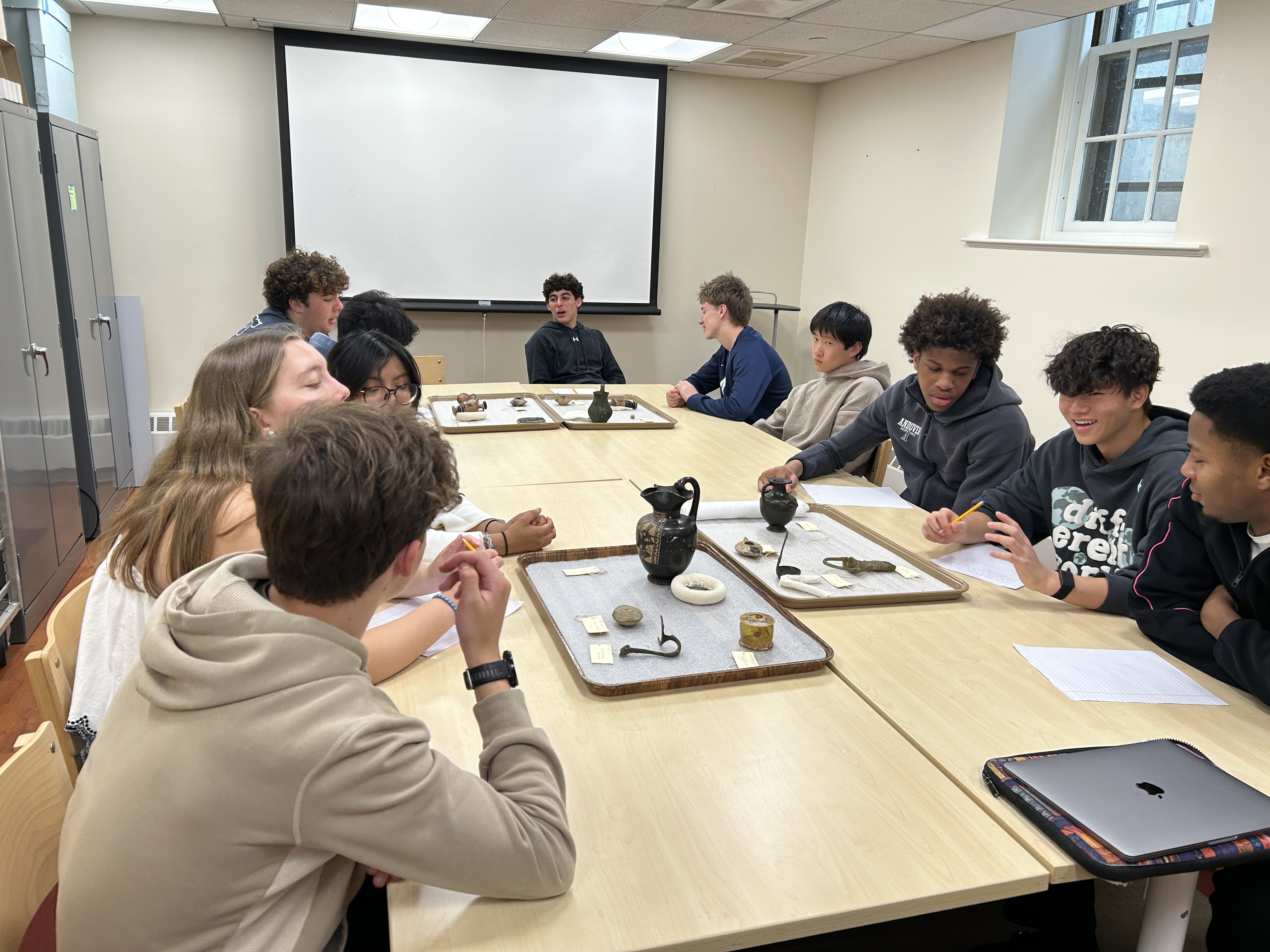
Our project centers on a question the Peabody has been grappling with: how long would it actually take to bring the museum’s artifact catalog up to an excellent standard, and what would better staffing make possible? To answer that, we needed data on the cataloging process itself, specifically how long it takes to catalog different types of artifacts. That meant a visit to the Peabody’s temporary location, where John Bergman-McCool and Marla Taylor walked us through a hands-on mock session. Because working directly with the real collection is not always feasible, John and Marla guided us through a range of representative mock artifacts so we could time the process across different object types and gather enough data points for a meaningful analysis. It was hands-on, eye-opening, and honestly a lot of fun.

With that data in hand, we are now building a statistical model to estimate how long a full cataloging effort would take under different staffing scenarios. The idea is to take our timing measurements, account for the variety of artifact types in the collection, and project out what various levels of staffing could realistically accomplish over time. The final report will go directly to the Peabody, and we hope it gives them something genuinely useful as they plan for the future.

What surprised me most was how much I came to care about the outcome. When you walk through a collection and realize just how much history is sitting there, waiting to be properly documented and shared with the world, the stakes feel very real. We came into this wanting to do meaningful work, and we are leaving with a much deeper appreciation for everything that goes into preserving and making accessible our shared cultural heritage. We hope our work makes a real difference!

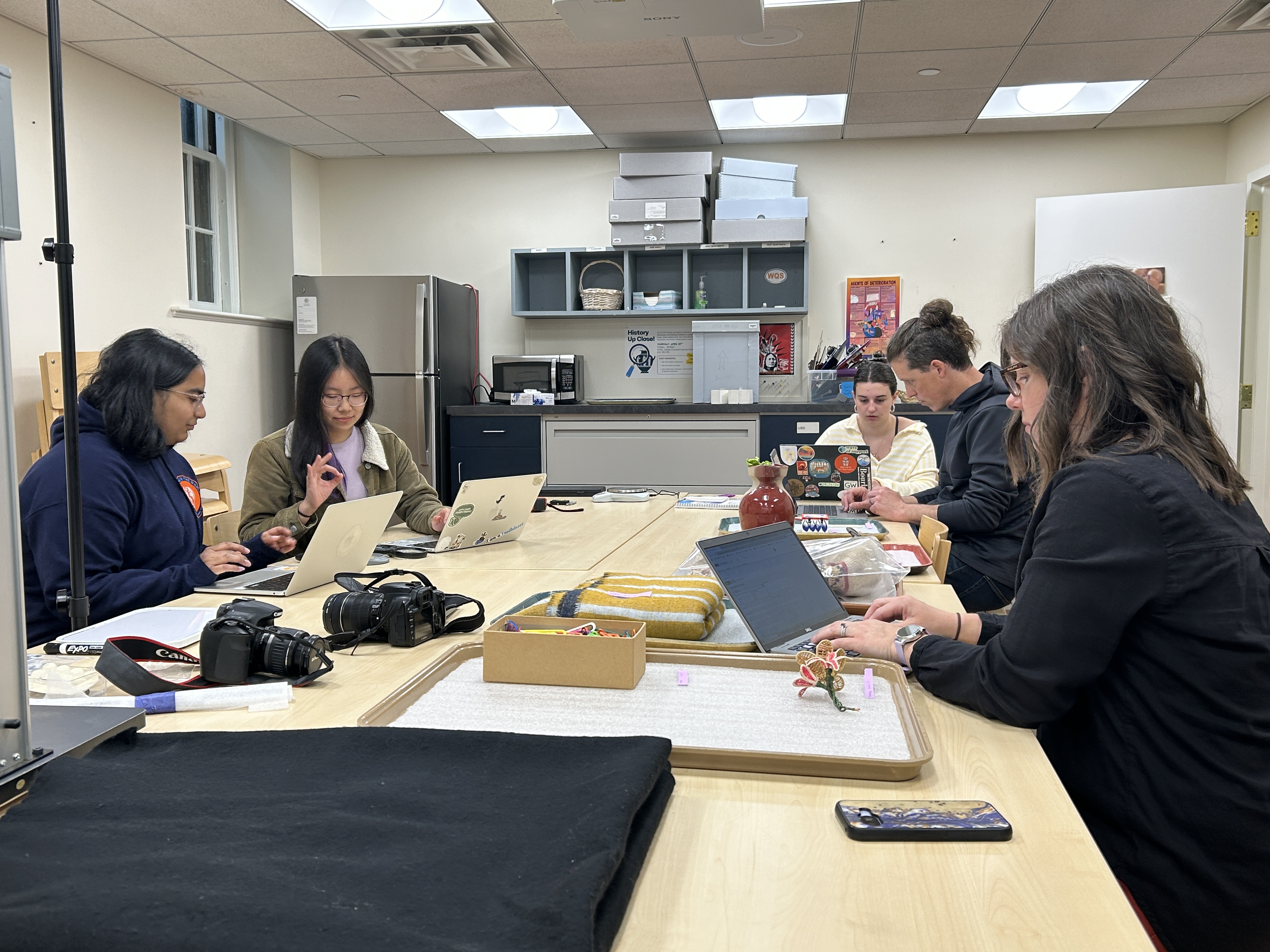
a group of five people sitting around a large table covered in objects, typing on computers
The team together at the Peabody’s temporary location during our data collection session.
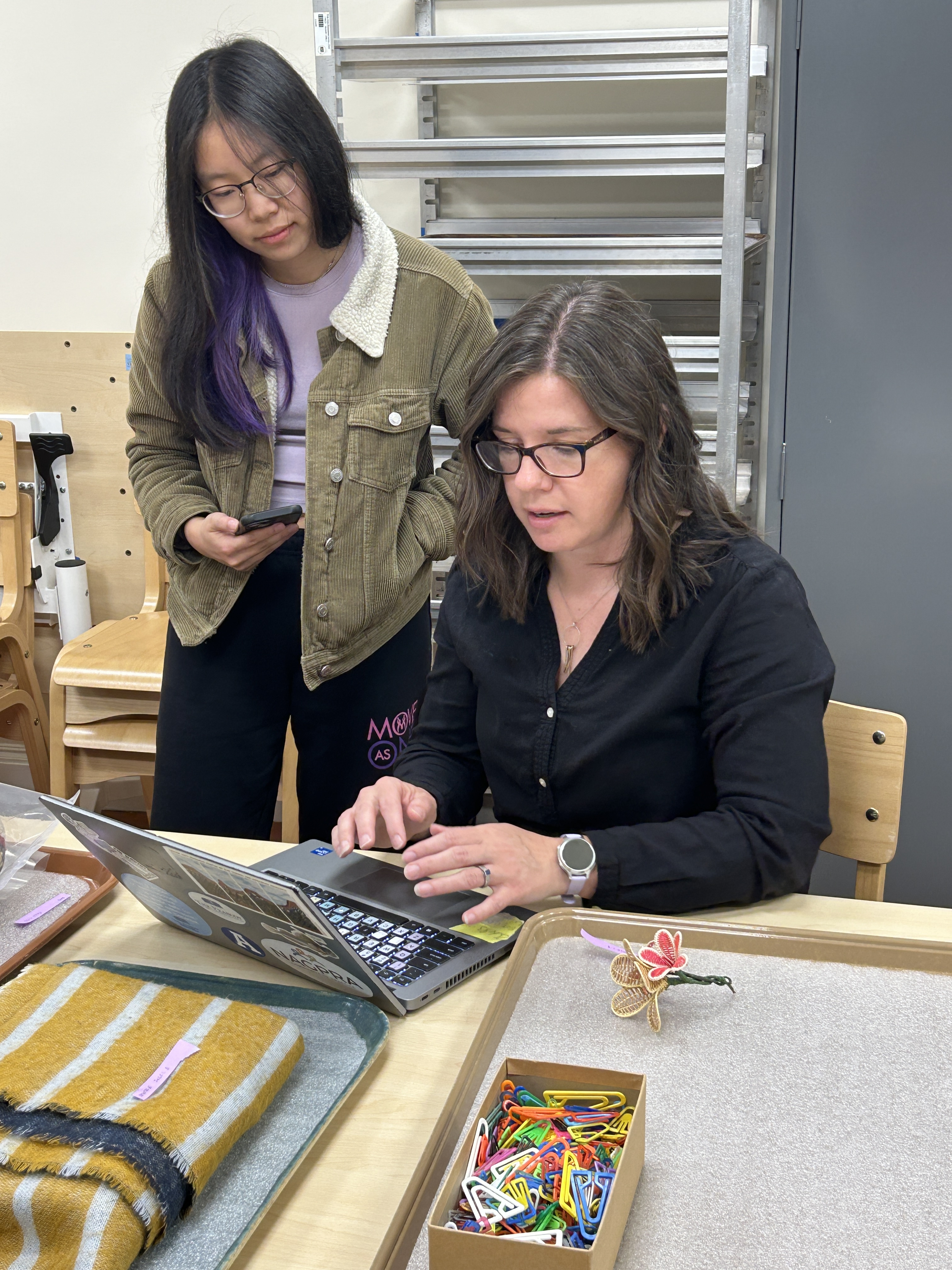
a woman sitting at a table with objects in front of her, typing on her laptop and talking to another woman standing behind her and looking over her shoulder
Marla Taylor walking Meara through the steps of cataloging a mock artifact.

A Dove, an Omphalos, and a Mystery: What’s on This Hydria?

Contributed by Selene Xu ‘27

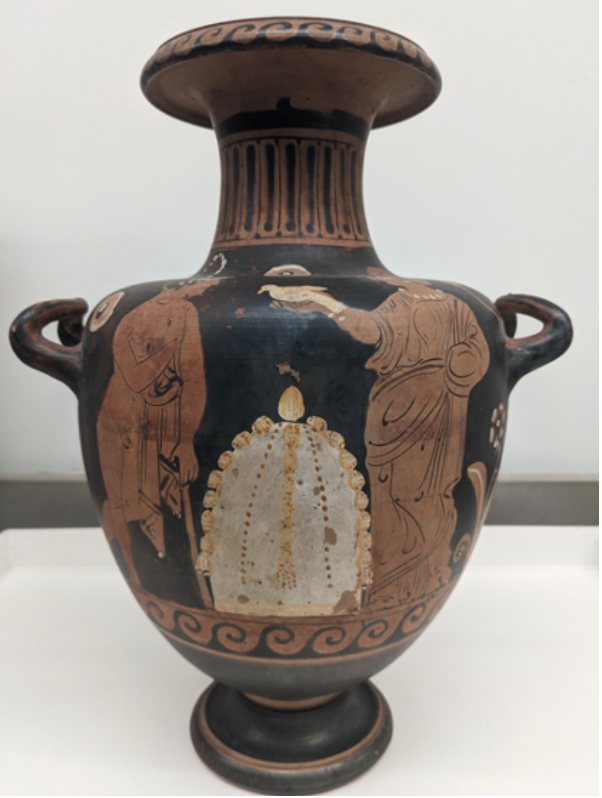
In the fall of 2024, I reached out to Dr. Ryan Wheeler to learn more about the collection of Ancient Mediterranean artifacts that I knew were housed at the Peabody. I didn’t yet know the extent of what the collection contained, or what sort of project I might want to take on, but I knew I wanted to learn more, and that I wanted to help the Peabody learn more, too, by enhancing its catalog records. Dr. Wheeler shared with me a catalog of the objects that the Peabody houses, including a folder with all their photographs. After taking a quick look, I found myself drawn to this hydria:

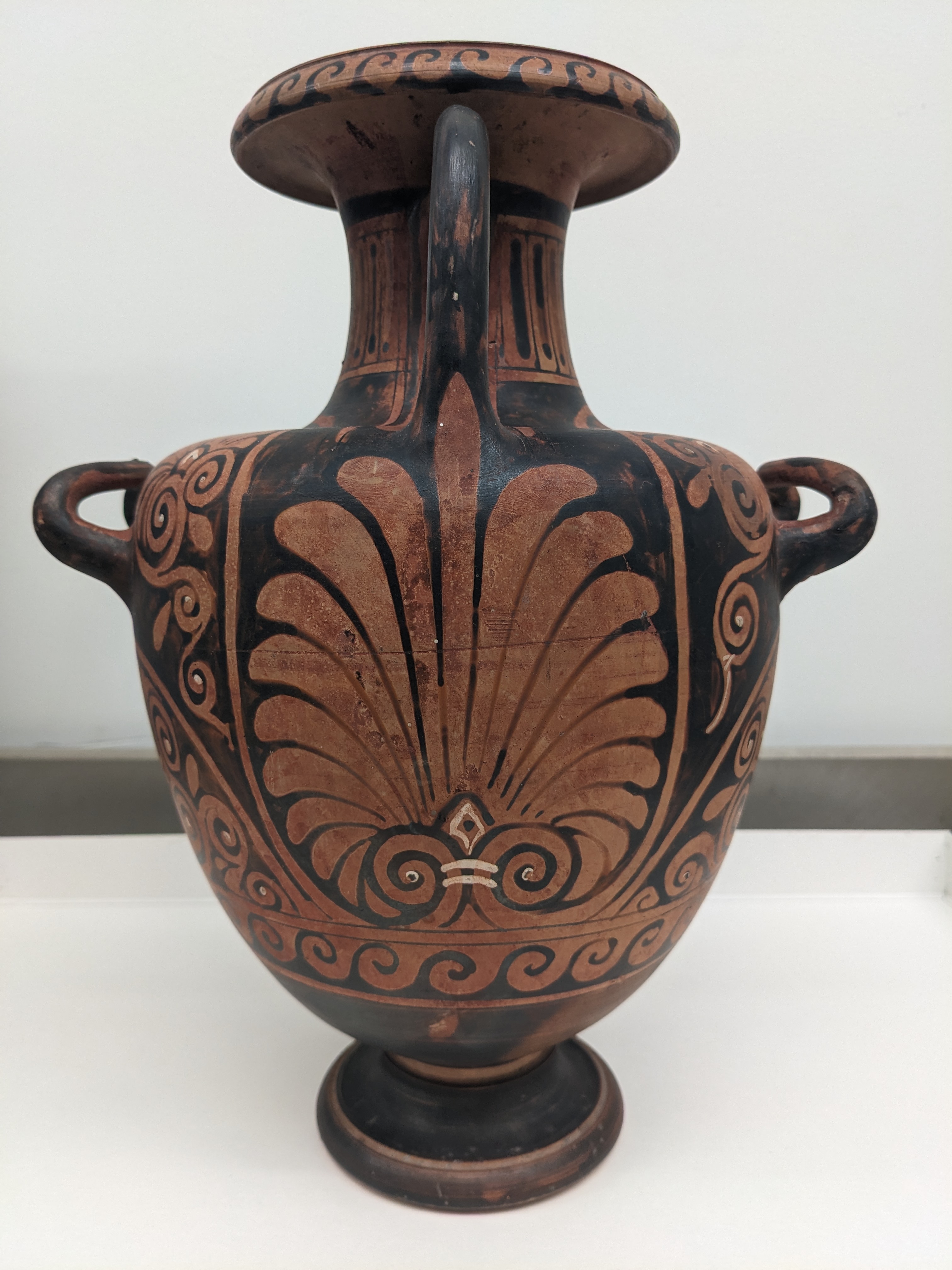
Hydria (jug) housed at the Peabody Institute, 1989.984.4.2.

This is where I chose to focus my independent research. Initial identification of the Ancient Mediterranean collections at the Peabody was provided by Dr. Laure Marest, then a curator at the Museum of Fine Arts, Boston. She described 1989.984.4.2 as a “hydria (jug) with a man and a woman holding a dove above an omphalos”, made from red-figure ceramics, dating to the late 4th century BCE, and attributed to the Hellenistic period in the Campanian region. This served as my starting point, and the direction for my research: to learn more about this type of pottery, and to identify who this man and woman might be.

I began by researching the history and evolution of Hellenistic vessels (ceramic containers produced during the Hellenistic period, roughly from the late 4th to the 1st centuries B.C.E., used for practical, ritual, or decorative purposes), from proto-geometric and geometric techniques to black-figure and, finally, red-figure, the technique used for this artifact. Red-figure pottery eventually took precedence over black-figure because it allowed artists to leave figures in the clay’s natural red while painting the background black. Instead of laboriously incising details, artists could draw them more freely, making the technique better suited to naturalistic depictions of anatomy, garments, and emotion. I also researched the different types of Attic pottery, or pottery produced in the region of Attica, Greece, especially in Athens, which became a major center of Greek vase production. These forms included hydriai, lekythoi, amphorae, kraters, and many more. In doing so, I learned that a hydria is a three-handled water jar, typically with two horizontal handles for lifting and one vertical handle for pouring.

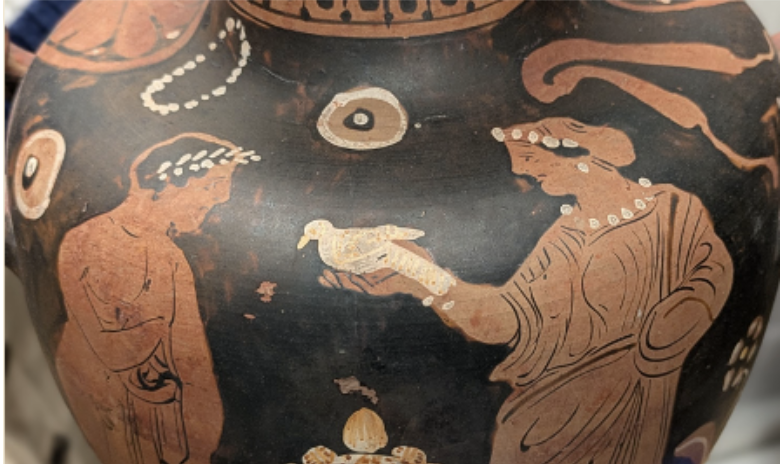
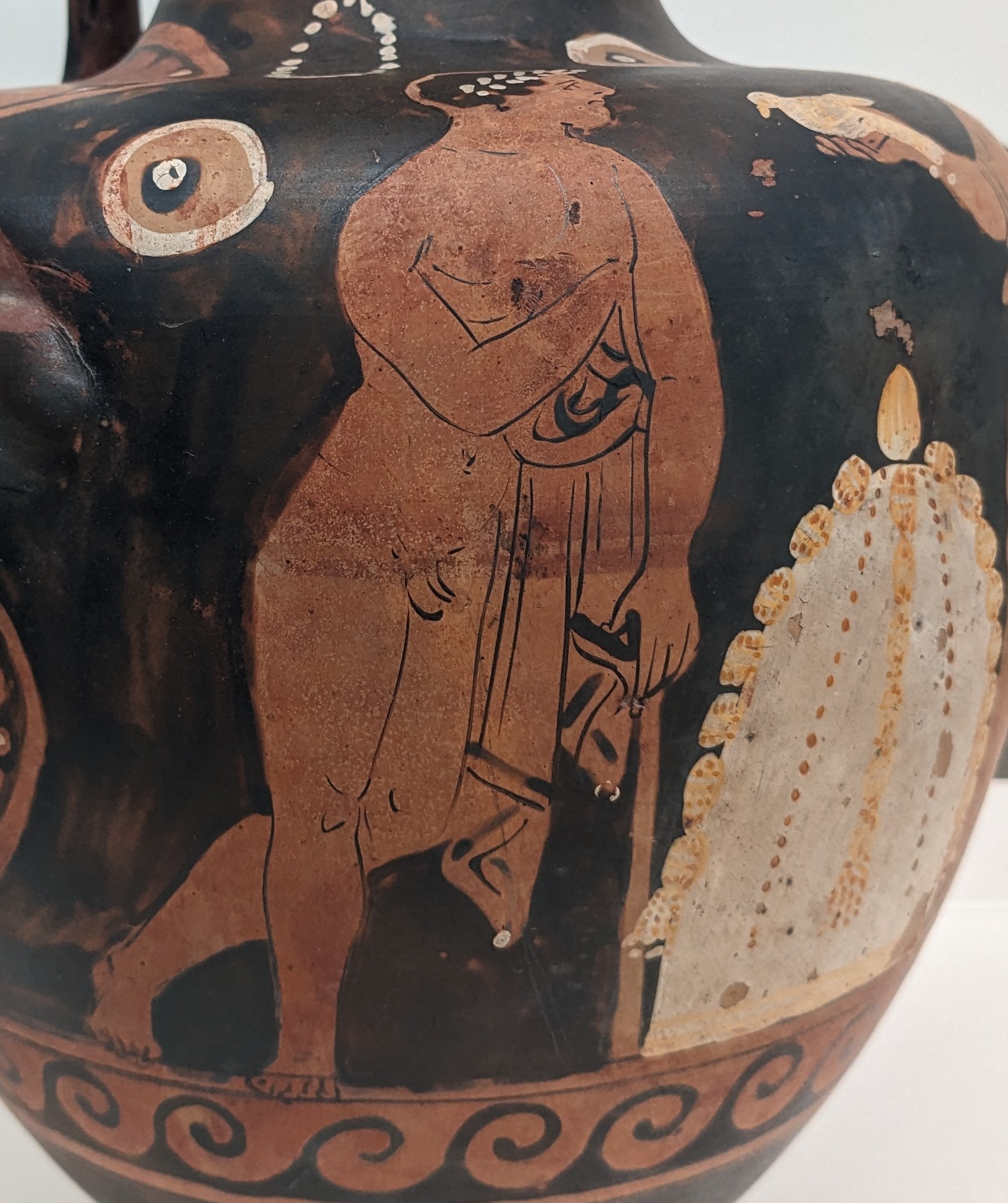
Understanding the broader historical and artistic context of the pot assisted my hypotheses of the figures’ identities. Since the woman on the right is holding a dove, I predicted that she was Aphrodite, the goddess of love and beauty, whose sacred animal is the dove. After finding more vessels online with Aphrodite depicted and comparing them with the illustration on this pot, I was confident that the well-decorated lady with her hair tied in a bunch, open beaded cap, earrings, necklace, and bracelets was Aphrodite.

close up image of a painting on a greek vessel, showing a woman holding a dove out toward a man wearing a laurel wreath
A closer view of the front of the hydria’s shoulder, with the now-identified Aphrodite.

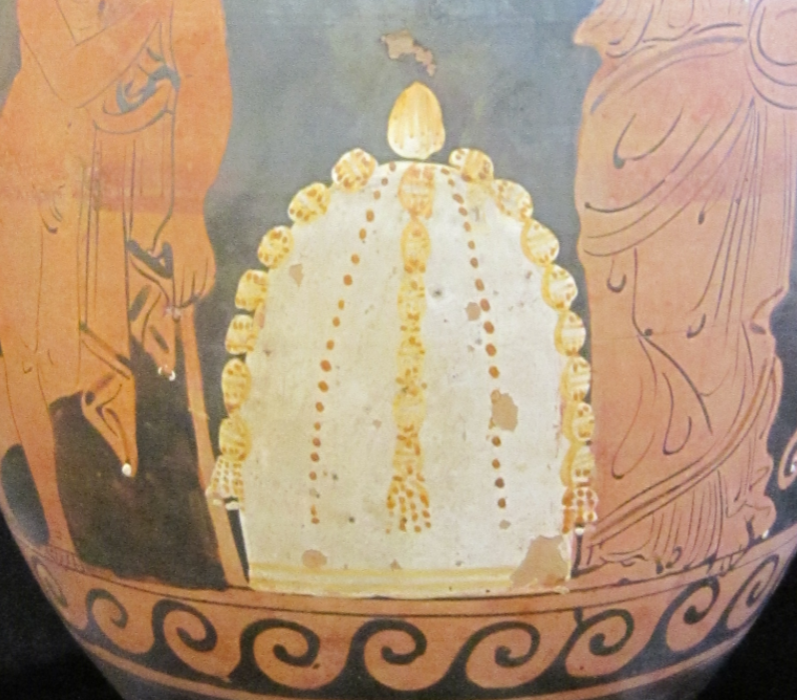
Then came the most challenging part: identifying the man on the left of the hydria. At first glance, there was nothing symbolic about the figure, except that he stood casually beside Aphrodite, showing no sign of reverence typically expected toward a goddess, therefore implying that he may be a god himself. I searched online databases and museum collections for depictions of various gods on Attic pottery and for their characteristics. Then, I remembered, too, that Dr. Marest had described the large object in between Aphrodite and this man as an “omphalos.”  Originating from the Ancient Greek word “ὀμφαλός,” meaning “navel,” an omphalos symbolizes the center of the world, glory, and birth and death in the Classical and Hellenistic periods. I later learned that the omphalos was also a marble monument discovered at Delphi, Greece, a religious sanctuary dedicated to Apollo.

close up image of a painting on a greek vessel, showing an omphalos
Close up on the omphalos.

Thinking about the relationship between the omphalos and Apollo, the fact that fillets (decorative bands of cloth often used as religious offerings), which adorn the omphalos, were often offered by worshippers consulting Apollo’s oracle, and the laurel wreath commonly worn by the nude Apollo, I suspected that this man could be Apollo. After researching more vessels online with depictions of Apollo, I found various similarities in the iconography, such as Apollo holding a staff in a print at the British Museum.

close up image of a painting on an ancient greek vessel, showing a man wearing a laurel wreath and leaning on a staff
A laurel wreath, a staff, and an omphalos with fillets.

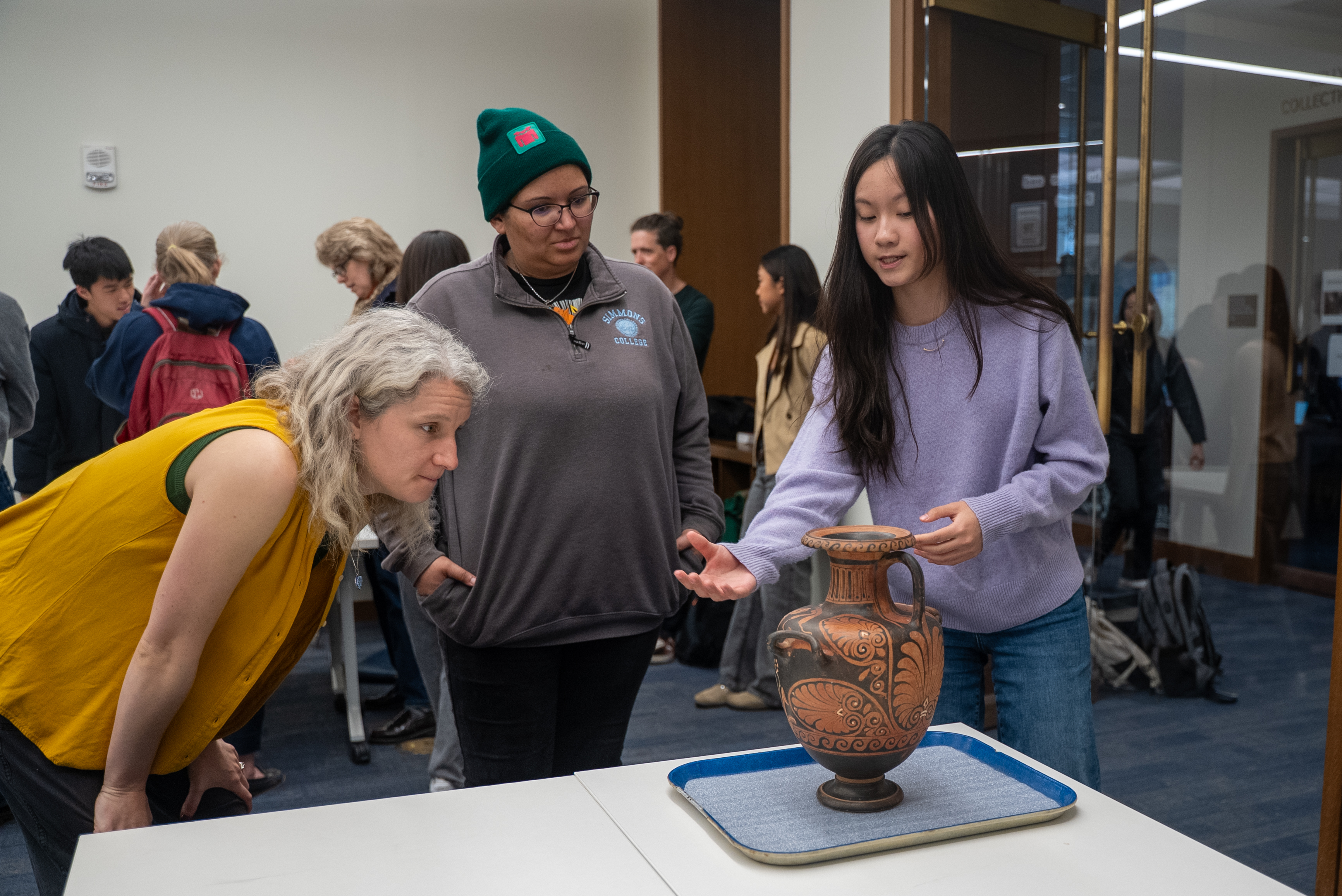
I wrote up my findings for the Peabody Institute and created slides of my research to present my findings to others. After coordinating with Dr. Lainie Schultz (Peabody Institute), Dr. Elizabeth Meyer (Instructor, Phillips Academy Classics Department), and Dr. Paige Roberts (Director, Phillips Academy Archives and Special Collections), I am so grateful to have had the opportunity to present my findings in person at the “History Up Close” event on April 30th, open to the Phillips Academy campus. The excitement of this experience also came from learning from the audience, many of whom asked very thoughtful questions about not only the iconography on the hydria but also the iconology, which gave me clearer next steps for my research.

three people standing around an ancient greek pot, looking and discussing
Selene presenting her research at the “History Up Close” event. Photo by Jessie Wallner.

Never would I have thought that I would have this amazing opportunity as a high schooler. I am also extremely grateful that this experience sparked my interest in archaeology, inspiring me to expand my research on Attic pottery even beyond the Peabody.

New Leadership and New Initiatives at the Andover Anthropological Society

Contributed by Aaron Bai ’27 and Barrett Kim ’27

Hi, I’m Aaron Bai, and I’m an upper (11th grader) at Phillips Academy. I’ve always been interested in history and the humanities. As a child, I would spend hours in the school library reading books on mythology and history from cultures all around the world. As I grew older, I would read and even write about interesting topics in my free time, from the Garamantes during the Roman Empire to modern extremism in the Sahel. I have come to believe that only through studying human culture and society throughout its history can we better understand who we are and how we came to be. Though the present may differ considerably from the days of Lucius Cincinnatus or George Washington, for instance, their legacies and the similarities in the challenges and decisions we face make it such that uncovering their stories unmasks more of our own.

Following my interests, I chose to work at the Peabody for my work-duty requirement during my lower year (10th grade). This turned out to be a great decision— I had the rare opportunity to help organize, document, and analyze the Peabody’s vast collection of artifacts, from Neolithic stone tools to Native American ceramics. Working closely with these objects allowed me to engage directly with material history and learn the stories behind them in a unique and deeply meaningful way. This year, with work duty completed, I have continued to volunteer at the Peabody every week, helping research and document its collection of coinage from the Ancient Mediterranean, which serves as an amazing window into the societies and belief systems of the ancient world.

Given my interest in anthropology, I joined the Andover Anthropological Society last year, a student club here on campus, and later applied to take on a leadership position. Now serving as co-president of the club, I hope to raise awareness of this remarkable resource at our school and expand opportunities for students to engage with the Peabody and the collections there, whether through open houses, workshops, or research projects. It may even be worthwhile exploring engagement beyond the student body, such as inviting local schools to participate in open houses or lectures. In any case, I am very excited and look forward to working with the Peabody on these initiatives.

A group of people standing around tables, looking at coins laid out on trays and talking.
Aaron sharing his coin research with members of the Phillips Academy campus.

My name is Barrett Kim, and I’m an upper (11th grader) at Phillips Academy interested in biological sciences, though what draws me most isn’t exclusively the science, but the philosophical questions of how we got here.

I came across anthropology very spontaneously. A friend mentioned a research project through the Andover Anthropological Society, specifically exploring gender dynamics in Indigenous artifacts. Their hard work and insightful research immediately fascinated me. Around the same time, I was reading Orwell, Bradbury, and Salinger, writers who kept returning to the same warning: societies fail when they forget their own past. Anthropology felt like the applied, real-life version of the messages those books portrayed. If you want to understand where humans are going, you must understand where we’ve been. Anthropology turned out to be the perfect intersection of biology and sociology, two fields most people treat as completely separate.

Coming into Phillips Academy, I had no idea what anthropology was; however, after exploring the field and its importance, I felt like I had to help share what I learned. This desire to inspire others made me pursue a leadership role with the club and the Peabody Institute, not because I had everything figured out, but because I wanted to guide others into learning anthropology’s importance.

Looking ahead, I’m really excited to work with the Peabody. We have a professional archaeological institute on our campus, and most students walk right past it. Next year I want to help encourage students to use this valuable resource to explore our past and shape the understanding of our futures. Working with Aaron, we envision a place where genuine questions can be passionately explored, and where the work we do helps expand people’s worldviews.

Three young men standing in a row at a table, looking at ancient collections of bone and stone.
Barrett (left) at a Peabody event organized by the Phillips Academy Biology Club.

In the Dean of Archaeology Office

Contributed by Lainie Schultz

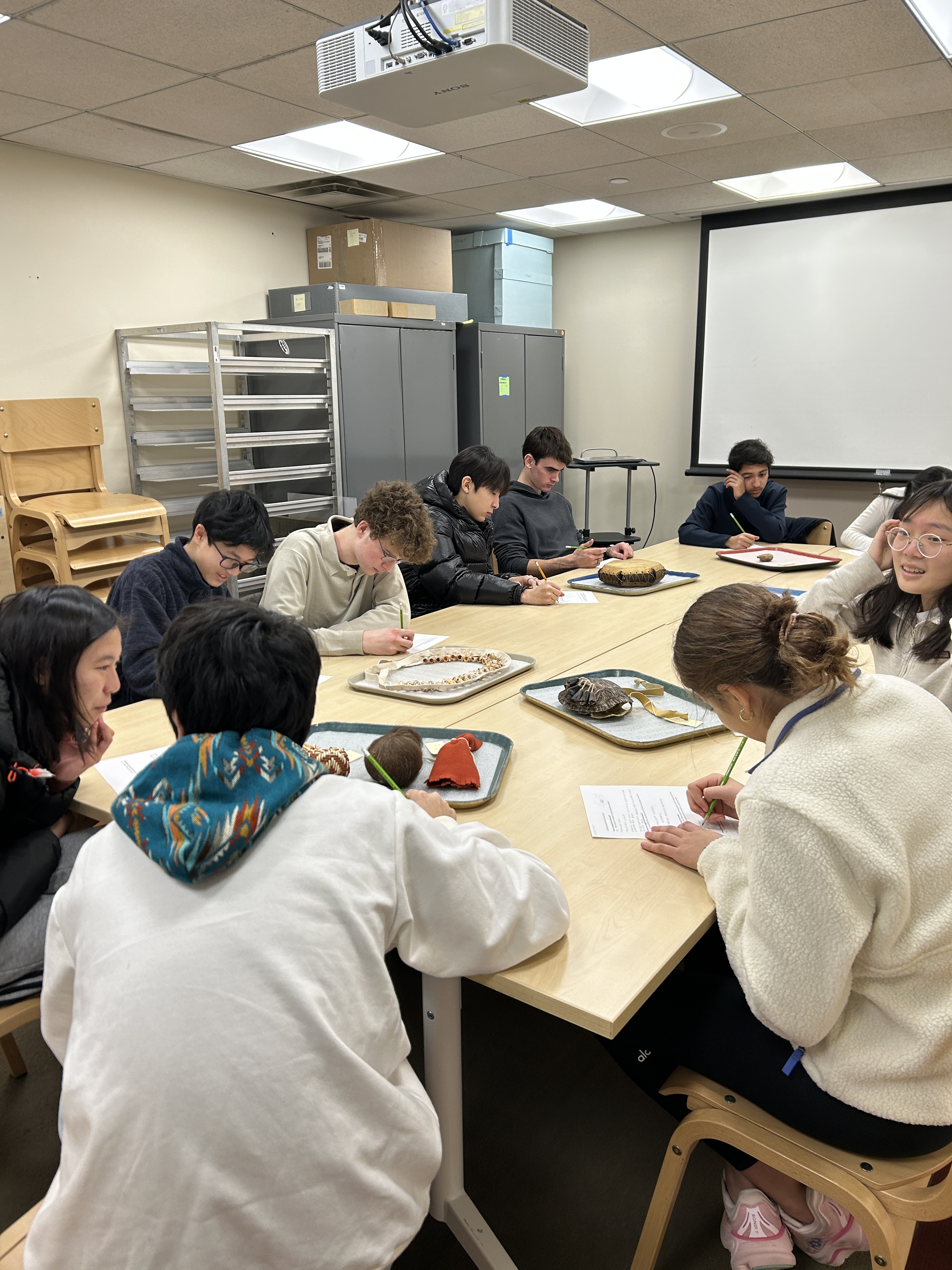
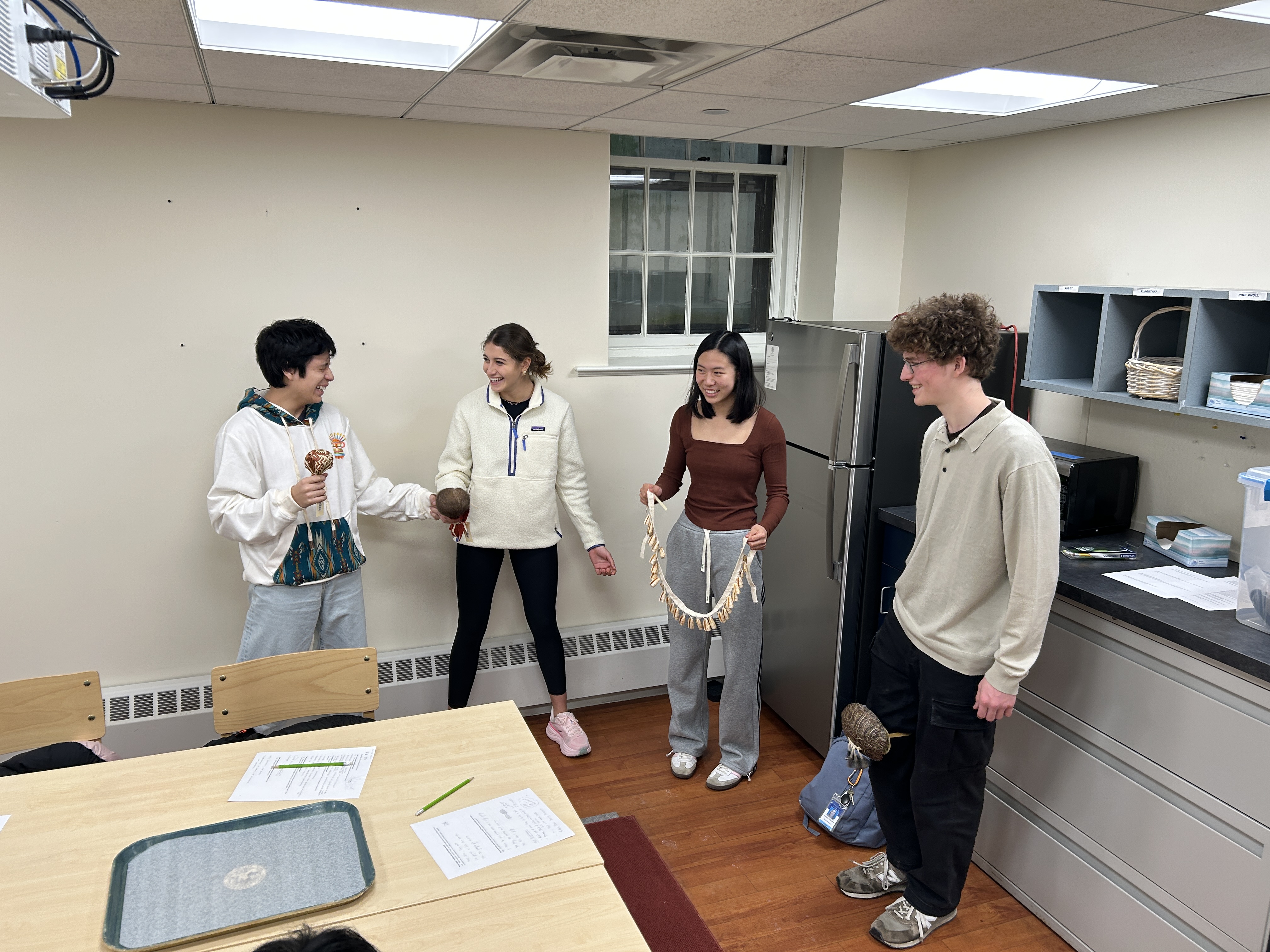
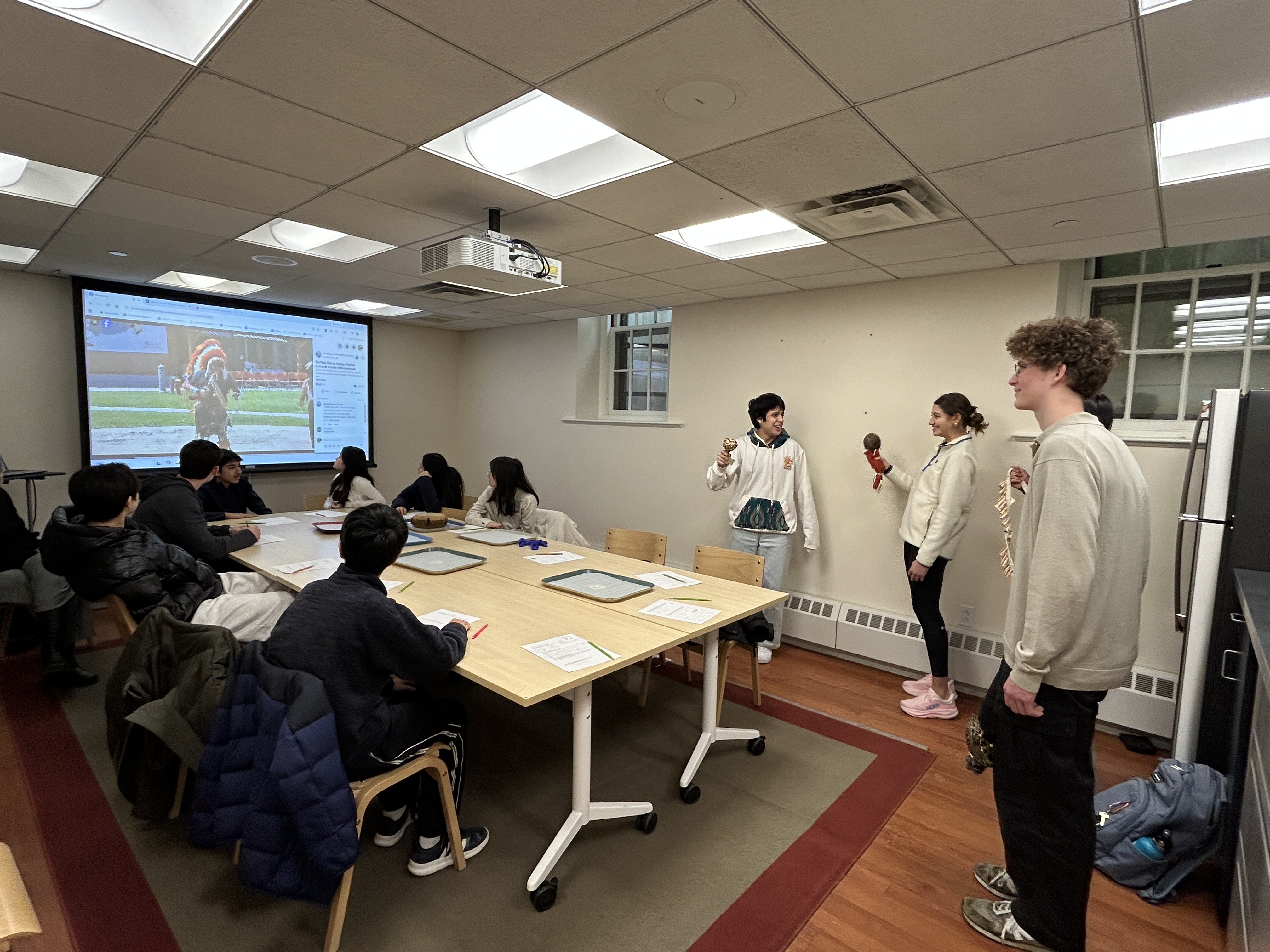
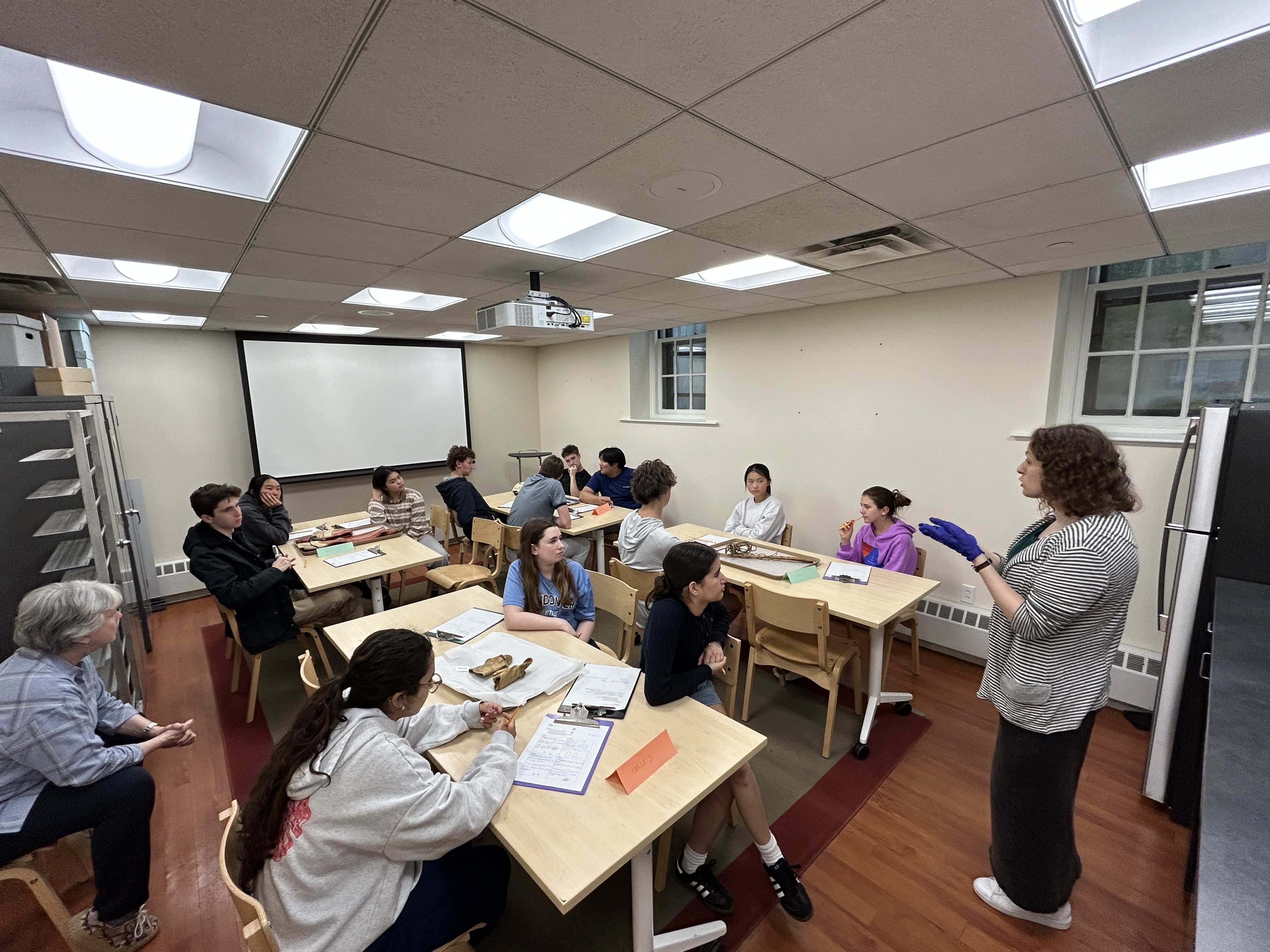
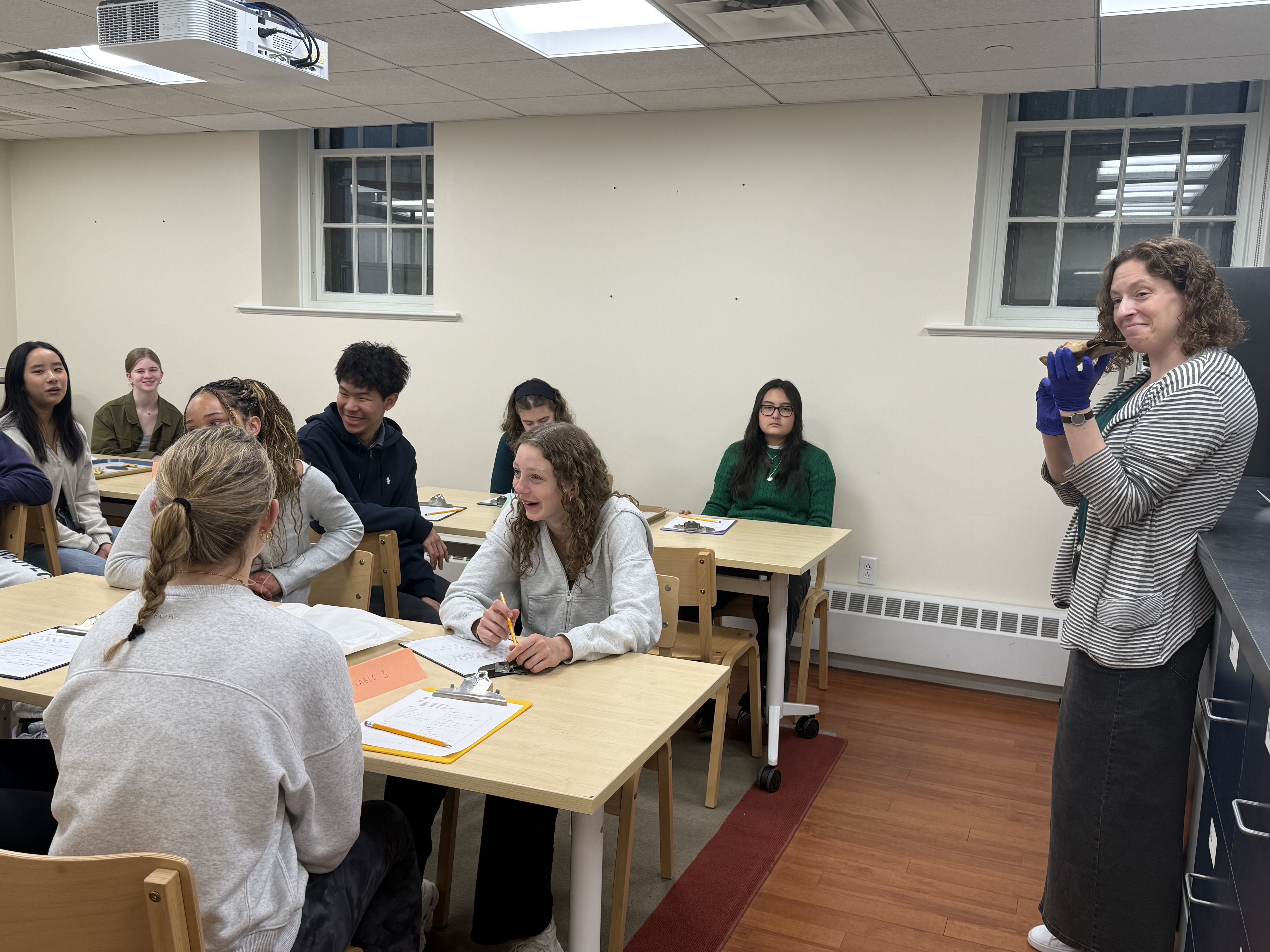
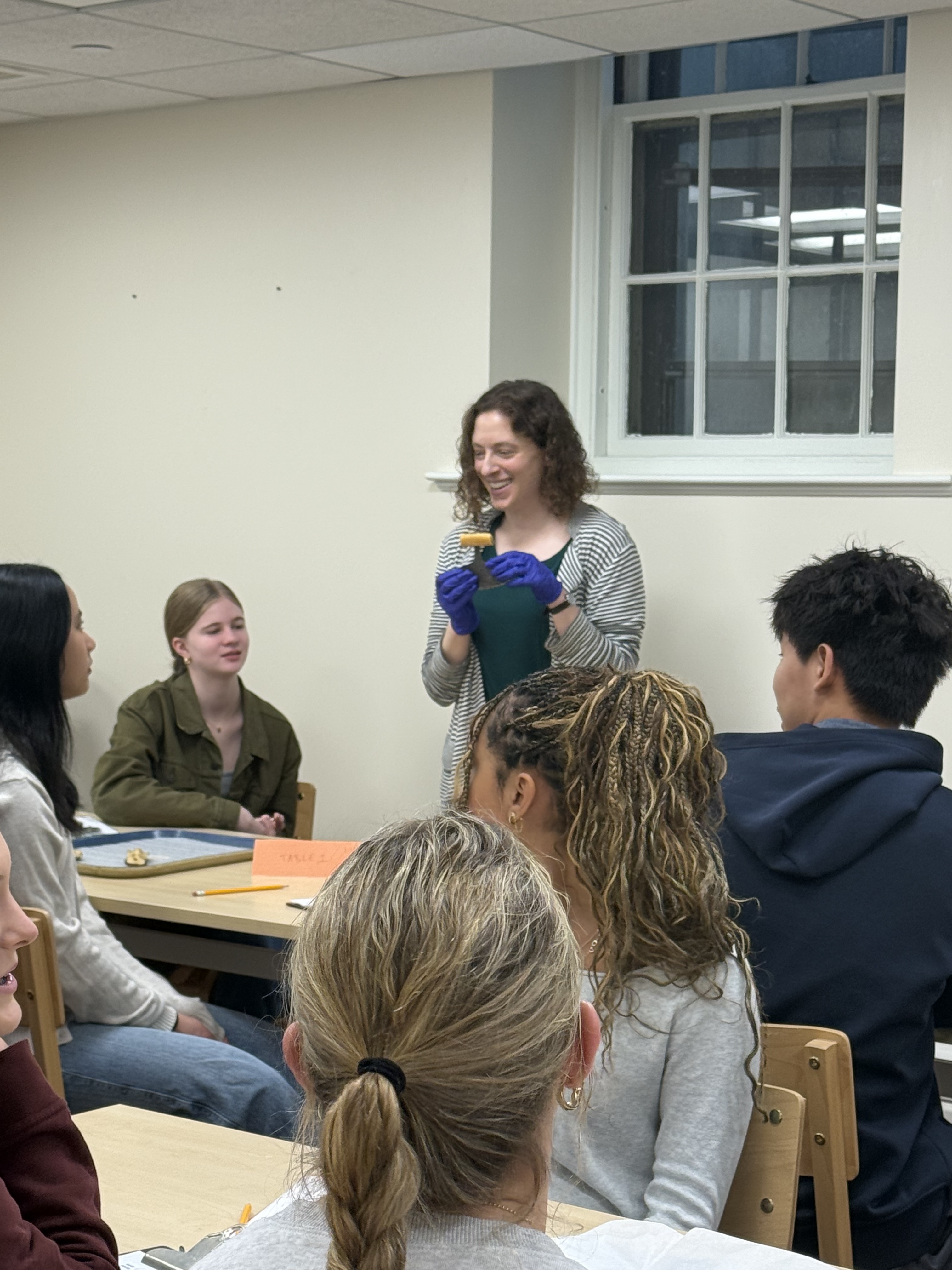
In January of this year, Peabody Institute staff were kicked out of the Peabody Institute building as the start of renovations loomed near. Fortunately, construction elsewhere at Phillips Academy meant that the Dean of Students moved into new digs, leaving available their suite in the basement of George Washington Hall to claim as our temporary-own. A Goldilocks fit, the space had five desks available for five Peabody folk, plus a bonus meeting room for meetings.

Or – could it be a meeting room for classes? Lore tells of Peabody staff moving into the School Room on the Abbot Academy campus for the first phase of building renovations. To continue teaching classes, staff valiantly packed up boxes of collections, carrying them from classroom to classroom along with all their teaching supplies: gloves, ethafoam, trays, and, goodness help them, laptops.

I wasn’t at the Peabody yet, so I have only heard the tale. It sounded very impressive and intrepid and like quite the adventure, and every lazy bone in my body knew I wanted nothing to do with it. And so, with my colleagues, I began carefully planning every piece of furniture we would bring over to our GW bonus room, with every permutation of every collections activity thought out. We measured twice and cut once, determined to make this suite available for teaching.

There is nothing more satisfying than a carefully considered plan that actually goes exactly as intended. Is it sometimes maybe slightly cramped? Yes. Does it always work? Yes. Am I a little smug? Oh, heck, yes.

Trying our hands (and waists and legs) at some new instruments with MUS410 Your Musical Brain.

Meeting the Inuit who met the Vikings with HSS100B Sojourns Across a Connected World.

Prepping for the ceramics studio with ART302 Clay and the Ancestral Pot. (What? Room to stand up and walk around? Incredible.)

Imagining the world of the New Testament with PHR330 New Testament.

Want to see more? Come on by! We accept you.

Why We Started the AAS Blog

Contributed by Jack Angelo ’26

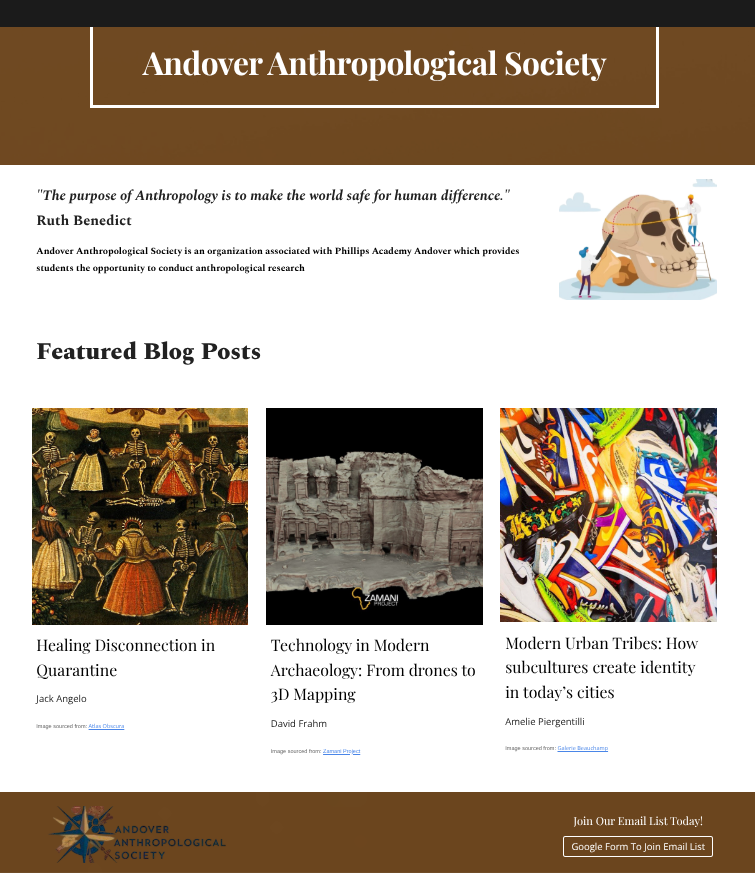
Homepage of the AAS blog site

My name is Jack Angelo and I am a board member and Blog Lead in Andover’s Anthropological Society, a student club we created here at Phillips Academy last year. I first became interested in Anthropology because of the many different topics it could cover, allowing someone to perform curiosity-based research about whatever subject matter interests them. When the other board members and I created the club, we knew most of our members’ research and curiosity would be directed towards our more major projects working in tandem with the Peabody Institute. But, understanding that the larger, focused research projects did not allow total intellectual freedom for the whole club, and that it did not spread our club’s messaging to the whole campus, we decided to create the Andover Anthropological Society Blog Site.

Our blog has now run for almost nine months and has served as an amazing display of the various topics our members are interested in, such as Corporate Consumerism in America, The Rise of Digital Tribalism, and the History of Art in Quarantine. Each post reflects what genuinely interests our writers, allowing people to contribute to the club without having to take part in our larger projects. In this way, the blog has developed into exactly the kind of free representational space we hoped for.

Additionally, the blog is a public source for anybody to read to understand our club’s messaging or to just further their interest in anthropology. We wanted to make sure that what we’re doing in AAS isn’t limited to the people who show up to meetings. By putting our work online, we’re giving the whole Andover community access to the topics we’re exploring and the research our members are doing. If someone’s curious about anthropology but doesn’t know where to start, or if they just want to read about a specific topic, the blog is there for them.

Ultimately, the AAS Blog is about making anthropology accessible. We wanted to create something that anyone could engage with, regardless of whether they’re in the club or have any background in the field. By keeping our work public and covering topics that connect to everyday life, we’ve built a resource that’s open to the entire Andover community.

Tales from The Phillipian, PART 2: Dinosaurs, Turtle Racing, and Spirits

Contributed by Emma Lavoie

Peabody staff always get excited when we unearth hidden stories from the Peabody Institute’s past. The Phillipian Archives is one such place that has held many a story. First printed in 1857, The Phillipian is a weekly student newspaper that continues today at Phillips Academy Andover. The student paper describes itself as “completely uncensored and entirely student-run,” offering a snapshot of what campus life is like both past and present, and in the case of this blog, some of the most outrageous and bizarre activities related to the Peabody.

As promised, we hope you enjoy PART 2!

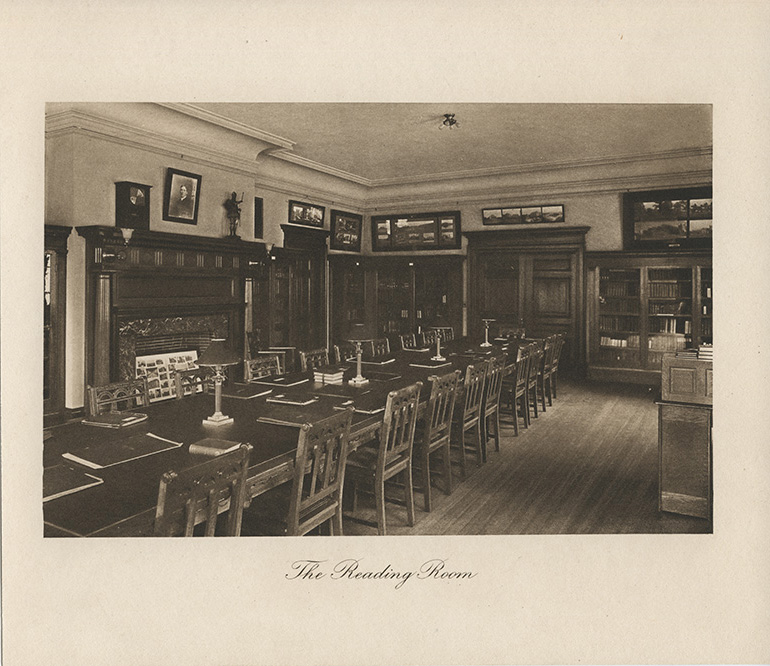
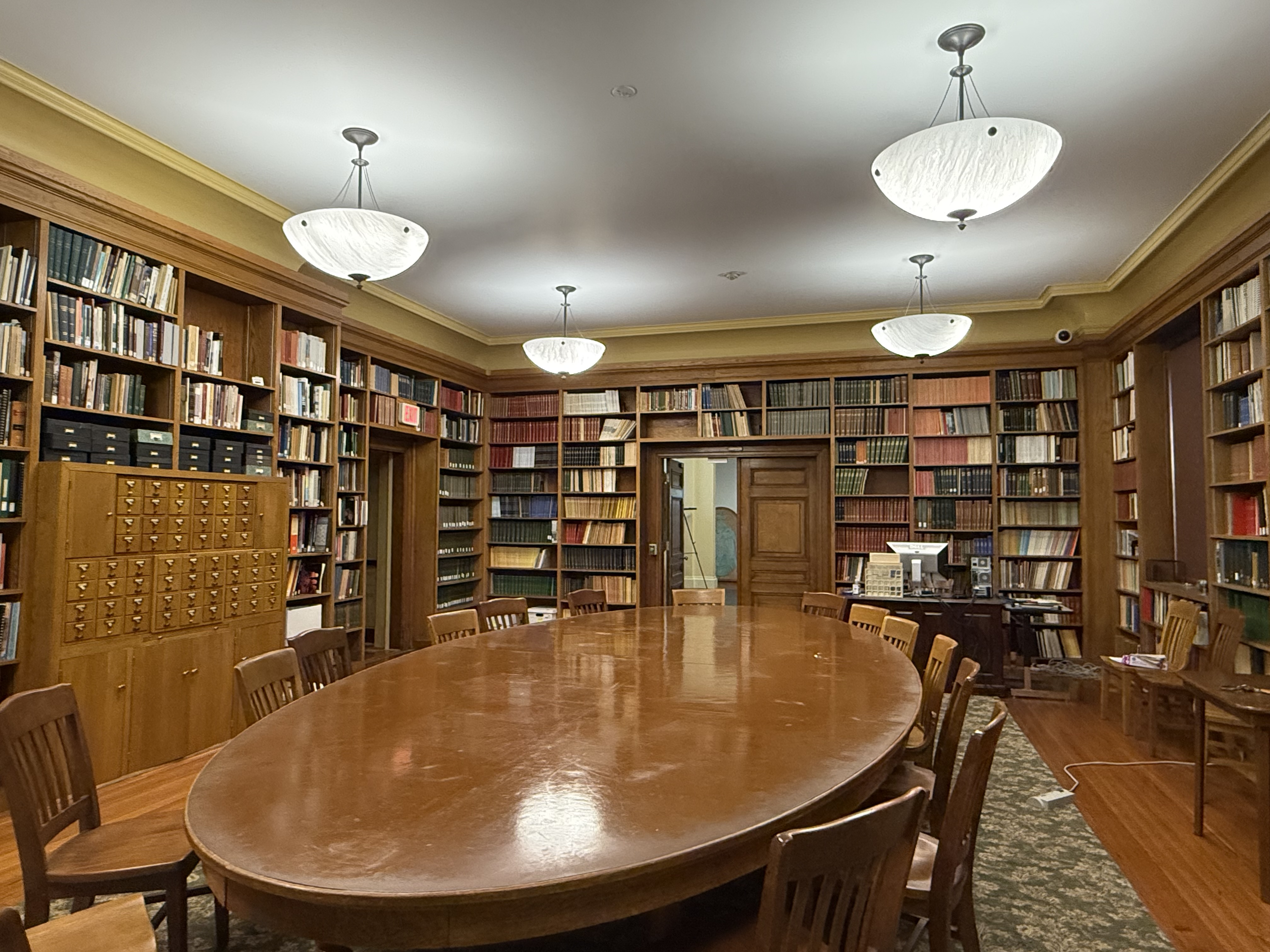
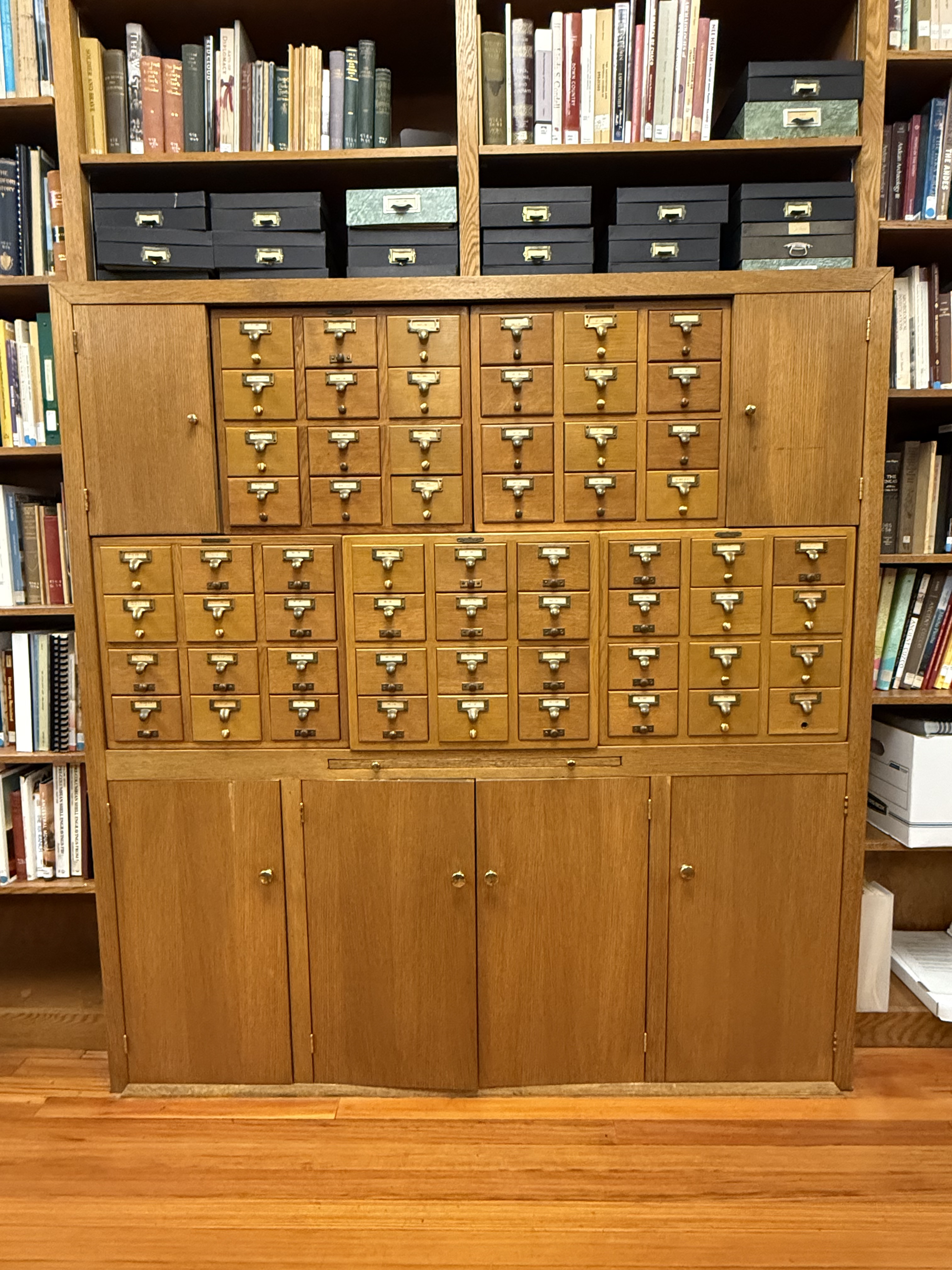
Peabody Card Catalog and Reading Room

In 1903, a reading room with library was opened on the second floor of the Peabody, furnished with easy-back chairs, a large center table, writing tables, and a few large lounging chairs. There was a list of rules included in this Phillipian article for students using the reading room:

  • Observe suitable quiet
  • That others may not be disturbed while reading
  • Not to cut, tear or in any way deface the periodicals
  • To remove hats and caps while in the room

By 1904, a Phillipian article stated the reading room as “well filled nearly every hour…the attendance averages about three hundred a day or nearly the entire school.”

Image from the Peabody Archives of the old reading room.
From the same vantage point – the current Peabody Library. Note: the original card catalog system now covers the original fireplace.

In 1904, work began on an index card catalog for the Peabody Institute’s library. This catalog would be similar to the Library of Congress plan which was being used at the time in the Seminary Library (but the catalog ended up being Dewey Decimal, arrgh!) This index card catalog is still occasionally used today at the Peabody Institute, though the entire library is catalogued in the North of Boston Library Exchange.

The original card catalog is still in use at the Peabody today!

Rumor Has It (Dinosaurs in the Chapel and Turtle Racing)

There had been rumors of turtle racing in the Peabody basement and other areas on campus. Mention of one turtle (named Alec) being kidnapped in a 1935 article may prove these rumors as true! Don’t worry, Alec was returned safe and sound.

In a “This Andover” column of The Phillipian in 1941, the Archaeology Department (now the Peabody Institute) was supposedly spreading rumors that several prehistoric dinosaurs live in the Cochran Chapel organ pipes.

“It is they [the dinosaurs], the rumor goes on having it, that furnish Dr. Pfatteicher’s lowest notes during Sunday services.”

Flute Recitals by the Peabody Director

On several occasions, Peabody Director, Dr. Charles Peabody performed flute recitals for students in the Academy chapel. On January 20th in 1915, Peabody was joined by Dr. Carl F. Pfatteicher, who played the organ. Pfatteicher was the director of music at the time, a post he held until 1947. During his time at Phillips Academy, he facilitated choir, glee club, and a small orchestra. Many of these groups met and practiced in the Archaeology Building or Peabody House. I think it’s safe to say that Dr. Charles Peabody and Dr. Carl Pfatteicher were good friends. The music played at this recital were the following:

Sonata in C Major – Mozart

Tres Lent from Sonata in G Major – Guillaume Lekeu

Barcarolle – Harold Nasan

Invocation – Eugene Lacroix

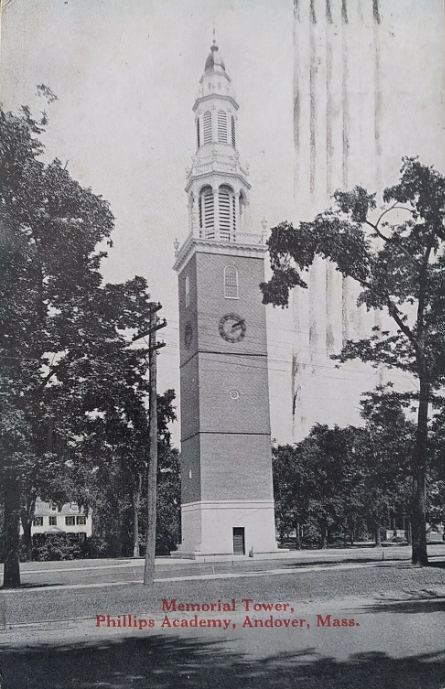
Fun Fact: Dr. Carl F. Pfatteicher was asked to help select the bells to be placed in the newly constructed Memorial Bell Tower on campus. He enjoyed giving regular carillon concerts, playing the bells sometimes at dawn. Many students did not appreciate this and one year managed to lock Dr. Pfatteicher in the tower.

Memorial Bell Tower, Phillips Academy Andover
Completed in 1922 by architect Guy Lowell
(the same architect of the Peabody building!)

“A Place for Students to Gather” – Clubs Find a Home at the Peabody

The Peabody was founded with three goals in mind – to educate students about the world of archaeology, to promote archaeological research, and to be a place for students to gather. As part of this vision, students and student clubs have been utilizing the Archaeology Building since its inception in 1903. Below are just a few examples of student club communications in The Phillipian related to the Peabody.

Class of 1910 in front of the Department of Archaeology (later known as the Peabody Institute of Archaeology.)

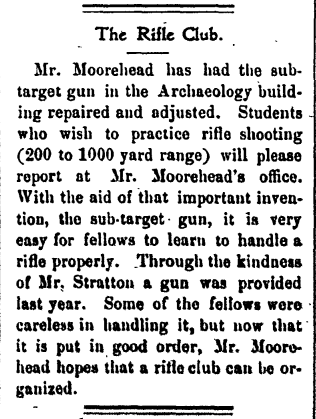
An advertisement in a 1904 column mentions organizing a student Rifle Club at the Archaeology Building and reporting to the office of Peabody Curator, Mr. Moorehead for those interested in shooting practice.

Courtesy of The Phillipian archives.

Fun Fact: The Sub-Target Rifle Machine and similar target practice devices were popular in the early part of the 20th century. They recorded information about marksmanship, position of the gun, etc. without firing live rounds.

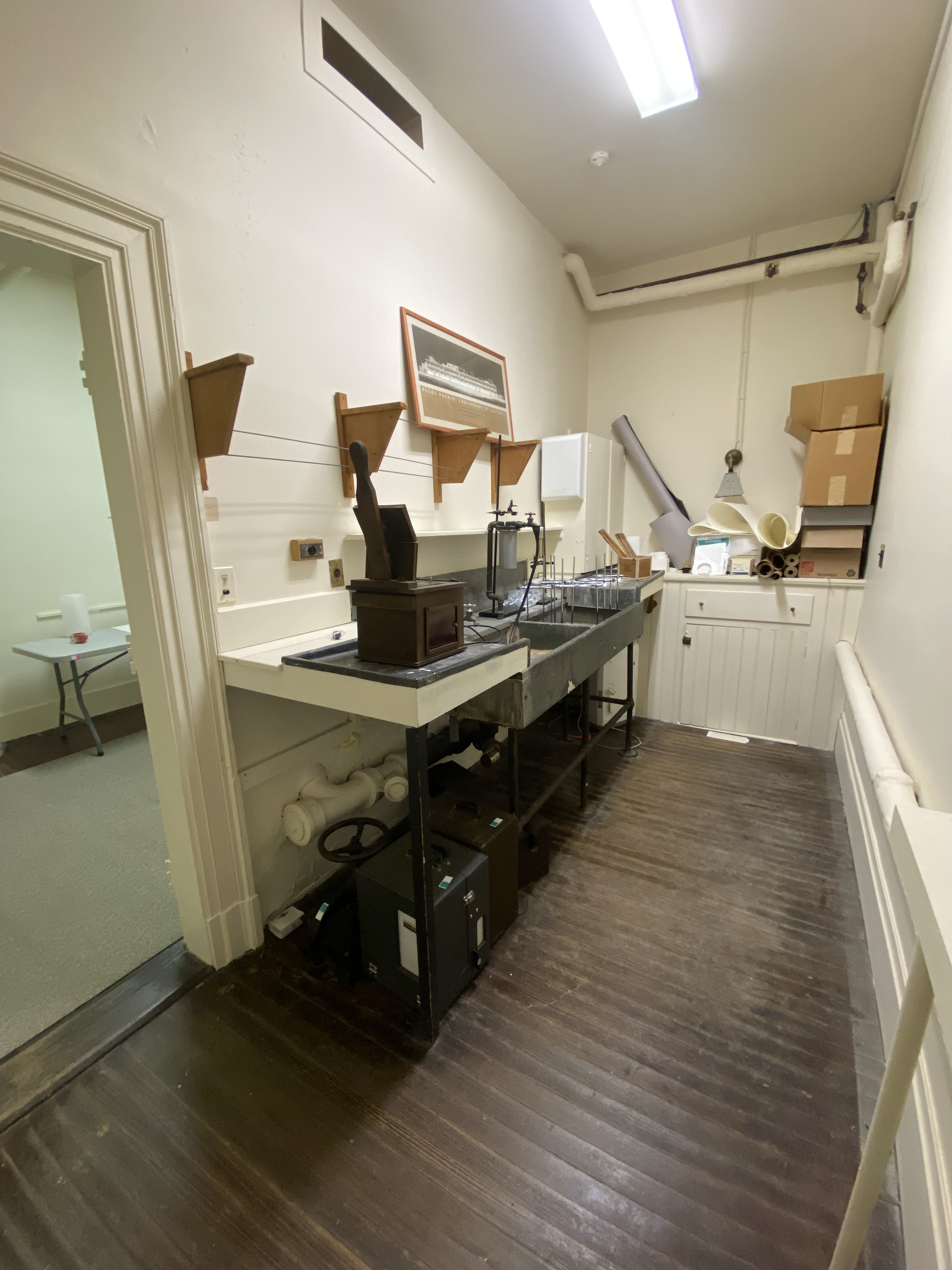
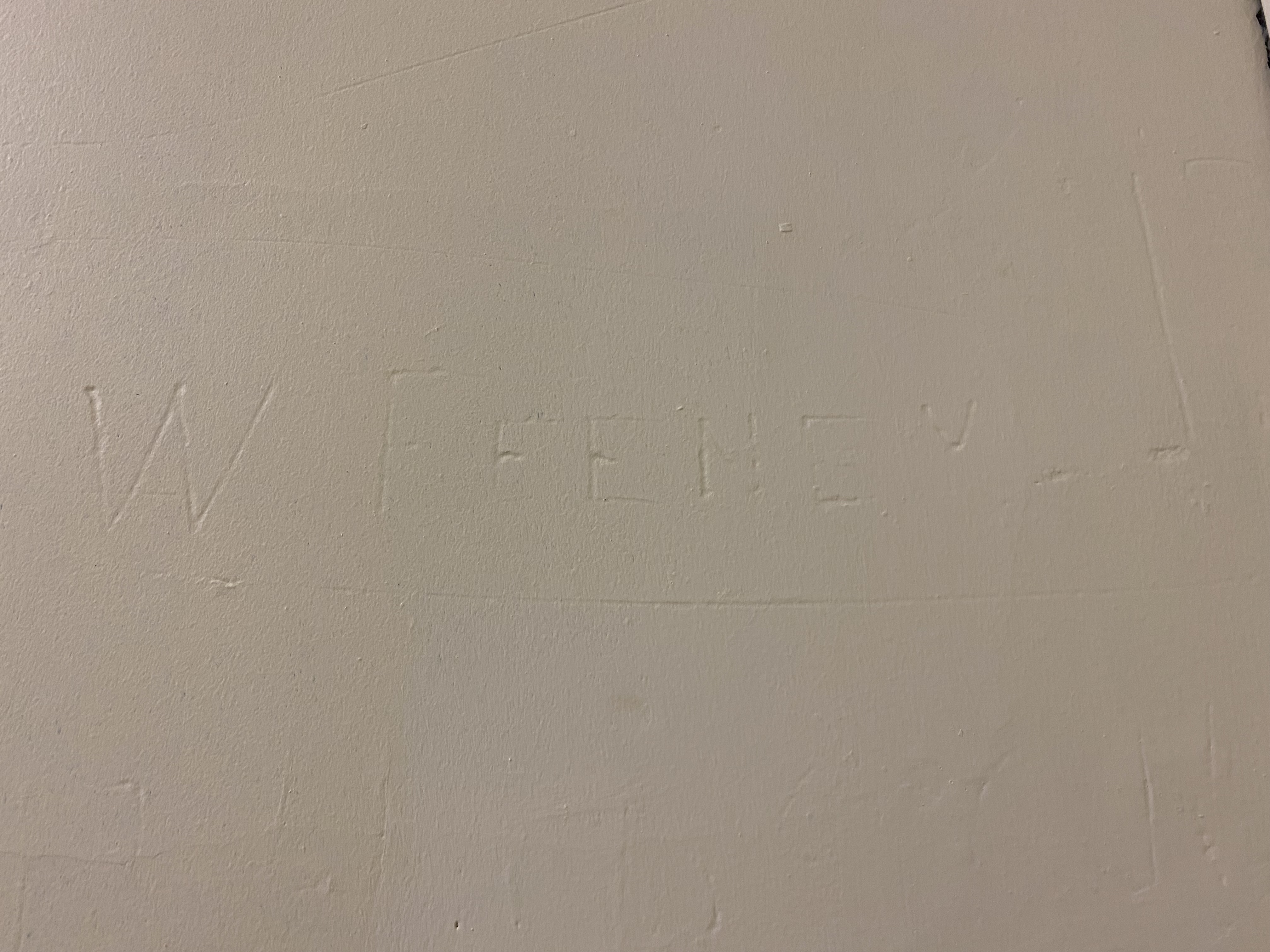
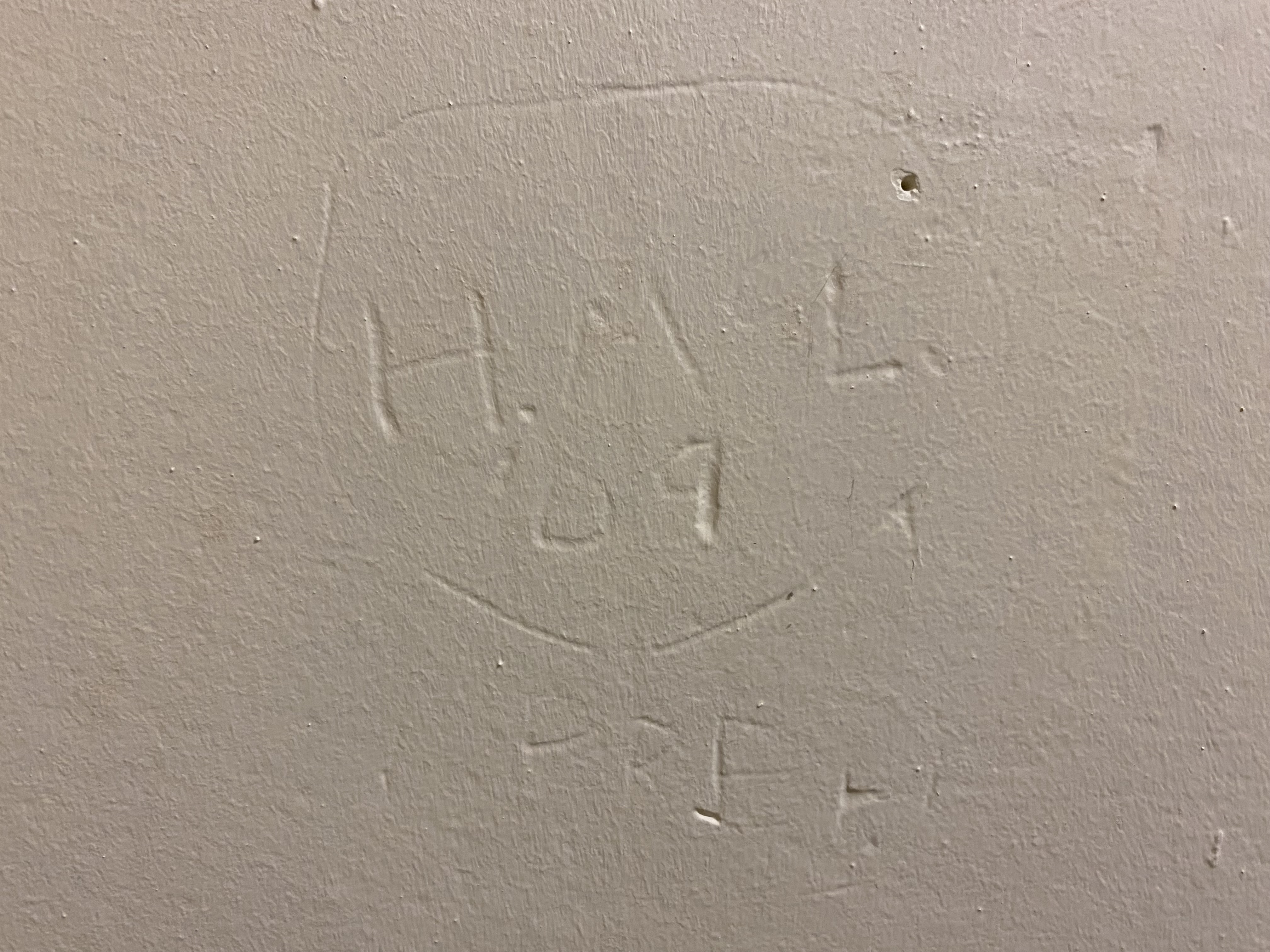
In 1904, a dark room was provided for the Camera Club, located in the basement of the Peabody. The Phillipian stated the space “is thoroughly equipped and is as fine as can be found in New England.” Before Phase 1 of the Peabody Project began, much of the original dark room space was still intact. One of my personal favorite details was the original carved signatures still on the wall left by past Camera Club students.

Original dark room at the Peabody before the recent building renewal project.
Student signatures on the wall of the dark room at the Peabody.
Note – that’s not 2009, it’s 1909!

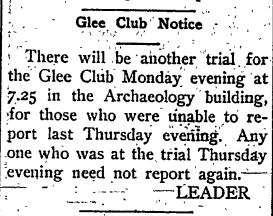
Mandolin and Banjo Club were some of the music clubs that met in the Archaeology Building for auditions, meetings, and practices. Glee Club was another student organization that commonly gathered at the Peabody and communications for this club are seen throughout the decades of The Phillipian.

I love seeing such a close connection between the Peabody and the Music Department, especially now that we’re neighbors with the new Music building, Falls Hall!

Glee Club communication in 1910.

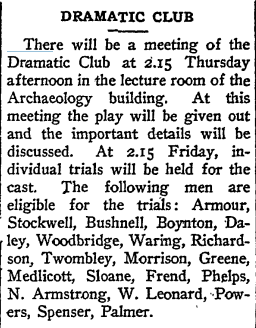
As we’ve seen above, many campus Arts organizations spent time at the Peabody. The Dramatic Club would meet to discuss scripts for upcoming plays and hold individual trials for those looking to participate in performances.

Dramatic Club communication from 1912.

Other clubs such as Chess, Astronomy, Spanish, Philo Congress, Bible Class, Foreign Missions, Yale Club, Harvard Club, Stamp Club, Nature Club, Forum, and Mirror all met at the Peabody throughout the first half of the 1900s. Even The Phillipian and football team held gatherings at one point. By the 1950s we see the Peabody becoming more active in exhibitions and many of these clubs move to other locations on campus, many finding a home at the Peabody House behind the Archaeology Building.

“…where his spirit still lives.”

Jumping ahead to 2011, a Phillipian article features Halloween traditions and campus lore passed down over the decades of PA’s history. The Peabody is mentioned to experience “frequent slamming doors, moving items and eerie noises that creak through the attic floors.” The strange activities convinced Peabody staff that the building was haunted by Warren K. Moorehead (1866-1939). Moorehead was the first curator at the Peabody from 1901 to 1924 and became the Peabody’s second director from 1924 to 1938.

The Peabody has many interesting stories of these experiences over the years. One story mentioned in The Phillipian, depicts a foreman being locked in the back stairwell. I can personally share that my first Reunion Weekend with the Peabody I experienced an alum being locked in one of our bathrooms during an event (the locks were on the inside of the door…) I considered this my “welcome” initiation from Moorehead, as the newest member to the Peabody team.

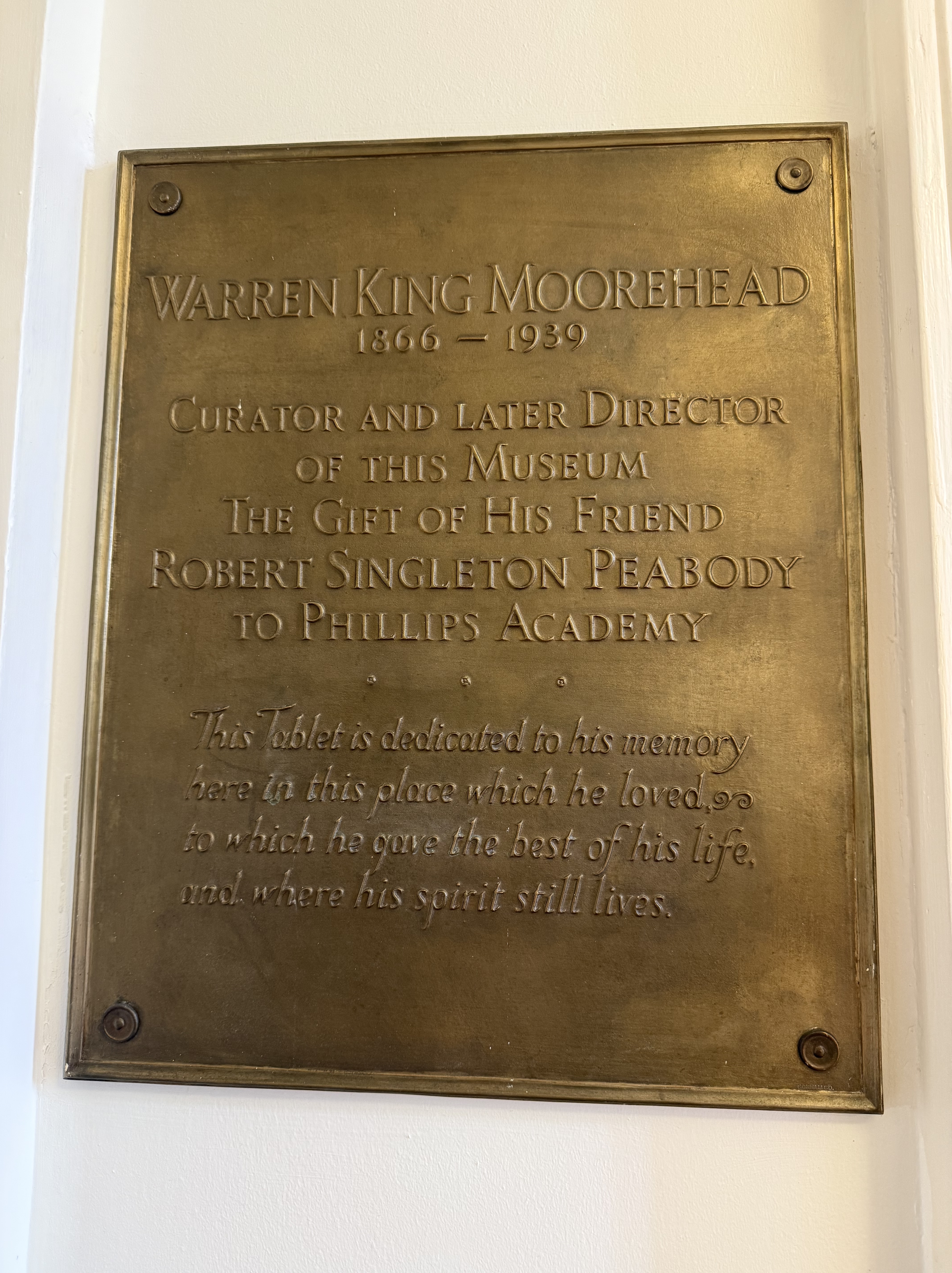
Over the years, our director has written notes to Moorehead to communicate our intentions and care of the building along with updates of upcoming changes such as our building renewal project. These notes are stored behind a plaque commemorating Moorehead, located by the front doors of the building. Much of the activity has quieted since writing these notes.

Plaque commemorating Warren K. Moorehead.

Tales from The Phillipian, PART 1: Smoke Talks, Fire, and a Grill in the Peabody Basement?!

Contributed by Emma Lavoie

Peabody staff always get excited when we unearth hidden stories from the Peabody Institute’s past. The Phillipian Archives is one such place that has held many a story. First printed in 1857, The Phillipian is a weekly student newspaper that continues today at Phillips Academy Andover. The student paper describes itself as “completely uncensored and entirely student-run,” offering a snapshot of what campus life is like both past and present, and in the case of this blog, some of the most outrageous and bizarre activities related to the Peabody.

In a few months, the Peabody Institute will be undergoing Phase 2 of some much-needed renewal work. The building and collections will be off-line Winter and Spring terms. The Peabody will continue to support modified classroom lessons and student activities, outside of the Peabody building. Student requests to access collections will be considered on a case-by-case basis.

In honor of the upcoming building project, this (part 1) blog shares some of the Peabody building’s history.

A Special Place at the Corner of Phillips and Main

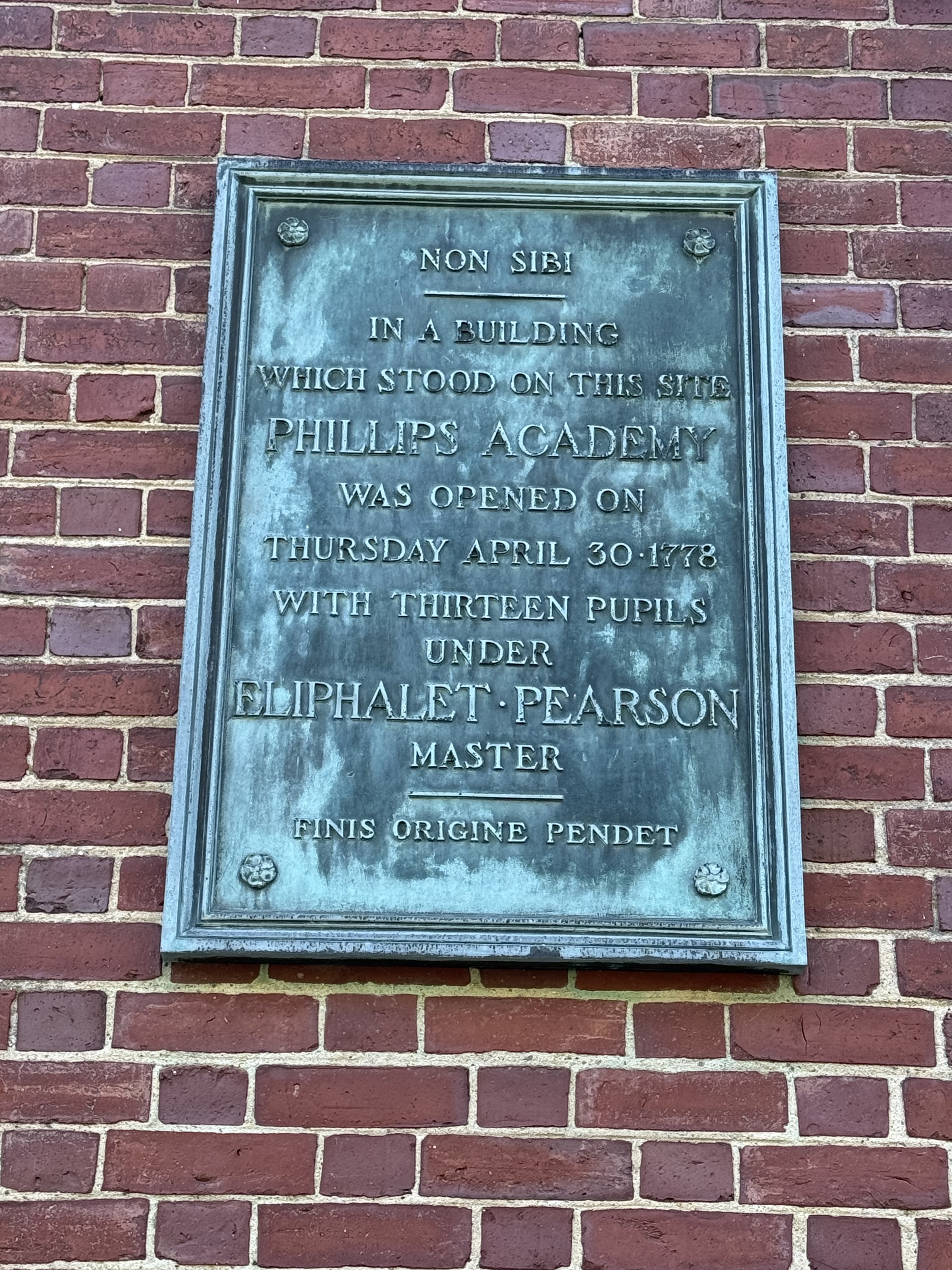
The first Founder’s Day for Phillips Academy was held in October 1913. At this time a bronze plaque was unveiled and placed on the Peabody Insitute building (known then as the Archaeology Department) commemorating the site where the first school-building on campus was opened in 1778. This plaque can still be seen on the Peabody building today!

Bronze plaque on the Peabody Institute building exterior from 1913.

The site at the corner of Phillips and Main streets has an interesting history, one that began well before the Peabody. The site first housed the 1778 carpenter’s shop used as the first classroom building at Phillips Academy.

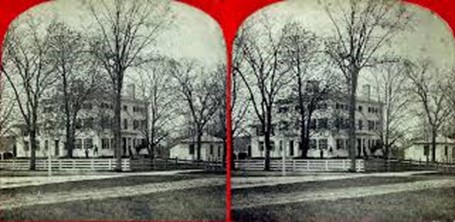
Around 1845, the shop was moved from the site and eventually razed. Samuel Farrar, treasurer of Phillips Academy and the Andover Seminary, built a three-story, Federal-style house on the location. The house has since been moved further down on Phillips Street and is known as Farrar House.

Farrar House – Image courtesy of Andover Historic Preservation, Memorial Hall Library, Andover, MA

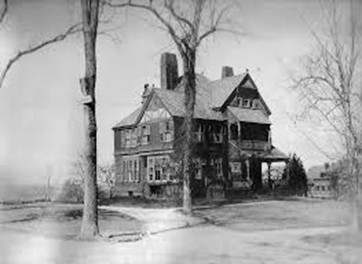
In 1882, a home was built on the site for J. Wesley Churchill, a professor at the Andover Theological Seminary. Later in 1901, the house was moved to another location on Main Street to make way for the new Archaeology Building which later became the Peabody. The house is known as Churchill House on campus today.

Churchill House – Image courtesy of Andover Historic Preservation, Memorial Hall Library, Andover, MA

In a Phillipian article from 1917, the history of Founder’s Day and the significance of the 175 Main street site is shared, noting a 1916 dedication of the new Peabody House by Dr. Charles Peabody (first Peabody Director and son of the Archaeology Department’s founder, Robert S. Peabody).

In this column, it was mentioned that ceremonies were not held to celebrate Founder’s Day as “this year, more than at any other time, matters of lesser importance should give way to more serious questions.” This was in reflection of the current impact of the Spanish Influenza and WWI.

Smoke Talks (Smoking and collections don’t mix…)

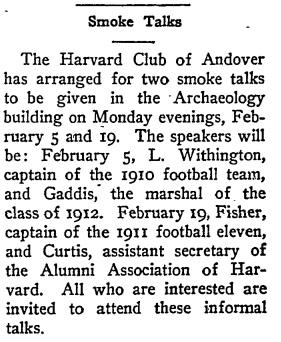
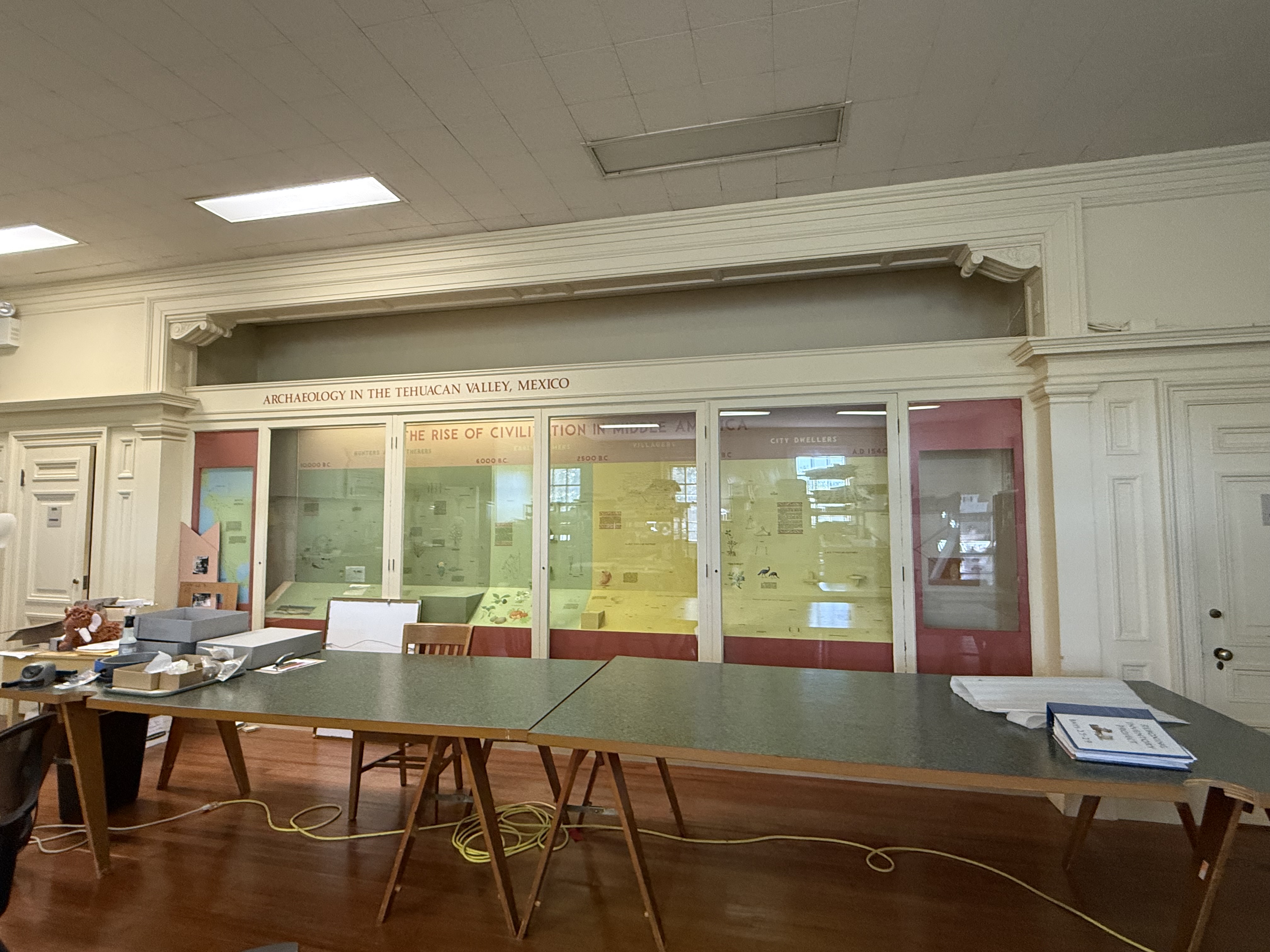
In the early years of the new Department of Archaeology building, Curator Warren K. Moorehead would give “smoke talk” lectures on the second floor of the building. Some of the original molding from the proscenium arch is still visible today at the Peabody. Beyond these lectures, student clubs would hold their own “smoke talks” in the Peabody, which served as the Student Union building for many years on campus. How did these lectures get their name? For the cigars smoked during these meetings by students and speakers alike!

A column from The Phillipian in 1912
Features of the old proscenium arch can still be seen at the Peabody today. In 1967, an exhibit wall with case was placed in the middle of the arch.

A Grill in the Basement (Now they’re pushing their luck…)

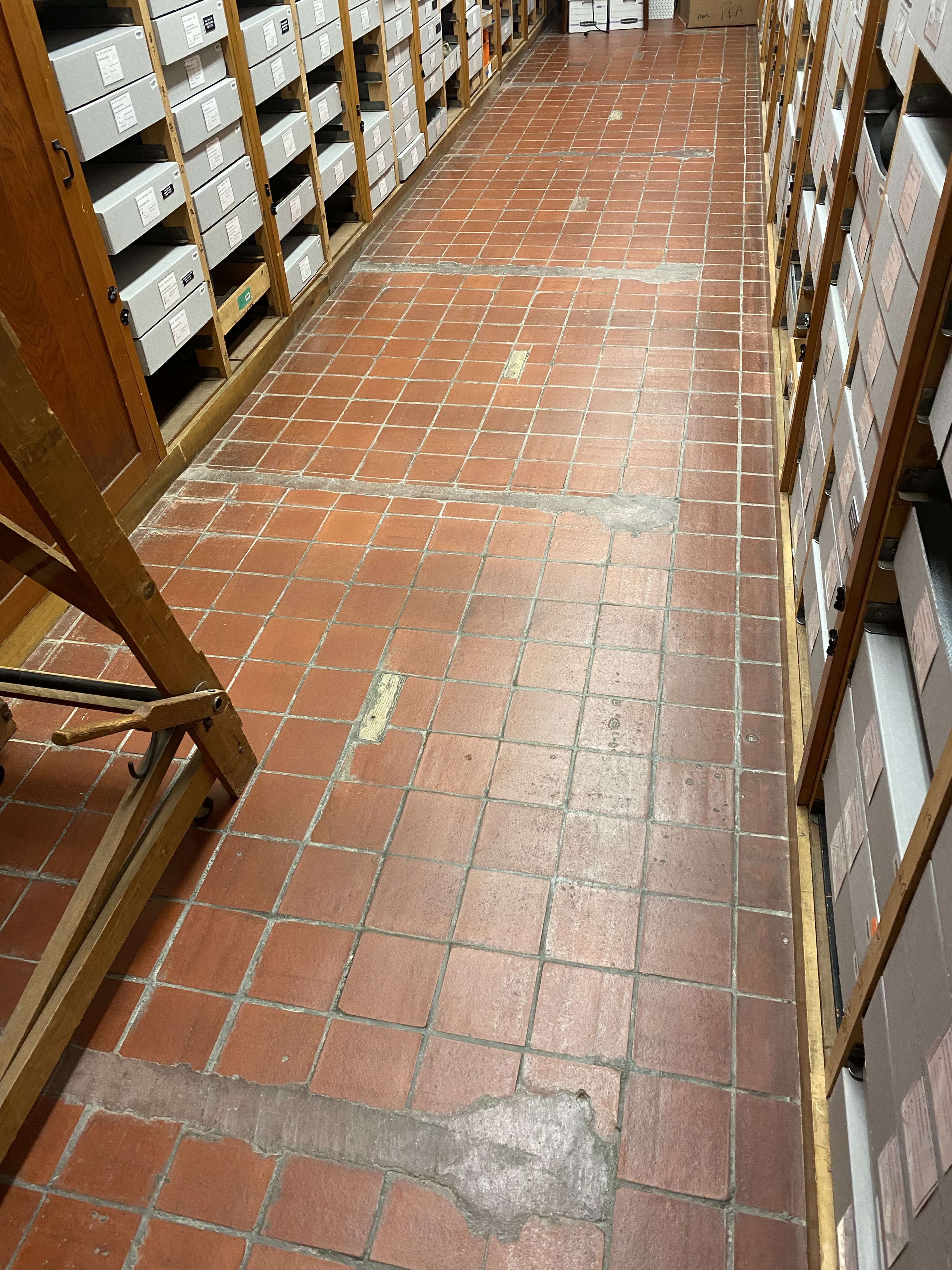
Beginning in 1913, The Phillipian mentions meetings at “the Grill” in the basement of the Peabody (known as the Department of Archaeology at the time). At one point, the Peabody had a kitchen complete with grill, stall seats, and tables for student gatherings. Improvements were made in 1913 giving the space a new red tile floor, dark brown wood paneling around the walls, a new stove, and a large suction flue to draw out heat and odors. In the past the odors of students’ cooking would circulate upstairs disturbing the Peabody staff.

Later in 1915, the Grill was moved to the newly constructed Peabody House located behind the Department of Archaeology building. The new space included a kitchen with large grill and private dining room for special dinners and banquets. There rooms are similar in design to the original grill room in the Archaeology Building.

Before Phase 1 of the Peabody Building Project, the original red tile floor from the Student Union Grill room was still visible in the basement of the building. In the photo you can see where the booths and tables made up the seating stalls.

Peabody House….and Fire (Well, it was bound to happen at some point…)

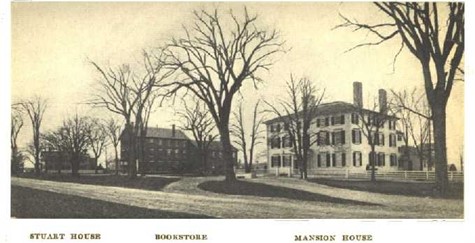
The Peabody House was opened in 1916 as an extension of the Department of Archaeology with the intent of giving students a building for their own use. Construction of the building used some of the funds contributed by Robert S. Peabody, founder of the Archaeology department at Phillips Academy and donor of the Archaeology Building. An article from The Phillipian describes the new building with an exterior of brick and stone, “which will correspond with the style of architecture of the Archaeology building and the new dormitories.” The first floor housed a student lounge and reading room with a large fireplace and large French windows. The second floor was similar in design to the first floor with space for the late Robert S. Peabody’s books and a large portrait of him. The room was used for club meetings as well as student assemblies and special banquets.

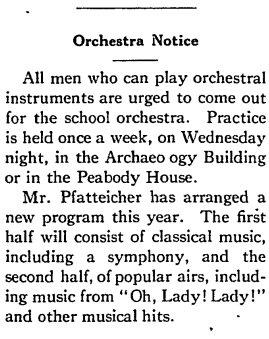
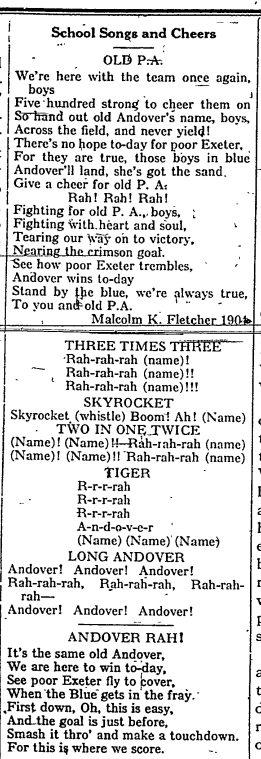
Some activities held in the Peabody House, highlighted in The Phillipian, are a notice to join the school Orchestra, with practices held once a week in the Archaeology Building or Peabody House. My personal favorite was an announcement to students for a mass meeting at the Peabody House to practice school songs and cheers. One entry from 1917 describes three hundred men present at the evening meeting called by head cheerleader, Howard Smith.

Two columns from 1917 advertising for the orchestra and sharing PA cheers and songs!

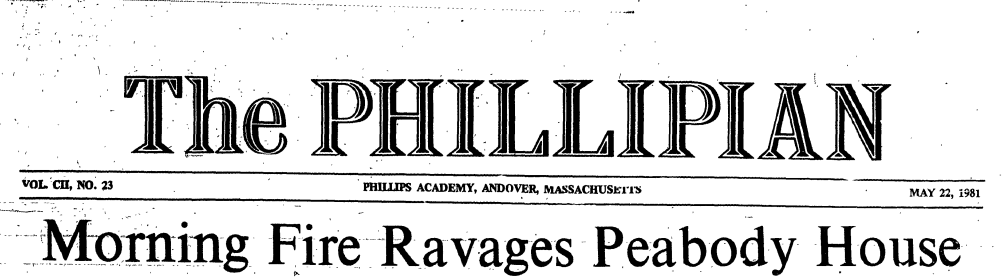
Jumping ahead to several decades later, headlines read “Morning Fire Ravages Peabody House.” In the early hours of May 18, 1981, a fire broke out in the Peabody House, destroying the first and second floors as well as the attic. There were no reported injuries, however, many of the Afro-Latino American Society’s possessions were lost on the second floor. Faulty electrical wiring is suspected to be the cause of the fire.

“[I was in] awe at how extremely hot the flames were, how much smoke there was and how terrifying it was to see the fire’s power.” – Headmaster Theodore R. Sizer

“[There was] steam and yellow light and flames bursting out of the roof.” – PA Student, Upper

We hope you enjoyed PART 1 of this two-part blog post. Stay tuned for PART 2, coming next month! To be continued…

A ‘Key’ Find at the Samuel Phillips Jr. Mansion House, 2025 Excavations.

Contributed by Katie Lincoln

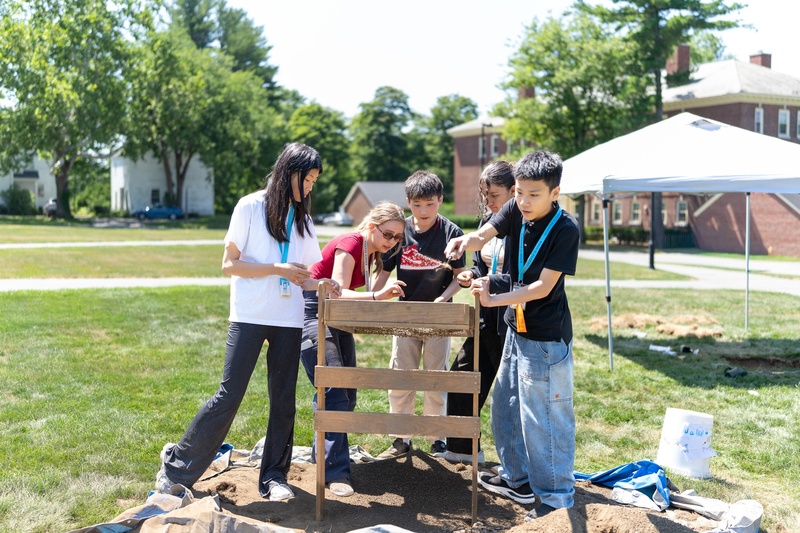
Almost every summer since 2016, young archaeologists from Phillips Academy’s summer session program embark on a mission to excavate the site of the eighteenth century Samuel Philips Jr. Mansion House, located on the West Quad of campus. The infamous Mansion House was built in 1782 by the academy’s founder and stood for 105 years, before burning down in 1887. News articles from the period suggest that the demise of the Mansion House was a result of arson; many speculating that the proprietor, Charles Carter, started the fire. During its long period of occupation, the Mansion House served as not only a home, but later an inn and tavern for students, community members, and travelers. The site’s long history and relatively undisturbed context creates an ideal setting for archaeological excavation and student learning.

Over the past seven years, students have succeeded in discovering portions of the house, including multiple chimneys and a basement feature. This year, students set out with high expectations, choosing to place four excavation units in spaces just outside of the Mansion and two units in the southwest portion of the quad, near the sites of historic outbuildings, a nineteenth century printing house, and an early nineteenth century pathway.

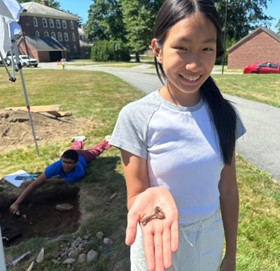
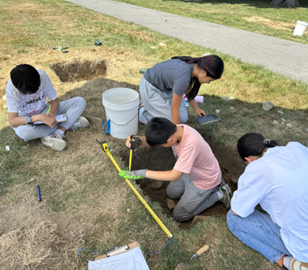
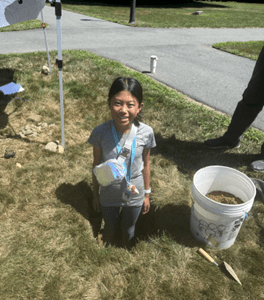
Students in each excavation team had a blast taking turns performing the primary tasks of an archaeologist: digging, screening, measuring, and note-taking. Many, if not all, students even got to unearth artifacts from their units! Some of our favorites included a small ferrous key, an impressed glass tumbler, and half a pair of scissors which all came from the two excavation units placed in the southwest portion of the quad.

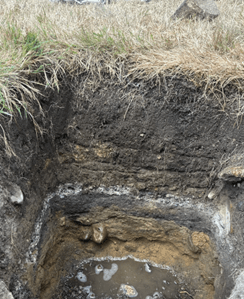
Further excavation in this area revealed a feature relating to the historic pathway present on early nineteenth century maps of campus. Pictured below is a dense, gravelly layer of soil discovered at 40 cm. This layer, interpreted here as the pathway, was intermixed with nineteenth century materials including glass, brick fragments, and some ceramic.

Students excavating the other four units in the northern portion of the quad found shallow cultural layers followed by a sterile C horizon, between 20 and 35 cm. While the artifact density of these units was limited, students still enjoyed finding an abundance of brick, metal nails, and some small ceramic fragments. The very shallow deposits found in these units informed the team that no building activity likely occurred in these areas. Additionally, the relatively low artifact density suggests that these areas were not regularly used like in a dooryard or garden area.

Overall, students in the 2025 field program successfully applied archaeological methods to ‘unlock’ more of the mysteries surrounding the Samuel Phillips Jr. Mansion House. This year’s field season serves to inform of the deep cultural deposits in the southwest portion of the quad and the significant research potential it could provide for future field seasons.

Thanks to the entire student field crew and cheers to a wonderful field season!

PA Pueblo Pottery-Making Workshops

Contributed by Emma Lavoie

Ceramic students participating in pottery-making workshops

We were honored to have the Toya family back this Spring term for their annual visit to conduct week long, hands-on workshops on Pueblo pottery-making with Thayer Zaeder’s studio ceramic students.

Each year students have the opportunity to make their own pieces using native clays and temper from New Mexico and traditional decorative techniques of painting and polishing. The workshops culminate in a traditional Jemez firing.

Students walk away with an unforgettable keepsake of their time as well as a greater appreciation for contemporary Indigenous art and culture.

We are so grateful for all the time and expertise the Toya family has shared with PA students!

Check out this video by PA’s Communications team highlighting the Toya’s work on campus.

Maxine Toya working with a student on painting their piece.
Mia Toya working with a student on polishing their piece.

Pecos Eagle Bone Flutes: Past, present, and future

Contributed by Alberto Agudo (’25)

I stumbled upon the Pecos bone flutes on a bright September afternoon that was supposed to be about beaver pelts and fur trade ledgers. My history class had followed Ms. Doheny to the Robert S. Peabody Institute for a lecture, but after the talk I lingered and asked the speaker, Dr. Lainie Schultz, whether the museum kept any musical instruments. That single question carried me into the archives, where Curator Marla Taylor opened a drawer and revealed two slender bones—one golden eagle, one hawk—pierced and polished, flutes waiting in perfect silence.

Music has framed my life since I was four in Madrid: first as a hobby, then as devotion, from my early passion for Romantic music to the shimmering modernism of Debussy, whose Masques I played at fifteen beneath the stone arches of Dubrovnik’s Rector’s Palace. Yet nothing in my previous musical experience had prepared me for the quiet authority of these flutes. Their accession records were almost empty, their makers unnamed, but the Tribal Historic Preservation Officer of Jemez Pueblo had granted permission for their study. Phillips Academy’s Abbot Independent Scholar program let me transform my curiosity into a full-term research project under the supervision of Dr. Schultz and Dr. Elizabeth Aureden from the music department.

The work began with patient looking. The eagle bone flute—just under twenty centimeters—bears four clean finger-holes; the hawk bone flute is shorter, its stops conical and ringed by three tiny oblique grooves. My initial efforts left me frustrated—despite my solid musical background, I couldn’t answer any of my research questions. Guided by Indigenous scholars, I began to understand the silence and endless questions as a wise teacher. By combining archival materials with present-day Indigenous resources, chiefly from Jemez musician Marlon Magdalena, I built a relationship with the eagle bone flute and experienced the music as something much deeper than pure sound.

In his song “Eagle’s Blessings,” which I shared during my presentation to the Massachusetts Archaeological Society in April, Marlon brings the flute to life. When I first heard it, I was nearing the end of my research, which had been mostly historical and archival. I had tried to learn about other Indigenous music, but this performance tied everything together. Throughout the term, I feared profaning the cultural or religious significance of the eagle bone flute. I understood its sacredness, and as a religious person involved in interfaith activities, I recognize the importance of respecting religious artifacts.

Marlon’s explanation before he played brought everything into focus. He explained that eagle bones are sacred, held only by tribal members and used to lift prayers skyward. When he played, I felt how, through his breath, he gave life back to the eagle and honored her. Suddenly, the silence became understandable. Even though I could not draw solid scientific conclusions, I forged a connection I will never forget.

This project has awakened a passion for ethnomusicology that I am now exploring with the music department, under the guidance of Ms. Ángela Varo-Moreno, studying the presence of LGBTQ+ subcultures in techno music. I would like to end by thanking everyone at the Peabody, at Phillips Academy Andover, and at Pecos and Jemez Pueblos—and other Indigenous communities—who have safeguarded the knowledge that reached me and made this project possible. It has been a gift I will always keep in my heart.

Alberto presenting his final project at the Peabody, finishing up his independent study.