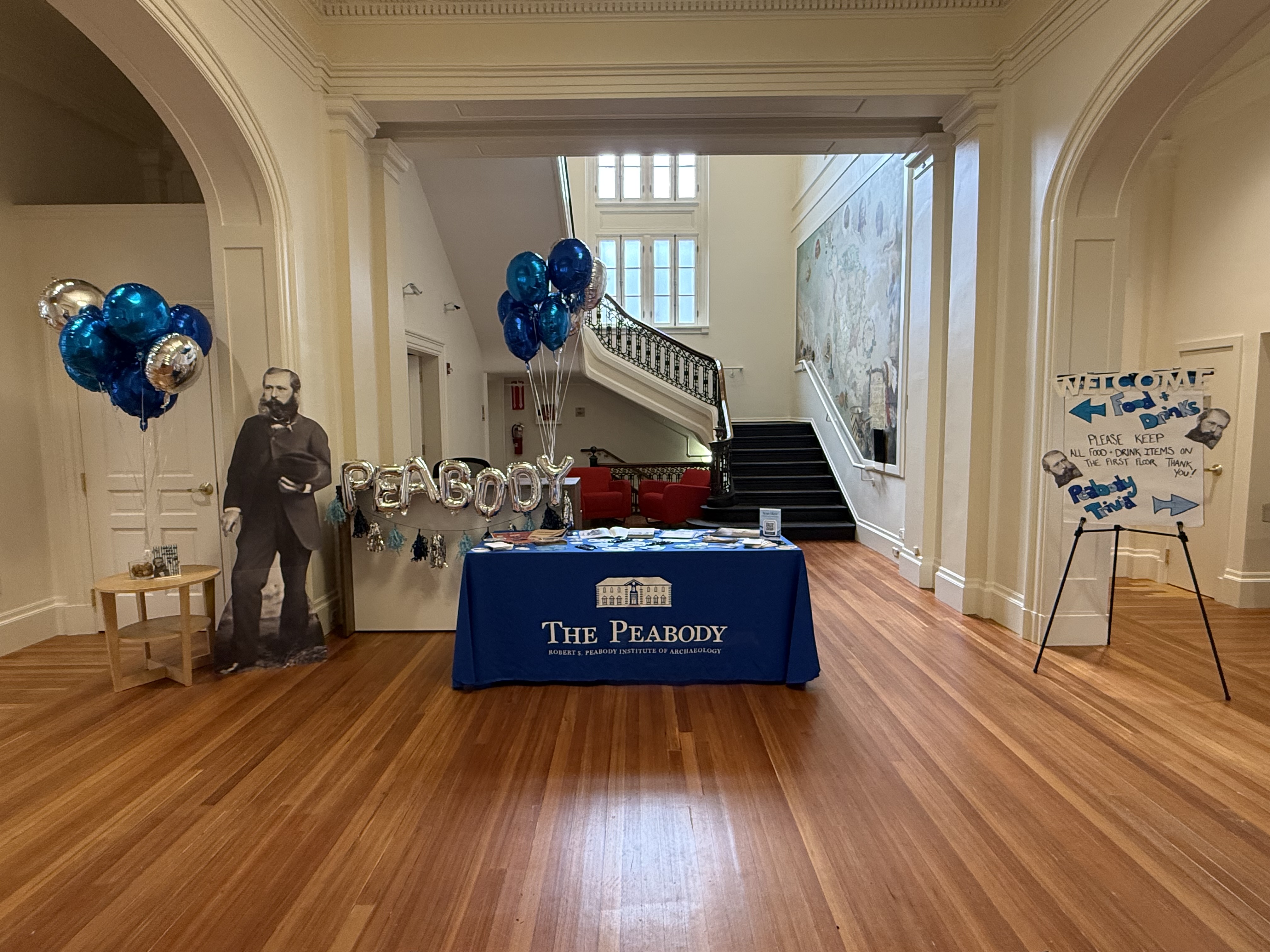
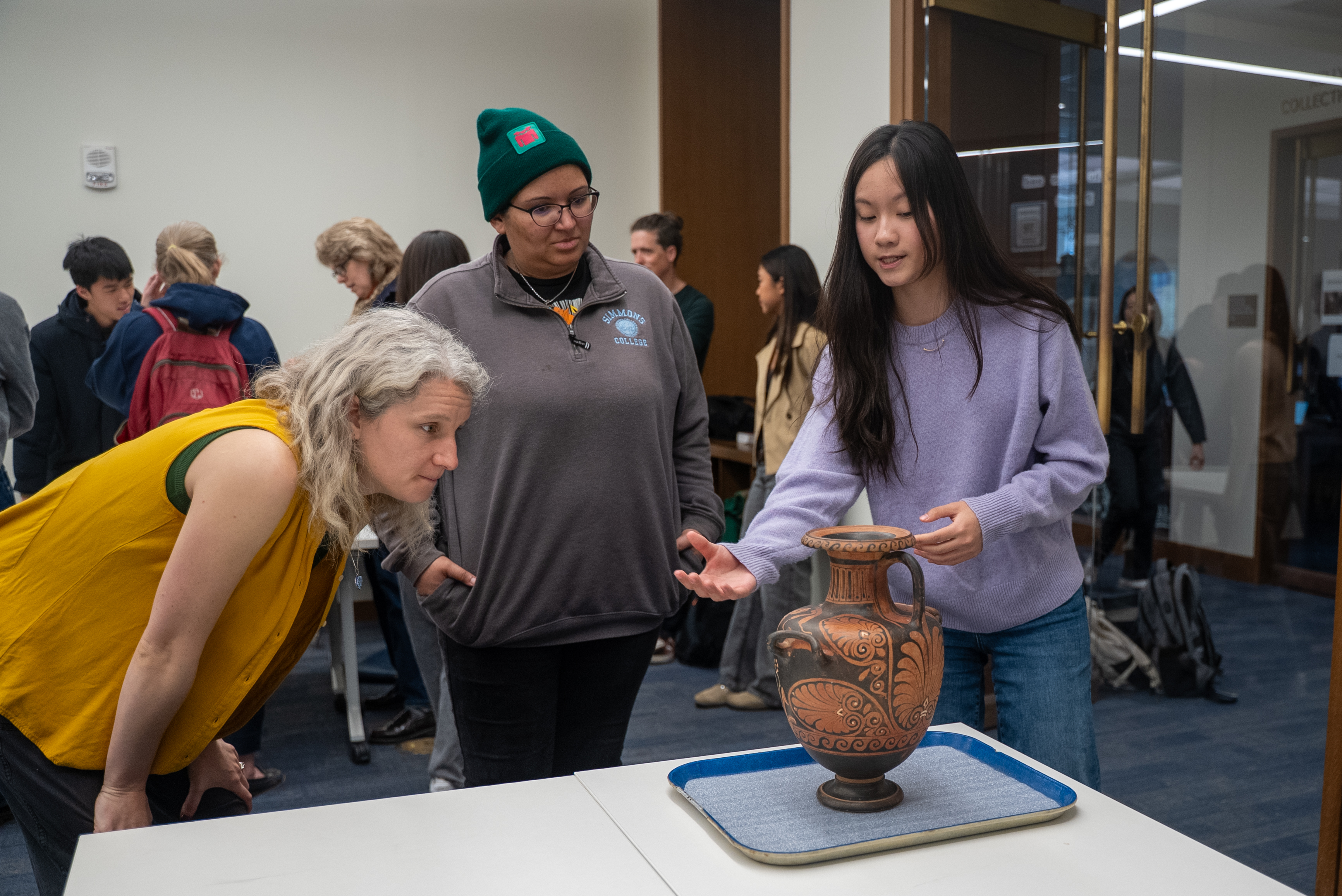
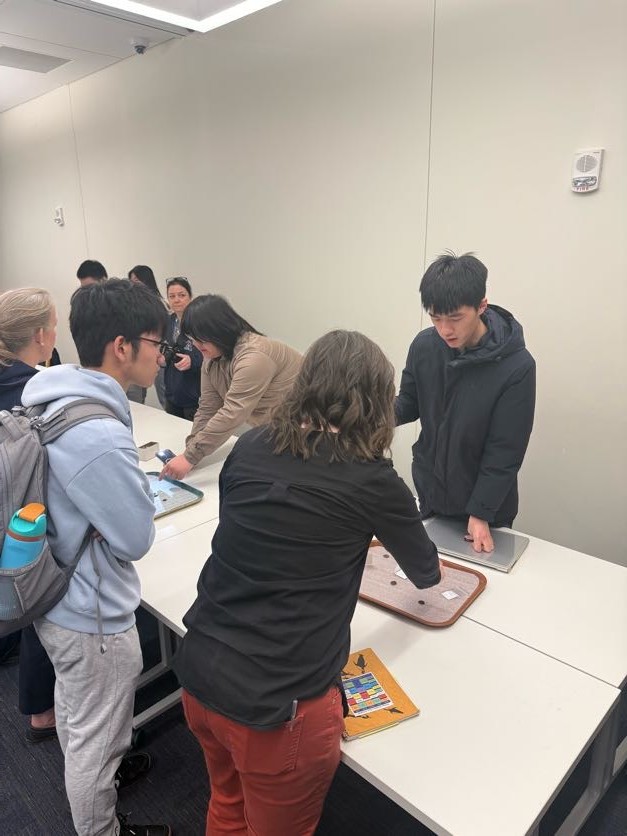
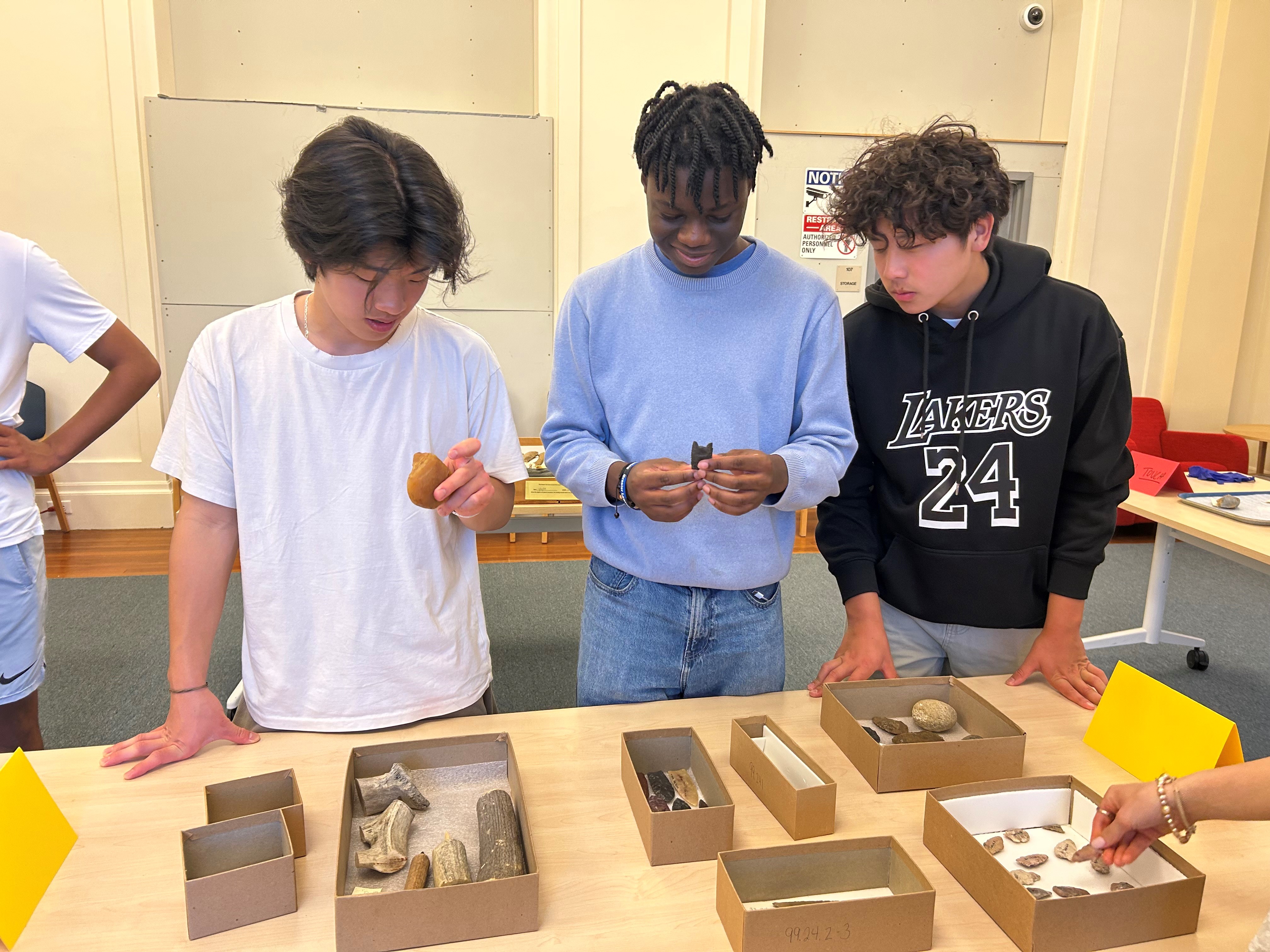
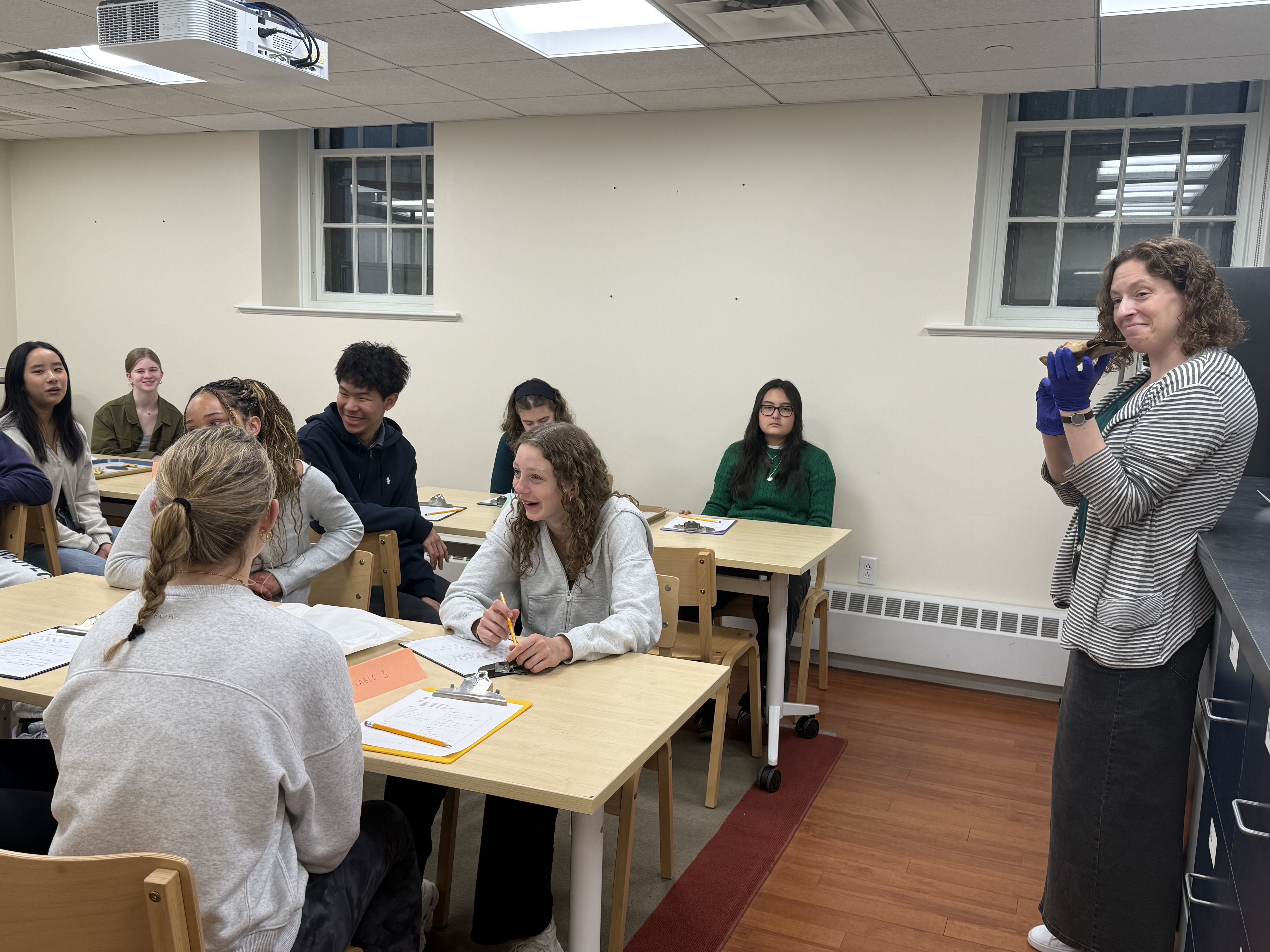
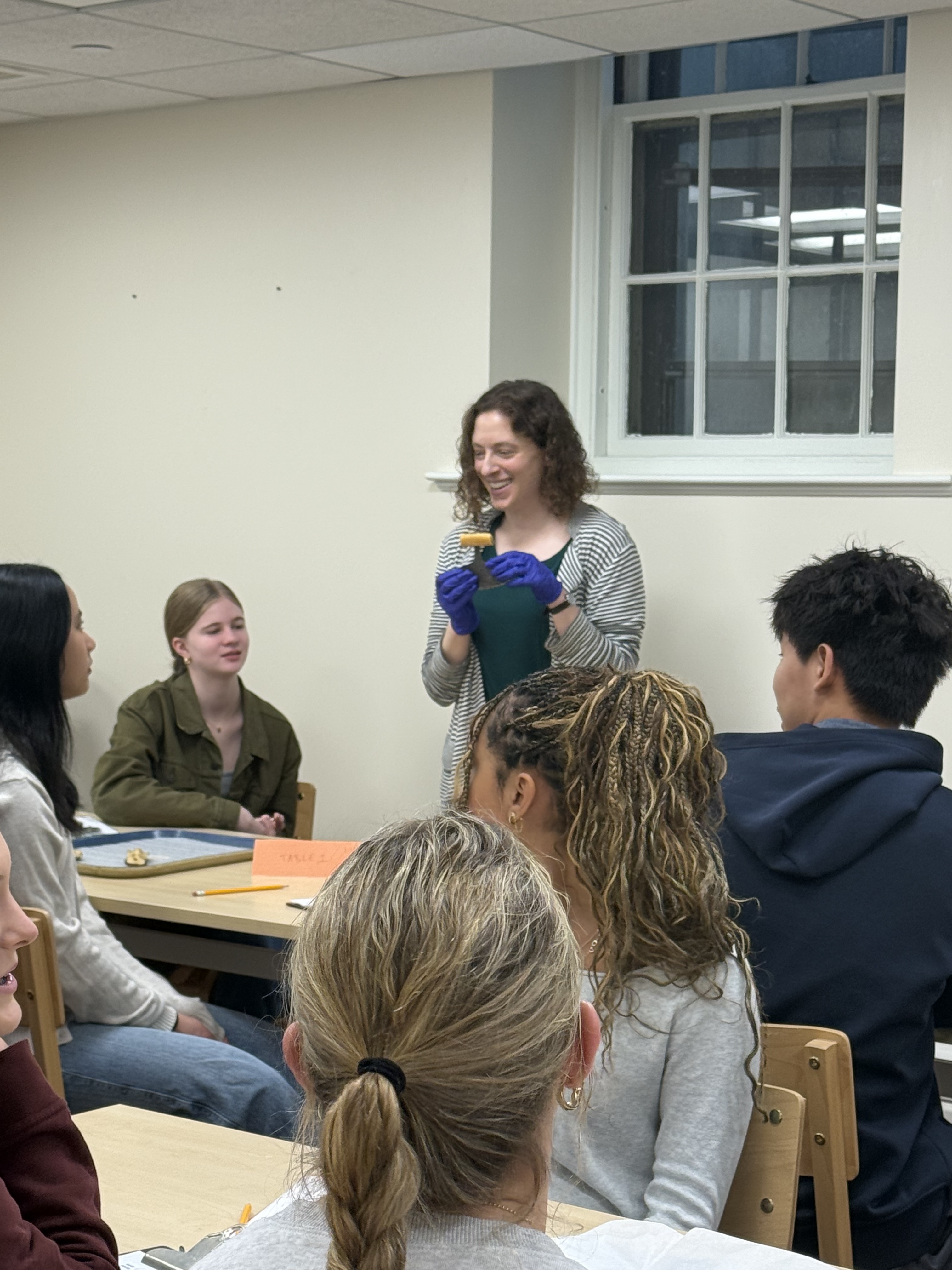
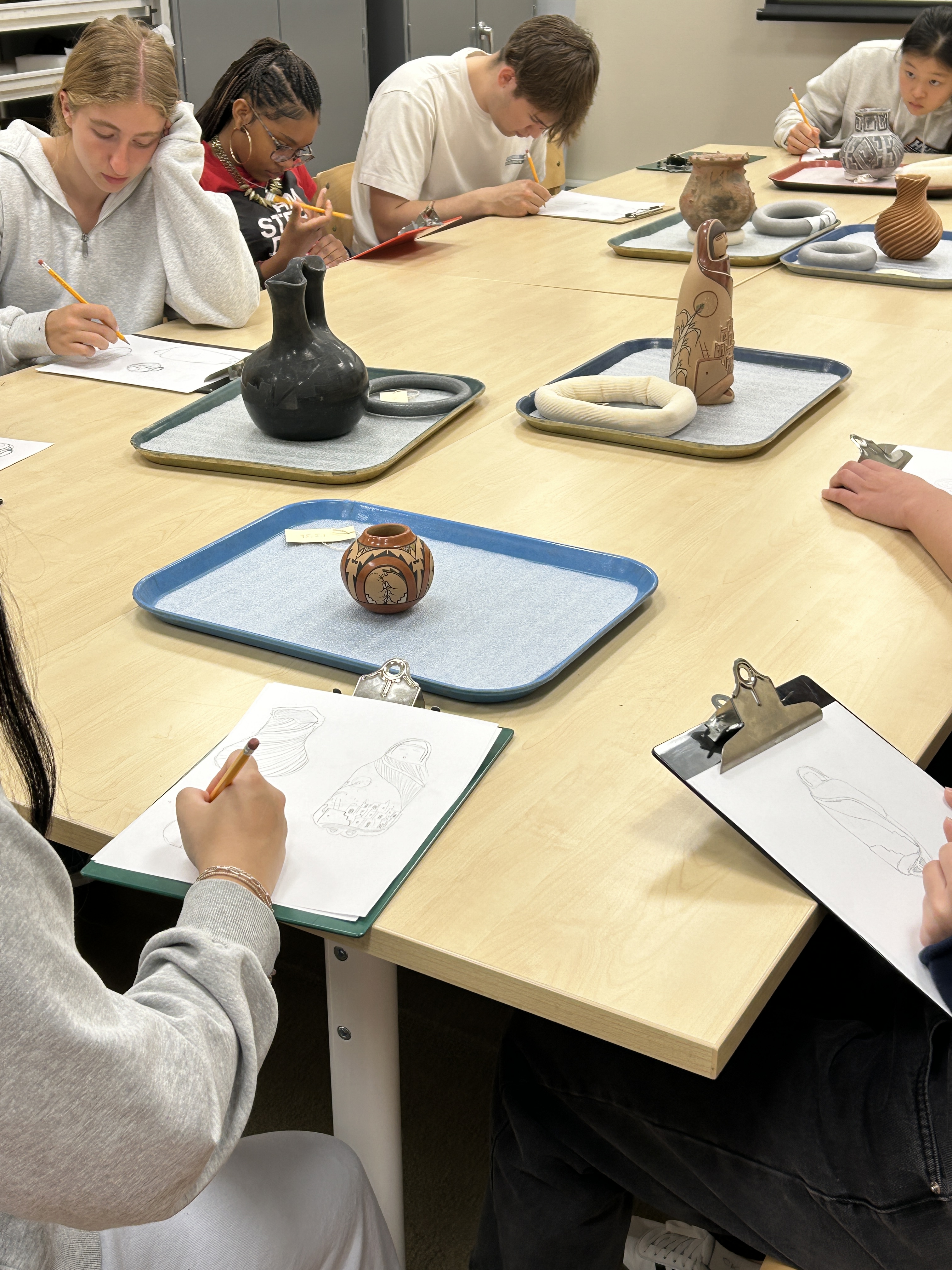
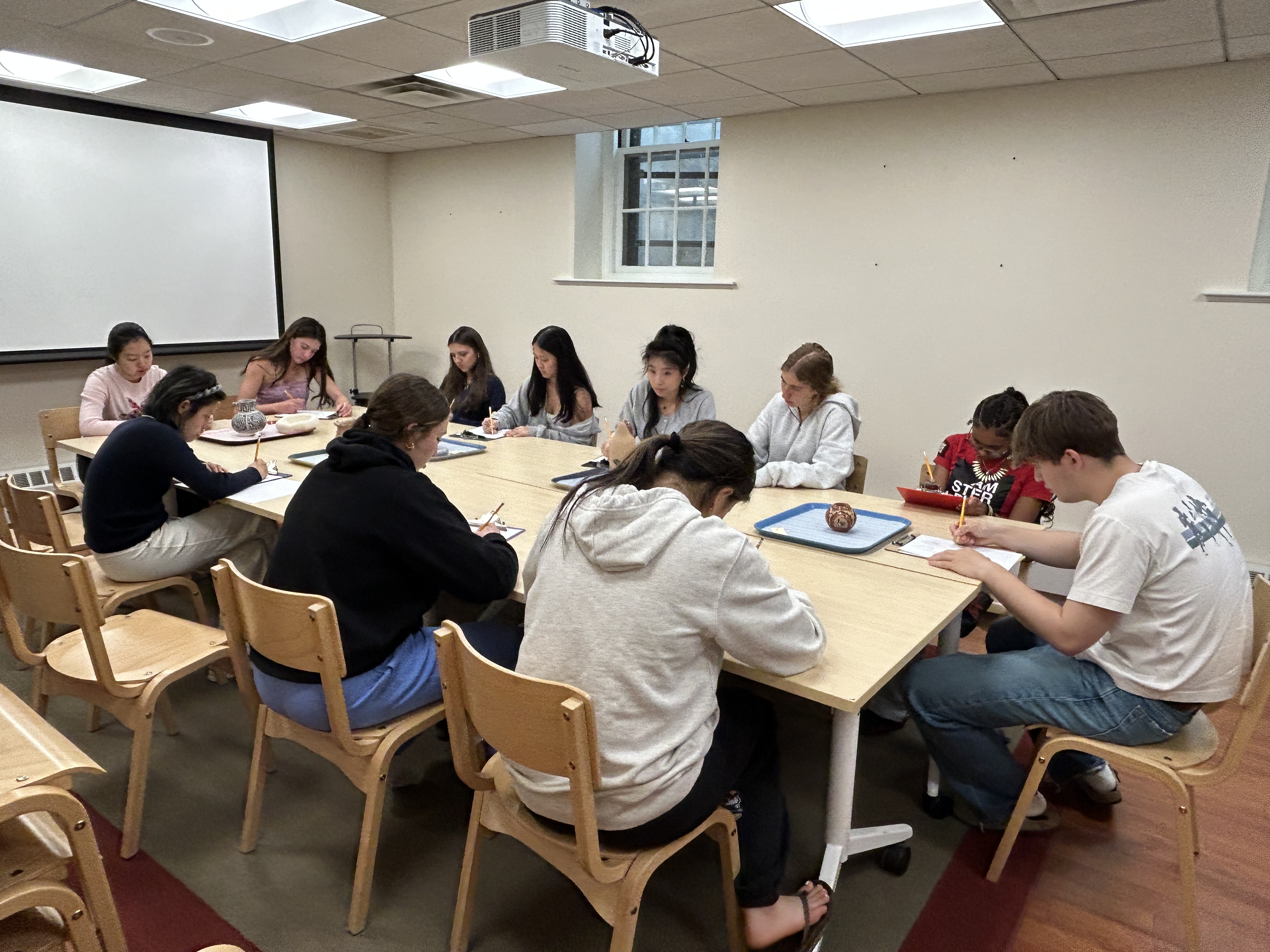
This October, the Peabody held an open house for the Phillips Academy community. The event gave students, faculty, and staff an opportunity to explore the Peabody’s newly renovated spaces and celebrate the completion of the Peabody Building Project.
Planning for the building renovation began over a decade ago, with an initial focus on inventory and rehousing collections to prepare for the actual renovation. Phase 1 began early in 2023, with milestones in spring and near completion in December 2023. Phase 2 commenced in January 2026, with a goal of improving climate, accessibility, safety, and functionality.
For highlights of the renovated building, check out this cool video created by the Phillips Academy communications team – Peabody Renovation Highlights
Thank you to everyone who supported the Peabody during the building renovation work. We are grateful for all you have done. We did it!
This series is a dedicated spotlight designed to share Peabody highlights and recognize and celebrate the exceptional work, unique achievements, and dedication of our Peabody team members.
The Indigenous Collection Care Guide & Upcoming Webinars
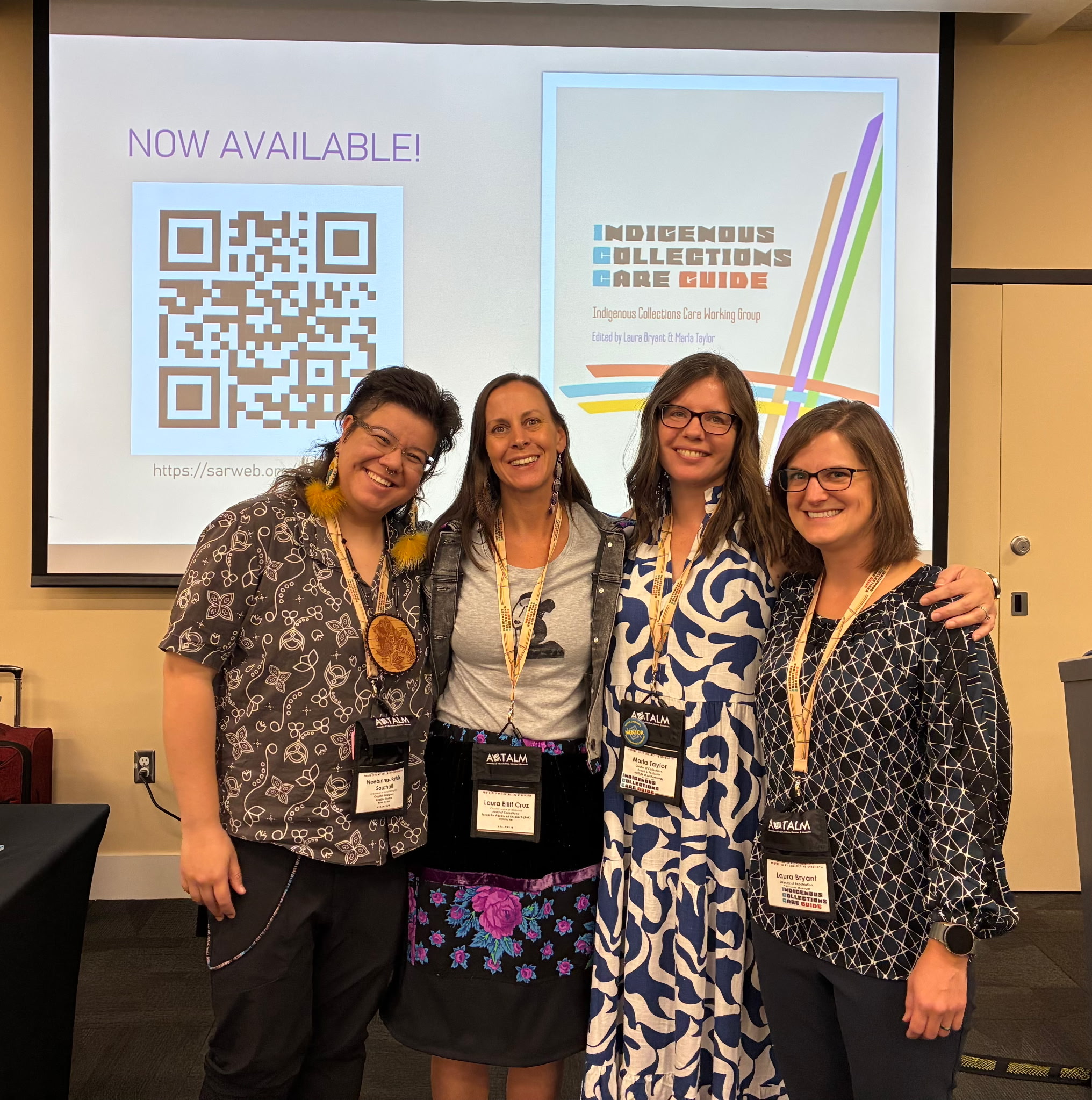
The ICC Guide is officially a hit! Marla and the ICC team have been spreading the word with lots of webinars and conference presentations. Follow this link if you want to learn more about the ICC Guide, how it was created, and how it can impact museum practice:
Peabody & PA Representation at the Boston Women’s 10K Race
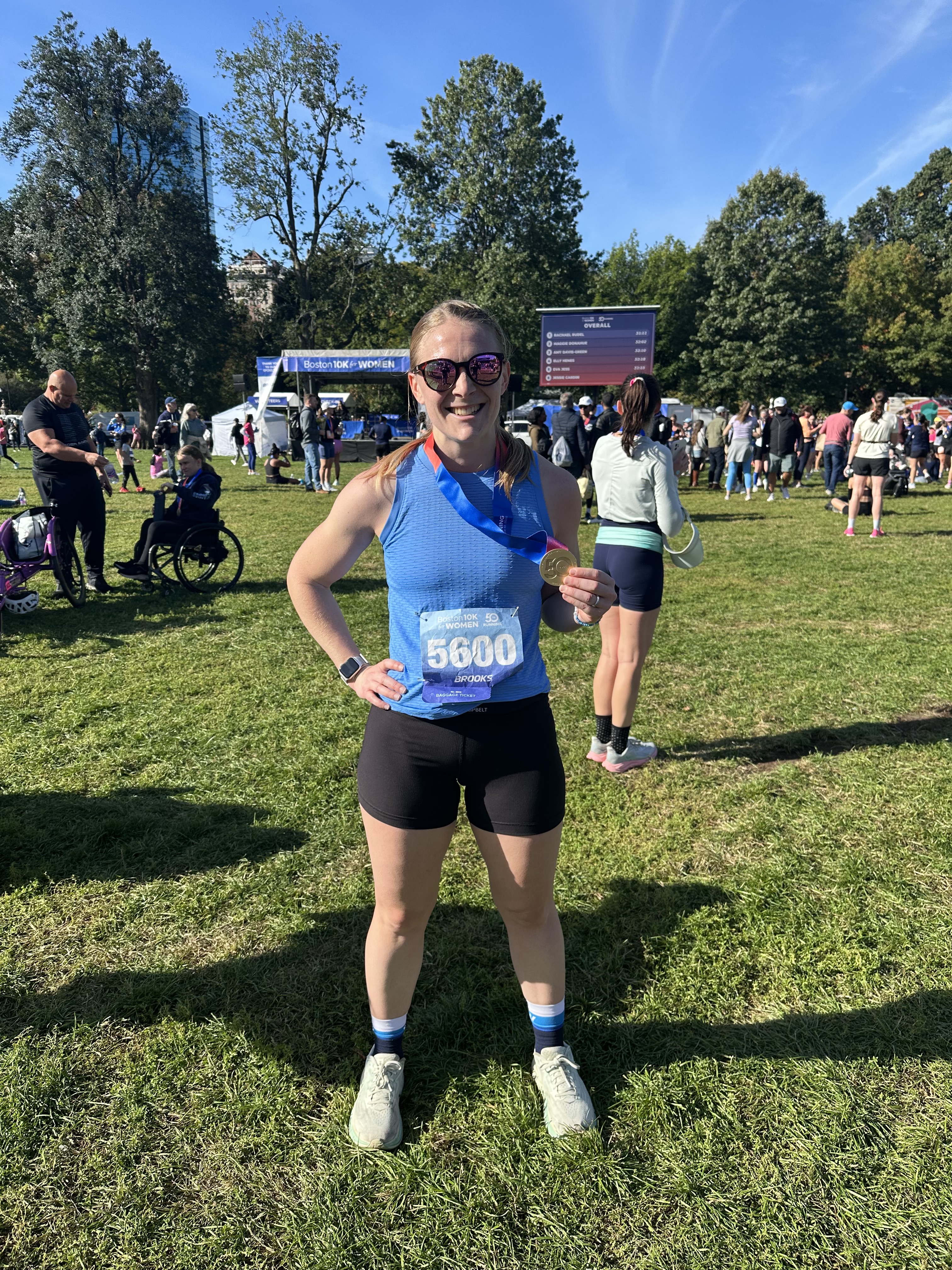
The Peabody’s Emma Lavoie joined several staff colleagues representing Phillips Academy in the 50th running of the Boston Women’s 10K Race this month. The event saw over 7,000 participants! Thank you to the PA Head of School’s office for supporting this opportunity.
Inman Painting in the Addison’s America in the Making Exhibition
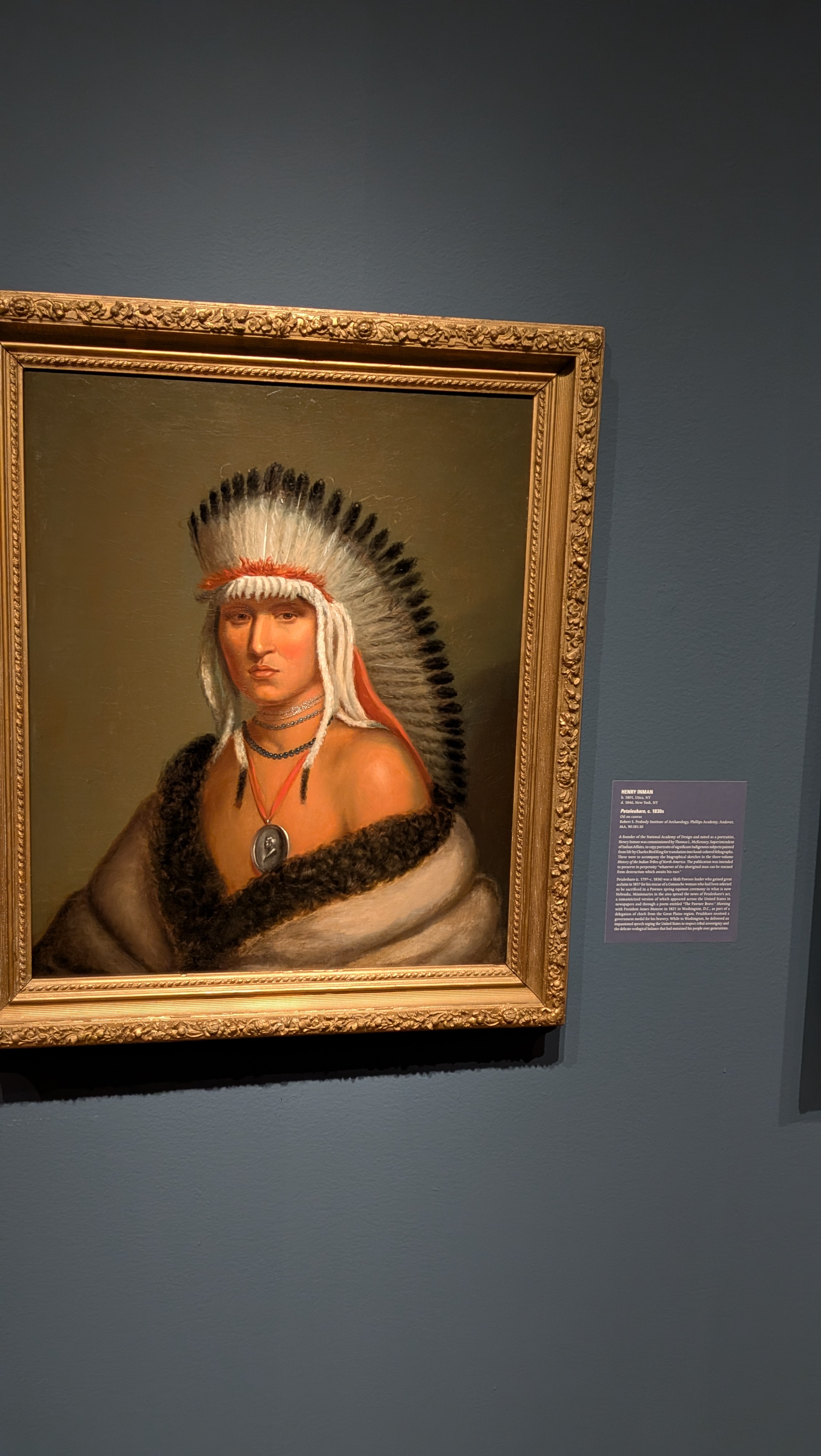
Make sure you visit the Addison Gallery of American Art’s exhibition America in the Making (September 8, 2026-January 31, 2027). The show marks the 250th anniversary of the Declaration of Independence and includes an extraordinary array of “greatest hits” from the Addison’s permanent collection. Be on the lookout for Henry Inman’s painting of Skidi Pawnee chief Petelesharo, on loan from the Robert S. Peabody Institute of Archaeology. Petelesharo is one of three Inman portraits held by the Peabody Institute.
Every summer departments across Phillips Academy host Scholar programs – an opportunity for rising 11th and 12th graders to conduct an independent research project of their choosing, with support from a faculty or staff advisor. Interested students submit their research proposals the winter prior; selected applicants use the spring to prepare any resources they require; and summer is spent immersed in the work. This past year, the Peabody Institute joined PA’s cohort of hosts, mentoring our first annual Peabody Scholar. Below, George Richardson gives us an insider account of the experience…–Lainie Schultz
What do teary-eyed Snapchat stories, ham-and-spinach omelets, and Raye’s My 21st Century Blues have in common? These were just a few of the many coping methods that got me through the 41-page paper that would be known as The Settler’s New Clothes: Coachella, Follower Counts, “Boho-Chic,” and the Dual Dispossession of Indigenous Regalia. Wordy? I know.
Before I detail those drawn-out Thursday nights spent mulling over whether wearing a headdress at Coachella is appropriation or appreciation, let me take you back to the beginning. No, not the first stage of research, the true beginning: my inbox.
It all started with an Outlook notification inviting me to a Scholar Information Session. The main attraction? Free pizza. The dining hall was looking particularly unappetizing that evening, so with an empty stomach and low expectations, I climbed the treacherous stairs of the Oliver Wendell Holmes Library to the Tang Institute. Naturally, I sat near the front, well within arm’s reach of the greasy American delicacy that would fuel my attention span for the next hour.
When the meeting ended, we broke out into interest groups: OWHL, Brace Center for Gender Studies, PA Sustainability Coalition, or, best of all, the Peabody. Why pick the Peabody, might you ask? Honestly, my odds looked best there since I was only competing against 5 other people. A few months later, an email confirmed it: I had the job.
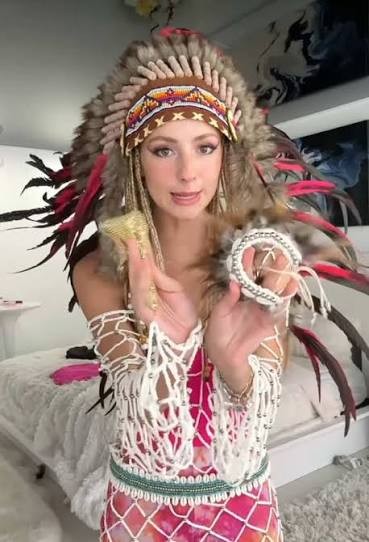
Jump to the start of my research. I knew I wanted to explore cultural appropriation at music festivals, but I had zero direction. So, naturally, I procrastinated on TikTok. The algorithm gods were clearly watching, because the very first video on my feed was influencer Natalie Reynolds showing off her 2025 Coachella outfit, which she proudly described as having an “Indian vibe.”
Just like that, my project was born: Non-Native festivalgoers wearing Native American headdresses. I hopped out of bed, opened a Google Doc, and started outlining.
What followed was a complete blur. Between 10 AM Monday check-ins with Dr. Schultz and endless late-night dives into the Internet Archive and JSTOR, I became utterly consumed. Narrowing the scope, though, was a nightmare. Every new journal article tempted me to change my entire thesis. There were moments I genuinely wondered: Am I moving the needle here, or is this just going to read like another non-Native person culture-policing?
To break through that anxiety, I completely reframed my approach. I stopped focusing on individual festivalgoers and instead landed at the crossroads of TikTok recommendation algorithms and the Indian Arts and Crafts Act of 1990. By centering the paper on corporate platform designs and statutory compliance rather than ethics, I gave myself the space to critique systemic exploitation without playing into polarized rhetoric.
Despite that triumph, with three weeks left before the final deadline, I realized my current draft couldn’t be saved. So, I opened a fresh doc and turned to the Dangerous Writing App (it deletes your work if you stop typing for 5 seconds). That panic-fueled session birthed a raw 3-page outline. Over the next week, mostly between 3 AM and 8 AM, that outline ballooned into a 17-page draft. Two weeks of refining and addressing Dr. Schultz’s feedback later, I had a paper.
The final step was formatting: setting it to Times New Roman and hitting double-space. Instantly, what had felt like a standard draft transformed into a 41-page short story of everything I could possibly utter on the subject.
Looking back, the Scholar process was entirely worth it. The level of research and writing feedback is unlike anything else I’ve done inside or outside Andover. Sure, there were days my entire schedule was swallowed by the paper, and days when muttering the word “draft” near me would put you at serious health risk. But if you’re ever considering applying (whether pizza is your primary motive or not), do it. If only for the pure satisfaction of hitting double-space at the end. Thank you.
Title inspiration from Green, Rayna. “The Tribe Called Wannabee: Playing Indian in America and Europe.”Folklore99 (1988): 30-55.
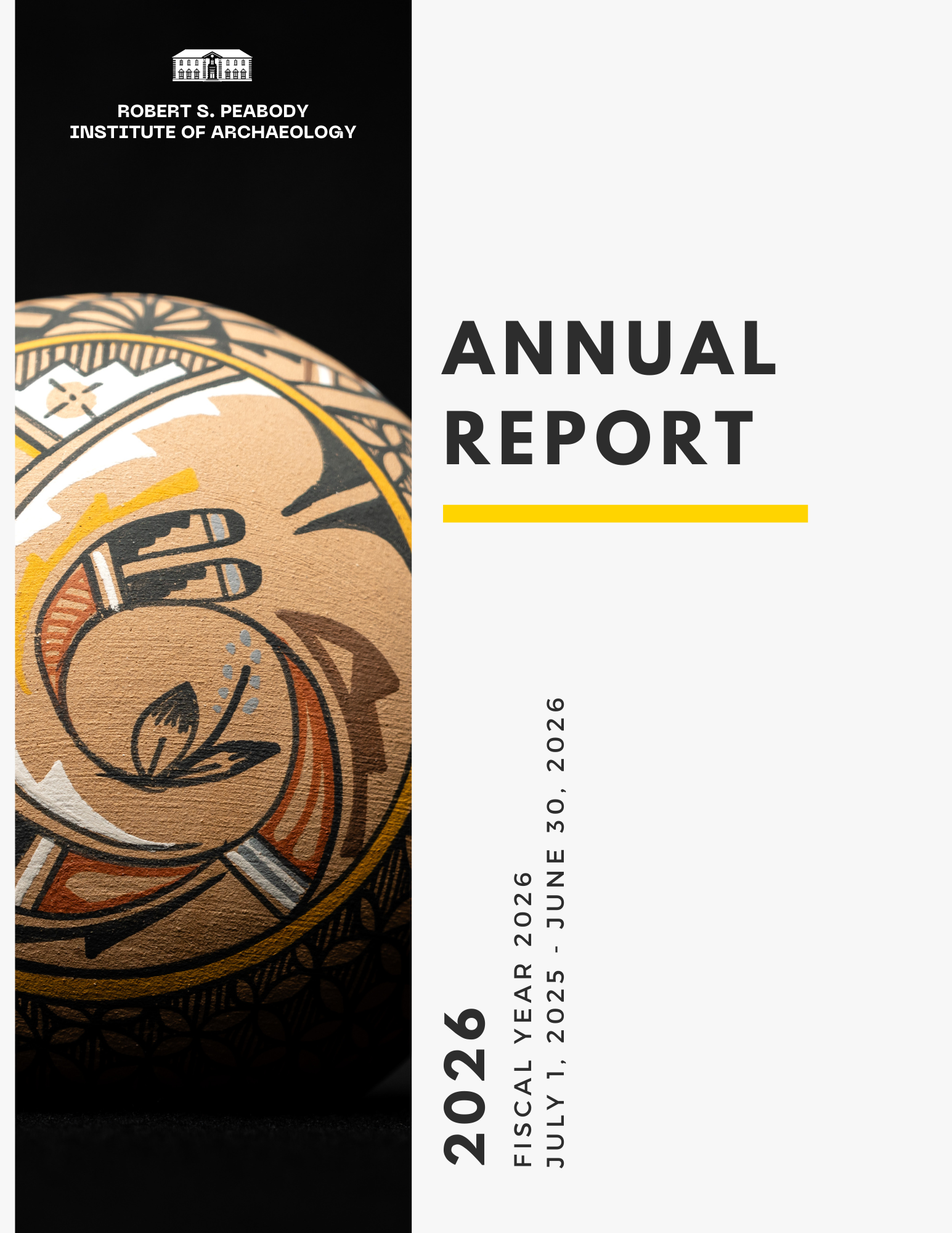
The Peabody’s annual report for fiscal year 2026 is LIVE!
This year marks an extraordinary milestone in our history as we proudly celebrate our 125th anniversary. For more than a century, the Robert S. Peabody Institute of Archaeology has inspired student interest, fostered appreciation for Native American cultures, and supported archaeological research. This landmark anniversary offers us the opportunity to look back with gratitude on our history, while looking forward to a vibrant future.
Fiscal Year 2026 has been a historic chapter of transformation, most notably distinguished by the successful completion of the Peabody building project and renovations. This major undertaking has revitalized our physical spaces, blending our historic architectural legacy with modern, accessible, and innovative facilities designed to serve student generations to come. From enhanced programming spaces to upgraded infrastructure, these improvements ensure that our physical home matches the excellence of the services and experiences we deliver every day.
None of these achievements would have been possible without the dedication of our staff, generosity of our donors, and the steadfast support of volunteers and community partners. You can read our full report HERE!
Contributed by Emma Lavoie (and Friends of the Peabody)
Ahhh summer! Whether you’re on the beach, enjoying a hike or walk through nature, taking a drive with the windows down, or a staycation in your backyard – nothing beats a day in the sun.
And there isn’t a better companion for your summer adventures than music! From nostalgic tracks to newest releases, the Peabody shares its “Songs of Summer” playlist to keep your summer vibes going. Enjoy our playlist here!
“This is one of my two favorite songs from my favorite band that stirs up ample memories of fun times and fun drives with family and friends. With fast and upbeat guitar riffs and classic Jim Morrison “whoos,” there is no better song to play too loudly with the car windows (or better yet drop top) down and the wind in your hair.”
– Donny Slater, PA Faculty & Peabody Board of Advisors Member
“Great Big Sea was the sound of my college years and is forever tied to fun, friendship, adventure, and a good time. Thelive versionis a MUST and I strongly recommend seeking out the live version for all their music.”
“Every time I hear it, I’m instantly reminded of summers growing up in Rhode Island. It was always playing while we were camping, out on the boat, or spending the day at the beach. It brings back all those carefree summer memories and never fails to put me in a good mood.”
– Danielle Akin, PA Capital Project Manager (Peabody Building Renovation)
“I’ve been wearing my Love and Rockets t-shirt a lot this summer and getting a ton of reactions from strangers in the street. None of them seems to notice, though, that my t-shirt is of the comic book, not the British rock band.”
“Full of expansive, 80’s inspired new wave soundscapes, this album takes me back to a time when summer stretched out forever and was full of possibilities. It’s a perfect complement to any trip with open roads and breathtaking landscapes.”
– John Bergman-McCool, Peabody Collections Coordinator
“New release just in time for the summer by one of my favorite bands. I’d describe this brotherly rock group as ‘new generation Led Zeppelin’ with classic bluesy riff-rock and Plant-esque vocal delivery. Whether you’re on the beach or out for a drive, this song represents restless energy, a sense of youth chaos, and the beautiful nature of seizing a moment.”
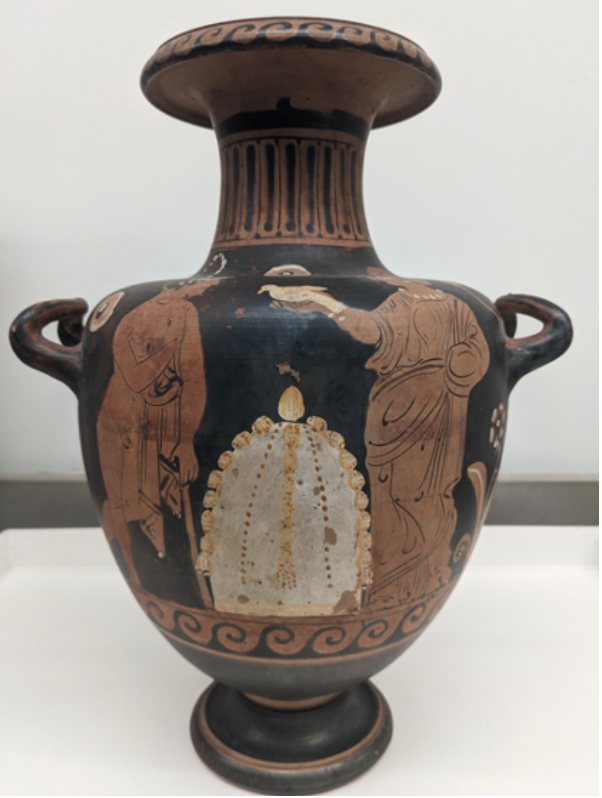
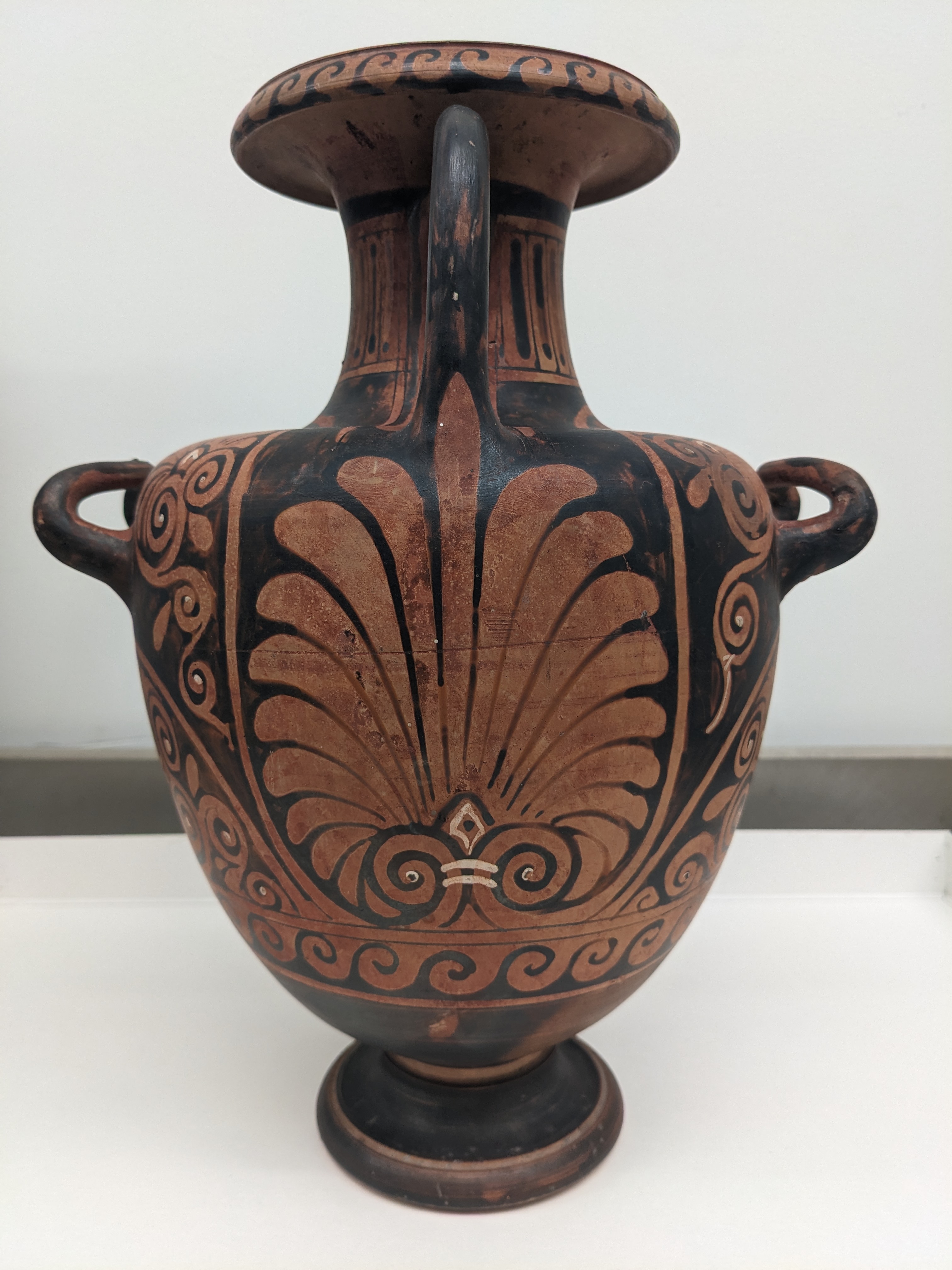
In the fall of 2024, I reached out to Dr. Ryan Wheeler to learn more about the collection of Ancient Mediterranean artifacts that I knew were housed at the Peabody. I didn’t yet know the extent of what the collection contained, or what sort of project I might want to take on, but I knew I wanted to learn more, and that I wanted to help the Peabody learn more, too, by enhancing its catalog records. Dr. Wheeler shared with me a catalog of the objects that the Peabody houses, including a folder with all their photographs. After taking a quick look, I found myself drawn to this hydria:
Hydria (jug) housed at the Peabody Institute, 1989.984.4.2.
This is where I chose to focus my independent research. Initial identification of the Ancient Mediterranean collections at the Peabody was provided by Dr. Laure Marest, then a curator at the Museum of Fine Arts, Boston. She described 1989.984.4.2 as a “hydria (jug) with a man and a woman holding a dove above an omphalos”, made from red-figure ceramics, dating to the late 4th century BCE, and attributed to the Hellenistic period in the Campanian region. This served as my starting point, and the direction for my research: to learn more about this type of pottery, and to identify who this man and woman might be.
I began by researching the history and evolution of Hellenistic vessels (ceramic containers produced during the Hellenistic period, roughly from the late 4th to the 1st centuries B.C.E., used for practical, ritual, or decorative purposes), from proto-geometric and geometric techniques to black-figure and, finally, red-figure, the technique used for this artifact. Red-figure pottery eventually took precedence over black-figure because it allowed artists to leave figures in the clay’s natural red while painting the background black. Instead of laboriously incising details, artists could draw them more freely, making the technique better suited to naturalistic depictions of anatomy, garments, and emotion. I also researched the different types of Attic pottery, or pottery produced in the region of Attica, Greece, especially in Athens, which became a major center of Greek vase production. These forms included hydriai, lekythoi, amphorae, kraters, and many more. In doing so, I learned that a hydria is a three-handled water jar, typically with two horizontal handles for lifting and one vertical handle for pouring.
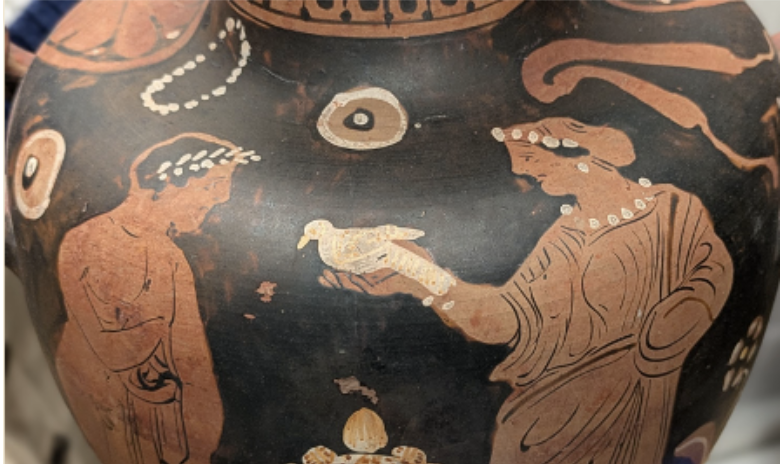
Understanding the broader historical and artistic context of the pot assisted my hypotheses of the figures’ identities. Since the woman on the right is holding a dove, I predicted that she was Aphrodite, the goddess of love and beauty, whose sacred animal is the dove. After finding more vessels online with Aphrodite depicted and comparing them with the illustration on this pot, I was confident that the well-decorated lady with her hair tied in a bunch, open beaded cap, earrings, necklace, and bracelets was Aphrodite.
A closer view of the front of the hydria’s shoulder, with the now-identified Aphrodite.
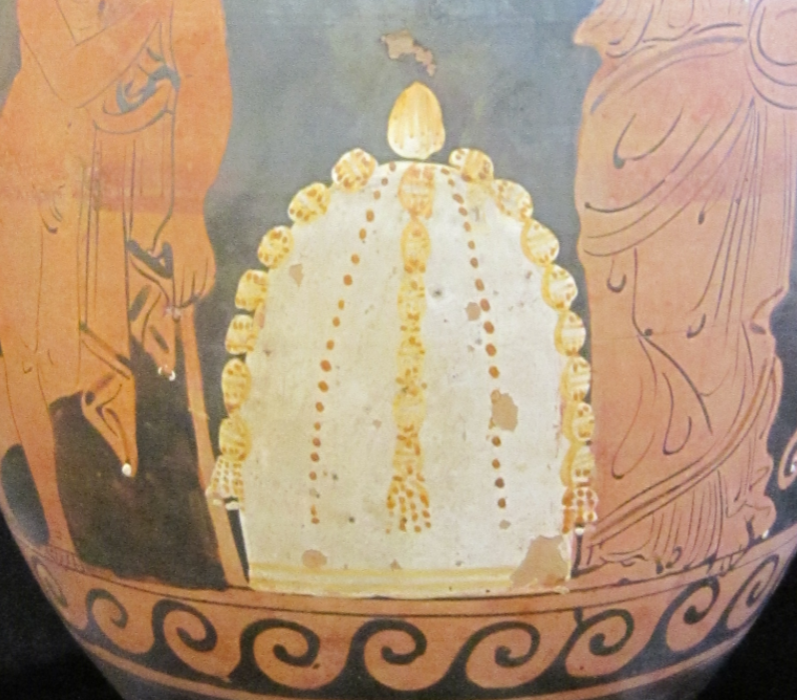
Then came the most challenging part: identifying the man on the left of the hydria. At first glance, there was nothing symbolic about the figure, except that he stood casually beside Aphrodite, showing no sign of reverence typically expected toward a goddess, therefore implying that he may be a god himself. I searched online databases and museum collections for depictions of various gods on Attic pottery and for their characteristics. Then, I remembered, too, that Dr. Marest had described the large object in between Aphrodite and this man as an “omphalos.” Originating from the Ancient Greek word “ὀμφαλός,” meaning “navel,” an omphalos symbolizes the center of the world, glory, and birth and death in the Classical and Hellenistic periods. I later learned that the omphalos was also a marble monument discovered at Delphi, Greece, a religious sanctuary dedicated to Apollo.
Close up on the omphalos.
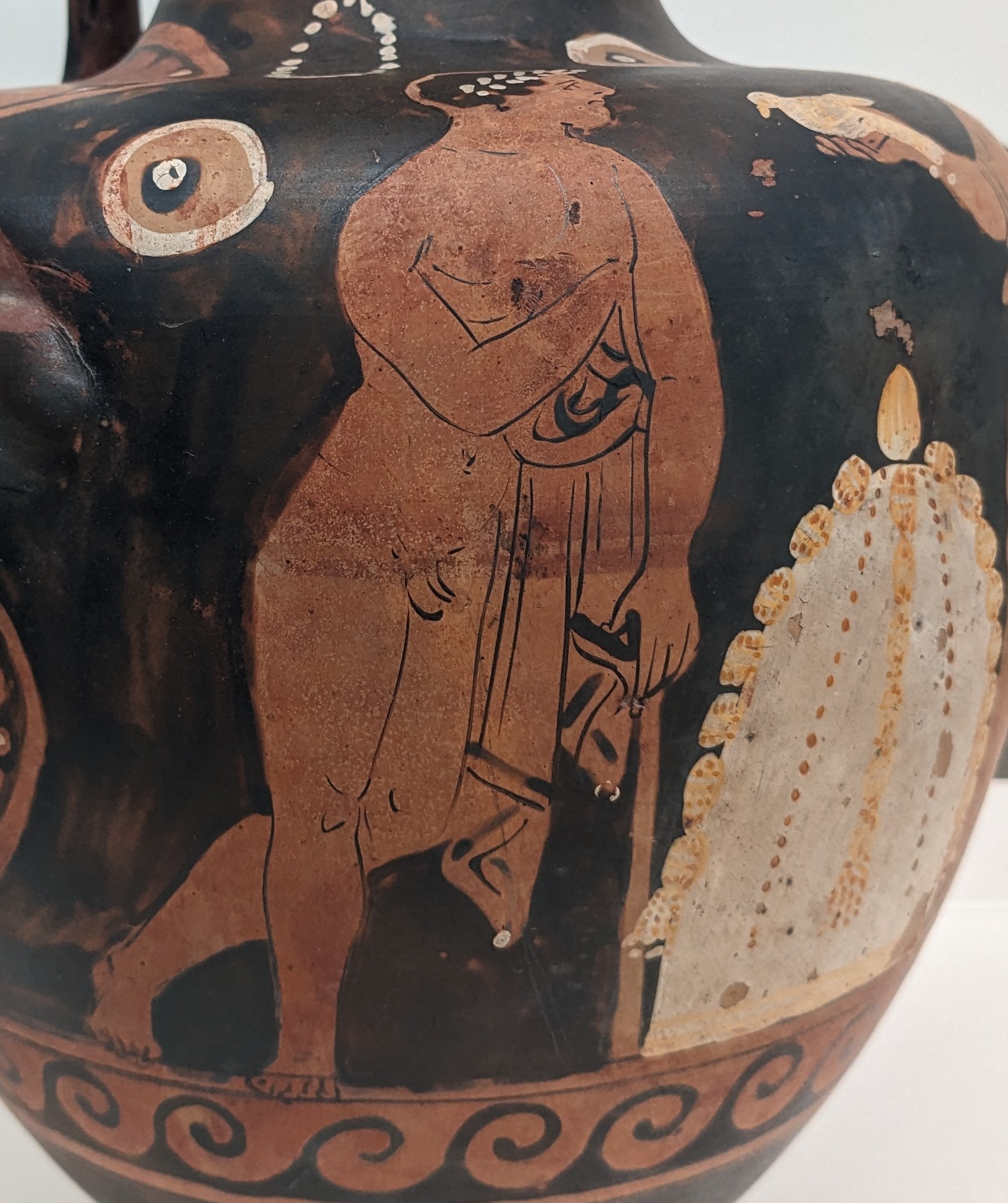
Thinking about the relationship between the omphalos and Apollo, the fact that fillets (decorative bands of cloth often used as religious offerings), which adorn the omphalos, were often offered by worshippers consulting Apollo’s oracle, and the laurel wreath commonly worn by the nude Apollo, I suspected that this man could be Apollo. After researching more vessels online with depictions of Apollo, I found various similarities in the iconography, such as Apollo holding a staff in a print at the British Museum.
A laurel wreath, a staff, and an omphalos with fillets.
I wrote up my findings for the Peabody Institute and created slides of my research to present my findings to others. After coordinating with Dr. Lainie Schultz (Peabody Institute), Dr. Elizabeth Meyer (Instructor, Phillips Academy Classics Department), and Dr. Paige Roberts (Director, Phillips Academy Archives and Special Collections), I am so grateful to have had the opportunity to present my findings in person at the “History Up Close” event on April 30th, open to the Phillips Academy campus. The excitement of this experience also came from learning from the audience, many of whom asked very thoughtful questions about not only the iconography on the hydria but also the iconology, which gave me clearer next steps for my research.
Selene presenting her research at the “History Up Close” event. Photo by Jessie Wallner.
Never would I have thought that I would have this amazing opportunity as a high schooler. I am also extremely grateful that this experience sparked my interest in archaeology, inspiring me to expand my research on Attic pottery even beyond the Peabody.
Hi, I’m Aaron Bai, and I’m an upper (11th grader) at Phillips Academy. I’ve always been interested in history and the humanities. As a child, I would spend hours in the school library reading books on mythology and history from cultures all around the world. As I grew older, I would read and even write about interesting topics in my free time, from the Garamantes during the Roman Empire to modern extremism in the Sahel. I have come to believe that only through studying human culture and society throughout its history can we better understand who we are and how we came to be. Though the present may differ considerably from the days of Lucius Cincinnatus or George Washington, for instance, their legacies and the similarities in the challenges and decisions we face make it such that uncovering their stories unmasks more of our own.
Following my interests, I chose to work at the Peabody for my work-duty requirement during my lower year (10th grade). This turned out to be a great decision— I had the rare opportunity to help organize, document, and analyze the Peabody’s vast collection of artifacts, from Neolithic stone tools to Native American ceramics. Working closely with these objects allowed me to engage directly with material history and learn the stories behind them in a unique and deeply meaningful way. This year, with work duty completed, I have continued to volunteer at the Peabody every week, helping research and document its collection of coinage from the Ancient Mediterranean, which serves as an amazing window into the societies and belief systems of the ancient world.
Given my interest in anthropology, I joined the Andover Anthropological Society last year, a student club here on campus, and later applied to take on a leadership position. Now serving as co-president of the club, I hope to raise awareness of this remarkable resource at our school and expand opportunities for students to engage with the Peabody and the collections there, whether through open houses, workshops, or research projects. It may even be worthwhile exploring engagement beyond the student body, such as inviting local schools to participate in open houses or lectures. In any case, I am very excited and look forward to working with the Peabody on these initiatives.
Aaron sharing his coin research with members of the Phillips Academy campus.
My name is Barrett Kim, and I’m an upper (11th grader) at Phillips Academy interested in biological sciences, though what draws me most isn’t exclusively the science, but the philosophical questions of how we got here.
I came across anthropology very spontaneously. A friend mentioned a research project through the Andover Anthropological Society, specifically exploring gender dynamics in Indigenous artifacts. Their hard work and insightful research immediately fascinated me. Around the same time, I was reading Orwell, Bradbury, and Salinger, writers who kept returning to the same warning: societies fail when they forget their own past. Anthropology felt like the applied, real-life version of the messages those books portrayed. If you want to understand where humans are going, you must understand where we’ve been. Anthropology turned out to be the perfect intersection of biology and sociology, two fields most people treat as completely separate.
Coming into Phillips Academy, I had no idea what anthropology was; however, after exploring the field and its importance, I felt like I had to help share what I learned. This desire to inspire others made me pursue a leadership role with the club and the Peabody Institute, not because I had everything figured out, but because I wanted to guide others into learning anthropology’s importance.
Looking ahead, I’m really excited to work with the Peabody. We have a professional archaeological institute on our campus, and most students walk right past it. Next year I want to help encourage students to use this valuable resource to explore our past and shape the understanding of our futures. Working with Aaron, we envision a place where genuine questions can be passionately explored, and where the work we do helps expand people’s worldviews.
Barrett (left) at a Peabody event organized by the Phillips Academy Biology Club.
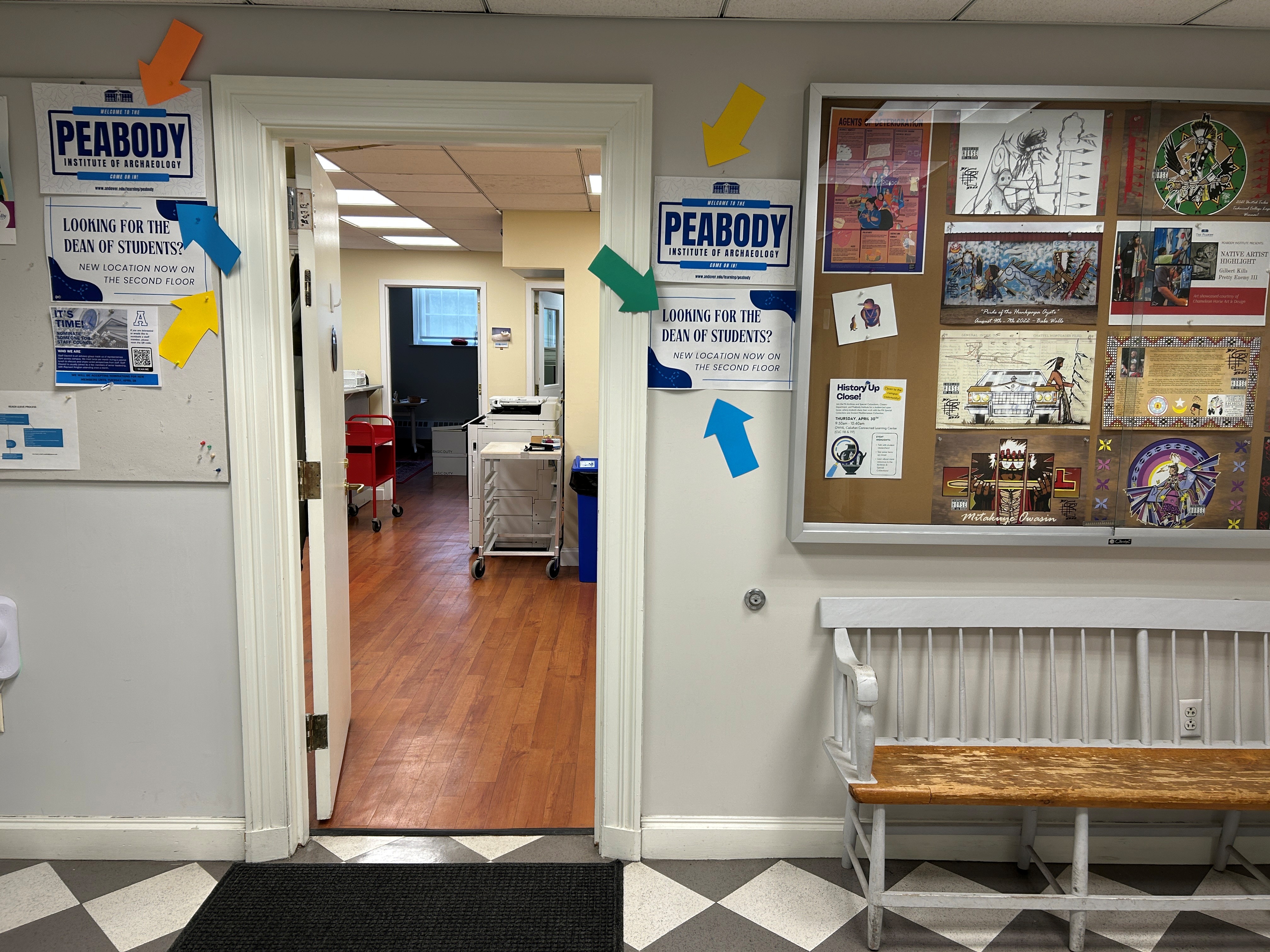
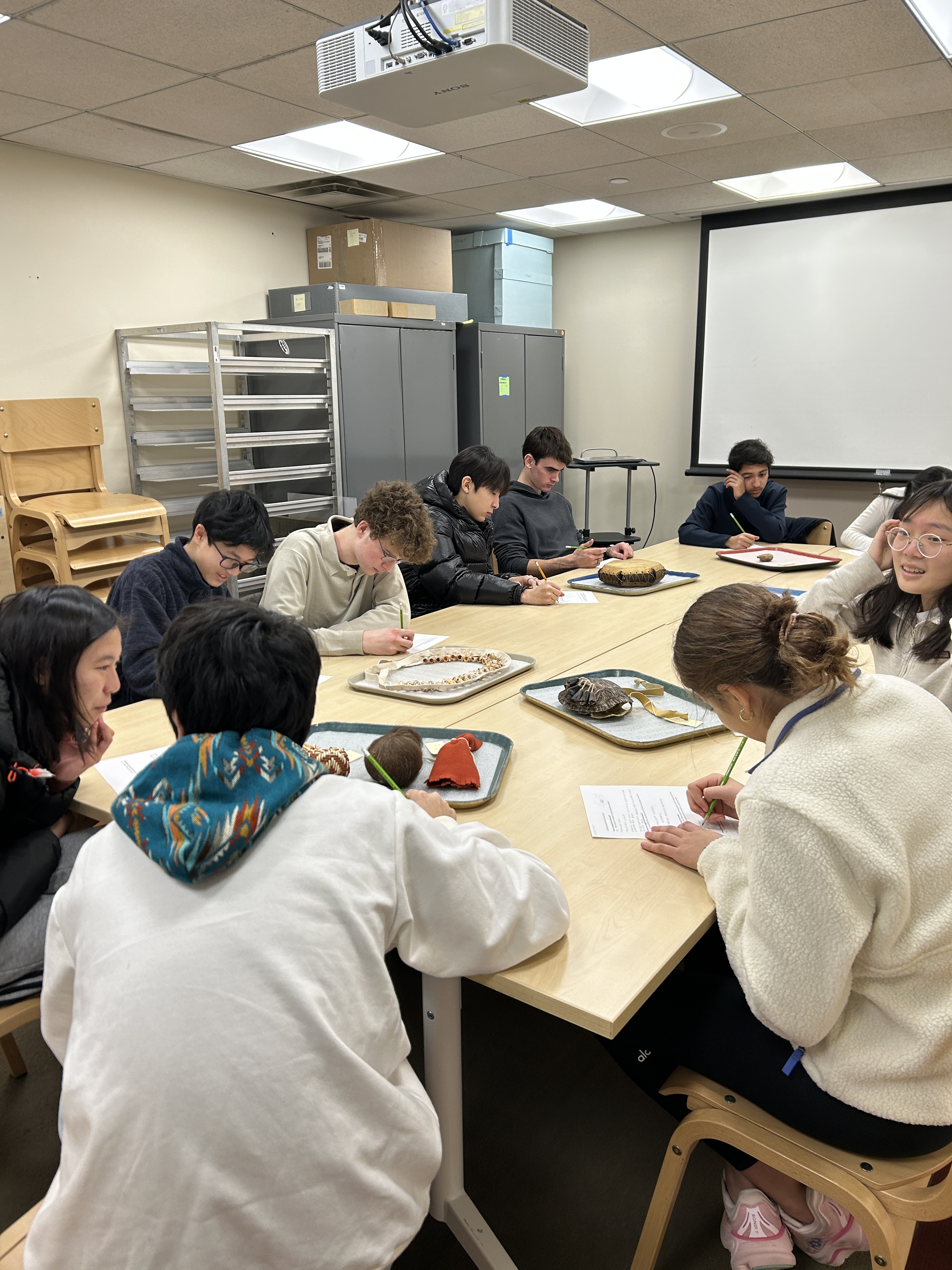
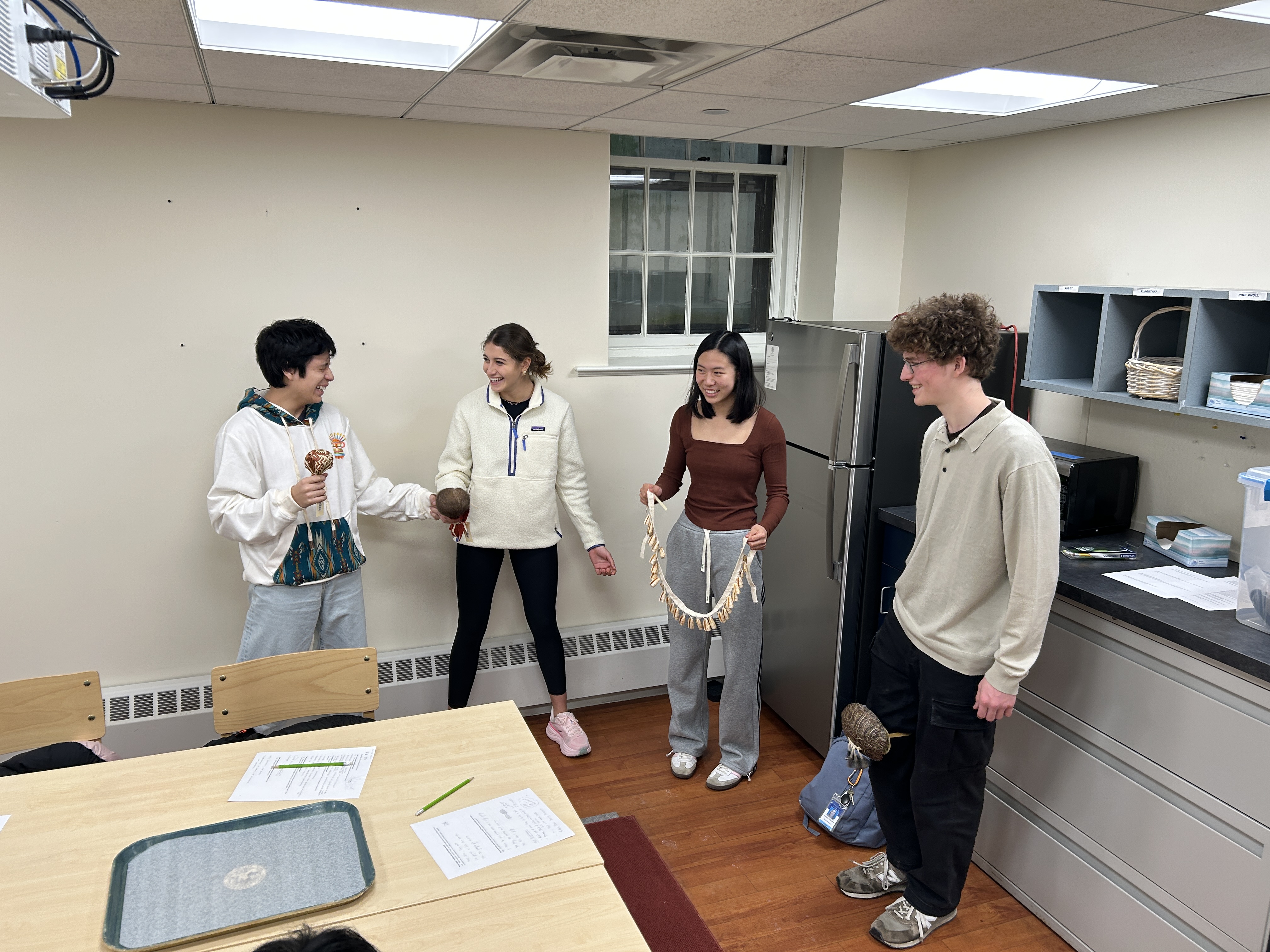
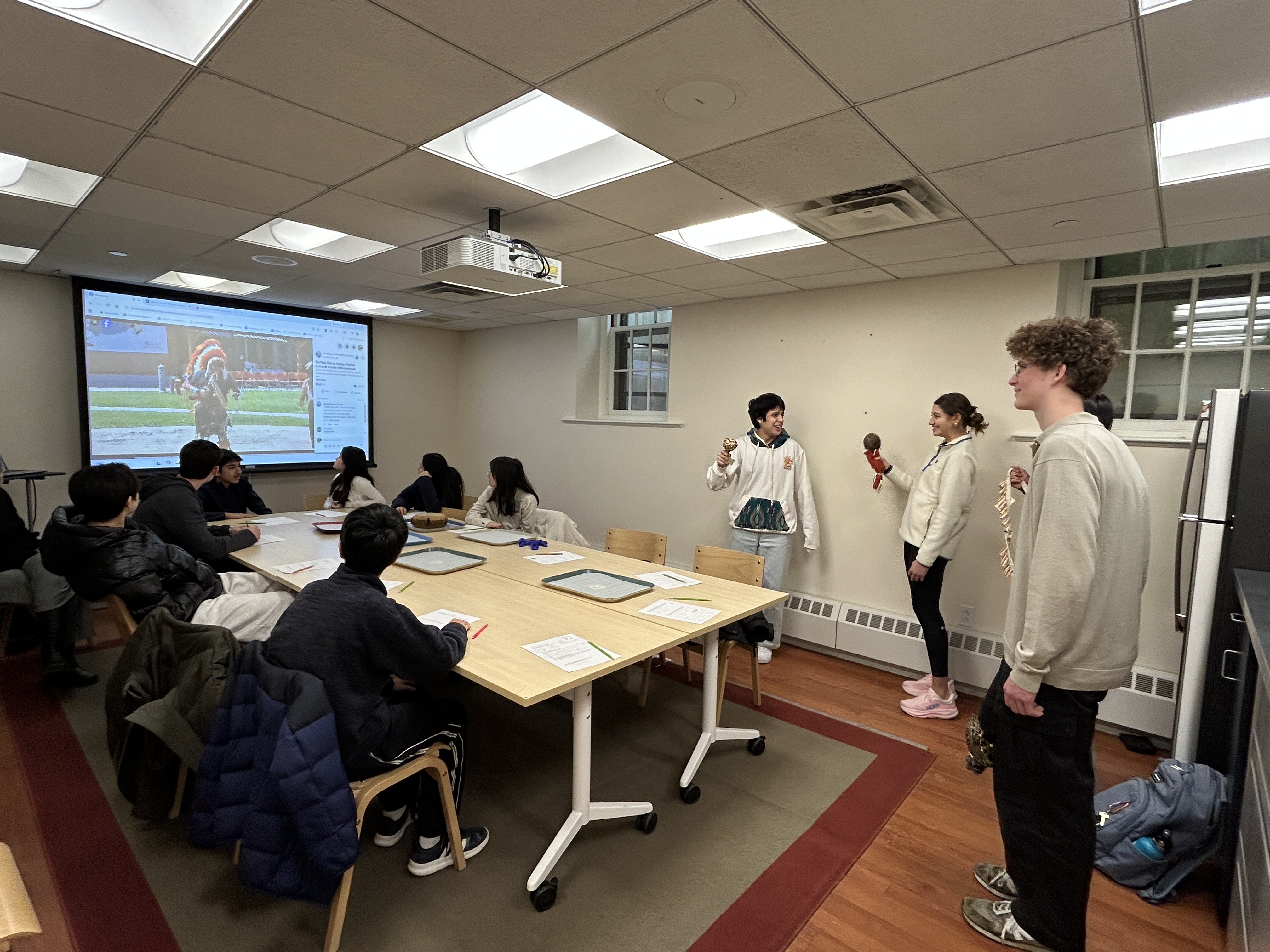
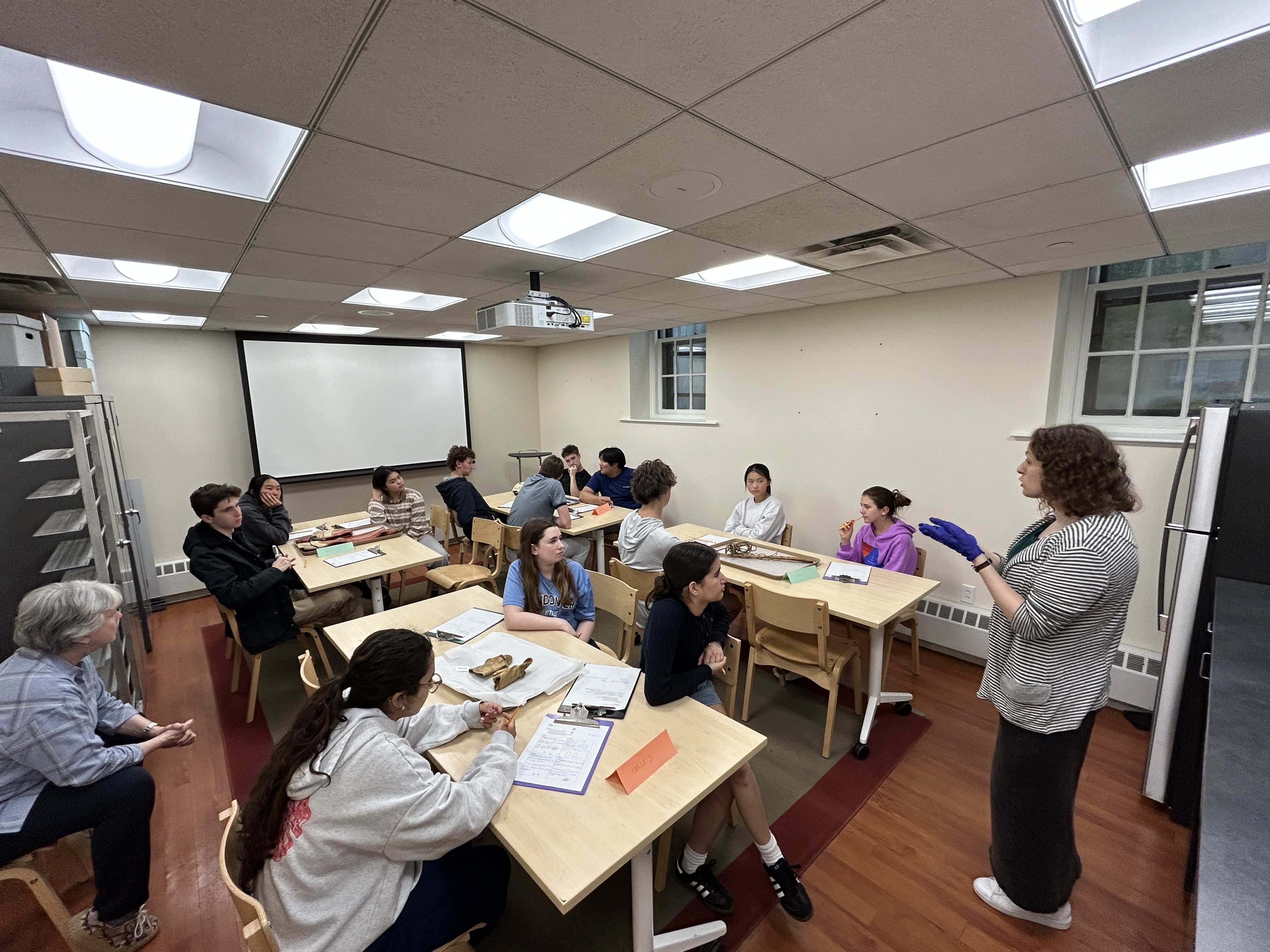
In January of this year, Peabody Institute staff were kicked out of the Peabody Institute building as the start of renovations loomed near. Fortunately, construction elsewhere at Phillips Academy meant that the Dean of Students moved into new digs, leaving available their suite in the basement of George Washington Hall to claim as our temporary-own. A Goldilocks fit, the space had five desks available for five Peabody folk, plus a bonus meeting room for meetings.
Or – could it be a meeting room for classes? Lore tells of Peabody staff moving into the School Room on the Abbot Academy campus for the first phase of building renovations. To continue teaching classes, staff valiantly packed up boxes of collections, carrying them from classroom to classroom along with all their teaching supplies: gloves, ethafoam, trays, and, goodness help them, laptops.
I wasn’t at the Peabody yet, so I have only heard the tale. It sounded very impressive and intrepid and like quite the adventure, and every lazy bone in my body knew I wanted nothing to do with it. And so, with my colleagues, I began carefully planning every piece of furniture we would bring over to our GW bonus room, with every permutation of every collections activity thought out. We measured twice and cut once, determined to make this suite available for teaching.
There is nothing more satisfying than a carefully considered plan that actually goes exactly as intended. Is it sometimes maybe slightly cramped? Yes. Does it always work? Yes. Am I a little smug? Oh, heck, yes.
Trying our hands (and waists and legs) at some new instruments with MUS410 Your Musical Brain.
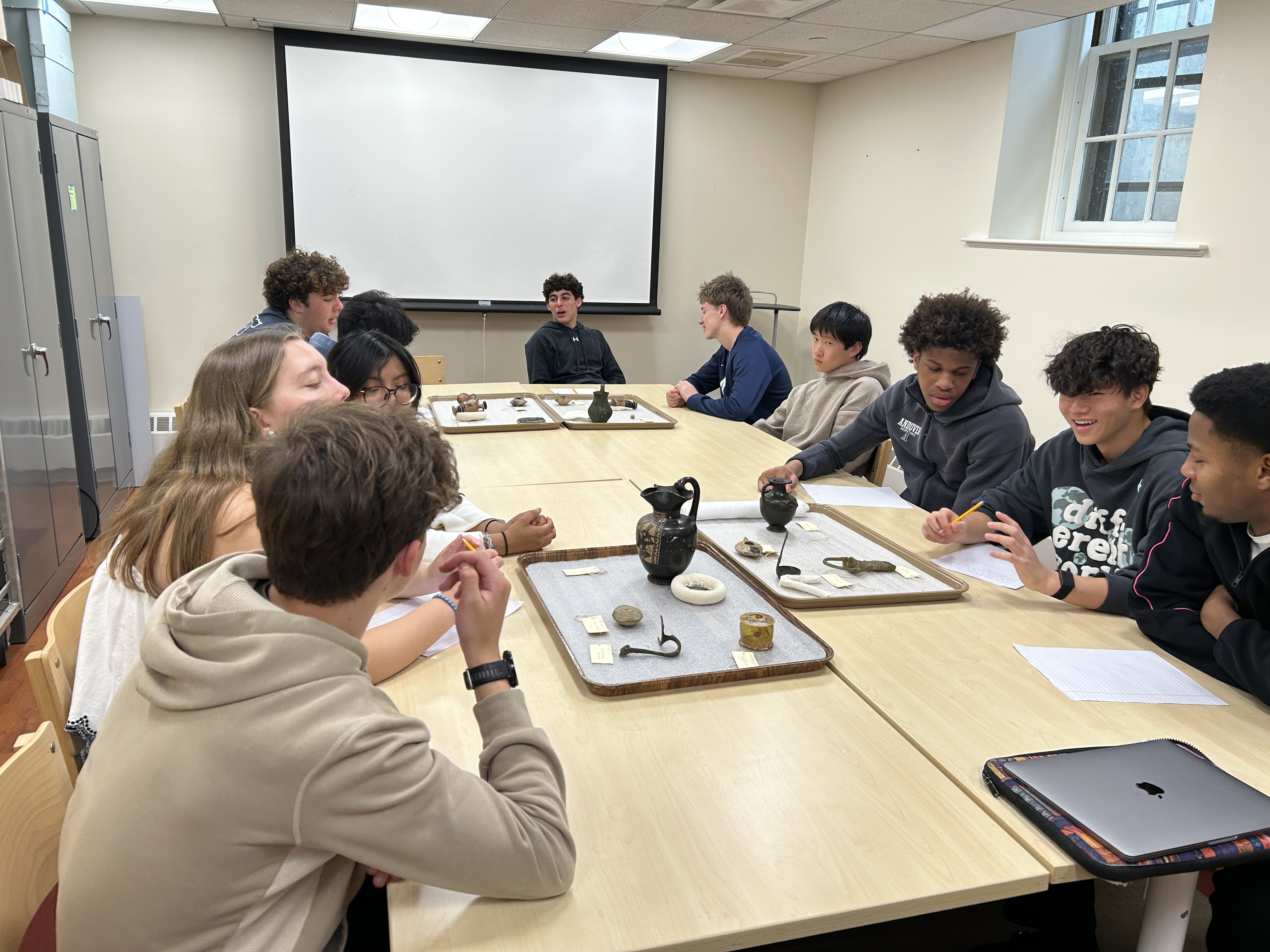
Meeting the Inuit who met the Vikings with HSS100B Sojourns Across a Connected World.
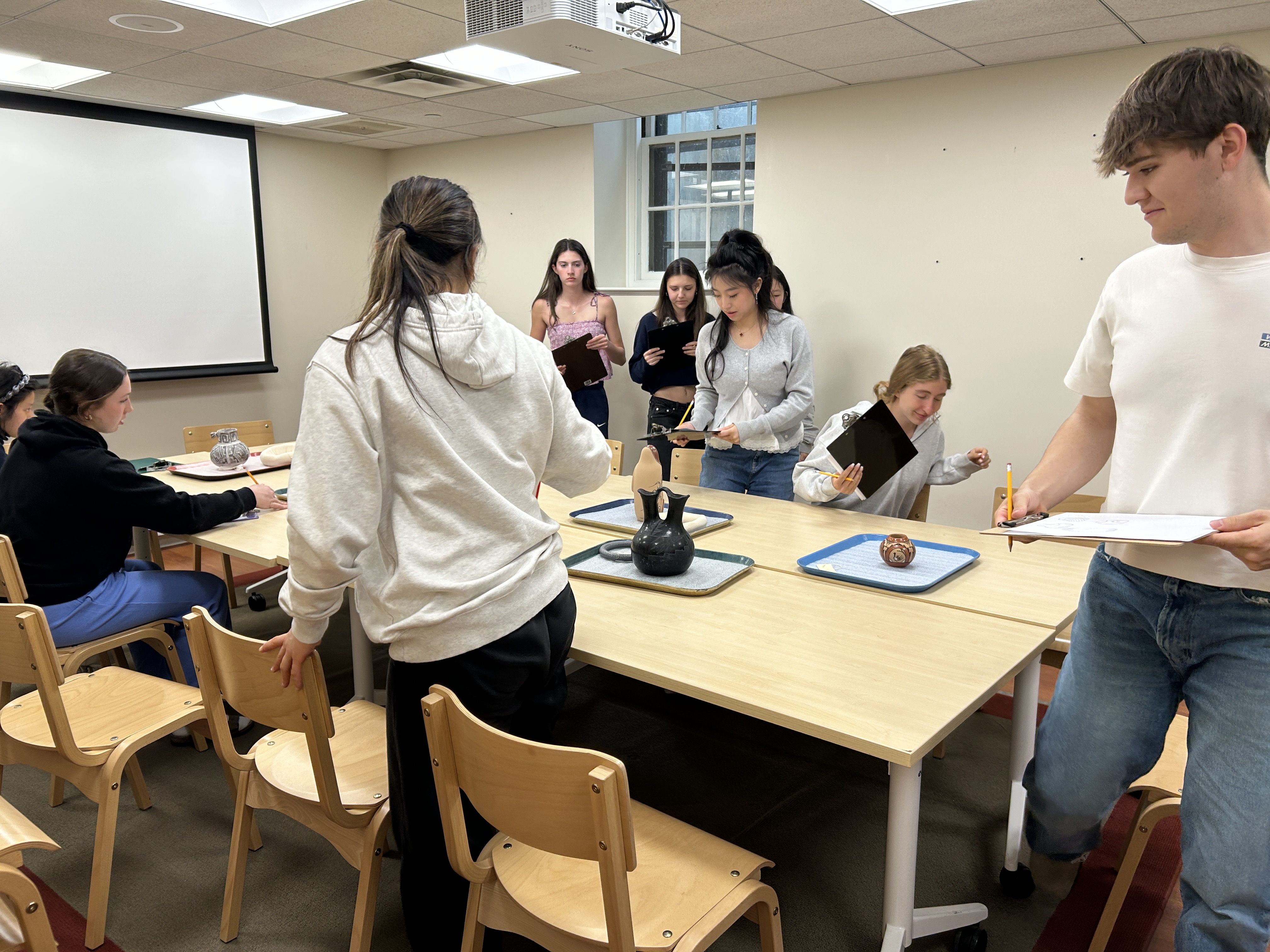
Prepping for the ceramics studio with ART302 Clay and the Ancestral Pot. (What? Room to stand up and walk around? Incredible.)
Imagining the world of the New Testament with PHR330 New Testament.
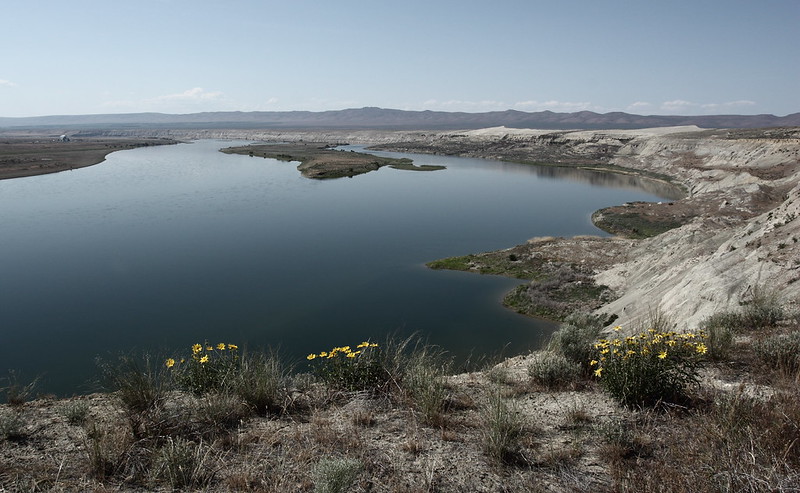
Hanford and reactor as seen from across the Columbia River. PHOTO: by nblumhardt
In the late 1940s, former Manhattan Project scientist and Nobel Prize chemist, Willard Libby, developed a powerful tool for dating archaeological remains using radioactive decay. Organic materials, such as wood, absorb radioactive carbon-14 isotopes from the environment. Upon death C-14 decays at a steady rate of ½ every 5,730 years, a phenomenon called a half-life. To simplify the process massively; the remaining C-14 in organic remains can be measured to determine the date of death.
This dating method was complicated by nuclear testing, which doubled the amount of C-14 in the environment. The global impact of human activity on the climate and environment, including nuclear testing, led to the proposal of a new geologic era that began in 1950, the Anthropocene. Although not officially accepted as a new epoch due to lack of consensus regarding the start date, there is no denying the atomic age has changed the planet.
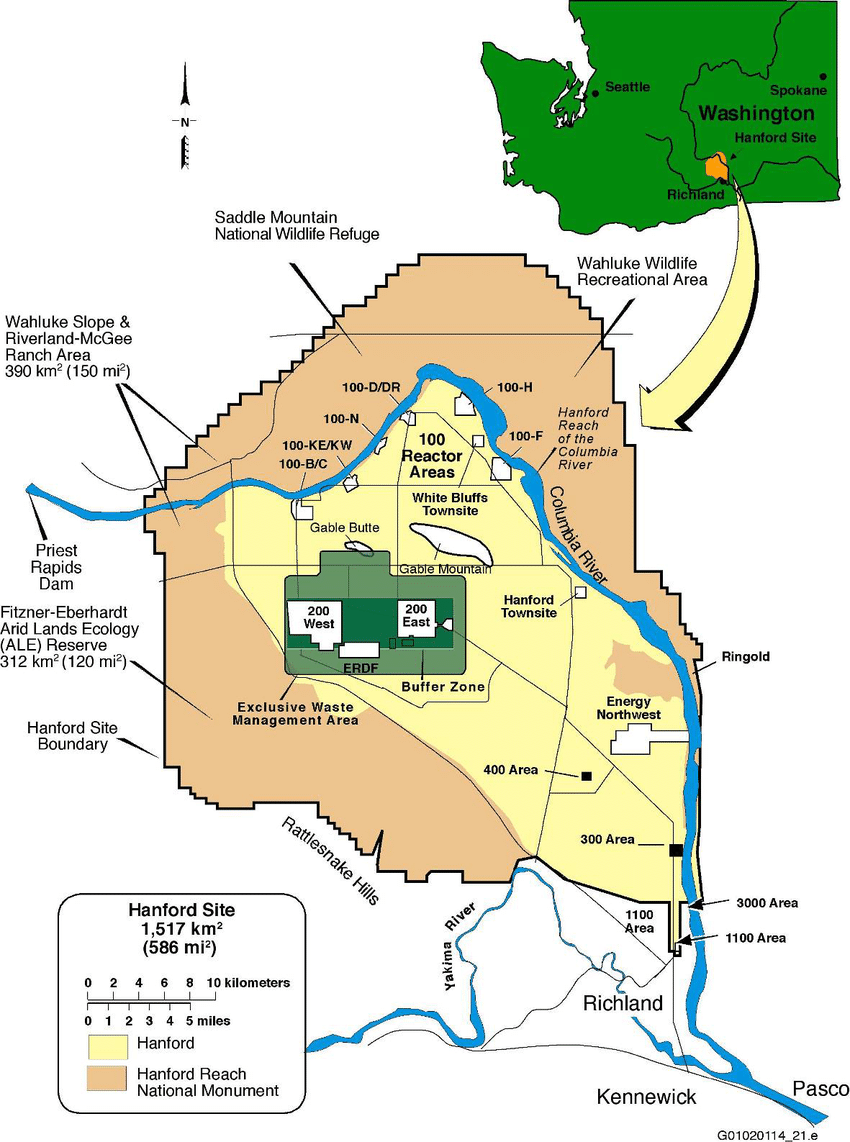
When I was a baby archaeologist, freshly graduated with an undergraduate degree, the second project I worked on was an archaeological survey on the Hanford Nuclear Reservation in Washington State. The Hanford site was part of the Manhattan project and home to reactors and processing plants that supplied plutonium to the military during the Second World War. After the war, plutonium production at the site was fueled by the cold war arms race and continued for almost thirty years. It is now considered the most contaminated site in America.
Map of the Hanford Site: DEPARTMENT OF ENERGY
By the time I worked at the Hanford Site, the reactors were decommissioned and entombed in steel sarcophagi, a process called ‘cocooning.’ Cleanup at the site had been going on for decades. Our survey area, though large, was located far away from the reactor sites. From my perspective, the nuclear reservation was huge, seemingly empty and very quiet.
The survey project covered thousands of acres and included mile-long transects. The landscape of the Columbia Plateau is beautiful. The ground is covered in sandy soil and dotted with sage brush. On hot days the smell of sage is dizzying.
We found and recorded can dumps, historic artifact scatters, and a handful of isolated stone tools. The area has an Indigenous history that dates back at least 11,000 years. More recently, the site was used as ranch land and was home to homesteads, farmsteads, and townsites. When the site was commissioned, the existing communities were evicted and the towns razed.
If I had concerns about working on a nuclear reservation, hours of safety training helped quiet some anxiety I had going into the project. I was still new to archaeology, so my attention was mostly focused on learning and doing a good job. We had one heat-exhaustion scare, so hot temperatures seemed like the project’s most pressing danger.
However, one day while working on the banks of the Columbia River, where the post-eviction remains of the town of Hanford looked like they were bulldozed into the river, nuclear activists in kayaks came close enough to ask us what we had witnessed on the site. This encounter, along with others like test wells and magenta and yellow barricades denoting radioactive hazards cut through the seeming normalcy of the project.
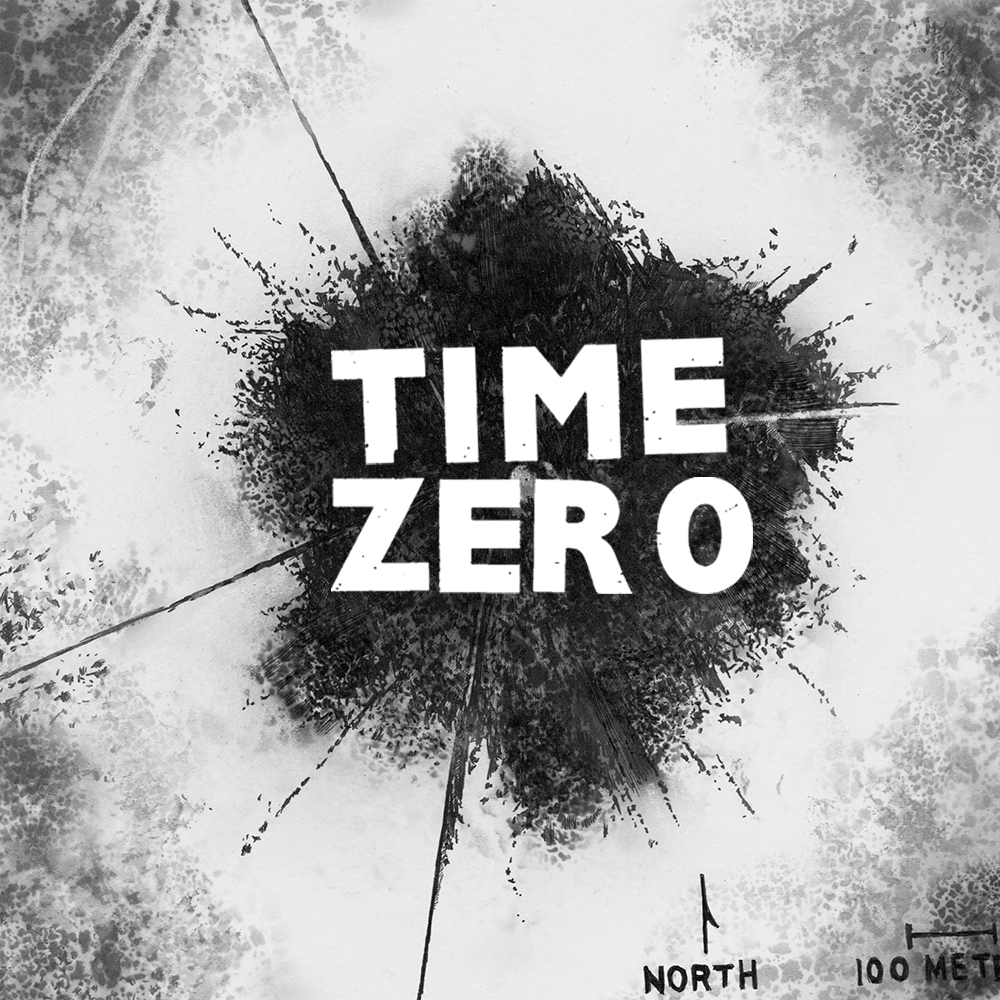
My memories of the project at Hanford have been freshly recalled because I’ve been listening to the Time Zero podcast. Time Zero tells the tale of the nuclearized world. Its creator, Sean J Patrick Carney is an artist, writer, and composer.
Carney tells the story of nuclear development through the eyes of Indigenous and non-native activists, historians, downwinders, artists, and archaeologists. Rather than a dry retelling of the history of nuclear development, the people and locations he presents keep the content engaging. At times the podcast delves into a critique of pop culture and at other times revisits catastrophes both well-trodden and lesser known.
As an example, growing up in eastern Washington State, I heard whispers of cancers attributed to but never concretely pinned to the Hanford site. Time Zero briefly covered the Green Run, the 1949 planned release of radioactive Iodine-131 from Hanford that would allow the government to develop technologies for tracking nuclear particles in the environment.
A National Parks Service history of the Green Run explained that the experiment was botched, releasing twice the amount iodine than planned. Unforeseen weather conditions blew the particles all across central Oregon and eastern Washington. While this release was considerable, the total amount of radioactive iodine over the three decades of work at Hanford was nine thousand times that of the Green Run.
The podcast is dense and full of too many facts to recount in this blog. If you are a fan of reading, the podcast has an accompanying Substack with free access. It includes images that provide context for readers and listeners alike.
The relevancy of Time Zero is particularly potent now, as the tech sector is seeking energy for data centers central to the development of AI technologies. Nuclear is often mentioned as a clean and safe option and advocates of nuclear energy argue for ramping up construction of new power plants.
Yet, the history of nuclear technology across the world, and in the United States specifically, includes instances of removal and contamination of people caused by extraction, production, and testing of nuclear products. As Carney and his Indigenous collaborators point out, no one in the U.S. has borne the burden of the Atomic age more directly than the Indigenous communities.
Indigenous lands have been and still are considered expendable to the nuclear industry. Most of the uranium mining, bomb-testing, and planned storage of waste materials has targeted Native lands. It’s a legacy that is at risk of being repeated if the tech industry is to be believed.
The Anthropocene dawned somewhere between 300 and 70 years ago. The lasting impact of the epoch is outsized compared to its young age. Half-lifes of spent nuclear fuel are geologic in scale and almost unfathomable. Plutonium decays at a rate of ½ every 24,100 years. It will be considered safe in 240,000 years. Uranium decays at ½ every 4.46 billion years (roughly the age of our planet). Nuclear’ s longevity is probably the most impactful takeaway from Time Zero.
Go check out the podcast and site. Though the material is heavy, there is hope that comes from art and activism.
AI seems to be everywhere these days. A recent real-world example of AI creep came during this year’s Super Bowl where roughly 25% of the ads that aired were about AI or utilized AI to generate ad content. In general, the ads promised increased productivity and greater inclusion of AI in our everyday lives.
Aside from the occasional Google Lens image search, I haven’t found a productive use for artificial intelligence in my everyday life. A recent study of ChatGPT interaction logs illustrated that, by rank, people engage AI most for creative composition, “romantic” role-playing, planning, and as a source of general information. Productive uses for AI, including coding and academic composition, came in farther down the list.
In my work at the Peabody, I engage in data management tasks that are repetitive or deal with large amounts of data. I have learned to use Excel tools to make my work more efficient (VLOOKUP- if you know, you know). However, some tasks are more complicated and in recent years we have explored AI as a tool for processing them.
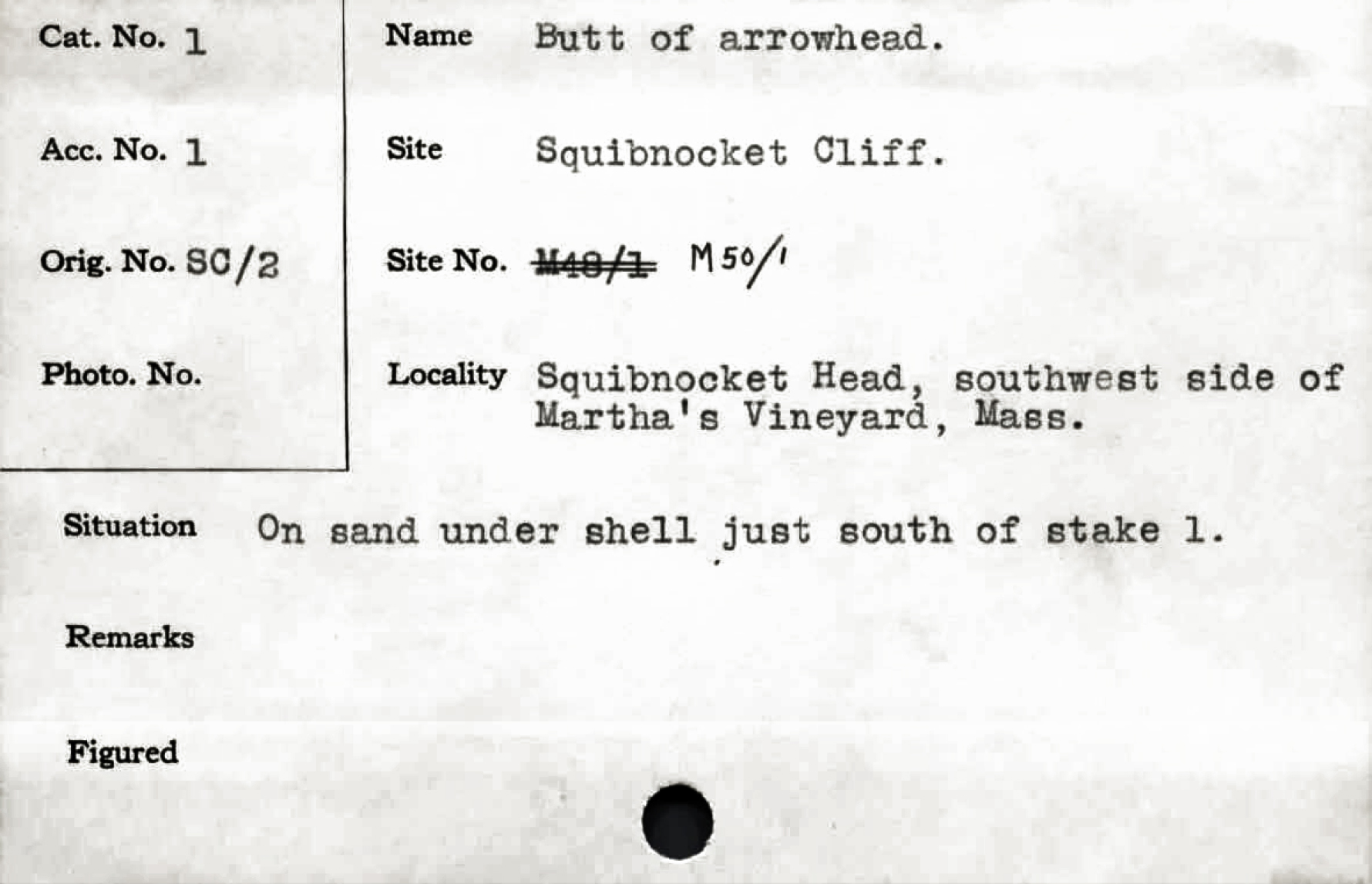
Example of catalog card with provenience information to extract.
One such complicated process is transcribing institutional records. We have roughly 50,000 catalog cards that are associated with our collections that were accessioned between the 1930s and 1970s. These cards hold valuable information on provenience and provenance for our collections and should be included in our database. Extracting the text from these cards would normally require time-consuming transcription of text by hand into an excel document.
As an example, in 2019 we were awarded an Abbot Academy Fund grant to hire a temporary staff member to transcribe our handwritten accession books. The process took a little over a year and, eventually, three staff members were tasked with completing the project. By comparison, the catalog cards would likely take just as much or more time to process.
Unlike the handwritten ledgers, the typed catalog cards have the benefit of being able to be converted to searchable text through the use of Optical Character Recognition (OCR). Many of us have converted a PDF into a searchable document with OCR. The technology is standard in many PDF readers these days.
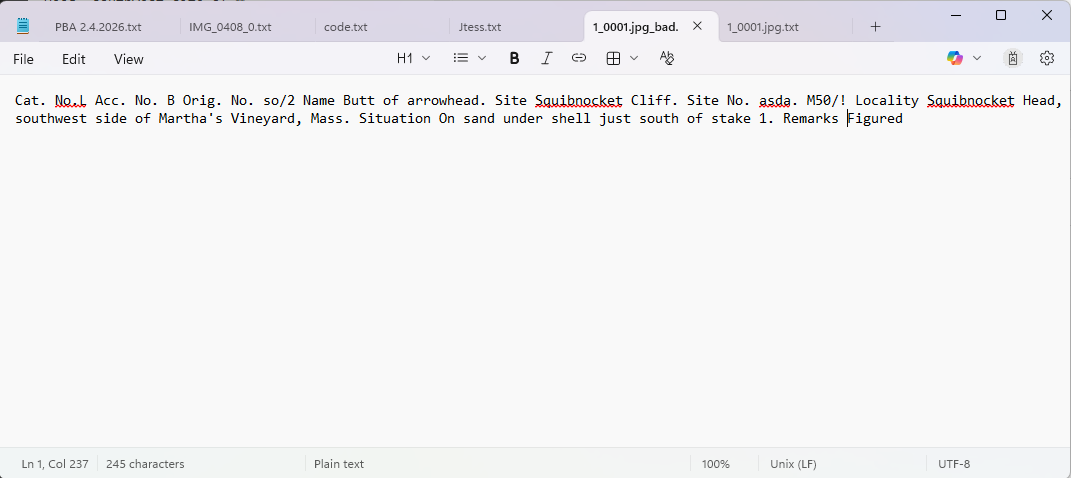
Various attempts have been made over the years to use OCR to extract the text from our catalog cards. The process is complicated because, in the case of these cards, a block of text is useless unless it can be related to the field it originated from. OCR is also an imperfect technology; it can include a lot of errors. Despite these problems, it can be helped with a bit of training.
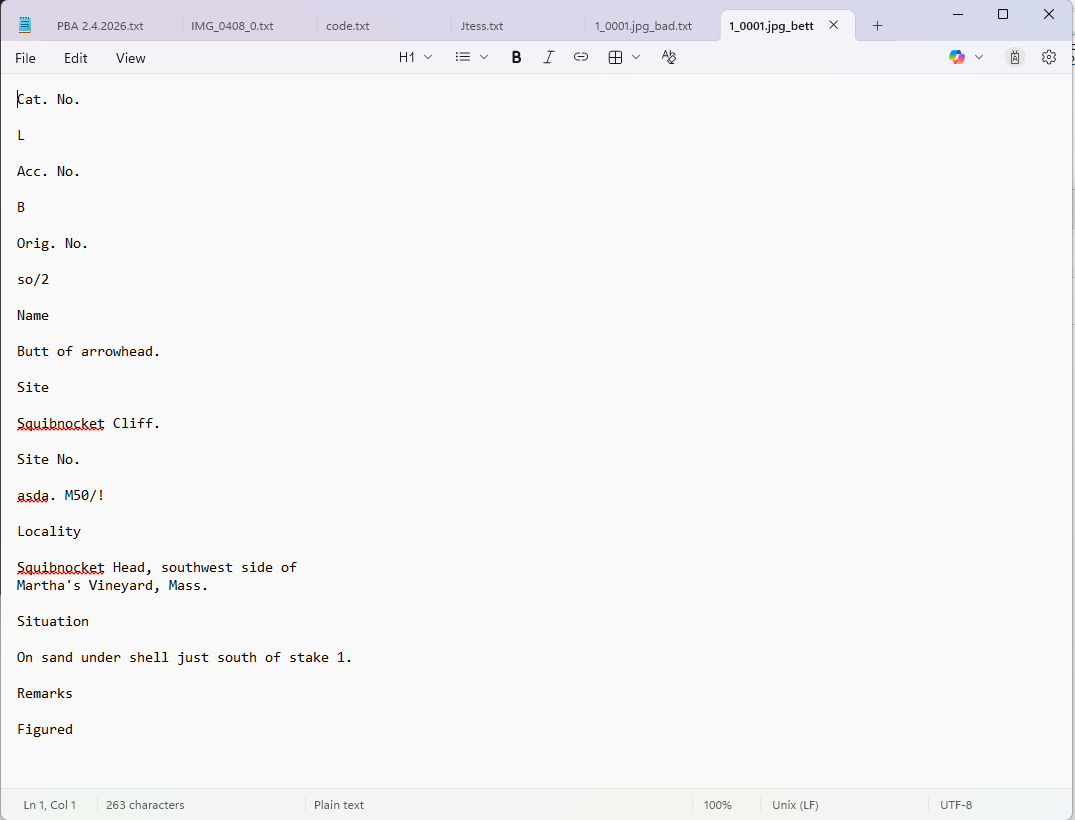
Normally, OCR spits out text in a single block, which is not helpful for isolating fields of text.It also includes many errors.
PA students embarked on the first attempt to read and extract the catalog card data. They created a computer program which read and extracted text from the cards and placed the text in corresponding fields. Even better, their model could be trained through the use of Machine Learning thereby improving the program’s accuracy over time. OCR, on its own, utilizes pattern-recognition which does not qualify as Artificial Intelligence. Once Machine Learning was incorporated the program fell squarely within the realm of AI.
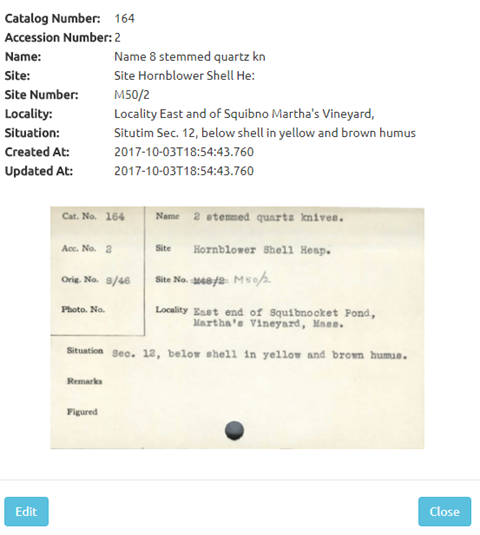
This is an example of the PA student’s program user interface. The output could be improved by editing the text fields above the image of the catalog card.
Output from the program was quality checked by humans; this was one of my weekly tasks when I first started working at the Peabody. In theory, the errors I and others corrected were fed back into the program. Once the output was loaded, the program would improve with subsequent readings.
Unfortunately, the student who spearheaded this program graduated and the project fizzled out without seeing results from the Machine Learning. Not long after, I found that I was consistently going to the catalog cards for provenience information. I realized that the project had serious benefits for our data management and I decided to take it on in my free time.
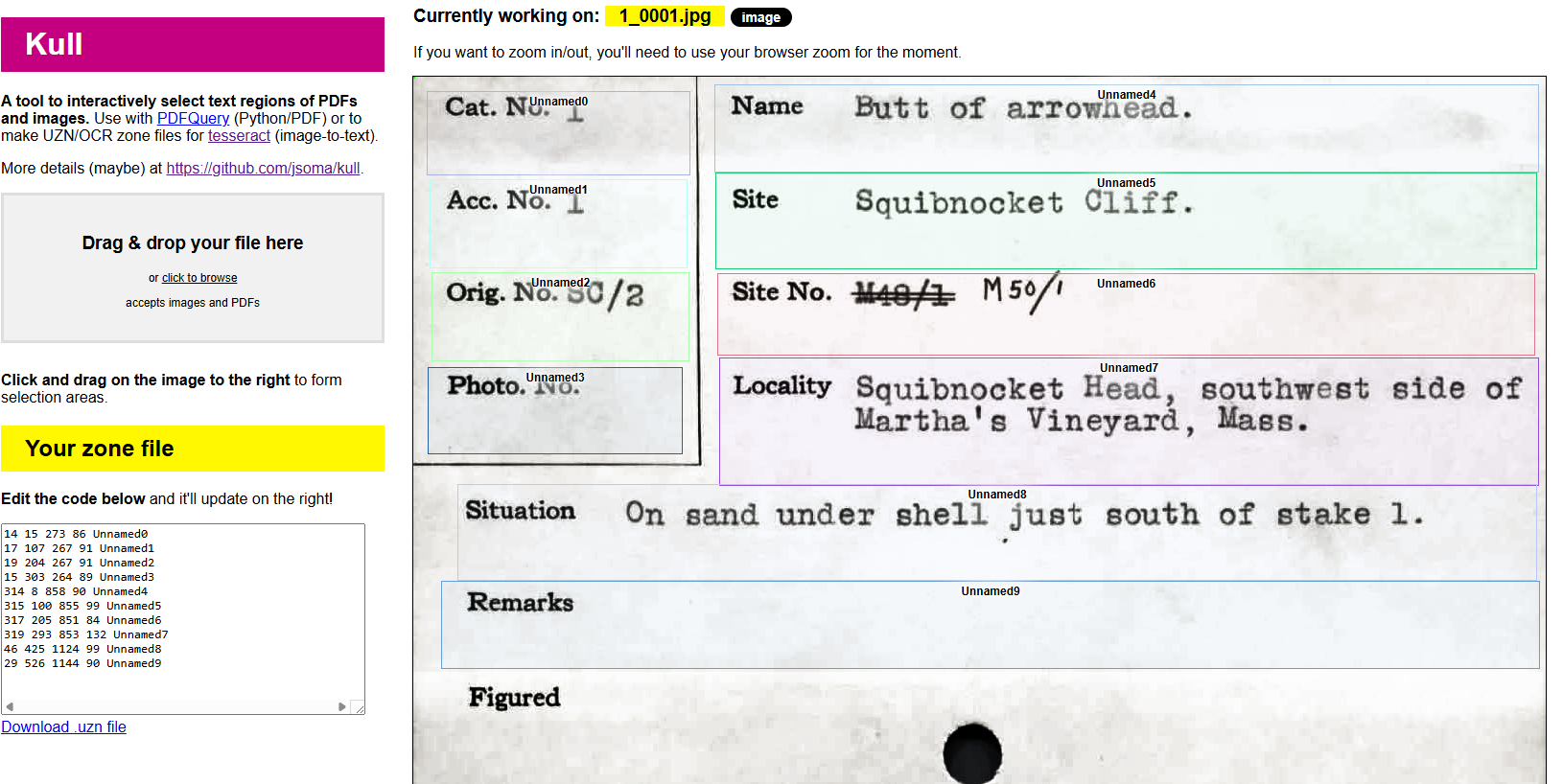
I found Tesseract OCR, a free and powerful tool for extracting text from images. I learned to use it in concert with tools to target specific areas of the cards so that the extracted text could be associated with its field of origin. The results were not great, so I learned how to improve the quality by correcting errors and feeding them back into the program. I basically recreated a very crude, inelegant and less functional version of the student program.
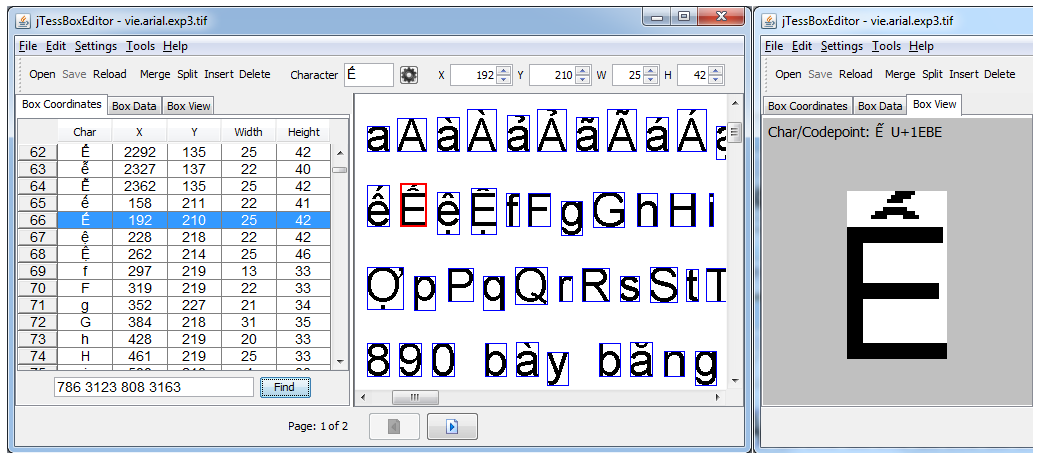
Kull, a free tool for pointing Tesseract at specific fields to read.OCR output with field separation.So many errors in my Tesseract output.To train Tesseract, box files are created around each character to correct the programs output. Way too much work!
Early training showed that the program was probably not going to improve without a lot of input. I decided to stop working on the project at that point.
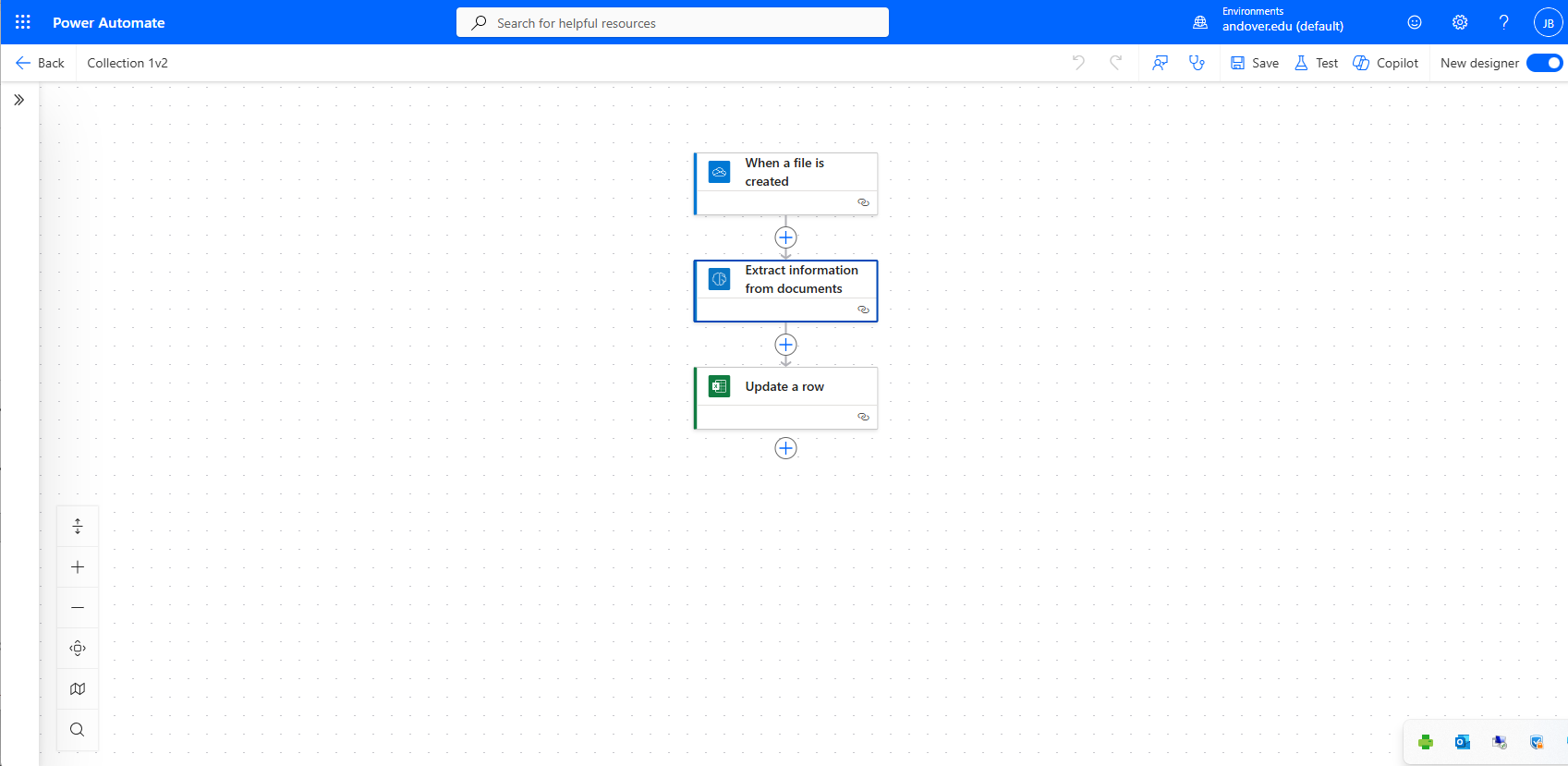
In the intervening years, AI tools have been developed that can read text with greater accuracy. We learned of a museum professional using Microsoft’s Power Automate to read catalog cards. We reached out and got a basic roadmap for how we could make the program work.
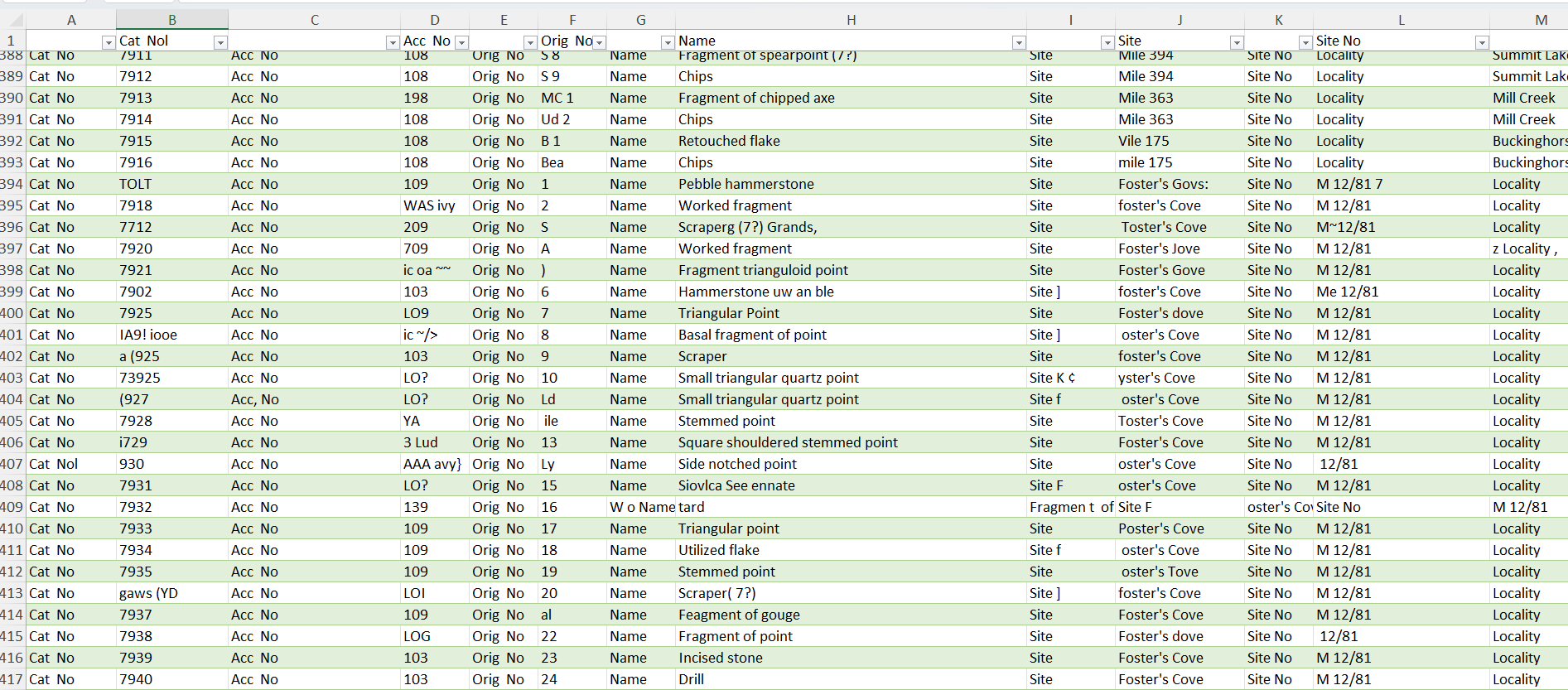
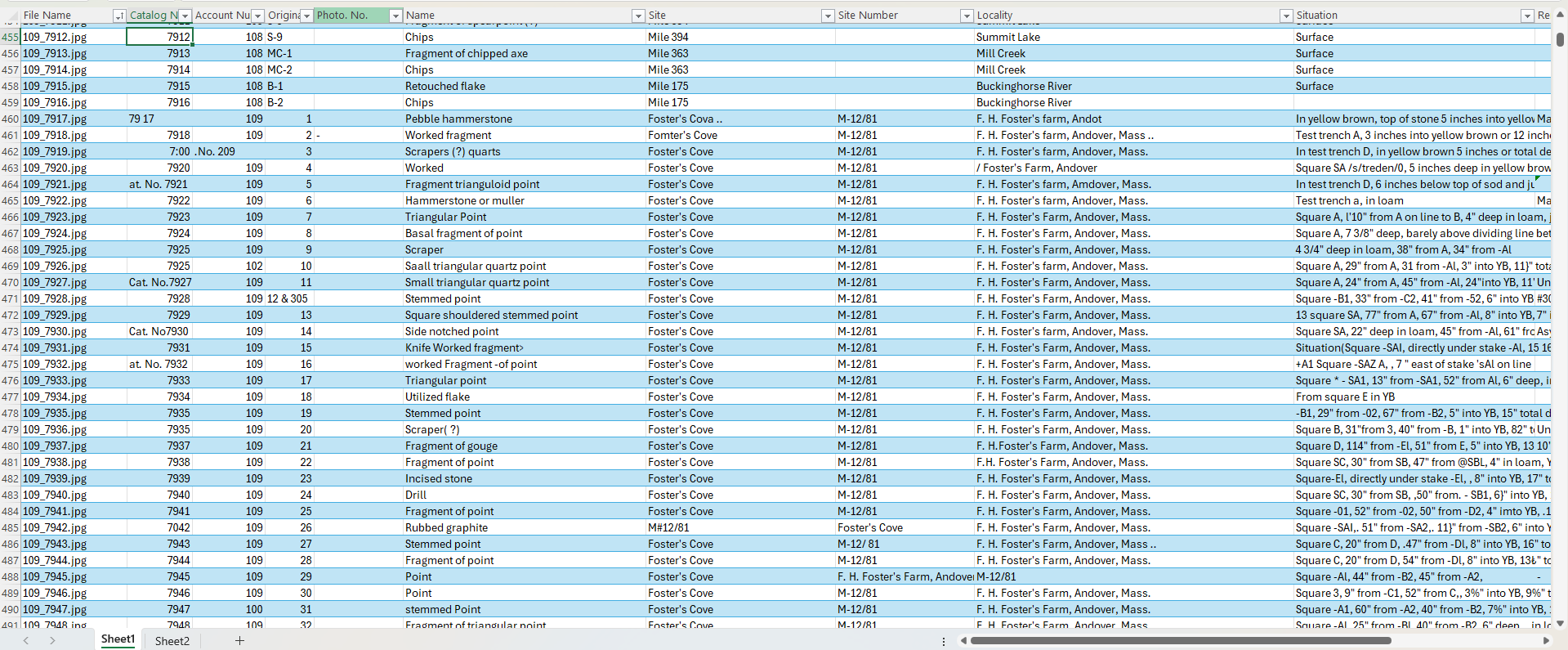
This is the visual workflow I set up. Once an image is placed in the folder, the model reads the card and extracts text into an excel file.This data is still a bit messy, but it is a huge improvement over what I obtained using Tesseract.
Very briefly, the AI Hub within Power Automate allows you to create a visual workflow that skips the need to write code. In addition to the workflow, I trained a model on ten examples of catalog cards. The training process allows you to select fields for the model to read. With the model trained and a workflow created, I was able to generate an Excel document where the extracted fields would be output.
The process of understanding how to set up the workflow, how to trigger it, and how to send the output into Excel were challenging. It required tinkering and several YouTube videos to get it function. It was not easy, but it was achievable, eventually.
And now, the Peabody has entered the AI age. If you need any advice on how to set up a workflow for reading documents, please feel free to reach out to me. Best of luck in your AI exploits.