Map Quest

The Peabody has recently acquired several examples of Indigenous art, with the goal of enriching our education collection. Raven Makes Gallery is an art gallery based in Sisters, Oregon, dedicated seeking to “work directly with artists to bring American Indian, or Native American, First Nations and Alaska Native art to the unique setting of Central Oregon and cultivate a deeper awareness about fine artists and their communities.”

The Gallery features original pieces made primarily by Indigenous artists from North America, but also has pieces that come from Indigenous people all over the world. It’s an amazing gallery and their website is definitely worth poking around for those who are interested.

Native American Art Gallery – Raven Makes Gallery

Super cool stuff, right? Here’s where we come in. This year the gallery presented “The Homeland Collection, year three.” It was a collection of 88 antique maps (think like, nineteenth century settler maps) that served as a canvas for 22 Indigenous artists from all over the world to incorporate into their own work. The Peabody purchased two of these pieces!

The Homelands Collection, 3rd Ed, Raven Makes Gallery Exhibit– Homelands Collection

The maps are a powerful visual representation of re-indigenization/decolonization in artwork. Maps are interesting to look at, but there are questions: what is the reason they are made, who are they made for, who are they made by? Maps like those in the Raven Makes Gallery collection may have been designed with settlers and land prospectors in mind. The maps were used to impose colonizer culture and world views on Indigenous people. The illustrated borders would have had little to no input by Native communities, on land that they were the stewards of to begin with. So, this project has been an opportunity to shift the narrative. Turning tools of colonization into a representation of decolonization. Flipping it on its head! A physical reminder that Native people have been here for at least tens of thousands of years before these maps were “needed.”

The Peabody has a large collection of items from Alaska and the Southwest, so these two pieces made the most sense to grab. We are excited to have the opportunity to support Native artists and strengthen our education collection! We hope to use these to create interesting conversations about the creation and usage of maps in our history!

The first is Isuqwiq Pisuraa (Hunting Seals) II by Heather Johnston (Alutiiq). The map is an 1827 depiction of south-western Alaska by Philippe Vandermaelen, showing the routes of artic explorers in the late 1700s.

The second piece is Kachinas’ Territory by Wilmer Kay (Hopi). The map is an 1862 depiction of the Southwest made during the Civil War by A.J. Johnson.

PA Students Visit Harvard’s 25th Annual Powwow

Contributed by Emma Lavoie

Last month, the Peabody Institute sponsored a day trip to Harvard University for Phillips Academy students. The 25th Annual Powwow was hosted by the Harvard University Native American Program (HUNAP). After a three-year hiatus due to the Covid-19 pandemic, the HUNAP program was able to welcome the return of their Powwow.

Flyer for HUNAP’s 25th Annual Powwow

This year’s theme for the HUNAP Powwow was Protect Indigenous Futures! The event was held on Orange Shirt Day, a national day of remembrance and reconciliation for victims of residential schools, which sought to separate Native children from their families and forcibly assimilate them. The Powwow honored survivors and victims of residential schools throughout Canada and the United States.

The Powwow ceremony is an Indigenous gathering with traditional dances and music held by Tribal nations from the New England area. The event welcomed hundreds of attendees from Harvard, neighboring Native communities, and the Greater Boston area.

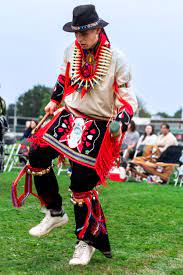
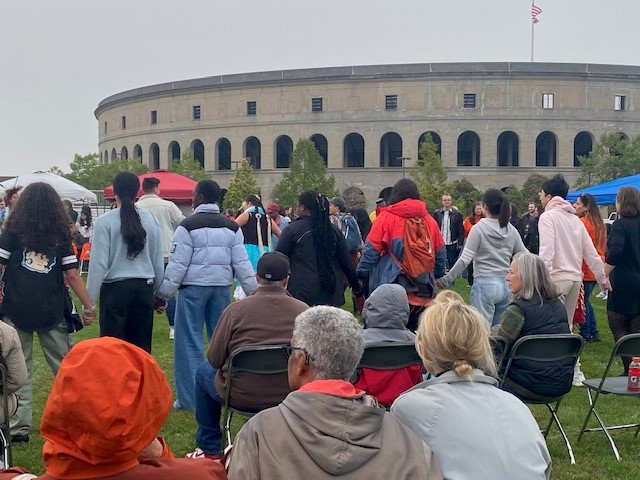
Photos from the HUNAP Powwow
Photos by Catherine Dondero and Courtesy of Harvard University

Students took part in community dances, which welcomed all event attendees into the arena to dance together. Many PA students took part in these community dances and got to experience the ceremony traditions first-hand.

PA students participating in community dances

This event was a wonderful opportunity for students to experience Indigenous cultural traditions and ceremonies. Students also had the opportunity to connect with Indigenous students, community members, HUNAP students, and Tribal nations from the Greater Boston area, New England, and those visiting from other parts of the United States and Canada.

Want to hear more about this event from the students’ perspective? Check out this article from Phillips Academy’s student paper, The Phillipian.

For more details about the HUNAP 25th Annual Powwow, explore this article from The Harvard Gazette and video coverage of the event by Harvard University.

Reading Angeline Boulley

Contributed by Marla Taylor

Last November, I attended the AAIA Repatriation Conference in New Buffalo, Michigan. There were many tremendous speakers, but the one that really sticks out in my memory was Angeline Boulley. She does not work in the world of repatriation, but held the room in her hands as she spoke to us. I so vividly remember Angeline speaking to us all at the conference – she earned a standing ovation and my presentation had to follow that!

Angeline is a citizen of the Sault Ste. Marie Tribe of Chippewa Indians, and storyteller who writes about her Ojibwe community in Michigan’s Upper Peninsula. She had recently published her book Firekeeper’s Daughter (a #1 New York Times Bestseller) and was giving us a tease of her next book, Warrior Girl Unearthed.

At the time, I had not read Firekeeper’s Daughter and quickly purchased myself a copy. I LOVED it. The story was a fresh take on a murder mystery/adventure. The main character, Daunis, is a biracial unenrolled tribal member whose cultural knowledge can contribute to protecting her community. Sprinkled throughout the book are Ojibwe words, phrases, and cultural teachings in a way that only augments and enriches the story being told. I highly recommend it to you all! (and ignore the young adult classification – this is a complex story that is not always appropriate for younger readers)

Warrior Girl Unearthed is powerful in a different way. Grounded in the complicated reality of repatriation and missing and murdered Indigenous women (MMIW), this novel can feel a little heavy at times. Angeline uses the book in part to educate her readers about NAGPRA and repatriation and in part to build a new adventure around preventing a plot to profit off robbed Indigenous graves. While an explanation of NAGPRA does not always make compelling reading, the story itself is exciting and multi-faceted. Angeline once again interweaves Ojibwe words and cultural teachings in an effective way. And that is maybe the best thing about the book – the Ojibwe culture is just a part of who the main character is. She is just living her life and interfacing with her cultural teachings in a way that does not feel contrived but is instead natural. That feels novel and under-represented in young adult literature.

Her words and her books have left an impression on me and I encourage you to pick up a copy yourself.