Creating an Indigenous Collections Care Guide

Contributed by Marla Taylor

Nearly three years ago, I co-founded the Indigenous Collections Care (ICC) Working Group along with Laura Bryant, Anthropology Collections Steward and NAGPRA Coordinator for the Gilcrease Museum in Tulsa, OK. Along with Laura Elliff Cruz, Head of Collections at the Indian Arts Research Center (IARC) in Santa Fe, NM and other group members, the ICC has been working to create an accessible reference tool for professionals who interact regularly with Native American collections.

The ICC grew out of our desire to incorporate the collections care requests of Indigenous communities into our institutional practice and policy. The working group was formed in late 2020 and is composed of approximately 20 people (both Indigenous and non-Indigenous museum professionals and academics, Tribal Historic Preservation Officers, and NAGPRA coordinators) who actively participate in monthly meetings on the creation of an Indigenous Collections Care Guide.

The ICC Guide will not instruct museums on how to specifically care for each item, since protocols vary among communities, but will offer scalable considerations of culturally appropriate collections stewardship, with questions and talking points to address during consultation, and with templates and case studies for use in implementation, advocacy, and the creation of policies and procedures.

In order to facilitate robust review of the ICC Guide by tribal communities, the ICC partnered with an incredible institution, the School for Advanced Research (SAR) in Santa Fe, NM.

I am excited to share that SAR received an IMLS National Leadership Grants for Museums of $175,587 for the IARC’s creation of the Indigenous Collections Care Guide. to support the museum field with an accessible reference tool for museum professionals who interact regularly with Native American collections. The guide will provide museums with a framework to recenter collections stewardship practices around the needs and knowledge of Indigenous community members. At the conclusion of the project, 175 tribal community representatives and museum professionals will have had a voice in the development of the guide, which will be made freely available for tribal community representatives and museums of all sizes. The IMLS reported receiving forty-eight applications for this opportunity, and SAR was one of nineteen projects to receive funding.

You can see the announcement and learn more about the project here.

What does this mean for the Peabody Institute? Well, first it means that I will be super busy for the next few years! It also means that the Peabody Institute is continuing our leadership role in the broader museum and archaeological conversations around ethical collections stewardship and relationships with tribal communities.

I will keep you posted as work continues over the next few years!

School for Advanced Research

The School for Advanced Research (SAR), a 501(c)(3) nonprofit educational institution, was established in 1907 to advance innovative social science and Native American art. Its sixteen-acre residential campus sits on the ancestral lands of the Tewa people in O’gah’poh geh Owingeh, or Santa Fe, New Mexico. Visit sarweb.org

Institute of Museum and Library Services

The mission of IMLS is to advance, support, and empower America’s museums, libraries, and related organizations through grantmaking, research, and policy development.

The agency carries out its charge as it adapts to meet the changing needs of our nation’s museums and libraries and their communities. IMLS’s mission is essential to helping these institutions navigate change and continue to improve their services. Visit imls.gov
From Decolonizing to DAMS: the Beauty of Online Learning

Contributed by Marla Taylor

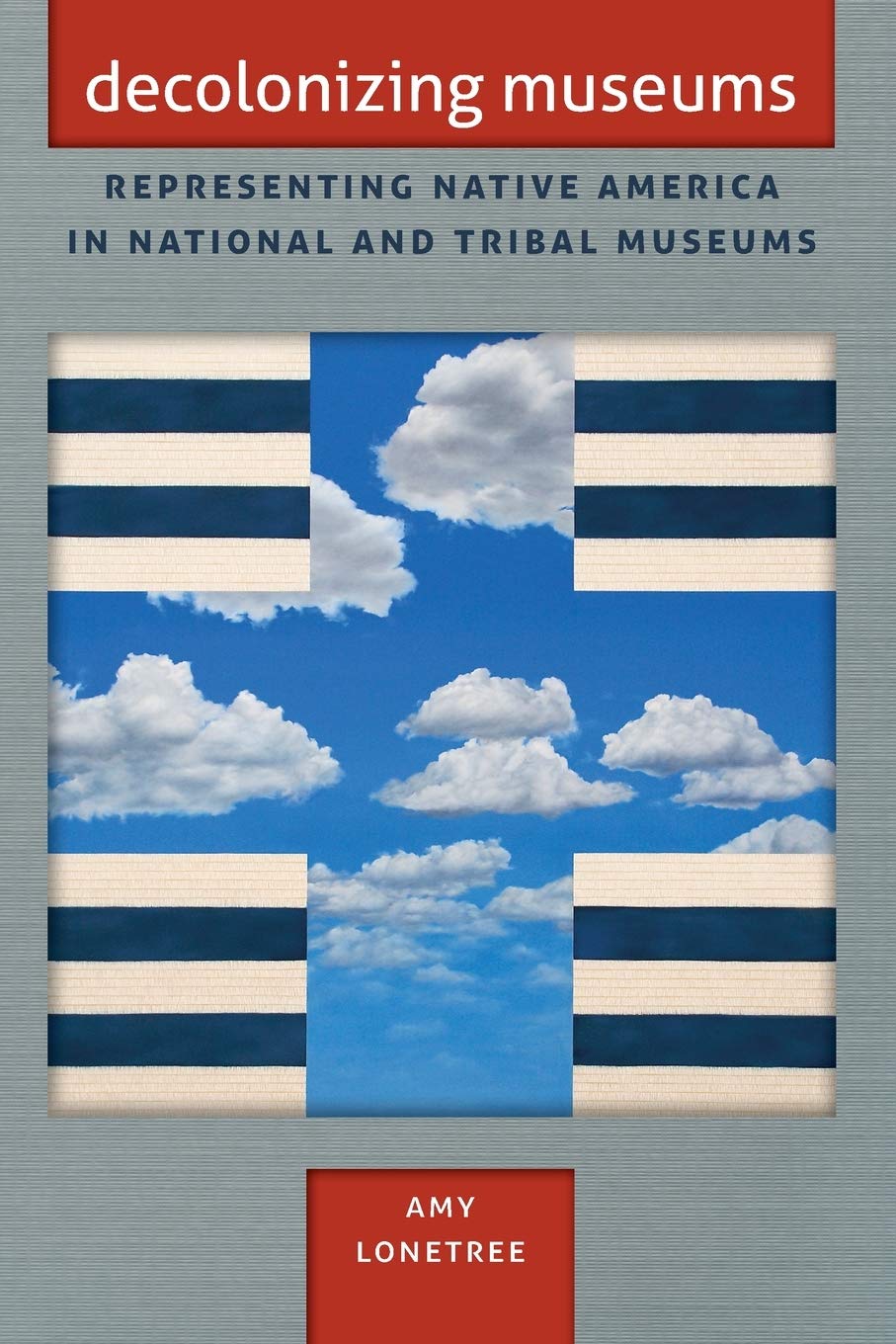
Over the last couple months, I was fortunate to take two online professional development courses – Decolonizing Museums in Practice and DAM for GLAM. These classes covered very different topics but overlapped in some really surprising ways.

The Decolonizing Museums class is directly applicable to so much of the work that I do every day. We have taken steps at the Peabody Institute to incorporate decolonizing into our collections management policy, researcher access policies, and NAGPRA implementation. I am proud of that work, but also wanted to take a step back and immerse myself in the scholarship behind this approach to museum management.

The class was filled with fascinating, thought-provoking, and occasionally uncomfortable readings that stretched my assumptions and gave me a new framework to view my role, as a white settler female, in managing an archaeological collection full of Indigenous material culture. The instructors and my classmates could not have been better. We represented a wide variety of museum roles and perspectives from across three different countries. We were all open and honest about when we were challenged by the readings and I found listening to others work through their decolonizing journey could be enlightening about my own.

Fortunately for me, one of my classmates was local to the Boston area and we were even able to meet up in person to discuss what we had been learning. She works with the collections at the Boston Children’s Museum. We bonded over our shared decolonization journey, but also our overall museum experiences, and an interest in knitting. We also discovered a collections link between our respective institutions and could seamlessly begin to support each other in repatriation consultations.

I loved the course.

DAM for GLAM was completely different. DAM = Digital Asset Management. GLAM = Galleries, Libraries, Archives, and Museums. This course walked me through what a DAM is and what it can do for cultural institutions. Basically, a DAM is a system to track the digital surrogates of the physical items in the collection and the born digital materials that derive from them (think image of an item in the collection, a scan of an excavation map, digitized archives, a video of a presentation, or a course catalog). This course was less intuitive for me, but ultimately really valuable as I had previously struggled to even understand what a DAM was.

During the course, we were asked to use the collections that we were affiliated with as examples to answer the teacher’s prompts. As the questions were regularly about data management, access, and use rights, I would always answer them through a decolonizing lens. It was really helpful at times to apply the slightly more abstract concepts from the decolonizing class to something as practical as metadata. It forced me to think about how challenging the data management will be to make digital surrogates available to tribal partners, researchers, and educators.

I made some positive professional connections in that class as well through conversations about digital repatriation. I think I helped some people understand that making digital copies of everything that will be repatriated so that you still have access to a version of the item doesn’t really jibe with the idea of repatriation. If a tribe asks us to destroy digital copies of repatriated items (images or 3-D scans), the Peabody will abide by that request. Their cultural authority does not end at the physicality of the item, it encompasses the totality of the item. I am grateful for the opportunity to conduct these thought experiments and share with others.

While both classes were really valuable experiences, I want to discourage any of you out there from taking two courses at once while working a full-time job… just sayin’…

Reflections on Repatriation

Contributed by Marla Taylor

Most of my time lately has been spent on repatriation work.  This work isn’t something that I can share lots of details about, but it is probably both the most challenging and rewarding part of my job. 

The Peabody has always had a commitment to working with tribes and Indigenous peoples to ensure that ancestors, funerary belongings, sacred objects, and objects of cultural patrimony are repatriated in a respectful and timely fashion.  I am fortunate to inherit that past work and a strong institutional reputation for fairness and responsibility.  It is a high standard that I constantly strive to uphold.

In late October, I was able to take part in the 6th Annual Repatriation Conference sponsored by the Association on American Indian Affairs (AAIA).  This conference was a focused on the 30th anniversary of the Native American Graves Protection and Repatriation Act (NAGPRA).  It was fabulous to learn about the work of other institutions and tribes, share strategies to overcome challenges, hear about success stories, and be inspired by so many other dedicated professionals. 

I was the most impacted by a wonderful presentation on decolonization by the Director of the Abbe Museum in Bar Harbor, ME and the staff of the Museum of Us in San Diego, CA.  The incredible work they have done, and continue to do, to address the inherently colonial nature of a museum interpreting the material culture of minority and Indigenous communities is inspiring.  Listening to their presentation and thinking about the work we do at the Peabody, I was pleased to identify so much overlap.  The thought we have put into the decolonizing process manifests itself in our collections policies, NAGPRA policy, how we approach education, and approach research inquiries.

I take this part of my job very seriously.  My work can’t erase past mistreatment of these ancestors and belongings, or redress colonial wrongs, but I can make progress.  The changes that I am part of will hopefully become the foundation of a stronger reputation for caring, meticulousness, and a progressive attitude toward repatriation.  Decolonization work is anti-racism work.

In mid-November, a colleague and I will be presenting to the NAGPRA Community a Practice (a group of scholars and NAGPRA practitioners from museum and tribes) on the topic of decolonizing collections care.  I am excited to share my ideas with this group and get feedback.

The process of decolonization will probably never end and there will always be more to learn.  I look forward to the challenge!

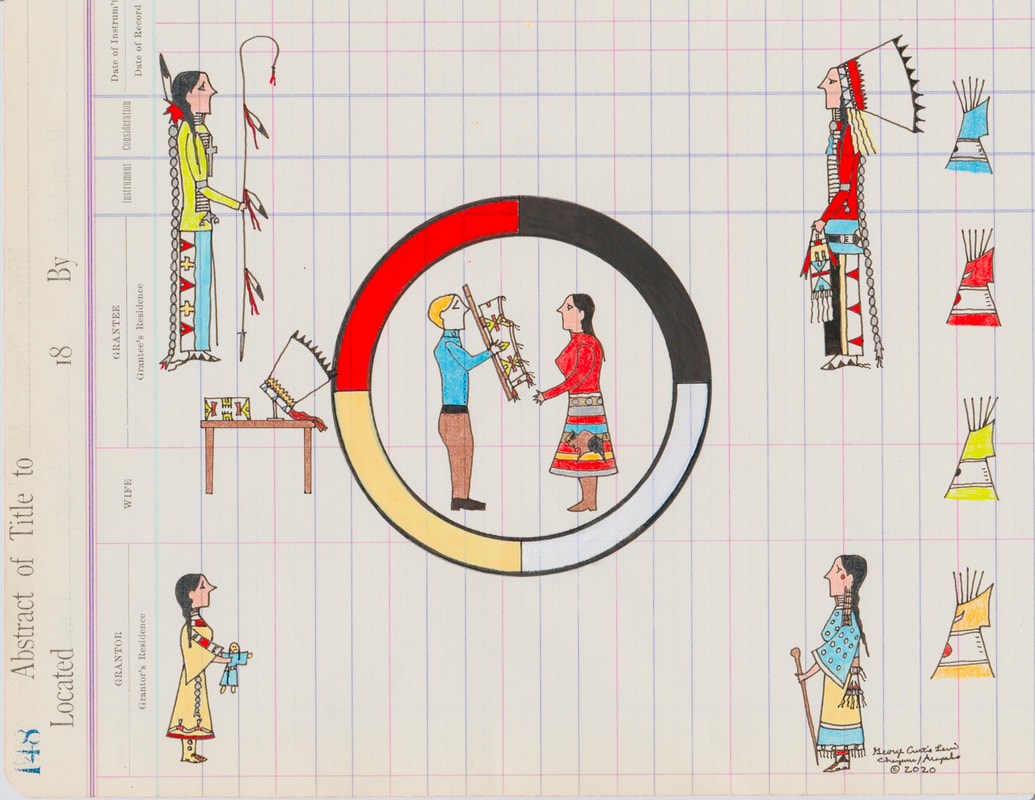
This artwork was created especially for the 6th Annual Repatriation Conference by George Curtis Levi, who is a member of the Southern Cheyenne Tribe of Oklahoma and is also Southern Arapaho. This ledger art painting depicts how repatriation builds community and strengthens culture. It was painted on an antique mining document from Montana that dates from the 1890s.