Tales from The Phillipian, PART 1: Smoke Talks, Fire, and a Grill in the Peabody Basement?!

Contributed by Emma Lavoie

Peabody staff always get excited when we unearth hidden stories from the Peabody Institute’s past. The Phillipian Archives is one such place that has held many a story. First printed in 1857, The Phillipian is a weekly student newspaper that continues today at Phillips Academy Andover. The student paper describes itself as “completely uncensored and entirely student-run,” offering a snapshot of what campus life is like both past and present, and in the case of this blog, some of the most outrageous and bizarre activities related to the Peabody.

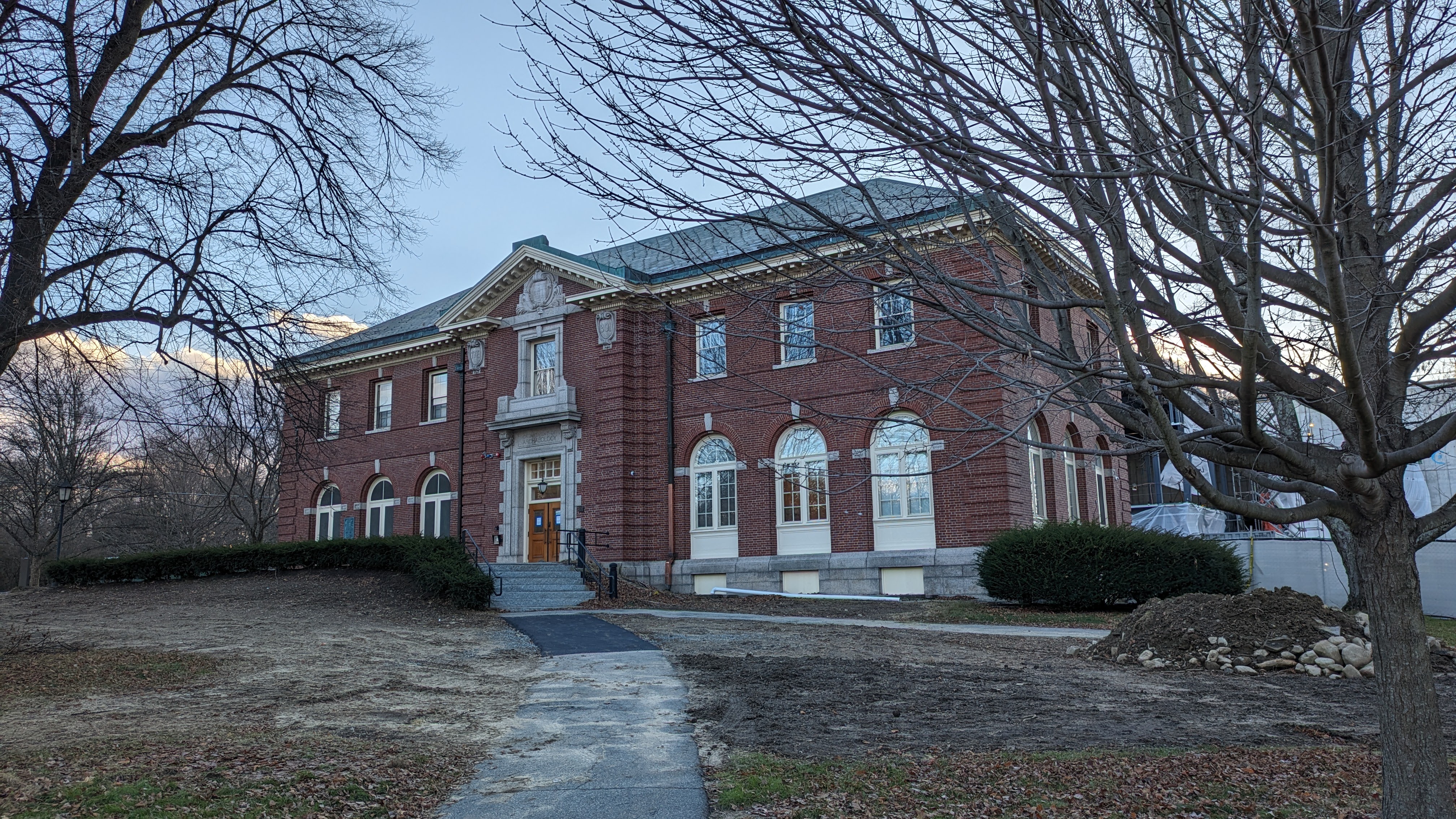
In a few months, the Peabody Institute will be undergoing Phase 2 of some much-needed renewal work. The building and collections will be off-line Winter and Spring terms. The Peabody will continue to support modified classroom lessons and student activities, outside of the Peabody building. Student requests to access collections will be considered on a case-by-case basis.

In honor of the upcoming building project, this (part 1) blog shares some of the Peabody building’s history.

A Special Place at the Corner of Phillips and Main

The first Founder’s Day for Phillips Academy was held in October 1913. At this time a bronze plaque was unveiled and placed on the Peabody Insitute building (known then as the Archaeology Department) commemorating the site where the first school-building on campus was opened in 1778. This plaque can still be seen on the Peabody building today!
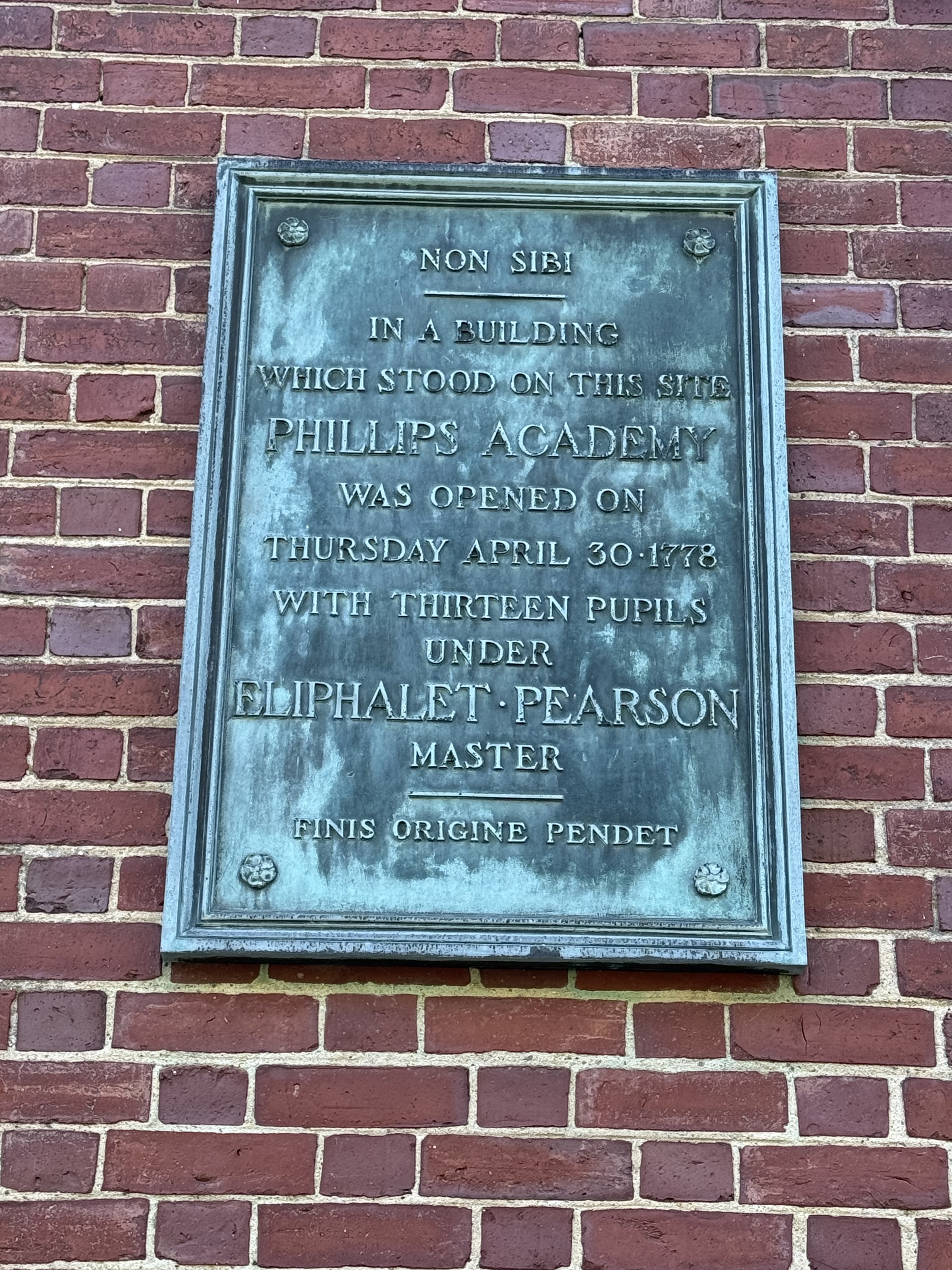
Bronze plaque on the Peabody Institute building exterior from 1913.

The site at the corner of Phillips and Main streets has an interesting history, one that began well before the Peabody. The site first housed the 1778 carpenter’s shop used as the first classroom building at Phillips Academy.

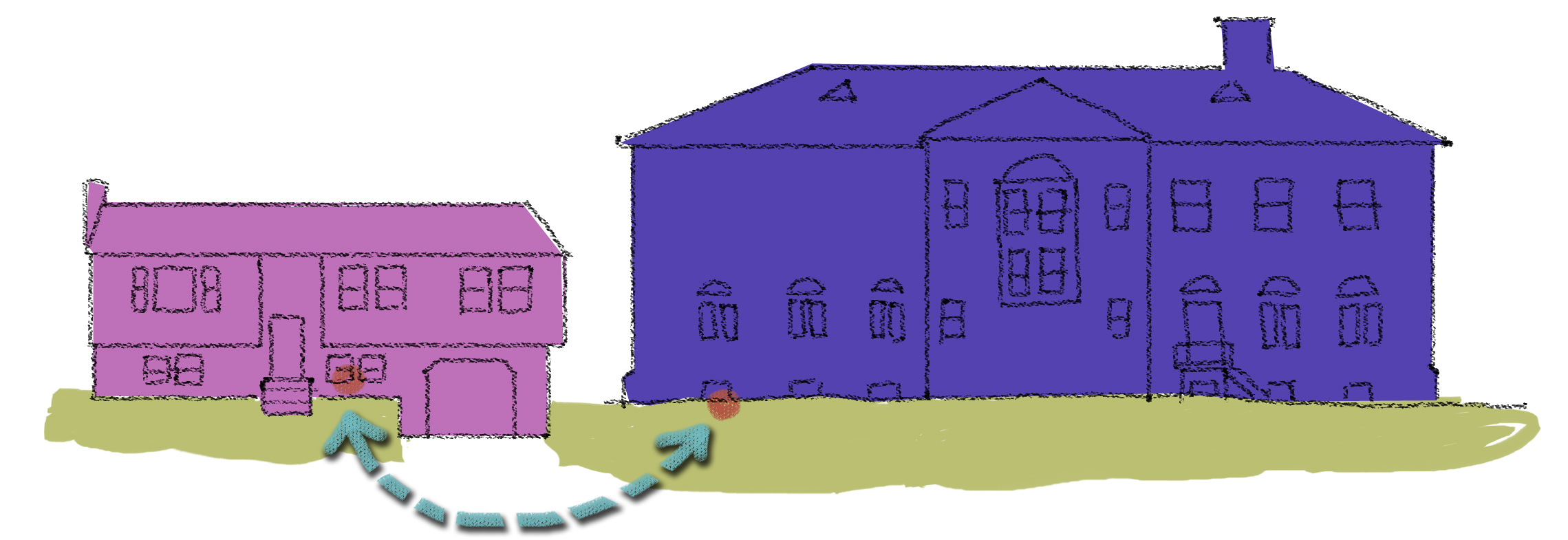
Around 1845, the shop was moved from the site and eventually razed. Samuel Farrar, treasurer of Phillips Academy and the Andover Seminary, built a three-story, Federal-style house on the location. The house has since been moved further down on Phillips Street and is known as Farrar House.
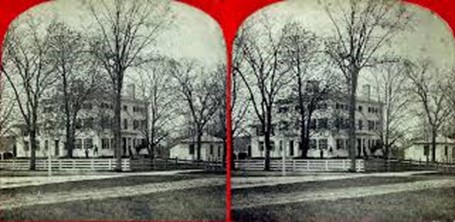
Farrar House – Image courtesy of Andover Historic Preservation, Memorial Hall Library, Andover, MA

In 1882, a home was built on the site for J. Wesley Churchill, a professor at the Andover Theological Seminary. Later in 1901, the house was moved to another location on Main Street to make way for the new Archaeology Building which later became the Peabody. The house is known as Churchill House on campus today.
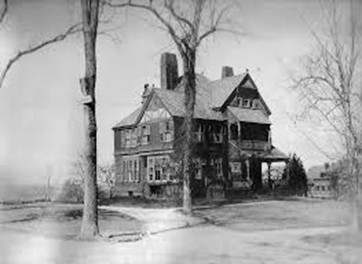
Churchill House – Image courtesy of Andover Historic Preservation, Memorial Hall Library, Andover, MA

In a Phillipian article from 1917, the history of Founder’s Day and the significance of the 175 Main street site is shared, noting a 1916 dedication of the new Peabody House by Dr. Charles Peabody (first Peabody Director and son of the Archaeology Department’s founder, Robert S. Peabody).

In this column, it was mentioned that ceremonies were not held to celebrate Founder’s Day as “this year, more than at any other time, matters of lesser importance should give way to more serious questions.” This was in reflection of the current impact of the Spanish Influenza and WWI.

Smoke Talks (Smoking and collections don’t mix…)

In the early years of the new Department of Archaeology building, Curator Warren K. Moorehead would give “smoke talk” lectures on the second floor of the building. Some of the original molding from the proscenium arch is still visible today at the Peabody. Beyond these lectures, student clubs would hold their own “smoke talks” in the Peabody, which served as the Student Union building for many years on campus. How did these lectures get their name? For the cigars smoked during these meetings by students and speakers alike!
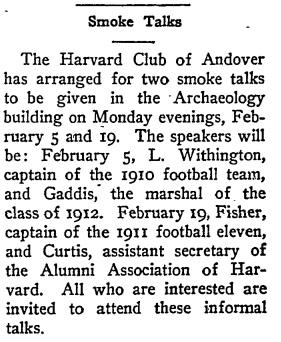
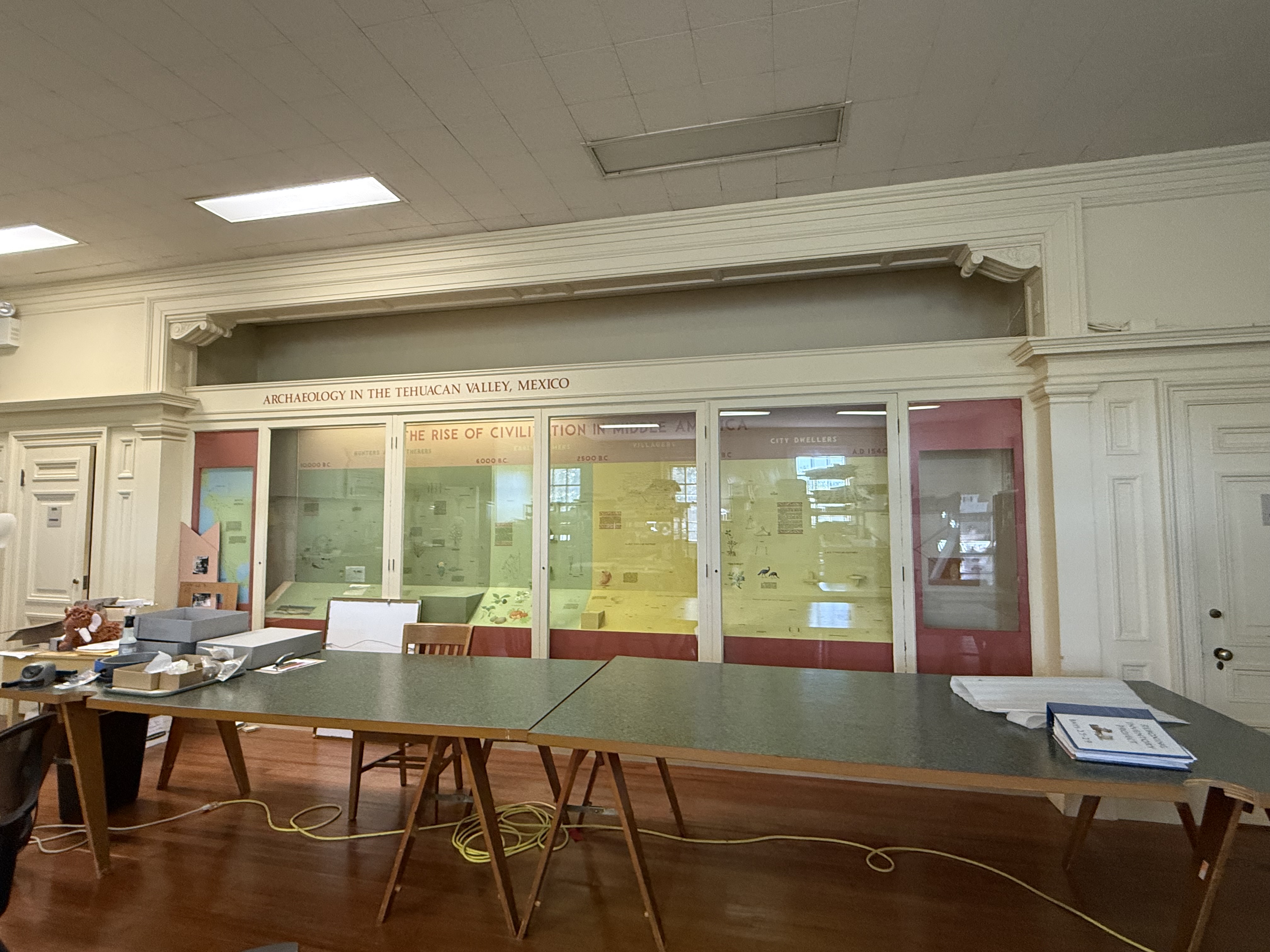
A column from The Phillipian in 1912
Features of the old proscenium arch can still be seen at the Peabody today. In 1967, an exhibit wall with case was placed in the middle of the arch.

A Grill in the Basement (Now they’re pushing their luck…)

Beginning in 1913, The Phillipian mentions meetings at “the Grill” in the basement of the Peabody (known as the Department of Archaeology at the time). At one point, the Peabody had a kitchen complete with grill, stall seats, and tables for student gatherings. Improvements were made in 1913 giving the space a new red tile floor, dark brown wood paneling around the walls, a new stove, and a large suction flue to draw out heat and odors. In the past the odors of students’ cooking would circulate upstairs disturbing the Peabody staff.

Later in 1915, the Grill was moved to the newly constructed Peabody House located behind the Department of Archaeology building. The new space included a kitchen with large grill and private dining room for special dinners and banquets. There rooms are similar in design to the original grill room in the Archaeology Building.
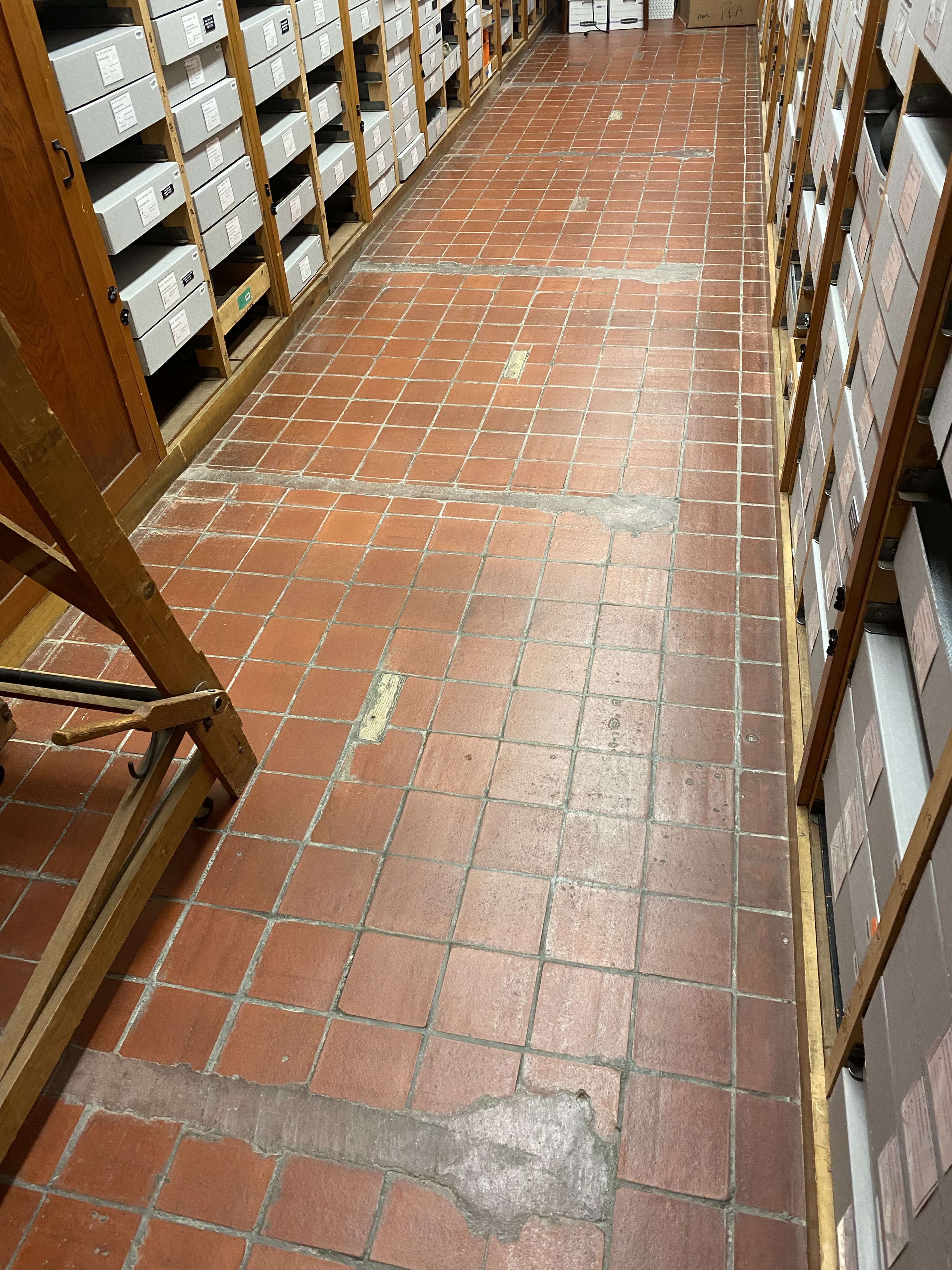
Before Phase 1 of the Peabody Building Project, the original red tile floor from the Student Union Grill room was still visible in the basement of the building. In the photo you can see where the booths and tables made up the seating stalls.

Peabody House….and Fire (Well, it was bound to happen at some point…)

The Peabody House was opened in 1916 as an extension of the Department of Archaeology with the intent of giving students a building for their own use. Construction of the building used some of the funds contributed by Robert S. Peabody, founder of the Archaeology department at Phillips Academy and donor of the Archaeology Building. An article from The Phillipian describes the new building with an exterior of brick and stone, “which will correspond with the style of architecture of the Archaeology building and the new dormitories.” The first floor housed a student lounge and reading room with a large fireplace and large French windows. The second floor was similar in design to the first floor with space for the late Robert S. Peabody’s books and a large portrait of him. The room was used for club meetings as well as student assemblies and special banquets.

Some activities held in the Peabody House, highlighted in The Phillipian, are a notice to join the school Orchestra, with practices held once a week in the Archaeology Building or Peabody House. My personal favorite was an announcement to students for a mass meeting at the Peabody House to practice school songs and cheers. One entry from 1917 describes three hundred men present at the evening meeting called by head cheerleader, Howard Smith.
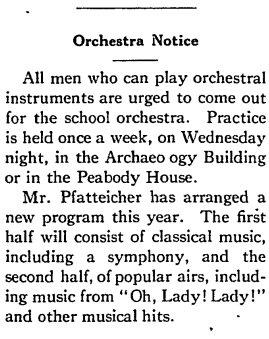
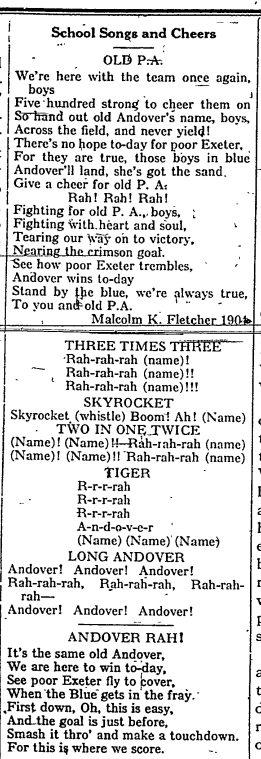
Two columns from 1917 advertising for the orchestra and sharing PA cheers and songs!

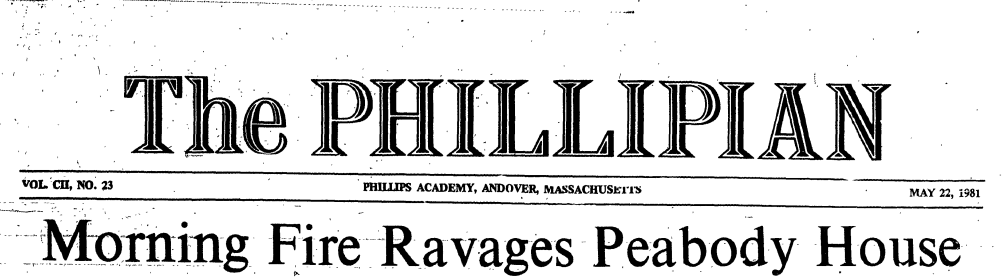
Jumping ahead to several decades later, headlines read “Morning Fire Ravages Peabody House.” In the early hours of May 18, 1981, a fire broke out in the Peabody House, destroying the first and second floors as well as the attic. There were no reported injuries, however, many of the Afro-Latino American Society’s possessions were lost on the second floor. Faulty electrical wiring is suspected to be the cause of the fire.

“[I was in] awe at how extremely hot the flames were, how much smoke there was and how terrifying it was to see the fire’s power.” – Headmaster Theodore R. Sizer

“[There was] steam and yellow light and flames bursting out of the roof.” – PA Student, Upper
We hope you enjoyed PART 1 of this two-part blog post. Stay tuned for PART 2, coming next month! To be continued…
She has a name, you know

Contributed by Lainie Schultz

Inclusive editing of catalog records is an important aspect of contemporary museum, library, and archival practice, or for any space maintaining a catalog of records for people to access and learn from. In particular where catalog records are themselves pieces of history, written at times when accepted language usage was different from what it is today, it can be necessary to return to the descriptions we rely on to access materials and rewrite them to remove what we now recognize as harmful language. In this way we can provide users with more accurate, respectful, and inclusive terminology, and disrupt the barriers created by prior language.

While incredibly vital work, accomplishing these changes can often be slow, at times requiring a thoughtful and collaborative approach to determine what language is correct in place of what was used previously; extensive research to fill missing gaps; and/or the development of new processes or procedures for altering records, to document these changes so that our history is not erased – and then, of course, actually editing these records, sometimes one by one. The satisfaction gained from the effort can be immense, but the gratification is often delayed.

And, also, sometimes it’s ridiculously easy.

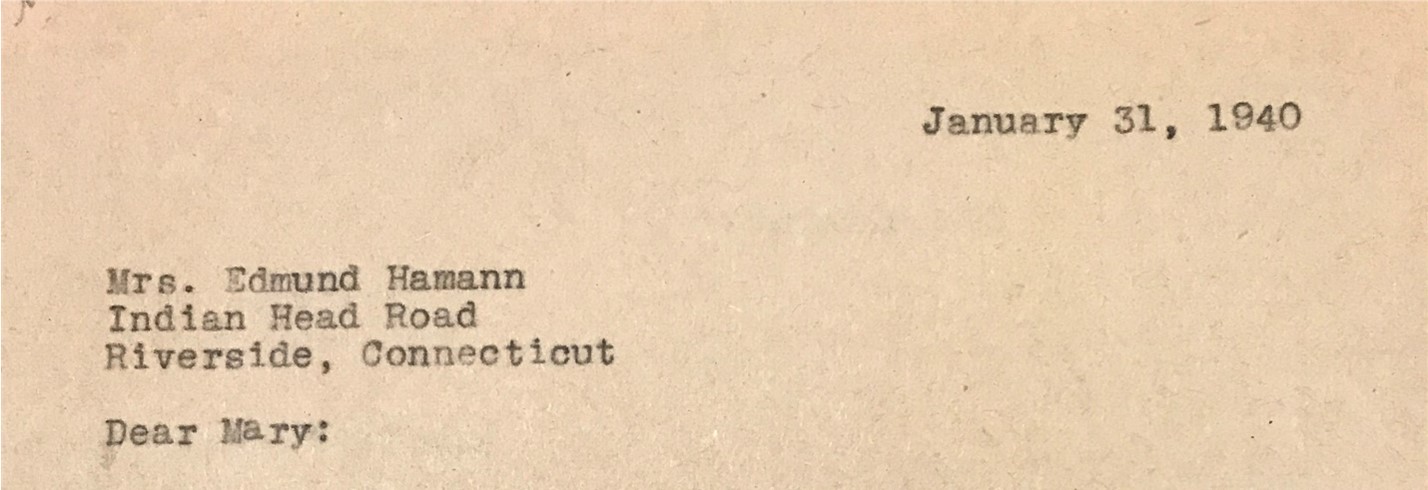
One common omission in catalog records is the names of women, often found identified as the wives of their husbands. I recently encountered one such woman in the Peabody Institute’s catalog while researching a Tohono O’odham basket in our care, donated by Mrs. Edmund Hamann. Looking to gain a better understanding of the basket’s arrival at the Peabody, I turned to its accession record, where I found the following:

A letter much like the one previous to it in the file, directed to Mrs. Edmund Hamann, but here with a very different greeting: Dear Mary.

Such a simple discovery, but one that thrilled me no end. No longer does Mary have to live in our records as the wife of Edmund, and no longer do we need to refer to her only in relation to him. She gets to have her own name.

What an improvement!

Peabody Loading…75% Complete…

Contributed by Marla Taylor

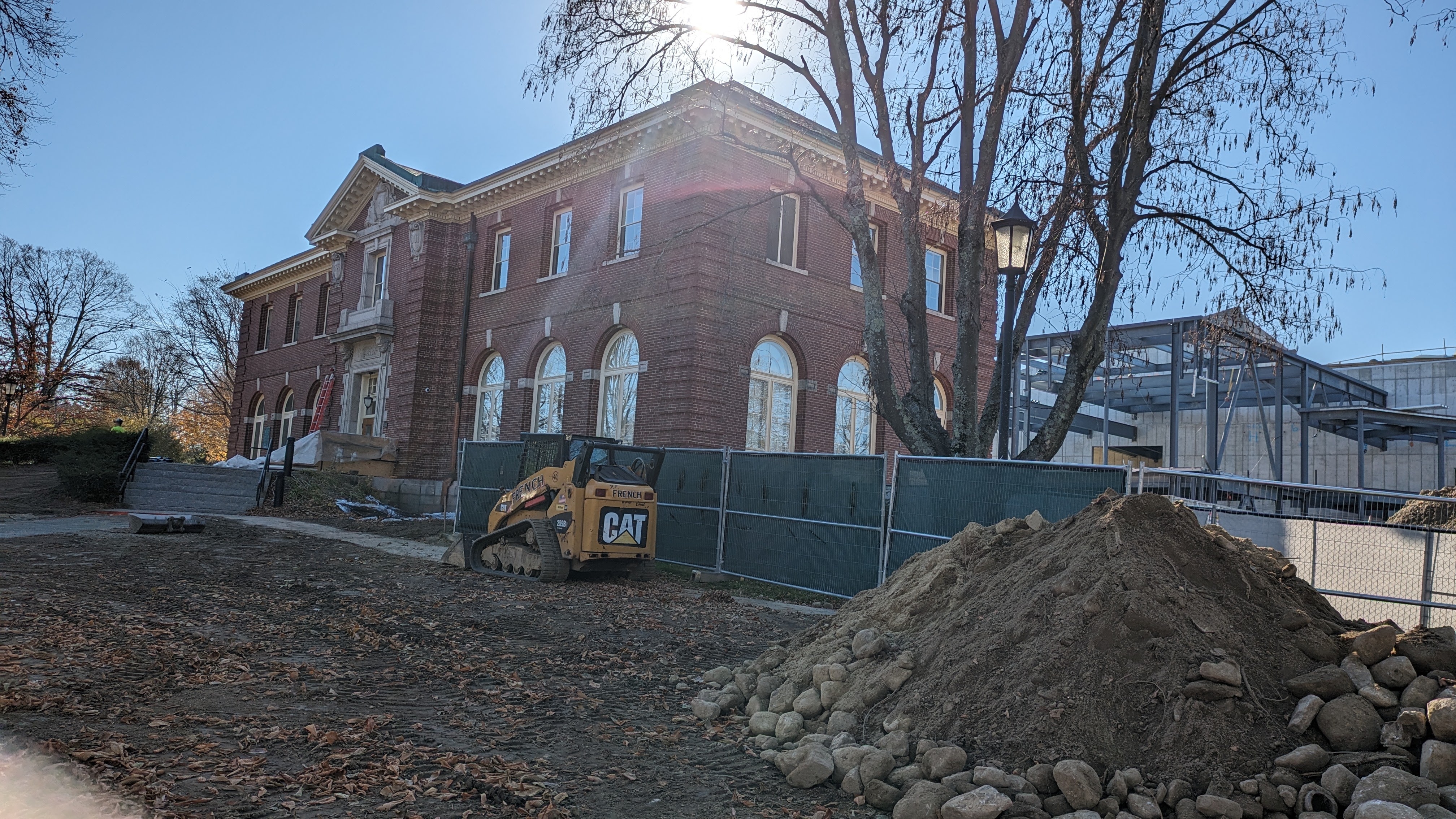
The fence around the Peabody is gone and there are no more contractors in the building.  It has been great to be back in the space for the past few days.

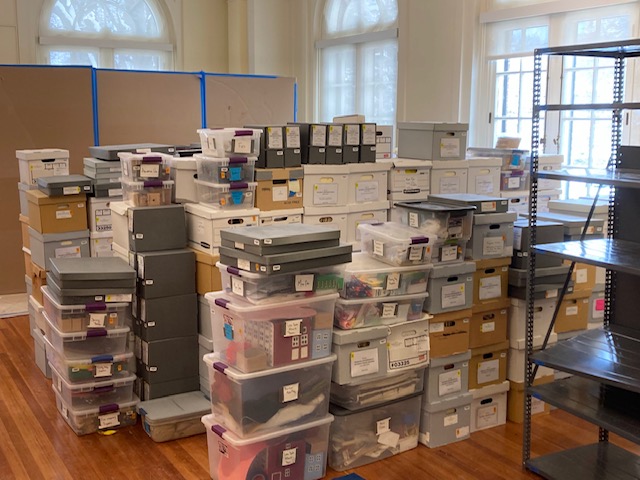
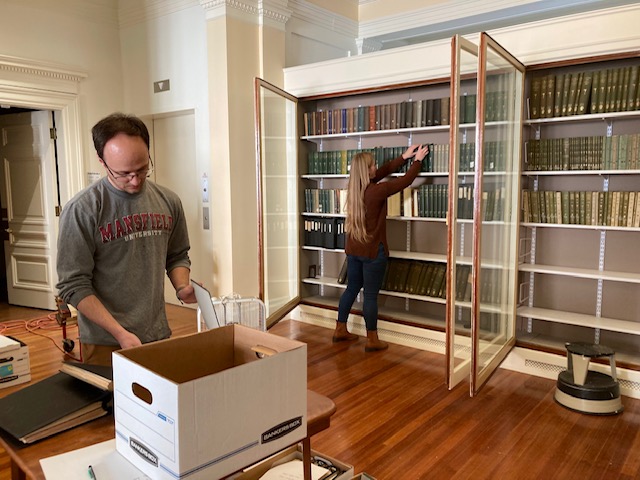
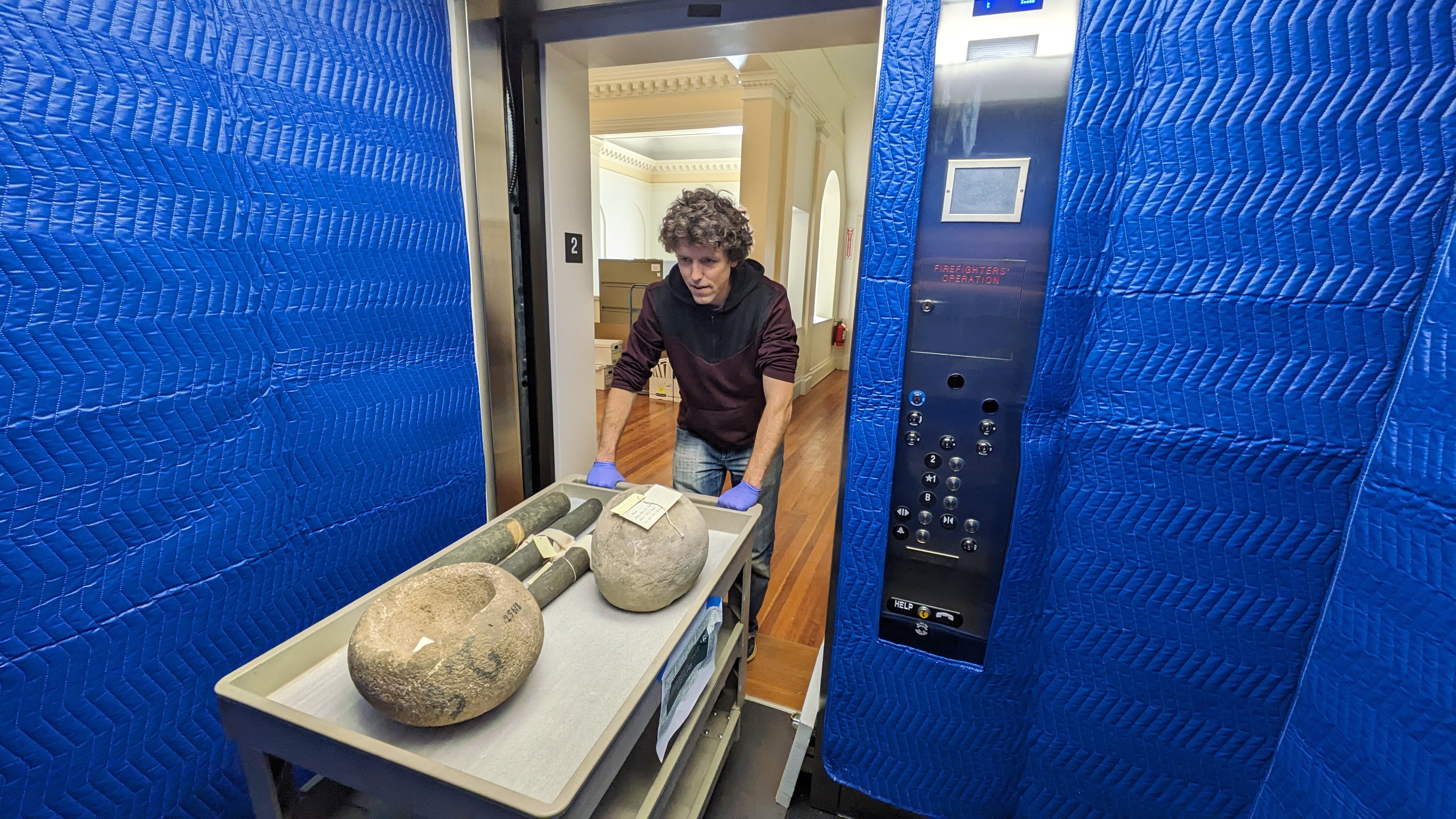
But, the work is nowhere near done!  Peabody staff are hard at work moving the collection back into the updated areas.  This is no easy task and won’t be complete for at least a couple months.

The Peabody looks forward to welcoming back the PA students and broader community in the spring term.  We can’t wait to show you what has been accomplished!

2023 ATALM Conference

Submitted by John Bergman-McCool

The 2023 International Conference of Indigenous Archives, Libraries and Museums was held in Oklahoma City at the end of October and hosted by the Association of Tribal Archives, Libraries and Museums (ATALM). ATALM is an international non-profit organization that maintains a network of support for Indigenous programs, provides culturally relevant programming and services, encourages collaboration among Tribal and non-Tribal cultural institutions, and articulates contemporary issues related to developing and sustaining the cultural sovereignty of Native Nations. The annual conference provides a venue for cultural institutions that seek to protect and advance Indigenous culture and lifeways to share best practices.

The conference included ninety-eight sessions and a host of keynote speakers organized around the theme “Honoring and Elevating Indigenous Culture and Knowledge Systems.” I was fortunate that the Peabody provided me with the opportunity to attend. It was an excellent opportunity to make connections and learn from people in my field who are working at the forefront of decolonizing institutions. The number of relevant conference sessions meant that choosing which to attend was extremely difficult. Luckily, I was there with Peabody curator Marla Taylor and we split-up to attend more sessions.

Within the sessions I experienced many inspirational and emotional moments. Indigenous and non-Indigenous presenters shared their experiences working at reversing centuries of colonial practices within cultural institutions. As an employee of a non-Indigenous research institution that houses Indigenous materials, it was an extremely powerful experience.

View from outside the conference after the first day of sessions.

Chief among my experiences was a day-long preconference workshop entitled “Tools and Strategies to Support Indigenous Intellectual Property.” The workshop was led by a team from Local Context, an organization that is focused on increasing Indigenous involvement in data governance and the integration of Indigenous values into data systems. You can find a much more detailed description of their work on their website.

The workshop introduced the participants to copyright law, how to identify copyrighted materials, and strategies for working with copyrighted Indigenous intellectual property (IP) held in museum collections. The copyright of Indigenous IP is particularly insidious, giving ownership, and control over access and circulation to the person who records, writes, or documents the Indigenous IP, not the creator. Prior to the workshop I didn’t know how copyright was created. I also considered the digitization process, the idea of the digital commons, and the transition of copyrighted material to the public domain as a democratizing force providing equal access to information. However, free use of these materials becomes complicated when they contain culturally sensitive or inaccurate information.

Copyright of Indigenous IP cannot be corrected retroactively and inclusion in the public domain cannot be avoided, but there are workarounds. Institutions can choose not to share Indigenous IP that they house without permission from relevant Tribal communities. Additionally, Local Context has created a series of labels that Indigenous communities can use to add additional context to collections held in non-Indigenous institutions. The labels help foster communication and collaboration between the institutions and Indigenous communities and are a pathway for inserting Tribal authority into institutional data systems.

The conference was a tremendous event and I came away with a renewed vigor for the work that we do at the Peabody.

How things have changed: The ongoing relationship between the Peabody Institute and The Phillipian

Contributed by Adam Way

This blog is the culmination of work done by Independent Researcher/Volunteer Adam Way to explore how the Peabody Institute has been portrayed by Phillips Academy students in The Phillipian over the years. Adam shared two previous blog posts about his work (Combing Through the Phillipian and Combing Through The Phillipian: End of an Era) and recently completed the project. His final blog is a summary of what he learned.

 The relationship between The Phillipian and the Peabody Institute has existed since the Institute’s founding back in 1901, and while the strength of that relationship has waxed and waned, it has persisted nonetheless. During my time combing through over a century’s worth of The Phillipian issues, I have noticed a few substantial changes, mainly the amount of coverage that the Peabody Institute received, the type of coverage, and the student’s view of Peabody.

The first major difference that appears when looking through The Phillipian archives is that the number of times that the Peabody is addressed/mentioned decreases drastically towards the present. In 1910, the Peabody Institute, then the Department of Archaeology, was mentioned 153 times throughout the year, with the following years yielding similar results. A significant amount of the times that the Peabody Institute was mentioned in these early years can be attributed to the existence of extracurriculars that took place within the building. Events such as meetings of the Banjo or Drama clubs and other such student activities that took place in the Peabody make up a large portion of mentions, while the rest is composed of articles detailing the academic work and scholarship being conducted by the Institute.

April 15, 1916

The constant high volume of mentions during the early years of the Peabody Institute, unfortunately, do not last forever. It appears that the turning point was, more or less, when Warren K. Moorehead retired from his position as director and was replaced by Douglas Byers. While the overall number of yearly mentions had been on a steady decline since the beginning of the century, the number had remained relatively consistent and the articles were primarily focused on academic work and lectures at the Peabody Institute. This changed when Byers and curator Fred Johnson took over, as it appears that these two did not have as close of a relationship with the The Phillipian as Moorehead did. This trend continued, and arguably was exacerbated under Richard “Scotty” MacNeish. I believe that this divide can be attributed to a shift in focus from teaching in the classroom to fieldwork, as all three of these former directors placed a heavy emphasis on fieldwork, while there was a lack of a consistent archaeology and/or anthropology class during this period (with other factors playing into that decision like student interest). Luckily, in the time since MacNeish, the Peabody Institute has regained a stronger, and more frequent, presence in the The Phillipian.

April 3, 1937

The next major change that I noticed while conducting this research, was that the type of coverage that the Peabody received changed over the years. Initially, I noticed this change through the club announcements. As time went on, the number of clubs using the Peabody, or at least publishing that they were in The Phillipian, was declining. Nothing about this appeared to be out of the ordinary as clubs moved to other buildings and Peabody House was constructed for the purpose of holding social events and clubs. The part that seemed strange to me was when members of the Peabody staff and faculty would leave without a single mention of their departure and only a brief mention when their replacement had been found, as was the case with Dick Drennan in 1977. However, as time progressed, the type of coverage in this area also shifted. Not only was there an article detailing the departure of the previous director, Malinda Stafford Blustain, but there was a subsequent article about the hiring of her replacement, Ryan Wheeler. It appears that the relationship between the The Phillipian and the Peabody Institute is steadily returning to its former strength.

The last major change that I have noticed is the waxing and waning of student interest in the Peabody Institute over the years. As with the other two variables that changed over time, student interest seemed to peek early on before dropping drastically as time progressed. After Moorehead’s departure and the subsequent drop in attention received from The Phillipian, the Peabody became increasingly referred to as a “hidden gem” and “unused asset.” There were even pieces written as a joke that say a student died of boredom due to their visit to the Peabody. Pieces like these are written in good fun, however, it does highlight the disparity between how involved students once were and how involved they are now. As with the other two changes that I noticed, this too is changing for the better in recent years. While there are still joke articles, there are fewer instances where the Peabody is labeled as an “unused asset.” There appears to have been a positive reception of student travel programs in the recent past as well as current lectures and other programs offered by the Peabody Institute.

October 7, 1994

While my time combing through The Phillipian has come to a close, I am glad to see that the Robert S. Peabody Institute of Archaeology is making a resurgence within the paper. The records showed that the institution has been through some difficult times and yet has prevailed and is strengthening its place within the Academy and student life.

A New Photo of Margaret Ashley Towle

Contributed by Ryan Wheeler

Several years ago as we organized the Peabody Institute’s extensive photographic collection, we came across a group of black-and-white prints that had not been flattened. These images relate to Warren Moorehead’s 1920’s era excavation of the Etowah mound group in Georgia. Any attempt to unroll the images would produce a tear and threatened to damage the prints. We did some research on techniques that might help these older prints relax a little, to no avail. Help was nearby, however, in the form of the Northeast Document Conservation Center or NEDCC, one of the leading paper and media conservation organizations in the country. We’ve used them before to digitize oversized maps and to scan black-and-white negatives.

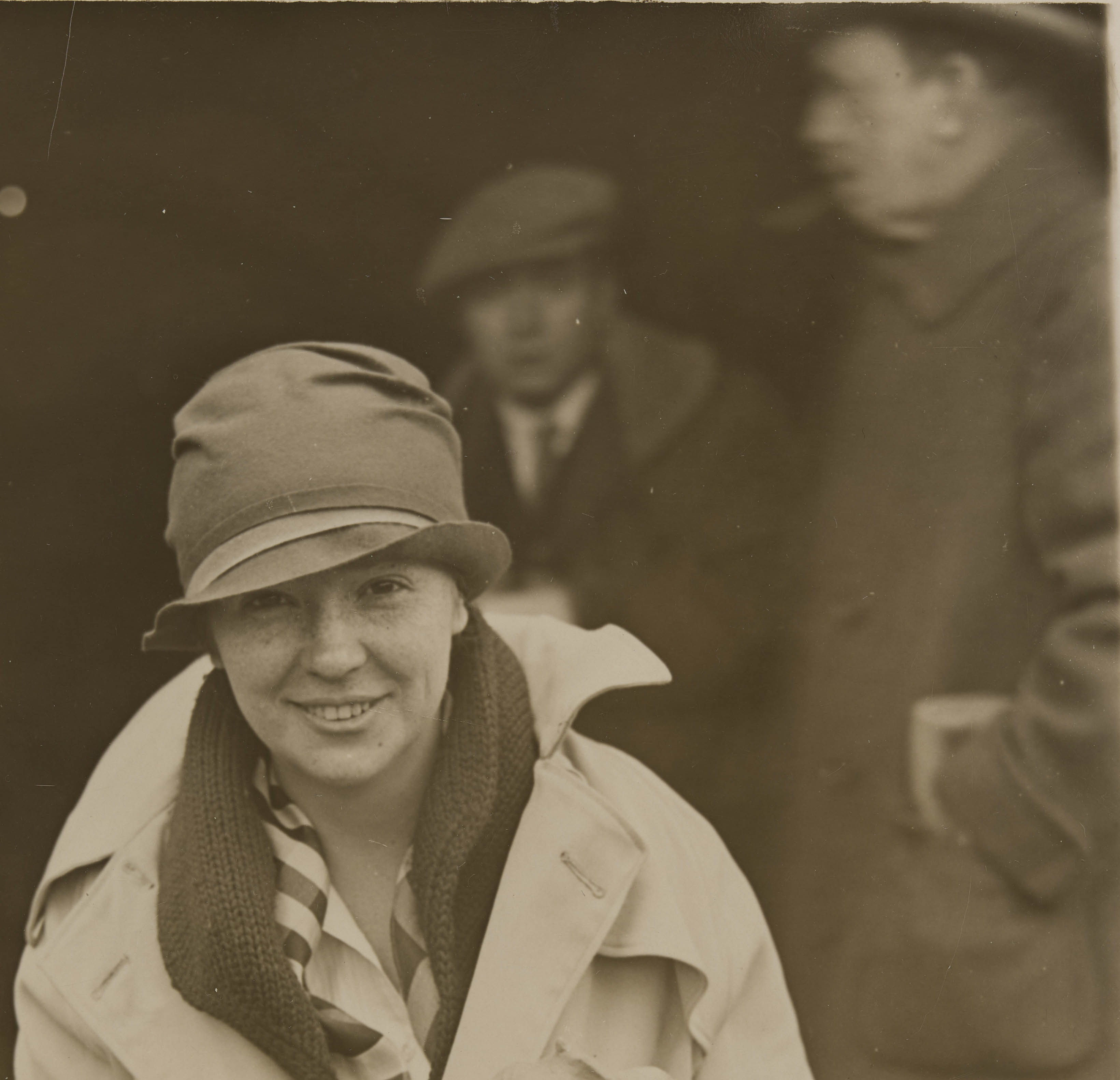
The images were returned to us after conservation recently, and we also received high resolution digital versions. Most of the photos show items from the Etowah site, but one picture was of Margaret Ashley Towle, one of the pioneering female archaeologists of the southeastern United States. The image is marked on the reverse as “Etowah Ga 1928 Miss Ashley” and has our recent catalog number 2020.3.283. It is a wonderful complement to Frank Schnell Jr’s 1999 chapter “Margaret E. Ashley: Georgia’s First Professional Archaeologist,” which appeared in Grit-Tempered: Early Women Archaeologists in the Southeastern United States. She was also featured, sans photo, in Irene Gates’s Women of the Peabody blog in 2018.

Image of Margaret Ashley as a smiling young woman wearing a cloche hat and light-colored trench coat with collar turned up. She has several scarves loosely around her neck. Hazy, out of focus image of Warren Moorehead in the background.
Image of Margaret Ashley at the Etowah site, 1928. In the right background is a slightly out of focus image of archaeologist Warren Moorehead. The image has been cropped to exclude several cultural items from the site. Robert S. Peabody Institute of Archaeology 2020.3.283.

Margaret Ashley was already well-versed in archaeology and was a skilled outdoorswoman when she worked with Warren Moorehead at the Etowah site, and went on to assist with his projects in Maine and to continue her own research in the Southeast. She also contributed to Moorehead’s Etowah Papers publication and published on her technique for illustrating pottery. According to Frank Schnell’s chapter in Grit-Tempered, Ashley married Moorehead’s main field assistant Gerald Towle in 1930. Unfortunately, Ashley’s marriage coincided with a significant hiatus to her training and research. We do know that after Towle’s death, Ashley completed her Ph.D. at Columbia with her dissertation later appearing as The Ethnobotany of Pre-Columbian Peru, number 30 of the Wenner-Gren Foundation’s Viking Fund Publications in Anthropology (1961). Colleagues working in the Andes report that Ashley’s publication remains a significant resource. Ashley spent several decades as an unpaid research associate at the Harvard Botanical Museum where she worked with botanist Paul Mangelsdorf, who had also been encouraging Richard “Scotty” MacNeish’s interests in agriculture, also around this same time.

We are delighted that we have been able to recover this early photo of Margaret Ashley Towle. If you get a chance, get a copy of Grit-Tempered–the biographical entries also include Adelaide Bullen, another pioneering archaeologist with connections to the Peabody Institute!

Ethnographic Photographs – Greater Understanding

Contributed by Deirdre Hutchison

My name is Deirdre Hutchison, and I am currently studying for my B.A. in history at UMass Lowell. As part of a semester internship, I had the opportunity to research the provenance of several unidentified Native American photographs held by the Robert S. Peabody Institute of Archaeology. My first blog outlined initial findings and potential areas of investigation. To summarize that blog, the photos, mounted on board, illustrate a 1905 event at the 101 Ranch in Oklahoma.

As I navigated various connections, photographer James B. Kent became a more prominent fixture of my research. Kent was a regular photographer at the 101 Ranch, and the Millers tapped him to design and compile the souvenir booklet for “Oklahoma’s Gala Day” at the ranch on June 11, 1905. –. Kent, it seems, was an integral part of photography at the 101 Ranch, ultimately becoming the head of the moving pictures department by 1927.

101 Magazine/The 101 Ranch Official Souvenir. BLISS, OKLA. 5127.1000. Tulsa: Gilcrease Museum, https://collections.gilcrease.org/object/51271000 (08/03/2017)

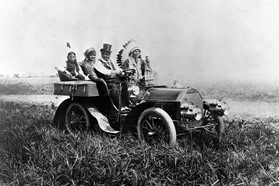
The 101 Ranch souvenir booklet is discussed by Michael Wallis in his book The Real Wild West. According to Wallis, it contains multiple images taken by Kent – including the picture of Geronimo skinning a buffalo held by the Peabody (discussed in my previous blog). The booklet also contains one of the most famous images of Geronimo, “Geronimo in an Automobile.” . Working with the archival staff at the Gilcrease Museum in Tulsa, I hope to view the images to confirm Kent’s pictures and perhaps discern other possible photo matches.

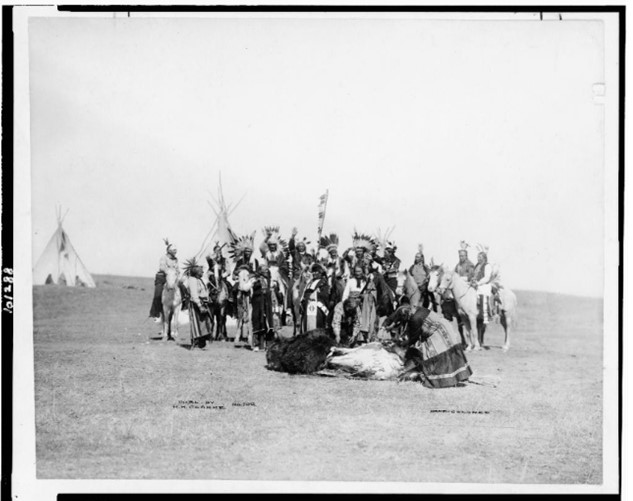
Isolating Kent’s work is relevant because he was not the only photographer working at the famous extravaganza on June 11, 1905. The Millers masterfully orchestrated spectacle – 65,000 people attended – could not be supported by just one photographer. Multiple photographers were present capturing various promotional images at the behest of the brothers. This is immediately evident in the Library of Congress photo of “Geronimo Skinning a Buffalo” that identifies O. Drum as the photographer. The strikingly similar images of the Peabody and the Library of Congress differ in only small ways. It seems a bank of photographers captured the same scene, each image similar, but slightly different: a person with a head facing a different direction, an extra person, women bending, or a western-clad gentleman caught talking with those being prepped for the publicity shoot.

Another name that kept popping up in my research and commonly associated with a broad range of images, including Kent’s, was the publisher H. H. Clarke. Not only did Clarke produce black and white photographs, but he also manufactured color versions for global distribution, and several of his postcards bear the notation Made in Germany. Clarke’s color versions are considered unique as he employed a hand-coloring technique rather than standard lithography. Other examples of this work are at the Cherokee Strip Museum (Cheryl DeJager, Cherokee Strip Museum, personal communication).

Although Clarke published images by Kent and other photographers, establishing a direct link between them is difficult. However, sifting through metadata across several institutions, I discovered interesting connections that explore the publishing and manufacture of images onto postcards. For example, in the early twentieth century, professional and amateur photographers could sell their negatives directly to distributors such as Clarke or major publishing houses such as The Albertype Company. The Library of Congress cites Albertype and Clarke for one of two images listed of Geronimo in a car.

Clarke published three photos I initially matched with the Library of Congress. However, with only a thumbnail view available, I could not say with conviction they were identical to the Peabody images. After corresponding with the Prints and Photographs Division at the Library of Congress, enlarged views are now accessible online which allowed me to confirm that two photos were identical to those at the Peabody, but a discrepancy arose with the third. A close inspection reveals small but salient differences between the image at the Peabody and the one at the Library of Congress. For example, in the Peabody image, women are standing over the buffalo, but in the Library of Congress, they are bending over. Furthermore, in the Peabody image, a man stands to the buffalo’s left with his back to the camera, notable for his western-style suit, boots, and derby hat. Kent was known for always wearing his signature derby hat, leading me to speculate he was directing the people for the staged photograph and was caught on camera by another photographer.

When I started this project, I naively thought I would find solid evidence pertaining to Warren Moorehead’s acquisition of the images. As the museum’s first curator and renowned Native American expert, I thought, how could there not be a connection? Yet, every avenue of research proved fruitless with Moorehead. The narrative unfolded around the Miller Brothers, James “Bennie” Kent, and H. H. Clarke. The interconnectedness of these people provided many answers; the photographs were staged publicity images, taken at the 101 Ranch and predominantly early 1900s. Unraveling this fascinating story has been immensely rewarding, yet it seemed unlikely I would find any correlation between the images and their arrival at the museum.

Despite this disappointment, potential connections with the Peabody Institute and theories of acquisition emerged when reviewing my data, though initially not with Moorehead. Ernest Whitworth Marland was in business with the Millers and became Governor of Oklahoma. Frank Phillips of Phillips Oil was also involved with the Millers and the 101 Ranch. Both men were natives of Pennsylvania, as was Robert S. Peabody. Each man was wealthy, prominent, and quite conceivably moved in the same upper echelons of society. It is possible either of these could have passed photographs to Moorehead or the Peabody. Considering the student body of Phillips Academy, any alum could have given the images as a donation to their alma mater. Equally so, any faculty member may have been gifted the photos. All of these are plausible scenarios. However, another tenuous link emerged, excitedly leading me back to Moorehead. The collections description for the three Library of Congress images mentioned earlier notes that they are mounted photographs, as are the ones at the Peabody.

Another facet that piqued my interest was the descriptions accompanying records at the National Archives. “Geronimo in a Car” is cited as taken on June 11, 1905, at the Millers’ Oklahoma Gala Day, along with other images; all are 8×10 or larger, just like the Peabody images. Although far from compelling, there are commonalities.

What I found most compelling with the National Archives photo of “Geronimo in a Car” was that it states a copy was sent to the Office of the Commissioner of Indian Affairs. The Office of Indian Affairs later became the Bureau of Indian Affairs. Moorehead was appointed to the board of commissioners for the Bureau of Indian Affairs by President Roosevelt in 1908.

Geronimo Driving a Car. Oklahoma Gala Day, June 11, 1905. Wall Street Journal

As an emerging historian, I like to focus on facts. Unfortunately, facts can be notoriously distorted by time, memory, and absent material evidence. However, the absence of proof does not equate to the absence of the action. Although I had discounted Moorehead as the conduit, I have circled back and believe he is a strong acquisition candidate based on my latest discoveries. That particular mystery may never be solved, but it does not detract from the powerful narrative of Native American presence and treatment in mainstream society in the early twentieth century. 

Further Reading

Bordewich, Fergus M. “Fierce Echoes from the Frontier.” Wall Street Journal, April 19, 2013, sec. Life and Style. https://www.wsj.com/articles/SB1000142412788732334630457842 6634203336120

Collings, Ellsworth, and Alma Miller England. The 101 Ranch. Norman: University Of Oklahoma Press, 1987.

Wallis, Michael. The Real Wild West: The 101 Ranch and the Creation of the American West. New York: St. Martin’s Press, 1999.

Understanding Ethnographic Photographs

Contributed by Deirdre Hutchison

My name is Deirdre Hutchison and I am currently studying for my B.A. in history at UMass Lowell. One of the things I love most about college is delving into archival research, unraveling forgotten stories, and the thrill when making connections that reveal new pieces of information, or even reshape the original context.

Recently I came across Warren K. Moorehead through his publication “The Merrimack Archaeological Survey.” Intrigued by this contradictory personality, I was excited to get the opportunity to do an internship at the Peabody and expand my knowledge on his work. Given my previous exposure and interest, curator Marla Taylor suggested I work on identifying information on approximately 30-50 photographs at the Peabody. The collection depicts ethnographic images of Native Americans. My objective was to discover how these images came to the museum, what was the purpose of the photos, and who may own the copyright. Given the magnitude of the search, it made sense to focus initially on only a few photographs. Several images had dates (early 20th century), captions with “101 Ranch, Oklahoma”, tribal names, and even a photographer name. Collectively, this seemed to occur during Moorehead’s tenure, and thus the investigation began with the Peabody’s first curator.

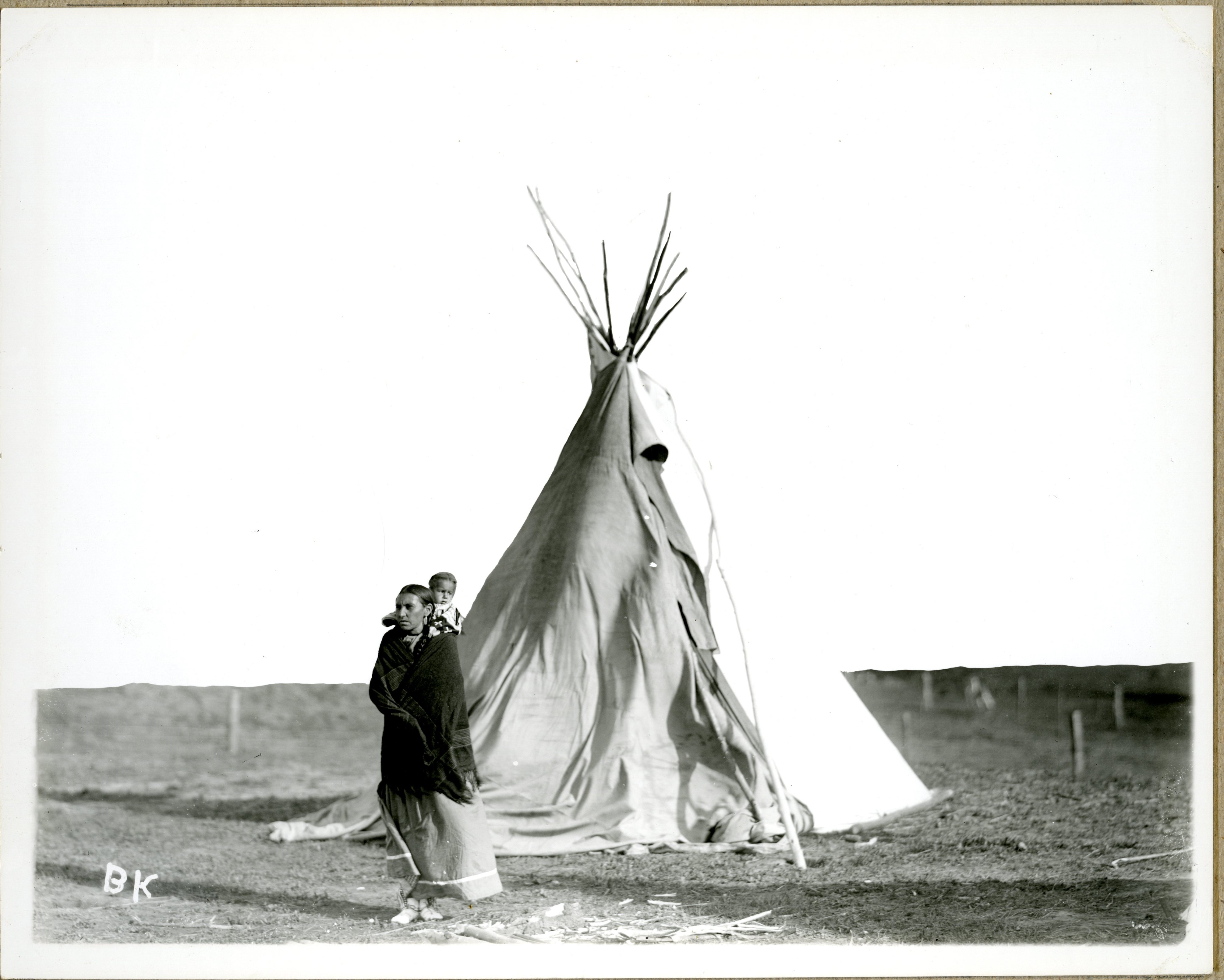
An example of one of the photographs being researched

As I eagerly navigated box after box of Moorehead records, I felt sure it was only a matter of time before I would make a connection between the man and the photos. After combing through his publications, correspondence centered on Oklahoma and the early 1900s, and hundreds of lantern slides later, a different narrative was emerging, though no less intriguing. Despite the vast array of articles, records and collections at the museum, disappointingly, no connection could yet be found between Moorehead and these early images. Details on the named photographer, Kent Chandler of OK, proved equally elusive. However, as we all learn in high school, never underestimate the importance of a comma. With no comma between Kent and Chandler on the photograph mount, I assumed it was his full name. Further digging finally revealed a gentleman named James Kent who lived in Chandler and worked with the 101 Ranch in OK.

My next investigative step was the Library of Congress. For three of the photos held at the Peabody I found a match. Excitedly I noticed the details confirmed those at the Peabody – the photos were of the Ponca tribe and taken at the 101 Ranch in Bliss, OK. However, I now had another new piece of key information, the publisher was H.H.Clarke. Investigation into the 101 Ranch revealed the Miller Brothers, famed for their wild west shows for decades, as the brainchild behind the images. Further insight came from a bio on the Oklahoma Historical Society of photographer James B. Kent, revealing he was a resident photographer for the Miller Brothers.

Despite making headway, H.H. Clarke, the publisher of the images, also proved difficult to trace. Finally, I found a reference to publishers H.H. Clarke on the Cherokee Strip Museum website in Perry, Oklahoma. Clarke and his wife operated a small newspaper and native curio store but also had a sideline in publishing postcards. Once again, up popped the 101 Ranch as the backdrop for many of their postcards. All roads keep circling back to the Miller Brothers. It seems they had quite the operation! The Oklahoma Historical Society has an interesting documentary from c.1950 that highlights the magnitude of the activities of the brothers and the ranch which can be watched here.

At the “Oklahoma Gala day” exhibit in 1905, the Millers had their ranch hands and Native Americans demonstrate their skills and featured the incarcerated Geronimo killing a buffalo as a special attraction.

Geronimo skinning a buffalo from the Peabody’s image collection – a similar image to the one in the Library of Congress yet with notable differences

It appears the brothers showcased many Native Americans performing a range of similar publicity stunts. Kent was one of their preferred photographers for these staged events and H.H. Clarke often published them.

How the images came to the Peabody is still not clear. However, I hope I can uncover more information from the archives of the Oklahoma Historical Society which has a great deal of information on the Millers and the ranch.

There is no doubt headway has been made on the purpose of the photos. As I navigate the vast empire of the Miller brothers, propaganda, and unashamedly, profit, seem to be the key factors in their relationship with Native American photos. The question stills remains of how the images came to the Peabody. As I move through the next few weeks, I am hoping to find a link between the Miller brothers, 101 Ranch, and the Peabody. At the same time, establishing who has reproduction rights on the images that I have identified will be key to achieving my goals. As with any historical research, and in the absence of records, there are no guarantees. However, I hope to get as close to the truth as one can and there is no doubt that this journey is as exiting as the destination. More to come…

Combing Through The Phillipian: End of an Era

Contributed by Adam Way

In the June 17, 1938 issue of The Phillipian, it was announced that Dr. Warren King Moorehead would be leaving his post as Director of the Department of Archaeology. This brought about the end of a long and prosperous career that saw Moorehead become an integral part of the Phillips Andover community and a major contributor to the field of archaeology as a whole.

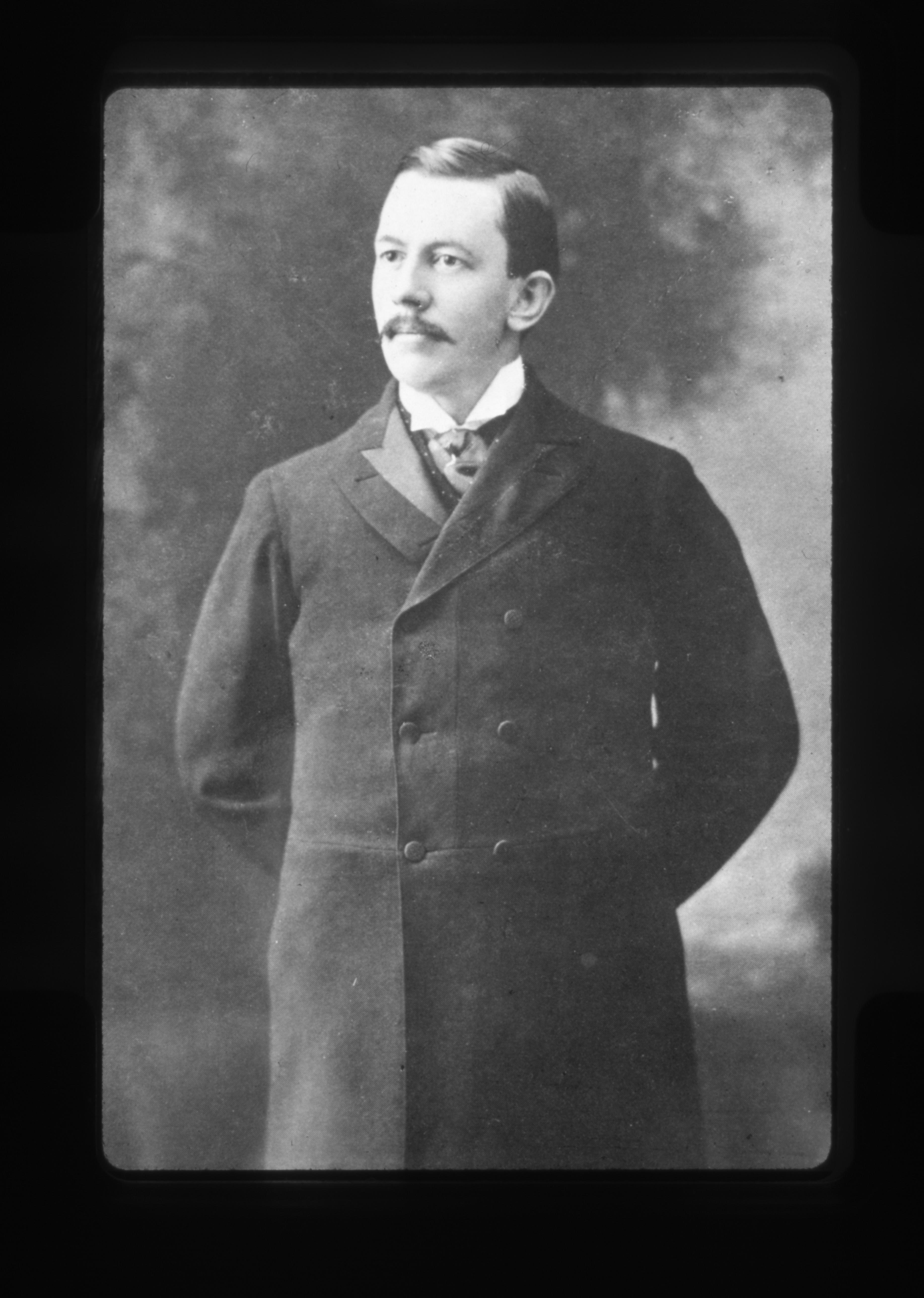
Portrait of Warren K. Moorehead, 1898

Moorehead began his career in the 1880s when he studied at Denison University before becoming an assistant at the Smithsonian Institution and later the curator of the Ohio Archaeological and Historical Society (now the Ohio History Connection). He joined the Department of Archaeology at Phillips Andover at its inception in 1901 and was appointed as the first curator. In fact, he worked closely with Robert S. Peabody, the Department’s founder, to develop the idea of such an institution. During his time as part of the Department, Moorehead received a Master of Arts from Dartmouth and was made a Doctor of Science in 1927 by Oglethorpe University and again in 1930 by Denison University. He became the director of the Department after Dr. Charles Peabody stepped down in 1924.

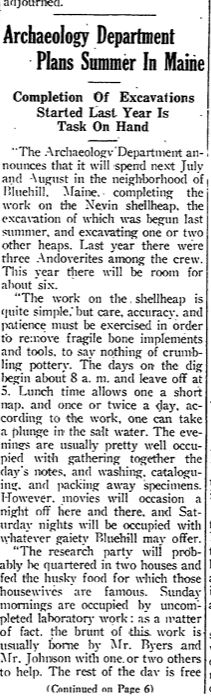
            The article that announces Dr. Moorehead’s retirement is not particularly long but does highlight some of the important aspects of his career. The article spends a majority of its content on his education and on his path to becoming the director. The article does include some of his other accomplishments, such as a partial list of publications, and a mention about his work with the US Board of Indian Commissioners. The article concludes by saying that his position within the archaeology community is undisputed and that he will be travelling to Europe with his wife for the summer.

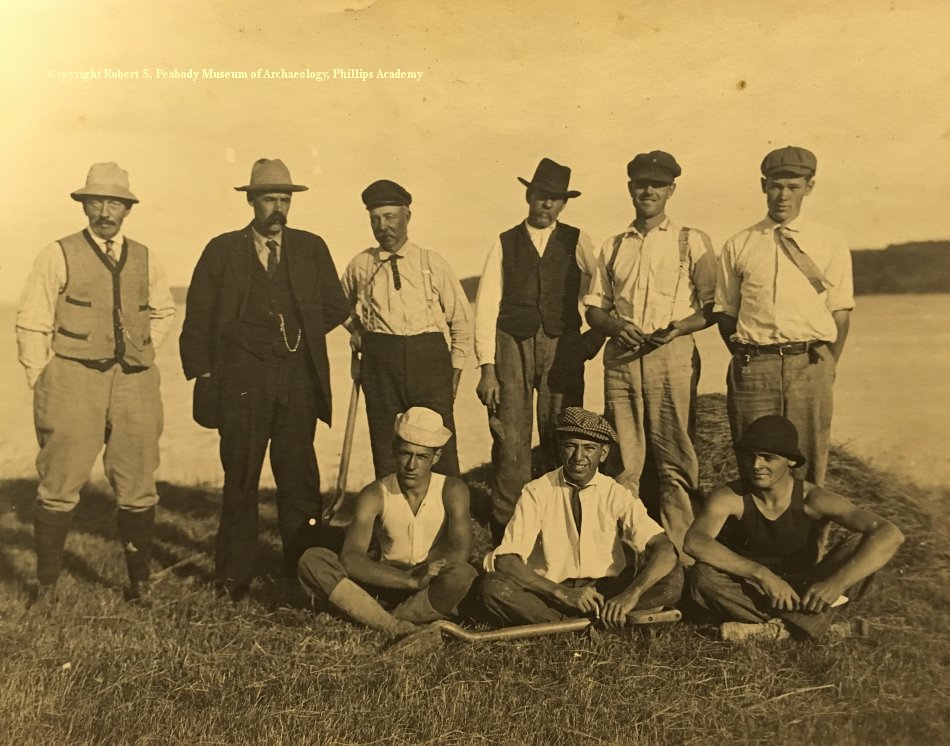
Warren K. Moorehead (far left) with an excavation group

Personally I was surprised with how Moorehead’s departure was presented in The Phillipian, particularly the brevity in which they describe his career. In the numerous issues of The Phillipian throughout the years that I have researched, it became clear just how much Moorehead fought for the rights of Native Americans and how he fought to bring the injustices committed against them to light. This was a frequently recurring topic for Moorehead and yet receives one sentence in his retirement article. This also occurs with his numerous archaeological discoveries from across the country. A significant aspect of Moorehead’s career was his participation in and leadership of numerous excavations and expeditions over the years and, unfortunately, that aspect receives little attention in this article, such as his work throughout New England, the Midwest, and Southeast. Although his methods do not meet today’s standards, Moorehead made multiple important contributions to the field that went unmentioned in his retirement article.

            I think that the reason I was so surprised was that the reception that Moorehead received in this article differs from most of his other appearances in The Phillipian. Many of the articles that featured Moorehead over the years went into a fair amount of detail. Whether it was discussing a lecture or one of his expeditions, the reader was usually given more information. Moorehead was seemingly respected and well liked by the students, as evidenced in numerous articles praising his lectures, yet the announcement of his retirement is rather straightforward and relatively unemotional. One possible reason for this could be declining student interest in the Department over the few years prior to his retirement and his habit of giving very similar lectures every year. Moorehead’s sendoff did not mirror his depiction in previous issues of The Phillipian.

            Warren King Moorehead was a staple of the Department of Archaeology from its inception in 1901 until his retirement in 1938 having served as both the curator and then as the director. He retired at the age of 72 and spent his brief retirement with his family before passing in January of 1939.

Check out the following Peabody blogs for more information and history about Warren K. Moorehead.

Warren K. Moorehead and the Peabody Institute

The ‘Horned Giants’ of Pennsylvania

“…and his spirit still lives”

Behind the Photograph – W.K. Moorehead and the Fort Ancient Excavation

 Archaeology in the Classroom at a New England Prep School

The Art of Collecting

The Ponca, Presidents, Politics, and Partial Answers

Out of the basement and into the basement

Contributed by John Bergman-McCool

RSP to Home
4 months of working in my basement and now, I’m back in the Peabody basement.

After four months of working from home, the Peabody is in its third week of a return to almost normal collections work. The two inventory specialists, Emily and myself, are working alternating weeks at the Peabody in order to continue our inventory work. With one week completed, it feels good to be back working toward our goal of a complete inventory of the collection. While working remotely will be an ongoing reality, I would like to share some of what I have been up to at home thus far.

With everything shutting down in March, Marla was quick to come up with projects that could be completed remotely. Her post in April outlined collections materials that were less sensitive and therefore reasonable to take home. I started with photographing site records from Peru and then moved to digitizing vacuum treatment paperwork related to Integrated Pest Management of the collections. We all contributed to finalizing the digitization of the original ledger books, our institution’s version of accession books. Now we have a searchable document with 75,000 records!

Work from home stuff copy
Everything I’ve worked on from home

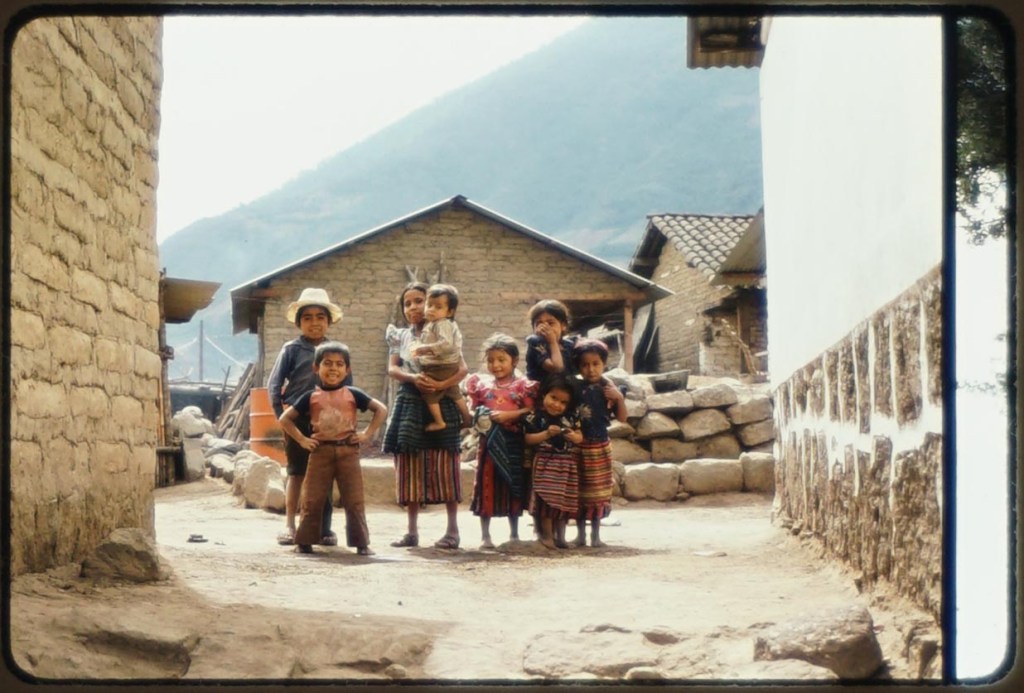
My favorite project has been photographing and editing photographic slides held in the collection. They include images documenting past exhibits and openings at the Robert S. Peabody Museum and photographs of the collections. The most interesting slides by far have been of Copeland Marks’s travels in Guatemala and South Korea. Mr. Marks was a textile collector who focused on the traditional clothing of ethnic Maya people living in the Guatemalan highlands. Some of his textiles became part of our collection at the Peabody. He would later write several cookbooks on cuisine covering locales ranging from the Mediterranean to South America. The slides I was working with document his travels in Guatemala spanning the 1960s through the 1980s. The subjects in the photographs cover everyday life, the dramatic volcanic landscape of the highlands and ceremonial life- all of which have been a great escape from the realities of coronavirus lockdown.

00.3.1585 copy
00.3.1585- People of San Pedro La Laguna.

It is anybody’s guess when life will return to normal. For the foreseeable future work at the Peabody will be interspersed with the strange blur of working from home with frustratingly cute interruptions from kids and dirty dishes. Until then I have to thank Marla for keeping us safely working from home during these crazy times.

lunch for 2
Oh yeah, I can’t forget my other work from home duty- silly lunches for the kids.