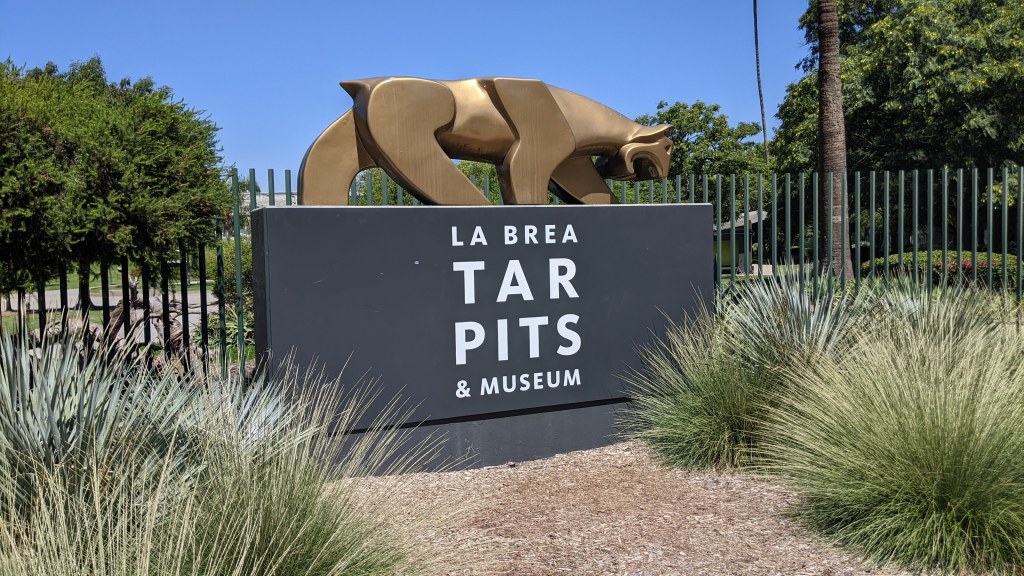
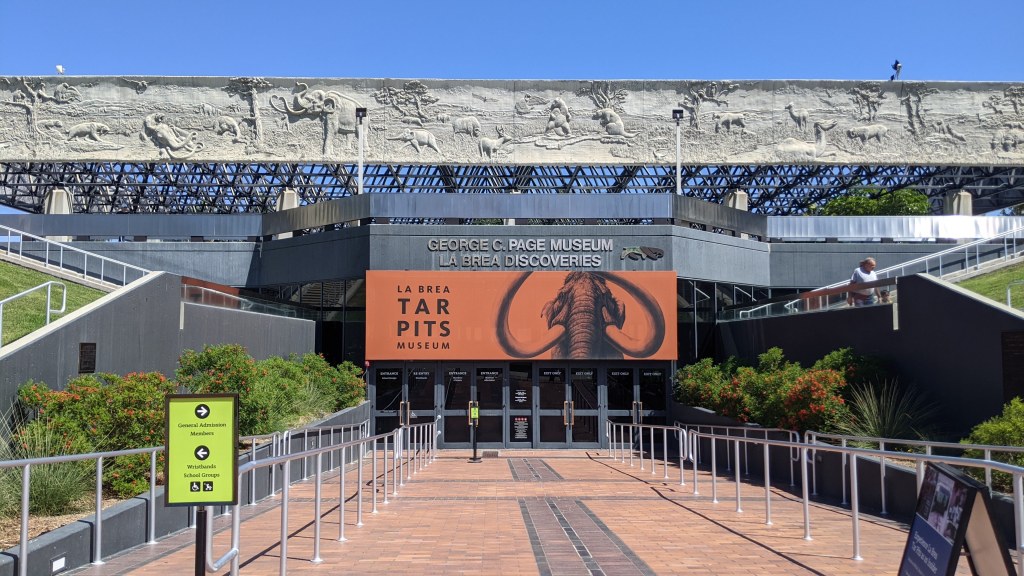
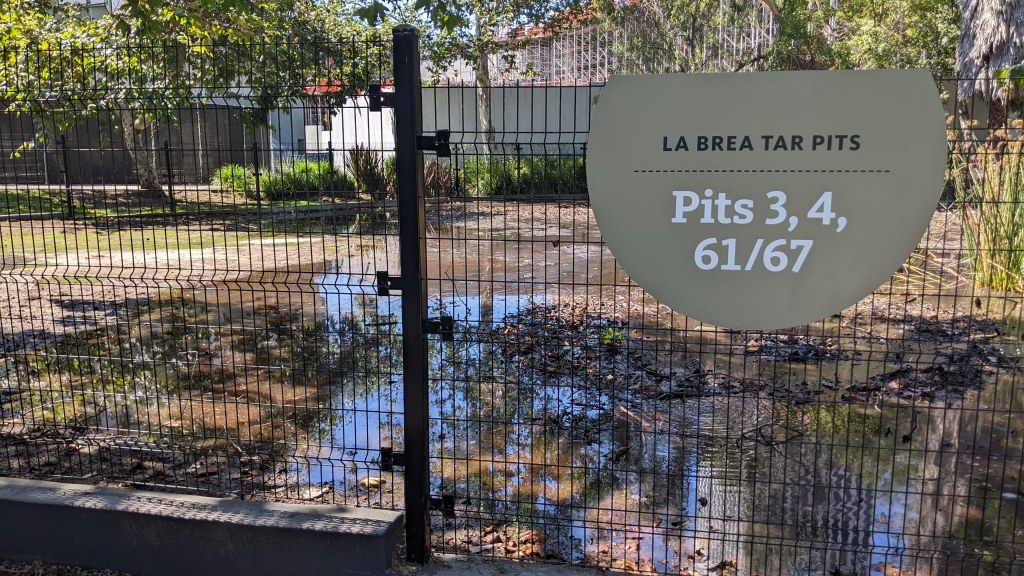
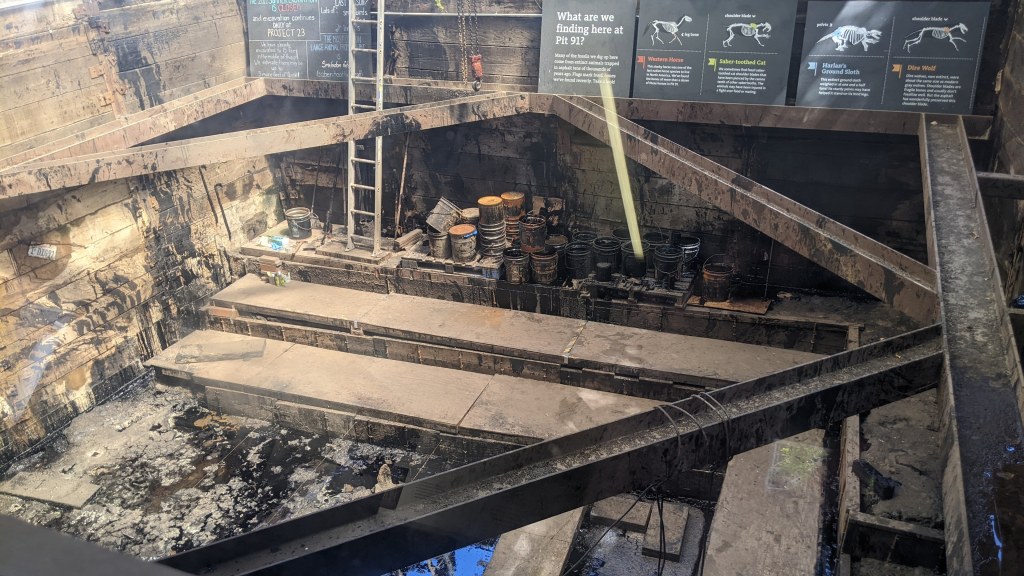
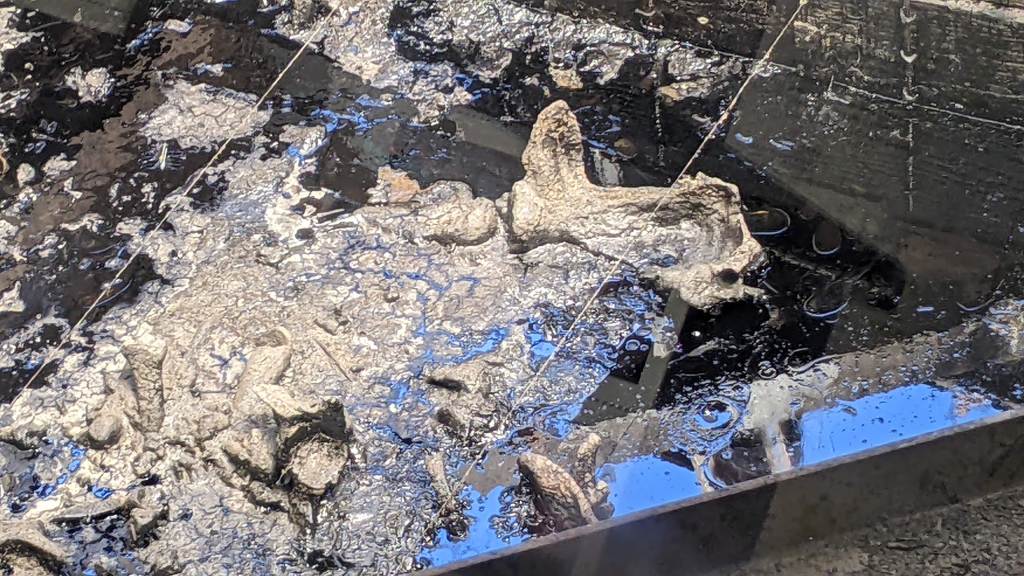
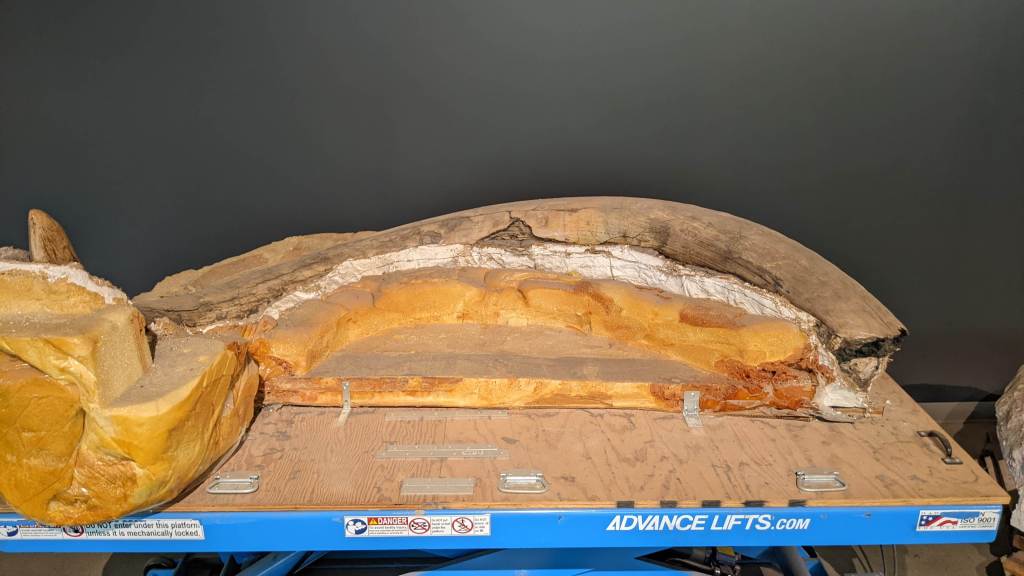
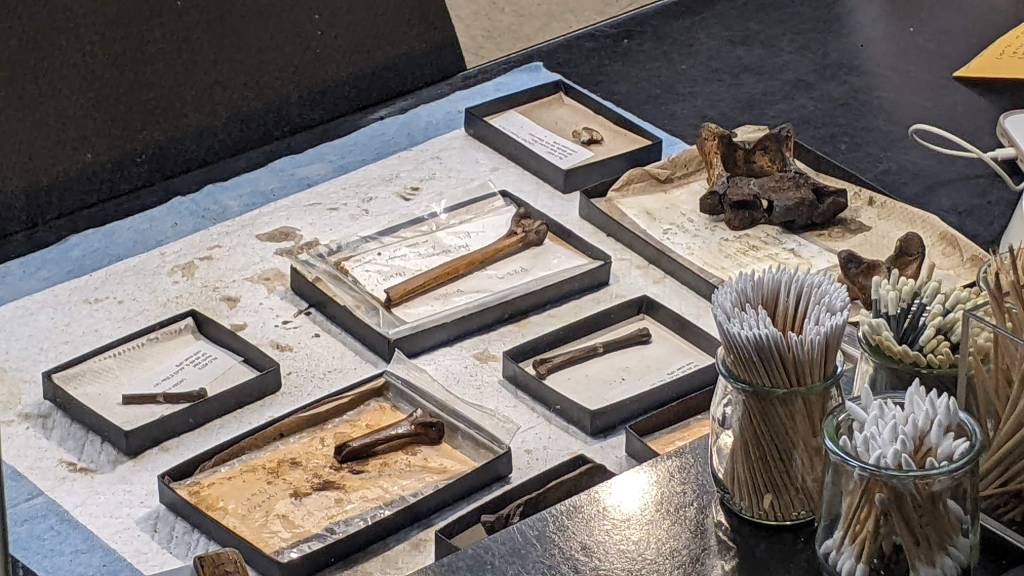
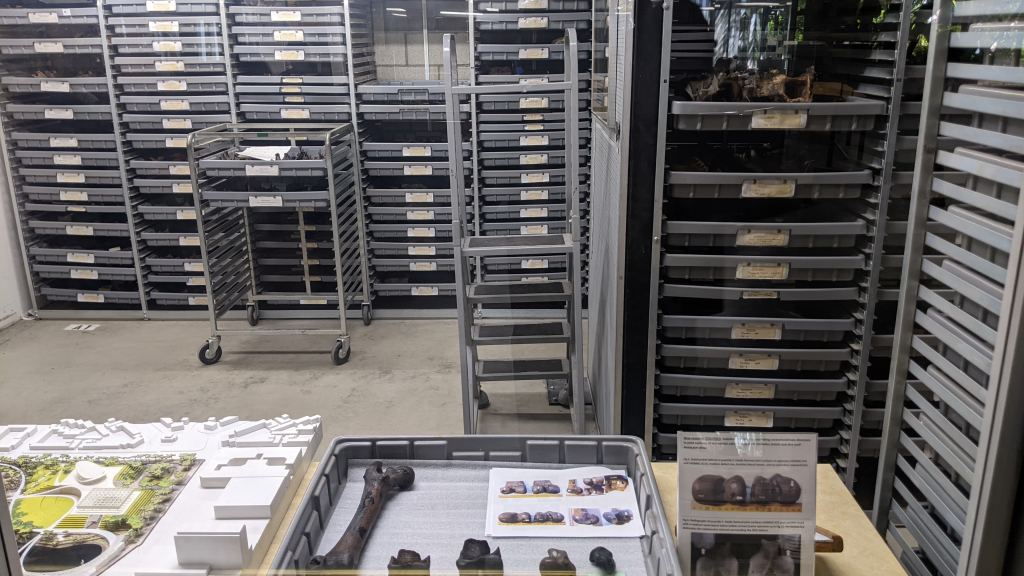
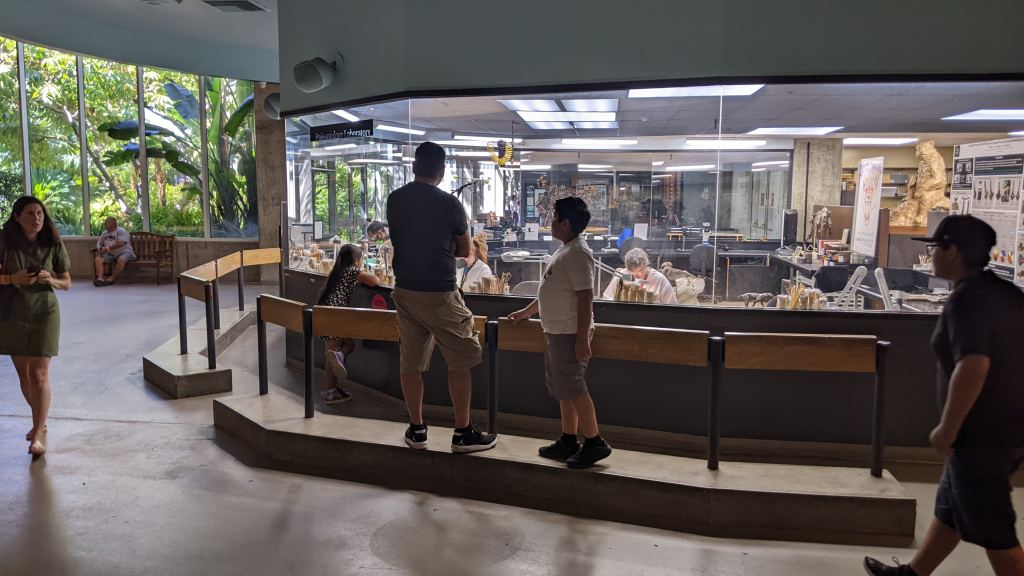
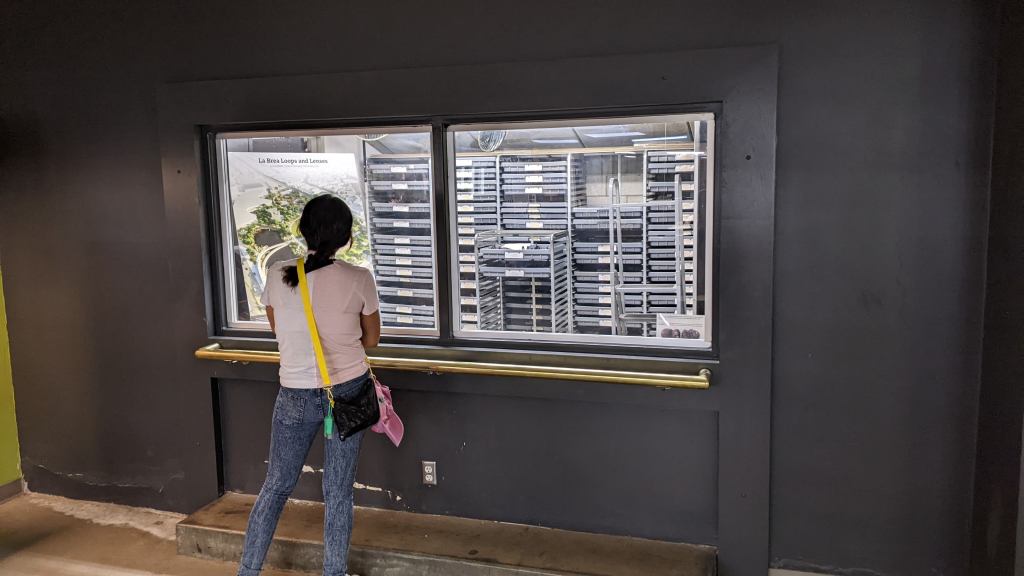
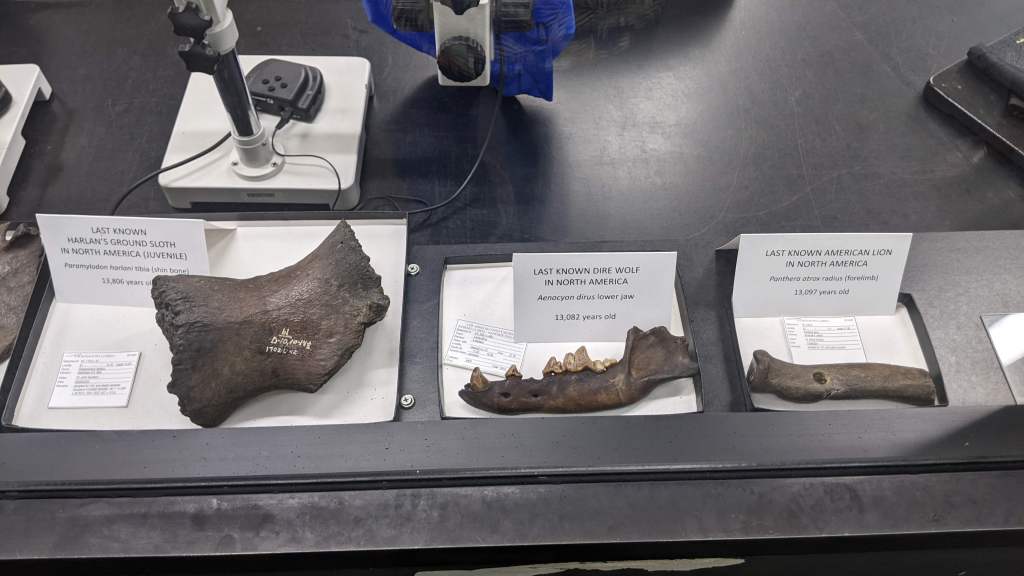
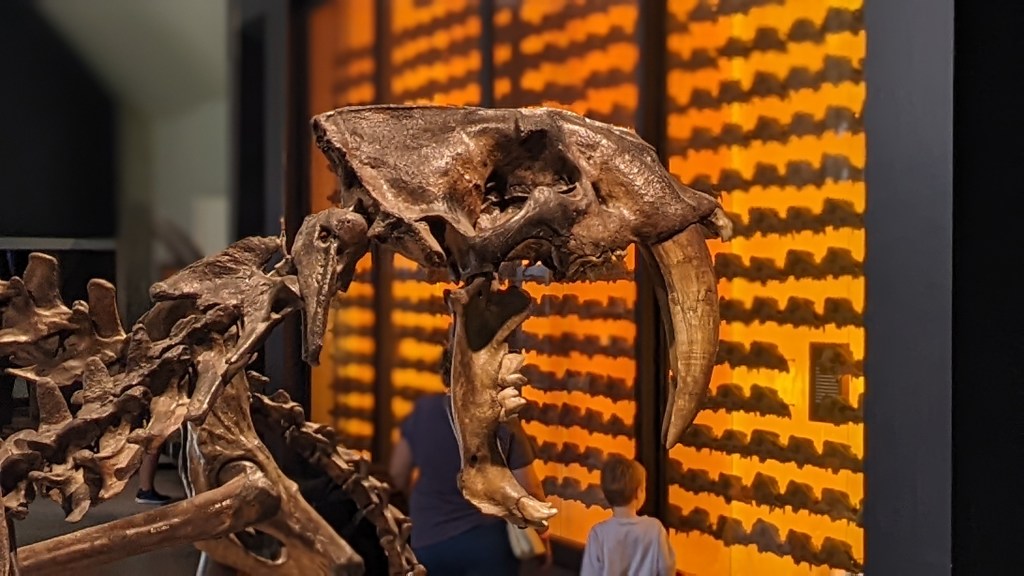
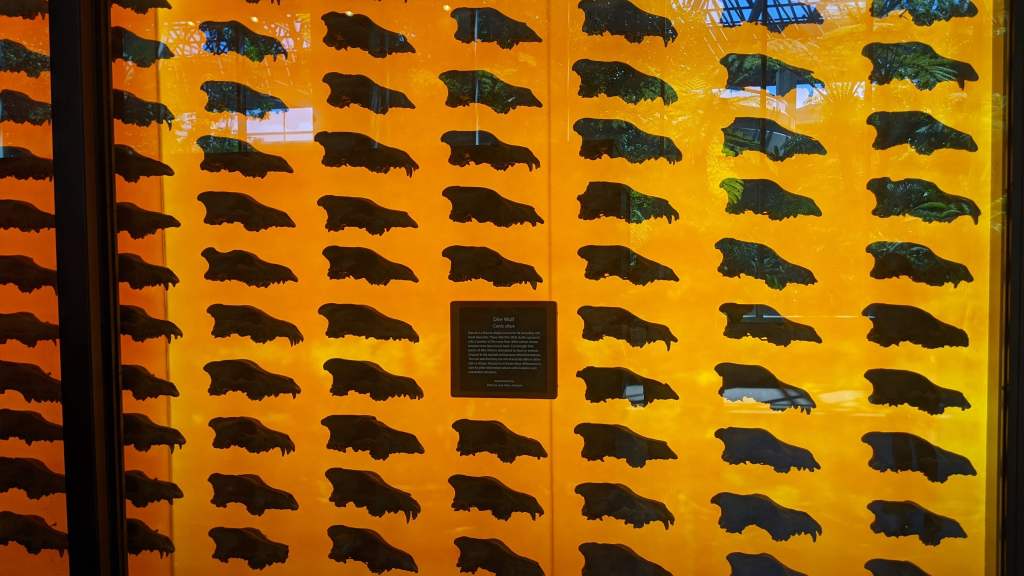
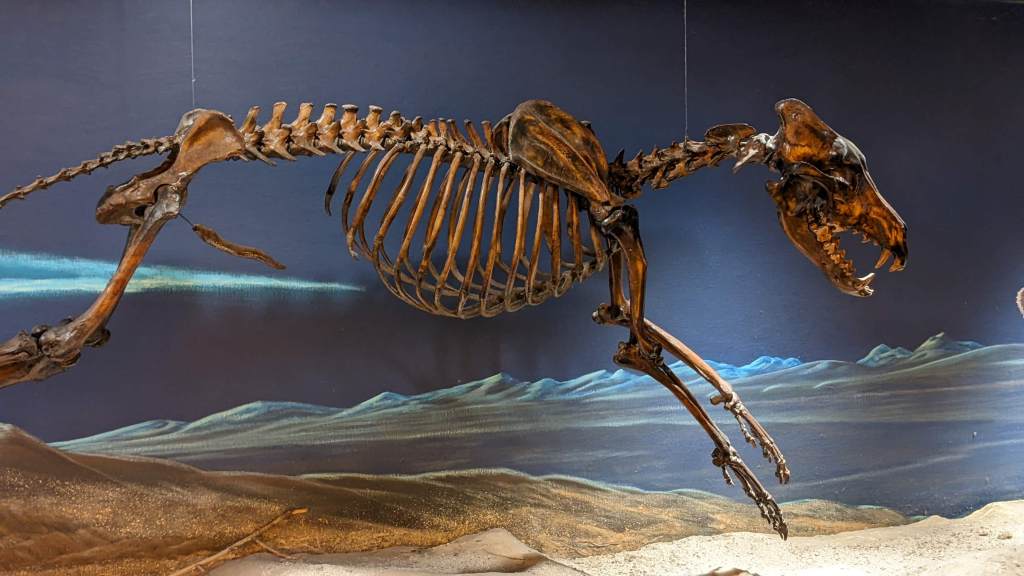
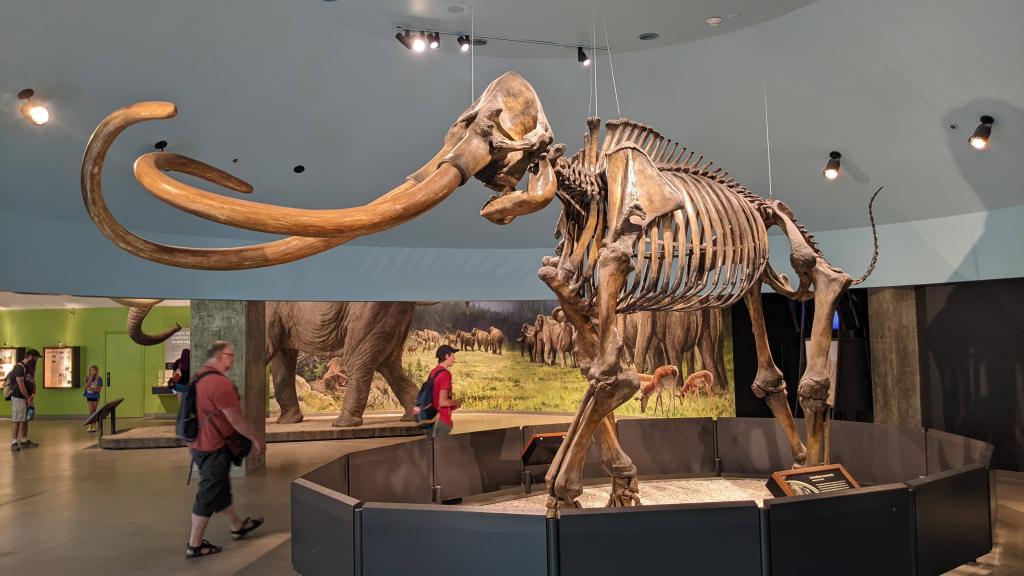
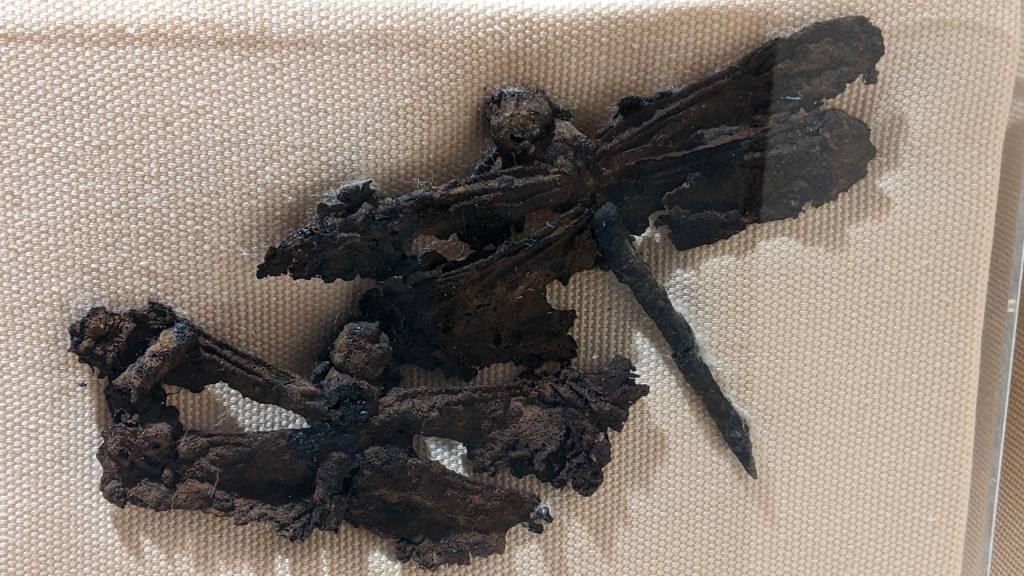
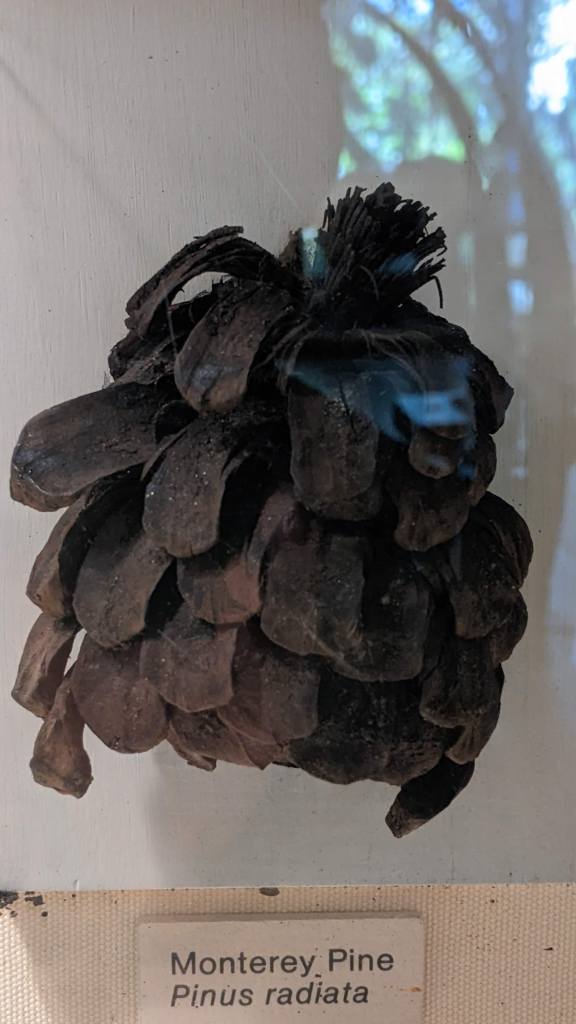
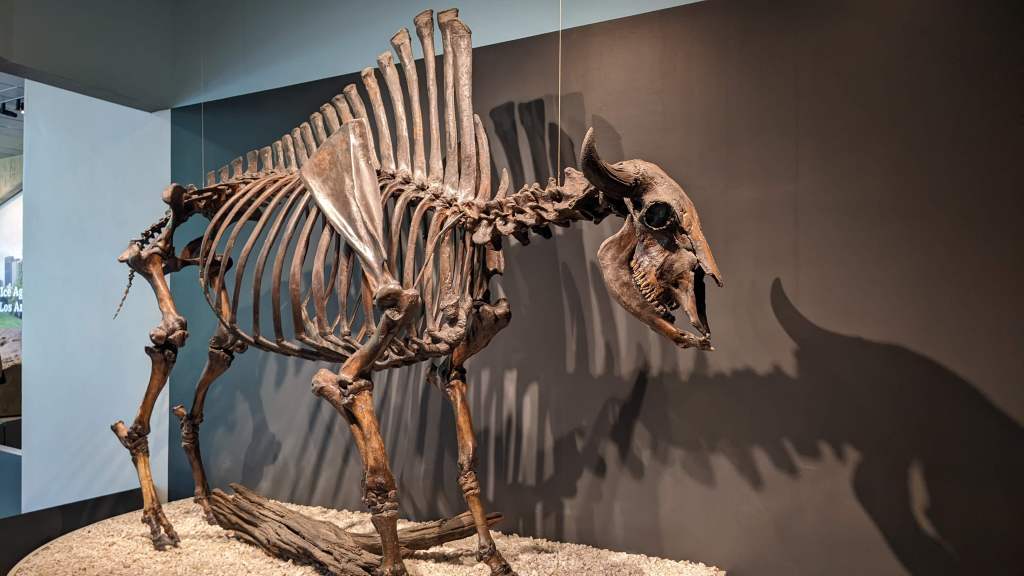
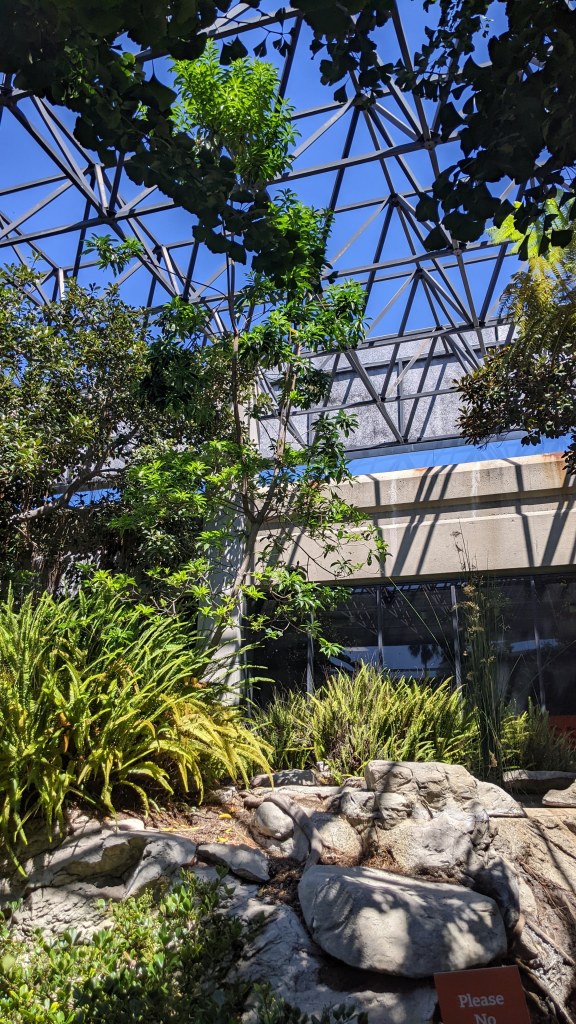
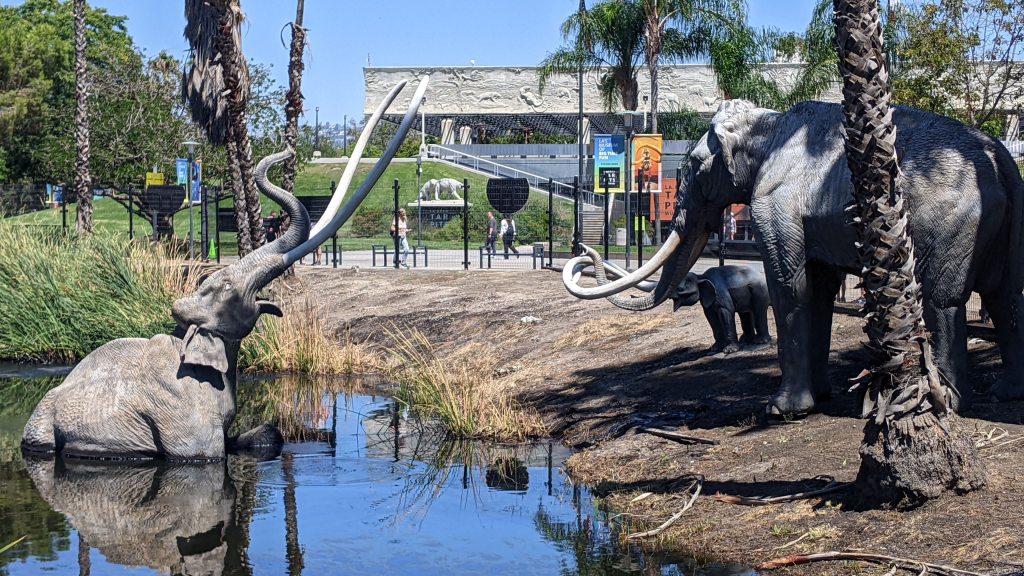
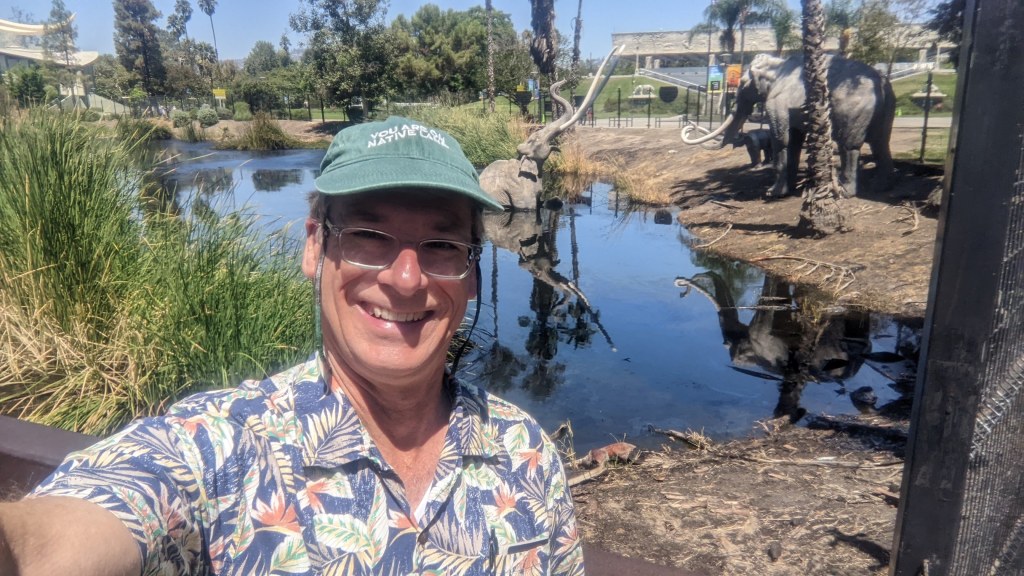
One of the best things about travel is visiting museums, especially those that are new to me! In August, I traveled to California for some great events for Andover alumni, students, and new families. As a newbie to Los Angeles, I was wowed by the Mediterranean Revival architecture and, top on my list of museums to visit, La Brea Tar Pits and Museum. The tar pits are actually asphalt that have been bubbling up from subterranean oil fields for about 240,000 years. Animals attracted to water accumulating on top of the tar pits were frequently trapped in the sticky goo, becoming part of the fossil record. The victims of the tar rarely remained intact, so there are lots of bones, but few complete animal skeletons. Exhibits in the museum, built around a recreated Pleistocene forest, has lots of examples of the animals recovered from the tar pits, including bison and mammoths—hallmarks of the Rancholabrean fauna—as well as dire wolves, saber tooth cats, birds, and even insects. You can watch scientists cleaning fossils inside the museum after visiting the tar pits, including at least one active excavation. The gift shop has lots of fun stuff, including resin casts of saber tooth cat teeth, stuffed animals, and books on the tar pits.
The return to in-person classes means that this fall’s Human Origins includes many of the hands-on project-based assignments that have become a hallmark of the course.
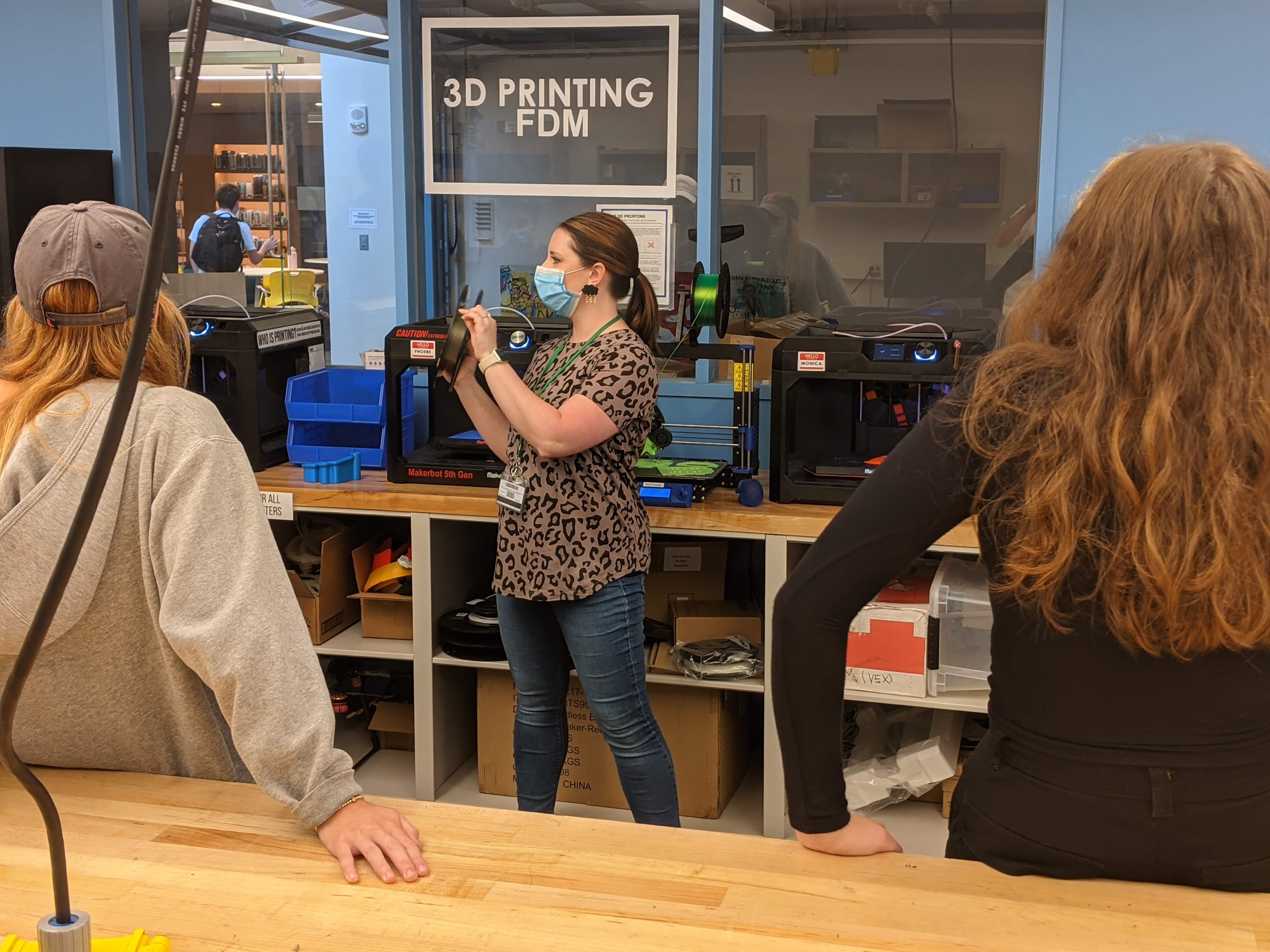
Makerspace guru Claudia Wessner introduces Human Origins students to 3D printing.
Students in Human Origins—an interdisciplinary science elective—visited with Claudia Wessner, Oliver Wendell Holmes Library Makerspace guru—who introduced the class to our hominin 3D printing project, including different 3D printing technologies, some of the ways that archaeologists use 3D printing and scanning, and Virtual Reality (VR) technology. Ms. Wessner also showed students how to use the Makerspace 3D printers for their projects.
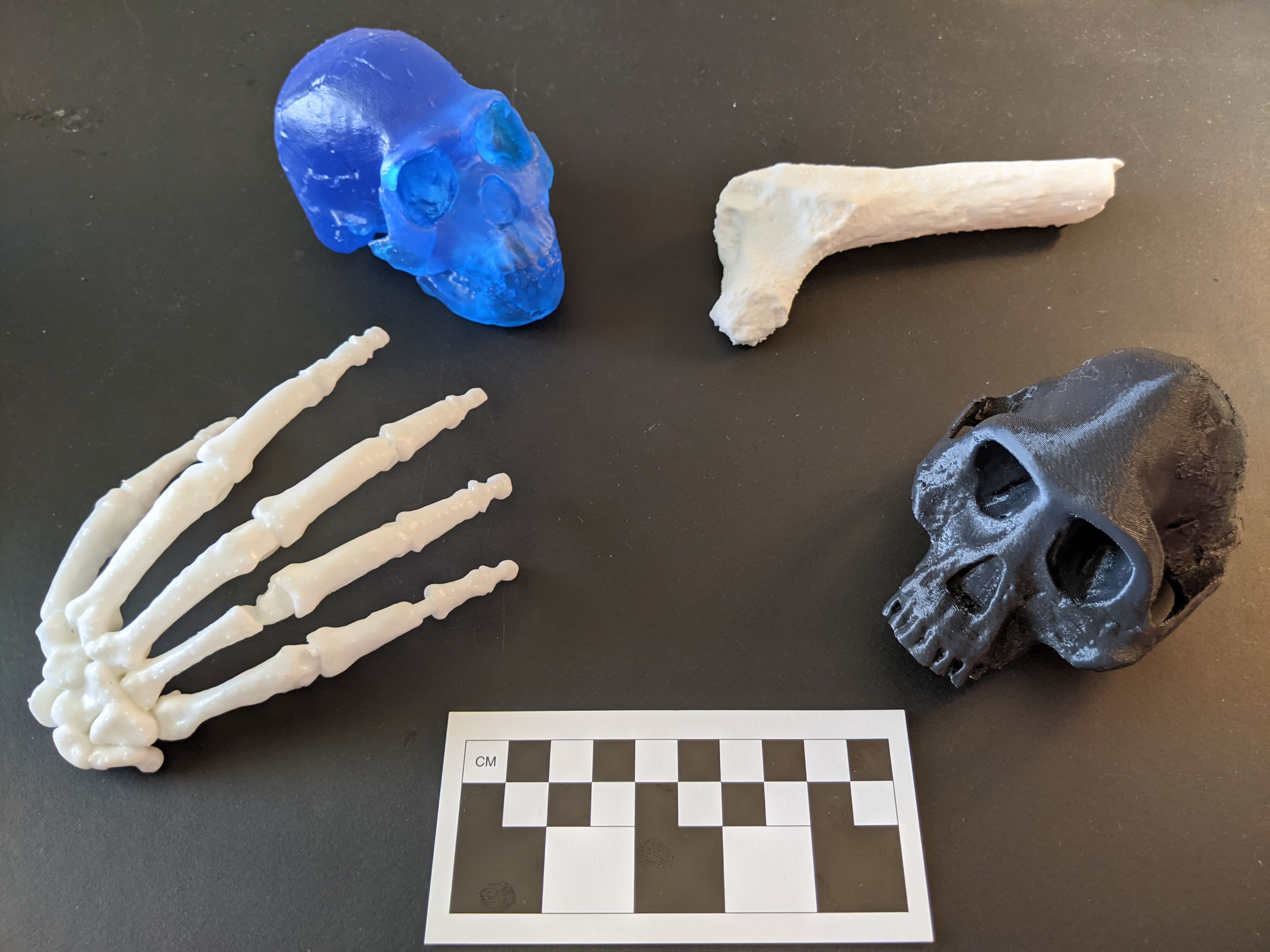
An assortment of 3D hominin prints.
Each project team will select a fossil hominin to 3D print in the Makerspace. Hominins are humans and their close extinct ancestors, including fossils dating back about 6 to 7 million years ago. Students will present their scaled prints, along with basic info on the fossil, during class in a few weeks. This project was inspired by the inclusion of 3D scans of Homo naledi in Morphosource, a database of 3D scans of fossils and biological specimens hosted by Duke University. Since the Homo naledi scans were made available in 2015, many additional fossil scans have been added, including other hominins.
CT scan of a Neanderthal from Duke University’s Morphosource databank.
During our September 2021 visit to the Makerspace, Ms. Wessner introduced us to Nefertari: Journey to Eternity-A Tombscale VR Experience. VR technology uses a headset interface so users can experience a virtual world, in this case an Egyptian tomb that has been scanned and recreated. We also discussed The Dawn of Art, Google’s VR version of Chauvet Cave in France, featuring some of the world’s oldest cave paintings.
Human Origins students got to explore Nefertari’s tomb in VR or Virtual Reality.
In July, I start to think about the upcoming fall course Human Origins. Last year I spent most of the summer retooling the course into an online experience. I owe a lot to the advice of my spouse, who passed along many of her experiences teaching online in spring 2020. I was pleased with the result—an iterative, assignment driven course, taught exclusively online, that even managed to keep some hands on activities. In fact, I plan to keep many elements of the online course—students in the fall will use Padlet for many of their assignments, we will dedicate at least two weeks to flint knapping, and we will keep the three major themes: pseudoscience, human evolution, and race. I will continue to look for ways to decolonize the syllabus as well. Considering the frequency of new discoveries (Google “Dragon Man,” for example), the focus is more on how to think about human evolution, rather than the details. The frequent new discoveries in the field continue to challenge the two competing models of human evolution, making us wonder, maybe we really need a new theory?
3D prints of fossil hominin skulls made by students in Human Origins, fall 2019.
I hope that we can revisit 3D printing again in the fall. Once many of the skeletal elements of Homo naledi became available on Morphosource, 3D printing became part of the course. For a few years, we visited the campus makerspace and looked at prints of Homo naledi’s more unusual features, including the hand and femur. In fall 2019, students worked in teams to 3D print their own miniature versions of fossil human skulls, learning details about each find and species as part of the assignment. Those miniature 3D prints got me thinking about earlier models and teaching tools for this subject, and my own first interests in human evolution.
Part of the foldout “March of Progress” graphic from Time Life’s Early Man book, circa 1970.
My first inkling that human evolution was something to be interested in came from a mid-1970s rebroadcast of a documentary called Natural History of Our World: The Time of Man (first aired, December 14, 1969). I wanted to watch this for two reasons: 1) Richard Basehart, who played Admiral Nelson in one of my favorite TV shows, Voyage to the Bottom of the Sea, provided the narration, and 2) I wanted to know more about the fossils shown in the teaser ads! I think my parents were a little baffled, but they let me stay up and watch it. I don’t remember much about that show, but it included some pretty incredible shots of volcanic activity and, of course, Basehart’s distinctive voice. Not long after that, my dad brought home a set of the Time Life nature books, with the 1970 edition of Early Man right on the top (it looks like Early Man was first published in 1965, but there were many reissues). That book captivated me! Books on dinosaurs, fossils, and evolution (for someone who was a kid, or perhaps anyone, really), were in short supply in the 1970s. I still share that book with students in Human Origins, and we talk about the many errors of the “March of Progress” graphic that launched a thousand memes. For a kid in the ‘70s interested in evolution, that book—authored by a serious scientist, H. Clark Howell—was a treasure.
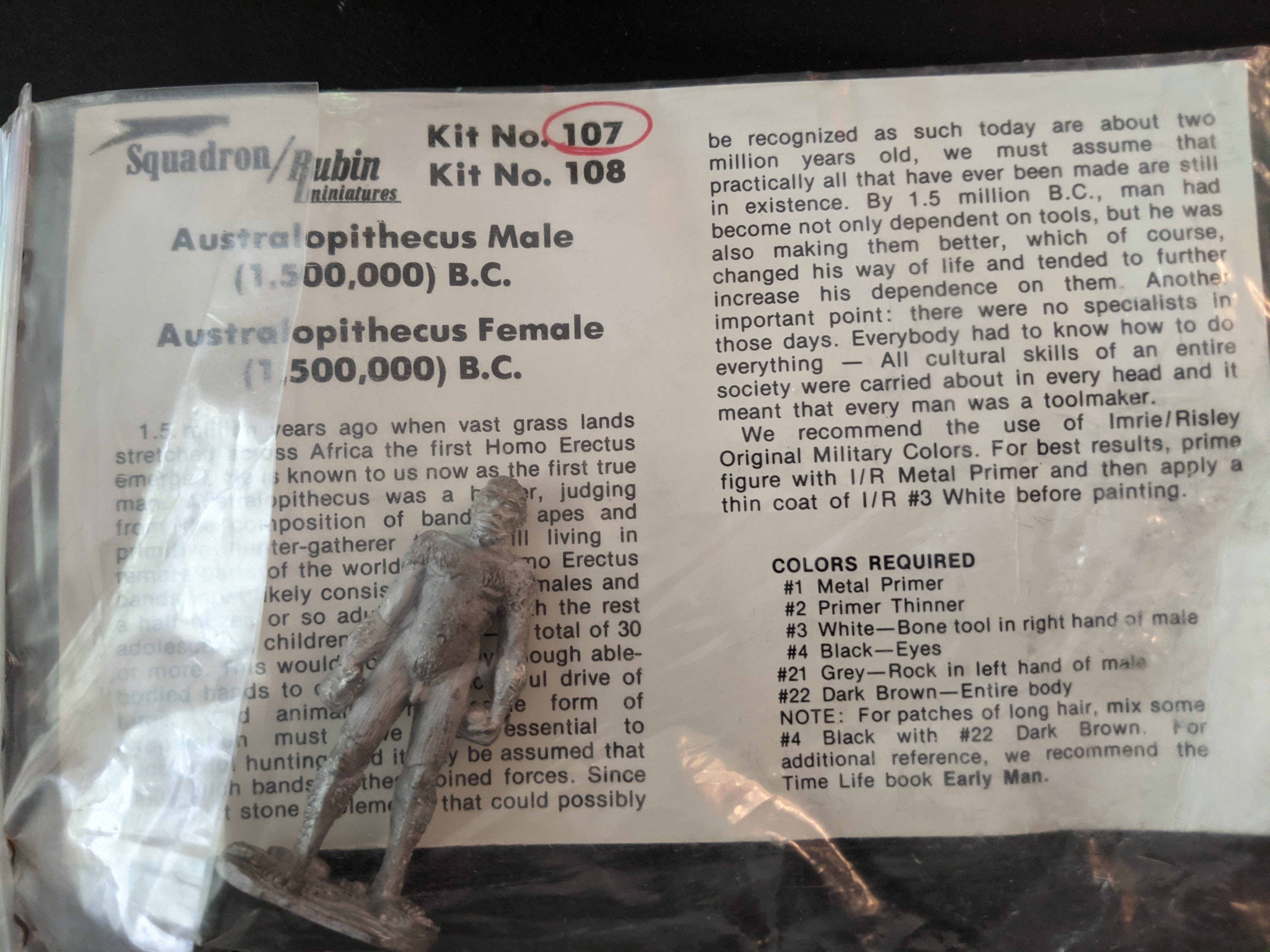
Squadron Rubin’s “Neanderthal man” figure with original packaging and color chart.
So imagine my delight when I found a tangible, material version of those fossil people. The discovery was in an unlikely place—the local hobby shop. I was interested in model kits, but the little metal figures of warriors, Vikings, and dragons were especially exciting. These were becoming more popular with the rise of the role playing game Dungeons & Dragons, and various alliances and licensing deals between the D&D publishers and companies like Grenadier who made these miniatures, or minis. There among the heros and monsters of D&D (think of the current TV show Stranger Things), were some old stock made by a company called Squadron Rubin. These were figures of all the fossil humans found in the pages of the Time Life Early Man book, and the color cards even referenced the book! Some Googling indicates that artist, sculptor, and businessperson Raymond Rubin was behind these figures. The main figures made by Squadron Rubin were of historical soldiers, spanning the Picts to Vietnam and every period in between. The idea was that you could buy these, glue as necessary, and paint following the color chart provided, building up your army. Eventually Rubin collaborated with others to launch Grenadier, the company that dominated the metal miniature business for a while. I wish I knew more of the story behind how the world of metal miniatures intersected with human evolution, but I was happy that it had!
The Squadron Rubin Australopithecus male figure with color chart!
The Squadron Rubin fossil people are 1:32 scale, so most are around or just under 2 inches tall. And, they aren’t frenzied savages like the “cavemen” depicted by Frank Frazetta or other artists around the same time. The artistic recreations in the Early Man book supplied the inspiration, and the figures are usually just posing, often in male-female pairs. I’ve managed to locate examples of Squadron Rubin Neanderthals, Australopithecines, and Cro-Magnon people, and I suspect there were other species depicted as well. Occasionally, they turn up on eBay.
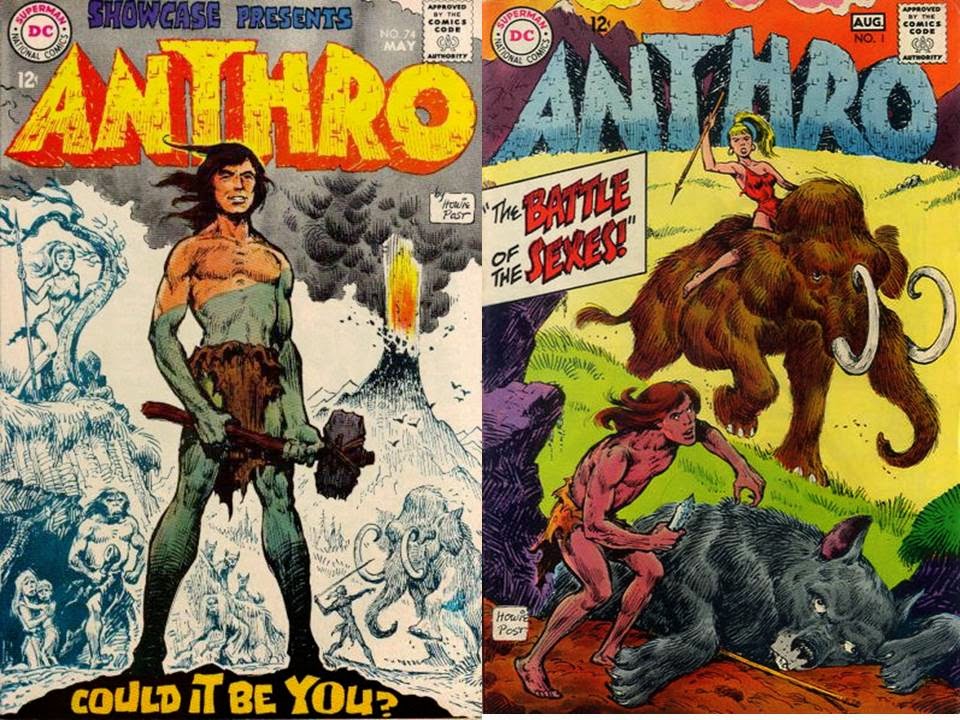
Covers from DC Comic’s “Anthro,” which pitted the first Cro-Magnon (or modern human) against an array of cave brutes and prehistoric monsters, late 1960s.
The Squadron Rubin figures, along with the many other depictions of fossil humans in popular writing, TV ads, comic books, movies, artwork, and sculptures give us a glimpse into thinking about human evolution and fossil people through time. I often ask the Human Origins students to find and research examples of how fossil humans were depicted in popular culture. Are the treatments sympathetic, savage, sexualized, or something else? Often this has to do with ideas about how closely modern humans are linked to these ancient people. The recognition of genetic connections between modern humans and Neanderthals in 2011 marked one shift in our relationship to “cavemen.” Once we understood there was a connection between us and them, depictions of ancient people began to shift, becoming more sympathetic and sensitive to our ancestors. But, it depends a lot on the artist, medium, and specific circumstances.
I was excited when Bernard Means of the Virtual Curation Lab posted 3D slice models of artifacts and fossils. The models reminded me of the topographic models we made in the Boy Scouts. We cut out and stacked cardboard pieces, replicating the elevation contours of a topographic map. A two dimensional image was transformed into 3D! Lock down means most of us are away from 3D scanners and printers, so the cardboard patterns are a fun way to make 3D models. Plus, I LOVE building stuff out of cardboard, often with my eight-year old son Leo. Leo and I have made a Corinthian helmet, the TARDIS and K-9 from Doctor Who, a wearable sea turtle carapace, a model of our house, and much more.
Choosing a 3D Slice Model
Initially I wanted to build the Virtual Curation Lab 3D slice model of a dire wolf skull. I downloaded the plans and watched the video loop showing a virtual assembly. Ultimately, I opted for the Megalonyx femur. I decided that it was a little simpler, and might make a better first build. Each set of plans includes numbered pieces with registration marks that indicate how all the pieces stack. I like Megalonyx too, since these giant ground sloths existed in my home state, and some Florida rivers occasionally reveal fossilized bones. Megalonyx existed across much of North America for over 10 million years, ultimately becoming extinct around 11,000 years ago!
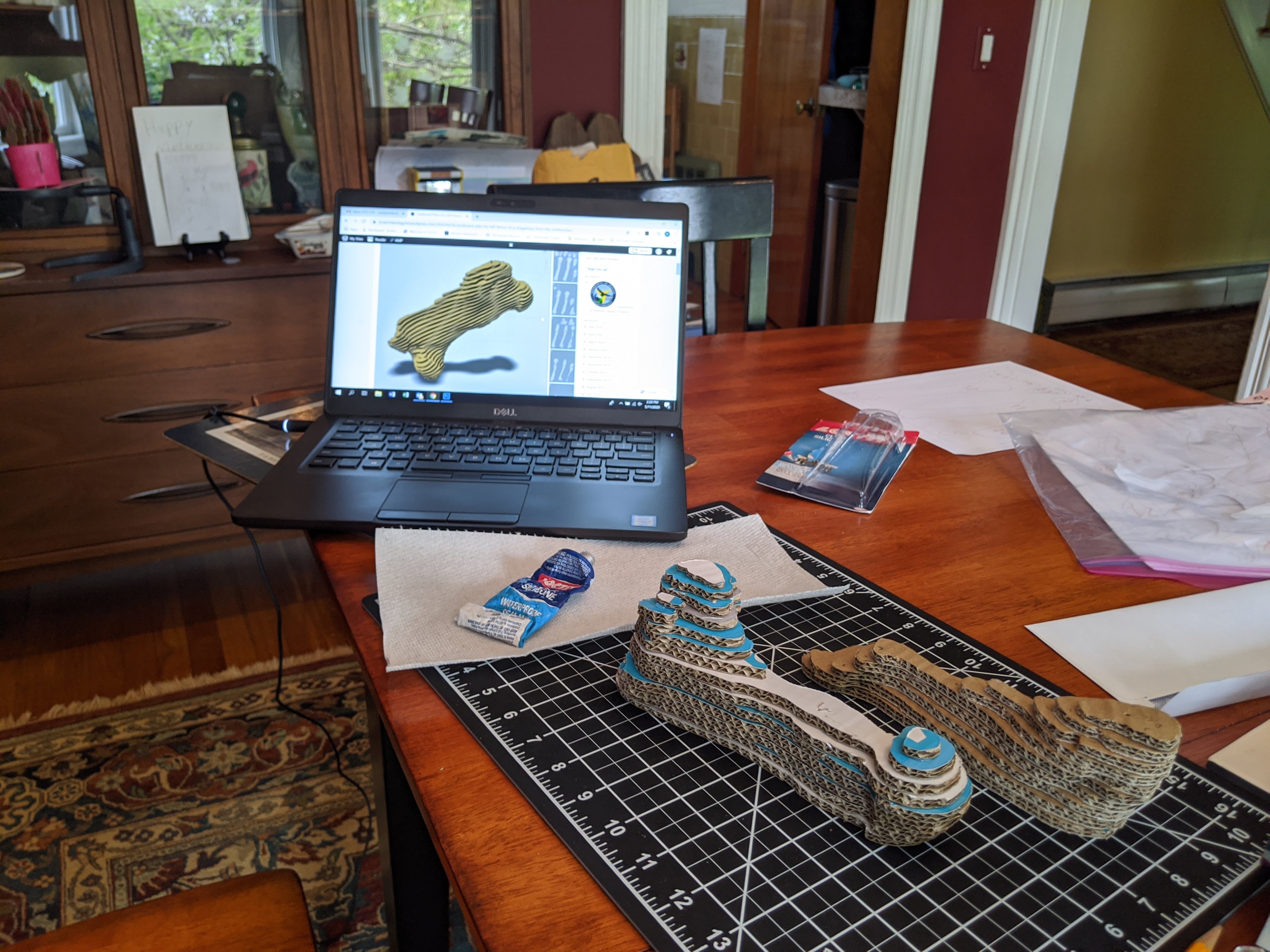
Stacked pieces of the Megalonyx femur with the VCL model playing in the background.
Assembling Materials
I started by downloading and printing a set of the plans from the Virtual Curation Lab. There are five pages with approximately 26 pieces for the Megalonyx femur. I printed two sets of plans, keeping one for reference as I cut each piece out to make patterns. As I worked on creating the patterns for each piece, I assembled my other materials, including:
pieces of thick, corrugated cardboard from a shipping box (thin cardboard, like a cereal box, won’t work well),
an X-acto knife with a supply of #11 blades,
a cutting mat,
an envelope to store the paper patterns,
adhesive glue,
and some black spray paint and some brown and tan acrylic modeling paint.
Cutting the cardboard pieces with a #11 X-acto blade.
Creating the Model
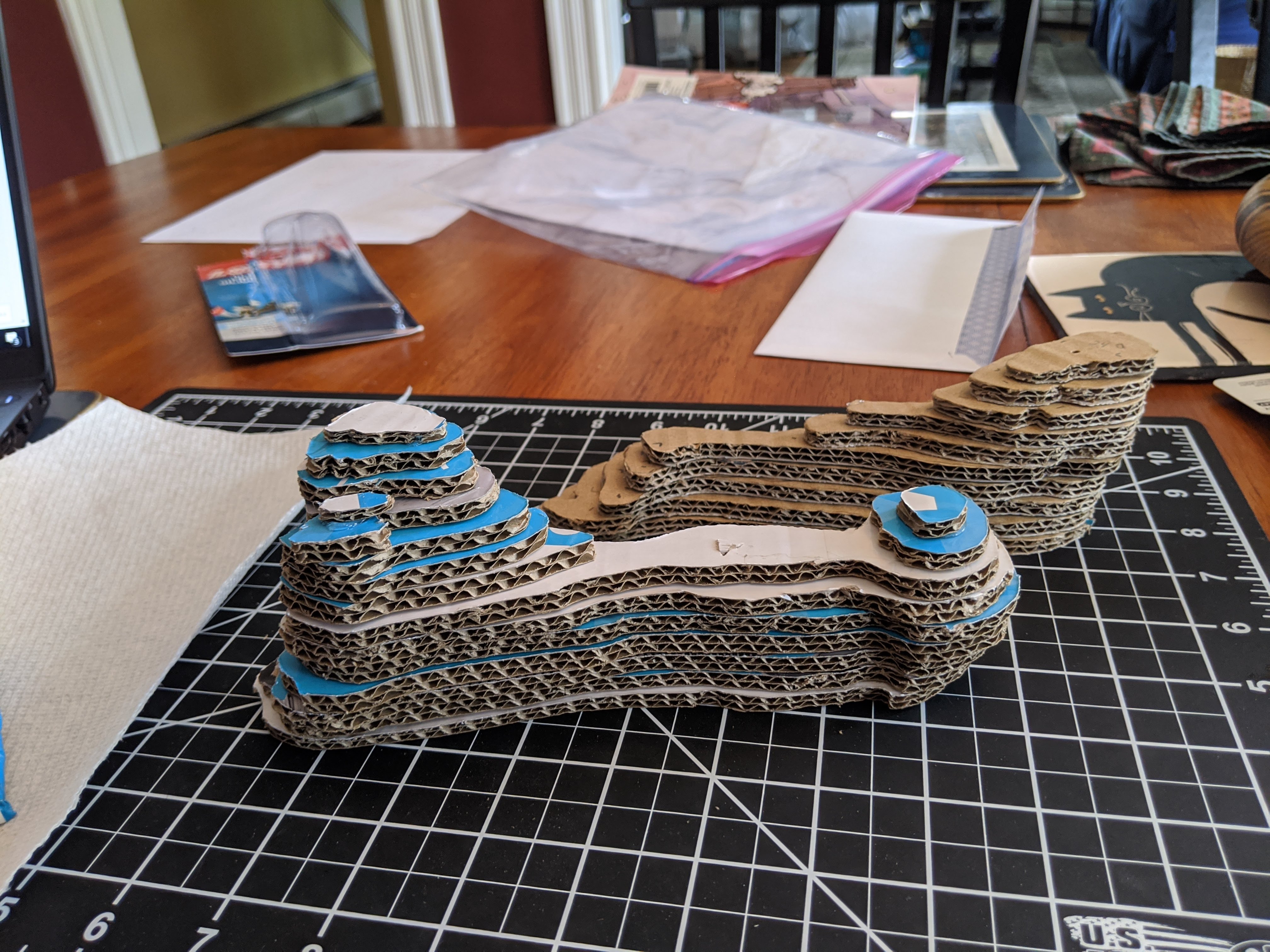
As I began making paper patterns for each piece, I noticed that some of the pieces are rather small or have narrow sections when printed on an 8.5 x 11-inch piece of paper. I decided to scale things up by adding about 1/8-inch on each side of each pattern. One could also use a program like Photoshop to scale up the pattern. I traced the patterns onto the cardboard, making sure to keep the long axis of each piece against the “grain” of the cardboard. This produced pieces that showed the honeycomb structure of the corrugate cardboard along their long side. I was a little worried that my cardboard might be too thick (2/8-inch), but the Megalonyx femur is a big, thick, flattish piece of bone, so I decided to keep going. Next time I will use some 1/8-inch corrugated cardboard. Change the X-acto blades with some regularity—they get dull quickly! I also made sure to transfer over the piece number and registration marks as I went. I saved all the pattern pieces in an envelope for future use. Once all the cardboard pieces were cut out I made a few test stacks and cleaned up edges as needed. I used some silicon glue left over from another project to adhere all the pieces. This provided for easy cleanup, allowed me to reposition pieces as needed, and made for a nice, solid bond after 35 minutes. White glue should work fine too. Dr. Means suggests on the Virtual Curation Lab blog assembling the models from the center moving outward. This worked well, and I made two large sections of the model that I then joined. I also had the virtual assembly loop playing to make sure the pieces were going together correctly. Following the registration marks is important too!
Two large glued-up segments of the cardboard slice model.
Painting and Decorating
When the cardboard was well bonded, I went to the garage to spray paint the model in a well-ventilated space. I used some leftover black spray paint to give a quick base coat. After the paint dried, I added some details with brown and tan acrylic paint. Minerals and tannins have heavily stained fossils from Florida rivers and quarries blackish-brown. Once I achieved the desired effect, I left the Megalonyx model to dry. My son produced a background drawing for display.
Two views of the finished Megalonyx 3D slice model after final assembly and painting.
Final Thoughts
Building these cardboard 3D slice models is a fun and low-tech way to learn about fossils and artifacts. During each stage of the build, my son and I looked up facts about the Megalonyx. The name Megalonyx is Greek for “large claw,” referring to the large, curved claws used for grabbing branches and foliage, their main food. We learned that our model, measuring about 9-inches long is about one-half scale. Megalonyx femurs measured by paleontologists are as much as 20-inches long! This was an impressive animal, measuring around 10-feet tall and weighing over 2,000 pounds. Their closest living relatives are the three-toed sloths of Central and South America, though these are much, much smaller! There are indications, too, that Native Americans hunted Megalonyx during the late Pleistocene.
The painted Megalonyx femur model on a background created by the author’s son Leo.
I’ve also made a Youtube video illustrating the build.









 The Peabody