This blog represents the twelfth entry in a blog series – Peabody 25 – that will delve into the history of the Peabody Institute through objects in our collection. A new post will be out with each newsletter, so keep your eyes peeled for the Peabody 25 tag!
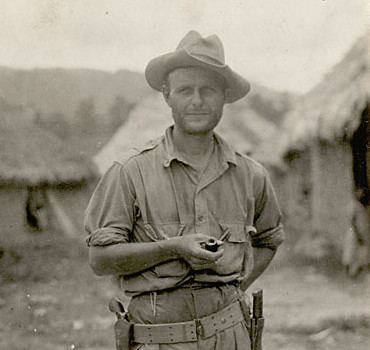
The Peabody Institute holds many collections from across North America. In the early 20th century, institutions often traded objects with one another in order to expand holdings and develop more diverse collections. One of the collections the Peabody received in trade is the William Duncan Strong collection, which consists of objects from Labrador. Strong was a prolific archaeologist and anthropologist who was known for his direct historical approach to studying Indigenous cultures of North and South America.
William Duncan Strong was born in Portland, Oregon in 1899. He attended the University of California at Berkeley where he initially studied zoology before switching his focus to Anthropology. While at Berkeley, he studied under Alfred L. Kroeber, a well-known American anthropologist who Strong considered a mentor and friend. Strong received his Ph. D. in 1926. His dissertation, titled “An Analysis of Southwestern Society,” was subsequently published in American Anthropologist, the flagship journal of the American Anthropological Association. Throughout his career, Strong conducted ethnographic and archaeological studies throughout southern California, Nebraska, the Pacific Northwest, the Great Plains, Peru, and Labrador.
William Duncan Strong. Photo Source: Alchetron.com/william-duncan-strong
The Labrador collection is one of the largest collections housed at the Peabody. It was given to the Peabody by the Field Museum in Chicago in exchange for materials from Pecos Pueblo. The Labrador collection contains many interesting artifacts from the Arctic region. Strong assembled the collection as part of a 1927-28 expedition to the Arctic led by Commander Donald B. MacMillan. MacMillan was known for his arctic cruises, which often included a variety of scientists and observers. Most of Strong’s time was spent in ethnographic research with the Montagnais-Naskapi, but he also found time to excavate several Inuit villages—this is where the Peabody collection originated.
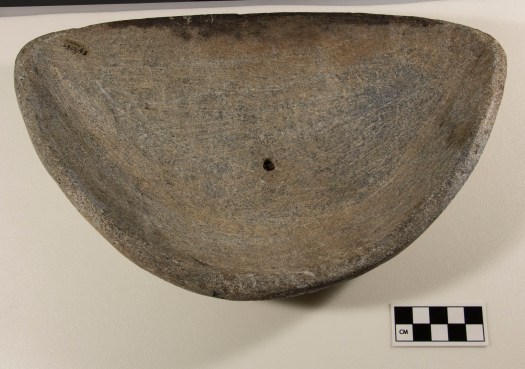
One of the artifacts that I found the most intriguing was what looked like a boat carved out of stone. I asked about what this object was since I had never come across anything like it. I thought perhaps it was some kind of kettle but I was informed that it was actually a lamp called a Kudlik.
One of the Kudliks present in our collection.
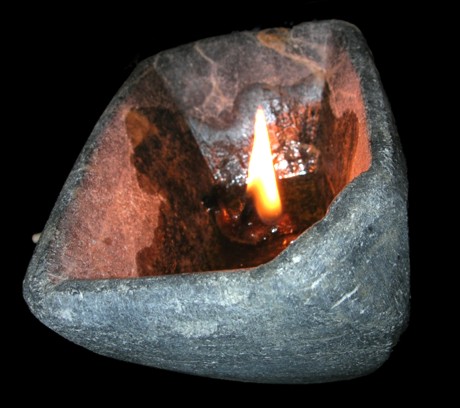
These lamps were typically used by people in the Arctic to light and heat their dwellings, to melt snow, and to cook. They were usually made out of soapstone, which was carved into a dish-like object with a shallow perforation in the center. This is where the wick, which was fashioned from cottongrass or moss, would be placed. The surrounding dish was then most commonly filled with seal blubber, although whale blubber was also used in whaling communities. The wick would soak in blubber, which would then allow it to remain lit and provide people with light.
A picture of a Kudlik in use. Photo Credit: elfshotgallery.blogspot.com
It is always very interesting to see how people in the past used various objects from their environment to create tools that we still use to this day!
Artifact collections are not meant to stagnate – museum collections are meant to be researched, examined, and shared. In a perfect world, all loans are returned promptly and paper-work is meticulous. But, let’s be real, in an institution with 100+ years of history, this is not often the case. Fortunately, some past researchers remember you when it is time to relocate collections.
Circa 1972, Scotty MacNeish sent faunal material from the Ayacucho Valley of Peru to Dr. Kent Flannery of the University of Michigan for analysis. Dr. Flannery is a prominent zooarchaeologist who specializes in investigating the origins of agriculture in Mesoamerica and the Near East. Many know Flannery from his 1976 book The Early Mesoamerican Village and his 1982 article The Golden Marshalltown: A Parable for the Archeology of the 1980s. Dr. Flannery completed the Ayacucho faunal analysis and sent data and a written chapter (for Volume I of the Prehistory of the Ayacucho Basin) back to MacNeish. But the artifacts were not returned until July, 2018.
Dr. Flannery, and the Museum of Anthropological Archaeology at the University of Michigan, shipped us 493 bags and 11 small boxes of faunal material. A loan from 45 years ago, of course, did not have much paperwork, though we did locate the original Peruvian export permits and customs documents. But, all bags and boxes are now inventoried and part of the Peabody collection. The material is from Jaywamachay Cave, Ruyru Rumi Cave, and Chumpas Cave in the Ayacucho Valley.
Boxes returned bones find a new home
The material was largely returned in bags like these
An example of the faunal material from Ayacucho
Why does this matter? These collections can now be made available to a new generation of researchers and are reunited with other materials from MacNeish’s Ayacucho work.
If you want to learn more about the Ayacucho Valley and MacNeish’s work, check out the First Annual Report and Second Annual Report on the Ayacucho Archaeological Botanic Project. Some of the published volumes are available for free via the HathiTrust Digital Library.
Last week, members of the Peabody staff made their way down to Washington D. C. to attend the 83rd annual meeting of the Society for American Archaeology! This society is the largest organization for archaeologists who conduct work in North and South America. It was founded in 1934 and had its very first meeting at Phillips Academy in December 1935. Today, the SAA is comprised of over 7000 members. The annual meeting of the SAA lasts for four days. Archaeologists from all over the Americas get together to present papers and posters pertaining to their research, conduct symposiums related to current issues in and directions for the field of archaeology, and many institutions and vendors rent space in the book room to promote their organizations.
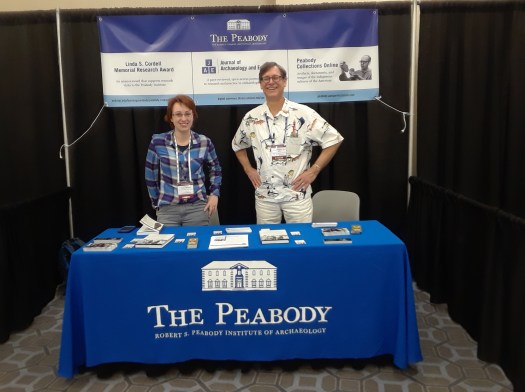
Dr. Wheeler and Rachel behind the Peabody’s table.
This was my primary task at the SAA meeting this year. The Robert S. Peabody Institute had a table in the exhibition hall manned by Peabody staff members. This is a great way for other conference attendees to stop by and talk to us about what is going on at the Institute, find out whether or not we have collections that researchers are interested in, and learn more about our online collections, Cordell Scholarship award and the Journal of Archaeology & Education. There was also an order form for anyone who interested in purchasing our new book, Glory, Trouble, and Renaissance at the Robert S. Peabody Museum of Archaeology. All in all, working the table was a great experience. It was awesome getting to talk to fellow archaeologists who might not have ever crossed my path if not for the Peabody table.
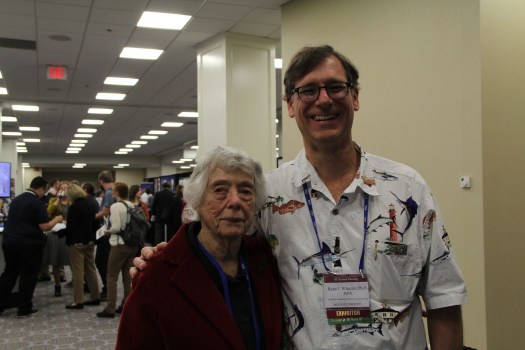
Dr. Wheeler and his former advisor Dr. Barbara Purdy
In addition to the educational and networking benefits that come along with attending conferences, the SAA is also a great place to get to see former colleagues and friends who have gone their own ways. I had the chance to see so many people that I never get to see anymore because in the world of archaeology, people can work with you one year and then go work halfway across the world the next! People I know came from St. Louis, Albany, New York City, Virginia, New Mexico and even Hawaii! I saw colleagues from my very early days as an archaeologist in New York, as well as friends that I had made working on projects all the way down in Virginia. It was very enjoyable to have my multiple spheres of friends finally collide in one space.
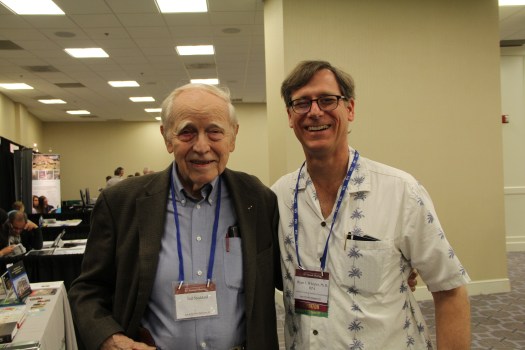
Dr. Ryan Wheeler with Ted Stoddard, whose collections are housed at the Peabody!
Because the conference was in Washington, D.C., it also provided the opportunity to see museums in the area. The main museum I had wanted to see was the National Museum of African American History and Culture. Unfortunately, everyone else in the city wants to go there too, and even though we tried to grab tickets at 6:30 AM, there were none to be had. I walked the mall with some friends anyway. The weather was gorgeous, passing 80 degrees! The cherry blossoms and sun were out and it was a great day to walk around outside and see the various monuments (which look much better in the sun and heat than they did the last time I was in D.C. in January 2016 with clouds and rain).
Check out those cherry blossoms blooming!
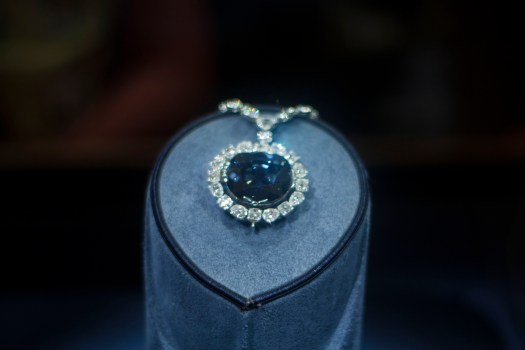
I finally made my way to the Smithsonian National Museum of Natural History. I’ve somehow never been to this one before, and I’m very glad that I went. The museum had numerous exhibits, including precious gems and rock formations, dinosaurs, a human origins exhibit, an osteology exhibit and even an exhibit showcasing mummies from Egypt. The collection of faunal skeletons in the Osteology Hall was particularly fascinating. It’s amazing to see how similar many creatures are when they are stripped down to just bone.
The Hope Diamond housed at the National Museum of Natural History.
The four days spent in D.C. for the SAA were amazing and I hope a good time was had by all who attended. It was a nice break from the daily routines I have here at the Peabody!
The Inventory Specialist position is supported by a generous grant from the Oak River Foundation of Peoria, Ill. to improve the intellectual and physical control of the institute’s collections. We hope this gift will inspire others to support our work to better catalog, document, and make accessible the Peabody’s world-class collections of objects, photographs, and archival materials. If you would like information on how you can help please contact Peabody director Ryan Wheeler at rwheeler@andover.edu or 978 749 4493.
When I joined the staff of the Robert S. Peabody Museum of Archaeology in July 2012 there was major project underway. At the 2011 annual meeting of the Society for American Archaeology, then Peabody director Malinda Stafford Blustain had organized a symposium on the history of our venerable institution. Presentations were made by archaeologists, as well as Phillips Academy faculty members, administrators, and alumni, and covered everything from the scientific contributions and the ups and downs of the Peabody to personal recollections. The major theme of that symposium was conveyed in its title, “Rising from the Ashes: Glory, Trouble, and Renaissance at the Robert S. Peabody Museum of Archaeology.” In 2002 financial issues and lack of connections with our parent institution, Phillips Academy, came to a head and resulted in a potential shuttering of the Peabody. That didn’t happen, and the 2011 SAA symposium was a celebration and reflection on what can be described as a very unusual place: an archaeology museum situated at a storied New England prep school.
Participants in the 2011 symposium “Rising from the Ashes” at the 2011 Society for American Archaeology annual meeting, Sacramento, California.
Malinda had done the Herculean task of procuring drafts of each symposium presentation and recruited Jane Libby, close friend and colleague of former Peabody director Richard “Scotty” MacNeish, to help with editing. The plan was to edit, design, and print the volume in-house. Linda S. Cordell, Peabody Advisory Committee member and contributor to the volume, had insisted on peer review; reviewers had been identified and were submitting notes to Blustain and Libby. When I joined the team it became clear that there were several challenges. Some of the contributions needed lots of editing, some were very long, there were over 100 photographs planned for inclusion, and, most notably, we possessed no means to warehouse, market, or fulfil orders. In September 2012 Linda Cordell and I discussed the project and I also spoke with Lynn Baca, then editor at the School for Advanced Research in Santa Fe and John Strand, editor for the American Alliance of Museums. We all agreed that the project had lots of merit, but that there were any number of obstacles to overcome. Institutional histories can be tricky to publish, as they often have a limited audience. Our lack of distribution and fulfillment created problems, as did questions of storage. As a part of Phillips Academy, we have no way to set up a bank account or receive payments. It was clear that we needed a publishing partner and that we needed to do some serious editing.
Peabody publications from the 1920s through the 1970s.
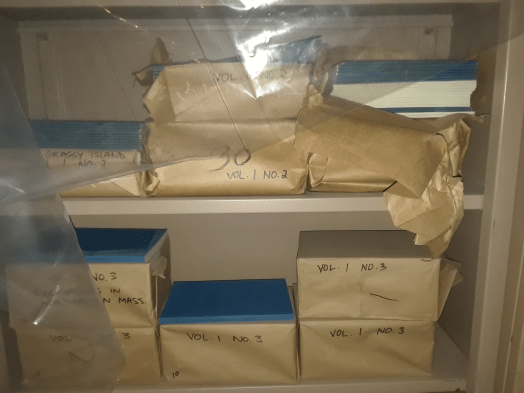
Our own history provided a clue. In the 1920s Alfred V. Kidder established a relationship with the Yale University Press. Yale published Kidder’s An Introduction to the Study of Southwestern Archaeology in 1924 (and it has remained in print since that time). Other volumes in Kidder’s Southwest project also were published by Yale, including studies of Pecos Pueblo artifacts, pottery, and volumes prepared by Carl Guthe, Elsie Clews Parsons, and Earnest Hooten. Warren Moorehead used the Yale press connection to bring out his volumes on Etowah and sites in Arkansas and neighboring areas. Some of these Yale titles are still in print, while others are hard to find, even on Internet book searches. The “blue book” series, developed in the 1930s by the Peabody’s Doug Byers and Frederick Johnson, suffered from many of the same problems that we were facing with the new volume: lack of distribution, marketing, and fulfillment logistics. Despite producing some significant work, most of the printed “blue books” are still stored here in the Peabody attic. We’ve had the bulk of this series digitized and made available via InternetArchive. Scotty MacNeish avoided these issues by partnering with academic presses at the University of Texas and the University of Michigan, which brought out his five-volume Tehuacan and three-volume Ayacucho studies in the 1960s through 1980s. This was clearly the solution!
Copies of Peabody “blue books,” so-called because of their blue paper covers, still housed in the attic. Many institutions had similar publication series–and similar challenges.
By the end of 2012 I hired writer and editor Sharon Magnuson to help work on the project. She continued to work on editing through the end of 2016. We were able to return substantive review comments to authors, along with copy-edited versions created by Sharon. In 2013 I had conversation with the kind folks at Harvard’s Peabody Museum Press, who were publishing David L. Browman and Stephen Williams fabulous Anthropology at Harvard: A Biographical History, 1790-1940. There were some discussions about publishing our volume as a companion piece and I prepared a prospectus. Time and other commitments didn’t allow that relationship to go forward, but conversations with Harvard’s Joan O’Donnell helped me think through some of the challenges. One idea that Sharon Magnuson and I tackled was to make some of the personal reflection chapters into much shorter essays or sidebars. This helped focus these pieces, and significantly shortened our page and image count. Sharon’s great editorial eye also helped identity a few other issues, including one massive bibliography that had one chapter tipping the scales at over 80 pages! We put it on a diet.
By September 2015 I felt that the book was in pretty good shape and I was on the hunt for a publisher. Early efforts were a bit discouraging and I was prepared to revisit in-house publishing. Marshall Cloyd, Phillips Academy Class of 1958 and long-time member of the Peabody Advisory Committee gave me a pep talk and encouraged me to keep trying. Archaeologist David Hurst Thomas of the American Museum of Natural History was kind enough to help me brainstorm ideas about presses that might be interested. It was clear that we needed an academic press that was publishing histories of archaeology and anthropology. I ultimately sent out at least twenty inquiries. I got a lot of rejections! I did, however, have interest from presses at the University of New Mexico and the University of Nebraska. Editor Matthew Bokovoy at Nebraska thought the book might fit nicely in their Critical Histories of Anthropology series. I supplied the manuscript and waited for reviewer comments and a decision from Matt and series editors Regna Darnell and Stephen Murray.
On July 5, 2016 we had two sets of review comments and positive feedback from the press. I prepared a response to reader’s comments, which was due August 1, 2016. The folks at Nebraska got it—we had an interesting story to tell, one that was often central to the history of American archaeology, but one that also was little known. It was summer 2016 and it was clear that we still had a lot of work to do. The editors and the twenty contributors alike had lots of constructive comments to address. We needed to cut back on the figures—we agreed that fifty-five was the right number—and we needed to find a way to reintegrate those sidebars that we had created into the regular chapter structure. By September 2016 we had an agreement with Nebraska and were working away on a final draft, which we submitted in January 2017.
Despite the joy surrounding the completion of the manuscript, we must remember the people that we lost during this journey. Linda S. Cordell (1943-2013), who wrote about Alfred Kidder’s contributions at Pecos Pueblo and pushed for a peer-reviewed volume, died March 29, 2013. Gene Winter (1927-2014), long-time Peabody volunteer and honorary curator, passed on February 24, 2014. Gene brought his tremendous knowledge of New England archaeology and institutional history to the volume and I am so grateful that I was able to sit with him and work on revisions to his co-authored chapter. Most recently the world of archaeology lost another bright light in Brian Robinson (1953-2016). Brian passed on October 27, 2016. He and I had had many discussions about Maine archaeology and our decision to affiliate and repatriate funerary objects from the Nevin site to the Wabanaki tribes. The last conversation we had was about his chapter and some final notes from the copyeditor. Linda, Gene, and Brian were kind, generous, and knowledgeable people who made time for the Robert S. Peabody Museum, shared our values and vision, and helped to make us better. You will be missed.
Over the course of 2017 we got to know many people at the University of Nebraska Press. We worked closely with copyeditor Sally Antrobus, as well as production editor Joeth Zucco, who both brought a lot to the volume. Heather Stauffer answered lots of questions and helped keep us on track. I was happy for the opportunity to meet editor Matthew Bokovoy in early December 2017 at the American Anthropological Association annual meeting in Washington DC and share just how professional, encouraging, and kind he and his entire staff had been during the publication process.
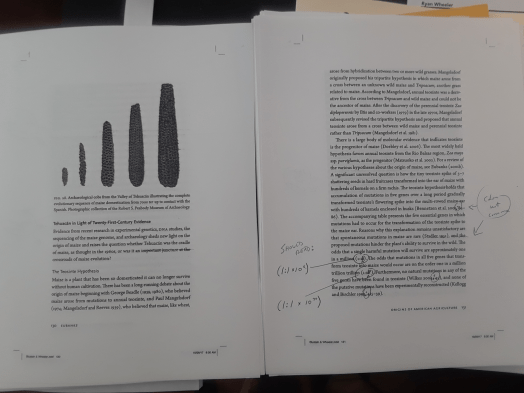
Pages from the galley proofs were marked up and returned to the press–this was the last time we saw the book before publication! These pages are from Mary Eubanks’ chapter on Scotty MacNeish and the search for the origins of corn domestication.
Marla Taylor, Peabody curator of collections, Irene Gates, archivist, and Lesley Shahbazian, staff assistant, all contributed to the volume, helping to find, re-find, and re-re-find photographs, providing proper citations for archival materials, and helping to obtain permissions. Their help is greatly appreciated!
One final person deserves a special mention. Dr. Peter Hetzler, Phillips Academy Class of 1972, and member of the Academy’s Board of Trustees and the Peabody Advisory Committee, provided much-needed support for publication of the volume. Archaeologist Jimmy Griffin once used the term “archaeological angel.” I can think of no better way to describe Peter!
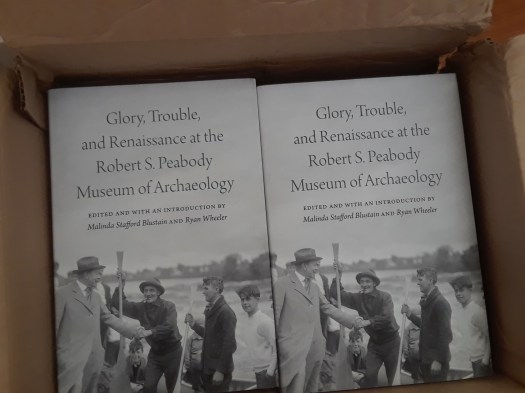
Copies of Glory, Trouble, and Renaissance at the Robert S. Peabody Museum of Archaeology arrived in early March 2018!
Copies of the published book arrived at my office on March 5, 2018. It’s a beautiful book with some amazing stories. Glory, Trouble, and Renaissance at the Robert S. Peabody Museum of Archaeology is a testament to what people did here, from Alfred V. Kidder and Warren K. Moorehead to today’s museum professionals, educators, and students. If you’d like a copy they are available directly from the University of Nebraska Press and on Amazon!
The Peabody has a new name! The Phillips Academy Board of Trustees, at their November 5, 2017 meeting, approved the Peabody’s new name. We are now known as the Robert S. Peabody Institute of Archaeology. Part of our proposal for a name change–included below–addresses the history of our institution’s name, issues of identity, and practical concerns:
Throughout the Peabody’s strategic planning work in 2014 and 2015 there was frequent discussion about the need for focused work on branding. These conversations included Museum personnel, members of the Peabody Advisory Committee, and the broader Phillips Academy community. There was general agreement that one issue was the name Robert S. Peabody Museum of Archaeology. Discussants pointed out that the name “Peabody” often leads to confusion with the other, larger institutions in Salem, Cambridge, and New Haven, and that the term “museum” is misleading.
The topic of branding was revisited during the Peabody Advisory Committee’s 2016 summer retreat and November 2016 meeting and the group proposed a name change.
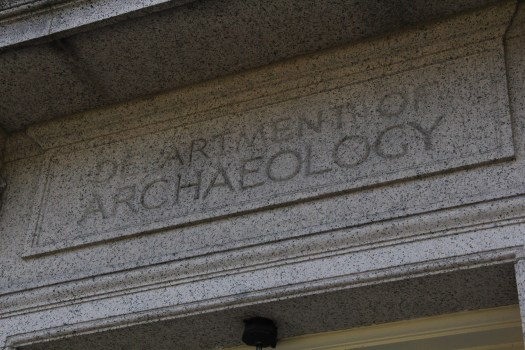
“Department of Archaeology” engraved in the granite entablature above the door was part of architect Guy Lowell’s original 1901 building design and reflects Robert S. Peabody’s interest in seeing the institution as an integral part of campus pedagogy.
The topic of a potential name change has been considered in three ways:
1) Historical— Past names for our institution include Department of Archaeology (1901-1938); Robert S. Peabody Foundation for Archaeology (1938-1995); and Robert S. Peabody Museum of Archaeology (1990-present). The most recent name change occurred in the 1990s and was made to reflect the interest in creating an exhibition driven institution like the Addison Gallery of American Art. That program ended in 2002 with a shift to our current focus on teaching and learning.
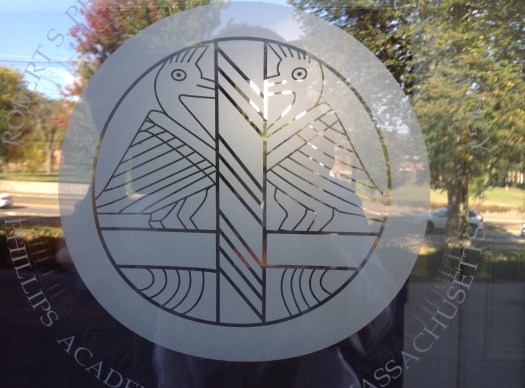
The logo from the Peabody’s front doors is based on a shell gorget from the Etowah site in Georgia.
2) Identity—Museum personnel and advisory committee members have discussed whether or not we are a museum. For example, Eugene Dillenberg’s 2011 article in Exhibitionist emphasizes exhibitions as the core defining aspect of a museum, with exhibits as the primary mission and goal of the institution. The Peabody’s current mission is to provide archaeological and anthropological learning opportunities to the students of Phillips Academy, returning to Robert Peabody’s original vision for the institution, which was to introduce students to the emerging disciplines of archaeology and anthropology, to conduct scientific research, and to provide a place for student activities. There also was general agreement that it was important to retain the name “Peabody,” despite the proliferation of Peabody museums in New England. The sense was that we would continue to be called “The Peabody” on campus and in the broader Phillips Academy community.
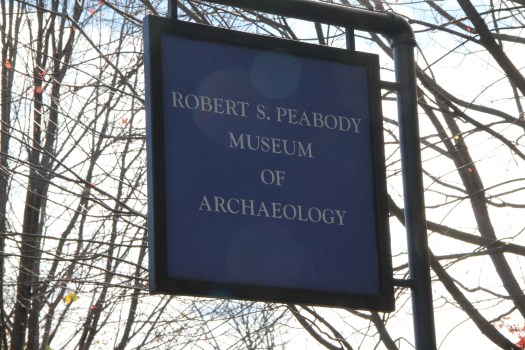
Blue sign for the Robert S. Peabody Museum of Archaeology on Andover’s Main Street.
3) Practical—the word “museum” creates considerable confusion as people come here expecting a more typical museum experience. While we are happy to have people come for tours and events (and classes, of course!) we are a pretty disappointing experience to a growing number of casual visitors. As we become more well-known in the area more people have become curious about what is inside the building and come in to find out.
In his gift letter to the Board of Trustees and the Academy administrators in 1901 Robert S. Peabody shared that he did not want to create a museum on campus, but rather to find ways to introduce students to the fields of archaeology and anthropology. We’ve come to recognize the prescience and vision of Peabody’s original idea for our institution. We trust the name change will help avoid confusion and emphasize our commitment to teaching and learning on campus and beyond.
This blog represents the ninth entry in a blog series – Peabody 25 – that will delve into the history of the Peabody Museum through objects in our collection. A new post will be out with each newsletter, so keep your eyes peeled of the Peabody 25 tag!
Bureaucracy and oversight committees are not modern phenomena. In the earliest years of the Peabody, contemporaneously known as the Department of Archaeology, the work done was overseen by a subcommittee of the Trustees of Phillips Academy. However, the Trustees recognized the limitations of their own knowledge in the world of archaeology and appointed a Special Advisory Committee on Archaeology in 1914.
The special committee was tasked with assessing mundane logistical needs of the Department as well as providing direction and feedback on proposed research. Composed of five prominent anthropologists; Franz Boas, William Henry Holmes, Roland Dixon, Hiram Bingham, and Frederic Ward Putnam, the committee made the following suggestions:
Install a synoptic exhibit, strictly limited in size and scope, of the life of man from geological time to the beginnings of history
Limit public lectures to no more than 4 each year
End formal classes in archaeology for the students at Phillips Academy and instead encourage individual students as their interests dictate
The work of ‘research’ should include two separate divisions; one to investigate large definite problems of archaeology, and the other to aid competent archaeologists in the execution of such of their plans
Appoint a small permanent advisory committee of experts of easy access, whose duty it shall be to report to the Trustees upon all plans for exploration, organization of study collections, museum research, and publication.
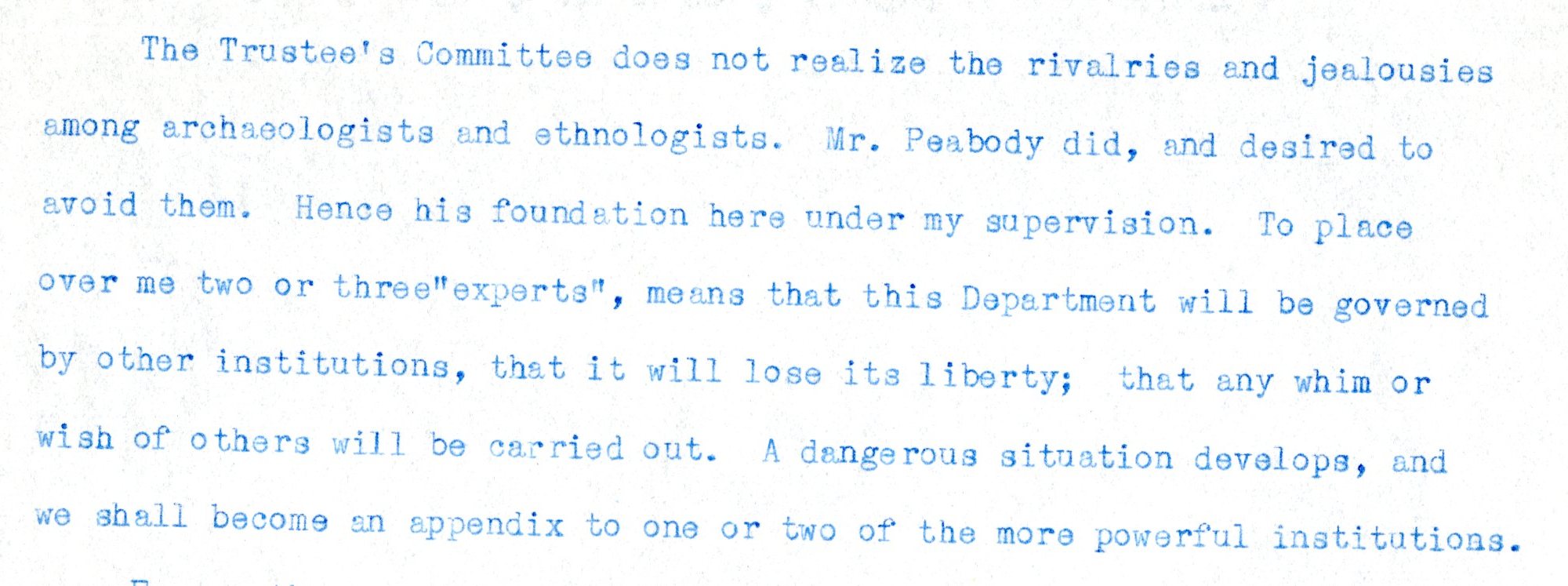
These recommendations were received with mixed feelings by curator Warren K. Moorehead. He appreciated many of the committee’s suggestions, but strongly objected to the creation of a permanent oversight committee. Convinced that they would meddle in his research plans and enmesh him in red tape, Moorehead clearly expressed his displeasure:
Warren Moorehead complains about a special advisory committee in a letter to the Headmaster.
However, the committee composed of Dixon and Bingham, existed for several years. They limited Moorehead to his ongoing work in Maine and simultaneously decided to embark on an expedition in the Southwest. This decision directly led to the appointment of Alfred V. Kidder as the Director of Southwest Explorations and his seminal work at Pecos Pueblo, New Mexico.
This blog represents the eighth entry in a blog series – Peabody 25 – that will delve into the history of the Peabody Museum through objects in our collection. A new post will be out with each newsletter, so keep your eyes peeled of the Peabody 25 tag!
Excavations at the Etowah Mound site in Georgia have revealed a great deal about the Mississippian culture. Based on the archaeological materials found at the site, it is likely that during its occupation about 1,100 to 500 years ago, it was one of the most significant and influential cities in southeastern North America. A hallmark of the Mississippian culture, is the linkage through economics, politics, and other societal influences of large villages, such as Etowah, with smaller communities that surround it.
Due to its historical prominence, the Etowah Mound site is considered an important archaeological site in the United States.
The site has three large platform mounds in addition to a plaza and smaller mounds. The largest of the mounds towered over the landscape, reaching the height of a six-story building. The mounds were used in a variety of ways: platforms that supported buildings, ceremonial sites, as well as burial locations for elite members of the society.
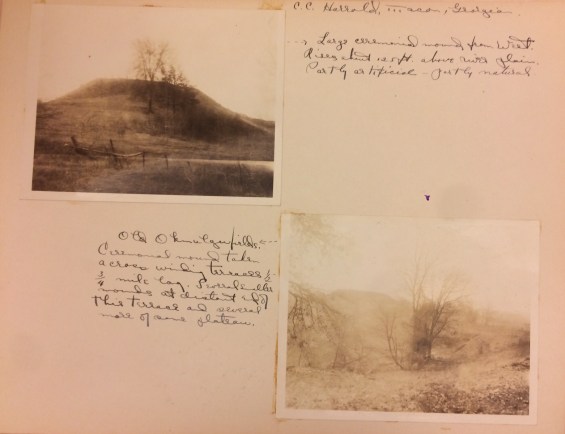
Images of some of the Etowah mounds from the Peabody collections
In 1925 the Trustees of Phillips Academy sponsored the first systematic excavation under the direction of Warren K. Moorehead. This three year investigation occurred during a transitional time in the history of archaeology when excavators were moving away from an antiquarian focus on objects and developing more scientifically rigorous methods. Moorehead’s interest in Etowah may have been a reaction to Alfred V. Kidder’s stratigraphic excavations at Pecos Pueblo in New Mexico, where new ideas about chronology and multidisciplinary work were tested.
Despite new methodologies and practices in archaeological investigations, many excavations were still carried out in ways that would make any archaeologist today cringe. The importance of stratigraphy was still not fully understood or appreciated by all archaeologists, including Moorehead, when the Etowah excavations were being undertaken. Modern attempts to sort out and understand Moorehead’s excavations have proved challenging. In their 1996 book Shell Gorgets: Styles of the Late Prehistoric and Protohistoric Southeast archaeologists Jeffrey Brain and Philip Phillips lament Moorehead’s lack of precision, poor recordkeeping, and disregard for context and stratigraphy. Perhaps it’s best that Moorehead announced in 1930 that he had decided “to abandon further field operations and concentrate on a study of type distributions in the United States during the next six years.”
As we reviewed Moorehead’s photographs of the 1925-1928 excavations at Etowah, we were often incredulous about the images of a tractor bulldozing a mound or workers (dressed in 3 piece suits no less!) hacking away at the side of a large mound. We understand today that a great deal of contextual information was lost using these clumsy techniques.
Tractor being used to excavate mound
Digging into the side of a mound
Workers at Etowah
Although these images affect our sensibilities, it cannot be denied that they are also important. These photographs help to document just how much the field of archaeology has changed and grown in the past 100 years. What started out as a gentlemen’s pastime has transformed into a profession associated with state-of-the art scientific techniques and theories that allow investigation of “hidden histories.” We understand that in another hundred years the images of our pristine and scientifically driven investigations might too cause heartburn in those archaeologists looking back on our work!
The site is now a Georgia state park and is designated as a National Historic Landmark (1964) and is listed on the National Register of Historic Places (1966)
This blog represents the fourth entry in a blog series – Peabody 25 – that will delve into the history of the Peabody Museum through objects in our collection. A new post will be out with each newsletter, so keep your eyes peeled for the Peabody 25 tag!
Contributed by: Lindsay Randall
Peabody curator Warren K. Moorehead, beginning in 1915, excavated in the Castine area of Maine in search of sites related to the Red Paint People. Moorehead believed the Red Paint People to be an ancient culture that was distinct from the more recent Algonquian tribes that still live in Maine today. He recognized a number of unusual artifact types found in Red Paint cemeteries and the liberal use of red ochre in burials, hence the name Red Paint. Ideas about the origins and relationships of the Red Paint or Moorehead Burial Tradition (as it is now called) are changing and often still hotly contested by archaeologists and tribes today. The Abbe Museum in Bar Harbor, Maine presents a timeline of contemporary Wabanaki peoples in Maine, demonstrating continuity of modern American Indians back to the earliest occupation of the state.
Map showing the location of Castine, ME.
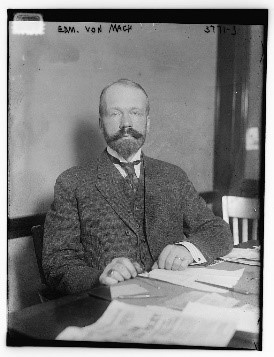
While Moorehead’s Castine investigation did not locate Red Paint site, numerous shell heaps were found. One of the most amazing sites to be excavated was located on the property of Professor Edmund Von Mach. Von Mach was an instructor in art and fine arts at Harvard, Wellesley and other schools in the Boston area and published books on painting and art history. He gained some notoriety during and after World War I for encouraging Americans to support the German cause and his book Official Diplomatic Documents Relating to the Outbreak of the War was withdrawn due to inaccuracies by the publisher.
Portrait of Edmund Von Mach
Von Mach’s politics aside, the shell heap was a very impressive monument, measuring approximately 660 feet long and having a depth between 3 and 5 feet. The vast majority of the shells present were quahog clams, quite common to the area. Given that a total of twenty four hundred artifacts were recovered, combined with the sheer expanse of the heap and its numerous layers, it is believed that the site was a permanent settlement used by tribes about 2,500 years ago.
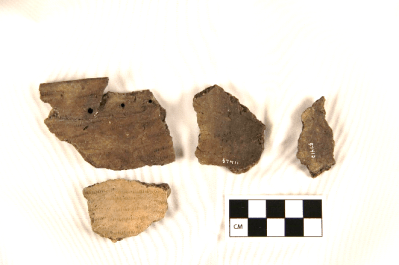
Throughout the summer, several hundred people visited the site to see what unique pieces of the past were being unearthed. Some of the most interesting artifacts discovered were fragments of pottery.
Four pottery pieces from the Von Mach Shell Heap collection at the Peabody Museum.
The pottery is unusual in New England as the soil conditions are very acidic and often deteriorate fragile artifacts. Ceramic specimens are more common in other parts of the country, like the American Southwest.
The only reason that the pottery was not dissolved by the acidic soils surrounding it is that the shells were deposited in the same area. Leaching of calcium carbonate from the shells neutralized the harmful acidic soil. Altering the soil matrix in this manner allows for almost unprecedented preservation of sensitive material.
The pottery helps us to learn about technology and artwork in the community. The introduction and development of ceramics into Maine around 2,700 years ago was very important. It is during this same period that the populations increased and became more sedentary in permanent villages.
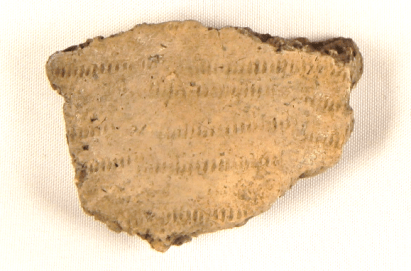
The majority of the pottery pieces in our collections are small and fragile, despite being preserved in the shell heaps. The ceramic pieces also are decorated with stamped and incised lines. This method of decoration not only reflects the aesthetics of the time, but may have helped reduce air bubbles prior to firing.
Close-up of one of the incised pottery fragments
Interestingly, archaeologists are now investigating the language that we use to describe archaeological sites. In her 2014 PhD dissertation at UMass Amherst Katie Kirakosian looks at the terms used by archaeologists like Warren Moorehead and his contemporaries to describe shell-bearing sites like Von Mach’s and how these terms have influenced our thinking about the sites and the people that made them. Kirakosian concludes that use of terms like “shell midden” to describe these sites (and, by extension, their Native constructors) denies their complexity and can result in a narrow and biased narrative.
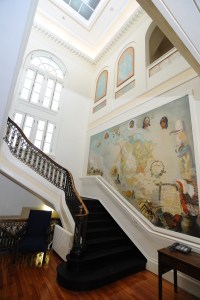
The central staircase of the Peabody includes a mural of American Indian life and history titled “Culture Areas of North America” by Stuart Travis (1868-1942). Travis was an accomplished and prolific American artist, illustrator, and designer who studied at the Académie Julian in Paris. His works—mostly drawings and watercolors—appeared frequently in magazines, books, and advertisements in the early twentieth century. Travis first came to Phillips Academy in 1928 to create the mural “History and Traditions of the School and Vicinity” in the Oliver Wendell Holmes Library. He continued to work at Phillips Academy, where he painted a total of three murals; he also designed the stone and wood gate that now leads to the Moncrieff Cochran Sanctuary.
Stuart Travis Mural at the Robert S. Peabody Museum of Archaeology. Photography by Gil Talbot.
The Peabody mural measures 13’11” by 10’2” and reflects ideas about anthropology and archaeology in the 1930s and 1940s. Major elements include the Maya Pyramid of the Magician at Uxmal on the left and a totem pole of the Northwest Coast on the right, with a map of cultures areas of North and Middle America occupying a central position, surmounted by six portraits across the top of the mural. Details and insets abound, illustrating artifacts, archaeological sites, ethnographic items, and scenes from Aztec and Maya codices. Illustrations of artifacts are drawn from the British Museum, the Museum of the American Indian (now the National Museum of the American Indian), the American Museum of Natural History, the Robert S. Peabody Museum of Archaeology, as well as several other prominent institutions.
Major Maya archaeological sites are labeled on the central map, but the majority of the map surface only depicts watersheds and topography, suggesting that Travis may have planned to add even more detail to the mural. The shadow of a thunderbird is painted over the central map, with a note explaining the widespread belief in supernatural birds in the Americas. Other details include an inset illustrating details of the Cahokia, Etowah, and Hopewell sites—likely a nod to long-time Peabody Director Warren K. Moorehead’s work. In all, there are over 30 American Indian artifacts illustrated (some in low relief), ranging from an example of Mi’kmaq writing on birch bark to a Tlingit “raven hat.” Many of these artifacts were probably drawn from contemporary books and articles on archaeology, while some may have been suggested by Museum staff. Detailed notes about the artifacts were likely included so the mural could be used as a teaching tool for visitors.
Travis dated the mural 1938, but continued with additions through 1942. The mural was restored in 1997 by Christy Cunningham-Adams through the generous support of the Abbott Academy Association.
This blog represents the third entry in a blog new series –Peabody 25– that will delve into the history of the Peabody Museum through objects in our collection. A new post will be out with each newsletter, so keep your eyes peeled for the Peabody 25 tag!
Contributed by Marla Taylor
The unassuming and muddled looking object below is a piece of loosely formed breccia from Jacob’s Cavern in McDonald County, Missouri.
Breccia from Jacob’s Cavern
Breccia is a type of rock that is composed of broken fragments of other rocks that have been cemented together by a fine-grained matrix – this process can take thousands of years. While this piece is not yet solid rock, it is on the way. In this case, the matrix (or glue) is ash from thousands of fires that sustained life in the cavern for hundreds of years.
Acting on a tip from a local named E.H. Jacobs, Charles Peabody and Warren Moorehead traveled to Jacob’s Cavern in April of 1903 to examine the site. Upon arrival, they found a large rockshelter of limestone with hundreds of stalactites and stalagmites, and the floor was covered with a thick layer of fine ash up to 1.5 meters (nearly 5 feet) deep! This ash is most likely the direct result of untold numbers of small fires in the cavern to keep the occupants warm over the years of use.
Peabody and Moorehead excavated the thick layer of ashes in using a careful grid system and uncovered hundreds of artifacts. The stone tools were primarily projectile points and blades with relatively few large tools like axes. They also found a ‘considerable’ number of bone needles and awls. These small bone tools are essential in daily life to create, maintain, and repair clothing and other basic equipment. The sheer volume of ash and artifacts in the cavern indicates long-term occupation.
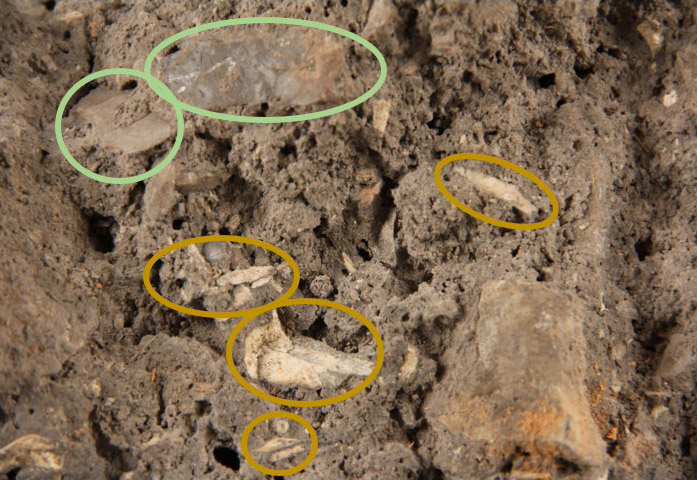
All evidence of human occupation – stone and bone tools, food debris – in the cavern was found in the layer of ashes and intermingled with breccia. And, most notably, many artifacts are visible within the breccia (see the photo below). This means that they were created, used, and discarded before the formation of the breccia and were left undisturbed for possibly thousands of years.
Detail of breccia with stone tools circled in green and bone fragments circled in yellow.
Peabody and Moorehead brought samples of the breccia and hundreds of collected artifacts back to the Peabody in 1903 while excavations continued by Mr. Jacobs for another couple years. Published in 1904, the report of their work became the first Bulletin published by the Department of Archaeology. The entirety of this report can be found here.
The work done by Peabody and Moorehead with Jacob’s Cavern became a foundation for later work at the Peabody. Explore and excavate a little-known site, bring the materials back to Andover for study, publish about that work, and provide invaluable new research and insight into the field of archaeology.











 The Peabody