Did you know that the building that houses the Peabody Institute was built between 1901 and 1903? Designed by well-known Boston architect Guy Lowell, the building was designed to be the home of the Phillips Academy Department of Archaeology. Over the past 120 years, the department has transitioned into the Peabody Institute.
As anyone who has lived in the same house for a long time can attest – it is really easy to accumulate stuff (both valuable items and less-than-helpful clutter). Like a well-loved home, the Peabody certainly had its fair share of stuff that needed to be sorted and rehomed before the current building project could get underway. The best stuff had been kept in the attic.
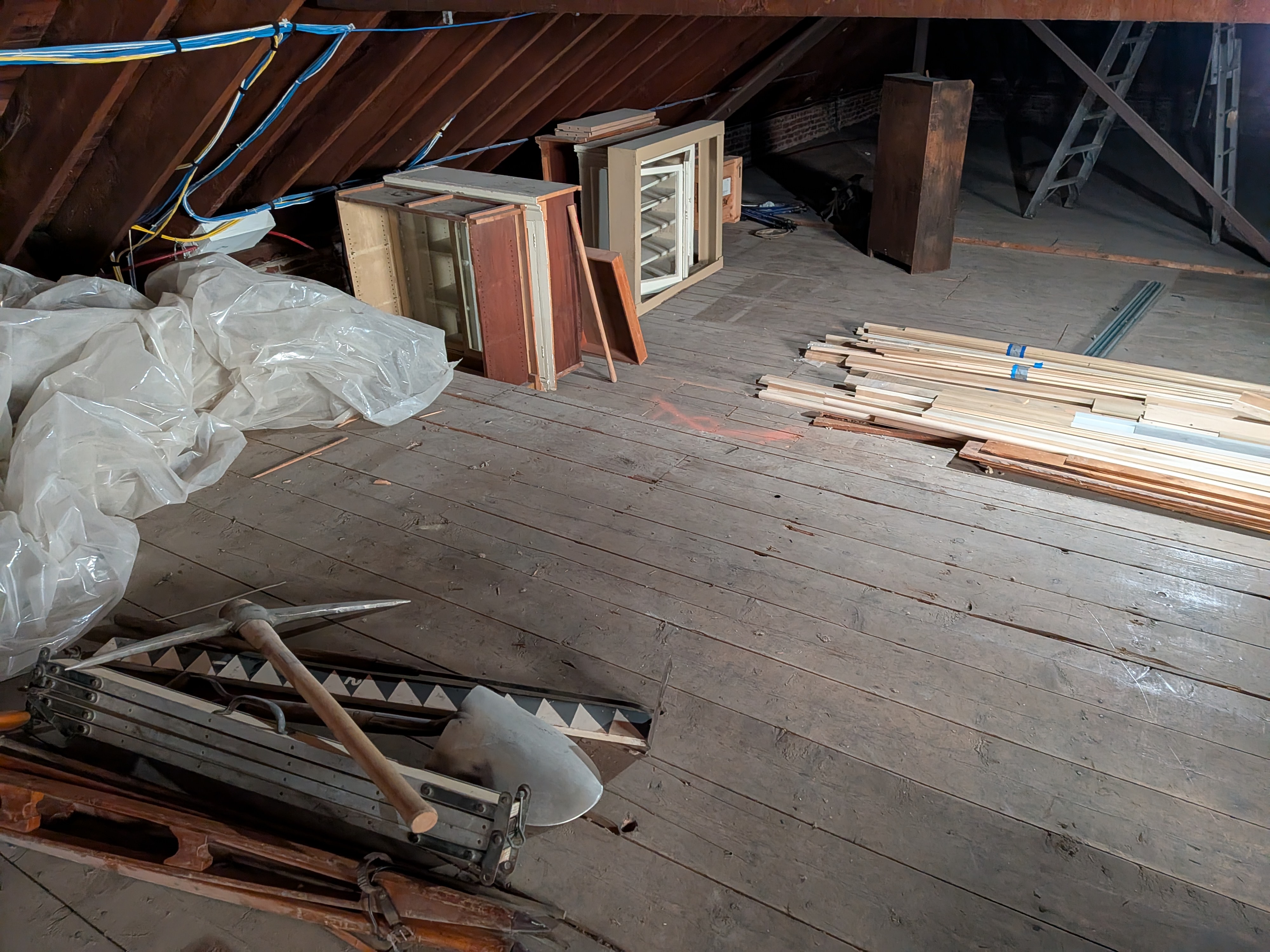
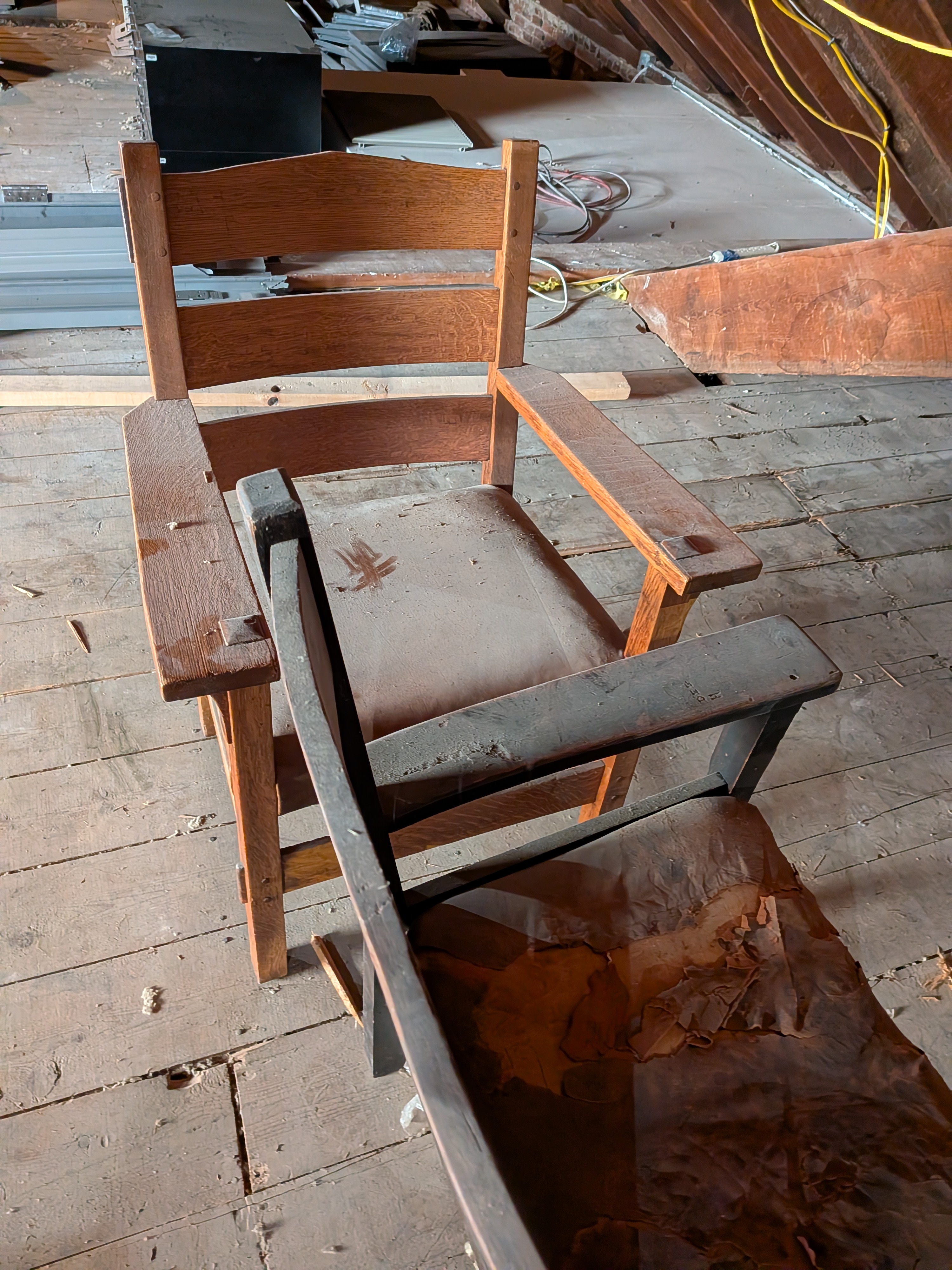
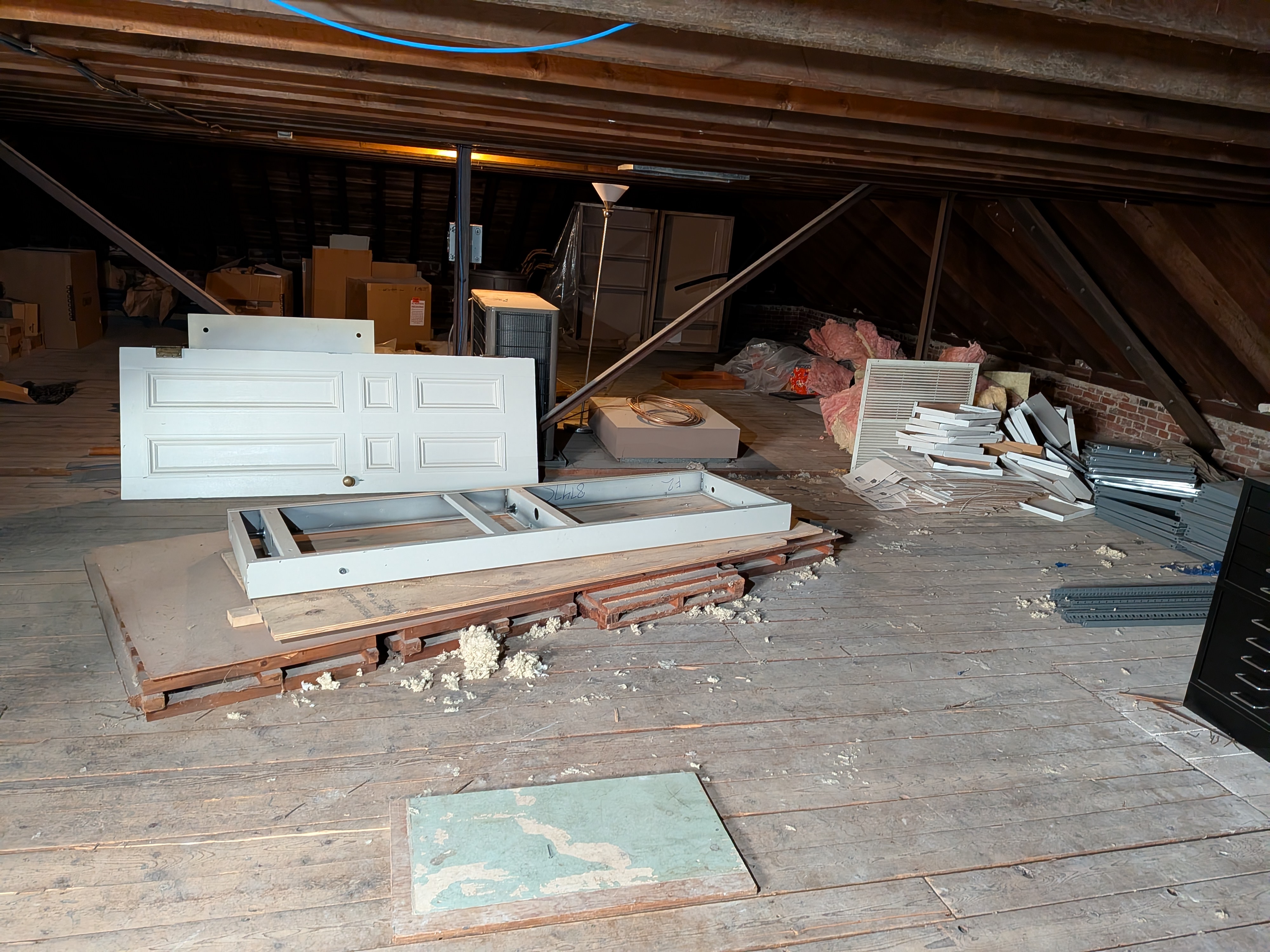
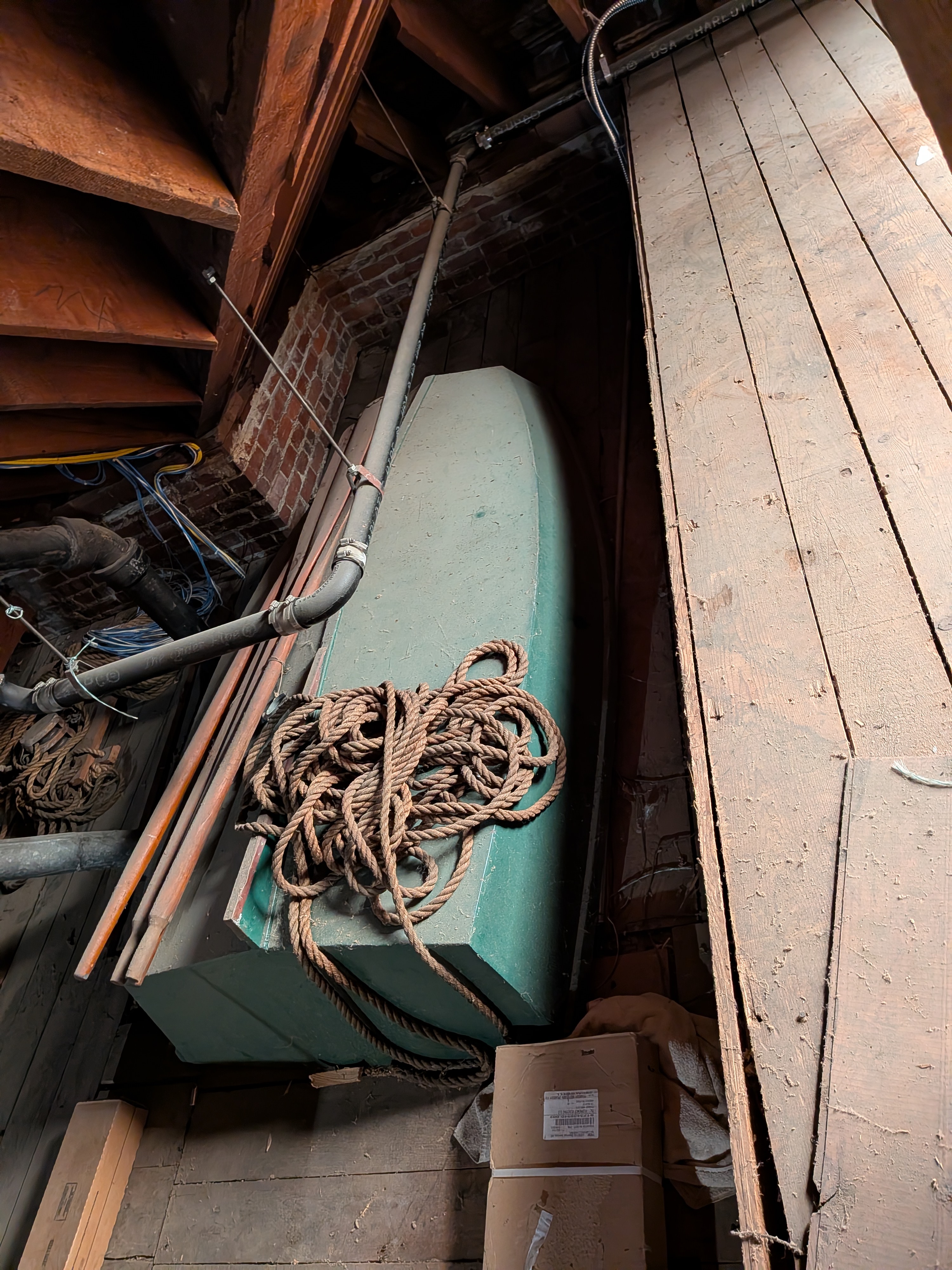
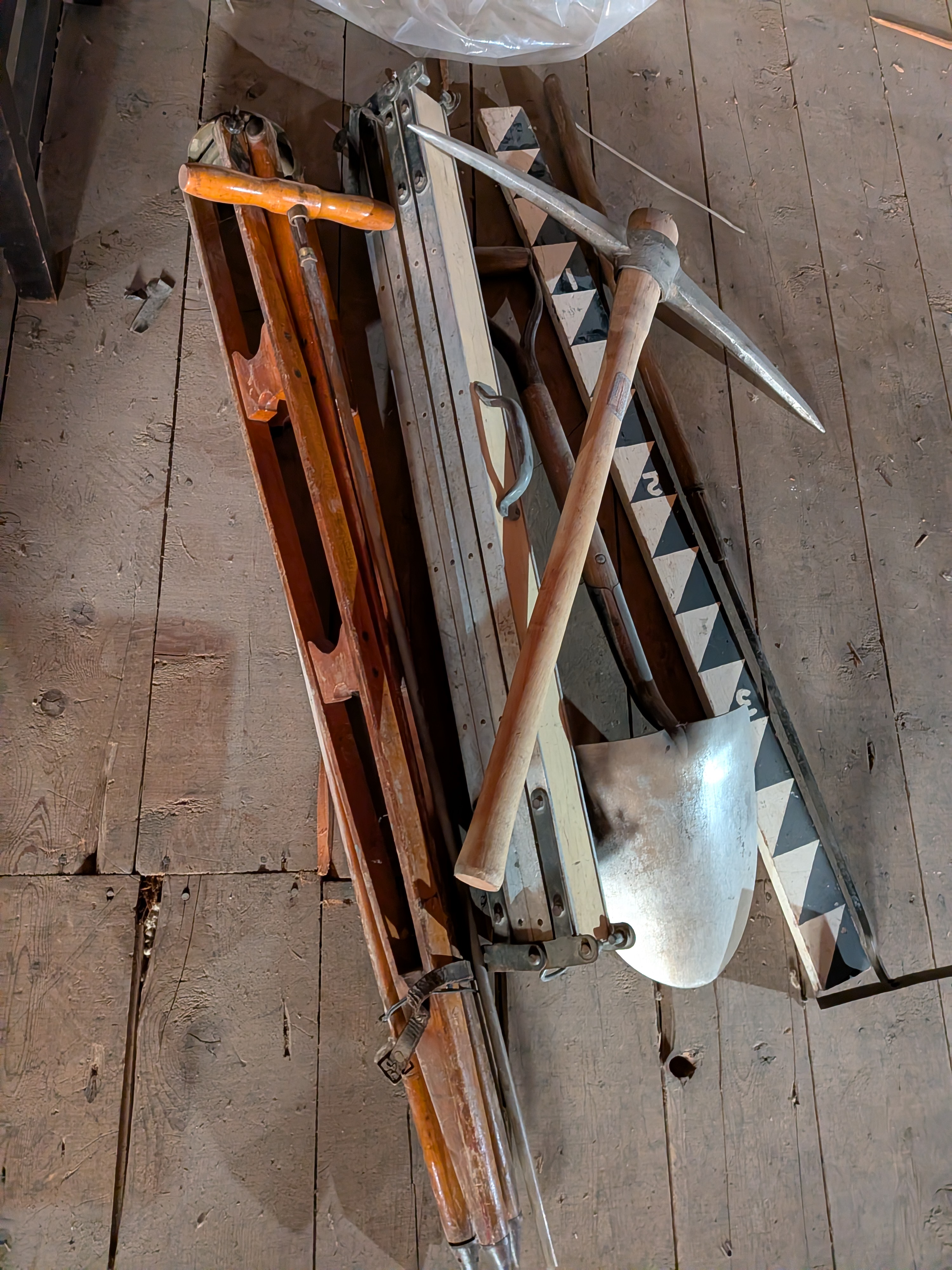
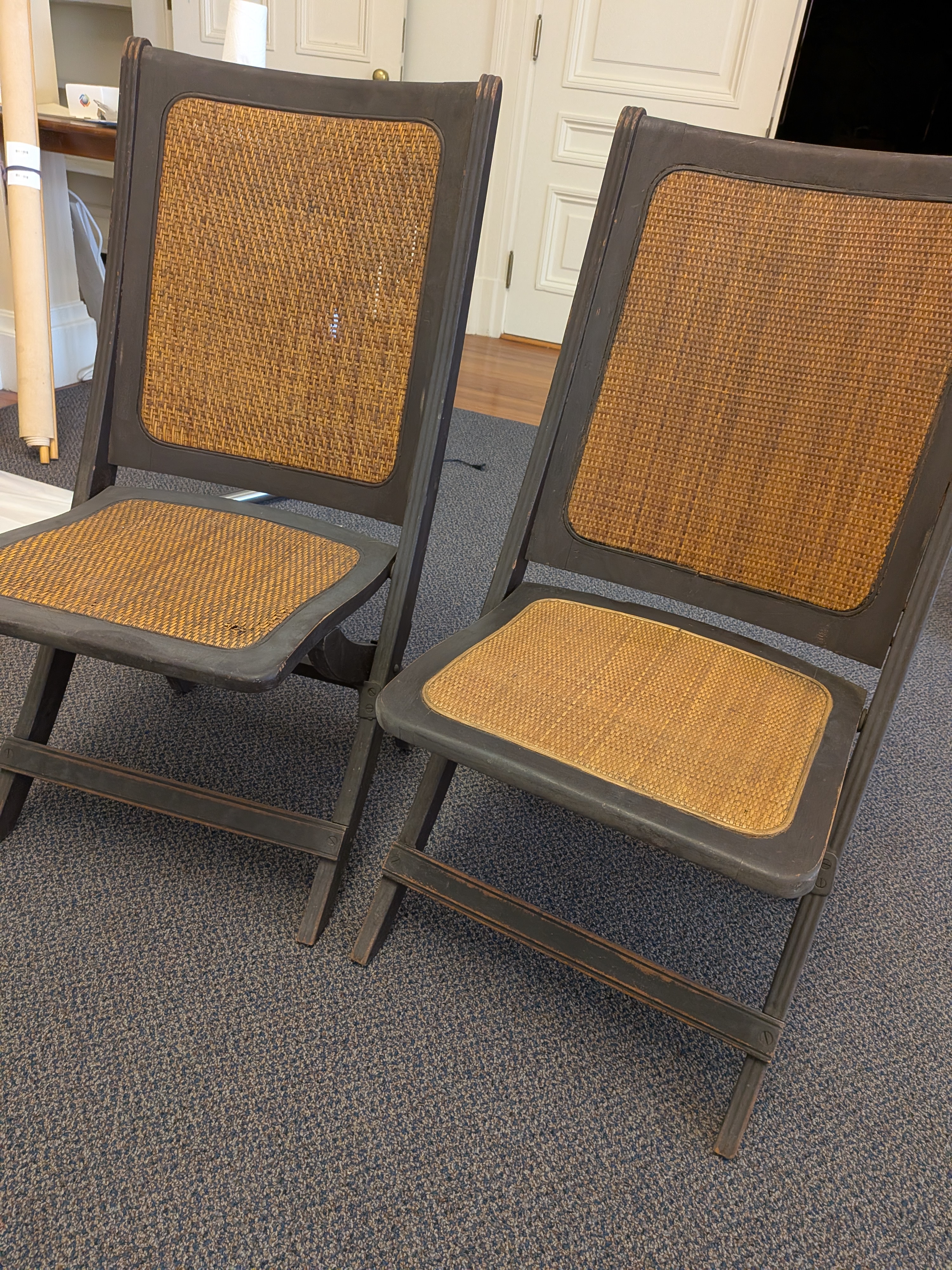
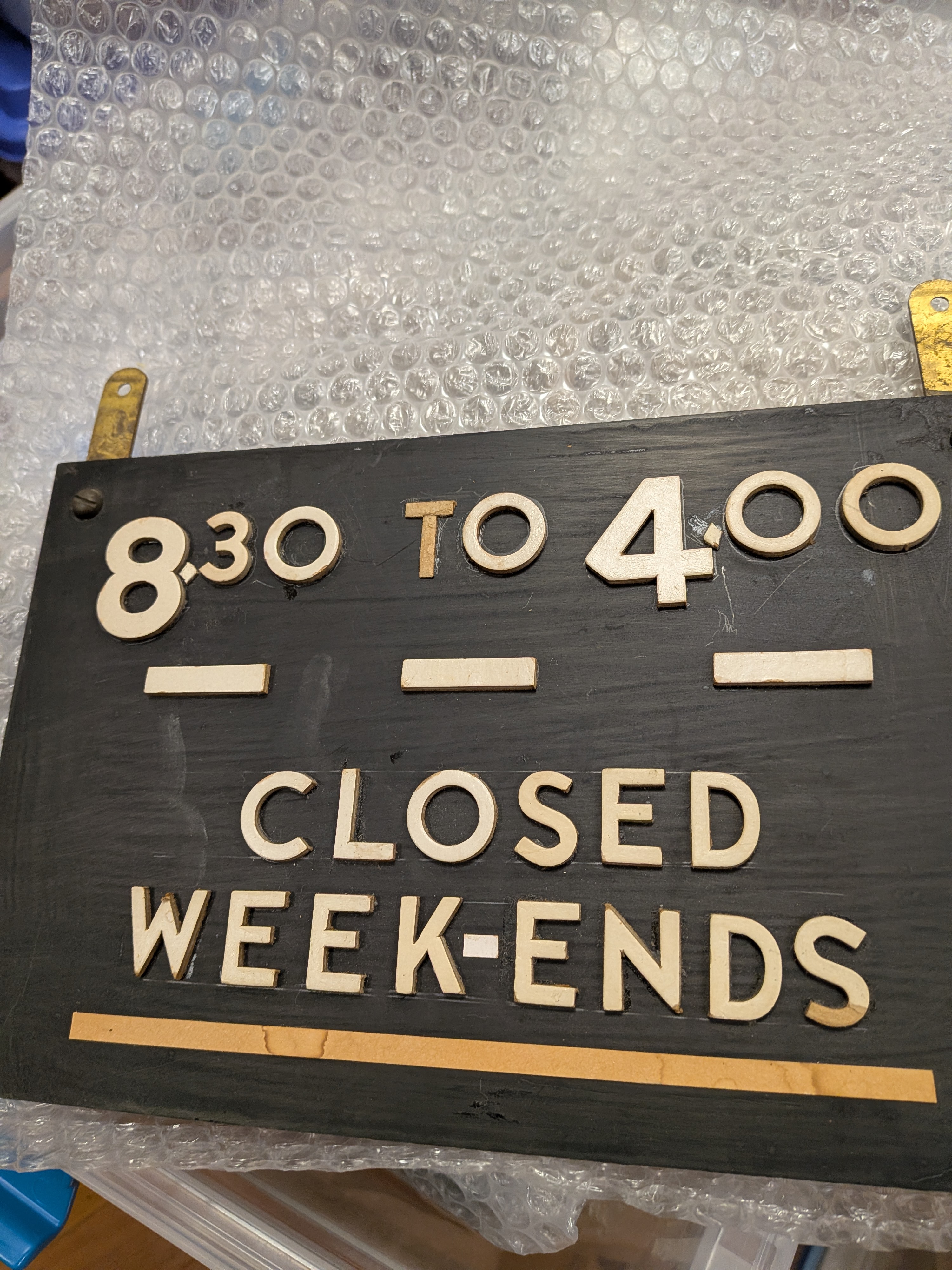
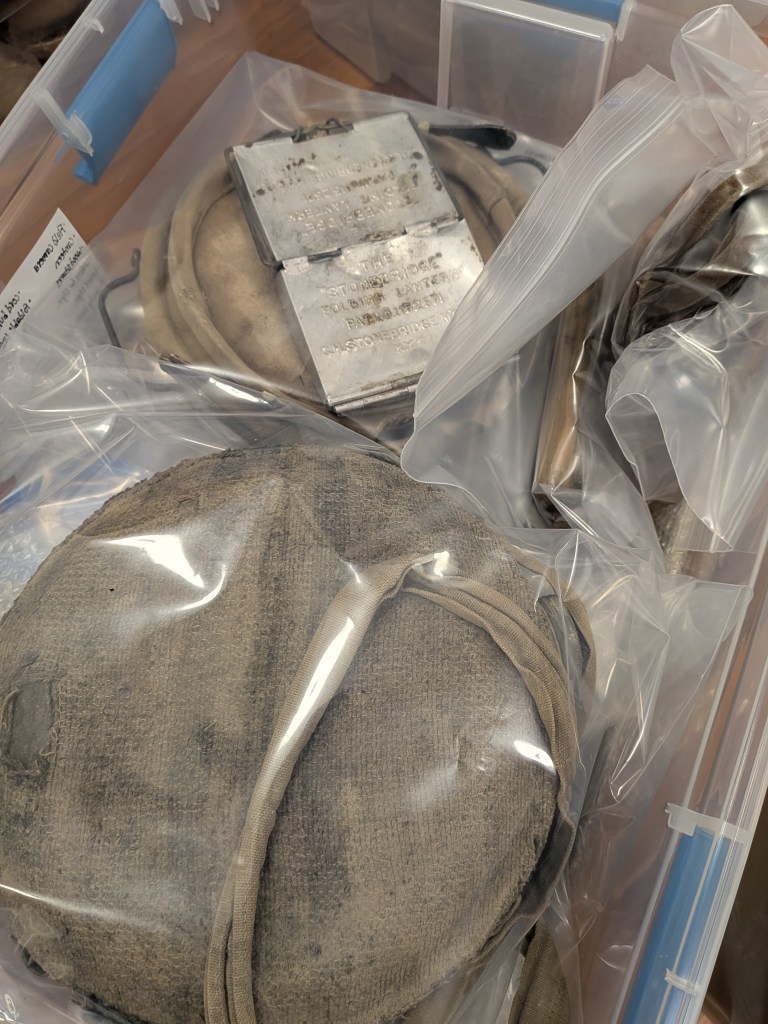
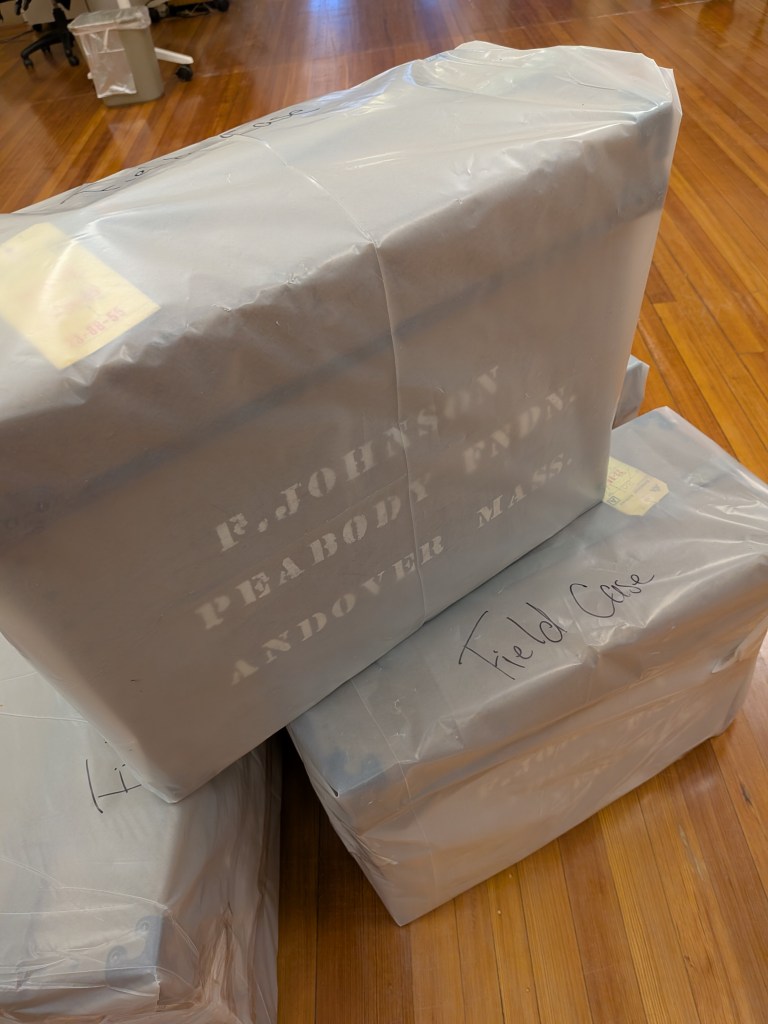
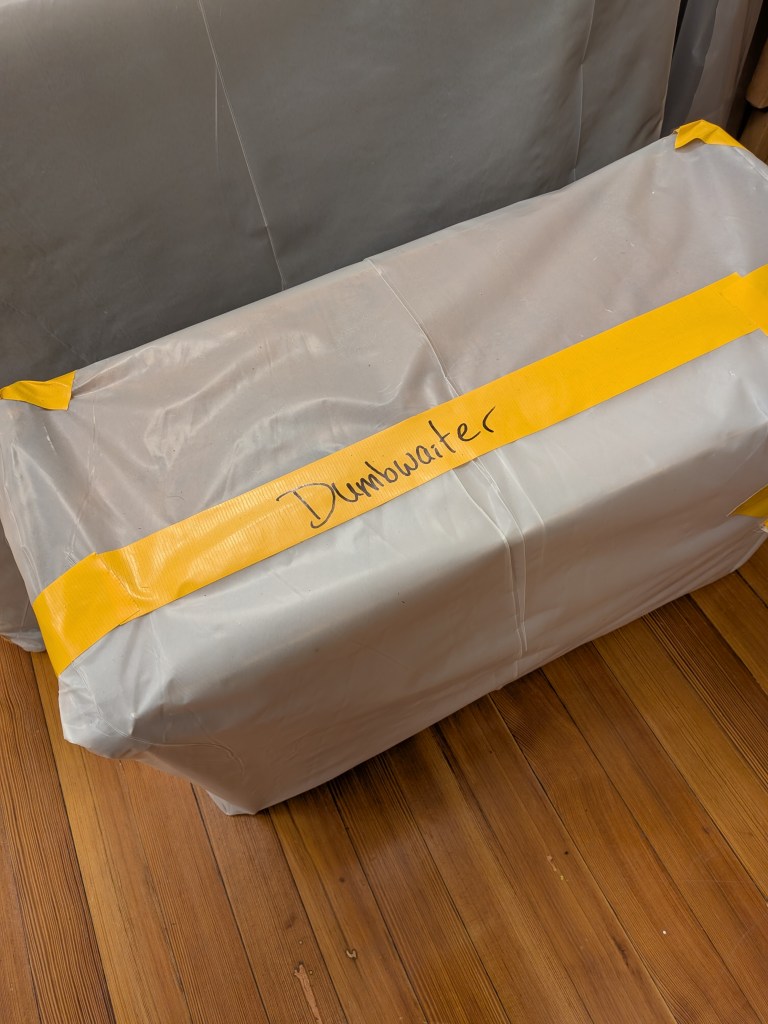
Attics always have a reputation (you know what I mean) and the Peabody’s attic is a special one. If you are over 5’6”, you better watch your head. The corners are as dark as you imagine. And yes, sometimes there are bats. However, there are also piles of old archaeological field equipment, a dumb-waiter, traveling trunks and some incredible pieces of institutional history that needed to be preserved before the building project.
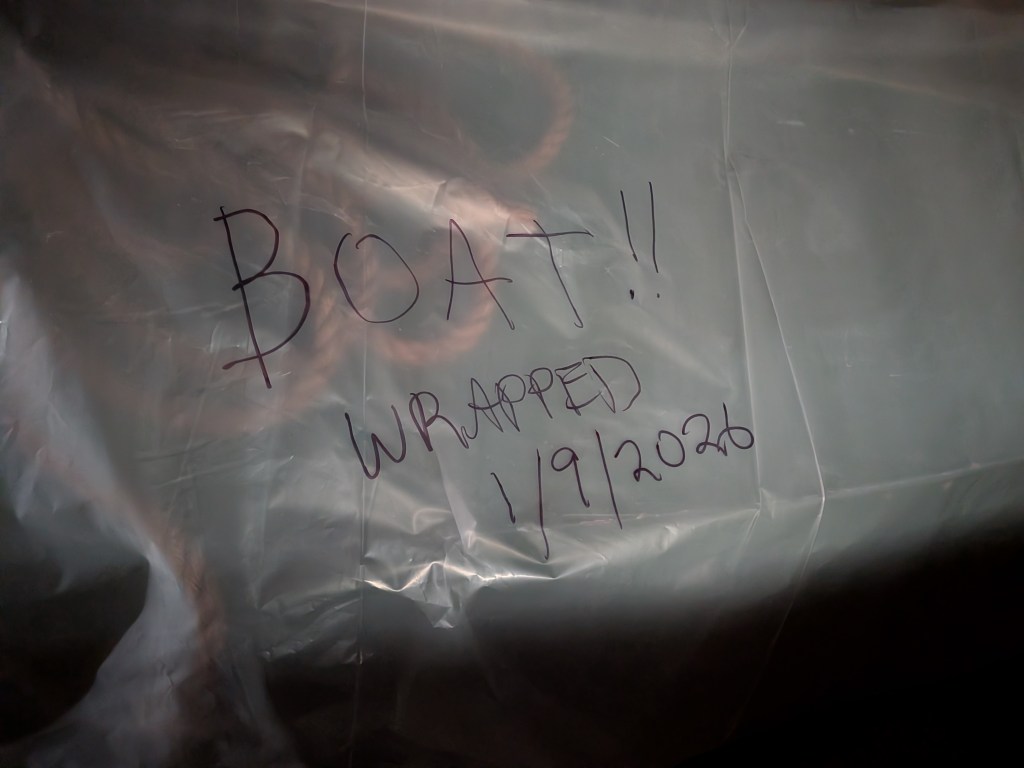
Everything was lovingly wrapped in plastic – it wasn’t always pretty (you try wrapping a pickaxe!) – and clearly labeled for the future. Who knows what future Peabody staff will do with these items, but I am relieved that they will have the opportunity to engage with these echoes of history.
Several years ago as we organized the Peabody Institute’s extensive photographic collection, we came across a group of black-and-white prints that had not been flattened. These images relate to Warren Moorehead’s 1920’s era excavation of the Etowah mound group in Georgia. Any attempt to unroll the images would produce a tear and threatened to damage the prints. We did some research on techniques that might help these older prints relax a little, to no avail. Help was nearby, however, in the form of the Northeast Document Conservation Center or NEDCC, one of the leading paper and media conservation organizations in the country. We’ve used them before to digitize oversized maps and to scan black-and-white negatives.
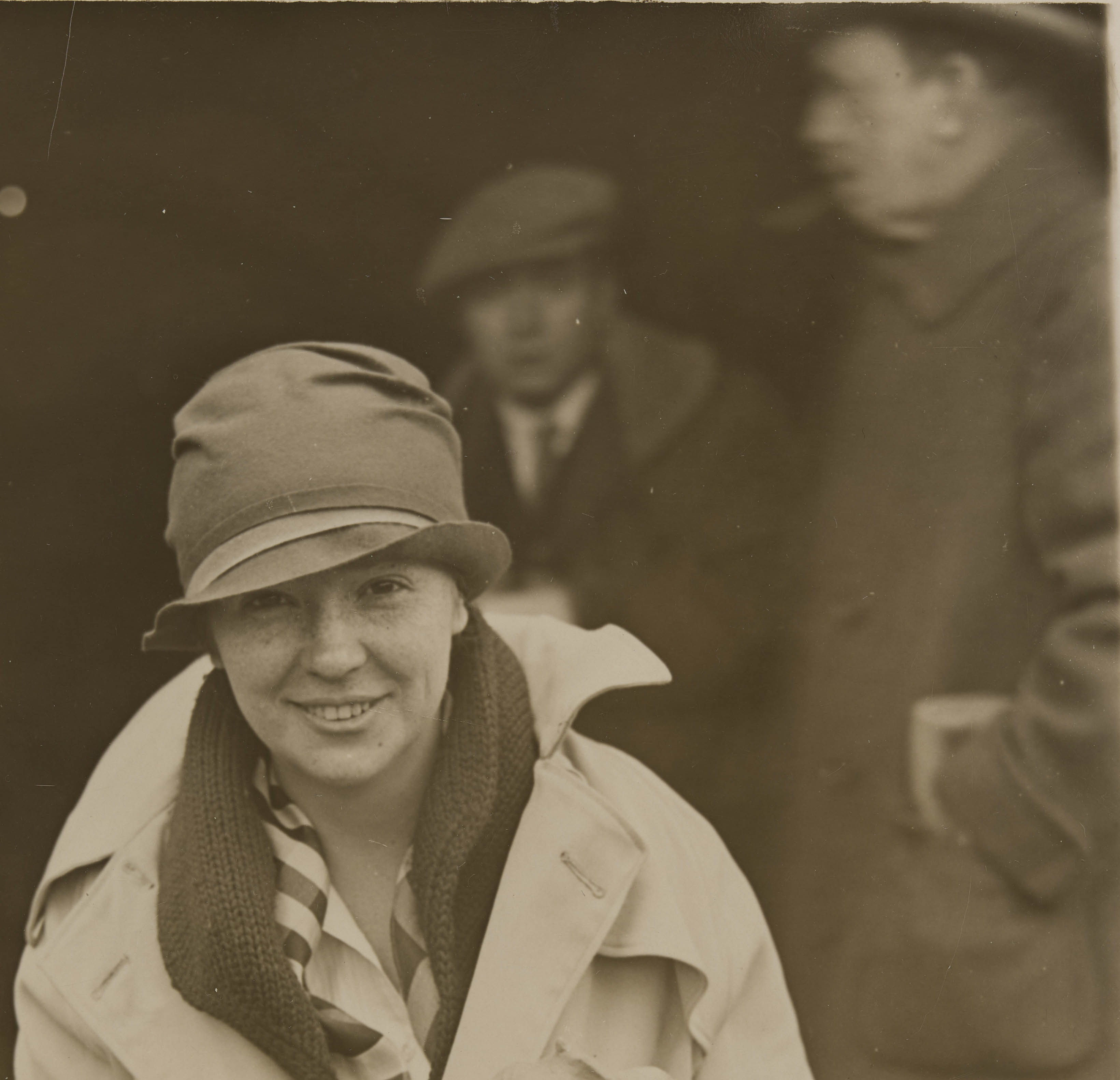
The images were returned to us after conservation recently, and we also received high resolution digital versions. Most of the photos show items from the Etowah site, but one picture was of Margaret Ashley Towle, one of the pioneering female archaeologists of the southeastern United States. The image is marked on the reverse as “Etowah Ga 1928 Miss Ashley” and has our recent catalog number 2020.3.283. It is a wonderful complement to Frank Schnell Jr’s 1999 chapter “Margaret E. Ashley: Georgia’s First Professional Archaeologist,” which appeared in Grit-Tempered: Early Women Archaeologists in the Southeastern United States. She was also featured, sans photo, in Irene Gates’s Women of the Peabody blog in 2018.
Image of Margaret Ashley at the Etowah site, 1928. In the right background is a slightly out of focus image of archaeologist Warren Moorehead. The image has been cropped to exclude several cultural items from the site. Robert S. Peabody Institute of Archaeology 2020.3.283.
Margaret Ashley was already well-versed in archaeology and was a skilled outdoorswoman when she worked with Warren Moorehead at the Etowah site, and went on to assist with his projects in Maine and to continue her own research in the Southeast. She also contributed to Moorehead’s Etowah Papers publication and published on her technique for illustrating pottery. According to Frank Schnell’s chapter in Grit-Tempered, Ashley married Moorehead’s main field assistant Gerald Towle in 1930. Unfortunately, Ashley’s marriage coincided with a significant hiatus to her training and research. We do know that after Towle’s death, Ashley completed her Ph.D. at Columbia with her dissertation later appearing as The Ethnobotany of Pre-Columbian Peru, number 30 of the Wenner-Gren Foundation’s Viking Fund Publications in Anthropology (1961). Colleagues working in the Andes report that Ashley’s publication remains a significant resource. Ashley spent several decades as an unpaid research associate at the Harvard Botanical Museum where she worked with botanist Paul Mangelsdorf, who had also been encouraging Richard “Scotty” MacNeish’s interests in agriculture, also around this same time.
We are delighted that we have been able to recover this early photo of Margaret Ashley Towle. If you get a chance, get a copy of Grit-Tempered–the biographical entries also include Adelaide Bullen, another pioneering archaeologist with connections to the Peabody Institute!
If you don’t know about the NAGPRA Comics yet, you really should take the time to check them out.
NAGPRA Comics is a community- based, collaboratively produced comic series that tells true stories about repatriation from tribal perspectives. They work with Native American communities to share their experiences with the law, from their point of view. This is an applied/educational comic series, so it also explains what the law is and how it works. [excerpt from napgracomics.weebly.com]
These comics are amazing teaching tools to introduce students, and members of the public, to the issues surrounding NAGPRA and repatriation. The comics focus on the perspectives of the tribal communities, highlighting their thoughts and experiences. I really love them and regularly recommend them to anyone interested in learning about NAGPRA – so go check it out!
The NAGPRA Comics team is working on several more issues and the Peabody Institute is proud to be a contributor to one upcoming issue.
In 2017, the Peabody Institute repatriated a birch bark scroll and other items of cultural patrimony back to the White Earth Nation of Minnesota. Those items left the reservation in 1909 with Warren K. Moorehead. Moorehead went to White Earth in his capacity as a member of the Board of Indian Commissioners, charged with investigating non-Natives’ rampant land and resource theft and the consequences of disposition, disease, and hunger. Investigations by the Minnesota attorney general and Congress, using the testimony that Moorehead and his team collected, led to the restoration of some lands and resources.
White Earth Nation seal and mapConsultation conversation with White Earth representative in 2017Warren K. Moorehead
The story in the upcoming comic is complex and rich. We are honored to be a small part of this meaningful project.
Jen Shannon, Program Manager and Curator at the National Museum of the American Indian and member of the NAGPRA Comics team, wrote a fantastic blog for the Ohio History Connection exploring the story and how it will be told in the comic. Her blog includes a glimpse of some draft pages. Take a look for yourself!
You can learn more about our work with White Earth Nation here and here.
Sample draft page of NAGPRA Comics. Courtesy of artist John Swogger.
My name is Deirdre Hutchison, and I am currently studying for my B.A. in history at UMass Lowell. As part of a semester internship, I had the opportunity to research the provenance of several unidentified Native American photographs held by the Robert S. Peabody Institute of Archaeology. My first blog outlined initial findings and potential areas of investigation. To summarize that blog, the photos, mounted on board, illustrate a 1905 event at the 101 Ranch in Oklahoma.
As I navigated various connections, photographer James B. Kent became a more prominent fixture of my research. Kent was a regular photographer at the 101 Ranch, and the Millers tapped him to design and compile the souvenir booklet for “Oklahoma’s Gala Day” at the ranch on June 11, 1905. –. Kent, it seems, was an integral part of photography at the 101 Ranch, ultimately becoming the head of the moving pictures department by 1927.
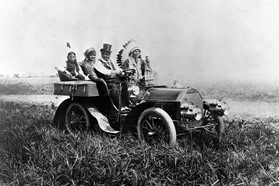
The 101 Ranch souvenir booklet is discussed by Michael Wallis in his book The Real Wild West. According to Wallis, it contains multiple images taken by Kent – including the picture of Geronimo skinning a buffalo held by the Peabody (discussed in my previous blog). The booklet also contains one of the most famous images of Geronimo, “Geronimo in an Automobile.” . Working with the archival staff at the Gilcrease Museum in Tulsa, I hope to view the images to confirm Kent’s pictures and perhaps discern other possible photo matches.
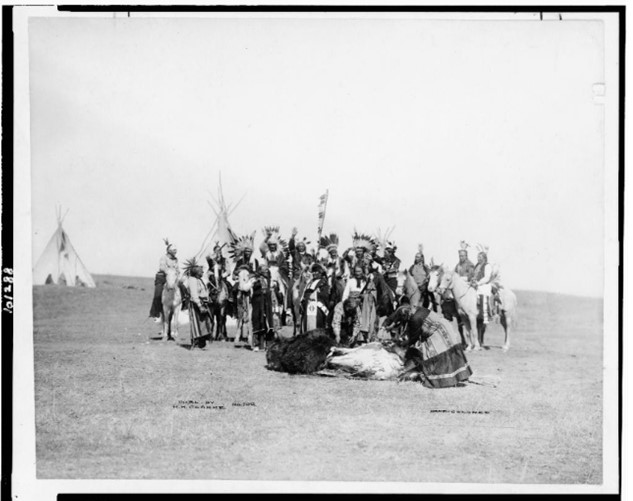
Isolating Kent’s work is relevant because he was not the only photographer working at the famous extravaganza on June 11, 1905. The Millers masterfully orchestrated spectacle – 65,000 people attended – could not be supported by just one photographer. Multiple photographers were present capturing various promotional images at the behest of the brothers. This is immediately evident in the Library of Congress photo of “Geronimo Skinning a Buffalo” that identifies O. Drum as the photographer. The strikingly similar images of the Peabody and the Library of Congress differ in only small ways. It seems a bank of photographers captured the same scene, each image similar, but slightly different: a person with a head facing a different direction, an extra person, women bending, or a western-clad gentleman caught talking with those being prepped for the publicity shoot.
Another name that kept popping up in my research and commonly associated with a broad range of images, including Kent’s, was the publisher H. H. Clarke. Not only did Clarke produce black and white photographs, but he also manufactured color versions for global distribution, and several of his postcards bear the notation Made in Germany. Clarke’s color versions are considered unique as he employed a hand-coloring technique rather than standard lithography. Other examples of this work are at the Cherokee Strip Museum (Cheryl DeJager, Cherokee Strip Museum, personal communication).
Printed in Germany , published by H.H. Clarke. Personal collection of Deirdre HutchisonUnidentified photograph from the Peabody Institute
Although Clarke published images by Kent and other photographers, establishing a direct link between them is difficult. However, sifting through metadata across several institutions, I discovered interesting connections that explore the publishing and manufacture of images onto postcards. For example, in the early twentieth century, professional and amateur photographers could sell their negatives directly to distributors such as Clarke or major publishing houses such as The Albertype Company. The Library of Congress cites Albertype and Clarke for one of two images listed of Geronimo in a car.
Clarke published three photos I initially matched with the Library of Congress. However, with only a thumbnail view available, I could not say with conviction they were identical to the Peabody images. After corresponding with the Prints and Photographs Division at the Library of Congress, enlarged views are now accessible online which allowed me to confirm that two photos were identical to those at the Peabody, but a discrepancy arose with the third. A close inspection reveals small but salient differences between the image at the Peabody and the one at the Library of Congress. For example, in the Peabody image, women are standing over the buffalo, but in the Library of Congress, they are bending over. Furthermore, in the Peabody image, a man stands to the buffalo’s left with his back to the camera, notable for his western-style suit, boots, and derby hat. Kent was known for always wearing his signature derby hat, leading me to speculate he was directing the people for the staged photograph and was caught on camera by another photographer.
Ponca Indian Scouts, Library of CongressPonca Indian Scouts, Peabody Institute
When I started this project, I naively thought I would find solid evidence pertaining to Warren Moorehead’s acquisition of the images. As the museum’s first curator and renowned Native American expert, I thought, how could there not be a connection? Yet, every avenue of research proved fruitless with Moorehead. The narrative unfolded around the Miller Brothers, James “Bennie” Kent, and H. H. Clarke. The interconnectedness of these people provided many answers; the photographs were staged publicity images, taken at the 101 Ranch and predominantly early 1900s. Unraveling this fascinating story has been immensely rewarding, yet it seemed unlikely I would find any correlation between the images and their arrival at the museum.
Despite this disappointment, potential connections with the Peabody Institute and theories of acquisition emerged when reviewing my data, though initially not with Moorehead. Ernest Whitworth Marland was in business with the Millers and became Governor of Oklahoma. Frank Phillips of Phillips Oil was also involved with the Millers and the 101 Ranch. Both men were natives of Pennsylvania, as was Robert S. Peabody. Each man was wealthy, prominent, and quite conceivably moved in the same upper echelons of society. It is possible either of these could have passed photographs to Moorehead or the Peabody. Considering the student body of Phillips Academy, any alum could have given the images as a donation to their alma mater. Equally so, any faculty member may have been gifted the photos. All of these are plausible scenarios. However, another tenuous link emerged, excitedly leading me back to Moorehead. The collections description for the three Library of Congress images mentioned earlier notes that they are mounted photographs, as are the ones at the Peabody.
Another facet that piqued my interest was the descriptions accompanying records at the National Archives. “Geronimo in a Car” is cited as taken on June 11, 1905, at the Millers’ Oklahoma Gala Day, along with other images; all are 8×10 or larger, just like the Peabody images. Although far from compelling, there are commonalities.
What I found most compelling with the National Archives photo of “Geronimo in a Car” was that it states a copy was sent to the Office of the Commissioner of Indian Affairs. The Office of Indian Affairs later became the Bureau of Indian Affairs. Moorehead was appointed to the board of commissioners for the Bureau of Indian Affairs by President Roosevelt in 1908.
Geronimo Driving a Car. Oklahoma Gala Day, June 11, 1905. Wall Street Journal
As an emerging historian, I like to focus on facts. Unfortunately, facts can be notoriously distorted by time, memory, and absent material evidence. However, the absence of proof does not equate to the absence of the action. Although I had discounted Moorehead as the conduit, I have circled back and believe he is a strong acquisition candidate based on my latest discoveries. That particular mystery may never be solved, but it does not detract from the powerful narrative of Native American presence and treatment in mainstream society in the early twentieth century.
[NOTE: This paper was published in the special issue “Indigenous Collections: Belongings, Decolonization, Contextualization” of Collections: A Journal for Museum and Archives Professionals, 2022, Vol. 18(1):8-17. We’ve reproduced the pre-press version here with pagination for those who do not have access to SAGE publications. Please cite as Wheeler, Ryan, Jaime Arsenault, and Marla Taylor. “Beyond NAGPRA/Not NAGPRA.” Collections 18, no. 1 (March 2022): 8–17. https://doi.org/10.1177/15501906211072916.%5D
Abstract
Institutions have been slow to respond to calls from Indigenous nations, organizations, and scholars to require free, prior, and informed consent before authorizing use of their cultural heritage materials in publications, exhibition, and research. In the United States, the Native American Graves Protection and Repatriation Act of 1990 fundamentally changed the relationship between museums, archaeologists, and Indigenous nations, requiring institutions to inventory their collections and consult with descendant communities on repatriation of specific Indigenous collections. In response, institutions and their personnel have come to view Indigenous collections as those subject to NAGPRA and those that are not—NAGPRA/Not NAGPRA. Many Indigenous nations, however, do not accept this demarcation, resulting in continued frustration and trauma for those descendant communities. This case study follows the evolving relationship between the White Earth Band of the Minnesota Chippewa Tribe and the Robert S. Peabody Institute of Archaeology. Beginning with repatriation, the relationship has expanded to consider how the museum and Indigenous nation can collaborate on the care and curation of cultural heritage materials that remain at the Peabody Institute. Most recently, White Earth and the Peabody have executed an MOU that governs how the museum will handle new acquisitions, found-in-collections materials, and donor offers. The relationship with the White Earth also has influenced how the Peabody Institute approaches its holdings of Indigenous cultural heritage materials more broadly, blurring the line between NAGPRA and Not NAGPRA collections. The Peabody Institute is working to revise its collections policy to require free, prior, and informed consent prior to use of Indigenous cultural heritage materials in publications, exhibitions, and research.
PAGE 9
Introduction
This case study is authored by Ryan Wheeler and Marla Taylor, who acknowledge that they are settlers of European descent in the unceded territories of many Indigenous nations in New Hampshire and Massachusetts, USA, including the Wabanaki Confederacy and the Wampanoag nations, and Jaime Arsenault, the Tribal Historic Preservation Officer (THPO) for the White Earth Band of the Minnesota Chippewa Tribe (White Earth). Wheeler and Taylor are employees of the Robert S. Peabody Institute of Archaeology (the Peabody), an archaeology museum that is part of Phillips Academy, a college preparatory school located in Andover, Massachusetts USA. Founded in 1901, the Peabody has a lot in common with other twentieth century museums in the United States, including amassing Indigenous collections from diverse areas with little or no consent from descendant communities. The Peabody currently holds nearly 600,000 objects of Indigenous material culture, primarily from the Arctic and Canada; the northeastern, southeastern, and southwestern United States, and Mexico and Peru, as well as photographs and archival materials.
The Native American Graves Protection and Repatriation Act (NAGPRA) was passed as federal law in 1990 and required that museums and federal agencies inventory their holdings for ancestral remains and funerary belongings, provide these inventories to descendant Indigenous communities, and consult with those communities on cultural affiliation and repatriation. NAGPRA has elements of property law and civil rights legislation, providing an opportunity for Indigenous nations to reclaim stolen ancestors and funerary belongings. NAGPRA fundamentally changed the relationship between Indigenous nations, archaeologists, and museums, creating an environment where representatives of each group were in regular contact with one another. Often this contact led to other programs and collaborations beyond NAGPRA. For examples, Nash (2021; also see Moore 2010) has recently revisited the concept of “propatriation,” collaborative undertakings that go beyond the legal requirements of the Native American Graves Protection and Repatriation Act (NAGPRA) or moral imperatives to return Indigenous cultural heritage to groups outside the United States. NAGPRA compliance, however, has been slowed by a variety of factors, including institutional reliance on archaeological and biological lines of evidence, even in the face of compelling oral history evidence or expert opinion supplied by Indigenous nations. At the time of this writing, over 100,000 ancestors remain in museum collections with little or no path to repatriation (Nash and Colwell 2020).
PAGE 10
Between 2013 and 2015, the Peabody developed a strategic plan that built on an earlier commitment to NAGPRA, prioritizing decolonial principles in all aspects of museum operations (Robert S. Peabody Institute of Archaeology 2015). With decolonization as a guiding principle, the plan acknowledged the harm caused by archaeological excavations and sought to shift the balance of power, giving Indigenous nations a greater voice in how their material culture is handled and interpreted. We argue that museums and institutions holding Indigenous cultural heritage must go beyond collaborative programming to instill change at the policy and procedure level. Work on NAGPRA compliance provides an opportunity to develop and implement those policy changes.
The Peabody Institute and the White Earth Band of the Minnesota Chippewa Tribe have collaborated to blur what we have been calling the NAGPRA/Not NAGPRA dichotomy. Though we have encountered other museums in the United States where staff are interested in instituting such changes, informal conversations have found few examples where official policies governing how Indigenous collections are accessed for exhibit, research, photography, or other purposes specifically require the free, prior, and informed consent of descendant communities. The United Nations Declaration on the Rights of Indigenous Peoples (UNDRIP) was adopted by the General Assembly on 13 September 2007. Part 2 of Article 11 specifically states:
States shall provide redress through effective mechanisms, which may include restitution, developed in conjunction with indigenous peoples, with respect to their cultural, intellectual, religious and spiritual property taken without their free, prior and informed consent or in violation of their laws, traditions and customs (UN General Assembly 2007).
Article 12 deals with the rights of Indigenous people to seek repatriation of ancestors and ceremonial objects. Revision of the Peabody’s collection policy specifically aligns with Articles 11 and 12 of UNDRIP, both in the way that NAGPRA is implemented, but also in going beyond NAGPRA compliance to insure the rights of Indigenous people regarding their tangible and intangible cultural heritage.
NAGPRA/Not NAGPRA
Co-authors Wheeler and Taylor, in their respective roles as director and curator of col- lections at the Peabody Institute, began using the phrase NAGPRA/Not NAGPRA sometime in the last few years to describe their own approach to Indigenous heritage collections. This articulation of our own institution’s approach to repatriation occurred in 2017 to 2018 when we first began to draft a broad repatriation policy, based on our existing practice. Consultation with Indigenous nations, especially White Earth, as well as the Osage Nation of Oklahoma, the Wabanaki Repatriation Confederacy of
PAGE 11
Figure 1. Tara Mason, beadwork artist and member, White Earth Band, examines Anishnaabe clothing at the Peabody Institute as co-authors Marla Taylor and Ryan Wheeler look on during a consultation visit, January 2017.
Maine, Pueblos in the American Southwest, as well as engagement with other repatriation practitioners in the NAGPRA Community of Practice began to erode our commitment to this approach (Figure 1). Taylor concisely stated that she believed that many institutions, in response to the passage of NAGPRA, began to distinguish those collections that they felt were subject to NAGPRA from those that were not. By firmly drawing boundaries between NAGPRA and Not NAGPRA collections, institutions preserve pre-NAGPRA decision-making structures regarding how they can access and use Indigenous cultural heritage. This discernment, whether intentional or not, reflects the imbalance inherent in a law that sought to balance the interests of museums with the rights of Indigenous nations to reclaim their stolen ancestors and make decisions regarding other tangible and intangible cultural heritage, including images, archives, and songs. If there is any doubt about this, responses from museums and archaeologists to the Department of Interior’s proposed changes to the NAGPRA rules support our assertion (see Seidemann 2008).
Blurring the Lines
While uncommon, there are some excellent examples where organizations and institutions have blurred the lines between NAGPRA and Not NAGPRA collections. The First Archivists Circle (2007) developed and shared The Protocols for Native American
PAGE 12
Archival Materials. Like NAGPRA, consultation with descendant communities is at the core of The Protocols. The Protocols stress that consultation and shared decision making about archival collections are in line with accepted ethical archive practices. Between 2016 and 2018, the Peabody Institute incorporated many of the principles and practices advocated for in The Protocols. For example, we agreed that digitizing paper and photographic records was inappropriate without consultation and explicit approval from Indigenous nations, especially as many of the museum records dealt with excavations of ancestral remains. It was not until more recently that we formally incorporated these practices into our collections policies and procedures. It is unclear, however, how many institutions have formally implemented the recommendations within The Protocols, though there are good examples and case studies at the website of the Society of American Archivists (2021a, 2021b).
The University of Maine (2018, Orono) executed a Memorandum of Understanding with the Penobscot Nation. The MOU formalizes principles and practices regarding how the university manages and shares Penobscot cultural heritage at the Hudson Museum, the Fogler Library, the University of Maine Press, and the Anthropology Department. University of Maine history faculty member Darren Ranco and Jane Anderson of New York University developed the University of Maine MOU. Anderson’s work on attribution, Indigenous archives, intellectual property, and Traditional Knowledge labels is critically important and informs the case study presented here (Anderson 2018; Christen and Anderson 2019).
Case Study
White Earth is one of seven Anishinaabe reservations in Minnesota, created in 1867 by a treaty between the United States and the Mississippi Band of Chippewa Indians. Unlike many lands set aside for Indigenous nations in the United States, the White Earth Reservation had abundant natural resources, including timber. Meyer (1994), a historian of mixed Irish, German and Eastern Cherokee heritage, published The White Earth Tragedy, telling the story of how unscrupulous companies and individuals defrauded the Anishinaabe people of their property, land, and natural resources (Bloch et al. 2008). The dispossession of the White Earth Anishinaabe also set in motion the loss of significant material culture, as anthropologists and collectors forced Indigenous nation members to sell or gift items they possessed.
Robert S. Peabody and Warren K. Moorehead founded the Peabody Institute in 1901, originally called the Phillips Academy Department of Archaeology, at Robert’s high school alma mater. The museum became involved in the major undertakings of twentieth century archaeology, including sponsorship of Alfred V. Kidder’s 1915– 1929 excavations of Pecos Pueblo, investigations across the Northeast and Southeast, with personnel holding leadership roles in major anthropological and archaeological
PAGE 13
organizations. Curator Warren K. Moorehead was also involved with the Bureau of Indian Affairs (Fritz 1985). Through his association with the BIA, he investigated the fraud being committed against the Anishinaabe people at White Earth. While at White Earth Moorehead obtained a number of cultural heritage materials, ranging from photographs to sacred items to elements of Anishinaabe clothing (Bacon 2009; Moorehead 1914).
Personnel at the Peabody Institute embraced repatriation after the passage of NAGPRA in 1990, perhaps largely due to the commitment and vision of Leah Rosenmeier, who served in a variety of roles at the museum from 1993 to 2002 (Bradley 2018). Starting in 2013, the leadership of the Peabody Institute recognized the importance of repatriation work conducted under NAGPRA and the need for broader theoretical underpinnings that could inform all collections and educational endeavors (see Lonetree 2012). As part of their strategic planning process, Wheeler invited Arsenault to present to the institute’s advisory committee, following an earlier meeting in 2011. Coincidentally, Arsenault was assisting in the development of the White Earth’s Tribal Historic Preservation Office (THPO) repatriation program, and was actively searching for Indigenous cultural heritage that had originated at White Earth.
Warren K. Moorehead’s activities at White Earth in 1909 had led to the accession of a number of items, including glass plate photographs of his investigation, Anishanaabe clothing and bandolier bags, as well as pipes, a war flag, and birch bark scroll meeting the definition of cultural patrimony and sacred objects under the NAGPRA law and rules. Arsenault and other White Earth representatives aided in the repatriation of some of these Indigenous collections, and provided informal guidance on the care of the remaining materials (National Park Service 2016, 2017). For example, White Earth representatives asked that the museum not share the photographic images made by Moorehead without permission from the THPO.
Arsenault, serving as the White Earth’s Tribal Historic Preservation Officer, pro- posed in 2020 that the Peabody Institute enter into a more formal agreement regarding future acquisitions of Indigenous cultural heritage originating from the Indigenous nation. The agreement would cover offers of donations or sale made to the museum, or purchases of contemporary artwork from Indigenous nation members. Arsenault collaborated with Jane Anderson of NYU and provided a draft agreement document, and Wheeler, Taylor, and the Phillips Academy legal counsel made revisions and updates. A copy of the final document—ultimately called Memorandum of Understanding (MOU) between White Earth Band of the Minnesota Chippewa Tribe Historic Preservation Office and the Robert S. Peabody Institute of Archaeology—is available from the authors or the Peabody Institute. Major elements include:
The MOU addresses all tangible and intangible materials (photographs, field- recordings, maps, archaeological collections, films, field-notes, legal papers,
PAGE 14
artwork, biographical material, and like materials) that relate or may relate to White Earth. There are provisions for the tribe to aid the institution in making cultural identifications if the materials cannot be sourced to White Earth specifically.
The MOU specifies that it is part of Peabody Institute efforts to adhere to CARE Principles for Indigenous Data Governance (Global Indigenous Data Alliance 2019). Among other things, the CARE Principles recognize that current efforts to digitize and widely share scientific data often fail to involve descendant com- munities in these decisions.
There is a focus on communication between the Peabody Institute and White Earth, especially in cases where there are potential purchases or donations of cultural materials that originated from White Earth. This includes contemporary artwork, so that the White Earth THPO can track all White Earth cultural heritage. There are provisions for regular contact and exchange of information between the tribe and museum, and revisions to the MOU as needed.
The MOU specifies that the Peabody Institute will encourage potential donors and sellers to work directly with White Earth to transfer tangible and intangible cultural heritage materials to the tribe as the descendant community.
White Earth is the primary cultural authority over their cultural heritage materials in perpetuity. This includes provisions that the White Earth THPO must approve all requests to publish, research, disseminate, image, or exhibit said cultural heritage materials before the museum grants permission to the requestor.
The Peabody Institute and White Earth will collaborate to develop Traditional Knowledge (TK) labels for White Earth heritage materials held by the institution, formalizing some of the practices already in place (Local Contexts 2019).
Recommendations
Work with your institutional leadership to revise collections policies and procedures to center Indigenous voices. This should include policies that govern loans, exhibits, and research, updated to require descendant community approvals. At the Peabody Institute we have revised the documents that relate to loans and researcher access, making it clear that descendant communities must be involved at all stages of a project and that those communities must approve how Indigenous cultural heritage is used or exhibited.
Add Indigenous members to your museum leadership board or committee, and col- lections subcommittees. Members with particular geographic or cultural affiliation with collections that you hold will bring invaluable expertise.
If your institution is working on NAGPRA compliance or repatriation in general, consider having conversations with consulting tribes about MOUs that would vest
PAGE 15
cultural authority and decision making on collections with those descendant communities.
Develop and implement a Care-and-Trust Agreement with the descendant communities represented in the collection to dictate the care, access, handling, and housing of collections while in the physical control of the institution. An agreement like this should apply to all relevant material within the collection regardless of repatriation status. Update webpages to indicate that your institution is open to collaboration with Indigenous communities, especially if the collections you hold are geographically and culturally diverse.
Educate staff and board members to help build a broad base of support for your efforts. This can include readings and coursework, as well as informal conversations about decolonizing work at all levels of the institution.
Acknowledgments
We thank Rose Buchanan for her help in understanding ongoing work to implement the Protocols for Native American Archival Materials.
Bradley, James. 2018. “Negotiating NAGPRA: Rediscovering the Human Side of Science.” In Glory, Trouble, and Renaissance at the Robert S. Peabody Museum of Archaeology, edited by Malinda Stafford Blustain and Ryan Wheeler, 159–72. Lincoln: University of Nebraska Press.
Fritz, Henry, E. 1985. “The Last Hurrah of Christian Humanitarian Indian Reform: The Board of Indian Commissioners, 1909-1918.” Western Historical Quarterly 16 (2): 147–62.
Global Indigenous Data Alliance. 2019. “CARE Principles for Indigenous Data Governance.” Accessed July 1, 2021. https://www.gida-global.org/care.
Lonetree, Amy. 2012. Decolonizing Museums: Representing Native America in National and Tribal Museums. Chapel Hill: University of North Carolina Press.
Meyer, Melissa, L. 1994. The White Earth Tragedy: Ethnicity and Dispossession at a Minnesota Anishinaabe Reservation, 1889–1920. Lincoln: University of Nebraska Press.
Moore, Emily. 2010. “Propatriation: Possibilities for Art after NAGPRA.” Museum Anthropology 33 (2): 125–36.
Moorehead, Warren, K. 1914. The American Indian in the United States: 1850-1914. Andover: Andover Press.
UN General Assembly. 2007. “United Nations Declaration on the Rights of Indigenous Peoples: Resolution Adopted by the General Assembly, 2 October 2007, A/RES/61/295.” Accessed October 12, 2021. https://www.refworld.org/docid/471355a82.html.
Ryan Wheeler is the director of the Robert S. Peabody Institute of Archaeology, a museum at Phillips Academy, Andover MA. At the Peabody, he has advanced a strategic vision focused on collections, education, and repatriation. In 2017, Ryan co-founded the Journal of Archaeology & Education, the only academic journal devoted to the intersection of these two fields. Ryan lives with his family in Medford, MA.
Jaime Arsenault is the Tribal Historic Preservation Officer (THPO), Repatriation Representative, and Archives Manager for the White Earth Band of the Minnesota Chippewa Tribe. Ms. Arsenault has worked with Indigenous communities for over twenty years. Currently, she is a member of the Minnesota Historical Society Indian Advisory Committee and the Repatriation Working Group with the Association on American Indian Affairs (AAIA) and a member of the Smithsonian Institution’s National Museum of Natural History Repatriation Review Committee. She is a Community Intellectual Property Advisory Board Member for the Penobscot Nation and sits on both the Advisory Committee and the Collections Committee of the Peabody Institute of Archaeology. Ms. Arsenault also serves as a MuseDI Partner on decolonization practice for the Abbe Museum.
Marla Taylor is the curator of collections at the Robert S. Peabody Institute of Archaeology at Phillips Academy in Andover, MA. She has worked in all facets of collections management from cataloging to conservation to repatriation. Marla currently splits her time between leading an effort to conduct a full inventory of the collection and facilitating access to the Peabody’s collection for Indigenous nation partners, researchers, and educators.
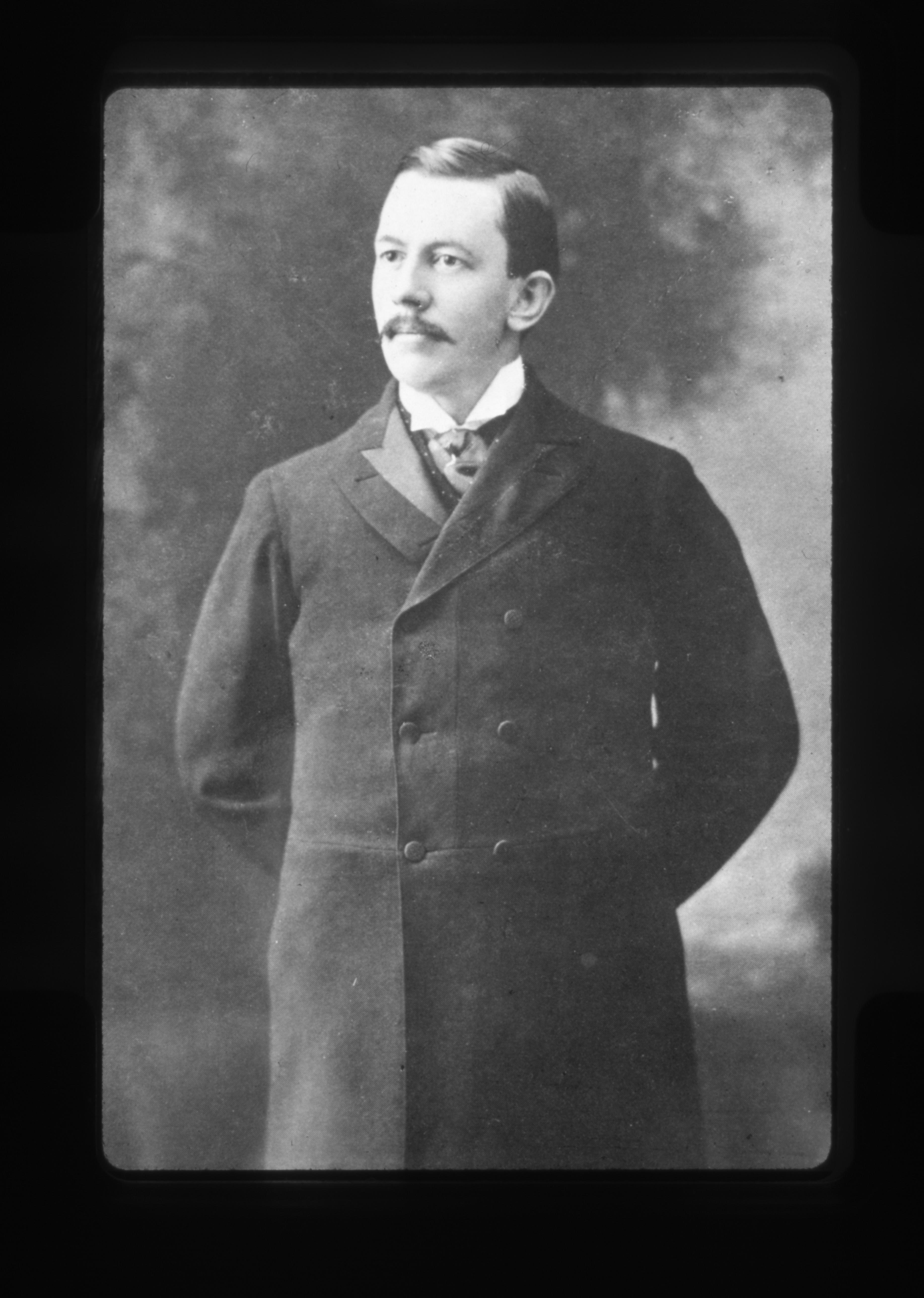
In the June 17, 1938 issue of The Phillipian, it was announced that Dr. Warren King Moorehead would be leaving his post as Director of the Department of Archaeology. This brought about the end of a long and prosperous career that saw Moorehead become an integral part of the Phillips Andover community and a major contributor to the field of archaeology as a whole.
Portrait of Warren K. Moorehead, 1898
Moorehead began his career in the 1880s when he studied at Denison University before becoming an assistant at the Smithsonian Institution and later the curator of the Ohio Archaeological and Historical Society (now the Ohio History Connection). He joined the Department of Archaeology at Phillips Andover at its inception in 1901 and was appointed as the first curator. In fact, he worked closely with Robert S. Peabody, the Department’s founder, to develop the idea of such an institution. During his time as part of the Department, Moorehead received a Master of Arts from Dartmouth and was made a Doctor of Science in 1927 by Oglethorpe University and again in 1930 by Denison University. He became the director of the Department after Dr. Charles Peabody stepped down in 1924.
The article that announces Dr. Moorehead’s retirement is not particularly long but does highlight some of the important aspects of his career. The article spends a majority of its content on his education and on his path to becoming the director. The article does include some of his other accomplishments, such as a partial list of publications, and a mention about his work with the US Board of Indian Commissioners. The article concludes by saying that his position within the archaeology community is undisputed and that he will be travelling to Europe with his wife for the summer.
Warren K. Moorehead (far left) with an excavation group
Personally I was surprised with how Moorehead’s departure was presented in The Phillipian, particularly the brevity in which they describe his career. In the numerous issues of The Phillipian throughout the years that I have researched, it became clear just how much Moorehead fought for the rights of Native Americans and how he fought to bring the injustices committed against them to light. This was a frequently recurring topic for Moorehead and yet receives one sentence in his retirement article. This also occurs with his numerous archaeological discoveries from across the country. A significant aspect of Moorehead’s career was his participation in and leadership of numerous excavations and expeditions over the years and, unfortunately, that aspect receives little attention in this article, such as his work throughout New England, the Midwest, and Southeast. Although his methods do not meet today’s standards, Moorehead made multiple important contributions to the field that went unmentioned in his retirement article.
I think that the reason I was so surprised was that the reception that Moorehead received in this article differs from most of his other appearances in The Phillipian. Many of the articles that featured Moorehead over the years went into a fair amount of detail. Whether it was discussing a lecture or one of his expeditions, the reader was usually given more information. Moorehead was seemingly respected and well liked by the students, as evidenced in numerous articles praising his lectures, yet the announcement of his retirement is rather straightforward and relatively unemotional. One possible reason for this could be declining student interest in the Department over the few years prior to his retirement and his habit of giving very similar lectures every year. Moorehead’s sendoff did not mirror his depiction in previous issues of The Phillipian.
Warren King Moorehead was a staple of the Department of Archaeology from its inception in 1901 until his retirement in 1938 having served as both the curator and then as the director. He retired at the age of 72 and spent his brief retirement with his family before passing in January of 1939.
Check out the following Peabody blogs for more information and history about Warren K. Moorehead.
When thinking about the collections held by the Peabody Institute, I often also think of Warren K. Moorehead. Regular readers of the blog (I know there are a few of you out there!) are certainly familiar with his name and how tightly he is intertwined with the Peabody. To recognize Moorehead’s 155th birthday this week, I wanted to take a few minutes to share some of his story.
Warren King Moorehead, 1898
Warren King Moorehead (1866-1939) grew up in Ohio, where he cultivated a lifelong interest in archaeology and Native Americans. In his early career, he worked as a correspondent for The Illustrated American and served as the first curator of archaeology for the Ohio Archaeological Society (now the Ohio History Connection). In 1896, he began what would become a personal friendship with Robert S. Peabody, providing him with several Indigenous artifact collections. When Mr. Peabody chose to donate his collection to Phillips Academy in 1901, he appointed Moorehead as the first curator of the Department of Archaeology. Moorehead served in that capacity until 1924 when he then assumed the directorship. He finally retired in 1938, only a year before his passing.
Throughout his career, Moorehead was a prolific writer, excavator, and collector. His large-scale archaeological surveys and excavations included the Arkansas River Valley, northwest Georgia, the Southwest, and coastal and interior Maine. His work directly contributed to expanding the Peabody’s collection by approximately 200,000 objects.
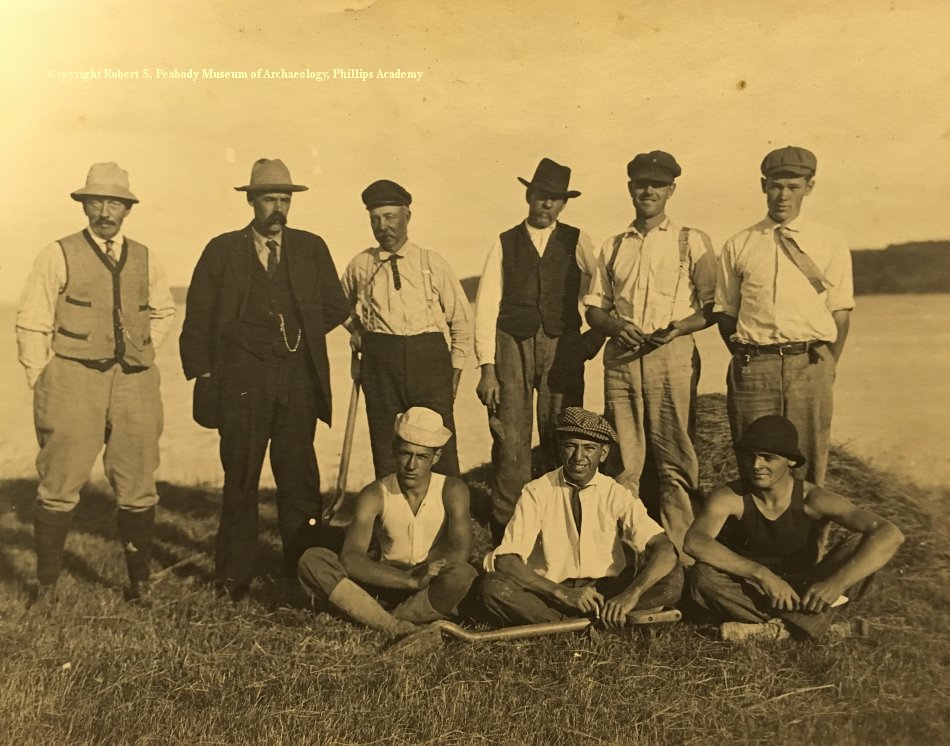
Moorehead and crew doing a survey along the Merrimack River
However, it must be acknowledged that Moorehead’s field and collection techniques are quite shocking by modern archaeological and museum standards. Early in his career, particularly in Ohio and Georgia, Moorehead would use horse drawn plows to cut into carefully constructed mounds. Often, his work was destructive yet superficial – he would level or bisect the mounds and collect what was of interest to him with relatively little note taking.
Moorehead was also a dealer – he regularly facilitated trades between institutions and with private collectors to fund his own work or to “remove duplicates.” Definitely something that would never be done now. And, it created lots of headaches.
It is perplexing to me that Moorehead was able to see the injustices done to contemporary tribes, but continue to be seemingly unaware that the material that he avidly collected and traded was connected to those same people. I firmly believe that Moorehead is an excellent candidate for a riveting biography. Anyone out there have the time to write it??
One day while I was working in the basement of the Peabody, plugging away at inventorying drawers, I was listening to a podcast called Astonishing Legends. It was an episode titled “The Tall Ones” exploring the legends and lore surrounding giants around the world. It came as a surprise when I heard the hosts say the name W.K. Moorehead! My ears instantly pricked up.
The podcast hosts went on to cite a New York Times article written on July 14, 1916 under the headline “Find Horned Men’s Skulls: Remarkable Discovery by Archaeologists in the Susquehanna Valley”. The short article stated that Professor A.B. Skinner of the American Indian Museum, Rev. George Donehoo, Pennsylvania State Historian, and Professor W.K. Moorehead of the Phillips Andover Academy uncovered a burial mound at the Murray Farm site while conducting research at Tioga Point in the Susquehanna Valley. In the mound, they uncovered the remains of sixty-eight men, believed to have been buried around the year 1200 AD. According to the article, the average height of these men was seven feet, with many being even taller. Also found with the remains were very large stone celts and axes, further evidence of the men’s gigantic size. Perhaps most interesting of all, some of the skulls had two inch bone protuberances on their foreheads. Well, this was something to explore!
Workers at the Murray Farm excavation. Photograph taken by Rev. George Donehoo, 1916.
Looking through historical texts and documents, it is clear that giants have been a topic of interest for centuries. Not only are they mentioned in the Biblical story of David and Goliath, but in fairy tales such as Jack and the Beanstalk, and the legend of Paul Bunyan. One pervasive theory about giants is that they are actually Nephilim (also from the Bible), the offspring of an angel and a human. Even some historical figures such as Gilgamesh are thought by some to have been giants.
Many newspaper articles from across the country in the nineteenth and early twentieth centuries claim to have found giant skeletons. Some accounts even call them a lost race of giant people, but many others hypothesize that they were giant Native Americans. An eight foot tall Native American skeleton was said to be found in Towanda, Pennsylvania in 1822. A headline from The World newspaper on October 6, 1895, read “Biggest Giant Ever Known-Nine Feet High and Probably a Prehistoric California Indian.” Some, like the Cardiff Giant, which was actually a buried stone statue, were proven to be hoaxes. Yet the stories still remain popular. Even Captain John Smith, in his account of meeting the Susquehanncocks in 1608, described them as giant-like. But were there really giants roaming this land before us? Or horned giants for that matter?
After some further digging, it was discovered that the “horned giants” found by Moorehead and others at Murray Farm were not horned at all, nor were they giants. Professor Skinner wrote a corrected article for the New York Times but it was not as publicized as the original, so it is harder to find. Apparently while excavating the site, a workman shouted out “There are horns over his head!”, after discovering a bundle burial which had been covered with deer antlers. An excited visitor or reporter at the site heard this and asked another workman, who decided to play a joke and claim that the skeletons had horns growing out of their heads. Another version says that a disgruntled camp cook made up the story.
Workers at the Murray Farm excavation, along with visitors who came to see the exciting finds. Photograph by Rev. George Donehoo, 1916.
This explains the story about the horns, but what about the supposed enormous height of these individuals and the other accounts of giants found nearby? It is thought that these skeletons, as well as accounts of living “giant” Susquehannocks, were not giant at all, but just taller than average. At the time, the average height of most Europeans was about five feet six inches tall, whereas Native Americans were thought to average about six feet tall. While six inches is not that big of a difference, anyone taller than six feet may seem like a giant to the generally shorter Europeans.
Another reason for the discovery of “giant” skeletons is that these bones were often misidentified as human when they actually belonged to extinct animal species. It may seem far-fetched that anyone could misidentify a mammoth bone as that of a human, but other than the skull, human bones actually look very much like animal bones. So to someone not trained in osteology, a very large rib bone may seem like it is from a human skeleton. Many skeletal remains have been innocently misidentified this way, not only as giants, but as monsters or “Titans” as well.
Over time it seems that this giant narrative of Native Americans by Europeans was exaggerated and, coupled with misidentified animal bones, resulted in the discovery of “giant skeletons.” However, these so-called giant skeletons always seem to mysteriously disappear after being excavated, leading many to believe that they either never existed, were misidentified animal bones, or it was actually just a taller than average person.
After hearing the podcast, I did some digging of my own through Moorehead’s records, just in case I could find anything related to the “horned giants”. I found many documents related to the Susquehanna Valley expedition as well as correspondences between Moorehead, Skinner, and Donehoo. None of these documents ever mentioned the “horned giants” or the article written in the New York Times. I did find a picture of Professor Skinner holding a perfectly normal looking skull with no protuberances while at Murray Farm. Moorehead also wrote a short report of the excavation, and again, no mention of giants was found.
Warren K. Moorehead (far right) and others in the Susquehanna Valley. Photograph taken by George Donehoo, 1916.
Even though the horned giants of Pennsylvania turned out to be nothing more than a tall tale (pun intended), it was fun to hear a story about Moorehead on one of my new favorite podcasts! I wonder what interesting stories I’ll uncover next!
P.S. For further reading on giants and other archaeological myths, check out Kenneth Feder’s book titled Frauds, Myths, and Mysteries!
October is one of my favorite times of the year. I love the changing leaves here in New England, the crisp air, and seeing all the creative Halloween costumes that people come up with. This is also a time for sharing spooky stories and strange experiences…
Have you ever noticed this plaque at the Peabody?
This plaque is next to the front door of the Peabody Institute
Warren K. Moorehead (1866-1939) was the first curator and second director of the Peabody Institute (then known as the Department of Archaeology). If you don’t know anything about him and his relationship with the Peabody, just try searching ‘Moorehead’ on our blog. I’ll wait.
Moorehead was definitely a strong personality. And I, personally, think some part of his spirit does still live at the Peabody.
Several years ago, there were a series of strange disturbances that were happening at the Peabody. I don’t have the space to tell you everything, but here are a couple that I personally experienced:
One morning, Lindsay and I were the first staff in the building and let ourselves into the basement office space. Sprawled across the floor by our kitchen area were paper plates, a glass shelf (an extra for the fridge), and various other little things that had been on top of the microwave. These things could NOT have fallen like this on their own – it looked like something had swiped its arm and pushed everything onto the floor. Lindsay and I had been the last ones out and were now the first ones in. We immediately photographed what we saw (I am so sorry that I can’t find that photo!) and did some follow-up. No motion alarm had gone off all night and our pest management company found no evidence of an animal.
Another time, a couple years ago, I was talking to work duty students and explaining that Moorehead used to exchange or give away artifacts that I really wish had stayed in our collection. Just as I was mid-sentence in a rebuke of his cavalier behavior, a photographic portrait of him fell from the wall and smashed its frame. This portrait had been hanging in the same spot for my entire tenure at the Peabody (at that point, about 10 years) and had never fallen before. The students and I exchanged shocked looks and I quickly apologized to Moorehead for bad-mouthing him.
Moorehead (he is the one standing) now rests on the floor. Although this was printed for an old exhibition, I can’t quite bring myself to get rid of the photo.
Shortly after these incidents, Ryan wrote a note to Moorehead explaining that we were taking care of the building and the collections and that we respected and appreciated him. Ryan slid the note behind the plaque by the front door and the strange occurrences stopped.
I am not big believer in the supernatural, but I do think Moorehead’s spirit does reside in the Peabody in some form. In my opinion, he is a pretty benign ghost who just wants to ensure that the collection and the building are getting their proper respect and care – I strive to meet his standards.
Returning to the Peabody Institute on a more regular basis this month led me to rediscovery an interesting little artifact on the window of my office. When I first joined the Peabody in 2012, my colleagues pointed this out to me, but it has remained largely covered up by window blinds since an initial peek.
Singleton Peabody Moorehead’s name scratched on the windowpane in the director’s office.
The artifact in question is a scratched signature on a glass windowpane: S. P. Moorehead. Singleton Peabody Moorehead was our first curator’s youngest son.
When I first saw this little relic of past occupants, I imagined the younger Moorehead scratching the signature using his father’s emerald ring. That ring is a prominent feature in pictures of Moorehead, and I can imagine a mischievous child borrowing the ring and testing the stone’s hardness on the nearest handy surface: his father’s office window.
Robert Singleton Peabody, our founder, lent his name to the younger Moorehead. In fact, S. P. Moorehead was born in October 1900, right around the time that his father Warren and Robert Peabody were imagining the Department of Archaeology, our name in the early part of the twentieth century. Robert had befriended the elder Moorehead and hired him about a decade earlier to help amass a collection of Native American objects. He also provided convalescent facilities when Moorehead was recovering from tuberculosis. In fact, Singleton Moorehead was born at Saranac, New York where his father was recovering at Peabody’s cabin.
Moorehead’s entry in the 1918 Phillips Academy yearbook.
So who was Singleton Peabody Moorehead? He grew up on Hidden Field Road on the Phillips Academy campus, and graduated from the school in 1918. During his time at Phillips, Singleton, or “Sing,” played football, swam, and served as art editor for the Academy’s yearbook Pot-Pourri. He also participated in archaeological projects, including Alfred V. Kidder’s excavations at Pecos Pueblo, New Mexico. Both of Warren Moorehead’s sons, Ludwig and Singleton, served in World War I. After a brief military service, Singleton attended Harvard, where he received undergraduate and graduate degrees in architecture (BA in 1922 and M. Arch. in 1927). At Harvard, he continued his association with archaeologists, including a friendship with Philip Phillips. One wonders to what extent Moorehead’s exposure to archaeology prepared him for the Colonial Williamsburg project that became his life’s work?
Moorehead’s elevation of Colonial Williamsburg Block 17; Block 8: Duke of Gloucester Street.
Singleton joined the Boston architectural firm Perry, Shaw and Hepburn in 1928 and almost immediately began work at the firm’s field office in Williamsburg, Virginia. Here he was involved in the restoration work of Colonial Williamsburg, ultimately joining the Colonial Williamsburg Foundation in 1934, where he worked as director of architecture from 1944 through 1948, and then as a consultant. So, if you’ve visited Colonial Williamsburg, you know Singleton Moorehead’s work! Perhaps one of the best-known structures at Colonial Williamsburg is the capitol building, reconstructed based on elevations, archival descriptions, and archaeological investigations conducted under the director of the Perry, Shaw and Hepburn architects. Another Colonial Williamsburg favorite is Chowning’s Tavern; a 2016 newspaper story on the 1939 reconstruction attributes much of the character of Chowning’s to Moorehead, who was interested in the quotidian aspects of eighteenth century architecture.
Moorehead’s birds-eye view of Pecos Pueblo, from Alfred Kidder’s 1958 “blue book” Pecos Notes.
He married Cynthia Beverley Tucker Coleman, a descendant of St. George Tucker, a colonial resident of Williamsburg. A New York Times (December 12, 1964) obituary notes his involvement in many other historic preservation and architectural projects, as well as contributions to two books, Colonial Williamsburg: Its Buildings and Gardens (1949) and The Public Buildings of Williamsburg (1958), and authorship of many articles. One such crossover project was Kidder’s revisit of his Pecos excavation, including detailed architectural plans executed by Singleton and published as one of the Peabody Foundation “blue books” in 1958.
S. P. Moorehead died in December 1964 and is interred in the Bruton Parish Church cemetery in Williamsburg.
Further Reading
Lounsbury, Carl R. (1990) Beaux-Arts Ideals and Colonial Reality: The Reconstruction of Williamsburg’s Capitol. Journal of the Society of Architectural History 49(4):373-389.
New York Times (1964) Singleton P. Moorehead Dead: Colonial Williamsburg Planner. December 13, 1964, p. 86.







 The Peabody