Earlier in May, members of the Eugene Winter/Northeast Chapter of the Massachusetts Archaeological Society asked me for some summer reading suggestions. I checked online for reading lists of archaeology books that might appeal to the interested public and was surprised to find that most did not include many actual books on archaeology! I quickly typed up the following list. Check out digital copies of almost all of these books after creating a free account in InternetArchive.
1) Books by David Hurst Thomas, including his textbook Archaeology. You might be surprised that a textbook would be at the top of my reading list, but this is a terrific book. In earlier editions, at least, each chapter includes all of these great quotes. This book demonstrated to me as a college senior that archaeology was for smart people. Also, Thomas’s book Skull Wars, on the Kennewick Man (the Ancient One), is a superb look into the complex relationship between Native Americans and archaeologists. Copies of Archaeology on InternetArchive: https://archive.org/search.php?query=david%20hurst%20thomas%20archaeology
2) Loren Eiseley’s The Night Country. Eiseley was an archaeologist and paleoanthropologist at the University of Pennsylvania and this is his semi-autobiographical memoir. It is so beautifully written, and funny, and gives some great insights into twentieth century archaeology by a master of the profession. You can borrow the book electronically from InternetArchive: https://archive.org/search.php?query=loren%20eiseley%20the%20night%20country
3) Encounter with an Angry God by Carobeth Laird. About her life with archaeologist and ethnographer John Peabody Harrington, who was brilliant and maybe more than a little crazy. I found this in the stacks as a grad student and couldn’t put it down. Again, available to borrow on InternetArchive: https://archive.org/details/encounterwithang0000lair
4) In Small Things Forgotten by James Deetz. In many ways, this book defined the field of historical archaeology. This is especially relevant for those of us in New England, but everyone will enjoy learning about pipe stems, gravestones, and other quotidian aspects of daily life that only archaeology can illuminate. Also available to borrow on InternetArchive: https://archive.org/search.php?query=in%20small%20things%20forgotten
5) What This Awl Means by Janet Spector. This is one of the first—and remains one of the most creative and engaging—books in the field of feminist archaeology. Spector uses feminist perspectives to interpret a nineteenth century Native American site near Minneapolis. Storytelling techniques that are rare in archaeological writing figure prominently, making this book fascinating and accessible.
6) The Early Mesoamerican Village by Kent Flannery. The major selling points of this book is that it is well written and highly readable AND that between the chapters there are these fictional interludes featuring The Great Synthesizer, The Skeptical Graduate Student, and The Real Mesoamerican Archaeologist. Archaeological writing at its best! Check it out on InternetArchive: https://archive.org/search.php?query=the%20early%20mesoamerican%20village
7) The Science of Archaeology? This is Richard “Scotty” MacNeish’s autobiographical musing on the future of archaeology. Scotty was the fifth director of the Robert S. Peabody Institute of Archaeology (then called the Robert S. Peabody Foundation for Archaeology). At our institution he conducted major projects in Mexico and Peru questing for the origins of agriculture and civilization. Happily, you can check it out on InternetArchive: https://archive.org/details/scienceofarchaeo0000macn
8) Frauds, Myths, and Mysteries by Kenneth Feder. All the kooky ideas, from Atlantis to Giants, about North American archaeology and why people believe them. Ken gave our big lecture last fall about his newest book, Archaeological Oddities: A Field Guide to Claims of Lost Civilizations, Ancient Visitors, and other Strange Sites in North America, a site guide to many of the places mentioned in Frauds. Lots of fun, well written, and you can’t help learning along the way. Frauds is available on InternetArchive too: https://archive.org/search.php?query=frauds%20myths%20feder
9) Gods, Graves, and Scholars by C.W. Ceram. This was published in 1949, but tells the stories of many of the great archaeological discoveries up to the mid twentieth century. Heinrich Schliemann at Troy, Howard Carter and King Tut, etc. You have to read this if you are an archaeologist. Again, see InternetArchive for e-copies: https://archive.org/search.php?query=gods%20graves
10) The Bog People by Peter Glob. Iron Age mummies from European bogs. Some crazy preservation that you only get in wetsites (anaerobic conditions). If you read this, you will want more on wetsite archaeology! Copies to borrow on InternetArchive: https://archive.org/search.php?query=the%20bog%20people%20glob If you do get hooked, follow this up with Bryony Coles’s Sweet Track to Glastonbury: The Somerset Levels in Prehistory. The Sweet Track is a Neolithic timber walkway. More great wetsite archaeology!
11) Lucy: the Beginnings of Humankind by Donald Johanson. I carried this book around with me for a year in high school, reading and re-reading it. This sometimes got me in hot water, as I attended a very conservative religious school. Dated now (first published in 1981), with so many new discoveries, but really well written and it gives a sense of the scholarly battles that still rage over human origins. Pair with Lee Berger’s more recent book Almost Human and you get a pretty good sense of the complexities of paleoanthropology. Click here for digital copies on InternetArchive: https://archive.org/search.php?query=lucy%20donald%20johanson
12) Rubbish! The Archaeology of Garbage by Bill Rathje. This is a fun book and recounts the work that Rathje and his University of Arizona students did on modern refuse disposal habits and how this could be applied to archaeological sites. Rathje was a big proponent of Behavioral Archaeology, so you get some of that theory as well. Checkout the copy on InternetArchive: https://archive.org/search.php?query=Rubbish%20rathje
In these unprecedented times, we are adjusting to a “new normal” in our lives – whether that be working from home, wearing a mask and social distancing in public places, ordering more online, participating in video calls and Zoom meetings, or assisting students with schoolwork. As we persevere during this time, we are finding ways to safely connect with friends and family, get outside, exercise, and continue our lives while embracing new changes to keep everyone safe and healthy.
It’s nice to find new ways to smile… even in a pandemic ☺️
House projects have been a popular trend for many, especially with the warming weather. A few friends of the Peabody have used this time to revive and repurpose some of our old collection drawers.
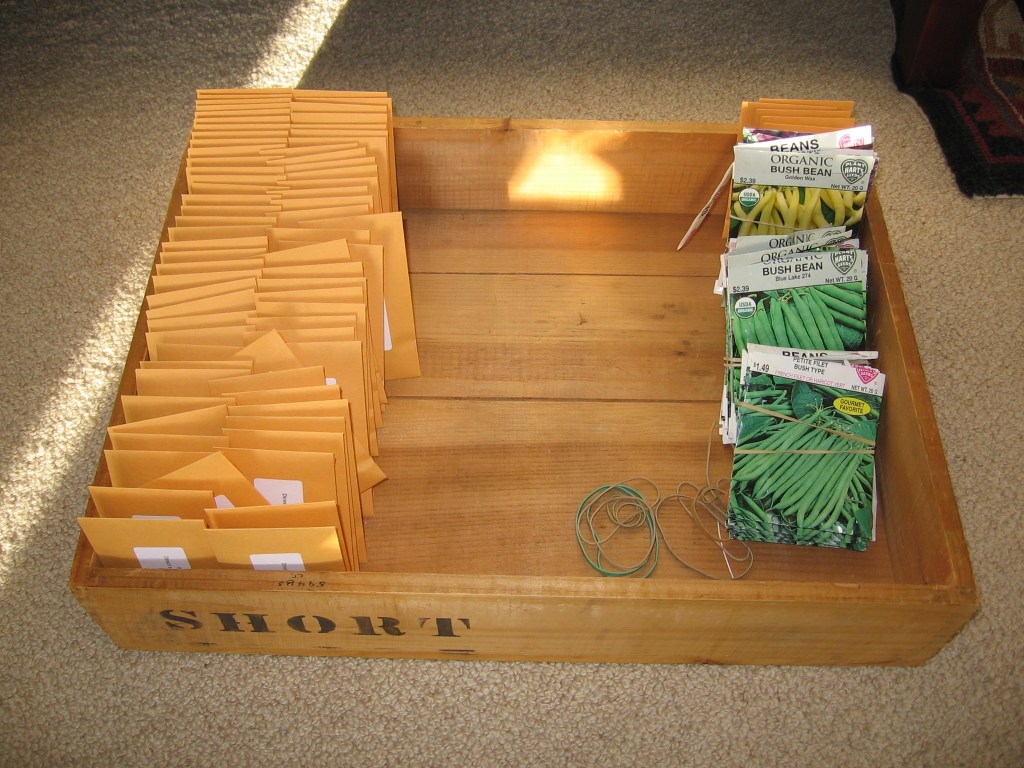
Planting season is in full swing! This drawer is being used to sort out seeds for the Andover Community Garden. It is the perfect medium for organizing the seeds before they are packaged and distributed to those in the community looking to begin their planting season.
From storing artifacts to storing seeds – this drawer is great for organizing and storage.
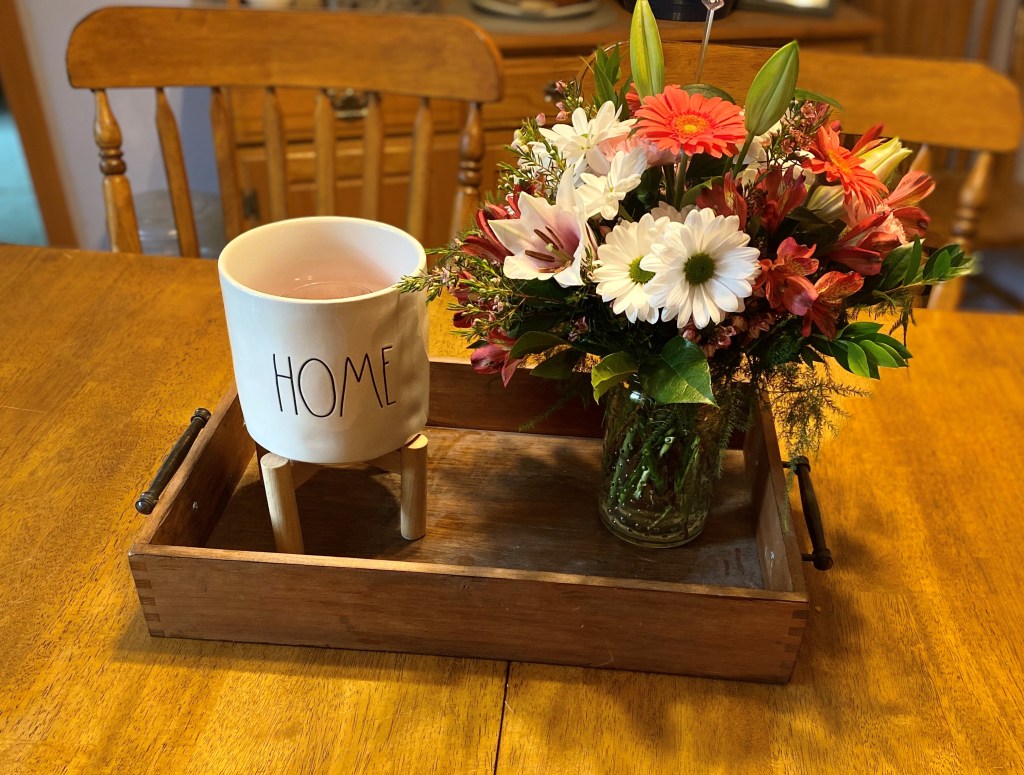
A little bit of sanding, wood stain, and cabinet handles can go a long way. Revive a drawer into a serving or decorative tray. Pair some bright flowers with that Rae Dunn piece you’ve always wanted and voilà! You have a decorative centerpiece for your kitchen table or coffee table.
Just look at those original box joints on the corners!
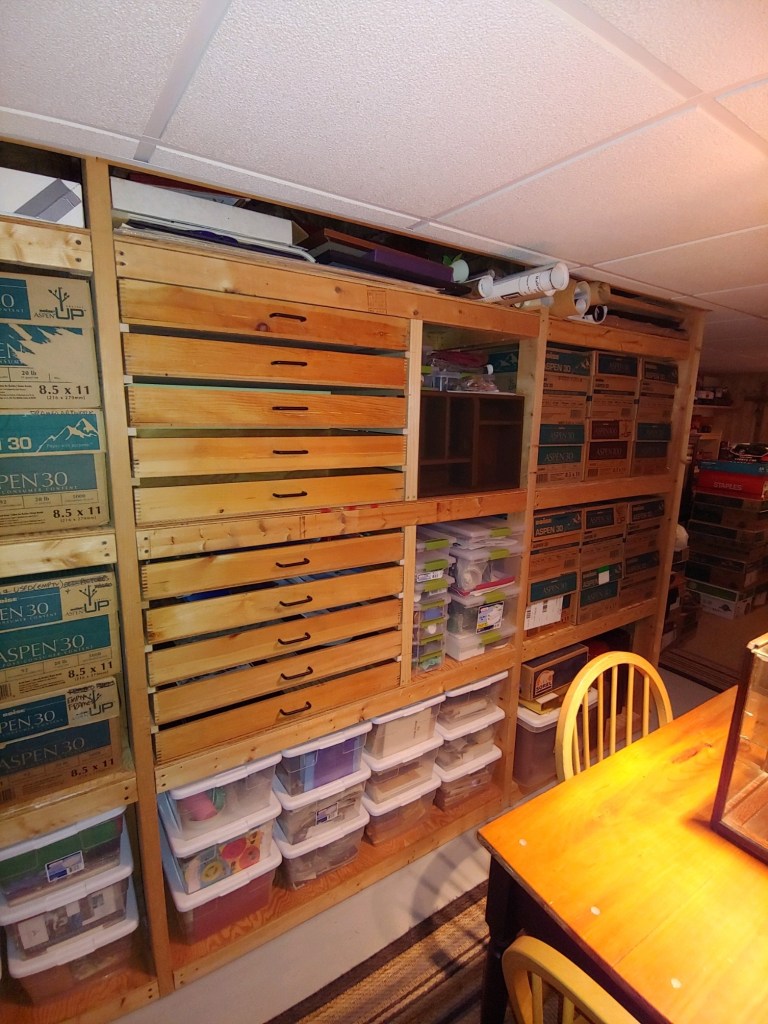
The large drawers are great for holding large items or large quantities of smaller items. Add handles and they make a perfect storage feature for your household. These drawers are being used to store artwork. What a great way to stay organized with a little piece of history!
Stay organized with a piece of the Peabody – a beautiful accent to your storage!
We love seeing our drawers revived and repurposed into new creations. Not only do the drawers provide great opportunities for organization, storage, décor, and material design, they provide a unique story and history to share with your family and friends. If you have repurposed some of the Peabody drawers, we would love to see and share your projects! Please share your photos with us at elavoie@andover.edu. Stay tuned for our next blog update featuring more repurposed drawer ideas!
Before COVID-19, the Peabody Institute kept our social media presence to Facebook and Twitter. But this seemed like the perfect time to expand to Youtube. This is definitely a new medium for me and I was puzzled for a few days as to how I could contribute to this platform. And then inspiration struck.
Phillips Academy is home to two cultural institutions – the Robert S. Peabody Institute and the Addison Gallery of American Art. Our friends at the Addison created a delightful short stop-motion video about the work of a registrar and shared it on Facebook. I thought it was fabulous. And I also thought, I can do that!
Well, that started a project that took about a week of evening shoots after the kids went to bed, and an additional couple weeks of sound design (maybe I shouldn’t admit that it took that long…). I wrote a short script and then cannibalized my boys’ Legos to recreate the Peabody staff and create sets. I regret not taking a picture of the carnage to our play room to share, but I am relieved that it is all cleaned up now.
Framing and filming the stop-motion required a level of patience and detailed focus that was challenging for me at times but necessary to make the film work. It is hard to remember to account for everyone and everything in the scene, but not to move it too much to ensure it was fluid. It was pretty fun to hide details in the background too.
Adding the voices and music was a whole separate task. I fully credit my husband with the patience to become my sound engineer. He took all the lines, including those contributed by our 5 year old, and music and ensured that everything synced with the video – and made sure we weren’t breaking any copyright laws with the music use…
I think the end result is pretty great. Viewers learn about what the Peabody does every day, from my perspective, and get to escape for about 3 minutes.
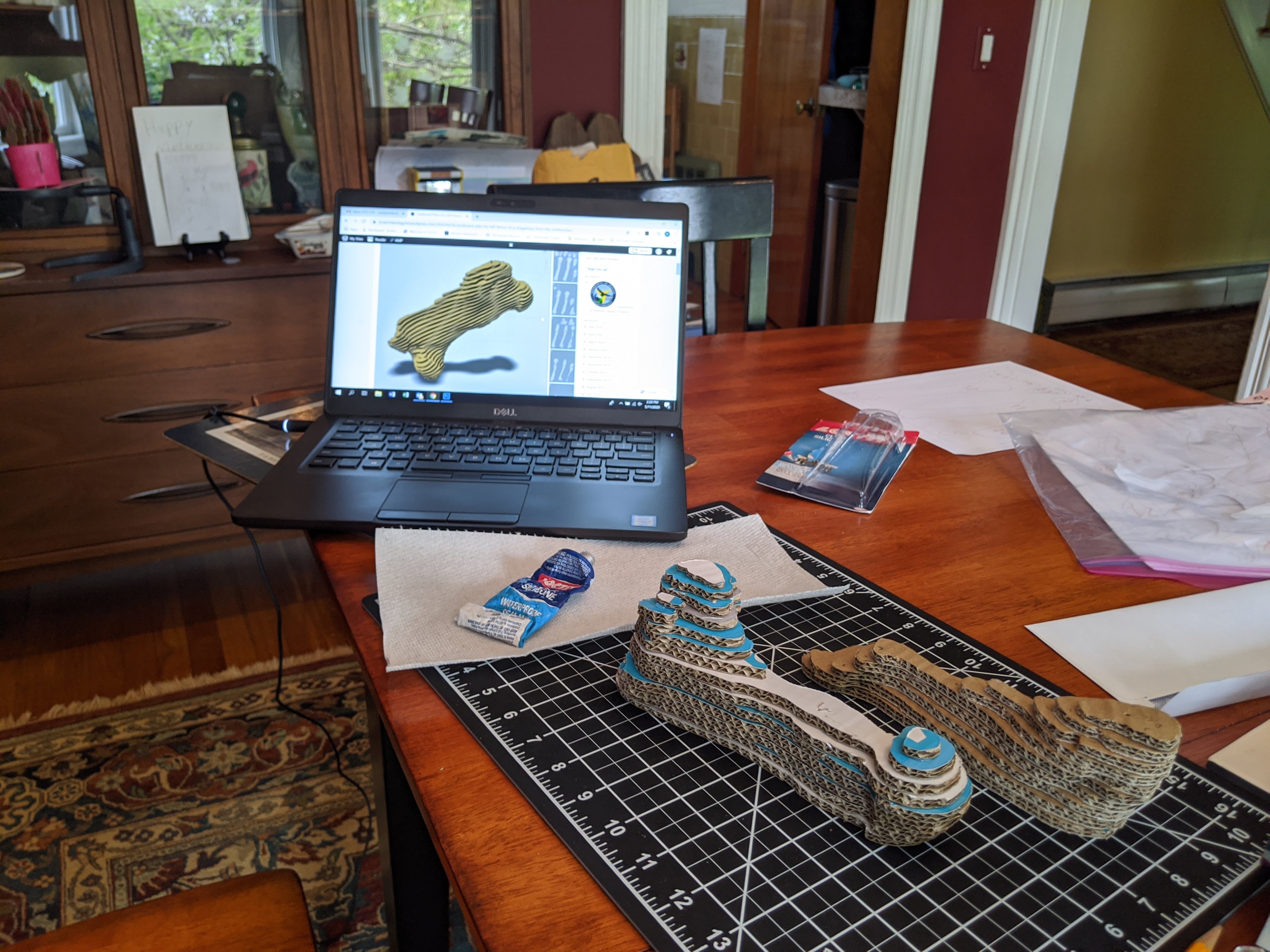
I was excited when Bernard Means of the Virtual Curation Lab posted 3D slice models of artifacts and fossils. The models reminded me of the topographic models we made in the Boy Scouts. We cut out and stacked cardboard pieces, replicating the elevation contours of a topographic map. A two dimensional image was transformed into 3D! Lock down means most of us are away from 3D scanners and printers, so the cardboard patterns are a fun way to make 3D models. Plus, I LOVE building stuff out of cardboard, often with my eight-year old son Leo. Leo and I have made a Corinthian helmet, the TARDIS and K-9 from Doctor Who, a wearable sea turtle carapace, a model of our house, and much more.
Choosing a 3D Slice Model
Initially I wanted to build the Virtual Curation Lab 3D slice model of a dire wolf skull. I downloaded the plans and watched the video loop showing a virtual assembly. Ultimately, I opted for the Megalonyx femur. I decided that it was a little simpler, and might make a better first build. Each set of plans includes numbered pieces with registration marks that indicate how all the pieces stack. I like Megalonyx too, since these giant ground sloths existed in my home state, and some Florida rivers occasionally reveal fossilized bones. Megalonyx existed across much of North America for over 10 million years, ultimately becoming extinct around 11,000 years ago!
Stacked pieces of the Megalonyx femur with the VCL model playing in the background.
Assembling Materials
I started by downloading and printing a set of the plans from the Virtual Curation Lab. There are five pages with approximately 26 pieces for the Megalonyx femur. I printed two sets of plans, keeping one for reference as I cut each piece out to make patterns. As I worked on creating the patterns for each piece, I assembled my other materials, including:
pieces of thick, corrugated cardboard from a shipping box (thin cardboard, like a cereal box, won’t work well),
an X-acto knife with a supply of #11 blades,
a cutting mat,
an envelope to store the paper patterns,
adhesive glue,
and some black spray paint and some brown and tan acrylic modeling paint.
Cutting the cardboard pieces with a #11 X-acto blade.
Creating the Model
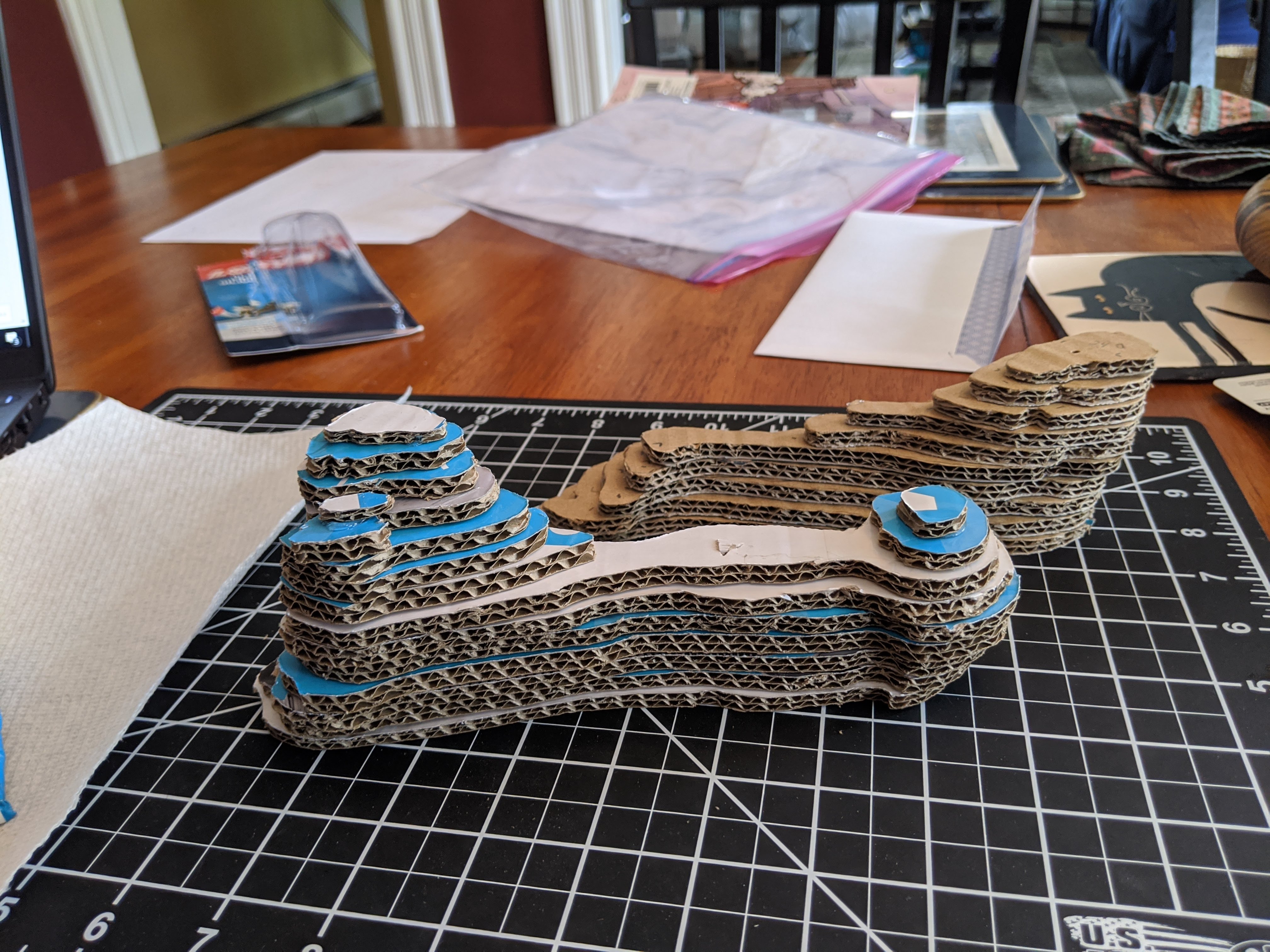
As I began making paper patterns for each piece, I noticed that some of the pieces are rather small or have narrow sections when printed on an 8.5 x 11-inch piece of paper. I decided to scale things up by adding about 1/8-inch on each side of each pattern. One could also use a program like Photoshop to scale up the pattern. I traced the patterns onto the cardboard, making sure to keep the long axis of each piece against the “grain” of the cardboard. This produced pieces that showed the honeycomb structure of the corrugate cardboard along their long side. I was a little worried that my cardboard might be too thick (2/8-inch), but the Megalonyx femur is a big, thick, flattish piece of bone, so I decided to keep going. Next time I will use some 1/8-inch corrugated cardboard. Change the X-acto blades with some regularity—they get dull quickly! I also made sure to transfer over the piece number and registration marks as I went. I saved all the pattern pieces in an envelope for future use. Once all the cardboard pieces were cut out I made a few test stacks and cleaned up edges as needed. I used some silicon glue left over from another project to adhere all the pieces. This provided for easy cleanup, allowed me to reposition pieces as needed, and made for a nice, solid bond after 35 minutes. White glue should work fine too. Dr. Means suggests on the Virtual Curation Lab blog assembling the models from the center moving outward. This worked well, and I made two large sections of the model that I then joined. I also had the virtual assembly loop playing to make sure the pieces were going together correctly. Following the registration marks is important too!
Two large glued-up segments of the cardboard slice model.
Painting and Decorating
When the cardboard was well bonded, I went to the garage to spray paint the model in a well-ventilated space. I used some leftover black spray paint to give a quick base coat. After the paint dried, I added some details with brown and tan acrylic paint. Minerals and tannins have heavily stained fossils from Florida rivers and quarries blackish-brown. Once I achieved the desired effect, I left the Megalonyx model to dry. My son produced a background drawing for display.
Two views of the finished Megalonyx 3D slice model after final assembly and painting.
Final Thoughts
Building these cardboard 3D slice models is a fun and low-tech way to learn about fossils and artifacts. During each stage of the build, my son and I looked up facts about the Megalonyx. The name Megalonyx is Greek for “large claw,” referring to the large, curved claws used for grabbing branches and foliage, their main food. We learned that our model, measuring about 9-inches long is about one-half scale. Megalonyx femurs measured by paleontologists are as much as 20-inches long! This was an impressive animal, measuring around 10-feet tall and weighing over 2,000 pounds. Their closest living relatives are the three-toed sloths of Central and South America, though these are much, much smaller! There are indications, too, that Native Americans hunted Megalonyx during the late Pleistocene.
The painted Megalonyx femur model on a background created by the author’s son Leo.
I’ve also made a Youtube video illustrating the build.
This series of blog posts—Miami Circle Reflections—are my memories of working on the Miami Circle project from fall 1999 through the construction and opening of the Miami Circle Park in February 2011. These reminiscences draw on my archived emails, newspaper-clipping collection, photos, publications, and, well, my recollections of the time. Florida’s Governor and Cabinet directed that my office, the Bureau of Archaeological Research, conduct an assessment to confirm the authenticity of the site (more on that to come!)l. Recently promoted to Archaeologist II, I had relocated from Gainesville to the Bureau headquarters in Tallahassee. I was nominated to lead the site assessment for several reasons: I was from southern Florida, I had studied the archaeology of the area, and no one else wanted to go. A six-week investigation of the Miami Circle property in October and November 1999 led to over a decade of involvement in research and publication, historic preservation and site planning, complicated permitting and politics, and ultimately the construction of the Miami Circle Park.
Miami-Dade County historic preservation director Bob Carr (left) examines the Miami Circle with County Archaeologist John Ricisak sometime in early 1999.
However, before I can tell about the events of fall 1999 I need to back up to the end of the previous year. December 1998 found me in Fort Lauderdale spending Christmas with my parents. Over breakfast one day just before Christmas, my father handed me the newspaper with a story about a mysterious archaeological discovery in the heart of downtown Miami. I scanned the story, which included claims of animal effigies carved in the soft Miami limestone and Maya visitors who brought stone axes to the site; I searched the story for the names and faces of familiar archaeologists, like Bob Carr, long time Miami-Dade County Archaeologist and then director of the county’s historic preservation program. Little did I know that the site described in that article—the Miami Circle—would change the direction of my career and dominate my professional life for the next decade. A week later, I shared the article with my colleagues back at the Bureau of Archaeological Research in Tallahassee. Over the first months of 1999, the Miami Circle ruled the archaeological news and each new day brought some new—often more incredible—claim. Most interesting, however, was the growing movement to save the site and the associated political twists and turns. Positioned at the very place where the Miami River meets Biscayne Bay, Miami’s twenty-first century rebirth would begin at its heart, with the destruction of the Miami Circle site and construction of two 40-story hi-rise towers.
Excavation of the Miami Circle feature by Miami-Dade County Archaeologist John Ricisak and a volunteer team, early 1999.
Archaeological investigations had first begun at the parcel known locally as Brickell Point in 1998 when a block of 1950s-era apartments were demolished and the property was being prepped for development by Michael Bauman’s company Brickell Pointe Ltd. Miami-Dade County has one of the most stringent local historic preservation ordinances, largely due to the efforts of long-time County Archaeologist Bob Carr. In the 1980s, Miami-Dade County enacted its ordinance and required that municipalities follow suit or develop even stricter historic preservation laws. The City of Miami tried to sidestep the requirement, but ultimately created its own historic preservation framework. Parcels in sensitive zones required archaeological surveys and could receive protective designations from the city’s historic preservation commission. In 1998, County Archaeologist John Ricisak took over the investigation of the Brickell Point site when it was determined that the developer’s contract archaeologist was doing substandard work. With a team of volunteers, Ricisak tackled what he believed would be a salvage project—the recovery of information from the site prior to destruction for development. However, local schoolchildren, followed by activists and Native Americans, began to insist on the preservation of the site. This led to tense moments in the field for Ricisak, including a plan by the developer to hire a stonemason to cut the 38-foot diameter Miami Circle feature out of the soft Miami oolite limestone and relocate it to a nearby park. Public outcry encouraged Miami-Dade County’s major, Alex Penelas, to sue the developer, citing eminent domain: the county planned to seize the Miami Circle parcel purely to save the ancient archaeological site. This action is almost unheard of in legal and historic preservation circles. The county feared that the court might accept the developer’s valuation of the property, exponentially greater than the $8 million paid for the parcel, while the developer worried that public sentiment might influence the decision, resulting in a punitively low value to be paid for the site. In this milieu, the developer and the county reached a compromise. The property would change hands; the sale price (including fees) was $26.7 million dollars. The county had to scramble, however, to secure the funds, or the deal would be off. Financial commitments came from the Knight Foundation, the Trust for Public Land, and the State of Florida. Contributing $15 million the State of Florida had several conditions—namely that the parcel would become state lands and that a state sponsored investigation could take place.
A montage of the author’s newspaper clipping collection about the Miami Circle.
Much of the above happened on the periphery of my involvement. I tracked the story carefully and collected a file of newspaper clippings through the first months of 1999. One big development was the response to the outlandish claims made about the site. Remember the Maya traders bringing stone axes, or the fabulous carved animals? Those were tame compared to the Druids, Atlanteans, and Extraterrestrials offered as possible builders or visitors to the site. This was 1999 and the beginning of the Internet Age. The Web was in its infancy, but stories like the Miami Circle attracted considerable fringe interest. The Circle was a regular topic on Art Bell’s Coast to Coast AM paranormal-themed radio show. Richard C. Hoagland (of the faces on Mars fame), and one of Bell’s regular guests, visited the Miami Circle and set up a webcam in a nearby hotel. One could log on and observe the site at any hour (not much was happening, as the developer had shut down most work at the site). Magician and paranormal debunker James Randi (aka The Amazing Randi) issued a challenge in February 1999. Randi claimed that the circular features that formed the Miami Circle were, in fact, part of the Brickell Point Apartments 1950s-era septic system and not an actual archaeological site. There were other skeptics, including Florida Museum of Natural History curator Jerald T. Milanich, who championed the septic tank theory. In April 1999, Milanich visited the site with State Archaeologist Jim Miller and other state representatives in response to an application to acquire the site using Conservation and Recreation Lands funds. Miller returned with his impressions, and not long after archaeologist Richard Haiduven visited Tallahassee and briefed us on the site. Haiduven had volunteered on the county-sponsored excavations and provided the most detailed account of conditions at the Circle.
John Ricisak and Jerry Milanich at the Miami Circle, April 1999.
As the legal fight to acquire the Miami Circle wore on in the spring and summer of 1999, the site remained in the news. The big milestones came in May and June 1999. In May, Florida Governor Jeb Bush and the Florida Cabinet, sitting as the Board of Trustees of the Internal Improvement Trust Fund, gave acquisition priority to the Miami Circle in the ranking of Conservation and Recreation Lands properties. A month later Miami-Dade County won the right to acquire the property through eminent domain. A trial to determine the value of the property was set for October 1999. A lot happened in September that year. The county and the developer reached a settlement, as described above, and the State of Florida agreed to participate in acquisition, pending a state investigation of the site. Two other things happened. Jacqueline Dixon, geologist at the University of Miami, conducted a sourcing study of the stone axes found at the site during John Ricisak’s salvage project. They were made of basaltic stone from the vicinity of Macon, Georgia, and were, in fact, not of Maya origin. Ricisak was pushing back against the far-fetched claims. Influential Archaeology magazine published archaeologist Jerry Milanich’s critique “Much Ado about a Circle.” Milanich, as mentioned above, had taken up The Amazing Randi’s notion that the site was not real and his push intensified as it looked more likely that the county and state would save the site. I’ve always believed that Milanich’s piece gave the Miami Circle story a boost at a point where media interest had begun to wane.
Signs left by protesters at the construction entrance to the Brickell Point property. Local shaman Catherine Hummingbird Ramirez frequently visited the gate and smudged visitors and archaeologists alike.
This is where my Miami Circle journey began. After the Governor and Cabinet authorized our office to investigate the site, I began planning for the project. Using the information provided by Jim Miller and Richard Haiduven, I developed a plan to investigate the remainder of the 2.2-acre parcel. John Ricisak had focused his efforts on the Miami Circle feature itself, and then been restricted by the developer from working elsewhere. The Circle was found somewhat fortuitously, with Ricisak and surveyor Ted Riggs noting that large, basin-like features in the limestone seemed to form a circular arc. They then marked the presumed path and excavated the 38-foot diameter Circle. Like other sites in the area, darkly stained archaeological deposits called midden (from the Danish word køkkenmøddinger for kitchen midden) capped the limestone bedrock. Midden deposits here are refuse and living surfaces left behind by the Tequesta Indians and their ancestors. I used maps of the site to plot a grid where we would excavate test pits. I hired a crew and planned to use a desk and phone in Bob Carr’s Archaeological & Historical Conservancy office in Little Havana, not too far from the Brickell Point site. The site remained fenced with 24-7 security guards and all entry required the developer’s approval. The investigation was relatively straightforward. We soon found, however, that a dense layer of construction debris capped the parcel. We abandoned gas-powered augers and the county loaned us a backhoe and a crackerjack operator, who carefully removed rubble to expose the old midden surface. We also cleaned profiles left from the demolition of the mid-twentieth century apartments, ultimately documenting three things: 1) about 70 percent of the 2.2-acre parcel had intact midden deposits and additional features carved in the underlying bedrock; 2) previous construction activity had removed the upper portions of the archaeological deposits, but left the lower layers intact; and 3) there were lots more carved holes to be found, including many in an area we dubbed “the Valley of the Holes.”
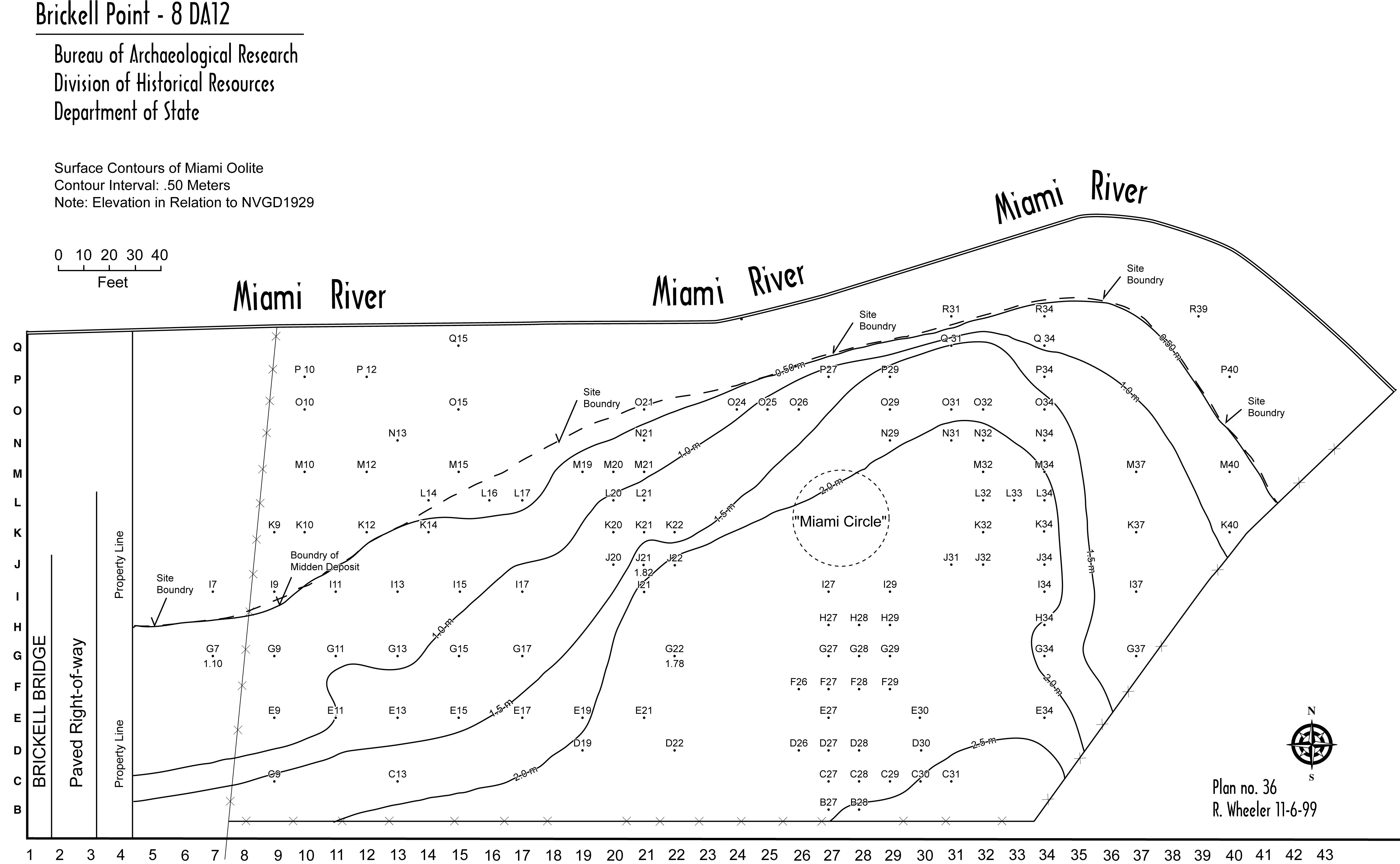
A map of the Brickell Point parcel showing the elevation and extent of limestone bedrock at the site. The author made of series of these maps, which were crucial during the later park development at the property.
We also wanted to tackle some of the claims made by conspiracy theorists, namely that the site wasn’t real. We asked that the State Geologist’s office inspect the underlying bedrock and the carved holes and basins that formed some of the most interesting parts of the site. Harley Means visited and made some interesting observations, ultimately published the following year. He noted that the Miami oolite limestone (oolite is composed of minuscule balls of calcium carbonate—or ooids—glued together to form a soft limestone rock) had a laminated coating formed by the interaction of acidic groundwater and dissolved minerals. This was a normal feature of oolite, but it was clear that the crust, formed over hundreds or thousands of years, covered the carved holes and basins. This meant that the holes and basins discovered by the county and state archaeology teams were quite old and not from the 1950s! If this wasn’t enough, I decided we needed to locate and excavate another one of the 1950s-era septic tanks. One was coincident with the Miami Circle, which had fueled the claims of a recent origin by the Amazing Randi and Jerry Milanich. Using the septic plans that John Ricisak had located at the town engineering office, we pinpointed the location of another tank (a large, concrete-encased structure). In a phone conversation with Jerry Milanich prior to the launch of my project he suggested that if we excavated another septic tank on the site we would find another circle of carved holes in the adjacent limestone. We found the tank quickly, but no associated features were located. Jerry was undeterred. A few years later when we nominated the site as a National Historic Landmark he suggested the Miami Circle was the foundation for an early twentieth century gazebo that could be seen on an old postcard of Brickell Point. Other skeptics (there were many) suggested the large midden-filled basins were “banana holes,” a geological feature known in the Bahamas that also involves the dissolution of cavities in soft limestone bedrock. The pattern of the hole at the Miami Circle, however, did not support the “banana hole” theory. Excavations on the north bank of the Miami River a few years later identified a similar circular feature, also measuring 38-feet in diameter, and directly opposite the Miami Circle. This discovery clinched our second attempt to list the Miami Circle as a National Historic Landmark!
The author at the Miami Circle in fall 1999. We still relied heavily on film cameras at this time–shooting black-and-white film and color slides. John Ricisak had a digital camera, but the images were low-res.
On the ground in fall 1999, the project had a few unusual elements. Protests at the site demanding the preservation of the Miami Circle had abated, but we still had the occasional visitor. Mostly we had to talk with folks through the fence, as the developer had forbidden guests inside the parcel. Catherine Hummingbird Ramirez was a fixture at the entry gate. Catherine is a local shaman and Carib Tribal Queen, originally from the Caribbean. She had been actively involved in the push to save the Circle and had created an altar on and just outside the entrance gate. The altar included laminated photos of celebrities that had visited the site, shells, woodcarvings, and beads. Catherine stopped by frequently to check on us. On Tuesday afternoons, people would gather for a vigil. Catherine smudged visitors (and our field crew members) with sage. We met other interesting people too, including Ishmael Bermudez. Ishmael stopped by one day to share information on dinosaurs and the Fountain of Youth, both located during excavations under his nearby Little Havana home. He told me about being at the Brickell Point site in the 1970s and receiving an energy surge. He lamented that he could not enter the property anymore. I motioned him to follow me to part of the property adjacent to the Sheraton Hotel next door. Here was a place where a driveway cut down through the limestone creating an exposure facing the hotel. I suggested he could “plug in” here. He did and left very satisfied a little while later. Ishmael frequently stopped to wave at us from Brickell Avenue Bridge, which bordered the west side of the property. In a cavernous storage space under the bridge the Florida Department of Transportation graciously allowed us to store our gear and the artifacts and samples we were collecting on a daily basis.
One of the press conferences held at the Miami Circle during the author’s investigation of the site. The author is somewhere in the middle of that throng of reporters!
Another unusual feature of our field project were the press conferences. Once the protesters were gone the daily media attention abated, but the county was interested in keeping the Circle in the spotlight, especially as they worked to secure funds for the acquisition—something that was still uncertain, despite the legal settlement. If I remember correctly, we had at least two of these, coordinated by Michael Spring, the head of the county’s arts programs. During one of these we agreed to share some of the finds, including the jaw of a massive grouper and an unusual object made from the primary ore of lead (galena). The fish jaw was local fare, and probably provided the centerpiece of an ancient Tequesta feast, but the lead ore had come from as far away as Missouri! I was worried about speaking and trying to share the objects, especially if someone decided to make a grab for one of them. I asked Victor Longo, a Florida Atlantic University anthropology student and one of our crew, to serve as “artifact wrangler.” In this capacity, Victor would share the objects on my signal, but was prepared to snatch them to safety at the first sign of trouble. He served admirably, and no artifacts were lost or harmed! This might sound a bit paranoid, but during the county’s investigation of the site a volunteer or visitor stole one of the exotic stone axes. Richard Haiduven, who had joined our crew, later related the story and his daydream of recovering the axe in a SWAT-type raid evocative of the Elián González saga, which was playing out just after our time at the Circle. Victor is now a successful realtor in Delray Beach.
Archaeologist Richard Haiduven excavates an unusual find at the Miami Circle–the burial of a five-foot shark. The five-gallon buckets protect the dark midden soil that contain the shark remains.
We concluded our investigation of the Brickell Point-Miami Circle parcel just before Thanksgiving 1999. I returned to Tallahassee to prepare my report and get back to my other projects, which had languished now for several months. Just before the year ended, the money changed hands and the Miami Circle officially became a state-owned property. And despite all the things that had happened since the discovery of the Miami Circle feature in October 1998, there was so much more to come! And since I had led the state investigation, I became the state Miami Circle guy. Stay tuned for my next Miami Circle Reflections blog where I detail the worst idea I’ve ever had.
In our new normal, museums around the world are finding new and clever ways to engage with people at home. I wanted to share with you some of my favorites.
Our friends at the Addison Gallery of American Art, also here at Phillips Academy, have gotten creative with Legos and stop-motion animation. Registrars: The Movie was the best 2 minutes of my day and I hope it makes you smile too!
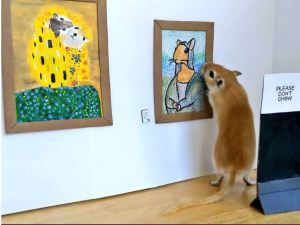
Do gerbils appreciate art? I don’t know, but I stumbled across this article about some art lovers who decided to find out. By all accounts, the gerbils had a positive experience with their private tour! And I hope you do too.
My favorite museum distraction is following the National Cowboy Museum on Twitter. Head of Security, Tim, has taken over their social media and has the best dad jokes around. Wonderfully refreshing and clever, Tim’s tweets bring a smile to my face every day – #HashtagTheCowboy. I can’t wait to find a reason to travel to Oklahoma City, OK and visit.
As the country continues to work from home, the Peabody collections team has gotten creative to keep everyone busy. Typically, our work requires touching and interacting with the objects in our collection as well as collaboration on deciphering difficult numbers or to respond to a research inquiry. I certainly can’t send the artifacts home with our staff, but we have been able to find plenty of remote work.
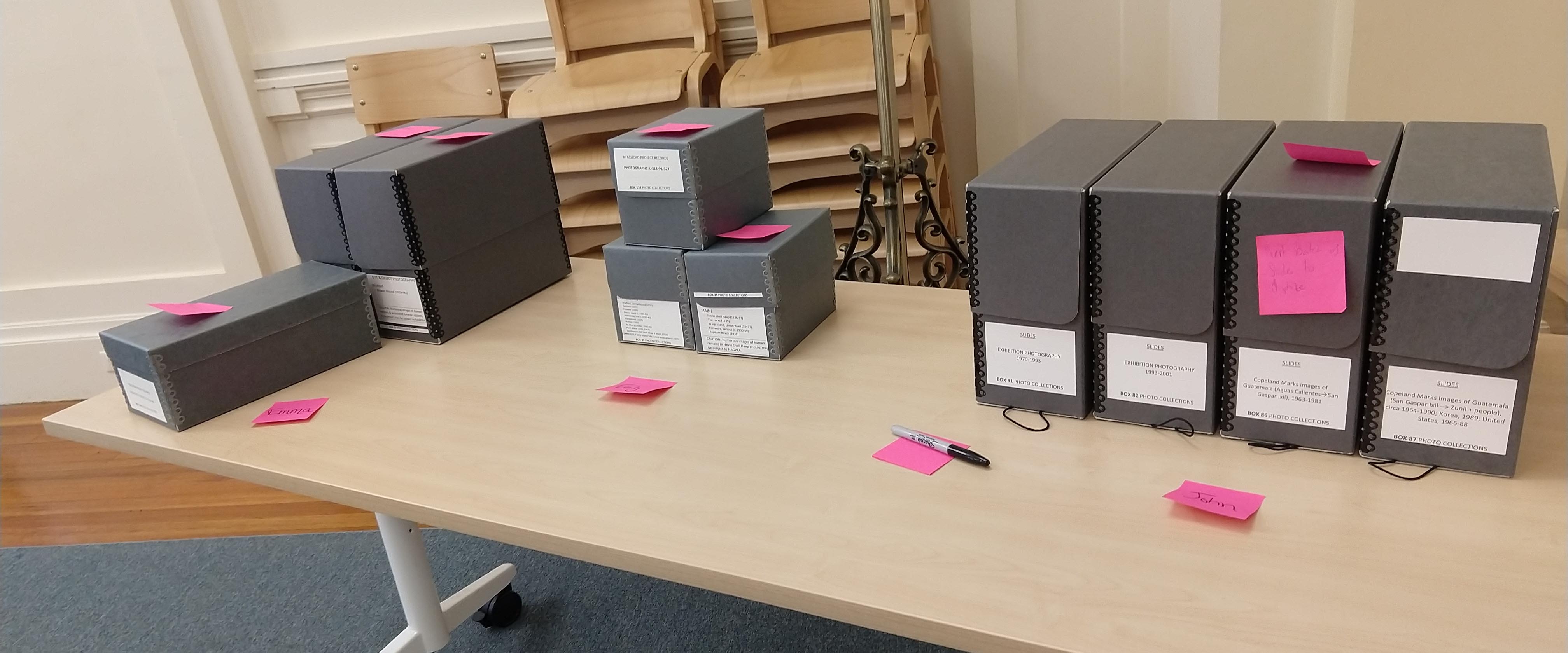
Boxes of photos and slides ready to go to their temporary homes
First, we attacked a backlog of paperwork relating to our pest management projects. Something that I thought would take months to catch-up on was done in a matter of days!
Second, supplies were split up and everyone signed out a few boxes of photographs to digitize from home. Many of them also created spreadsheets that will make for quick addition to our collections management database when we return. Once again, massive progress is being made on projects that have been sitting on the back-burner too long.
Digitizing slides one sheet at a time
Scanning photos from home
Several of us still share the responsibility of checking on the collections in person regularly and the system has been working wonderfully.
For me, like so many others, working from home has been a balancing act. I am caring for two kids under the age of 5 while my husband works a job that is considered essential. My work is squeezed into nap-time, evenings, early mornings with a cup of coffee, and some weekend time. We are all doing the best we can to support ourselves and our colleagues. I cannot thank the Peabody collections team – Rachel, John, Emily, and Emma – enough for their hard work and continued dedication to our mission.
If you have some time to kill, try checking out our collection online – I hope to have lots of new material uploaded when we return to our regular routine.
The Digital Resource Spotlight series will highlight a variety of heritage-based organizations that offer unique activities that educators and parents may want to explore. We hope that you find our compilations helpful as you navigate this new educational landscape.
The Florida Public Archaeology Network (FPAN) is a premier educational resource for educators looking to incorporate easy, hands-on activities. Many of their lessons can easily be restructured to fit the current online learning model that many private and public schools are adapting to. They are also clear and straightforward, which makes them a perfect tool for the numerous parents who are finding themselves suddenly acting as their children’s teacher.
Their 130 page guide Beyond Artifacts is a trove of useful lesson plans that could readily be duplicated in a students home, with online guidance from the teacher. Want to study archaeology during lunch? They have a Peanut butter and Jelly Excavation lunch, which can even be followed up by a cookie excavation. YUM!!!!
In addition to the broad archaeology lessons they also offer more topical ones focused on prehistoric, historic, and underwater archaeology.
One of my favorite lessons that they ha is one called Stone Silent. It allows student to collect demographic data from a local cemetery. This is a perfect lesson as it will help everyone to get outside (which we all desperately need) while still practicing social distancing since there are probably not many people wandering cemeteries for fun right now.
FPAN has many other resources to offer, so be sure to check out all of them here.
Early in his archaeological career Richard “Scotty” MacNeish, the Peabody’s fifth director, used funds from the Wenner-Gren Foundation to investigate caves and rock shelters in northern Mexico. MacNeish had found that some of these sites contained preserved plant remains, basketry, twine, and other perishable artifacts while a graduate student at the University of Chicago. Early in 1949 his crew chief discovered tiny corn cobs in La Perra Cave in the Sierra de Tamaulipas. The rich biodiversity of this area in northern Mexico, near the Gulf Coast and Texas border, had attracted other scientists interested in the flora and fauna of the so-called cloud forests. Perhaps it is not surprising that the ancient people of the area experimented with plants, including early crops like corn. MacNeish’s work in the Sierra de Tamaulipas pushed corn origins back to 4,500 years ago (about half of the now-acknowledged age).
Scotty MacNeish removes samples from La Perra Cave, Sierra de Tamaulipas, March 1949. Collection of the Robert S. Peabody Institute of Archaeology 2018.0.0741.
The Peabody houses a small type collection of materials from MacNeish’s work in Tamaulipas, including artifacts, photographs, and fieldnotes. Last year we collaborated with the Boston Public Library’s Digital Commonwealth project to digitize the archival records associated with MacNeish’s Tamaulipas project, primarily to facilitate access by Mexican archaeologists working in the region. Those files are available on InternetArchive. We also digitized many of the photos from the project, available via PastPerfect Online. Recently, Peabody staff member Emma Lavoie has been cataloging the artifacts from Tamaulipas. Looking over Emma’s shoulder one day at the many preserved plant remains, I was surprised to see part of an ancient orchid!
Dried pseudobulbs and roots of orchid from Sierra de Tamaulipas. Collection of Robert S. Peabody Museum of Archaeology 2019.6.396.
The Orchidaceae are one of the largest families of flowering plants, known to most of us from the cultivated examples with colorful and fragrant blooms available at grocery stores and garden centers. Commercial growing of orchids as houseplants began in the nineteenth century as the demand for “parlor plants” increased and diverse hybrids were created, many with fantastically shaped and colored blooms. Most of the orchids available for sale are of the genus Phalaenopsis. In the wild there is considerable diversity too, with terrestrial and epiphytic examples and a range of shapes, sizes, colors, and scents. Perhaps the best-known orchid is vanilla, a terrestrial form from Mexico.
We do not know what genus or species the dried pseudobulbs and roots of the Tamaulipas orchid represent. Notes on file show that botanist C. E. Smith, a student of Paul Mangelsdorf at Harvard, identified the orchid. Mangelsdorf worked closely with MacNeish on his early corn project, and Smith pioneered the field of archaeological botany. Quick searches of the literature did not reveal many examples of archaeological specimens of orchids in the Americas. We do know from some of the few preserved screen-fold books made by the Mixtec, Aztec, and their contemporaries that a variety of orchids were used in medicine, some may been collected for their hallucinogenic properties, and others were used to produce a special glue used in featherwork.
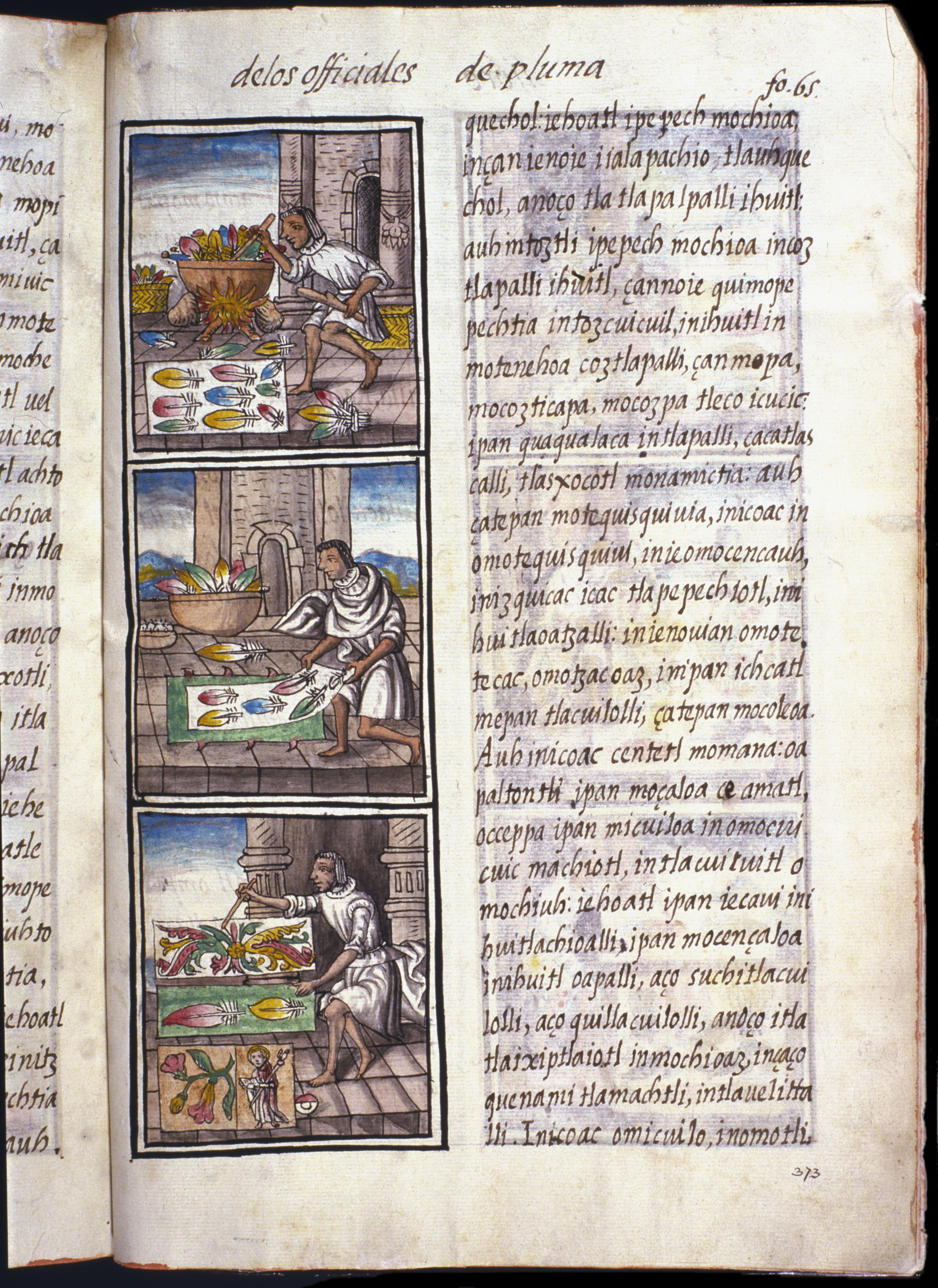
Image of Aztec featherwork from Sahagun’s sixteenth century Florentine Codex.
Carlos Ossenbach, in his 2005 study “History of the Orchids in Central America, Part 1: From Prehispanic Times to the Independence of the New Republics,” laments that the destruction of the majority of the screen-fold books by the Spanish also destroyed considerable information on the use of orchids in Mesoamerica. Between 1547 and 1577 Bernardino de Sahagún compiled his History of Things of New Spain (also called the Florentine Codex), which includes considerable information on the use of plants, including orchids, among the Aztec. Here Sahagún documents the use of the Encyclia pastoris orchid for glue making, when he describes how the pseudobulbs of the orchid are cut and soaked in water to produce a sticky substance called tzacutli. The complete codex can be viewed online: https://www.wdl.org/en/item/10096/view/1/35/ Researchers have documented at least twenty-three different orchid species and their use by the Aztec, Maya, and their neighbors, primarily as medicines, adhesives, fixers for pigments, and as ornamental specimens.
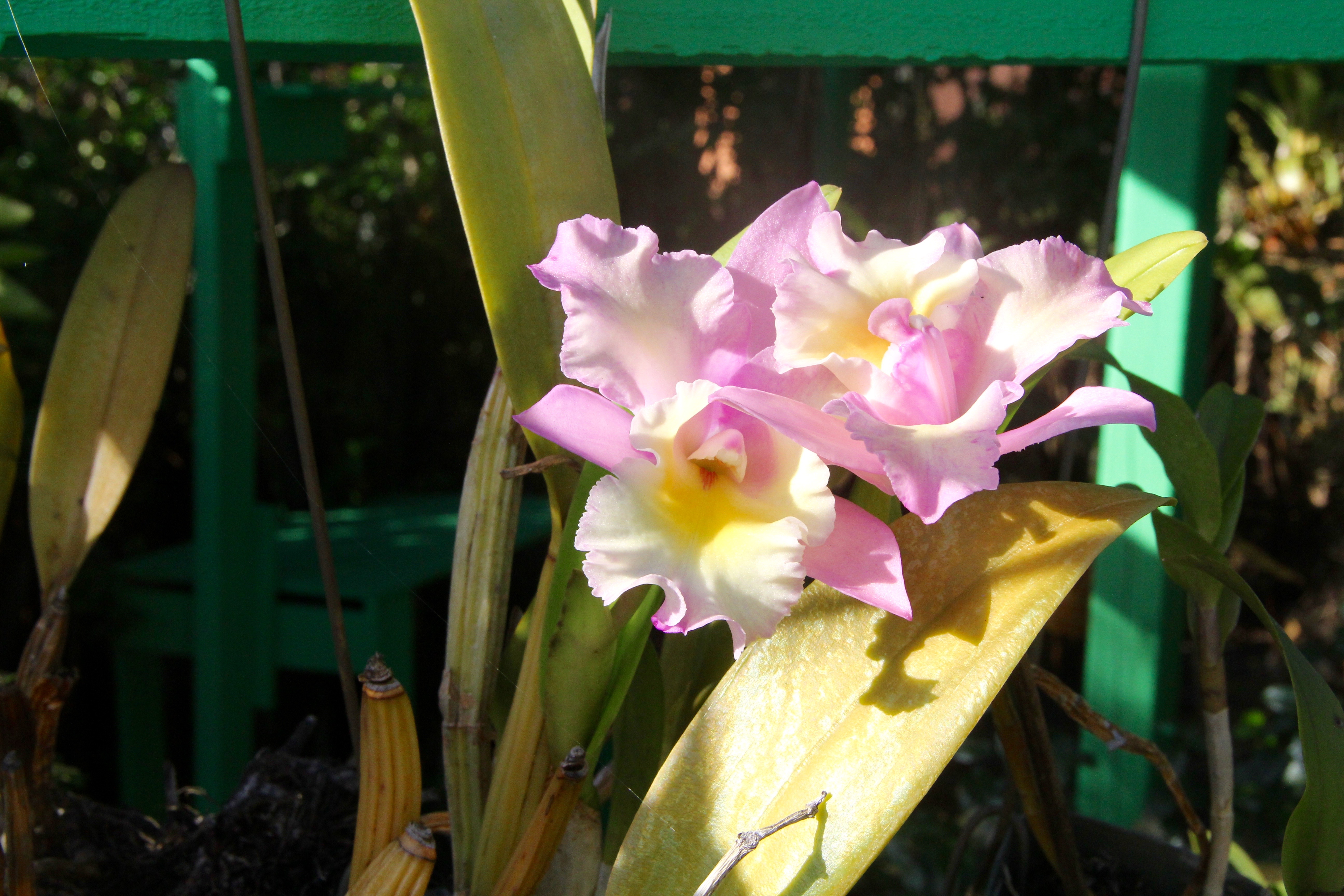
Orchids in Ryan Wheeler’s mom’s shadehouse, Fort Lauderdale, Florida.
The Tamaulipas orchid reminded me of the many terrestrial and aerial orchids that we often encountered at archaeological sites in Florida. Limestone and shelly soils encouraged their growth. It also brought back memories of my work at the Miami Circle site in late 1999. During the fieldwork I stayed with my parents and I was fortunate to accompany my mom on an orchid ramble one Saturday. A bus packed with orchid enthusiasts left Fort Lauderdale and visited at least half a dozen orchid growers in Homestead and Redlands, south of Miami. During the ramble we entered a raffle. I was surprised to receive a call Sunday evening. The gentleman calling informed me I had won a raffle prize and asked if I could collect it after work on Monday. After another intense day at the Miami Circle I navigated my Ford F-150 long-bed pickup through Miami’s crowded streets, onto Florida’s Turnpike, and then onto the Homestead extension. It was dark by the time I found the orchid grower. We entered the massive greenhouse and the grower–the gentleman who had called me the night before–gestured to one of the tables covered with orchids. I assumed I had won one of the orchids. He corrected me in a mellifluous English accent, I had won ALL of the orchids on the bench, approximately 100! He helped me load them into the F-150 and I headed north. My parents were disbelieving upon my return home. After I persuaded them to come outside, however, they acknowledged the enormity of the prize. My dad helped me unload and we struggled to find room in my mom’s orchid shade house. Some are still thriving today, while others were lost to hurricanes.
I’m interested in our Tamaulipas orchid. Could we determine the genus and species? Would that help us better understand why the orchid was in a cave deposit? Maybe as a drug, or for glue making, or as a mind-altering hallucinogen? Perhaps we can connect with a specialist and answer some of these questions!
As we all adapt to our new normal, the Peabody has compiled a list of various institutions that offer digital resources, from virtual tours to artifact images. If you are a caregiver at home with children, these can be used to enhance their educational experiences as you work to continue their learning.
And for those who simply are looking for something to do now that everyone has extra time on their hands (I’m sure no one misses their long commutes into work and sitting in traffic though), experiencing new and exciting things can be a perfect way to combat boredom!
National Women’s History Museum: This museum has a variety of online exhibits such as Breaking In: Women in STEM and Fashioning Yourself!
Museum of the Rockies: In this YouTube video Michael Fox and Dr. Shane Doyle explain why in August the town of Crow Agency becomes the Tipi Capitol of the World.
Canadian Museum of History: This museum offers numerous online exhibits including Inuit Prints from Cape Dorset and Archaeological Mysteries in the Ottawa Area.
British Museum: The largest museum in the United Kingdom offers a digital tour of some of their most impressive collections.
The Louvre: Three virtual tours are offered on Egyptian Antiquities, Remains of the Louvre’s Moat, and the Galeried’Apollon.
National Museum of Anthropology: One of Mexico’s premiere institutions that houses numerous archaeological artifacts that have been digitized and shared with the public.
Blarney Castle: If you were sad to miss out on gathering with friends and strangers for St. Patrick’s Day, or just have a fondness for old castles, Blarney Castle has incredible 360-degree tours of the interior and grounds of the castle.
We also understand that after being cooped up in your house, you might not want to stay indoors, even virtually. So if you find yourself just needing to leave the confines of your house for a bit,our friends at the National Park Service have created a way to virtually escape the walls around you atfive differentNational Parks.
We’ll be posting other resources that can be used and explored during this unique situation, so check back with us often!














 The Peabody