Contributed by Quinn Rosefsky
This blog represents the sixth entry in a blog series – Peabody 25 – that will delve into the history of the Peabody Museum through objects in our collection. A new post will be out with each newsletter, so keep your eyes peeled for the Peabody 25 tag!

At the Robert S. Peabody Museum, it seems as though there is almost no limit to the range of phenomena one can explore. When the topic Chaco Canyon was suggested, I thought looking at trade routes would be interesting. It quickly became clear that what I was about to enter was the world of a great culture which I thought had mysteriously “disappeared” about 800 years ago. What I quickly learned was that these people, the “Ancestral Puebloans,” had not disappeared. Research has shown that the Puebloans had adapted to climate change in the area by dispersing. “Today, twenty Puebloan groups in New Mexico, as well as the Hopi in Arizona, claim Chaco as their ancestral homeland and are tied to this place through oral traditions and clan lineages. A number of Navajo clans are also affiliated with Chacoan sites through their traditional stories.” (National Park Service: https://www.nps.gov/chcu/faqs.htm)
Chaco Canyon, located on a section of the Colorado Plateau in northwest New Mexico, was home to the Chacoan culture which flourished from AD 1000 to 1150. A UNESCO World Heritage Site, the people who lived there were very sophisticated. They used astronomical alignments, geometry, and impressive building techniques, allowing for multi-storied masonry houses. They had a complex road system stretching hundreds of miles, linking Chaco to other communities. One of their buildings, four or five stories high, Pueblo Bonito, contained about 650 rooms.

The Chacoans traded with people in the Mongollon and Hohokam regions to the south and with people from Mexico and Central America. Long-distance travel by Ancestral Puebloan people was common and among the goods they acquired were turquoise, seashells, copper and chocolate, none of which were found locally. They also traded for scarlet macaws, a bird with a natural habitat 1000 miles to the south.
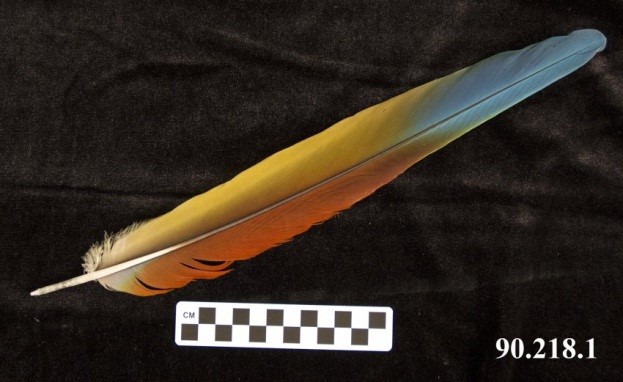
The Robert S. Peabody Museum has several “modern” macaw tail feathers in its collection, one of which is shown below. Preserved feathers from 1000 years ago would be quite rare.
Scarlet macaws measure about thirty-two inches long, of which more than half is a pointed tail. They can live up to seventy-five years and eat mostly fruits, nuts and seeds. We know macaws, essentially large parrots, as intelligent birds that are quick to echo our deepest secrets using speech, a magical quality, especially because macaws have no vocal cords. That parrots are rated among the top five in the animal world for intelligence and cognition should come as no surprise. It is likely that the people of Chaco Canyon would have been awed by such an animal.
Scarlet macaws are native to the gulf coast of Mexico, Central America, and South America. The question to ask is for what purpose macaws were brought back to Pueblo Bonito?
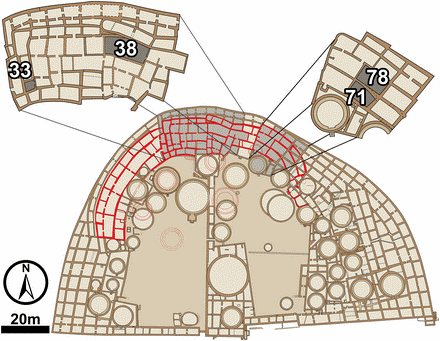
Thirty four macaws were recovered from Pueblo Bonito and other sites in Chaco Canyon. Room 33 (see illustration above) was used as a burial crypt for 200-250 years. Macaws were found in rooms 38, 71, and 78. Archaeologist Adam Watson and his colleagues postulated that scarlet macaws were a powerful cosmological symbol and that their presence from the early tenth century reinforced and stimulated a rising social inequality. Those who possessed the birds had access to key cosmological beings and forces as well as links with far distant cultural groups. There is little doubt that the ability of the birds to speak played into this perception.
What is currently exciting is how recent radiocarbon dating of scarlet macaw skeletons from Chaco Canyon has given further insight into the question of their presence. What has been shown is that, based on acquisition and control of valued items such as chocolate and macaws, an elite class at the top of a social and political hierarchy dominated Chacoan life. (Watson et al. 2015)
What the elites achieved and their importance is amply demonstrated in their “great houses” and the acquisition of “exotic” goods from distant regions (ibid.) Included in these exotic goods were macaws. Feathers from macaws were found on prayer sticks, costumes, and masks. According to Watson and his colleagues,“…the flight of or just the appearance of certain birds or the use of their feathers is believed to motivate the fall of rain or snow, as well as the seasons, the sunshine, and the heat.”
Originally, it was believed that trade in items such as macaws at Chaco dated from around AD 1040. With radiocarbon dating done in 2010 on skeletal remains of the macaws from Pueblo Bonito, the dates of the florescence have been moved back to AD 775-875.
Whether or not the macaws were brought back to Pueblo Bonito in single journeys or in successive stages has been debated extensively. Some have raised the possibility that macaws were also bred locally in Chaco Canyon itself, although the arid region is not a natural habitat for such birds. The discovery of breeding pens, perches, bones, and eggshell fragments has led to speculation about on site breeding, but evidence suggests such macaws did not reach maturity.
“There are no indications that the people of Pueblo Bonito bred scarlet macaws. Only one of the sample birds was of breeding age and none were exceptionally young. There is also no mention of eggshells in any of the excavation notes, although one room where many of the bird remains were found was probably an aviary.” (“Scarlet macaws point to early complexity at Chaco Canyon.” A’ndrea Elyse Messer, 2015: http://news.psu.edu/story/361255/2015/06/22/research/scarlet-macaws-point-early-complexity-chaco-canyon).
One of many phenomena to explore at the Peabody, the scarlet macaw feathers represent a tangible example of extensive trade routes present in the New World prior to European contact.


Nancy Gonlin is a Senior Associate Professor at Bellevue College, Washington. She earned her Ph.D. in Anthropology at The Pennsylvania State University, is a Registered Professional Archaeologist, and a former Dumbarton Oaks Fellow of Harvard University. Her specialization is the Classic Maya civilization of Mexico and Central America. Nancy is on the Editorial Board of Ancient Mesoamerica, published by Cambridge University Press. She has taught for over 25 years and is highly regarded for her pedagogical contributions – she is the 2012 recipient of Bellevue College’s Margin of Excellence. As an active member of the Society for American Archaeology, Nancy serves on the Committee on Curriculum and has been appointed as the upcoming Chair of the Book Award Committee. She co-author Copán: The Rise and Fall of an Ancient Maya Kingdom, and co-edited Commoner Ritual and Ideology in Ancient Mesoamerica, Ancient Households of the Americas, and Human Adaptation in Ancient Mesoamerica. Nancy’s fifth book will be a co-edited volume on a new field of research in archaeology, The Archaeology of the Night.
Dr. Kirakosian received her PhD from UMass Amherst in 2014 and is currently adjunct faculty at several schools in Rhode Island. Her project focuses on archival materials from Warren Moorehead, Douglas Byers, and Frederick Johnson to continue her dissertation research and prepare a book on the history of archaeology in Massachusetts using social network analysis. Dr. Kirakosian published some of her previous research using Peabody collections in the 2015 issue of the Bulletin of the History of Archaeology:
Mr. Campbell is a PhD candidate at the Memorial University of Newfoundland. His research at the Peabody includes a re-examination of collections from the Dennysville site in Maine, as well as several other sites in New Brunswick. His dissertation research is focused on protohistoric and contact period Wabanaki peoples in Maine and the Canadian Maritimes.