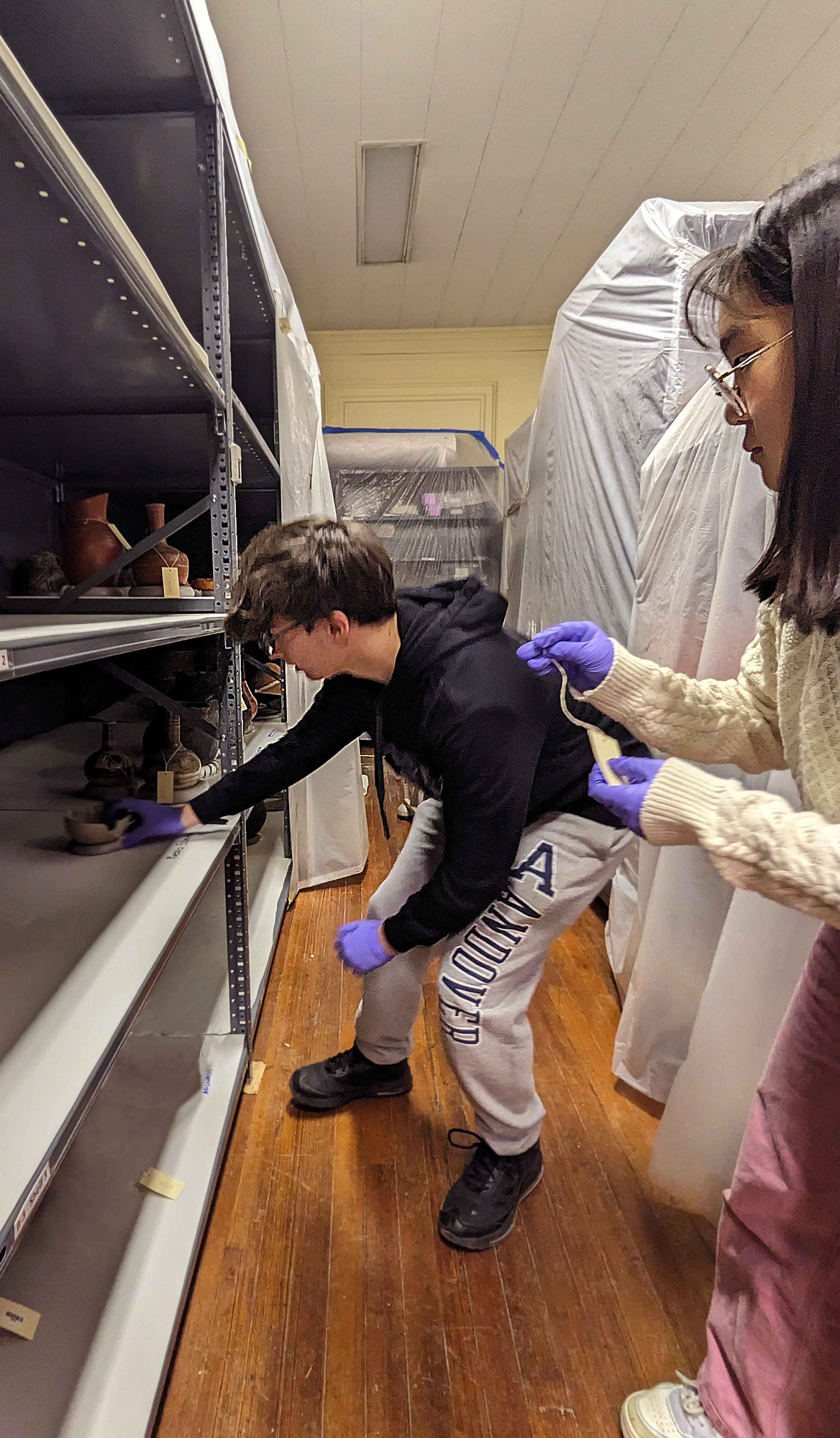
Work duty students are back assisting with collections projects.
We are excited to announce that after a year-and-a-half hiatus, work duty resumed at the Peabody two weeks ago! Preparations in the months leading up to building renovations, scheduled for the winter of 2023, meant that Peabody staff couldn’t devote resources to overseeing work duty students. Once the renovations began, the building would be unsafe for students and staff.
The most daunting pre-construction project was moving thousands of collection boxes from the basement into temporary housing on the first floor. Help from work duty students would have been welcomed, but had we taken on students in the fall they would be looking for new assignments that winter, which didn’t seem fair to the students. We decided that work duty should be cancelled at the Peabody for the 2022-2023 academic year.
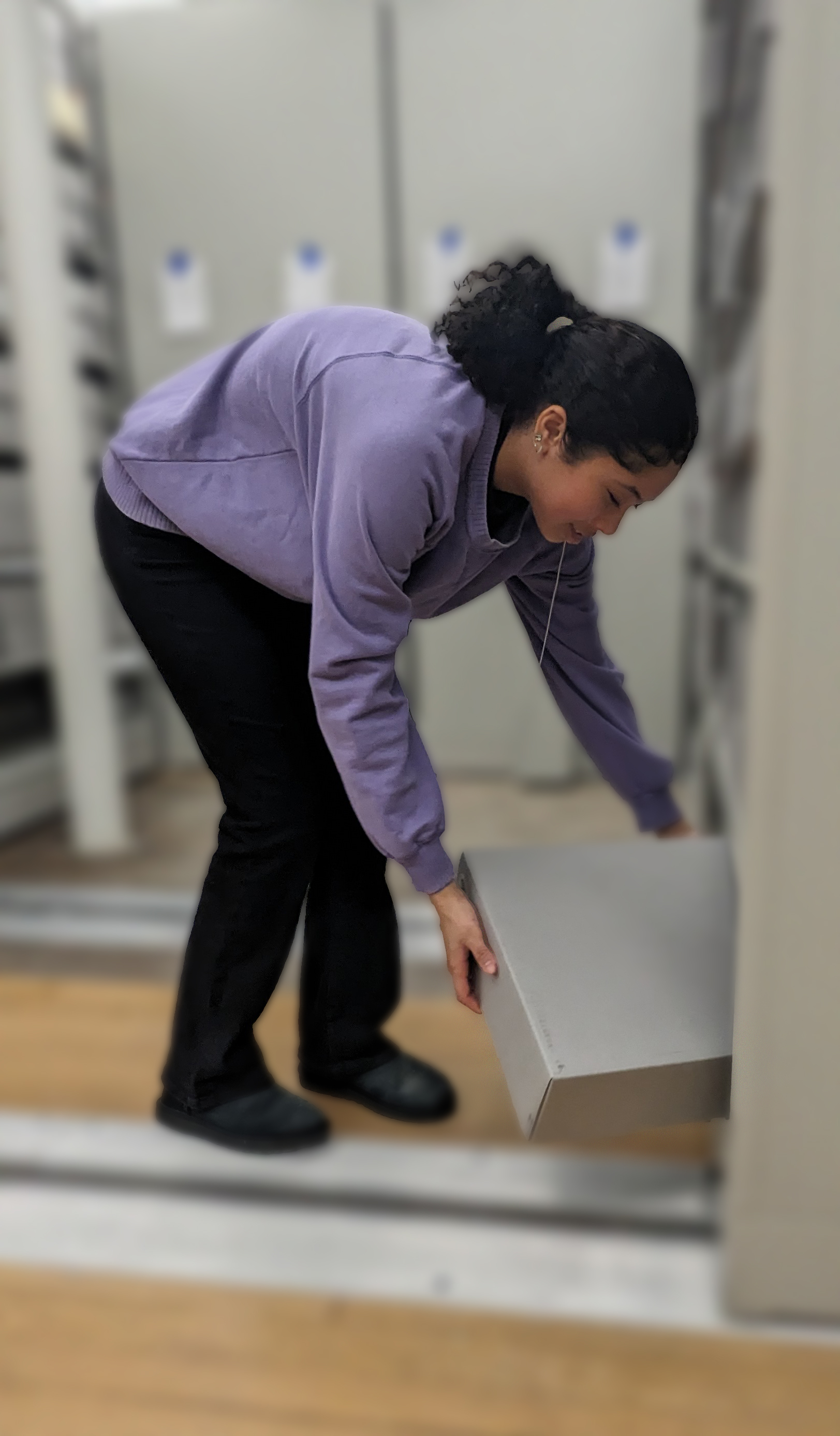
Collections boxes are moving into their new housing! This image was intentionally blurred to obscure the details of our new collections housing until the move has been completed.
Last fall, as construction began winding down, we were eager to bring work duty back. Organizing the collection in the newly renovated basement would be a larger undertaking than any of the pre-construction preparations. Generally, we knew students would be allowed back in the building this academic year, but we didn’t know an exact date. The Dean of Student’s office generously offered to take on students who were interested in working at the Peabody until we could safely bring them back.
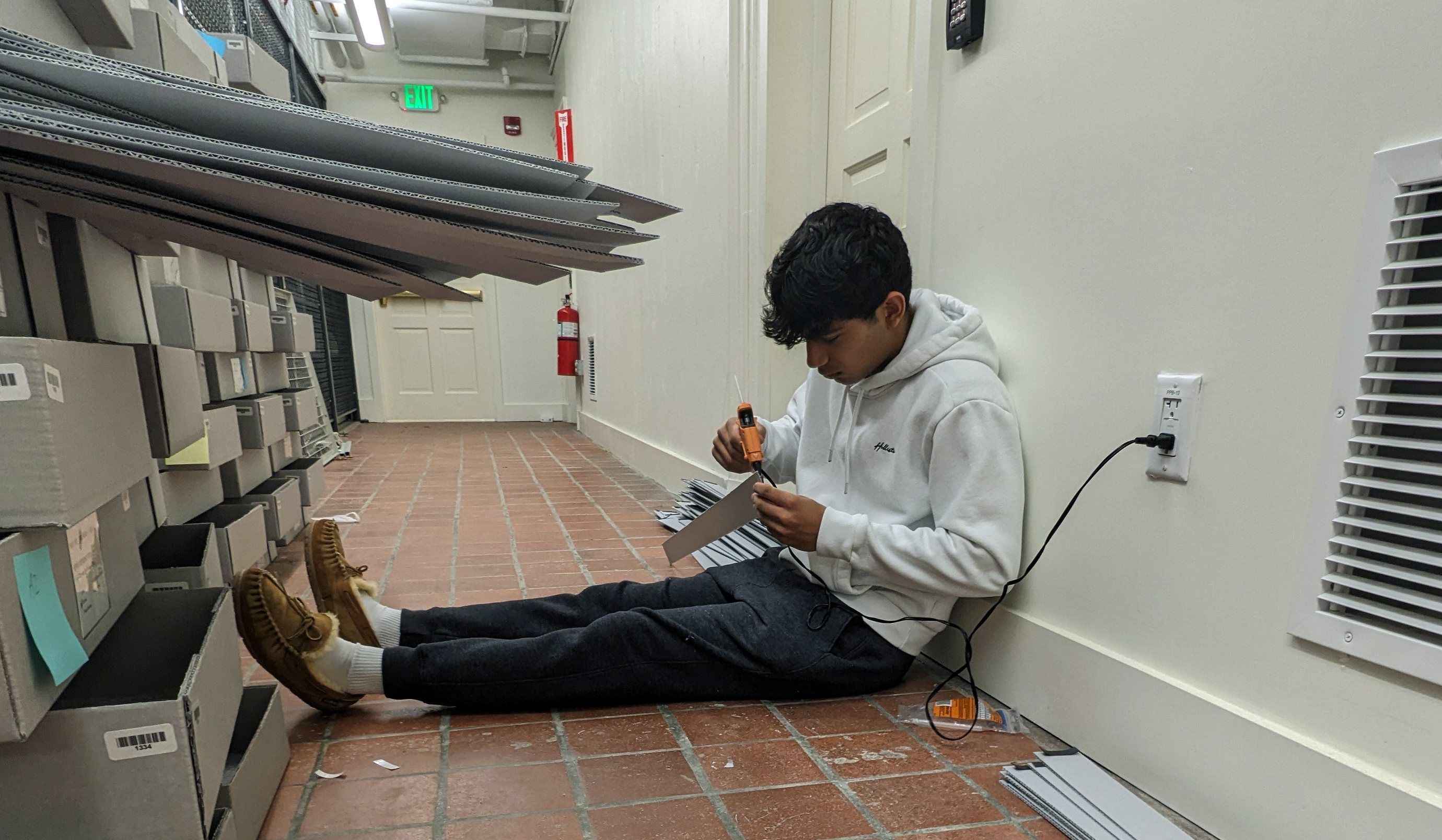
Ultimate week is the perfect time to relax while working on a collections project.
Now that the students have returned, they have been assisting us with preparing the basement to receive collections from throughout the building. They have added foam to shelving, helped sort items by geographic region, and solved inevitable mysteries that crop up in the wake of a large move. Their help has made it possible for staff to focus on moving our collection into the basement.
We are very happy to have students back and look forward to the spring term when we can welcome the wider Phillips community into the building.
Lately, the process of fully cataloging Adopt-A-Drawers has resulted in some interesting discoveries. The most recent of these comes from artifacts collected by Richard “Scotty” MacNeish in Tamaulipas, Mexico.
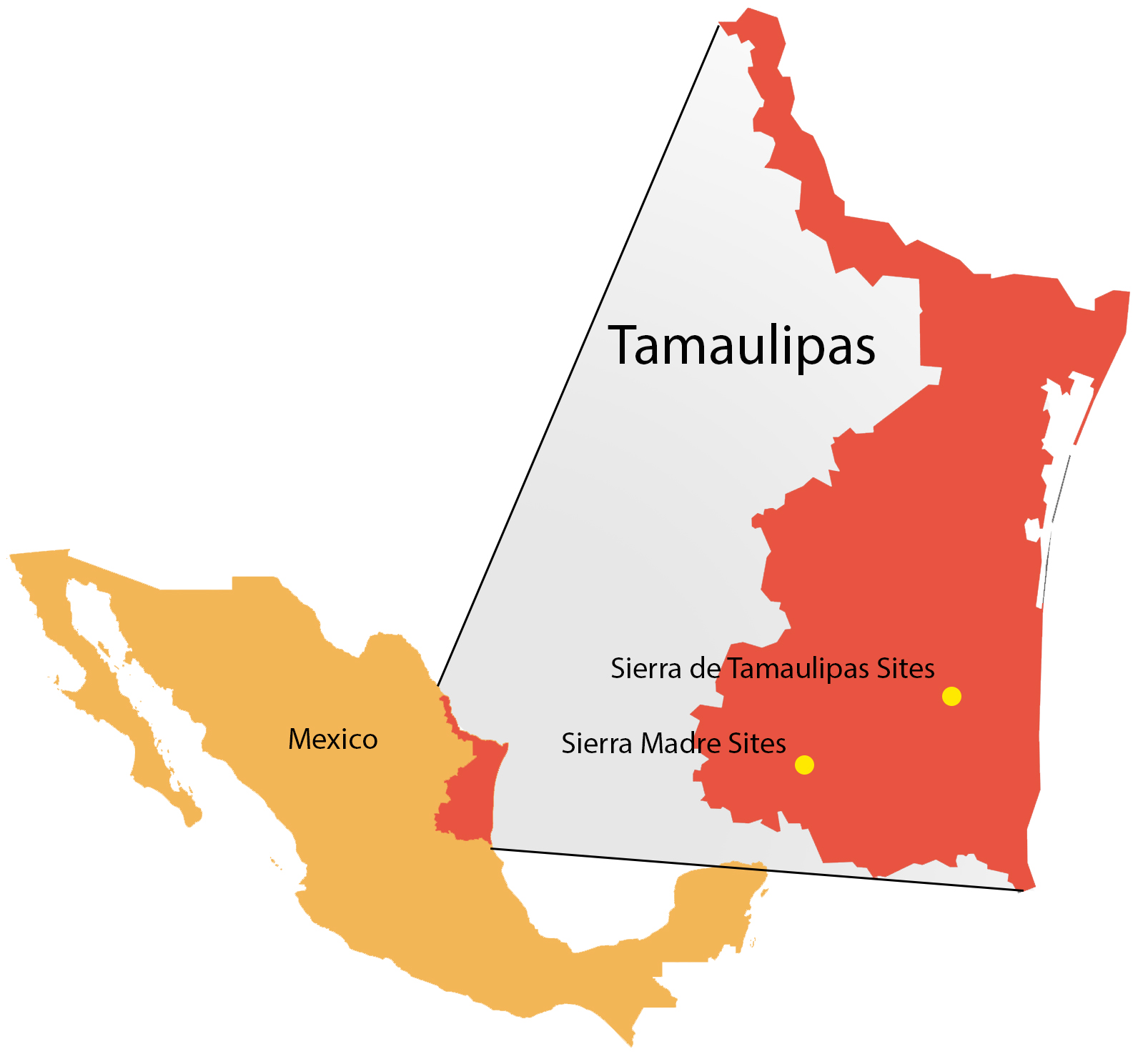
MacNeish went to Tamaulipas in 1945 hoping to find sites that predated the production of ceramics. In particular, he was searching for sites with long cultural sequences that he could use to tell the story of the development of human culture in Mesoamerica. During three field seasons, spanning ten years, MacNeish identified and excavated several village and cave sites in the Sierra de Tamaulipas and the Sierra Madre Oriental, two mountain ranges in Tamaulipas.
MacNeish’s Tamaulipas excavation areas.
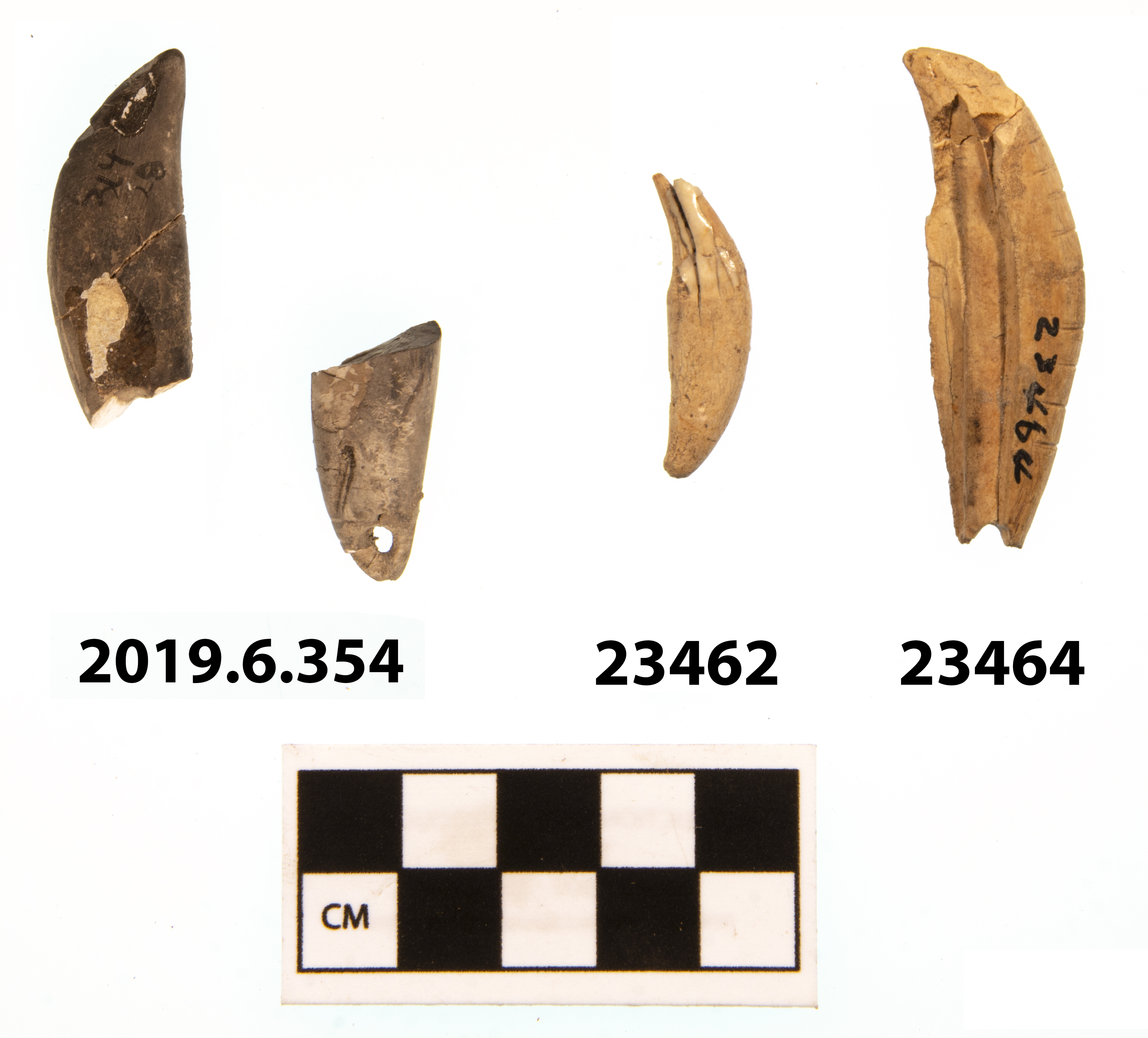
MacNeish recovered a wide variety of items from the well-preserved cave deposits in Tamaulipas. Of these were two fragmentary bear canine-shaped pendants recovered from Armadillo Cave in the Sierra de Tamaulipas. They appear to have been burnt and MacNeish believed that they were fashioned from sandstone. When compared with real canines from a bear and unknown canid, it is clear that they are an imitation. For example, the Tamaulipas pendants have no enamel and they lack the same degree of detail. However, they do approximate the shape very effectively.
Left: Two Tamaulipas bear canine-shaped pendant fragments. Middle: Dog or coyote canine pendant from Ohio. Right: Bear canine pendant from Ohio.
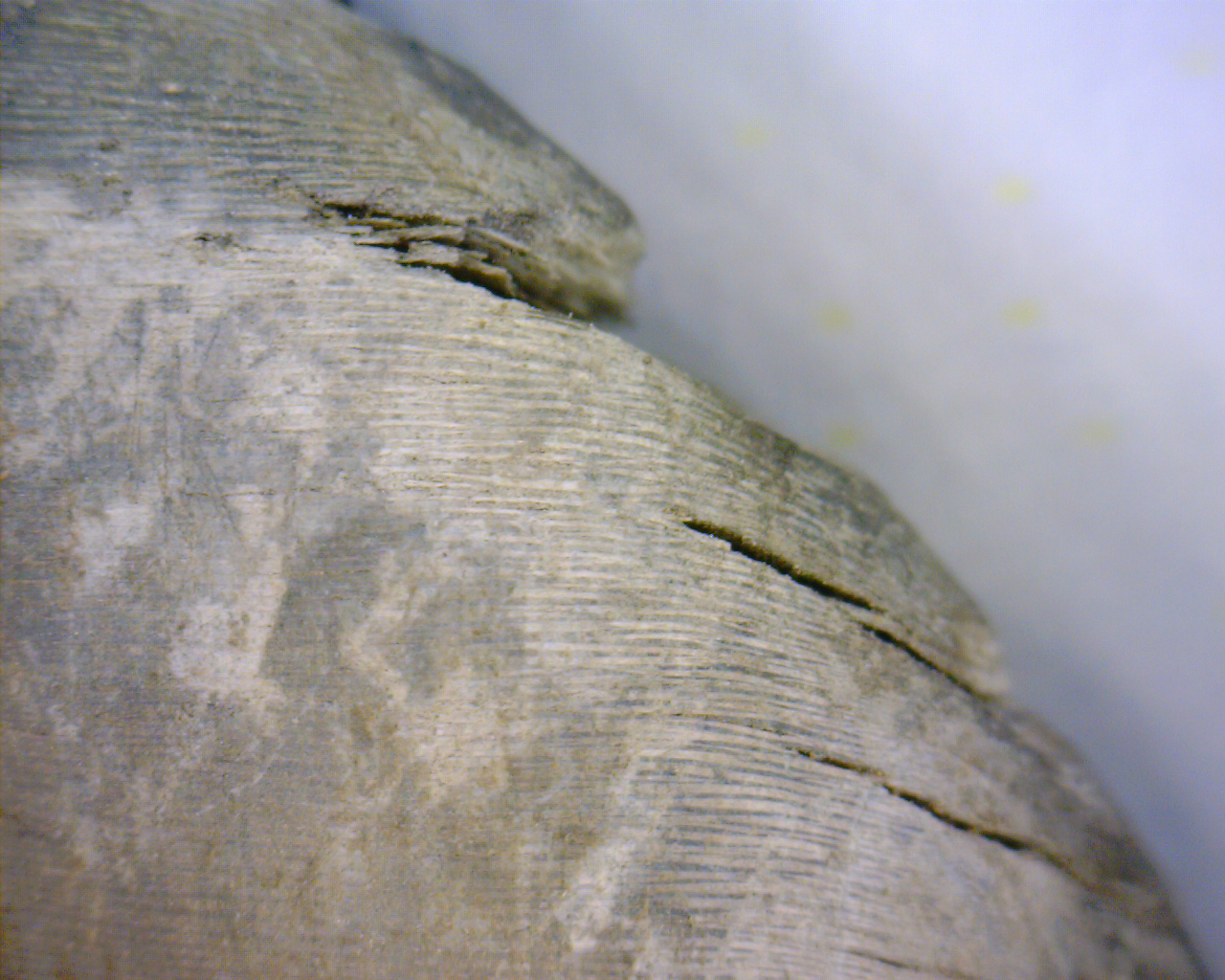
One of the pendants was fractured below a possible enamel layer so they were both inspected under magnification. Surprisingly, they show signs of very thin layering more reminiscent of the annuli of shell. I asked our Director, Dr. Ryan Wheeler to take a look at them. Among those who work here at the Peabody, he is the resident expert on shell artifacts. Dr. Wheeler agreed they were shell.
Magnified View of bear canine-shaped pendant from Tamaulipas, showing annuli.
The fact that the pendants were made of shell led us to think about a possible connection with the Hopewell Culture. Several shell imitations of bear canines have been recovered from Hopewell mound sites. Additionally, the Hopewell developed a very large interaction sphere, traveling far and wide for trade materials. The Hopewell procured copper from Lake Superior, silver from Canada, obsidian from Wyoming, mica from the Blue Ridge Mountains and shell from the Gulf of Mexico.
We wondered if these pendants could have been a Hopewell trade object. Fortunately, the Peabody archives include MacNeish’s Tamaulipas excavation paperwork (digitized here). The first step to establishing a possible link was to determine the items’ age. Using charcoal from distinct layers excavated from the cave deposits, MacNeish was able to radiocarbon date the deposits. The layer containing the shell pendants dates to the Almagre Phase, roughly 2,200 to 1800BCE. This correlates to the Archaic period in the Ohio valley, about 2,000 years before the Hopewell developed. The Hopewell connection was out.
I also searched for bear remains found in northern Mexican archaeological contexts. A very quick review of available resources indicated that bear remains are not all that common in the region. The only positive return came in the form of bear long bones found at Casas Grandes in Chihuahua, Mexico. This was interesting, because the historical range of both Mexican grizzly and black bears include much of northern Mexico, including Tamaulipas state. It is very likely that humans and bear interacted in the past.
At Dr. Wheeler’s suggestion I reached out to Dr. Brad Lepper, Senior Archaeologist with the Ohio History Connection and José Luis Aguilar Guajardo, archaeologist in Tamaulipas, Mexico. They both responded with helpful information. Dr. Lepper was interested in the presence of the shell pendant and was unaware of anything similar coming from Archaic sites. He suggested consulting Cheryl Claassen’s book Beliefs and Rituals in Archaic Eastern North America for possible archaic examples, which I haven’t yet had a chance to read.
Dr. Lepper provided several examples from the Ohio History Connection’s collection of Middle Woodland Hopewell bear canine pendants (here and here) and their imitations (here and here). Some of the canines were split, or contained fresh water pearls from the Ohio River. Imitations were made from mica, copper, shell, bone, ceramic and stone.
José Luis Aguilar Guajardo was also very interested in the bear canine-shaped pendants. He was unaware of anything similar coming from sites in the Sierra de Tamaulipas mountains. He indicated that shell was a semi-precious material used for making ornamentation by the Indigenous people in the area. The Sierra de Tamaulipas mountains are quite close to the Gulf of Mexico, a source for shell materials.
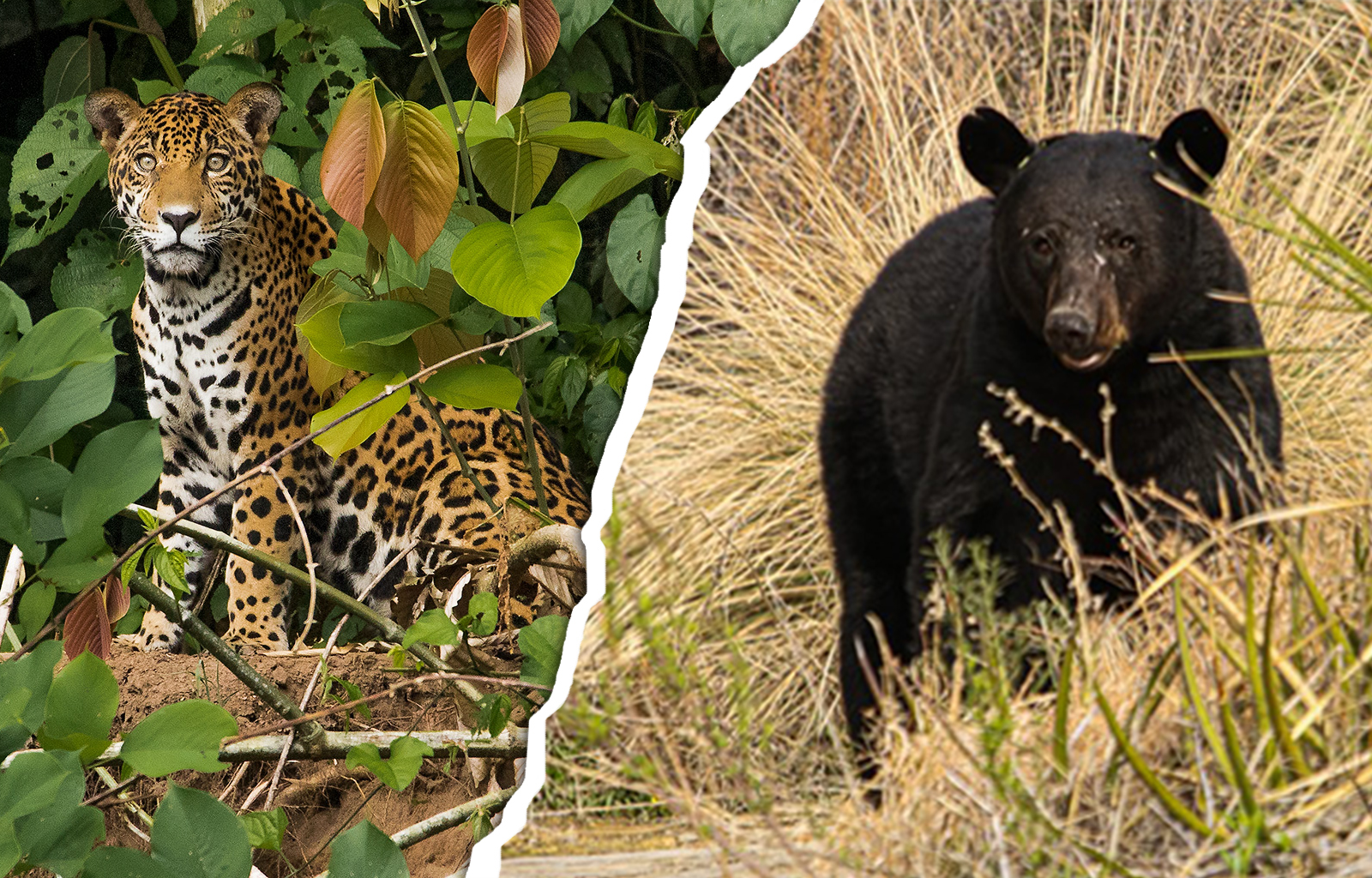
José was clear that black bears can still be found in the Sierra de Tamaulipas, and supported the possibility that they were bear-shaped. However, he suggested the possibility that they were inspired by the jaguar instead. According to José, jaguar were abundant in the area and were revered by the Indigenous people.
How to assign an animal label to the pendants becomes an interesting problem. Bear and jaguar canines can look similar in size and appearance. Understanding what the maker of the pendants intended them to represent is difficult when they cannot be asked about them directly. Both animals’ habitats overlapped in northern Mexico.
Though they don’t provide a definitive answer, some helpful articles, and their authors, that explore the importance of bear and jaguar imagery in north and Mesoamerica include: Bear Imagery and Ritual in Northeast North America, Thomas E. Berres, David M. Stothers and David Mather; Predators of Culture: Jaguar Symbolism and Mesoamerican Elites, Nicolas J. Saunders; and Rohonas and Spotted Lions: The Historical and Cultural Occurrence of the Jaguar, Panthera onca, among the Native Tribes of the American Southwest, Steve Pavlik. There are probably many, many others.
Perhaps, as José Luis Aguilar Guajardo has suggested in personal communications, Sierra de Tamaulipas falls into an area in which jaguars were strongly revered. In a very simplistic summary of the above articles, cranial remains of bears in archaeological contexts in North America have been considered a sign of bear ceremonialism. They don’t appear in MacNeish’s Tamaulipas excavations. Jaguar hides were an element of Aztec royal clothing and one of the accoutrements used by Aztec shamans. A small fragment of possible jaguar hide was recovered from the Sierra Madre excavations in Tamaulipas.
Future excavations in the area will likely bring more evidence to bear on the ritual and symbolic practices of the people of Tamaulipas.
Resources:
Archaic Bear Tooth Pendants and other related artifacts
Donaldson, William S. and Stanley Wortner
1995 The Hind Site and the Glacial Kame Burial Complex in Ontario. Ontario Archaeology 59:5-95.
Bear Imagery and Ritual
Berres, Thomas E., David M. Strothers and David Mather
2004 Bear Imagery and Ritual in Northeast North America: An Update and Assessment of A. Irving Hallowell’s Work.Midcontinental Journal of Archaeology 29(1):5-42.
Jaguar Imagery and Ritual
Pavlik, Steve
2003 Rohonas and Spotted Lions: The Historical and Cultural Occurrence of the Jaguar, Panthera onca, among the Native Tribes of the American Southwest. Wicazo Sa Review 18(1):157-175.
Saunders, J. Nicolas
1994 Predators of Culture: Jaguar Symbolism and Mesoamerican Elites. World Archaeology 26(1):104-117.
The Peabody is keeping busy this summer with volunteers, interns, events and visits, researchers, and of course hosting the Andover Summer Session class, Dig This!
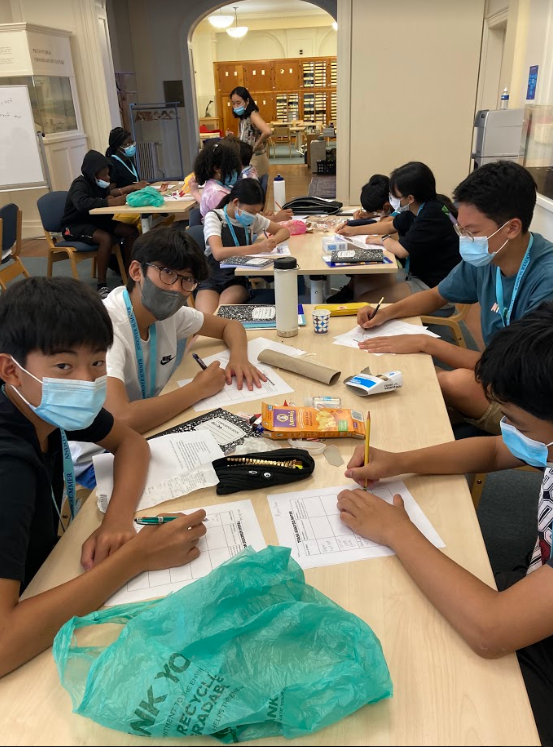
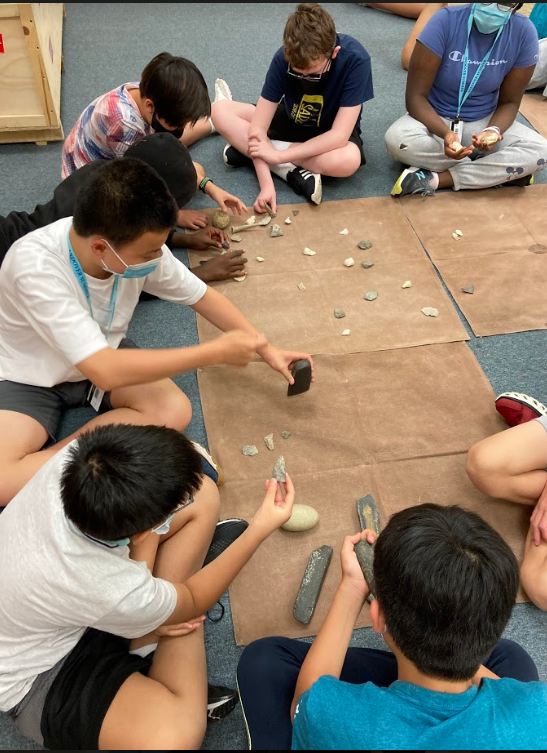
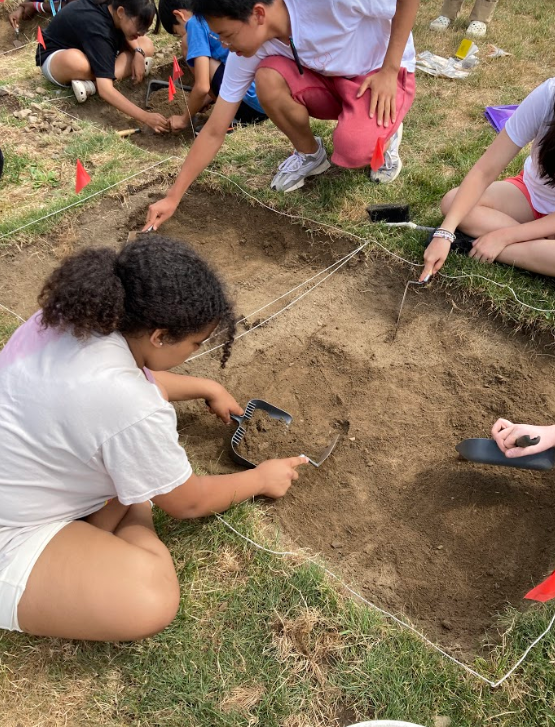
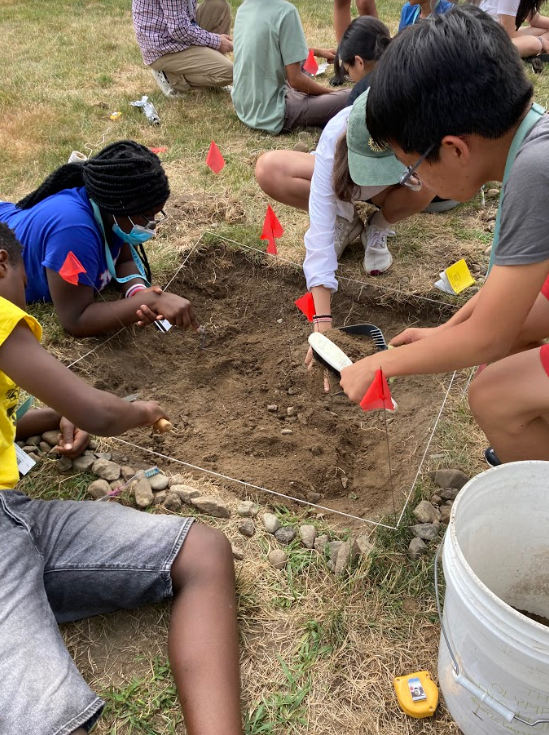
Dig This! students in class and learning to read an excavation site.
During the month of July, the Peabody hosts the Dig This! class, a course offered by Phillips Academy’s Andover Summer Session. This Lower School initiative takes a closer look at some crucial episodes in the development of this country to hone skills and understanding of dynamic interactions that took place between Native peoples and European newcomers, which continue to shape the United States to this day.
Using the Peabody Institute’s collections, together with extensive library and internet materials, students actively explore a series of case and character studies to understand the minds and strategies of important individuals from some of the most significant events in history. In addition, students attend field trips to nearby historical sites that bring these stories to life.
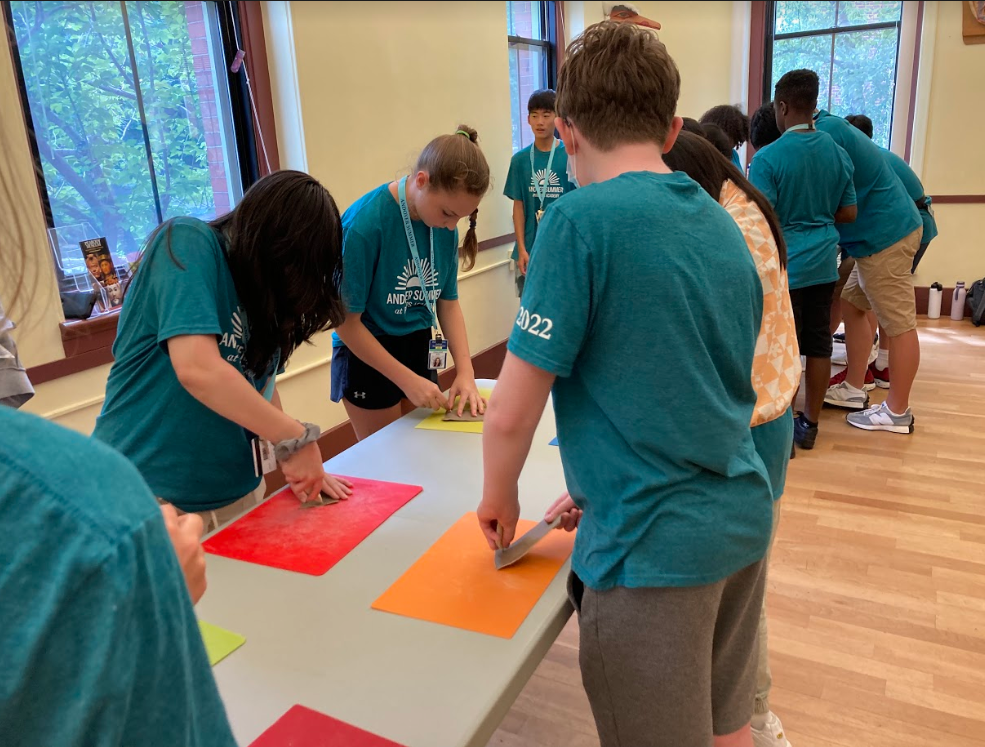
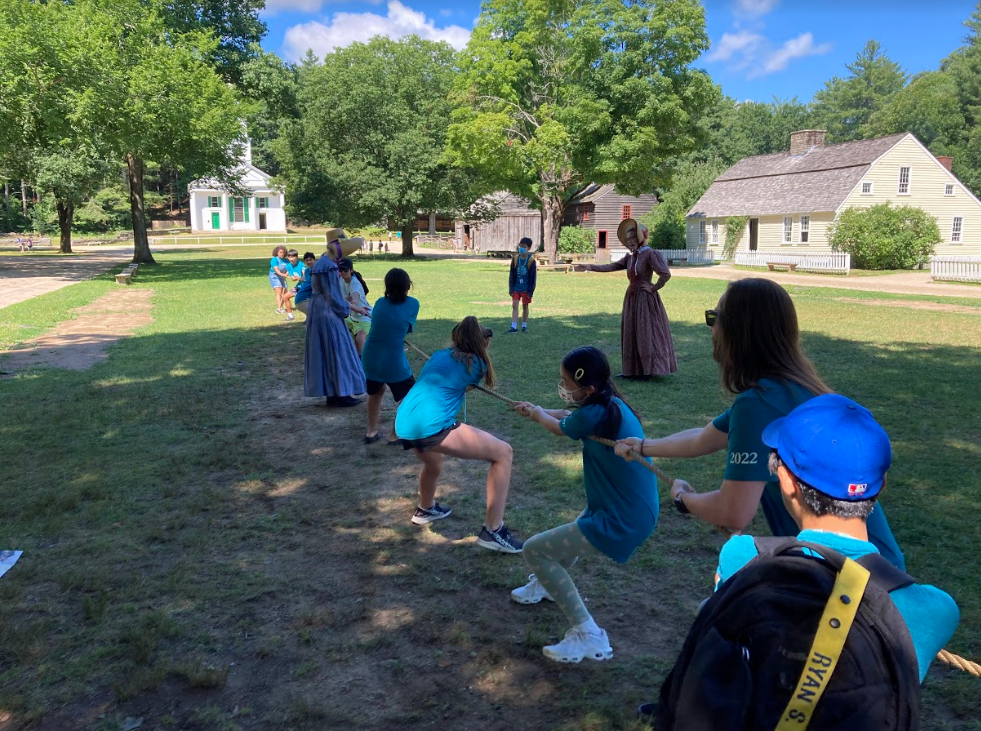
Dig This! students on field trips to the Peabody Museum of Archaeology & Ethnology at Harvard and Old Sturbridge Village
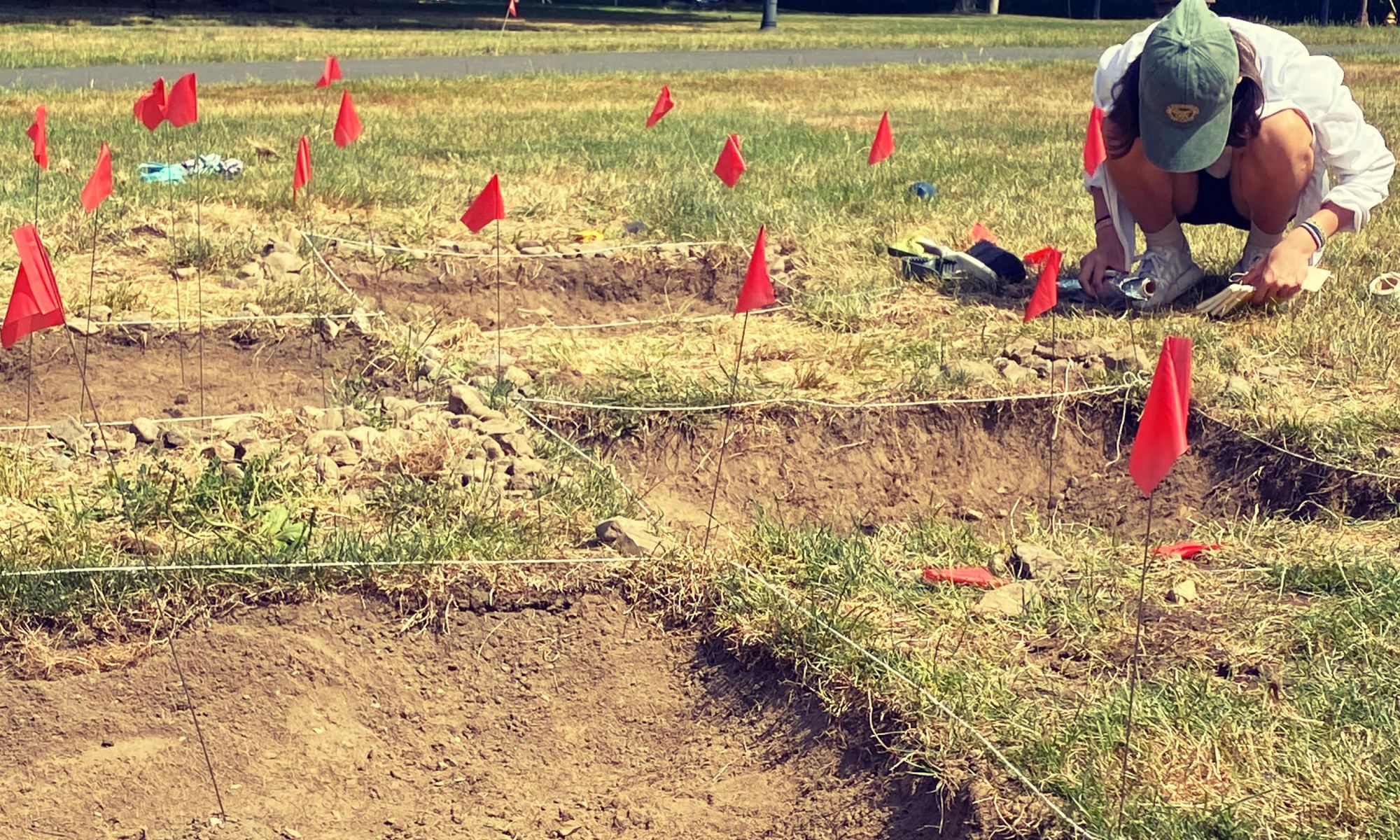
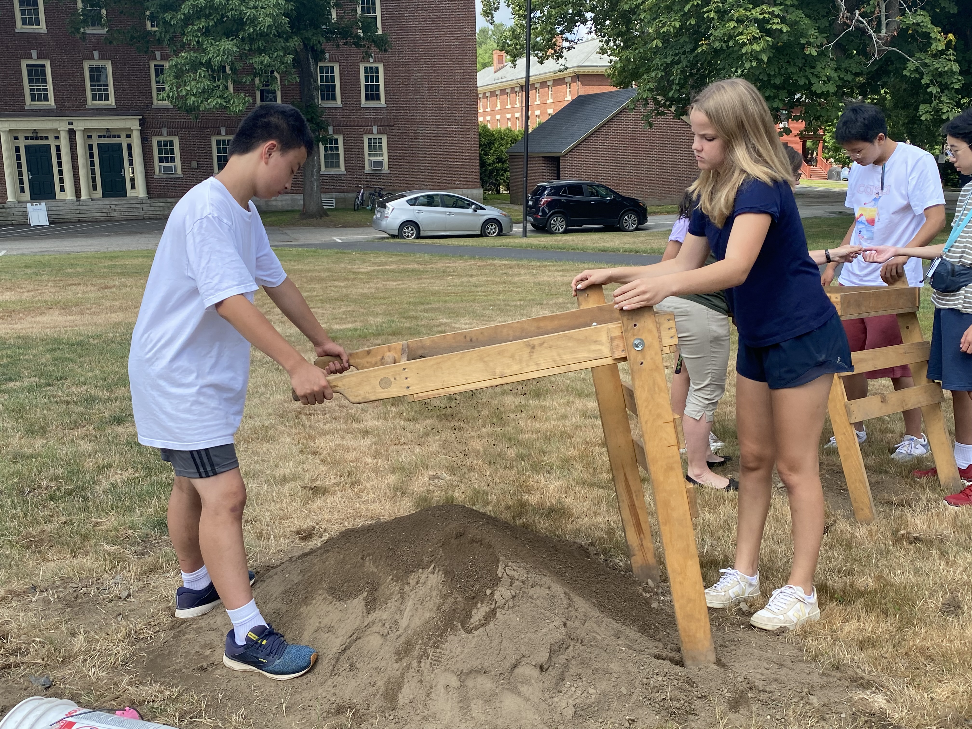
Students then get to participate in their own archaeological excavation of the Mansion House at Phillips Academy – the home of PA founder, Samuel Phillips, Jr. It’s always so exciting to see what these students discover as they take part in this unique opportunity to witness history.
Dig This! students excavating the Mansion House site
Be on the lookout for more updates on students’ findings through our social media this month and maybe even a blog from one of our Dig This! class instructors!
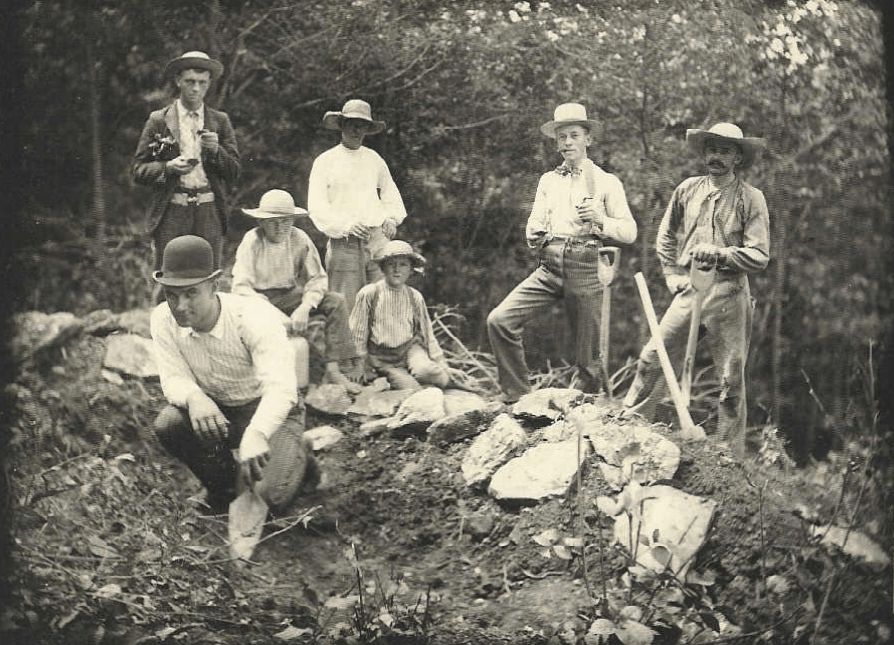
Our last newsletter sparked the interest of many readers with a featured black and white photograph of seven individuals posing with shovels, trowels, and cigars in hand. Their eyes focused intently on the camera, full of hope and mystery – reminds me of a moment like the Carpe Diem scene from Dead Poet’s Society. By popular demand, we share some additional information about this photograph.
Plate XIV – The Excavation of a Stone Heap near Station 246, Fort Ancient Site, Ohio. Photographed by C.J. Strong. Warren K. Moorehead (second from right), Joseph Wigglesworth (closest to camera on left with trowel), and unidentified field crew members.
This photograph was taken at the Fort Ancient site in Warren County, Ohio in the late nineteenth century. The photograph is of Warren K. Moorehead (second from right) and some of his field crew. Another man is identified in the photograph as Joseph Wigglesworth (closest to camera on left with trowel), a collector and amateur archaeologist from Wilmington, Delaware. You can view the original image in Moorehead’s publication of the Fort Ancient site here.
Fort Ancient is a series of earthen embankments, known as earthworks, with 18,000 feet of earthen walls enclosing 100 acres near the Little Miami River. People of the Hopewell culture (100 B.C. to 500 A.D.) built these walls and many other features both within the enclosure and on the steep valleys that surround the site. Investigations at Fort Ancient began in the early 1800s as mapping expeditions, expanding to surface collecting and full-scale excavations near the end of the century.
Warren K. Moorehead was the first curator for the Ohio Archaeological and Historical Society (now the Ohio History Connection). In 1893, Frederic Ward Putnam hired Moorehead to conduct excavations at Fort Ancient and obtain artifacts for the Columbian Exposition. One of Moorehead’s major contributions to archaeology was the preservation of Fort Ancient as an archaeological park. Later in his career, Moorehead served as the curator and then director of the Phillips Academy Department of Archaeology (now the Robert S. Peabody Institute of Archaeology) in Andover, Massachusetts, where he conducted important excavations at the Cahokia site in Illinois and the Etowah site in Georgia.
The Fort Ancient site is maintained by the Ohio History Connection and is a National Historic Landmark and listed on the National Register of Historic Places. Along with its earthworks, the site includes a museum about Ohio’s ancient history. You can explore the site’s website here!