Trapping a giant

Contributed by John Bergman-McCool

In a past blog post, I shared that we regularly monitor glue traps for signs of insect activity around our building. The traps are not a method for controlling insect populations, rather, they alert us to the presence of unwanted pests that pose a danger to the collections. When unwanted bugs are found we have a set of tools we can employ to remove them while minimizing risk to the health of our collection and colleagues. These tools include vacuuming and freezing collections.

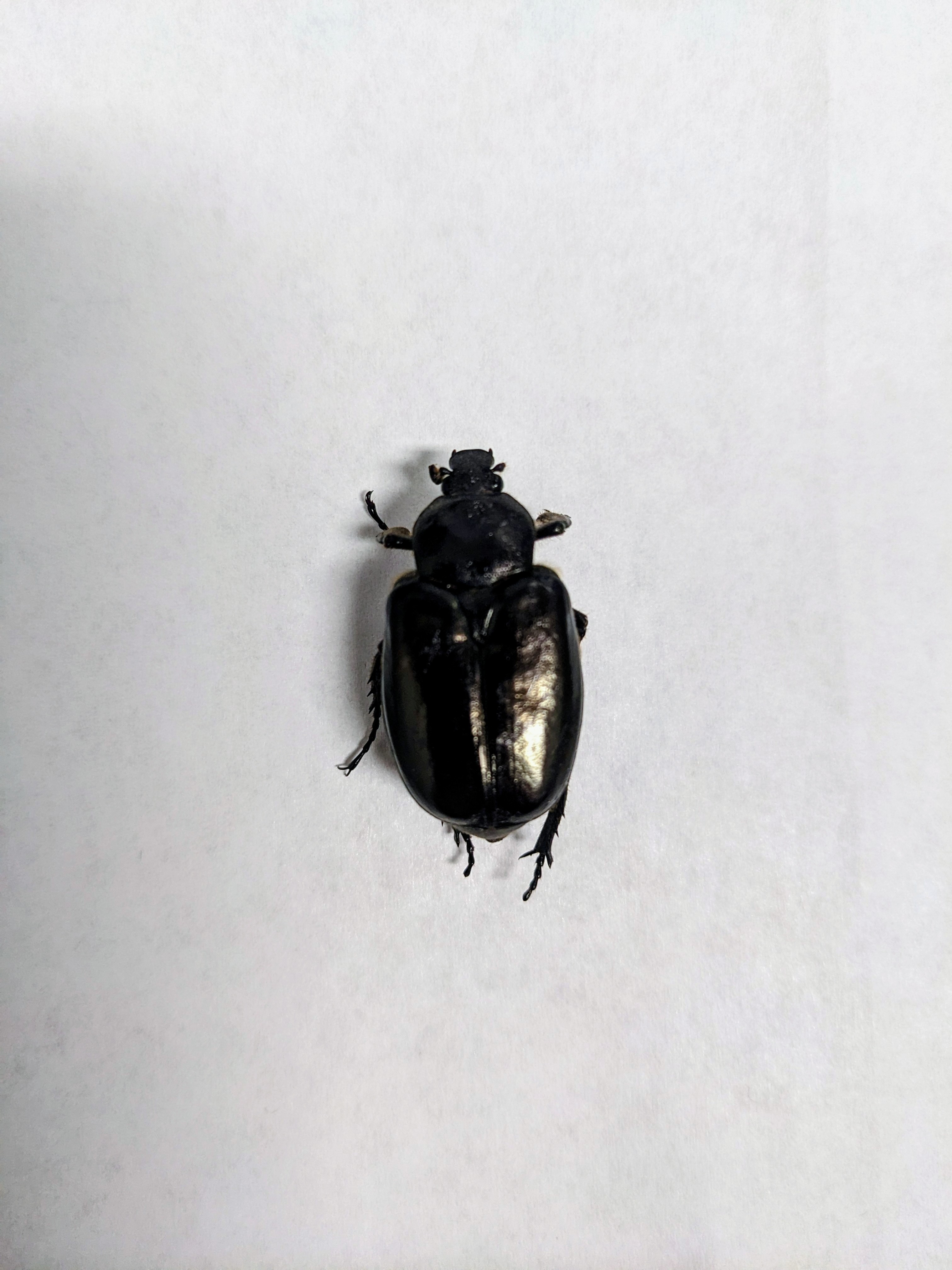
Now, I imagine that many readers (probably most of you) are not excited by pictures of bugs, but earlier this fall, we trapped an unknown insect that I felt was worthy of the spotlight.

Unknown Beetle removed from glue trap for easier identification

This remarkable beetle is the largest insect that I’ve seen in our traps. Beyond it’s massive size, any new or unknown bug is cause for excitement for a few reasons. First, we typically see the same three or four insects throughout the year. Second, we need to find out whether the insect is cause for alarm.

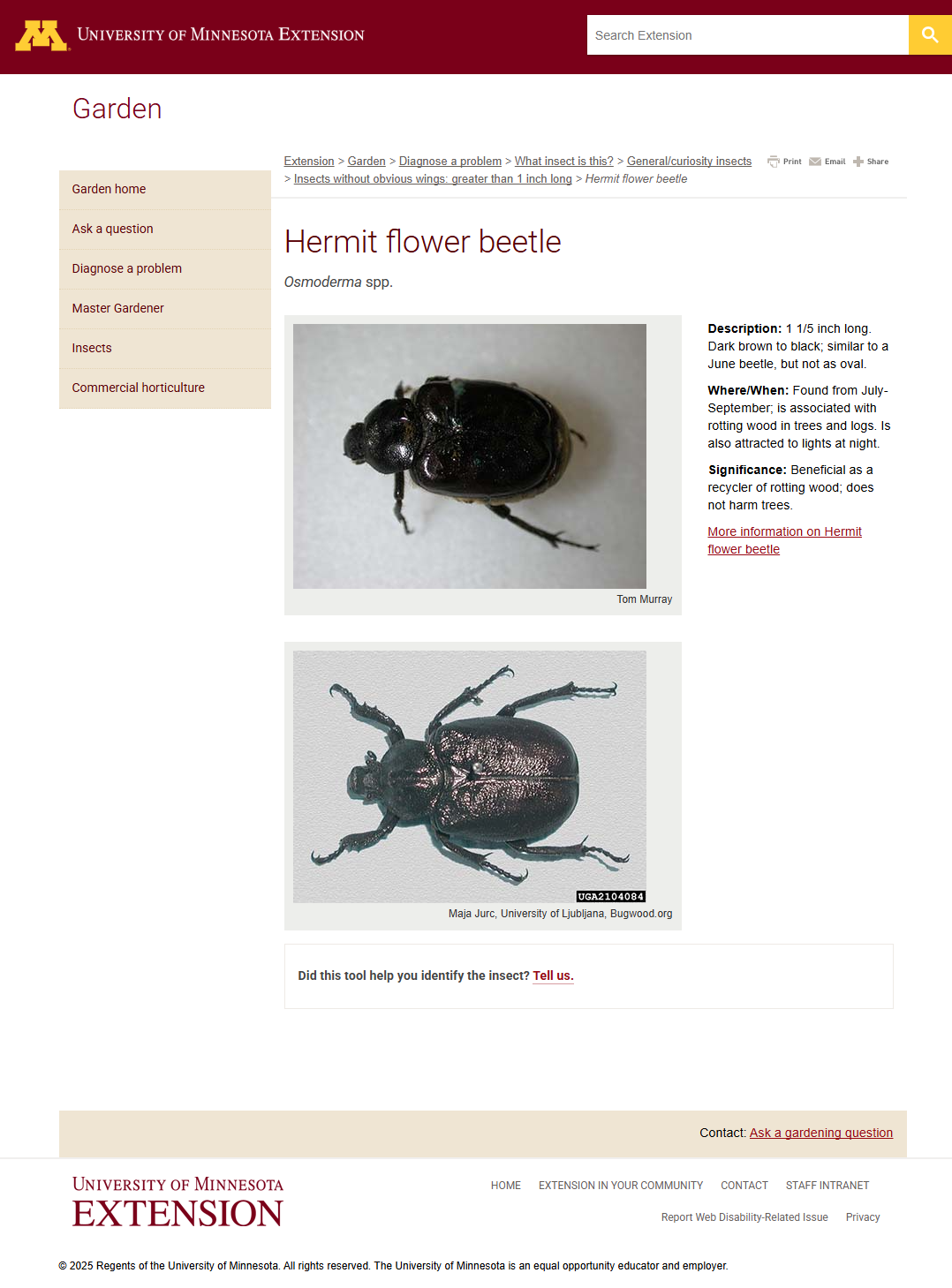
I snapped a few pictures and loaded them into Google’s ‘search by image’ function. Pretty quickly I learned that this guy is a Hermit Flower Beetle (or that is my best guess). They pose no danger to the collection. The larva live inside dead or rotting logs and play an important role in recycling wood and the nutrient cycle. The adults are frequently found around flowers. Somehow this one wandered into our building and ended up in one of our traps.

The University of Minnesota Extension webpage is a helpful identification resource

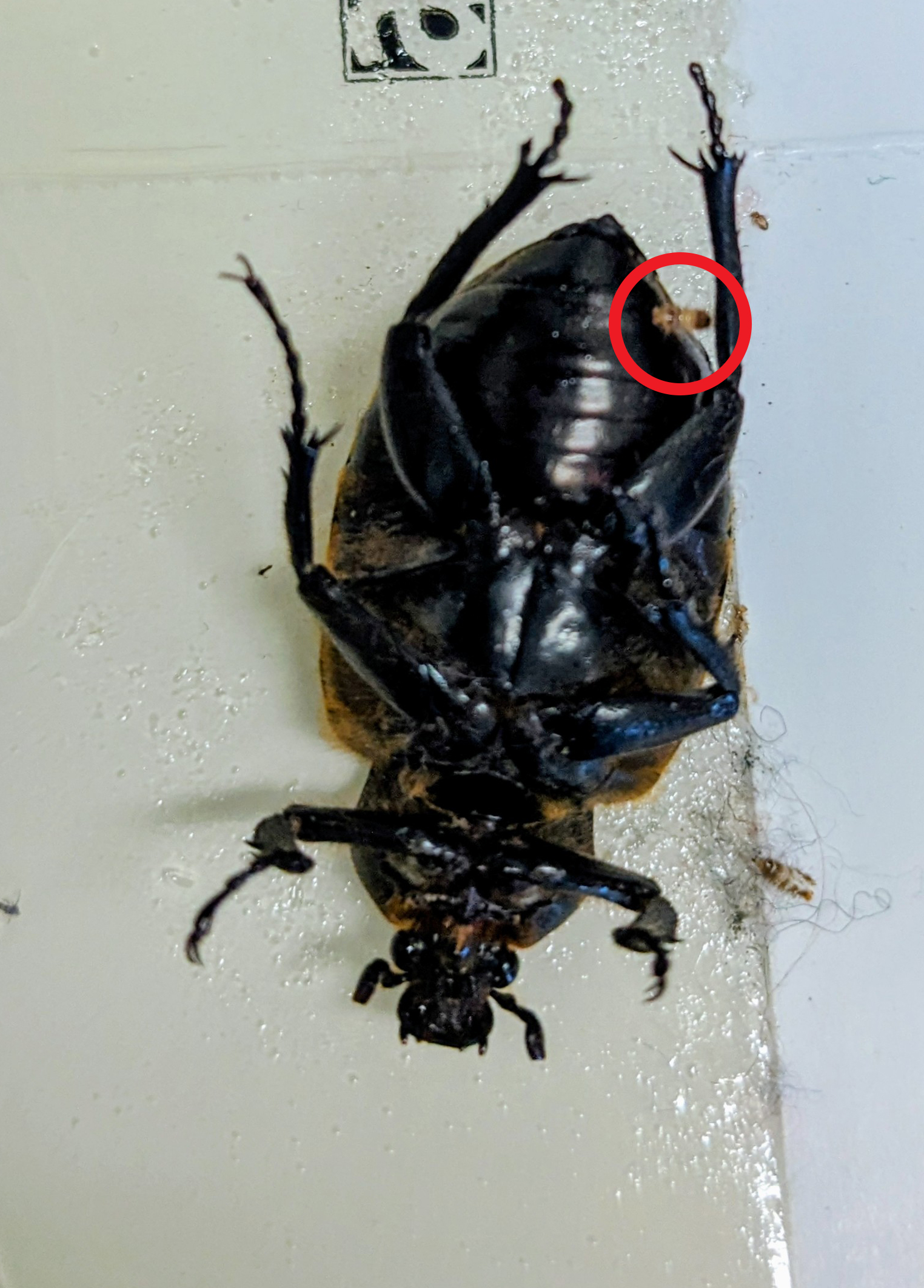
Unfortunately, once in our trap, the beetle died and became a food source for a carpet beetle, an insect we absolutely do not want in our collection. Even if an insect is not actively detrimental, it can always pose a risk.

Previously unknown Hermit Flower Beetle still in glue trap with carpet beetle outlined in red

Revisit Visit

Contributed by John Bergman-McCool

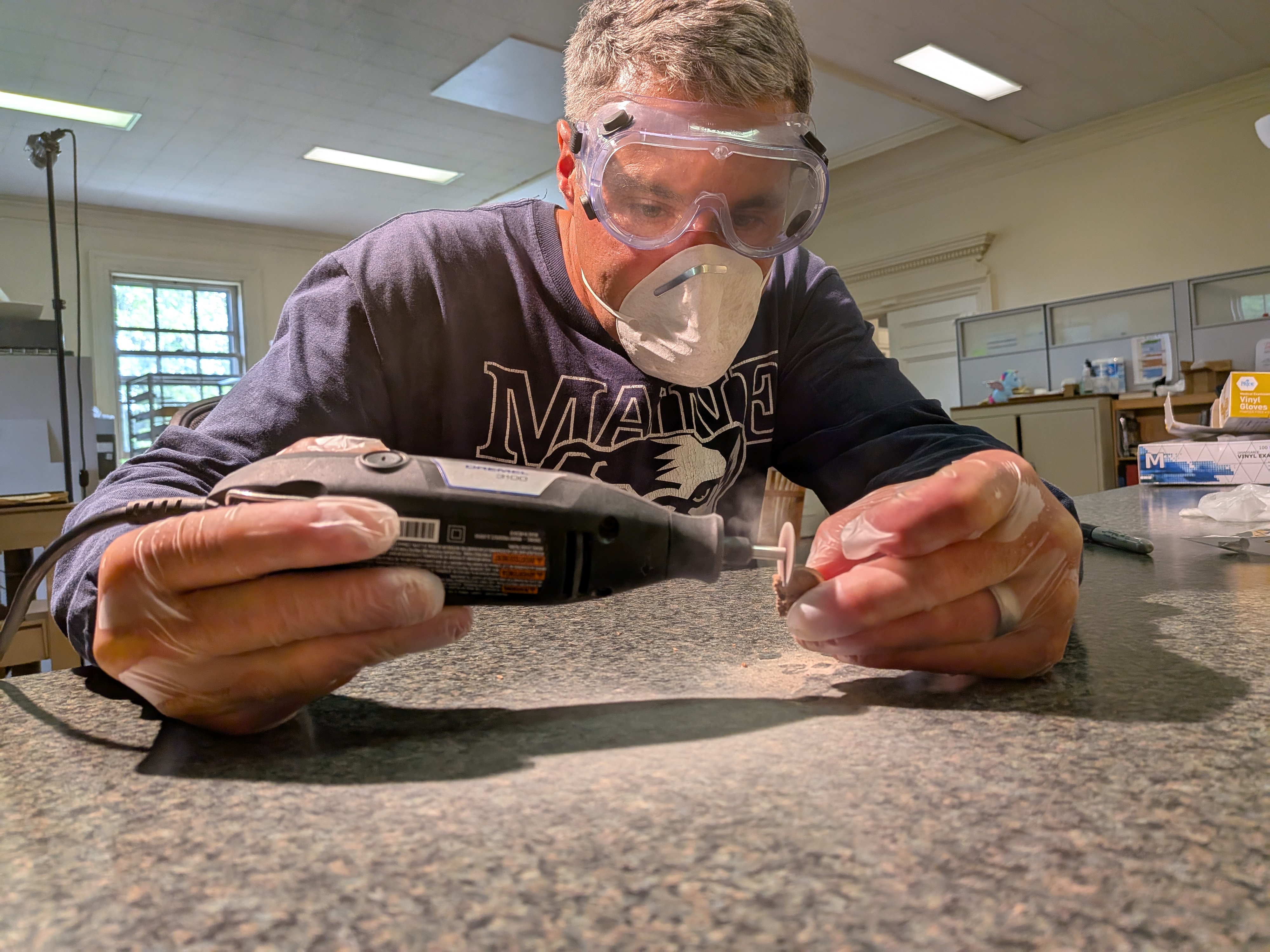
Figure 1. Visiting researcher, Dr. Rademaker taking samples for isotope analysis.

Last May the Robert S. Peabody Institute hosted visiting researcher, Dr. Kurt Rademaker. Dr. Rademaker is an Associate Professor and Director of the Center for the Study of the First Americans Laboratory at Texas A&M University. His research interests include early human ecology and settlement dynamics of the central Andean highlands.

Dr. Rademaker came to the Peabody to view materials collected by Richard “Scotty” MacNeish from the Ayacucho Valley in the Andean highlands. Between 1969 and 1972, MacNeish led an interdisciplinary team that searched for evidence of the origins of agriculture and civilization in South America.

Based on previous work conducted on the Peruvian coast, MacNeish and others hypothesized that agriculture originated in Peru’s Andean highlands. The Ayacucho Valley encapsulates diverse habitats spanning a range of elevations. It also contains dry caves with long stratigraphic sequences, two criteria MacNeish utilized in his study of the origins of agriculture in the Mexico’s Tehuacán Valley.

Botanical remains discarded by humans, including domesticated plants, can be well-preserved in dry caves, while long stratigraphic sequences give archaeologists the ability to see how things change over long spans of time. MacNeish was looking for evidence of human cultural development, including domesticated plants across time and habitats.

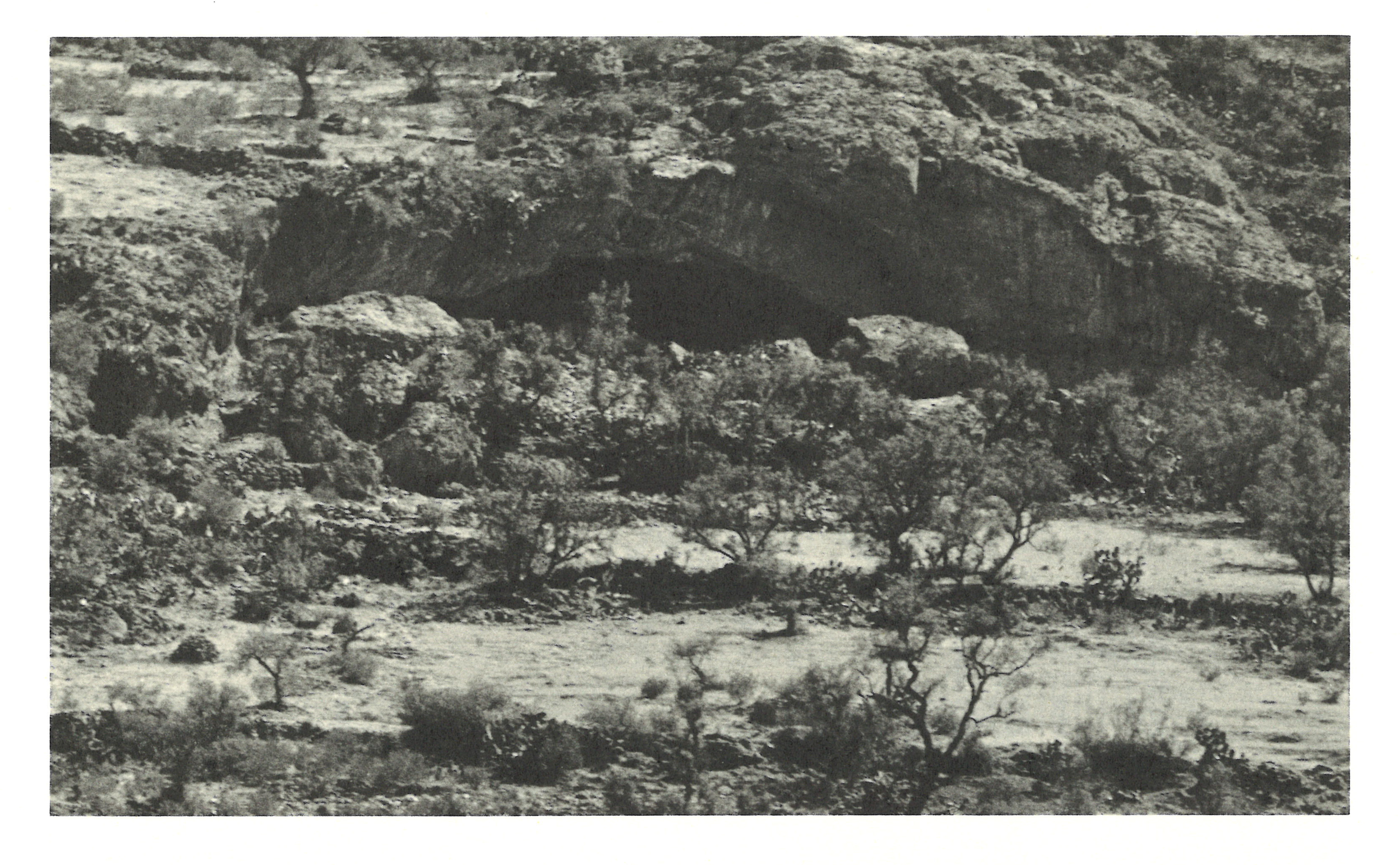
Figure 2. Pikimachay Cave as seen from the east.

Interestingly, and unrelated to the question of plant domestication, MacNeish’s summary of excavations at one site, Pikimachay, concluded that humans and now-extinct Pleistocence animals may have interacted. This was based on the presence of artifacts and extinct animal remains in the same pre-ceramic stratigraphic layer. The claim was supported by radiocarbon dating which returned dates of roughly 14,000 and 23,000 years before present. However, this conclusion has always been somewhat controversial since the dating methods do not meet scientific standards of quality control, not to mention they contradicted widely held notions of the peopling of the Americas.

Radiocarbon dating, at the time, required a large amount of sample material. MacNeish gathered material from several sources spanning a wide area. In the intervening years, isotope analysis has improved to the point where only one gram of sample material is needed. Now a single bone with clear stratigraphic origin can be sampled.

Additionally, sample preparation can now isolate carbon from the item being dated and remove carbon from the surrounding sediment. Previous methods couldn’t parse these sources and may have resulted in dating the burial environment. This can help determine if the sample was moved from it’s original stratigraphy by burrowing animals or other natural forces.

The story of when people arrived in the Americas has changed over time as new discoveries led archaeologists to question existing hypotheses. At the time of MacNeish’s Ayacucho project, the commonly held belief was that the first people arrived at the end of the Ice Age, by way of the Beringia land bridge and ice-free corridors. The earliest evidence of human presence was at Clovis, New Mexico, dated 13,250 to 12,800 years before present. His discovery meant that people may have arrived in North America much earlier if they were established in Peru 14,000 to 23,000 years ago.

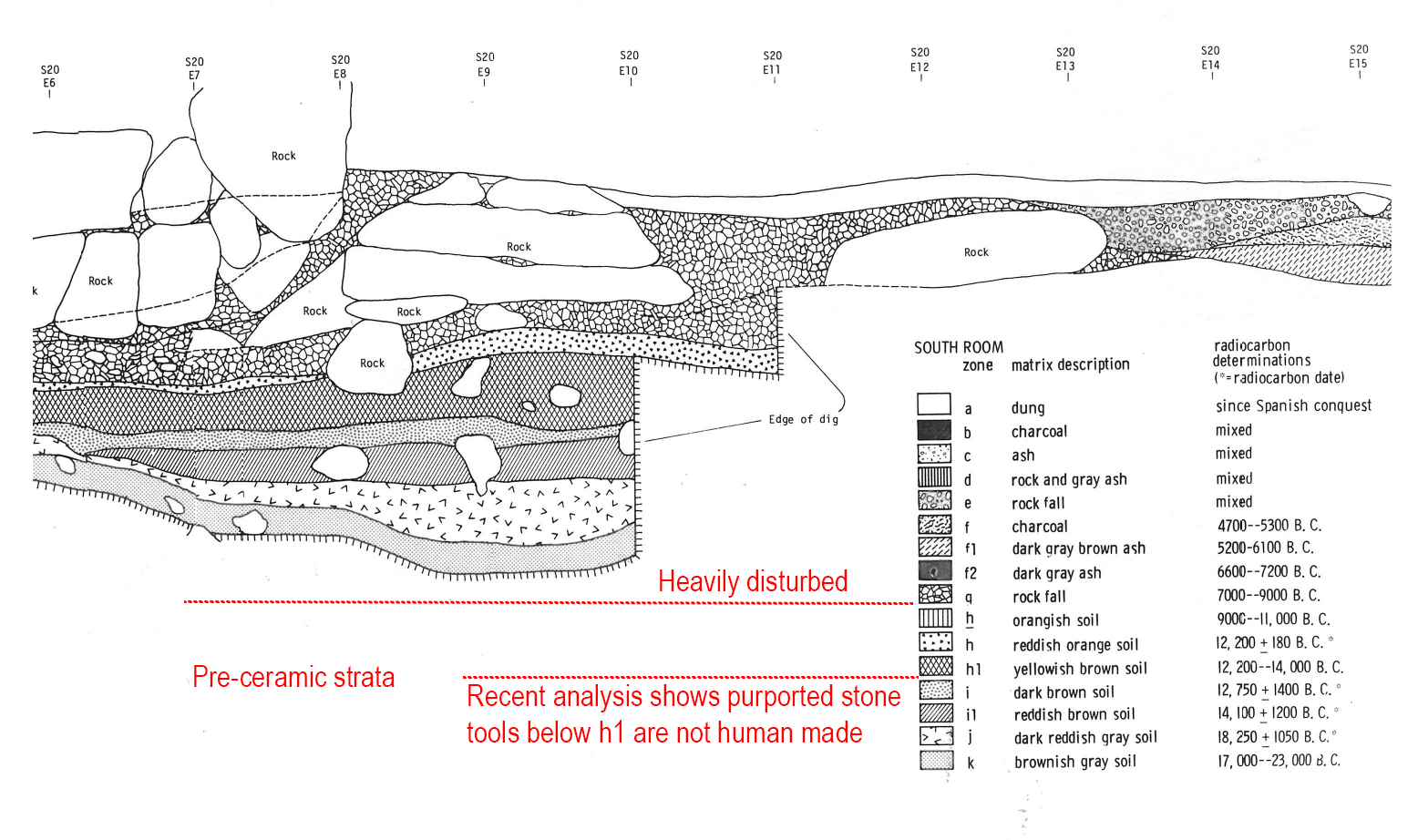
Revisiting MacNeish’s Ayacucho materials offers an intriguing opportunity to confirm his findings. Recent work has revealed that the stone tools found in the lowest strata (see figure 3) were naturally occurring and not made by people, perhaps ruling out the oldest dates MacNeish obtained. However, the researchers confirmed that human-made tools and cut animal bones are present in earlier layers (strata h, h and h1).

Figure 3. Stratigraphy from the South Room in Pikimachay. Samples will be taken from pre-ceramic layers. Layers above the pre-ceramic strata are heavily disturbed by pot hunting, animal activity and construction from animal corrals.

Dr. Rademaker has proposed sampling as many animal bones as possible from pre-ceramic stratigraphic layers. If any remains are from the Pleistocene Epoch, then MacNeish’s results will be supported and will add further support to a pre-clovis peopling of the Americas. If the remains are younger, from the Holocene Epoch, then it is likely that they were deposited in lower strata through some manner of disturbance.

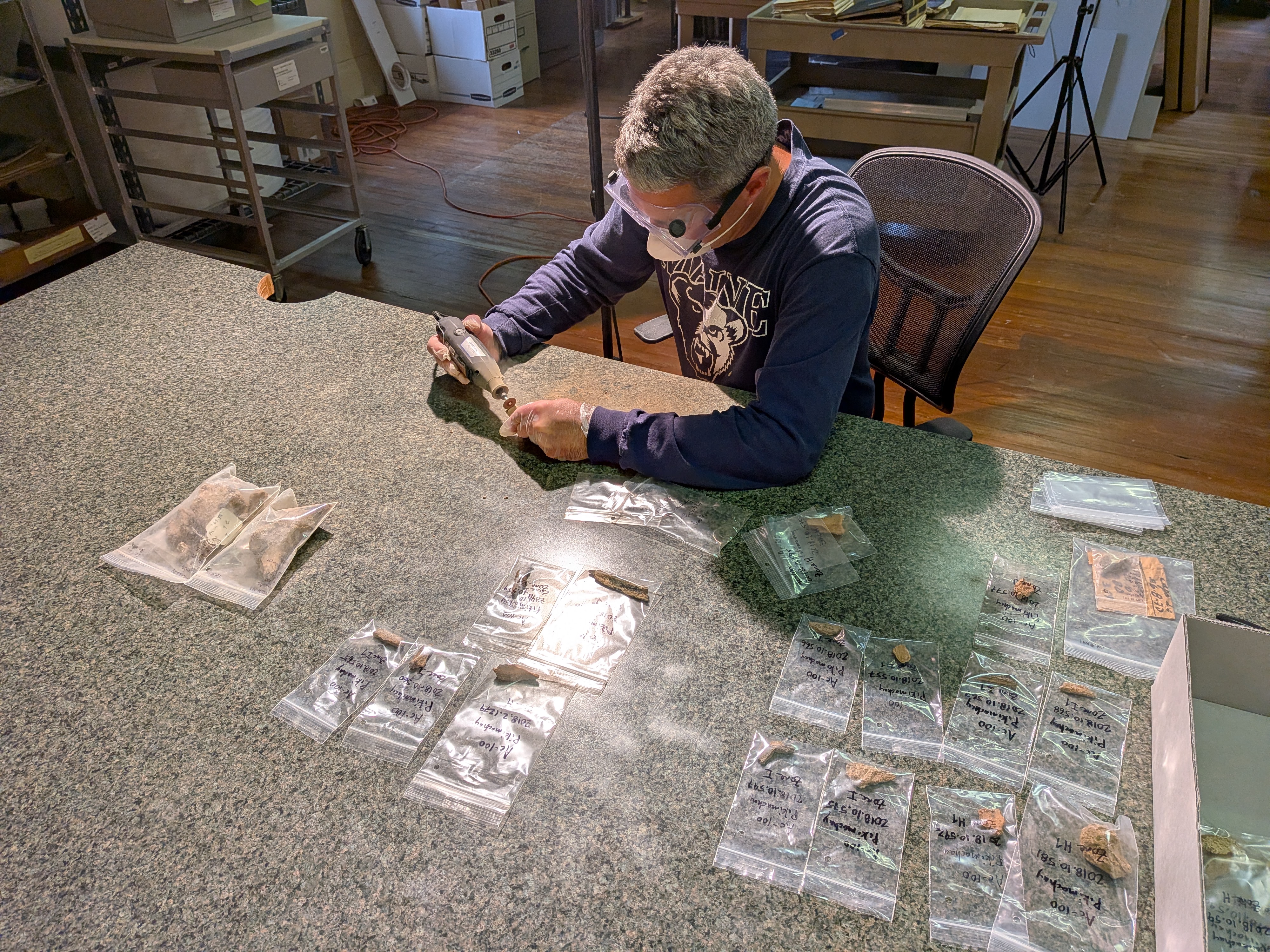
Figure 4. Pikimachay samples arrayed for processing.

During Dr. Rademaker’s visit he spent several days reviewing archival materials including field notes, radiocarbon sample data and correspondence. The final day of the visit, Dr. Rademaker collected a sub-set of samples; roughly 1/3 of the total proposed. The bones they were taken from are quite old and may not contain the collagen necessary for isotope analysis. If these samples prove to have viable collagen and they return good dates, Dr. Rademaker will return to collect the remaining samples.

The Wrestler and the Calf

Submitted by John Bergman-McCool

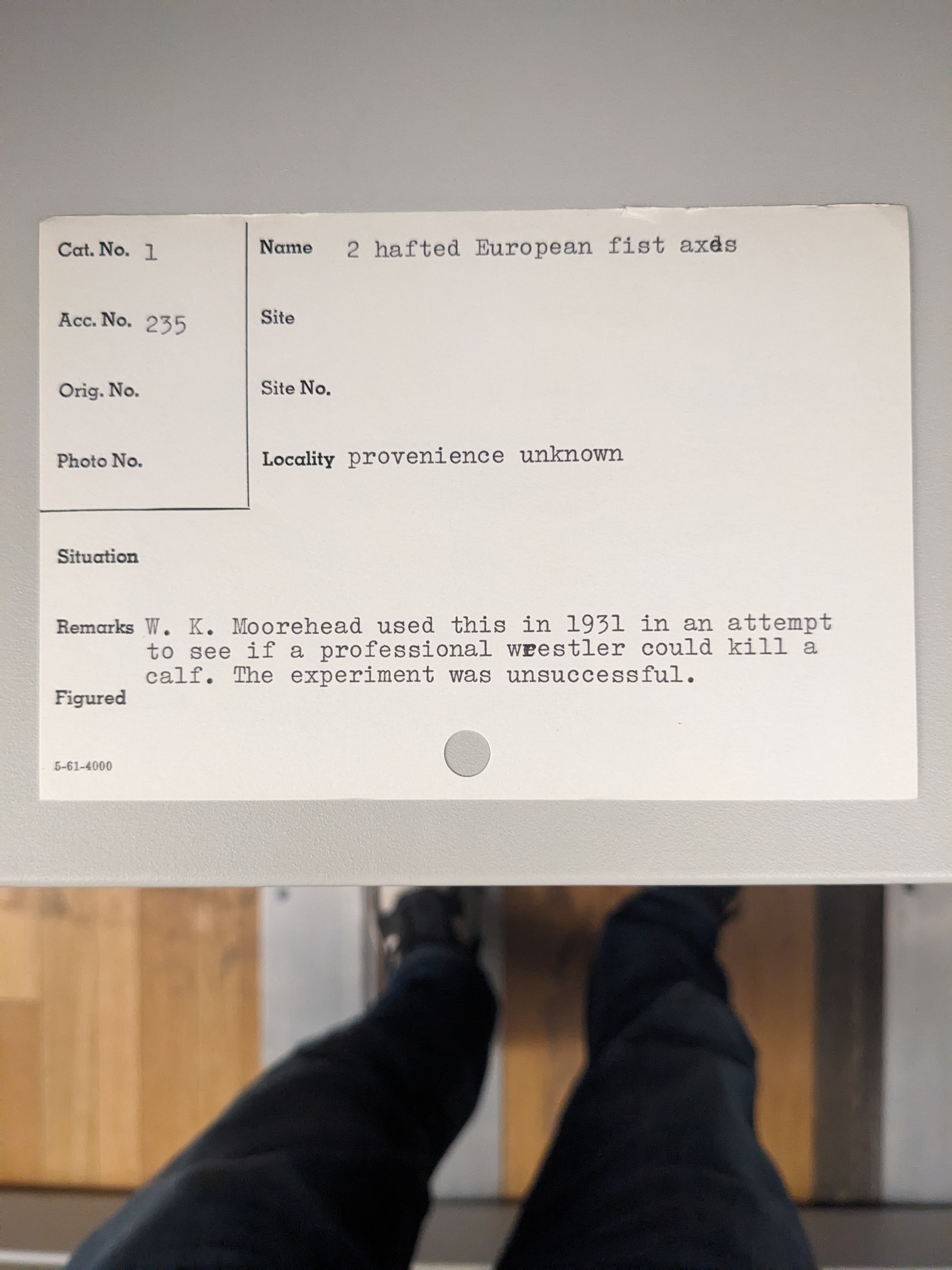
A few years ago, I came across a catalog card with an interesting account in the remarks section. The card read “W. K. Moorehead used this in 1931 in an attempt to see if a professional wrestler could kill a calf. The experiment was unsuccessful.” There is a lot to unpack from this card. It references experimental archaeology, professional wrestling, and, judged by today’s standards, ethically questionable behavior. I figured that there had to be a story to unearth, but with more pressing work to do, I filed this note away for another time.

The catalog card describing the handaxes.

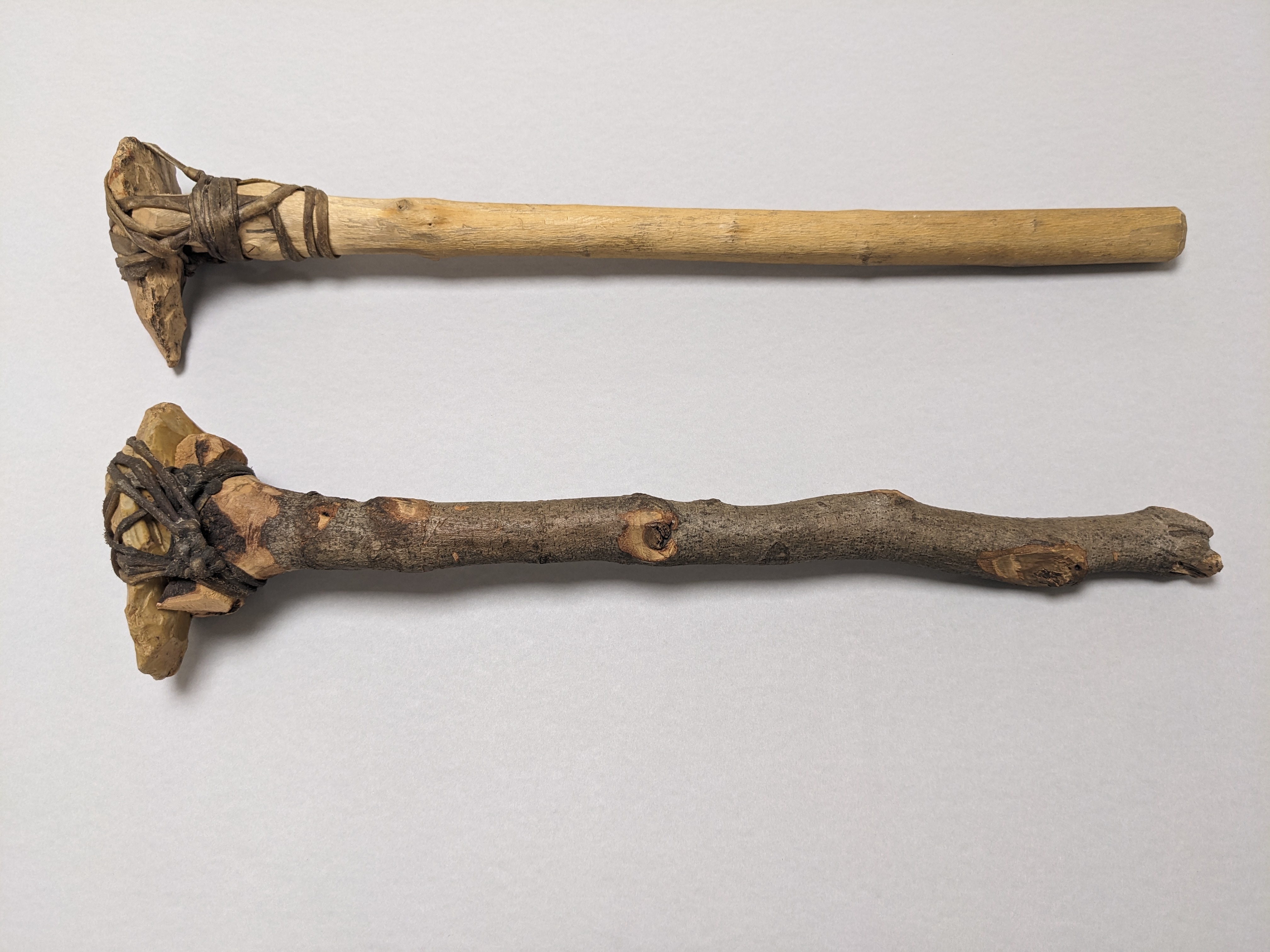
The catalog card describes two hafted European ‘fist axes’ (or handaxes). The provenience of the items is unknown. The Peabody acquired a collection of similar European tools shortly before these items were cataloged. It’s possible that the hafted handaxes are somehow related.

The handaxes used in Moorehead’s experiment.

Over the past few years this card occasionally comes to mind, or I will see the handaxes. When they do, I will do a quick search of the internet for any related newspaper articles, journals, or archival clues. I’ve looked through our institutional records but haven’t found anything that appears to be related.

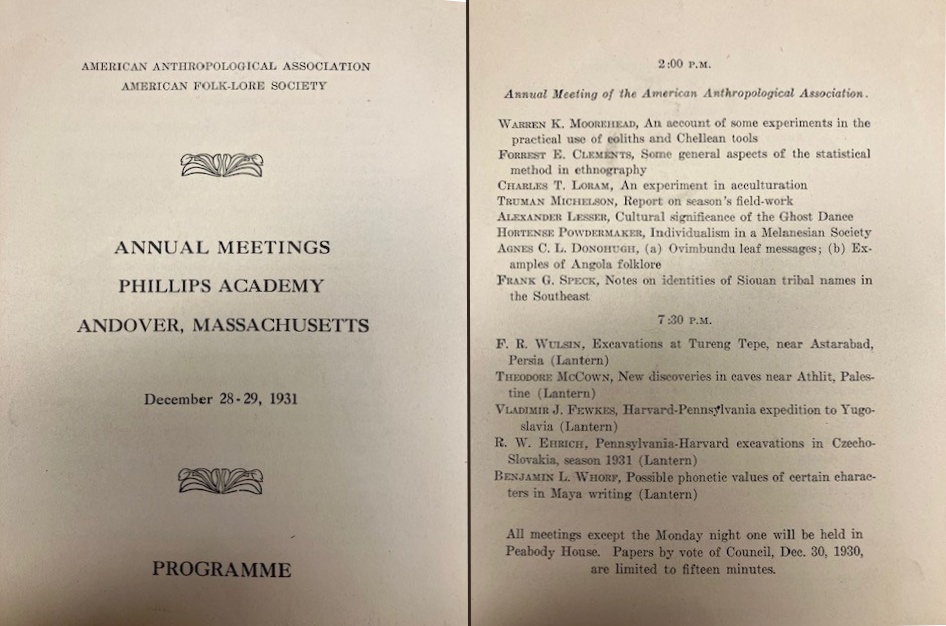
A breakthrough came when I found the minutes from the combined 1931 Annual Meeting of the American Anthropological Association (AAA) and American Folk-Lore Society. The meeting was held at Peabody House at Phillips Academy on December 28-29. The minutes included a description of a talk given by Warren K. Moorehead titled “An account of some experiments in the practical use of eoliths and Chellean tools.”

Selected pages from the program for the 1931 American Anthropological Association annual meeting.

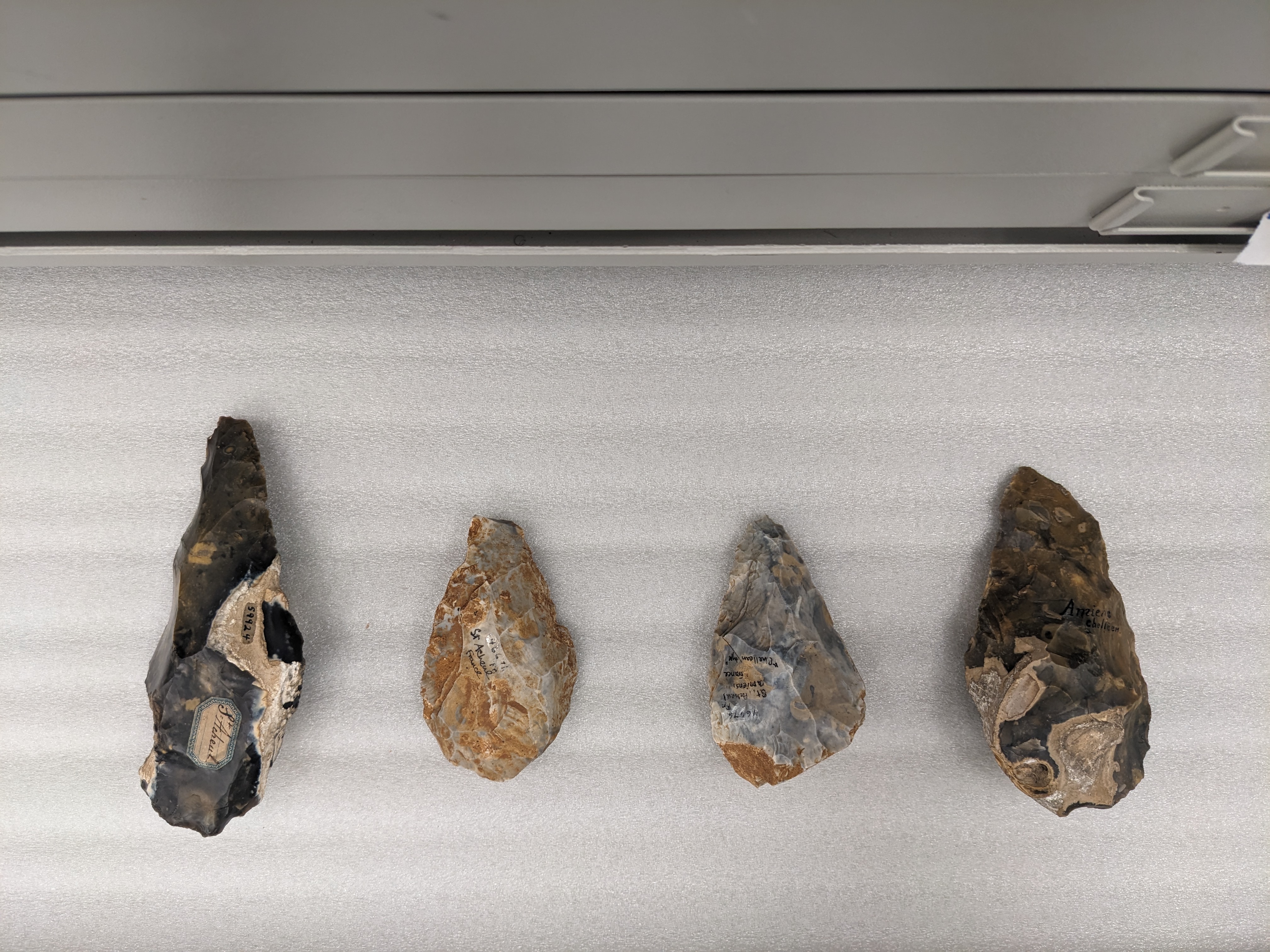
The Chellean tools Moorehead references belong to what is today known as the Acheulean stone tool industry. They are named after a site in Saint-Acheul, France where their classification as a prehistoric tool was first broadly accepted. Acheulean handaxes are distinct and have come to define Acheulean stone tool technology overall. The hafted hand axes in question are unquestionably Acheulean in form, with the hafting being a recent addition.

A few examples of other Acheulean handaxes the Peabody stewards.

The distribution of these tools is wide-ranging geographically and temporally. The oldest examples date to 1.76 million years ago. An end date for their use has been placed between 300,000 and 100,000 years BP. Some handaxes are very large, measuring 2 feet, while others are quite small, just 6 inches.

They have been found in Africa, Europe and west, south and east Asia. They are very old examples of stone tool technology and would have been made by hominids, such as Homo erectus.

-A quick note about eoliths. These were once thought to be stone tools and were subject to heated debate for many decades. They have been found in deposits that vastly predate the Acheulean. They are now recognized as naturally occurring geofacts and are not of human origin.

Finding the meeting minutes describing Moorehead’s presentation seemed to be one step closer to an account of the experiment-gone-wrong mentioned in the catalog card. Armed with more information and a date to work with, I did another round of searching on the internet and within our archives.

Eventually, I contacted the Ohio History Connection (OHC). Moorehead was the first curator at the Ohio Archaeological and Historical Society (OAHS) before coming to Phillips Academy. After his death in 1939, Moorehead’s family gave many of his papers to OAHS. Our two institutions share some of the same correspondences and we have reached out to them in the past.

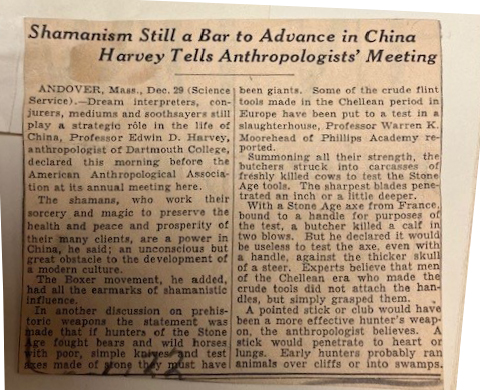
Amazingly, OHC responded with a newspaper clipping from the New York Times that provided more context about the talk Moorhead gave at the 1931 AAA meeting. The article mentions that the tools were used by butchers in a slaughterhouse on carcasses and one living animal. The butchers declared the tools to be ineffectual, and Moorehead proposed that sticks or clubs would have been better suited as hunting tools.

The New York Times article from December 30, 1931 describing Moorhead’s experiement (fourth paragraph through to end).

Today, experimentation of this nature on live animals would be ethically inconceivable. Scientific research is meant to manipulate variables in controlled situations to study factors relevant to the proposed question. Moorehead’s experiment didn’t take into account the many varied sizes of handaxes and whether they should be hafted or simply held in hand. Testing a range of sizes and handling methods might lead to better results. However, this and any future replication or refinement of Moorhead’s conditions would certainly lead to increasing levels of harm to animals.

A researcher who has engaged in experimental archaeology shared via correspondence some of the alternatives and ethical considerations of modern experimentation in the field. Colleagues testing projectile point penetration utilized targets made from meat and meat substitutes, such as ballistic gel and clay. The meat used for the targets needed to be ethically sourced (from a hunter or butcher for example) and would otherwise have been discarded if it not used in the experiment.

Sometimes substitutions for animal remains are unavoidable. An article on the topic of animal resources in experimental archaeology outlines concerns of sample procurement. Scientific studies often require large sample sizes. Animal remains are non-renewable resources that have limited availability. These samples are linked to the death of animals, no matter how they are procured. In these situations, modern researchers must strike a balance between scientific rigor and ethical integrity.

Returning to the catalog card and newspaper article concerning this experiment; it is interesting to note that the professional wrestler in one, is a slaughterhouse butcher in the other. I was hoping any notes Moorehead used to prepare his presentation or other related correspondence could provide more information, but I have yet to find them. 

Both the card and article declare the experiment to be a failure, seemingly as tools for hunting and maybe butchery. To be sure, the hafting has left very little of the cutting edge of one of these tools available for penetration.

Subsequent experiments with Acheulean handaxes have found them to be effective tools for a wide range of tasks aside from hunting including butchering animals, stripping wood, processing plants and digging. These experiments are supported by surface wear pattern studies. It is unclear whether these tools were ever used for hunting, which Moorehead’s sensational experiment somewhat confirms.

Websites with more information on Acheulean culture:

Museum of stone Tools

University of Missouri

Becoming Human

Journal article outlining challanges associated with animal experiments in archaeology:

Steele, Teresa E., Guilia Gallo, Naomi L. Martisius et. al. 2025. Animal resources in experimental archaeology: A reflection on standards and ethics. Journal of Archaeological Science: Reports 61

Pecos Eagle Bone Flutes: Past, present, and future

Contributed by Alberto Agudo (’25)

I stumbled upon the Pecos bone flutes on a bright September afternoon that was supposed to be about beaver pelts and fur trade ledgers. My history class had followed Ms. Doheny to the Robert S. Peabody Institute for a lecture, but after the talk I lingered and asked the speaker, Dr. Lainie Schultz, whether the museum kept any musical instruments. That single question carried me into the archives, where Curator Marla Taylor opened a drawer and revealed two slender bones—one golden eagle, one hawk—pierced and polished, flutes waiting in perfect silence.

Music has framed my life since I was four in Madrid: first as a hobby, then as devotion, from my early passion for Romantic music to the shimmering modernism of Debussy, whose Masques I played at fifteen beneath the stone arches of Dubrovnik’s Rector’s Palace. Yet nothing in my previous musical experience had prepared me for the quiet authority of these flutes. Their accession records were almost empty, their makers unnamed, but the Tribal Historic Preservation Officer of Jemez Pueblo had granted permission for their study. Phillips Academy’s Abbot Independent Scholar program let me transform my curiosity into a full-term research project under the supervision of Dr. Schultz and Dr. Elizabeth Aureden from the music department.

The work began with patient looking. The eagle bone flute—just under twenty centimeters—bears four clean finger-holes; the hawk bone flute is shorter, its stops conical and ringed by three tiny oblique grooves. My initial efforts left me frustrated—despite my solid musical background, I couldn’t answer any of my research questions. Guided by Indigenous scholars, I began to understand the silence and endless questions as a wise teacher. By combining archival materials with present-day Indigenous resources, chiefly from Jemez musician Marlon Magdalena, I built a relationship with the eagle bone flute and experienced the music as something much deeper than pure sound.

In his song “Eagle’s Blessings,” which I shared during my presentation to the Massachusetts Archaeological Society in April, Marlon brings the flute to life. When I first heard it, I was nearing the end of my research, which had been mostly historical and archival. I had tried to learn about other Indigenous music, but this performance tied everything together. Throughout the term, I feared profaning the cultural or religious significance of the eagle bone flute. I understood its sacredness, and as a religious person involved in interfaith activities, I recognize the importance of respecting religious artifacts.

Marlon’s explanation before he played brought everything into focus. He explained that eagle bones are sacred, held only by tribal members and used to lift prayers skyward. When he played, I felt how, through his breath, he gave life back to the eagle and honored her. Suddenly, the silence became understandable. Even though I could not draw solid scientific conclusions, I forged a connection I will never forget.

This project has awakened a passion for ethnomusicology that I am now exploring with the music department, under the guidance of Ms. Ángela Varo-Moreno, studying the presence of LGBTQ+ subcultures in techno music. I would like to end by thanking everyone at the Peabody, at Phillips Academy Andover, and at Pecos and Jemez Pueblos—and other Indigenous communities—who have safeguarded the knowledge that reached me and made this project possible. It has been a gift I will always keep in my heart.

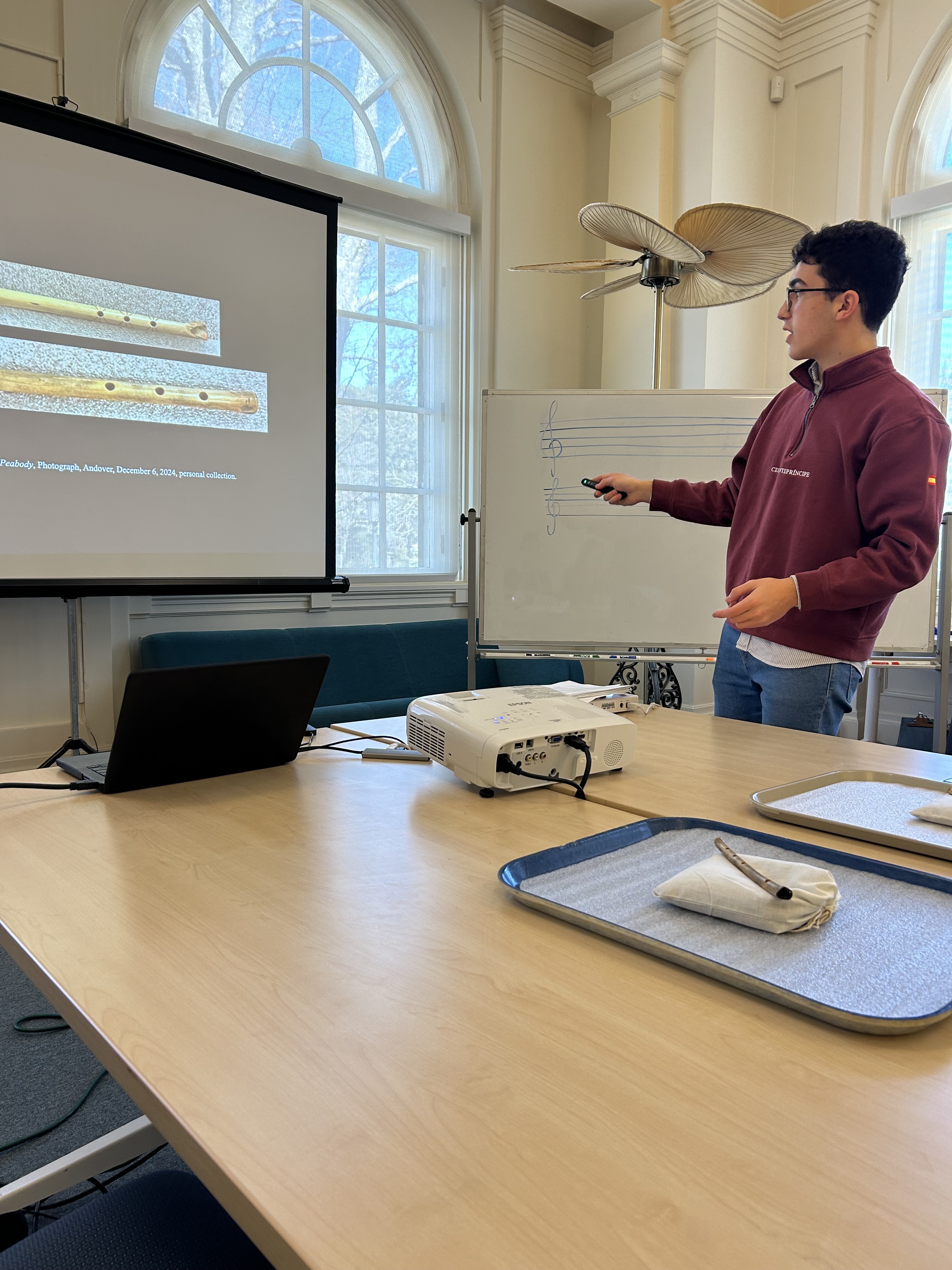
Alberto presenting his final project at the Peabody, finishing up his independent study.

More Than Metal: What’s Really on a Coin?

Contributed by Patrick Zheng ‘28

Every Wednesday, I come to the Peabody Institute to be in the company of pharaohs and emperors, not through books but from 2000-year-old coins held in the institute’s collections. I help to identify these coins and record observations into the Peabody’s catalogue system. I’m extremely fortunate to experience “living history” from these remnants of ancient Rome, Hellenistic Egypt, and the Byzantine world.

As the mass media of the ancient world, coins carried big messages. The images depicting rulers, gods, animals, or symbols were carefully chosen and deeply meaningful. Every coin has a story to tell about culture and politics. Together, they offer new perspectives on historical events that we thought we already understood.

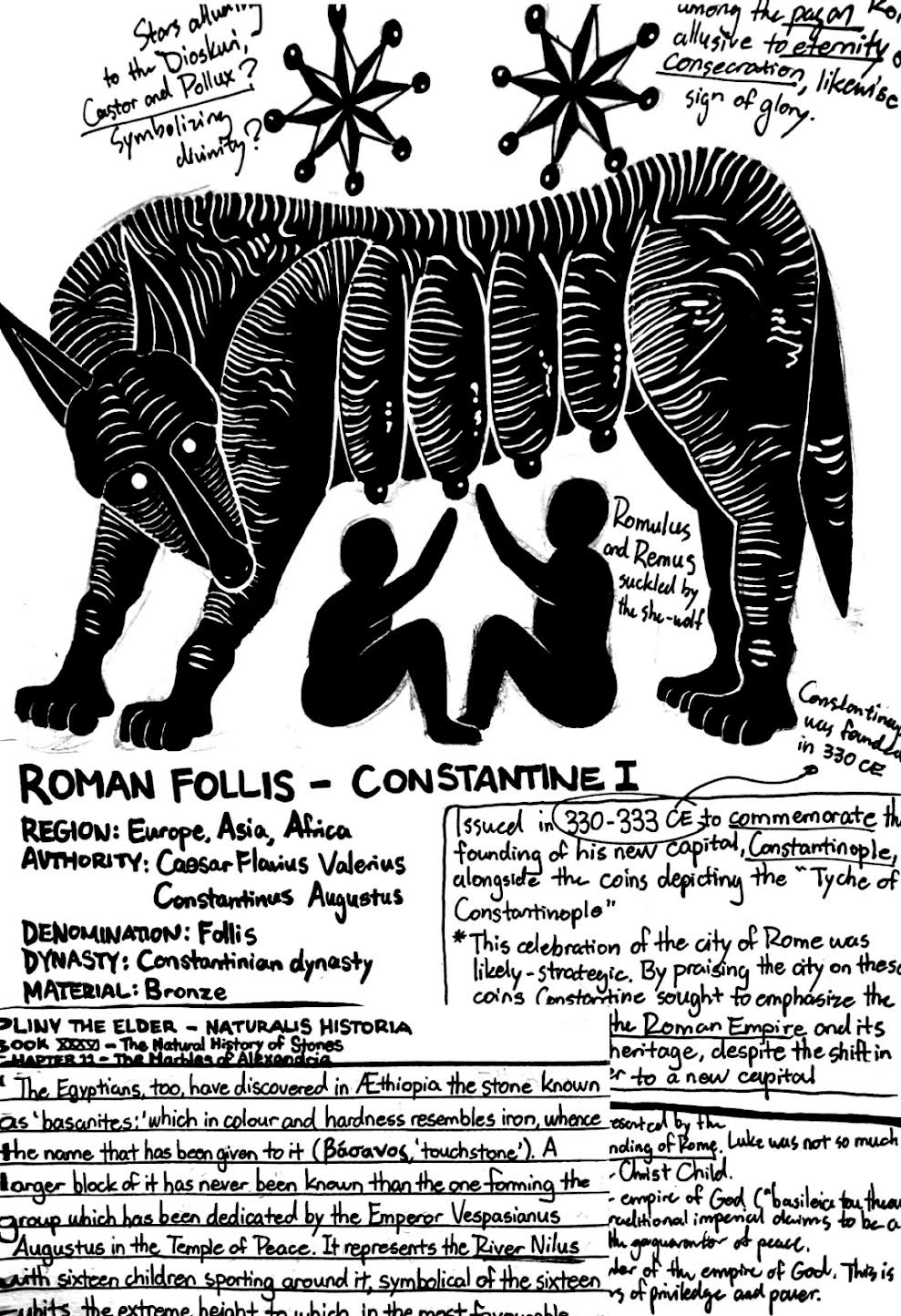
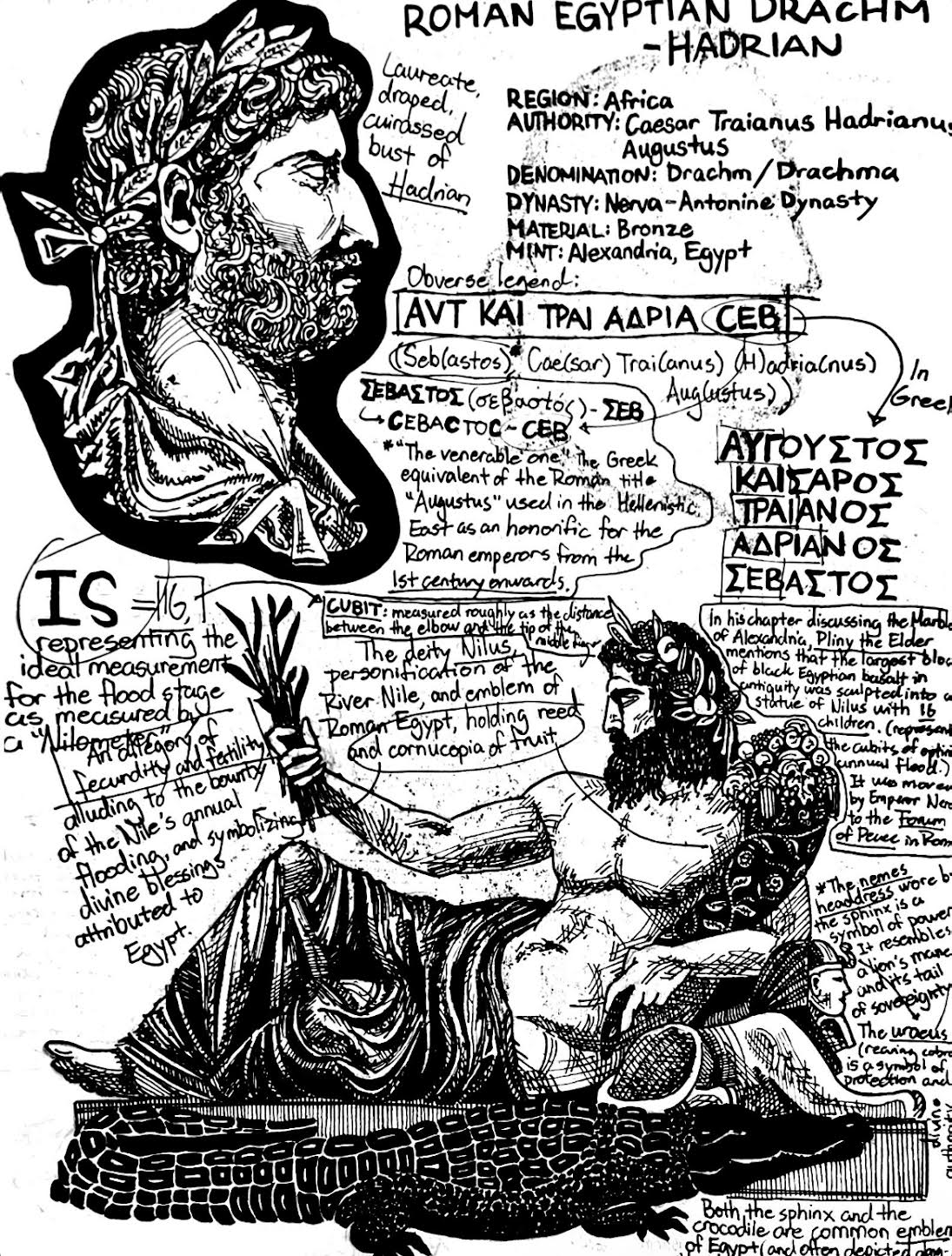
From my notes. Left: sketches and notes of a coin showing Rome’s foundation myth to commemorate Constantinople’s founding under Constantine (Rome reborn). Right: Roman coin minted in Egypt during Hadrian’s reign depicting the River Nile as a reclining deity.

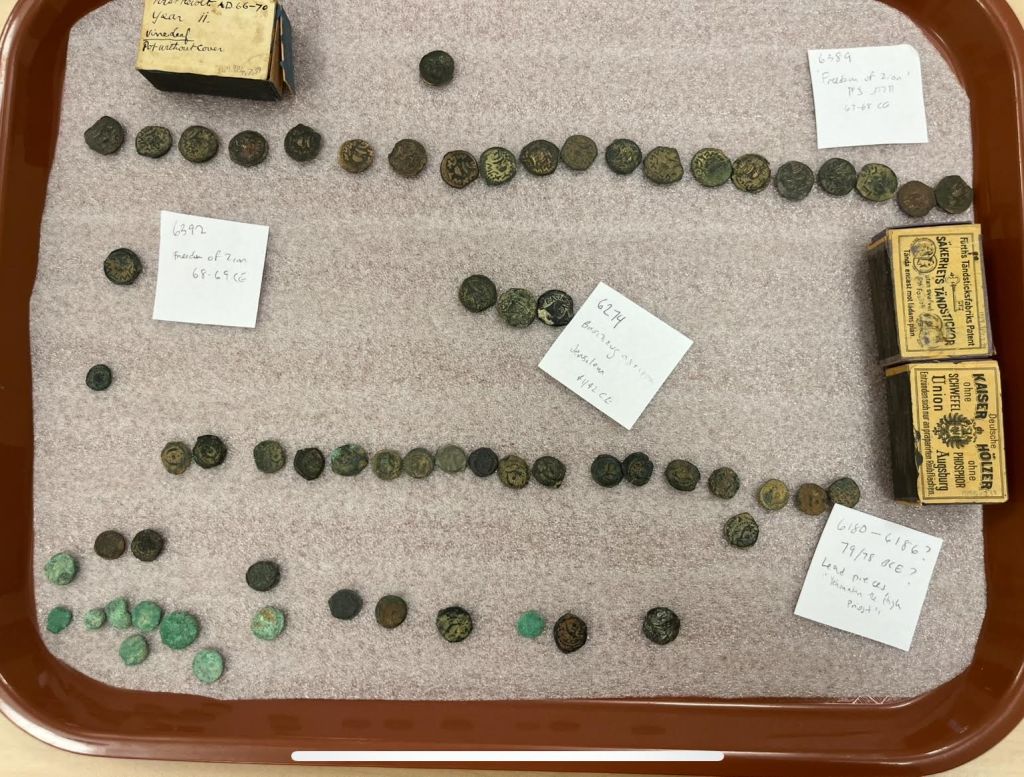
I first became involved in this research when I met Dr. Elena Dugan, who teaches Religion and Philosophy at Phillips Academy Andover, and was researching Jewish coins that dated back 2,000 years. These coins were struck for only four years, 66-70 CE, during which time, the Jewish population in modern-day Israel rebelled against their Roman occupiers. Long after their war against the Romans and their eventual defeat, their cry of freedom endured as inscriptions on these coins, surpassing even the Romans themselves. Dr. Dugan quite literally held the legacies of these men and women in her hands. How extraordinary is that!

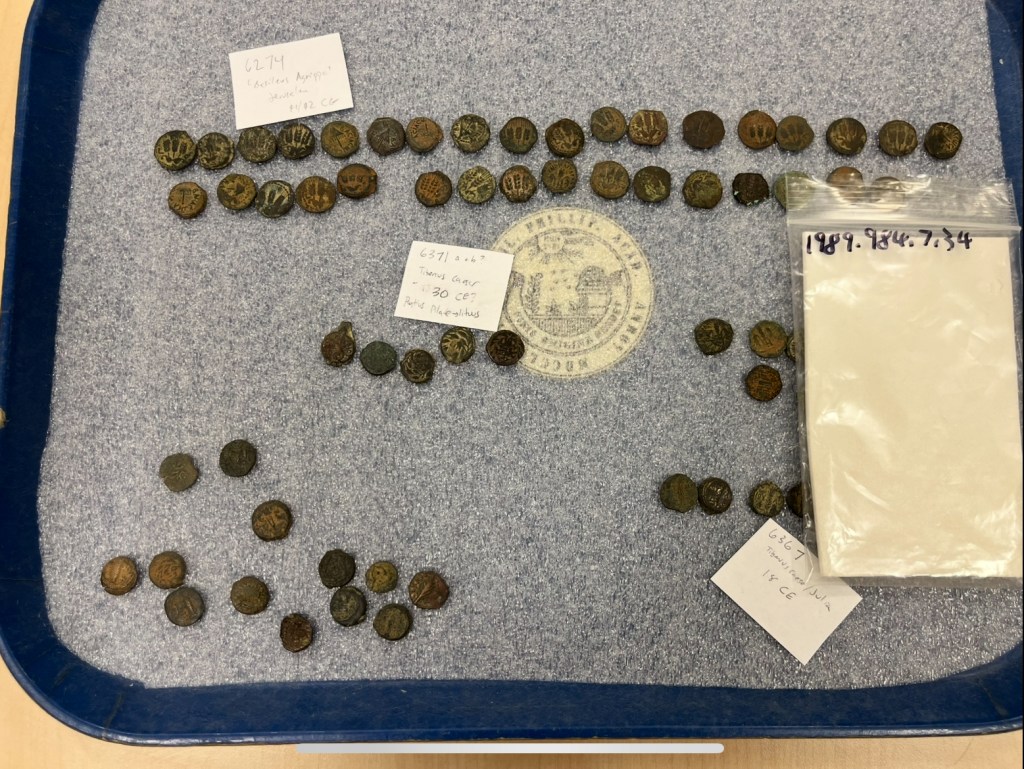
Top: Coins with inscriptions calling for the “Freedom of Zion,” along with coins minted during the times of King Herod Agrippa I and Yehonatan the High Priest. Bottom: Biblical coins of Pontius Pilate and Emperor Tiberius.

I would soon uncover such stories myself. Through Byzantine coins within the Peabody’s collections, I came to appreciate the story of Justinian, a Roman emperor bold enough to dream big. He dreamed of restoring the Roman Empire, which by his time was territorially less than half of its former glory. He dreamed of a reunified Mediterranean and the spread of Christianity. Fueled by determination, he led years of campaigns until the city of Rome was once again truly part of the empire.

But the dream didn’t last. Enemies in the East drew his attention away from Rome and the West, which was soon lost again. Any last hope was swept away by a devastating plague, which killed half of the Roman population (now every time I pick up one of Justinian’s coins, I feel an urge to wash my hands!). Rome’s wealth was drained, and Justinian lost his new territories as quickly as he gained them. In the end, he sadly died believing his dream had failed.

But it hadn’t. Though Justinian didn’t expand Rome’s borders, he redefined her identity. His image on coins, boldly facing his audience and clad in armor, was copied by every emperor who followed. He had inspired others to dream. Alongside his portrait appeared Christian symbols, marking Rome’s turn from her pagan past toward new ideals. Never again would she reach the heights Justinian had brought her to.

If all that remains of him and his dream are coins and a few lines in a textbook, then so be it. But let’s not forget them!

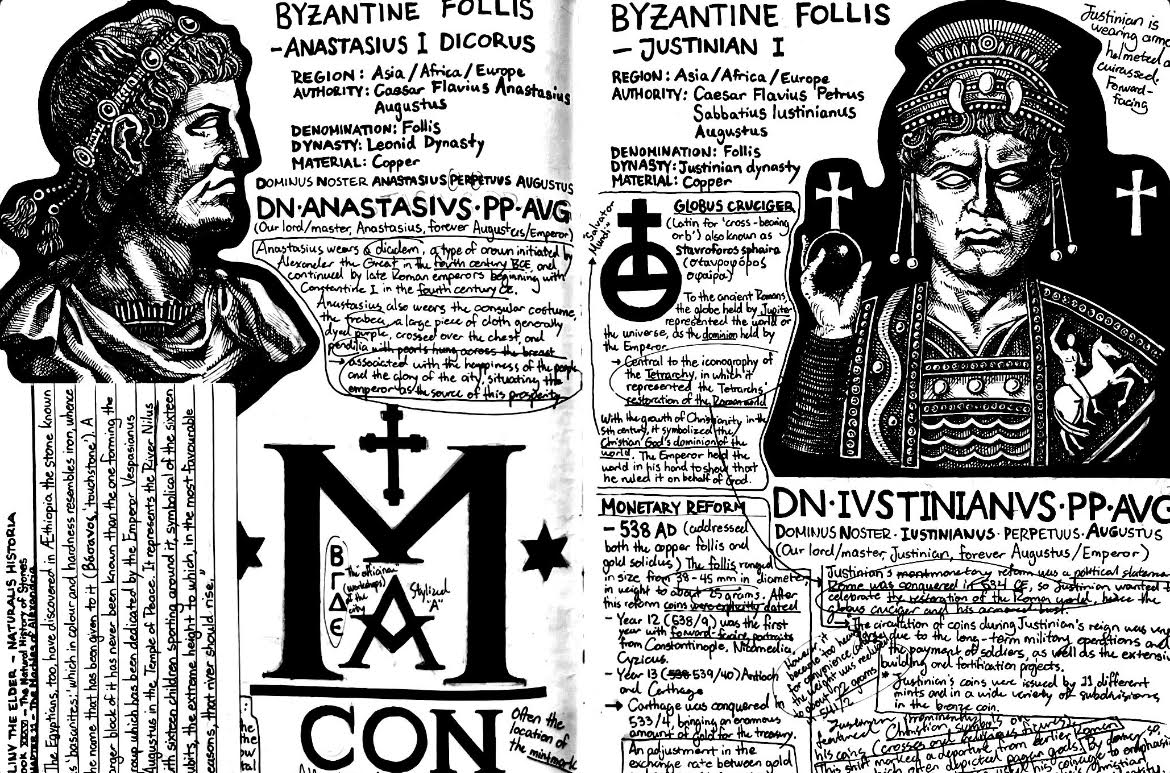
Left: Emperor Anastasius depicted in traditional imperial dress with a diadem and toga. Right: Depiction of Emperor Justinian facing the audience, fully in armor, and holding the globe and cross. While Anastasius followed strong traditions, Justinian was more than eager to distinguish himself.

This experience has strengthened my love for history. It has brought me closer to people in the distant past and their values. Their love of liberty. Their audacity to dream. These values stir a certain nostalgia in me, and suddenly, these people don’t feel so distant after all. Their worlds may have disappeared, but they are far from forgotten. It’s hard to believe that such an experience can come from objects that measure less than my pinky finger. But, after all, conveying messages is also a coin’s purpose, alongside economic ones. 

This journey has truly expanded my curiosity and built my understanding of history. I’m incredibly grateful to the Peabody Institute for not only allowing an inexperienced ninth grader to interact with these priceless artifacts but also for patiently teaching me the research process, providing the right tools, and encouraging me to share my story. 

What a highlight this has been as part of my school year! I’ll be sure to return on many more Wednesdays!

Mount Up, follow up.

Contributed by John Bergman-McCool

In January I wrote about a student volunteer project aimed at improving housing for moccasins that we steward at the Peabody (link). The purpose of the project is to give moccasins at the Peabody more space and internal support to maintain their shape. At the time of posting the blog, the project was in an initial design phase with students making practice mounts and internal supports. Since then the students and I worked through iterations of mounts and with feedback from our Curator of Collections, Marla Taylor, we arrived at the final design.

Top: evolution of mount design. Bottom: changes to the interior support pillow from a “v” toe to one that matches the shape of the moccasin.

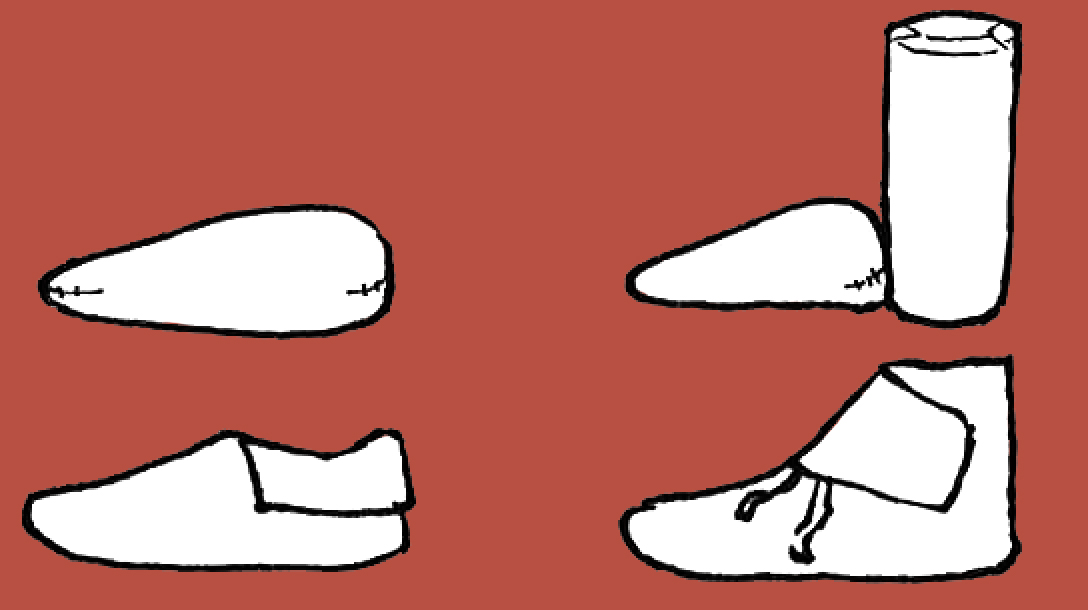
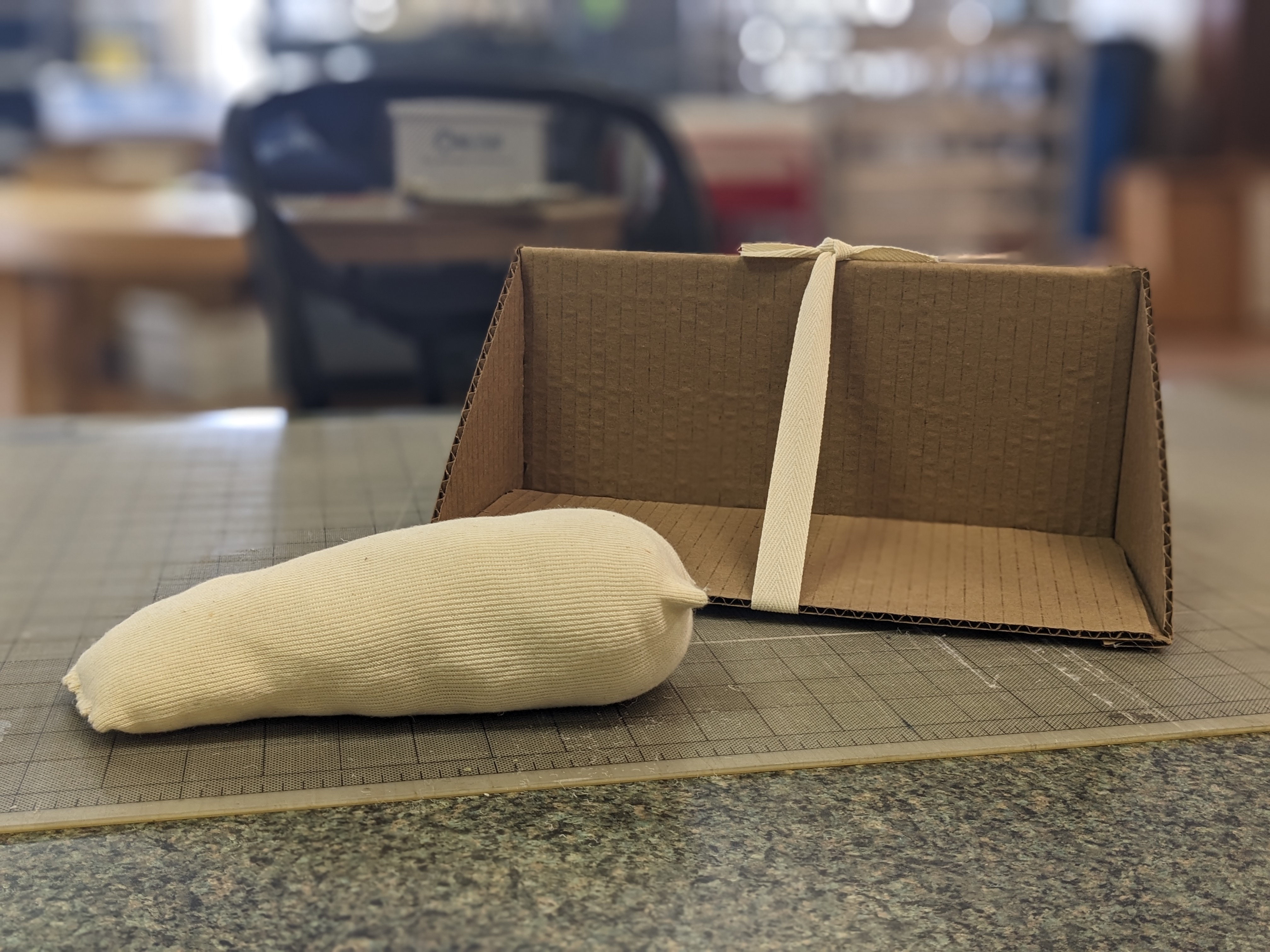
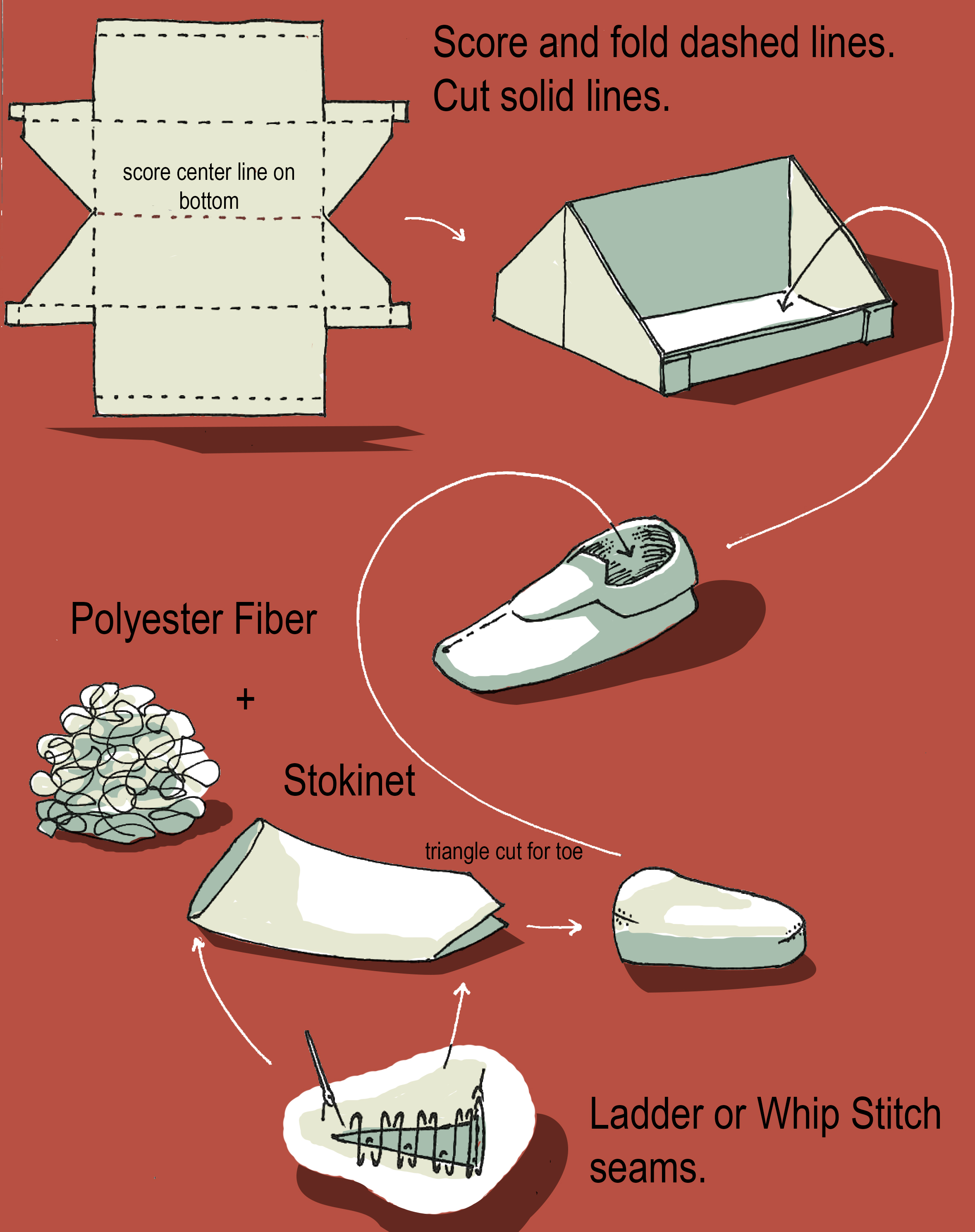
With the mount finalized we selected a pair of moccasins to rehouse and moved on to solve how to make interior mounts. We intended to make an internal support “pillow” of stockinet filled with polyester fiber. However, the height of the moccasins meant that the pillow alone couldn’t support the ankle area.

We consulted a great presentation at the 2017 Association of Tribal Archives, Libraries, and Museums (link) on making internal moccasin supports, for ideas on how to provide stability. We landed on making a support pillow for the toe area and a stiff tube for the heal and ankle area.

Internal supports for low and high moccasins

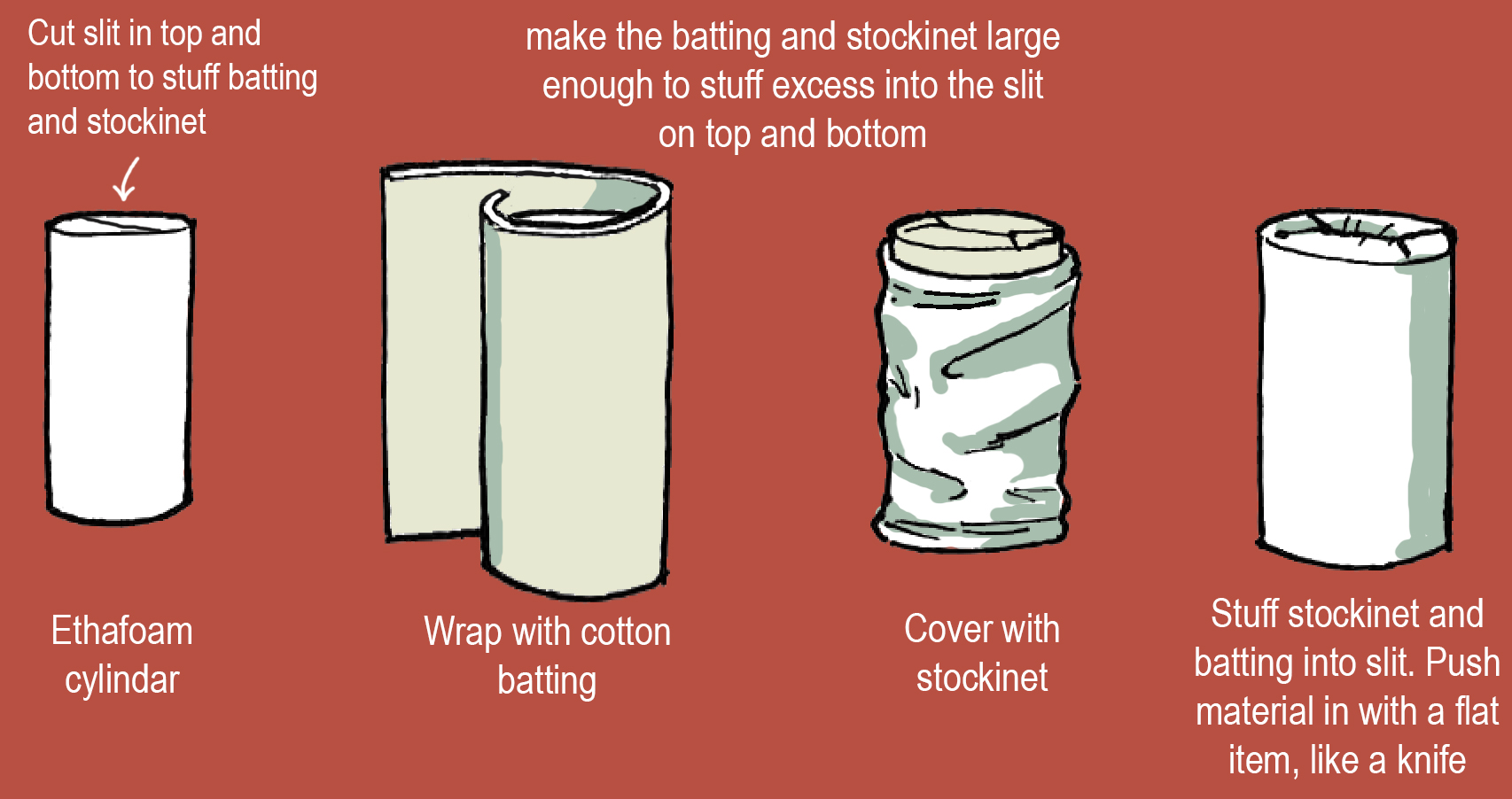
The stiff support is made from ethafoam planks cut into cylinders. The cylinders are wrapped with cotton batting to provide cushioning, then they are covered in stockinet. We measured the circumference of the area above one of the ankles and made sure the ethafoam, batting and stockinet added up to that dimension.

Steps for constructing a cushioned rigid support. It is important to use enough batting and stockinet to be able to push it into the slit.

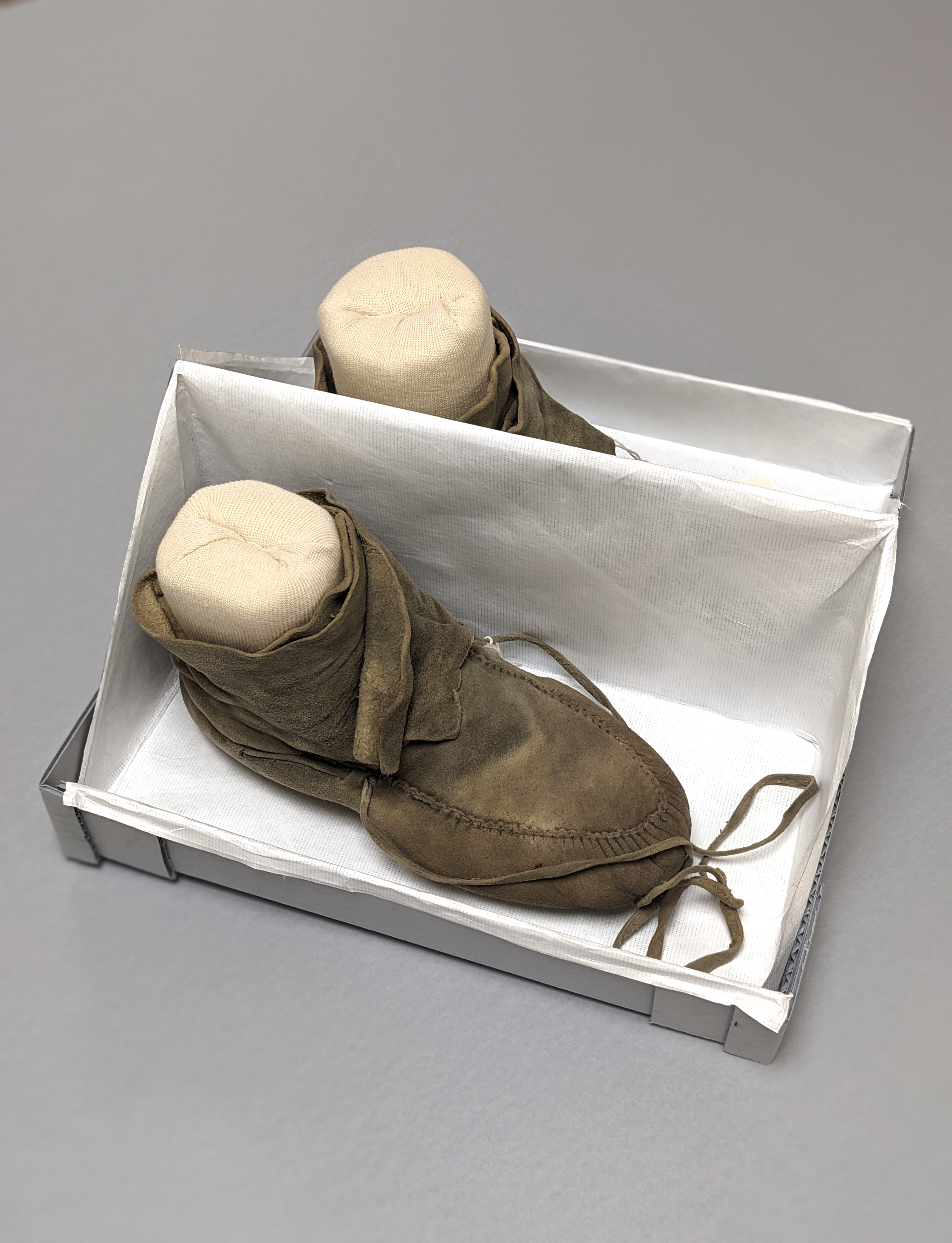
The final step involved covering the mount with soft Tyvek. With that, we have our first moccasin mount! Once students are back from spring break, we will continue our rehousing of moccasins.

Here is the final mount. The students did a great job!

Mount Up!

Contributed by John Bergman-McCool

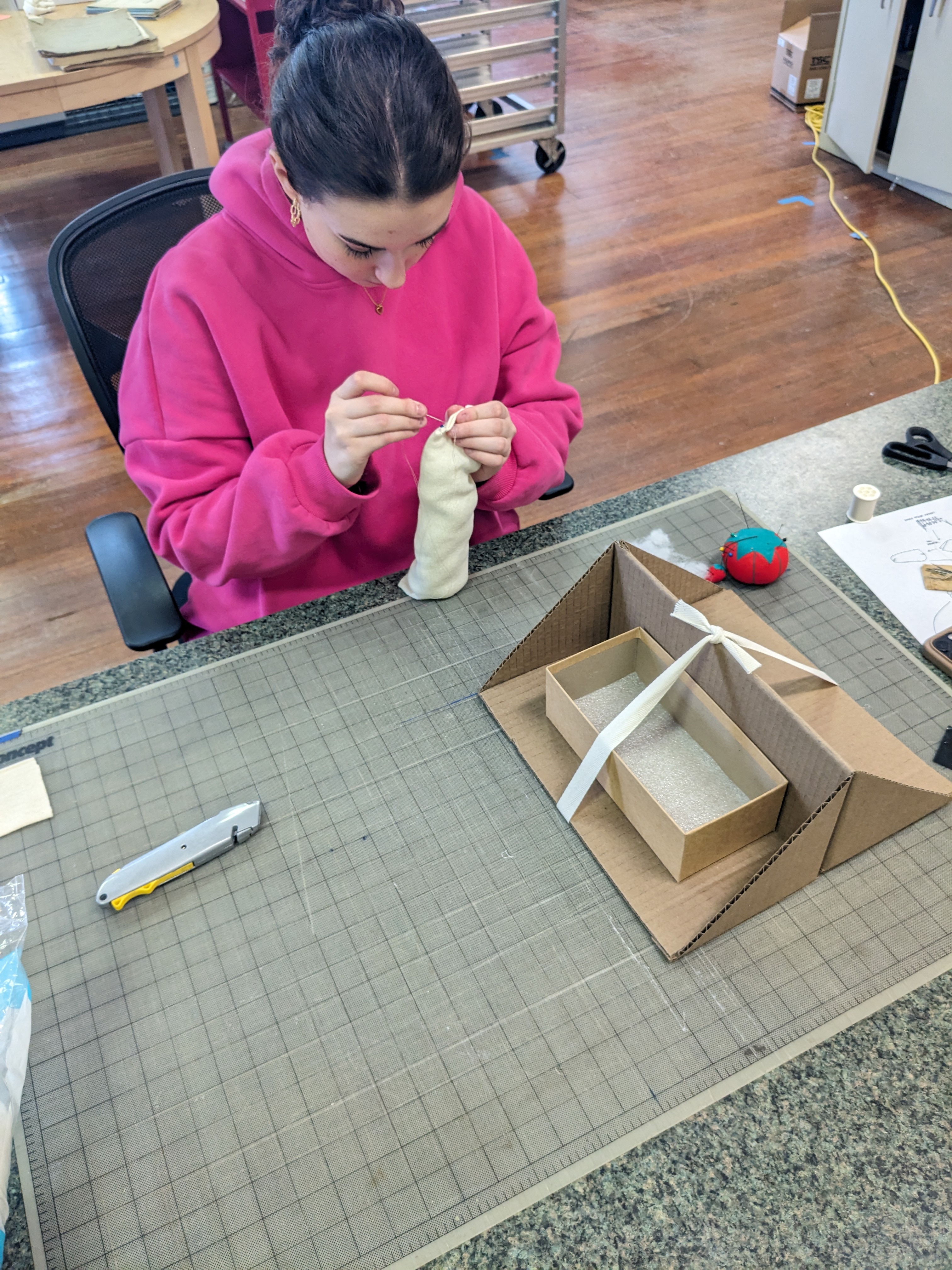
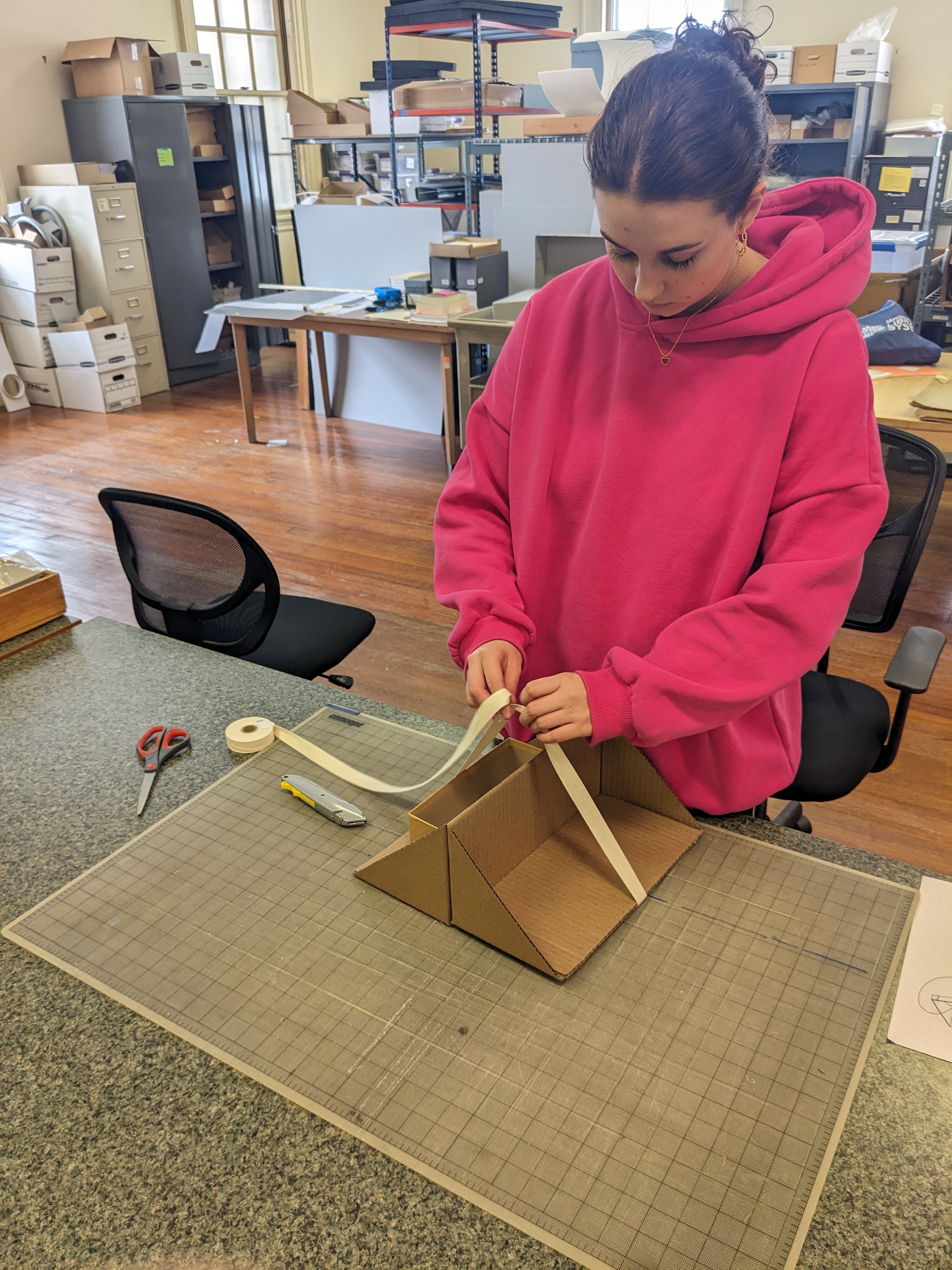
This term, the Peabody has a student volunteer workforce assisting us with making mounts for the moccasins that we care for. Currently, the moccasins are wrapped in tissue and housed in boxes. This housing situation is stable, but it can be improved. On the positive side, the boxes protect their contents from dust and debris. They are also stackable, which was a space-saving necessity prior to the renovation. Inside the boxes, the tissue prevents movement, but the moccasins are resting on their sides. In addition, some of the boxes are overfilled and need to be de-densified.

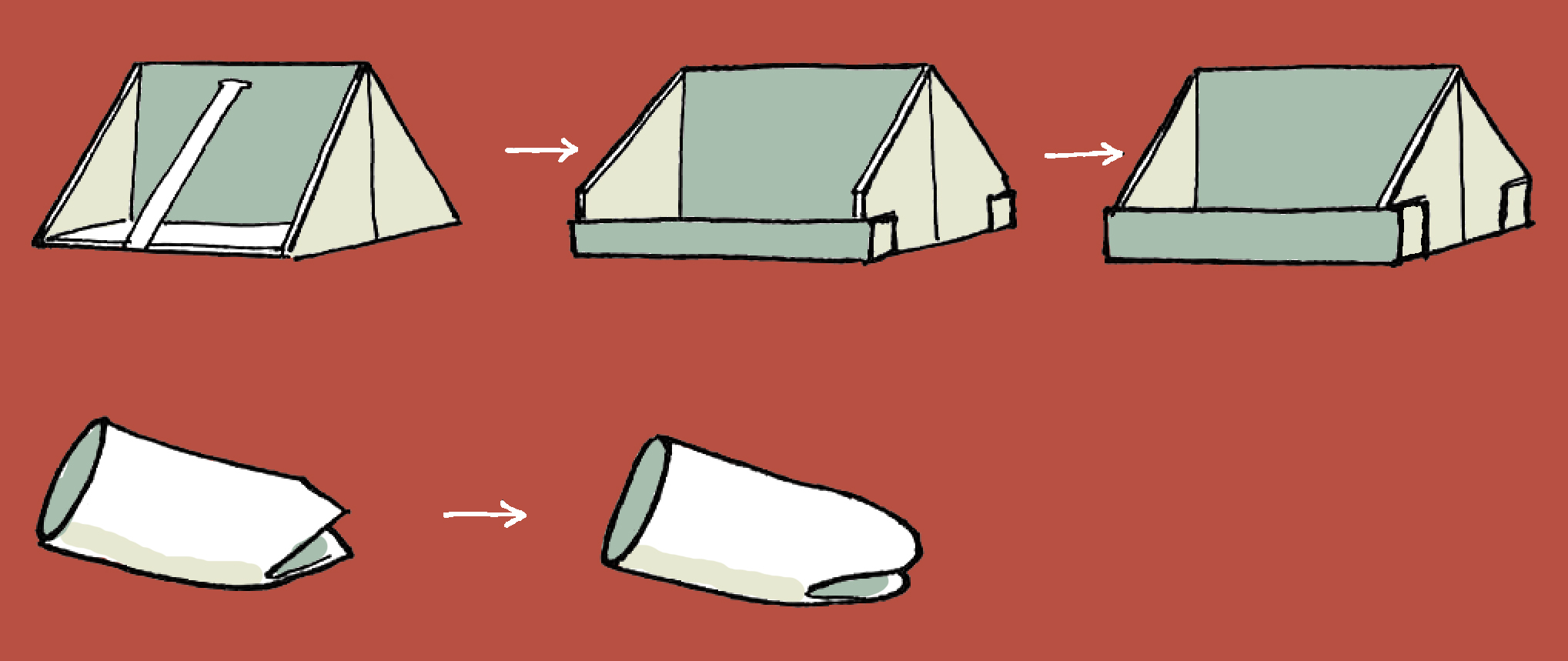
Workflow for Moccasin Mount.

Our goals for this project are two-fold. The first is to design and construct external supports for pairs of moccasins that prevent them from rolling on to their sides or off the mount.

The second goal is to create soft internal supports. Leather items, like moccasins, can be subject to flattening if they do not have additional support. Since the moccasins are laying on their sides in the boxes, the flattening can lead to additional deformation. If left unaddressed, flattening and deformation will cause permanent creasing which requires careful conservation to reverse.

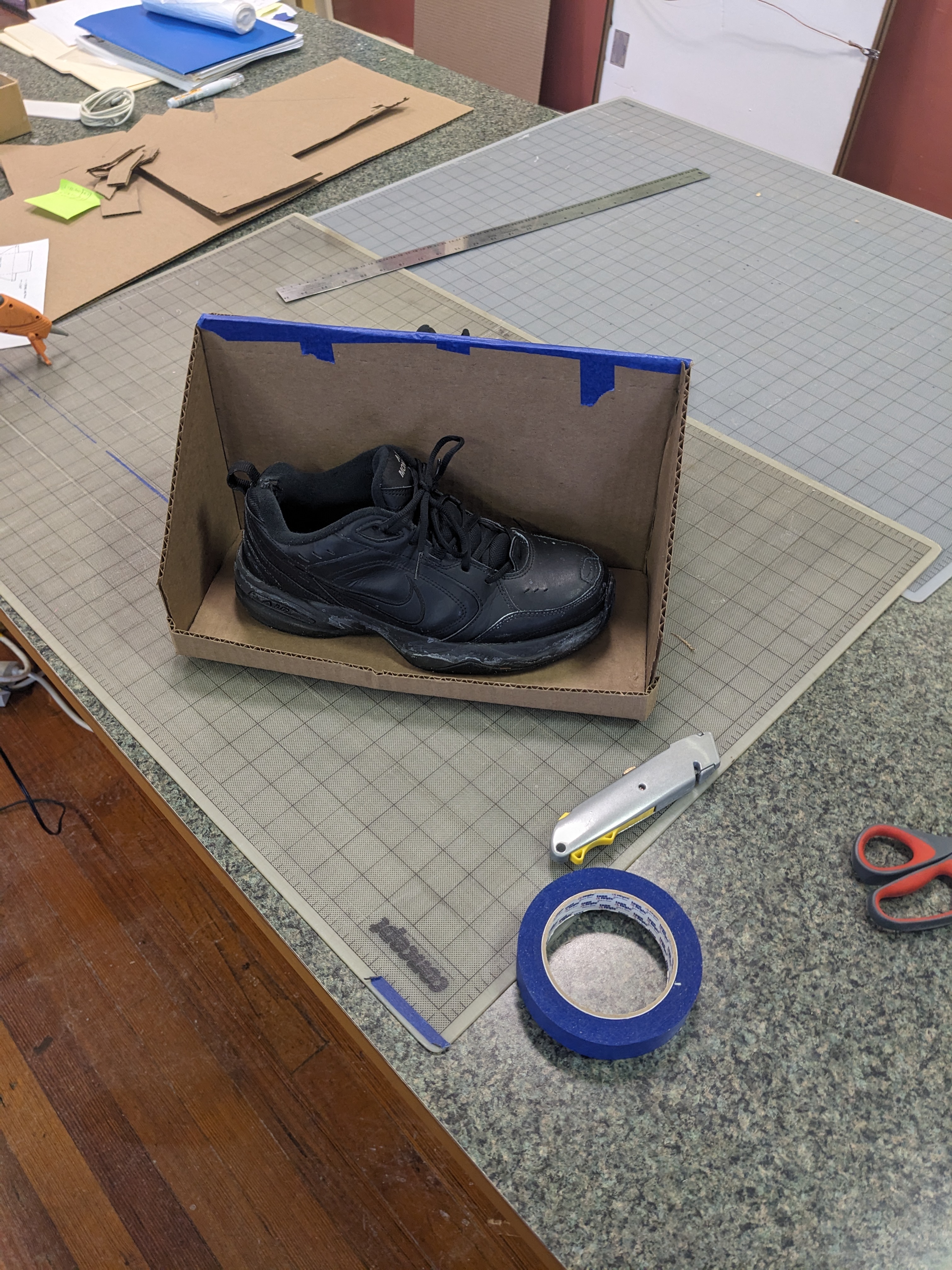
For the first step, the volunteers practiced making external mounts for their own footwear using cardboard. A few elements of the mount were altered after we saw the construction of the initial design. When the design is finalized, the volunteers will be using archival blue board covered in soft Tyvek fabric to house the moccasins.

The next step will be to practice making internal supports. These supports are essentially tubes constructed of stockinet filled with polyester fiber. The ends are stitched together to ensure the poly-fil doesn’t come out of the tube. Once fabricated, these will be inserted into the moccasin,  helping keep their shape and resist the flattening effect of gravity.

The volunteers are making great strides with their practice work, which means they will soon start making mounts for the moccasins. We will keep you posted with an update in the future.

If you are interested in seeing what kinds of mounts your institution can make use of, please see this pdf from History Nebraska. It was an excellent source of inspiration.

Organizing a Collection

Contributed by John Bergman-McCool

Two months ago, I wrote about the process of moving the collection in advance of renovations to our building’s basement and moving it back after renovations were complete. In this blog, I thought I could briefly cover how we organized the collections when we moved back in.

Before embarking on any large-scale collections-based project it is a good idea to know what comprises the collection. As noted in the moving blog, the seeds of the renovation started with the 2017-2021 inventory and rehousing project. Understanding the size, weight, and material of the collection was instrumental for us to plan where it would all go. It also helped us select the appropriate type of furniture to best suit the items’ individual storage needs.

Quantify the collection

We worked with a design team from the storage furniture company we contracted to help us make the most of the space we had available. The designers needed to know how much space was required to house the items we steward. Thinking of the future, the figures we gave them included room for growth. We hoped we wouldn’t be at capacity as soon as the renovation was completed.

The dimensions for items held in standard sized boxes was straightforward. We provided more detailed dimensions of the large items and boxes. Shelving for these items would need to be more strictly planned to accommodate individual item and box dimensions.

Capacity, layout and review

The building renovation contractors provided the storage furniture design team with precise room dimensions that included height restrictions required by lighting, HVAC, electrical, and fire suppression systems.

Based on our needs and the space available, the design team gave us a series of shelving layouts. We double checked the dimensions of shelving- length, depth and shelf heights- to ensure that the collections could fit. The design team and our collections team went through several drafts before we came to a finalized layout.

Organization

Once we knew the basement’s storage capacity, we set about creating an organizing principle for the collection. Collections in each space were organized by region. Unboxed items were organized first by type, followed by region. Space on fixed shelves was reserved for items at risk of rolling off mobile shelving.

Future

We’ve been living with the renovation for several months now and are very happy with the results. We have contemplated making a change to the organizational structure of the standard-sized archival boxes. In the future we may organize collections by site or collection area within their broader region. Understanding the scope of this project will require data manipulation to better understand. It may mean moving items between boxes, in which case we’d have to weigh the benefits against the resources required to see an organizational schema such as this carried out.

Never Whistle At Night: Indigenous Folklore (highlights from the Peabody Collection)

Contributed by Emma Lavoie

The change in season brings a time for storytelling and passing down traditions. The winter months are a prime time for sharing scary stories due to colder weather keeping people inside and gathered together.

In honor of Indigenous Peoples’ Day (October 14) and upcoming National Native American Heritage Month (November), we’re highlighting some folklore inspired by the Indigenous dark fiction anthology, Never Whistle at Night. This book is comprised of 26 short stories that explore aspects of Indigenous horror, beliefs, traditions, and folklore. These stories are told by a variety of Indigenous authors (see complete list below), edited by Shane Hawk (Cheyenne & Arapaho Tribes of Oklahoma) and Theodore C. Van Alst Jr. (Mackinac Bands of Chippewa and Ottawa Indians), and introduced by Stephen Graham Jones (Blackfeet Nation).

Contributing Authors

Norris Black (Haudenosaunee, Tyendinaga Mohawk Territory)

Amber Blaeser-Wardzala (White Earth Nation)

Phoenix Boudreau (Chochenyo)

Cherie Dimaline (Métis Nation of Ontario)

Carson Faust (Edisto Natchez-Kusso Tribe of South Carolina)

Kelli Jo Ford (Cherokee Nation of Oklahoma)

Kate Hart (Chickasaw/Choctaw in Arkansas)

Shane Hawk (Cheyenne & Arapaho Tribes of Oklahoma)

Brandon Hobson (Cherokee Nation Tribe of Oklahoma)

Darcie Little Badger (Lipan Apache Tribe of Texas)

Conley Lyons (Comanche)

Nick Medina (Tunica-Biloxi Tribe of Louisiana)

Tiffany Morris (Mi’kmaw)

Tommy Orange (Cheyenne and Arapaho Tribes of Oklahoma)

Mona Susan Power (Standing Rock Sioux Tribe)

Marcie R. Rendon (White Earth Band of the Minnesota Chippewa Tribe)

Waubgeshig Rice (Wasauksing First Nation)

Rebecca Roanhorse (Navajo Nation)

Andrea L. Rogers (Cherokee Nation)

Morgan Talty (Penobscot Indian Nation)

D.H. Trujillo (Pueblo)

Theodore C. Van Alst Jr. (Mackinac Bands of Chippewa and Ottawa Indians)

Richard Van Camp (Dene Nation)

David Heska Wanbli Weiden (Lakota)

Royce Young Wolf (Hiraacá, Nu’eta, and Sosore, ancestral Apsáalooke and Nʉmʉnʉʉ)

Mathilda Zeller (Inuit)

The title of the anthology refers to a belief common in many Indigenous cultures that whistling at night can attract malevolent entities. The act of night whistling is forbidden by many Native American cultures due to a shape-shifting entity, known as a “Skinwalker” or “Stekini” that responds to the call, causing harm to those who encounter it.

Skinwalker – Image courtesy of DoubleOurEfforts/reddit

Native cultures use storytelling to pass down knowledge and history, including folklore. Scary stories often carry deeper meanings, serving as lessons and warnings. Some of my favorite stories from this book were: Kushtuka, Quantum, Snakes are Born in the Dark, Before I Go, and Dead Owls.

Several stories in the book share a common subject – the owl. Interpretations of owls can be found across different Native American tribes, with some viewing owls more negatively than others. There are several items in the Peabody collection that highlight the owl form, their meanings varying significantly between different Indigenous cultures and locations. Here are just a few for you to explore!

Image courtesy of © Megan Lorenz/Dreamstime.com

Owls are often associated with death and the spirit world, seen as messengers or harbingers of bad luck reflected in their nocturnal habits. Seeing an owl, particularly during the day can be a sign of death or misfortune. Some tribes consider owls as spirits of the deceased or that they might not be real birds at all, but shapeshifters. The sound of an owl’s hoot is seen as a call to the spirit world or a way to connect with ancestors.
Owl Effigy (2018.2.1266) – Fragment of an owl effigy from the Valley of Mexico. Warren K. Moorehead compared this item to clay effigies from the Etowah village site in his 1932 book Etowah Papers: Exploration of the Etowah Site in Georgia.

Owl Effigy (2018.2.1266), Peabody Collections

Folklore of the Valley of Mexico believe in a witch known as “La Lechuza” who shapeshifts in the form of an owl that preys on people who are disobedient, unbaptized, or who harm others. Check out this episode on La Lechuza from the podcast, History Uncovered.

Owl Effigy Slingshot (97.1.53) – From the Ixil Maya community in Chajul, El Quiché, Guatemala. Used by men and boys to hunt birds, though it is common to hunt with a blowgun.

Owl Effigy Slingshot (97.1.53), Peabody Collections

Other tribal beliefs revere owls as symbols of wisdom and intuition, as well as carriers of ancient knowledge and protection.

Ceramic Owl Figurine (2017.6.1) – Ceramic piece by Maxine Toya from the Pueblo of Jemez, New Mexico. In Pueblo culture, owls are seen as protectors. The ceramic owl design is built by stacking and smoothing hand coils of clay. The piece is both carved and painted, the feathers on the front being carved into the clay. Painted designs are intricate using symbols of rain, clouds, and feathers. These designs are all matte and painted with clay slips with only the eyes being polished.

Ceramic Owl Figurine (2017.6.1), Peabody Collections

Maxine Toya is well known for her figurative pottery (the first piece of pottery Maxine created was an owl!) Maxine is one of several pottery artists from the Pueblo of Jemez that visit Phillips Academy campus each spring to work with students in ceramic classes. You can read more about these visits here and here!

Ceramic Owl Effigy Jar (90.4.2) – Globular body in black on white design with vessel opening located at owl beak. Owl facial features at neck, wings at sides and tail at back. The globular shape is the most recognizable characteristic of pottery from Cochiti Pueblo, New Mexico.

Ceramic Owl Effigy Jar (90.4.2), Peabody Collections

Owls are featured in Cochiti Pueblo pottery, often associated with the god of death and spirit of fertility, Skeleton Man.

Exciting News! – Never Whistle at Night, Part II: Back for Blood is currently accepting submissions from emerging Indigenous writers. This is the second book in the Never Whistle at Night series.

Moving a collection

Contributed by John Bergman-McCool

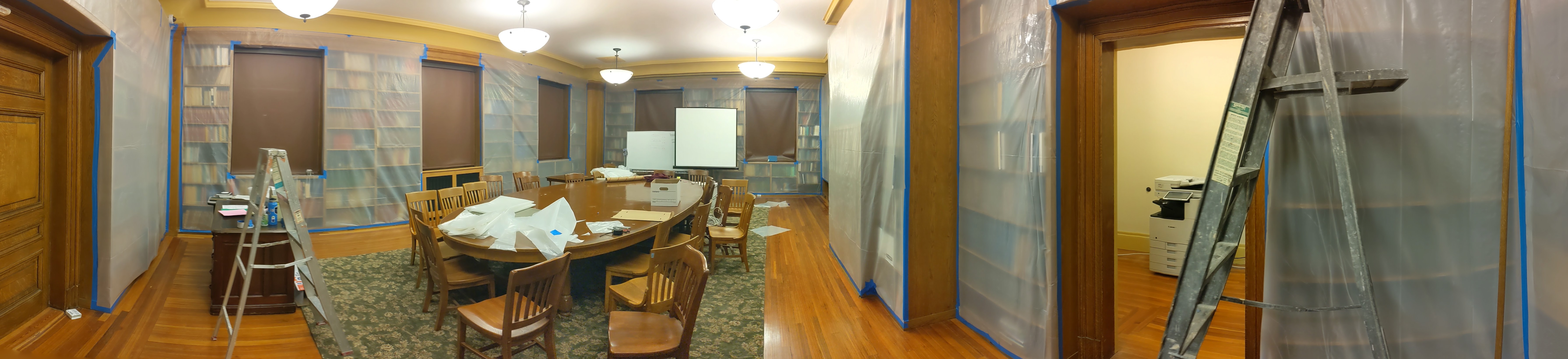
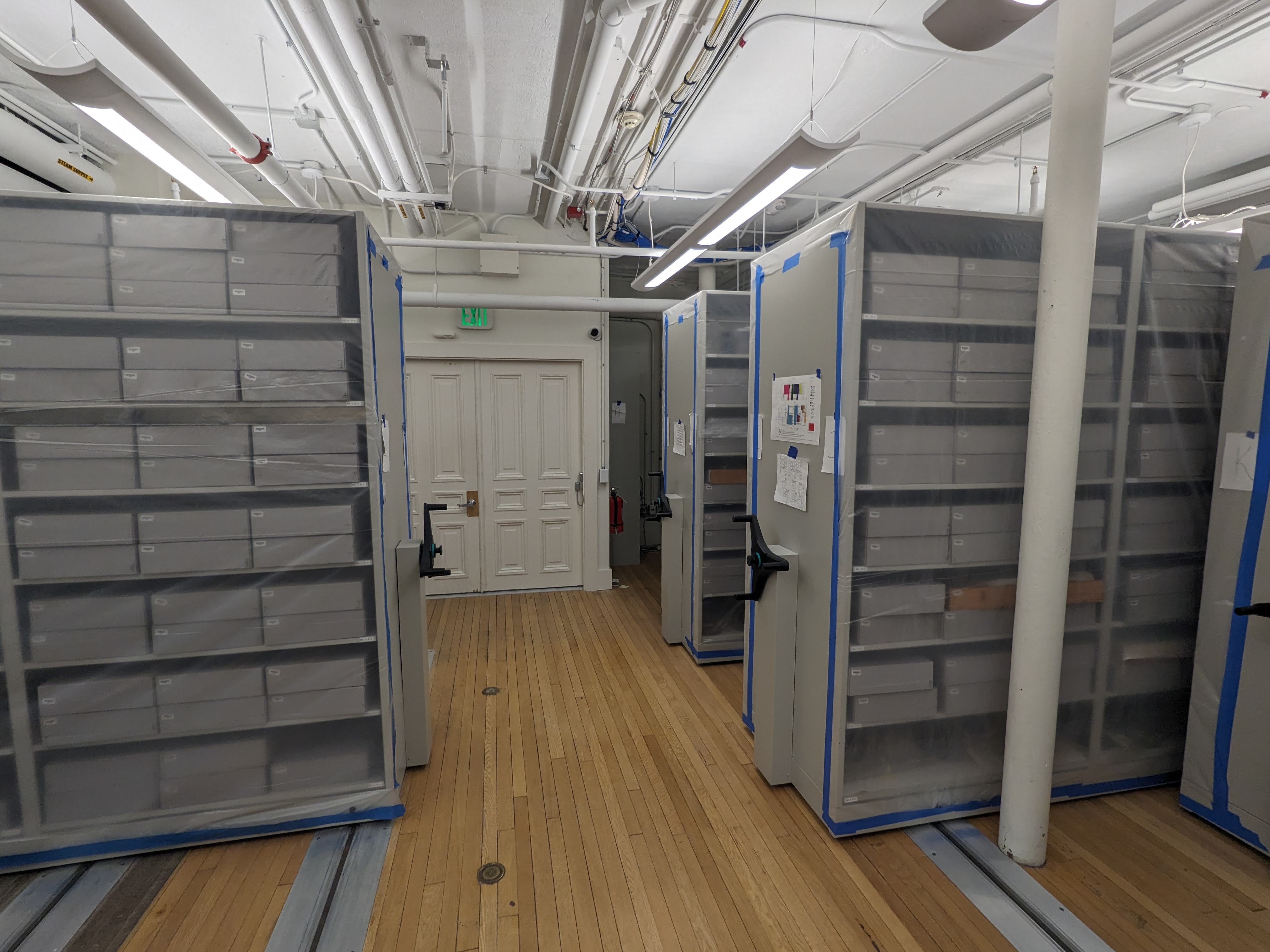
In January 2024 renovations to our collection housing were completed, finalizing a process that started in March 2023. To accommodate the demolition of existing shelving and installation of new condensing metal shelving, the collection was moved out of the basement in early 2023. With the project completed and several months of living with the move behind us, this seems like a good time for a brief recap. Perhaps some of our planning can help other institutions that have a collection move on the horizon.

During initial planning for the renovation, we faced two scenarios for moving the collection. The first was to move the collection offsite. The second, involved keeping the collection onsite within portions of the building that were not renovated. We needed to make viable plans for both options while decisions about construction phases and timelines were being made.

We identified several challenges to moving the collection offsite. Some of the largest hurdles included the high cost of offsite storage, the massive time commitment required for packing the collection for an offsite move and conducting a post-move inventory and condition reporting of the collection. A second round of inventory and condition reporting would need to be done after the collection was moved back into the building.

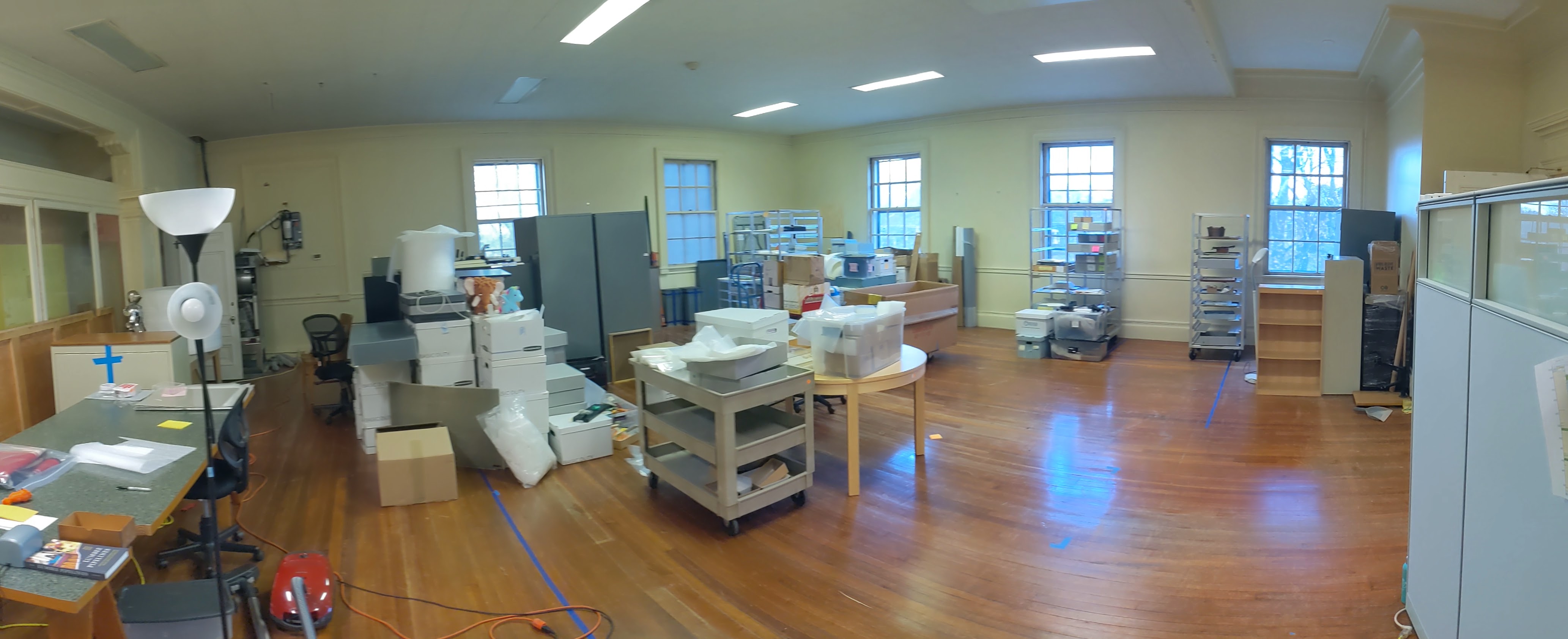
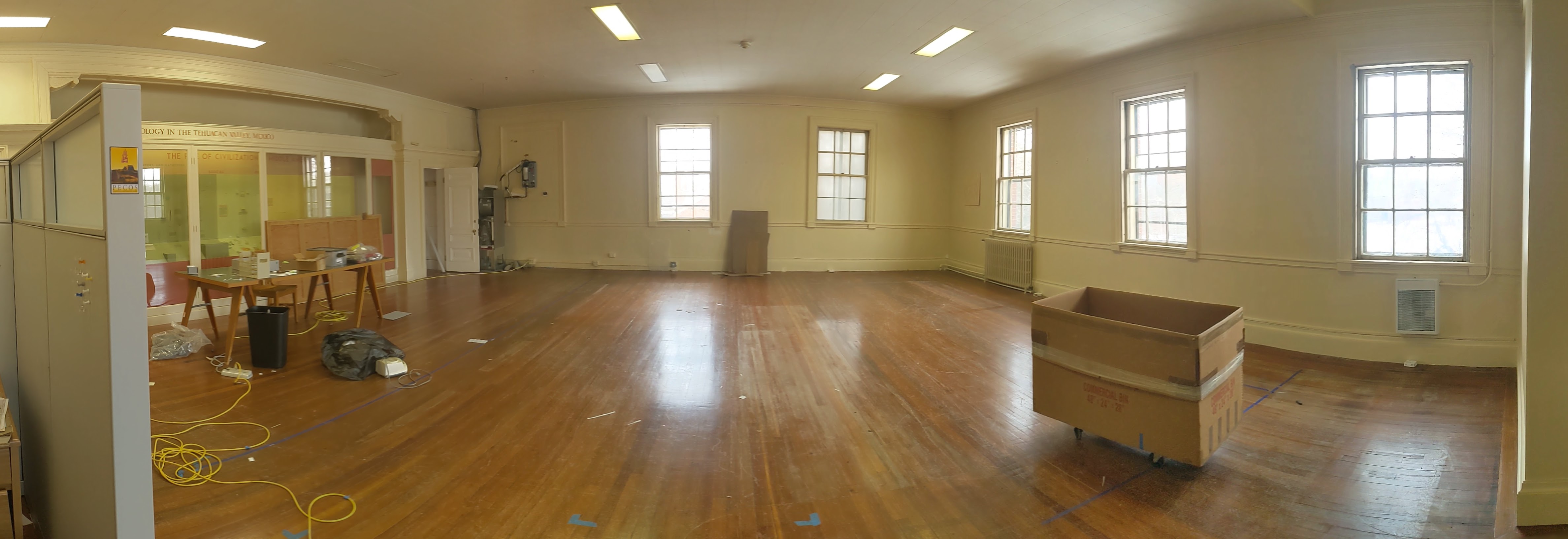
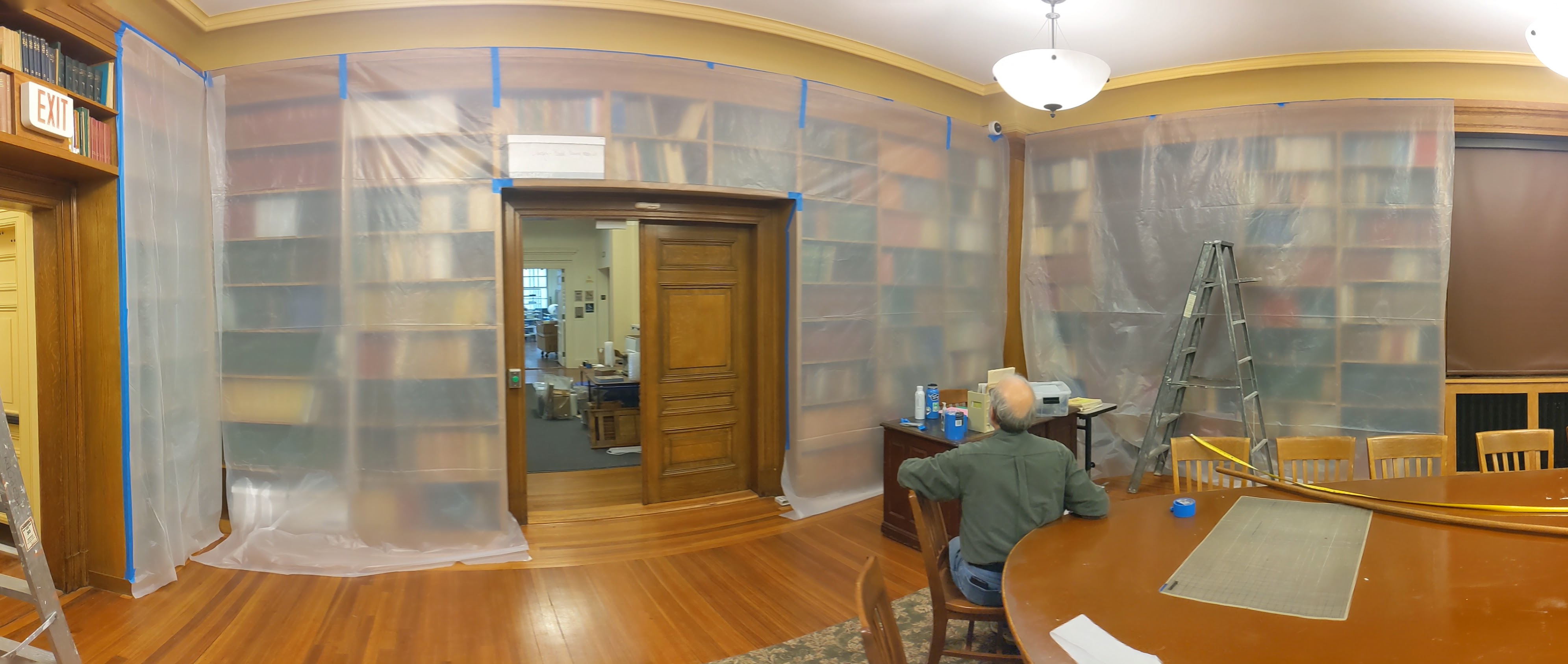
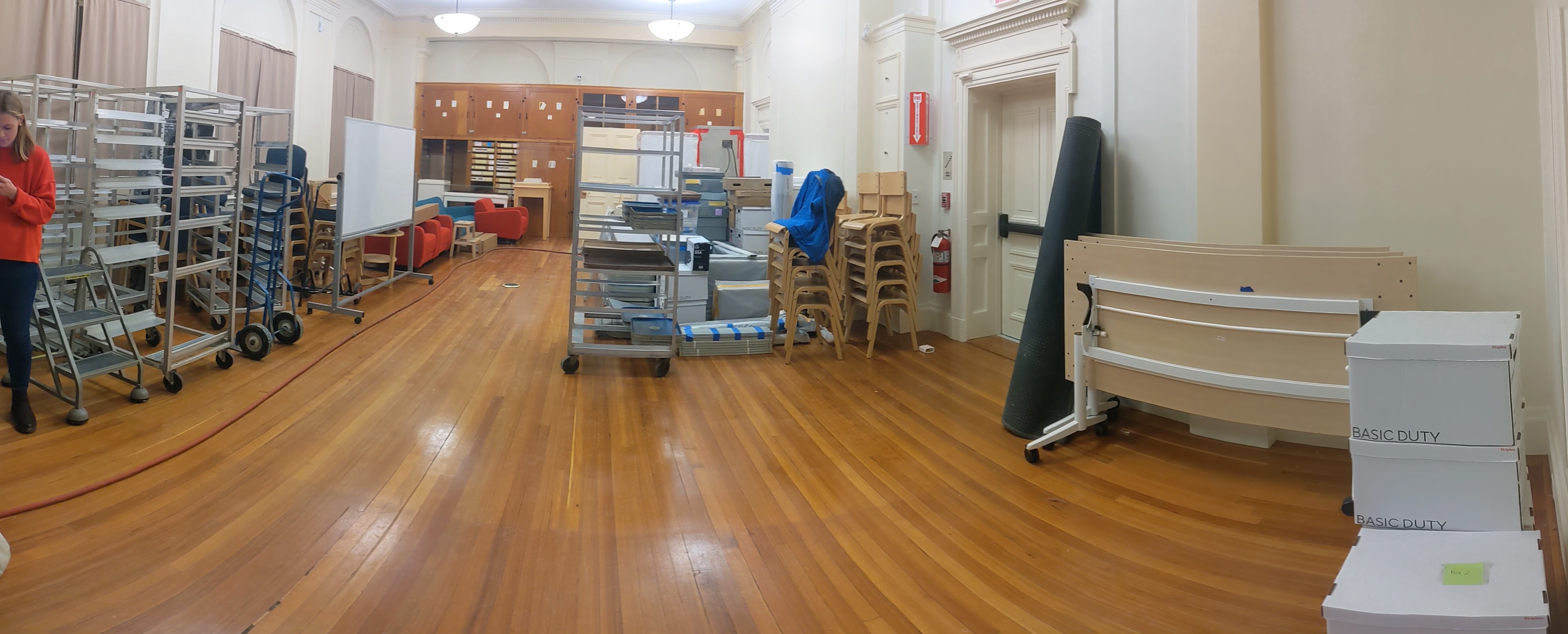
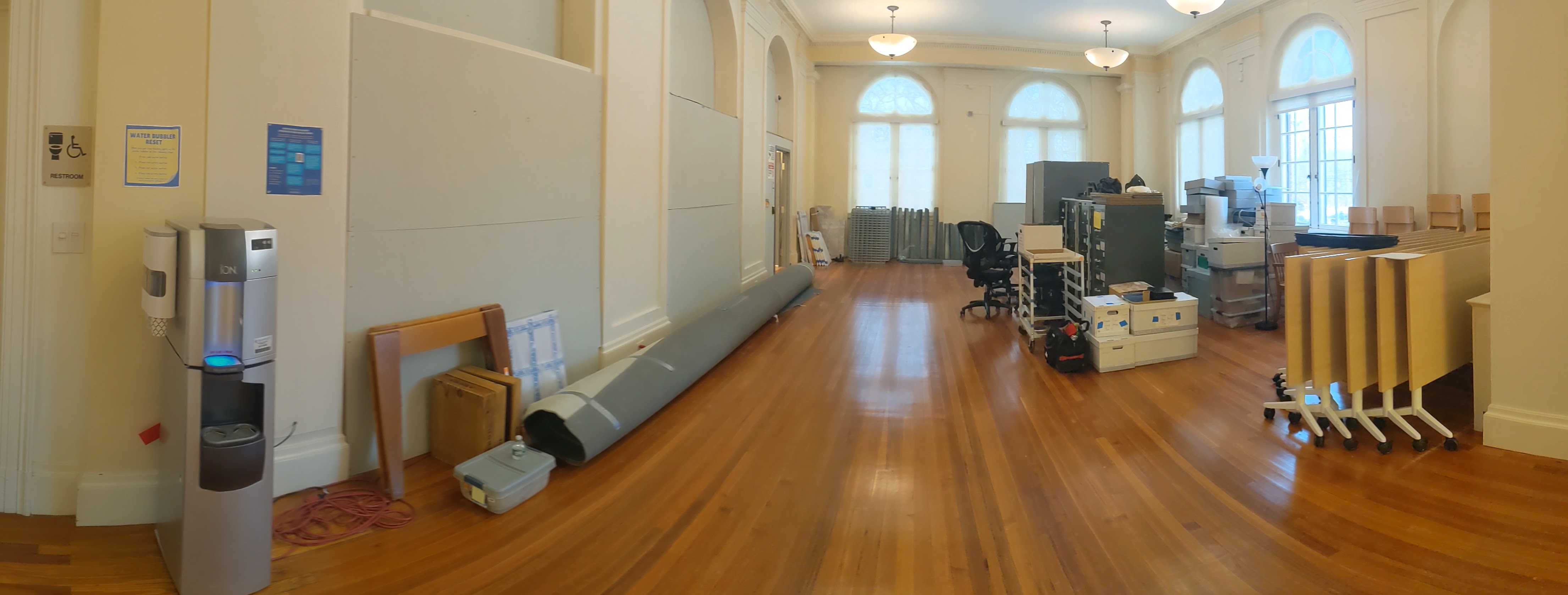
Keeping the collection onsite raised other concerns. Temporary housing would need to be big enough to house the collection. We would only be allowed in the building during designated windows when it was safe for us to enter, therefore the temporary housing area would need to be locked and monitored by cameras. The space would need to be environmentally controlled to the best of our ability. We also contemplated whether construction could lead to a catastrophic accident that would damage the building and collection.

The benefits and challenges of each scenario were taken into consideration within the larger framework of the construction plan. Ultimately, it was decided to keep the collection onsite in temporary housing. Although it came with some complications, it resulted in huge savings and a greater degree of control over the moving process when compared to moving the collection off-site.

Inventory and rehouse

The move started with an inventory and rehousing project that was carried out between 2017 and 2021. The project has been covered in previous blog posts. To summarize, Peabody staff conducted a 100% inventory of collections housed in aging wooden drawers in our basement. The inventory collected basic information; a description, count and provenience. Once inventoried, the items were rehoused in archival boxes with lids. While the wooden storage bays didn’t allow for stacking, future storage could take advantage of the ability to stack boxes.
The archival boxes were about half the size of the wooden drawers. Boxes were therefore much lighter and in most cases two boxes existed where previously there was one drawer.

Barcode and Weigh

During the planning onsite and offsite moves, we identified the first floor as the likeliest location for temporary housing if we were moving the collection inside the building. We knew the collection was heavy, but in the basement the collective weight of the collection was never a concern. Now, the ability of the building to hold the weight of the collection boxes was an important question that needed to be answered.

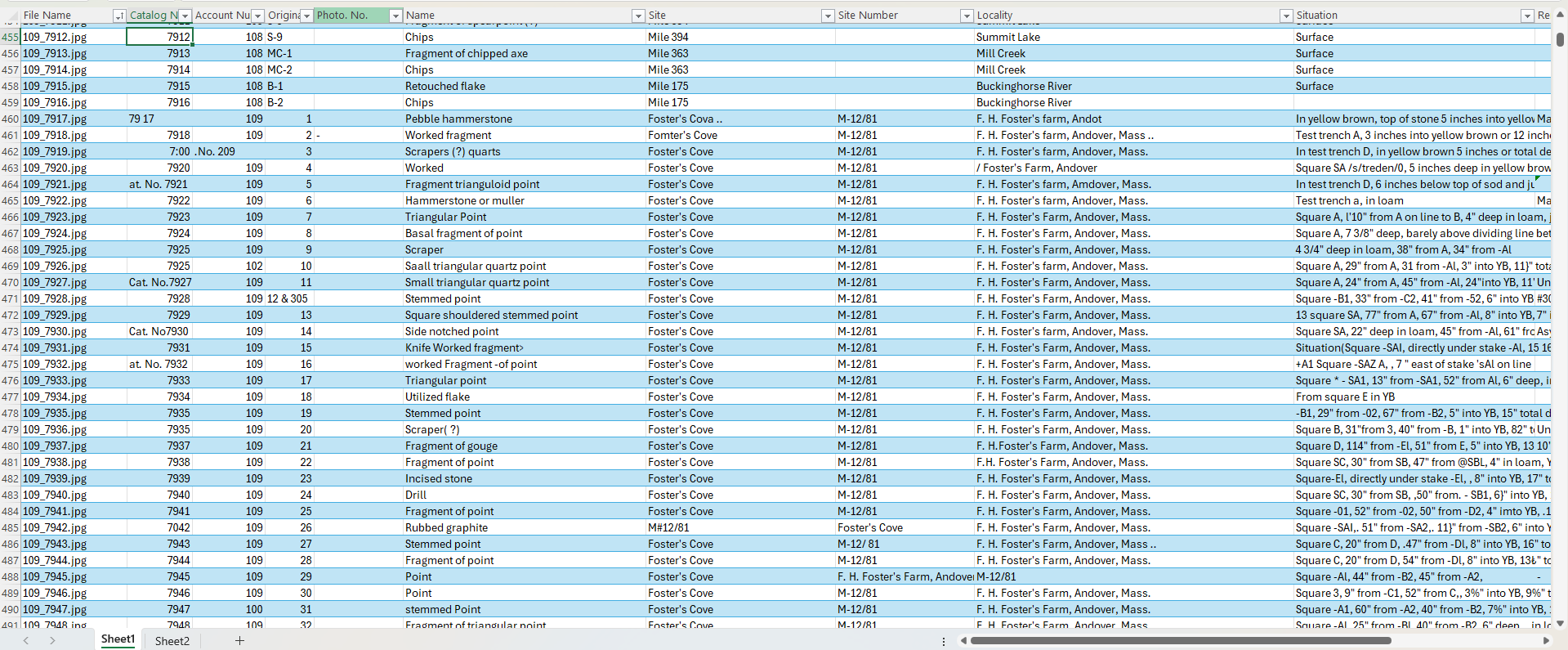
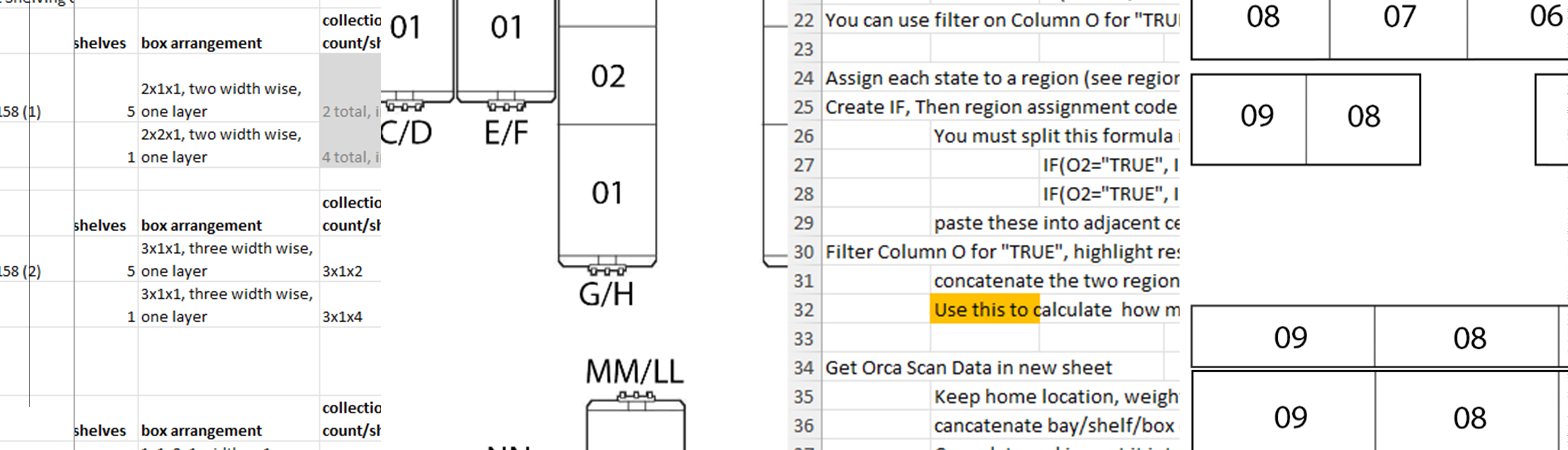
Equally important was how we would maintain physical control (i.e. knowing where everything in the collection is) over the collection boxes and their contents. This portion of the collection comprises nearly 3,000 boxes containing roughly 500,000 items. It was necessary to come up with an efficient way of tracking each item’s movement. Updating records at the item level within our existing database would take an incredible amount of time. Our database at the time supported barcodes at the item level, a process that would be no different than updating each item individually. We decided to assign barcodes to each box and track the box locations using a separate barcode tracking program (Orca Scan).

Over the summer of 2020, with the help of two great interns the collection was weighed and barcoded. The barcode data included the original location within the wooden storage (home location), weight, how many spaces the box would occupy in temporary housing, and any additional notes.

Results

Armed with the weight data, we were able to organize the collection so that the weight was equally distributed over the entirety of the first floor. This information also helped us organize the collection in the newly renovated basement. Now, heavy boxes are located on shelves at waist height, making for safer lifting. Lighter boxes are housed on higher and lower shelves.

Tracking box locations with barcodes worked well for the most part and was a net positive over tracking individual item locations. A 5% inventory of barcodes after the move resulted in no errors. However, errors have been found in the system since we moved the collection back into the basement. These have resulted from location errors entered into the database, as well as errors and inconsistencies entered into Orca Scan. I would recommend checking for inconsistencies in the original location data before making the move.

Using the barcode program in addition to the database to find items on the fly was time consuming, but not unreasonable. Tracking movement has been more challenging. Some movements were simple, like moving a box from one location to another. Other moves involved unpacking dense boxes and giving the removed items their own barcodes or emptying an entire box, deleting the barcode, and giving each unpacked item a new barcode. Processing so much data has required the use of formulas in Excel, and it is hard to find and analyze errors when looking at 115,000 item records.

That wraps up this brief summary of our experience moving the collection. It was the culmination of years of planning and months of preparing and implementing. I’m happy to report that 600,000 items moved one or more times up and down one or two flights of stairs resulted in nothing being damaged. Hopefully some of the issues we encountered can help inform other institutions researching a move.