Contributed by Lainie Schultz
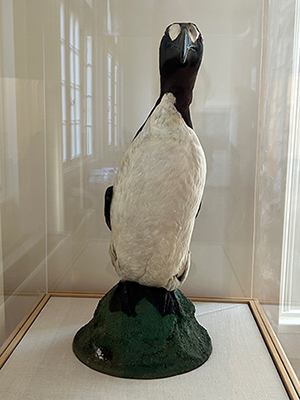
I started at the Peabody Institute right at the midpoint of its building renovations. Phase 1 had just completed; phase 2 was just gearing up. It was a false sort of calm, when operations largely appeared stable, especially for someone new who didn’t know any better. On the rare moments, though, when I wasn’t too busy trying to figure out what on earth was a Phillips Academy, I would look up and notice the gaps in the norm. Like the empty display case standing opposite my office door, inside what is now my primary teaching space. I was told its occupant had been temporarily moved to the Addison Gallery of American Art until the chaos of construction was fully completed, and occasionally it would occur to me, “Oh, yeah. Something belongs in there.” Occasionally, too, it would occur to me, “Dude is going to be looking right at me.” I really hoped that we were going to be friends, because no one needs an officemate giving them the stink eye…
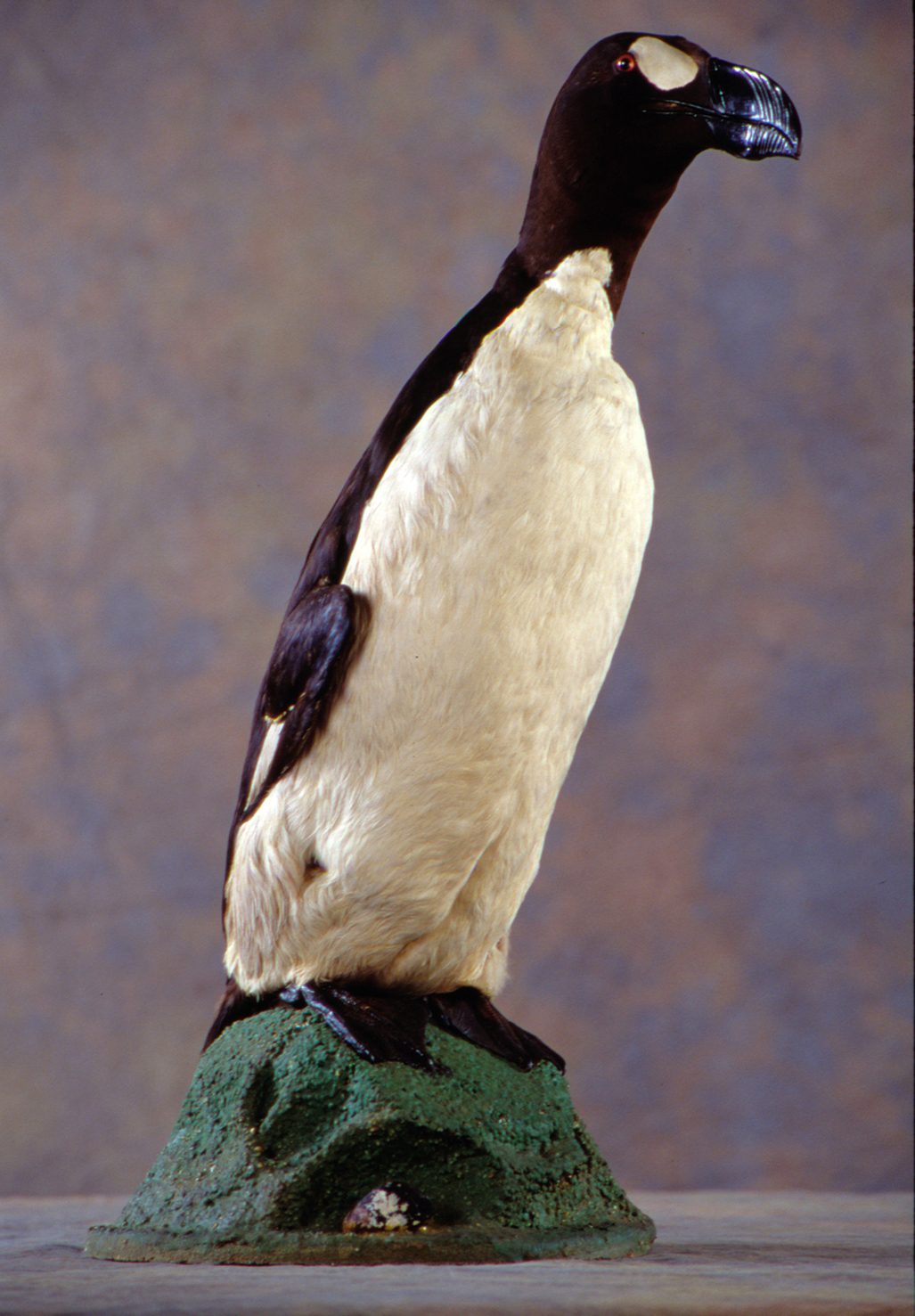
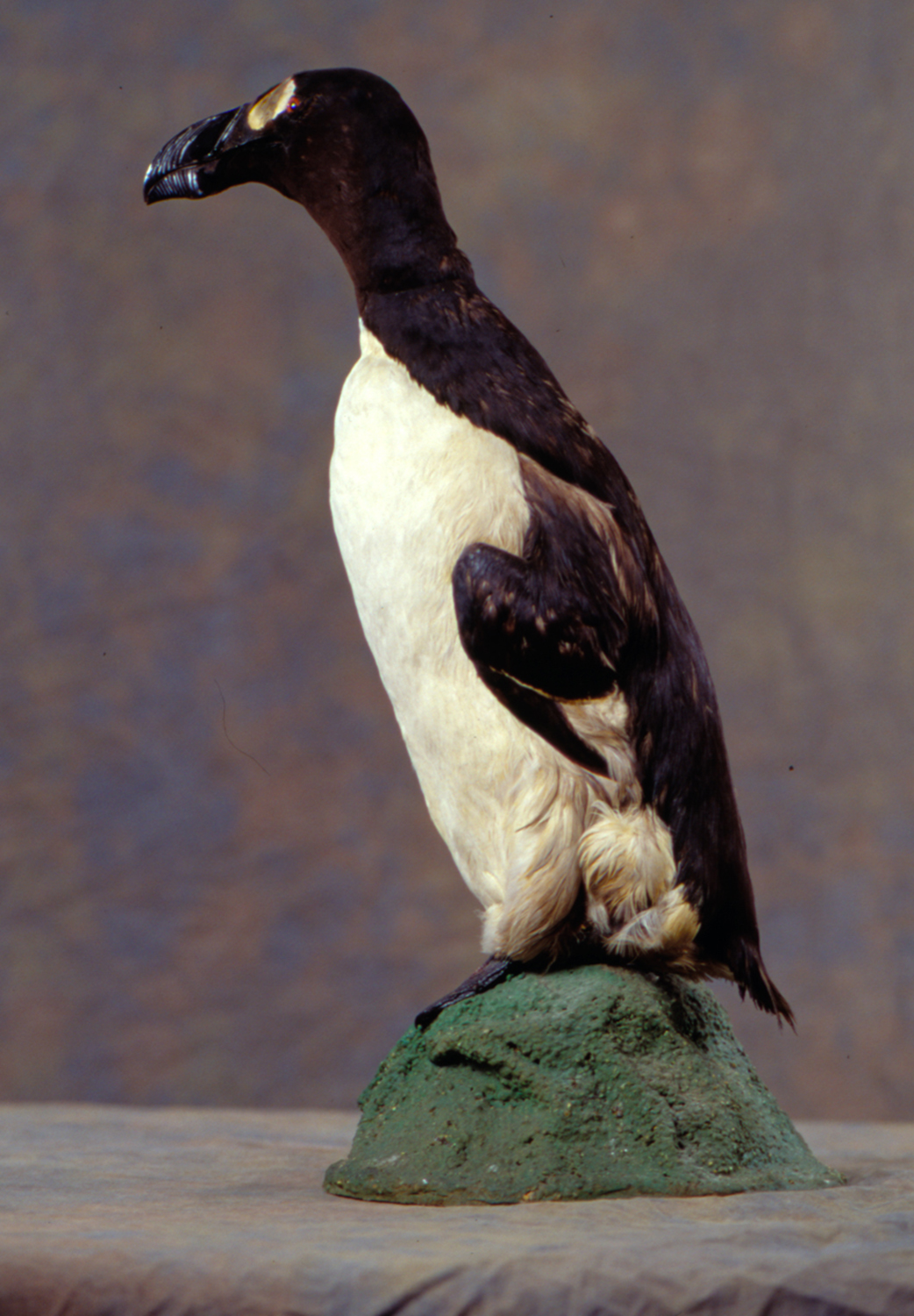
Our Addison colleagues recently returned the occupant of our exhibit case, and I am relieved to confirm it makes a lovely companion. It has a “hey, girl” swagger that says it’s ready to hang, with a Boston attitude that says it’s cool if I don’t say hi every time I walk by.
It has also proven to be an excellent co-instructor. It inspires more interest and questions from students than anything I have ever actually prepared for them (I am not yet jealous. Give me time). So, for all the students visiting my classroom, and for all my would-be visitors, here are the answers to your three most frequently asked questions:
1. Yes, it is real.
2. It is an auk, and its name is Champ.
Great Auks were flightless birds that lived in large colonies along the shores of the north Atlantic, breeding on isolated rocky islands off of Canada, Greenland, Iceland, the Faroe Islands, and some of the British Isles. At times they would paddle south, reaching as far as Florida and northern Africa. Agile in the water, they were clumsy on land, making them easy targets for human hunters who started to prey on them in the sixteenth century for their meat, eggs, and feathers.
The closer the birds came to extinction the greater the interest in them grew, as trophies as much as for scientific study. By the early 1800s, collectors were paying huge sums for a single egg or skin, driven by the dealers and auction houses supplying them. The Great Auk’s end came in 1844, when, as the story goes, the last two birds were hunted by a collecting expedition on Iceland’s Island of Eldey, the breeding pair’s egg broken in the process.
About eighty Great Auk taxidermy specimens are known to exist, as well as about seventy Great Auk eggs. With so many interested in these preserved remains and so few available, Great Auks took on the names of their collectors, be they individuals or institutions. This is how our auk, owned by Phillips Academy and residing in a Peabody Institute classroom, came to be known as “Champley’s Auk,” or, as we prefer, Champ. Robert Champley (1829-1895) was a Scarborough, England Alderman, the eldest son of a wealthy druggist, ship-owner, and baths proprietor, whose obsession for collecting natural history specimens was commensurate with that of a Victorian man of means. In addition to this auk – once living in Iceland, later sold by Mechlenburg, Apothecary of Flensburg – Champley acquired nine auk eggs from dealers around Europe.
When Champley died in 1895, his collection passed to his daughter, who sold it at auction in 1902. Champley’s Auk was purchased by J. B. Nichols, with whom it stayed until Nichols’ death in 1929. The auk went once again to auction, where a dealer purchased it in June of that year on behalf of an unnamed client. Thereafter, Champley’s Auk was largely lost to the world, with researchers unable to say where it was or whether it still existed. 65 years later, a letter located in the Phillips Academy Archives confirmed that the Phillips Academy Auk and Champley’s Auk were, in fact, one and the same: In 1934, the school wrote to Thomas Cochran regarding his donation of an auk, asking for details of the bird’s origins. Cochran’s secretary replied to say that Mr. Cochran knew virtually nothing of the bird’s prior history, but that he had bought it at auction in London on June 11, 1929.
Thomas Cochran was a Phillips Academy alum (Class of 1890) and a major benefactor of the school, helping to shape the campus as we know it today through construction of, among other spaces, the Addison Gallery of American Art; George Washington Hall; Cochran Chapel; the Vista; and the Cochran Wildlife Sanctuary – aka the bird sanctuary. Hmm.
3. It’s spelled a. u. k.