Mount Up!

Contributed by John Bergman-McCool

This term, the Peabody has a student volunteer workforce assisting us with making mounts for the moccasins that we care for. Currently, the moccasins are wrapped in tissue and housed in boxes. This housing situation is stable, but it can be improved. On the positive side, the boxes protect their contents from dust and debris. They are also stackable, which was a space-saving necessity prior to the renovation. Inside the boxes, the tissue prevents movement, but the moccasins are resting on their sides. In addition, some of the boxes are overfilled and need to be de-densified.
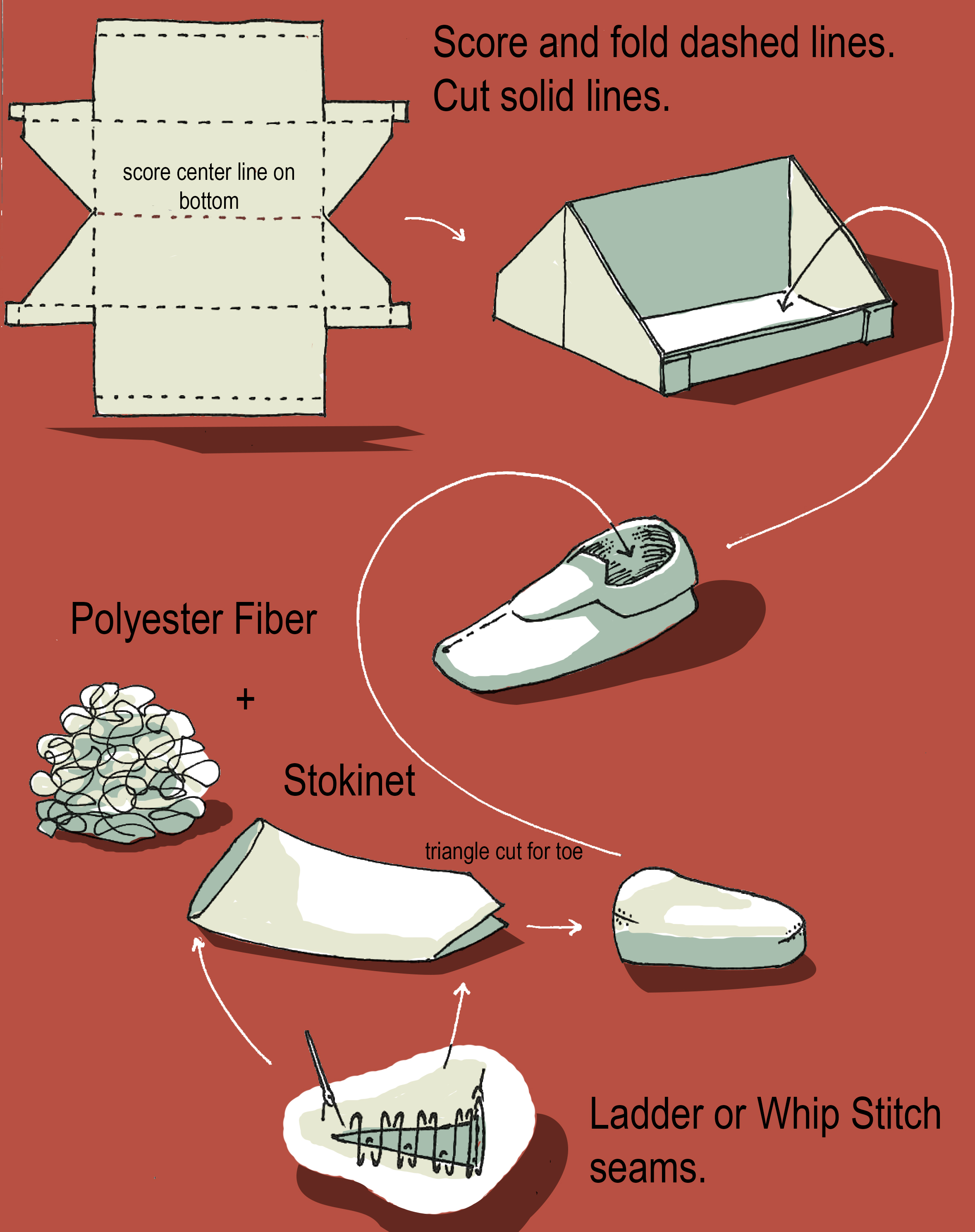
Workflow for Moccasin Mount.

Our goals for this project are two-fold. The first is to design and construct external supports for pairs of moccasins that prevent them from rolling on to their sides or off the mount.

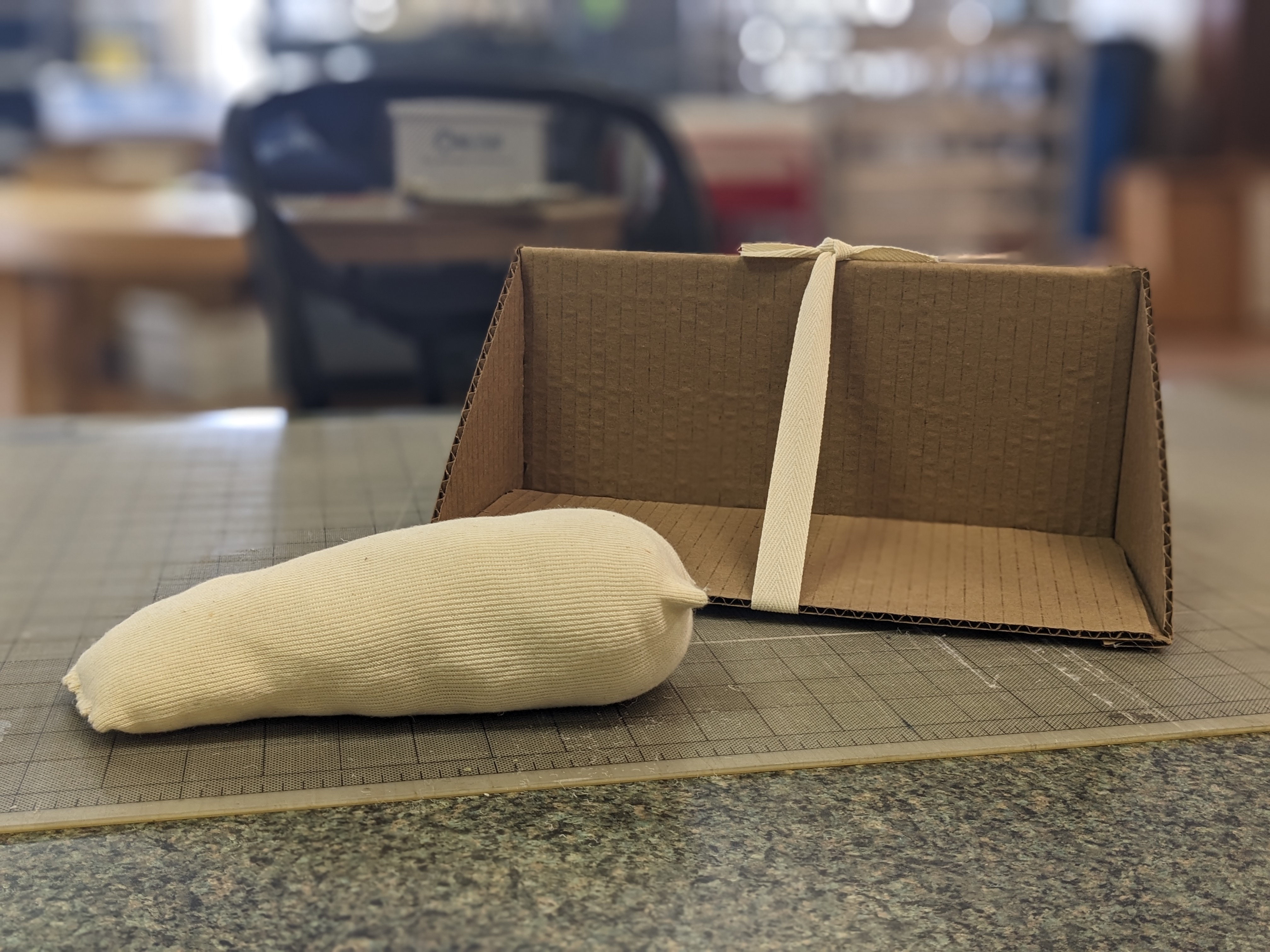
The second goal is to create soft internal supports. Leather items, like moccasins, can be subject to flattening if they do not have additional support. Since the moccasins are laying on their sides in the boxes, the flattening can lead to additional deformation. If left unaddressed, flattening and deformation will cause permanent creasing which requires careful conservation to reverse.
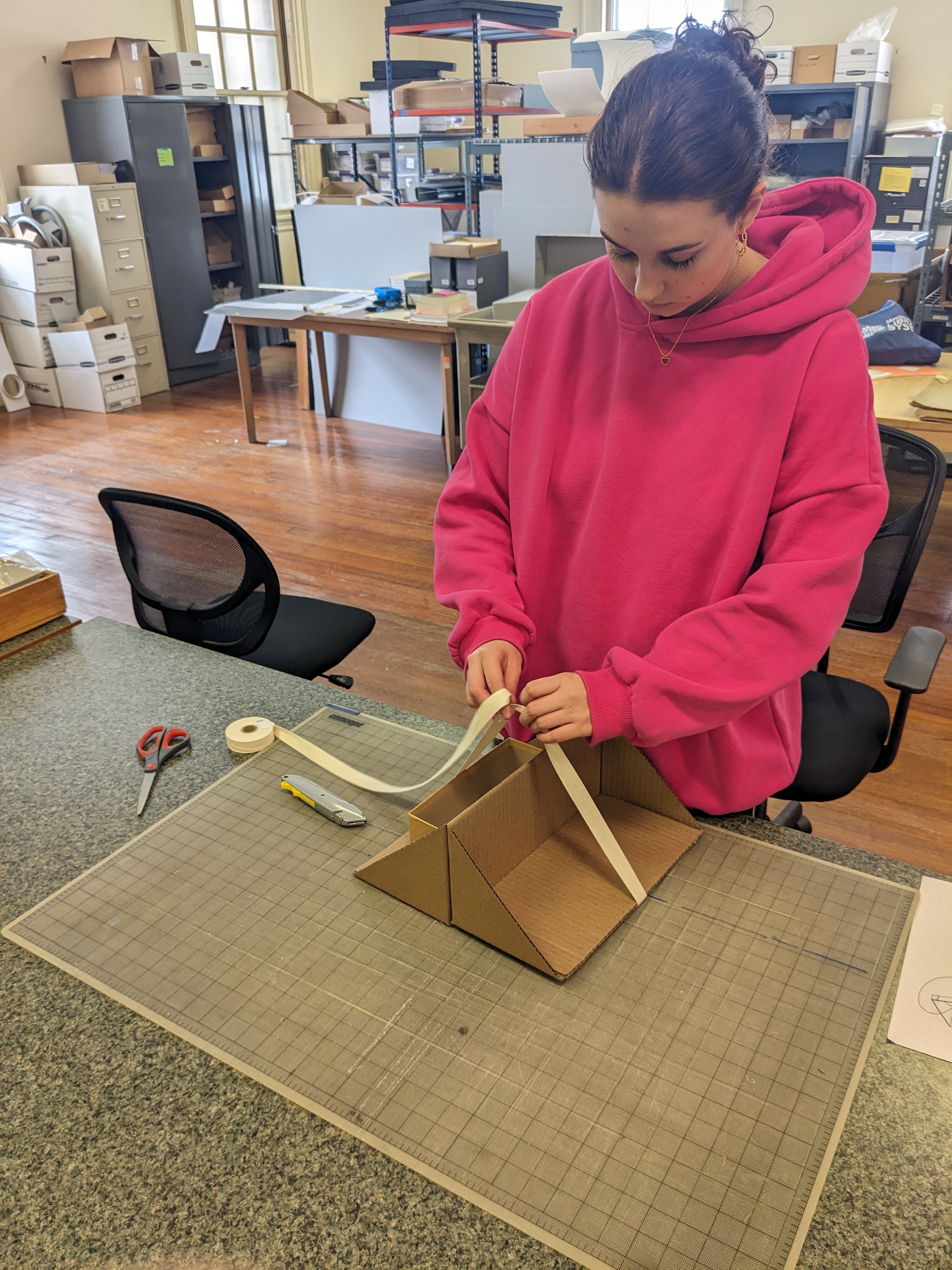
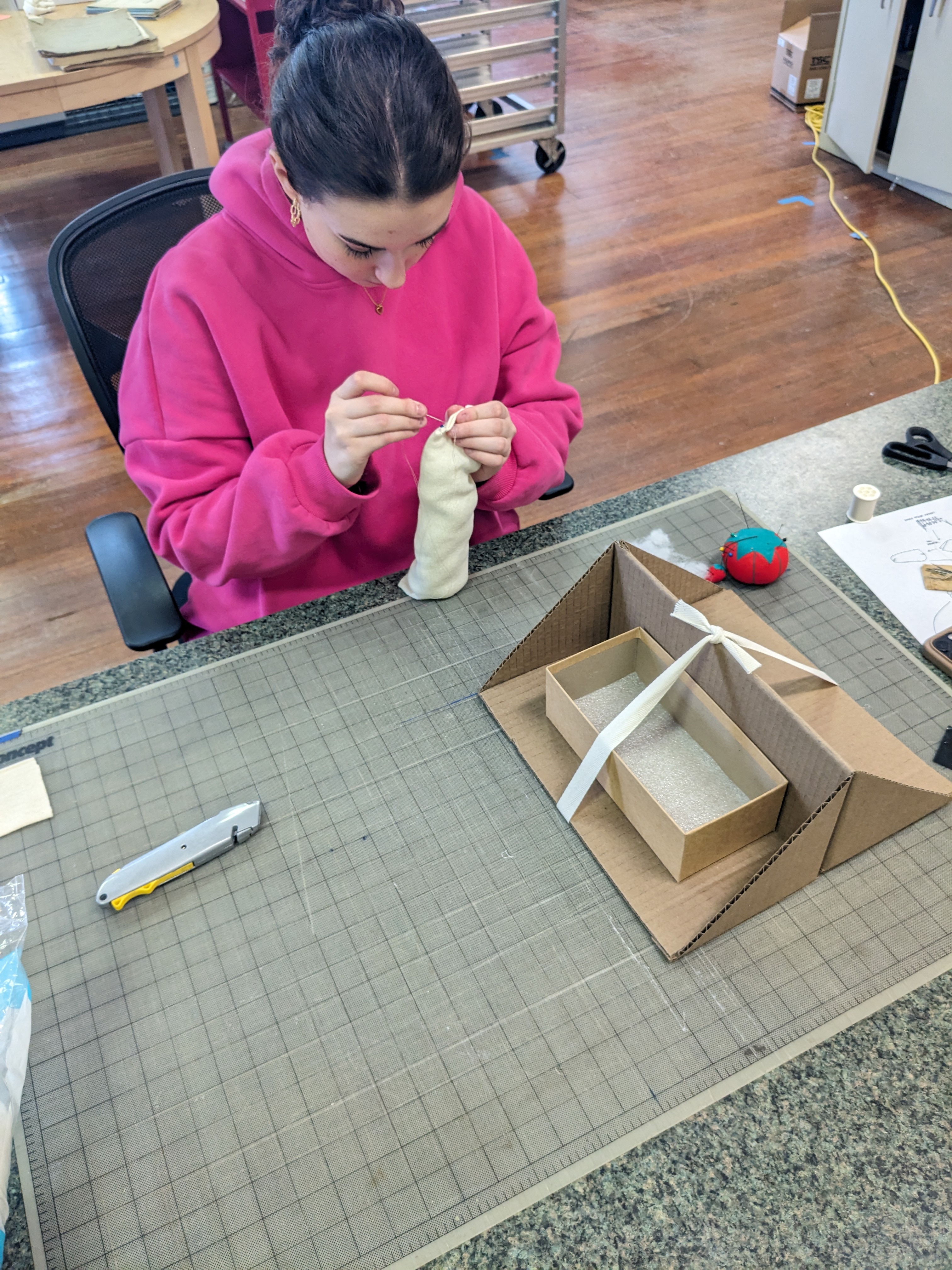
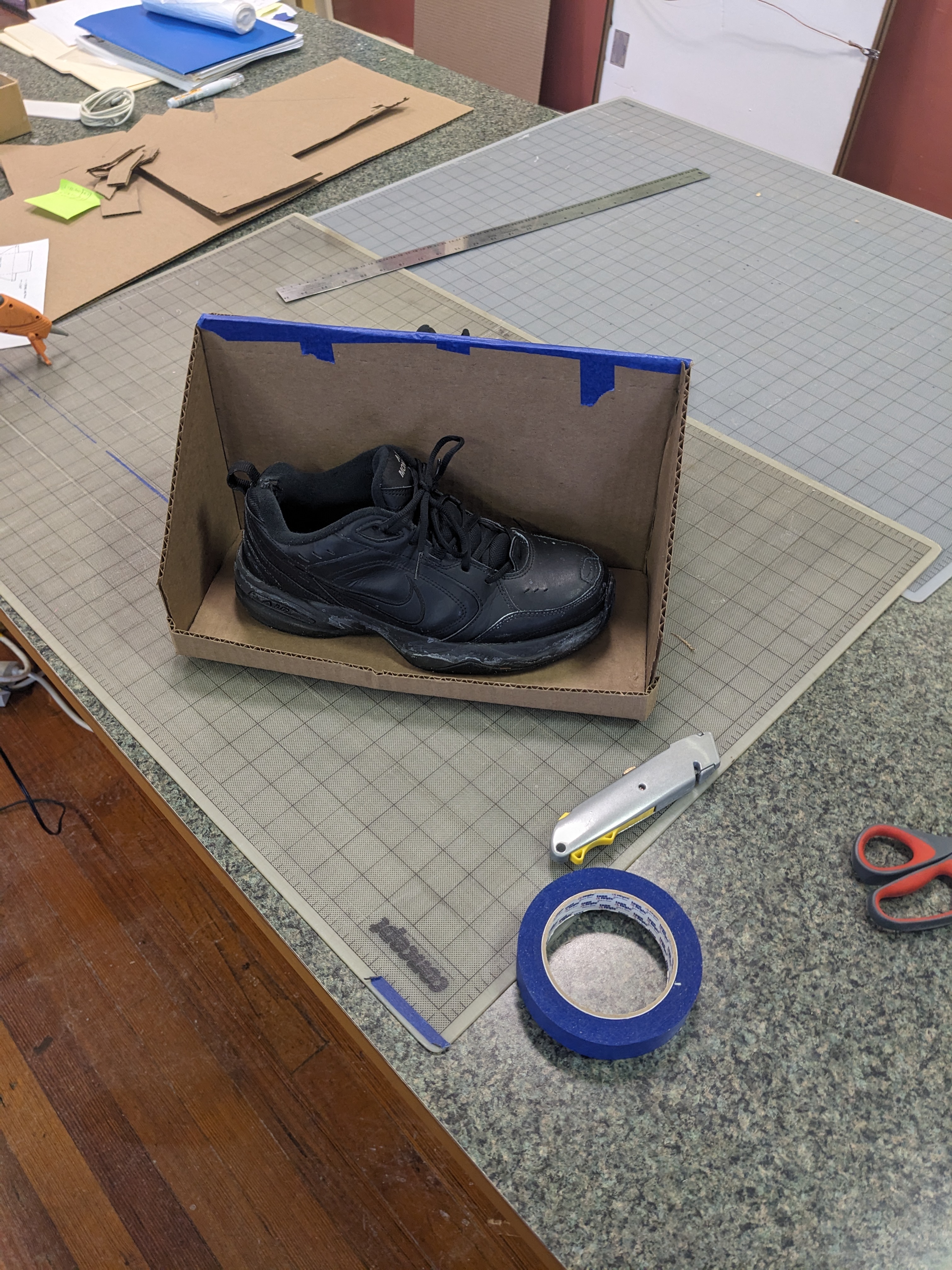
For the first step, the volunteers practiced making external mounts for their own footwear using cardboard. A few elements of the mount were altered after we saw the construction of the initial design. When the design is finalized, the volunteers will be using archival blue board covered in soft Tyvek fabric to house the moccasins.

The next step will be to practice making internal supports. These supports are essentially tubes constructed of stockinet filled with polyester fiber. The ends are stitched together to ensure the poly-fil doesn’t come out of the tube. Once fabricated, these will be inserted into the moccasin,  helping keep their shape and resist the flattening effect of gravity.

The volunteers are making great strides with their practice work, which means they will soon start making mounts for the moccasins. We will keep you posted with an update in the future.

If you are interested in seeing what kinds of mounts your institution can make use of, please see this pdf from History Nebraska. It was an excellent source of inspiration.

Peabody Volunteer Spotlight: Meet Mike

Contributed by Mike Agostino

Hello, my name is Mike Agostino and I am a volunteer here at the Peabody Institute of Archeology. I am a recently retired scientist from the field of bioinformatics. My work in this field, for over 30 years, concerned the analysis of gene and protein sequences. I love the field so much that I am presently an instructor on the subject for the Harvard Extension School. I am also writing the second edition of a textbook I published on this topic more than 12 years ago.

Peabody volunteer, Mike, analyzes various projectile points in the Peabody collection.

As a resident of Andover, I frequently went past the Peabody and often wondered what treasures it held. When a good friend, Richard Davis, said he volunteered here and told me about the work, I immediately wanted to join him. To say this is a dream come true is not an exaggeration. I have always been interested in archaeology and spent many years looking down on the ground for the artifacts people said were all around us. But I never found any! To work with and learn about dozens, if not hundreds of specimens each day is amazing. As I hold these objects in my hands, I try to imagine their history: was it careful fabrication by an adult expert, or was it made during a learning period of a youngster? Was it used to bring home a meal, build a boat or dwelling, or for the creation of clothes? Did it come from local stone, or did it travel many miles to be found at a new locale? My imagination is further enhanced or tempered by the kind and knowledgeable staff of the Peabody who are training and patiently helping me identify what is in my hand. I have only been at the Peabody for less than two years and there is so much to learn!

After years as a scientist, I feel right at home with my principal responsibilities: the careful handling, description, cataloging, and storage of the specimens. Attention to detail is absolutely required and very satisfying. We record their identities, or best guesses because many are just fragments. The intact specimens are something to behold. Some arrowheads or axes are impossibly beautiful, and the precision of shaping and symmetry with such a hard material is just astounding. The skills of the people, past and present, are just amazing.

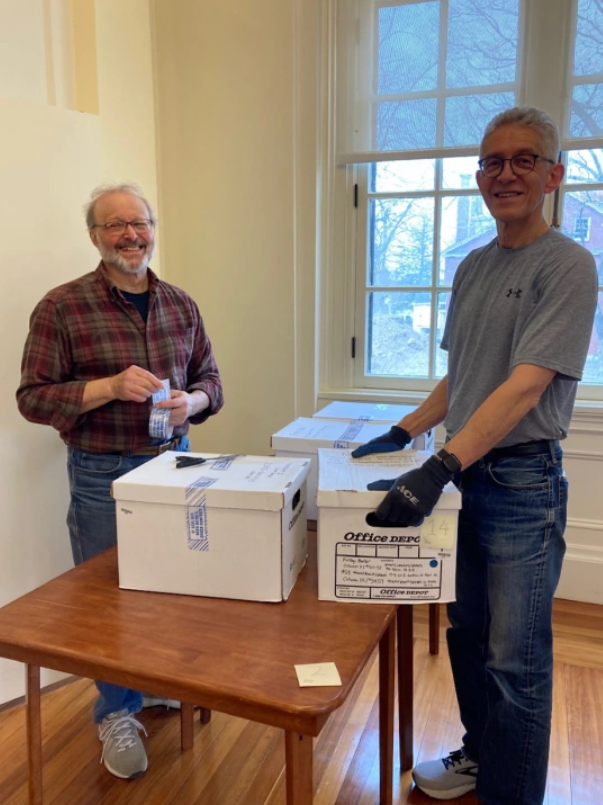
Peabody volunteers, Richard (left) and Mike (right), moving boxes for the Peabody’s building project.

I have also helped with activities associated with the huge renovation project of the building (for pictures and updates, see the blog postings by Marla Taylor). I am impressed with how everyone has remained calm considering hundreds of boxes, and specimens too large for boxes, had to be carefully moved up one or two floors from the basement to temporary locations elsewhere in the building. With the absence of an elevator, I helped move many boxes up the stairs out of harm’s way. My smart watch said I went up 80 flights of stairs one day! And I am only there one day a week, so the staff had a monumental challenge. We are now waiting for the renovations to be completed and then we will return the specimens to a much-improved setting. Even with the new elevator, reshelving hundreds of boxes won’t be easy, but I am looking forward to the project and the “new” institute.

Student Volunteer Voices

Contributed by Elizabeth Reppas, Anthony Chung Yin Woo and John Bergman-McCool

Here at the Peabody, we are fortunate to have students assist us with collections-related projects. Work duty is the primary avenue for students to help our small staff, but we also rely on non-work duty students who volunteer in various ways during their free time. As we prepare for building renovations, work duty assignments have been canceled at the Peabody for the academic year. However, a few dedicated student volunteers have continued to come each week to help us as we approach the start of construction. We’ve asked them to share a bit about their experiences:

Hi! I am Elizabeth Reppas, and I am a three-year senior from Washington DC. I have always really loved visiting museums and learning how they work, so when I learned that I could volunteer at the Peabody Institute, I was very interested. I have been volunteering since the winter of my upper year and have gotten to help with a range of projects from organizing objects to creating an exhibit.

I first started helping with inventory like labelling and sorting objects. As I learned more about the artifacts, I got the chance to help curate an exhibit with projectile points and textiles from Tamaulipas Mexico for one of the exhibit cases. I helped with all things from choosing the objects and photos for the case to writing the explanations and putting the pieces together. I finished off the year with that exhibit, which was up on display for reunion weekend. It was particularly meaningful because it was in honor of Maya Cointreau ’92 supported by her classmates. Now, this year, I have helped with smaller projects like putting together an interactive activity for the Andover Historical Society and reviewing new objects, but I have mostly been helping to sort and organize the collections as the Peabody gets ready for its renovations.

I have loved these past two years working at the Peabody. I have learned a lot about archeology and how objects are excavated. I have also gotten to learn more about Andover and places around us since many of the Peabody’s artifacts come from nearby. And lastly, and for the reason I initially joined, I have gotten to learn more about collections: taking care of objects, doing inventory, and learning about ethically acquiring, maintaining, and displaying artifacts. Overall, I love the time I have spent volunteering and am excited for what is to come with the Peabody.

I’m Anthony and I’m a Phillips Academy student volunteering at the Peabody. Currently, I’m an eleventh grader living in Tucker House on campus, though I call the city of Hong Kong my home.

Since tenth grade, I’ve been involved with the Peabody, first through the work duty program, then by reaching out to become a student volunteer. The work I do at the Peabody varies a lot, which involves hands-on tasks such as sorting through artifacts, rehousing them in small Ziploc bags, and climbing up rickety wooden ladders to correctly label the new archival boxes in their respective bays, all as part of the rehousing project at the Peabody. Other work that I’ve done at the Peabody includes writing condition reports for artifacts that are used in classes as well as packaging old pamphlets for storage. More recently, I was involved with calculating and measuring the space required for to move all the boxes from the basement to the first floor, in preparation for the renovation work that will soon commence in the building.

To me, the Peabody has always been a place where I am able to take my mind off class work and come into close contact with items from decades, centuries, or perhaps epochs ago. Having visited a fair amount of museums before, it was eye opening for me to see the massive logistical challenges and the large amount of work that the Peabody staff and volunteers have to put into overcoming these challenges, along with digitizing artifact data and developing strict procedures to categorize and label the objects. My experiences at the Peabody have allowed me to better appreciate the people who work in the field of taking care of objects that are historically and culturally significant, particularly as we investigate the previously silenced histories of subjugated people across the globe.