
Contributed by Ryan J. Wheeler
One of the early topics covered in the interdisciplinary course Human Origins is science vs. pseudoscience. Students watched a short video by Craig Foster, who talks about his experience attending a Bigfoot research conference. Archaeology has long contended with claims for ancient aliens, lost continents, and cryptids, like Bigfoot, Yeti, and the Abominable Snowman. While seemingly fun and harmless diversions, these things can muddy thinking about what science is and how it is done, and contribute to misperceptions about the accomplishments of indigenous people. The nineteenth century Moundbuilder Myth suggested that the ancient earthen monuments of the Ohio Valley had not been built by the ancestors of contemporary Native Americans, but rather by a mysterious lost race. This was used to justify the United States’s expansion westward, as exhibited in the doctrine called Manifest Destiny. If Native people were not responsible for creating the Ohio Valley monuments it called into question their rightful occupation of this territory and empowered American expansion.
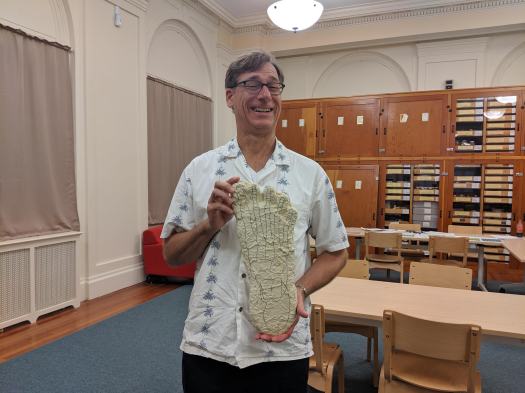
Paranormal and cryptid researchers often use technology and techniques that approximate science. They represent an investigation of the unknown and the possible. During class we discussed perceptions of science and philosopher Karl Poppers’s recognition that falsifiability is the hallmark of scientific investigation. The classic example is Arthur Eddington’s check of Einstein’s theory of relativity. Einstein had noted that it should be possible to observe the gravitational deflection or bending of starlight during as eclipse; if the starlight wasn’t deflected, it meant that his postulates had been proven false. Eddington made a series of photographs during the 1919 eclipse that demonstrated that the Sun did, in fact deflect starlight. Ancient aliens, Bigfoot, and Lost Tribes can never be subject to real scientific investigation like this because the claims can never be tested and proved false.

We revisited Foster’s video and his thoughts on the Bigfoot adherents. Why do people believe these outrageous claims? For one, it has to do with context. If you spend time with other Bigfoot believers it reinforces your own thinking. We also discussed belief as a continuum. Some people don’t believe in cryptids or aliens, but are willing to consider the possibility of ghosts. Foster also notes that we are all susceptible to pseudoscientific claims and that the people who believe are perfectly rational and pleasant individuals who will remain unconvinced by arguments or contradictory evidence.
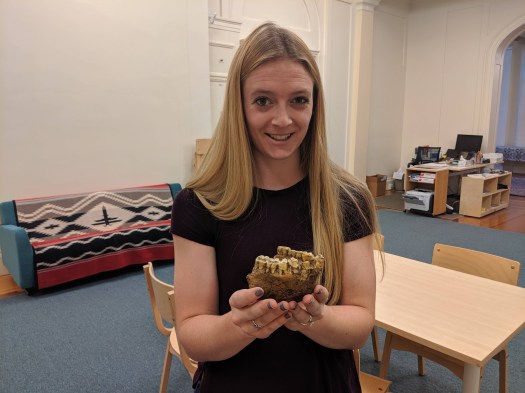
During class we also examined a cast of a jaw of Gigantopithecus blacki, a very large primate known from around 9 million years ago in parts of Asia; paleontologists believe Gigantopithecus became extinct around 100,000 years ago. Gigantopithecus is often offered as the real creature behind cryptids like Bigfoot and Yeti. As the claim goes, perhaps the large ape has persisted in remote areas into modern times. Relatively harmless thinking, right? But if we accept claims like this, we are effectively denying Darwin’s theory of evolution. And if we believe that evolution isn’t operating it opens the door for a host of other, more insidious thinking, especially ideas about race.
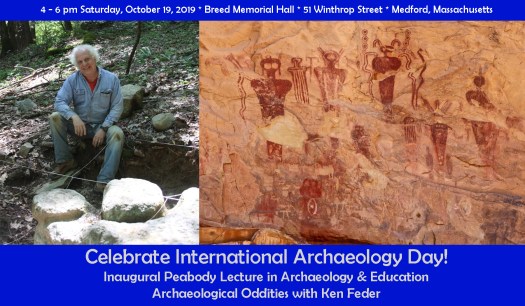
If you want to learn more about archaeology, science, and pseudoscience please attend our inaugural Peabody Lecture in Archaeology & Education, featuring archaeologist and author Ken Feder. Feder will talk about his newest book, Archaeological Oddities: A Field Guide to Claims of Lost Civilizations, Ancient Visitors, and other Strange Sites in North America. Ken will sign copies of the book after his talk. 4-6pm, Saturday, October 19, 2019, Breed Memorial Hall, Tufts University, 51 Winthrop Street, Medford MA. The event is free and open to the public, but we ask that you RSVP: https://events.attend.com/f/1383789424#/reg/0/
 The Peabody