
Contributed by Lainie Schultz
Inclusive editing of catalog records is an important aspect of contemporary museum, library, and archival practice, or for any space maintaining a catalog of records for people to access and learn from. In particular where catalog records are themselves pieces of history, written at times when accepted language usage was different from what it is today, it can be necessary to return to the descriptions we rely on to access materials and rewrite them to remove what we now recognize as harmful language. In this way we can provide users with more accurate, respectful, and inclusive terminology, and disrupt the barriers created by prior language.
While incredibly vital work, accomplishing these changes can often be slow, at times requiring a thoughtful and collaborative approach to determine what language is correct in place of what was used previously; extensive research to fill missing gaps; and/or the development of new processes or procedures for altering records, to document these changes so that our history is not erased – and then, of course, actually editing these records, sometimes one by one. The satisfaction gained from the effort can be immense, but the gratification is often delayed.
And, also, sometimes it’s ridiculously easy.
One common omission in catalog records is the names of women, often found identified as the wives of their husbands. I recently encountered one such woman in the Peabody Institute’s catalog while researching a Tohono O’odham basket in our care, donated by Mrs. Edmund Hamann. Looking to gain a better understanding of the basket’s arrival at the Peabody, I turned to its accession record, where I found the following:
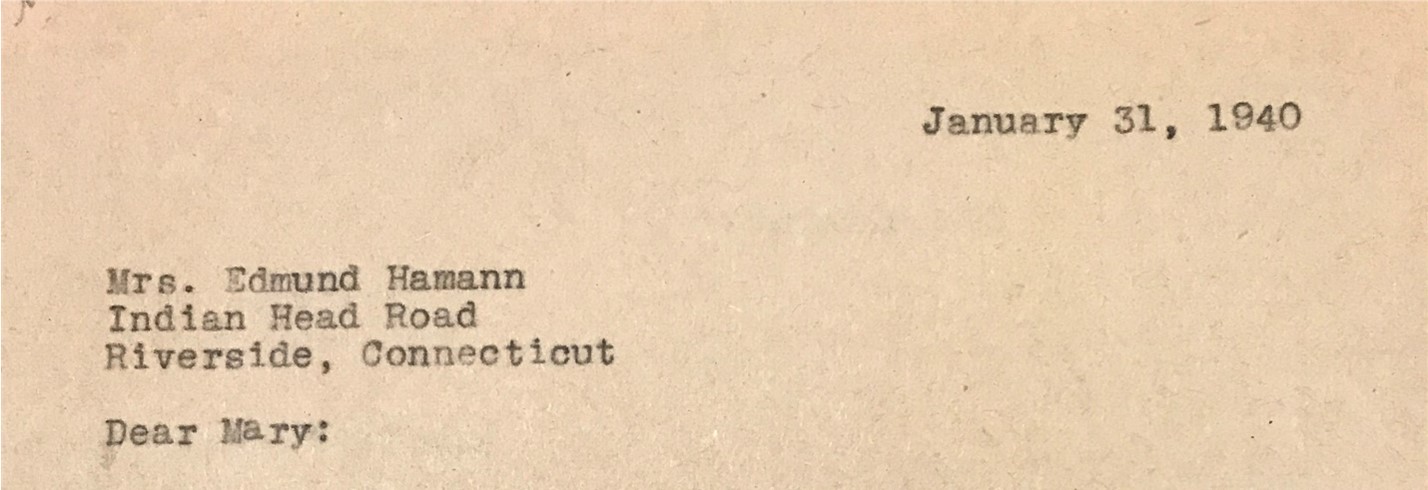
A letter much like the one previous to it in the file, directed to Mrs. Edmund Hamann, but here with a very different greeting: Dear Mary.
Such a simple discovery, but one that thrilled me no end. No longer does Mary have to live in our records as the wife of Edmund, and no longer do we need to refer to her only in relation to him. She gets to have her own name.
What an improvement!
 The Peabody