Movie Magic – sort of

Contributed by Marla Taylor

Before COVID-19, the Peabody Institute kept our social media presence to Facebook and Twitter.  But this seemed like the perfect time to expand to Youtube. This is definitely a new medium for me and I was puzzled for a few days as to how I could contribute to this platform.  And then inspiration struck.

Phillips Academy is home to two cultural institutions – the Robert S. Peabody Institute and the Addison Gallery of American Art.  Our friends at the Addison created a delightful short stop-motion video about the work of a registrar and shared it on Facebook.  I thought it was fabulous.  And I also thought, I can do that!

Well, that started a project that took about a week of evening shoots after the kids went to bed, and an additional couple weeks of sound design (maybe I shouldn’t admit that it took that long…).  I wrote a short script and then cannibalized my boys’ Legos to recreate the Peabody staff and create sets.  I regret not taking a picture of the carnage to our play room to share, but I am relieved that it is all cleaned up now.

Framing and filming the stop-motion required a level of patience and detailed focus that was challenging for me at times but necessary to make the film work.  It is hard to remember to account for everyone and everything in the scene, but not to move it too much to ensure it was fluid.  It was pretty fun to hide details in the background too.

Adding the voices and music was a whole separate task.  I fully credit my husband with the patience to become my sound engineer.  He took all the lines, including those contributed by our 5 year old, and music and ensured that everything synced with the video – and made sure we weren’t breaking any copyright laws with the music use…

I think the end result is pretty great.  Viewers learn about what the Peabody does every day, from my perspective, and get to escape for about 3 minutes.

Enjoy Raiders of the Peabody Institute Collections!

#Museumathome

Contributed by Marla Taylor

In our new normal, museums around the world are finding new and clever ways to engage with people at home.  I wanted to share with you some of my favorites.

Our friends at the Addison Gallery of American Art, also here at Phillips Academy, have gotten creative with Legos and stop-motion animation.  Registrars: The Movie was the best 2 minutes of my day and I hope it makes you smile too!

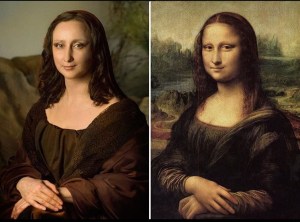
Mona Lisa

A fabulous trend on Instragram are people dressing themselves and their homes like art.  The creativity is impressive!  Discover the trend through #gettychallenge, #betweenartandquarantine, and #covidclassics.

Gerbil art museum
Gerbil art museum

Do gerbils appreciate art?  I don’t know, but I stumbled across this article about some art lovers who decided to find out.  By all accounts, the gerbils had a positive experience with their private tour!  And I hope you do too.

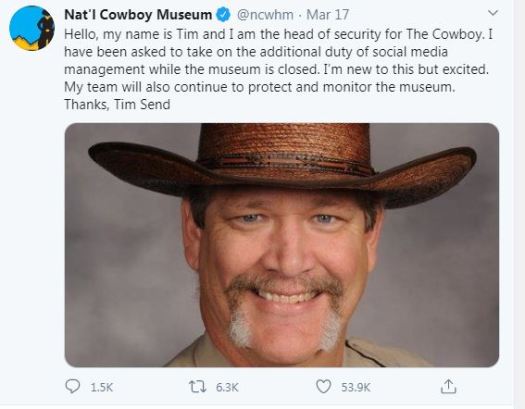
My favorite museum distraction is following the National Cowboy Museum on Twitter.  Head of Security, Tim, has taken over their social media and has the best dad jokes around.  Wonderfully refreshing and clever, Tim’s tweets bring a smile to my face every day – #HashtagTheCowboy.  I can’t wait to find a reason to travel to Oklahoma City, OK and visit.

Thanks, Tim

Collections work – Home edition

Contributed by Marla Taylor

As the country continues to work from home, the Peabody collections team has gotten creative to keep everyone busy.  Typically, our work requires touching and interacting with the objects in our collection as well as collaboration on deciphering difficult numbers or to respond to a research inquiry.  I certainly can’t send the artifacts home with our staff, but we have been able to find plenty of remote work.

Piles for work from home
Boxes of photos and slides ready to go to their temporary homes

First, we attacked a backlog of paperwork relating to our pest management projects.  Something that I thought would take months to catch-up on was done in a matter of days!

Second, supplies were split up and everyone signed out a few boxes of photographs to digitize from home.  Many of them also created spreadsheets that will make for quick addition to our collections management database when we return.  Once again, massive progress is being made on projects that have been sitting on the back-burner too long.

Several of us still share the responsibility of checking on the collections in person regularly and the system has been working wonderfully.

For me, like so many others, working from home has been a balancing act.  I am caring for two kids under the age of 5 while my husband works a job that is considered essential.  My work is squeezed into nap-time, evenings, early mornings with a cup of coffee, and some weekend time.  We are all doing the best we can to support ourselves and our colleagues.  I cannot thank the Peabody collections team – Rachel, John, Emily, and Emma – enough for their hard work and continued dedication to our mission.

If you have some time to kill, try checking out our collection online – I hope to have lots of new material uploaded when we return to our regular routine.

Moving the Big Ones

Contributed by Marla Taylor

I have always thought of the Peabody’s collections storage as one of those sliding tile puzzles.  You have to keep shifting pieces that look like they are in the right place in order to end up with the correct completed final image.  Sometimes it seems never ending, but each shift makes the space more organized, cleaner, and more efficient.

A few months ago, I was faced with trying to find space for a couple dozen boxes that we agreed to store temporarily (maybe a year or so).  These objects needed discrete storage in a place that would not be disturbed.  This was a challenge, but one worth tackling.  After some thought, Rachel (Collections Assistant) came up with the idea of moving our large groundstone collection – that storage was discrete and in an area of the room that we rarely needed to interact with.  Perfect.

You may be asking yourself, What is a large groundstone?  Groundstone objects are stone tools that are formed by grinding and pecking away the larger stone into the desired shape.  These can include axe heads, portable petroglyphs, weights, as well as manos and metates.  The largest of these are often the metates, or grinding stones, that were used to prepare wheat and corn flour. Some of them are easily 40+ pounds!

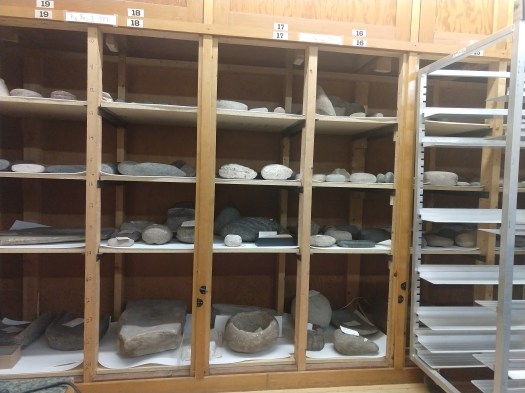
The first task was dismantling the previous storage bays – a fun day with power drills and a sawzall.  Then I created a plan to install new shelving inside the bays that would be sturdy enough to support all the weight we were moving.  The photos may just look like shelves, but I am proud of all the precise measuring, leveling, and cutting with a circular saw and jigsaw that went into this project.  When we installed the shelves, everything fit perfectly.

To move the 183 objects we had to load everything onto trays and wheel them across the storage space – some were much too heavy to carry that distance.  A quick reinventory assigned everything a new storage location and the process was complete.  All told, this move took about a week.

I can’t pretend for a second that I did this project alone – massive thanks and credit to Rachel, Emily, John, and Ryan for their insights, object moving abilities, and skills with power tools!

Oversize storage
Look at those beautiful shelves!

Abbot Academy Fund continues to support the Peabody Institute

Contributed by Marla Taylor

Have you ever heard of the Abbot Academy Fund?  (if you said “yes” from one of our earlier blog posts – Gold Star!)  If not, please allow me to introduce them.

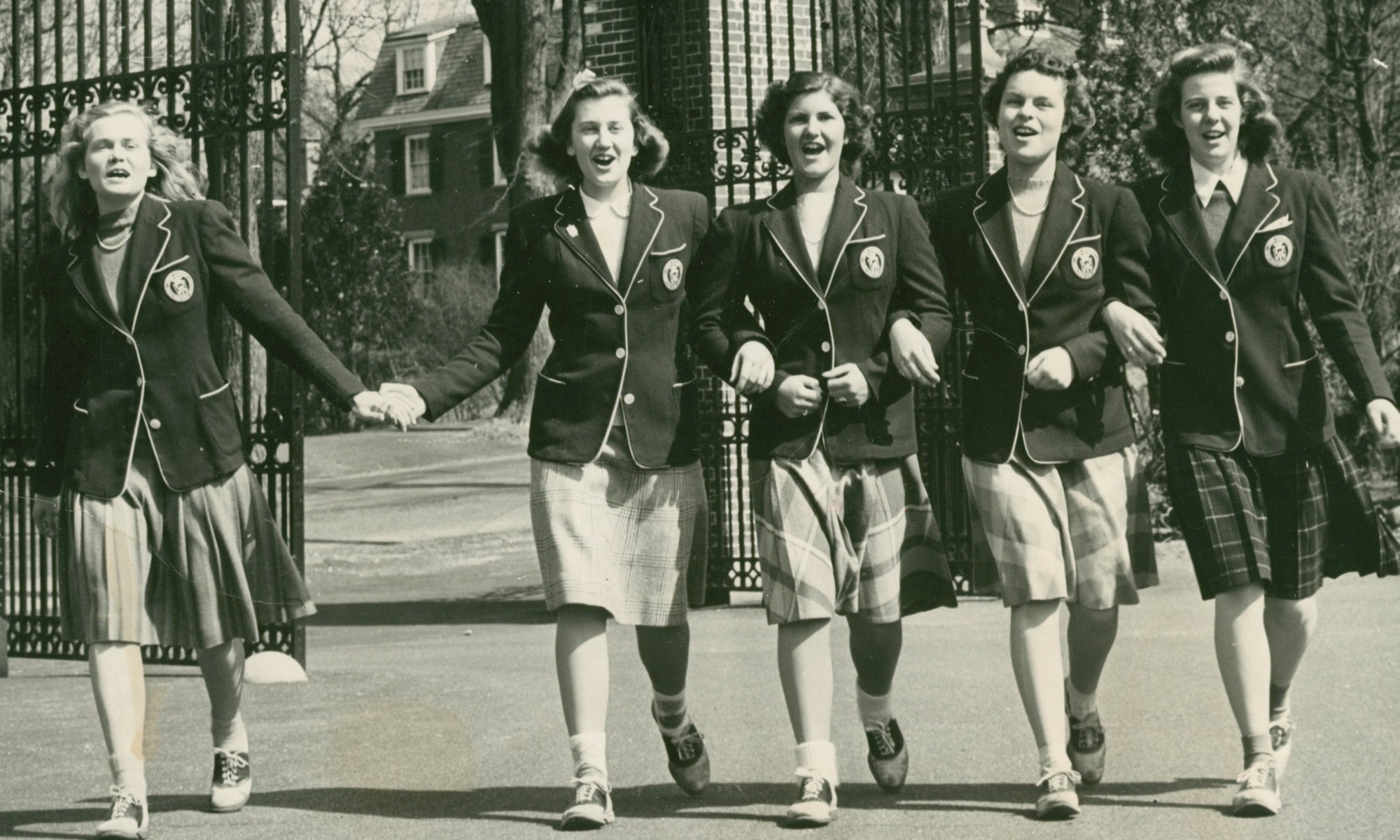
One of the first educational institutions in New England founded for girls and women, Abbot Academy opened its doors in 1829 and flourished until Abbot Academy and Phillips Academy merged on June 28, 1973.  At that point, the Abbot Academy Fund (AAF) was established with $1 million from the Academy’s unrestricted funds.  The fund operates as an internal foundation with its own board of directors.  Its goal is to preserve the history, standards, tradition, and name of Abbot Academy by funding new educational ventures at the combined school.

The Abbot Academy Fund has been a foundational supporter of the Peabody Institute, especially in recent years.  With grants going back to 1990, the AAF has given the Peabody over $250,000!  I was recently reminded of this incredible generosity when the AAF once again provided support to complete the transcription of the Peabody’s original accession ledgers.

Looking back over all the successful grants, the AAF has supported a real variety of projects at the Peabody – everything from exhibition support to object conservation to equipment purchase to expeditionary learning trips.  However, the largest portion of their patronage has gone to support cataloging and rehousing the collection.  They provided funds to purchase a server in 2014 to allow for an online catalog.  And again in 2016-2018 to acquire the boxes needed to rehouse the artifacts and gain physical control over the collection.  All told, the AAF has awarded us over $100,000 in the last ten years!

Basically, the Peabody Institute would not look or operate the way it does now without the incredible support from the Abbot Academy Fund.  I can’t thank them enough!

So much work at the Peabody is brought to you by a grant from the Abbot Academy Fund, continuing Abbot’s tradition of boldness, innovation, and caring.

Traditional sewing in Labrador and the Peabody

Contributed by Marla Taylor

In 2017, the Peabody welcomed Dr. Laura Kelvin to examine the William Duncan Strong collection from Labrador.  You can learn all about that visit in a previous blog post here.

Recently, Dr. Kelvin reached out for permission to share some of the images she took in a video that is part of a larger project – the Agvituk Digital Archive Project, which is part of the Agvituk Archaeology Project (AAP).  The AAP is a community-based archaeology project that was initiated by the Hopedale community through the Tradition and Transition Research Partnership between Memorial University and the Nunatsiavut Government.

Labrador
An Agvituk Archaeology Project excavation. Image from Tradition and Transition website.

Every summer, students are hired (high school, college/university, or upgrading) from Hopedale to help conduct traditional knowledge interviews with community members (and sometimes archaeologists) and help with survey and excavation if needed.  The interviews were originally going to focus on specific objects that Dr. Kelvin documented, or those recovered through AAP activities.  However, due to the high volume of material, the students have been picking topics inspired by the artifacts and interviewing people about those subjects.  This past summer the students chose to discuss sewing.

Short videos are created that blend conversations with community members and images of relevant artifacts and historical photos.  The videos can then easily share traditional knowledge with the larger community.

Dr. Kelvin and her students used several artifacts from the Peabody’s collection in the sewing video.  You can see it in its entirety here.

To learn more about the project, check out their Facebook page.

Annual Report 2018-2019

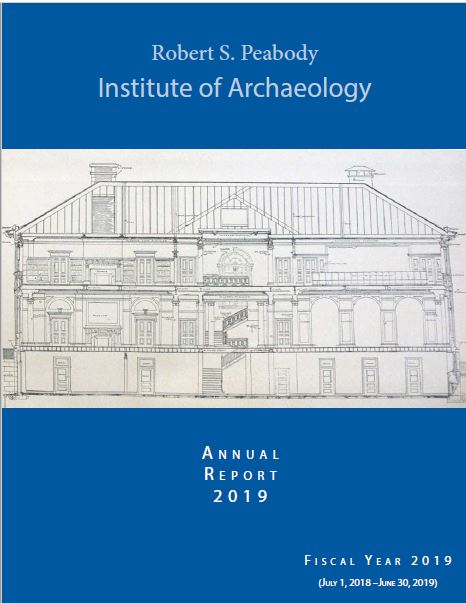
Hot off the presses – the Peabody’s annual report for academic year 2018-2019 has just been released!  Interacting with nearly 2,000 students (yes, some PA students keep coming back for more) and dozens of researchers, another wonderful year is under our belt.

You can read the report in its entirety HERE.

Annual Report Cover

Peabody at the Addison

Contributed by Marla Taylor

The Addison Gallery of American Art is across the street from the Peabody at Phillips Academy.  While I am happy to gently tease that the Peabody is cooler, the Addison is a pretty amazing institution as well. Founded in 1931, the Addison’s collection of American art is one of the most comprehensive in the world, including more than 20,000 objects spanning the eighteenth century to the present. I strongly recommend that you take the time to check out their awesome collection online.

Several months ago, Gordon Wilkins, the Robert M. Walker Associate Curator of American Art, requested a loan of several objects from the Peabody for an exhibition. We were thrilled to be able to help out and loan ten objects to the Addison for their show A Wildness Distant from Ourselves: Art and Ecology in 19th-Century America. The exhibition considers how the evolution of the European-American understanding of the natural world fundamentally altered the ecology of North America. From the Puritans’ seventeenth century “errand into the wilderness” to the present, the perceived dichotomy between man and nature has defined the European-American experience in the so-called “New World.” A Wildness Distant from Ourselves focuses on the nineteenth century, an era that witnessed both the extreme exploitation of the land and its peoples and the birth of a modern conservation movement.

I have been over there to check it out, and the exhibition looks great! It is wonderful to see the objects from the Peabody seamlessly integrated with other examples of American art to contribute to an important story.

If you are in the Andover area, I strongly recommend taking in the exhibition. And don’t miss the opening reception on Friday, October 4th from 6-8pm.

Sharing our collection – Indian Basketry in Yosemite Valley

Contributed by Marla Taylor

In September 2018, Catherine Hunter, Research Associate, presented a paper to the 2018 Symposium of the Textile Society of America (TSA).  The symposium was an opportunity to publish a portion of the Native American basketry collection at the Peabody Institute.  Held in Vancouver, BC, the symposium was a dynamic event with over 400 participants and Catherine was one of 120 individuals presenting their research.

Catherine’s paper, Indian Basketry in Yosemite Valley, 19th-20th Century: Gertrude ‘Cosie’ Hutchings Mills, Tourists and the National Park Service, is now available via Digital Commons at the University of Nebraska.

For more about the basketry in the Peabody’s collection, take a look back at Catherine’s past contributions to our blog: The Language of Baskets, The Language of Weaving, California Basketry Exploration

Halfway there…and funding for the finish!

Contributed by Marla Taylor

I am thrilled to share that we have officially inventoried half of the collection!

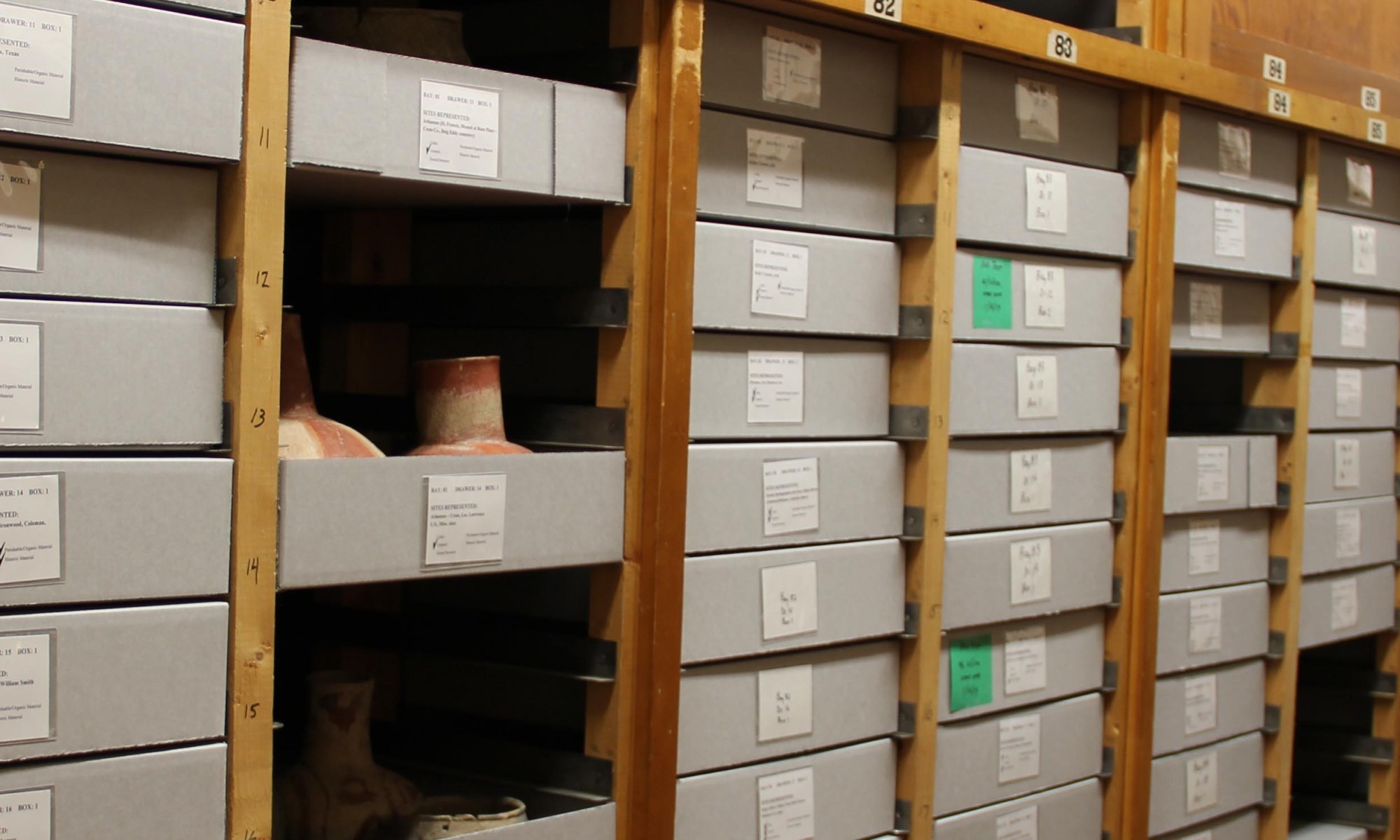
As of mid-June, the collections team has inventoried 1,079 artifact drawers – half of the 2,159 that hold our collection.  Those drawers translate to 243,967 individual artifacts that have been counted and rehoused in the process!

A massive “thank you” goes out to all of the staff and volunteers who have contributed to the inventory so far: Rachel Manning, John Bergman-McCool, Emma Cook, Annie Greco, Alex Hagler, Quinn Rosefsky, and dozens of work duty students.

With excitement and deep gratitude, we also announce that funding has been secured to complete the inventory by our target deadline of December 31, 2020.

The Oak River Foundation of Peoria, Illinois has renewed its support for a temporary inventory specialist for another two years.  Our deepest appreciation goes to the Oak River Foundation for its continued generosity and commitment to the Peabody’s goal of improving the intellectual and physical control of the museum’s collections.

But that is not all!

Barbara and Les Callahan have agreed to provide critical funding to extend the appointment of our current inventory specialist – John Bergman-McCool.  Les graduated from Phillips Academy in 1968 and is an active volunteer on campus. Barbara has served on the Peabody Advisory Committee since 2013.  Both have been steadfast advocates and supporters of our mission and we cannot thank them enough for providing this deeply meaningful gift.

We hope these acts will inspire others to support our work to better catalog, document, and make accessible the Peabody’s world-class collections of objects, photographs and archival materials. If you would like information on how you can help, please contact Peabody director Ryan Wheeler at rwheeler@andover.edu or 978 749 4493.