
Contributed by Bonnie Sousa, Registrar/Senior Collections Manager
When I mention to people outside of the museum world that I am in collections management and registration, some think I work for a collections agency. In fact, museu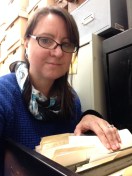 m collections management and registration involves physical and intellectual control of artifact collections and includes such activities as cataloging, inventorying, and storing artifacts; accessioning (the formal process of taking items into the collections); managing loans; answering research and reproduction queries; and working on the museum’s Native American Graves Protection and Repatriation Act (NAGPRA) inventory, to name a few.
And at a small museum like the Peabody, the list of responsibilities grows to include additional activities. Not typically mentioned in job descriptions, but still important in the goal of reaching professional standards, are such unglamorous tasks as emptying dehumidifiers in artifact storage spaces, handling early morning calls from the alarm company regarding power outages at the building, and removing food trash at the end of the day so that insects and other pests are not attracted to the artifacts. To give you a better idea of what’s involved in collections management and registration at the Peabody, here is a list of a few behind the scenes tasks I performed on a typical day recently:
Morning:
Answered e-mail queries—Some of the queries we receive are from textbook publishers asking for  permission to use images from the Peabody’s collections. To date, our most received request is for this image of the evolution of corn from the excavations of Richard “Scotty” MacNeish in the Tehuacán Valley of Mexico. Many college-level, introduction to archaeology textbooks feature this image.
Renewed our loan to the Visitor Center at the Pueblo of Jemez—The Peabody has several ongoing loans to other museums, Native American tribes, a national park, and a public high school. On loan to the Visitor Center at the Pueblo of Jemez are artifacts from their ancestral site, Pecos Pueblo.
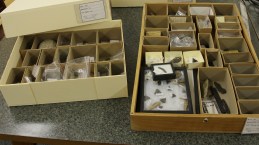
Put away artifacts for a Phillips Academy history class on westward expansion – Artifacts from the Peabody are regularly used in classes taught at the Peabody. Our PastPerfect collections management database allows us to create lists that work perfectly for pulling artifacts to ensure that we can locate them and put them back in the right spot.
Afternoon:
Entered catalog records into the Peabody’s database for artifacts from the Mansion Inn, a site in Wayland, Mass. — We recently learned that items from this site must be listed on the museum ’s NAGPRA inventory. Assembling an inventory begins with compiling existing documentation and records and ensuring that all artifacts are entered into the museum’s database. Our next steps will be to contact tribal officials to let them know we hold these collections, and National NAGPRA, a Cultural Resources program of the National Park Service, to update the museum’s inventories. After consulting with tribal officials and submitting drafts to National NAGPRA, a Notice of Inventory Completion will be published in the Federal Register.
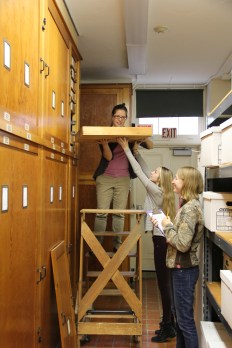
Updated storage locations for textile artifacts—I have two volunteers who have been trained to inspect and vacuum textile collections for pest damage as part of a comprehensive pest management program. When textile artifacts have been inspected and vacuumed after undergoing low temperature treatment to eliminate any potential pests, their storage locations must be updated to ensure we can find them in the future.
Backed up our PastPerfect collections management database before heading home—Regular backups of data are important so that recent information added about the artifacts is not lost.
As you can see, one of the most rewarding benefits of working in museum collections is the wide variety of work that needs to be done, and I’ve really only touched the surface here. There is never a dull moment, and the nature of the work keeps me on my toes. I wouldn’t have it any other way.
 The Peabody