NAGPRA, Repatriation, and Relearning History

Contributed by Ryan Wheeler

This blog is an email response to a follow-up question from a journalist writing a piece about Seminole Tribe of Florida efforts to get the Smithsonian Institution’s Museum of Natural History to repatriate ancestors being held there. A little context is necessary. Last year the Peabody Institute repatriated ancestors from Florida to the Seminole. We continue to work with them on repatriation of other ancestors from neighboring states. That repatriation included decisions about affiliation, a key concept in the Native American Graves Protection and Repatriation Act (NAGPRA). The tribe referred the reporter to me for some background on the broader questions of affiliation and the question of Seminole ancestors at the Smithsonian. After I had a conversation with the reporter, they had a talk with the Smithsonian’s repatriation personnel. Here’s the question that prompted my response, “I spoke with _____ at the Smithsonian about repatriation, and he says one reason he’s not turning over many of the remains held by his museum is that the Seminoles came to Florida in the 17th and 18th centuries. Since many of his remains are older than that, he doesn’t consider them Seminoles. Of course, the Seminoles disagree and say they are still their ancestors. I’m wondering how you made the determination that the remains you had could be returned to the Seminoles.”

Many thanks for sharing that question. I read your message yesterday afternoon and experienced a welling up of sadness at the thought that so many ancestors held by the Smithsonian really have no pathway to repatriation. I thought about this all night, on and off, thinking about my own rather longer than necessary journey to understanding, and feeling sadness for the ancestors and their modern-day descendants, and sympathy towards my archaeological colleagues who are struggling with this.

I have a couple of things to share that I hope will be helpful—the first are academic sources that helped in making our affiliation decision, while the second are more personal experiences. Reading this over, they are really all personal experiences.

A good place to start is Patricia Wickman’s 1999 book The Tree that Bends: Discourse, Power, and the Survival of the Maskoki People (University of Alabama Press). Wickman tackles this idea that somehow the modern Seminole and Miccosukee are disconnected from more ancient Indigenous people of Florida. She makes the case that this is an intentional white-washing of history, much like the Mound Builder Myth of the Ohio Valley, which was used by nineteenth century Americans to justify a push west and a land grab. In other words, if these Indigenous people have no real deep connections to the land, moving them out is perfectly justified. The book was controversial when it came out, because it went up against what we had all learned in school—and when I say school, I mean from elementary through graduate school. And archaeology and ancestors are a big part of this—those cemeteries, burials, and physical remains of the ancestors are tangible proof of long tenure on the land. Eugene Lyon, who has a blurb on the back cover and is mentioned in the acknowledgments of The Tree that Bends, was a history professor at Flagler College, he also was a peer reviewer of the book. I called him after I read it and we talked for a long time. Gene shared that maybe there were other histories that we needed to look for, what we might call hidden histories, and that this probably was one of them. That book, with whatever faults it may have, and my ensuing conversation with Gene really was a major bubble in my own understandings of Florida history and who the Seminole were and are. Gene passed in 2020, a victim of COVID-19—he was 91.

I would point to a couple of other academic things that I had already known about when Patricia’s book came out. In 1956 Frances Densmore, an ethnomusicologist affiliated with the Smithsonian Institution, published a monograph Seminole Music (Bulletin 161 in the Bureau of American Ethnology series). I found a copy of this in a used bookstore while I was in grad school at the University of Florida in the early ‘90s. What caught my attention was that she had recorded several songs that the Seminole attributed to the Calusa—one of those ancient Florida Indigenous groups that was centered in southwestern Florida. That means they knew about these people and had some close contact.

That Densmore monograph made me revisit William C. Sturtevant’s 1953 article Chakaika and the “Spanish Indians,” which was published in the magazine Tequesta. Sturtevant was an anthropologist at the Smithsonian. In the Chakaika article he tackles this question of connection between the Seminole and earlier peoples, based on oral history with Indigenous people and history as written by Anglo-Americans. It’s long and complicated, and not particularly conclusive, but it would appear that even in the early nineteenth century there were a number of Indigenous groups in Florida, including the Seminole and Miccosukee, as well as Choctaw, people of mixed Spanish and Indigenous ancestry, and Calusa. He doesn’t come to any definite conclusions, but all these people were around, and around a lot later than the conventional wisdom would have us believe. They knew about one another, and it’s pretty clear they adopted some cultural practices, like those songs Densmore recorded.

So, those are some academic books and articles that tackle this question of Seminole origins and identity that diverge, either a little or a lot, from the accepted wisdom. Now, onto some more personal observations. I knew a fair number of Seminole folx growing up, and the oral history accounts shared by Sturtevant rang pretty true, but were perhaps a little more vehement in the ‘80s: basically, we’ve been here a long time, we have deep roots and connections with the land, and anything else is nonsense. Hmmm, okay. I went to college with James Jumper. Jimmy was in his late 40s and I was in my late teens/early twenties. He had come to Florida Atlantic University to study criminal justice and went on to get a law degree and worked for the tribe. He lived in the dorm next to mine, but we often compared notes on our classes and I had taken some criminology classes too. We sometimes ordered a pizza or cooked in the dorm kitchen or on the grill outside. We sat around and chit chatted. I told him about the history and archaeology that I was taking. He was kind and patient, but challenged what I told him about Seminole origins. No, we’ve been here a long time, he told me. First bubble.
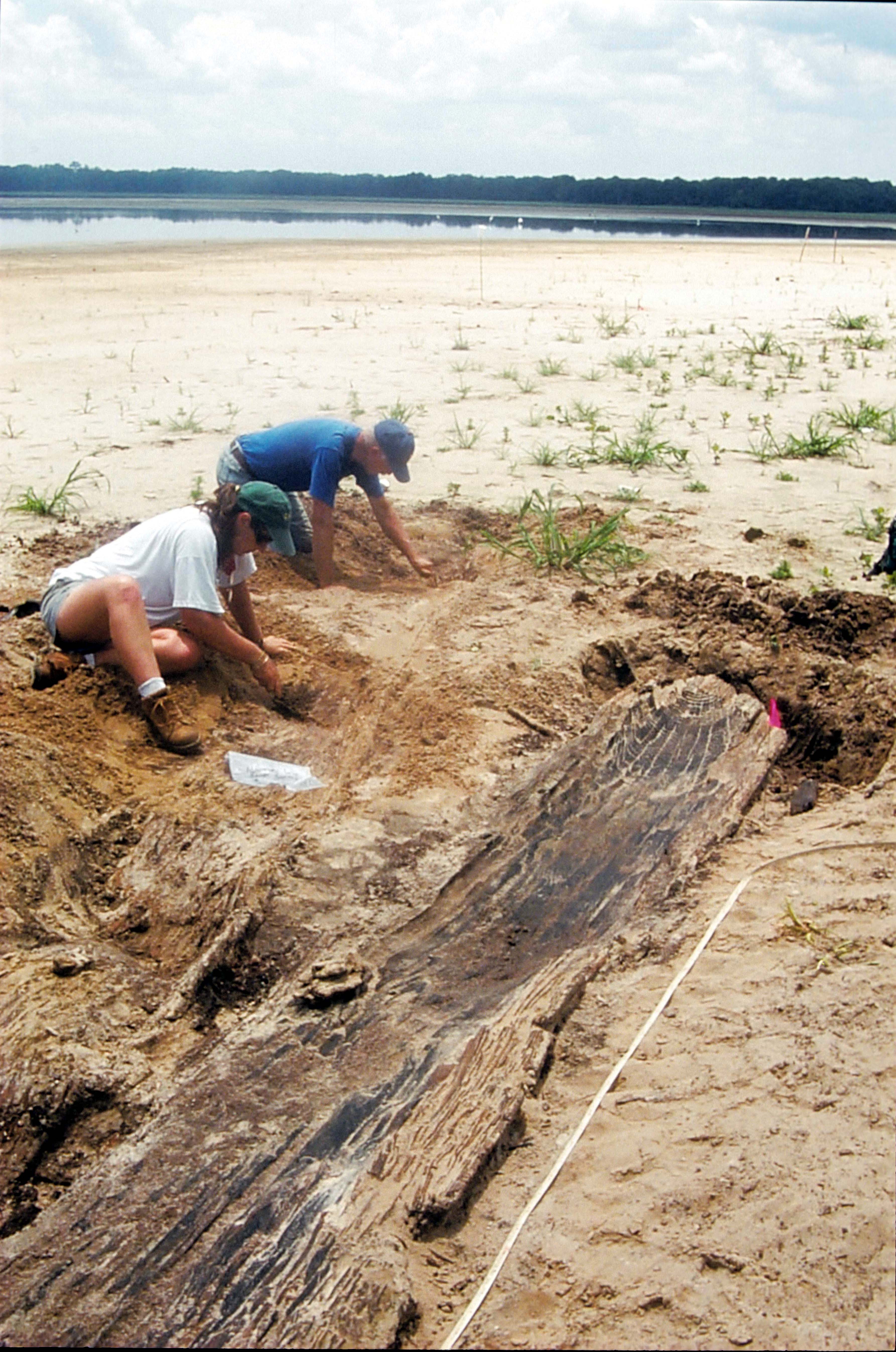
Archaeologists Christine Newman and Ray McGee excavate ancient dugout canoes at Lake Pithlachocco in 2000.

In 2000 Lake Pithlachocco (aka Newnans Lake—named after Daniel Newnan who led an illegal early nineteenth century invasion of Florida to wage war against the Spanish and Indigenous inhabitants) near Gainesville, FL dried up. I was an archaeologist with the Florida Division of Historical Resources at the time and we started getting calls about dugout canoes being found. We follow up and there were hundreds of canoes. We conducted a project and documented about 50, including many from 4,000 to 5,000 years old. These were all really old canoes! We published an article in 2003 in American Antiquity called Archaic Period Canoes from Newnans Lake, Florida. What struck me was the Seminole and Miccosukee response when some of the canoes were damaged by a man who was permitted by the state to remove old logs (deadhead logs) from the lake. You can look up the newspaper accounts. Without going into a lot of detail, the response was akin to that when human burial sites were disturbed. Oh, the original, Indigenous name of the lake—Pithlachocco—that means something like “boat house” or “place of boats” in the Creek language spoken by the Seminole. So, we have these supposed recent immigrants in the people that become the Seminole and Miccosukee acknowledging an ancient site. Is this a coincidence? Another bubble.

One of my jobs when I worked for the Division of Historical Resources was following up on reports of unmarked human burials, a responsibility of our office under state statute 872.05. This work, which I ultimately wrote an article about (September 2013, The Florida Anthropologist—Florida’s Unmarked Human Burial Law: A Retrospective, 1987-2010) put me in pretty regular contact with representatives of the Seminole and Miccosukee tribes. I learned a lot from this experience, especially from Fred Dayhoff, who was the NAGPRA representative for the Miccosukee. Fred was not a member of the tribe, but he had a long relationship with them, and dealt with the complicated issues of archaeology and ancestors and burials. I would let him know about discoveries and disturbances, he would consult with the tribal leadership and elders, then work with me on implementing some solution. As you will see, if you get a chance to read my 2013 article, the focus was on preservation in place and reburial. And long conversations with Fred, as well as the representatives from the Seminole tribe, made me again question what I had learned in school. There were connections between the Seminole, Miccosukee, and the ancient tribes, what NAGPRA refers to as affiliation. More bubbles.

Probably the last bubble came in 2009 or 2010 when we started to have meetings with the Seminole tribe’s Tribal Historic Preservation Office (THPO), helmed at that time by Paul Backhouse (you can read the book they wrote in 2017 called We Come for Good: Archaeology and Tribal Historic Preservation at the Seminole Tribe of Florida). I don’t remember what prompted the meetings, perhaps it was just the formation of the THPO office and some work to partner and collaborate more (I was Florida’s state archaeologist at that time). One of the meetings, at their offices there at Big Cypress, next to the Ah-Tah-Thi-Ki Museum, included some conversations with several of their cultural advisors. These were tribal members who were traditionalists, with deep knowledge of cultural practices, that served to advise the employees of the THPO. They explained, patiently, yet firmly, about the Seminole beliefs not just about ancestors, but about all archaeological sites. Even the most mundane and quotidian sites—little campsites with pottery fragments and animal bones from meals. These were the places where the ancestors had lived, where they had cooked, where they had raised their families. I was blown away. I had never made these connections. And, it was full circle—it was all about land and connections to place. The final bubbles. I realized that what I had learned in school, from my beloved teachers and professors, was just flat out wrong. And not just wrong, but harmful and hurtful to Indigenous people because it perpetuated the idea that somehow these Indigenous people were newcomers. Think about that—how crazy is that? We literally have a story that places Indigenous people as the newcomers after Anglo-Americans!
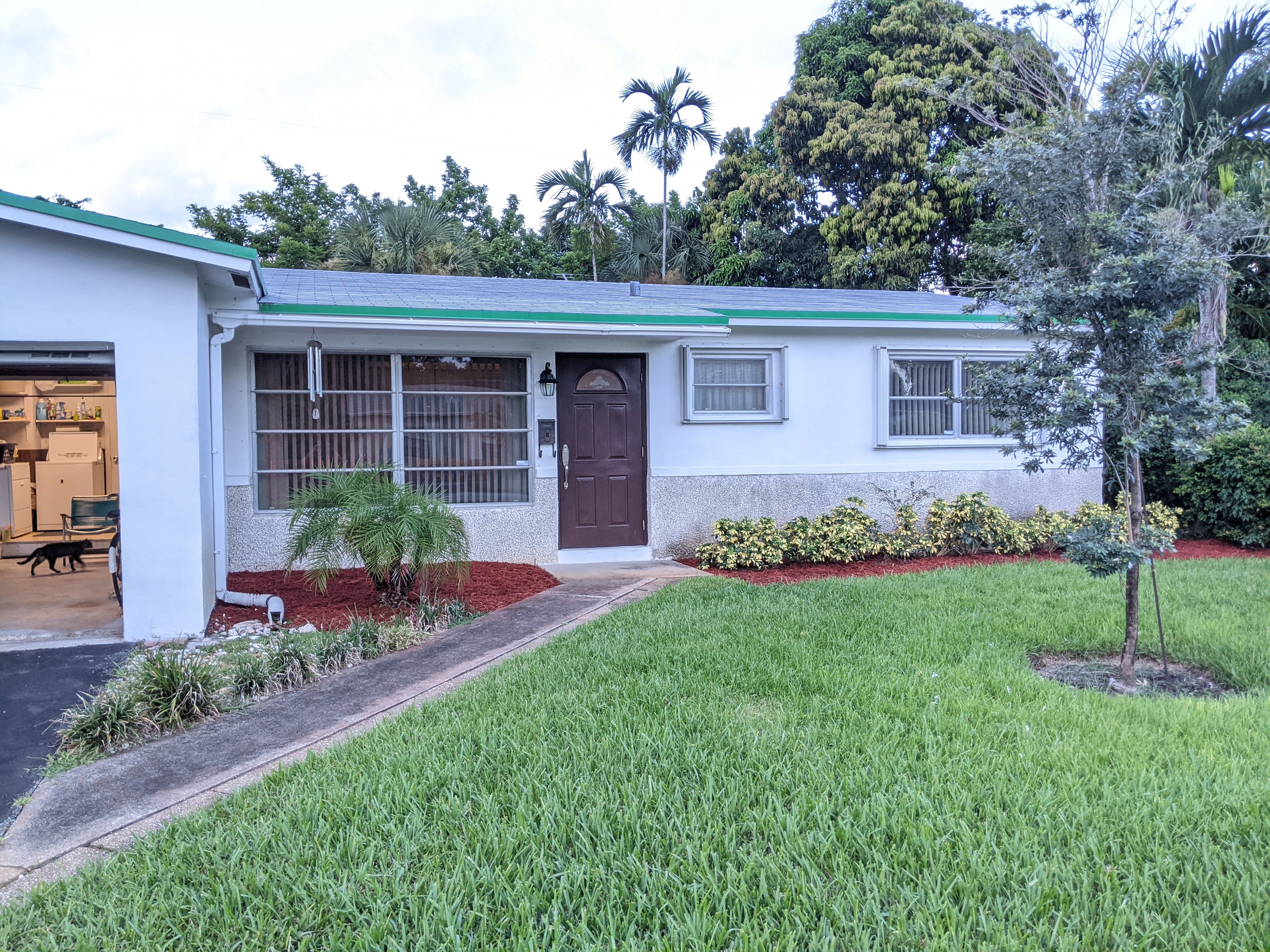
The author’s family home in Broward County, Florida, August 2021.

Last week I sold my family’s home in Florida—where my parents had lived since 1969 and where they had raised me. It was incredibly difficult to say goodbye to that place, and I expect it will remain challenging for a while. So many memories, so many connections. This is what those Seminole cultural advisors were sharing with me in 2009 or 2010. But not just fifty years of connections, millennia of connections. Generations upon generations of people all doing those human things that we all do.

In reflecting on all of this, I think a couple of things. One, I’m embarrassed that it has taken me so long to connect the dots, to see those bubbles breaking through the surface of what I had learned, and understanding that I needed to relearn history. I’ve been holding the threads of this history in my hand for a long time and I still don’t understand why it’s taken me so long to put it all together. What I learned was wrong. Maybe because our institutions, especially our educational institutions are powerful, and maybe too, because we respect and love our teachers. How could they be so wrong? Two, all of the Indigenous people, both in Florida and elsewhere, have been so patient with me. I’m not sure I deserve it, but they were and continue to be nothing but patient. They have always been there ready to help those bubbles break through the surface. I am so grateful for that patience and kindness. Three, in putting this in the context of NAGPRA and repatriation, the legal bar for affiliation is pretty low. The law requires a preponderance of the evidence, and that means slightly more than fifty percent. Looking back at the literature, oral history, and my own experiences, that requirement is met and exceeded. I don’t know the Smithsonian’s repatriation law (the Museum Act) like I do NAGPRA. Perhaps there are different requirements? But, both laws are about repatriation. These aren’t museum laws that help museum workers figure out how to hold onto ancestors and collections, they create processes for facilitating repatriation. That’s the intent, the goal. Four, I feel for my colleagues who haven’t figured all of this out yet. My message to them is, it’s not too late. Listen to people, listen to the tribes. Relearning history is hard, but it’s healing. Returning the ancestors doesn’t just heal Indigenous people and communities. This is trauma we all share, especially those of us who are archaeologists and historians, and we all need that healing. I hope this is helpful. I’m glad I had a chance to write this down. I’ve been wanting to write it down for a long time, but its hard.

As a coda to this message, I would note that things are changing. All of our institutions, from the Smithsonian down to our little museum in Andover, are colonial enterprises. There is no escaping that. And, many personnel at these institutions are stuck, because of policies and practices put in place by others, because of political pressures, whatever, to not support repatriation. While we are still part of the colonial machine, it is possible to change—some of this is generational. Younger people “get it.” The Society for American Archaeology (SAA) did a survey a few years ago and it demonstrated just this—and, the whole field has flipped. In the ‘80s when NAGPRA and the Museum Act were being debated, SAA and the American Alliance of Museums (the big museum organization) were oppositional, with a small minority of archaeologists and museum professionals recognizing that repatriation was a pathway to addressing some of the harm done by archaeology and museums. That is reversed now, largely on generational lines. As older professionals retire and leave the field, they are being replaced by younger people with new ideas who are learning all of the histories.

The organizations are changing as well. The January/February 2020 issue of Museum magazine, published by the AAM, was dedicated entirely to decolonizing, highlighting work done by museums, tribes, and Indigenous scholars and curators to change the relationships between museums and tribes. In July 2021, the SAA issued a draft statement on acknowledgment of the harm caused by archaeological practice. SAA members were asked for input on the statement, which followed the SAA’s adoption of a revised statement on the ethical treatment of human remains. This was the first time SAA had revisited this issue for more that 30 years–the previous statement on repatriation dated from the 1980s, prior to the passage of NAGPRA and the Museum Act. Just a few days ago, the Southeastern Archaeological Conference (SEAC) issued a statement supporting NAGPRA, including the following:

The Executive Committee of the Southeastern Archaeological Conference (SEAC) acknowledges the centrality of research on Indigenous cultures to the founding and perpetuation of our organization and discipline. Aspects of this history, in particular the treatment of ancestral human remains, have caused harm. We acknowledge this problematic history and seek to move forward in mutually respectful and productive partnerships with tribal nations. 

It’s our job as museum professionals, as archaeologists, as scholars, as educators, to not only educate ourselves, but to make sure students are learning the history and are given the tools to critically examine what they are being told.

JAE’s Institutional Review Board Policy

Contributed by Ryan Wheeler

In August 2021, the Journal of Archaeology & Education’s editorial board met via Zoom to consider a policy regarding Institutional Review Board or IRB approvals for research published in the journal. The IRB originated with the passage of the National Research Act in 1974 after a series of congressional hearings on human-subjects research, but can trace its origins to research that lacked informed consent, like the Tuskegee Syphilis Study, which began in the 1930s.

The JAE board agreed that since studies involving assessment and other types of educational research would normally require at least a minimal review, we needed to have an explicit statement that alerted author’s to the need for IRB approvals prior to executing their studies. Shortly after the meeting the JAE policy website was amended to include the following guidance:

All human subjects research results published by the Journal of Archaeology and Education (JAE) must be approved by an Institutional Review Board (IRB) or an equivalent entity in the author’s country. The purpose of IRB review is to assure, both in advance and by periodic review, that appropriate steps are taken to protect the rights and welfare of people participating as subjects in your research. If you do not have an IRB affiliated with your organization, you must find a suitable IRB at a qualified university or other institution. Most universities have IRBs that will accept applications from outside their institution. Authors, especially those without an academic affiliation, could use an independent IRB, which is subject to the same federal regulations as universities. There may be fees associated with university and independent IRB reviews. The IRB protocol number assigned by your IRB must be included in the article. Manuscripts without IRB approval will not be considered for publication in JAE.

IRB policies at journals in medicine, psychology, and other fields that rely heavily on human-subjects research are usually brief. We felt, however, that the JAE policy needed to provide extra guidance as archaeologists expand their research to encompass educational studies on the effectiveness of teaching, assessment, work with students, and more. If you have questions about the JAE policy or how it might apply to your research, please contact the editors Jeanne Moe or Ryan Wheeler.

Nominations Open for Education Awards

Contributed by Ryan Wheeler

The Peabody has a long history with the Society for American Archaeology (SAA), dating back to the origins of the society in the mid-1930s. Carl Guthe, who had served as Alfred Kidder’s assistant on excavations at Pecos Pueblo, organized the society in 1934 and the first meeting was held at Phillips Academy a year later. Connections between the Peabody and SAA continued throughout the twentieth century and still exist today.

In 2020, the Peabody and the SAA partnered to create a new award honoring individuals and organizations dedicated to archaeology and education. The Robert S. Peabody Institute of Archaeology Award for Archaeology and Education recognizes excellence of individuals or institutions in using archaeological methods, theory, and/or data to enliven, enrich, and enhance other disciplines, and to foster the community of archaeology education practitioners. The Peabody Award will spotlight these contributions and promote teaching ideas, exercises, activities, and methods across the educational spectrum, from K-12 through higher education and including public education broadly conceived. Diving with a Purpose was the inaugural award winner in 2021.

I’ve had the honor of helping to create the Peabody Award as chair of the SAA’s teaching awards subcommittee, and to help launch the Binford Family Award for Teaching Critical Thinking in Archaeology, which is new this year. The Binford Family Award encourages curriculum development with a deliberate focus on teaching critical thinking and scientific reasoning skills in archaeology courses at any level, to reward individuals or institutions that develop excellent examples of such curricula, and to promote the sharing of ideas and materials relating to these efforts.

Both the Peabody and Binford awards include a $1,000 prize. Nominations are open to both members and non-members of SAA, as well as those based in the United States or internationally. The nomination deadline is December 1, 2021.

Details about each award and how to make a nomination can be found on the SAA website:

Robert S. Peabody Institute of Archaeology Award for Archaeology and Education

Binford Family Award for Teaching Critical Thinking in Archaeology

Questions about either award may be directed to me, Ryan Wheeler, at rwheeler@andover.edu

3D Printing and Human Origins

Contributed by Ryan Wheeler

The return to in-person classes means that this fall’s Human Origins includes many of the hands-on project-based assignments that have become a hallmark of the course.

Makerspace guru Claudia Wessner introduces Human Origins students to 3D printing.

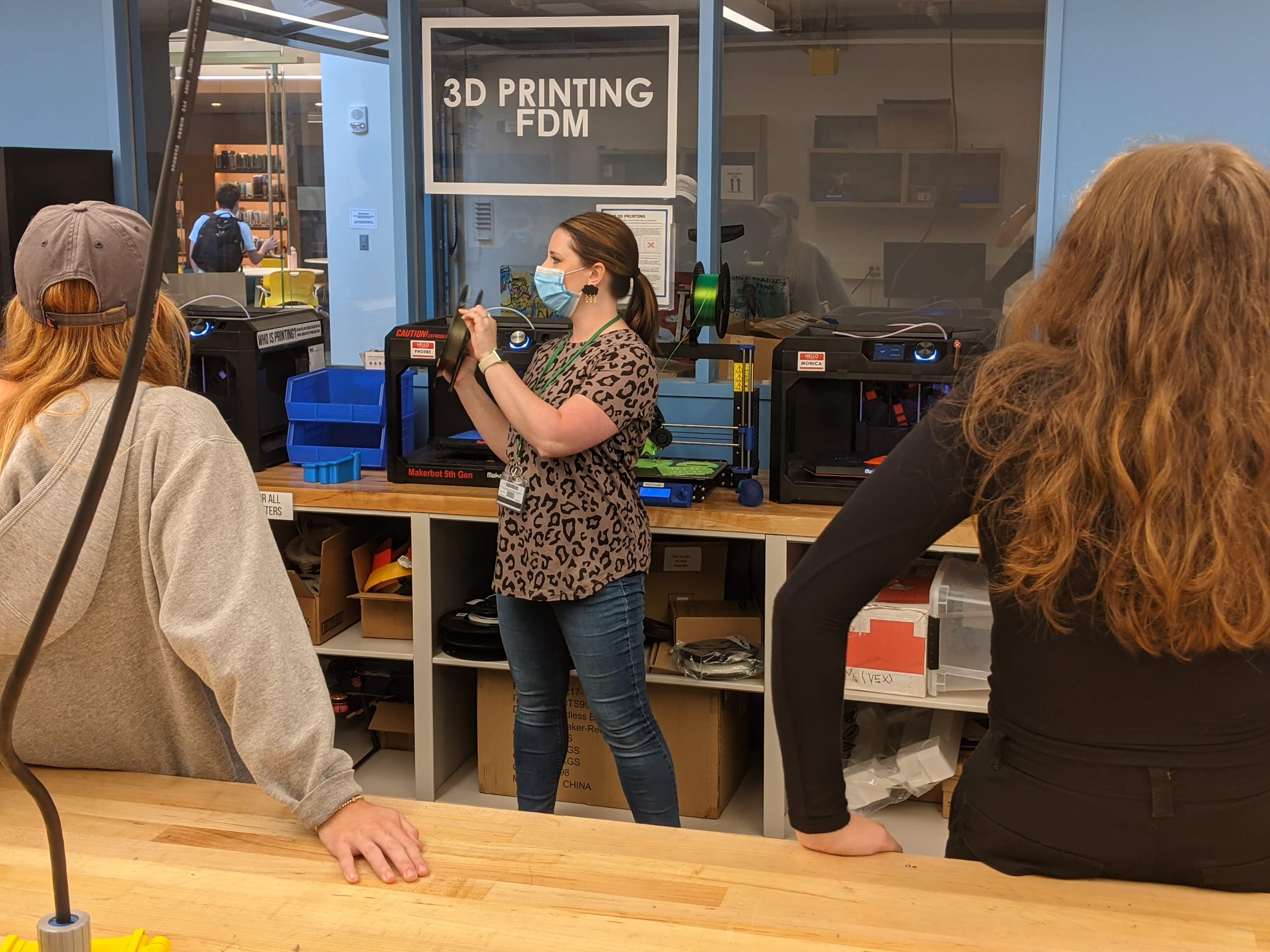
Students in Human Origins—an interdisciplinary science elective—visited with Claudia Wessner, Oliver Wendell Holmes Library Makerspace guru—who introduced the class to our hominin 3D printing project, including different 3D printing technologies, some of the ways that archaeologists use 3D printing and scanning, and Virtual Reality (VR) technology. Ms. Wessner also showed students how to use the Makerspace 3D printers for their projects.

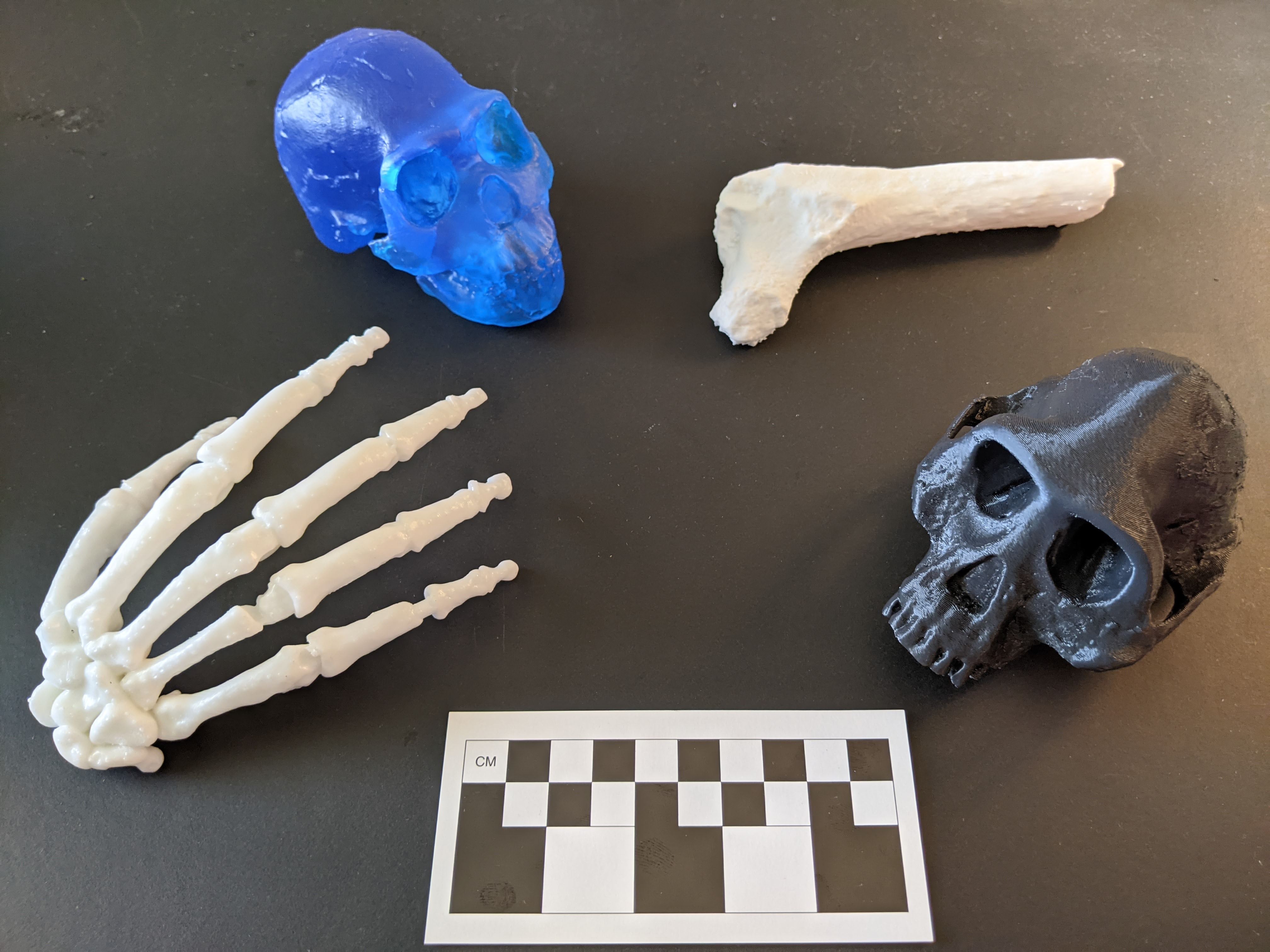
An assortment of 3D hominin prints.

Each project team will select a fossil hominin to 3D print in the Makerspace. Hominins are humans and their close extinct ancestors, including fossils dating back about 6 to 7 million years ago. Students will present their scaled prints, along with basic info on the fossil, during class in a few weeks. This project was inspired by the inclusion of 3D scans of Homo naledi in Morphosource, a database of 3D scans of fossils and biological specimens hosted by Duke University. Since the Homo naledi scans were made available in 2015, many additional fossil scans have been added, including other hominins.

CT scan of a Neanderthal from Duke University’s Morphosource databank.

During our September 2021 visit to the Makerspace, Ms. Wessner introduced us to Nefertari: Journey to Eternity-A Tombscale VR Experience. VR technology uses a headset interface so users can experience a virtual world, in this case an Egyptian tomb that has been scanned and recreated. We also discussed The Dawn of Art, Google’s VR version of Chauvet Cave in France, featuring some of the world’s oldest cave paintings.

Human Origins students got to explore Nefertari’s tomb in VR or Virtual Reality.

To learn more about 3D scanning and printing in paleontology and archaeology take a look at the Virtual Curation Lab at Virginia Commonwealth University and University of South Florida’s Digital Heritage and Humanities Collection, each featuring different ways that 3D technology is used today.

Check back as we update this blog with the student 3D prints!

Miniatures Meet Fossil Humans

Contributed by Ryan Wheeler

In July, I start to think about the upcoming fall course Human Origins. Last year I spent most of the summer retooling the course into an online experience. I owe a lot to the advice of my spouse, who passed along many of her experiences teaching online in spring 2020. I was pleased with the result—an iterative, assignment driven course, taught exclusively online, that even managed to keep some hands on activities. In fact, I plan to keep many elements of the online course—students in the fall will use Padlet for many of their assignments, we will dedicate at least two weeks to flint knapping, and we will keep the three major themes: pseudoscience, human evolution, and race. I will continue to look for ways to decolonize the syllabus as well. Considering the frequency of new discoveries (Google “Dragon Man,” for example), the focus is more on how to think about human evolution, rather than the details. The frequent new discoveries in the field continue to challenge the two competing models of human evolution, making us wonder, maybe we really need a new theory?

3D prints of fossil hominin skulls made by students in Human Origins, fall 2019.

I hope that we can revisit 3D printing again in the fall. Once many of the skeletal elements of Homo naledi became available on Morphosource, 3D printing became part of the course. For a few years, we visited the campus makerspace and looked at prints of Homo naledi’s more unusual features, including the hand and femur. In fall 2019, students worked in teams to 3D print their own miniature versions of fossil human skulls, learning details about each find and species as part of the assignment. Those miniature 3D prints got me thinking about earlier models and teaching tools for this subject, and my own first interests in human evolution.

Part of the foldout “March of Progress” graphic from Time Life’s Early Man book, circa 1970.

My first inkling that human evolution was something to be interested in came from a mid-1970s rebroadcast of a documentary called Natural History of Our World: The Time of Man (first aired, December 14, 1969). I wanted to watch this for two reasons: 1) Richard Basehart, who played Admiral Nelson in one of my favorite TV shows, Voyage to the Bottom of the Sea, provided the narration, and 2) I wanted to know more about the fossils shown in the teaser ads! I think my parents were a little baffled, but they let me stay up and watch it. I don’t remember much about that show, but it included some pretty incredible shots of volcanic activity and, of course, Basehart’s distinctive voice. Not long after that, my dad brought home a set of the Time Life nature books, with the 1970 edition of Early Man right on the top (it looks like Early Man was first published in 1965, but there were many reissues). That book captivated me! Books on dinosaurs, fossils, and evolution (for someone who was a kid, or perhaps anyone, really), were in short supply in the 1970s. I still share that book with students in Human Origins, and we talk about the many errors of the “March of Progress” graphic that launched a thousand memes. For a kid in the ‘70s interested in evolution, that book—authored by a serious scientist, H. Clark Howell—was a treasure.

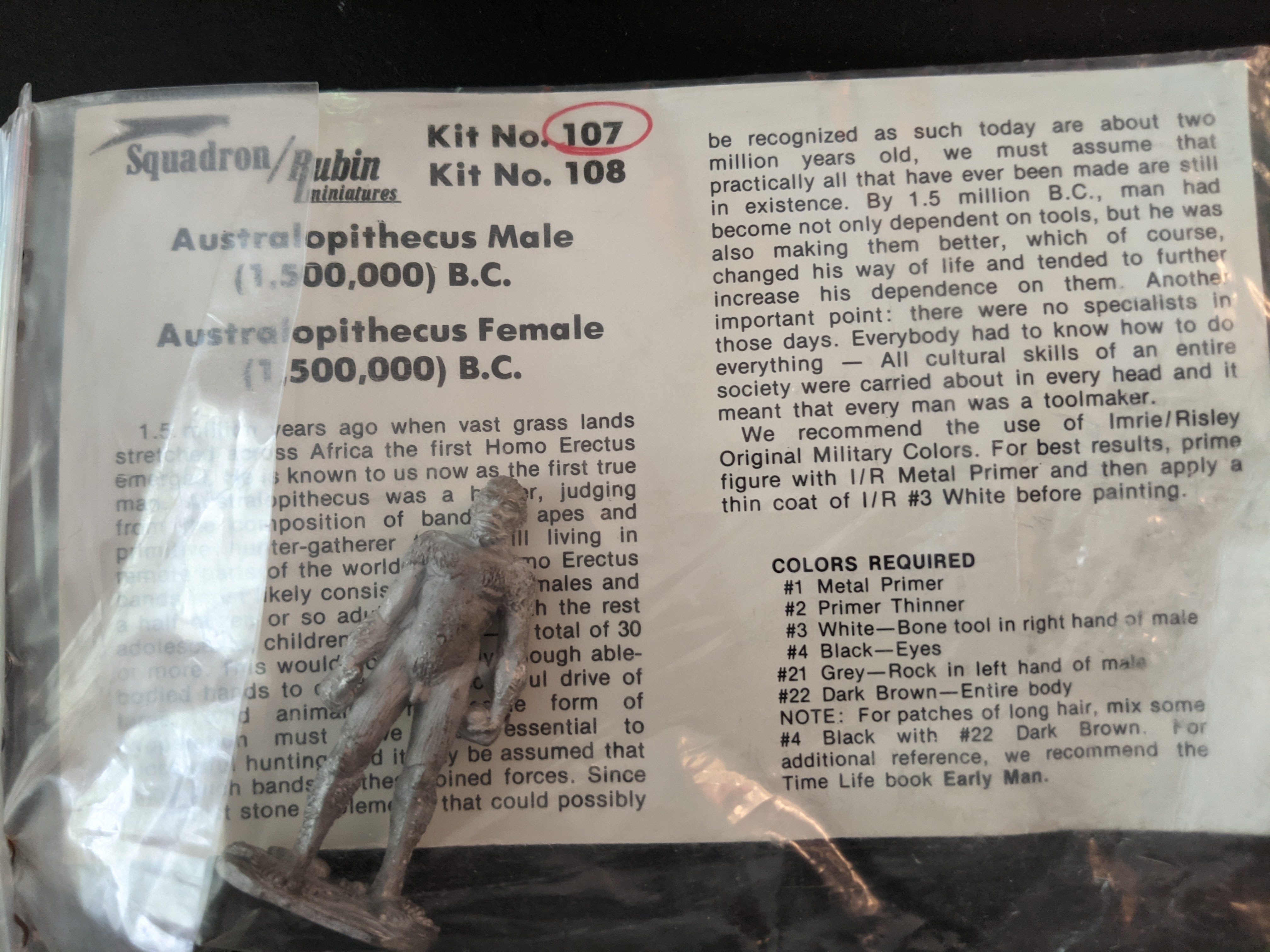
Squadron Rubin’s “Neanderthal man” figure with original packaging and color chart.

So imagine my delight when I found a tangible, material version of those fossil people. The discovery was in an unlikely place—the local hobby shop. I was interested in model kits, but the little metal figures of warriors, Vikings, and dragons were especially exciting. These were becoming more popular with the rise of the role playing game Dungeons & Dragons, and various alliances and licensing deals between the D&D publishers and companies like Grenadier who made these miniatures, or minis. There among the heros and monsters of D&D (think of the current TV show Stranger Things), were some old stock made by a company called Squadron Rubin. These were figures of all the fossil humans found in the pages of the Time Life Early Man book, and the color cards even referenced the book! Some Googling indicates that artist, sculptor, and businessperson Raymond Rubin was behind these figures. The main figures made by Squadron Rubin were of historical soldiers, spanning the Picts to Vietnam and every period in between. The idea was that you could buy these, glue as necessary, and paint following the color chart provided, building up your army. Eventually Rubin collaborated with others to launch Grenadier, the company that dominated the metal miniature business for a while. I wish I knew more of the story behind how the world of metal miniatures intersected with human evolution, but I was happy that it had!

The Squadron Rubin Australopithecus male figure with color chart!

The Squadron Rubin fossil people are 1:32 scale, so most are around or just under 2 inches tall. And, they aren’t frenzied savages like the “cavemen” depicted by Frank Frazetta or other artists around the same time. The artistic recreations in the Early Man book supplied the inspiration, and the figures are usually just posing, often in male-female pairs. I’ve managed to locate examples of Squadron Rubin Neanderthals, Australopithecines, and Cro-Magnon people, and I suspect there were other species depicted as well. Occasionally, they turn up on eBay.

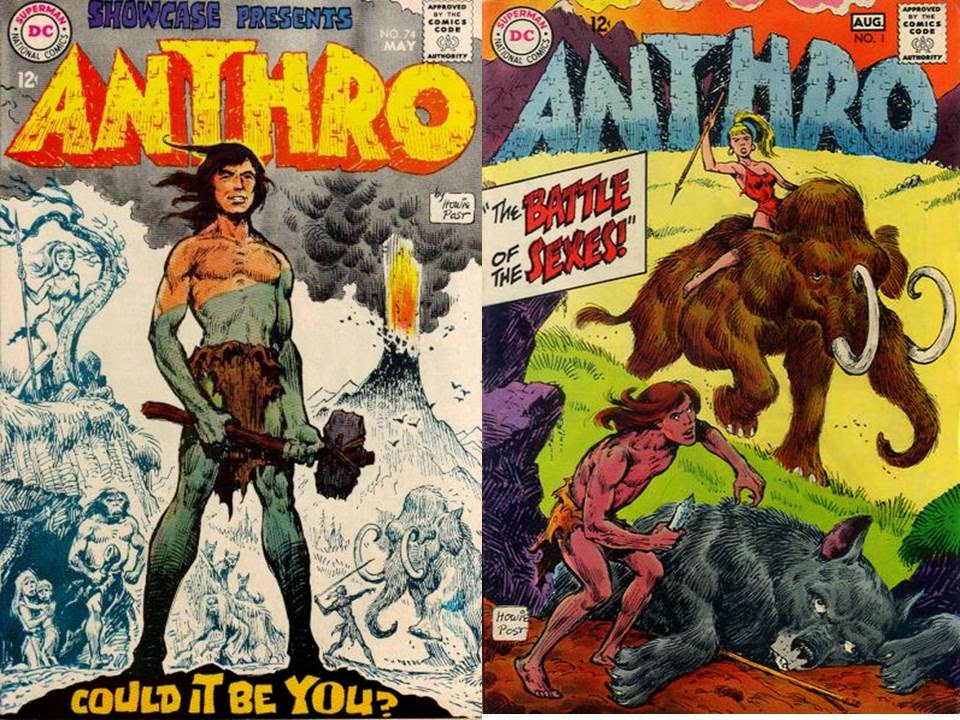
Covers from DC Comic’s “Anthro,” which pitted the first Cro-Magnon (or modern human) against an array of cave brutes and prehistoric monsters, late 1960s.

The Squadron Rubin figures, along with the many other depictions of fossil humans in popular writing, TV ads, comic books, movies, artwork, and sculptures give us a glimpse into thinking about human evolution and fossil people through time. I often ask the Human Origins students to find and research examples of how fossil humans were depicted in popular culture. Are the treatments sympathetic, savage, sexualized, or something else? Often this has to do with ideas about how closely modern humans are linked to these ancient people. The recognition of genetic connections between modern humans and Neanderthals in 2011 marked one shift in our relationship to “cavemen.” Once we understood there was a connection between us and them, depictions of ancient people began to shift, becoming more sympathetic and sensitive to our ancestors. But, it depends a lot on the artist, medium, and specific circumstances.

JAE Publishes Special Issue on Doing and Teaching Archaeology Online

Contributed by Ryan Wheeler

May 2021 saw the publication of special issue “Perspectives on Teaching, Learning, and Doing Archaeology and Anthropology Online” in the Journal of Archaeology and Education. Nine timely articles address the big picture and specific case studies in teaching archaeology and anthropology online—something that many of us have gained new experience in during the pandemic. And, while most institutions are looking to a return to in-person teaching, these articles, organized by David Pacifico and Rebecca Robertson, and based on the 2018 American Anthropological Association roundtable session “Teaching and Learning Anthropology Online,” make the case that teaching archaeology and anthropology online is not only possible, but can be done well and comes with some benefits. For example, Russ Bernard makes the case in his article that “online education is the only way to scale up training in statistics and research methods for both graduate students and undergraduate students of anthropology,” helping to forge more and better connections between our academic departments and employment. Michael Wesch, in his contribution, describes anth101.com, an online course that “is organized around 10 big lessons that attempt to help students embody the ‘ethos’ of anthropology, including … the ability to ask big questions, try new things, see patterns, see the big picture, see the little things that matter, and overcome fear, hate, and ignorance to empathize with others and understand cultural differences.” Check out this great special issue and all it has to offer at JAE today! And, many thanks to JAE editor Jeanne Moe and JAE guest editor Katie Kirakosian for their work on the special issue, and to the authors for sharing their work in JAE!

The Journal of Archaeology and Education is a peer-reviewed, open-access journal dedicated to disseminating research and sharing practices in archaeological education at all levels. We welcome submissions dealing with education in its widest sense, both in and out of the classroom—from early childhood through the graduate level—including public outreach from museums and other institutions, as well as professional development for the anthropologist and archaeologist. The journal’s founders recognize the significant role that archaeology can play in education at all levels and intend for The Journal of Archaeology and Education to provide a home for the growing community of practitioners and scholars interested in sharing their first-hand experiences and research.

JAE was founded at the Robert S. Peabody Institute of Archaeology, where archaeology is used to support high school curricula at Phillips Academy, and is hosted at the University of Maine’s Digital Commons website.

Cutshamache and Cochichawick

Contributed by Ryan Wheeler

What is now called Andover, North Andover, and parts of Lawrence, Massachusetts were once Cochichawick. This is the Indigenous name for the place where many of us work and live. The name persists in Lake Cochichewick in North Andover, Essex County’s largest lake. Indigenous leader Cutshamache transferred the land to English colonists, not through a deed, but rather in an agreement ultimately attested before the General Court of the Massachusetts Bay Colony:

At a General Court, at Boston 6th of the 3rd m, 1646 (in the Gregorian calendar, May 16, 1646)

Cutshamache, sagamore of the Massachusets, came into the Court, and acknowledged that for the sum of 6 pounds & a coat, which he had already received, he had sold to Mr. John Woodbridge, in behalf of the inhabitants of Cochichawick, now called Andover, all his right, interest, and privilege in the land six miles southward from the town, two miles eastward to Rowley bounds, be the same more or less, northward to Merrimack River, provided that the Indian called Roger & his company may have liberty to take alewifes in Cochichawick River, for their own eating; but if they either spoil or steal any corn or other fruit, to any considerable value, of the inhabitants there, this liberty of taking fish shall forever cease; and the said Roger is still to enjoy four acres of ground where now he plants. This purchase the Court allows of, and have granted the said land to belong to the said plantation forever, to be ordered and disposed of by them, reserving liberty to the Court to lay two miles square of their southerly bounds to any town or village that hereafter may be erected thereabouts, if so they see cause.

Cutshamache acknowledged this before the magistrates, and so the Court approved thereof, and of the rest in this bill to be recorded, so as it prejudice no former grant.

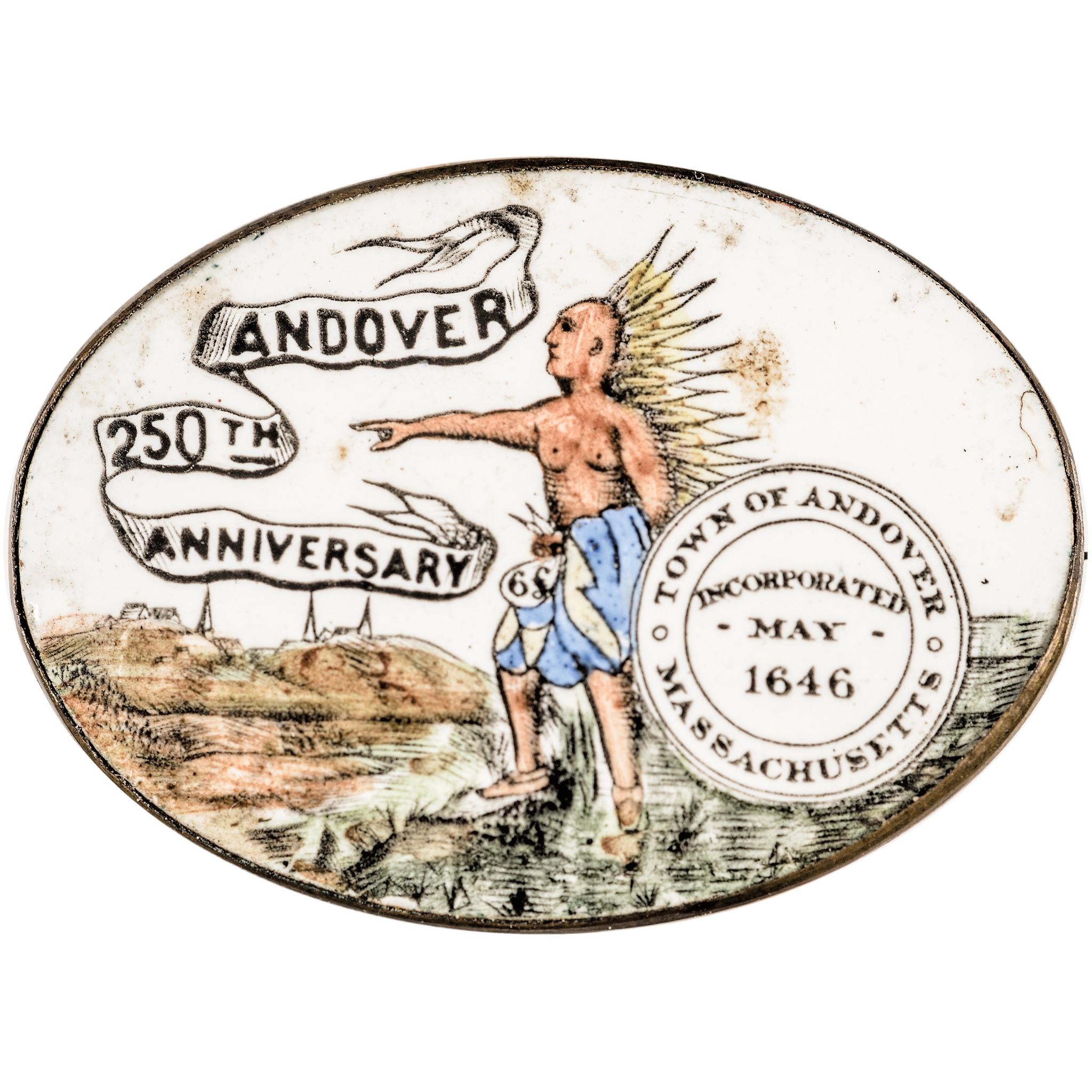
Enamel pin created in 1895 by John E. Whiting to commemorate Andover’s 250th anniversary, the origin of the town seal featuring Cutshamache. Collection of the Robert S. Peabody Institute of Archaeology.

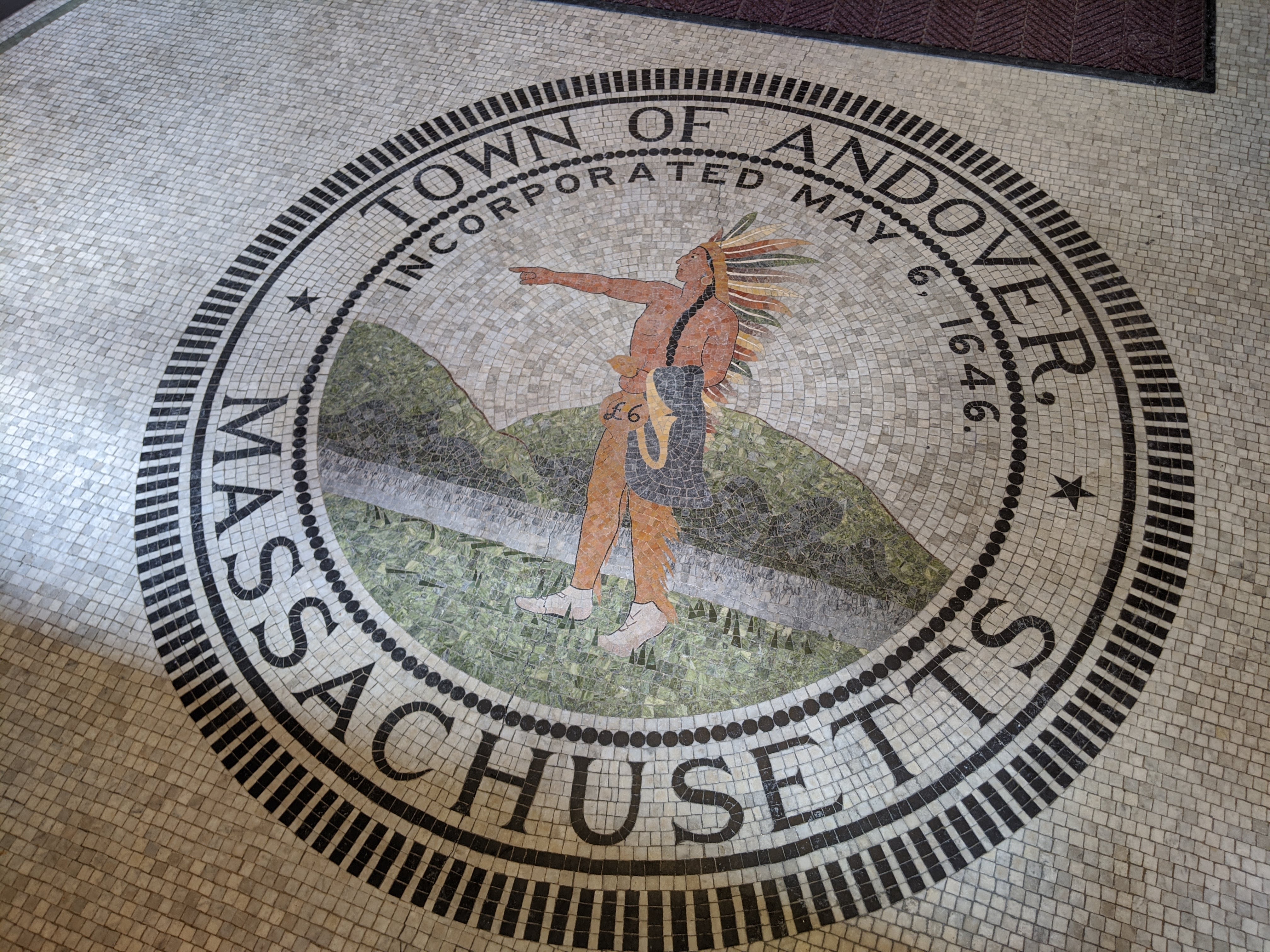
The story and its protagonist feature prominently in Andover’s 1895 town seal, where we see Cutshamache holding the coat, part of his payment for the land. Cutshamache appears frequently in the seventeenth century records of the English colony in Massachusetts, ranging from his involvement in the Pequot War to skepticism about missionary John Eliot’s preaching (see Drake 1856). Frank Speck (1928:141), in his discussion of the Punkapog Band of Massachusett, mentions that “the name and pronunciation of Kitchamakin or Cutshamekin are still remembered.” For us, his involvement in selling a large portion of Andover, North Andover, and Lawrence to John Woodbridge sometime in the early 1640s is of greatest interest. Local histories, in books, articles, and now online, frequently repeat the story, and tweak it to fit whatever narrative is being told. In some cases, the currency is converted into modern dollars (a pretty complicated exercise), and in other variants, Cutshamache is described as a Pennacook leader (see the Wikipedia entry for the Town of Andover). The latter makes sense, since the Pennacook, helmed by their leader Passaconaway, are associated with the area around Andover. However, Cutshamache does not appear to have been Pennacook, but was rather a Massachusett leader who lived in what is now Dorchester. The General Court statement clearly identifies him as such. But, this is puzzling, since Dorchester is pretty far from Andover. So what’s going on?

Many authors suggest a family connection between Passaconaway and Cutshamache, possibly based on Sidney Perley’s assertion (1912:35), though I have found no primary sources to support this and this suggested link may just be a way to help explain Cutshamache’s involvement in the sale of the Andover lands. Passaconaway does seem to have created alliances through marriage that crosscut ethnicity and relied more on cultural similarities, creating a heterogeneous coalition distinct from the more homogenous Massachusett (see Cook 1976:29; Stewart-Smith 1998:24-25). What’s more intriguing is the sale of Haverhill in 1642 by Native leaders Passaquo and Saggahew required the consent of Passaconaway (in fact, his consent is mentioned twice in the text of the deed). See the original document and transcript on the Essex National Heritage Area website. The General Court acknowledgment of the Andover, North Andover, and Lawrence sale does not mention Passaconaway, suggesting several possibilities. Perhaps Cutshamache’s less formal court appearance resulted in an omission. But, the court statement includes considerable detail, including the preservation of land and fishing rights for Roger and his company, Indigenous residents of the area.

Tile mosaic version of Andover’s town seal in the foyer of the Town Hall by Perley Gilbert and Elias Galassi. Photograph by Ryan Wheeler, February 3, 2020.

Archaeologist Eric Johnson (1999:155), in his book chapter on Native political geography, provides a different way of thinking about Indigenous groups in the area during the seventeenth century that helps inform Cutshamache’s sale of Cochichawick. Johnson says, “What does a map of bounded tribes imply about political organization? It implies stasis and homogeneity, both within and among political units.” He attributes this to the desire of colonial European observers to describe unfamiliar people and places in a familiar way—through the lens of political organization in seventeenth century Europe. This plagues our understanding today—we want carefully delineated maps that show the boundaries of Indigenous lands, matching those of city, county, and state political entities. Johnson (1999:158) argues for a different model to understand the geography of the area that takes into account the dynamic and heterogeneous polities. Further, he suggests that groups in the region consisted of autonomous communities that regularly underwent expansion, contraction, and internal upheaval, depending on a variety of socio-political strategies at play among leaders and group members. Alliances, often transitory, could result in confederacies of autonomous groups, as well as splintering and new alliances. Confederations were based on real and fictive kinship relationships between principal leaders and those of local communities; autonomy of local communities varied greatly depending on the leadership qualities of the principal leader, overall group size, geographic distances between communities, and genealogical connections (Johnson 1999:161). Within this context, Kathleen Bragdon (2009:206-209), in her second book on the Native people of the Northeast, points to connections between Indigenous communities across the region, stating, “linkages between the Pennacooks and Pawtuckets of the Merrimac drainage of what is now northeastern Massachusetts and southern New Hampshire, show connections ranging as far south and east as Natick and Charlestown. Other historical evidence shows marriage ties between Pennacooks and Pawtuckets with Niantics and Wamesits as well.”

Intertribal relations just at the time of European conquest illustrate the linkages that likely characterize the area. After the devastating epidemic of 1619, Indigenous allies of the French raided the lower Merrimack. Passaconaway was the Pennacook sachem at the time. His Pawtucket counterpart, Nanepashemet, was killed around present-day Medford or Malden and his widow assumed the role of sachem. Two of her sons married Passaconaway’s daughters, cementing the Pennacook-Pawtucket alliance. According to historian David Stewart-Smith (1998:24-25), Passaconaway (also called Papisseconnewa) was acknowledged as the leader of Pawtucket, Agawam, and Piscataqua, though each group retained local leaders as well. He explains that it is helpful to think of the larger tribal designations as “aggregations of allied family territories,” including Pennacook, Pawtucket, Massachusett, Nipmuc, and others (Stewart-Smith 1998:28). The divisions were not hard lines, but rather fluctuated with marriages and other connections.

View of Lake Cochichewick from the Brooks School, North Andover Massachusetts, January 15, 2012. John Phelan, CC BY 3.0 https://creativecommons.org/licenses/by/3.0, via Wikimedia Commons

Historian Peter Leavenworth (1999:277) explains the ways in which Pennacook-Pawtucket lands moved into English ownership in the seventeenth century, principally through legal means, but also via violent incursions. He also documents important instances where Indigenous people resisted land loss. Leavenworth describes a violent attack against the Pennacook during King Philip’s War (1675-78), but helps us understand that the extensive transfers of land, through deeds or appearances in the General Court like Cutshamache’s, occurred during the 1640s, following the smallpox epidemic of 1633-34 and decisions by Passaconaway, including the belief that Indigenous people could share land with the English. According to Leavenworth (1999:281), there were serious misunderstandings in terms of what was happening, especially as these more informal land “sales” occurred: English colonists believed they were buying large tracts of land, while the Indigenous “sellers” believed they retained their usufruct rights. This is reflected in Cutshamache’s sale of Cochichawick, which references Roger and his group’s continuing rights to at least some small part of the landscape and fishing rights (check out this interactive map site that shows Rogers Brook in Andover, namesake of the seventeenth century Indigenous inhabitant). Leavenworth also documents an interesting shift in acceptable payment—at first the English were buying land for clothing, tools, ornaments and other trade goods, but apparently by 1650, the Indigenous people of the area would only accept currency. Cutshamache’s sale involves both—6 pounds in money, and a coat (interestingly, an earlier order by the General Court in 1642 directed that a coat be given to Cutshamache, perhaps the coat referenced in the 1646 appearance?).

So, there’s a lot to unpack in Cutshamache’s sale of Cochichawick. Most notable are the traditional cultural patterns that involved seasonal movements, settlement, and marriage that linked widely dispersed groups versus our modern desire to have Indigenous people fit into neat territories that align with historical and modern municipal, county, state, and national boundaries. It’s also impossible to think about this outside the devastating disruptions wrought by European incursions and the attendant diseases and demographic shifts (Strobel 2020:71-75). For example, Daniel Gookin, one of the English colonists, recorded 3,000 Pawtucket men in the earliest days of European conquest, but by 1674, the tribe had been reduced to “not above 250 men.” Within this milieu—traditional Indigenous practices, the disease and disruptions brought by the English, and attempts to adapt—land moved from Native to European hands.

For an Indigenous perspective, check out the detailed histories, timelines, and more on the Massachusett Tribe at Ponkapoag’s website. Here you can learn about the modern day Massachusett, their history, as well as ongoing initiatives, like work on the newly created Massachusetts state seal commission. If you would like to learn more about the Abenaki tribes in nearby New Hampshire and Vermont, start with the website of the Cowasuck Band of the Pennacook-Abenaki. There you can learn about history and contemporary initiatives of the Abenaki, who have close ties to the Native inhabitants of the Andover area.

References Cited and Further Reading

Bragdon, Kathleen J.

2009 Native People of Southern New England 1650 – 1775. University of Oklahoma Press, Norman.

Cook, Sherburne F.

1976 The Indian Population of New England in the Seventeenth Century. University of California Publications in Anthropology Vol. 12. University of California Press, Berkeley.

Drake, Samuel G.

1856 Biography and History of the Indians of North America, from its first discovery. Sanborn, Carter, and Bazin, Boston.

Johnson, Eric S.

1999 Community and Confederation: A Political Geography of Contact Period Southern New England. In The Archaeological Northeast, edited by Mary Ann Levine, Kenneth E. Sassaman, and Michael S. Nassaney, pp. 155-168. Bergin & Garvey, Westport, CT.

Leavenworth, Peter S.

1999 “The Best Title That Indians Can Claime:” Native Agency and Consent in the Transferal of Penacook-Pawtucket Land in the Seventeenth Century. The New England Quarterly 72(2):275-300.

Perley, Sidney

1912 Indian Land Titles, Essex County, Massachusetts. Riverside Press, Cambridge (for Essex Book and Print Club).

Speck, Frank G.

1928 Territorial Subdivisions of the Wampanoag, Massachusett, and Nauset Indians. Indian Notes and Monographs No. 44. Museum of the American Indian, Heye Foundation, New York.

Stewart-Smith, David

1998 The Pennacook Indians and the New England Frontier, circa 1604 – 1733. PhD dissertation, Union Institute, Cincinnati OH.

Strobel, Christoph

2020 Native Americans of New England. Praeger, Santa Barbara CA.

Need Help with NAGPRA?

Contributed by Ryan Wheeler

The Native American Graves Protection and Repatriation Act became law thirty years ago. NAGPRA fundamentally changed the relationship between tribes, archaeologists, and museums, but there are still many challenges. Museums have over 120,000 Native American ancestral remains and some institutions have not yet consulted with tribes.

Image of tribal representatives in the Peabody Institute collection space with Marla Taylor, curator of collections
Marla Taylor (right), Peabody curator of collections, with Nekole Alligood (left) and Susan Bachor, representatives of the Delaware tribes, during a consultation meeting.

At the New England Museum Association annual meeting in November 2020 the Peabody Institute partnered with experts from tribes, museums, and federal agencies to answer questions about and discuss NAGPRA in a relaxed, welcoming, and no pressure workshop format. Seventy museum professionals participated, and we’ve had an opportunity to follow up with many of those folx since the workshop.

Representatives from the White Earth Band of Chippewa Indians during a repatriation with members of the Peabody Institute staff. From left to right: Bob Shimek, Kayla Olson, Ryan Wheeler, Merlin Deegan, and Bonnie Sousa.

But don’t fear! If you couldn’t make the November workshop, we are still available to help you, wherever you are in the process. NAGPRA might seem a little daunting at first, so if you would like to chat with Peabody Institute personnel, or get some specific advice on how to move forward, we are here to support you. Contact Peabody Institute director Ryan Wheeler at rwheeler@andover.edu to set up a time to talk.

NAGPRA Resources

NAGPRA Community of Practice: Hosted by the University of Denver, this is a great space to ask questions and connect with others engaged in repatriation. Consider joining one of the Zoom calls that happen twice a month: https://liberalarts.du.edu/anthropology-museum/nagpra/community-practice

National NAGPRA Website: This is the National Park Service’s newly redesigned website with everything you need to get started, including links to the NAGPRA law and rule, databases, templates, and advice on how to get started: https://www.nps.gov/subjects/nagpra/index.htm

NAGPRA Data Visualization: Curious about how NAGPRA has been implemented in your area or across the country? Check out Melanie O’Brien’s NAGPRA Data Visualization on Tableau: https://public.tableau.com/profile/melanie.obrien#!/vizhome/NAGPRA-Totals/1_Reported

No Vikings at the Peabody

Contributed by Ryan Wheeler

The Robert S. Peabody Institute of Archaeology is not known for its Viking collections, or are we?

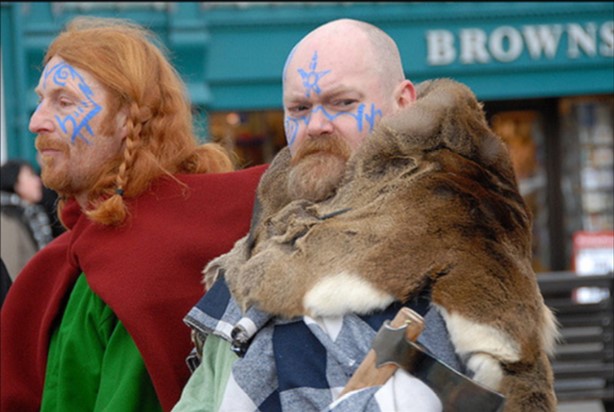
Vikings shopping in York. Bryan Ledgard, CC BY 2.0 https://creativecommons.org/licenses/by/2.0, via Wikimedia Commons

One object, donated to the Institute by Dr. C.A. Kershaw in the early twentieth century, is repeatedly cited as evidence for Viking visitors to Massachusetts long before the days of the Pilgrims.

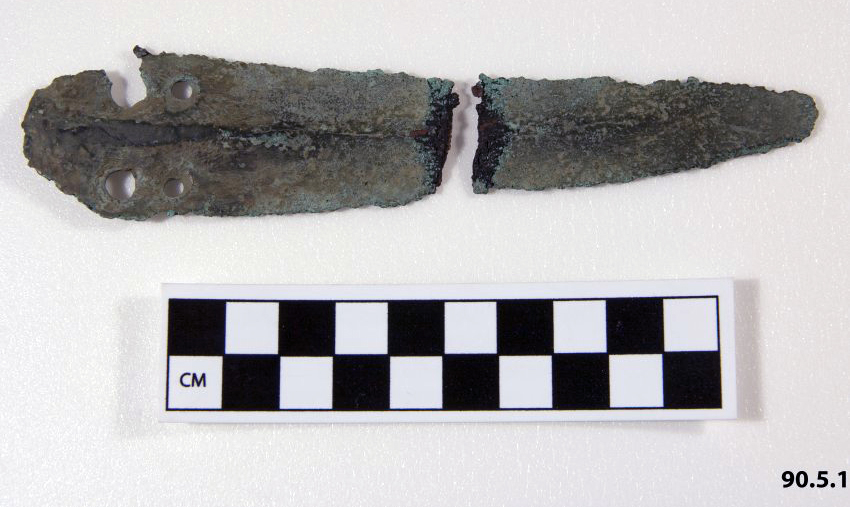
The object in question is a copper dagger or knife and is pictured in Frederick Pohl’s 1961 book Atlantic Crossings before Columbus. Barry Fell also discussed the piece in his popular 1976 book America BC: Ancient Settlers in the New World. Both authors contributed extensively to the literature on connections between Europe and the Americas, often featuring Vikings; mainstream archaeology has dubbed Pohl, Fell, and allied writers as pseudoscientists who offer provocative theories, but little concrete or testable evidence.

Copper dagger or knife blade from Merrimacport, Massachusetts in the collection of the Robert S. Peabody Institute of Archaeology, catalog # 90.5.1.

Regarding the dagger, here is what Pohl has to say:

Arthur Petzold (of Andover, MA) recently called my attention to a heavily-patinated copper “spearhead or knife” found many years ago by Dr. C.A. Kershaw of Merrimacport, Massachusetts, on Indian Flat near his home. A drawing of it showing two large and two small rivet holes for hafting was published by Warren King Moorehead in 1931. Benjamin L. Smith, who wrote “Supplementary Notes” to the Moorehead volume, says he has always been “troubled” by the copper artifact because its unusual form suggests it may not be Indian. Dr. Gad Rausing of Lund, Sweden, thinks that the general outline and size agree quite closely with the very early Bronze Age daggers of Northern Europe—but he has never seen one with two big and two small rivet holes arranged in such a manner, and so he says he “cannot claim to recognize it at all.” It may be, as he suggests, that the four rivet holes were not made at the same time, but that the small ones were added when one of the large ones got broken. A distinguished archaeologist, a specialist in European pre-history, has written me that the copper object is doubtless a dagger and, he believes, a very old one, from the mid-European early Bronze Age, presumably about 1300 B.C. But, he says, “How could it have found its way to Massachusetts, I wonder. Perhaps brought by some collector, and lost. Who can tell?” On the other hand, Dr. William Ritchie, New York State Archaeologist, assures me that prehistoric Indians of the Upper Great Lakes area riveted some of their spear points to the shaft, and so he says of the Merrimacport specimen that it may or may not be prehistoric. Spectrum analysis should determine its place of origin; for North American Indian copper is quite pure, having only slight traces of silver and iron, while European smelted copper contains antimony, bismuth, lead, iron, cobalt, nickel, Sulphur, gold, silver, arsenic and oxygen. In view of the possibility that the Merrimacport artifact may be early European, it is interesting that it was found only thirteen miles from North Salem and near the river used by boats approaching the North Salem site. [Pohl 1961:15-16]

Pohl’s argument is characteristic of many pseudoscientific claims—two competing ideas about an artifact or site are presented as equivalent—in this case, the Merrimacport artifact is offered as potentially Native American and potentially Bronze Age. The Native American origin of the dagger, however, is much more likely, especially as archaeologists like Ritchie noted similarities to copper artifacts from the Great Lakes. The North Salem site that Pohl mentions is now known as America’s Stonehenge and is located in North Salem, New Hampshire.

Barry Fell, building on Pohl’s arguments, illustrates a photograph of the Merrimacport artifact and cites ongoing research (mid-1970s) by James Whittall. Fell says that museums housing these copper artifacts, which he identifies as Celtic, believed they were from the European Bronze Age, but that they had been recently lost (see Fell 1976:127-128). Interestingly, James P. Whittall Jr., who wrote about the copper object in the December 1970 issue of the New England Antiquities Research Association newsletter, compares the piece to a Bronze Age dagger from Spain—a comparison that is echoed by Fell. And, despite that comparison, Whittall remains undecided about the origins and significance of the artifact, saying, “The dagger does not prove cultural contact between Western Europe and New England in the late Bronze Period, but the fact remains that the dagger was found here. This should be kept on record. When and if more evidence is recovered in this area, this singular artifact becomes more important. For the present it rests in a cultural void.” Writing a few years later, Whittall (1975:4) is more decisive, stating that “copper celts in Vermont and rivet copper daggers in Massachusetts are typical examples of middle bronze age European artifacts.”

Moorehead (1931:13), as noted by Pohl, includes an illustration in his Merrimack Archaeological Survey, though does not comment on the artifact other than to describe it as a “copper spearhead or knife,” while Charles S. Willoughby (1936:114-115) includes the piece with other Native American copper objects in his Antiquities of the New England Indians, saying:

The unique specimen figured in g [referring to Figure 59g], is from an old site on the bank of the Merrimack, at Merrimackport, Massachusetts. It is probably a knife, and was lashed to its handle through two perforations near its base, one of which has been torn out. In repairing this damage two more perforations were made just above the others. This is now in the Andover Museum. In all of the above [copper] specimens one side is flat. On the opposite side the blade is beveled from a central strengthening ridge to either edge.

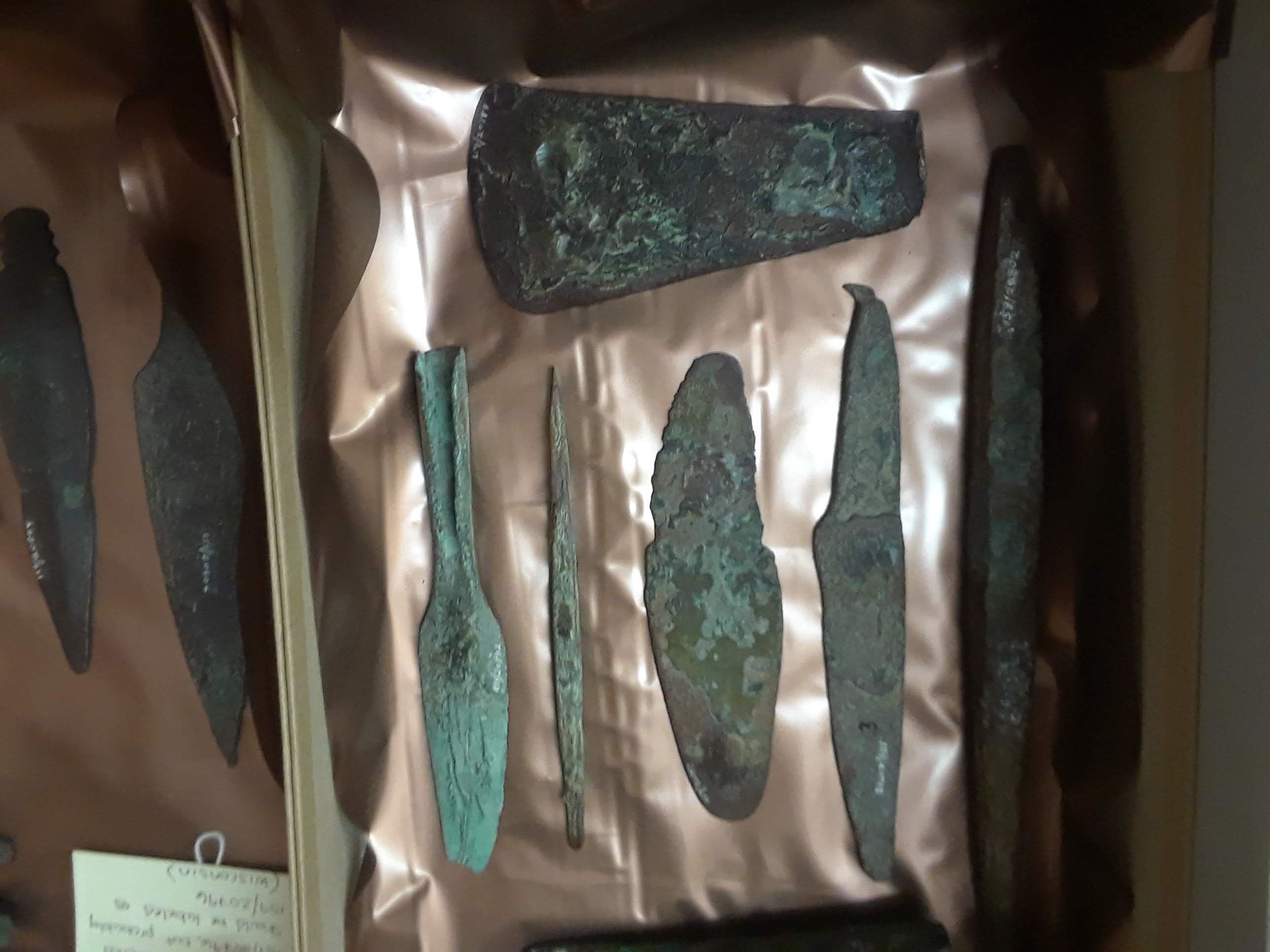
Copper objects from Wisconsin in the collection of the Robert S. Peabody Institute of Archaeology.

So, you might ask, “what’s the harm in all this?” We do know that the Norse settled in Greenland, at least for a while, and that one Norse site has been confirmed in Labrador, so it’s not impossible that other sites or objects could be found. Ken Feder (2020:131), in his great book Frauds, Myths, and Mysteries, notes that “a growing number of native sites in Arctic Canada show evidence of widespread, occasional, but sometimes intimate contact for centuries between local people and Norse visitors.” Every year in my fall Human Origins course, we discuss the distinction between science and pseudoscience. We learn that science relies on falsifiability, where proving a hypothesis true is less important than the ability to prove it false. Possibilities and probabilities often fail to meet the falsifiability test—could Vikings have been in Massachusetts and neighboring states? Yes, but those possibilities must be subject to testing. Also, there’s a darker side to these Viking stories, which negate the long land tenure, accomplishments, and technology of Native Americans. As archaeologist William Ritchie reported to Frederick Pohl in the 1960s, Native Americans worked Great Lakes copper into an array of tools and ornaments thousands of years ago, and these objects were transported by travelers and through exchange networks. Before conjuring Celts, Vikings, Irish monks, or other trans-Atlantic European travelers, Native Americans are much more likely to have fashioned artifacts like the Merrimacport dagger.

References Cited

Feder, Kenneth L. 2020. Frauds, Myths, and Mysteries: Science and Pseudoscience in Archaeology. New York: Oxford University Press.

Fell, Barry. 1976. American B.C.: Ancient Settlers in the New World. New York: Pocket Books.

Moorehead, Warren K. 1931. The Merrimack Archaeological Survey: A Preliminary Paper. Salem, MA: Peabody Museum.

Pohl, Frederick J. 1961. Atlantic Crossings Before Columbus. New York: W.W. Norton & Company.

Whittall, James P. Jr. 1970. An Unique Dagger. New England Antiquities Research Association (NEARA) Newsletter 5(4, Issue #19):77.

___. 1975. Precolumbian Parallels between Mediterranean and New England Archaeology. Occasional Publications of the Epigraphic Society 3(52):1-5.

Willoughby, Charles C. 1935. Antiquities of the New England Indians, with Notes on the Ancient Cultures of the Adjacent Territory. Cambridge, MA: Peabody Museum of American Archaeology and Ethnology, Harvard University.

NAGPRA at 30: Reflecting on the Past, Looking to the Future

NAGPRA at 30: Reflecting on the Past, Looking to the Future

New England Museum Association Annual Meeting 2020

NAGPRA resources for session attendees:

NAGPRA Communities of Practice: https://liberalarts.du.edu/anthropology-museum/nagpra/community-practice Network of NAGPRA practitioners from museums, tribes, universities, and government agencies; bimonthly Zoom calls with presentations and networking opportunities; document and repatriation policy sharing.

National NAGPRA: https://www.nps.gov/subjects/nagpra/index.htm The National Park Service’s national NAGPRA website, with templates, databases, grant information, and contacts for the NPS professional NAGPRA staff.

NAGPRA data visualization: https://public.tableau.com/profile/melanie.obrien#!/vizhome/NAGPRA-Totals/1_Reported Tableau presentation of NAGPRA data, highlighting institutional and geographic compliance.

Association on American Indian Affairs annual repatriation conference: https://www.indian-affairs.org/repatriation_conference.html The annual conference brings together repatriation practitioners and includes plenary and specialized sessions on all aspects of NAGPRA and repatriation.

Carrying our Ancestors Home: https://www.fowler.ucla.edu/archaeology/coah/ Fowler Museum at UCLA project that documents their work with repatriation.

NAGPRA resources from the University of Indiana, Bloomington: https://lrnagpra.sitehost.iu.edu/nagpra-education/Educational%20Resources.php Includes online resources, further reading, videos, and more.

Contact information and bios for facilitators:

Nekole Alligood, independent consultant, is a member of the Delaware Nation and has served as the NAGPRA Officer for the Nation. Alligood is a cultural anthropologist who has worked in museums and in Section 106.  She has conducted NAGPRA repatriations in collaboration with the Delaware Tribe of Indians and the Stockbridge-Munsee Community and a non-NAGPRA reburial teaming with the National Forest Service in West Virginia.  She currently is a scholar on the development of a traveling exhibit with Ball State University and Ohio History Connection focused on St. Claire’s Defeat (Battle of the Wabash).  She also is working with Ohio History Connection on a reinterpretation of Schoenbrunn Village in Ohio. E-mail: workinglenape@gmail.com

Jaime Arsenault is the Tribal Historic Preservation Officer (THPO), Repatriation Representative, and Archives Manager for the White Earth Band of the Minnesota Chippewa Tribe. Ms. Arsenault has worked with Indigenous communities for over 20 years. Currently, she is a member of the Minnesota Historical Society Indian Advisory Committee and the Repatriation Working Group with the Association on American Indian Affairs (AAIA) and a member of the Smithsonian Institution’s National Museum of Natural History Repatriation Review Committee. She is a Community Intellectual Property Advisory Board Member for the Penobscot Nation and sits on both the Advisory Committee and the Collections Committee of the Peabody Institute of Archaeology. Ms. Arsenault also serves as a MuseDI Partner on decolonization practice for the Abbe Museum. E-mail: Jaime.Arsenault@whiteearth-nsn.gov

David Goldstein is an anthropologist with the National Park Service currently serving as the Tribal and Cultural Affairs Specialist in the Northeast Region. David works to bring the region’s tribal and community partners into the NPS stewardship programs through sharing capacity and ongoing consultation.  The goal is to support self-determination and resource protection, acknowledging that tribal and community partnerships provide long term sustainability to stewardship. E-mail: david_goldstein@nps.gov

Katie Kirakosian is a trained archaeologist whose research focuses on the history of Native American archaeology. She has conducted archival research in repositories throughout New England and New York State on many NAGPRA sensitive sites, particularly shell middens, prompting recent research with co-author Irene Gates on the complex nature of archival records and digital repatriation. E-mail: kvkirako@anthro.umass.edu

Krystiana L. Krupa is NAGPRA Program Officer, University of Illinois at Urbana-Champaign. Her NAGPRA experience includes osteology and archival research relating to university and museum collections in addition to consultation. Krystiana’s current work focuses on tribal perspectives on the repatriation of biological samples extracted from ancestral remains, such as ancient DNA extracts. E-mail: klkrupa@illinois.edu

Melanie O’Brien is responsible for carrying out all duties assigned to the National NAGPRA Program by the Secretary of the Interior and serves as the Designated Federal Officer to the NAGPRA Review Committee. Throughout her career, Melanie has specialized in Federal-Indian law and policy, applying her master’s degree in public history from Loyola University Chicago to the work of the Federal government. E-mail: maobrien@nps.gov

Lorén M. Spears, Narragansett, Executive Director of Tomaquag Museum, holds a Master’s in Education and received a Doctor of Humane Letters, honoris causa, from the University of Rhode Island. She is an author, artist and shares her cultural knowledge with the public through museum programs. She has written curriculum, poetry, and narratives published in a variety of publications such as Dawnland Voices, An Anthology of Indigenous Writing of New England; Through Our Eyes: An Indigenous View of Mashapaug Pond; The Pursuit of Happiness: An Indigenous View and From Slaves to Soldiers: The 1st Rhode Island Regiment in the American Revolution. Recently, she co-edited a new edition of A Key into the Language of America by Roger Williams. She consults with K-12 districts, Higher Education, museums and historical societies on Native American Cultural Competency and DEI/J training. E-mail: lorenspears@tomaquagmuseum.org

Marla Taylor is the curator of collections at the Robert S. Peabody Institute of Archaeology at Phillips Academy in Andover, MA.  She has worked in all facets of collections management from cataloging to conservation to repatriation.  Marla currently splits her time between leading an effort to conduct a full inventory of the collection and facilitating access to the Peabody’s collection for tribal partners, researchers, and educators. E-mail: mtaylor@andover.edu

Jayne-Leigh Thomas is the Director of the Office of the Native American Graves Protection and Repatriation Act at Indiana University. Her work involves active consultation with over 100 federally recognized sovereign nations across the United States to return ancestral human remains and cultural items to their rightful communities. Her research interests are NAGPRA, repatriation, bioarchaeology, ethics, cremation studies, and mortuary studies. E-mail: thomajay@indiana.edu

Jackie Veninger-Robert is the NAGPRA Coordinator for the University of Connecticut.  In addition to her NAGPRA and collection management responsibilities for the Office of State Archaeology, Jackie advises students and provides instruction on issues surrounding Native American cultural property law and advocates for opportunities to decolonize museum anthropology.  Jackie has worked for tribal governments in southern New England in a NAGPRA and collections management capacity.  She is a non-member advisee of Connecticut’s Native American Heritage Advisory Council (NAHAC).  Her research interests include: archaeological ethics, heritage management and conflict archaeology. E-mail: jacqueline.veninger@uconn.edu

Ryan Wheeler is the director of the Robert S. Peabody Institute of Archaeology, a museum at Phillips Academy, Andover MA. At the Peabody he has advanced a strategic vision focused on collections, education, and repatriation. In 2017, Ryan co-founded the Journal of Archaeology & Education, the only academic journal devoted to the intersection of these two fields. Ryan lives with his family in Medford, MA. E-mail: rwheeler@andover.edu