
Contributed by Ryan Wheeler
Archaeologists are known as a creative and frugal bunch, and this is evident in the many ingenious ways that we have found to store artifacts and samples from recovery in the field to processing in the lab to long term storage on the museum shelf. Prior to the plastic bag, soil samples were housed in everything from feed sacks to paper bags. Glass food and condiment jars were a great way to keep charcoal samples, especially if you didn’t have a ready supply of tin foil. Metal, and then plastic, 35mm film canisters were highly prized for retaining tiny objects, like beads (the slightly opaque Fuji film canisters allowed a peek at the contents, unlike the black and gray Kodak canisters).

Nothing, however, is more ubiquitous for storing artifacts than the classic cigar box. These sturdy wood or cardboard boxes with a built-in hinged lid were highly prized by generations of kids for storing marbles, coins, arrowheads, and other treasures. Perhaps it’s not surprising that as adults these boxes remained as the go-to storage solution. The Canadian Museum of History has a great interactive website about cigar boxes that explores the significance, history, art, and general usefulness of these containers. Much has been written too about cigar box guitars, which apparently go back to at least the 1840s through 1860s when cigars were first being stored and marketed in wooden boxes—see, for example, http://cigarboxguitars.com/about/history.

The collections of the Peabody Institute are no exception, and vast numbers of stone points, tools, and pottery fragments were once kept in legions of cigar boxes. Most, if not all, our artifacts have been rehoused in cardboard boxes and now we are working on a massive rehousing and cataloging endeavor that will improve our intellectual and physical control over our collections (museum-speak translated as “we will have a better idea what we have and where it is”). Our current strategic plan, developed in 2014 and 2015 identifies this as one of our most important objectives, and one we plan to accomplish in the next few years.
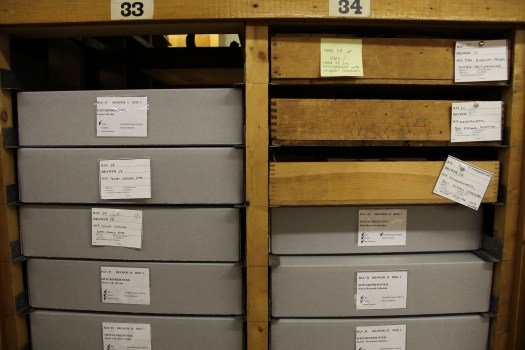
There are, however, still a small collection of cigar boxes and other biscuit, cereal, and medicine boxes and tins that were once used to house objects and photographs. Handwritten labels, pasted over the decorative and distinctive cigar box art, identify sites and catalog numbers. A small collection of these boxes has been retained.

A recent effort to address a backlog of objects awaiting cataloging turned up a groovy mid-twentieth century shoebox that contained a woven bag, apparently given to the Peabody by Dorothy Byers, widow of former director Douglas Byers (1903-1978). Byers worked at the Peabody from 1933 until his retirement in 1968, and served as director from 1938 through 1968. Zodiac was a brand of Encore Show Corp. and first debuted in the late 1970s and has had a recent revival. The woven bag—unfortunately bearing little information—has been rehoused and is now in storage. The shoe box is in my office.
The Peabody’s cataloging and rehousing project is made possible through a grant from the Abbot Academy Fund, continuing Abbot’s tradition of boldness, innovation, and caring, and the generous support of the Oak River Foundation, and Barbara and Les’ 68 Callahan. For information on how you can contribute to this project, please contact Peabody Institute director Ryan Wheeler at rwheeler@andover.edu or 978.749.4490.






 Nancy Gonlin is a Senior Associate Professor at Bellevue College, Washington. She earned her Ph.D. in Anthropology at The Pennsylvania State University, is a Registered Professional Archaeologist, and a former Dumbarton Oaks Fellow of Harvard University. Her specialization is the Classic Maya civilization of Mexico and Central America. Nancy is on the Editorial Board of Ancient Mesoamerica, published by Cambridge University Press. She has taught for over 25 years and is highly regarded for her pedagogical contributions – she is the 2012 recipient of Bellevue College’s Margin of Excellence. As an active member of the Society for American Archaeology, Nancy serves on the Committee on Curriculum and has been appointed as the upcoming Chair of the Book Award Committee. She co-author Copán: The Rise and Fall of an Ancient Maya Kingdom, and co-edited Commoner Ritual and Ideology in Ancient Mesoamerica, Ancient Households of the Americas, and Human Adaptation in Ancient Mesoamerica. Nancy’s fifth book will be a co-edited volume on a new field of research in archaeology, The Archaeology of the Night.
 Dr. Kirakosian received her PhD from UMass Amherst in 2014 and is currently adjunct faculty at several schools in Rhode Island. Her project focuses on archival materials from Warren Moorehead, Douglas Byers, and Frederick Johnson to continue her dissertation research and prepare a book on the history of archaeology in Massachusetts using social network analysis. Dr. Kirakosian published some of her previous research using Peabody collections in the 2015 issue of the Bulletin of the History of Archaeology:
  Mr. Campbell is a PhD candidate at the Memorial University of Newfoundland. His research at the Peabody includes a re-examination of collections from the Dennysville site in Maine, as well as several other sites in New Brunswick. His dissertation research is focused on protohistoric and contact period Wabanaki peoples in Maine and the Canadian Maritimes.
 The Peabody