Adventures in Ancient China is one of the newest Learning in the World programs at Phillips Academy. During spring break 2019 eighteen students experienced some of China’s most dynamic history and archaeology, along with spicy cuisine, fantastic religious art, and new friends.
After exploring the impressive architecture of Ming and Qing dynasties at the Summer Palace, the Tian Tan, and the Forbidden City we engaged with some of Beijing’s Intangible Cultural Heritage. UNESCO defines intangible cultural heritage as “the practices, representations, expressions, as well as the knowledge and skills (including instruments, objects, artifacts, cultural spaces), that communities, groups and, in some cases, individuals recognize as part of their cultural heritage.” This can include oral tradition, performing arts, rituals and festivals, traditional knowledge, and craftsmanship.
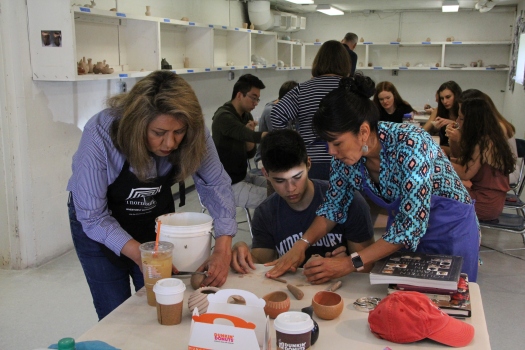
Beijing Tu’er Ye artist explains how to decorate a figurine.
Students participated in a workshop with a local artist who makes and decorates figurines of Lord Rabbit, also known as Tu’er Ye in Beijing. Tu’er Ye, once worshiped in the pantheon of local deities, was renown as a healer and maker of elixirs. The moon goddess Chang’e sent Tu’er Ye to use his/her knowledge of medicine to save the people of Beijing from a plaque. Tu’er Ye probably appeared as early as the Ming Dynasty, often as a clay figurine for inclusion in household shrines.
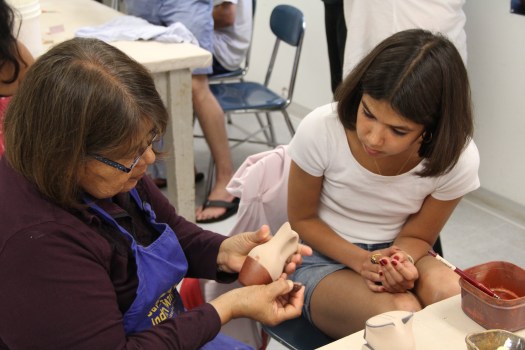
Students paint their own Tu’er Ye figurines.
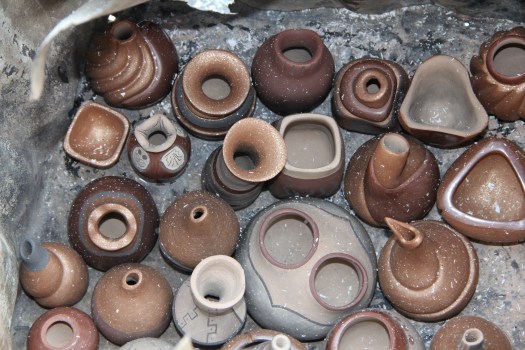
Tu’er Ye is a rabbit with a human body adorned with the outfit of an ancient general: helmet, scarf, shoulder-draped golden armor, broad belt and big boots, while holding an alchemist’s pestle and mortar. Tu’er Ye figures prominently in the Mid-Autumn festival and the figurines may have become toys to occupy children during festival preparations.
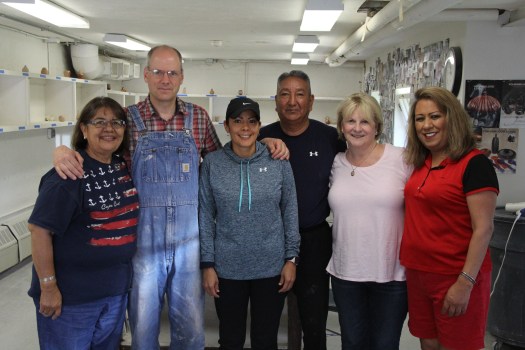
The finishing touches–after completing their figurines each student had a nice souvenir of Beijing!
A handful of artists continue the tradition of making and decorating the figurines. Making the Tu’er Ye figurines is one of Beijing’s more than 12,000 intangible cultural heritage items. It was inscribed on the national list in 2014.
Adventures in Ancient China is generously supported by The Schmertzler Fund for Exploration and Experiential Education.
Mark your calendars! The third PA Giving Day is Wednesday, March 27, 2019! Last year the Peabody Institute garnered 60 gifts, nearly doubling PA Giving Day gifts in 2017! This year we hope to have more challenges, more social media posts, and even more support!
In 1901 Robert S. Peabody lamented the lack of instruction in archaeology at his high school alma mater Phillips Academy, a prestigious New England boarding school. To rectify the situation, he used family funds and artifacts amassed by his personal curator Warren K. Moorehead to establish a Department of Archaeology at the school. A building was constructed and Moorehead and Peabody’s son, Charles, set about teaching classes. The pattern established by Moorehead and Peabody, however, was disrupted in 1914 when the school refocused the program exclusively on research. Classes were offered periodically over the next decades, and some students were inspired to follow their high school passions to lifetime careers in our field. Successive administrators at the institution, ultimately called the Robert S. Peabody Institute of Archaeology, struggled to find a place for archaeology in the high school curriculum due to a variety of factors. Cyclical trends in teaching archaeology at Phillips Academy and long term struggles to integrate archaeology into the high school classroom mirror nationwide patterns, providing a case study that can inform the broader initiative to harness the excitement and interdisciplinary aspect of archaeology, and to encourage stewardship of archaeological resources. The experience of the educators at Phillips Academy, however, suggests that these goals may be at odds with one another and require a delicate balancing act to achieve sustained results.
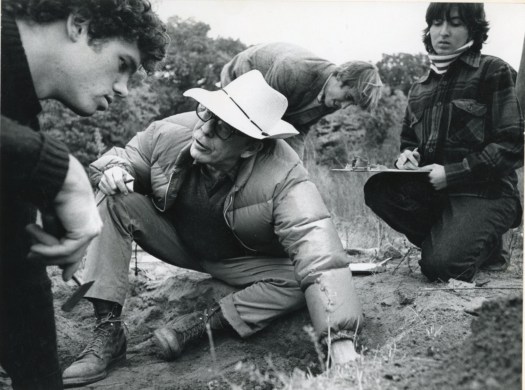
Peabody director Richard “Scotty” MacNeish instructing Phillips Academy students at the Andover town dump, 1970s.
During spring break, March 2019, eighteen Phillips Academy students will accompany Peabody director Ryan Wheeler, instructor in Chinese Congmin Zhao, and Anne Martin-Montgomery, Chinese for Families, on the inaugural Adventures in Ancient China trip. Adventures in Ancient China is one of the newest Learning in the World Programs, offered cooperatively by the Tang Institute and the Robert S. Peabody Institute of Archaeology.
Recruiting for the trip commenced in fall 2018, with a deadline for applications on December 1, 2018. Wheeler, Zhao, and Carmen Muñoz-Fernández, Director of Learning in the World, hustled to make decisions and invite students to participate before winter break began. We were impressed by the diversity of the group, with a good mix of male and female students, as well as good representation of each grade, including some intrepid juniors! Students and families were asked to complete the first round of paperwork necessary for the trip, and to check that passports were current.
Flyer from the Chinese Consulate in New York detailing visa photo requirements.
Once all the initial paperwork was in at the outset of January, we began the process of booking flights and lodging, all necessary for the fairly complex visa applications that would be required of most of our travelers. Along the way we learned a lot about Adobe Acrobat forms and benefited from tips provided by one parent! At this point we have our hotels booked for our stay in Beijing, as well as our airline tickets secured, thanks to assistance from China Highlights and Jody’s Travel. As families complete visa application forms, we’ve asked our student travelers to secure their visa photos. Happily, there are several apps that can help generate the photos in their required format and size (33 mm by 48 mm).
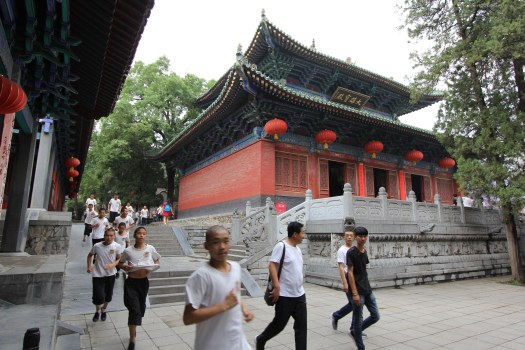
Gong Fu students from a nearby school training at the Shaolin Monastery.
Setting aside the paperwork, bookings, and visa applications for a moment, however, we can reflect on some of the cultural and archaeological wonders that await us in a China. Some of our student travelers have mentioned that they are particularly excited about visiting the Shaolin Monastery, a day trip during our stay in Luoyang. The Shaolin Monastery is the center of Chan Buddhism and is believed to have been founded in the fifth century CE—some 1,500 years ago! Chan Buddhism is believed to be the predecessor of Japanese Zen Buddhism and shares many similarities; Chan Buddhism was also heavily influenced by Taoism, and this is evident in some of the martial arts practiced by the Shaolin monks and at the many Gong Fu (Kung Fu) schools in the area. We will get a chance to visit one of those schools and take a short course in Gong Fu!
A pipa toting Buddhist immortal gets a touch up at the Shaolin Zhongyue Temple. June 21, 2017. The pipa is a four-stringed musical instrument, similar to a lute.
Soon it will be time to hand in the completed visa applications, which will then go to a visa service company and the Chinese consulate in New York. We’re also planning for our first gathering with the students—an opportunity to meet fellow travelers, review the itinerary, ask questions about the packing list, and get ready for our trip!
The Robert S. Peabody Institute of Archaeology was one of seventeen tribes and other organizations supporting the Association on American Indian Affairs December 6, 2018 statement urging collectors and investors to buy contemporary American Indian art instead of antiquities.
The AAIA statement asks that collectors “interested in American Indian art should … support contemporary American Indian artists and their creations made for the art market” rather than buy American Indian “artifacts” and “antiquities.”
The statement explains the sad truth known to most archaeologists and museum workers, namely that “there is a long history of looting and stealing American Indian burials and important American Indian cultural and sacred patrimony. These items often end up in private collections and ultimately auction houses and institutions all over the world.”
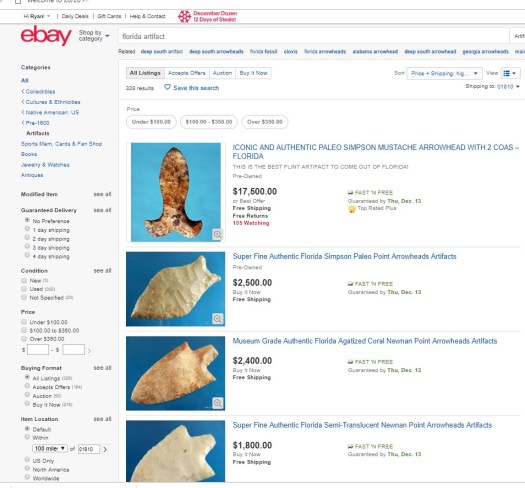
A small sample of the many American Indian artifacts for sale on a popular internet auction site.
The advent of internet auctions in the mid-1990s made it easy for collectors to connect with sellers, ultimately fueling the demand for American Indian artifacts and antiquities and driving up prices. Internationally the trade in antiquities has been closely linked to funding terrorism, while domestically it is related to the illicit drug trade. A November 3, 2017 blog post by Jason Daley on Smithsonian.com concludes that most international antiquities being sold online are fake or illegal. The same is likely true of artifacts from the United States.
Exhibit during Operation Timucua news conference. Photo by Tim Donovan, Florida Fish and Wildlife Conservation Commission, February 12, 2013. Used in compliance with Creative Commons license https://creativecommons.org/licenses/by-nd/2.0/
One example is found in Operation Timucua, a multi-year undercover sting conducted by law enforcement agencies in Florida, which culminated in a number of arrests in 2014. Florida Fish and Wildlife Conservation Commission officers spent two years infiltrating what they came to know as a crime ring intent on removing ancient American Indian artifacts from public lands and then selling them on the internet, netting nearly $2 million. Thirteen individuals from Florida and Georgia were arrested, considered the main dealers and looters involved in the illicit organization. Massive numbers of antiquities were seized as well, many torn from sacred mounds and riverbeds where they had been placed and remained for thousands of years.
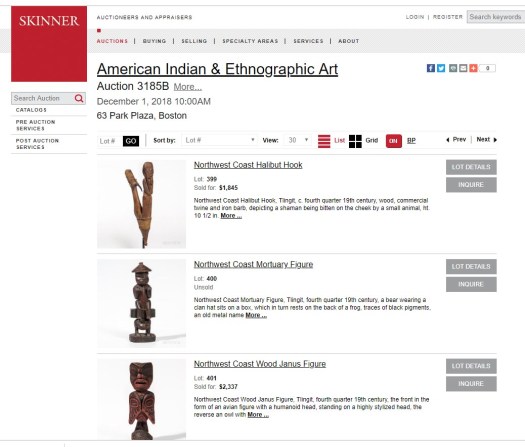
Screen shot of some of the items that were sold in the December 1, 2018 Skinner auction.
Closer to home, public outcry recently halted the auction of seven objects that originated with Tlingit, Bella Coola, and Nitinat peoples in the Pacific Northwest. The Medford Public Library, in a suburb of Boston, had received the objects in 1880. The objects were being offered in a December 1, 2018 auction run by Skinner in Boston, with sales of $117,000 anticipated and earmarked to fund construction of a new library. Shannon Keller O’Loughlin, executive director of the Association on American Indian Affairs asserted that the library needed to comply with the Native American Graves Protection and Repatriation Act (NAGPRA), a federal law that requires museums and other publically funded institutions and agencies to consult with tribes regarding sacred objects and objects of cultural patrimony. Medford Mayor Stephanie M. Burke investigated the auction with input from the town’s attorneys and ultimately agreed that the items should be pulled from the auction.
The AAIA statement concludes by stating that:
Buyers and collectors interested in Tribal antiquities and artifacts should do their own careful due diligence and consideration as to whether Ancestors and burial belongings, and cultural and sacred patrimony are a proper investment. Perceptions on collecting items of Tribal Cultural Heritage are changing quickly, along with laws that seek to protect them. Finally, and as stated above, buyers and collectors should focus their investment on contemporary American Indian artists whose stories and creations are accessible and created to share.
On Thursday September 13 just after 5pm we received text, email, and phone alerts to evacuate all campus buildings. Phillips Academy responded quickly to evacuation orders, due to gas fires and explosions in Lawrence, Andover, and North Andover. Reports from town officials at the time stated that in Andover a total of 35 fires were reported with 18 fires burning at the same time. Significant damage was being reported from surrounding communities as well, and sirens and emergency vehicle were regular sights on Main Street. Subsequent reports indicate that older gas lines had been over pressurized, resulting in gas accumulation, fires, and explosions. Officials and first responders described the scene as a “war zone” and “Armageddon.”
Utility workers purge gas lines on Phillips Street, next to the Peabody. September 26, 2018.
Quiet study night at the Peabody had just begun when we received the evacuation order and several students were already in the building. They evacuated and joined their peers on the Great Lawn. All students were well cared for by their house counselors, faculty, and administrators and ultimately were able to get back into their dorms around 11:00pm. Classes were cancelled on Friday at Phillips Academy and in the other affected towns.
I remained at the Peabody until just after 7:00pm to ensure that there was no immediate danger to our collections. Rachel Manning arrived and kept an eye on things for another hour. Curator of Collections Marla Taylor was in touch with both of us. By this time utility workers had depressurized the gas lines in our vicinity and all electricity had been shut down to the towns.
Utility workers purge old gas from the lines just outside the Peabody. September 26, 2018.
Following in the wake of the recent conflagration and near total loss of the Brazilian national museum, we were extremely concerned about possible threats to the Peabody building and collections. The Brazilian fire illustrates just how susceptible cultural collections are to loss. In that case officials estimate that nearly 20 million objects were destroyed, including recordings of now-extinct Native languages, paintings and decorative arts, and other significant archaeological and ethnographic collections.
Utility workers monitored the gas vault behind the Peabody in the days following the emergency.
Happily the Peabody has never had gas service, so we were relatively safe, though gas can travel through the soil and invade basements. Gas lines do exist in the area and provide service to many of the homes and apartments on campus and in the vicinity. There is an access point to one line–a vault–just outside our building and I watched the utility worker depressurize this and shut it off. This site has continued to attract the attention of utility workers over the subsequent days. On Wednesday September 26 workers purged old gas from these lines in anticipation of line replacement.
This was a pretty scary emergency, especially considering the scale and scope. It’s absolutely heartbreaking to see the loss of homes in our Merrimack Valley community, as well as learning about the injuries to dozens of people and at least two deaths. Many homes and businesses in the area remain without heat and considerable numbers are out of work.
Human Origins at Phillips Academy began in 2007 and represented one of the early collaborations between faculty and the Peabody. In its initial incarnation the course was led by Jerry Hagler, science faculty, and co-taught by personnel at the Peabody. The content was strongly interdisciplinary, mirroring the reality of archaeology and anthropology, which draw heavily on science, history, historiography, psychology, and other fields. Three years ago I began leading the course solo, but have endeavored to maintain the strong interdisciplinary flavor. The course is now among those offered by the Academy’s new Department of Interdisciplinary Studies. The course description states:
This interdisciplinary science course uses insights drawn from history, art, archaeology, and other disciplines to chart the human journey from hominid to the first civilizations that forecast the modern world. Hands-on laboratory exercises emphasize use of Peabody Institute of Archaeology collections and challenge students to apply ancient techniques to solve daily problems of survival.
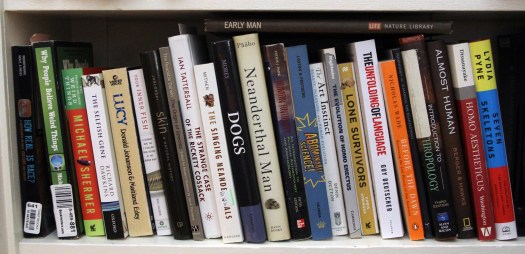
The Human Origins bookshelf. These are some of the texts from which class readings are drawn.
In the fast paced world of human evolution, I’ve found it imperative to focus on some of the big questions and issues, rather than on the details, as new finds and discoveries rewrite our evolutionary history nearly monthly. In June 2017 a new discovery in Morocco pushed back the antiquity of modern humans (us!) by nearly 100,000 years and called into question the predominant view that our earliest ancestors first appeared in eastern and southern Africa. We also only have 10 weeks to cover some 7 million years of human evolution, so judicious pruning of the syllabus is necessary.
On the first day of class some students are surprised to learn that we will spend a great deal of time talking about race. When you understand that the scientists who first studied fossil humans were also the scientists that were interested in human diversity this connection becomes clearer. We encounter ideas like polygenesis, which suggests that so-called races today had different evolutionary origins and trajectories. Despite the widespread adherence to the “Out of Africa” hypothesis, polygenism casts a long shadow and continues to crop up in new guises.
Casts of Bigfoot or Sasquatch footprint impressions, Washington State, cast and reconstructed by Dr. Grover Krantz, Professor of Anthropology at Washington State University. Casts from Bone Clones Inc.
Early in the term we tackle pseudoscience and read a chapter from Michael Shermer’s 1997 book Why People Believe Weird Things. We get to talk about Big Foot. It was with great reluctance that I dropped a reading from Daniel Loxton and Donald R. Prothero’s 2013 book Abominable Science: Origins of the Yeti, Nessie, and Other Famous Cryptids. They review every piece of evidence for the existence of these creatures (and more!), pointing out over and over that scientific inquiry requires falsifiability beyond all else. The importance of falsifiability in science will remain central, but the Loxton and Prothero readings were just too long!
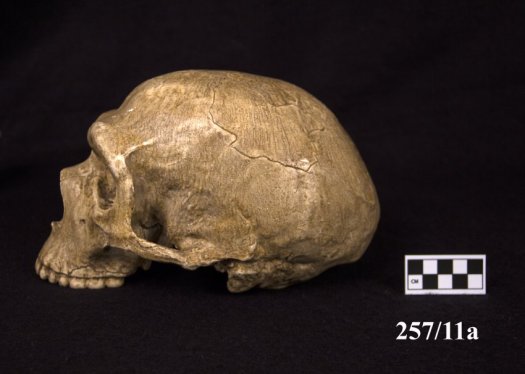
The Peabody’s vintage plaster cast of a Neanderthal from La Chapelle-aux-Saints, France.
We also spend some time talking about Neanderthals, and the incredible shifts in our understanding of one of our closest human relatives. As much as possible I try to have students read things written by the scientists on the front line of human origins research, including Svante Pääbo, who less than ten years ago reconstructed the Neanderthal genome and demonstrated that many of us carry a little Neanderthal DNA, the product of interbreeding between what most scientists had though two separate species. The recent discovery of an individual from 90,000 years ago that had a Neanderthal mother and a Denisovan father will no doubt be front and center in our discussion. Denisovans are another recently discovered fossil human group that overlapped geographically and temporally with Neanderthals in eastern Europe and Asia. Students presenting on Neanderthals in the popular imagination will explore everything from the GEICO caveman to the Flintstones.
Students try their hand at flint knapping in Human Origins, fall 2017.
During our extended periods we will explore a variety of early technologies, from flint knapping to fire making. In order to contextualize these early technologies, students will read some of Richard Dawkins’ 1976 book The Selfish Gene, where he introduces the concept of the “meme.” Many are surprised to find that the term meme, now embedded in the culture of social media, originated with Dawkins as he wrestled with ways to model the origins and transmission of ideas. We discuss innovation versus transmission, and how both are necessary for an idea to persist and spread. Fire and stone tool making are particularly good examples, sparking discussion of the earliest evidence for each and if they were independently invented over and over (and how one might tell).
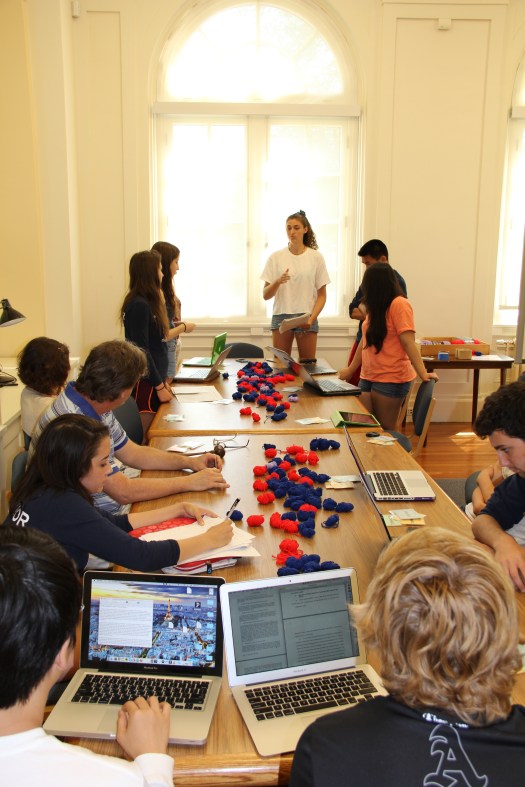
Students apply the Giles & Elliot discriminant functions to models of human skulls, a basic forensic technique that is often used to distinguish “race.” We explore why it works, its limitations, and the problems with scientific explorations of race and human diversity.
We revisit race again with an entire week dedicated to readings and discussion of the problematical origin of the concept, and how it melds physical traits with cultural ones. We delve into paleontologist Stephen J. Gould’s campaign against the idea of race as a biological or scientific concept, and how scientists have continued to study race despite Gould’s protests. The focus here is on creating a context for future discussions of race—the cultural construct—versus biological diversity. We’ll tackle the complexities of forensic methods used to distinguish race, why these work so well, and how physical anthropologists struggle with ideas about race. Other lab days visit the Peabody’s collection of fossil human cranial casts, how to read the story of human evolution in one skeleton, and a special trip to the campus Makerspace where we will 3D print a fossil of Homo naledi, a recently discovered fossil human species from South Africa that overlaps with modern humans in space and time and blends ancient and modern characteristics.
The NAGPRA debate unfolds in Human Origins, spring 2015. The class is divided into teams, each representing one of the parties in the case of Spirit Cave Man, a 10,600-year old individual found in Nevada. Materials from the Fallon Paiute-Shoshone tribe’s legal battle for the remains are used as primary source material.
The term will finish with some time dedicated to the Native American Graves Protection & Repatriation Act (NAGPRA), explored through a classroom debate and using the legal documents from the Spirit Cave Man case. The Peabody has been deeply involved in NAGPRA since its implementation in 1990 and it seems appropriate to share this work with students and investigate the arguments on all sides of the repatriation debate.
Stay tuned for updates from this fall’s Human Origins course. Let’s see how new discoveries in the field and lab change our conversations in the classroom!
To the uninformed, the Peabody Institute of Archaeology is just a building on the Phillips Academy campus that houses old artifacts and sherds of pottery from long ago archaeological expeditions. They would be very mistaken! The Peabody provides incredible academic enrichment opportunities to the student body across all disciplines.
In a unique approach to education, the Peabody collections are used to demonstrate the practical applications of history, language, mathematics, science and sociology. This year celebrates the fifth year the Peabody has arranged for pottery artists from the Pueblo of Jemez to come to campus to work with students.
In collaboration with Thayer Zaeder’s ceramics classes the potters spent the week working with 48 students teaching the ancient techniques of transforming clay into pottery. I had the rare opportunity to not only observe these artists work with the students, but to actually work with them myself. Maxine, Dominique and Mia worked with students individually on both shape and decorative painting to create unique pieces of art.
Dominique Toya (left) and Mia Toya (right) work with a student.
Glazing is not used in Pueblo pottery. Any glossy surfaces are achieved by polishing the area with smooth stones. The process is delicate and time consuming and if you mess up, as one student found out, the Potters would show you how to fix the problem – sand it all off and start again!
Maxine Toya demonstrates how to polish the red slip.
Dominique, Mia and their mother, Maxine Toya come from a multi-generational family tradition of Pueblo Potters. Each is known for their unique style, Dominique for her mellon designs, Mia for her signature butterfly designs and Maxine for her animals and figures. Their work is highly collectible and sought after. Nancy Youngblood, another prominent Pueblo potter, has joined them the last three years. These four ladies are the “Super Stars” in the Native American world of ceramic art.
Maxine Toya working on one of her famous owls.
Mia Toya talks about her butterfly swirl jar, in process.
Dominique Toya begins the spiral ribs on a miniature swirl pot.
Mia’s friend Ward Weppa helps sand the ribs on her butterfly swirl bowl.
Maxine Toya’s completed owl figurine–all the fine line painting is done with Maxine’s masterful hand-eye coordination!
Dominique Toya’s distinctive swirl vessels with micaceous slip, collection of the Robert S. Peabody Institute of Archaeology.
When speaking with the Potters, one theme stood out. They love bringing the ancient methods to this generation to instill a knowledge of their culture and heritage. They each spoke of how polite the Andover students were as well as the appreciation shown to them by each student for the opportunity to learn this ancient art form.
Students look on as Dominique tends the fire.
The culmination of each of their visits is the “firing.” They still use the ancient method of firing the pottery outdoors, which usually draws a large crowd. A huge bonfire is built to bake all the pieces the classes have created. The end result brings pride and a sense of accomplishment to both students and teachers alike.
From left to right: Maxine Toya, Thayer Zaeder, Mia Toya, Ward Weppa, Barbara Callahan, and Dominique Toya.Vessels as they emerge from the fire.
*Guest contributor Barbara Callahan is Secretary of the Peabody Advisory Committee. She and her husband Les Callahan (Phillips Academy Class of 1968) provided the generous support for the Pueblo Potters program in 2017 and 2018.
We are delighted to share this recent acquisition, a contemporary painted vessel made by Jason Garcia. Garcia (Okuu Pin) is a talented ceramic artist from Santa Clara Pueblo in New Mexico known for his mix of traditional materials and methods with pop culture. This piece explores the Pueblo Revolt of 1680 through the media of traditionally built pottery and painting in the style of comic books or graphic novels.
Here Garcia illustrates a dynamic struggle between Tewa religious leader Po’Pay and Spanish soldiers. Po’Pay, from Ohkay Owingeh (also called San Juan Pueblo), is depicted in the style of a comic book superhero. He rose to prominence in 1675 after his imprisonment at the hands of the Spanish colonial government. After his release he planned the successful ouster of the Spanish from New Mexico, carefully orchestrating the insurgency across diverse linguistic, geographic, and cultural lines. The Spanish returned in 1692, but Po’Pay and the Pueblo Revolt of 1680 remain significant, though little-known in American history. We work with several Phillips Academy instructors in history and social science to introduce their students to the Pueblo Revolt, which some scholars have suggested provided a template for the American Revolution some one-hundred years later.
We were fortunate to receive a generous gift from Phillips Academy trustee and Peabody Advisory Committee member Peter T. Hetzler MD, FACS (Class of 1972) in December 2017 that allowed us to purchase several important books to add to our library.
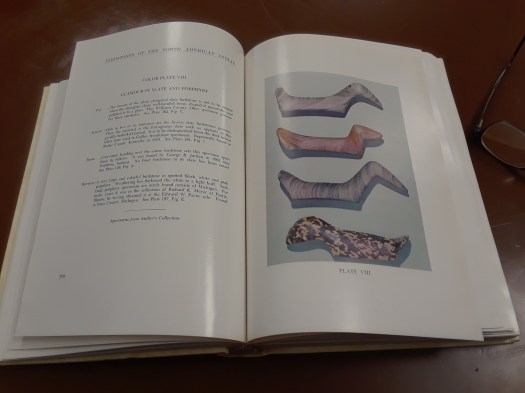
One of these is the very rare, privately published volume Birdstones of the North American Indian by Earl C. Townsend, Jr. Published in 1959, Townsend’s book was limited to 700 copies. A reprint edition was released in 2003 by Steven Hart, but these are also scarce and hard to find. Both the original edition and the reprint can be quite expensive, if you are lucky enough to find one. Townsend (1914-2007) was an attorney and founding member of the Indiana Archaeological Society, as well as an avid collector of Native American artifacts, cars, and artwork. According to Townsend’s obituary, he was honored by the Black River-Swan Creek Saginaw Chippewa Tribe with the name Senee Pen Eshee Na Na, meaning “Birdstone Man.”
One of the color plates in Townsend’s Birdstones book, showing some of the variations in color and material found among this artifact type.
Townsend’s preface begins with a reference to Warren Moorehead, the Peabody’s first curator, who “spoke of the need for specialized volumes, each devoted to one particular form of prehistoric North American Indian relic.” Moorehead insisted that the province of archaeologists was the study of material culture and he urged his contemporaries to abandoned reconnaissance and site survey that were becoming more common in the first quarter of the twentieth century and hunker down on description and classification of artifacts. Moorehead published at least three volumes that highlighted objects, mostly those held by artifact collectors. His most expansive was the 1910 two volume The Stone Age in North America. Moorehead also published more detailed studies of particular artifact types, like his 1906 The So-Called “Gorgets,” an early bulletin of the Phillips Academy Department of Archaeology, and his 1899 The Bird-stone Ceremonial.
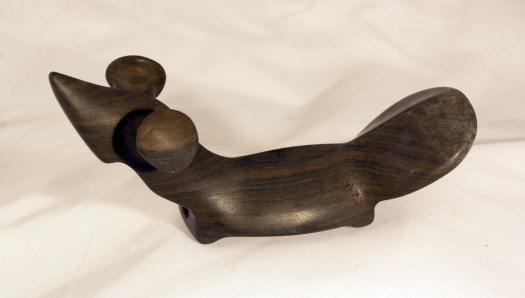
A magnificent example of a pop-eyed birdstone in banded slate, Warren County, Ohio.
Townsend’s 719-page book is nothing short of monumental, and depicts thousands of birdstones from public and private collections. He also covers the ideas about what these objects are, which are myriad and diverse, as well as how they were made, distribution patterns, cultural affiliations, and fraudulent specimens.
A selection of birdstones from the Peabody Institute collection. Note that some are broken and repaired.
So, what is a birdstone? As Townsend notes, this is not an easy question to answer, since there is no clear agreement on how they were used in antiquity. In terms of form, birdstones are often described as highly stylized depictions of birds. A variety of distinct forms are all described in detail by Townsend. The virtuosity of manufacture, incredible symmetry, and sculptural quality have often elicited comparison with modern art. Sizes range from an inch or two to larger examples that are five or six inches in length. A common feature is the presence of bi-conically drilled holes, one at either end of the birdstone’s base. These holes are often the site of breakage and repair. Most birdstones are made of banded slate, especially the greenish-gray banded Huronian variety, but other stones were used as well, including porphyry. Many have projecting eyes or ears. Few if any have come from secure archaeological contexts and most are known as field finds. Townsend’s distribution map indicates that the vast majority of birdstones in his sample come from areas around the southern margins of the Great Lakes, especially in Wisconsin, Michigan, Indiana, Ohio, New York, and Ontario. Cultural affiliations of birdstones vary across this area and include a number of Late Archaic and Early Woodland cultures like Glacial Kame and Red Ochre, circa 1500-500 BCE.
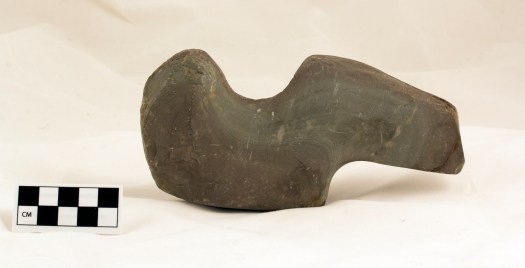
A birdstone preform, showing one stage in the manufacture process.
Townsend does a nice job of summarizing the diverse opinions on birdstones. The ideas range from Charles C. Abbott’s notion that they were worn as hair ornaments by women during maternity to use as a spear thrower (atlatl) counterweight. Other ideas include attachment to flutes or similar musical instruments, game pieces, hair or clothing ornaments, staff mounted religious symbols, and atlatl handle grips (Townsend’s preferred idea). Considering the diversity of forms, it seems likely that different styles were used in different ways and there are probably layers of meaning that we are unable to detect. Many contemporary archaeologists have accepted that birdstones are, in fact, associated with atlatls or spear throwers (for example, this is how they are described by David Penney in his essay on Archaic art in the 1985 exhibit catalog Ancient Art of the American Woodland Indians). Many articles about birdstones have been added to the literature since the 1959 publication of Townsend’s book, often proposing new ideas or offering further support or evidence for an existing hypothesis.
We were particularly excited to acquire a copy of Townsend’s Birdstones because the Peabody collections contain many examples of this enigmatic and interesting artifact. Only a few, however, are illustrated in Townsend’s book, including two from Ohio that had been salvaged after breakage (see Townsend 1959: Plates 76s and 77h). A few other fine examples from the Peabody are illustrated here.
It’s unlikely that we will unlock the secret of the birdstone anytime soon, however, we are immensely grateful to Peter Hetzler for his generous gift of the Earl Townsend book, which nicely complements our object collection!