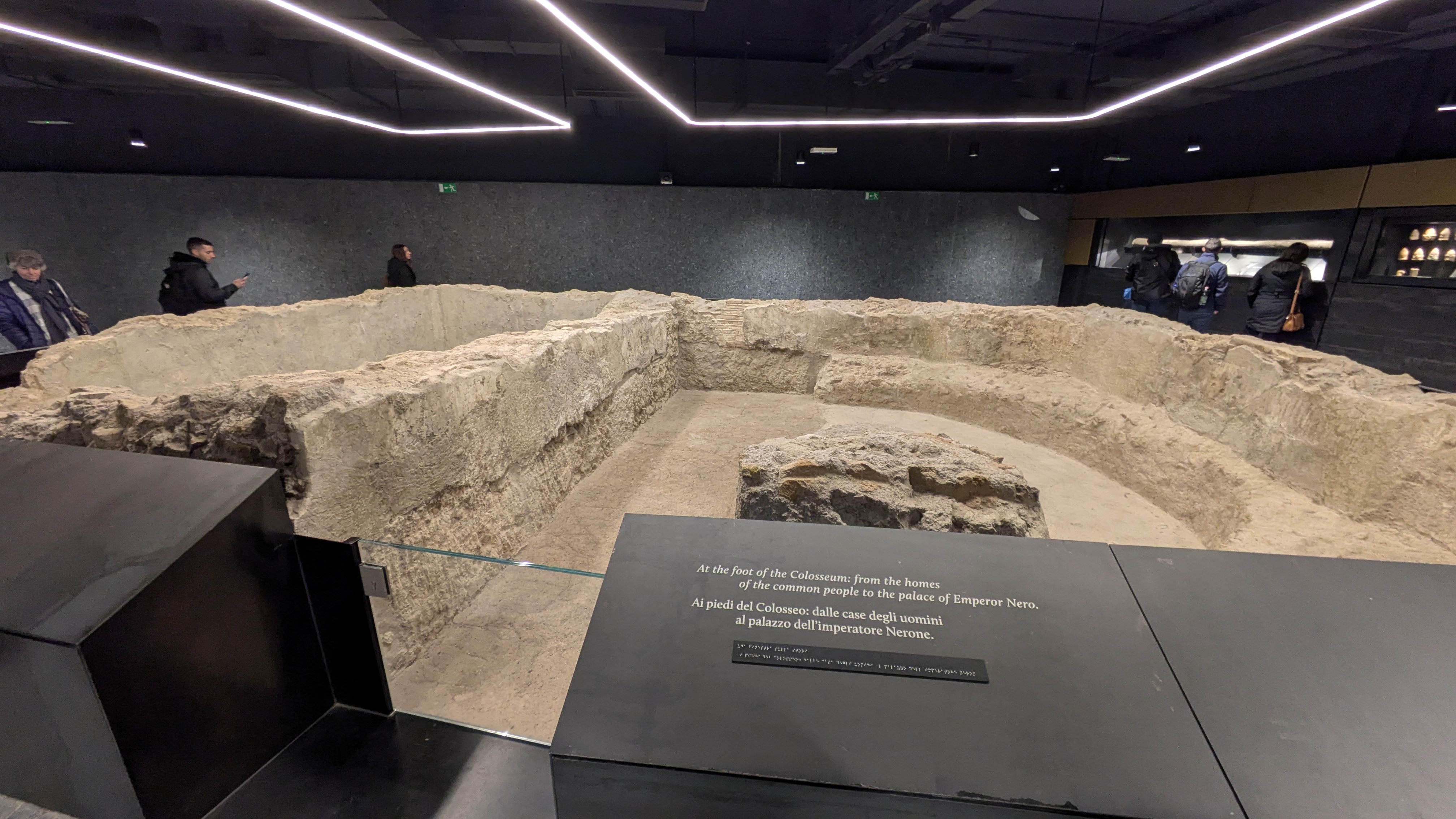
Phillips Academy’s March 2026 spring break allowed for a family trip to Rome. These family vacations are often something of a busman’s holiday, with numerous excursions to museums, galleries, and ancient ruins. This week in Rome was no exception, and included lots of ruins, a day trip to Ostia Antica, as well as a visit to the newly opened mini-museum at the Colosseum subway station, and, truthfully, many, many more sights.
I visited Rome once before, as somewhat of a treat after receiving my master’s degree in 1992—that trip included a whole swath of Italian cities and only allowed for some Roman highlights (like the Colosseum).
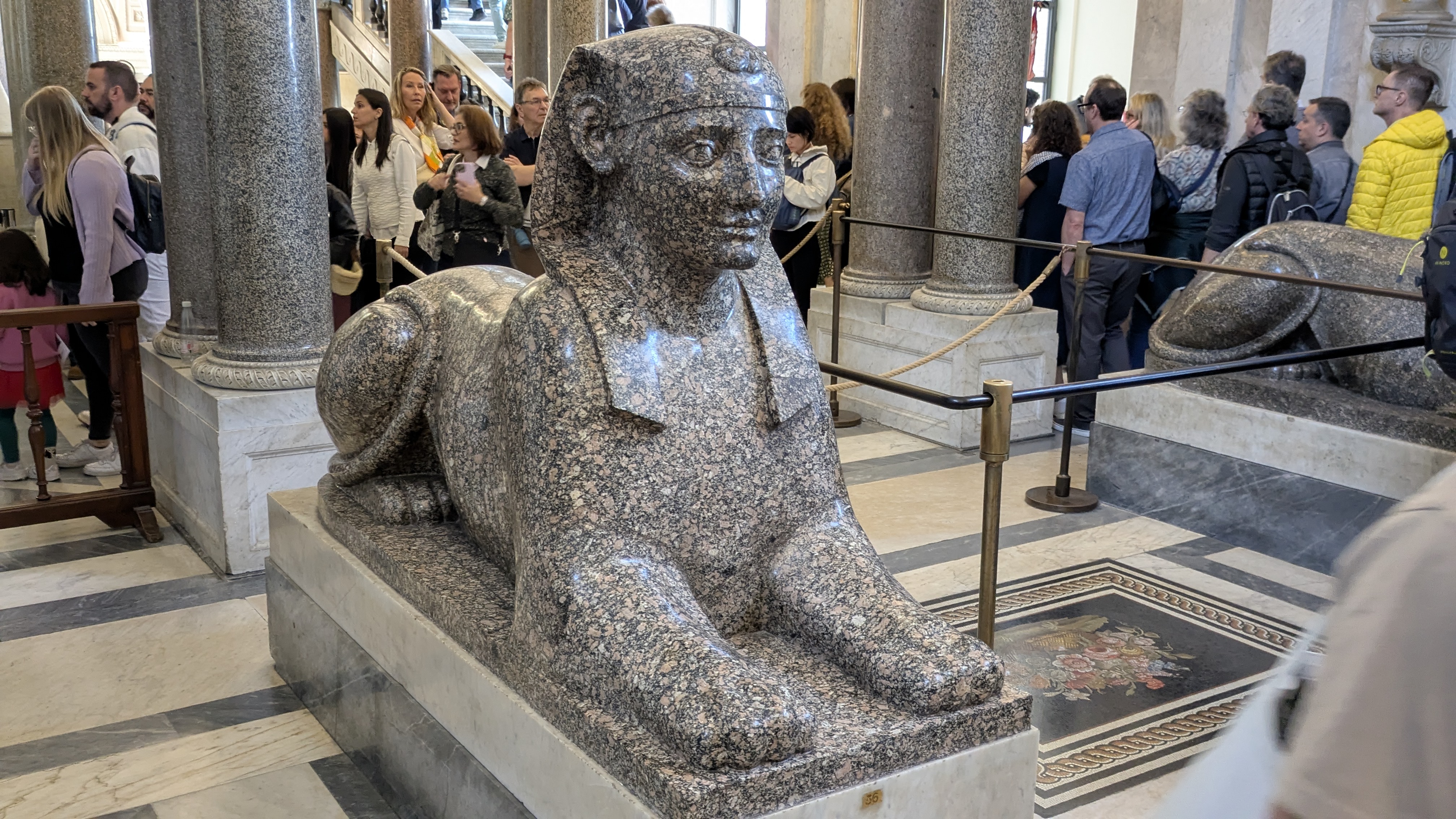
Sphinx, Greek Cross Room, Vatican Museums. pink granite, likely first century CE.
What I came to appreciate on this trip with a little surprising—just how much Egypt influenced ancient Rome. I feel like I should have known this, especially since my graduate coursework included some wonderful Roman, Greek, and Egyptian art history classes from the late Barbara Barletta.
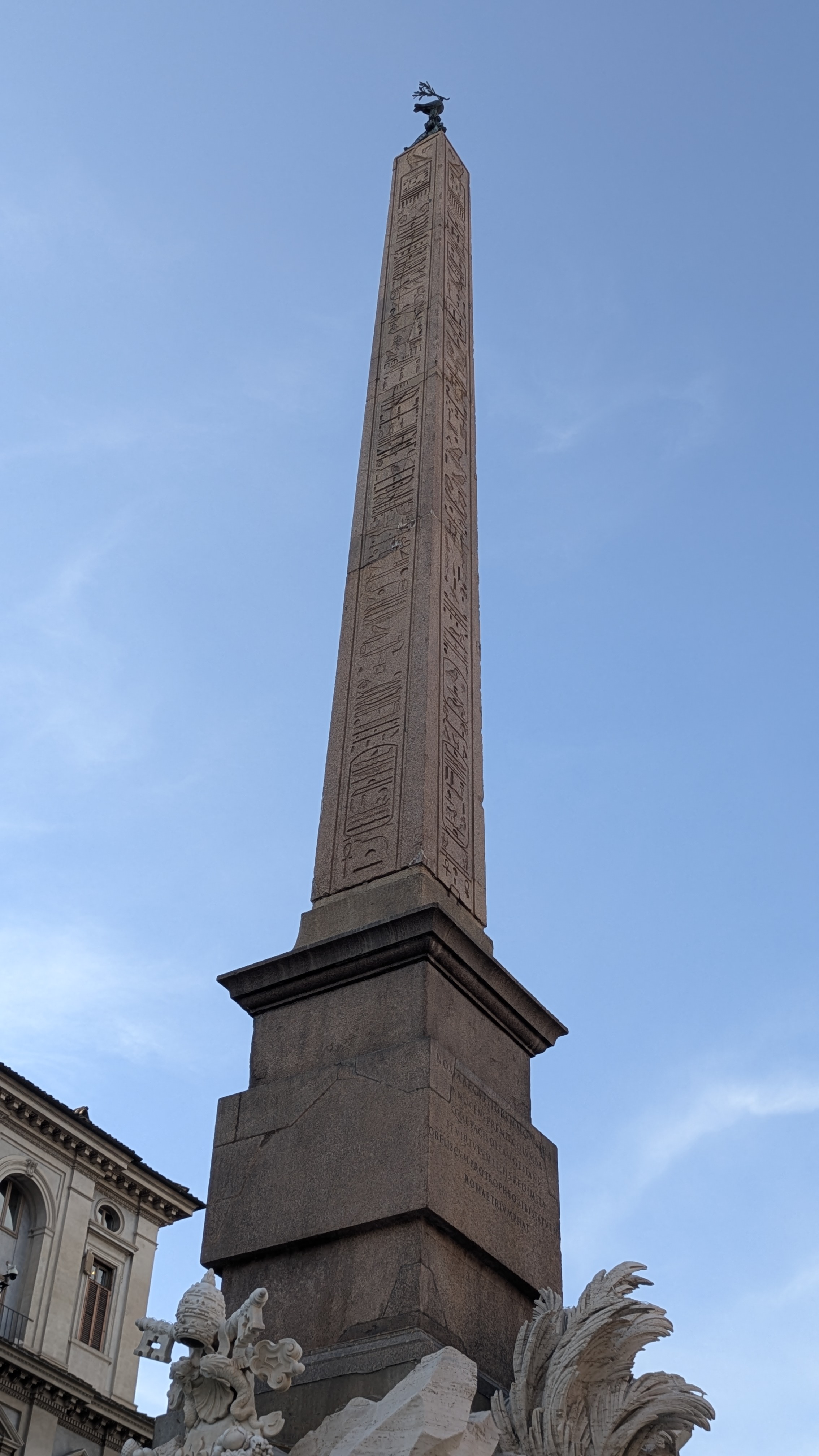
Obelisk, Piazza Navona. This monument was commissioned by Emperor Domitian and was eventually incorporated into Bernini’s Fountain of the Four Rivers.
Not far from where we stayed—and in the Piazza della Rotonda—right in front of the Pantheon—we encountered an Egyptian obelisk. Apparently, there are around twelve or thirteen obelisks throughout Rome, some Roman recreations of Egyptian architecture, others actually brought from Egypt. The one by the Pantheon is covered in hieroglyphics, including cartouches that link it to Ramses II.
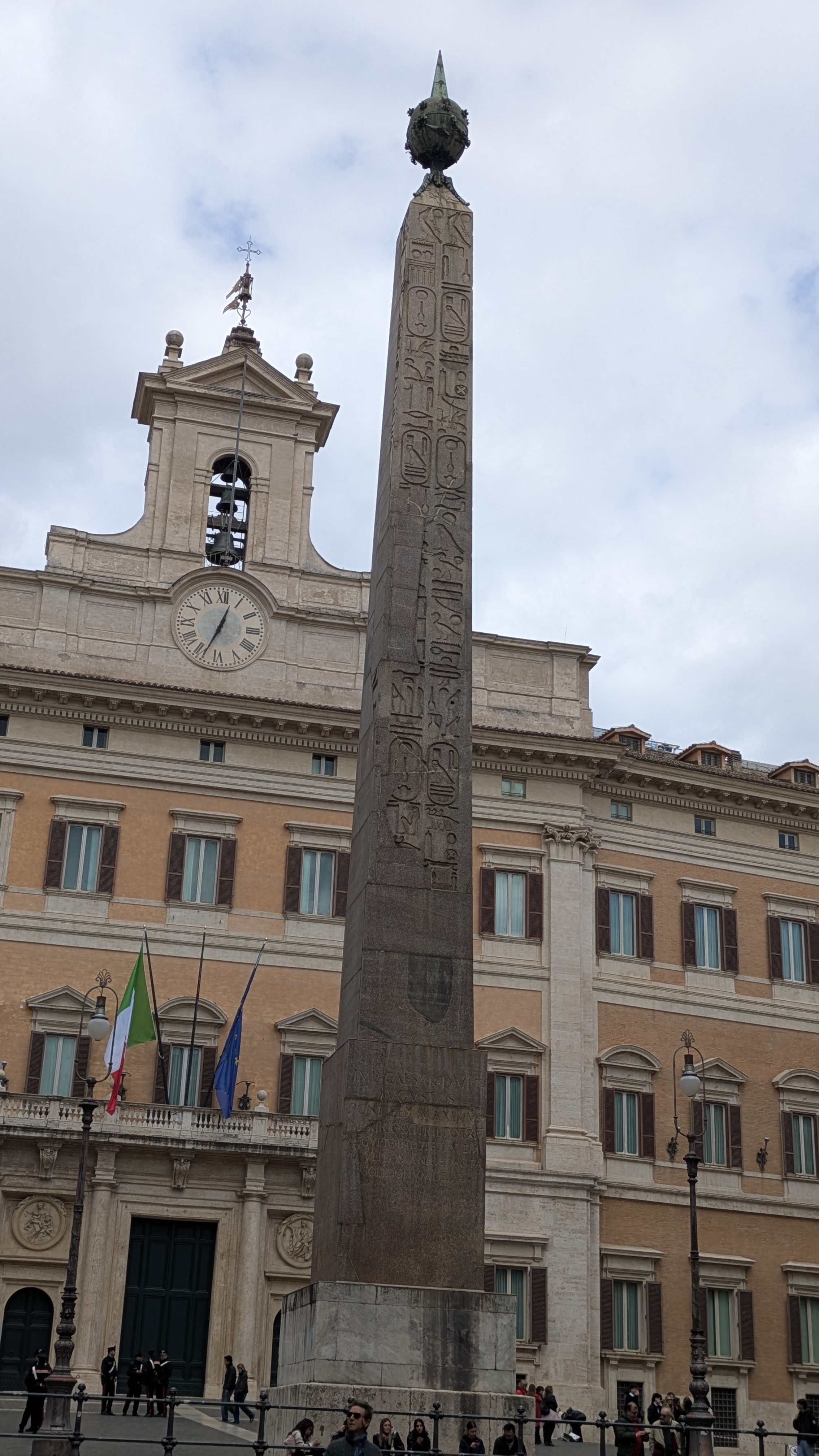
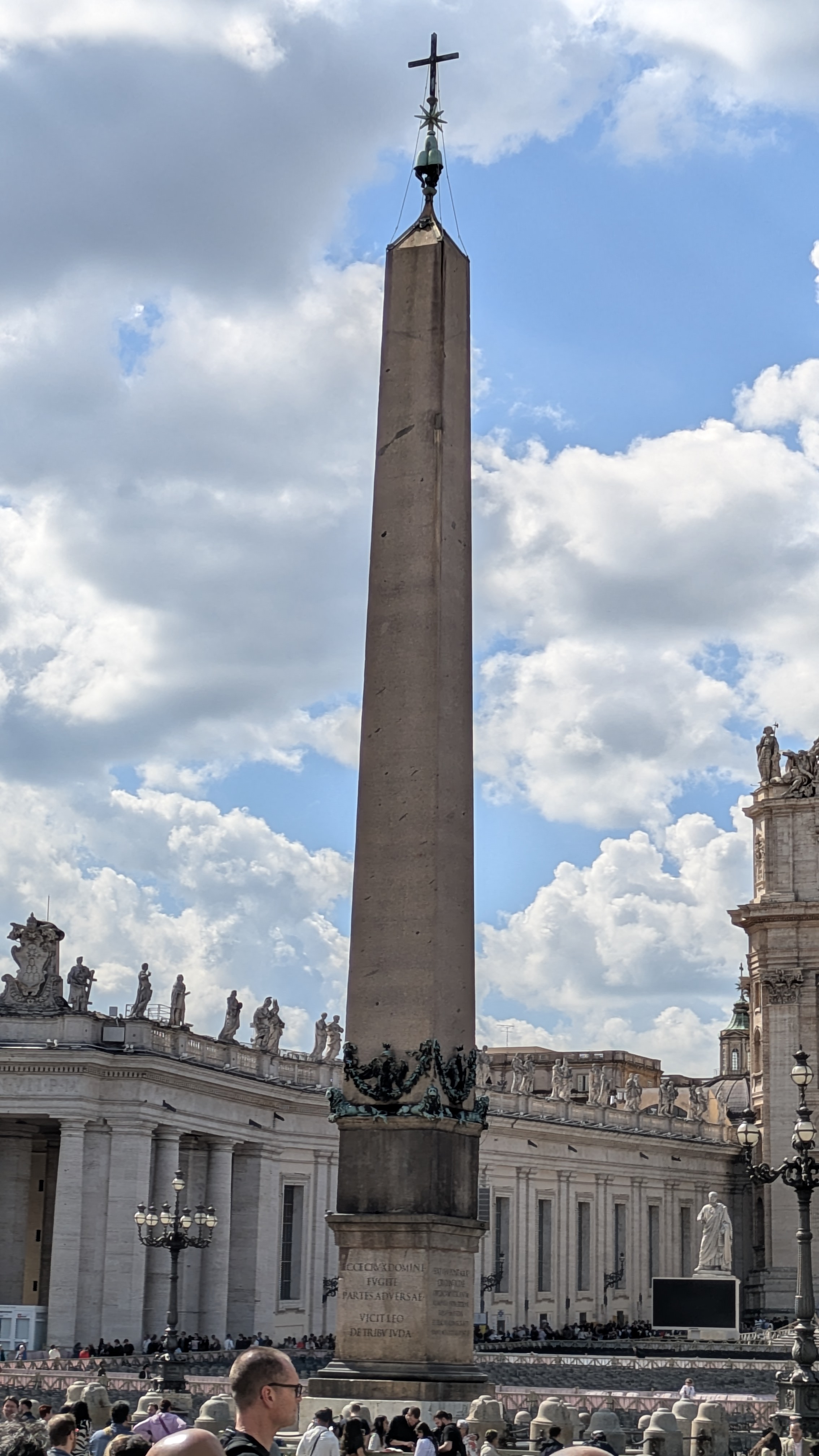
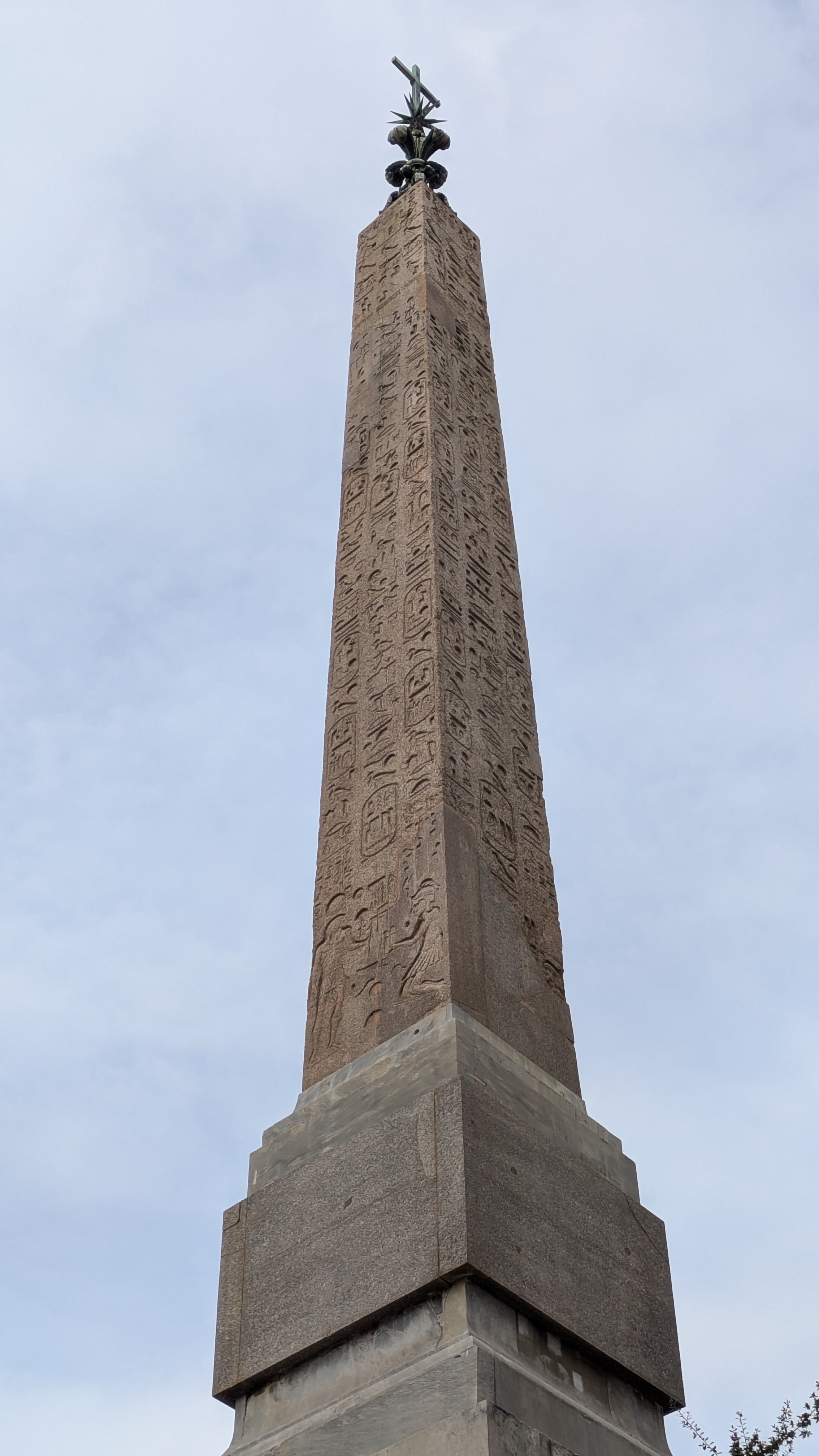
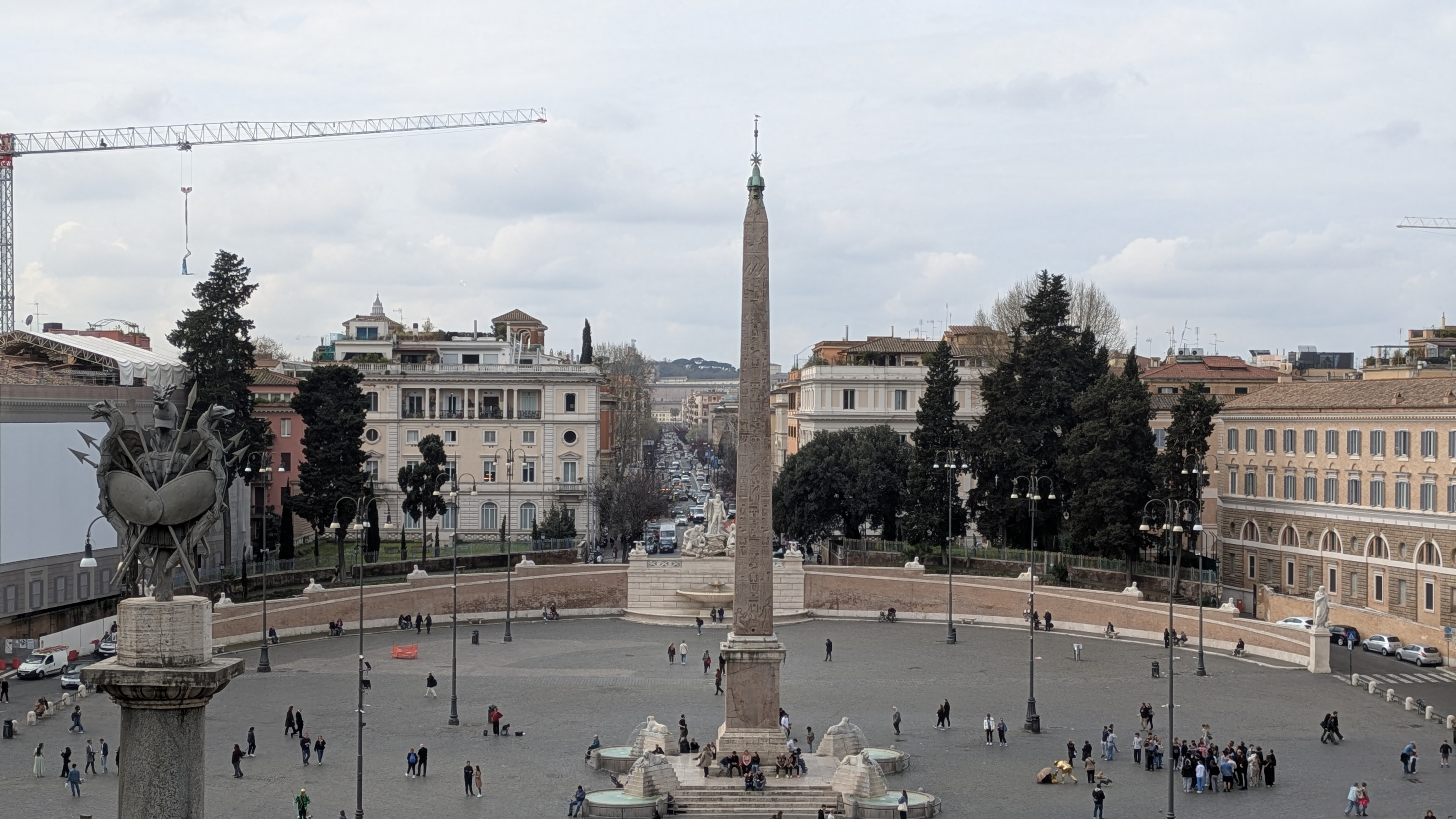
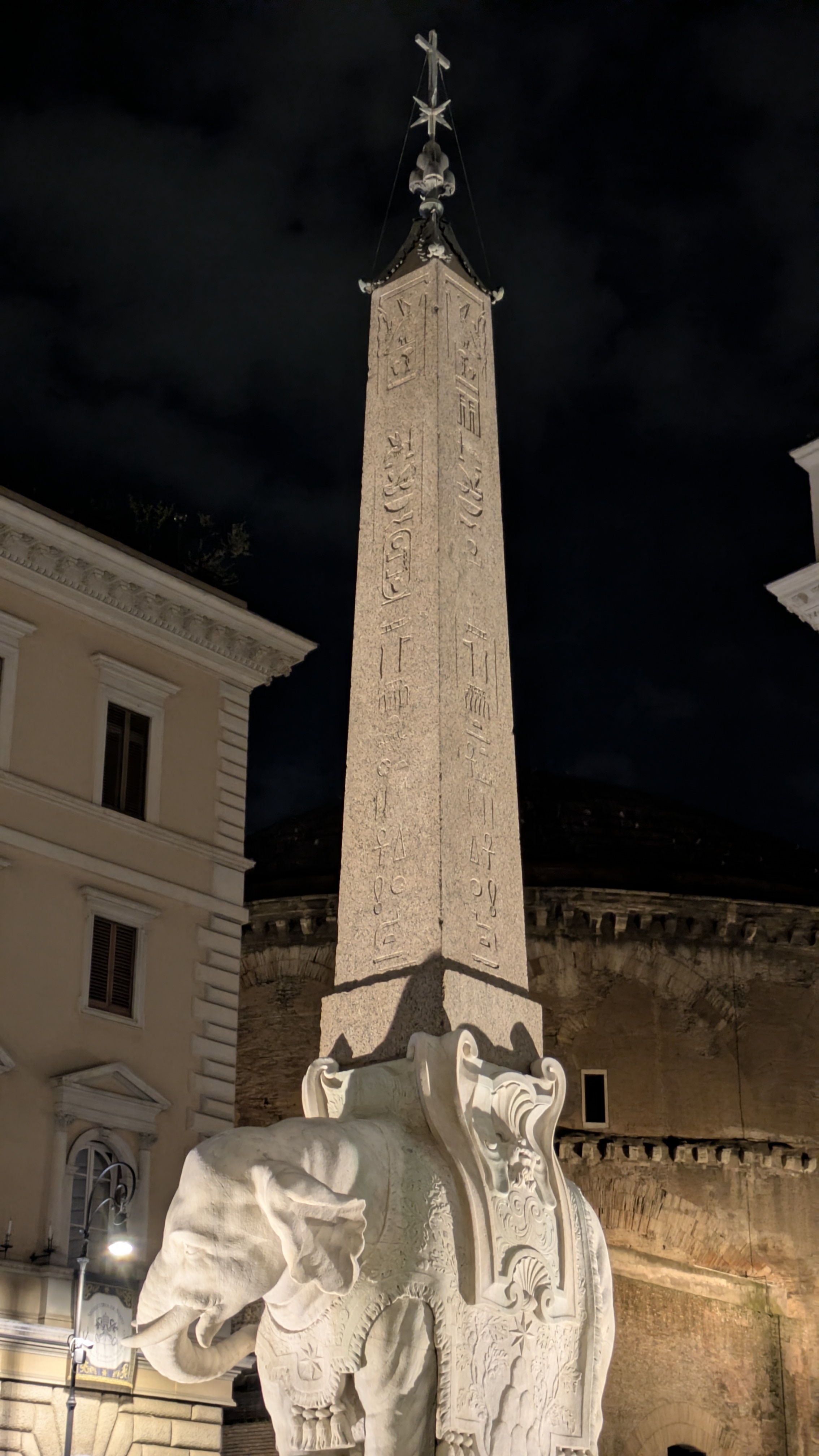
A complete tour of Egyptian obelisks in Rome was not on our itinerary, but we did manage to see quite a few, including the Flaminio Obelisk, originally from Heliopolis, dating to the thirteenth century BCE and brought to Rome by Augustus in 10 BCE (now in the Piazza del Popolo); the Sallustian Obelisk (at the top of the Spanish Steps, opposite Santissima Trinita die Monti—its hieroglyphs seems to copy those of the Flaminio Obelisk); the 1667 Elephant and Obelisk in the Piazza della Minerva, designed by Gian Lorenzo Bernini and incorporating a sixth century BCE obelisk; and the Obelisk of Montecitorio or Psamtik II, which had formed the gnomon of a Roman sundial. In fact, the lure of the obelisks was so great that I wandered off to get a closer look at the obelisk in St. Peter’s Square at the Vatican.
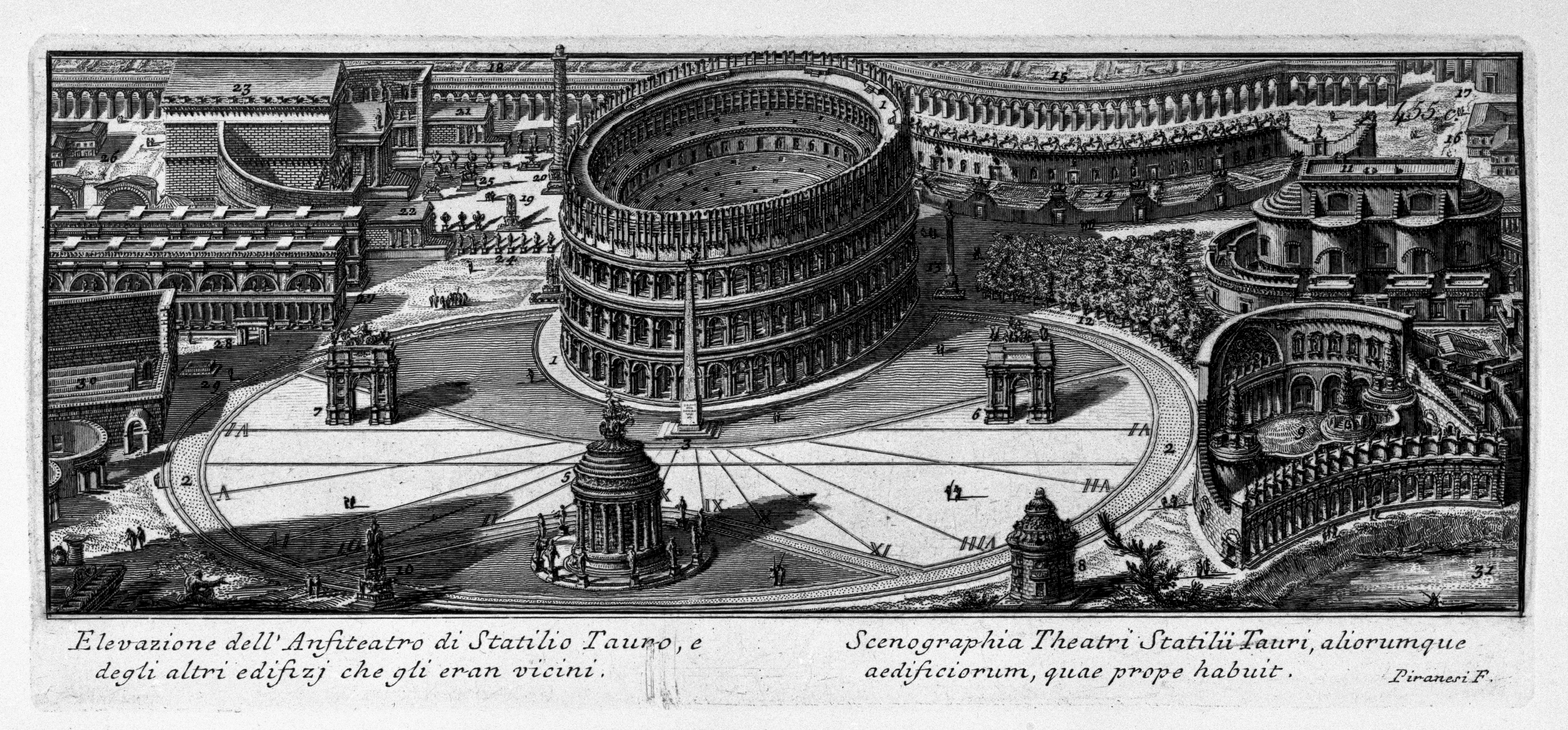
In case you were wondering about the obelisk used as the gnomon of a Roman sundial, here is an eighteenth century depiction of the horologium of Augustus, engraving by Giovanni Battista Piranesi (1720-1778), from Opere di Giovanni Battista Piranesi, Francesco Piranesi e d’altri. Firmin Didot Freres, Paris, 1835-1839, Volume 10.
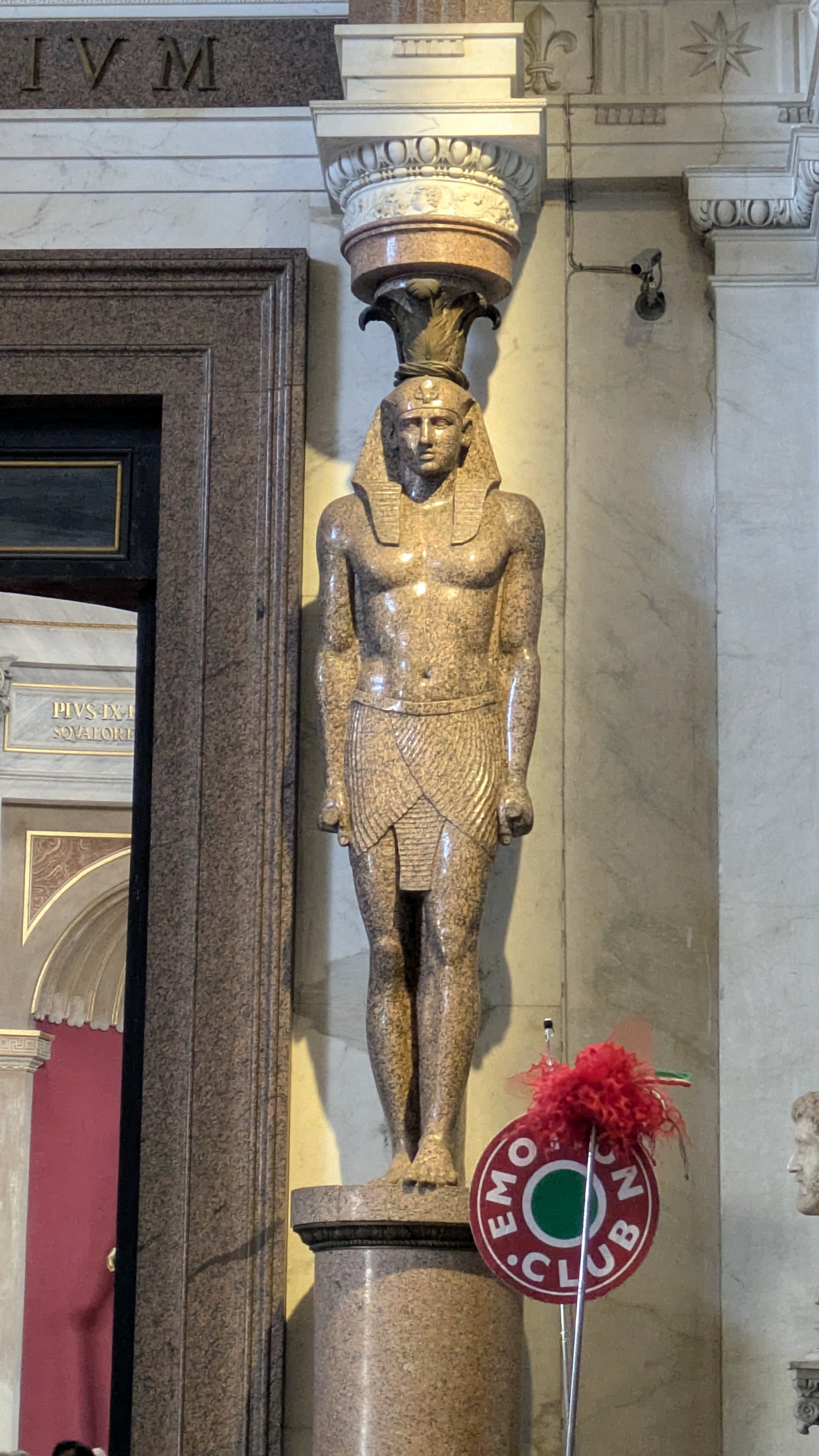
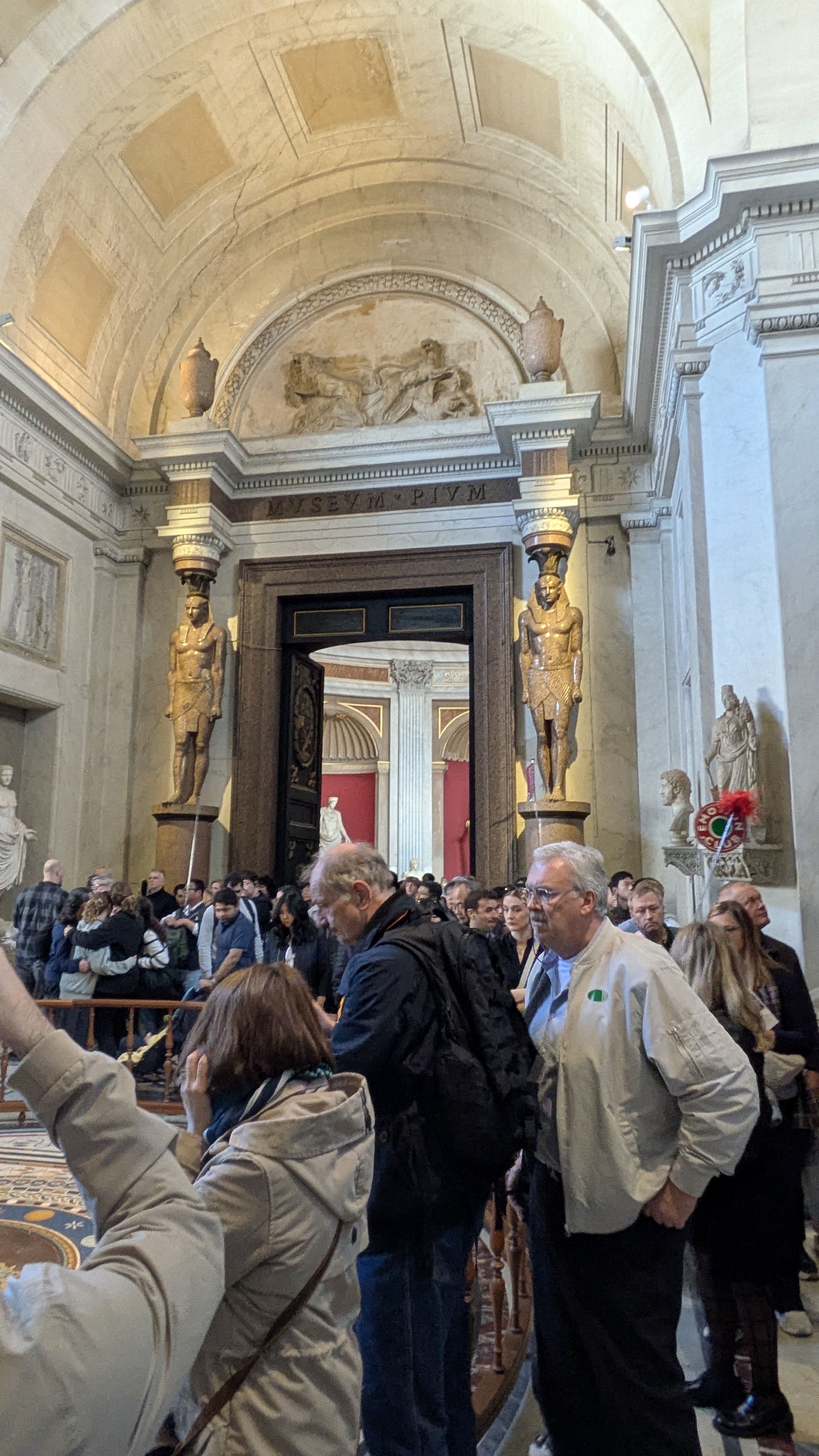
Sadly, time did not permit a tour of the Egyptian gallery at the Vatican Museums, but we did spot several interesting pieces of Egyptian statuary as we pushed through the crush of humanity along with the other 35,000 daily visitors. I was particularly taken with a pair of Egyptian style pillar-statutes in the Greek Cross Hall. You can tell these are Roman copies of Egyptian artwork by their pose—the first century Romans went for symmetry, alternating right and left feet forward, while the Egyptian convention dictated the left leg forward.
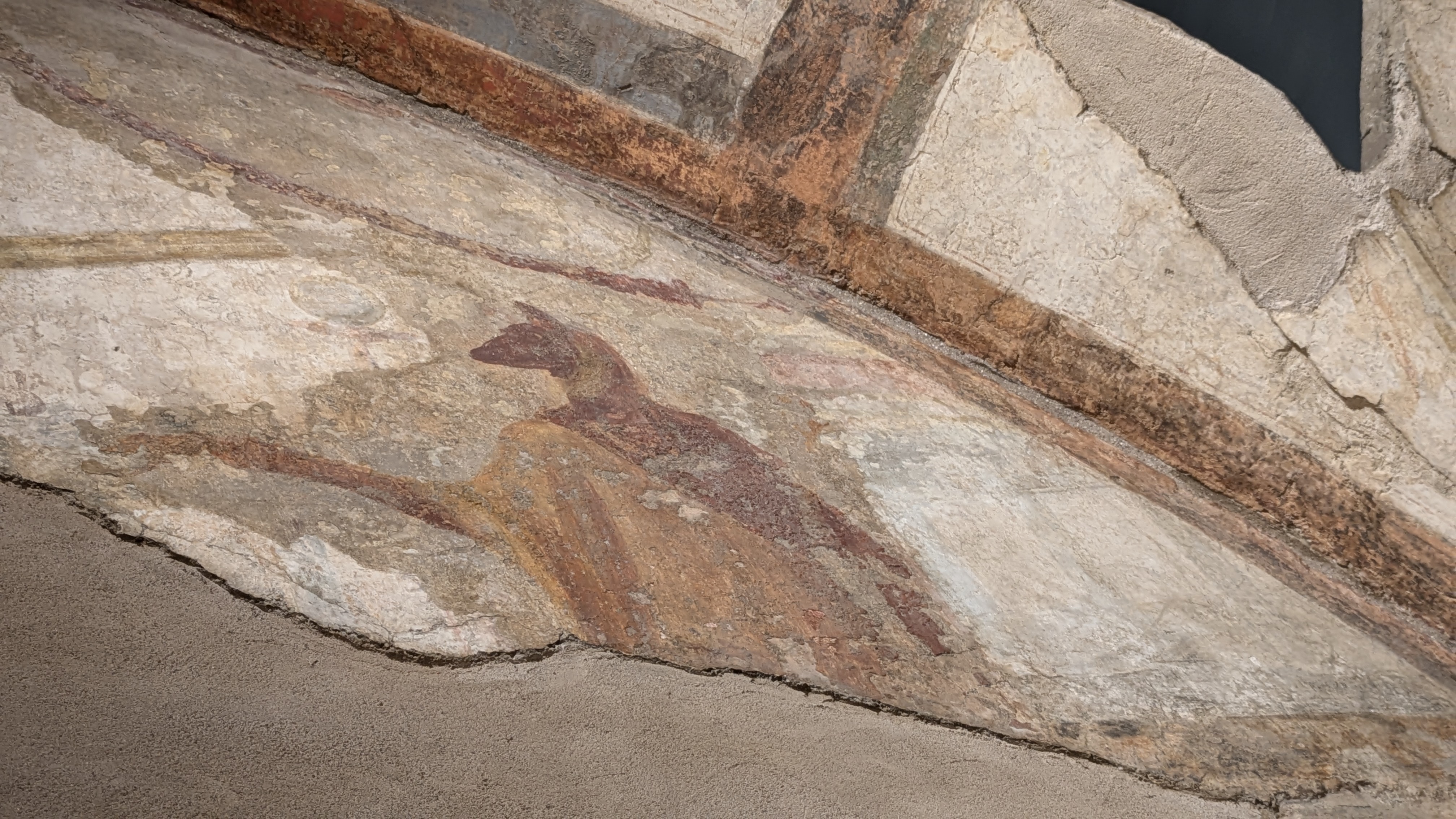
Anubis featured on a fresco in an early Roman home, later built over by the Baths of Caracalla. Cults of Egyptian gods were prevalent in Rome 2,000 years ago.
Many of the ancient obelisks had been parts of temples, removed and reset in later times. We also got a sense of just how pervasive Egyptian art, architecture, and deities were in ancient Rome with a glimpse at a fresco showing Anubis, the jackal-headed Egyptian god of death, in the ruins of a Roman house pre-dating the construction of the Baths of Caracalla by several hundred years.
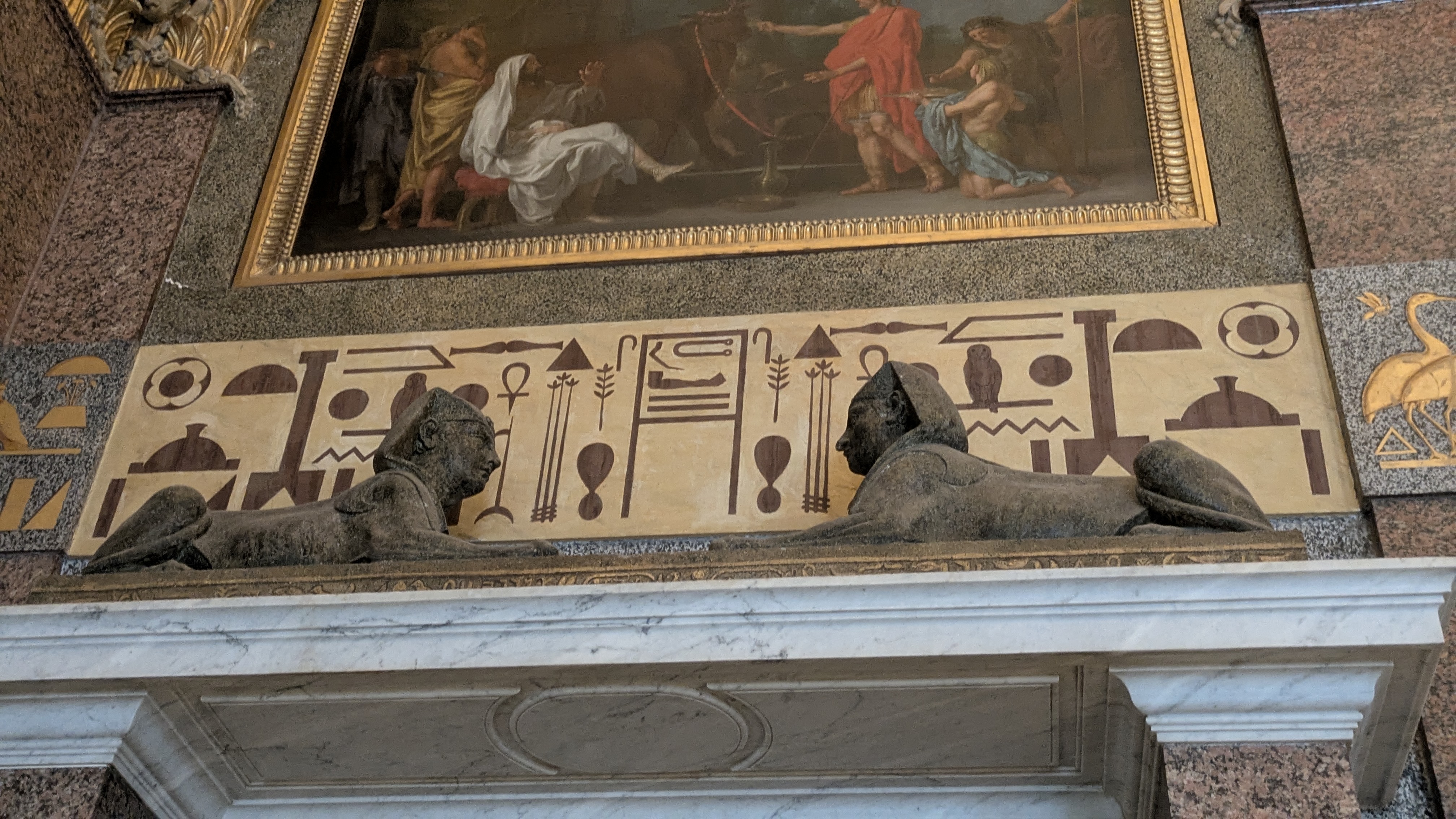
Egyptian sphinxes and faux-hieroglyphics in the Egyptian Room, Galleria Borghese hint at the Egyptomania of late eighteenth century Rome.
Egyptian influences continued well into later periods, as evident in the late eighteenth century Egyptian Room in the Galleria Borghese, which includes non-sensical hieroglyphic decoration, lots of red granite, Egyptian style ornamental architecture, and Greco-Romanized Egyptian gods in the ceiling frescoes. So, not only was Egypt an inspiration to the ancient Romans, but borrowing designs, materials, and items continued for a long time!
A zippy cab ride back to the airport provided a quick glimpse of a pyramid in Rome as well (though I was too slow to snap a pic). The pyramid, built around 18 BCE, serves as the tomb of Caius Cestius, a Roman official, who may have been involved in Roman campaigns against Meroe, explaining his interest in the steep pyramids that contrast with those at Giza. Originally out in the countryside, the pyramid has been incorporated into more recent city walls and enveloped by the bustling metropolis.
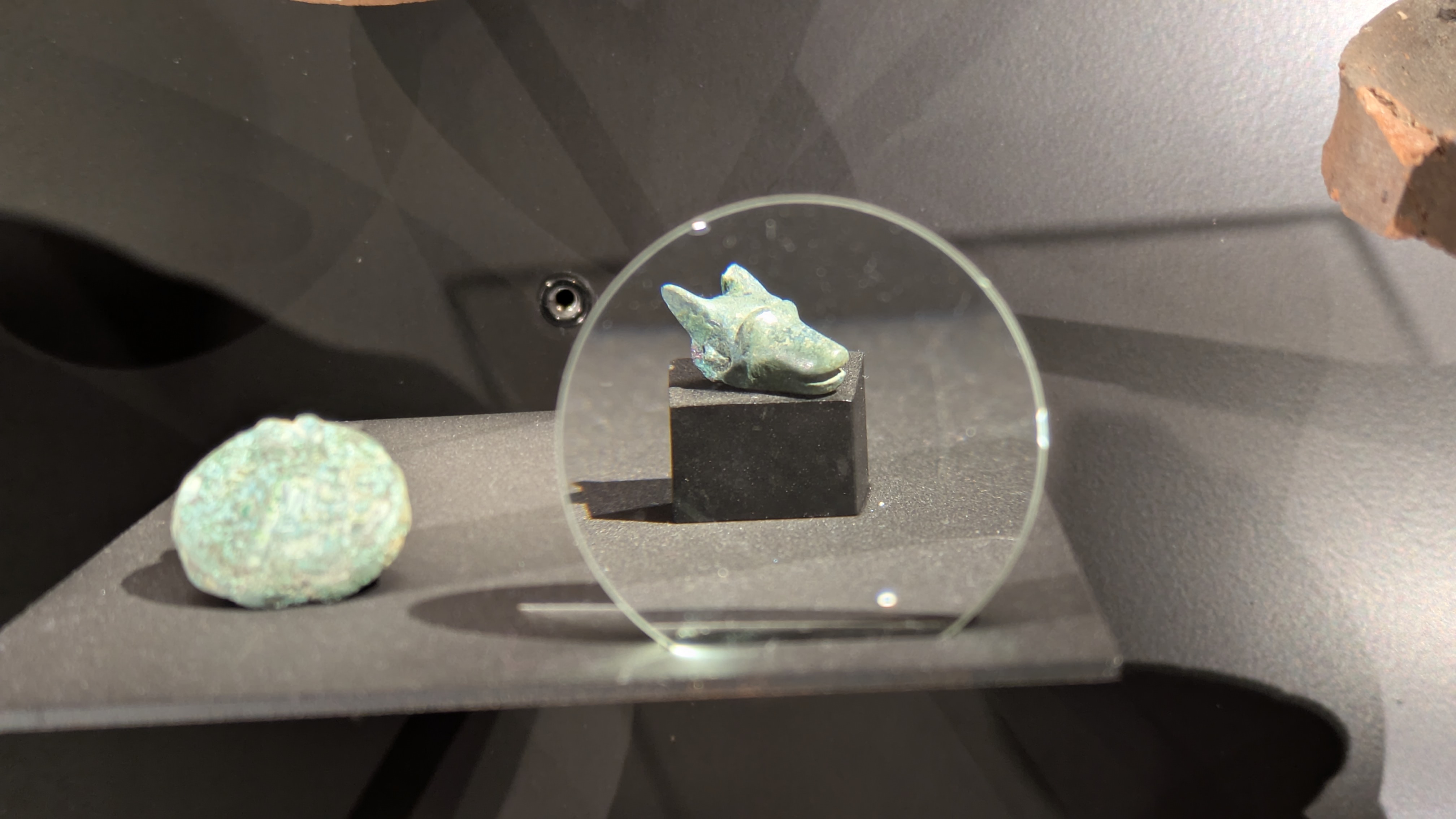
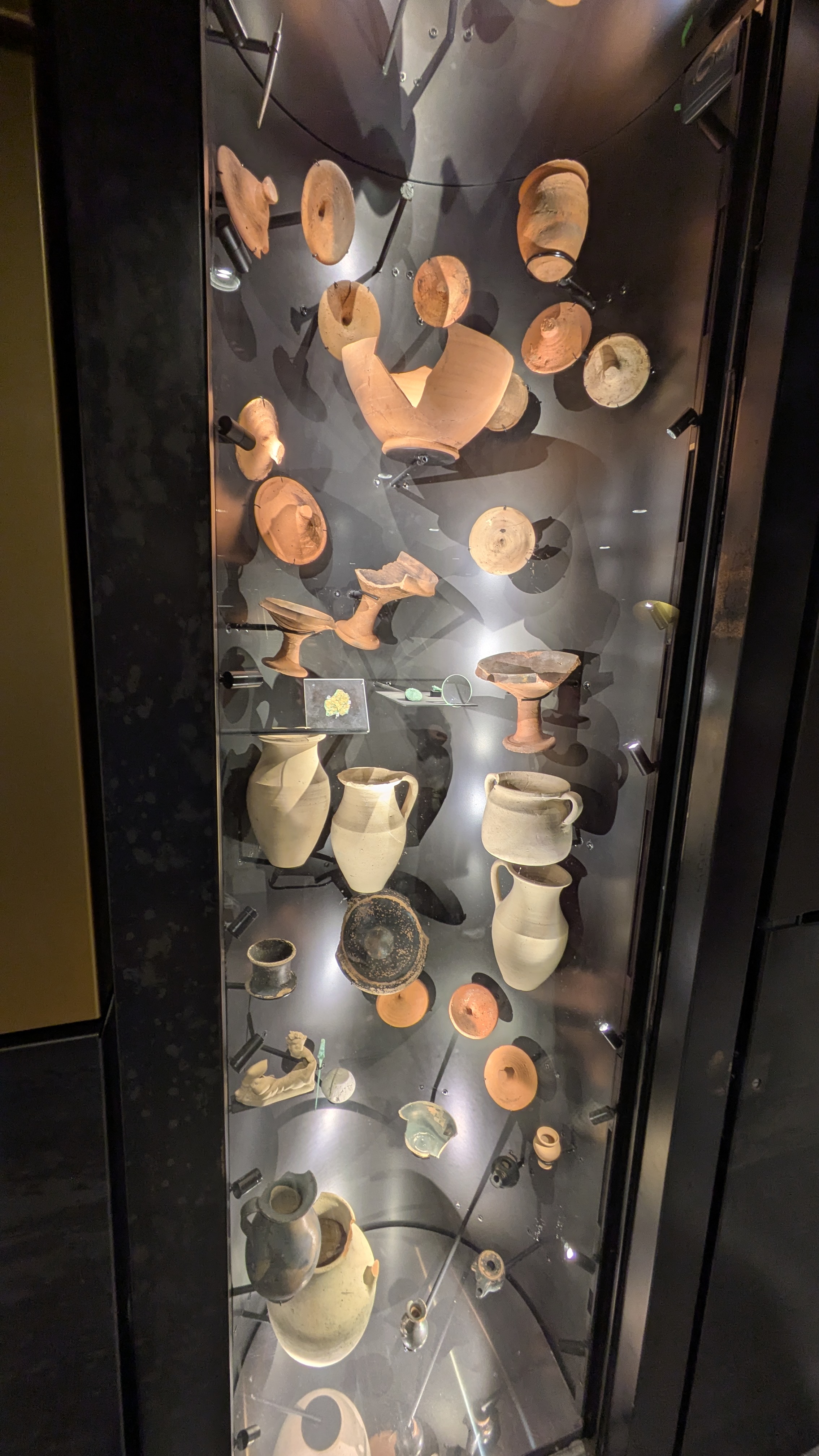
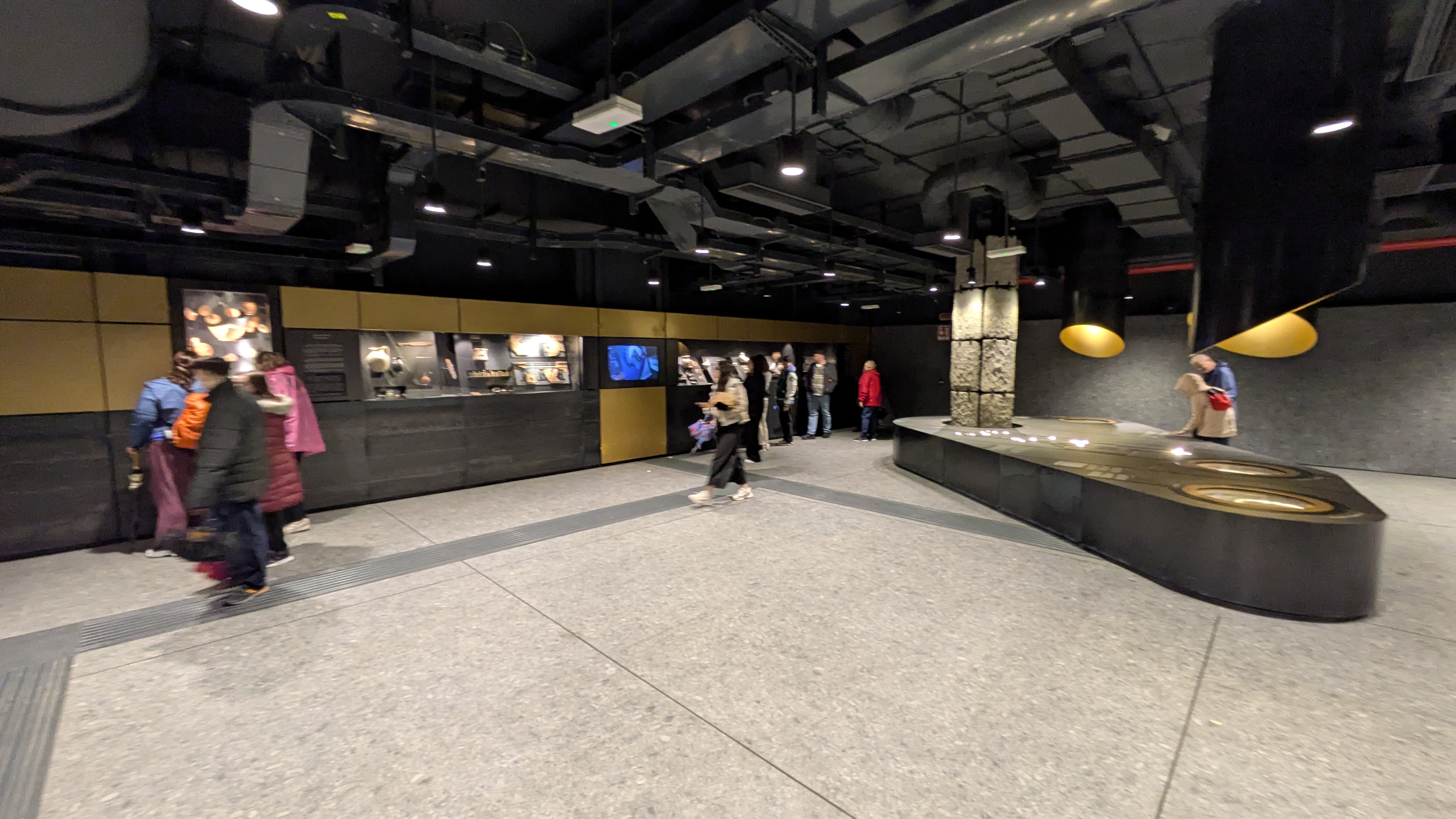
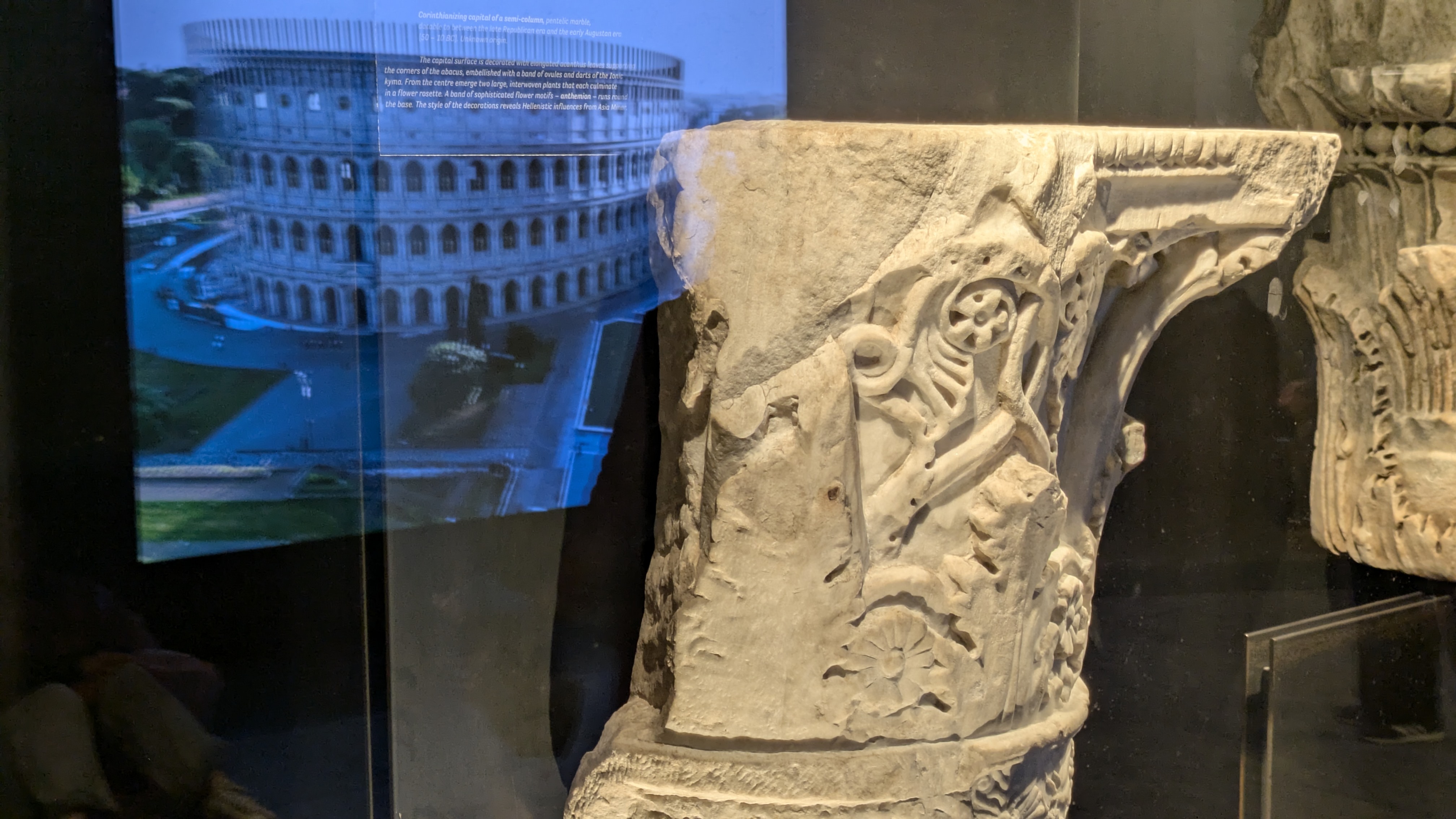
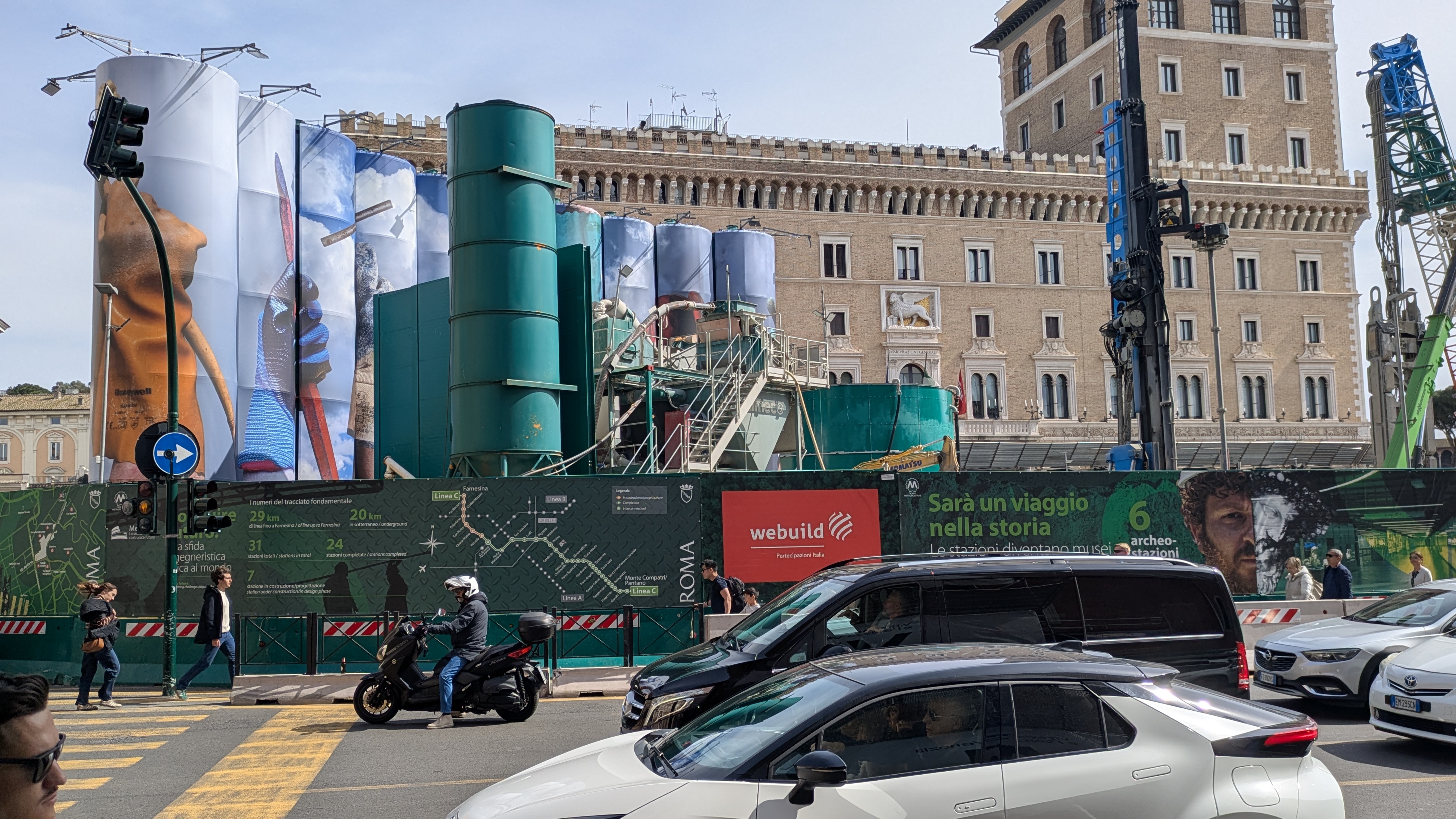
More subway construction, Piazza Venezia, which will feature a new mini-museum!
We agreed that we needed to return to Rome at some point, and I’m positive we will find more Egyptian pieces! We learned about additional mini-museums being created at new and expanded subway stops, so we will have those at the top of our itinerary.
We are just over a month away from celebrating the founding anniversary of the Peabody Institute of Archaeology (originally known as the Department of Archaeology) at Phillips Academy Andover. This year marks a special milestone for the Peabody, being our 125th Anniversary, that’s quasquicentennial if you’re fancy!
This blog celebrates the founding history of the Peabody as captured by Phillips Academy’s student newspaper, The Phillipian, and acts as a “save the date” for more ways to celebrate with the Peabody throughout the year.
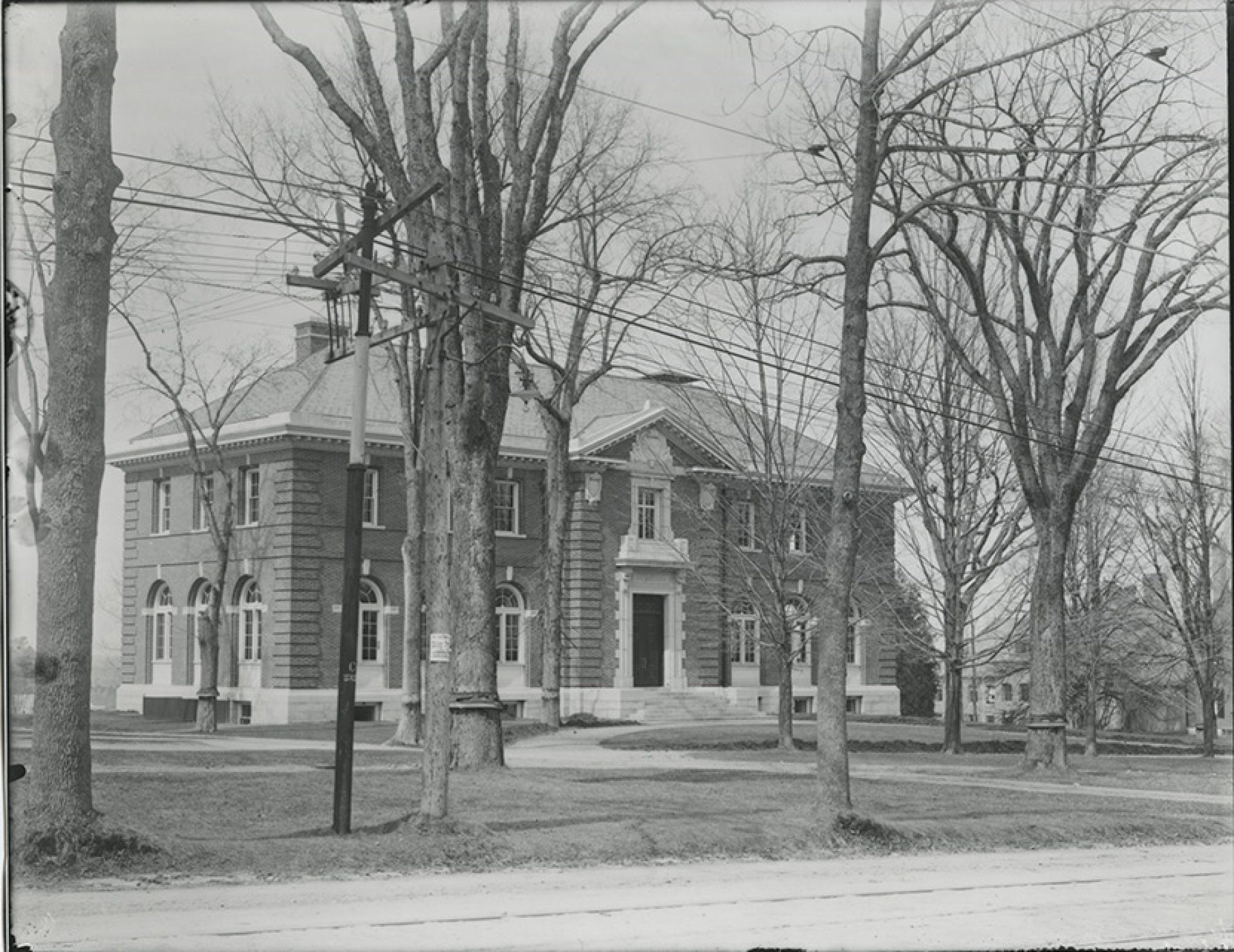
Department of Archaeology, 1906.
On Thursday, March 21, 1901, the Trustees of Phillips Academy established the Department of Archaeology at a meeting held in Boston. An anonymous donor and friend of the Academy, “provided a foundation sufficient for the erection of a suitable building, an endowment for instruction, research, and publication, together with a large collection.”
The inaugural officers of the Department of Archaeology were Dr. Cecil F.P. Bancroft (Principal of Phillips Academy), Charles Peabody (first Peabody Director), and Warren K. Moorehead (first Peabody Curator and Chief Executive Officer of the Archaeology Department).
In later years, the anonymous donor was recognized as Phillips Academy alumnus, Robert S. Peabody (Class of 1857), the namesake of our institution. Peabody’s passion for archaeology led him to create the archaeology program to encourage young students’ interest in archaeological sciences and to foster respect and appreciation for Native American culture. In addition, the institution would support archaeological research and serve as a place for students of Phillips Academy to gather.
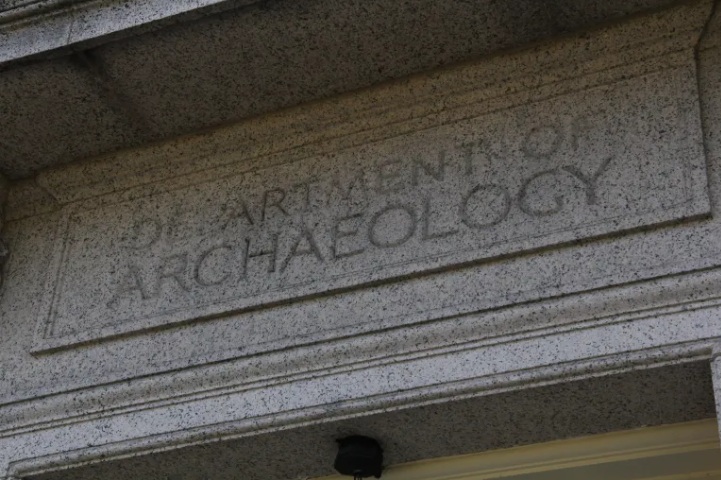
The original name of the Peabody is still present above the building’s front entrance.
At the time (1901), this was the largest single gift to the Academy and included Peabody’s collection of nearly 40,000 items. It was not only rare but quite unusual for a preparatory school to have its own department of archaeology with international connections and a major collection.
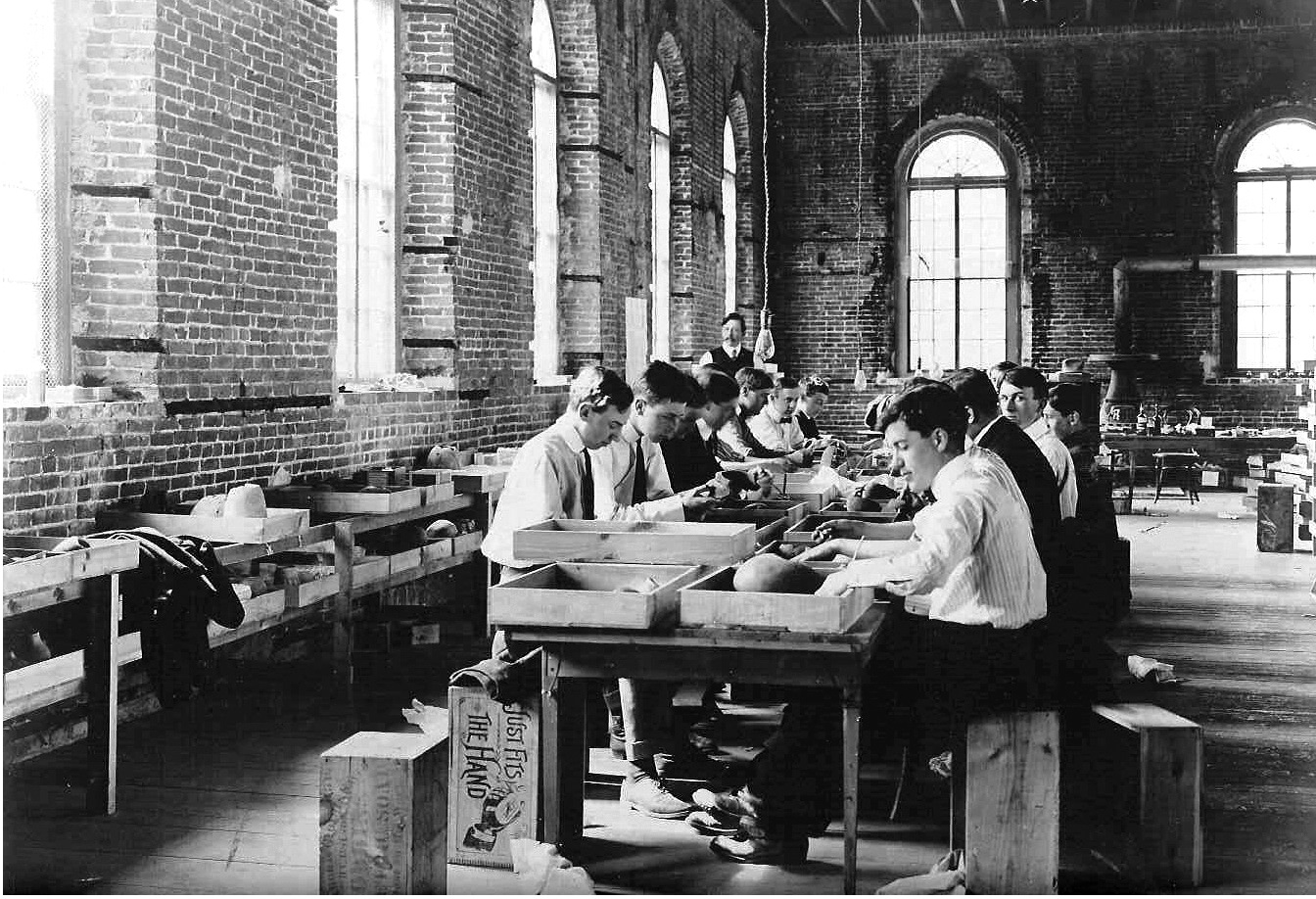
The new archaeology department was officially dedicated on Wednesday, May 1, 1901. Warren K. Moorehead spoke at a campus chapel meeting describing upcoming construction for the department and that a new building would be located on the corner of Phillips and Main Streets, where the current institute resides today. “The collection is now in Philadelphia and will be brought here [Phillips Academy] within the next two weeks and placed in the old gymnasium until the new building is finished.” Students from the Archaeology class would meet in the old gymnasium (located in the Brick Academy – the gym incarnation of Bulfinch Hall) on Monday and Thursday afternoons to help Mr. Peabody and Mr. Moorehead unpack the collection. The class met there for weeks while the new building was under construction, the laboratory-style work giving a unique replacement to the typical lectures students attended in their daily classes.
Students unpack Robert S. Peabody’s collections in the school gymnasium, circa 1901. Lantern slide, from the photographic collections, Robert S. Peabody Institute of Archaeology.
In the image above, students are unpacking from the very wooden drawers the Peabody used as housing for the collection, before it was replaced by more sustainable storage material in Phase 1 of the Peabody’s building project in 2023. If you look closely, you’ll see Mr. Moorehead standing in the background overseeing his students’ work!
The first lecture in Archaeology was given by Charles Peabody on October 14, 1901. Lectures were shared between Peabody and Warren K. Moorehead, most taking place in other buildings on campus such as the science building while the Department of Archaeology was under construction. In addition, Moorehead would take students participating in the archaeology class to various sites in the area – examining shell heaps in Ipswich, MA and an Indigenous village site along the Merrimack River near Lawrence, MA.
It is fascinating to see the parallels between current Peabody events and this moment in time – as of January 2026, the Peabody staff have moved out of the Peabody building to a temporary space across campus while the final Phase 2 of the Peabody’s building project begins. In addition, classes with the Peabody are (at present) being taught across other locations on campus during the building’s construction. With our Peabody Director, Ryan Wheeler, even teaching his Human Origins course in the science building as we saw Mr. Peabody and Mr. Moorehead doing about 125 years before!
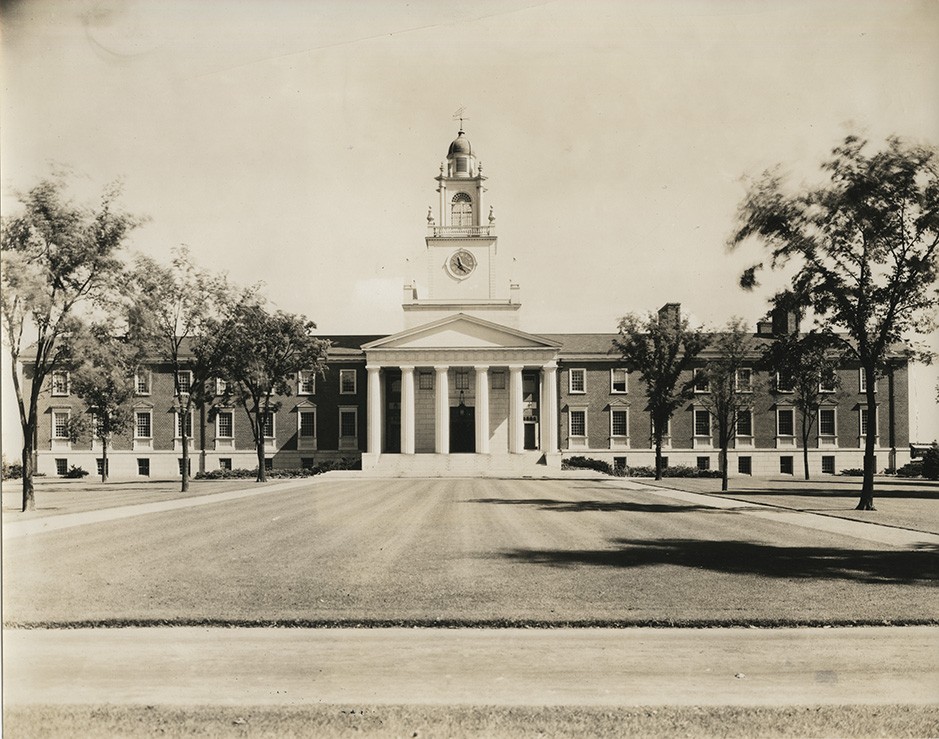
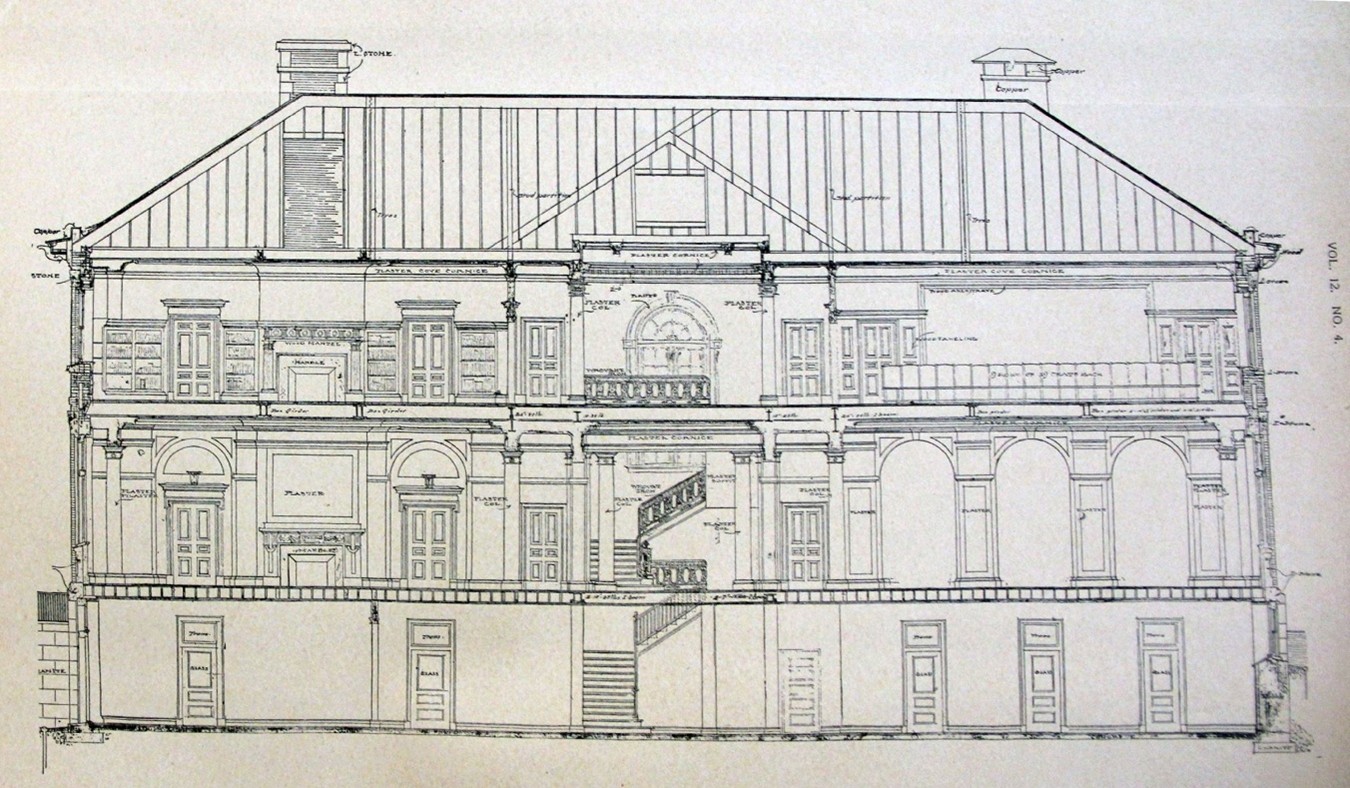
By October 30, 1901, bids for the new Archaeological building were in and construction was to begin soon after. Guy Lowell was chosen to design the building – the Peabody being his first architectural commission for Phillips Academy. Guy Lowell would later design other buildings on campus such as the Isham Infirmary (1913), Memorial Bell Tower (1922), and Samuel Phillips Hall (1924). Lowell also played a part in the development of the campus “Vista”, the reorganization of the Great Quadrangle, and renovations to Bulfinch Hall (1902). The Boston architect was most renowned for his design of the Boston Museum of Fine Arts and New York State Supreme Court Building.
“The main entrance is in the center, opening into a spacious hall wherein the largest specimens in the collection can be shown. On one side of this hall is to be a big exhibition room, with an alcove, and on the opposite side is a similar hall, behind which are the custodian’s office and private apartments, and a cataloguing room.
The building is two stories. The second floor is given over to a room, on one side of the main hall, to be used for lectures and entertainment, with a large platform provided for these purposes. This hall will seat 175 or 200 students. On the other side of the main hall is a large library and reading room and lounging place, with a stack room, which will make it possible to care for 15,000 volumes. The windows on the lower floor are arched at the top, while those of the second are what architects term square headed.
The basement of the building is commodious, but will not be finished at once, although the plan is to have eventually an assembly room, a grill room, various committee rooms for the athletic departments, offices for The Phillipian and Mirror, and possibly a small cooperative store for the benefit of the students.”
For more details about some of the Peabody’s earlier building features, check out my previous blogs here and here!
Peabody Building Plans, 1902
As the new building construction began to reach completion, the Peabody collections were growing from various donations across the country. The archaeology department staff stored the collection in various parts of campus such as the old gymnasium (Bulfinch Hall), the new gymnasium (Borden Gym), and the Administration building (which alone, stored about 30 different collections, totaling to about 4,000 items.)
By early February of 1903, the Peabody collection was officially moved into the new building. Briggs & Allyn, a company in Lawrence, MA built fifteen large museum exhibit cases modeled after the Peabody Harvard Museum to display some of the collections.
The Peabody during the Byers and Johnson era (1936 – 1968)
I did appreciate the Peabody staff’s honesty at the time expressing the difficulties of balancing the move into the building with their academic responsibilities, mentioning “it has been difficult for the officials of the department to conduct class work properly, and for students to understand the course, since all the specimens have been inaccessible… all will welcome the installation of the collections in their proper quarters.”
The formal opening of the new Department of Archaeology building was held on Saturday, March 28, 1903. The opening was celebrated with a reception including performances by the Mandolin and Banjo clubs as well as several speakers from the Academy and Archaeological field. Out of the various addresses by members of the Academy, two stood out – one, from Dr. Robert R. Bishop (on behalf of the Trustees of the Academy) who most gratefully accepted the gift of the new building on behalf of the Trustees, regretting only that “on account of the modesty of the donor, he was not permitted to make known their name.” This being the very donor that we now honor as the namesake of our institution.
Second, from Vice-Principal A.E. Stearns (on behalf of the Faculty of the Academy) who mentions a very significant fact – “that one hundred and twenty-five years ago the first class that ever graduated from Phillips Academy, met for its exercises on the very spot where the new archaeology building now stands.” I find these words timely as the Peabody looks forward to celebrating 125 years in that same spot next month.
In commemoration of our 125th the Peabody will be celebrating all year with upcoming activities, events, special communications, virtual opportunities to connect with our institution, and ways to support the Peabody and our future projects. There is so much more to come that we cannot wait to share with you! Stay tuned and follow us on our socials so you don’t miss out on the festivities!
Did you know that the building that houses the Peabody Institute was built between 1901 and 1903? Designed by well-known Boston architect Guy Lowell, the building was designed to be the home of the Phillips Academy Department of Archaeology. Over the past 120 years, the department has transitioned into the Peabody Institute.
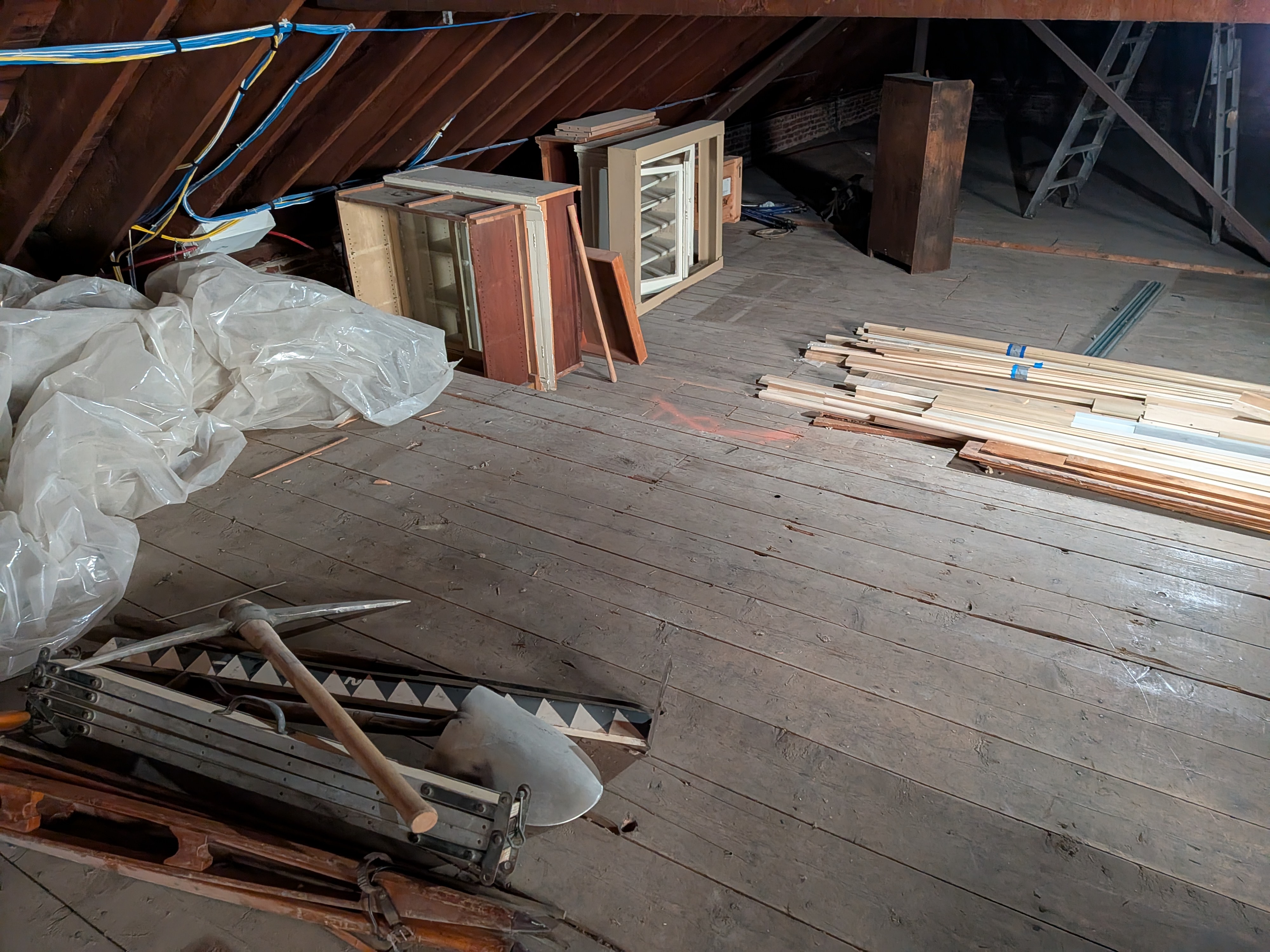
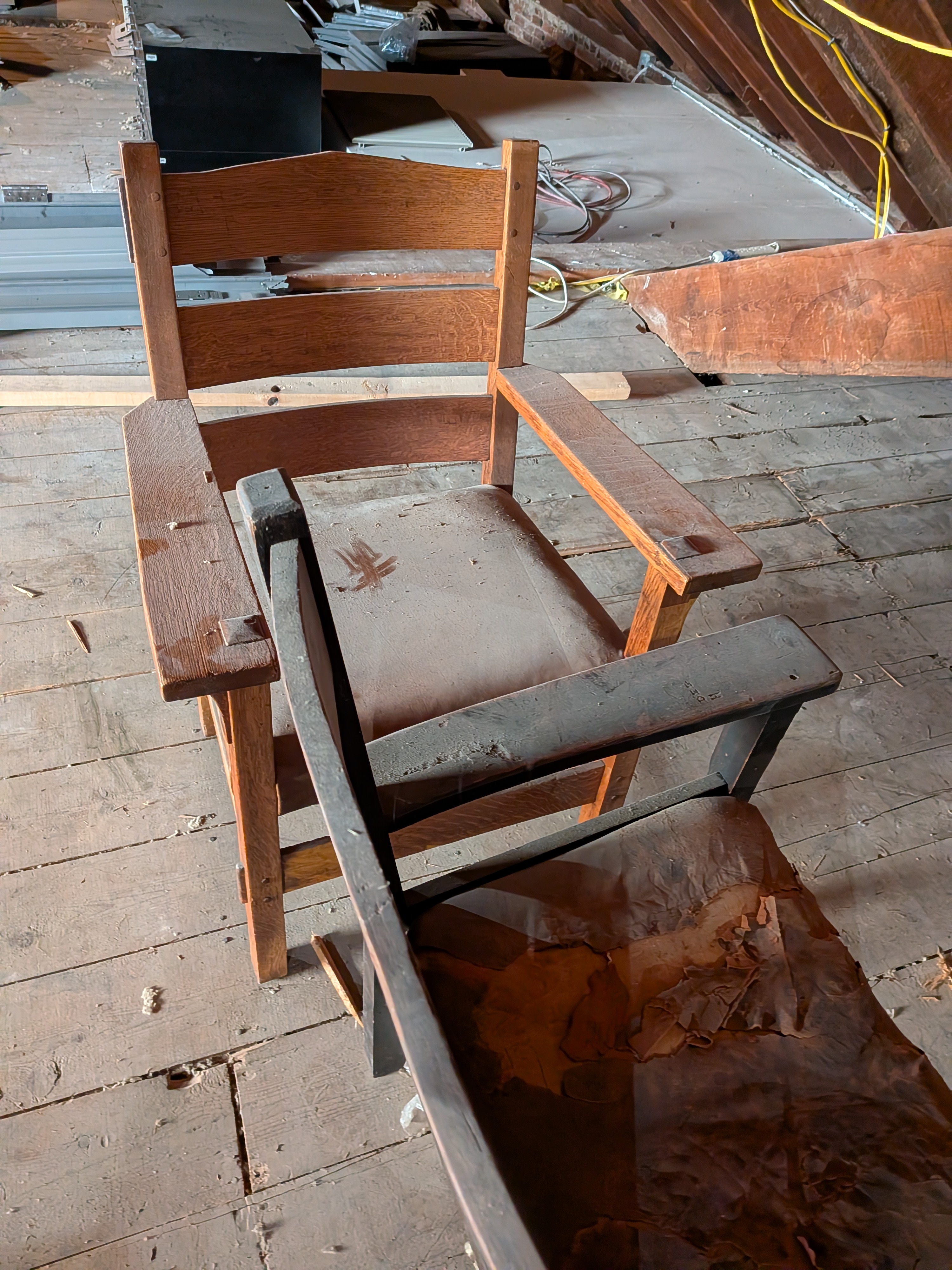
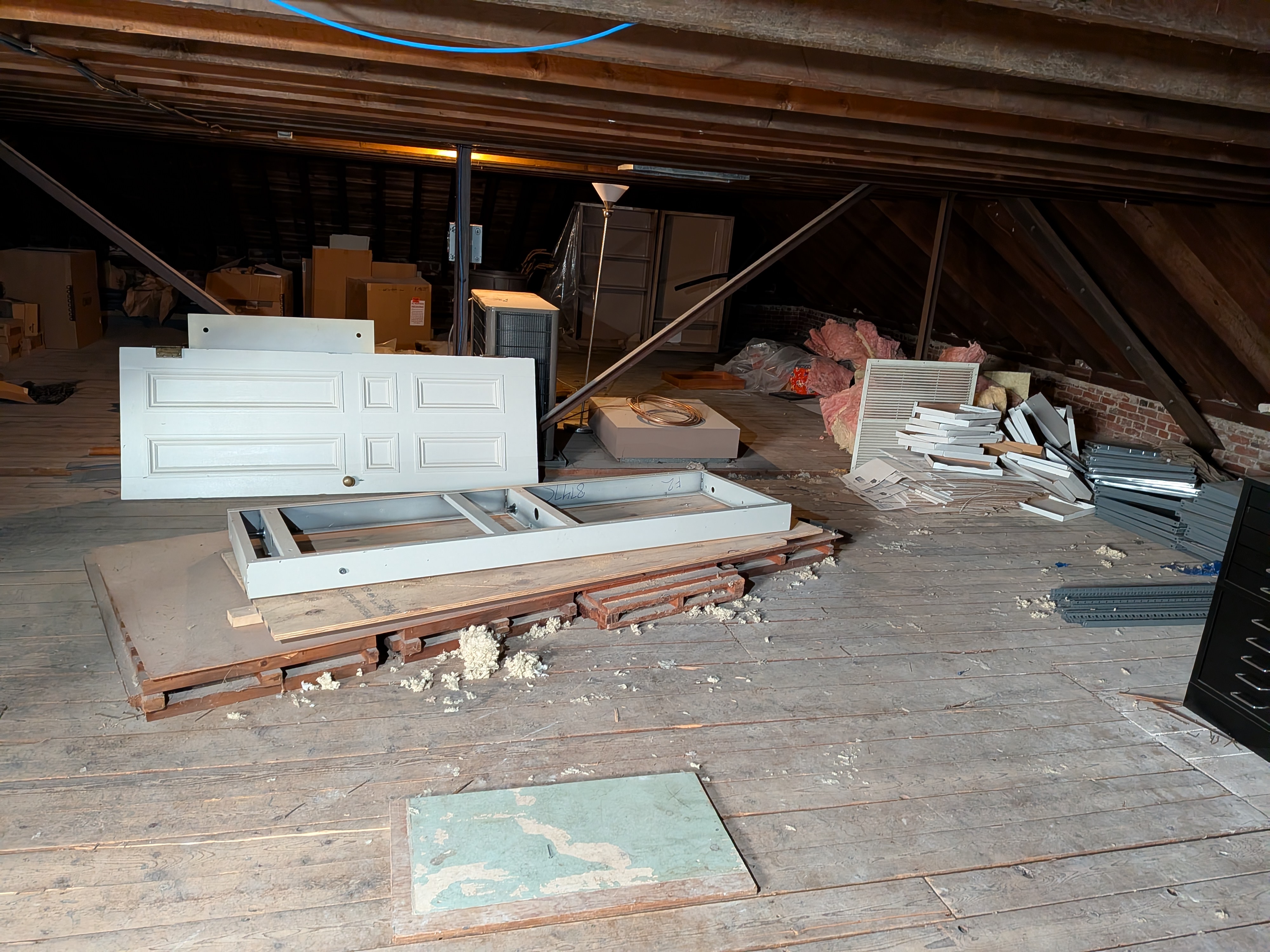
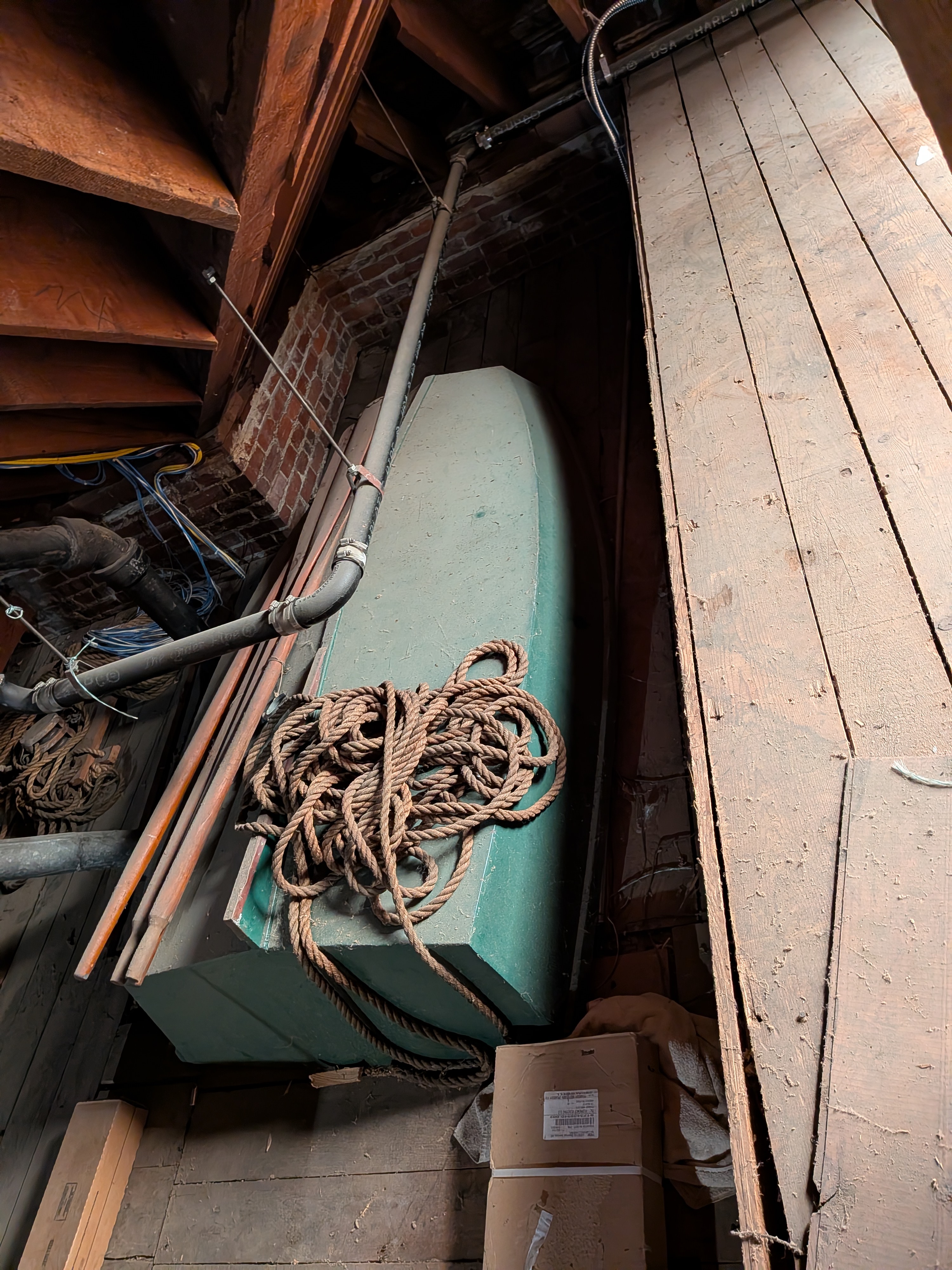
As anyone who has lived in the same house for a long time can attest – it is really easy to accumulate stuff (both valuable items and less-than-helpful clutter). Like a well-loved home, the Peabody certainly had its fair share of stuff that needed to be sorted and rehomed before the current building project could get underway. The best stuff had been kept in the attic.
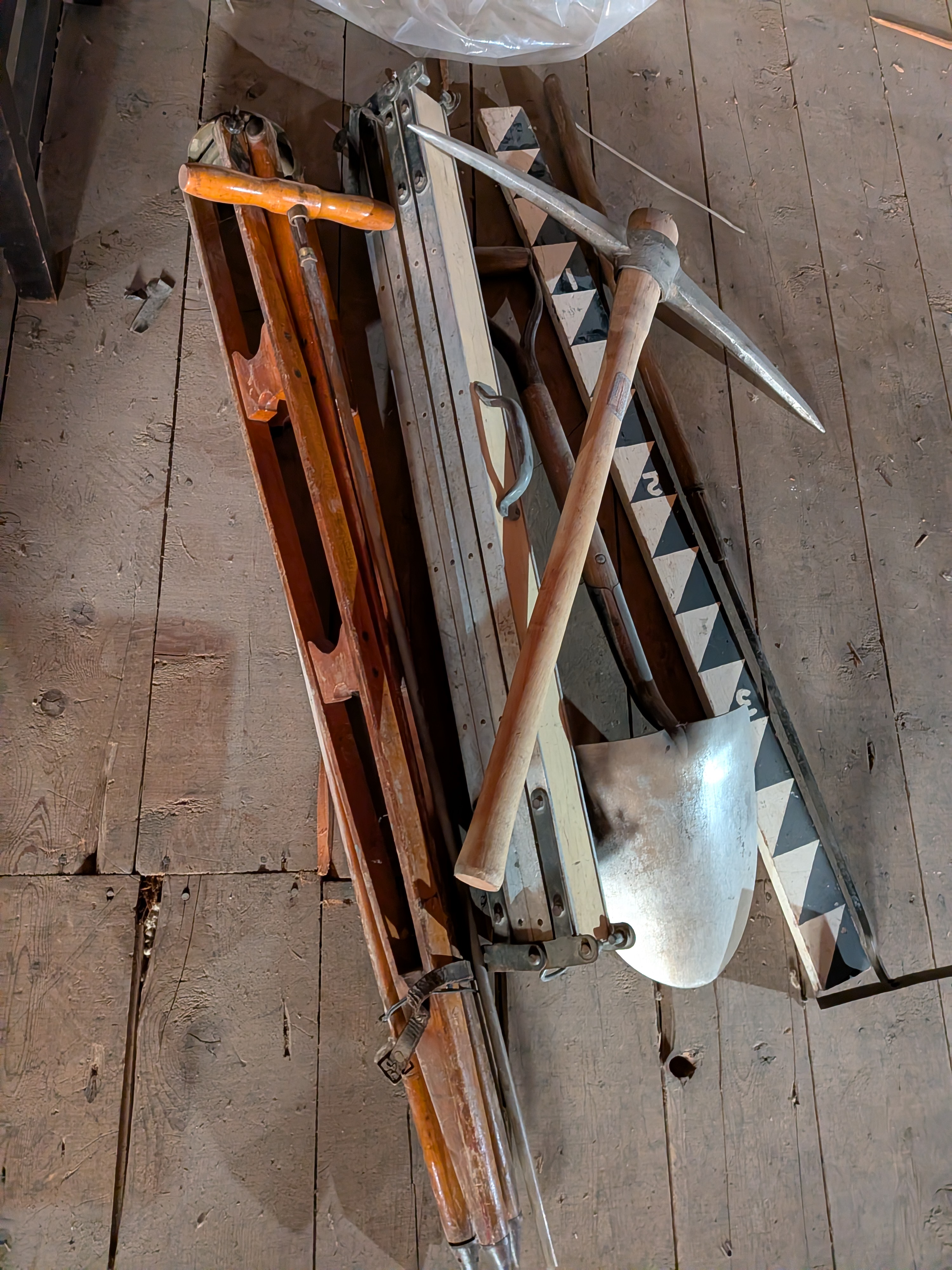
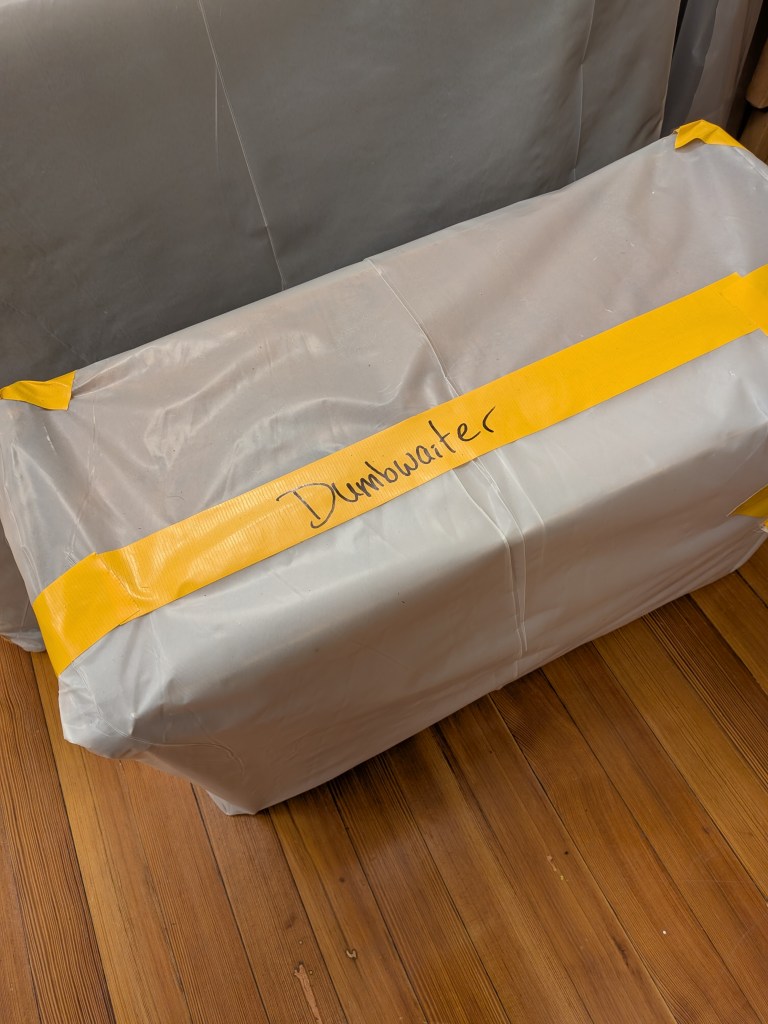
Attics always have a reputation (you know what I mean) and the Peabody’s attic is a special one. If you are over 5’6”, you better watch your head. The corners are as dark as you imagine. And yes, sometimes there are bats. However, there are also piles of old archaeological field equipment, a dumb-waiter, traveling trunks and some incredible pieces of institutional history that needed to be preserved before the building project.
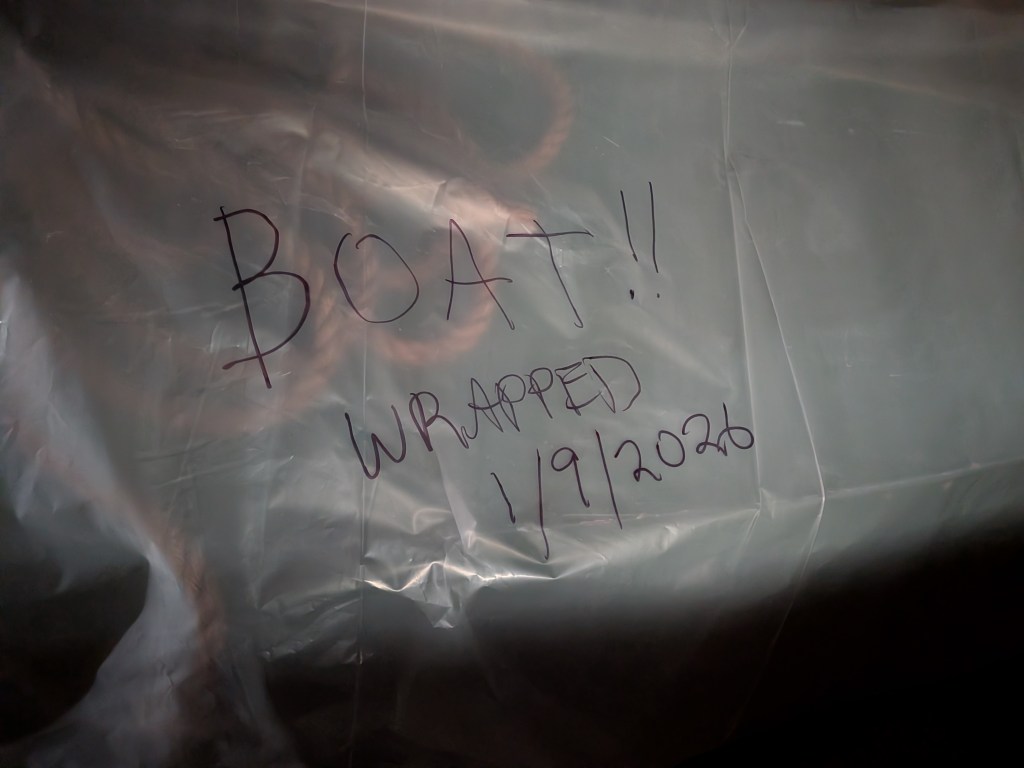
Everything was lovingly wrapped in plastic – it wasn’t always pretty (you try wrapping a pickaxe!) – and clearly labeled for the future. Who knows what future Peabody staff will do with these items, but I am relieved that they will have the opportunity to engage with these echoes of history.
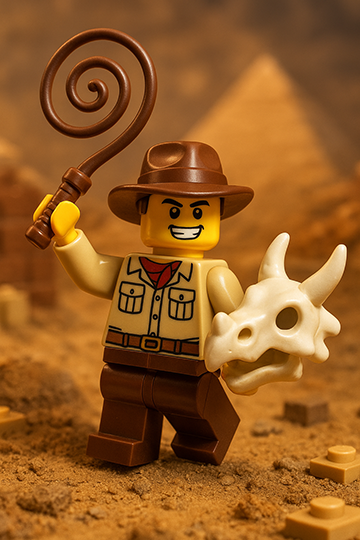
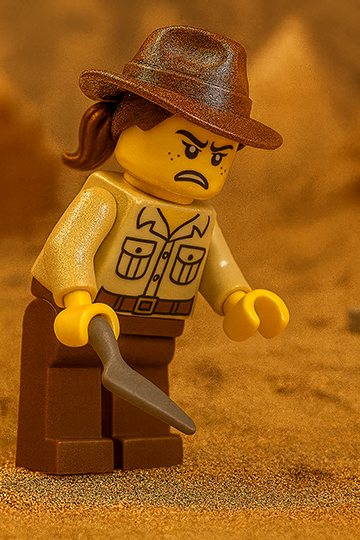
Sometimes it’s hard to be an archaeologist. You tell people what you do and watch their excitement dim as you say “No. Not dinosaurs.” Sometimes people think you’re Indiana Jones, so that’s a little better, but then you have to explain that actually looting’s not ok, and maybe we should discuss the ethics of collecting? Plus, you’ve never once fought a Nazi. (You do, however, wear an awesome hat.)
Not an archaeologist. (Via ChatGPT. I didn’t even need to prompt the pyramid.)
Some would argue this is the greatest real-world problem archaeologists today face. Incredibly, hope for the field has finally arrived – and it’s all thanks to LEGO.
FIRST® LEGO® League (FLL) is a global program designed to encourage children in hands-on STEM learning. Among its major activities is the FIRST LEGO League Challenge, an annual competition for students aged 9-16 that has them working in teams to design, build, and code their own LEGO robot and complete a research-driven Innovation Project that identifies and solves a real-world problem related to a specific scientific theme. This year, the Challenge theme was UNEARTHED, inviting FLL teams to learn about the field of archaeology, identify a real-world problem faced by archaeologists, and propose an innovative solution.
Never have archaeologists been so popular! As soon as the Challenge kicked off, the Peabody began receiving requests from teams hoping to meet with an archaeologist and find out what challenges they’d want to see solved. And, of course, we weren’t remotely alone in this. I had a lot of fun this fall checking in with colleagues at other institutions, as we collectively realized how big the FLL Challenge is. The Society of American Archaeologists (SAA) even convened a panel of experts (including our own Ryan Wheeler!) for a webinar specifically designed for participants in the UNEARTHED season, just to help manage all the requests people were receiving. Exploring Archaeological Challenges: A Webinar for FIRST® LEGO® League and Robotics Teams was recorded and posted on the SAA’s YouTube channel, massively eclipsing in viewership all the channel’s other recordings combined.
We also heard from teams once they had their projects and were ready for feedback on the problems they’d selected and the solutions they’d proposed. Projects broadly sought either to help archaeologists do their jobs more easily with sustainable solutions, or to help non-archaeologists better understand the field and access archaeological information. Ideas included such products as a Swiss Army trowel, and an artifact cleaning and processing machine with residue-testing capabilities. They sought to help people grasp the size of ancient monuments through comparison with a football stadium for scale, and harnessed the sun to power absolutely anything you could imagine. They ranged in size, scope, and ambition, and all were far more sophisticated than I have represented here.
We might have initially been both a little concerned and a little amused when we first learned about this competition (an FLL reel Ryan found on Instagram had a lot more fire and explosions than we generally like to associate with archaeology!), but the projects that teams have come up with have truly been impressive. Most impressive of all has been the amount of thought and attention these young students have put into learning about the field of archaeology, and the care they have put into making it better for the future. I can only imagine what might be the long-term impacts of this program on the next generation of archaeologists.
Though perhaps their biggest problem will be convincing people that, no. Usually they do have thumbs.
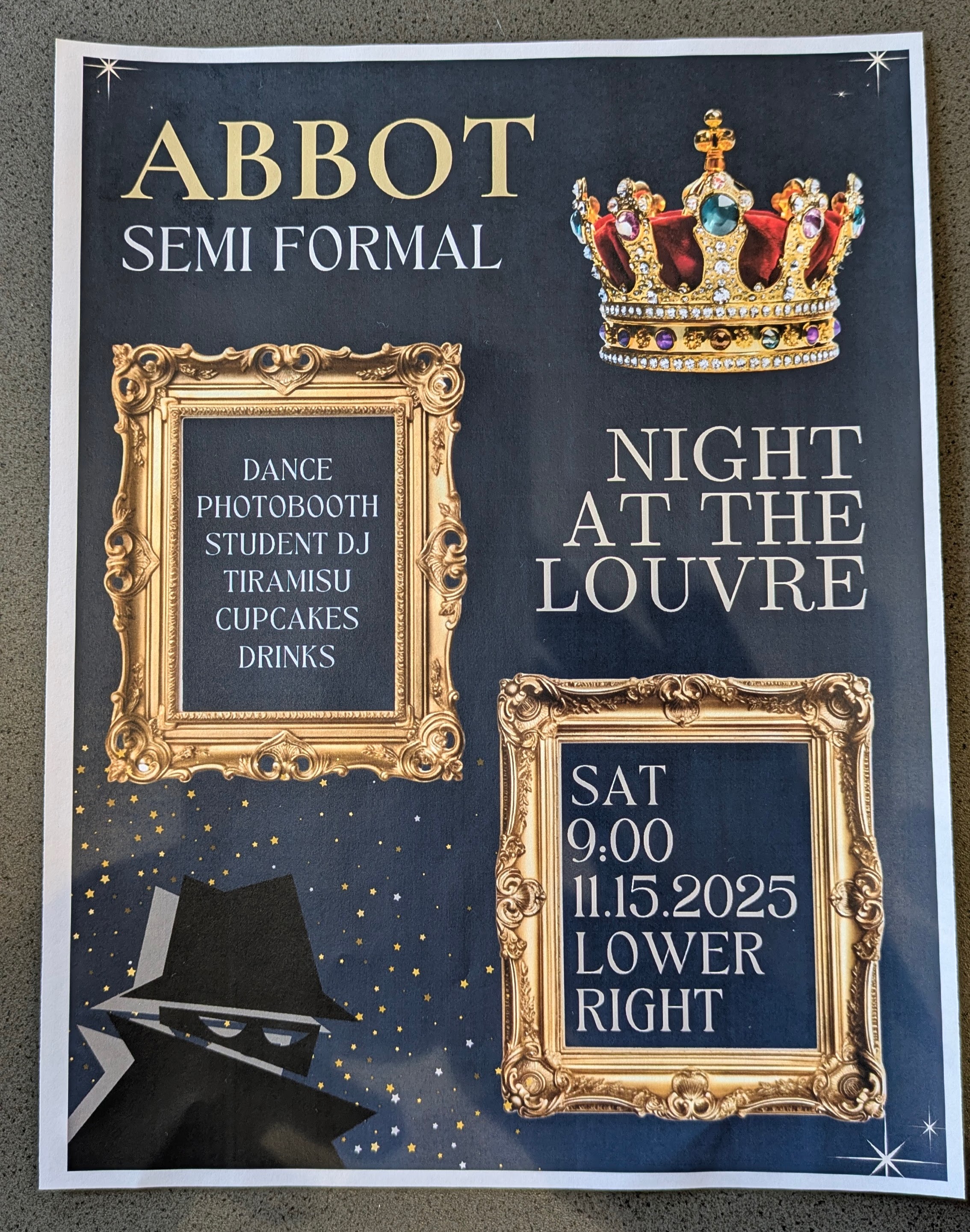
Flyer for a dance at Phillips Academy capitalized on the Louvre heist, November 2025.
The brazen theft of crown jewels from the Louvre on October 19, 2025 fed the ongoing public fascination with museum heists. From details like which mobile work platform was used to access the museum to issues with security, there was almost endless interest and speculation. Even the dapper high school student mistaken for a French detective captured the world’s attention. Not surprisingly, the museum heist is a classic movie and tv trope from the recent The Mastermind (2025) to How to Steal a Million (1966) to the multiple versions of The Thomas Crown Affair (1968, 1999—and apparently a new one in production!), and many others. Fictional literature about heists could occupy a library. Even students here at Phillips Academy hosted a Louvre heist-themed dance! The exciting and glittery portrayals of museum heists, however, often veer far from the real blend of cunning, avarice, ineptitude, and the real mess that museum thefts leave in their wake. Just a few days before the Louvre heist, thieves gained access to the Oakland Museum’s storage spaces, taking over 1,000 objects, including many Native American items.
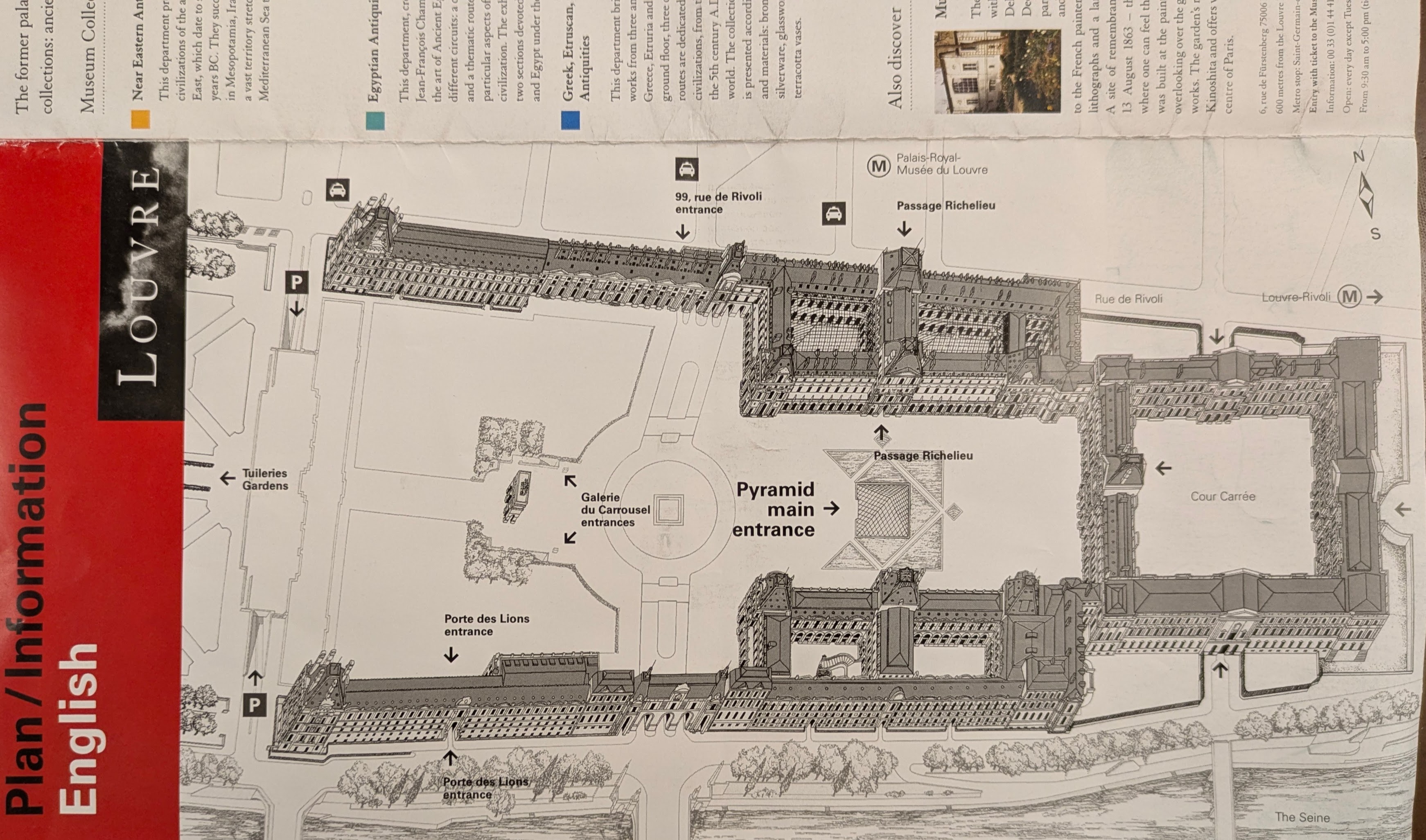
Plan of the Louvre from Phillips Academy student trip, 2015.
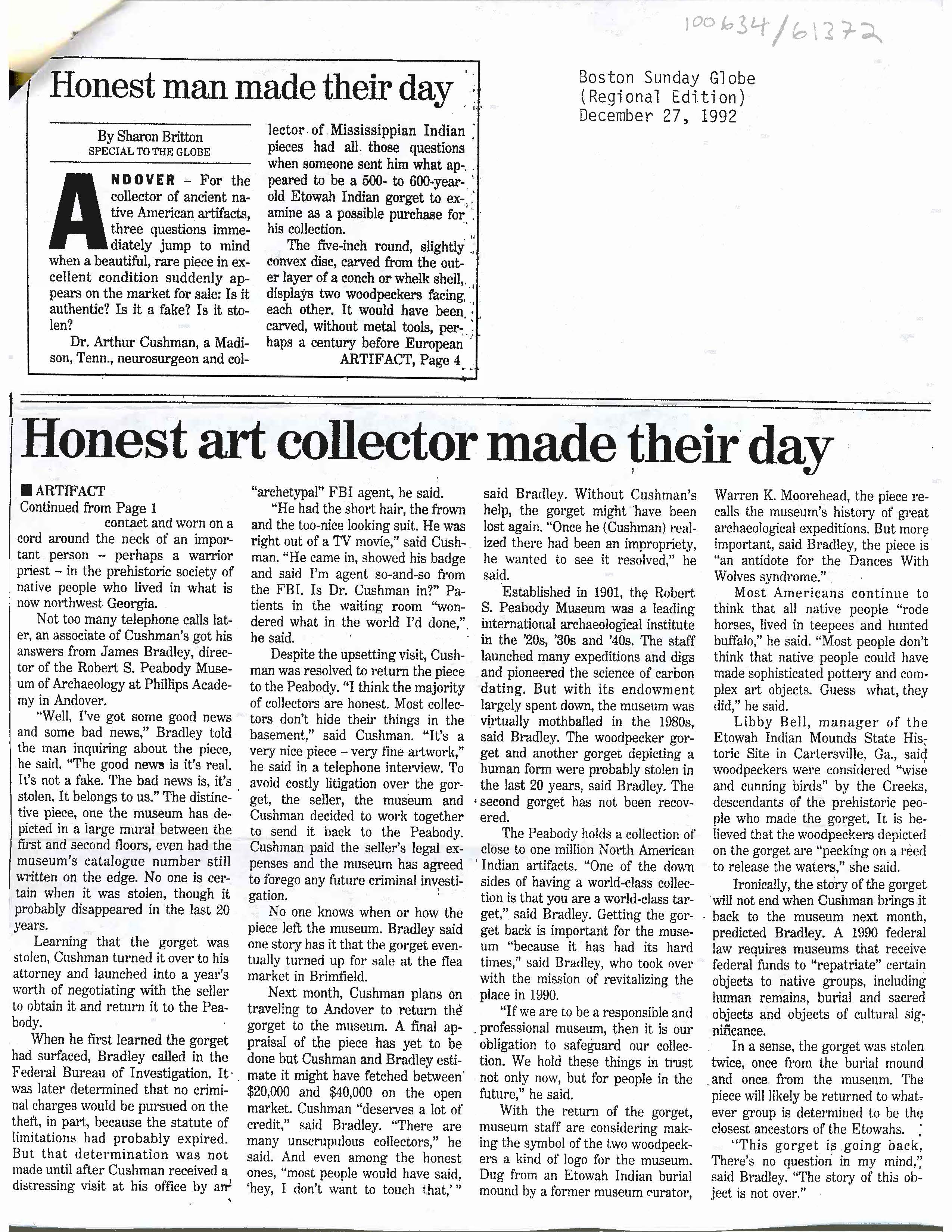
When I joined the Peabody Institute in 2012, former director Jim Bradley told me to be on alert for missing items, presumed stolen at some unknown point in the museum’s past. Early in Jim’s tenure as director, he had been involved in the recovery of a shell gorget from the Etowah site in Georgia. Since that time several collectors have returned items from Etowah and Maine, and others have been tracked down with the aid of the FBI art crimes team. What we now understand is that the Peabody Institute experienced two thefts—one in late 1970 or early 1971, and another in 1986.
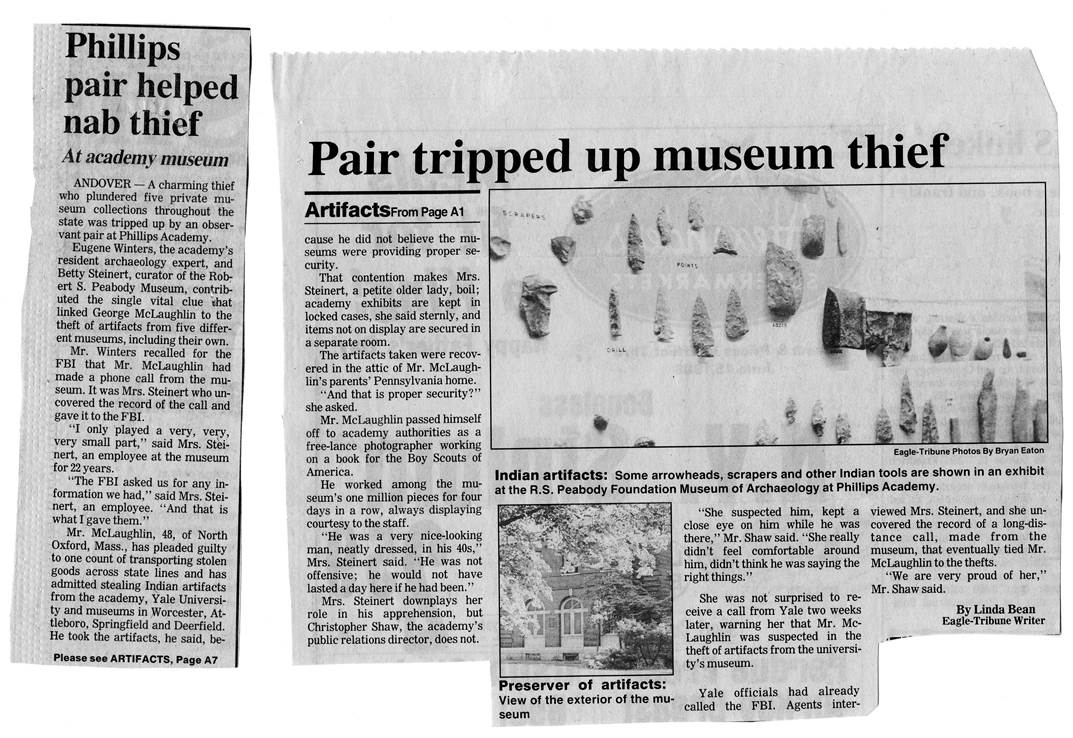
Eagle-Tribune article from 1986 recounts George McLaughlin’s theft of artifacts from the Peabody Museum.
Marla Taylor and John Bergman-McCool recount the theft by George McLaughlin in 1986 in their 2020 blog post. McLaughlin gained access to the Peabody’s collection housing areas at a time when the institution lacked professional staff. That made it easier, but he also stole from other museums across New England and several private collectors. He was ultimately caught by the FBI and prosecuted, but not before removing most of the catalog numbers from the thousands of stone tools that he had taken. It was unclear what McLaughlin’s plans were, but it seems he was readying items for sale. And while the FBI arrest prevented that, to this day we have a large number of items that have lost their original provenience—in other words, a big mess.
Boston Sunday Globe article recounts the return of the Etowah shell gorget (December 27, 1992).
I’ve shared before about an earlier theft at the Peabody Institute (also, see my article in the April 2018 SEAC newsletter). Based on correspondence, we are confident that items from Georgia and Maine were stolen in late 1970 or early 1971 while exhibits were being refreshed and updated. These items had been on display when they were photographed to illustrate Dean Snow’s 1976 book The Archaeology of North America. It seems like they were taken while awaiting reinstallation in the exhibits. As I mentioned above, a number of these items have been returned, either by conscientious collectors or through an investigation by the FBI art crimes team, begun in January 2018 when one of the Etowah items was returned to us. Many of these items are funerary objects and subject to repatriation under the Native American Graves Protection & Repatriation Act (NAGPRA). Their continued absence complicates those repatriation efforts.
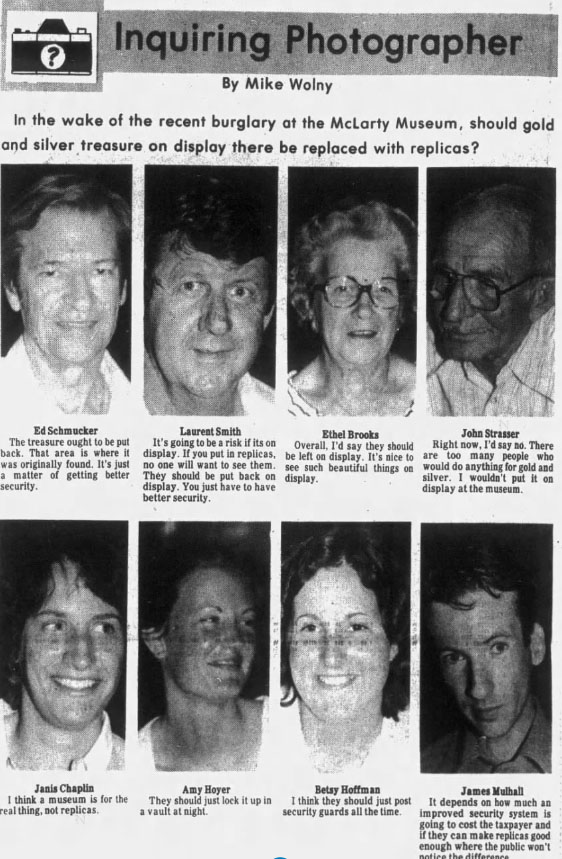
The Indian River Press Journal sought reader opinions about the 1980 theft of Spanish shipwreck treasure from the McLarty Museum and if treasure items should continue to be exhibited (Friday, March 8, 1980, page 8).
Unlike the glamourous (or humorous) fictional depictions of museum heists, these are often crimes of opportunity, driven by greed or misguided ideas about the role of museums in caring for and sharing art and culture. I think one example from my past career as Florida’s state archaeologist aptly captures the stupidity of the museum heist. Our collections in Florida included impressive holdings recovered from the shipwrecks of Spanish treasure galleons. Loans to the McLarty Museum near the survivor’s camp of the 1715 fleet wreck included gold coins and gold bars. In 1980, thieves defeated locks and security systems, but when confronted with the reality of disposing of a gold bar, things took a weird turn. They used a hack saw to begin cutting a gold bar into more saleable (or tradeable) pieces before being apprehended. The gold bar was recovered, but the saw cut end remains at large. During our annual 100% inventory of precious metals and coins our outside auditor frequently questioned what was going on with the clearly chopped up gold, so much so that we finally tucked some of the paperwork and news coverage with the piece to allay fears that we were helping ourselves. The thief in that case ultimately criticized press coverage, telling the court that he was “by no means a professional burglar” and that the theft was just a “reckless impulse.” So, enjoy that museum heist movie or book, but remember, it’s a far cry from the real mess made by these thefts.
As we prepare updated Native American Graves Protection & Repatriation Act (NAGPRA) summaries and the required notices following claims and decisions about affiliation we are frequently confronted with the names of collectors. Some of these are quite familiar to us, Warren K. Moorehead, for example, who was our first curator and then our director. We recognize that the names of collectors often hold significant clues that may help make connections between now widely distributed holdings—what we refer to as “split and shared collections,” or aid in understanding localities or other entanglements. I’ve started developing short biographies of some of the collectors, with the hope that knowing when and where they were active might inform some of these other considerations. To develop the biographies, I usually rely on genealogical information to fill in birth and death dates, geography, personal and professional connections, and other details. Many of these collectors were in contact with Warren Moorehead and their names appear in his correspondence files or in his books, especially those volumes that highlight collectors and collections. In other cases, the collectors have some connection to our parent organization, Phillips Academy—either as students, alumni, or faculty. Here are a few recent biographies:
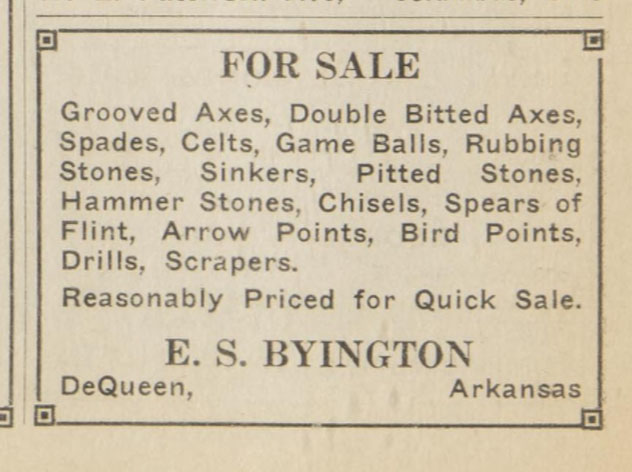
Byington’s advertisement in The Philatelic West, 1928.
Edward Spencer Byington (often styled as E.S. Byington) was a civil engineer in DeQueen, Sevier County, Arkansas (1866-1941). He worked for several railroad companies, including DeQueen & Eastern. Byington often bought and sold artifacts, and his ads can be found in several publications—see for example, The Philatelic West (1926), and Hobbies, the Magazine (1931). One of Byington’s ancestors was Cyrus Byington, an early settler and missionary to the region, who had traveled to the area with Choctaw people being forced from their homes in Mississippi. E.S. Byington was an affiliate of Warren K. Moorehead and advocated for establishment of an “Association of Indian Relic Collectors & Dealers.” Correspondence with Moorehead indicates he was collecting artifacts during railroad construction and maintenance. Byington is listed as the source of at least 131 items in the Peabody Institute holdings.
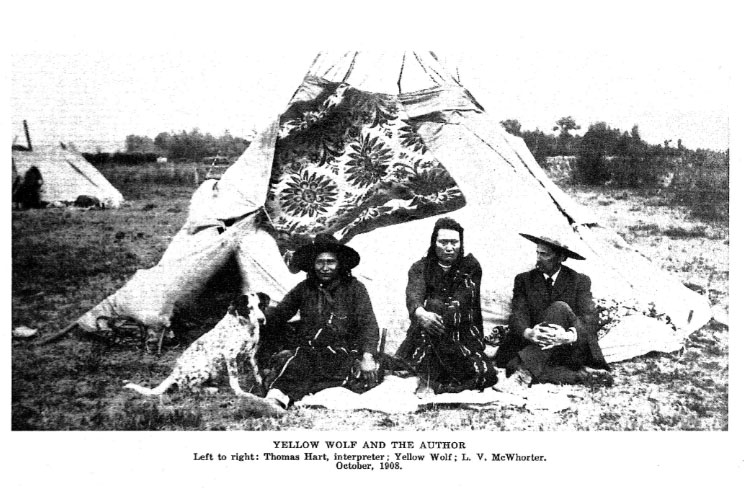
McWhorter (far right) with interpreter Thomas Hart (far left) and Yellow Wolf, October 1908–from McWhorter’s book Yellow Wolf: His Own Story (1940)
Lucullus Virgil McWhorter (often styled as L.V. McWhorter) was an American farmer and rancher, frontiersman, and writer who was a regular source of Native American material heritage for Warren K. Moorehead at the Peabody Institute (1860-1944). McWhorter compiled information on Indigenous communities and history of the Pacific Northwest, and is generally regarded as an advocate and ally of the Native American individuals and tribes that he worked with, including Yellow Wolf and the Nez Perce. See Washington State University for the McWhorter papers and finding aid, which frequently mention Moorehead: https://archiveswest.orbiscascade.org/ark:80444/xv98497. McWhorter is listed as the source of at least 507 items in the Peabody Institute holdings.
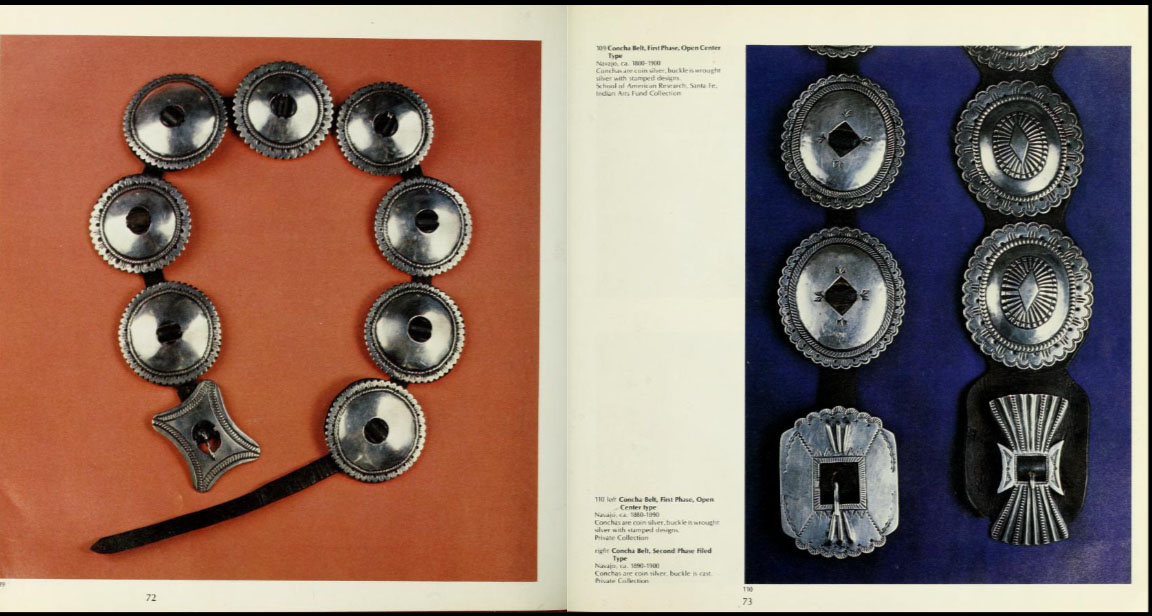
Diné silverwork illustrated in Enduring Visions, the exhibit catalog co-authored by Donnelley Erdman.
Donnelley Erdman (1938-2024) was a graduate of Phillips Academy (Class of 1956), an architect and instructor at Rice University. In 1978-79 he was involved in an exhibition of Southwestern material culture at the Aspen Center for the Visual Arts, Aspen, Colorado. See Philip M. Holstein and Donnelley Erdman (1979) Enduring Visions: One Thousand Years of Southwestern Indian Art, Aspen Art Museum (exhibit catalog). Erdman is listed as the source of at least 195 items in the Peabody Institute holdings.
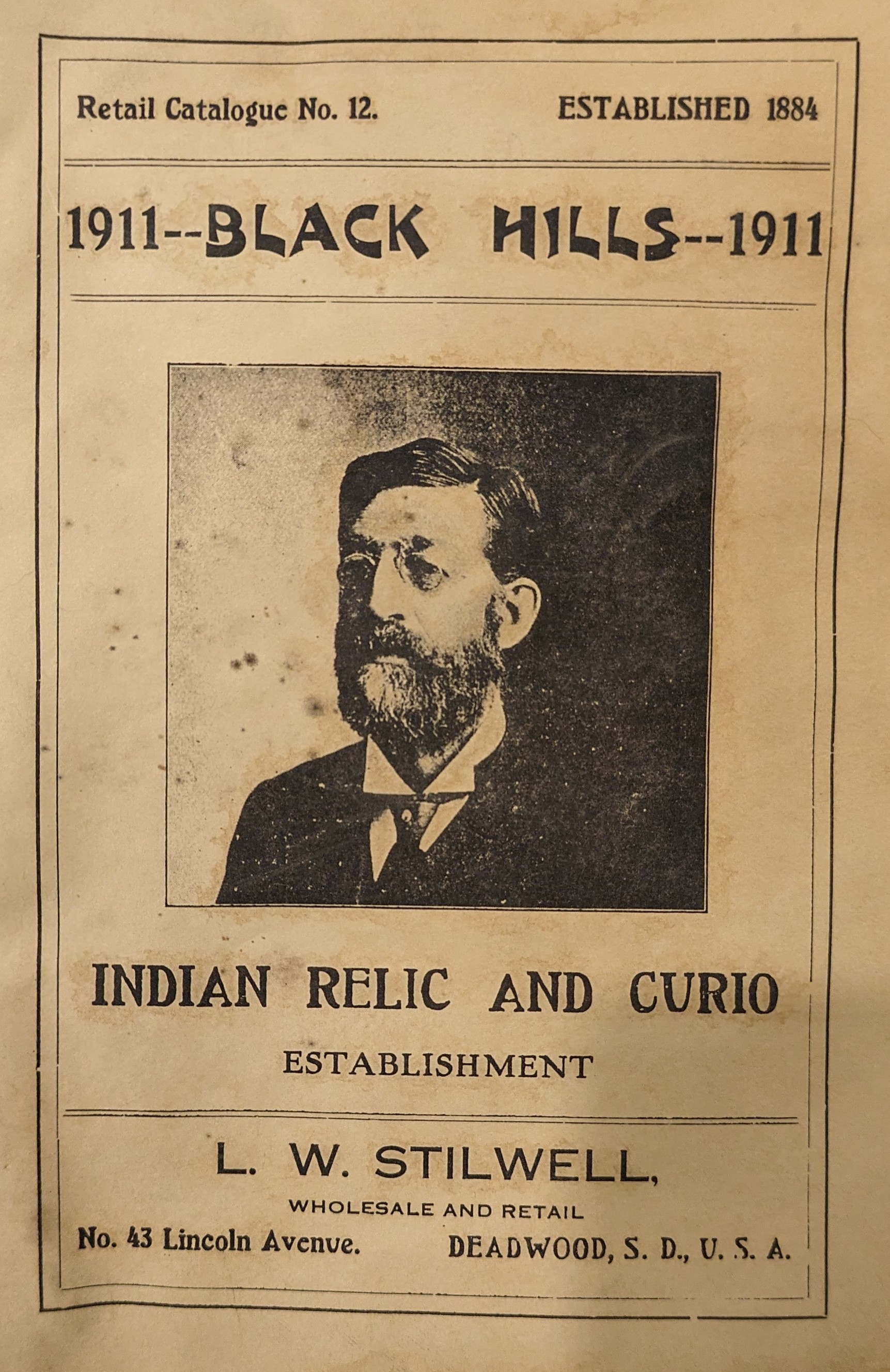
The cover of Stilwell’s 1911 catalog.
Lucien White Stilwell (often styled as L.W. Stilwell) was born in New York and grew up in Wisconsin (1843-1932). Following graduation from Ripon College, Stilwell moved to Cairo, Illinois and engaged in the grocery business. Throughout the 1860s and 1870s he was engaged in the grocery business via several partnerships, briefly worked for the Elgin Watch Company before relocating to Deadwood, South Dakota in 1879. In Deadwood, Stilwell was involved in banking, but it was here that he began to develop and expand his business in buying and selling Native American and natural history items. Throughout the 1880s he frequently advertised in collecting magazines, including Young Oologist, Mason’s Coin Collectors Magazine, The Agassiz Association Journal, The Museum, Hoosier Naturalist, The Philatelic West, and others, as well as short publications on geology. In the early 1900s he published catalogs advertising his “Indian Relic and Curio” establishment. He sold his business to Kenneth J. Crawford Company in 1928. Condensed from a longer biography by John N. Lupia III: https://www.numismaticmall.com/encyclopedic-dictionary-of-numismatic-philatelic-biographies/stilwell-lucien-white Stilwell is listed as the source of at least 18 items in the Peabody Institute holdings.
Peabody staff always get excited when we unearth hidden stories from the Peabody Institute’s past. The Phillipian Archives is one such place that has held many a story. First printed in 1857, The Phillipian is a weekly student newspaper that continues today at Phillips Academy Andover. The student paper describes itself as “completely uncensored and entirely student-run,” offering a snapshot of what campus life is like both past and present, and in the case of this blog, some of the most outrageous and bizarre activities related to the Peabody.
As promised, we hope you enjoy PART 2!
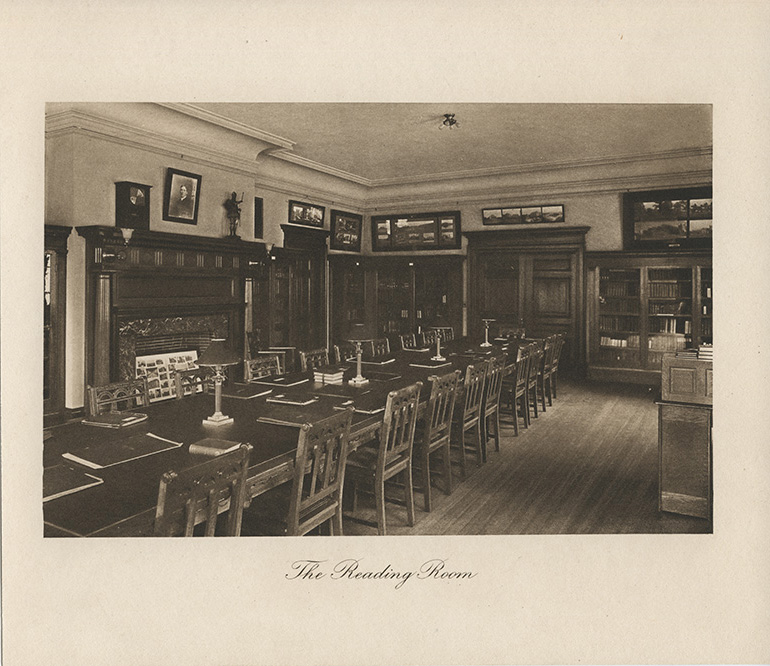
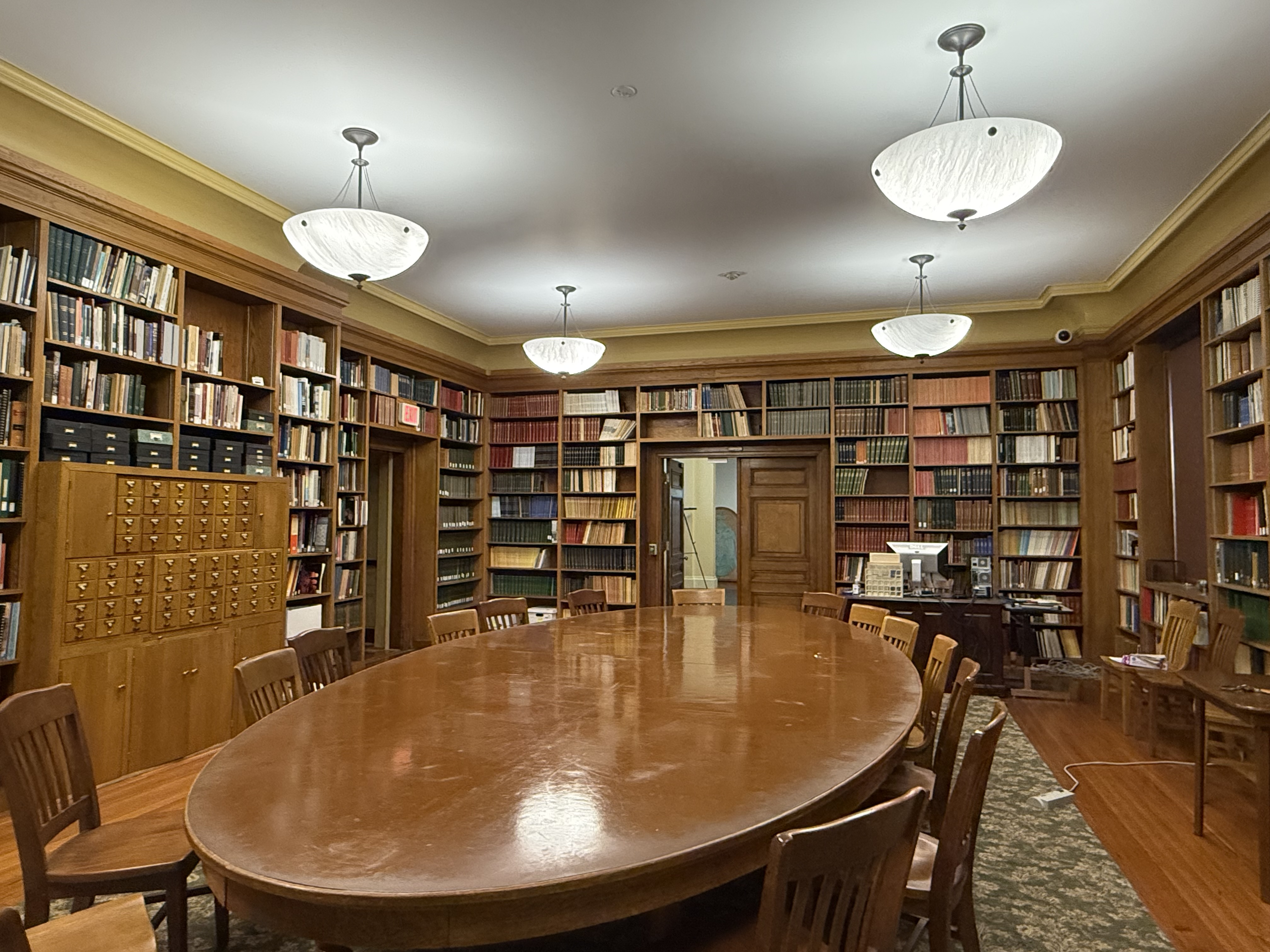
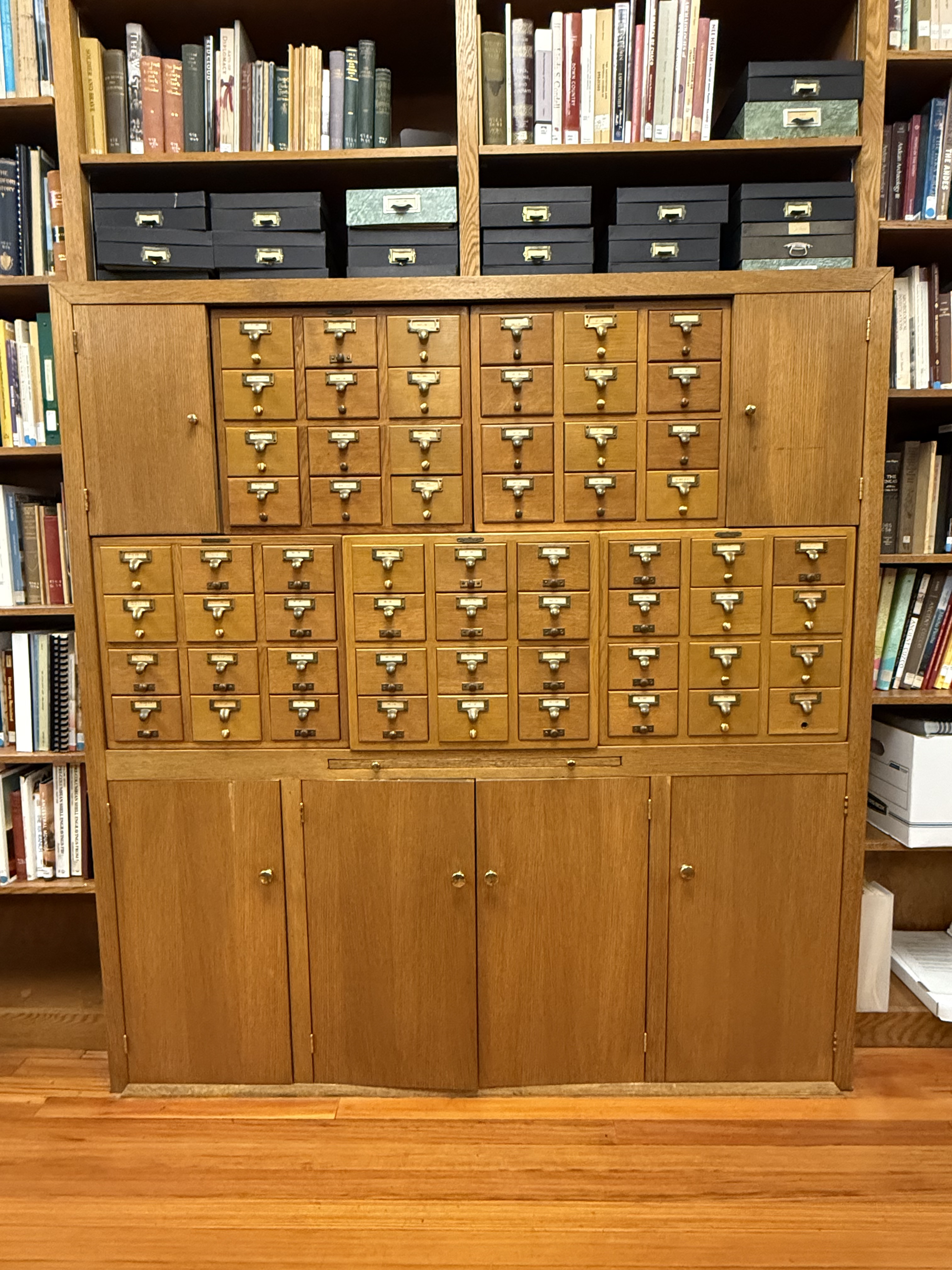
Peabody Card Catalog and Reading Room
In 1903, a reading room with library was opened on the second floor of the Peabody, furnished with easy-back chairs, a large center table, writing tables, and a few large lounging chairs. There was a list of rules included in this Phillipian article for students using the reading room:
Observe suitable quiet
That others may not be disturbed while reading
Not to cut, tear or in any way deface the periodicals
To remove hats and caps while in the room
By 1904, a Phillipian article stated the reading room as “well filled nearly every hour…the attendance averages about three hundred a day or nearly the entire school.”
Image from the Peabody Archives of the old reading room.
From the same vantage point – the current Peabody Library. Note: the original card catalog system now covers the original fireplace.
In 1904, work began on an index card catalog for the Peabody Institute’s library. This catalog would be similar to the Library of Congress plan which was being used at the time in the Seminary Library (but the catalog ended up being Dewey Decimal, arrgh!) This index card catalog is still occasionally used today at the Peabody Institute, though the entire library is catalogued in the North of Boston Library Exchange.
The original card catalog is still in use at the Peabody today!
Rumor Has It (Dinosaurs in the Chapel and Turtle Racing)
There had been rumors of turtle racing in the Peabody basement and other areas on campus. Mention of one turtle (named Alec) being kidnapped in a 1935 article may prove these rumors as true! Don’t worry, Alec was returned safe and sound.
In a “This Andover” column of The Phillipian in 1941, the Archaeology Department (now the Peabody Institute) was supposedly spreading rumors that several prehistoric dinosaurs live in the Cochran Chapel organ pipes.
“It is they [the dinosaurs], the rumor goes on having it, that furnish Dr. Pfatteicher’s lowest notes during Sunday services.”
Flute Recitals by the Peabody Director
On several occasions, Peabody Director, Dr. Charles Peabody performed flute recitals for students in the Academy chapel. On January 20th in 1915, Peabody was joined by Dr. Carl F. Pfatteicher, who played the organ. Pfatteicher was the director of music at the time, a post he held until 1947. During his time at Phillips Academy, he facilitated choir, glee club, and a small orchestra. Many of these groups met and practiced in the Archaeology Building or Peabody House. I think it’s safe to say that Dr. Charles Peabody and Dr. Carl Pfatteicher were good friends. The music played at this recital were the following:
Sonata in C Major – Mozart
Tres Lent from Sonata in G Major – Guillaume Lekeu
Barcarolle – Harold Nasan
Invocation – Eugene Lacroix
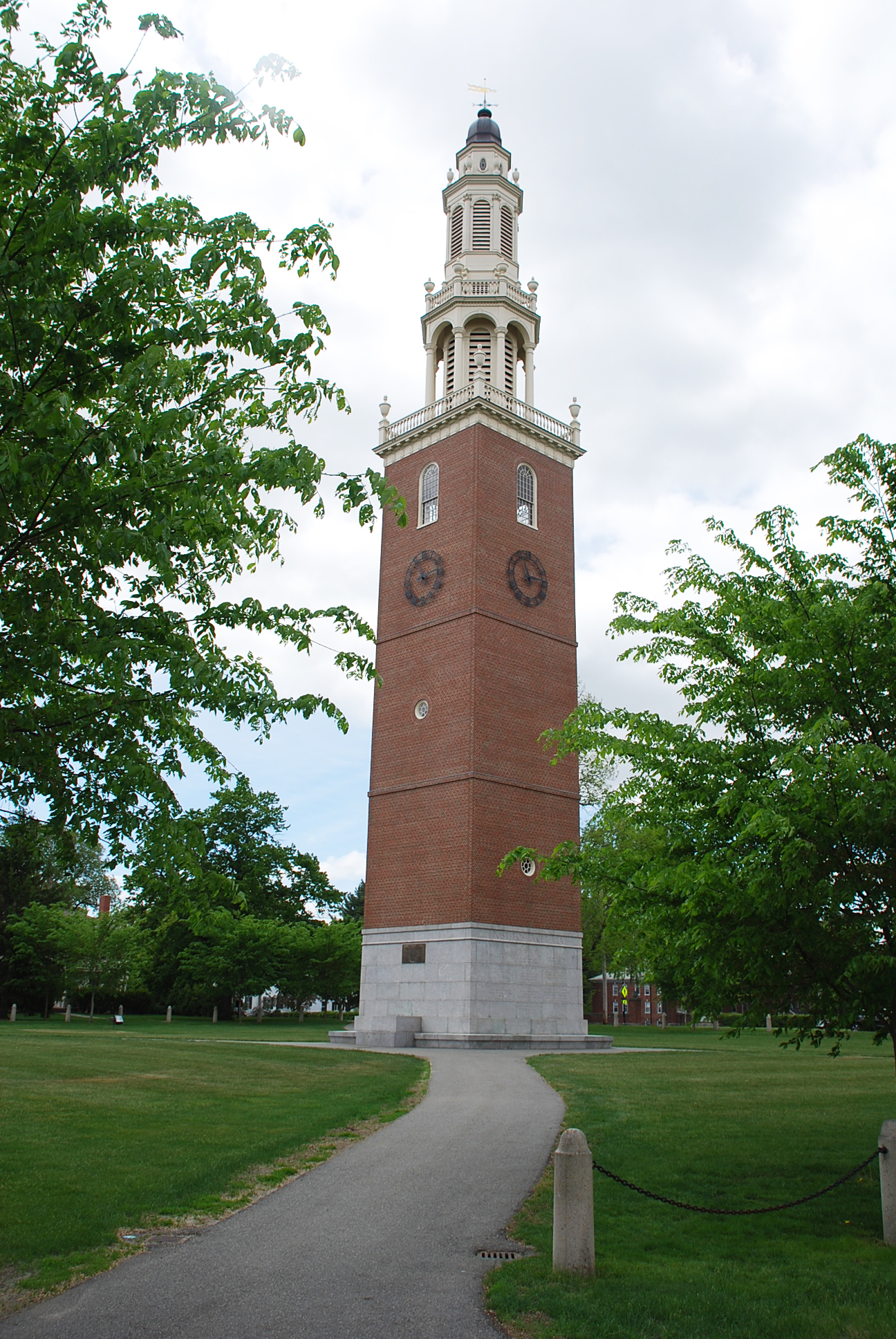
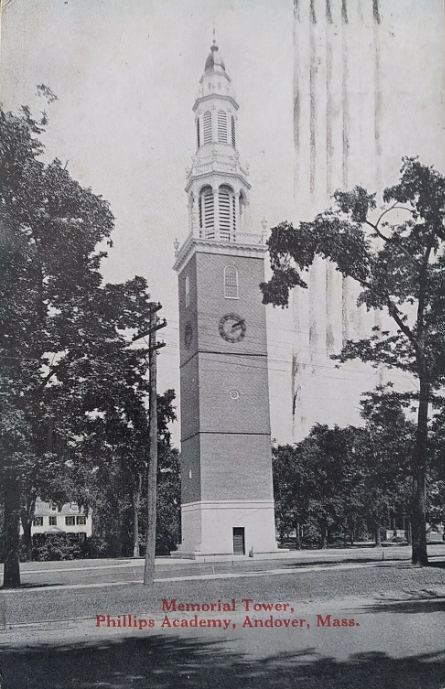
Fun Fact: Dr. Carl F. Pfatteicher was asked to help select the bells to be placed in the newly constructed Memorial Bell Tower on campus. He enjoyed giving regular carillon concerts, playing the bells sometimes at dawn. Many students did not appreciate this and one year managed to lock Dr. Pfatteicher in the tower.
Memorial Bell Tower, Phillips Academy Andover Completed in 1922 by architect Guy Lowell (the same architect of the Peabody building!)
“A Place for Students to Gather” – Clubs Find a Home at the Peabody
The Peabody was founded with three goals in mind – to educate students about the world of archaeology, to promote archaeological research, and to be a place for students to gather. As part of this vision, students and student clubs have been utilizing the Archaeology Building since its inception in 1903. Below are just a few examples of student club communications in The Phillipian related to the Peabody.
Class of 1910 in front of the Department of Archaeology (later known as the Peabody Institute of Archaeology.)
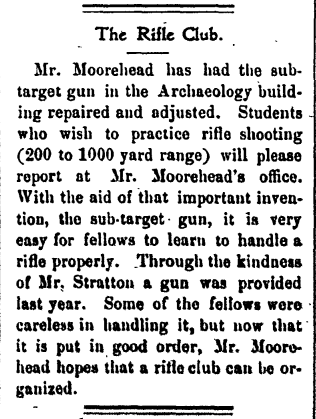
An advertisement in a 1904 column mentions organizing a student Rifle Club at the Archaeology Building and reporting to the office of Peabody Curator, Mr. Moorehead for those interested in shooting practice.
Courtesy of The Phillipian archives.
Fun Fact: The Sub-Target Rifle Machine and similar target practice devices were popular in the early part of the 20th century. They recorded information about marksmanship, position of the gun, etc. without firing live rounds.
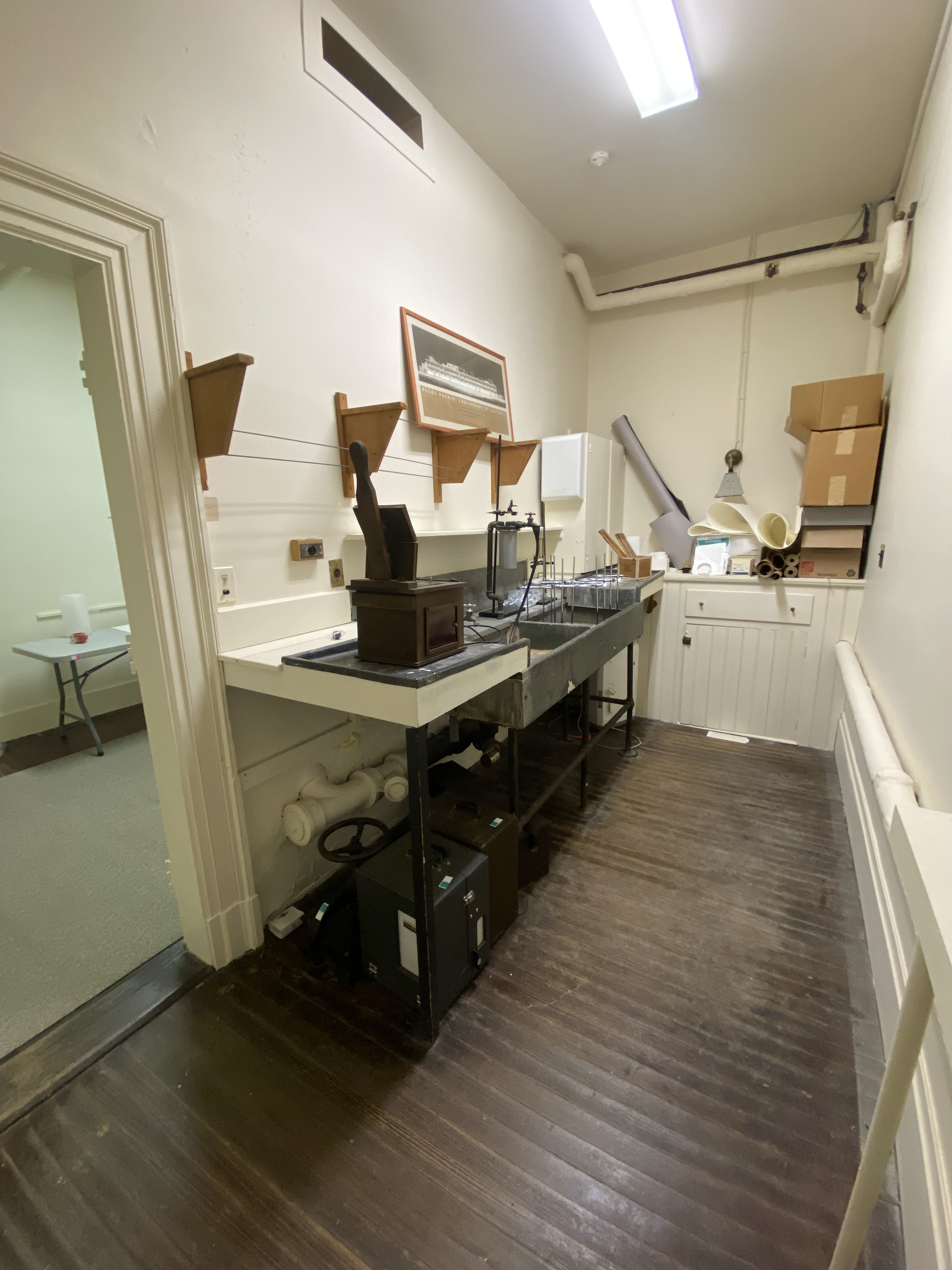
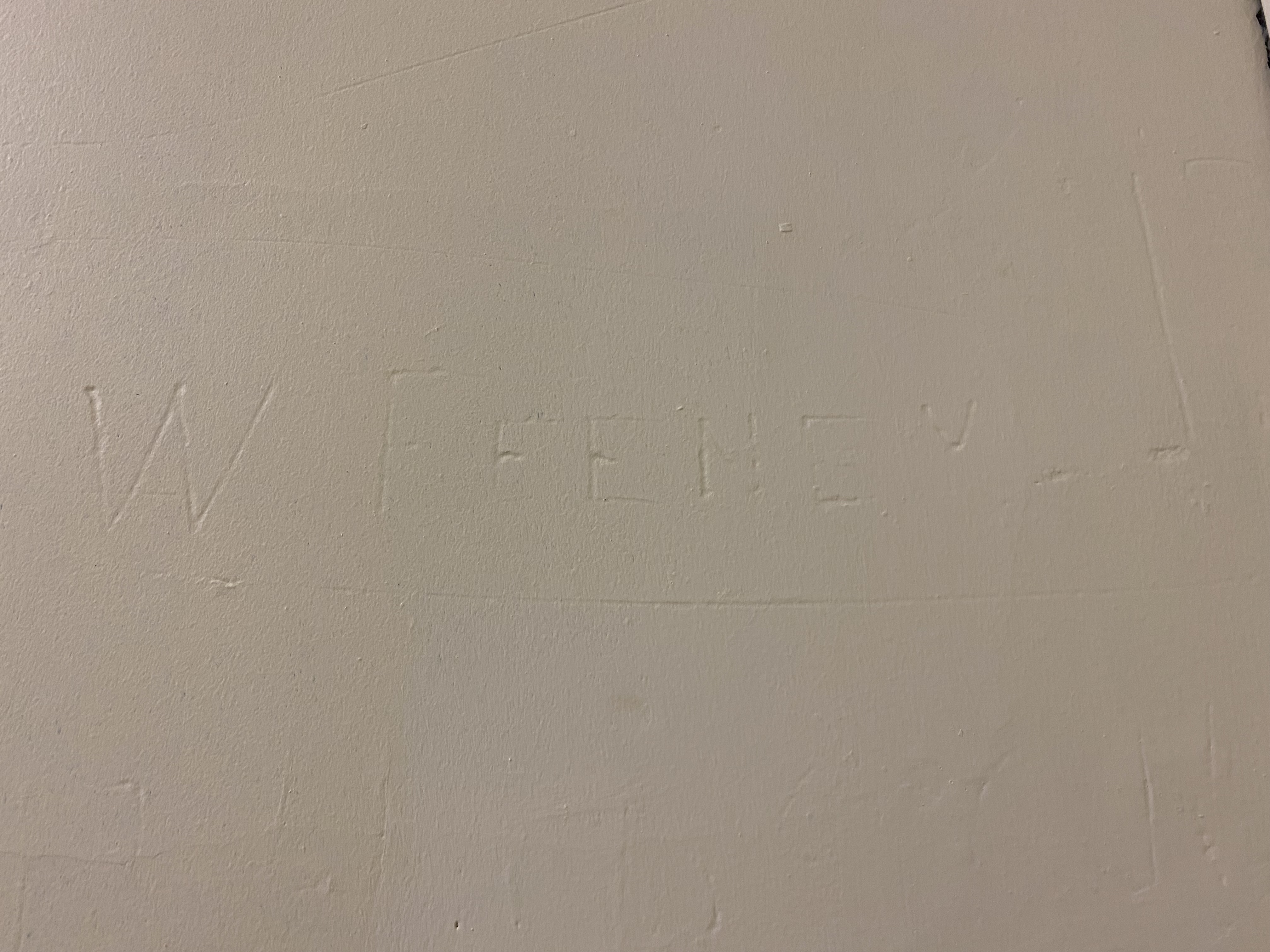
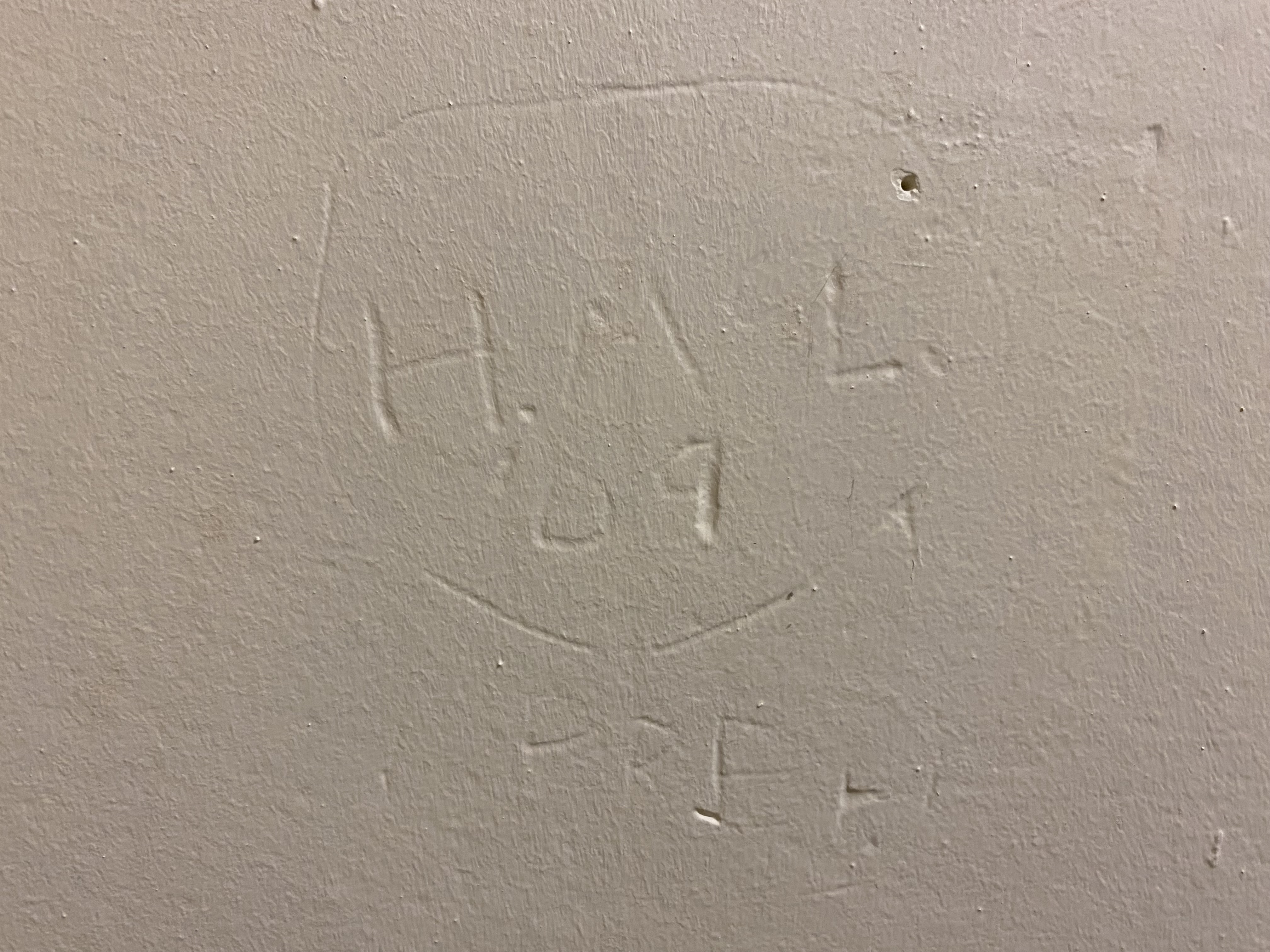
In 1904, a dark room was provided for the Camera Club, located in the basement of the Peabody. The Phillipian stated the space “is thoroughly equipped and is as fine as can be found in New England.” Before Phase 1 of the Peabody Project began, much of the original dark room space was still intact. One of my personal favorite details was the original carved signatures still on the wall left by past Camera Club students.
Original dark room at the Peabody before the recent building renewal project.
Student signatures on the wall of the dark room at the Peabody. Note – that’s not 2009, it’s 1909!
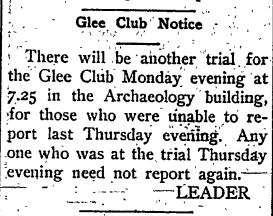
Mandolin and Banjo Club were some of the music clubs that met in the Archaeology Building for auditions, meetings, and practices. Glee Club was another student organization that commonly gathered at the Peabody and communications for this club are seen throughout the decades of The Phillipian.
I love seeing such a close connection between the Peabody and the Music Department, especially now that we’re neighbors with the new Music building, Falls Hall!
Glee Club communication in 1910.
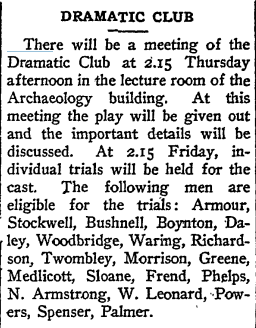
As we’ve seen above, many campus Arts organizations spent time at the Peabody. The Dramatic Club would meet to discuss scripts for upcoming plays and hold individual trials for those looking to participate in performances.
Dramatic Club communication from 1912.
Other clubs such as Chess, Astronomy, Spanish, Philo Congress, Bible Class, Foreign Missions, Yale Club, Harvard Club, Stamp Club, Nature Club, Forum, and Mirror all met at the Peabody throughout the first half of the 1900s. Even The Phillipian and football team held gatherings at one point. By the 1950s we see the Peabody becoming more active in exhibitions and many of these clubs move to other locations on campus, many finding a home at the Peabody House behind the Archaeology Building.
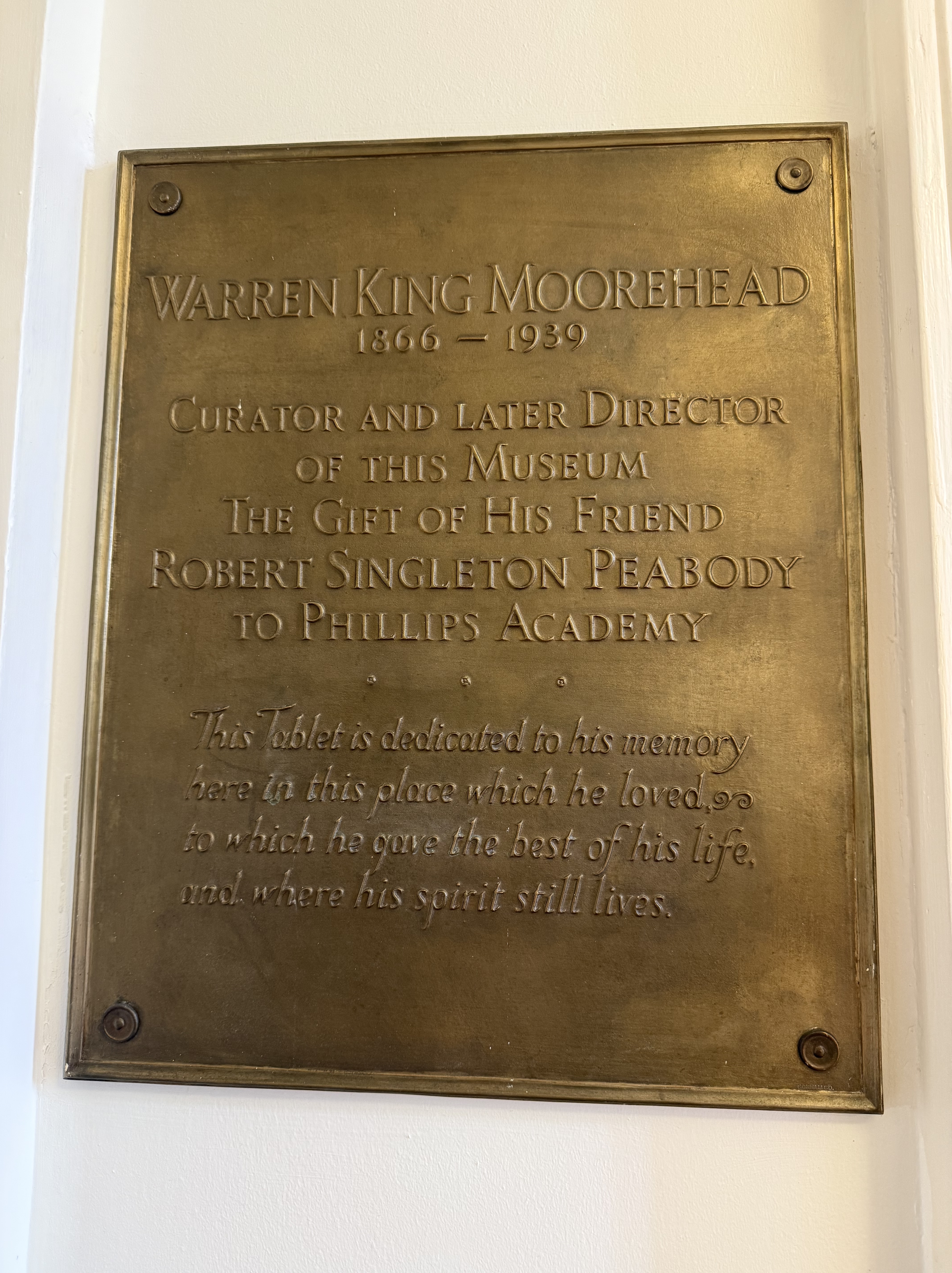
“…where his spirit still lives.”
Jumping ahead to 2011, a Phillipianarticle features Halloween traditions and campus lore passed down over the decades of PA’s history. The Peabody is mentioned to experience “frequent slamming doors, moving items and eerie noises that creak through the attic floors.” The strange activities convinced Peabody staff that the building was haunted by Warren K. Moorehead (1866-1939). Moorehead was the first curator at the Peabody from 1901 to 1924 and became the Peabody’s second director from 1924 to 1938.
The Peabody has many interesting stories of these experiences over the years. One story mentioned in The Phillipian, depicts a foreman being locked in the back stairwell. I can personally share that my first Reunion Weekend with the Peabody I experienced an alum being locked in one of our bathrooms during an event (the locks were on the inside of the door…) I considered this my “welcome” initiation from Moorehead, as the newest member to the Peabody team.
Over the years, our director has written notes to Moorehead to communicate our intentions and care of the building along with updates of upcoming changes such as our building renewal project. These notes are stored behind a plaque commemorating Moorehead, located by the front doors of the building. Much of the activity has quieted since writing these notes.
Peabody staff always get excited when we unearth hidden stories from the Peabody Institute’s past. The Phillipian Archives is one such place that has held many a story. First printed in 1857, The Phillipian is a weekly student newspaper that continues today at Phillips Academy Andover. The student paper describes itself as “completely uncensored and entirely student-run,” offering a snapshot of what campus life is like both past and present, and in the case of this blog, some of the most outrageous and bizarre activities related to the Peabody.
In a few months, the Peabody Institute will be undergoing Phase 2 of some much-needed renewal work. The building and collections will be off-line Winter and Spring terms. The Peabody will continue to support modified classroom lessons and student activities, outside of the Peabody building. Student requests to access collections will be considered on a case-by-case basis.
In honor of the upcoming building project, this (part 1) blog shares some of the Peabody building’s history.
A Special Place at the Corner of Phillips and Main
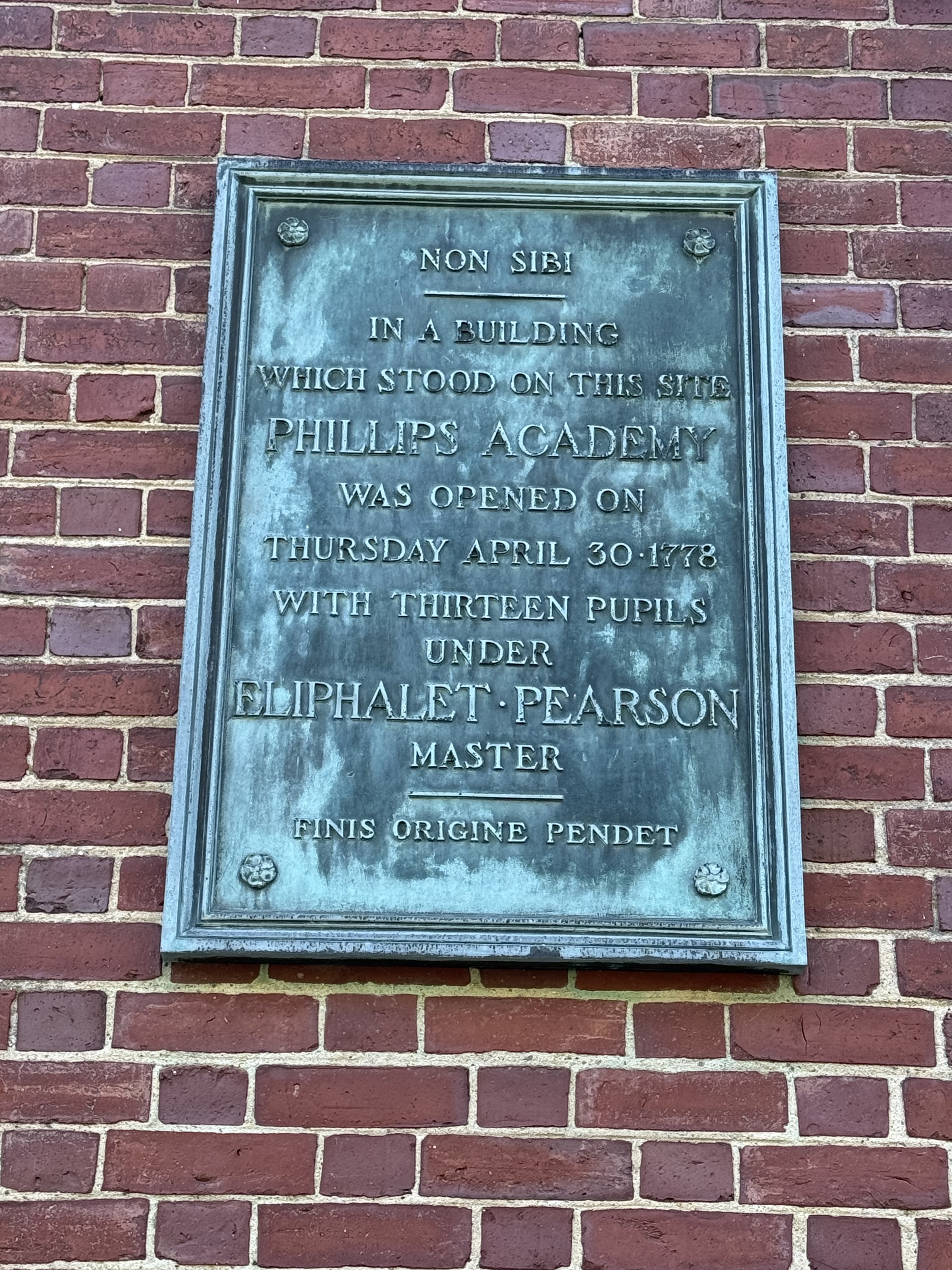
The first Founder’s Day for Phillips Academy was held in October 1913. At this time a bronze plaque was unveiled and placed on the Peabody Insitute building (known then as the Archaeology Department) commemorating the site where the first school-building on campus was opened in 1778. This plaque can still be seen on the Peabody building today!
Bronze plaque on the Peabody Institute building exterior from 1913.
The site at the corner of Phillips and Main streets has an interesting history, one that began well before the Peabody. The site first housed the 1778 carpenter’s shop used as the first classroom building at Phillips Academy.
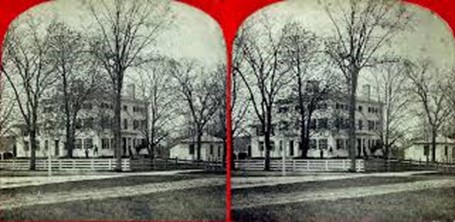
Around 1845, the shop was moved from the site and eventually razed. Samuel Farrar, treasurer of Phillips Academy and the Andover Seminary, built a three-story, Federal-style house on the location. The house has since been moved further down on Phillips Street and is known as Farrar House.
Farrar House – Image courtesy of Andover Historic Preservation, Memorial Hall Library, Andover, MA
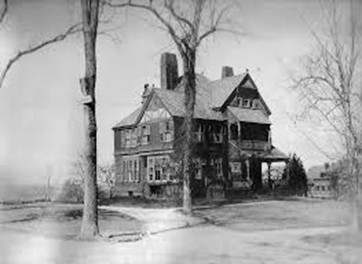
In 1882, a home was built on the site for J. Wesley Churchill, a professor at the Andover Theological Seminary. Later in 1901, the house was moved to another location on Main Street to make way for the new Archaeology Building which later became the Peabody. The house is known as Churchill House on campus today.
Churchill House – Image courtesy of Andover Historic Preservation, Memorial Hall Library, Andover, MA
In a Phillipian article from 1917, the history of Founder’s Day and the significance of the 175 Main street site is shared, noting a 1916 dedication of the new Peabody House by Dr. Charles Peabody (first Peabody Director and son of the Archaeology Department’s founder, Robert S. Peabody).
In this column, it was mentioned that ceremonies were not held to celebrate Founder’s Day as “this year, more than at any other time, matters of lesser importance should give way to more serious questions.” This was in reflection of the current impact of the Spanish Influenza and WWI.
Smoke Talks (Smoking and collections don’t mix…)
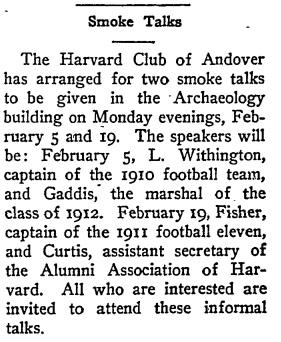
In the early years of the new Department of Archaeology building, Curator Warren K. Moorehead would give “smoke talk” lectures on the second floor of the building. Some of the original molding from the proscenium arch is still visible today at the Peabody. Beyond these lectures, student clubs would hold their own “smoke talks” in the Peabody, which served as the Student Union building for many years on campus. How did these lectures get their name? For the cigars smoked during these meetings by students and speakers alike!
A column from The Phillipian in 1912
Features of the old proscenium arch can still be seen at the Peabody today. In 1967, an exhibit wall with case was placed in the middle of the arch.
A Grill in the Basement (Now they’re pushing their luck…)
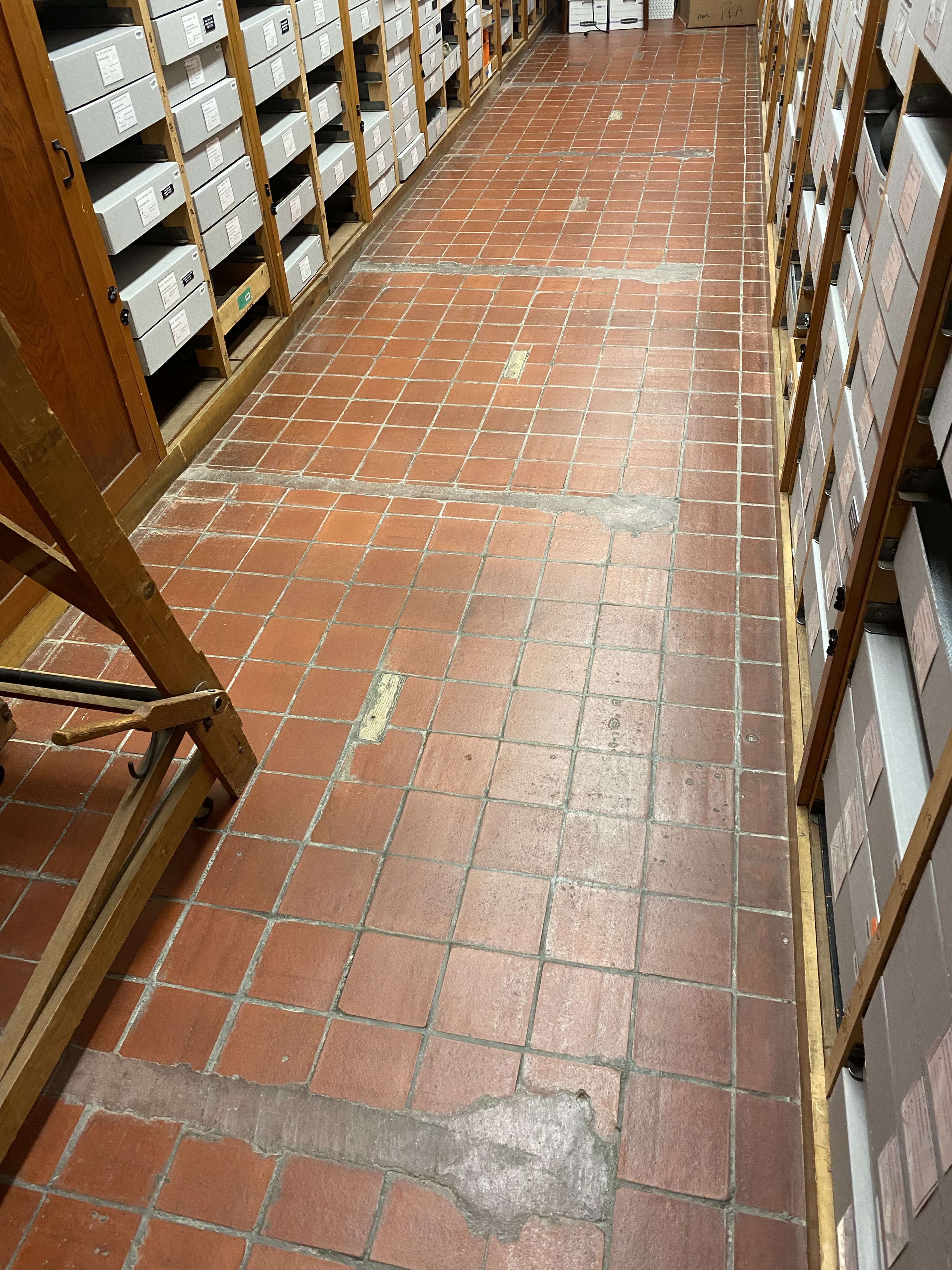
Beginning in 1913, The Phillipian mentions meetings at “the Grill” in the basement of the Peabody (known as the Department of Archaeology at the time). At one point, the Peabody had a kitchen complete with grill, stall seats, and tables for student gatherings. Improvements were made in 1913 giving the space a new red tile floor, dark brown wood paneling around the walls, a new stove, and a large suction flue to draw out heat and odors. In the past the odors of students’ cooking would circulate upstairs disturbing the Peabody staff.
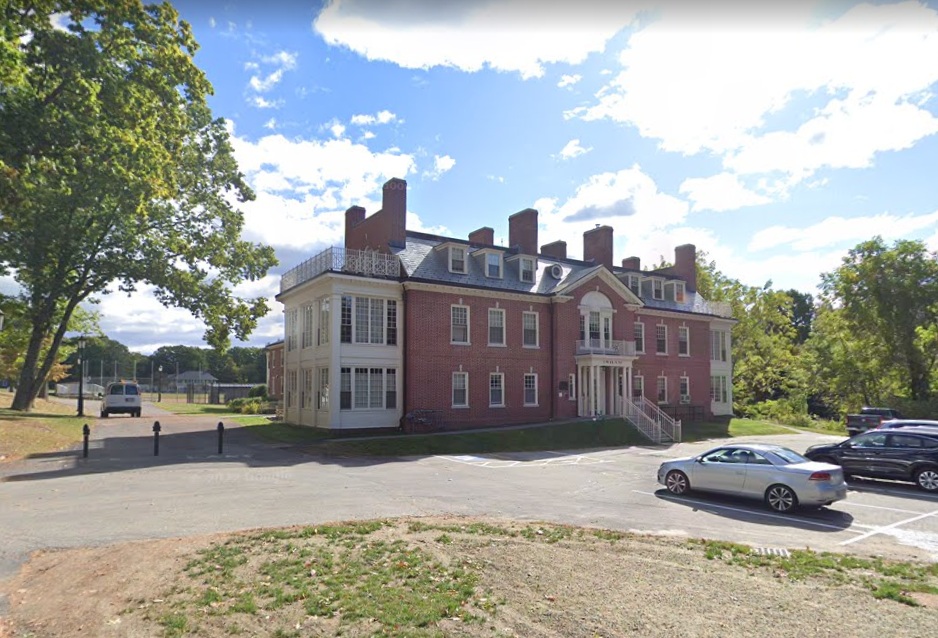
Later in 1915, the Grill was moved to the newly constructed Peabody House located behind the Department of Archaeology building. The new space included a kitchen with large grill and private dining room for special dinners and banquets. There rooms are similar in design to the original grill room in the Archaeology Building.
Before Phase 1 of the Peabody Building Project, the original red tile floor from the Student Union Grill room was still visible in the basement of the building. In the photo you can see where the booths and tables made up the seating stalls.
Peabody House….and Fire(Well, it was bound to happen at some point…)
The Peabody House was opened in 1916 as an extension of the Department of Archaeology with the intent of giving students a building for their own use. Construction of the building used some of the funds contributed by Robert S. Peabody, founder of the Archaeology department at Phillips Academy and donor of the Archaeology Building. An article from The Phillipian describes the new building with an exterior of brick and stone, “which will correspond with the style of architecture of the Archaeology building and the new dormitories.” The first floor housed a student lounge and reading room with a large fireplace and large French windows. The second floor was similar in design to the first floor with space for the late Robert S. Peabody’s books and a large portrait of him. The room was used for club meetings as well as student assemblies and special banquets.
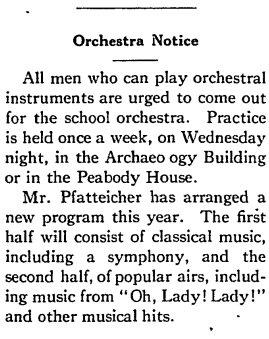
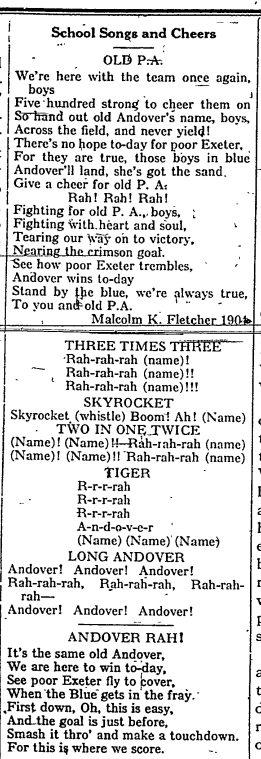
Some activities held in the Peabody House, highlighted in The Phillipian, are a notice to join the school Orchestra, with practices held once a week in the Archaeology Building or Peabody House. My personal favorite was an announcement to students for a mass meeting at the Peabody House to practice school songs and cheers. One entry from 1917 describes three hundred men present at the evening meeting called by head cheerleader, Howard Smith.
Two columns from 1917 advertising for the orchestra and sharing PA cheers and songs!
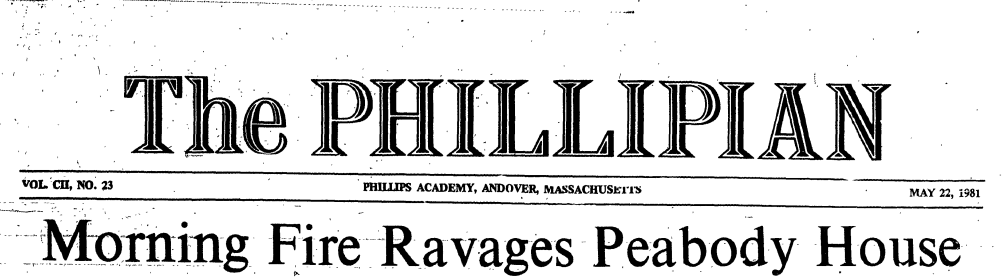
Jumping ahead to several decades later, headlines read “Morning Fire Ravages Peabody House.” In the early hours of May 18, 1981, a fire broke out in the Peabody House, destroying the first and second floors as well as the attic. There were no reported injuries, however, many of the Afro-Latino American Society’s possessions were lost on the second floor. Faulty electrical wiring is suspected to be the cause of the fire.
“[I was in] awe at how extremely hot the flames were, how much smoke there was and how terrifying it was to see the fire’s power.” – Headmaster Theodore R. Sizer
“[There was] steam and yellow light and flames bursting out of the roof.” – PA Student, Upper
We hope you enjoyed PART 1 of this two-part blog post. Stay tuned for PART 2, coming next month! To be continued…
Did you know how beautiful New Mexico is? I had the opportunity to travel to the Albuquerque and Santa Fe areas this July and can definitely recommend making the trip.
The Peabody Institute actually has a long relationship with New Mexico. In the 1920s, Alfred Kidder excavated Pecos Pueblo on behalf of Phillips Academy (what is now the Peabody Institute). The ripple effects of that work included repatriation work with the Pueblo of Jemez, a long-term loan with the Pecos National Historical Park, inter-institutional collaboration, relationships with Jemez artists, and incredible learning opportunities for the students at Phillips Academy.
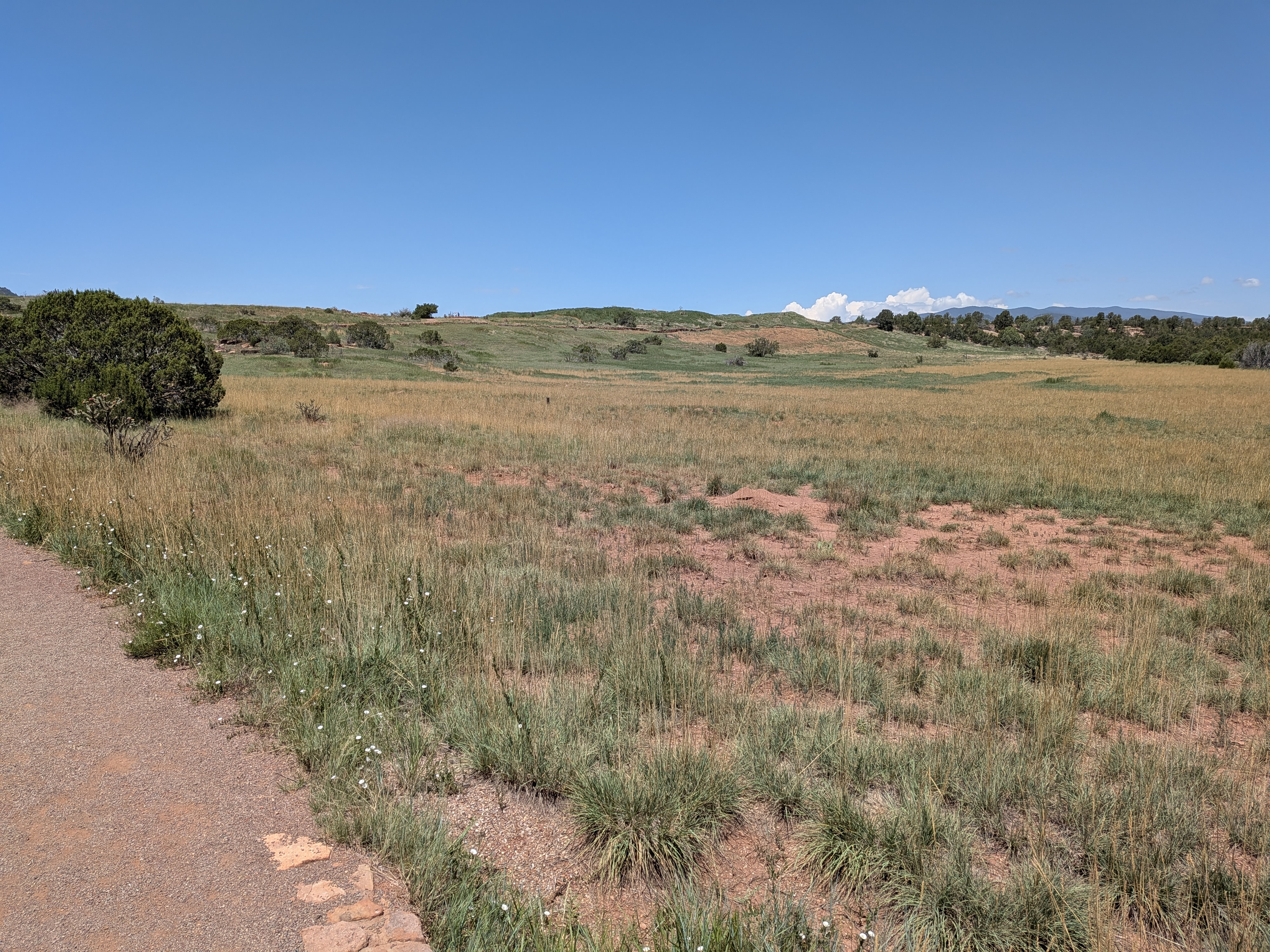
While I had been to the Pueblo of Jemez before this summer, I had not had the opportunity to see the Pecos archaeological site or Pecos National Historical Park before. It was truly a pleasure to experience the site in-person and get an understanding of how Pecos sits in the landscape. I was also able to view their wonderful exhibit, spend time with the Museum Curator to view the collections on loan from the Peabody, and meet several dedicated park staff members. I am grateful for the opportunity to spend that time with them all.
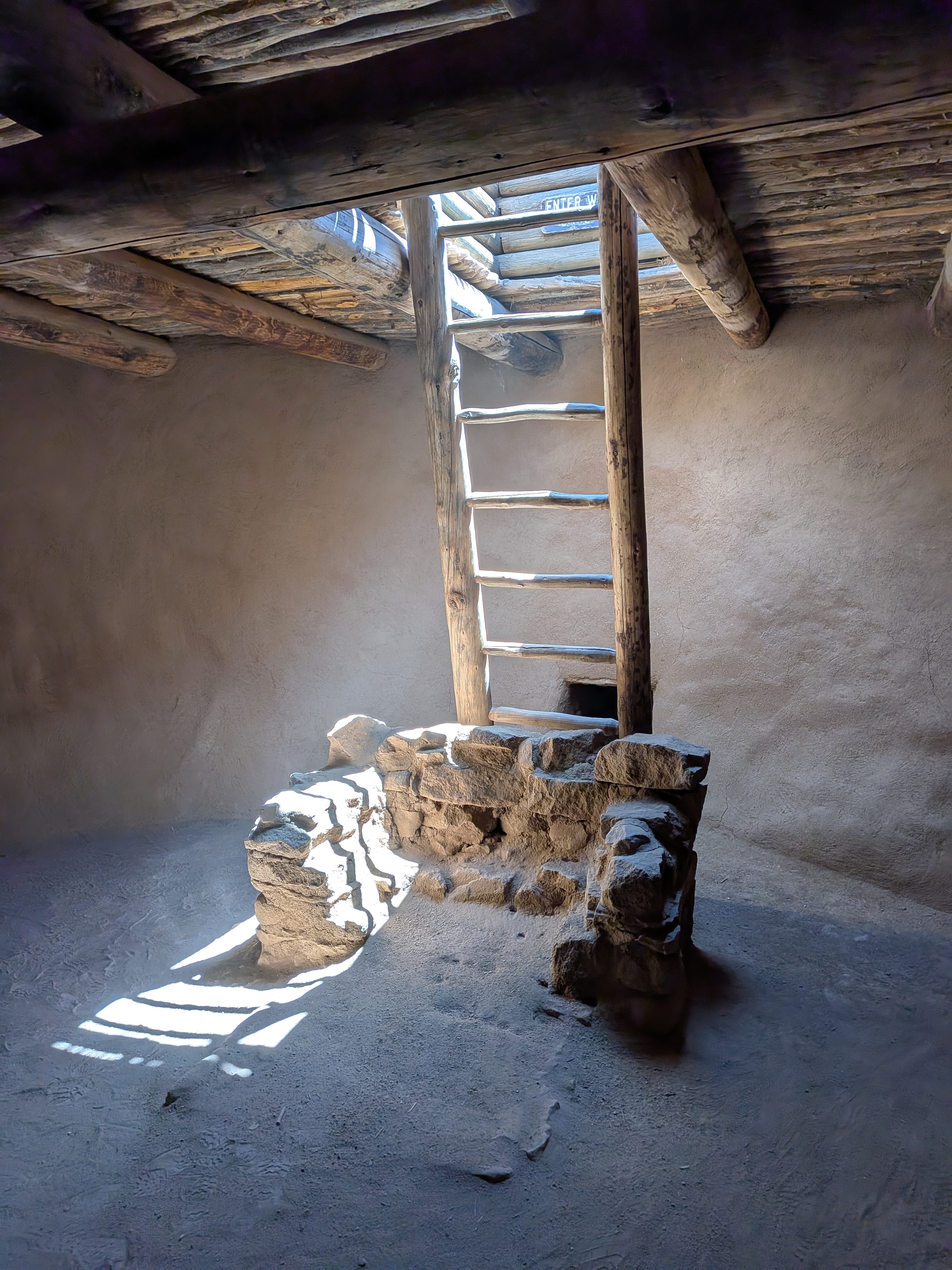
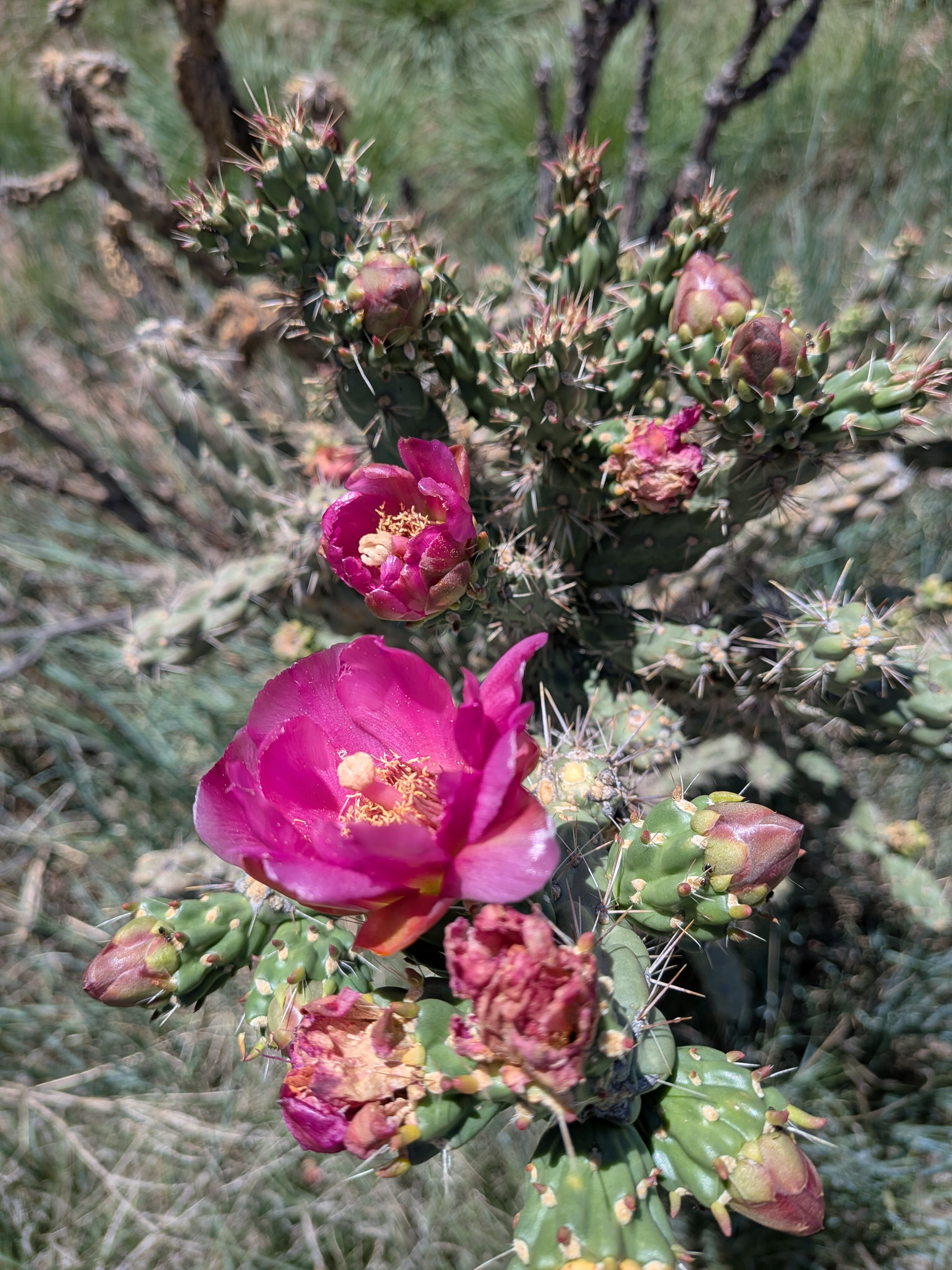
Inside the kiva at PecosCactus flowers!The view from Pecos
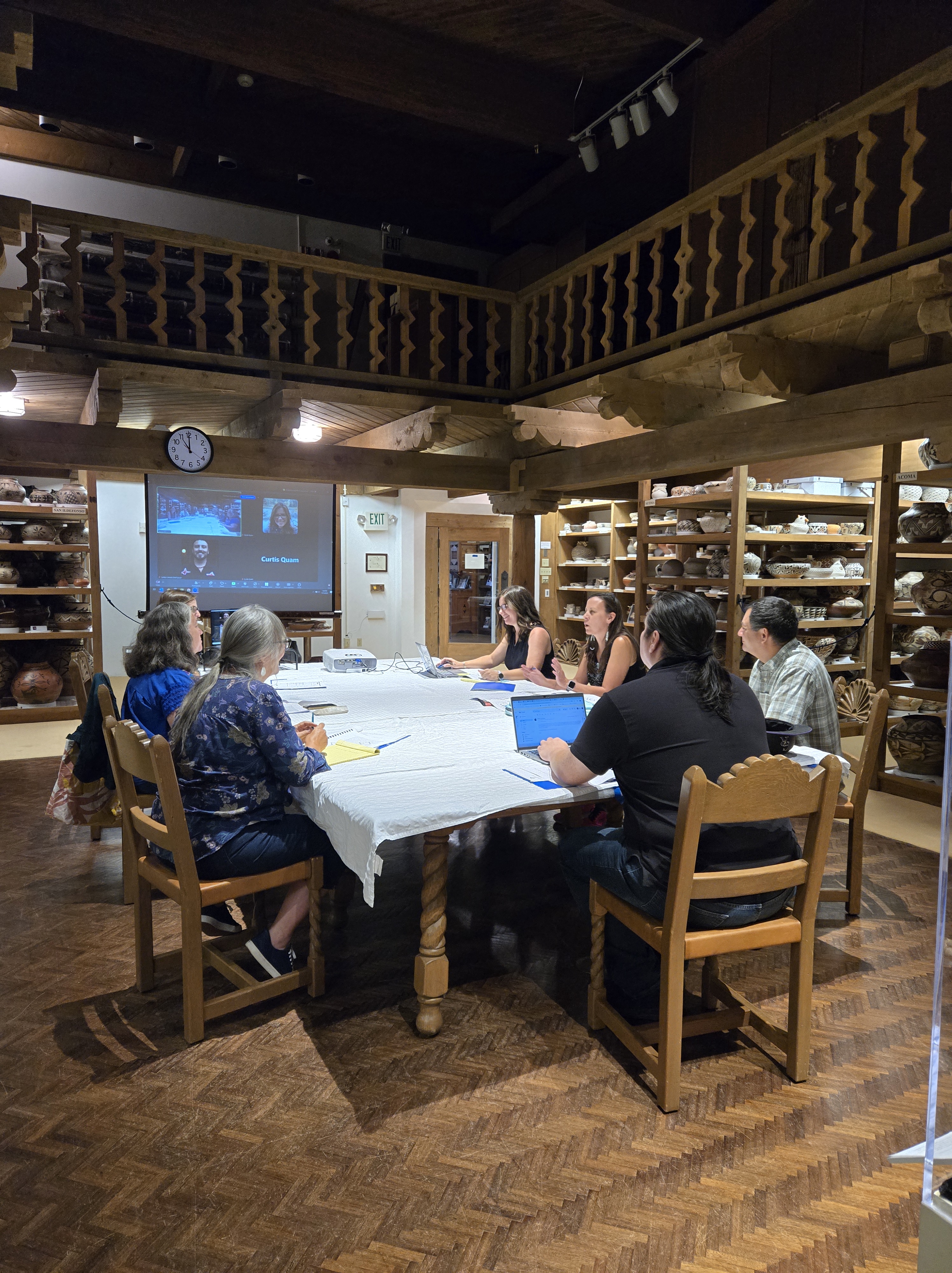
After my time at Pecos, I went to the School for Advanced Research in Santa Fe to facilitate the final review session of the Indigenous Collections Care (ICC) Guide. This is a project that I have been working on for awhile and it was excited to be entering the final stages. Although the review session had to be rescheduled due to complications with our IMLS grant, we had a wonderful group of people to discuss the ICC Guide and help us move forward into the final stages of development.
The ICC Guide provides a framework to respect and recenter collections stewardship practices around the needs and knowledge of Indigenous community members. The Guide speaks to individuals engaged in collections stewardship within museums and collecting institutions. It is aimed specifically at museum professionals, emerging and established, and individuals who are seeking clarification, support, and validation to pursue culturally appropriate care.
Next steps are to send the Guide out for copy-editing and graphic design. A final version will be ready to be shared in the summer of 2026.
My time in New Mexico was amazing and I hope you can visit there sometime soon!
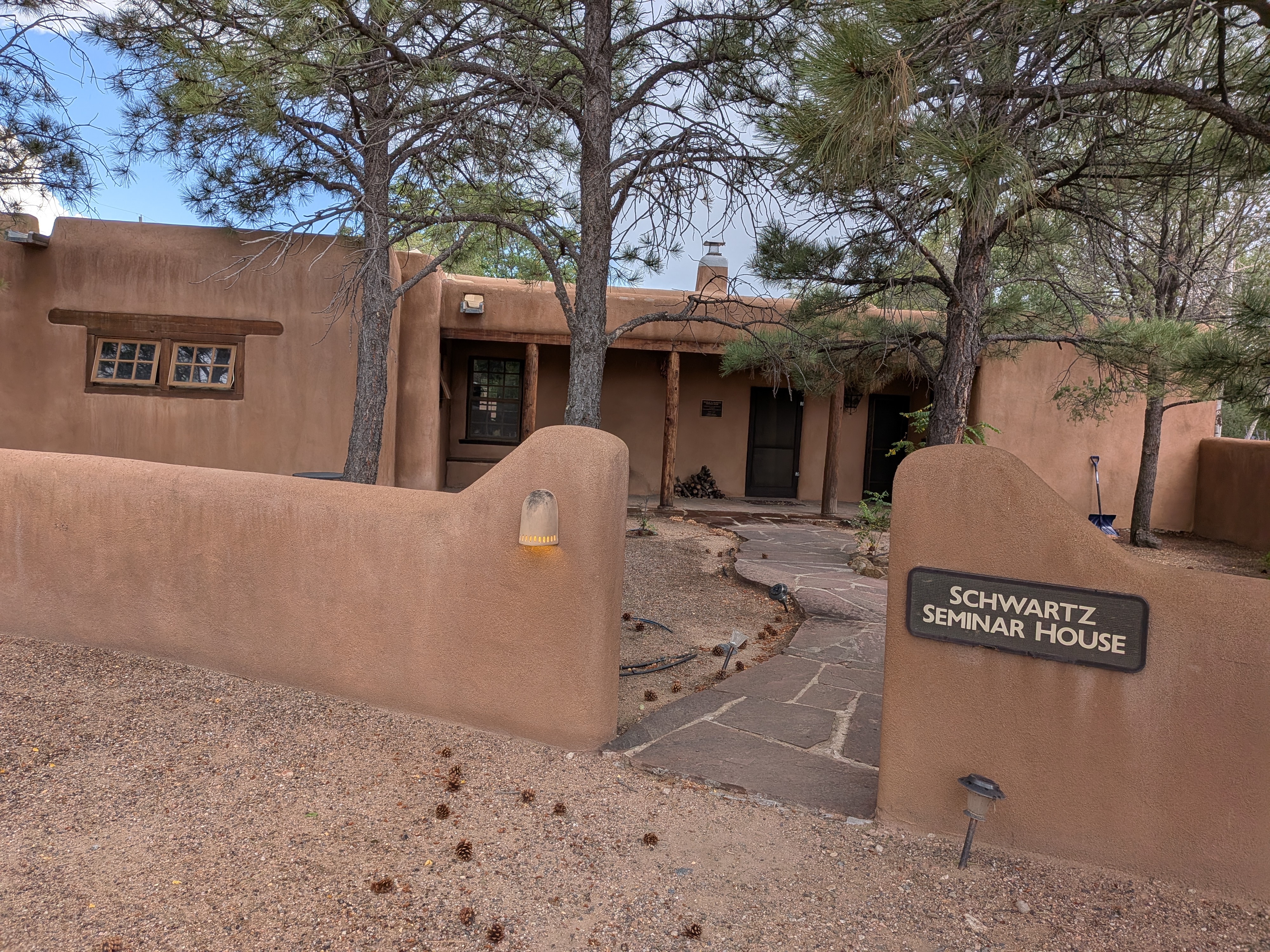
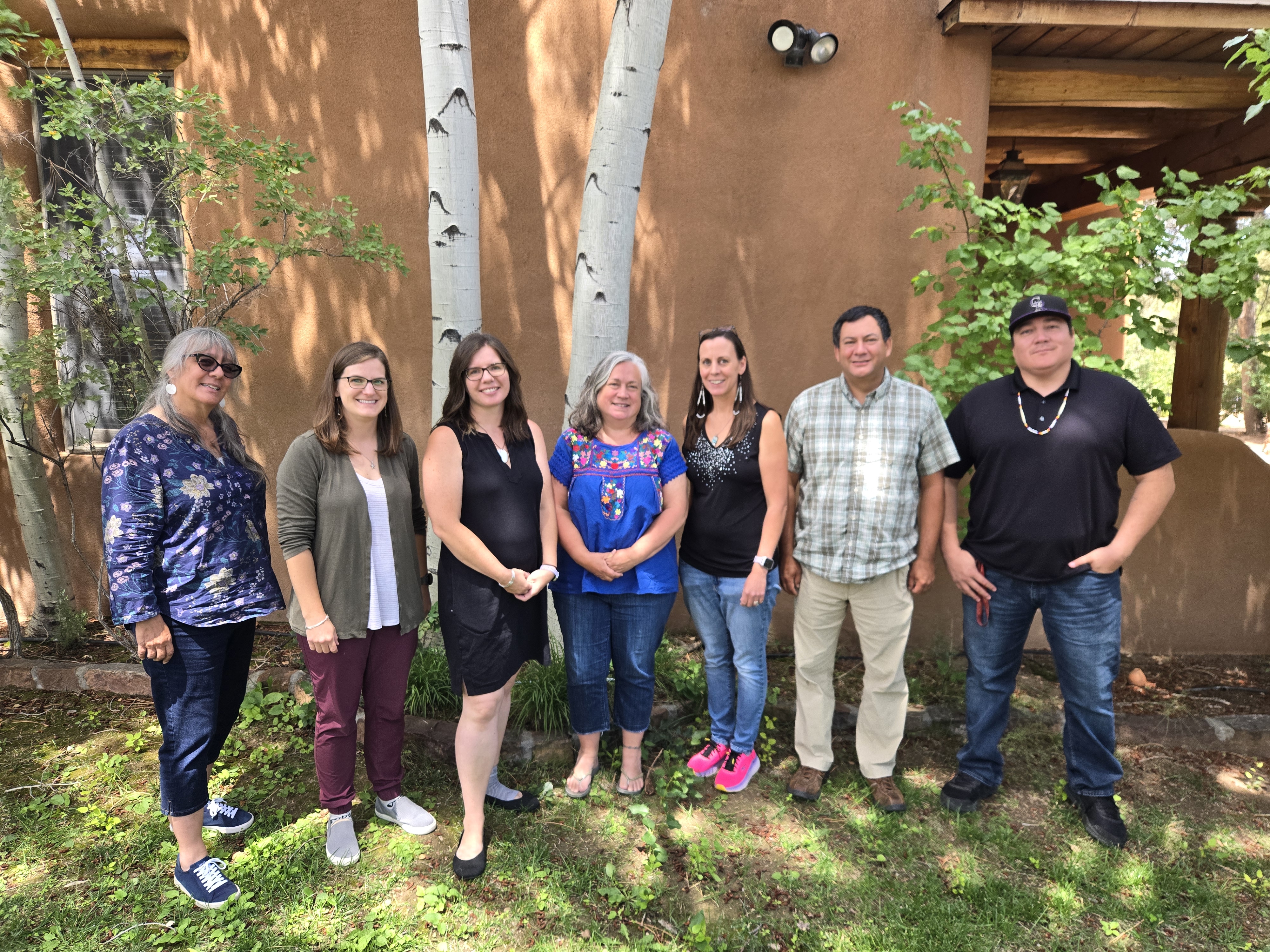
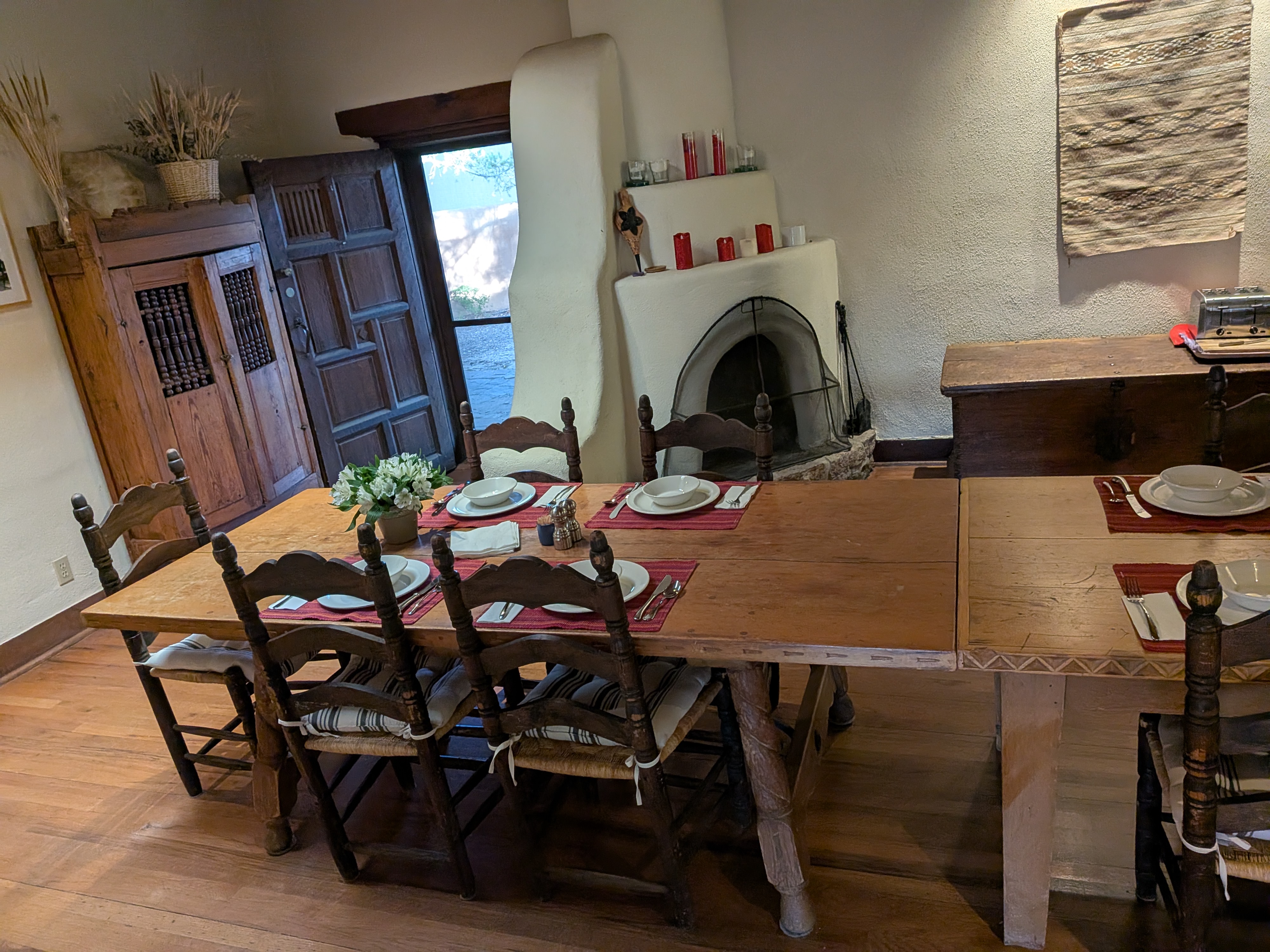
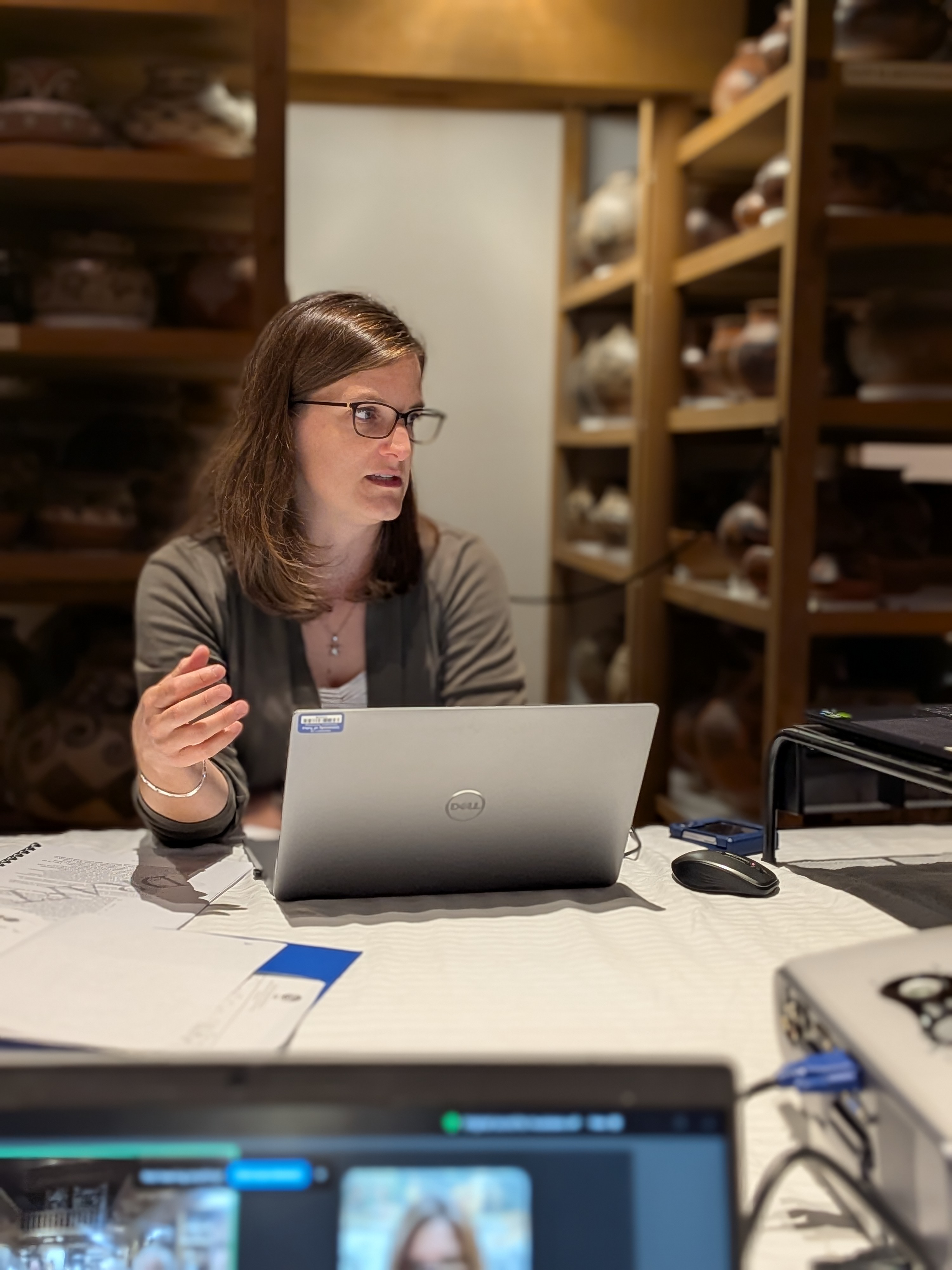
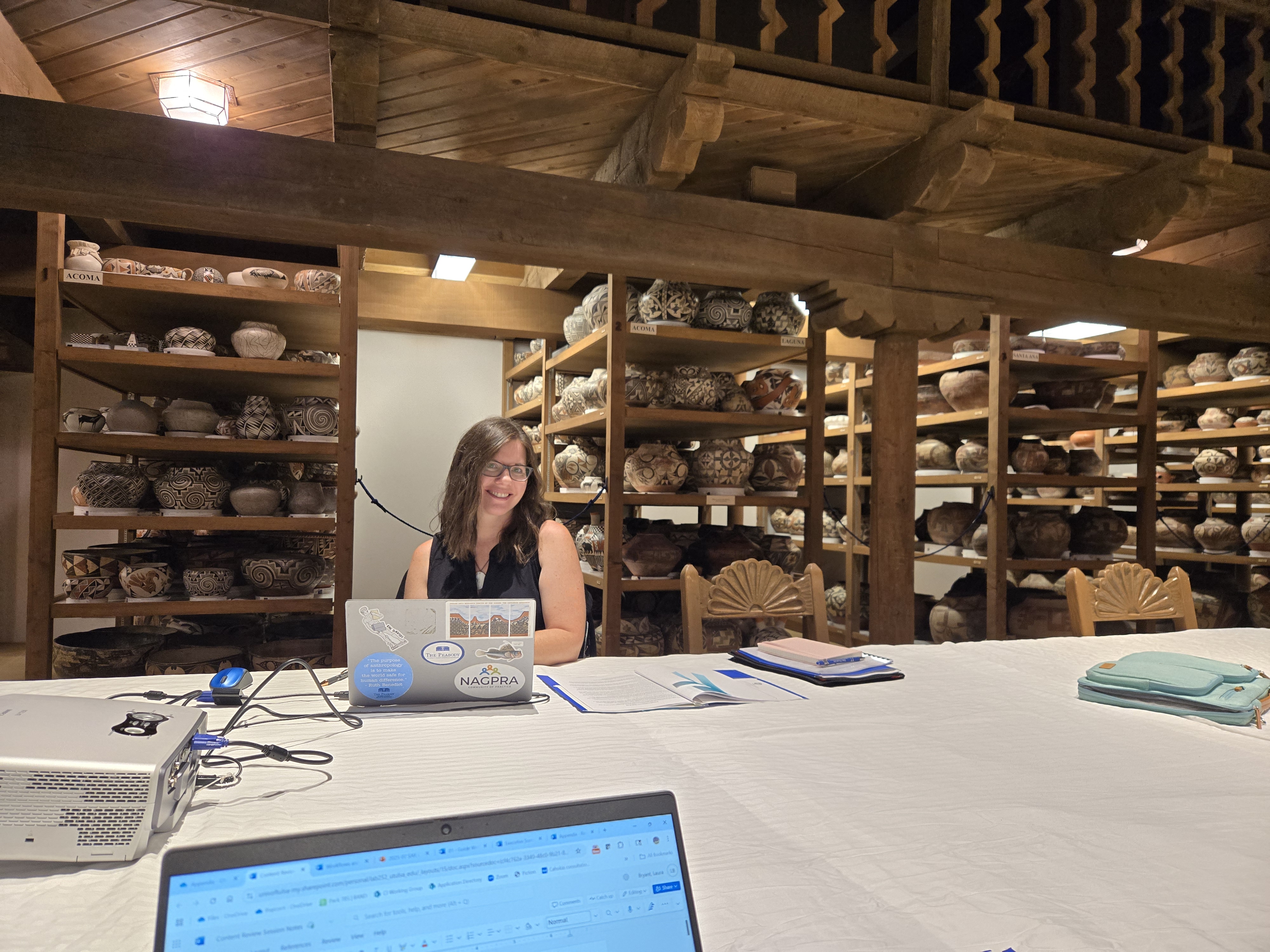
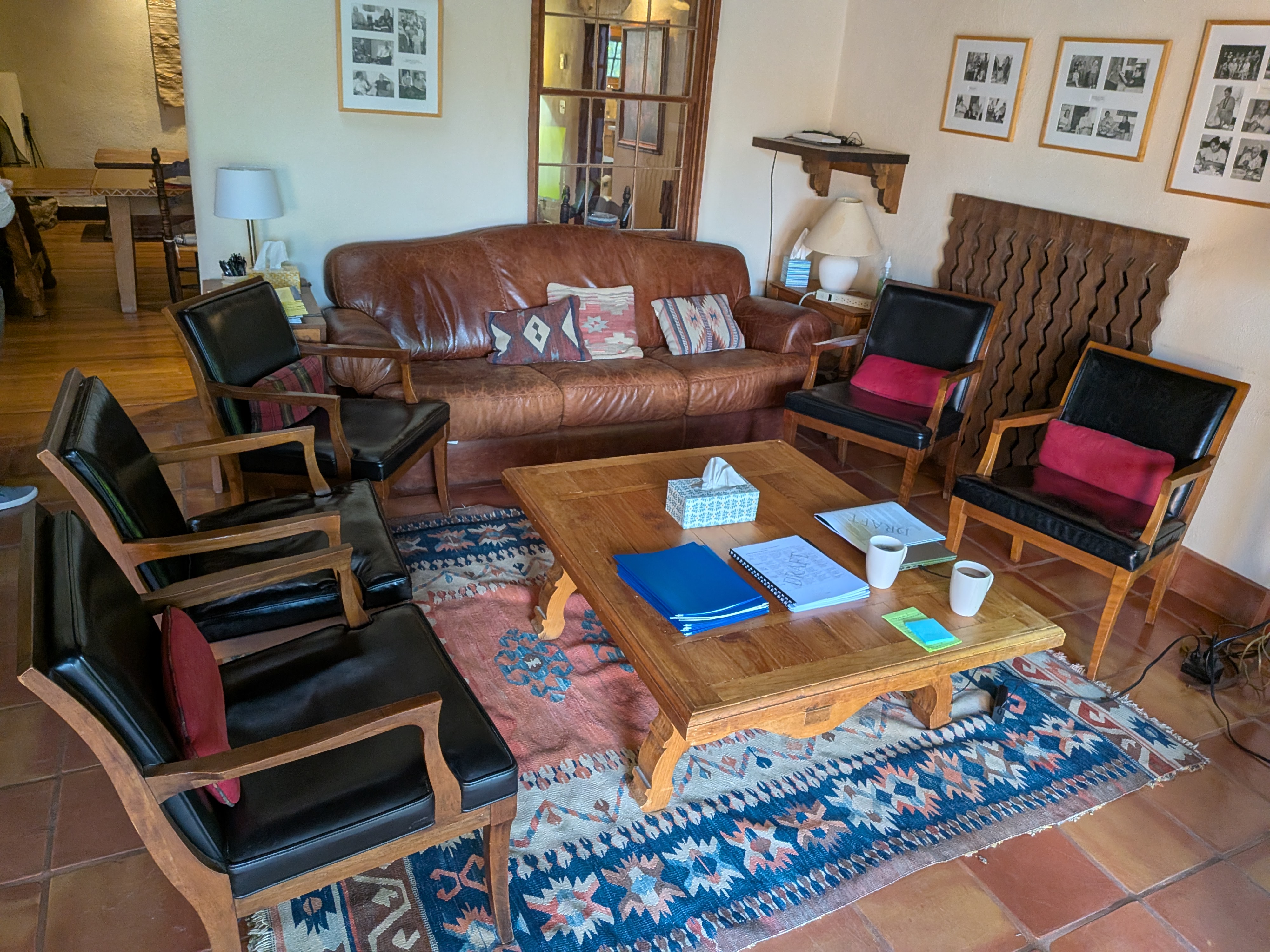
SAR Seminar HouseThe ICC Guide review groupSAR Seminar HouseICC co-facilitator, Laura BryantMeeting at the Indian Arts Research Center at SARSAR Seminar House
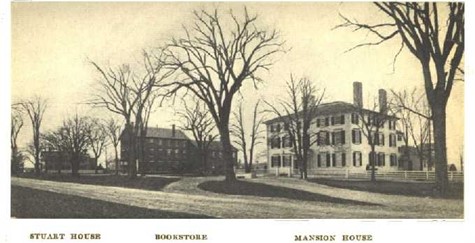
Almost every summer since 2016, young archaeologists from Phillips Academy’s summer session program embark on a mission to excavate the site of the eighteenth century Samuel Philips Jr. Mansion House, located on the West Quad of campus. The infamous Mansion House was built in 1782 by the academy’s founder and stood for 105 years, before burning down in 1887. News articles from the period suggest that the demise of the Mansion House was a result of arson; many speculating that the proprietor, Charles Carter, started the fire. During its long period of occupation, the Mansion House served as not only a home, but later an inn and tavern for students, community members, and travelers. The site’s long history and relatively undisturbed context creates an ideal setting for archaeological excavation and student learning.
Over the past seven years, students have succeeded in discovering portions of the house, including multiple chimneys and a basement feature. This year, students set out with high expectations, choosing to place four excavation units in spaces just outside of the Mansion and two units in the southwest portion of the quad, near the sites of historic outbuildings, a nineteenth century printing house, and an early nineteenth century pathway.
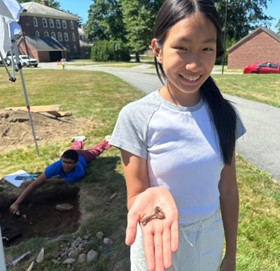
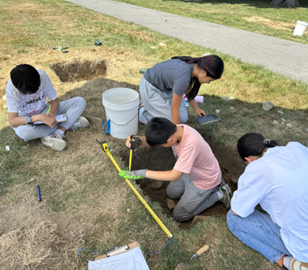
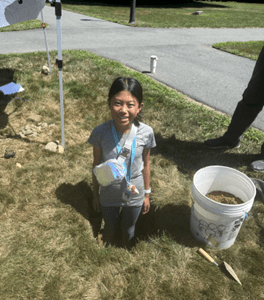
Students in each excavation team had a blast taking turns performing the primary tasks of an archaeologist: digging, screening, measuring, and note-taking. Many, if not all, students even got to unearth artifacts from their units! Some of our favorites included a small ferrous key, an impressed glass tumbler, and half a pair of scissors which all came from the two excavation units placed in the southwest portion of the quad.
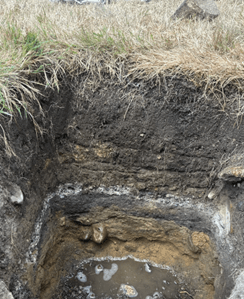
Further excavation in this area revealed a feature relating to the historic pathway present on early nineteenth century maps of campus. Pictured below is a dense, gravelly layer of soil discovered at 40 cm. This layer, interpreted here as the pathway, was intermixed with nineteenth century materials including glass, brick fragments, and some ceramic.
Students excavating the other four units in the northern portion of the quad found shallow cultural layers followed by a sterile C horizon, between 20 and 35 cm. While the artifact density of these units was limited, students still enjoyed finding an abundance of brick, metal nails, and some small ceramic fragments. The very shallow deposits found in these units informed the team that no building activity likely occurred in these areas. Additionally, the relatively low artifact density suggests that these areas were not regularly used like in a dooryard or garden area.
Overall, students in the 2025 field program successfully applied archaeological methods to ‘unlock’ more of the mysteries surrounding the Samuel Phillips Jr. Mansion House. This year’s field season serves to inform of the deep cultural deposits in the southwest portion of the quad and the significant research potential it could provide for future field seasons.
Thanks to the entire student field crew and cheers to a wonderful field season!

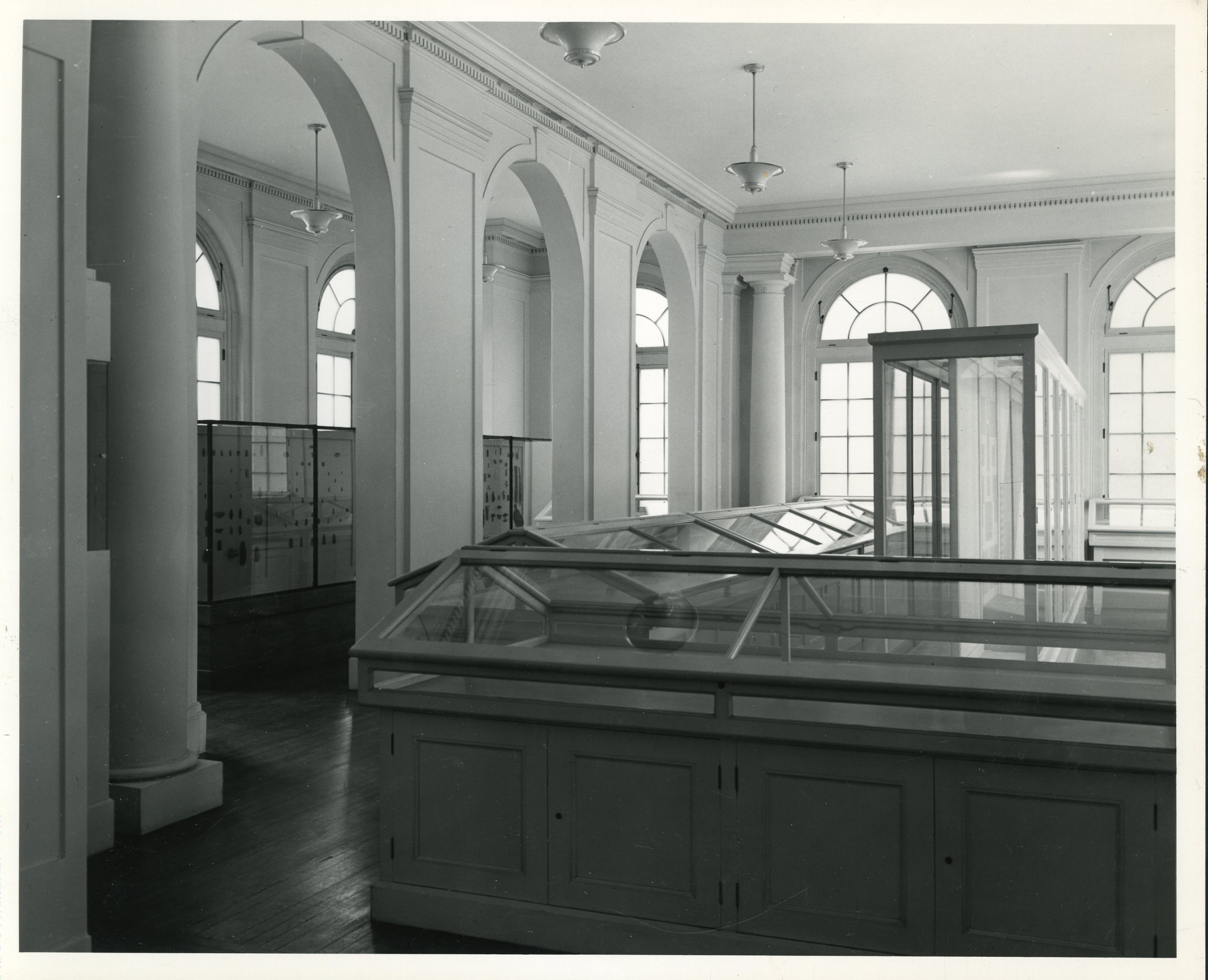
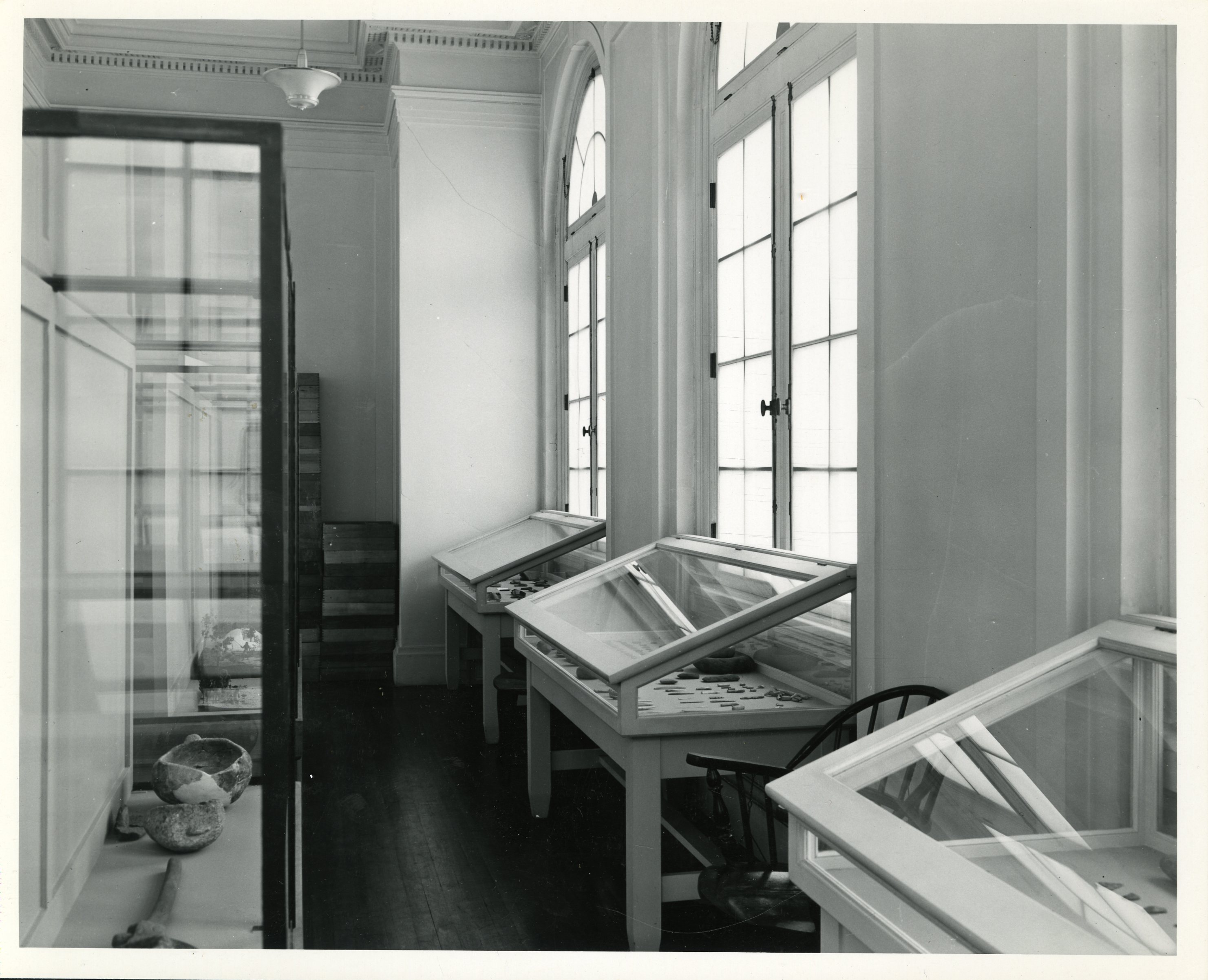


 The Peabody