Given how wildly successful our Diggin’ In: Digital Lecture series has been, we wanted to expand how our audiences can interact with archaeologists from around the country.
Our new project – dIPPIN’ IN: Quick Conversations with Archaeologists – highlights the variety of jobs and experiences archaeologists can have by asking each person the same five questions:
Describe what kind of archaeology you focus on.
How did you get into archaeology?
Why should we care about archaeology and history?
What is the most exciting thing you ever found?
Anything else people should know about archaeology?
It is fascinating to learn about each archaeologist’s career path and what initially hooked them. And, while some answers have been remarkedly similar many are wildly different!
If you want a glimpse into the exciting field of archaeology through the personal lens of an archaeologist, this series is for you.
As we continue to add to the series, you can find the videos here.
And, if you are an archaeologist who wants to participate or if there is someone you want us to interview – let us know!
When thinking about the collections held by the Peabody Institute, I often also think of Warren K. Moorehead. Regular readers of the blog (I know there are a few of you out there!) are certainly familiar with his name and how tightly he is intertwined with the Peabody. To recognize Moorehead’s 155th birthday this week, I wanted to take a few minutes to share some of his story.
Warren King Moorehead, 1898
Warren King Moorehead (1866-1939) grew up in Ohio, where he cultivated a lifelong interest in archaeology and Native Americans. In his early career, he worked as a correspondent for The Illustrated American and served as the first curator of archaeology for the Ohio Archaeological Society (now the Ohio History Connection). In 1896, he began what would become a personal friendship with Robert S. Peabody, providing him with several Indigenous artifact collections. When Mr. Peabody chose to donate his collection to Phillips Academy in 1901, he appointed Moorehead as the first curator of the Department of Archaeology. Moorehead served in that capacity until 1924 when he then assumed the directorship. He finally retired in 1938, only a year before his passing.
Throughout his career, Moorehead was a prolific writer, excavator, and collector. His large-scale archaeological surveys and excavations included the Arkansas River Valley, northwest Georgia, the Southwest, and coastal and interior Maine. His work directly contributed to expanding the Peabody’s collection by approximately 200,000 objects.
Moorehead and crew doing a survey along the Merrimack River
However, it must be acknowledged that Moorehead’s field and collection techniques are quite shocking by modern archaeological and museum standards. Early in his career, particularly in Ohio and Georgia, Moorehead would use horse drawn plows to cut into carefully constructed mounds. Often, his work was destructive yet superficial – he would level or bisect the mounds and collect what was of interest to him with relatively little note taking.
Moorehead was also a dealer – he regularly facilitated trades between institutions and with private collectors to fund his own work or to “remove duplicates.” Definitely something that would never be done now. And, it created lots of headaches.
It is perplexing to me that Moorehead was able to see the injustices done to contemporary tribes, but continue to be seemingly unaware that the material that he avidly collected and traded was connected to those same people. I firmly believe that Moorehead is an excellent candidate for a riveting biography. Anyone out there have the time to write it??
In January, the HVAC system in one of our collection storage areas malfunctioned. Repair work required that the system was turned off for several days. During this time, we monitored the objects for any changes. One vessel caught our eye.
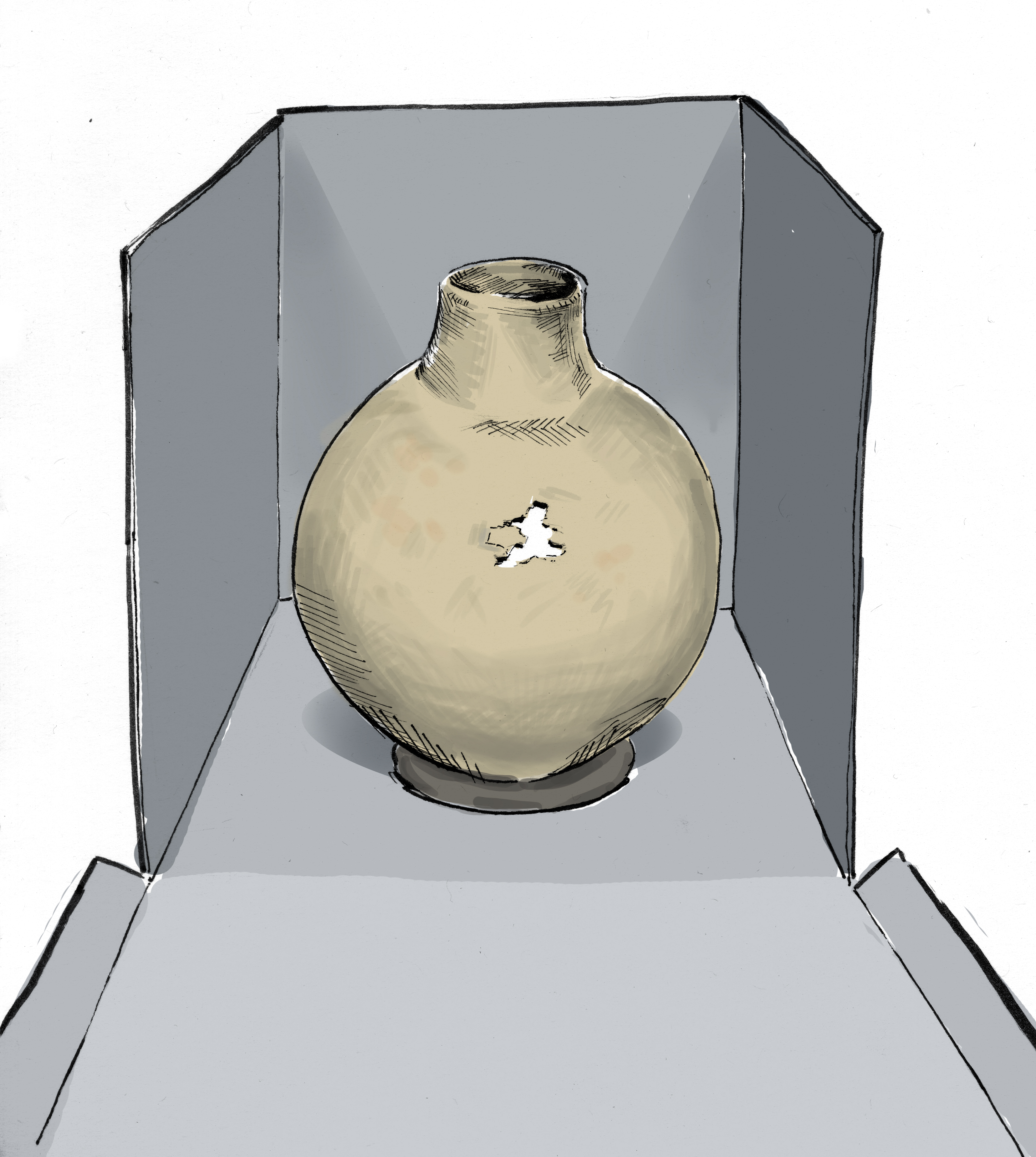
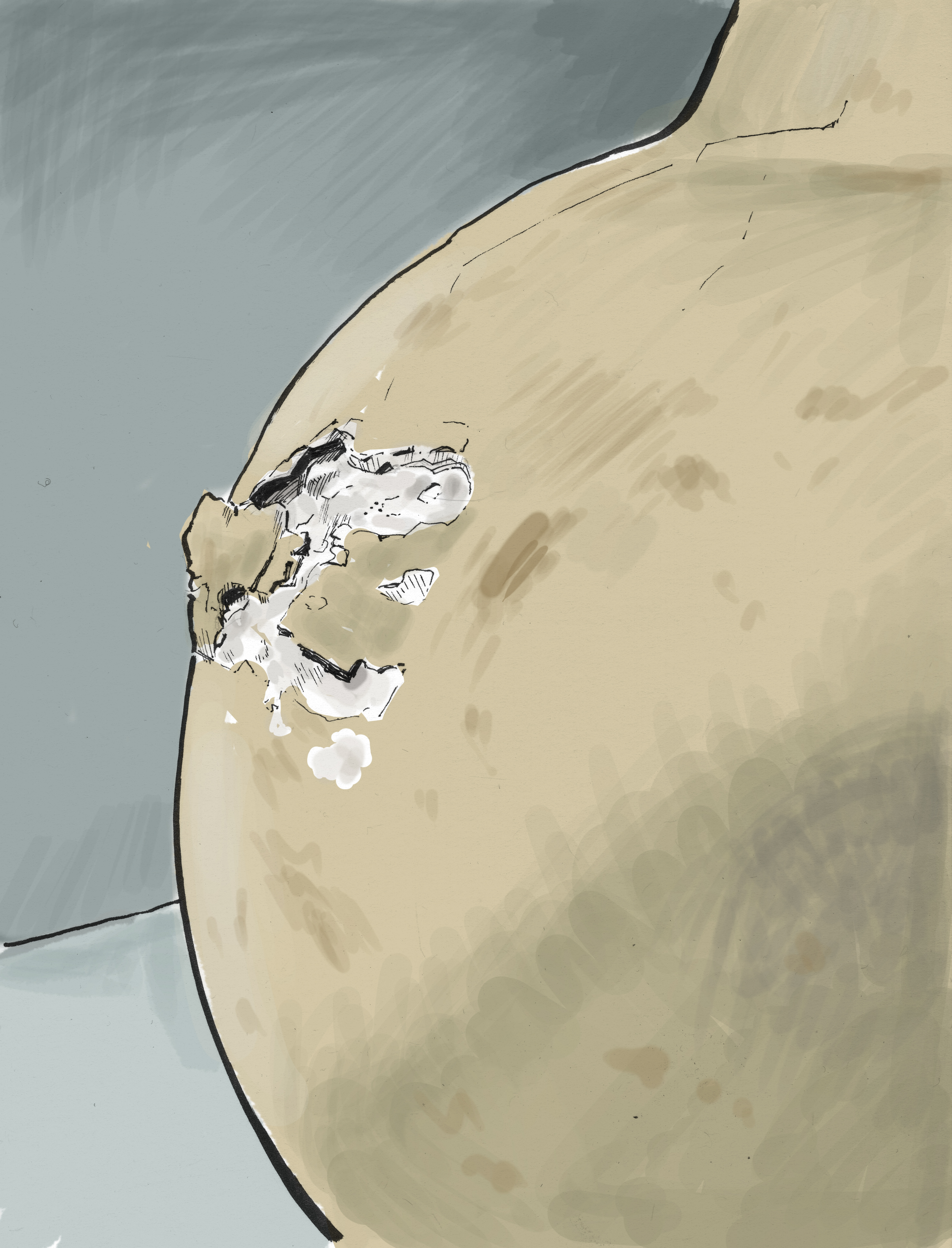
Thanks to Marla’s experience with the collection, she noticed that previously documented spalling due to salt efflorescence was likely developing further (see figure). A quick look at older photographs confirmed that the damage had indeed progressed. The vessel was stored on open shelving and an inspection of the area around the object determined that no fragments had fallen completely off. We decided to rehouse the vessel in a box to buffer it against changes in environment during the current or future failure of the HVAC system.
Figure 1. Rehoused vessel in open box
Since I’ve encountered salt efflorescence a few times, I thought I’d add a bit more information. Porous materials, like bone, ceramic and stone, can absorb salt from various sources. Once inside, salts can be dissolved by moisture in the air through a process called deliquescence. Eventually, the water evaporates and the salt recrystallizes. In very porous objects, the salt crystals form on the surface. In objects where the surface is less porous than the underlying body, recrystallized salt can generate massive forces than can spall or pit the surface (Source: NPS Conserv O Gram 06/05 page 1). In worst case scenarios objects can disintegrate.
As I mentioned in an earlier blog, salts can enter porous objects through groundwater or seawater in buried or submerged contexts (Source: NPS Conserv O Gram 06/05 page 1). They are a major source of salt in archaeological collections such as ours. In the case of ceramics, food and water stored in objects during their pre-burial use life can also leave salt residues (Source: Minnesota Historical Society Page 2). Salts can be introduced to ceramics during manufacture through additives that modify the clay body and through water (Source: Minnesota Historical Society Page 2, Source: Digital Fire). Even clay itself can be salty. When I lived in Arizona, I can remember hearing a potter discuss that they would check their clay by tasting it to make sure it wasn’t too salty.
After ceramic objects are recovered during excavation, salts can continue to be added in archaeological labs and museums. Hydrochloric acid has been used to remove calcium carbonate, an insoluble salt that adheres to ceramics during burial that impedes analysis. An unintended result of this process creates calcium chloride, a soluble salt, which is absorbed into the ceramic matrix (Source: The International Institute for Conservation of Historic and Artistic Works- Studies in Conservation Page 172, Source: NPS Conserv O Gram 06/05 Page 2). I would be highly doubtful of repairs that were done years ago. Without detailed treatment records, who knows what glues were used and what contaminants they might introduce.
Figure 2. Spalling due to efflorescence
Deliquescence and evaporation of soluble salts can be greatly diminished by keeping the storage environment below 60% relative humidity and by reducing humidity and temperature fluctuations (Source: NPS Conserv O Gram 05/06 Page 3). However, there is a continued danger of efflorescence. Display cases and storage shelving made from wood have the potential to release acetic acids. This volatile organic compound has the potential to interact with soluble salts leading to precipitation even in controlled storage environments (Source: ICOM Committee for Conservation Page 640).
There may not be quick or inexpensive solutions to mitigate efflorescence. Our current plans for renovation of Peabody collections spaces call for the replacement of wood drawers and cabinets, but this is expensive. In regards to removing salt from objects, the traditional method is through a desalination wash or soak, wherein the object is immersed in distilled or deionized water until the salt level is reduced. This is a complicated process and shouldn’t be done without involving a conservator. Desalination risks removing important residues and compounds that can reduce the usefulness of the objects for future analysis and weaken the object (Source: NPS Conserv O Gram 05/06 Page 3).
Here at the Peabody we’ve taken steps to remove salt through dry brushing, environmental controls, and monitoring. In the future, we have plans to improve our storage space so that these issues will no longer be a concern.
One object, donated to the Institute by Dr. C.A. Kershaw in the early twentieth century, is repeatedly cited as evidence for Viking visitors to Massachusetts long before the days of the Pilgrims.
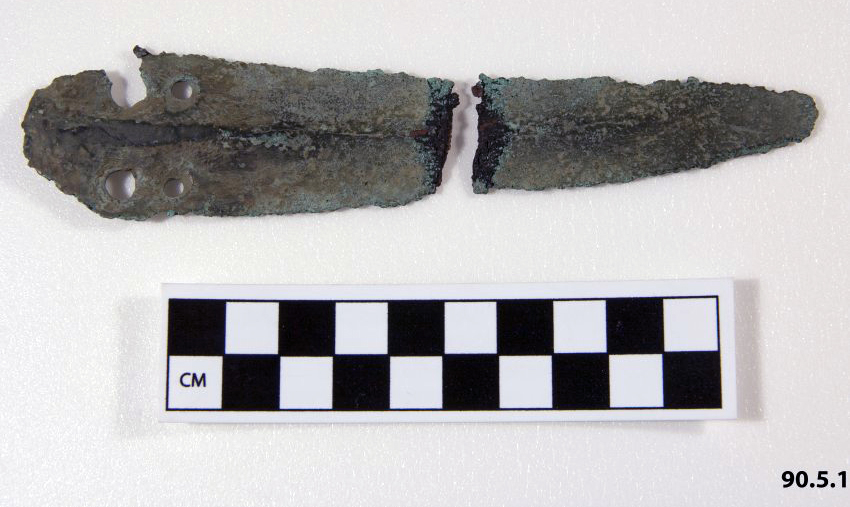
The object in question is a copper dagger or knife and is pictured in Frederick Pohl’s 1961 book Atlantic Crossings before Columbus. Barry Fell also discussed the piece in his popular 1976 book America BC: Ancient Settlers in the New World. Both authors contributed extensively to the literature on connections between Europe and the Americas, often featuring Vikings; mainstream archaeology has dubbed Pohl, Fell, and allied writers as pseudoscientists who offer provocative theories, but little concrete or testable evidence.
Copper dagger or knife blade from Merrimacport, Massachusetts in the collection of the Robert S. Peabody Institute of Archaeology, catalog # 90.5.1.
Regarding the dagger, here is what Pohl has to say:
Arthur Petzold (of Andover, MA) recently called my attention to a heavily-patinated copper “spearhead or knife” found many years ago by Dr. C.A. Kershaw of Merrimacport, Massachusetts, on Indian Flat near his home. A drawing of it showing two large and two small rivet holes for hafting was published by Warren King Moorehead in 1931. Benjamin L. Smith, who wrote “Supplementary Notes” to the Moorehead volume, says he has always been “troubled” by the copper artifact because its unusual form suggests it may not be Indian. Dr. Gad Rausing of Lund, Sweden, thinks that the general outline and size agree quite closely with the very early Bronze Age daggers of Northern Europe—but he has never seen one with two big and two small rivet holes arranged in such a manner, and so he says he “cannot claim to recognize it at all.” It may be, as he suggests, that the four rivet holes were not made at the same time, but that the small ones were added when one of the large ones got broken. A distinguished archaeologist, a specialist in European pre-history, has written me that the copper object is doubtless a dagger and, he believes, a very old one, from the mid-European early Bronze Age, presumably about 1300 B.C. But, he says, “How could it have found its way to Massachusetts, I wonder. Perhaps brought by some collector, and lost. Who can tell?” On the other hand, Dr. William Ritchie, New York State Archaeologist, assures me that prehistoric Indians of the Upper Great Lakes area riveted some of their spear points to the shaft, and so he says of the Merrimacport specimen that it may or may not be prehistoric. Spectrum analysis should determine its place of origin; for North American Indian copper is quite pure, having only slight traces of silver and iron, while European smelted copper contains antimony, bismuth, lead, iron, cobalt, nickel, Sulphur, gold, silver, arsenic and oxygen. In view of the possibility that the Merrimacport artifact may be early European, it is interesting that it was found only thirteen miles from North Salem and near the river used by boats approaching the North Salem site. [Pohl 1961:15-16]
Pohl’s argument is characteristic of many pseudoscientific claims—two competing ideas about an artifact or site are presented as equivalent—in this case, the Merrimacport artifact is offered as potentially Native American and potentially Bronze Age. The Native American origin of the dagger, however, is much more likely, especially as archaeologists like Ritchie noted similarities to copper artifacts from the Great Lakes. The North Salem site that Pohl mentions is now known as America’s Stonehenge and is located in North Salem, New Hampshire.
Barry Fell, building on Pohl’s arguments, illustrates a photograph of the Merrimacport artifact and cites ongoing research (mid-1970s) by James Whittall. Fell says that museums housing these copper artifacts, which he identifies as Celtic, believed they were from the European Bronze Age, but that they had been recently lost (see Fell 1976:127-128). Interestingly, James P. Whittall Jr., who wrote about the copper object in the December 1970 issue of the New England Antiquities Research Association newsletter, compares the piece to a Bronze Age dagger from Spain—a comparison that is echoed by Fell. And, despite that comparison, Whittall remains undecided about the origins and significance of the artifact, saying, “The dagger does not prove cultural contact between Western Europe and New England in the late Bronze Period, but the fact remains that the dagger was found here. This should be kept on record. When and if more evidence is recovered in this area, this singular artifact becomes more important. For the present it rests in a cultural void.” Writing a few years later, Whittall (1975:4) is more decisive, stating that “copper celts in Vermont and rivet copper daggers in Massachusetts are typical examples of middle bronze age European artifacts.”
Moorehead (1931:13), as noted by Pohl, includes an illustration in his Merrimack Archaeological Survey, though does not comment on the artifact other than to describe it as a “copper spearhead or knife,” while Charles S. Willoughby (1936:114-115) includes the piece with other Native American copper objects in his Antiquities of the New England Indians, saying:
The unique specimen figured in g [referring to Figure 59g], is from an old site on the bank of the Merrimack, at Merrimackport, Massachusetts. It is probably a knife, and was lashed to its handle through two perforations near its base, one of which has been torn out. In repairing this damage two more perforations were made just above the others. This is now in the Andover Museum. In all of the above [copper] specimens one side is flat. On the opposite side the blade is beveled from a central strengthening ridge to either edge.
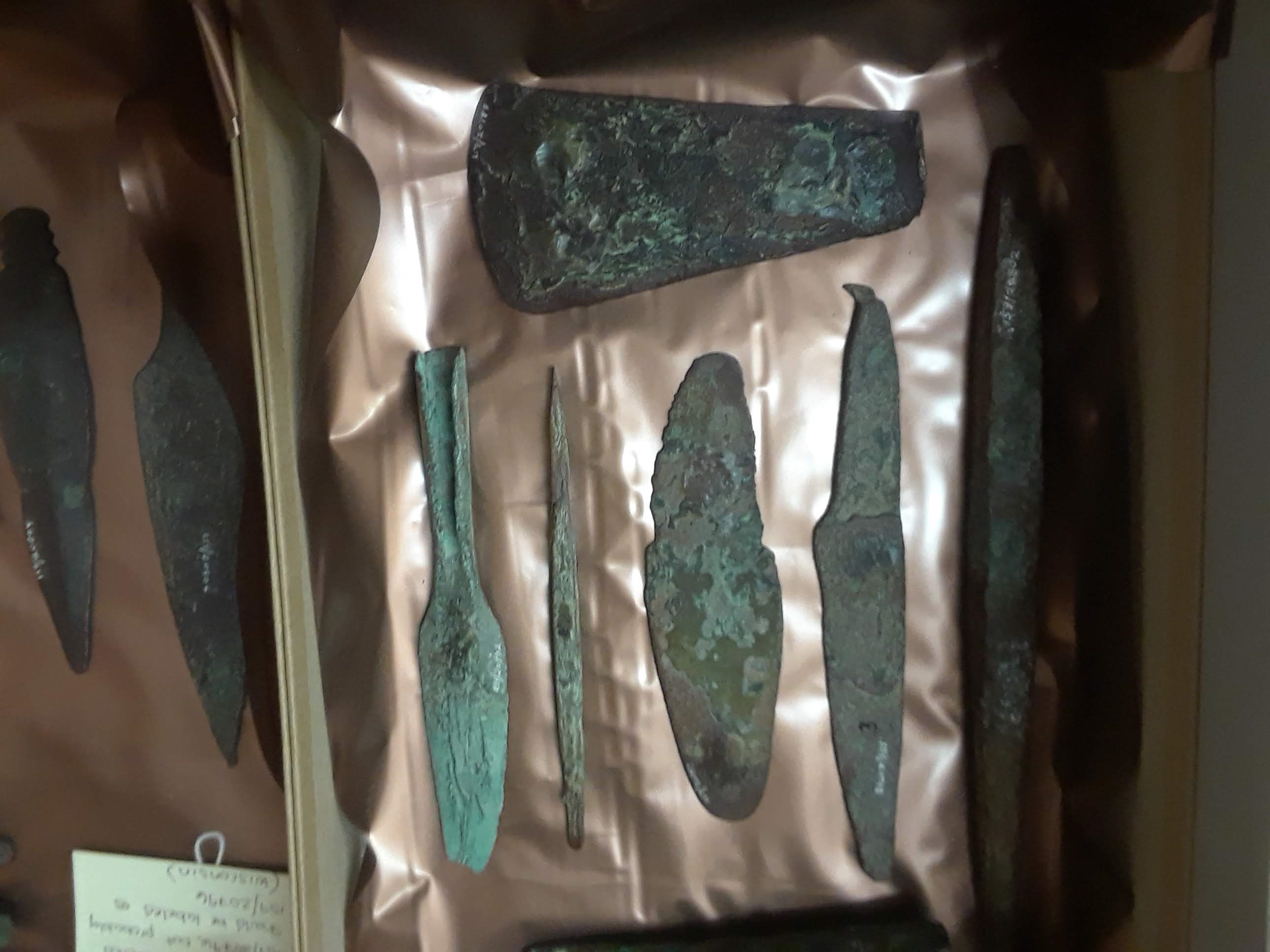
Copper objects from Wisconsin in the collection of the Robert S. Peabody Institute of Archaeology.
So, you might ask, “what’s the harm in all this?” We do know that the Norse settled in Greenland, at least for a while, and that one Norse site has been confirmed in Labrador, so it’s not impossible that other sites or objects could be found. Ken Feder (2020:131), in his great book Frauds, Myths, and Mysteries, notes that “a growing number of native sites in Arctic Canada show evidence of widespread, occasional, but sometimes intimate contact for centuries between local people and Norse visitors.” Every year in my fall Human Origins course, we discuss the distinction between science and pseudoscience. We learn that science relies on falsifiability, where proving a hypothesis true is less important than the ability to prove it false. Possibilities and probabilities often fail to meet the falsifiability test—could Vikings have been in Massachusetts and neighboring states? Yes, but those possibilities must be subject to testing. Also, there’s a darker side to these Viking stories, which negate the long land tenure, accomplishments, and technology of Native Americans. As archaeologist William Ritchie reported to Frederick Pohl in the 1960s, Native Americans worked Great Lakes copper into an array of tools and ornaments thousands of years ago, and these objects were transported by travelers and through exchange networks. Before conjuring Celts, Vikings, Irish monks, or other trans-Atlantic European travelers, Native Americans are much more likely to have fashioned artifacts like the Merrimacport dagger.
References Cited
Feder, Kenneth L. 2020. Frauds, Myths, and Mysteries: Science and Pseudoscience in Archaeology. New York: Oxford University Press.
Fell, Barry. 1976. American B.C.: Ancient Settlers in the New World. New York: Pocket Books.
Moorehead, Warren K. 1931. The Merrimack Archaeological Survey: A Preliminary Paper. Salem, MA: Peabody Museum.
Pohl, Frederick J. 1961. Atlantic Crossings Before Columbus. New York: W.W. Norton & Company.
Whittall, James P. Jr. 1970. An Unique Dagger. New England Antiquities Research Association (NEARA) Newsletter 5(4, Issue #19):77.
___. 1975. Precolumbian Parallels between Mediterranean and New England Archaeology. Occasional Publications of the Epigraphic Society 3(52):1-5.
Willoughby, Charles C. 1935. Antiquities of the New England Indians, with Notes on the Ancient Cultures of the Adjacent Territory. Cambridge, MA: Peabody Museum of American Archaeology and Ethnology, Harvard University.
You have probably heard of radio-carbon (C14) dating. An invaluable tool for contextualizing the past, C14 dating is a method for determining the age of an object containing organic material by measuring stable and unstable (radioactive) isotopes of Carbon. Developed by University of Chicago physical chemist Willard Libby in the 1940s, C14 dating was a game-changer for the field of archaeology. Libby received the Nobel Prize in Chemistry in 1960.
Instead of relying solely on relative dating – the basic concept that an object found below another is older than one found closer to the surface – archaeologists gained the ability to specifically identify a year range for organic artifacts. The Peabody Institute was a contributor to this work through past curator, Frederick Johnson, but that is a story for another blog.
This profile is an example of relative dating – more recent objects are closer to the surface while older material is deeper.
Lately, I have been working to facilitate C14 dating on bone artifacts from Pikimachay Cave in the Ayacucho Valley of Peru at the request of the 2019 Cordell Fellow, Juan Yataco. Juan is revisiting work done in the Ayacucho Valley by Scotty MacNeish. Back in the 1970s, MacNeish made some pretty bold assertions about the dates of human occupation in that region. At the time, the C14 dates from animal bones supported his claims, but other archaeologists doubted whether those bones were associated with human occupation.
While Juan’s specialty is stone tools, he also wanted to use improved technology to obtain an updated date for Pikimachay Cave. Unfortunately, the first bone sent for testing failed to yield an appropriate collagen sample and could not be tested. A second bone is on its way now. Both bones were modified by humans and will provide a fascinating glimpse of the past. Fingers are crossed for a better outcome this time around!
Contributed by Marla Taylor and John Bergman-McCool
Every museum is full of stories and story-tellers. Our recent work in the inventory process has uncovered an old story that always gets my attention (Marla’s). But, before I begin, I must give credit to Eugene Winter, the Peabody’s late Curator Emeritus, who was a story-teller extraordinaire – I am sharing a shortened version of his memories. (Another time, I will tell you about the time Gene cooked his lunch in an active volcano or walked on a whale. The man was full of stories!)
Gene Winter – the best story-teller I knew
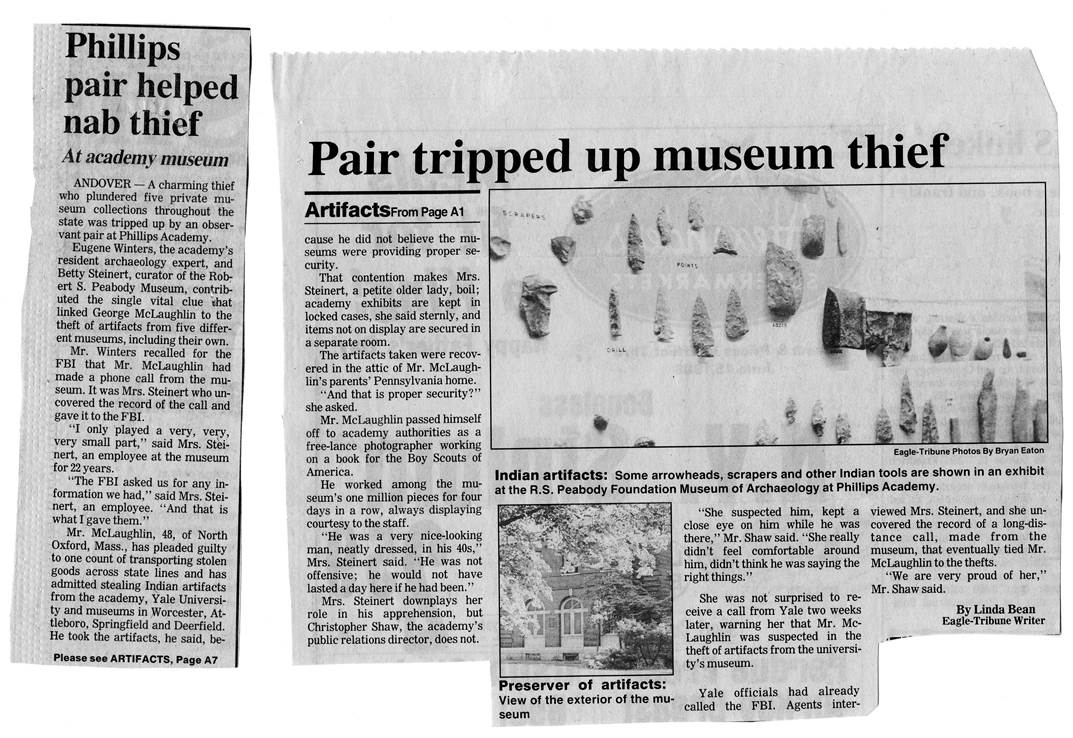
In 1986, Gene welcomed a man named George McLaughlin into the Peabody. McLaughlin claimed to be creating a handbook on archaeology for the local Boy Scouts and was looking to photograph objects in the Peabody’s collection. As a teacher himself, Gene was happy to encourage this project and made arrangements for McLaughlin to return a couple weeks later to access the collection.
However, McLaughlin instead returned the next day and told the administrative assistant, Betty Steinert, that Gene had authorized him to examine the collection – alone. Over the next three days, McLaughlin helped himself to an unknown number of objects from the collection.
Less than a week later, Gene received a call from security at Yale’s Peabody Museum of Natural History. A man matching McLaughlin’s description had stolen artifacts from a grad student’s work area and ran out of the museum before he could be caught. Because McLaughlin had now crossed state lines, the FBI became involved.
Gene and Betty remembered that McLaughlin had used the Peabody’s phone to call his wife about being late for dinner. This crucial piece of information allowed the FBI to locate McLaughlin’s home. Fortunately, McLaughlin was arrested soon after these incidents and all materials in his possession were seized.
Eagle-Tribune article from 1986 recounts George McLaughlin’s theft of artifacts from the Peabody Museum.
In total, McLaughlin victimized six institutions in New England and stole thousands of artifacts valued at over $800,000 in 1986 ($1.9 million in 2020 dollars). He intermingled the artifacts based on his own system and systematically removed their catalog numbers (often the best clue to their original home). By so drastically removing the objects from their context, it was a challenge to return the objects to their appropriate homes.
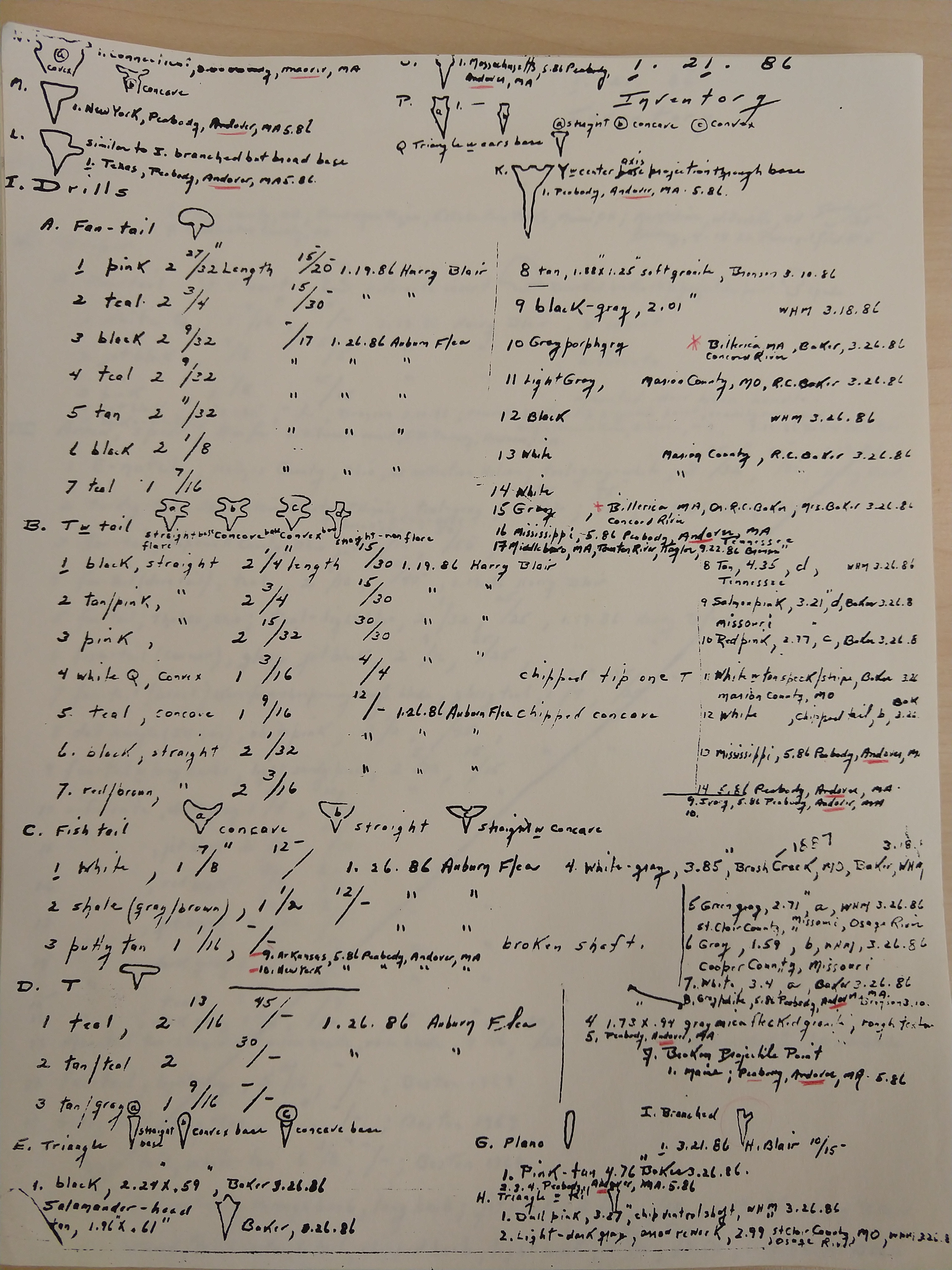
McLaughlin had kept his own version of a ledger identifying the objects and where they came from. And fortunately, Gene was able to recognize a dozen or so very specific objects from the Peabody’s collection. The FBI left it up to the victimized institutions to divide the material in McLaughlin’s collection. The Peabody ended up with nearly 1600 objects from McLaughlin.
Ultimately, McLaughlin was sentenced to a three year suspended sentence and four years of probation. He was also fined $10,000 and ordered to pay a small restitution to each institution.
And therein lays the origin of the Peabody’s FBI collection.
Having come across these materials during our inventory and rehousing project it was time for them to be cataloged by myself (John). One challenge confronted us: McLaughlin had removed any identifying numbers applied by the museums and applied stickers with his own numbers. As the objects were cataloged, a careful inspection was made for remnants of original numbers not completely obliterated during the removal process. There were many with tantalizing hints of legible numbers. In the end though, there were just a few objects with numbers clear enough to associate with our museum’s ledger.
A page of McLaughlin’s inventory
The remaining majority of objects needed new numbers. As mentioned above, McLaughlin had organized the objects and transcribed them into a ledger of sorts. His ledger was too general to make a one-to-one comparison with our own museum’s ledger, but it served as the outline of our numbering system. We added our own prefix, indicating that these objects were stolen and returned by the FBI and followed that with the McLaughlin number. In that way the objects will always carry that part of their strange history.
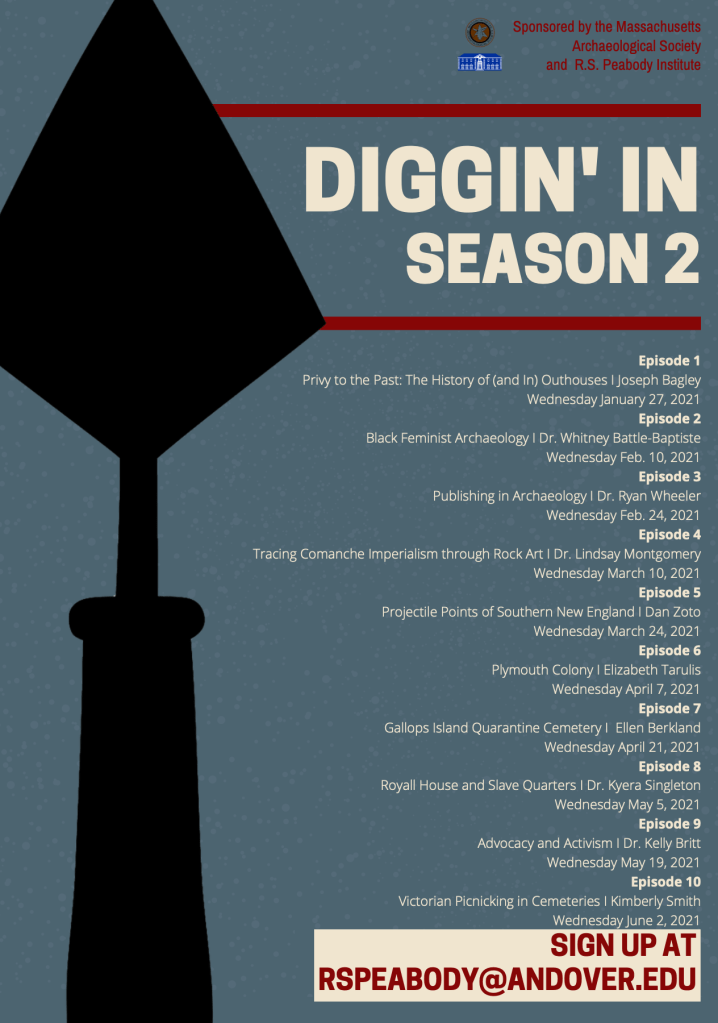
We are tremendously excited to announce the continuation of Diggin’ In: Digital Conversations with Archaeologist. Co-hosted by the Peabody Institute and the Massachusetts Archaeological Society the lecture series brings leading experts and their work directly to our viewers. All lectures are free and open to the public.
Building on the success of the inaugural season of Diggin’ In, which reached over 1000 individuals, Season 2 promises to continue to be especially robust. Outstanding scholars such as Dr. Whitney Battle-Baptist, Dr. Lindsay Montgomery, and Kimberly Smith will cover fascinating topics ranging from Black feminist archaeology, to Comanche rock art, to the artifact patterning of the Victorian practice of picnicking in cemeteries.
Join us on Wednesday January 27, 2021 for the launch of the new season with Joe Bagley, Boston City Archaeologist for his talk Privy to the Past: The History of (and in) Privies. All lectures begin at 1:30 pm.
If you want to attend one or all of these lectures, please sign up at rspeabody@andover.edu to get on the ZOOM invitation list.
Each episode will be recorded and uploaded to YouTube afterwards.
One day while I was working in the basement of the Peabody, plugging away at inventorying drawers, I was listening to a podcast called Astonishing Legends. It was an episode titled “The Tall Ones” exploring the legends and lore surrounding giants around the world. It came as a surprise when I heard the hosts say the name W.K. Moorehead! My ears instantly pricked up.
The podcast hosts went on to cite a New York Times article written on July 14, 1916 under the headline “Find Horned Men’s Skulls: Remarkable Discovery by Archaeologists in the Susquehanna Valley”. The short article stated that Professor A.B. Skinner of the American Indian Museum, Rev. George Donehoo, Pennsylvania State Historian, and Professor W.K. Moorehead of the Phillips Andover Academy uncovered a burial mound at the Murray Farm site while conducting research at Tioga Point in the Susquehanna Valley. In the mound, they uncovered the remains of sixty-eight men, believed to have been buried around the year 1200 AD. According to the article, the average height of these men was seven feet, with many being even taller. Also found with the remains were very large stone celts and axes, further evidence of the men’s gigantic size. Perhaps most interesting of all, some of the skulls had two inch bone protuberances on their foreheads. Well, this was something to explore!
Workers at the Murray Farm excavation. Photograph taken by Rev. George Donehoo, 1916.
Looking through historical texts and documents, it is clear that giants have been a topic of interest for centuries. Not only are they mentioned in the Biblical story of David and Goliath, but in fairy tales such as Jack and the Beanstalk, and the legend of Paul Bunyan. One pervasive theory about giants is that they are actually Nephilim (also from the Bible), the offspring of an angel and a human. Even some historical figures such as Gilgamesh are thought by some to have been giants.
Many newspaper articles from across the country in the nineteenth and early twentieth centuries claim to have found giant skeletons. Some accounts even call them a lost race of giant people, but many others hypothesize that they were giant Native Americans. An eight foot tall Native American skeleton was said to be found in Towanda, Pennsylvania in 1822. A headline from The World newspaper on October 6, 1895, read “Biggest Giant Ever Known-Nine Feet High and Probably a Prehistoric California Indian.” Some, like the Cardiff Giant, which was actually a buried stone statue, were proven to be hoaxes. Yet the stories still remain popular. Even Captain John Smith, in his account of meeting the Susquehanncocks in 1608, described them as giant-like. But were there really giants roaming this land before us? Or horned giants for that matter?
After some further digging, it was discovered that the “horned giants” found by Moorehead and others at Murray Farm were not horned at all, nor were they giants. Professor Skinner wrote a corrected article for the New York Times but it was not as publicized as the original, so it is harder to find. Apparently while excavating the site, a workman shouted out “There are horns over his head!”, after discovering a bundle burial which had been covered with deer antlers. An excited visitor or reporter at the site heard this and asked another workman, who decided to play a joke and claim that the skeletons had horns growing out of their heads. Another version says that a disgruntled camp cook made up the story.
Workers at the Murray Farm excavation, along with visitors who came to see the exciting finds. Photograph by Rev. George Donehoo, 1916.
This explains the story about the horns, but what about the supposed enormous height of these individuals and the other accounts of giants found nearby? It is thought that these skeletons, as well as accounts of living “giant” Susquehannocks, were not giant at all, but just taller than average. At the time, the average height of most Europeans was about five feet six inches tall, whereas Native Americans were thought to average about six feet tall. While six inches is not that big of a difference, anyone taller than six feet may seem like a giant to the generally shorter Europeans.
Another reason for the discovery of “giant” skeletons is that these bones were often misidentified as human when they actually belonged to extinct animal species. It may seem far-fetched that anyone could misidentify a mammoth bone as that of a human, but other than the skull, human bones actually look very much like animal bones. So to someone not trained in osteology, a very large rib bone may seem like it is from a human skeleton. Many skeletal remains have been innocently misidentified this way, not only as giants, but as monsters or “Titans” as well.
Over time it seems that this giant narrative of Native Americans by Europeans was exaggerated and, coupled with misidentified animal bones, resulted in the discovery of “giant skeletons.” However, these so-called giant skeletons always seem to mysteriously disappear after being excavated, leading many to believe that they either never existed, were misidentified animal bones, or it was actually just a taller than average person.
After hearing the podcast, I did some digging of my own through Moorehead’s records, just in case I could find anything related to the “horned giants”. I found many documents related to the Susquehanna Valley expedition as well as correspondences between Moorehead, Skinner, and Donehoo. None of these documents ever mentioned the “horned giants” or the article written in the New York Times. I did find a picture of Professor Skinner holding a perfectly normal looking skull with no protuberances while at Murray Farm. Moorehead also wrote a short report of the excavation, and again, no mention of giants was found.
Warren K. Moorehead (far right) and others in the Susquehanna Valley. Photograph taken by George Donehoo, 1916.
Even though the horned giants of Pennsylvania turned out to be nothing more than a tall tale (pun intended), it was fun to hear a story about Moorehead on one of my new favorite podcasts! I wonder what interesting stories I’ll uncover next!
P.S. For further reading on giants and other archaeological myths, check out Kenneth Feder’s book titled Frauds, Myths, and Mysteries!
October is one of my favorite times of the year. I love the changing leaves here in New England, the crisp air, and seeing all the creative Halloween costumes that people come up with. This is also a time for sharing spooky stories and strange experiences…
Have you ever noticed this plaque at the Peabody?
This plaque is next to the front door of the Peabody Institute
Warren K. Moorehead (1866-1939) was the first curator and second director of the Peabody Institute (then known as the Department of Archaeology). If you don’t know anything about him and his relationship with the Peabody, just try searching ‘Moorehead’ on our blog. I’ll wait.
Moorehead was definitely a strong personality. And I, personally, think some part of his spirit does still live at the Peabody.
Several years ago, there were a series of strange disturbances that were happening at the Peabody. I don’t have the space to tell you everything, but here are a couple that I personally experienced:
One morning, Lindsay and I were the first staff in the building and let ourselves into the basement office space. Sprawled across the floor by our kitchen area were paper plates, a glass shelf (an extra for the fridge), and various other little things that had been on top of the microwave. These things could NOT have fallen like this on their own – it looked like something had swiped its arm and pushed everything onto the floor. Lindsay and I had been the last ones out and were now the first ones in. We immediately photographed what we saw (I am so sorry that I can’t find that photo!) and did some follow-up. No motion alarm had gone off all night and our pest management company found no evidence of an animal.
Another time, a couple years ago, I was talking to work duty students and explaining that Moorehead used to exchange or give away artifacts that I really wish had stayed in our collection. Just as I was mid-sentence in a rebuke of his cavalier behavior, a photographic portrait of him fell from the wall and smashed its frame. This portrait had been hanging in the same spot for my entire tenure at the Peabody (at that point, about 10 years) and had never fallen before. The students and I exchanged shocked looks and I quickly apologized to Moorehead for bad-mouthing him.
Moorehead (he is the one standing) now rests on the floor. Although this was printed for an old exhibition, I can’t quite bring myself to get rid of the photo.
Shortly after these incidents, Ryan wrote a note to Moorehead explaining that we were taking care of the building and the collections and that we respected and appreciated him. Ryan slid the note behind the plaque by the front door and the strange occurrences stopped.
I am not big believer in the supernatural, but I do think Moorehead’s spirit does reside in the Peabody in some form. In my opinion, he is a pretty benign ghost who just wants to ensure that the collection and the building are getting their proper respect and care – I strive to meet his standards.
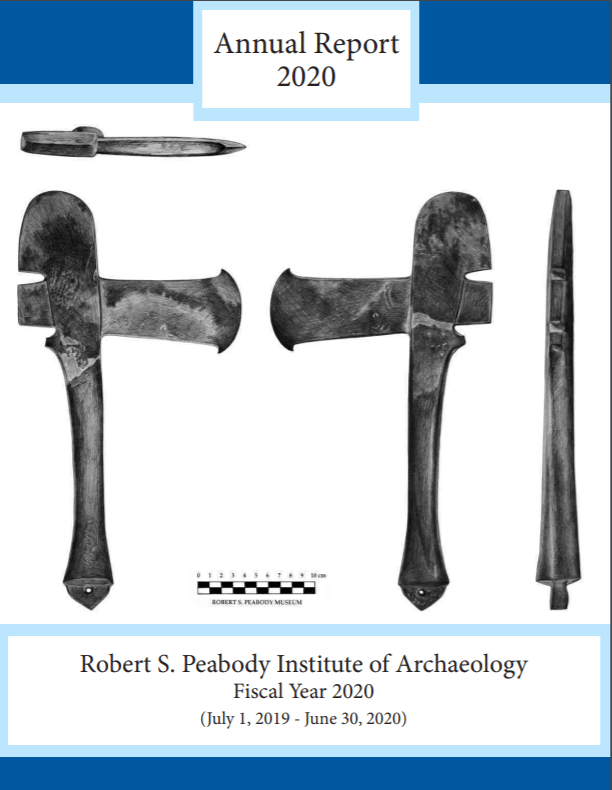
To many institutions, the annual report is one of the most important pieces of information. A single document, yet a powerful tool in communicating an institution’s performance during each fiscal year. Each fall the Peabody presents their annual report to the public, highlighting their achievements, overall performance of the past year, as well as their goals and objectives for the coming year. Not only does the annual report provide a snap shot of what a year at the Peabody looks like, it provides transparency of the institution to the public and its local community.
The making of the Peabody annual report includes several staff members who collaborate in the documentation, writing, and gathering of the material across several departments within the Peabody. These include: Administration (Ryan, Director), Education and Outreach (Lindsay, Curator of Education and Outreach and Ryan, Director), Collections (Marla, Curator of Collections), and Peabody Donors and Support (Beth, PA Director for Museums and Educational Outreach). Once the information is gathered and content is written, I take over to design the overall layout of the annual report.
A page from the 2020 Peabody Annual Report
Using the Adobe InDesign software, I create each page spread using the information that staff give me. When designing, it is important to always keep in mind the overall flow of information and that the format/design features are cohesive throughout the document. Something new I incorporated into the report this year were black and white photographs from the Peabody archives. I used these photographs as transitions between specific sections of the report to provide a natural break, while still maintaining the overall flow of the report. I also had a little fun creating a new page dedicated to our collections remote work during Covid-19.
Photograph from the Peabody archives used in the 2020 Peabody Annual Report
I really enjoy designing the annual report and watching all the work Peabody staff put into the year unfold with the design of each page. Not only does it provide an opportunity for each department to feature their success and performance, its where all the Peabody’s work finally comes together.
You can view the 2020 Peabody Annual Report here. Enjoy!