The collections team remains busy at the Peabody during the summer time, following an already packed school year. Instead of working with PA students, we spend much of our time working to catalog the collections and hosting outside researchers.
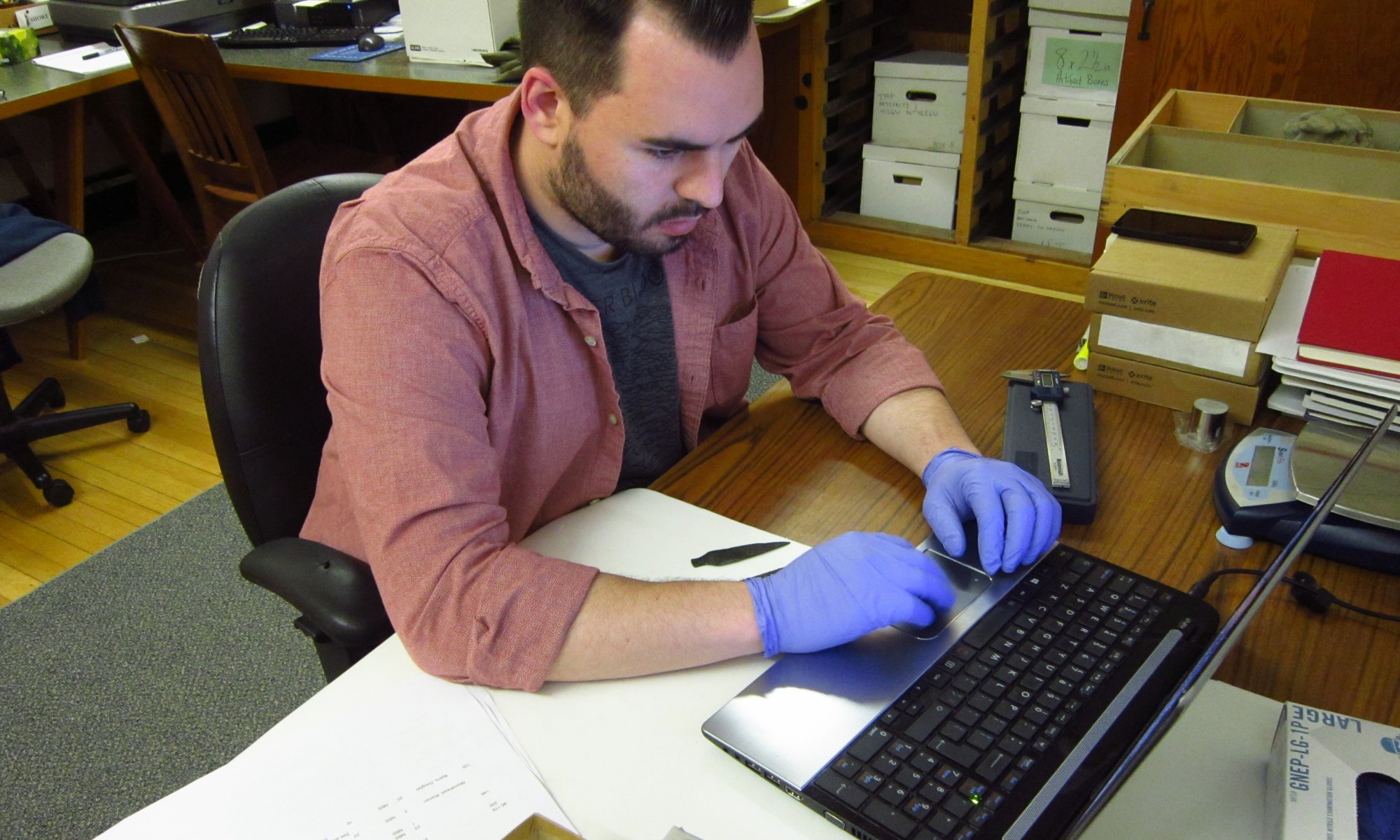
The summer has started off strong with one of the Linda S. Cordell Memorial Research Award recipients , John Andrew Campbell. John is documenting artifacts from the period of first contact between Native Americans and European settlers along the maritime region of eastern Canada and northern New England. ”What does that mean?,“ you may ask.
Basically, John is identifying copper, glass beads, and glazed ceramic artifacts that were found intermingled with traditional native tools and artifacts. The first appearance of these ”foreign” materials indicates that contact between the cultures had been made. Their use and modification by tribes is the direct result of trade with the European settlers and can be revealing of those early interactions.
The Peabody is John’s first stop for collections research as he begins to build data for his dissertation work at Memorial University in Newfoundland. He will be visiting for most of June and documenting hundreds of items.
The rest of the summer is chock full of research appointments and we are happy to share our collections to contribute to the field of archaeology!
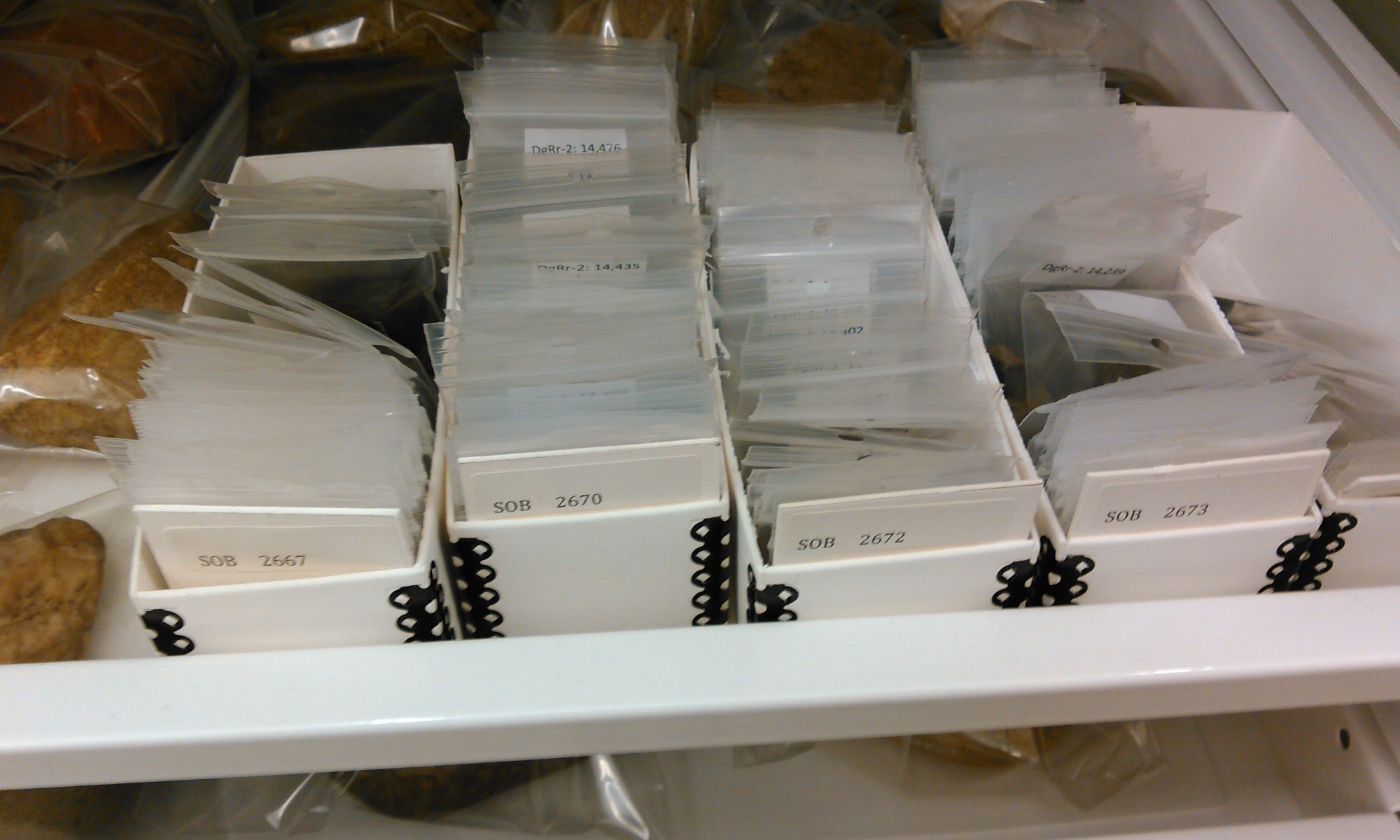
Drawers pulled for research
Researcher John Andrew Campbell recording details about objects in the Peabody collection
On Monday May 22nd students and teachers from Brookwood School came to the Peabody Museum to kick off their “Steep Week.” During Steep Week, students immerse themselves in an intensive program related to an area of interest, in this case archaeology.
When the students arrived they were very proud to announce that archaeologists “DON’T DIG DINOSAURS!” Clearly their two teachers (one of whom is a trained archaeologist) had worked VERY hard to prep them for their visit to the Peabody, as well as for the rest of the week’s activities.
The students began by learning how to “read” modern trash to make a biography about an individual based solely on the objects that the person had thrown away. The clean trash that the students looked through was mine that I had split into three different bags related to different activities that I do: kayaking and running, cooking, quilting and reading. The group that had the container with an old Doritos bag declared that their person (me!) was a guy who was either “failing at adulting” or “had student loans” – very interesting assumptions they were making!!! They were then shocked to learn that the person who had the Doritos was also the same person who had run a half marathon and made quilts. This allowed us to have a great conversation about assumptions that we make and how that can impact our understanding and interpretation of the past.
The next two activities were mock excavations of a prehistoric site as well as a historic one. Both helped the students prepare for the real archaeological dig that they were going to conduct on their school property later in the week, particularly the historic example, since they had already been looking at old maps of the school’s property to see what they could learn about it before putting a shovel into the ground.
Students looking at a mock excvation unit that has evidence of pottery making
Students working in the “lab” to identify artifacts found from the mock Katherine Nanny Naylor site
The rain mostly held off for the group and we were able to conclude the day with a fierce atlatl competition!
A little rain could not sop us from our atlatl competition.
“Our introduction to Archaeology at the Peabody Museum at Phillips Academy, Andover successfully prepared our students to investigate archaeological problems at a high level by concentrating on the conceptual basis of archaeological thought and filtering it through readily understandable, local examples. Our students enjoyed themselves while having their minds opened to a different way of investigatory thought that they relied on heavily to ask questions and achieve understanding.” – Mike Wise, Brookwood teacher
Did you know that the Peabody curates ancient poop?
Coprolites are the fossilized remnants of excrement – animal or human. While it may sound gross, curating these materials is invaluable for the archaeological community. You may be asking yourself ‘what could you possibly learn from poop?!’ and while I understand your incredulity, allow me to share the incredibly fascinating information that you can learn.
A coprolite from an unknown site in Arizona.
Coprolites are the snapshot of one day of one individual’s life thousands of years ago. They can reveal what that person ate – whether or not that food was cooked first, was that food local to the area or the product of trade, what time of year that food would be available. Is there evidence of disease or illness? Did different individuals from the same site have radically different diets? If so, what does that say about social status? Coprolites are also viable sources of ancient DNA!
The Peabody curates only a couple dozen coprolites in the collection. And we are always thrilled when researchers come to get the scoop on the poop!
When you think of the binary search algorithm you immediately think an archaeology museum is the perfect place for students to get a hands on example. Right?
Well it certainly was not what students in Nick Zufelt’s Computer Science 500 class expected when they showed up at the museum. To many of the students who had been to the Peabody with their history or science class to look at objects, it was a bit perplexing how they could be combining archaeology with computer science.
What many do not know is that the Peabody has many other resources that PA faculty can tap into. Mr. Zufelt discovered something that Peabody Museum still had that no other place on campus (not even the OWHL!) still had: our card catalog.
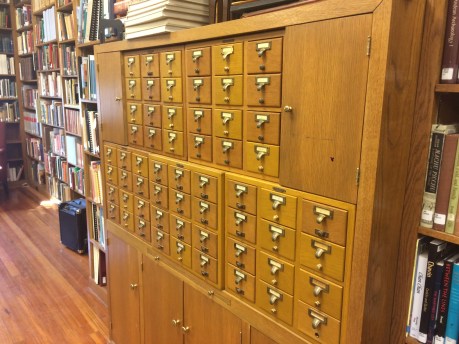
The card catalog at the Peabody Museum
When Nick first came up with the idea to use our card catalog in an interactive lab activity for his students, we were ecstatic. We love when Peabody resources are utilized for learning in such out of the box ways. The card catalog was a perfect hands on example for students to understand the binary search algorithm.
To those who are not familiar with this concept (and I was certainly one of them!) Nick began the class with this simple introduction:
When you look up a word in the dictionary, do you start at page 1, look for the word, then move onto page 2, etc.? No, of course not. You have a more sophisticated way of searching through the massive list of words. This activity hones in on the algorithm underlying this process: the binary search algorithm. The basic idea is: chop in half, go to the half that will have your item in it; repeat.
Nick Zufelt, computer science faculty, explaining the project to the students
Each student was then given a page listing 23 different cards from our card catalog system and told to pick one of them. Then they had to find the card and write down the process of how they found it, but in a manner that a computer could follow.
At this point, you might be saying to yourself, “wow that seems like a pretty easy project….” WRONG!
While this activity may strike us as simple, it actually turned into a battle of the wills for many students as they struggled throughout the period to create a very simple process that was also accurate. And when some students had a friend try their process, they often found that what they had devised was incorrect (Arrrgggg!!! The FRUSTRATION!!!!)
This type of learning helps to make abstract concepts more accessible for students as they begin learning something that forces them to think in a completely new and different manner.
Mr. Zufelt has already talked about bringing future students back for the activity and we look forward to working with him and his students on this and other computer science adventures at the Peabody!
NOTE: Despite still having a card catalog, the Peabody library is completely cataloged in the system used by the Oliver Wendell Holmes Library. Our librarian Mary Beth Clack is currently updating records to make monographic series more accessible.
Most of the Peabody staff recently traveled to Vancouver, British Columbia to take part in the 82nd annual meeting of the Society for American Archaeology (SAA). While at the conference, we each had our own role. In addition to helping to staff the Peabody table in the exhibitor hall, collections assistant Samantha Hixson and I had the privilege of a collections tour at the Museum of Anthropology (MOA) and the Laboratory of Archaeology (LOA) at the University of British Columbia.
The MOA is a unique institution that houses ethnographic objects from around the world, with an emphasis on material from the Pacific Northwest. The vast majority of these pieces are on display in open storage. That means the galleries are essentially storage spaces with thousands of objects presented to the visitor with little interpretative text.
Basketry display at the MOA
Totem poles at the MOA
Display of a fish mask at the MOA
Collections storage at the MOA is impressive and elaborate. Each object has its own individually crafted mount and locations are tracked with barcodes. The Laboratory of Archaeology on the other hand has very little to no exhibition space. They carefully photograph every object for inclusion in their online catalog and individually bag and label each artifact. Their storage is no less impressive as artifacts are arrayed on compacting storage shelves with room for growth. This is the type of collections storage that I aspire to – but we have a long way to go!
Example of individual object storage at the MOA
Example of individual object storage at the LOA
Collections storage at the MOA
Touring the storage spaces at these institutions was incredibly helpful as Samantha and I brainstorm to reimagine collections storage at the Peabody. We are very grateful for the time spent and information shared with us – well worth the trip!
Last week, the Peabody had the pleasure of hosting Dr. Paulette Steeves as she examined portions of the MacNeish collection. Dr. Steeves is currently a Lecturer of Indigenous archaeology and anthropology and the Interim Director of the certificate program in Native American Studies at UMass Amherst. Her research focuses on the peopling of the Western hemisphere, but not through the traditional Bering Strait theory.
Dr. Steeves uses indigenous theory and methodology to explore sites in the Americas that date back as far as 60,000 years ago. This is actually a big deal and an anti-establishment approach to the subject. Dr. Steeves is looking into the materials collected by Scotty MacNeish during his work in the 1960s in Peru and Mexico for additional evidence. MacNeish was also a proponent of the idea of early colonization and much of his collection has remained unanalyzed for decades.
Dr. Steeves was thrilled to see the collection and to meet MacNeish himself on her visit. We look forward to hosting her again for many research visits to come!
The bulk of the Peabody’s collection is stored in the basement. It has been challenging over the years to control the temperature and humidity in the basement – an essential factor in maintaining an artifact collection. A small fluctuation of both temperature and humidity is normal and expected as seasons change. However, extreme variation lead to damage – bone can become fragile, ceramics can develop weak-points, and even stone tools can become brittle.
For the past four years, I have been tracking the environment throughout Peabody and noticed these strong fluctuations. By taking readings of the temperature and humidity in all our storage spaces once an hour (through the use of a datalogger), I determined that the influx of outdoor air through these poorly sealed windows is large contributing factor. There is only one way to fix this.
In collaboration with the Office of Physical Plant on campus, we are implementing a plan to mitigate some of this fluctuation. Contractors are working to seal the windows in the basement to stop outside air from sneaking into the storage.
This will stabilize the environment and lead to fewer changes in both temperature and humidity. The first step on the road to environmental control!
Thanks to Catherine Hunter, Peabody Museum research associate, our full basketry collection of 329 is inventoried and described. In September, Catherine turned over 7 binders of material including research into known artists, glossaries, information on weaving techniques, and a basic description of each basket. This massive project took Catherine nearly a year!
The next phase is to photograph each of these gorgeous baskets and improve their storage and accessibility. Last week, Marla Taylor, Samantha Hixson, and Catherine took a trip to the Peabody Museum of Archaeology and Ethnology at Harvard University to examine their basketry storage. The visit was full of inspiration and incredibly helpful as we continue to work on this project.
Keep your eyes peeled for the inclusion of these amazing baskets in our online collection database!
Catherine Hunter with some of the Peabody’s baskets
Catherine Hunter, Samantha Hixson, and Marla Taylor visit the Harvard Peabody basketry collection.
My name is Samantha Hixson and I am the new collections assistant here at the Peabody. I come to you from New Mexico where the weather is warm and has left me completely unprepared for New England winters (although Marla and Lindsay promise that they’ll get me through it).
I have previously worked at the Museum of Indian Arts and Culture in Santa Fe, New Mexico as well as the Smithsonian Institution’s National Museum of the American Indian in Washington, DC. It’s these places that got me excited to work within museums, focusing specifically on Native American collections. So you can imagine how excited I was when I was hired to work at the Peabody, it’s the perfect job for me! I’ve also had some other very interesting archaeological/ethnographic experiences, but those are for other posts.
I’ve started getting my feet wet in a couple projects already (with the promise of a lot more to come) and am most excited about the re-housing of the collection as well the Adopt A Drawer program. I think it’s great that these collections are getting new homes and more personal interactions, however brief.
If you’re in the neighborhood of the museum, come stop by; I’d love to meet you!
The new Peabody Collections Assistant, Samantha Hixson
Students enrolled in Human Origins (SCIE 470) this fall will come face to face with our distant human ancestors as well as contemporary issues like race and scientific racism that are part and parcel of paleoanthropology’s legacy. Between reading and discussion on a variety of topics, ranging from the so-called “Hobbit” fossil—Homofloresiensis to the debate over multiregionalism, students will do some experimental archaeology, including flint knapping, fire making, and throwing a dart with an atlatl. We also will be visiting “The Nest”—the makerspace at the Oliver Wendell Holmes Library, where we will be 3D printing casts of the newest fossil discovery from South Africa—Homo naledi and comparing them to traditional plaster casts and resin models of other fossil hominins. Other hands-on projects will include looking for clues to human evolution in the bones of a modern human, bone flute making, and creating our own Mesolithic symbol system, akin to the painted pebbles found in Mas d’Azil cave in the French Pyrenees. Throughout the course students will explore some of the most recent discoveries and newest ideas about human evolution and the scientific discourse and debate that ensue. Students will be challenged to develop their critical thinking skills as we evaluate these new discoveries in light of broader discourse on race and the scientific method.
Biology instructor Jerry Hagler looks on as students in Human Origins make bone flutes using bow drills, spring 2016.
Human Origins is an interdisciplinary science course developed collaboratively by biology instructor Jerry Hagler and personnel at the Peabody Museum and was first taught in 2007. Since then it has been offered most years as a senior elective. The pace of new discoveries—like Svante Pääbo’s work on the introgression of Neanderthal DNA into the modern human genome in 2011—means that the curriculum is constantly shifting, making for an exciting and lively class. Dr. Hagler is on sabbatical this year so Dr. Wheeler–Peabody Museum director–is leading the course.