PA Employee Spotlight – Peabody’s Own, Marla Taylor!

Contributed by Emma Lavoie

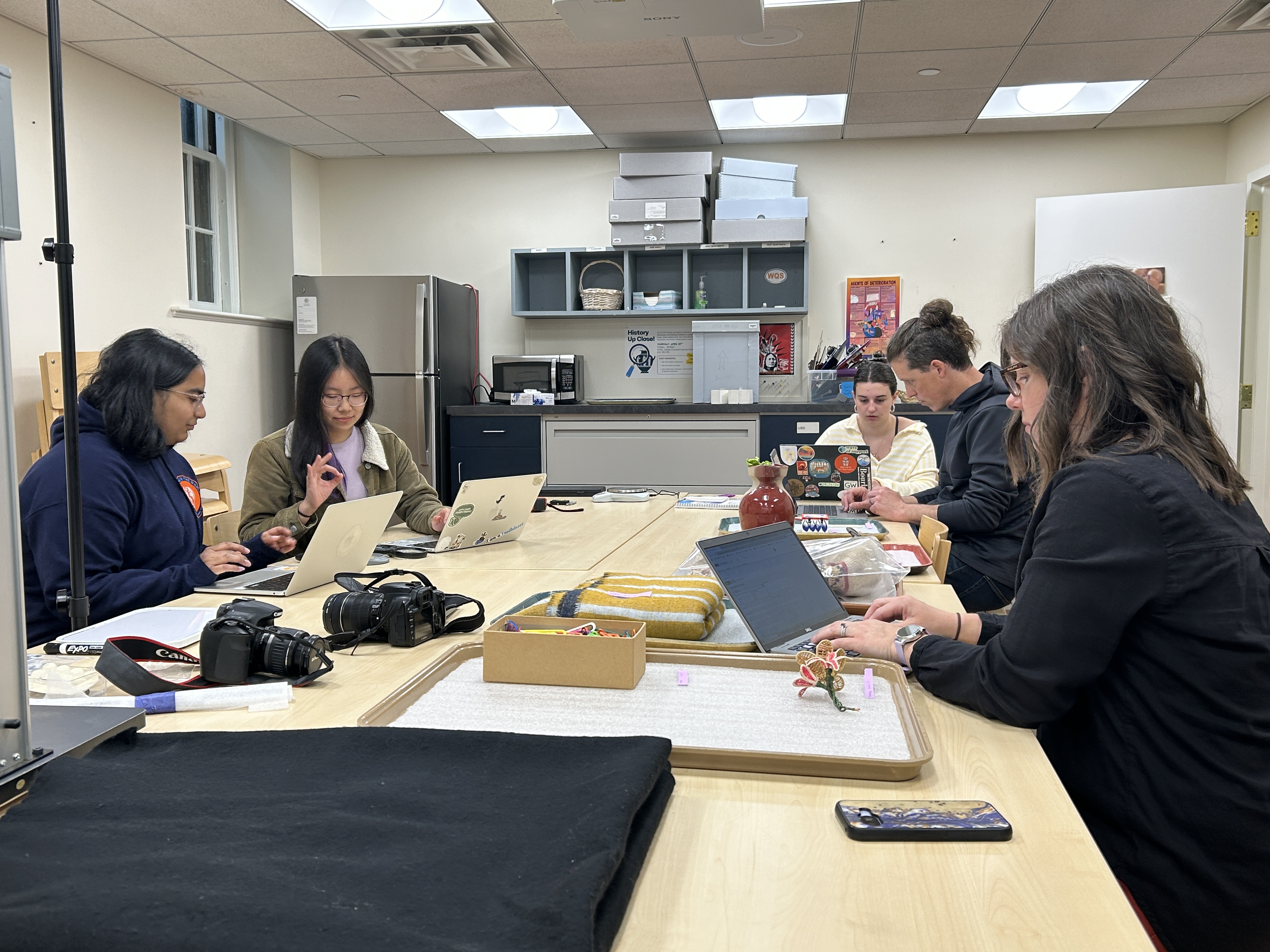
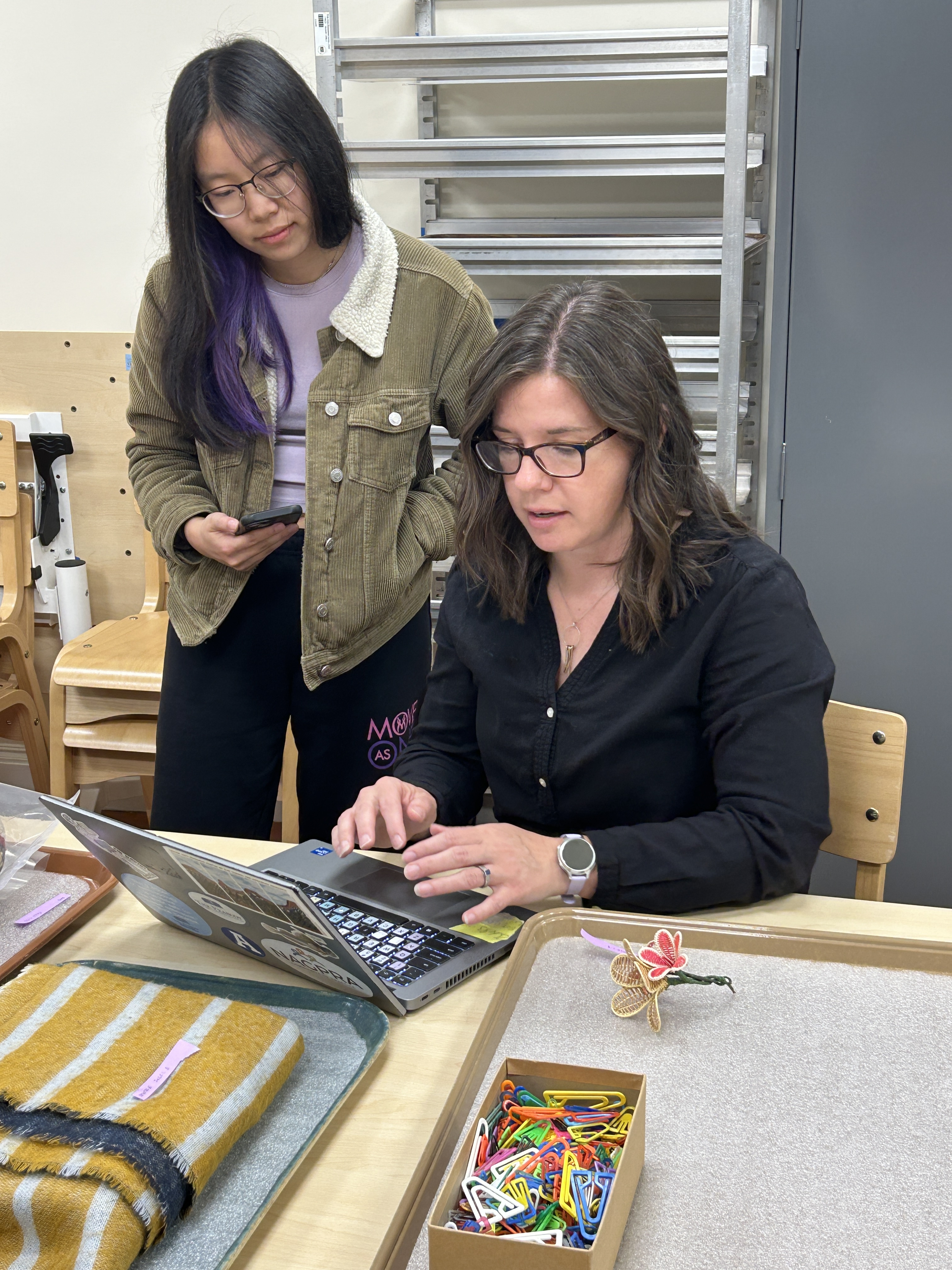
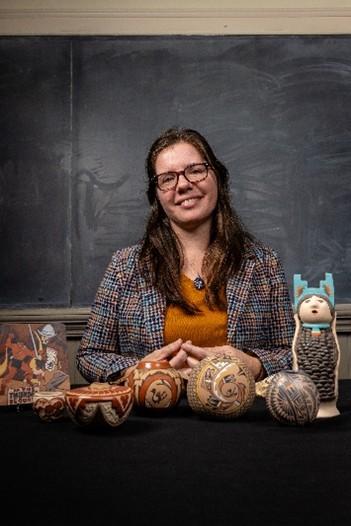
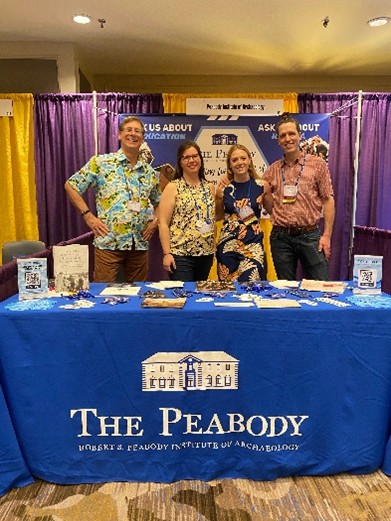
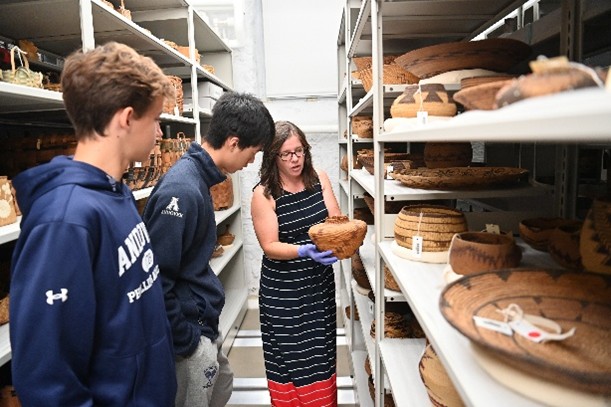
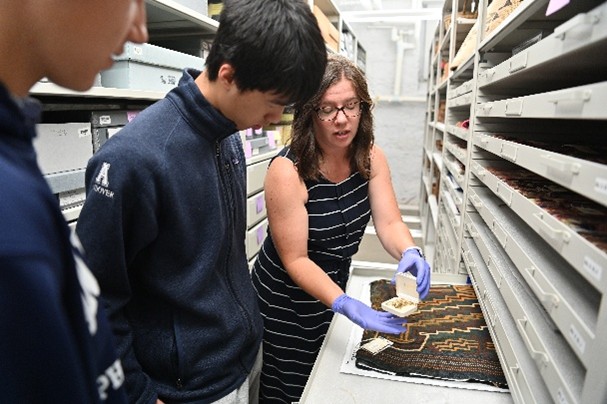
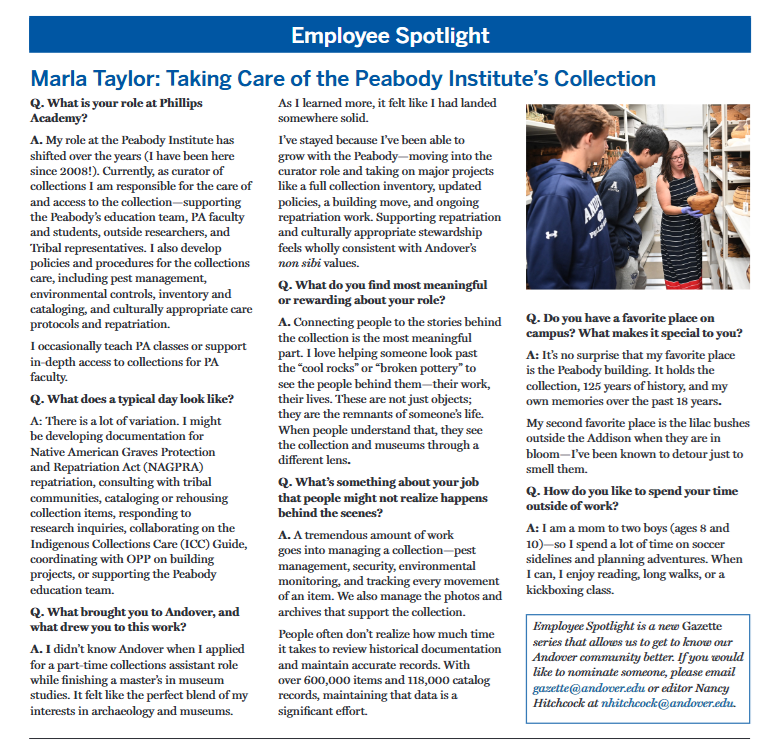
This month our Peabody Curator of Collections, Marla Taylor, was featured in Phillips Academy’s “Employee Spotlight” section of the campus community Gazette – a weekly internal newsletter for Phillips Academy faculty and staff.

Each week, a member of the PA campus community is nominated and selected to share details about their role and work. We are excited to see one of our Peabody staff members highlighted and are grateful for all the support Marla has contributed in the 18+ years she has been with the Peabody and Phillips Academy.

Check out the article below and congratulations to Marla for being featured!

PA Giving Day 2026 – Thank you!

Contributed by Emma Lavoie

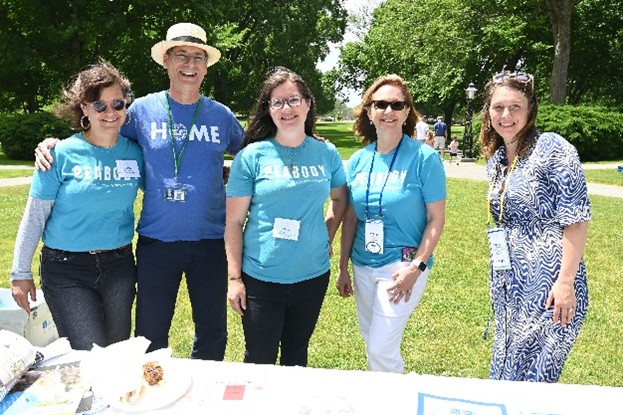
We had a successful PA Giving Day last week! Special thanks to all those who participated in supporting the Peabody and contributing to our match challenge, generously shared by a pair of Peabody donors.

PA Giving Day represents a critical milestone in our fundraising efforts for the Peabody. Last year we raised 77% of the Peabody’s total annual support from 65 donors in just one day, achieving our match goal in the process and engaging new PA alumni and friends of the Peabody during PA’s collective day of giving.

This year our goal was to exceed last year’s success by leveraging this collective day of giving to achieve even more in honor of our year of critical Peabody milestones and to celebrate the Peabody’s 125th anniversary.

The final dollar figures and donor counts for the Peabody are not in yet, but the overall day raised over $1.6 million from more than 1,850 donors towards Andover academics, financial aid, the arts, athletics, and outreach programs.

Creating an Indigenous Collections Care (ICC) Guide

Contributed by Marla Taylor

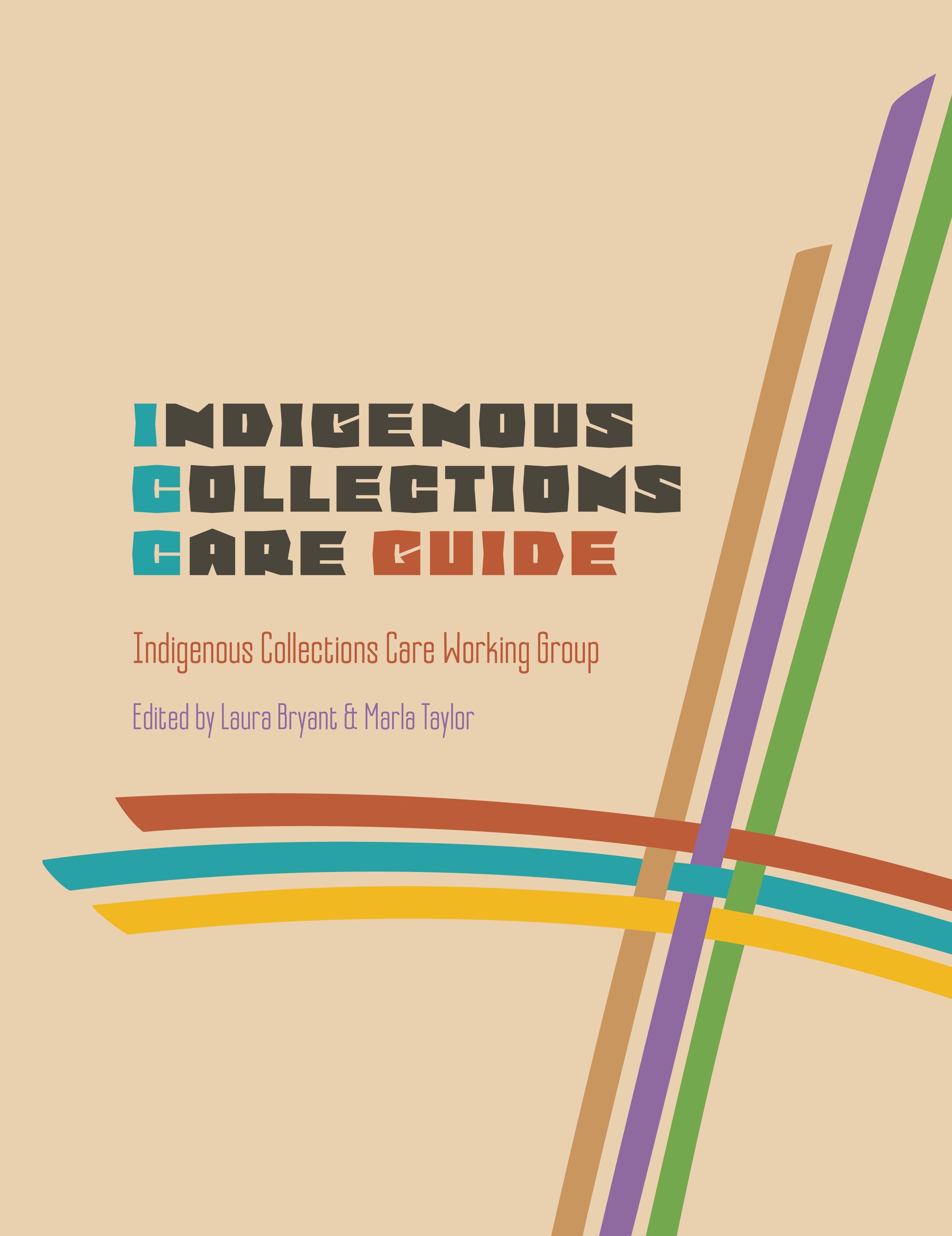
For the past 5 years I have been co-facilitating the development of the Indigenous Collections Care (ICC) Guide.  The ICC Guide is now nearly complete and I wanted to share some updates.
The inspiration for the ICC Guide grew out of email exchanges I had with ICC co-facilitator Laura Byrant (Director of Repatriation for the Gilcrease Museum) about how to best to steward collections that were awaiting physical repatriation.  We realized there was often a tension between museum practices and tribal priorities for cultural collections.  Conversations with colleagues revealed that there was little or no established guidance on how to incorporate Indigenous cultural care needs into collections stewardship practices.  We created a working group to discuss the issue and the seeds of the ICC Guide were sewn.

With an IMLS National Leadership Grant for Museums in 2023 and a strategic partnership with the School for Advanced Research (SAR) in Santa Fe, NM, the ICC Guide was collaboratively written and covers every aspect of collections stewardship.  It provides frameworks to recenter collections stewardship practices in ways that respect the needs and knowledge of Indigenous community members. It serves as a bridge between Indigenous community perspectives and traditional museum collections management—on the individual, community, and institutional level—helping those involved in all aspects of collections to engage in a meaningful conversation about culturally appropriate care. 

The approach outlined in the ICC Guide is grounded in meaningful consultation with communities whose cultural materials can be found in institutional collections.  In fact, the guide has been reviewed by approximately 120 individuals, including over 70 Tribal representatives.

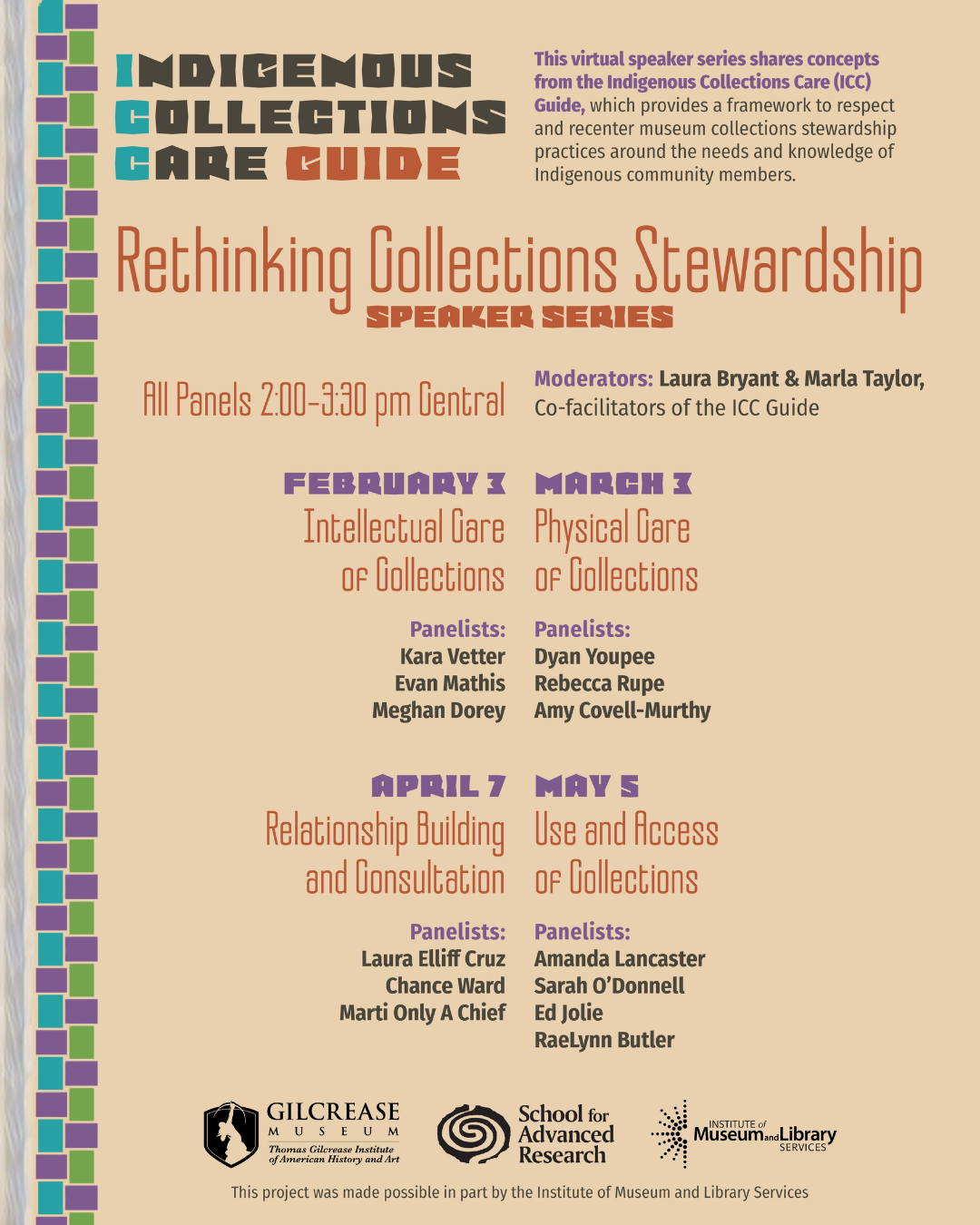
My co-facilitator and I regularly speak about the development and content of the ICC Guide – at conferences, to classes, and as part of a speaker series we developed.  The Rethinking Collections Stewardship Speaker Series is hosted by the Gilcrease Museum in collaboration with SAR.  We planned for four panels that center on the key content areas within the guide – Intellectual Care of collections, Physical Care of collections, Relationship Building and Consultation, Use and Access of collections.

So far, registration and attendance at these webinars has been fantastic.  The panelists have done a tremendous job of sharing their expertise and engaging the audience.  We are so grateful for their time and efforts.

Of course, the culmination of all of this will be when the ICC Guide is ready to be shared with the museum field and the public.  When will that be?  We are in the final editing stages and soliciting one more round of feedback.   We don’t have a date set quite yet but I can say that it will be in the Fall of 2026You can sign-up on our website to be notified when the ICC Guide is available.

Please email me (mtaylor@andover.edu) with any questions you may have.  I am so excited to share this work with the broader museum/repatriation/tribal community!

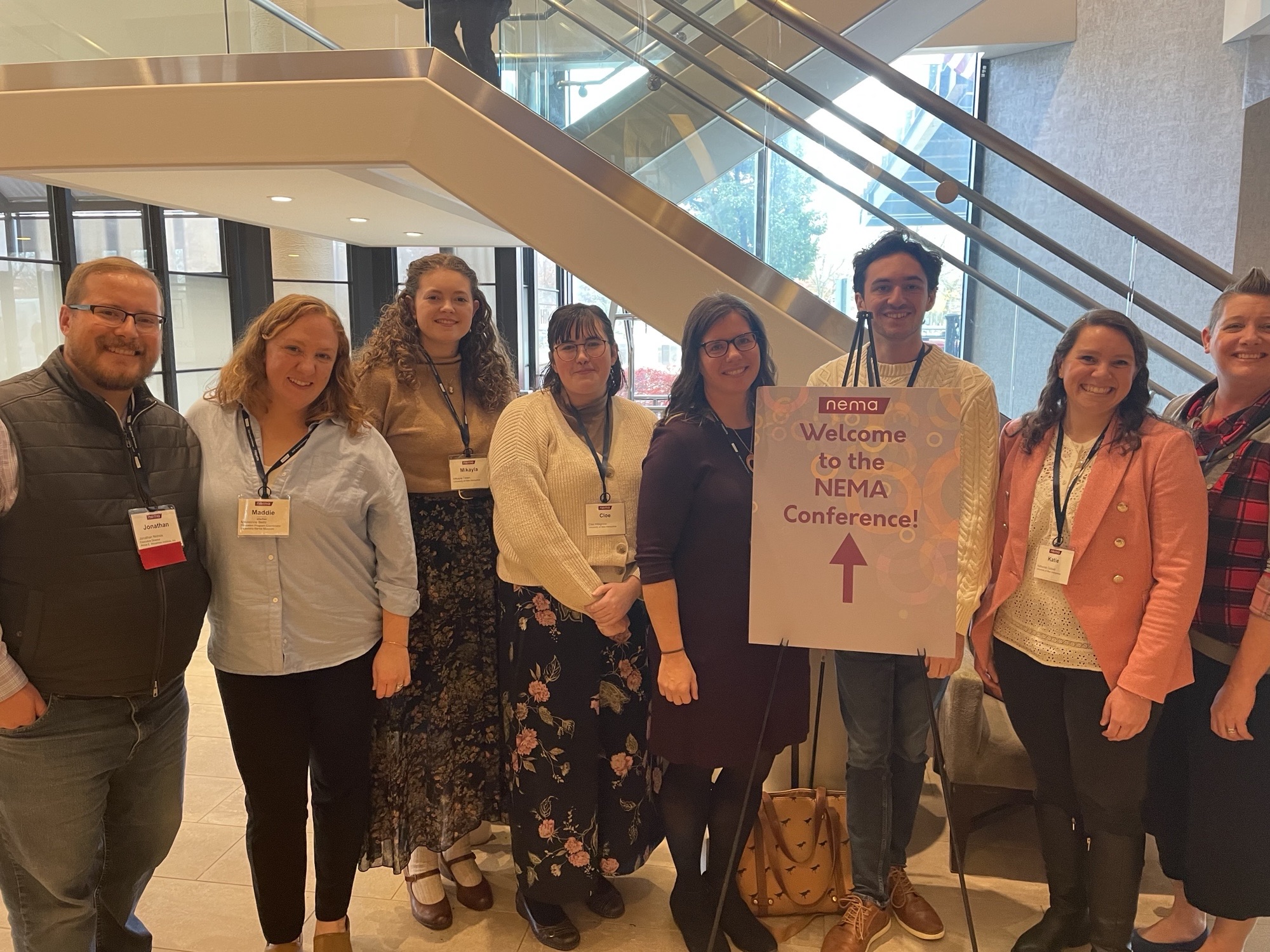
Welcome to the NEMA Conference!

Contributed by Marla Taylor

The New England Museum Association (NEMA) held their annual meeting in November in Manchester, New Hampshire. Billed as a Wellness Check: A Holistic View of Museums in the First Quarter Century, topics ranged from how climate change can affect collections to telling LGBTQ stories to supporting mental health for museum staff. It was illuminating and validating to hear so many colleagues exploring how to make their museums as welcoming, financially sustainable, and diverse as possible.

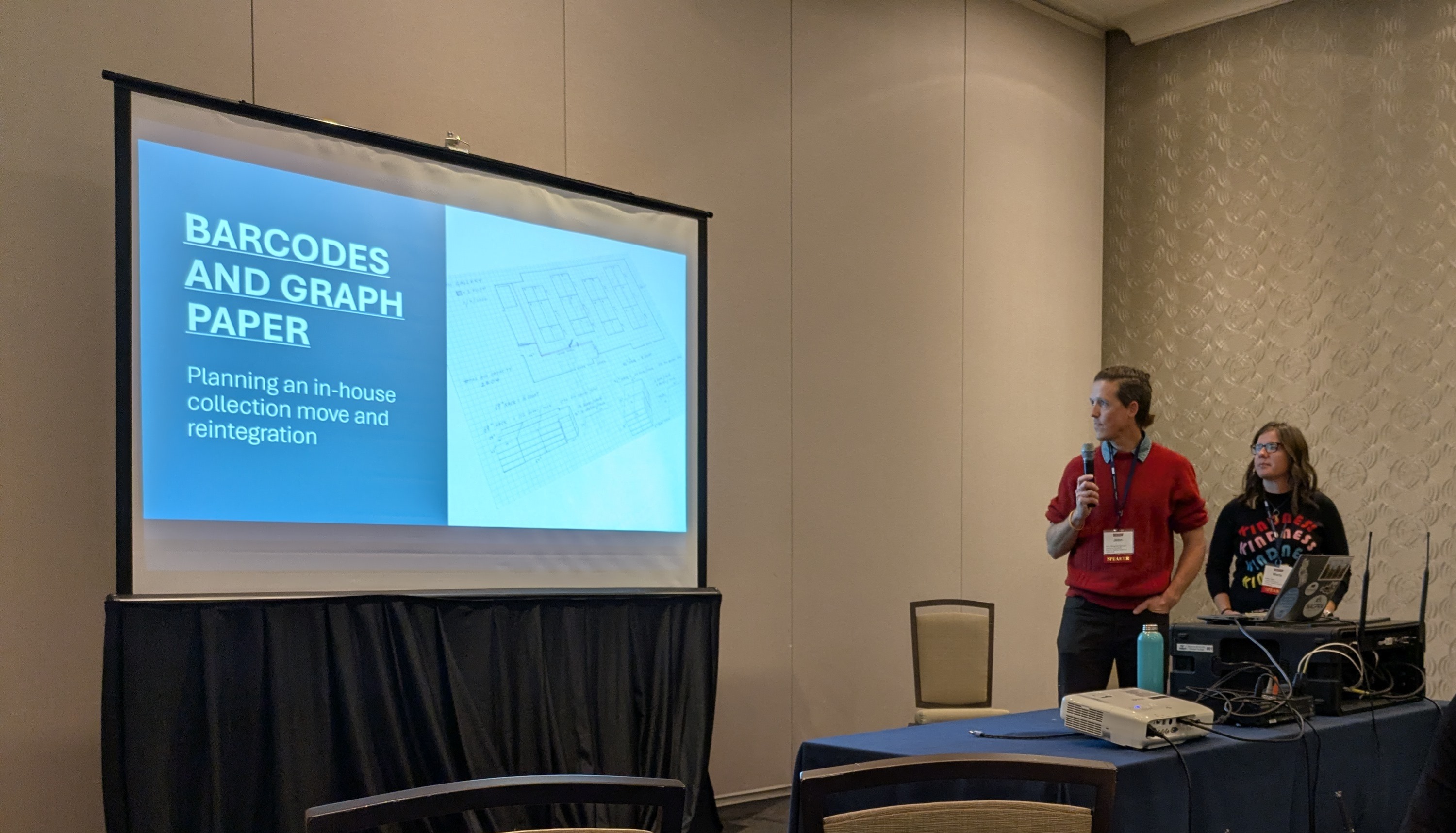
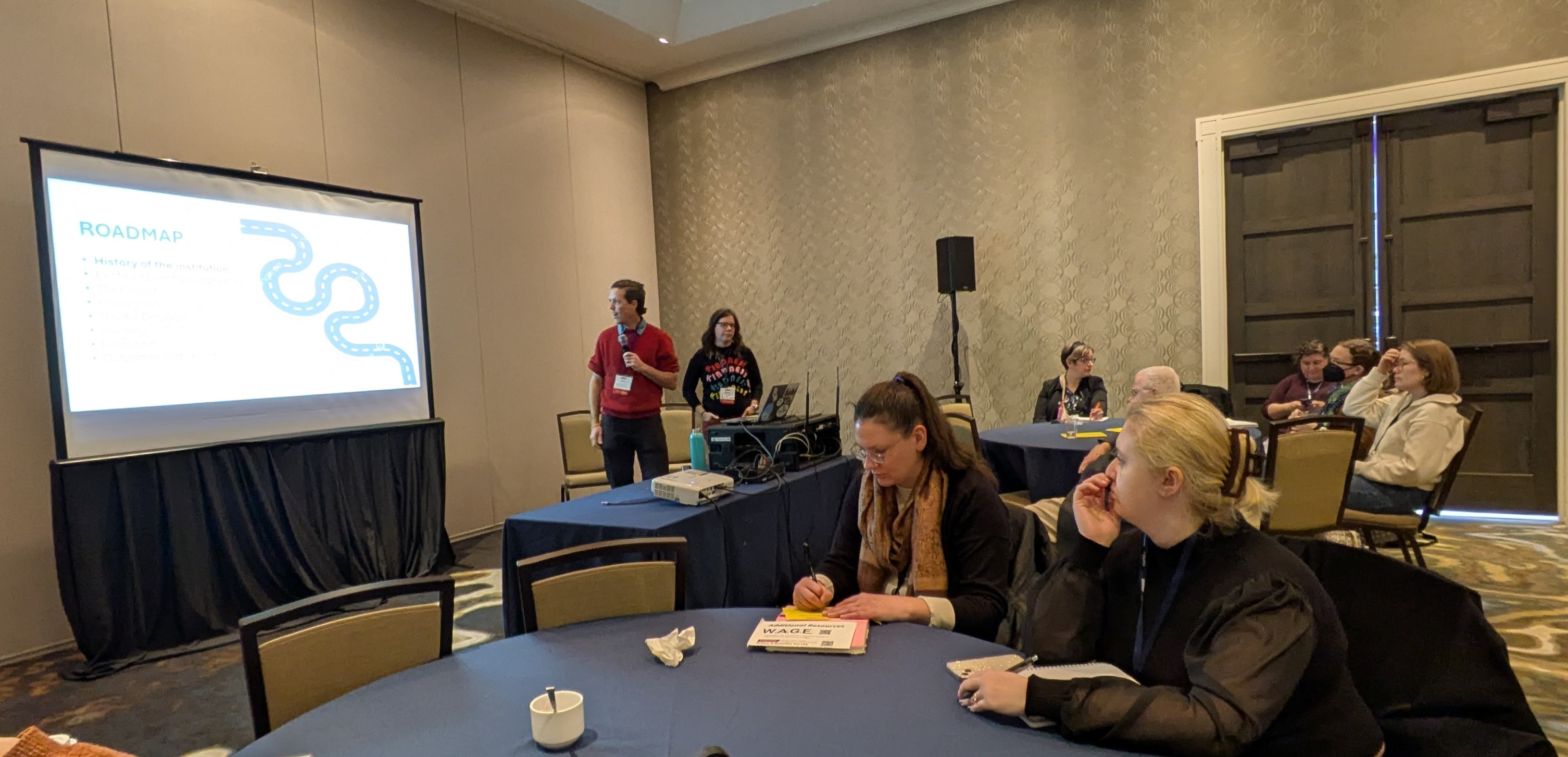
John Bergman-McCool, the Peabody’s Collections Coordinator, and I had the opportunity to share about the collections move that was part of the recent building project. Our session, Barcodes and Graph Paper, was well attended and we hope people were able to take away a nugget of advice or experience that will help them. It was a pleasure to be able to share this information alongside an amazing colleague who was invaluable to the process.

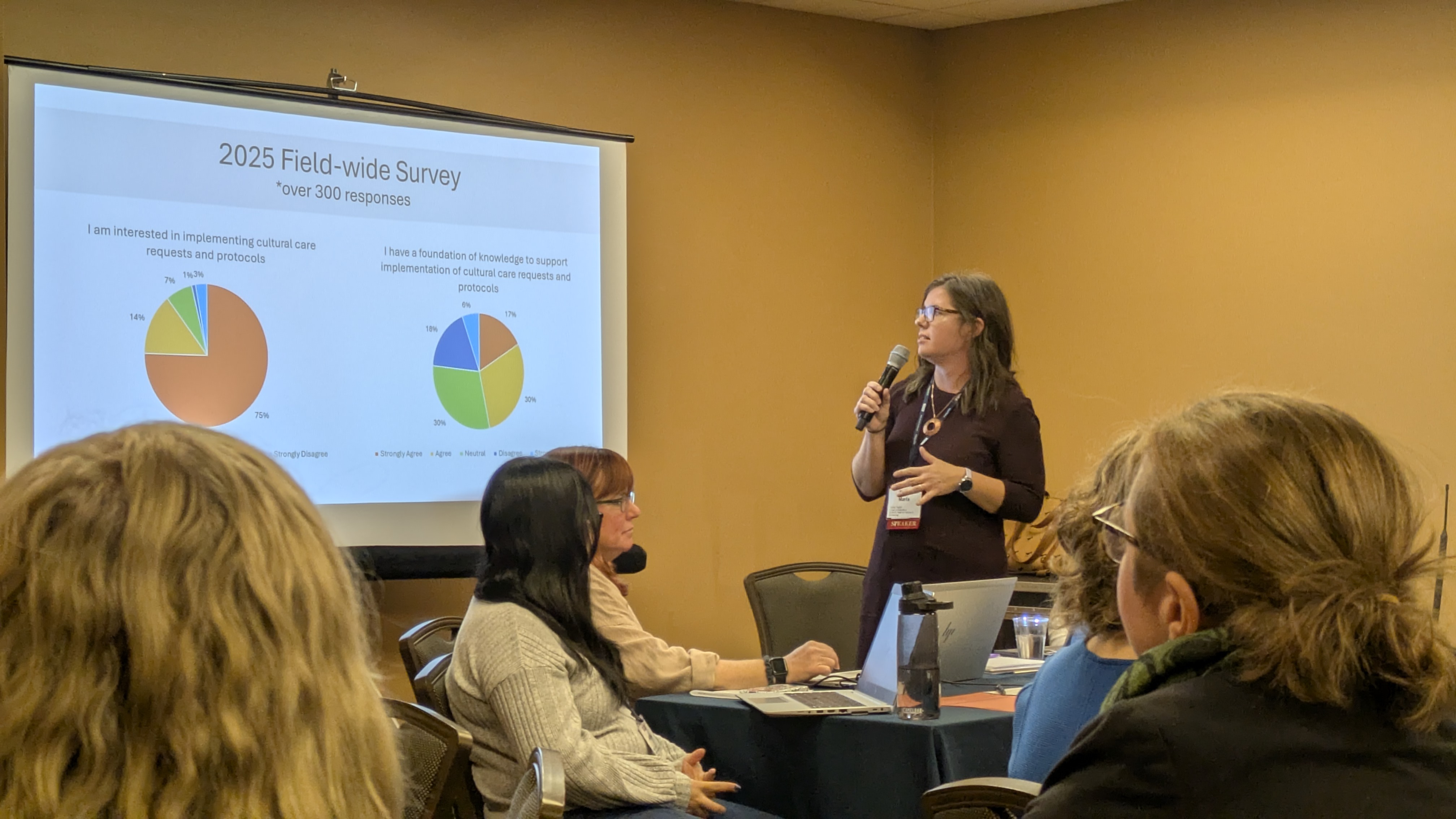
I was also a part of a session that focused on resources for museum professionals who are interested in engaging with best practices for stewarding Indigenous collections. Along with several incredible colleagues, I shared information about the Indigenous Collections Care (ICC) Guide and the Northeast NAGPRA Community of Practice (NECP).

Local Contexts was also a part of our panel. If you are in the museum world and don’t know about Local Contexts and their work – you should. “Local Contexts is a global initiative that supports Indigenous communities with tools that can reassert cultural authority in heritage collections and data. By focusing on Indigenous Cultural and Intellectual Property and Indigenous Data Sovereignty, Local Contexts helps Indigenous communities repatriate knowledge and gain control over how data is collected, managed, displayed, accessed, and used in the future.” (https://localcontexts.org/)

I am proud to be a part of the ICC Guide and NECP. Both of those communities are valuable resources to museum professionals and NAGPRA practitioners.

It was an honor to be a part of both of these sessions!

Building Renovations: The Sequel

Contributed by Marla Taylor

What happens when a project is successful but doesn’t quite resolve the larger storyline or need?  A sequel!

I share with you – Peabody Building Renovations: the Sequel.

The first phase of the work, completed in early 2024, focused on improving collections care.  This included new shelving, an HVAC system, updated security, and an elevator in the building. To facilitate this, the entire collection had to be moved to temporary storage and back again. Phase I was a huge amount of work for all of the Peabody staff and I can confidently say that the collection is now in a better environment than it was before.

This next phase will largely ignore the collections spaces and instead focus on updating classrooms, creating offices, and modernizing systems. By using the space more efficiently, we will create two additional classrooms for use by Peabody educators or PA faculty.  Staff members will have discrete office spaces and there will be room to grow.

One of the biggest improvements will be the addition of an HVAC system to the classrooms and office spaces.  As someone who has worked in these spaces for as long as I have, I would have to say that this is the part that I am looking forward to the most.  Currently, it can be really hot in the summer (over 80 degrees in the classroom) and quite chilly in the winter.  We all have our methods to deal with the discomfort, but I am excited to have air conditioning!

All of this of course comes with some disruption to our regular activities.  Staff will once again be moved to a temporary location and access to the collection will be restricted.

As of December 1st, Peabody collections will be largely unavailable and classroom spaces will be out of commission.  Repatriation work and collections inquiries from Tribal communities will be prioritized but other access will be restricted.  Please contact me, mtaylor@andover.edu, with any questions or requests.

PA classes may be taught in a modified format with limited collections based on availability.  Please contact Lainie Schultz, Curator of Education, to request a class.

The Peabody should be back in commission by September of 2026.  I will be able to share periodic updates on the process through the blog and we are so excited to welcome you into our updated space next year.  Stay tuned!

If you are interested in supporting Phase 2, please contact Jen Pieroni, Director for Advancement Initiatives, Office of Academy Resources.

New Mexico Adventures

Contributed by Marla Taylor

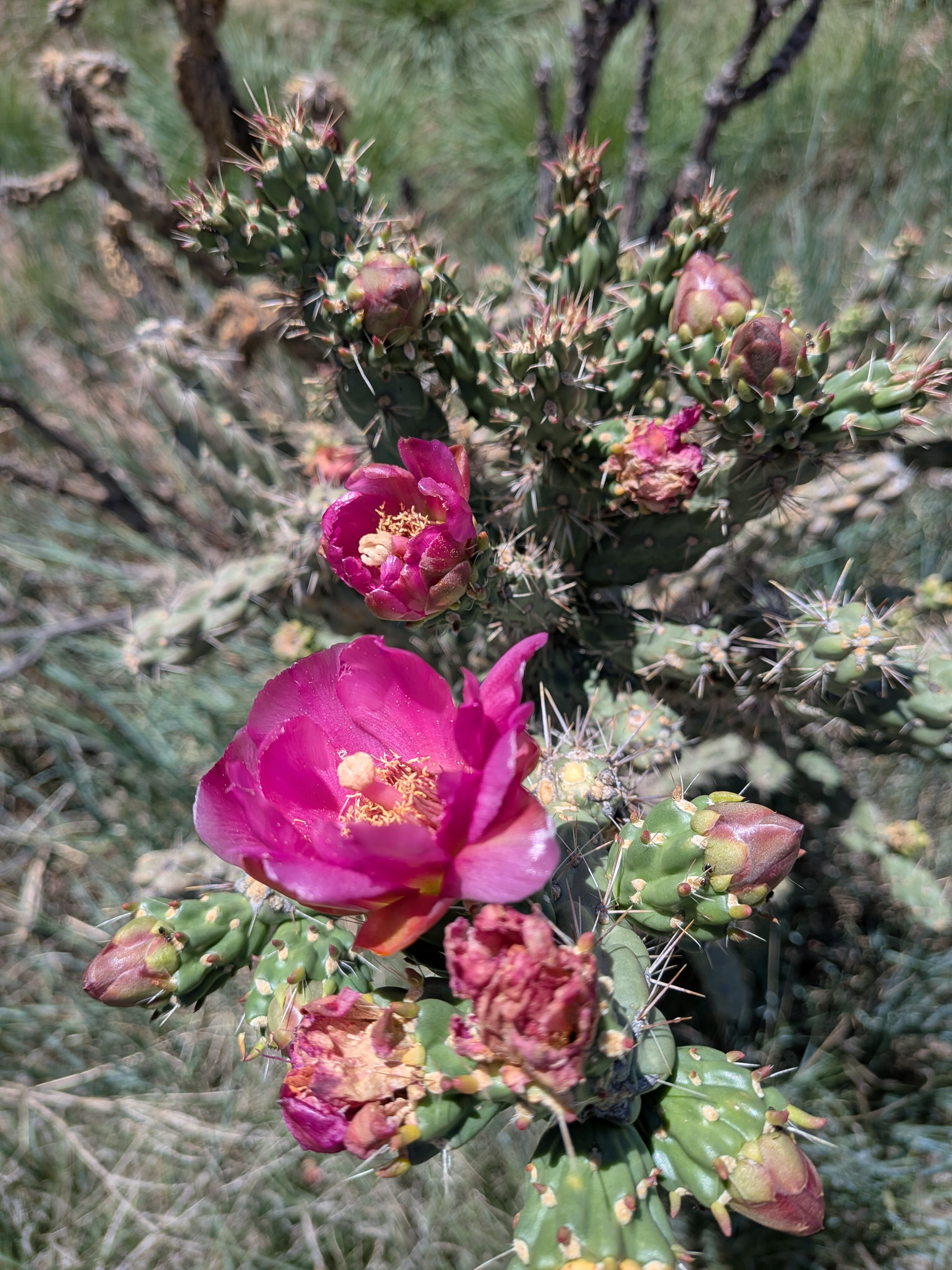
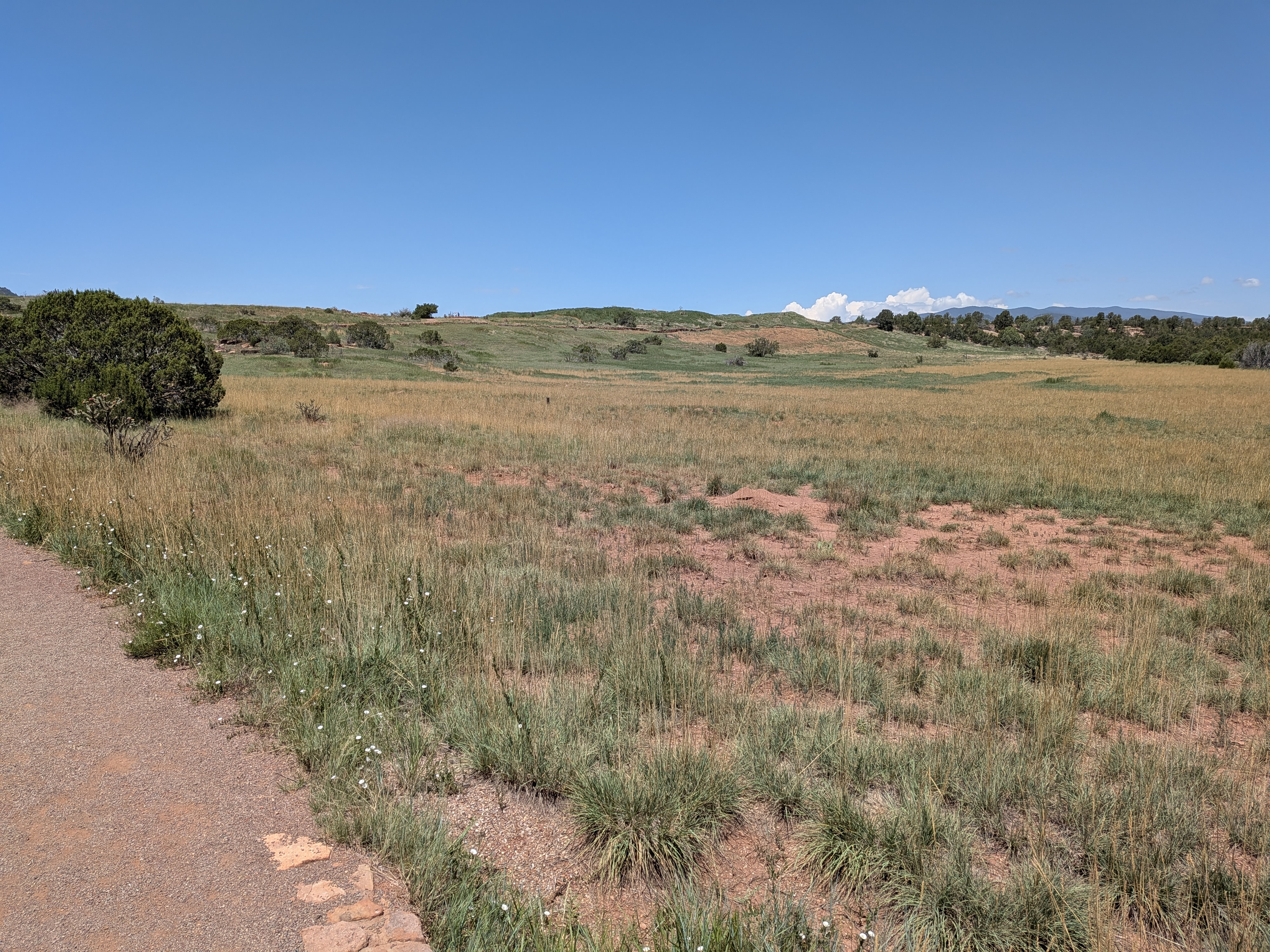
Did you know how beautiful New Mexico is?  I had the opportunity to travel to the Albuquerque and Santa Fe areas this July and can definitely recommend making the trip.

The Peabody Institute actually has a long relationship with New Mexico.  In the 1920s, Alfred Kidder excavated Pecos Pueblo on behalf of Phillips Academy (what is now the Peabody Institute).  The ripple effects of that work included repatriation work with the Pueblo of Jemez, a long-term loan with the Pecos National Historical Park, inter-institutional collaboration, relationships with Jemez artists, and incredible learning opportunities for the students at Phillips Academy. 

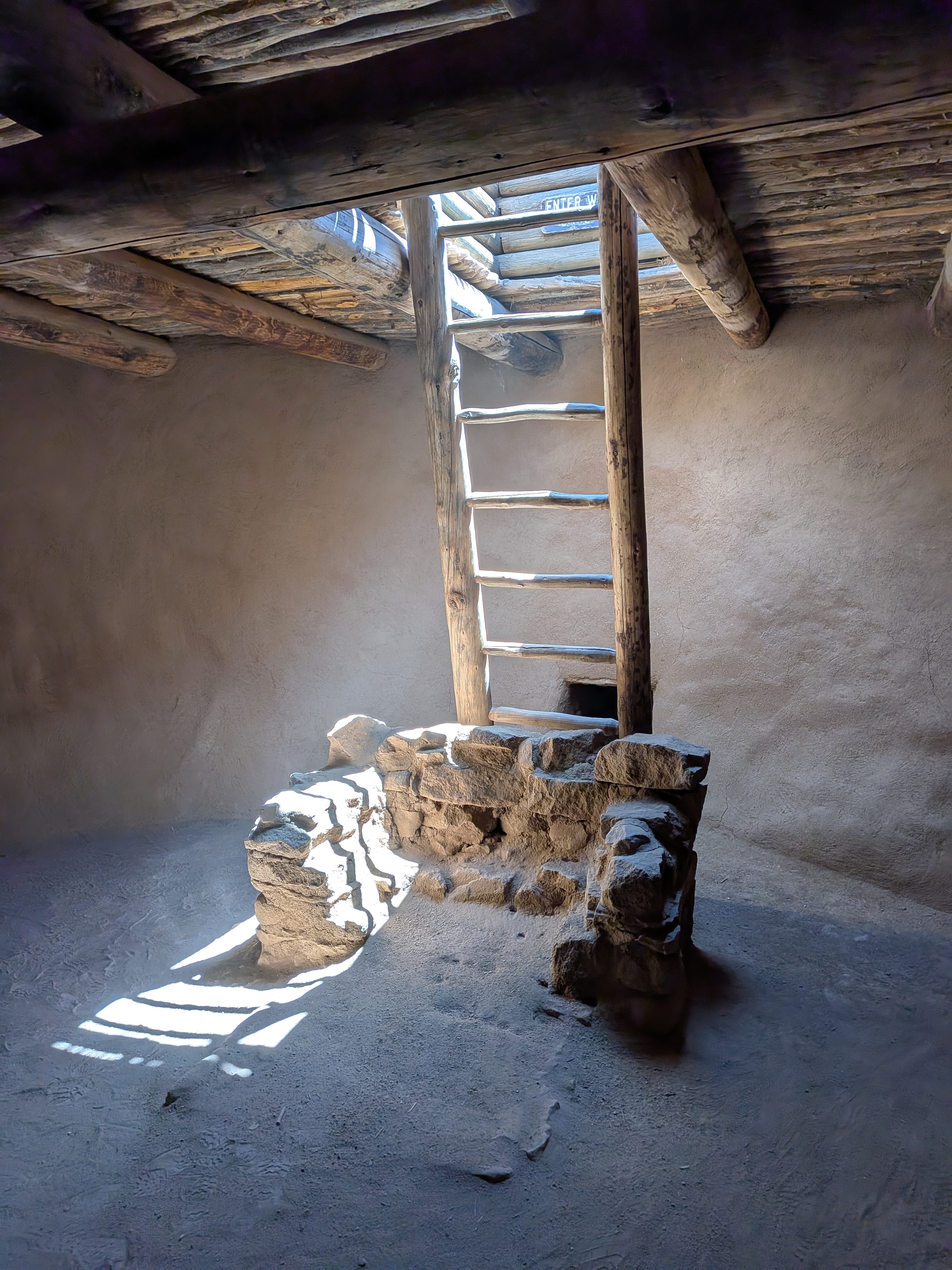
While I had been to the Pueblo of Jemez before this summer, I had not had the opportunity to see the Pecos archaeological site or Pecos National Historical Park before.  It was truly a pleasure to experience the site in-person and get an understanding of how Pecos sits in the landscape.  I was also able to view their wonderful exhibit, spend time with the Museum Curator to view the collections on loan from the Peabody, and meet several dedicated park staff members.  I am grateful for the opportunity to spend that time with them all.

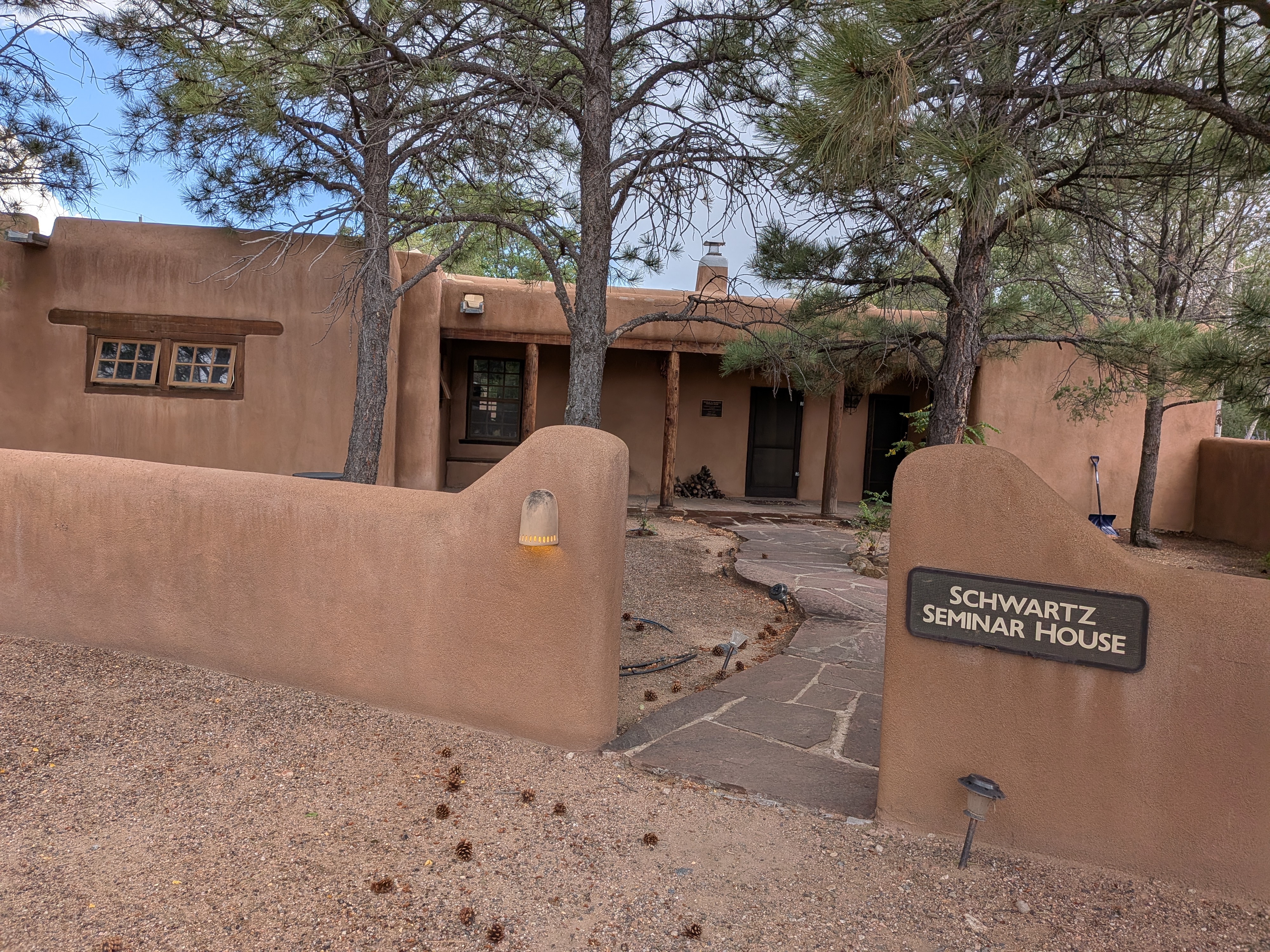
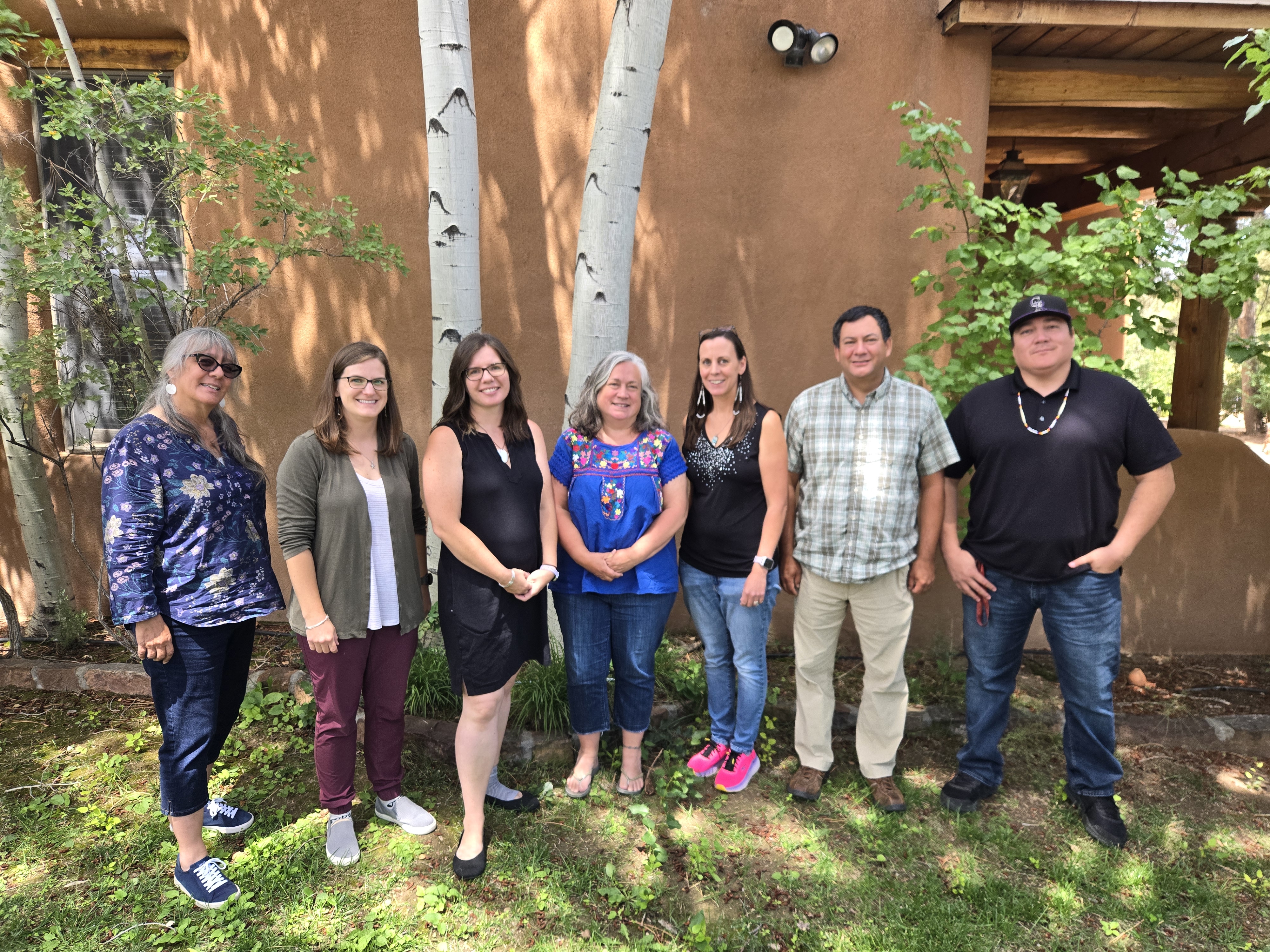
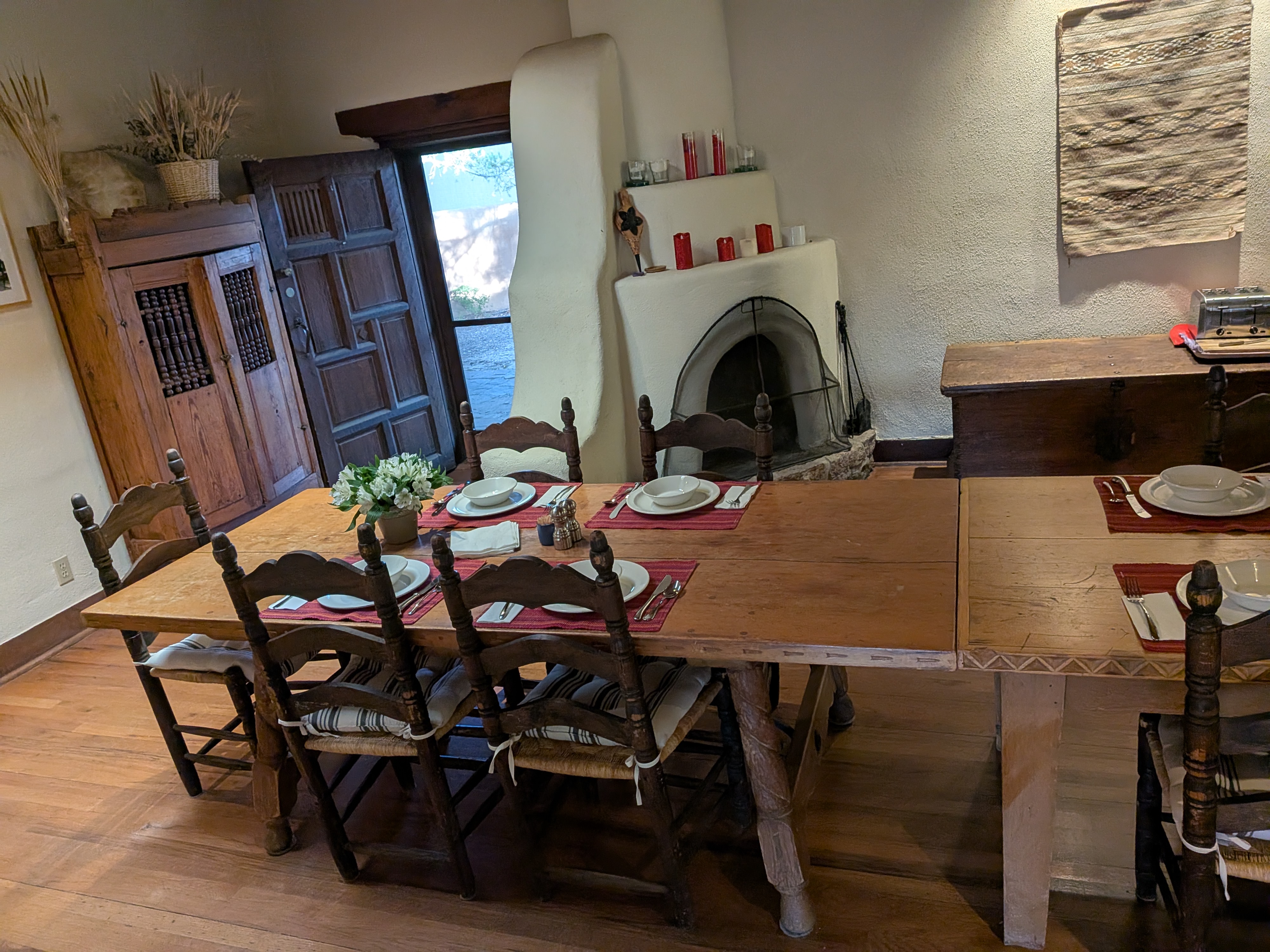
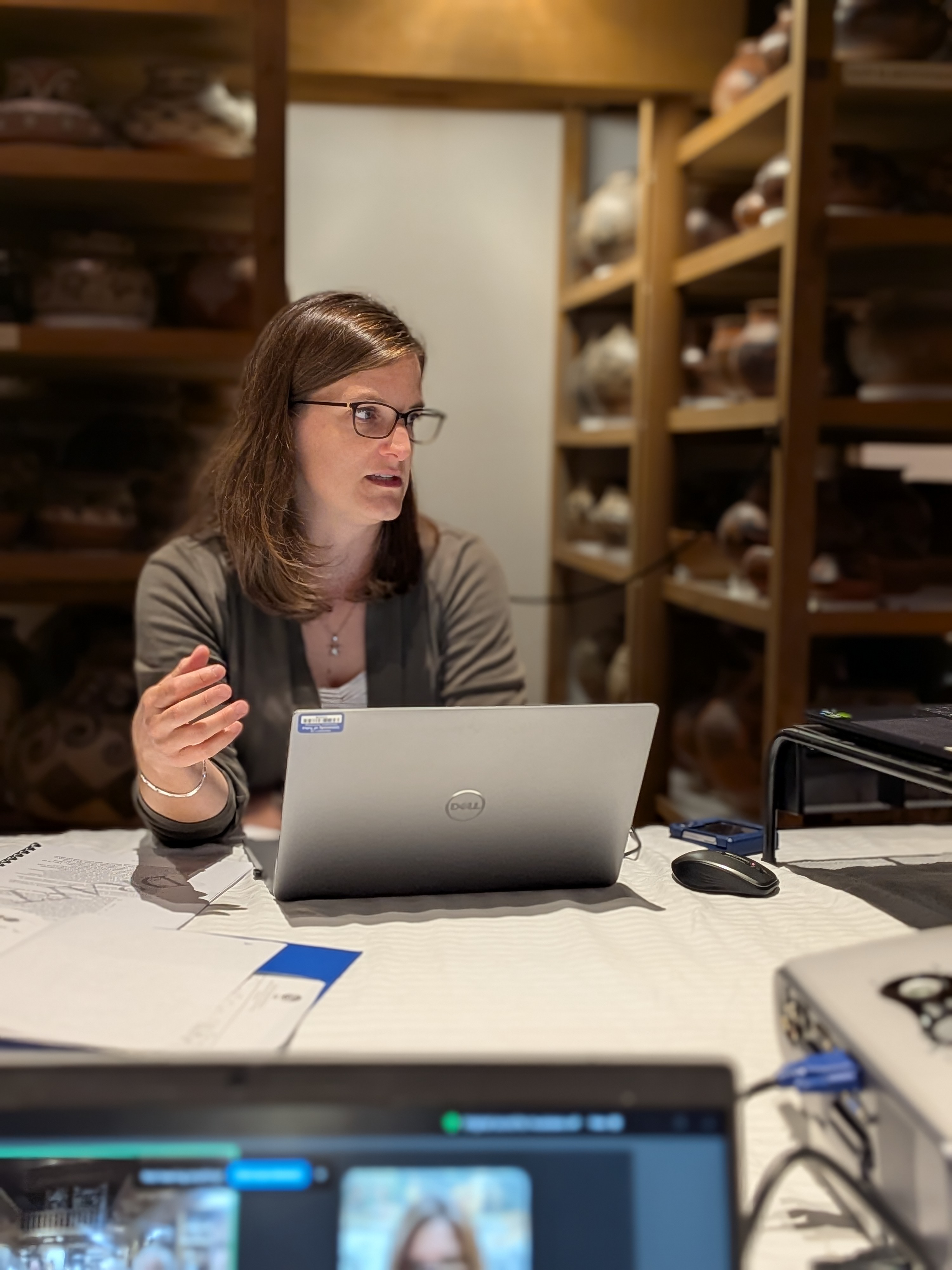
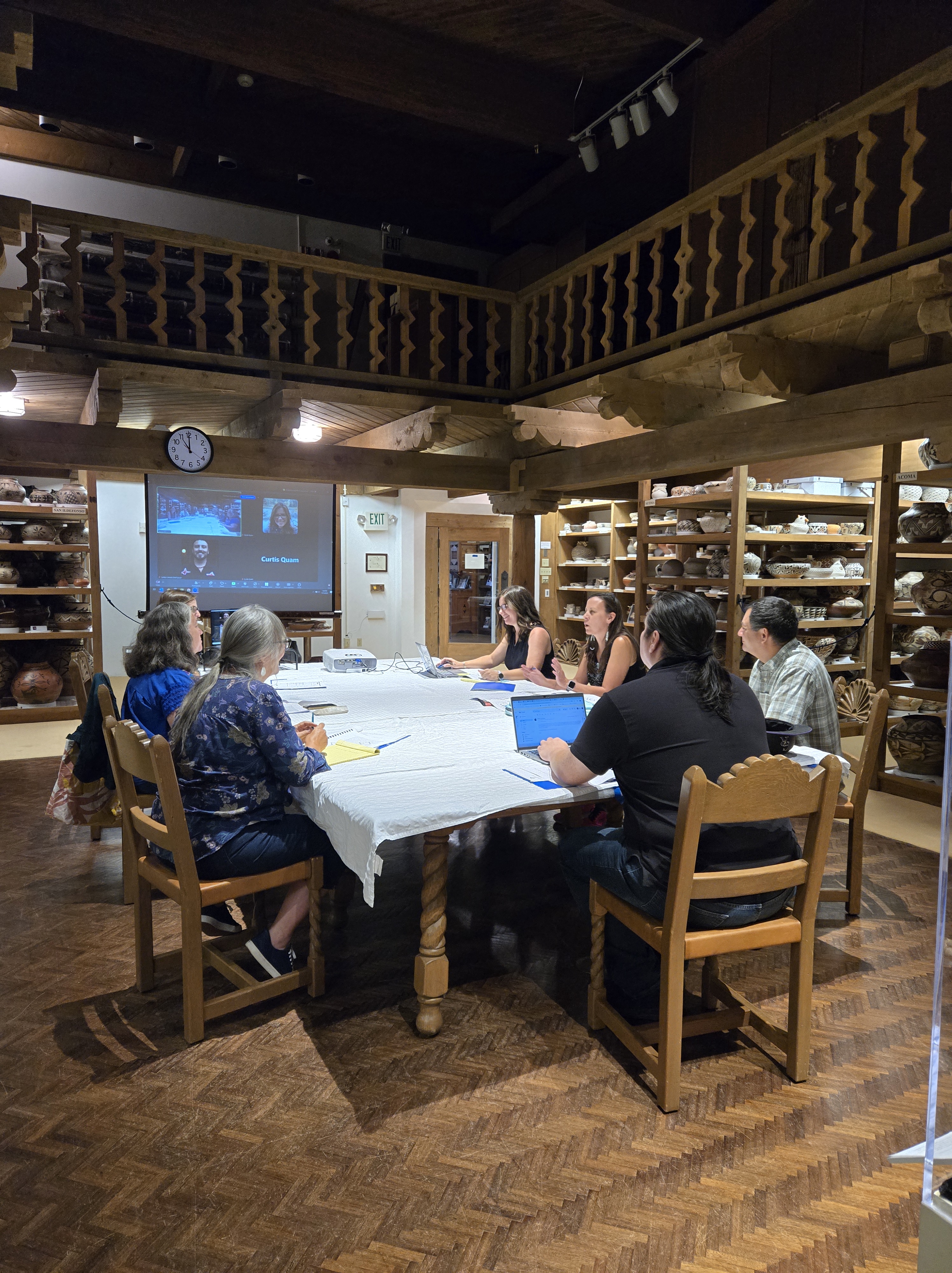
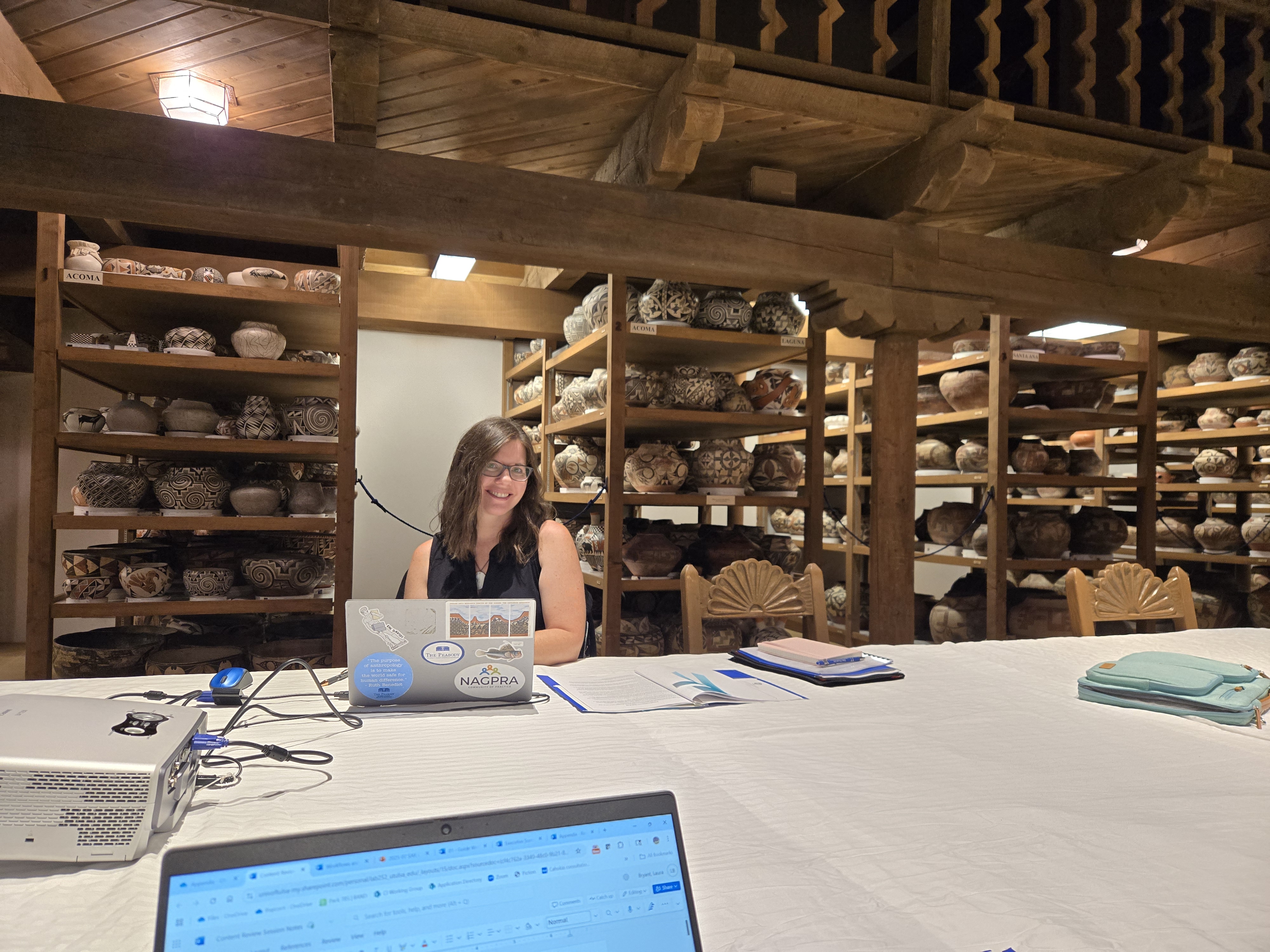
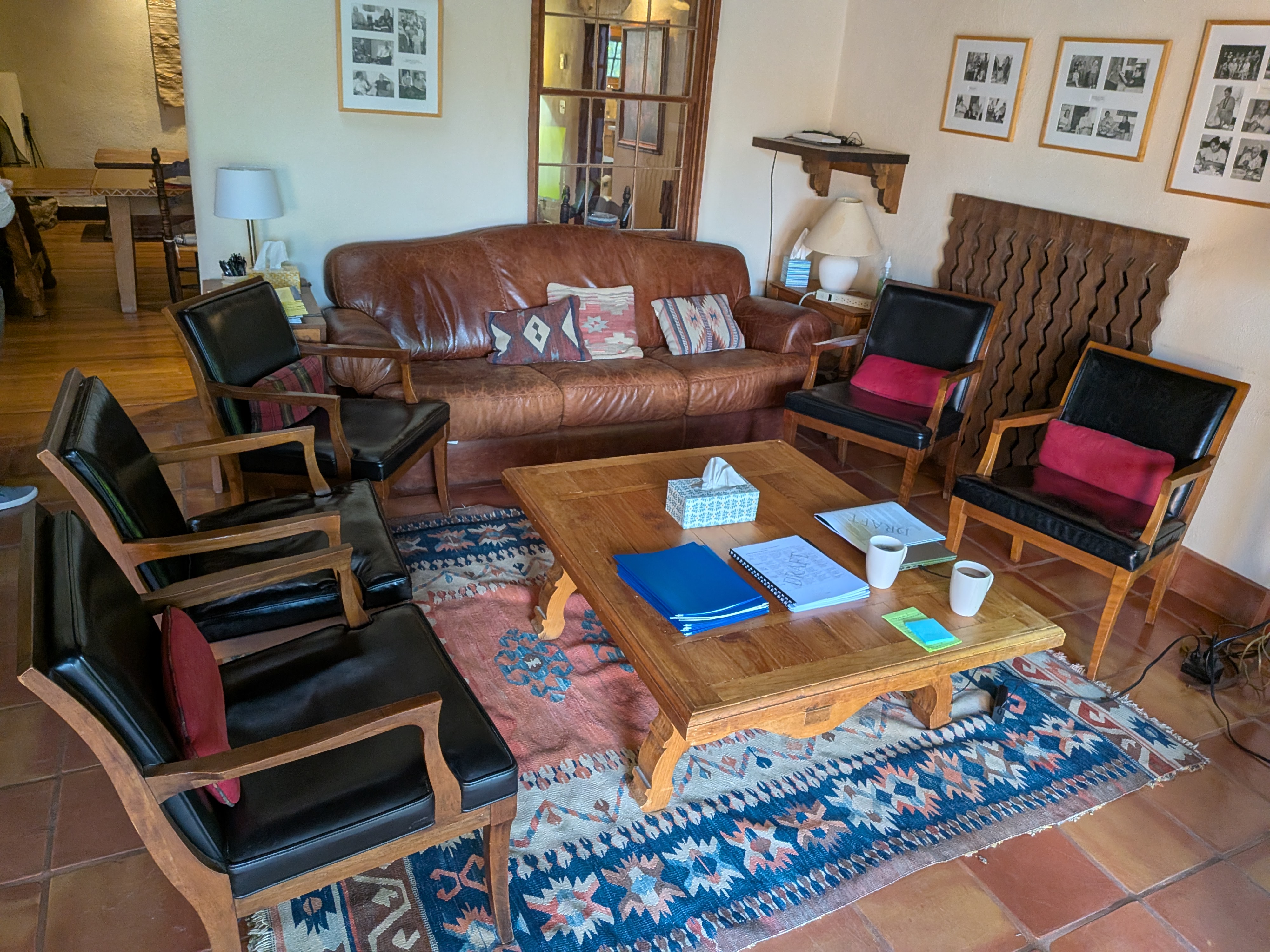
After my time at Pecos, I went to the School for Advanced Research in Santa Fe to facilitate the final review session of the Indigenous Collections Care (ICC) Guide.  This is a project that I have been working on for awhile and it was excited to be entering the final stages.  Although the review session had to be rescheduled due to complications with our IMLS grant, we had a wonderful group of people to discuss the ICC Guide and help us move forward into the final stages of development.

The ICC Guide provides a framework to respect and recenter collections stewardship practices around the needs and knowledge of Indigenous community members. The Guide speaks to individuals engaged in collections stewardship within museums and collecting institutions.  It is aimed specifically at museum professionals, emerging and established, and individuals who are seeking clarification, support, and validation to pursue culturally appropriate care.

Next steps are to send the Guide out for copy-editing and graphic design.  A final version will be ready to be shared in the summer of 2026.

My time in New Mexico was amazing and I hope you can visit there sometime soon!

PA Pueblo Pottery-Making Workshops

Contributed by Emma Lavoie

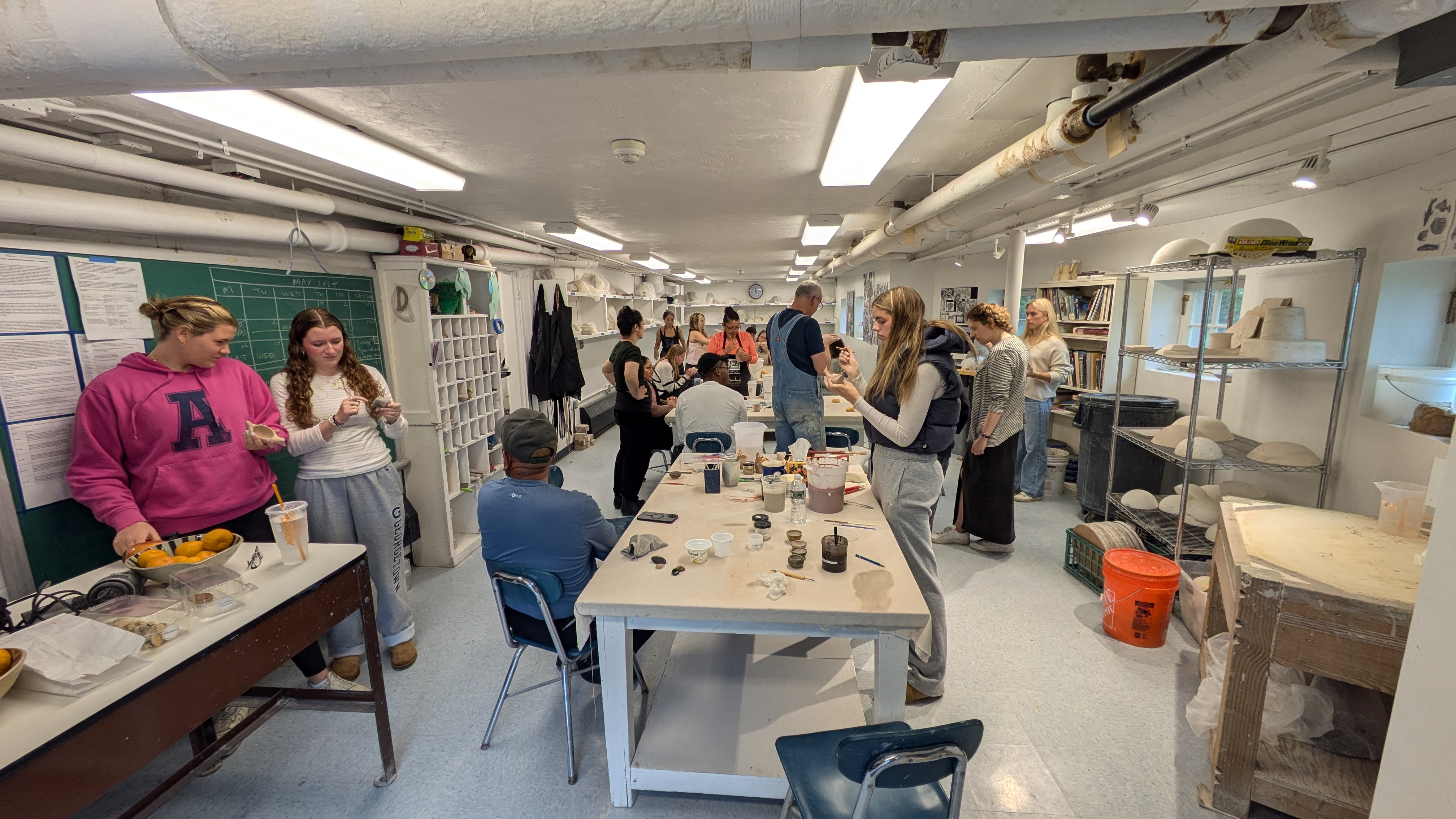
Ceramic students participating in pottery-making workshops

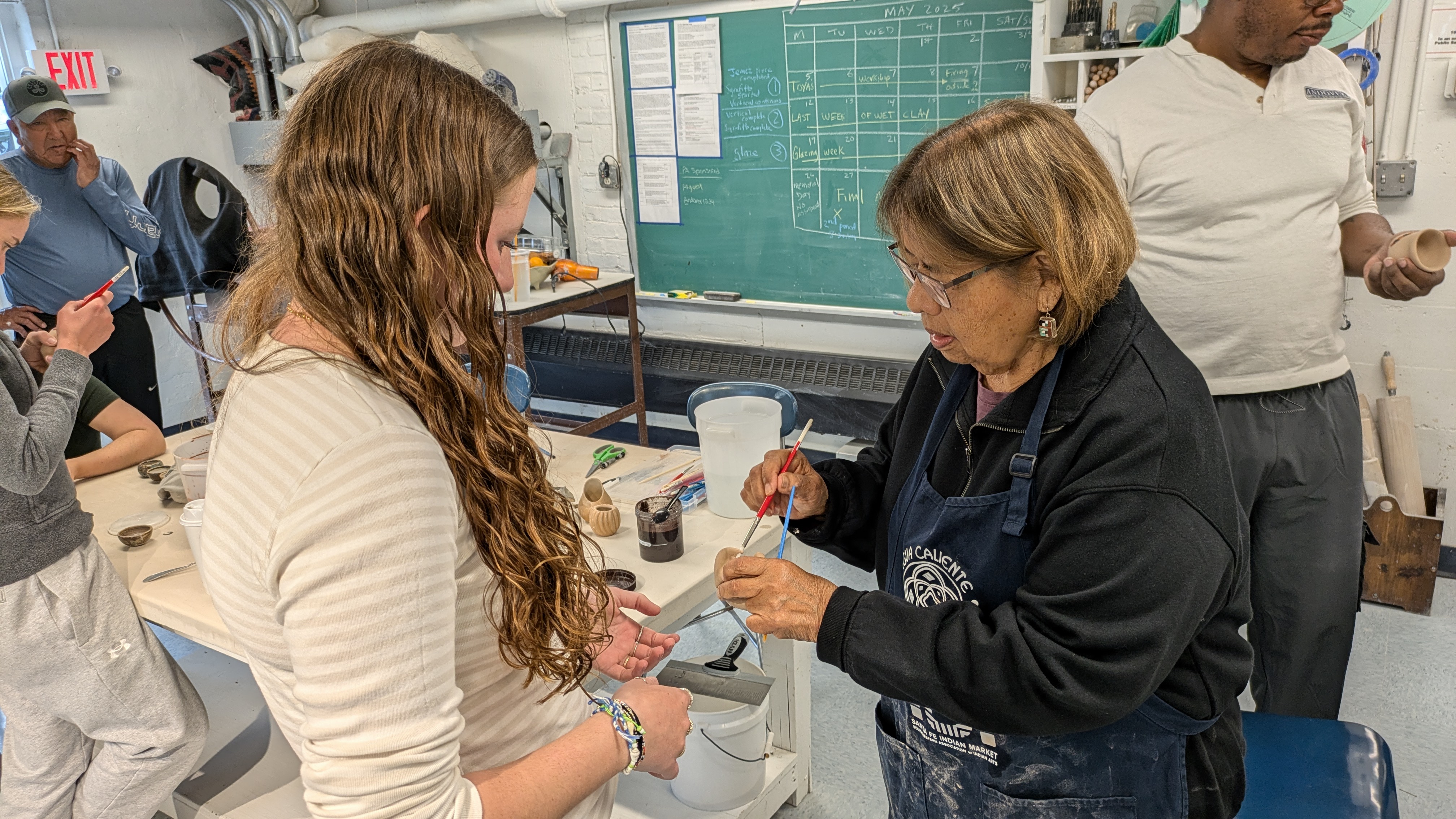
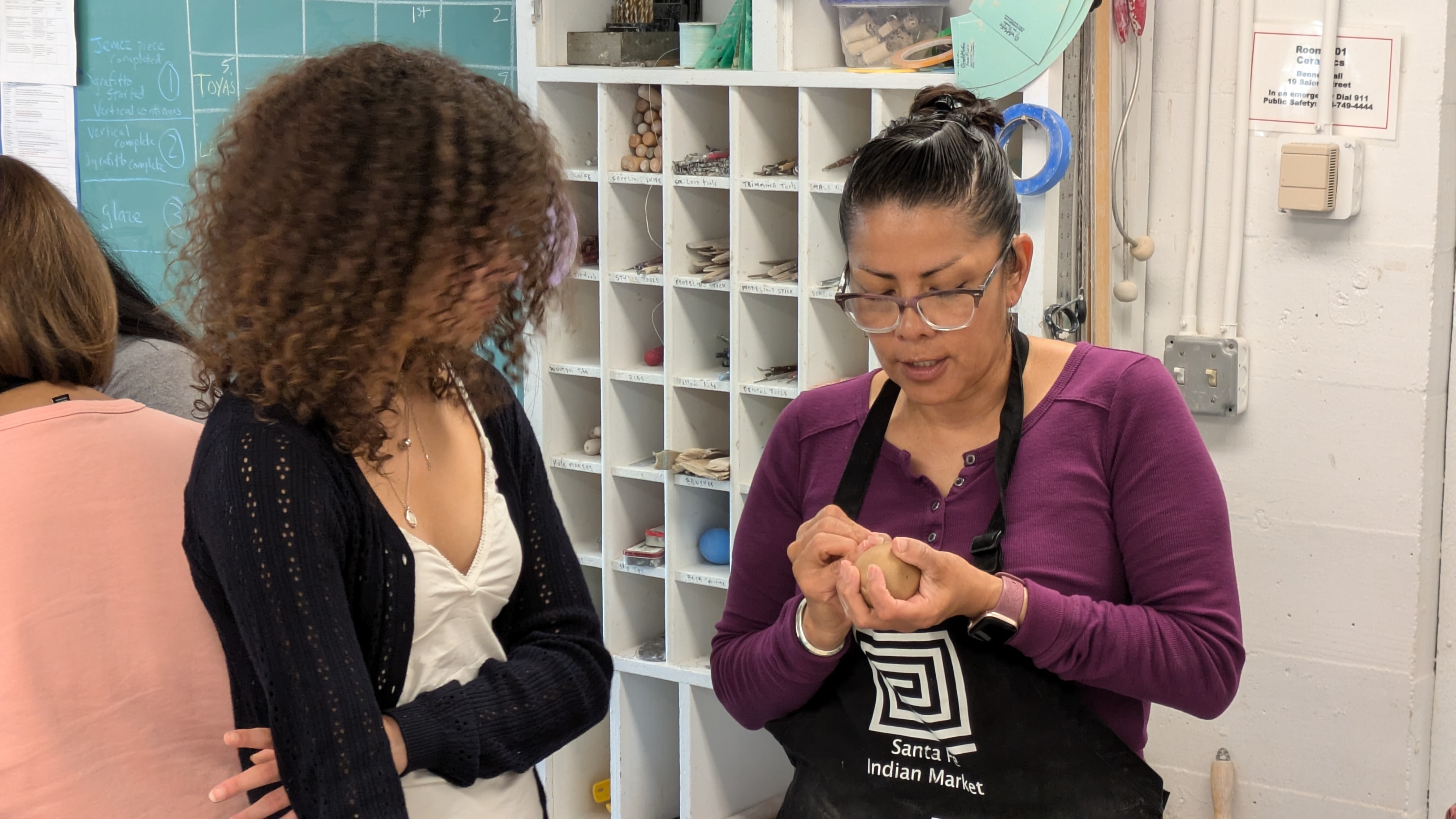
We were honored to have the Toya family back this Spring term for their annual visit to conduct week long, hands-on workshops on Pueblo pottery-making with Thayer Zaeder’s studio ceramic students.

Each year students have the opportunity to make their own pieces using native clays and temper from New Mexico and traditional decorative techniques of painting and polishing. The workshops culminate in a traditional Jemez firing.

Students walk away with an unforgettable keepsake of their time as well as a greater appreciation for contemporary Indigenous art and culture.

We are so grateful for all the time and expertise the Toya family has shared with PA students!

Check out this video by PA’s Communications team highlighting the Toya’s work on campus.

Maxine Toya working with a student on painting their piece.
Mia Toya working with a student on polishing their piece.

Fusing Glass with Hopi Artist, Ramson Lomatewama

Contributed by Emma Lavoie

Last month we were delighted to welcome back Ramson Lomatewama to Phillips Academy Andover (PA) where he worked with students and campus community members in fused glass workshops.

Ramson Lomatewama is an award-winning Hopi glass artist, kachina doll carver, jewelry maker, and published poet from Hotevilla, Arizona. This is his second year working with the Peabody Institute to bring fused glass workshops to the PA campus community. Ramson has also participated in various virtual, and in-person talks at PA, sharing his poetry, art, and life stories with students and the broader public. You can view these virtual talks on our Peabody YouTube page.

Ramson speaking to one of the fused glass community workshops.

Ramson creates stained glass, blown glass, and fused glass art. Ramson’s glass art is viewed as “a contemporary expression of ancient and artistically rich people… evoking a beautiful, yet humbling mindscape which we all long to find.” He is the first hot glass artist from the Hopi Tribe. Ceremonies and cultural activities continue to play a major role in his life. He has showed works at the Santa Fe Indian Market, the Museum of Northern Arizona, Fusing Traditions, a traveling exhibition, and the San Diego Museum of Man (now known as the Museum of Us).

Stained glass artwork by Ramson Lomatewama.
Blown glass ‘spirit figure’ sculptures by Ramson.
Blown glass vessel by Ramson.

Ramson is an educator on several levels. Early in his career, he was a middle school and high school teacher, and for many years, served as adjunct faculty at North Central College in Naperville, Illinois. Ramson also taught glass art for Hopitutuqayki (The Hopi School), an arts apprenticeship program located on the Hopi reservation. Ramson’s studio, Hotevilla Glassworks, is the first and only Hopi owned working glass studio. Check it out here!

Students at work, creating their own fused glass pieces in their class workshops.

Working with fused glass seemed a little daunting at the beginning of the workshops, but a quick demonstration by Ramson with helpful instructions gave students the courage and motivation to dive in. The plethora of glass pieces to work with – stringers, millefiori, frit, swizzle sticks, dichroic, and ribbons – came in many shapes, textures, and colors. Students worked side by side creating their pieces of art, asking Ramson questions about his techniques and listening to stories about his life and art journey.

“Working with fused glass, you need to be prepared to forfeit control…” was Ramson’s important insight that would hold true from assembling our glass pieces to the final kiln firing of our pieces. No matter the shape or size of your glass piece – after firing – it would melt down to around 6mm thick. Ramson calls this the “6mm rule.” I found it best to go into a fused glass design with no plan, as your final product would tend to come out a little different from what you’d imagine… most of the time it would look even better!

This year I created two pendants and (hopefully) some pieces to assemble into earrings. You can see my “before and after” photos of my glass pieces at the end of this blog. In the meantime, see below for some finished pieces by PA community members.

Finished fused glass pieces from the PA community workshops.

We are very fortunate to have acquired a stained-glass piece that Ramson created for the Peabody. We look forward to completing its installation in the Peabody’s front transom window once the next iteration of the building renovation is complete.

Ramson’s stained glass piece, commissioned by the Peabody.

We are very grateful for the time that Ramson dedicates to working with and educating our PA students and campus community! We hope to have him back next year! For more information about Ramson and the PA fused glass workshops, check out this article by the Andover Magazine (i.e. page spread #10-11, Digging Deeper article).

My fused glass pieces – before and after!

Fall Time = Conference Time

Contributed by Marla Taylor

Over the past month I have had the good fortune to represent the Peabody Institute at two professional conferences. Learning from others in a shared space can be really energizing and informative. I also really enjoy attending conferences and getting to connect with colleagues that I usually only see in a tiny Zoom window on my computer screen. 

First, I attended the New England Museum Association (NEMA) Annual Conference in Newport, Rhode Island. NEMA is a great conference that brings together people in the area to discuss a wide range of museum-related topics. This year, I noticed more sessions that focused on telling LGBTQ+ stories, exploring ‘hidden histories,’ and how institutions can support emerging professionals.

I was the facilitator for a panel titled Implementing NAGPRA: A Conversation with NAGPRA Practitioners. The panel was composed of individuals who are part of the Northeast NAGPRA Community of Practice and was a conversation to demystify the repatriation process, learn from colleagues, and identify opportunities for collaboration. The session was well attended and we had a fabulous conversation amongst ourselves and with the audience. 

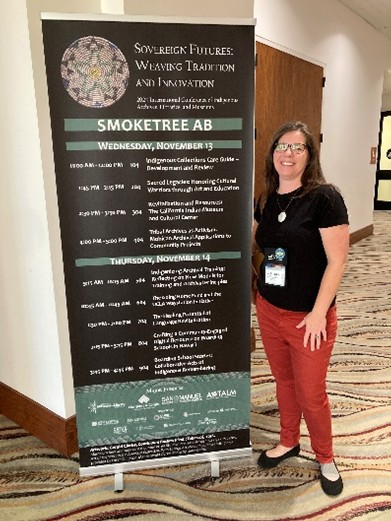
After a short (but long) day in Newport, I traveled the following week to Palm Springs, California for the Association of Tribal Archives, Libraries, and Museums (ATALM) Annual Conference. I love ATALM. It is a conference full of helpful information on everything from repatriation to pesticide management in collections to archival management. I appreciate that so many of the conversations really center on uplifting Indigenous voices and perspectives in all aspects of museum and cultural heritage work. It is a space that is invigorating and inspiring to me as a professional.

I was part of a session at ATALM to share information about the review process for the development of the ICC Guide. That session was well attended and we received lots of supportive feedback. 

The fall season tends to be super hectic with all the conference travel, but it is a great way to connect with the larger profession.

Kay WalkingStick/Hudson River School + Peabody Institute

Contributed by Marla Taylor

What do, parfleche, ceramics, paintings, and basketry all have in common? They are all currently on display at the Addison Gallery of American Art here at Phillips Academy as part of the Kay WalkingStick/Hudson River School exhibition.

Kay WalkingStick (Cherokee) is a contemporary artist and educator known for her landscape paintings. This exhibition originated at the New-York Historical Society and has been joined by over a dozen pieces from the Addison’s permanent collection as well as three from the Peabody Institute.

In another wonderful collaboration with the Addison Gallery, the Peabody loaned two Mohican culture baskets and a vessel made by Wampanoag artist Ramona Peters to be placed in dialogue with Kay’s work. The items were thoughtfully selected and contribute to an intentional conversation between traditional painting techniques and Indigenous art.

You can explore the exhibition yourself through virtual tour.

We really appreciate the opportunity to collaborate with the Addison and highlight pieces from the Peabody Institute. Check it out if you are in the area!

Kay WalkingStick, Durand’s Homage to the Mohawks, 2021. Oil on panel. Colby College Museum of Art, Waterville, Maine; The Lunder Collection. Photo by JSP Art Photography. Copyright Kay WalkingStick