This blog represents the first entry in a blog new series – Peabody 25 – that will delve into the history of the Peabody Museum through objects in our collection. A new post will be out with each newsletter, so keep your eyes peeled for the Peabody 25 tag!
Contributed by Quinn Rosefsky (Phillips Academy Class of ’59)
Robert Singleton Peabody (1837-1904) grew up in Muskingum County, Ohio—just outside of Zanesville—but attended an eastern boarding school—Phillips Academy—to graduate in 1857. After law school at Harvard he established a lucrative legal practice in Vermont before relocating to the Germantown area of Philadelphia. During much of his life, Robert nurtured an interest in archaeology and Native Americans and worked to amass a personal collection of artifacts. In 1866, Robert’s uncle, George Peabody (known as the father of modern philanthropy) gifted PA with funds to establish a “scientific department” to encourage scientific discourse be incorporated into the curriculum. At the turn of the 20th century, Robert sought to revitalize his uncle’s good intentions by re-establishing a program for the sciences, specifically archaeology.
The archives of the Peabody Museum contain the letters and documents that reveal the evolution of Robert’s intentions. The primary correspondence is between Robert Peabody and Warren K. Moorehead. Moorehead was the man responsible for building, cataloging, and maintaining Robert’s artifact collection and would ultimately become the first curator of the Department of Archaeology at Phillips Academy.

Excerpt of a letter from Robert S. Peabody to Warren K. Moorehead in March 1898
Peabody then wrote in a letter dated March 3, 1898, that he was impressed with Moorehead’s cataloguing of the substantial collection Peabody had amassed (nearly 50,000 artifacts), which were “of sufficient value, to be cared for.” Adding, “I have known too well the fate of those Orphaned collections placed at the Mercy of a cold world…” Although what Peabody then proposed was to establish a department of archaeology, he also wrote that the financial situation at the time was not good. He was likely referring to the Panic of 1893, during which 500 banks closed and 15,000 businesses failed. The ensuing financial depression lasted from 1893 to 1898. Peabody’s conclusion was: “…I will not deliberately, add another to the list of failures…I want to make assurance doubly sure, if I go into it at all.”
Nevertheless, Moorehead’s letter to Peabody on April 4, 1898, continued to press the issue. He had spoken to the wife of Dr. Wilson, a Curator of Anthropology at the Smithsonian Institute, and conveyed her response to Peabody: “…It is fortunate for Andover and the public at large that you conceived the idea of preserving archaeological relics.”
The archives have a gap in the sequence of letters, but it is clear that Robert S. Peabody had been having discussions with Dr. Cecil F. P. Bancroft (1839-1901), Andover’s fifth headmaster. Bancroft agreed to help push the project forward with the school’s Board of Trustees. By November 11, 1900, planning was well-advanced.

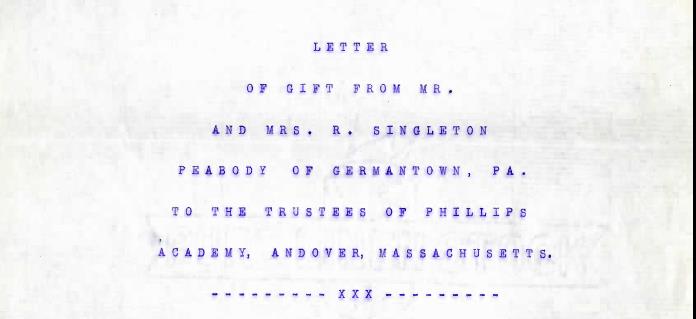
Excerpt of Robert S. Peabody’s letter to the Trustees of Phillips Academy in March of 1901
In a letter dated March 6, 1901 from Peabody to the Trustees of Phillips Academy, the amount and purpose of the donation were laid out. Specifically, Peabody wished his collection to have a home for preservation, the establishment of a Department of Archaeology which would be “self-supporting and independent.” Furthermore, this Department should be “disconnected from any other branch of Phillips Academy.” As for the museum itself, “…(it) should be, as far as consistent, tasteful and attractive on its exterior, with good proportions, not too high, and within, light and cheerful as possible, with some simple and tasteful decoration—as tinted walls, etc.” Peabody went on to propose that Moorehead be the first curator because “…Professor Moorehead knows every specimen in the collection, and its history.” Peabody also stipulated, “…that the building/museum be a pleasant place where students might find an agreeable relaxation during the broken events which occur in the lives of the most closely pressed.” In other words, the building would serve not only as a museum but as a social center.
It was no surprise that the amount of the gift to Andover, indicated in a letter dated March 8, 1901 from Peabody to Bancroft, was related to the amount given previously by his uncle in 1866. George Peabody had also dedicated the same amount—$150,000—to aid in founding the Peabody Museum of Archaeology and Ethnology at Harvard and the Yale Peabody Museum of Natural History. To differentiate himself from his uncle, Robert pointed out that his gift would also include a collection of artifacts. These artifacts amounted to one hundred thirty-two boxes containing nearly 50,000 items insured for $35,000 at the time of transportation by rail on July 10, 1901 from Philadelphia to Warren K. Moorehead in Andover. The actual endowment, anonymous by design, included $100,000 for the Peabody Foundation and $50,000 for the building. This amount would grow substantially at Peabody’s death, as he willed the residue and remainder of his estate to Phillips Academy in March, 1902. The total gift amounted to at least $500,000—approximately $12 to $13 million by today’s standards.
What did $50,000 buy in 1901? The future architect for Boston’s Museum of Fine Arts, Guy Lowell, was hired and he submitted plans for the projected museum at Phillips Academy. By the end of October, 1901, ground-breaking began on the site where formerly the First Classroom Building, the Farrar House, and then the Churchill House had been located. The building was completed in less than two years and was dedicated on March 28, 1903, the event was memorialized in the mid-April 1903 edition of The Phillipian.“The building was tastefully decorated with potted palms and flowers…Mr. Frederick W. Putnam, L.L.D, professor of Ethnology and Archaeology at Harvard, said that students would learn to reason more for themselves, and would depend more upon their own powers than upon text books.”






 The Peabody