Updating spaces at the Peabody is like playing with a giant sliding puzzle. In order to rearrange one room, you have to make space in another for everything that will be displaced. We wrestled with this puzzle as we recently updated two major spaces at the museum – our basement work room and our main exhibit gallery.
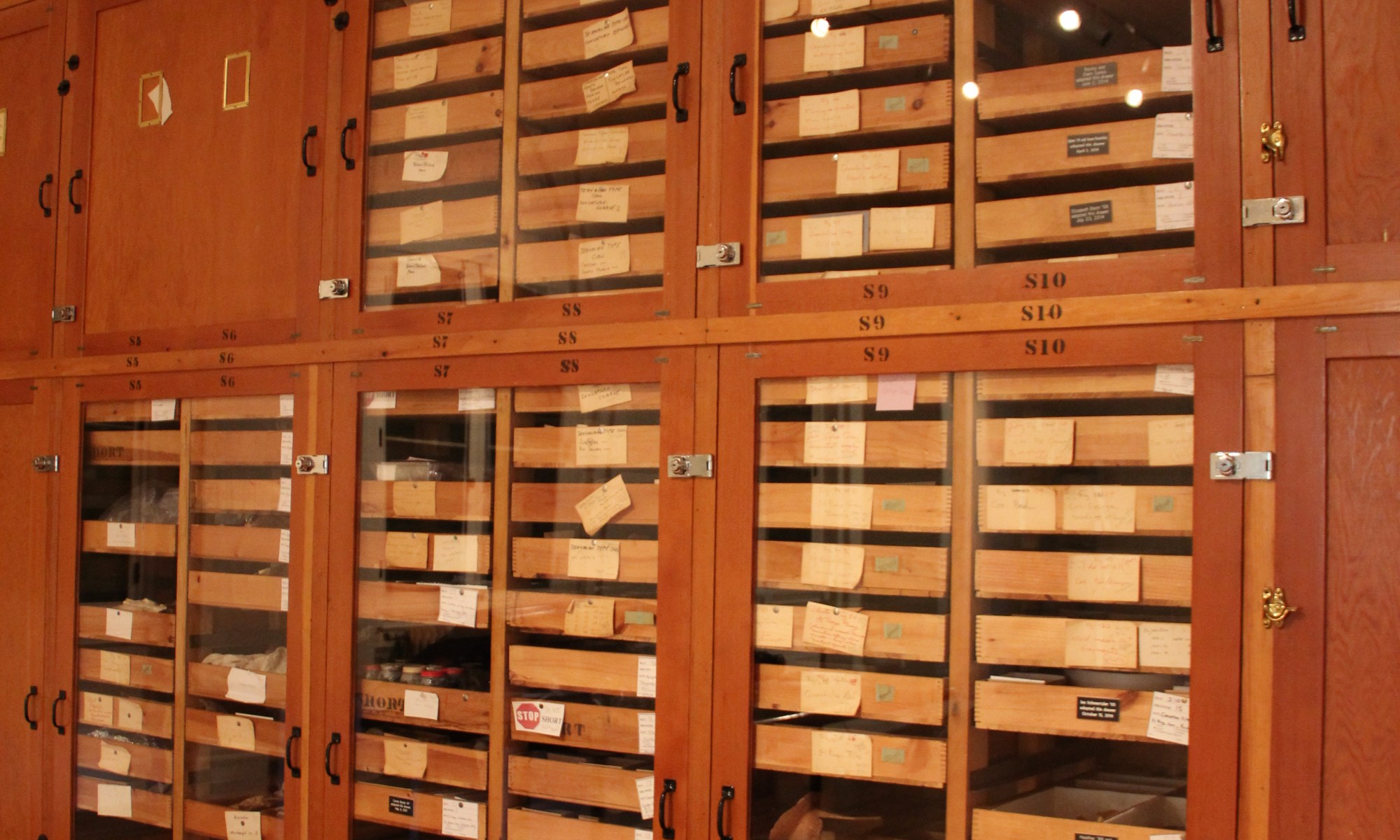
The basement work room is the center of most of the collections work at the Peabody. It is where work duty students, volunteers, and collections staff spends most of their time. And, until recently, it was home to several staff work spaces too. But it was time to refresh the space and make room to spread out the collection as we transfer artifacts from the old wooden drawer to new archival boxes.
Peabody basement work room – before
Peabody basement work room – before
Peabody basement work room – after
Peabody basement work room – after
Updating the gallery space was no small task! First, all the old exhibit was dismantled and objects were returned to storage. Then the exhibit cases were removed. And finally, the false walls that confined the space were demolished. Patching and painting is now underway. Future projects will see updated lighting and restoration of the windows.
Peabody gallery – after
Peabody gallery – taking down the walls
Peabody gallery – taking down the walls
Removing the debris
Newly visible collections on display
Peabody exhibit gallery – before
Conversations are on-going about how to utilize this newly empty gallery space. The added space has already benefited our community family days and will hopefully provide space for student curated exhibits and larger student and alumni events.
If you haven’t been over to the Peabody for a while, now is the time!
On the third Tuesday of every month, the Massachusetts Archaeological Society – Gene Winter Chapter invites a guest speaker to their meeting at the Peabody Museum. For the past six years, Phillips Academy students have been invited to speak about their experiences with archaeology at one of these meetings.
On February 16th, seven students, in three groups, shared their research and work on a variety of topics.
Youth for Restoration: Preserving Local History
Viraj Kumar’s ’17 interest in local history led him to create a non-profit organization that works to preserve and restore local history in Poughquag, New York. He discussed his experiences working with the community on a 19th century grist mill.
Printing History: 3D Rendering of Artifacts
Four students, Alana Gudinas ’16, Jacob Boudreau ’16, Mia LaRocca ’16, and Sarah Schmaier ‘16, were challenged to scan three artifacts from the Peabody Museum’s collection and print them as 3D models. They discussed the process and highlight some of the implications of this technology for museums and other institutions.
More than Meets the Eye: 19th Century Portrayals of Native Americans
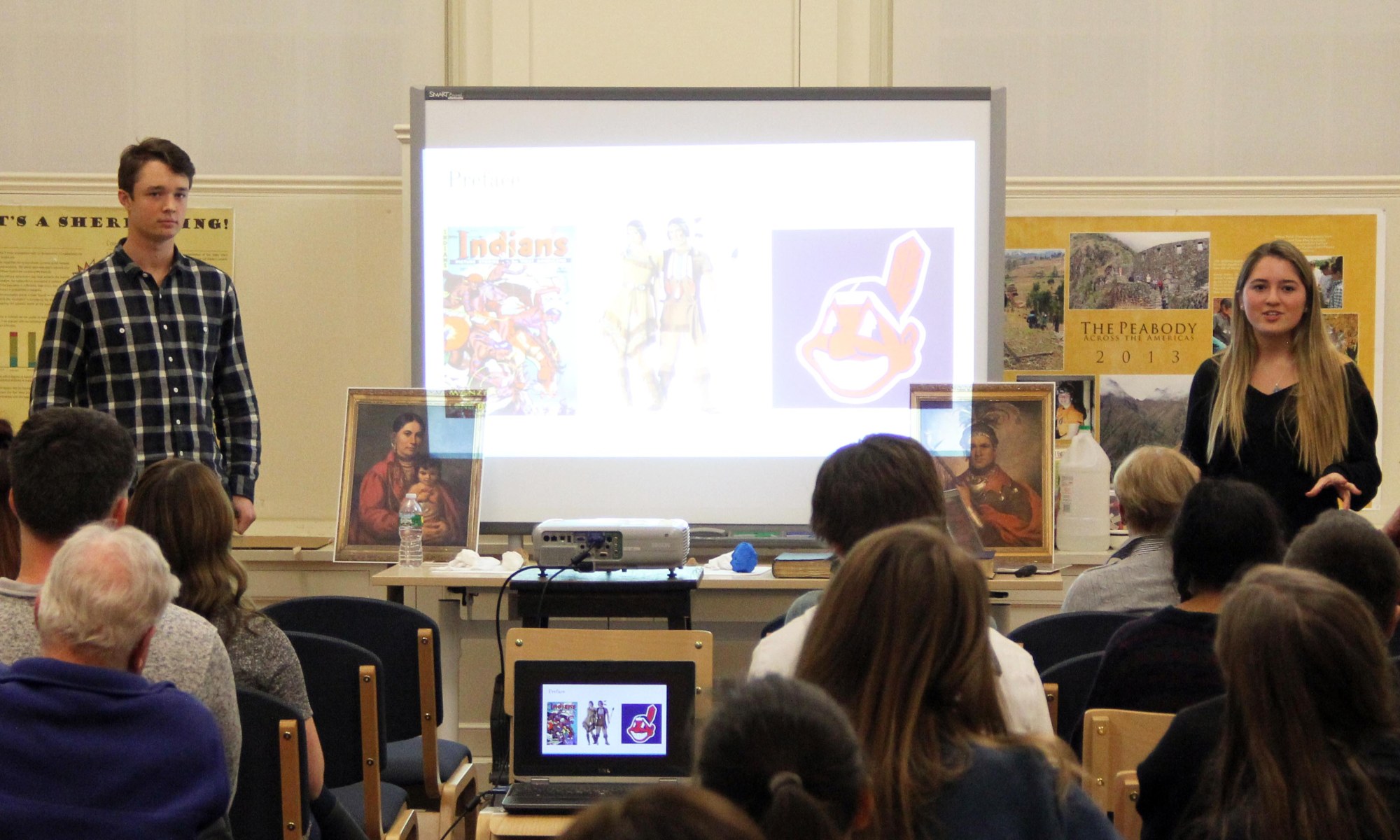
In the 1830s, the first director of the Bureau of Indian Affairs launched an ambitious effort to collect over one hundred portraits of Native Americans. Veronica Nutting ’16 and Alex Armour’16 investigated three of these paintings at the Peabody–how and when they got here, why they’re important, and how they compare to contemporary depictions of Native Americans.
Jacob presents his experience to the MAS
Speaking to an audience of nearly 50 chapter members, professional archaeologists, and members of the PA community, all the presentations were very well received. Congratulations to all the students for their hard work!
Check out this article from the Phillipian to learn even more.
The Toomey Foundation for the Natural Sciences awarded the Peabody Museum $5,000 to support “The Archaeology, Art, and Iconography of Florida’s Watery Landscapes,” a symposium to be held at the 81st annual meeting of the Society for American Archaeology (SAA), scheduled to take place this April in Orlando, Fla. Organized by Joanna Ostapkowicz of National Museums Liverpool and Peabody Museum director Ryan Wheeler, the symposium will include a number of presentations highlighting sites, excavations, and objects from waterlogged deposits that allowed preservation of wood and other perishable materials.
The symposium was inspired by conversations between Ostapkowicz and Wheeler after they met at the SAA meeting in 2013 and recognized that archaeological sites in Florida had produced an amazing array of carved wooden artifacts, but that many of these ancient American Indian objects were understudied. Since then, Ostapkowicz and Wheeler have collaborated on a project that seeks better radiocarbon dates, wood identification, and physical documentation of four wood carvings from Hontoon Island and Tomoka River in central Florida. The Hontoon owl totem—a six-foot-tall, stylized carving discovered in the 1950s—is among the sculptures being studied and has been selected as the emblem of the SAA meeting in April.
The symposium will feature Lee Newsom of Pennsylvania State University and Vernon J. Knight of the University of Alabama as discussants, and will include the following presentations:
“ ‘Totem’ Owls, Otters and Pelicans: 14C Dating Central Florida’s Prehistoric Sculptures,” presented by Joanna Ostapkowicz, Ryan Wheeler, Lee Newsom, Fiona Brock, and Christophe Snoeck
“Wood Preservation Dilemmas of Florida’s Prehistoric Saltwater Sites: Famous Key Marco and Recent Weedon Island,” presented by Phyllis Kolianos
“The Original Spaghetti Junction: Using Canoe Locations to Trace Routes of an Ancient Transportation Network in Florida,” presented by Julia Byrd
“Mortuary Ritual at the Fort Center Mound-Charnel Pond Complex (8GL12): New Insights from an Accidental (Re)Discovery,” presented by Daniel Seinfeld
“The Pineland Site Complex: A Southwest Florida Coastal Wetsite,” presented by Karen Walker and William Marquardt
“The Karst Spring Vent as Receptacle with Meaning: Chassahowitzka Headsprings Weeden Island Period Dolphin Fin Effigy,” presented by Michael Arbuthnot and Michael Faught
“Fort Center’s Iconographic Bestiary: A Fresh Look at Fort Center’s Zoomorphic Wood Carvings,” presented by S. Margaret Spivey
“Early Archaic through Middle Archaic Design Elements on Artifacts from the Basin at Little Salt Spring (8SO18), Sarasota County, Florida,” presented by Steven Koski and John Gifford
Joanna Ostapkowicz measures the Hontoon owl totem in its display at the National Park Service’s Timucuan Ecological Preserve, Jacksonville, Fla., December 2014.