Among the newest student clubs on offer to the Phillips Academy community as of this term is the Andover Anthropological Society: a group of students of superior intelligence who recognized ahead of their peers that doing research with cultural materials is incredibly fun, and an excellent use of one’s free time.
Now with a membership of ten, club members selected as their inaugural project an accession of Arctic materials surface-collected by Patricia Hume near Utqiagvik (previously Barrow), Alaska during six summers between 1959-1969, and donated to the Peabody Institute in 1998. Meeting weekly at the Peabody, so far the AAS has received collections handling training and begun to build direct experience doing close-looking analysis of cultural materials; perused the Pat Hume accession file and visited storage, doing archival research AND learning some basics of museum practice (I’m very efficient); learned about the Bureau of American Ethnology and delved into 20th century ethnographies from the region (thank you, OWHL reference librarians!); and started to explore various themes and approaches for their group project. These have included connecting collections to Iñupiaq language, exploring notions of gender and household structures, and questioning anthropological terms like “effigy” to build more robust interpretations of people’s material expressions of spirituality and religion – just to name a few.
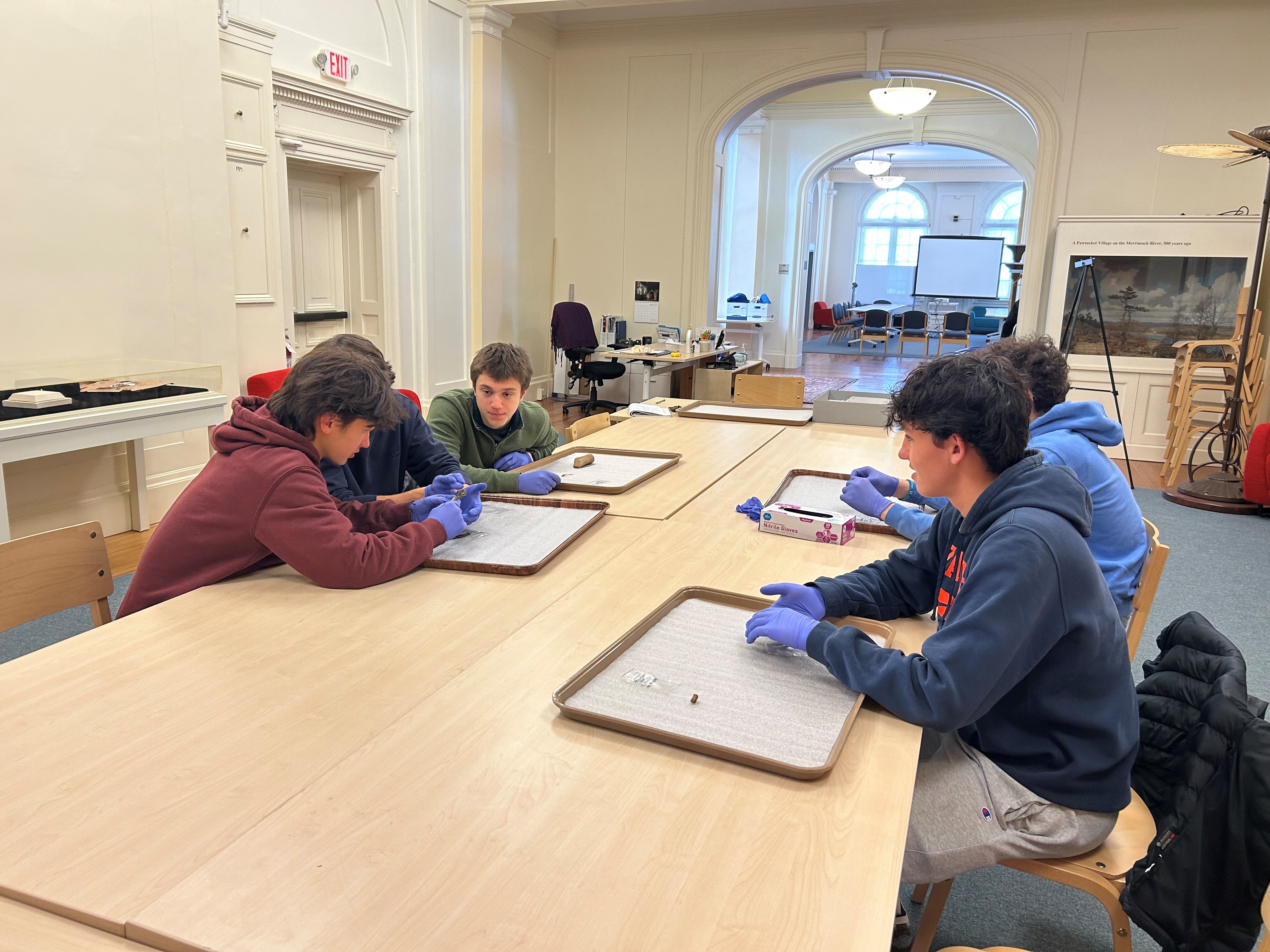
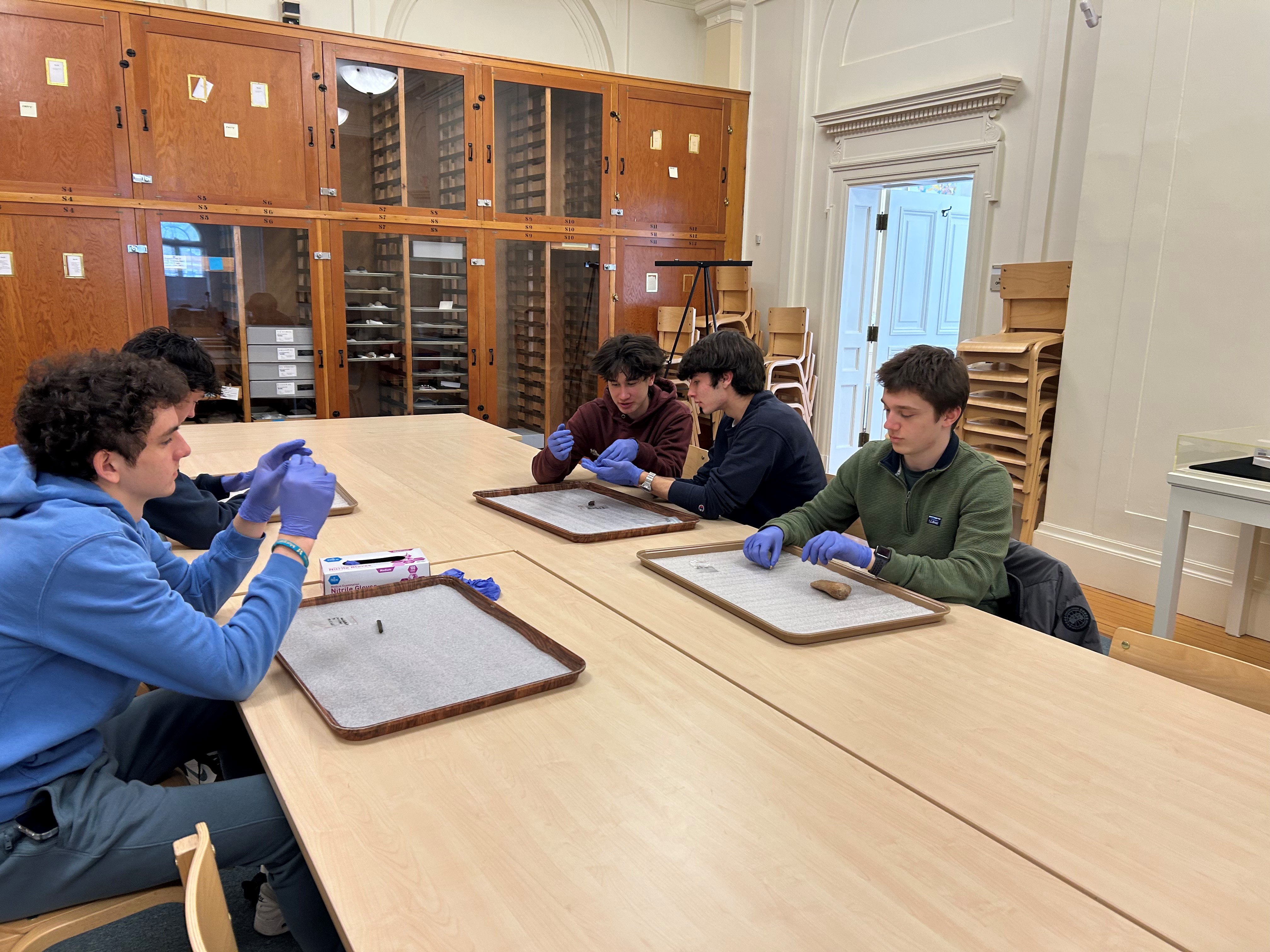
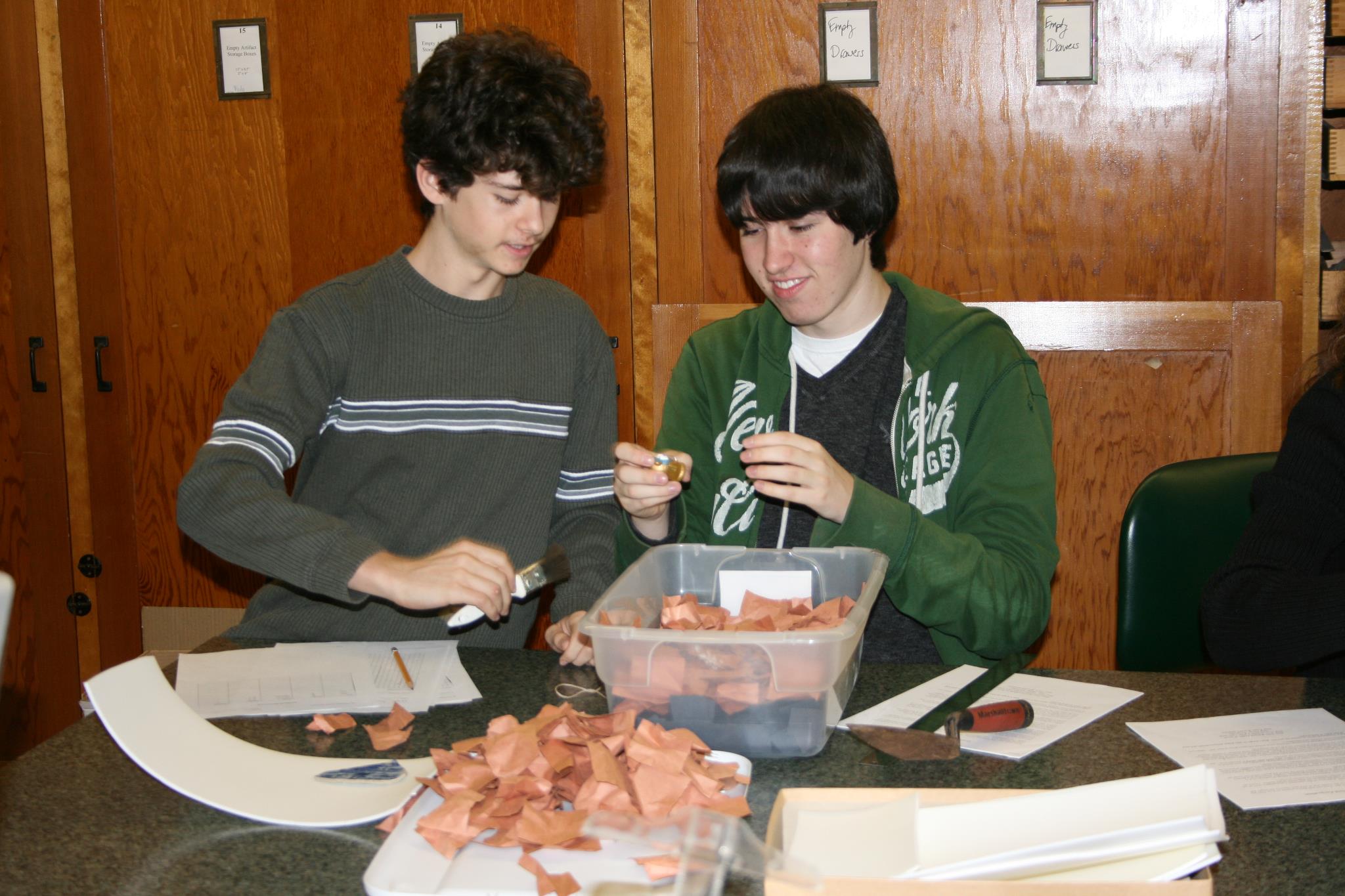
AAS members closely examining “household” items from the Pat Hume accession and debating whether I was messing with them in my claims for what they were. [Not pictured: all the female members of the club. I promise it was just unlucky they had to leave before I could take any photos…]
Whichever direction(s) the club ends up taking, what they learn will enter into the Peabody’s database, enhancing our own understandings of these collections here and the ways in which we’ll be able to connect others to them in the future.
I happen to have the privilege of serving as faculty advisor for this club, and it has been a joy getting to know these students, and having them teach me about Iñupiat culture. Bookmark this blog and stay tuned to learn more about the AAS from the AAS itself!
For the past two years, the Peabody has been dealing with an endlessly noisy neighbor. Falls Music Center, a new home for music at Phillips Academy, has been under construction since early 2023.
The noise started early in construction as a massive mountain of dirt was excavated from the building site. Next came the drilling for the geothermal wells. We could feel the vibrations in the ground as the wells reached 500 feet deep in an effort to maintain PA’s commitment to sustainability. Alas, despite our repeated (yet playful) requests, we were not allowed to sift through the back dirt to look for pieces of Phillips Academy history.
Over the next months, the building rose behind us and carried all the sounds of construction as the steel frame went up and carefully crafted practice and performance spaces were built. Most spaces within Falls Music Center are acoustically separated to isolate noises and capture the most “live” sound possible. The sounds were a constant background to much of our work moving back into the Peabody after our building project.
My favorite discovery during the construction was that the window in the main stairwell of the Peabody looks directly into the glass stairwell of the Falls Music Center. I have to admit that more than once I tried to wave at the construction workers. Unfortunately, no one waved back.
Towards the end of 2024 the fences around Falls Music Center came down, the sidewalks were repaved, the grounds were cleaned up, and the sounds diminished. I can’t say that we have missed them, but we definitely notice their absence.
Now, Falls Music Center is open to students and I look forward to a new type of noise – the stray notes from the incredible student musicians and sound of increased student presence in our little corner of PA.
Last month we were delighted to welcome back Ramson Lomatewama to Phillips Academy Andover (PA) where he worked with students and campus community members in fused glass workshops.
Ramson Lomatewama is an award-winning Hopi glass artist, kachina doll carver, jewelry maker, and published poet from Hotevilla, Arizona. This is his second year working with the Peabody Institute to bring fused glass workshops to the PA campus community. Ramson has also participated in various virtual, and in-person talks at PA, sharing his poetry, art, and life stories with students and the broader public. You can view these virtual talks on our Peabody YouTube page.
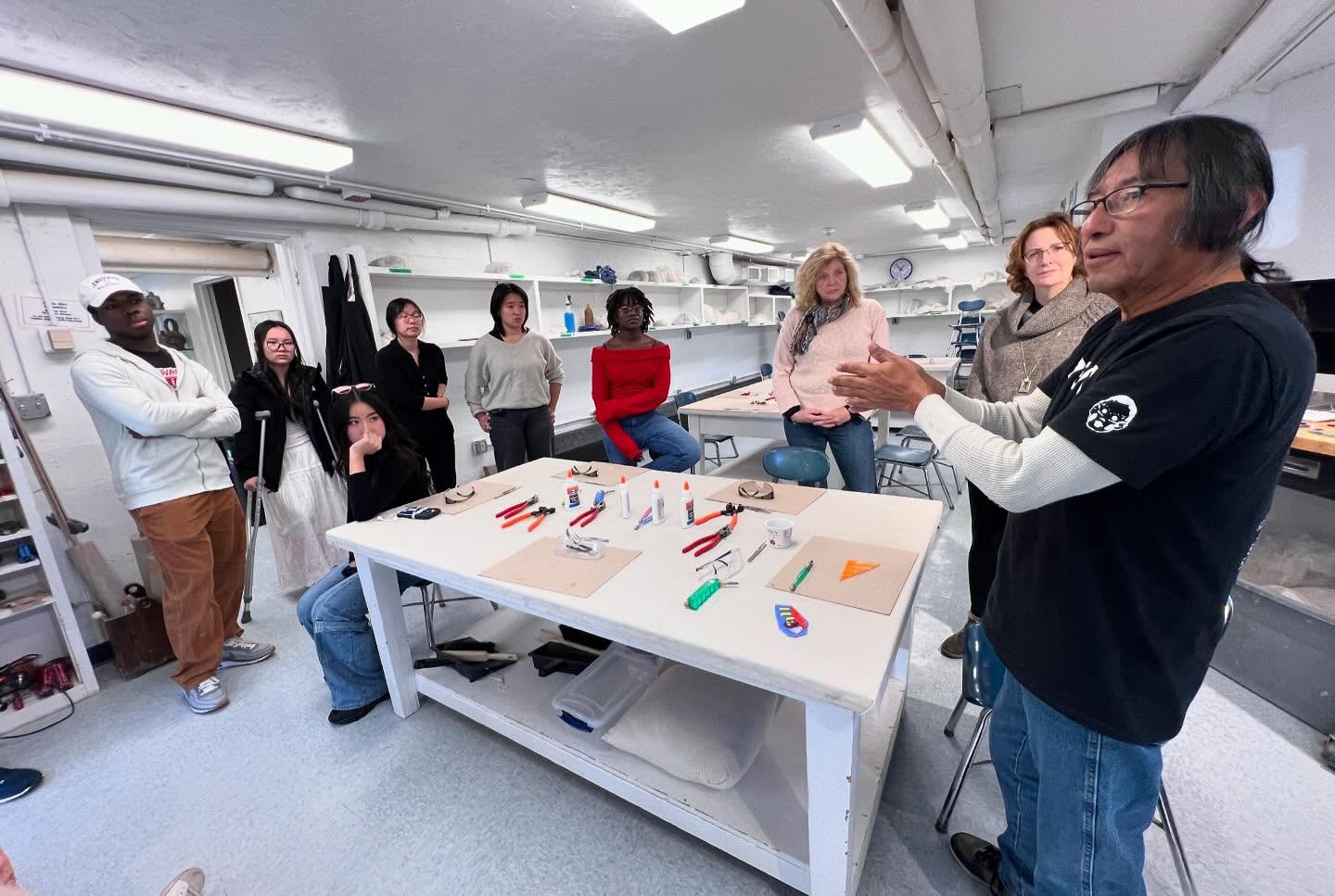
Ramson speaking to one of the fused glass community workshops.
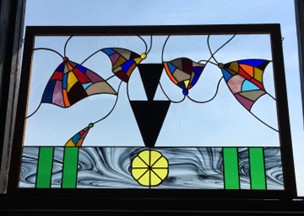
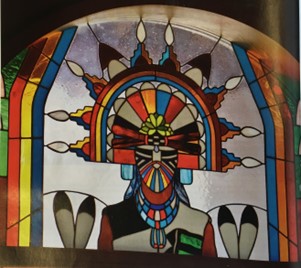
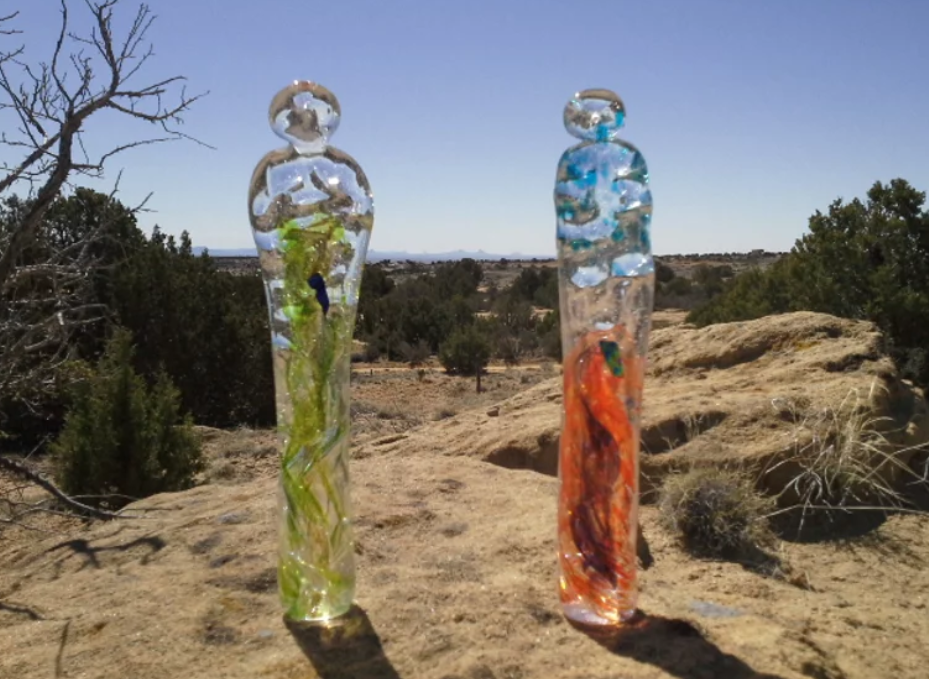
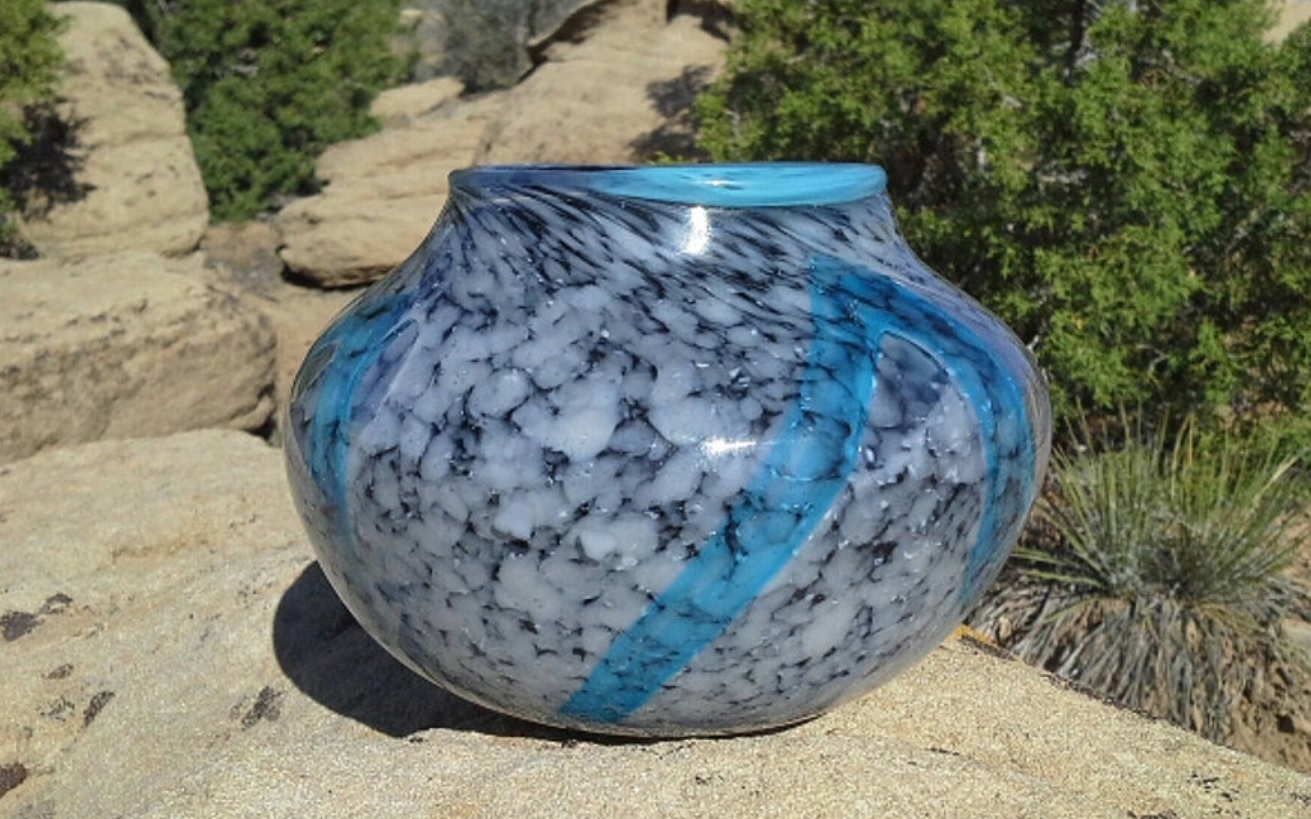
Ramson creates stained glass, blown glass, and fused glass art. Ramson’s glass art is viewed as “a contemporary expression of ancient and artistically rich people… evoking a beautiful, yet humbling mindscape which we all long to find.” He is the first hot glass artist from the Hopi Tribe. Ceremonies and cultural activities continue to play a major role in his life. He has showed works at the Santa Fe Indian Market, the Museum of Northern Arizona, Fusing Traditions, a traveling exhibition, and the San Diego Museum of Man (now known as the Museum of Us).
Stained glass artwork by Ramson Lomatewama.
Blown glass ‘spirit figure’ sculptures by Ramson.
Blown glass vessel by Ramson.
Ramson is an educator on several levels. Early in his career, he was a middle school and high school teacher, and for many years, served as adjunct faculty at North Central College in Naperville, Illinois. Ramson also taught glass art for Hopitutuqayki (The Hopi School), an arts apprenticeship program located on the Hopi reservation. Ramson’s studio, Hotevilla Glassworks, is the first and only Hopi owned working glass studio. Check it out here!
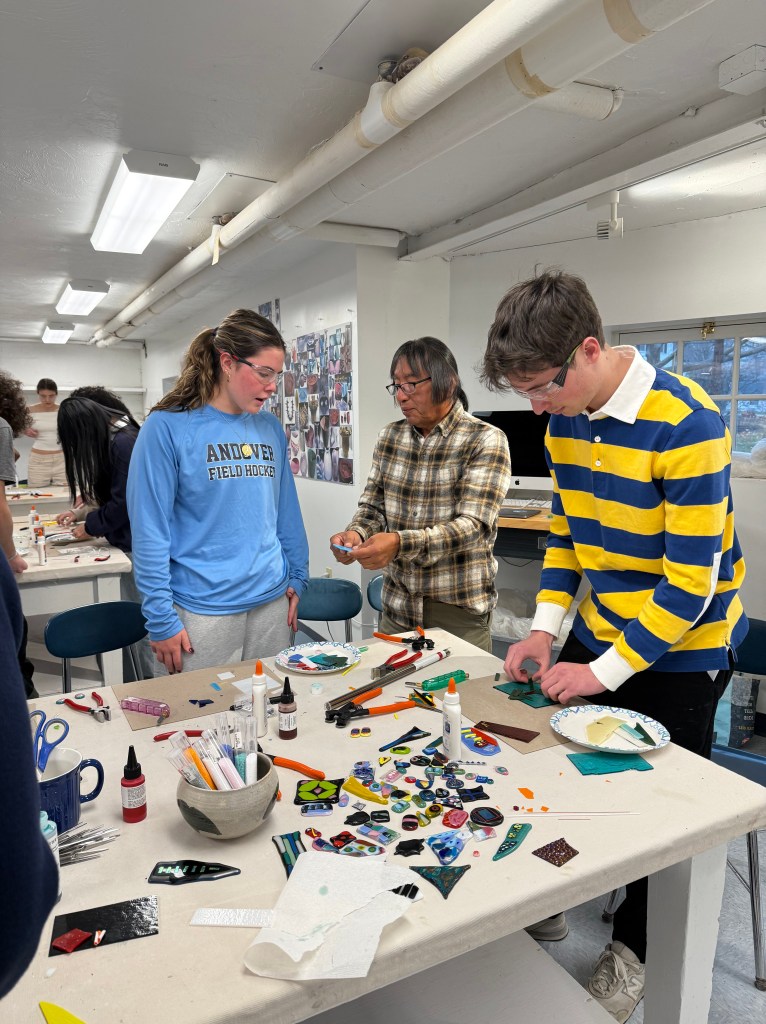
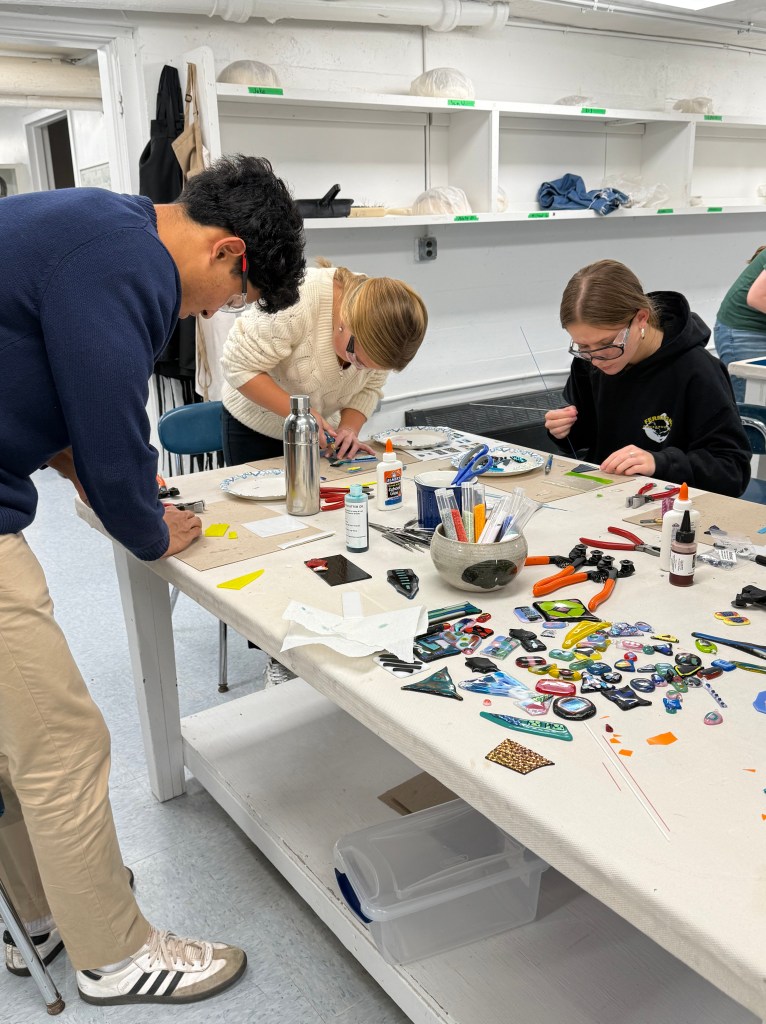
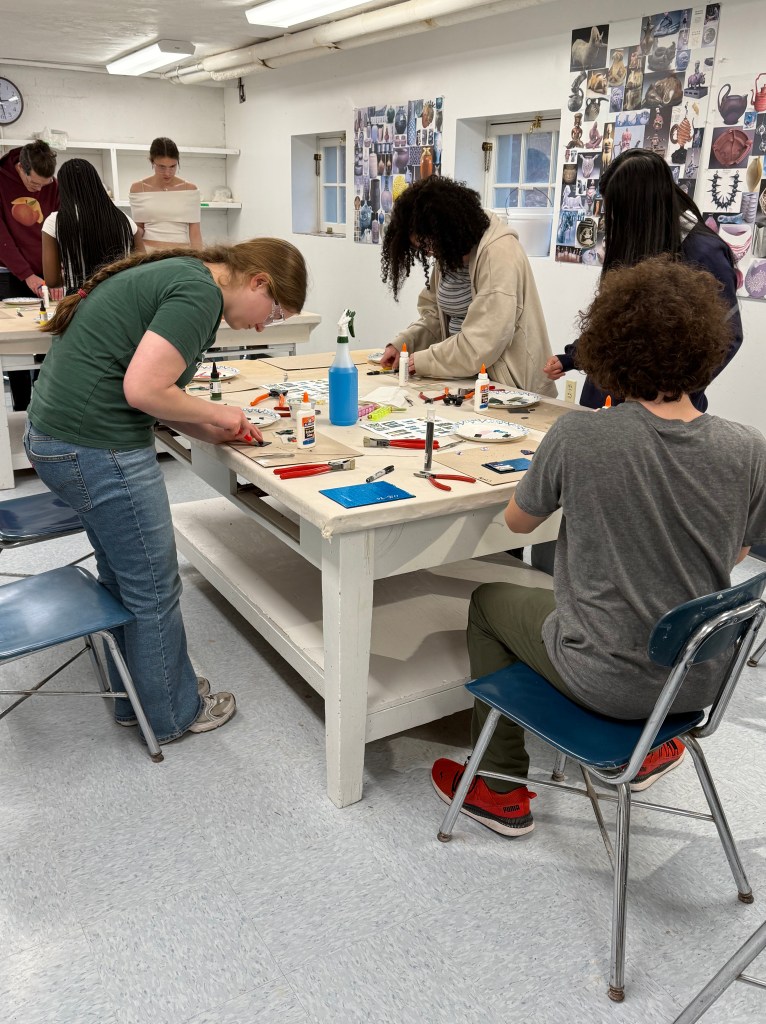
Students at work, creating their own fused glass pieces in their class workshops.
Working with fused glass seemed a little daunting at the beginning of the workshops, but a quick demonstration by Ramson with helpful instructions gave students the courage and motivation to dive in. The plethora of glass pieces to work with – stringers, millefiori, frit, swizzle sticks, dichroic, and ribbons – came in many shapes, textures, and colors. Students worked side by side creating their pieces of art, asking Ramson questions about his techniques and listening to stories about his life and art journey.
“Working with fused glass, you need to be prepared to forfeit control…” was Ramson’s important insight that would hold true from assembling our glass pieces to the final kiln firing of our pieces. No matter the shape or size of your glass piece – after firing – it would melt down to around 6mm thick. Ramson calls this the “6mm rule.” I found it best to go into a fused glass design with no plan, as your final product would tend to come out a little different from what you’d imagine… most of the time it would look even better!
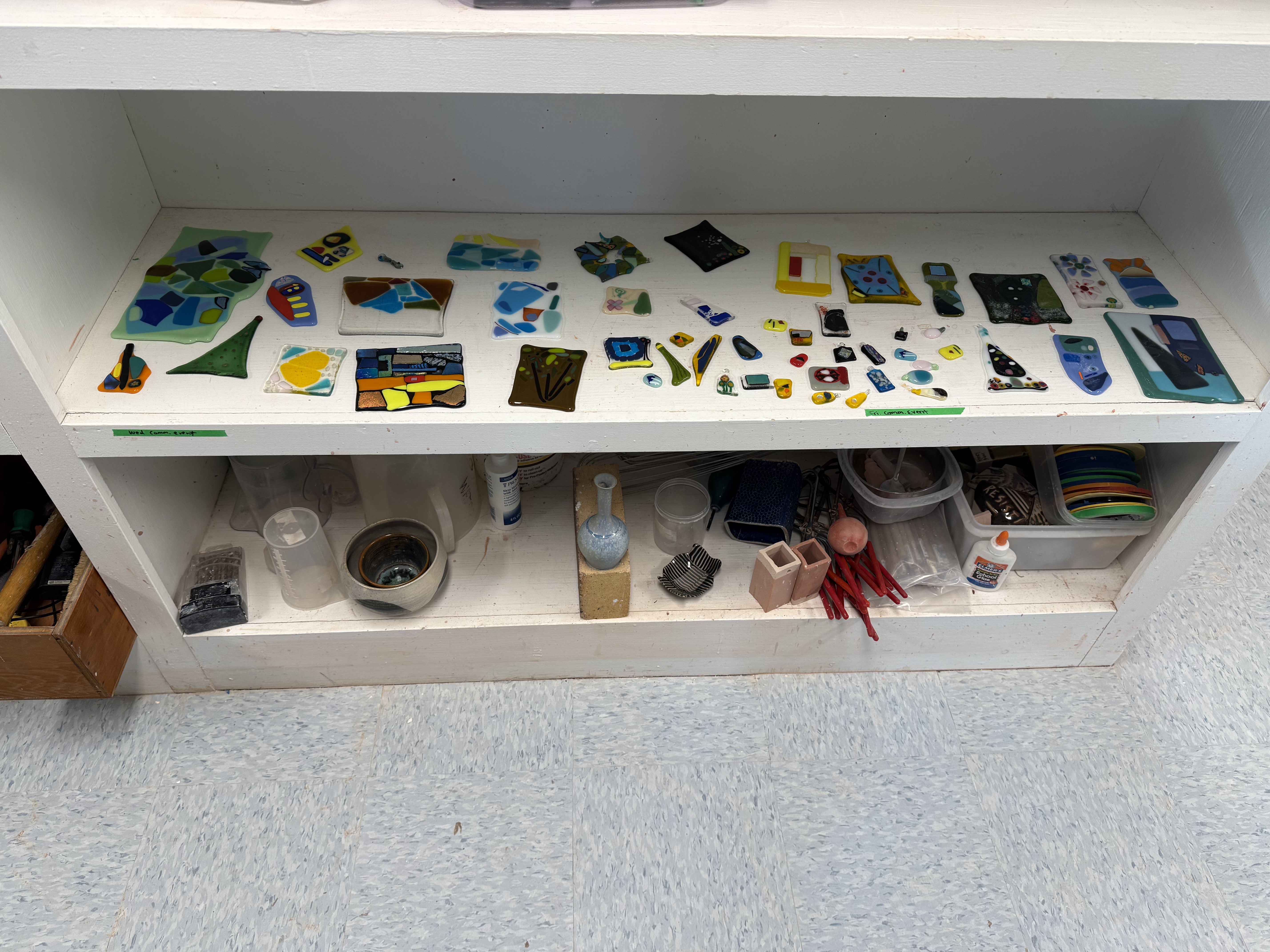
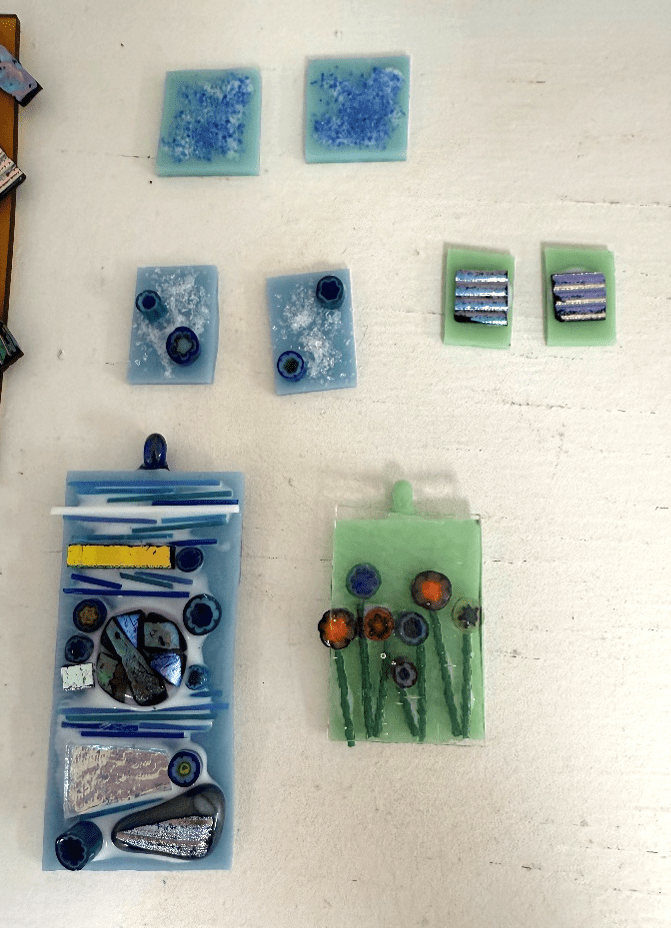
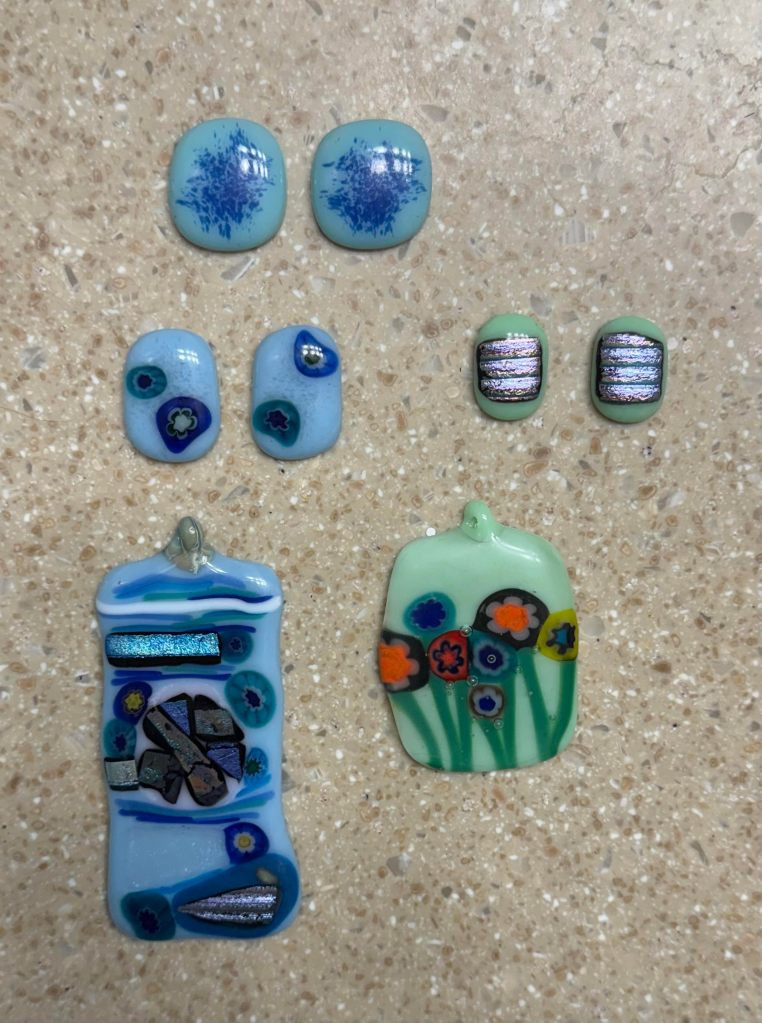
This year I created two pendants and (hopefully) some pieces to assemble into earrings. You can see my “before and after” photos of my glass pieces at the end of this blog. In the meantime, see below for some finished pieces by PA community members.
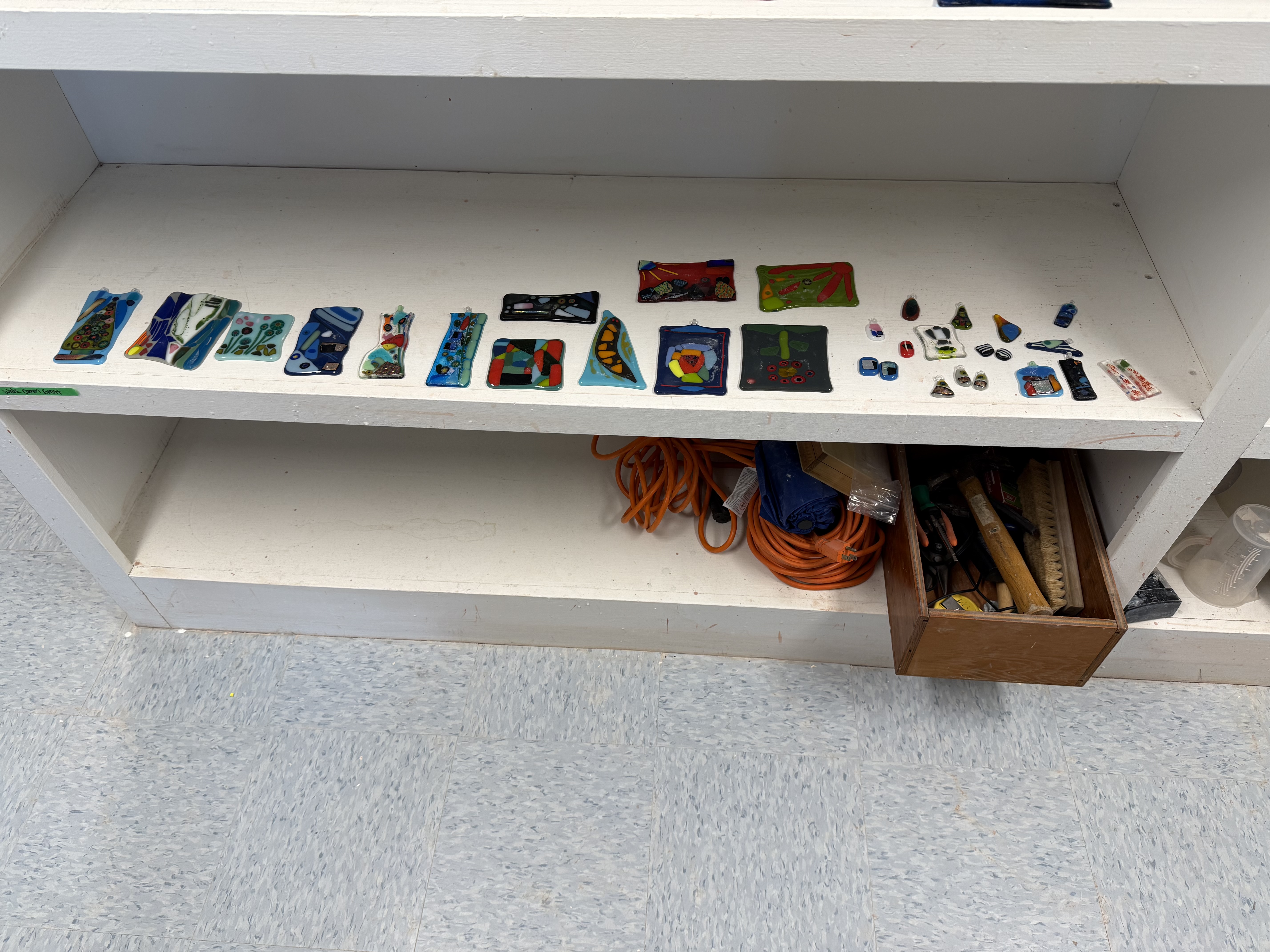
Finished fused glass pieces from the PA community workshops.
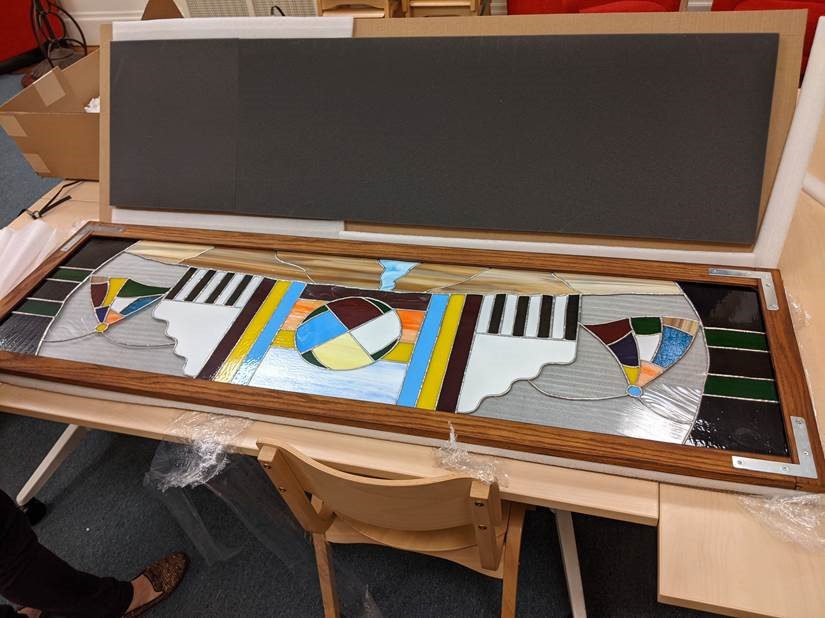
We are very fortunate to have acquired a stained-glass piece that Ramson created for the Peabody. We look forward to completing its installation in the Peabody’s front transom window once the next iteration of the building renovation is complete.
Ramson’s stained glass piece, commissioned by the Peabody.
We are very grateful for the time that Ramson dedicates to working with and educating our PA students and campus community! We hope to have him back next year! For more information about Ramson and the PA fused glass workshops, check out this article by the Andover Magazine (i.e. page spread #10-11, Digging Deeper article).
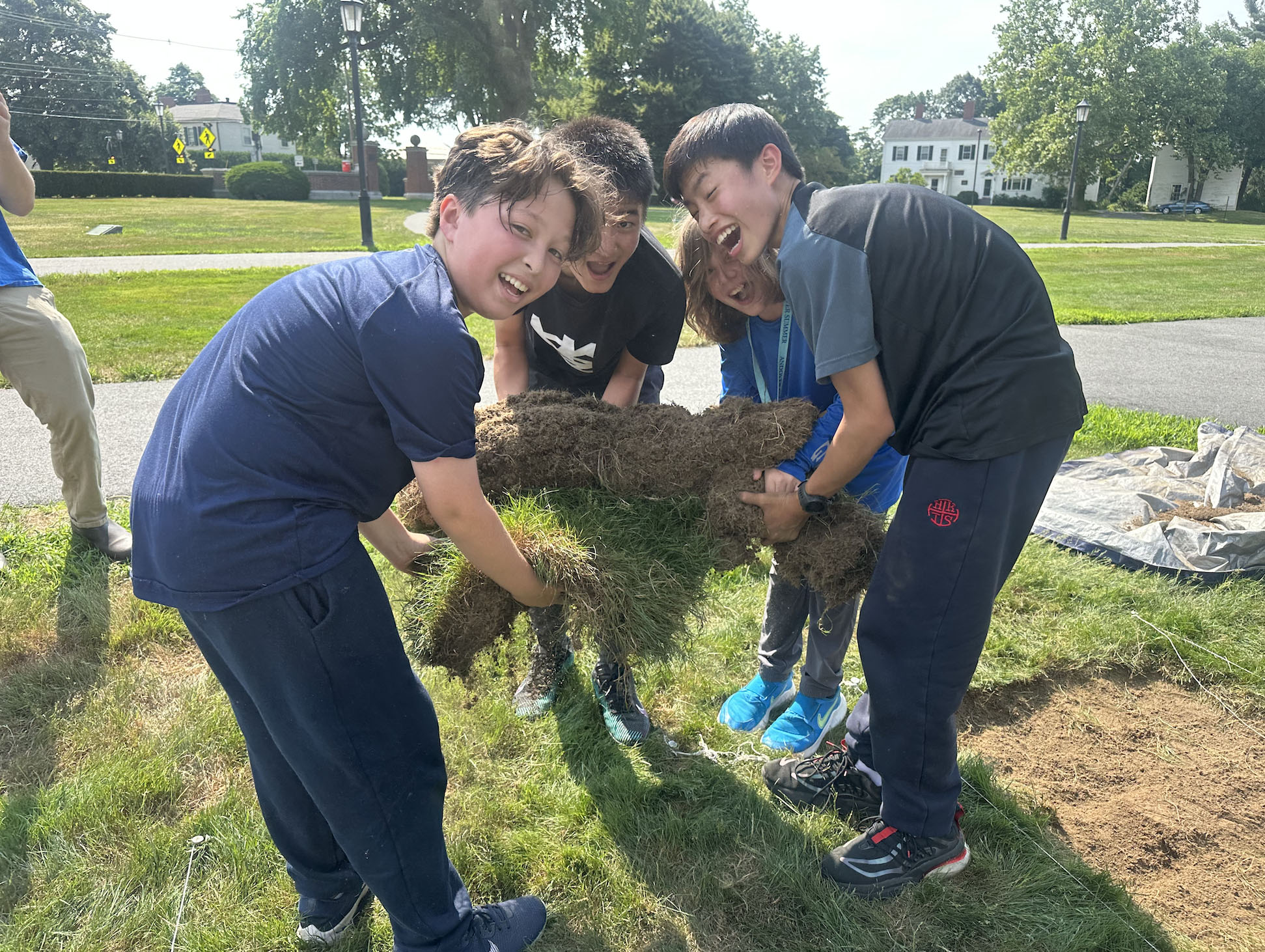
As Phillips Academy’s Lower School Institute (LSI) Dig This! course comes to the end of its seventh field season, students and instructors are so excited to share stories of the many artifacts they discovered at the school’s very own excavation site. At the start of the 2024 season, students were introduced to the story of the Mansion House, an eighteenth century home which belonged to the founder of the academy, and now lies buried underneath the lawn of the West Quad on Phillips Academy campus. The Mansion House stood on the property for 105 years before being burned down through an act of arson, which was never solved or prosecuted. The remains of the house laid just centimeters underneath the surface of the quad for a little over 100 years before LSI’s summer session course began the long process of meticulously digging it up.
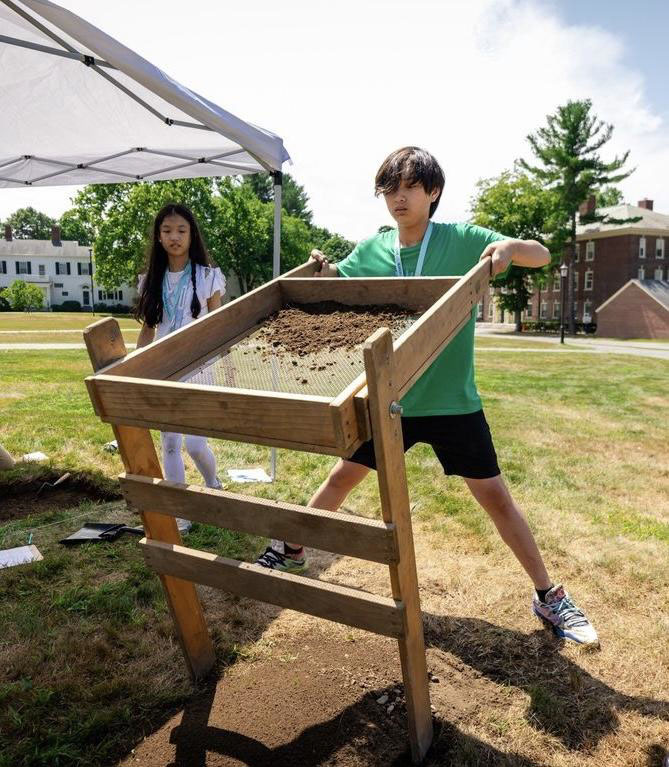
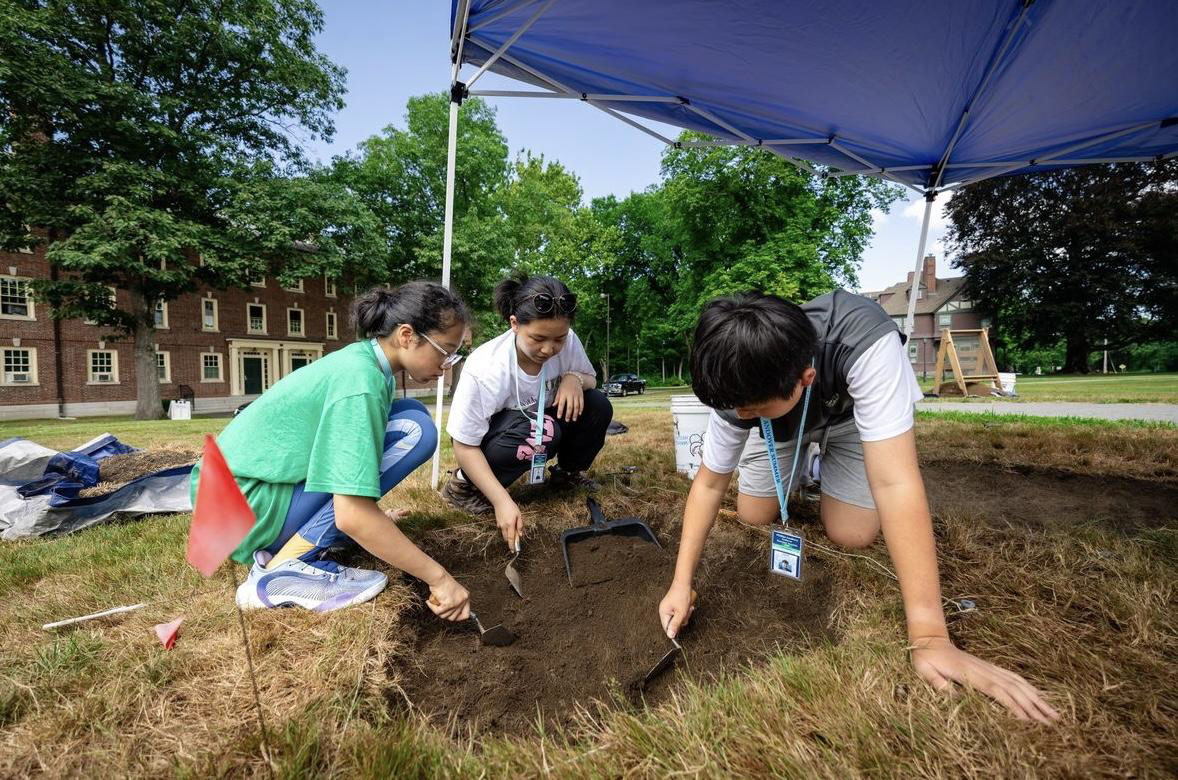
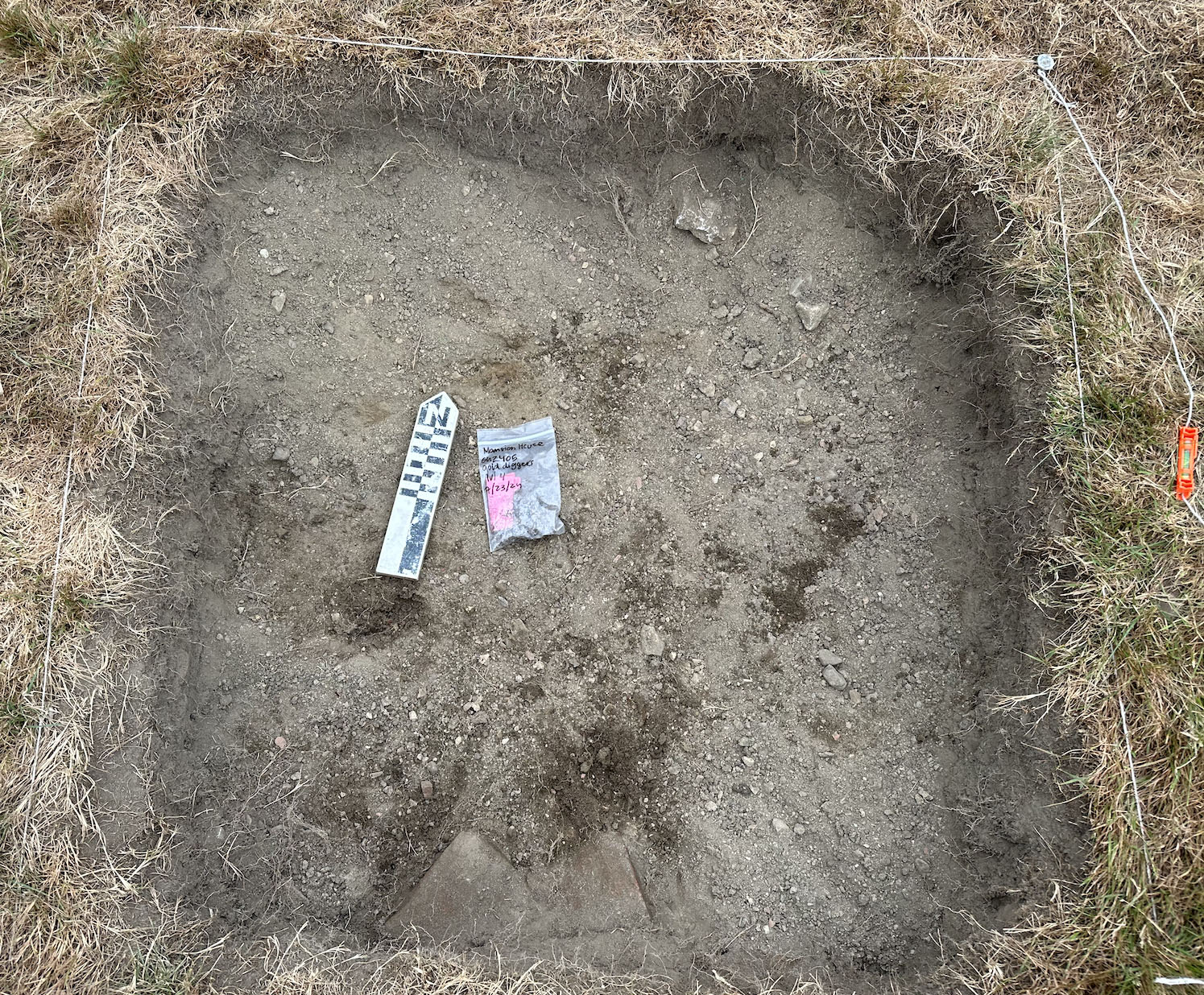
After being introduced to the legacy of the Mansion House and its past excavations, the 2024 archaeology crew set out to build upon this research by investigating parts of the site which have never been previously tested. Specifically, six teams were each assigned a 1 X 1 meter unit and asked to investigate a given region of the West Quad, whether it be just outside of the Mansion House walls, in the area suspected to hold a nineteenth century privy, or the very place where a neighboring nineteenth century printing house was known to have stood. Equipped with shovels, trowels, and screens, the six teams got to work and all quickly began to gather archaeological data.
While no team this summer unearthed ash layers relating to the infamous 1887 fire, which resulted in the destruction of the Mansion House, several groups discovered an abundance of charcoal and burned brick. Additionally, the two groups assigned to dig in the hypothesized privy, EU 2404+2405, uncovered a plethora of cultural materials, including a button, many ceramic shards, and faunal bones. Specifically, a small black glass button, which was unearthed in EU2405, became of great interest to the students. Because black glass beads were only in fashion during the ten-year period when England’s Queen Victoria was in mourning, the button students found can be dated to that decade between 1861 to 1870. How exciting!
Students stationed in the area believed to be where the nineteenth century printing house once stood uncovered a considerable amount of leather. It is unknown if this leather came from shoes or book bindings, however the find itself is incredible given how well the material preserved over time!
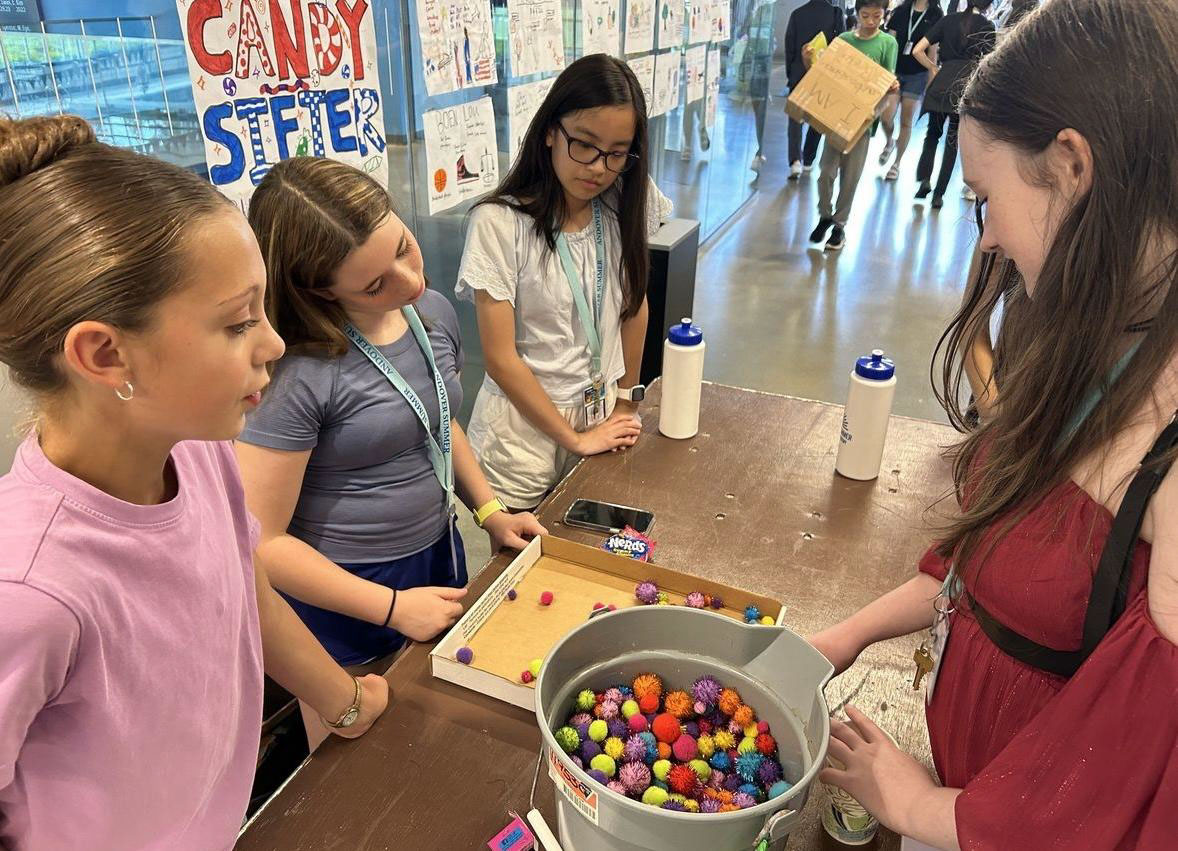
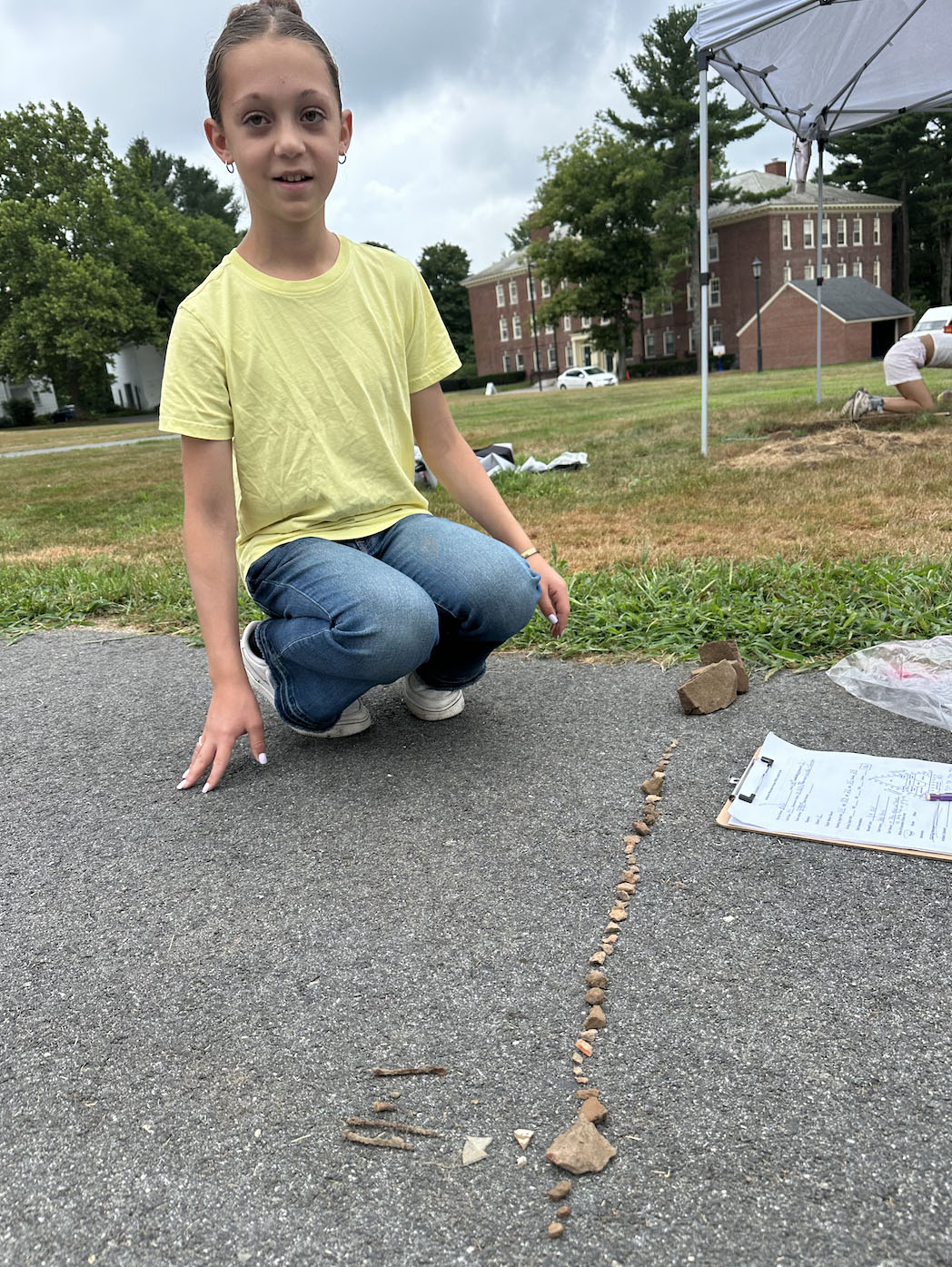
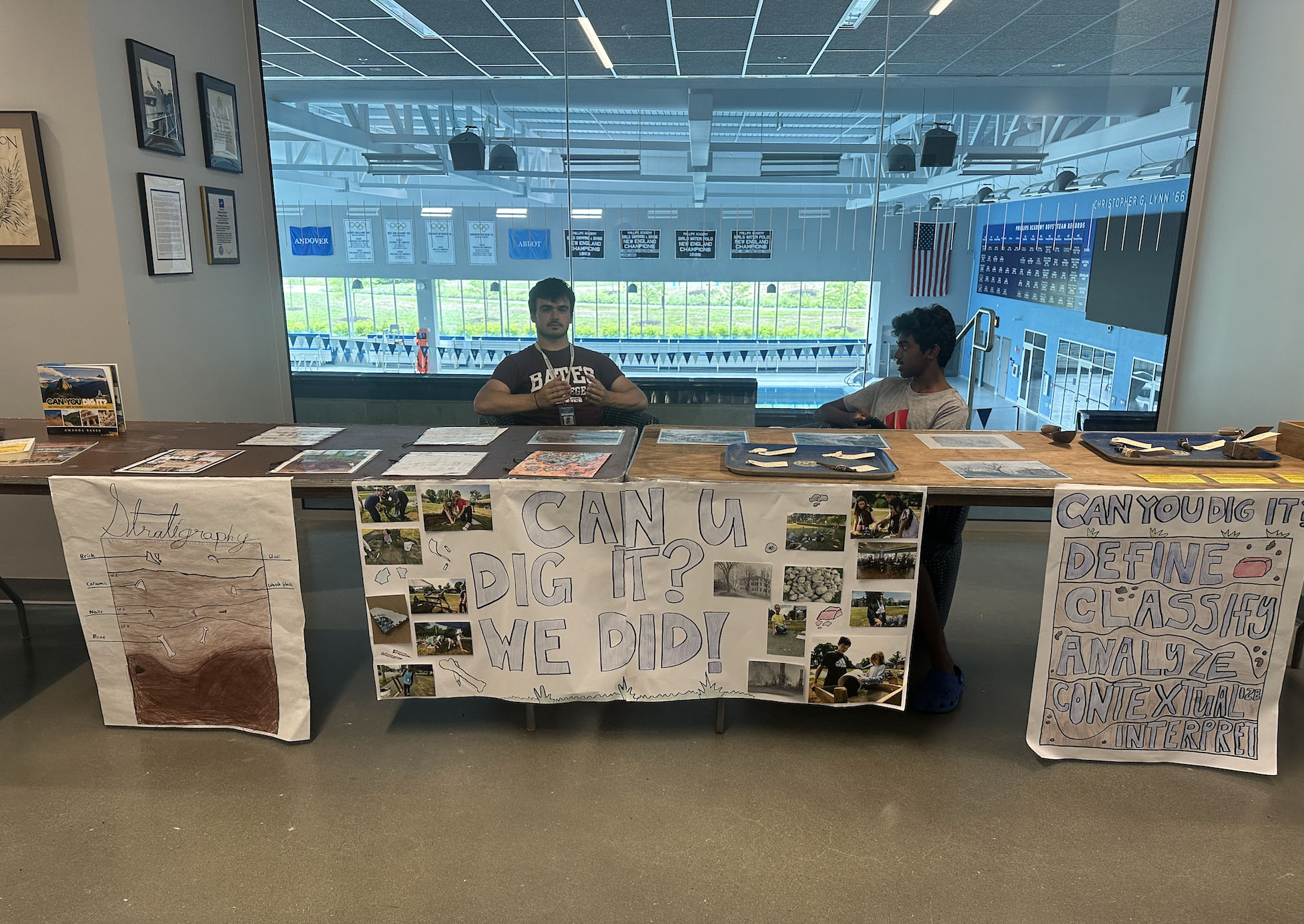
Despite the fact that the 2024 Dig This! crew did not uncover any features relating to the Mansion House, privy, or printing house, students still reveled in the amount of cultural material found and were very excited to show it off at their LSI student exhibition. Students specifically enjoyed the opportunity to set up an archaeology simulation, where they explained the process of digging and let others take a stab at excavating exciting treasures in the form of candy!
Cheers to another amazing summer of learning in the dirt!
PA Reunion Weekend only comes once a year and it is one Saturday that I don’t mind working. Now that I have been at the Peabody for over 16 years (gasp!), I am privileged to have forged connections with dozens of students over the years and I really love seeing them return as alumni.
For anyone who doesn’t know, the Peabody Institute has long been a part of the Phillips Academy work duty program. PA students are required to do some type of work on campus during their time as part of their education. The Peabody has been one of those work venues for about 20 years now. While time requirements for work duty have shifted over the years, this has long been an important link between the Peabody and students. Running the work duty program was a primary focus of mine for 8-10 years and I really enjoyed getting to know the students.
Now, some of those students come back as adults and share their memories with me. Being a part of their PA experience and leaving any type of impact on them is truly one of the best parts of my job. I look forward to many more opportunities to connect!
I’ve sat down several times to write this. It’s hard, for a couple of reasons. Dominique will always remain a remarkable person, funny, talented, generous of spirit, and with a laugh that made everyone around her soar. I think I’ve delayed writing because I feared I wouldn’t find the right words. Also, I was afraid that with the words would come a finality.
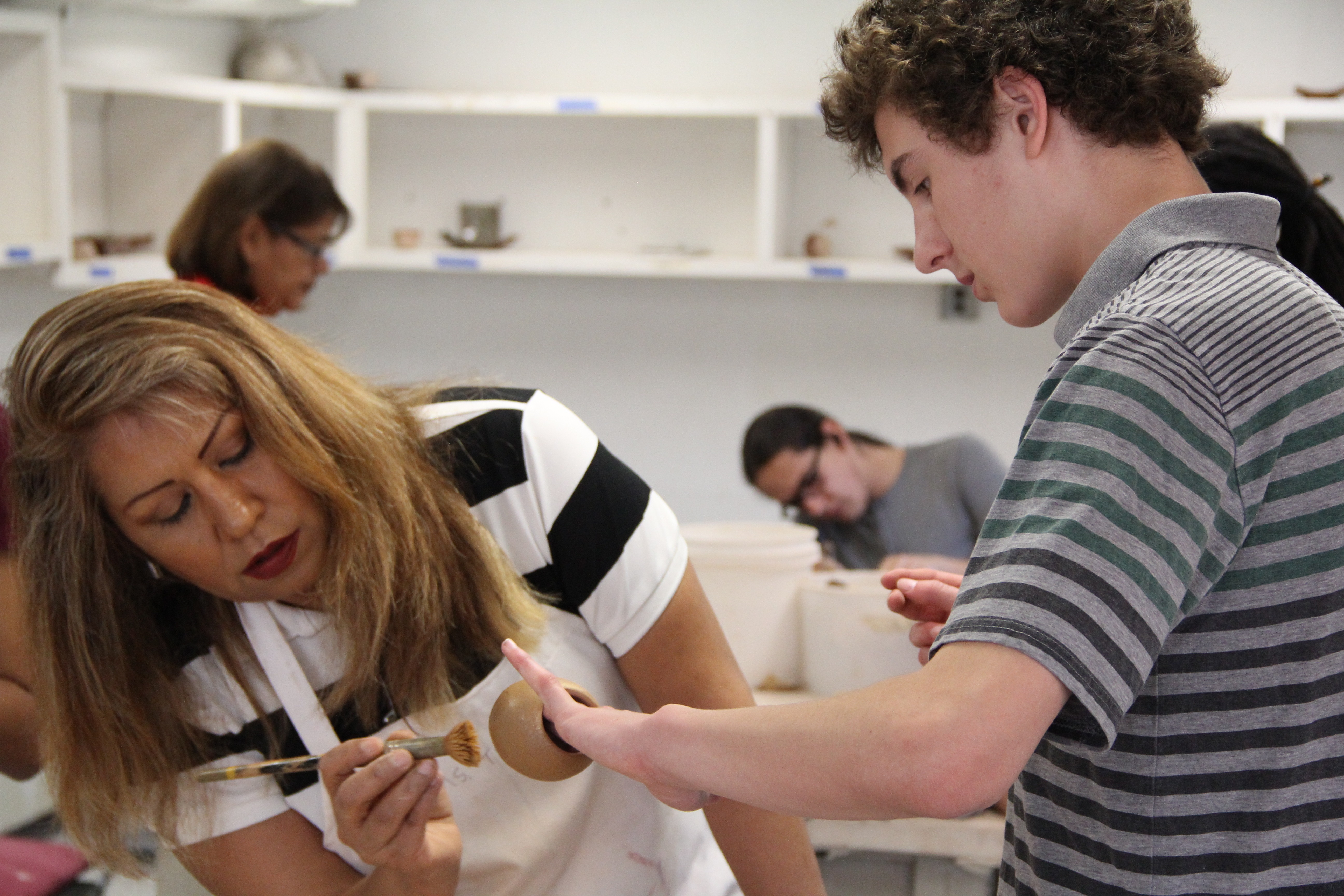
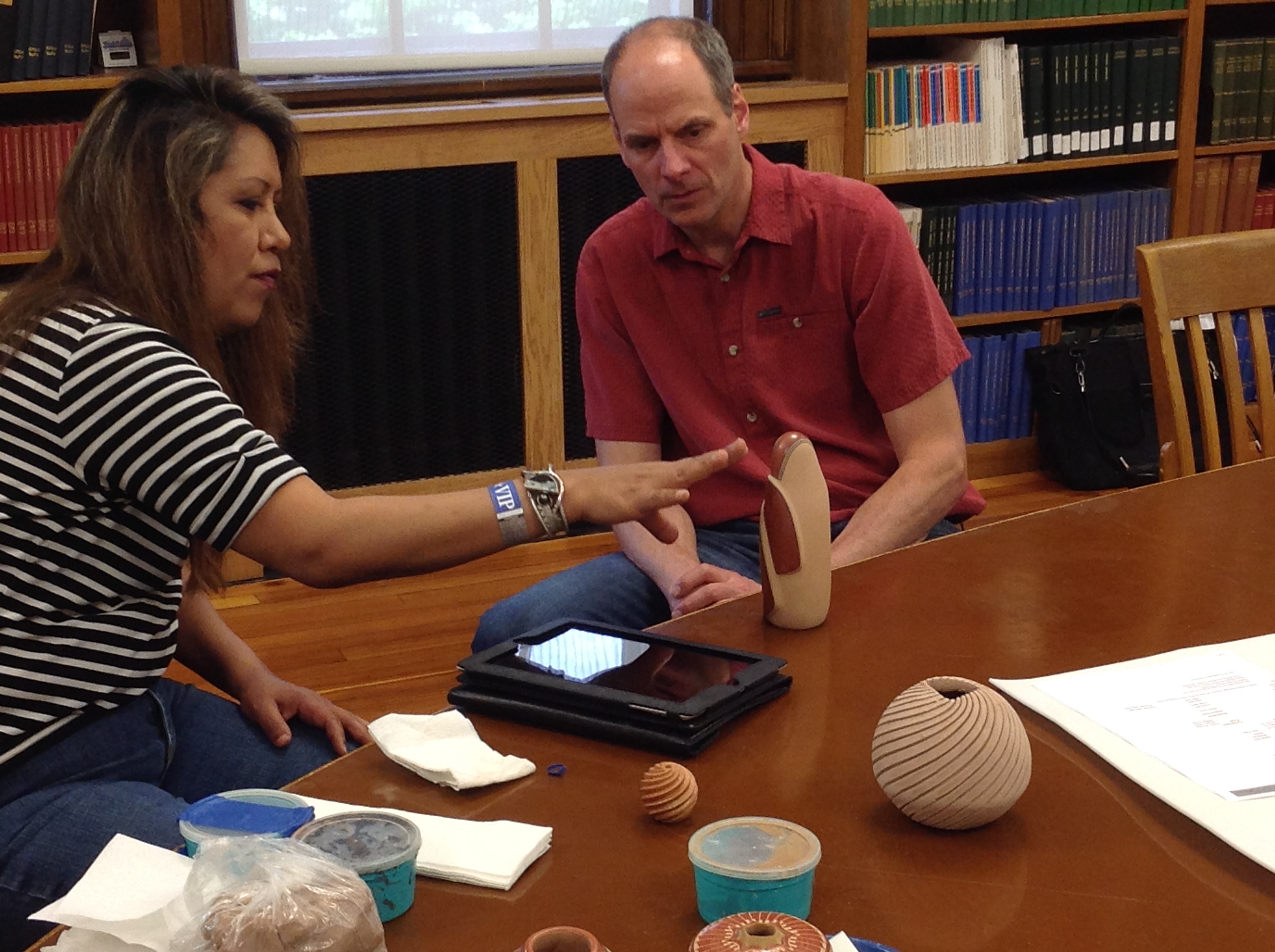
Dominique demonstrates the addition of mica to a student’s piece, May 2016.
Last month saw the passing of a truly remarkable individual. We remain shocked and saddened by the loss of Dominique Toya (1971-2023), who we have been fortunate to know since 2013. Dominique was a fifth generation potter, born to the Corn Clan at the Pueblo of Jemez. Dominique’s particular style of pottery saw the fusion of traditional methods and materials with innovative shapes and surface treatments. Collaboration with her family and other artists produced stunning and innovative results.
Dominique shares points out the polished details on her mom’s town crier figure to Phillips Academy ceramics instructor Thayer Zaeder, May 2014.
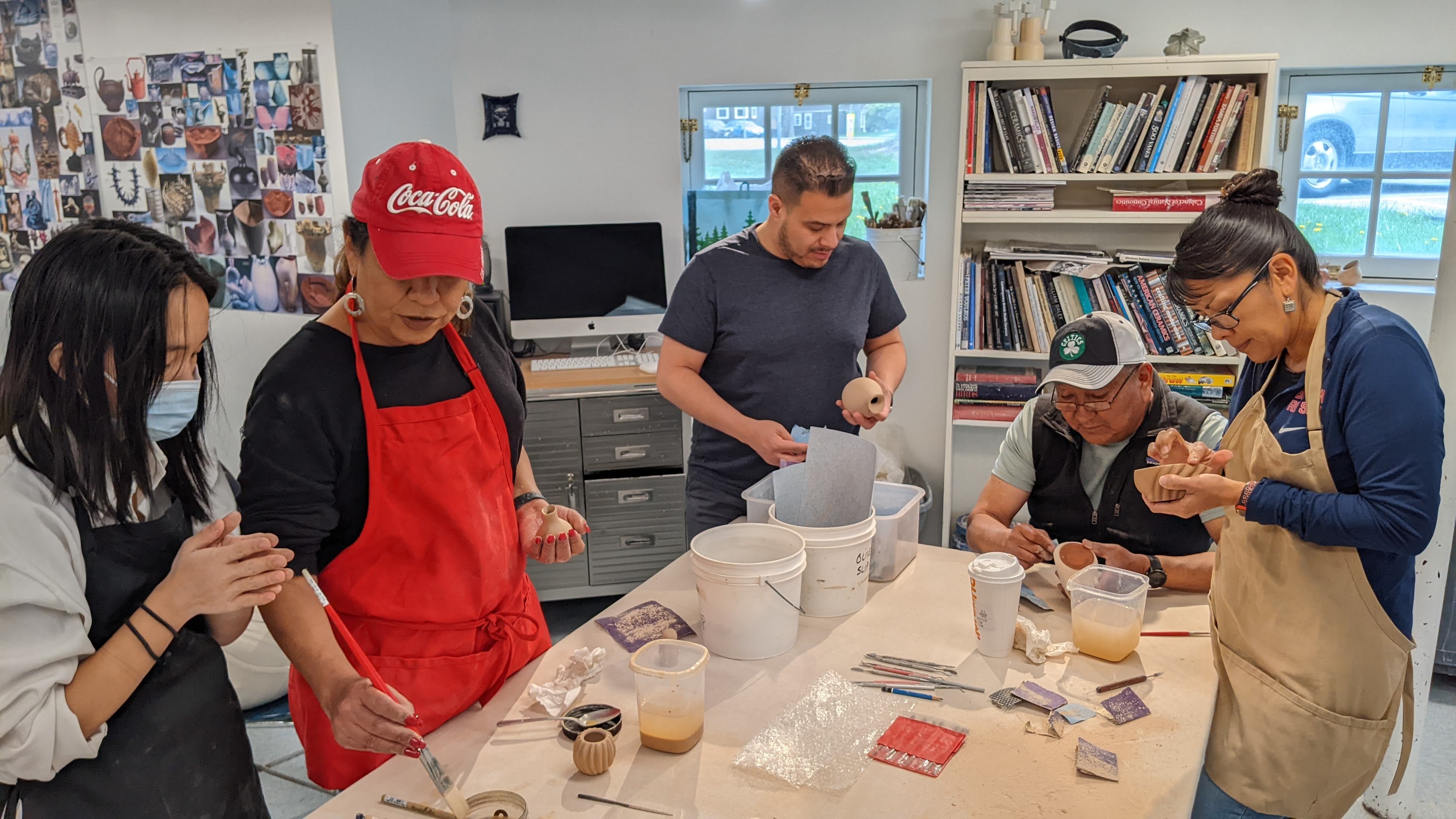
Dominique and her mom Maxine and sister Mia, often with other friends and family, traveled to Andover every year since 2014 to share Pueblo pottery making with Phillips Academy students, faculty, and friends. These weeklong workshops allowed students to make their own ceramic pieces with clay from New Mexico, finished, decorated, guided, and encouraged by the Toya Family. One year I conducted interviews with students following the finale of the class—an open-air firing. Considering all that Phillips Academy has to offer, I was a bit surprised when many of the students said their time with Dominique and her family was their best Andover experience. I shouldn’t have been surprised. Dominique was far more than a gifted artist; she was an ambassador of Indigenous art, and above all, a generous teacher.
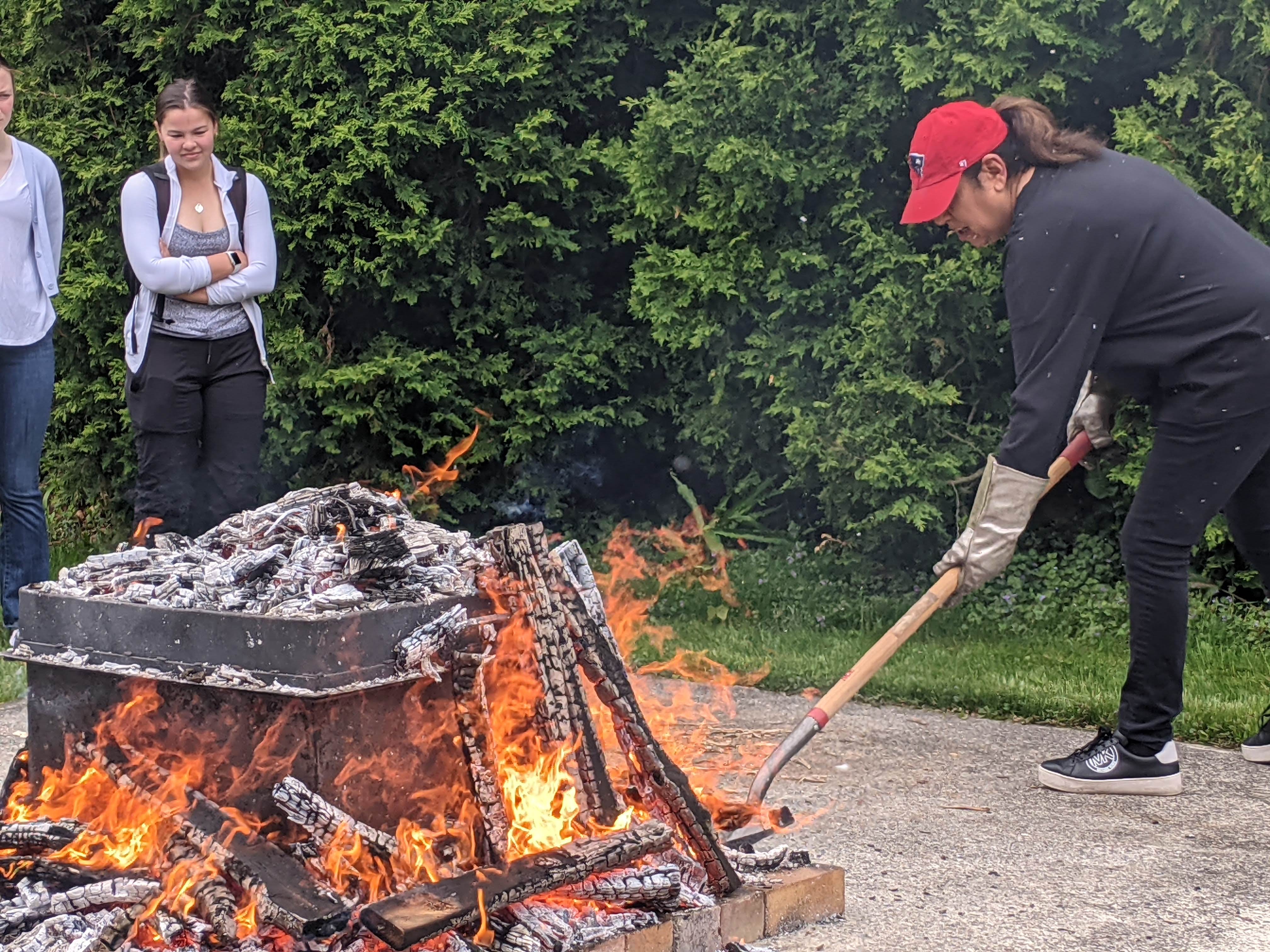
Dominique tends the open air pottery firing at the end of May 2022’s weeklong workshop as students look on.
I cherish the Toya Family’s time on campus, Dominique’s laughter and sense of humor, but also watching her help students design and complete pieces, often helping them figure out how to solve problems or challenges (often ones that they had created!). Dominique played a big role in many communities–she was involved in the Southwestern Association for Indian Arts, from exhibiting and frequently winning awards at the annual Santa Fe Indian Market, judging and mentoring, to service on the SWAIA board. Dominique also was a drag performer and frequently traveled to participate in the International Court System, including the Imperial Sovereign Court of New Mexico, where she was crowned Empress 10. The International Court System is a venerable and well-known LGBTQ organization, raising funds for social issues, education, and other charitable causes. Dominique and her mom often donated their pieces for those fundraising efforts. During the Jemez and Pecos feast days, Dominique and her family prepared traditional foods, like Jemez enchiladas and oven bread, welcoming friends and visitors into their home to celebrate.
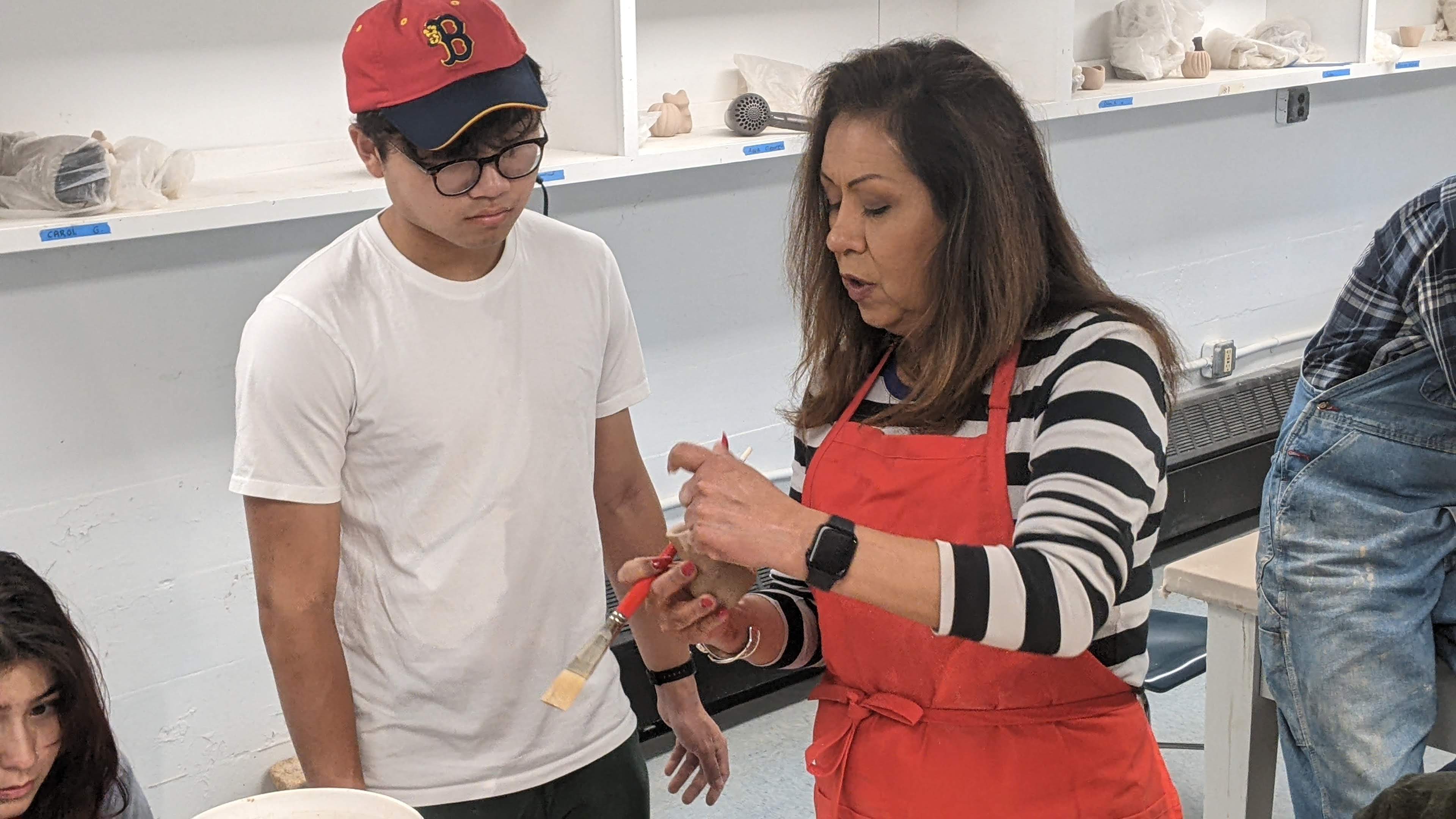
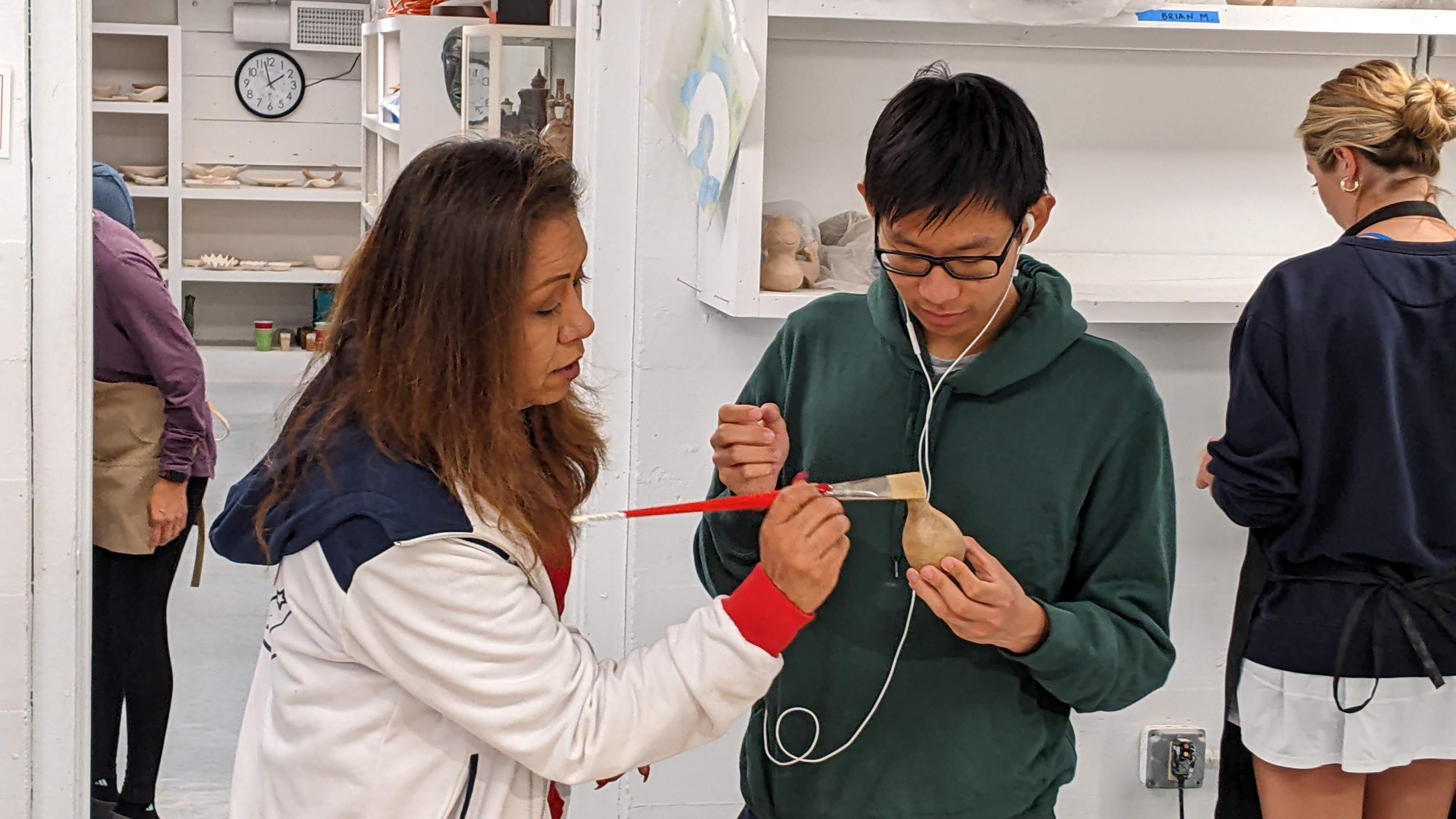
Dominique shares some tips on finishing a piece with an Academy student, May 2023.
I’m grateful that Dominique chose to be part of the Peabody Institute and Phillips Academy communities as well. Dominique, you taught us all a lot about art, Indigenous art, clay, the magic of mica, the business (and politics) of Native American art, but most of all, the art of being yourself. I’ll end with some of the student reflections from the Toya Family workshop in 2017: “Working with the Pueblo potters is really fun—we learned a lot and they have an amazing sense of humor.” “To be able to incorporate these techniques into my pieces gave me a new level of respect for pottery.” “This is one of the best things I’ve done all term, actually all year.” “These artists are so cool and they really care about their art and about your art.” Dominique, thank you for sharing and Godspeed.
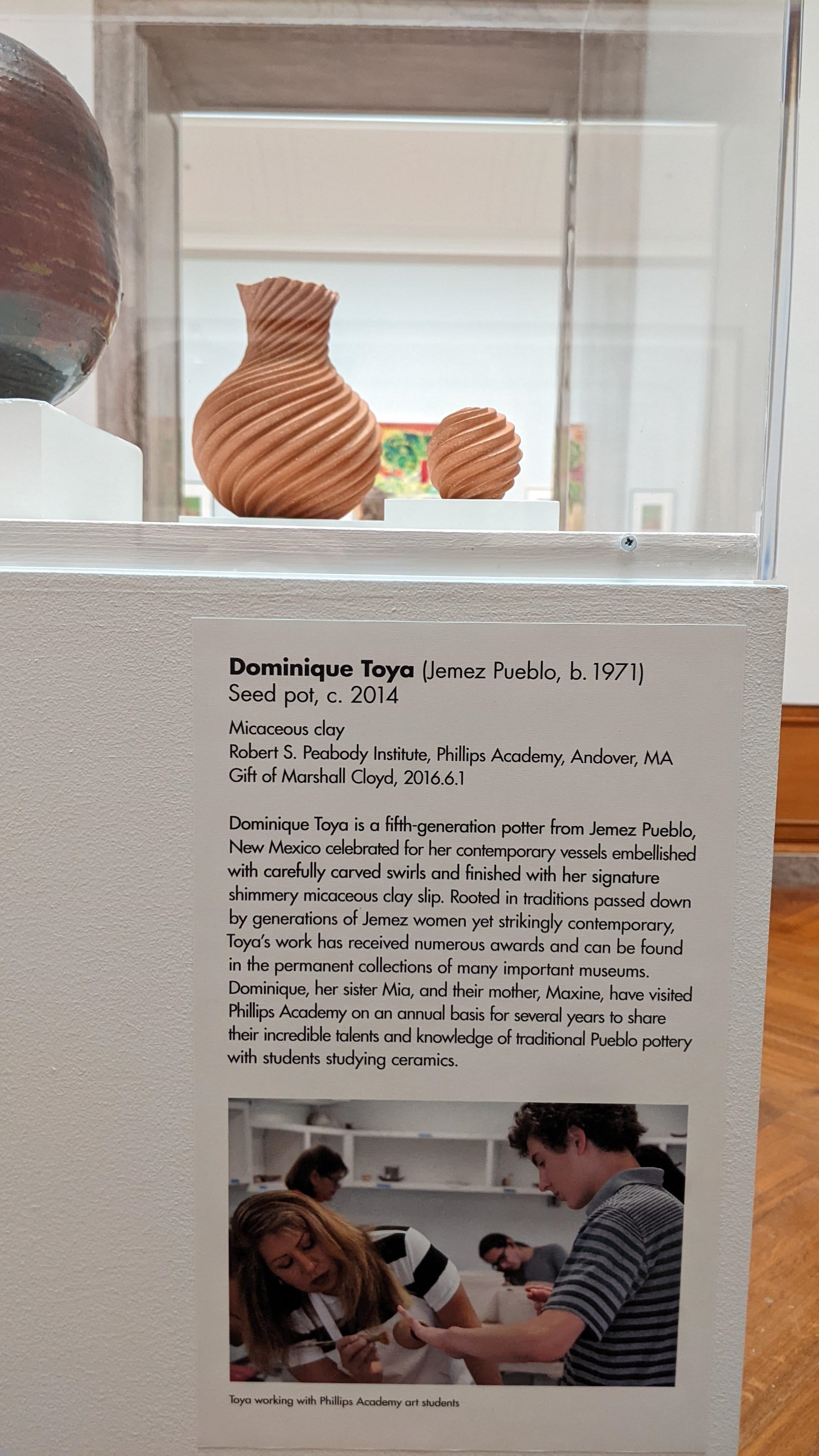
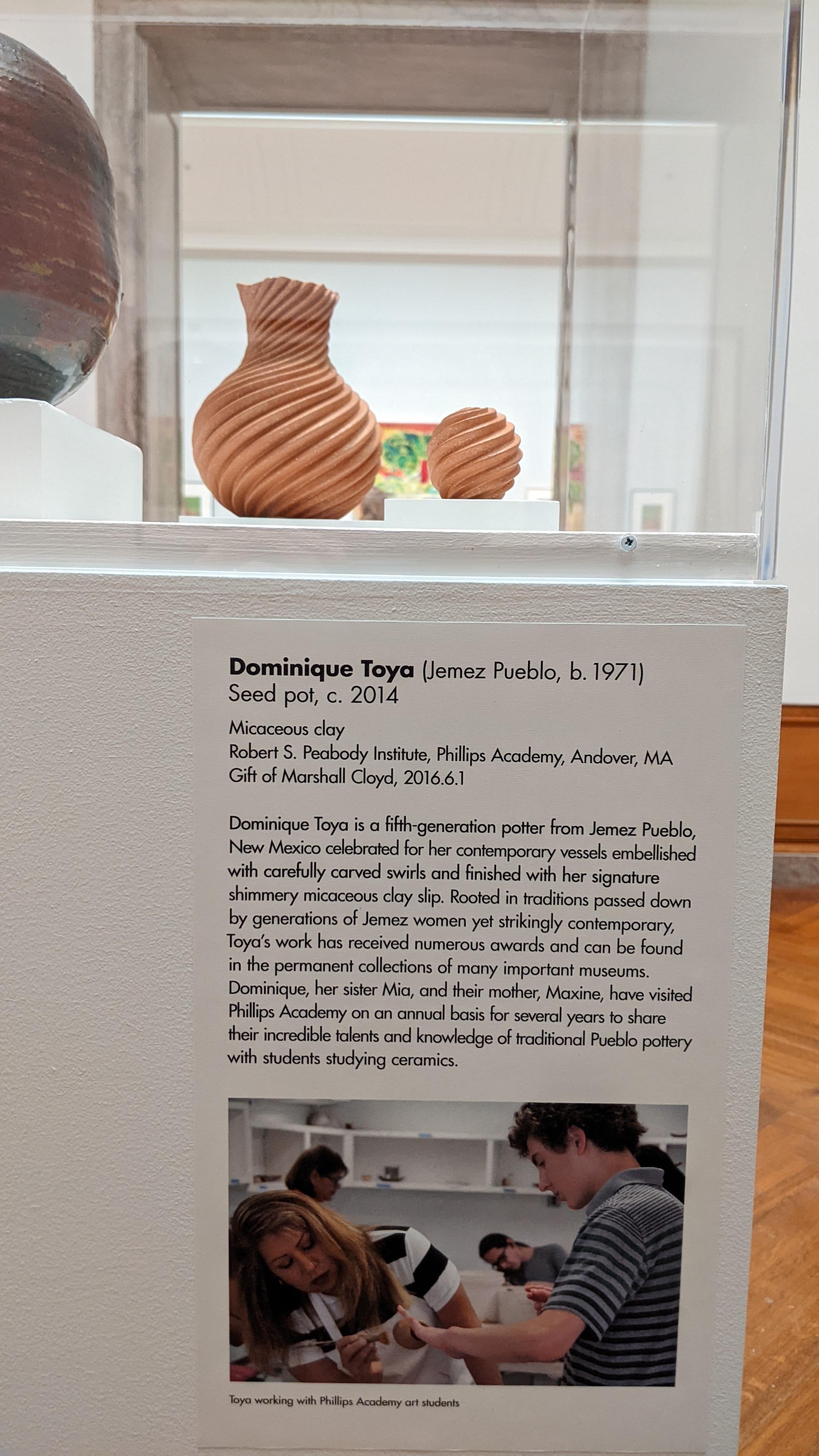
The Peabody Institute is fortunate to have several of Dominique’s pieces, including these two swirl vessels that were featured in the spring 2023 show “Women in Abstraction” at the Addison Galley of American Art.
Contributed by Peabody Student Volunteer, Anthony Chung Yin Woo
In the fall term of tenth grade, I first joined the Peabody as a work duty student before returning as a student volunteer during my upper senior year. Working at the Peabody has given me an in depth behind the scenes look into running a museum, exposing me to the challenges in caring for a collection. When participating in preparation works for the building renovation project last winter, I learned about some of the technical complexities that museum workers have to go through in order to responsibly safeguard the collection. Having had the great opportunity to attend the Peabody Board of Advisors meeting in the fall as a student representative, I was also exposed to some of the administrative complexities behind museum work.
A complete revamp of the basement area meant that we had to come up with creative solutions when it came to temporarily rehousing the collection within museum premises. Armed with a tape measure and a rough floor plan, we navigated all protruding columns and bulky built in radiators in the southern first floor gallery to mark up the approximate location for a separated temporary storage space with individual climate monitoring, while maintaining the required three foot hallway for access to the fire exit located at the back of the building. Additionally, previously underutilized spaces had to be optimized to fit in more durable, weather resistant objects, allowing me to foray into the expansive attic as I removed sawhorses and large glass tubes from the basement.
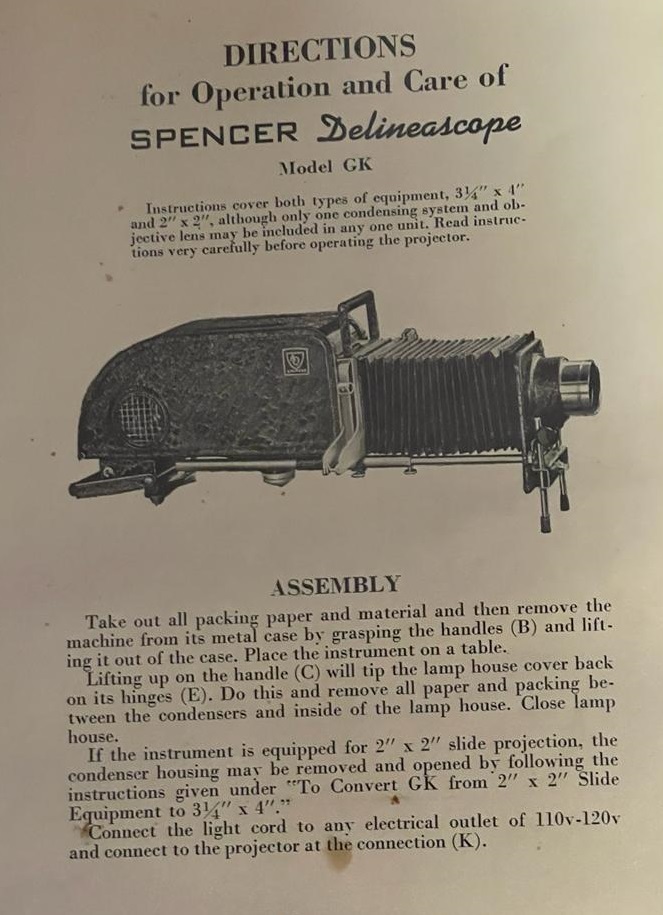
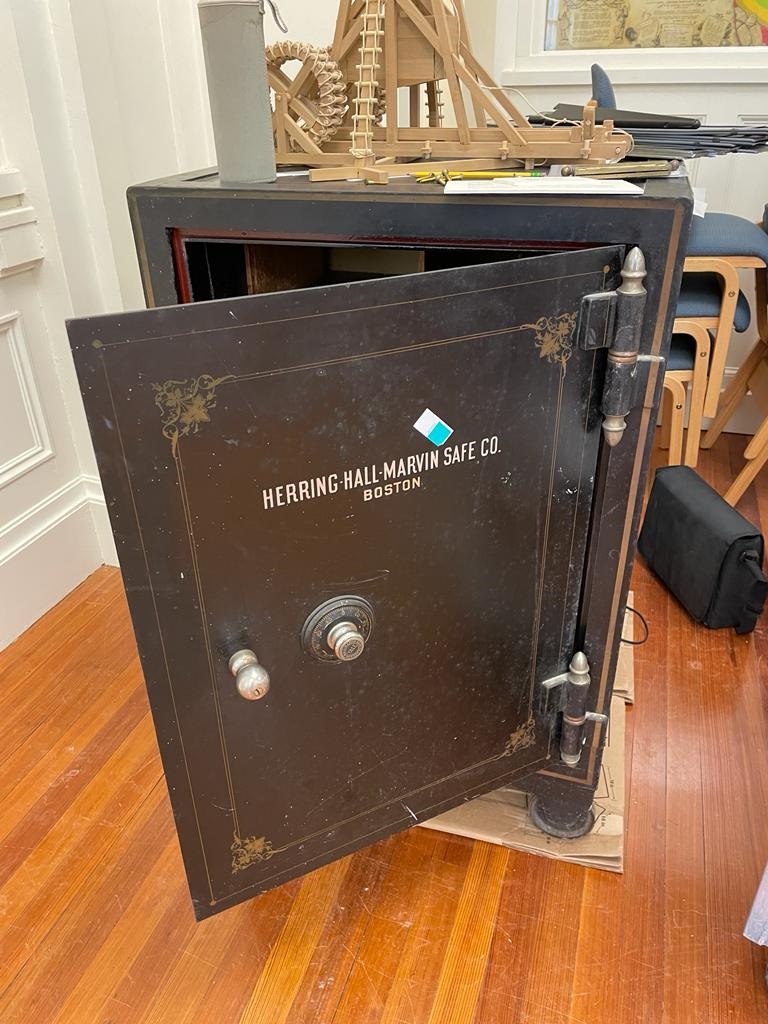
In spite of the physically and mentally draining task of completely clearing out the basement, moments of excitement rewarded me throughout the process. Under the empty wooden bays, for example, I found tiny matchboxes from the 1940s, cool items which alluded to the museum’s own history. A Spencer Delineascope, manufactured by Bell and Howell found in the basement, spoke to the great advancements made in projection technology since the 1930s, as the bulky object was moved slowly up the stairs. Only when it was removed from the little room under the stairs to the basement was when I could truly appreciate the size of the museum’s safe and its obsolescence in a time when the entire collection was kept behind locked doors.
Direction Booklet for the Peabody’s Delineascope
The Peabody’s old safe.
Learning about the 3D printed replicas of the intricate molding on the gallery ceilings also made me appreciate the museum as a historically significant space itself, allowing me to understand that preserving the space’s spirit through attention to detail was crucial even as the building is physically altered to facilitate better learning in the future through greater accessibility.
Attending the Peabody Advisory Committee meeting allowed me to better contextualize my work as a volunteer as I watched experts across disciplines partake in the collaborative process of museum governance. It was especially interesting for me to hear about the cross-institutional connections brought by Hopi artist Ramson Lomatewama, and I was particularly happy to share my experience at the communal fused-glass making workshop, which was enthusiastically attended by both faculty members and students. Going through items on the agenda, such as the adoption of a new mission statement, as well as the advisory board’s renaming (form the Peabody Advisory Committee to Peabody Board of Advisors), while less captivating than the discussion on the Peabody’s educational program and future student engagement opportunities, were nevertheless just as relevant to the student experience. As I look forward to returning to the updated building on Main Street in the winter, both as a student volunteer and as a member of this year’s Human Origins cohort, I am constantly reminded of the care demonstrated by the Peabody’s staff as well as the Peabody Board of Advisors towards the collection, the museum, and the greater community as a whole, manifested in the meticulous attention to word choice in the advisory board’s mission statement drafting process.
This summer, 23 young archaeologists set out to investigate one of the first buildings constructed by Samuel Phillips Jr. after he founded Phillips Academy. During the first week of the Andover Summer program, the students of the Lower School’s Dig This course were introduced to the story of the Mansion House and the mysterious fire that destroyed it in 1887. According to primary accounts, the fire seemed to have started in two different places in the house. This account was made even more suspicious by sources that said the caretakers, Mr. and Mrs. Carter, had their bags packed the day of the fire and walked away with insurance money. With this interesting piece of information, the students were excited to uncover more clues about the Mansion House and the people who inhabited it. The students worked in groups of 3 to 4 at six excavation units. These units were spread across the site in areas that, using past excavation results and Ground Penetrating Radar maps, had a good chance of finding evidence of the Mansion House.
Figure 1. Commemorative Plaque of the Mansion House
The first day of excavations was met with enthusiasm, apprehension, and later exhaustion as the students realized how much work goes into opening a unit. Nonetheless, we persevered and by the end of the first week of excavations many groups had already finished Level 1. Some had even found glass and metal artifacts which, of course, created healthy competition between groups and motivated the students as they continued in the second week of excavations.
Figure 2. Two students working in Excavation Unit 1
During the second week, things got interesting. The students working in Excavation Unit 5 came across an 1802 “Draped Bust” Liberty penny which caused a ripple of excitement for both the students and the instructors. This coin gave an important terminus post quem (TPQ) for the level and showed the students how old the artifacts we were finding really were.
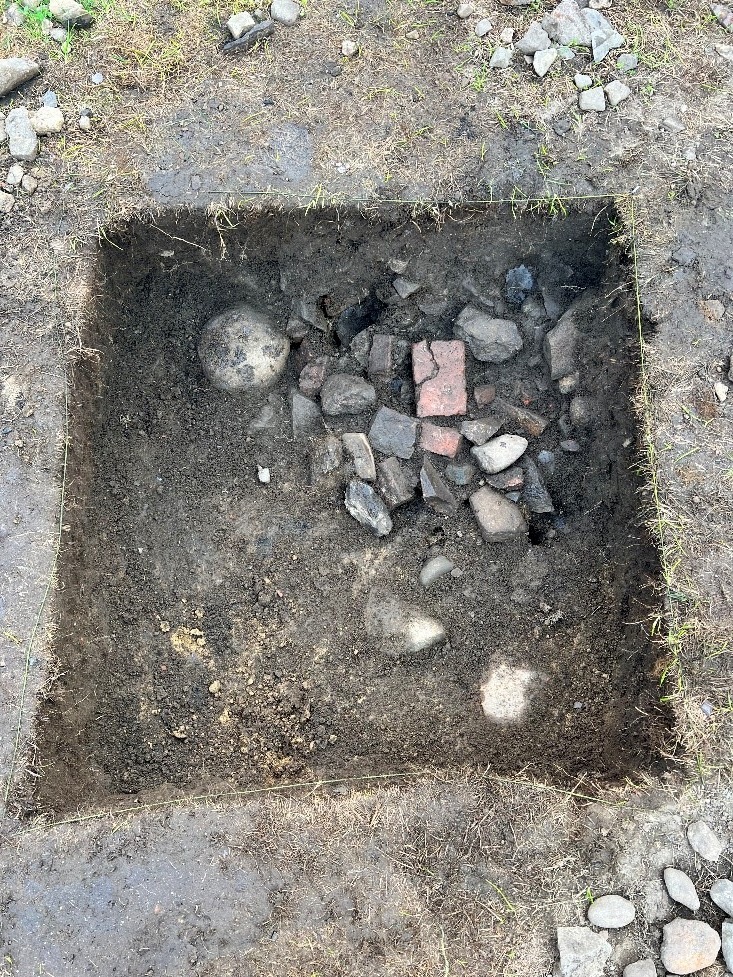
Additionally, in Excavation Unit 2 Level 2, a brick feature began to reveal itself in the northeast corner. This unit was placed near a 2018 excavation unit that uncovered part of a chimney, so it is likely these features were related and Unit 2 uncovered another part of the chimney which helps in understanding how large the chimneys would have been and the layout of the Mansion House. The images below show the brick feature when it began to be discovered in Level 2 and the brick feature in Level 3 before backfilling.
Figure 3. Brick feature in Excavation Unit 2 Level 2Figure 4. Brick feature in Excavation Unit 2 Level 3.
The third and final week of excavations supported the archaeological adage that you always find the most interesting stuff right before you’re going to leave a project. This week, two new features were discovered. One was in Excavation Unit 6, which was intended to find one of the foundational walls of the structure. This feature also included a brick, though it is unclear if it relates to another chimney of the house. There was also a large stone and some smaller stones found near it, though, likely not enough to constitute a foundational wall of the building.
Figure 5. Students working in Excavation Unit 6
That being said, one of the biggest finds of the project included a huge rectangular stone with other large stones overlapping it. This feature was found in Excavation Unit 1 which was placed north of Excavation Unit 2 in the hopes of uncovering part of the foundation of the house. Given the size of the stone and the overlapping rock around it, it is pretty likely that this feature relates to the foundation or a wall of the Mansion House. On the last day of excavations this unit surprised us further by containing a large amount of metal artifacts in the southwest corner of the unit. A fork, a hinge, a handle, and a plethora of other artifacts were uncovered in the last level of this unit. We probably could have found more in the next level if we didn’t have to backfill the next day. This unit is definitely one to revisit in future years!
Figure 6. Stone feature in Excavation Unit 1 Level 3.
While neither unit contained a feature, Excavation Unit 3 and Excavation Unit 4 contained a lot of charcoal and mortar. Excavation Unit 3 specifically had extremely dark, somewhat ashy soil which was likely due to the fire. Ideally future Dig This! classes will uncover more of this ashy, dark soil and the data can be compiled to give a better understanding of how the fire destroyed the mansion house.
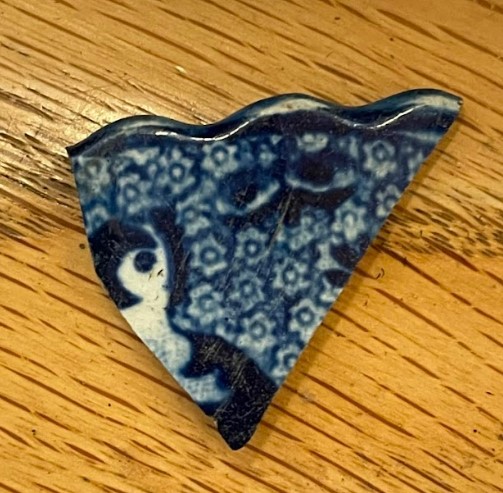
During the last week of the course, the students were busy washing their artifacts and picking a few to display at their end of the year exhibition. These artifacts included a locking mechanism, large nails, blue transfer print ceramics, a marble, a hinge, and a fork! All of the artifacts found during this summer’s course were transferred to the Peabody Institute to be cataloged and analyzed with the rest of the Mansion House artifacts.
Figure 7. Fork found in Excavation Unit 1Figure 8. Ceramic sherd found in unit 2.Figure 9. Locking mechanism found in unit 5.
Overall, the students had a great summer excavating the Mansion House and learning how to be archaeologists by following proper archaeological methods and recording techniques. I look forward to seeing what next summer’s Dig This class will find!
The Peabody has several amazing pieces of pottery made by members of the Toya Family of Jemez Pueblo. On their first visit to the Peabody in 2013, Maxine and Dominique Toya noticed a small vessel on our open shelving. What caught their attention was a delicately painted corn stalk, representing their clan. They wondered aloud who might have used these design, and we were all delighted to find that Maxine’s mom and Dominique’s grandmother, Marie G. Romero, had made the piece. Marshall Cloyd ’58 generously helped us acquire several of Dominique’s creations, including a small seed jar with distinctive carved ribs and mica slip. Since then we have added a number of wonderful pieces to the Peabody collection, including one of Maxine’s owl figures and a collaboration featuring Dominque’s beautifully crafted vessel bearing Maxine’s hand painted deer and corn stalk designs.
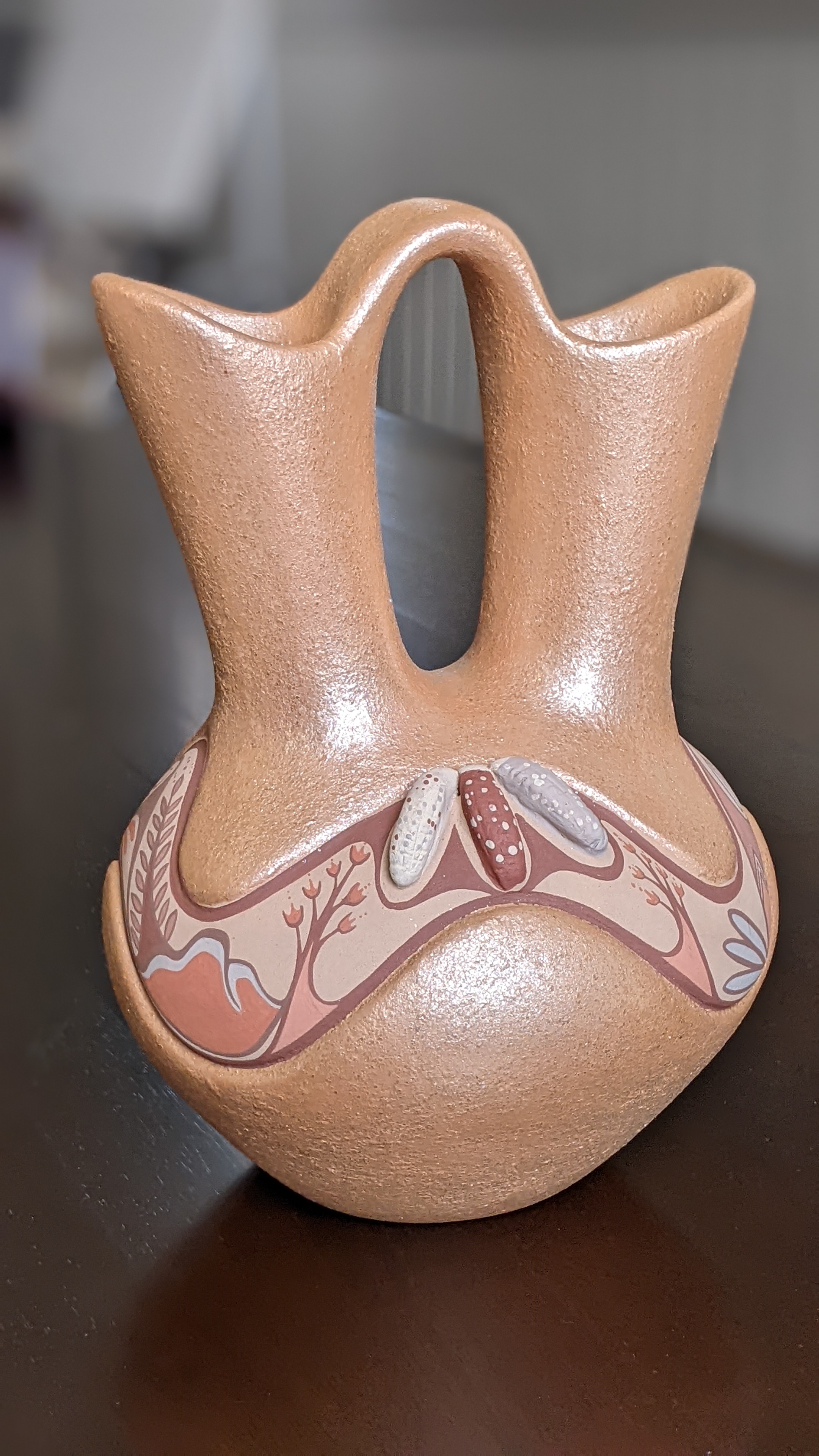
In May, we acquired a special piece called Three Generations. Dominique said, “this was the last wedding vase my grandmother, the late Marie G. Romero, created before she passed away. My mom and I have kept it sitting at our studio until we finally decided to finish her. I’m going to sand her and apply mica on the top and bottom and mom will paint a design in the middle where the band is and paint the ears of corn. This piece will be called Three Generations and will be the only piece that is signed by me, my mom, and I’ll sign my grandmother’s name since she created her.” The Toyas fired Three Generations on April 3 and brought her to us during their workshop with students in May. This is a large piece, at least 11 inches tall, and the overall shape, finishing, and delicate painting is truly impressive. Dominique commented that, “my mom outdid herself again with the amazing painting!!!” and we couldn’t agree more!
At this year’s American Society for Eighteenth Century Studies (ASECS) conference, I had the opportunity to participate in the roundtable Teaching the Global Eighteenth Century. Phillips Academy instructor in history and social sciences Natalya Baldyga and I presented Assimilation, Acculturation, Catachresis, and Syncretism: Employing Archaeology to Foreground Indigenous Resistance in the Spanish Southwest, sharing our experiences teaching the Pueblo Revolt of 1680 to History 200 classes at the Academy.
Contemporary Indigenous artist Jason Garcia’s take on the Pueblo Revolt combines traditional materials and methods with graphic designs depicting Po’Pay, the architect of the revolt, as a comic book superhero. These two pieces are in the collection of the Robert S. Peabody Institute of Archaeology–you can see the vessel on the right in the inaugural exhibition of the Smithsonian’s National Museum of the American Latino.
If you are not familiar with the Pueblo Revolt, it is a pivotal moment in the history of the Southwest and the modern descendants of those who fought Spanish colonization at the end of the seventeenth century. Our abstract has a little more information on the Revolt and our approach:
Using the case study of the Pueblo Revolt of 1680, our presentation illustrates how archaeological artifacts can be employed to unsettle and decenter colonial narratives by refocusing the North American story of the early eighteenth century on Indigenous peoples of the Spanish Southwest. Too often, Anglophone histories associate the long eighteenth century in the Americas with English colonialism in general, and with the American Revolution in particular. We ask students to consider instead the “first American Revolution,” in which the Pueblo Peoples, led by the Tewa religious leader Po’pay, confronted missionaries and soldiers in the Spanish borderlands of what is now New Mexico. In our classes, students explore both artifacts from the Pueblo Revolt and contemporary Puebloan artistic responses to the historical event, foregrounding Indigenous resistance and survival over tales of erasure and domination. This approach both reorientates students’ understanding of colonial North American history towards wider global narratives of European expansion, and, perhaps more importantly, introduces students to multiple ways that Indigenous peoples adapted to, resisted, and overcame the efforts to erase their cultural identities and physical existence.
Drs. Wheeler and Baldyga also celebrated their anniversary during the conference.
The Peabody Institute has long offered various versions of a Pueblo Revolt lesson, but the current iteration has greatly benefitted from Dr. Baldyga’s experience and training. Together we’ve developed the lesson, typically delivered in the world history survey course for tenth grade, providing students with anthropological concepts, like assimilation and catachresis, that they can use in other settings, as well as foregrounding contemporary Indigenous perspectives and objects directly related to the Revolt. Conversations with other participants in the workshop were productive, especially in their pedagogical approach to topics like the production of sugar.