Last fall I had the opportunity to work with students and faculty in Outdoor Pursuits in a unique way. Ranbel Sun, Stephanie Cormier, and Miriam Villanueva learned that I knew about a terrestrial ship wreck that the students could visit and asked me to join them on their planned outing to Crane Beach, where the wreck has rested for over 100 years.
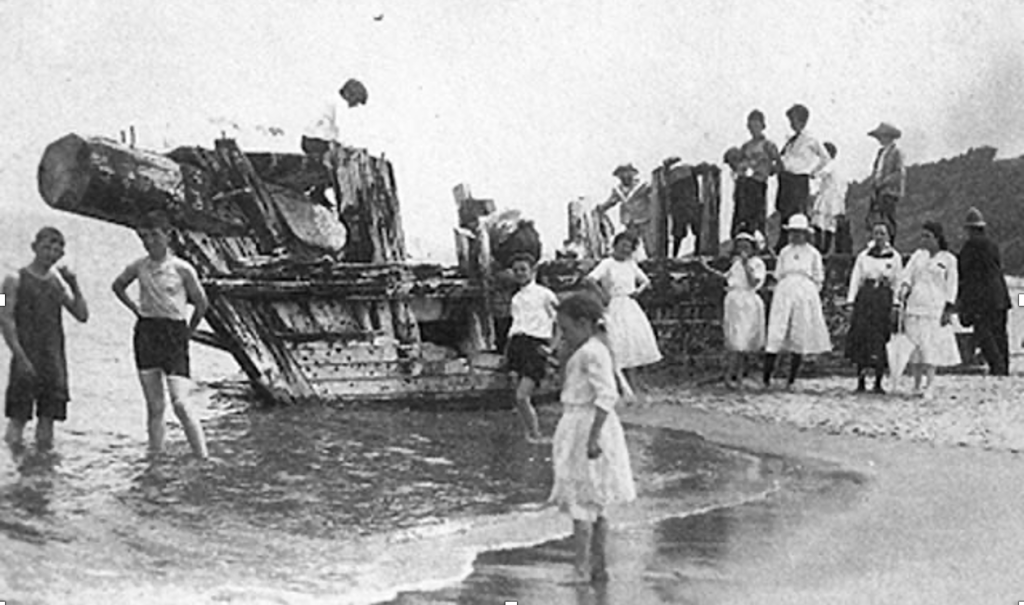
Outdoor Pursuits visiting the Ada K. Damon in 2019
The shipwreck that we visited was of the Ada K. Damon in Ipswich, MA. It is a great place to bring students to learn more about maritime archaeology since it is accessible at low tide. Salem State University and partner SEAMAHP have also done field schools at the site.
The Ada K. Damon was a schooner built in 1875 by H.A. Burnham Boat Building (still in operation today!). By 1909, the owner was Captain A.K. Brewster who had sold his property and used the proceeds, along with all his savings, to invest in the ship.
It a bout of terrible luck, it was during her first voyage for Brewster that the Ada K. Damon was wrecked. She was caught in what locals called the “Great Christmas Snowstorm.” That storm was also responsible for destroying many other ships on Cape Ann.
Since 1909, she has sat on the sands of Crane Beach at the base of Steep Hill and become quite a tourist attraction for visitors.
Sadly, due to the strong surf that resulted from Hurricane Teddy, the Ada K. Damon has been broken up and strewed across the beach.
Both Dave Robinson, the current state underwater archaeologist for Massachusetts, and his predecessor Vic Mastone will survey the damage.
While I hope that the damage isn’t too extensive and that I will be able to bring future students back to this shipwreck, it does serve as an example about the fragility of archaeological sites.
It’s been almost two months now since John and I have been back at the Peabody alternating weeks of work. In order to save time while we are in the Peabody, we are using that time exclusively to inventory drawers and spending our weeks at home updating the database with the drawers we inventoried the previous week. Now that we’ll be back in the Peabody more regularly, our work from home duties have shifted to more database work. In his post from last month’s newsletter, you can see all the hard work John’s been doing at home so now I’d like to share some of the things I’ve been able to accomplish from home so far.
Marla has kept everyone busy with various projects since we started working remotely in March. For me, that included digitizing photographs, creating condition reports for textiles, digitizing ledger books, and photographing site records. In total, while working remotely, I was able to digitize nine boxes of photos, complete 120 condition reports, digitize 1,700 ledger entries, and photograph 354 site records.
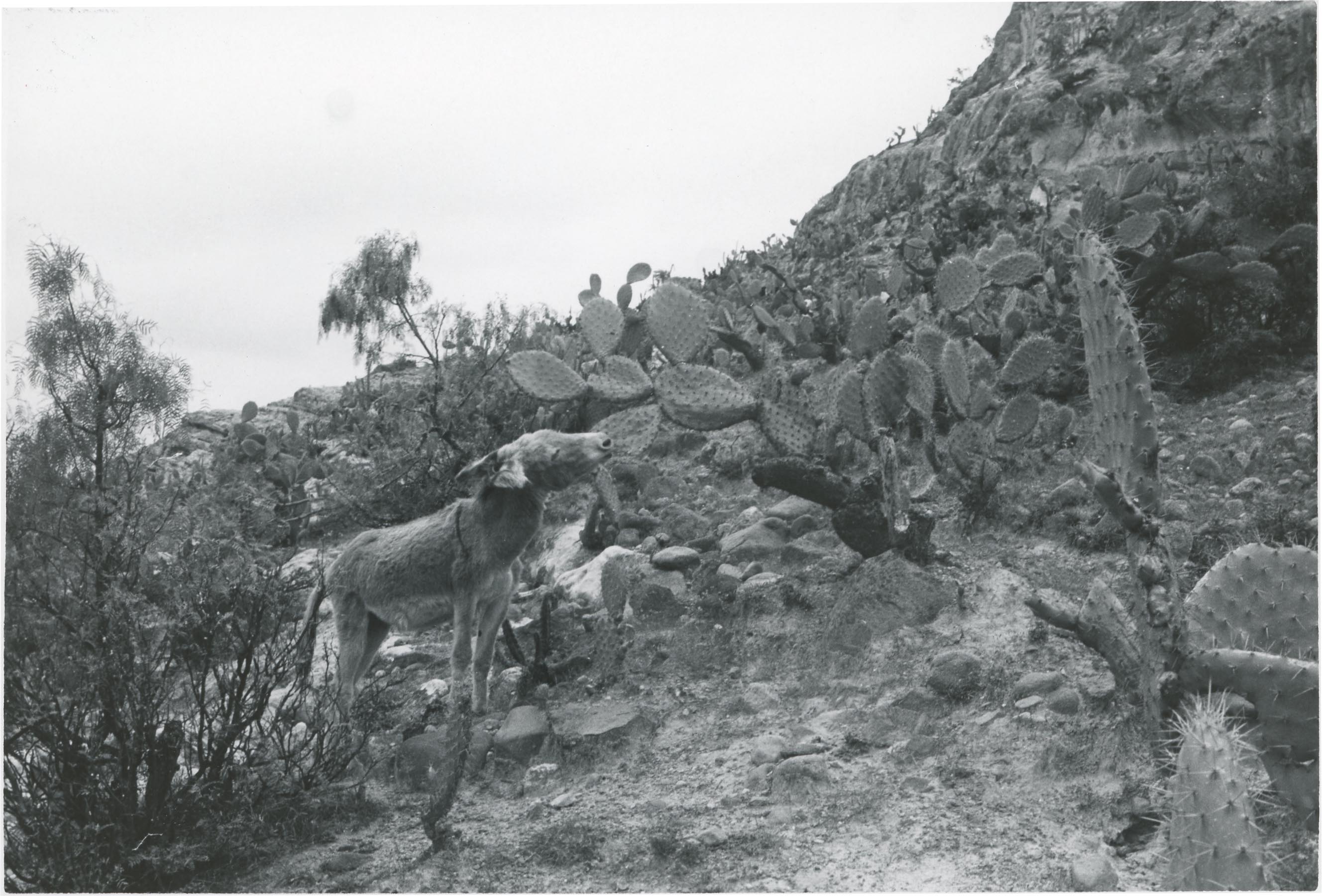
2019.0.706 – A goat on a mountainside in the Ayacucho Valley. (I think this goat is so cute!)
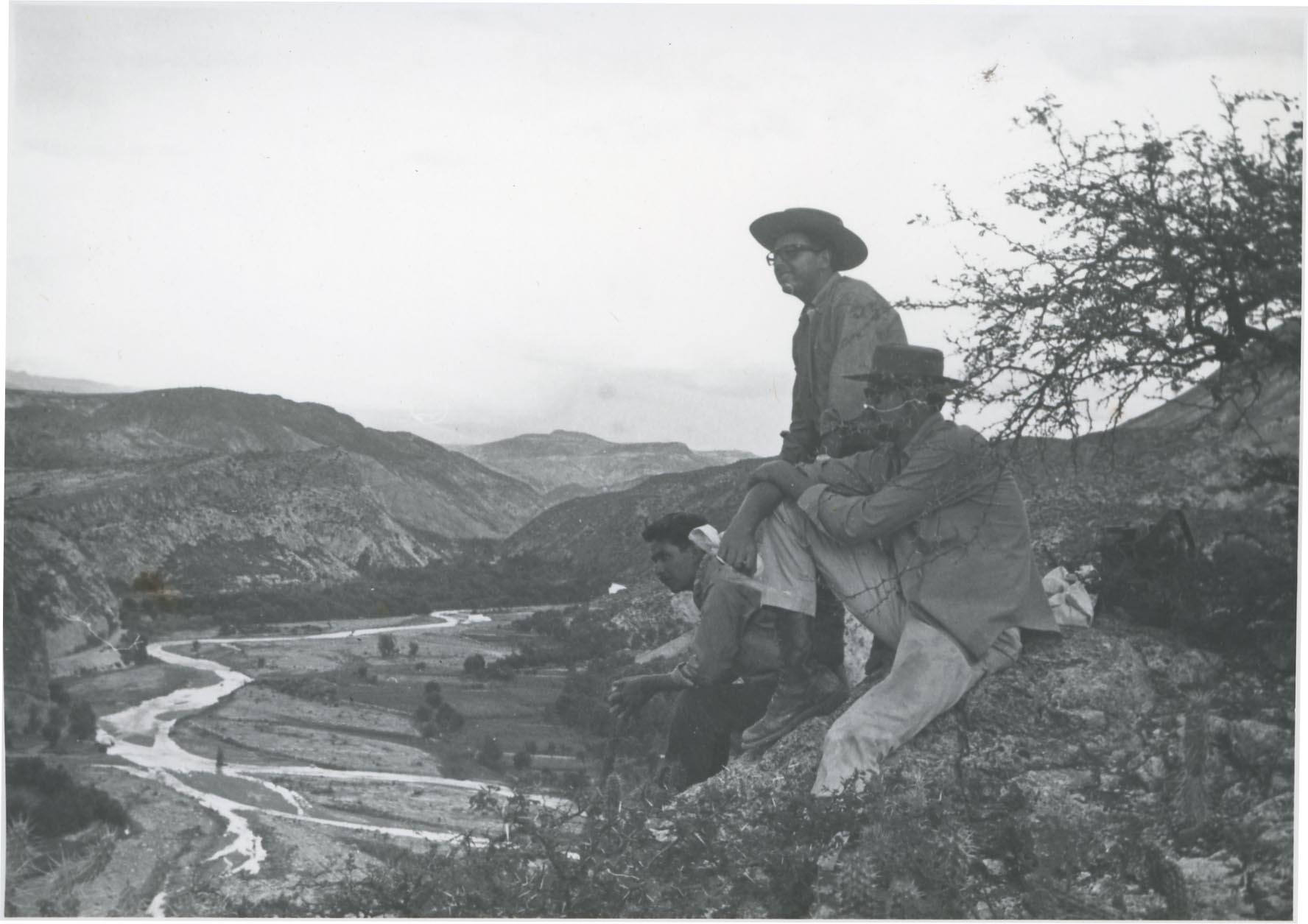
The majority of my time working remotely has been spent scanning and editing photographs of various archaeological projects from the collection. The photos I digitized were from archaeological excavations in Massachusetts, Maine, Ohio, Illinois, Kentucky, and Connecticut. Perhaps my favorite photos to work with were the ones from the Ayacucho Archaeological-Botanical Project in Peru. This project, directed by Richard MacNeish, was meant to investigate the origin of agriculture and its relationship to the development of civilization in New World Centers. The Ayacucho Valley was subsequently excavated between 1969 and 1975, which produced the hundreds of images that I’ve been working on. Many of the photos are of cave excavations, others show sweeping views of the Peruvian highlands complete with mountains and wildlife, and there’s the occasional photo of the archaeologists acting silly.
2019.0.743 – Archaeologists overlooking the Ayacucho Valley
Since we’ve been back at the Peabody, John and I have been working hard to make up for lost time on the inventory project. So far we’ve been making great progress as we’ve been able to inventory over 60 drawers since being back. Empty wooden drawers are once again piling up like crazy!
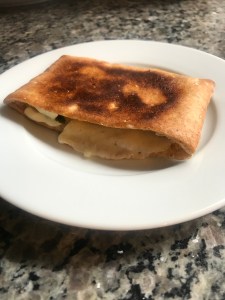
Working from home for the past few months has been an interesting experience. It’s been great saving so much money on gas and I loved being able to make myself gourmet grilled cheese sandwiches for lunch every day, but I’m very happy to be back working with the artifacts. Hopefully someday soon we’ll all be able to enjoy being back at the Peabody full time!
If you’re in need of some grilled cheese inspiration here is one of my favorites—olive tapenade, roasted red peppers, arugula, and manchego cheese! (I only had pita pockets at the time but I think a nice sourdough would be great)
In August, the Society for American Archaeology (SAA) announced its newest education award, the Robert S. Peabody Institute of Archaeology Award for Archaeology and Education.
The Robert S. Peabody Institute of Archaeology Award for Archaeology and Education recognizes the excellence of individuals or institutions in using archaeological methods, theory, and/or data to enliven, enrich, and enhance other disciplines, and to foster the community of archaeology education practitioners. The Peabody Award will spotlight these contributions and promote teaching ideas, exercises, activities, and methods across the educational spectrum, from K-12 through higher education and public education.
Peabody Advisory Committee member and recent chair Dan Sandweiss ’75 proposed the award to the PAC and SAA. Both organizations agreed that it was a great opportunity to honor those involved in archaeology and education, joining the Journal of Archaeology & Education as another important tool for creating community among those engaged in these endeavors.
One important criterion is that nomination documentation must include materials—like activities or lesson plans—that can be shared with the broader community via SAA’s website.
The award description indicates that anyone may submit a nomination and that nominees do not have to be members of the SAA. Both individuals and programs are eligible. The award committee offered this list as examples of activities that might distinguish a nominee, including archaeology service learning programs, popular archaeology writing, adult or youth training programs, lessons or lesson plans for K-12 educators, archaeological outreach programming, oral history projects, lifelong learning classes or programs, archaeology camp experiences, and collaborative work with other educators or institutions around archaeological pedagogy.
The deadline for submitting a nomination is December 1, 2020 and submission information and guidelines are on the SAA website for the Robert S. Peabody Institute of Archaeology Award in Archaeology and Education. Peabody director Ryan Wheeler is serving as the SAA’s Teaching Awards committee chair and can be contacted with questions about the Peabody Award.
Last fall, the Peabody loaned ten objects to the Addison Gallery of American Art here at Phillips Academy. They spent nearly a year there for the exhibition A Wildness Distant from Ourselves: Art and Ecology in 19th Century America.
Due to public health concerns related to COVID-19, both the Peabody and the Addison have been closed to visitors since mid-March. But, the behind the scenes work never ends. The Addison regularly exhibits works of art on loan from other institutions and actively loans its own collection to museums around the world. Returning these objects during COVID shutdowns has been a logistical challenge for our friends, and we were happy to coordinate with them to return the materials back across the street to us.
When the objects from the Peabody went to the Addison, a professional fine arts shipping company took care of packing and moving everything. To come home, the Addison staff did the packing themselves – and they are awesome at it!
It is now up to me to put these artifacts back into our storage areas – a job I am happy to do! Typically, we would use many of these in the upcoming school year for classes, but this year is different. Like most other institutions, any of our classes will be taught online.
But I know that I will be happy to see Champ the auk back at home in his case every time I come into the Peabody.
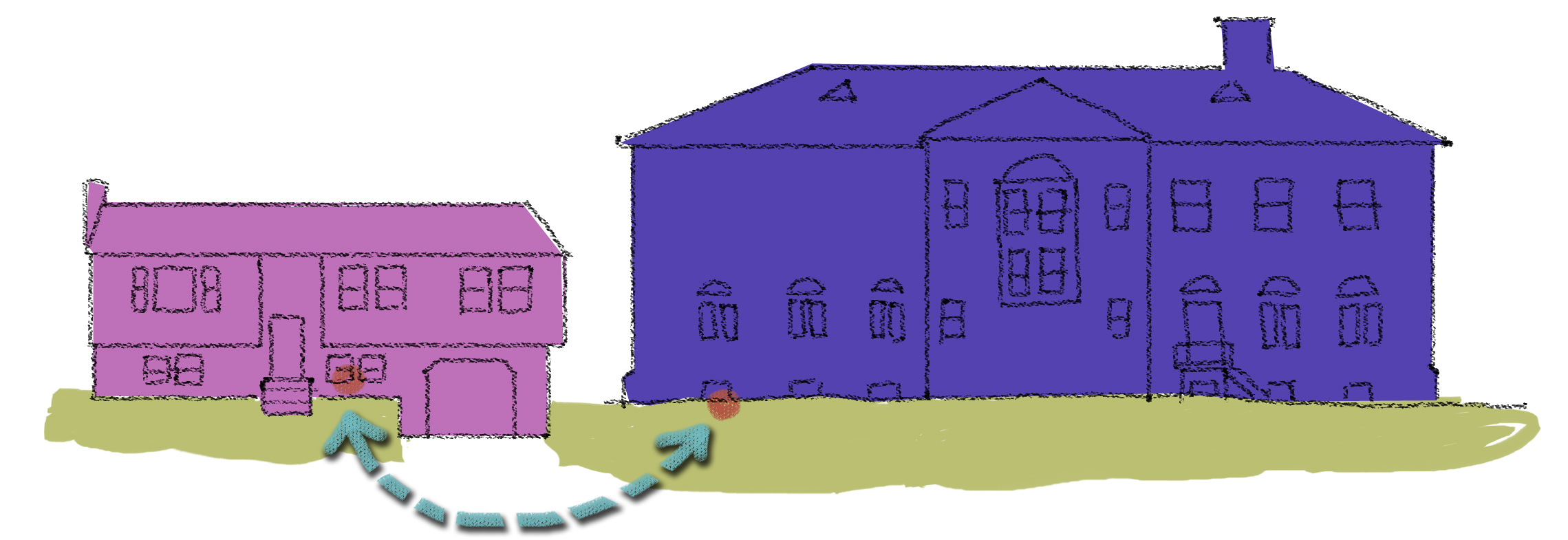
4 months of working in my basement and now, I’m back in the Peabody basement.
After four months of working from home, the Peabody is in its third week of a return to almost normal collections work. The two inventory specialists, Emily and myself, are working alternating weeks at the Peabody in order to continue our inventory work. With one week completed, it feels good to be back working toward our goal of a complete inventory of the collection. While working remotely will be an ongoing reality, I would like to share some of what I have been up to at home thus far.
With everything shutting down in March, Marla was quick to come up with projects that could be completed remotely. Her post in April outlined collections materials that were less sensitive and therefore reasonable to take home. I started with photographing site records from Peru and then moved to digitizing vacuum treatment paperwork related to Integrated Pest Management of the collections. We all contributed to finalizing the digitization of the original ledger books, our institution’s version of accession books. Now we have a searchable document with 75,000 records!
Everything I’ve worked on from home
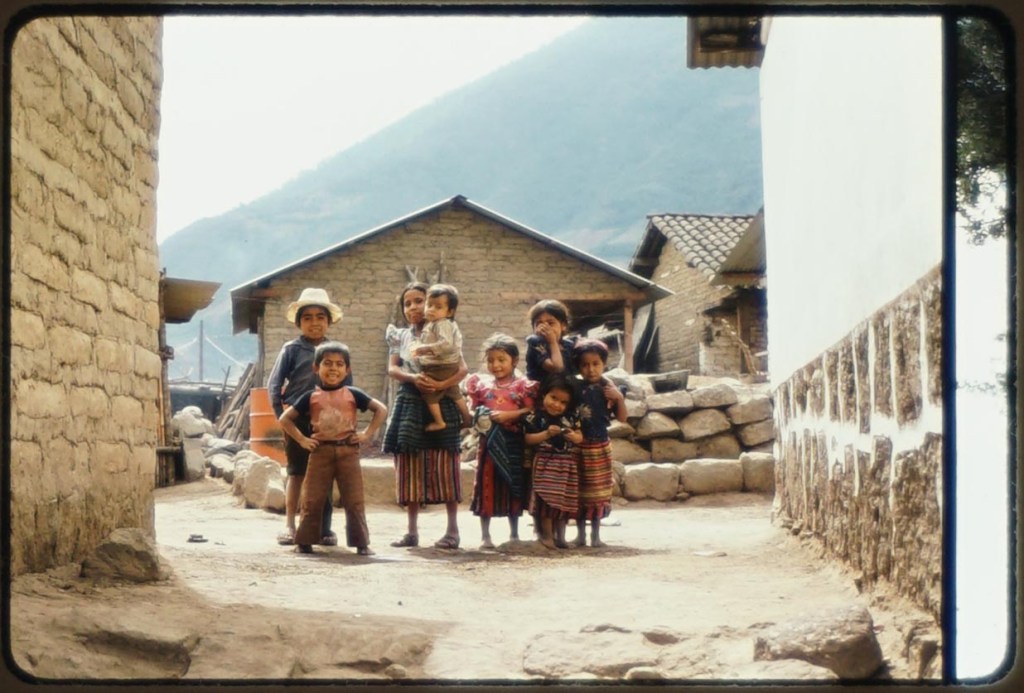
My favorite project has been photographing and editing photographic slides held in the collection. They include images documenting past exhibits and openings at the Robert S. Peabody Museum and photographs of the collections. The most interesting slides by far have been of Copeland Marks’s travels in Guatemala and South Korea. Mr. Marks was a textile collector who focused on the traditional clothing of ethnic Maya people living in the Guatemalan highlands. Some of his textiles became part of our collection at the Peabody. He would later write several cookbooks on cuisine covering locales ranging from the Mediterranean to South America. The slides I was working with document his travels in Guatemala spanning the 1960s through the 1980s. The subjects in the photographs cover everyday life, the dramatic volcanic landscape of the highlands and ceremonial life- all of which have been a great escape from the realities of coronavirus lockdown.
00.3.1585- People of San Pedro La Laguna.
It is anybody’s guess when life will return to normal. For the foreseeable future work at the Peabody will be interspersed with the strange blur of working from home with frustratingly cute interruptions from kids and dirty dishes. Until then I have to thank Marla for keeping us safely working from home during these crazy times.
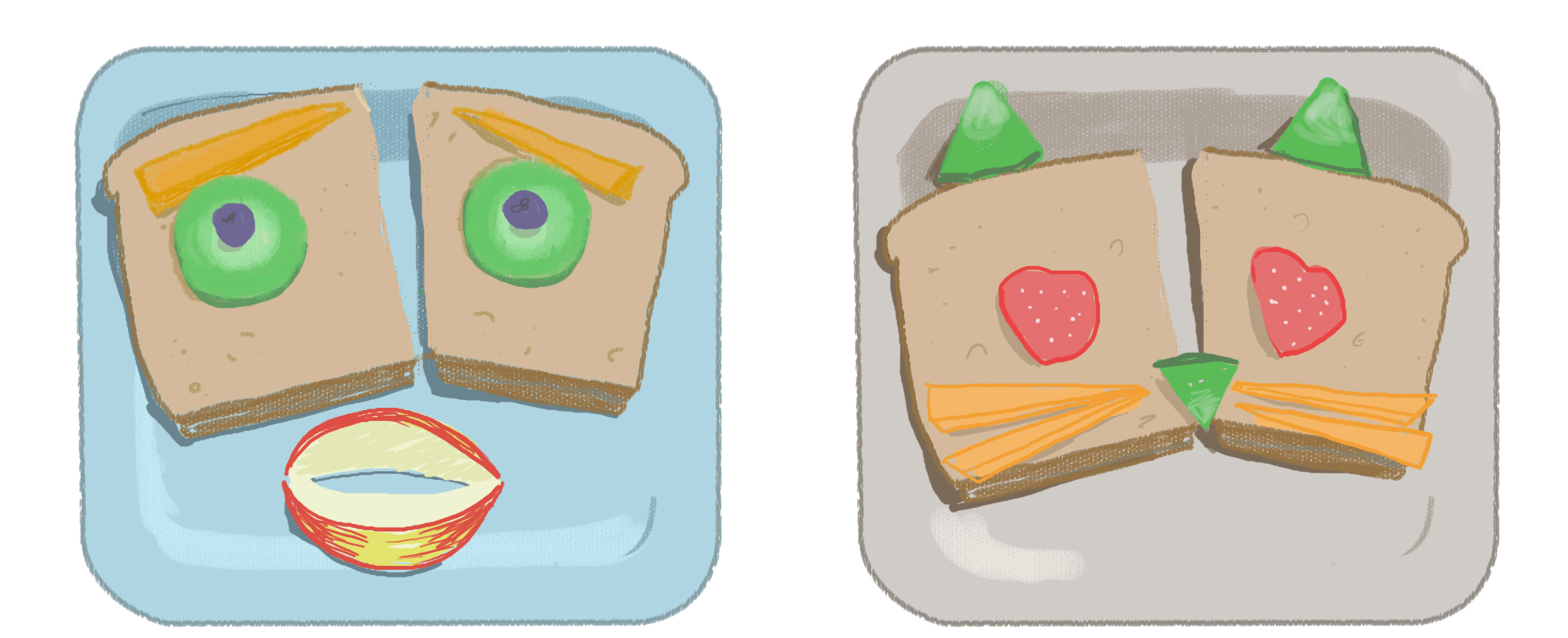
Oh yeah, I can’t forget my other work from home duty- silly lunches for the kids.
As we weather this pandemic storm, we are finding more and more that the days of yesterday are unlike the days of tomorrow. Many of our daily activities have gone virtual and museums, galleries, and institutions alike have adapted to reach their audiences online in order to continue their mission of educating and engaging with the public.
Another wonderful site to add to this collection is New Day Culture. This site is a society and culture website founded by a group of cultural enthusiasts that have created an online community (amidst the pandemic) where audiences can connect, explore, and experience the world of art and culture.
From live animal cams at the San Diego Zoo to drone footage of amazing destinations and historical sites, this site has everything for all ages and interests! Here are a few highlights of some of my favorite activities.
Explore the Depths of an Ancient Egyptian Queen’s Tomb
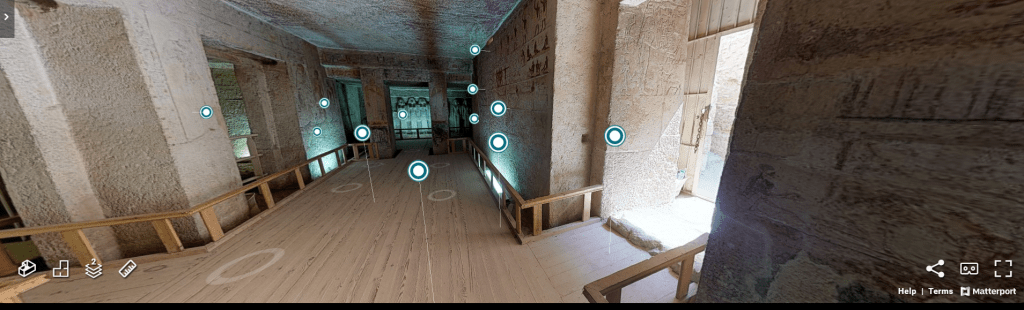
Thanks to this 3D modeling project by Harvard University, you can take a virtual tour of the tomb of Queen Meresankh III. Discover photographs from the original excavations of the tomb along with details and reconstructions of the wall art found in each room. Take a winding staircase down about 5 meters below the upper level to discover the burial chamber of Queen Meresankh III. For more information about this project click here.
3D image of the upper level of Queen Meresankh III’s tomb. Image courtesy of Matterport, The Giza Project by Harvard University.
Explore the Civil Rights Trail
This activity is an interactive map of the United States’ Civil Rights Trail. This map highlights places and moments that impacted history, including the heroes and stories behind the movement that forged new trails for civil rights.
#metkids
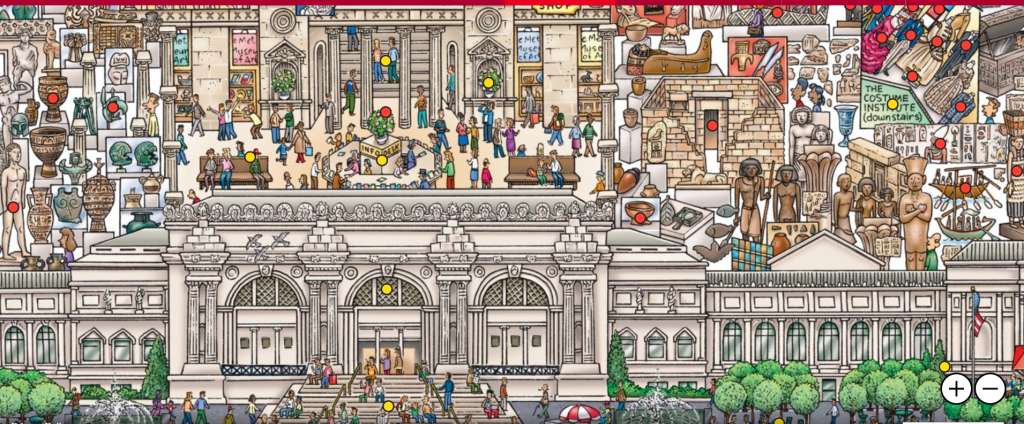
The Metropolitan Museum of Art creates a space of learning and exploring for, with, and by kids and the Met. Kids (or the young at heart) can watch videos to learn more about art, create their own time machine adventure, or explore the Met through an interactive map.
An interactive map of the Met by #metkids. Image courtesy of the Metropolitan Museum of Art.
The Great Inka Road: Engineering an Empire
Discover one of the most incredible achievements in history – the Great Inka Road, a 20,000 mile route through mountains and hillsides, all made by hand. The Smithsonian’s National Museum of the American Indian shares a virtual walkthrough of its Inka Road exhibition.
Buckle in to Climb a Mountain
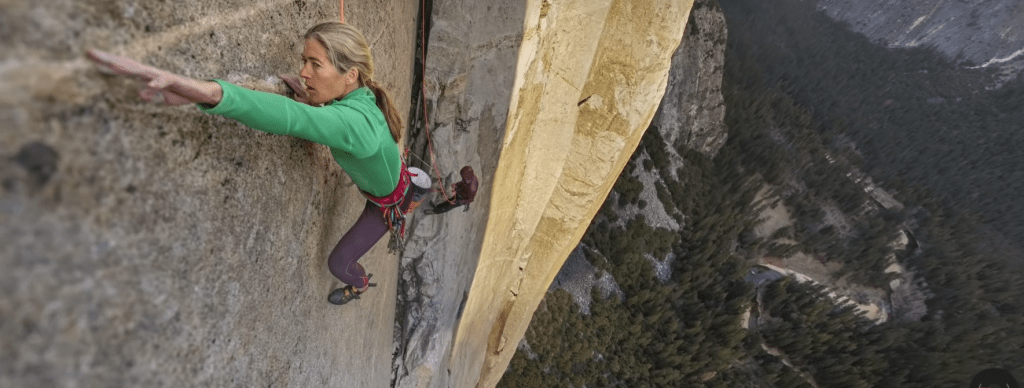
Through storytelling and 360 views, this interactive video and Google Maps site follows renowned rock climbers as they scale the heights of El Capitan in Yosemite National Park. Prepare your gear and experience the dizzying views of the Yosemite Valley from your 3,000 foot climb.
Climber, Lynn Hill, as she scales the Nose of El Capitan – the most famous rock climb in the world. Image courtesy of Google Maps.
Some honorable mentions I have come across in my exploring are a photo tour of the Burnt Food Museum (yes, you read that right), an elevator ride to the top of the Eiffel Tower, a YouTube tour of how Pixar films are made along with links to activities, a video tour of the “It’s a Small World” ride for the Disney enthusiast (Viewer disclaimer: the song will be stuck in your head for the rest of the day), and iconic performances to revisit or discover (without the hassle of waiting in lines, nosebleed seating, and even buying tickets!)
If you are unsure where to start I recommend exploring the “Top 15 Tours” first. You can find a list of them here.
There is so many experiences to discover and so much this site has to offer. All it takes is just your name, email, and a minute of your time to register! Don’t worry it’s free! Once you have joined the New Day Culture community, you will have all these art and culture resources at your fingertips – including exclusive events. For more information check out New Day Culture’s Facebook page here.
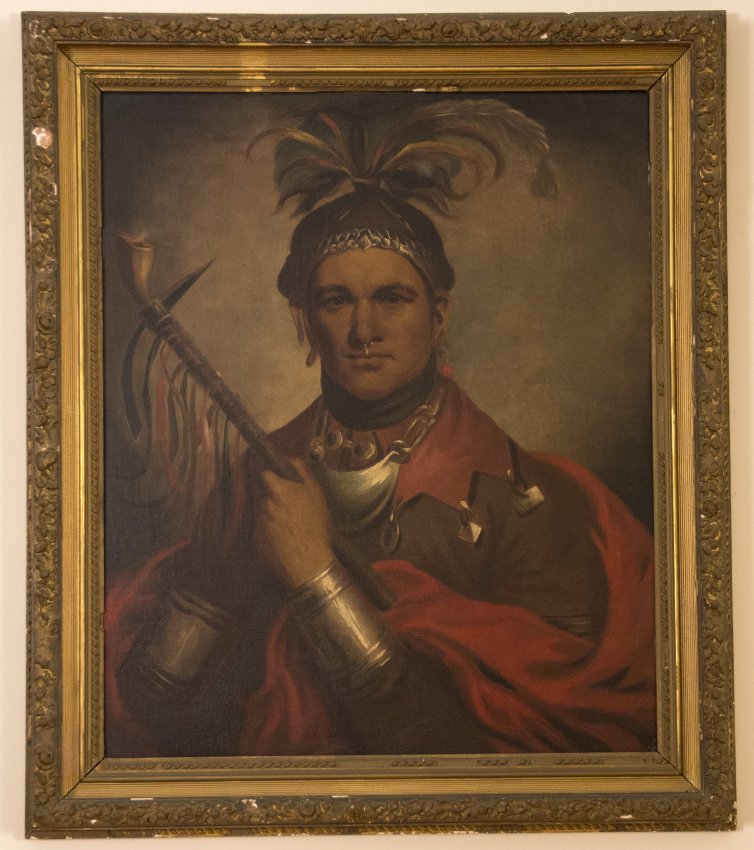
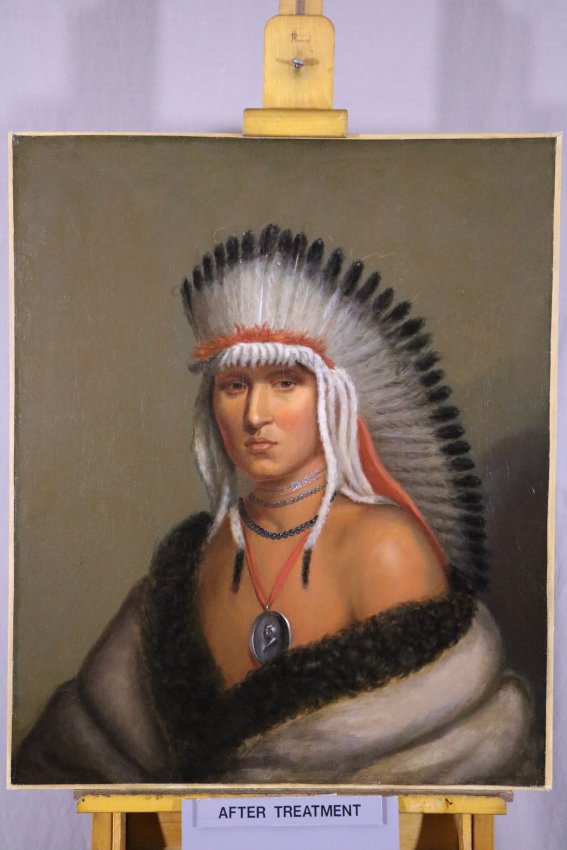
Three distinctive oil paintings attributed to artist Henry Inman (1801-1846) are among the collections of the Robert S. Peabody Institute of Archaeology. These paintings are part of a larger group of portraits created by Inman to produce the hand colored lithographs that appeared in the three volumes of The History of Indian Tribes of North America (1836-1844) by Thomas McKenney and James Hall. Specifically, the Peabody paintings depict Petalesharo (90.181.10), Ki-On-Twog-Ky, or Cornplanter (90.181.11), and Mohongo and Child (90.181.12). The source material for the Inman paintings were original works created principally in Washington DC by portrait painter Charles Bird King (1785-1862). The bulk of the King originals were destroyed in a fire in 1865.
Henry Inman’s portrait of Ki-On-Twog-Ky, or Cornplanter.
Today, original editions of the McKenney and Hall volumes and individual lithographs are valuable and highly sought after, but at the time the project was not a financial success. Many of the Inman portraits (at least 100 or more) were given to the Tilestone and Hollingsworth Paper Company of Milton, MA, who had supplied paper for the book project. The families of Edmund Tilestone and Amor Hollingsworth made a gift of the paintings to the Harvard Peabody Museum of Archaeology and Ethnology in 1882. In the late 1970s and early 1980s the Harvard museum sold many of the Inman paintings in their collection, ultimately retaining twenty-five.
Henry Inman’s portrait of Petalesharo after a recent cleaning.
Comparison with the list of Harvard’s original holdings indicates that the three Inman portraits at the Robert S. Peabody Institute of Archaeology did not come from that source. The frames also are quite different; the paintings at Harvard have simple wood frames, with descriptive plaques affixed, while those at the Robert S. Peabody Institute of Archaeology have ornate frames with gold leaf. In correspondence on file, former museum director Richard S. MacNeish told then director James Bradley that the paintings were part of the original gift from Robert S. Peabody. Stebbins and Renn (2014:288) report that Harvard received 107 of the Inman paintings from the Tilestone and Hollingsworth heirs, but that Inman had originally painted 117 and the whereabouts of the remaining paintings is unclear. It is possible that Robert S. Peabody acquired the three paintings when they were exhibited in Philadelphia.
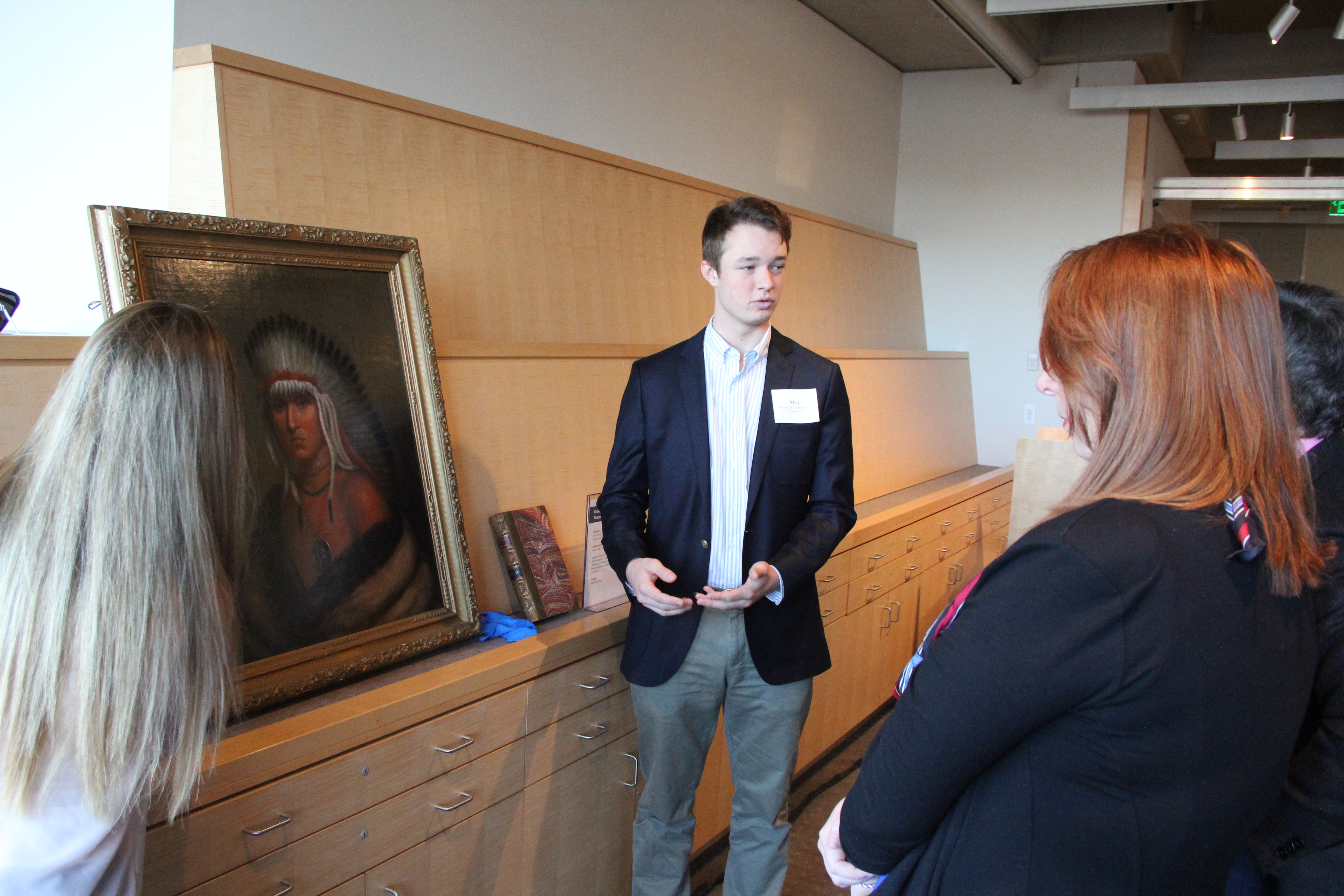
Phillips Academy students share their independent research on the Henry Inman paintings with members of the Board of Trustees.
The paintings reflect the classical style of portraits painted in the nineteenth century, and do not attempt to portray people in an imagined “primitive” setting as the photographs of Edward S. Curtis do at the end of the century. Clothing and personal items reflect the blend of traditional and Anglo-European attire resulting from varying levels of cultural assimilation. History and Social Sciences instructor Marcelle Doheny uses the paintings in her senior elective, Race and Identity in Indian Country, and they were part of an independent student project in 2015-2016 that examined Anglo-European portrayals of Native Americans.
Henry Inman’s portrait of Mohongo and child in storage at the Peabody.
The biographical notes that accompany the McKenney and Hall publication provide additional details about the lives of these individuals, at least as documented by the editors. Mohongo’s (1809-1836) story is particularly striking, as she was one of a group of Osage persuaded to make a European tour in 1827. While in Europe, she gave birth to twins, but only one survived. The tour organizer, who had brought the Osage to Europe to perform as a Wild West Show, was arrested for debt in Paris, leaving the rest of the party to fend for themselves. Ultimately, the Marquis de Lafayette learned of the situation and arranged for passage back to North America. During the sea voyage more members of the party perished, but Mohongo and her child survived, ultimately arriving in Norfolk, Virginia, where Charles Bird King painted their portrait. We believe that the peace medal worn by Mohongo depicts Andrew Jackson, who was president at the time. Mohongo and her child made their way back to Missouri. The book, An Osage Journey to Europe, 1827-1830: Three French Accounts edited and translated by William Least Heat-Moon and James K. Wallace, documents the episode.
Several exhibits—for example, the Indian Gallery of Henry Inman, which toured museums from 2006 to 2012—have assembled small collections of the extant Inman paintings, but the examples at the Peabody have never been included, likely because curators and art historians have not known about them.
Other Sources
Christie’s East. 1981. American Paintings and Watercolors of the 18th, 19th and 20th Centuries (auction catalog). New York.
Ewers, John C. 1954. Charles Bird King, painter of Indian visitors to the nation’s capital. Annual Report of the Board of Regents of the Smithsonian Institution, 1953. Pp. 463-473. Publication 4149. Government Printing Office, Washington DC.
Gerald Peters Gallery. 2008. Henry Inman, Twenty-four Indian Portraits (catalog). New York.
Gerdts, William H., and Carrie Rebora. 1987. The Art of Henry Inman. National Portrait Gallery, Smithsonian Institution, Washington, DC.
Stebbins, Theodore E., Jr., and Melissa Renn. 2014. American Paintings at Harvard, Volume 1: Paintings, Watercolors, and Pastels by Artists Born before 1826. Harvard Art Museums and Yale University Press, New Haven.
Viola, Herman J. 1976. The Indian Legacy of Charles Bird King. Smithsonian Institution Press and Doubleday & Company, New York.
Viola, Herman J. 1983. Indians of North America: Paintings by Henry Inman from the D. Harold Byrd, Jr. Collection. Buffalo Bill Historical Center, Cody, WY.
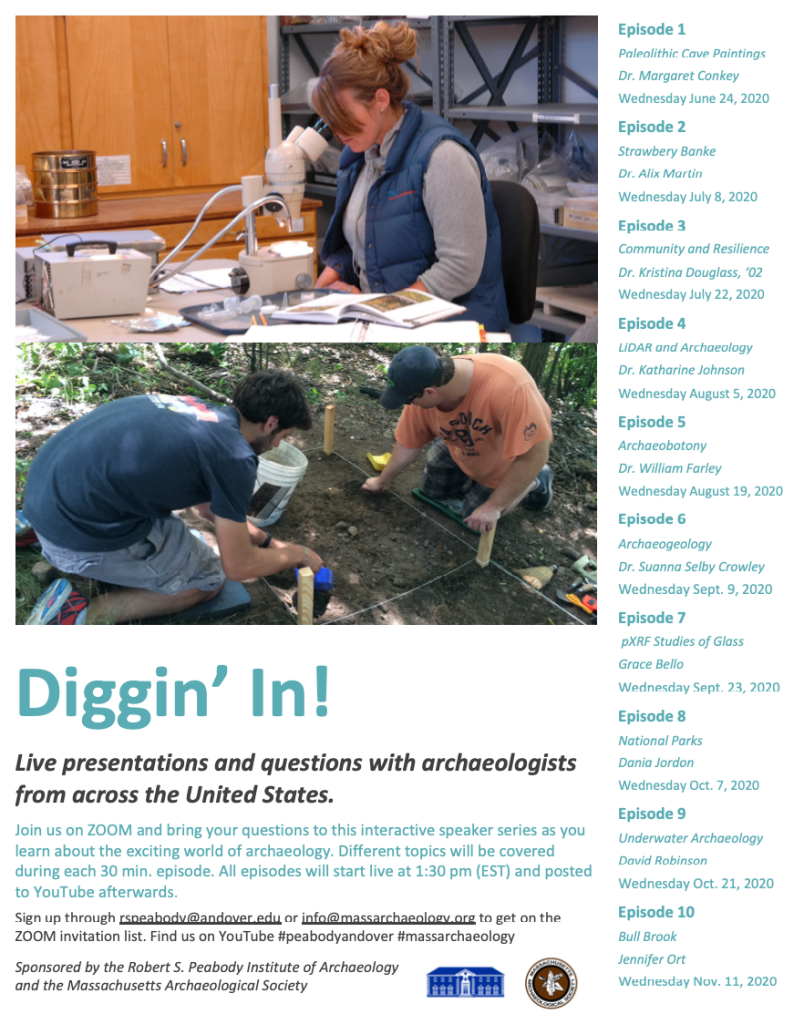
Part of the missions of both R.S. Peabody Institute and the Massachusetts Archaeological Society is to engage and connect with all who are interested in archaeology. Since we are unable to do this in person, both institutions are excited to announce our joint digital speaker series: Diggin’ In.
This series show cases live presentations with archaeologists from across the United States who will take questions directly from you!
Different topics will be covered during each 30 min episodes, which start live at 1:30 pm (EST) every other Wednesday and then will be posted to YouTube afterwards.
Sign up through the following emails to get on the ZOOM invitation list:
While we are excited to welcome all our speakers digitally to our campus and community, we are particularly pleased to have Dr. Meg Conkey and Dr. Kristina Douglass join us.
In addition to her work at University of California, Berkeley and in France, Dr. Conkey is also a current member of the R.S. Peabody’s advisory board.
And while Phillips Academy might be unfamiliar to some of our speakers, that is certainly not the case for Dr. Kristina Douglass who graduated from PA in 2002. It will be fun to welcome her “home” even if it is remotely.
The Peabody lost a great friend with the recent passing of John Lowell Thorndike ’45 (1926 – 2020).
John Lowell Thorndike ’45 at the Peabody in 1998. Collections of the Robert S. Peabody Institute of Archaeology.
John was critical in the recent history of the Peabody, serving as chair of the Visiting Committee in the 1990s and early 2000s. This was a turbulent period, seeing everything from the reopening of the Peabody in 1990, engagement with Native American tribes through repatriation, and an attempt to become a public-facing institution with relevance on campus, culminating in a near-closure in 2002. He and Marshall Cloyd ’58, played a big part in the decision to keep the Peabody open and refocus our efforts on programming for Phillips Academy students.
I was fortunate in getting to know John a little, as he would visit campus at least once a year to attend the luncheon presentation of the Augustus Thorndike Jr. Internship, which he founded with his brother Nicholas (PA Class of 1951). Students selected as interns spent a year preparing a historical biographic sketch of an interesting Phillips Academy person, often an alumnus or faculty member.
John remained intensely interested in the activities of the Peabody in the years after 2002. He was particularly interested in our relationship with the Pueblo of Jemez and our continued work on repatriation of Native American ancestral remains and funerary belongings. We often had a chance to sit and talk before and after the luncheons, and John and I frequently had e-mail or phone exchanges after he received our monthly newsletter. John was particularly delighted when our ceramic artist friends from Jemez, Dominique and Maxine Toya, joined one of the Thorndike luncheons. They were on campus that week to work with Thayer Zaeder’s ceramics classes, continuing our long relationship with the pueblo.
John also shared with me his pleasure in seeing the publication of our book, Glory, Trouble, and Renaissance at the Robert S. Peabody Museum of Archaeology, by the University of Nebraska Press in 2018. John was not able to attend our launch party at the Peabody, but he called me shortly after receiving his copy in the mail and expressed his delight at our success, the considerable work done by Peabody director Malinda Stafford Blustain and Peabody staff members. He grudgingly and humbly acknowledged that he had some small role in that success, in the understated style of the New England gentleman that he was.
Our condolences to John’s family and friends. He will be missed.
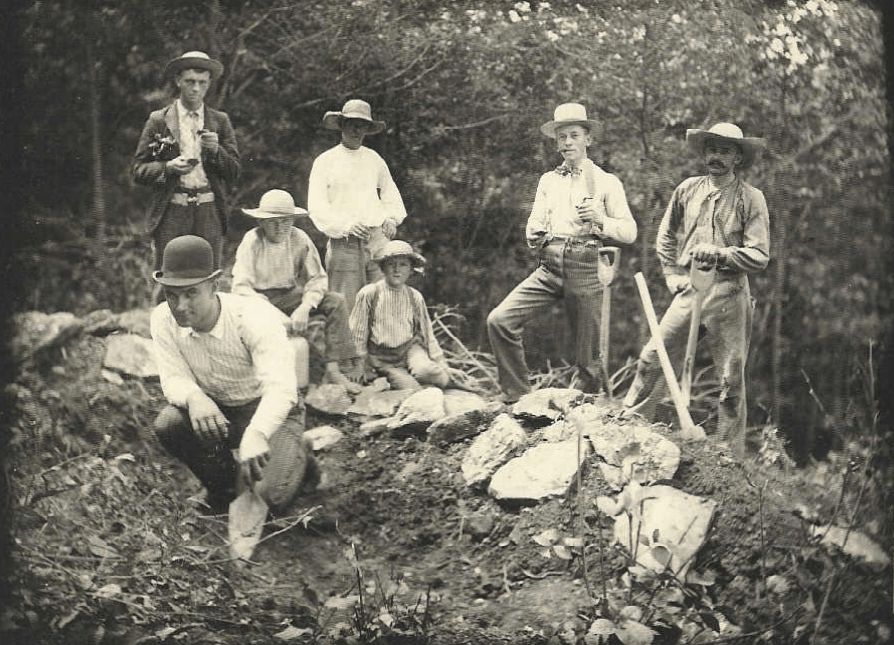
Our last newsletter sparked the interest of many readers with a featured black and white photograph of seven individuals posing with shovels, trowels, and cigars in hand. Their eyes focused intently on the camera, full of hope and mystery – reminds me of a moment like the Carpe Diem scene from Dead Poet’s Society. By popular demand, we share some additional information about this photograph.
Plate XIV – The Excavation of a Stone Heap near Station 246, Fort Ancient Site, Ohio. Photographed by C.J. Strong. Warren K. Moorehead (second from right), Joseph Wigglesworth (closest to camera on left with trowel), and unidentified field crew members.
This photograph was taken at the Fort Ancient site in Warren County, Ohio in the late nineteenth century. The photograph is of Warren K. Moorehead (second from right) and some of his field crew. Another man is identified in the photograph as Joseph Wigglesworth (closest to camera on left with trowel), a collector and amateur archaeologist from Wilmington, Delaware. You can view the original image in Moorehead’s publication of the Fort Ancient site here.
Fort Ancient is a series of earthen embankments, known as earthworks, with 18,000 feet of earthen walls enclosing 100 acres near the Little Miami River. People of the Hopewell culture (100 B.C. to 500 A.D.) built these walls and many other features both within the enclosure and on the steep valleys that surround the site. Investigations at Fort Ancient began in the early 1800s as mapping expeditions, expanding to surface collecting and full-scale excavations near the end of the century.
Warren K. Moorehead was the first curator for the Ohio Archaeological and Historical Society (now the Ohio History Connection). In 1893, Frederic Ward Putnam hired Moorehead to conduct excavations at Fort Ancient and obtain artifacts for the Columbian Exposition. One of Moorehead’s major contributions to archaeology was the preservation of Fort Ancient as an archaeological park. Later in his career, Moorehead served as the curator and then director of the Phillips Academy Department of Archaeology (now the Robert S. Peabody Institute of Archaeology) in Andover, Massachusetts, where he conducted important excavations at the Cahokia site in Illinois and the Etowah site in Georgia.
The Fort Ancient site is maintained by the Ohio History Connection and is a National Historic Landmark and listed on the National Register of Historic Places. Along with its earthworks, the site includes a museum about Ohio’s ancient history. You can explore the site’s website here!







 The Peabody