Sitting on my office shelf in a red binder is the Peabody disaster plan. No institution ever wants to use it, but it is essential to be prepared. Our plan is in need of its regular update, and fortunately for us, the Addison Gallery of American Art (also part of Phillips Academy) hosted a three-day seminar and full-scale emergency response disaster training for the protection of cultural assets in March. Over 100 people took part in the workshop, including several members of Peabody staff.
The workshop included presentations from conservators, companies who specialize in disaster clean-up, and organizations that can help think through the disaster plan with us. We learned the basics of painting conservation, how to mitigate water damage, how to dry/salvage wet books and papers, and how to identify and deal with pests in the collection. Training stations were presented so that we could try all of these methods ourselves and have the opportunity to ask specific questions relating to our own collections.
Triaging damaged books from the disaster scenario.
Faux smoke damaged gallery during disaster scenario
Packing damaged books from the disaster scenario.
Marla and Rachel prepare for a disaster
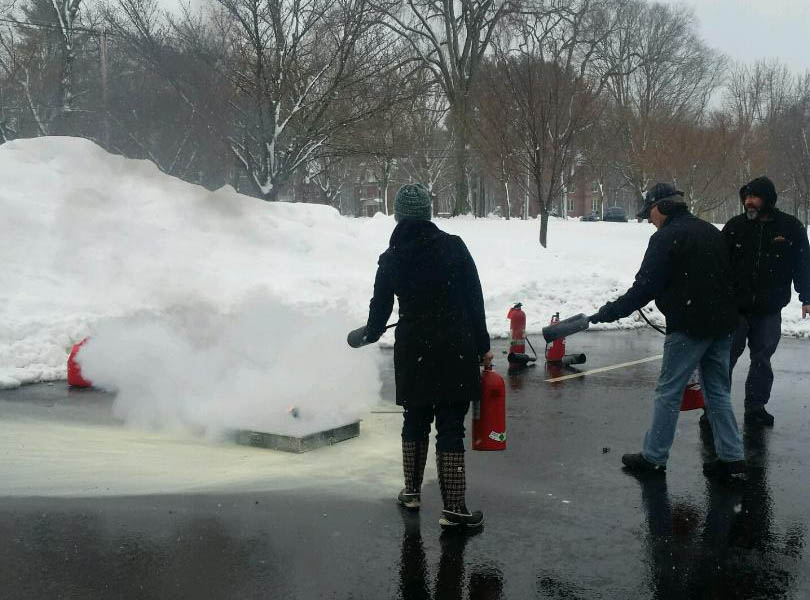
That’s me in the hat using the fire extinguisher
The big highlight for me was the triage scenario meticulously installed at the Addison. The Addison repainted one of their temporary galleries to appear smoke damaged, and they displayed pieces of art that had been previously damaged to replicate how fire damage may present itself in a museum. As a team, we were given only 10 minutes to remove the damaged artwork (without additional damage!), set up work flow to begin cleaning objects, and isolate the most damaged pieces. This was fun and realistic.
Now comes the hard work – applying all of this new knowledge to our own disaster planning process.
The emergency response and disaster planning workshop was generously made possible by a grant from the Abbot Academy Fund, continuing Abbot’s tradition of boldness, innovation, and caring.
We were fortunate to receive a generous gift from Phillips Academy trustee and Peabody Advisory Committee member Peter T. Hetzler MD, FACS (Class of 1972) in December 2017 that allowed us to purchase several important books to add to our library.
One of these is the very rare, privately published volume Birdstones of the North American Indian by Earl C. Townsend, Jr. Published in 1959, Townsend’s book was limited to 700 copies. A reprint edition was released in 2003 by Steven Hart, but these are also scarce and hard to find. Both the original edition and the reprint can be quite expensive, if you are lucky enough to find one. Townsend (1914-2007) was an attorney and founding member of the Indiana Archaeological Society, as well as an avid collector of Native American artifacts, cars, and artwork. According to Townsend’s obituary, he was honored by the Black River-Swan Creek Saginaw Chippewa Tribe with the name Senee Pen Eshee Na Na, meaning “Birdstone Man.”
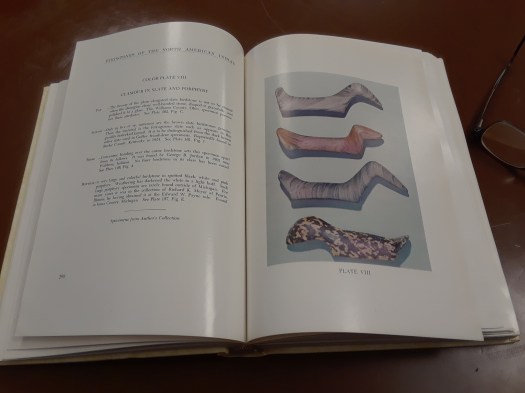
One of the color plates in Townsend’s Birdstones book, showing some of the variations in color and material found among this artifact type.
Townsend’s preface begins with a reference to Warren Moorehead, the Peabody’s first curator, who “spoke of the need for specialized volumes, each devoted to one particular form of prehistoric North American Indian relic.” Moorehead insisted that the province of archaeologists was the study of material culture and he urged his contemporaries to abandoned reconnaissance and site survey that were becoming more common in the first quarter of the twentieth century and hunker down on description and classification of artifacts. Moorehead published at least three volumes that highlighted objects, mostly those held by artifact collectors. His most expansive was the 1910 two volume The Stone Age in North America. Moorehead also published more detailed studies of particular artifact types, like his 1906 The So-Called “Gorgets,” an early bulletin of the Phillips Academy Department of Archaeology, and his 1899 The Bird-stone Ceremonial.
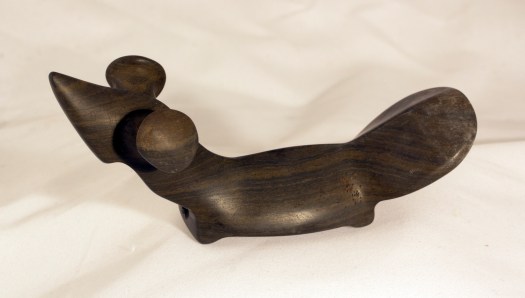
A magnificent example of a pop-eyed birdstone in banded slate, Warren County, Ohio.
Townsend’s 719-page book is nothing short of monumental, and depicts thousands of birdstones from public and private collections. He also covers the ideas about what these objects are, which are myriad and diverse, as well as how they were made, distribution patterns, cultural affiliations, and fraudulent specimens.
A selection of birdstones from the Peabody Institute collection. Note that some are broken and repaired.
So, what is a birdstone? As Townsend notes, this is not an easy question to answer, since there is no clear agreement on how they were used in antiquity. In terms of form, birdstones are often described as highly stylized depictions of birds. A variety of distinct forms are all described in detail by Townsend. The virtuosity of manufacture, incredible symmetry, and sculptural quality have often elicited comparison with modern art. Sizes range from an inch or two to larger examples that are five or six inches in length. A common feature is the presence of bi-conically drilled holes, one at either end of the birdstone’s base. These holes are often the site of breakage and repair. Most birdstones are made of banded slate, especially the greenish-gray banded Huronian variety, but other stones were used as well, including porphyry. Many have projecting eyes or ears. Few if any have come from secure archaeological contexts and most are known as field finds. Townsend’s distribution map indicates that the vast majority of birdstones in his sample come from areas around the southern margins of the Great Lakes, especially in Wisconsin, Michigan, Indiana, Ohio, New York, and Ontario. Cultural affiliations of birdstones vary across this area and include a number of Late Archaic and Early Woodland cultures like Glacial Kame and Red Ochre, circa 1500-500 BCE.
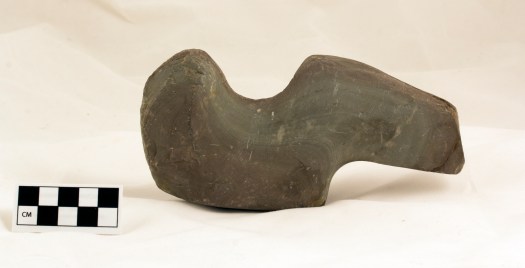
A birdstone preform, showing one stage in the manufacture process.
Townsend does a nice job of summarizing the diverse opinions on birdstones. The ideas range from Charles C. Abbott’s notion that they were worn as hair ornaments by women during maternity to use as a spear thrower (atlatl) counterweight. Other ideas include attachment to flutes or similar musical instruments, game pieces, hair or clothing ornaments, staff mounted religious symbols, and atlatl handle grips (Townsend’s preferred idea). Considering the diversity of forms, it seems likely that different styles were used in different ways and there are probably layers of meaning that we are unable to detect. Many contemporary archaeologists have accepted that birdstones are, in fact, associated with atlatls or spear throwers (for example, this is how they are described by David Penney in his essay on Archaic art in the 1985 exhibit catalog Ancient Art of the American Woodland Indians). Many articles about birdstones have been added to the literature since the 1959 publication of Townsend’s book, often proposing new ideas or offering further support or evidence for an existing hypothesis.
We were particularly excited to acquire a copy of Townsend’s Birdstones because the Peabody collections contain many examples of this enigmatic and interesting artifact. Only a few, however, are illustrated in Townsend’s book, including two from Ohio that had been salvaged after breakage (see Townsend 1959: Plates 76s and 77h). A few other fine examples from the Peabody are illustrated here.
It’s unlikely that we will unlock the secret of the birdstone anytime soon, however, we are immensely grateful to Peter Hetzler for his generous gift of the Earl Townsend book, which nicely complements our object collection!
In the last two weeks, we have had three major Nor’easters here in New England. Fortunately, it has been while students are on break and has not slowed down the creation of new lessons for spring term.
“A man never lies in his garbage heap” – Franz Boas.
Last term I was approached by Emma Frey, faculty in history, to create a single period activity that would introduce her 9th graders to the concept of reading objects as text and use them to tell a story. As Emma and I talked and brainstormed, we decided on an existing lesson that I had created years ago for our Archaeology Explorers and how we could flesh it out so that it better met Emma’s class goals and objectives. The activity is a garbology lesson called Trash Talks!
Two bags of clean trash that students will analyze.
In the activity students are divided into three groups and are given a bag of clean trash. While working together to sort and identify the trash, each group also compiles a biography of the person(s) who created the trash. They will be asked to make observations and inferences about the trash and what it might reflect about a person, such as their gender, age, activities, etc.
An example of how students might mark down artifacts in their trash bags to better understand what they show about the life of someone.
While the trash is “modern” the principles that students use to analyze the trash are the same as the ones that archaeologists use to study cultures of the past.
I am very excited to run this lesson with students and to see how they interpret the trash!
The past five years have been a busy time for museums- most notably in the image department. Following a number of high profile controversies, a lot of people–audiences, and museum professionals alike–asked what role museums play in our society? Here are a couple of recent articles dealing with this subject head on.
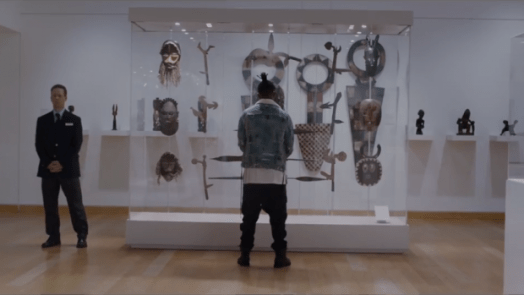
Killmonger in the Museum (Photo courtesy of article)
Last month saw the release of Marvel’s newest blockbuster, Black Panther. Besides being a fantastic movie, this film offers a unique chance to open dialogues on a large scale about many topics- least of which are museums as mechanisms of colonialism. This article discusses how and why museum professionals especially should look at their roles in this and the effects they have on the audiences we try to reach. The piece ends by laying out suggestions for how museums can move forward incorporating and working towards more diverse and open dialogues between communities.
Gover and Bunch at Symposium (Photo courtesy of Smithsonian Magazine)
This article opens with the quote, “history matters because it has contemporary consequences,” and it just gets better from there. Directors Kevin Gover (National Museum of the American Indian) and Lonnie Bunch (National Museum of African American History and Culture) participated in a day long symposium titled, “Mascots, Myths, Monuments and Memory,” in which they talked about confronting the historic and continued racist ideologies that are entrenched in contemporary American society and the role of museums. They specifically discuss the example of the concurrent rise of confederate statues and racist mascots.
Chronicling a series of high profile controversies, this article looks at the combination of factors that have led to these, as well as the changes they are bringing to museums and their operation. It also discusses why museums have become ground zero for explosive cultural encounters stating, “We’re in a time when these issues are real, these controversies are part of public space and public discourse, and museums are going to become the places where these issues get played out.”
Students using NK360 (photo courtesy of Smithsonian Insider)
This article showcases the role museums have within their respective walls and how they are branching out to have far reaching impacts in classrooms all over the nation. Similar to classes taught at the Peabody by Curator of Education, Lindsay Randall, this article follows the creation and implementation of National Museum of the American Indian’s newest initiative, Native Knowledge 360. NK360 is a “long-term initiative to integrate the Native American experience into social studies, language arts and other curriculum in kindergarten through 12th-grade classrooms across the country.” This program works with the inclusion and cooperation of Native communities and educators as well as provides educational materials for teachers.
March is Women’s History Month, so it seemed like the perfect time to write about some of the women who have worked at or been associated with the Peabody. I have been struck during my work here by how male dominated the Peabody was for most of the twentieth century – there is a noticeable absence of women in the archives. Almost all Peabody director and curator positions were held by men, with the exception of Jane C. Wheeler, curator in the late 1970s. In the 1990s, this began to shift, with women beginning to occupy more leadership and professional posts (staff size also grew and new roles developed); eventually Malinda Stafford Blustain would become the Peabody’s first female director in 2001. This shift reflects broader trends in museum staff demographics – today, 60% of museum staff members are female, though leadership positions continue to be dominated by men (see the Andrew W. Mellon Foundation Art Museum Staff Demographic Survey, which also highlights the underrepresentation of people of color among museum staff).
Most of the women who worked at the Peabody before the 1990s were administrative assistants. There are traces of them in our archives and in the Phillips Academy handbooks: their names, titles, salaries, and occasionally correspondence or internal documents that they wrote. Theodora George, who received a bachelors’ degree in archaeology from Columbia University, worked at the Peabody from 1968 to 1980 – she is the only administrative assistant for whom I’ve found an obituary, which includes her photograph. I also discovered that her father was of Syrian descent and owned a grocery store in Lawrence for a time. She is acknowledged with helping catalog museum collections and editing the Tehuacán publications. Other administrative assistant names I’ve come across are Florence Cummings, Gladys Dill Salta (later Gladys Jump), Ethel Cohen, Evelyn Willett Drew, Marie Indurre, Marjory McC. Stevens, Ashley Baker, Carole A. Walker, and Elizabeth Steinert.
Two early women pioneers of archaeology and anthropology were briefly associated with the Peabody. Margaret E. Ashley Towle (1902-1985) and Adelaide Kendall Bullen (1908-1987) are both notable for pursuing these interests in a time when those fields (like museums) were very much male dominated. Presumably, their socio-economic status also gave them a certain measure of freedom in doing so. Margaret E. Ashley Ph.D., is listed as the Research Associate in Southeastern Archaeology at the Peabody in 1929 and in 1930 (she actually received her PhD later in her career). Her association with the Peabody came because of Warren Moorehead’s Etowah, Georgia excavations; Emory University asked her to serve as a representative on the dig because some of the collections were destined to come to them. Ashley subsequently came to Andover to further study the ceramics. Her ceramic analysis forms part of the official site publication, the Etowah Papers. Ashley went on to work extensively in South American paleobotany, with a long association at Harvard’s Botanical Museum. To learn more about her, see pages 25-41 in Grit-Tempered, Early Women Archaeologists in the Southeastern United States (1999).
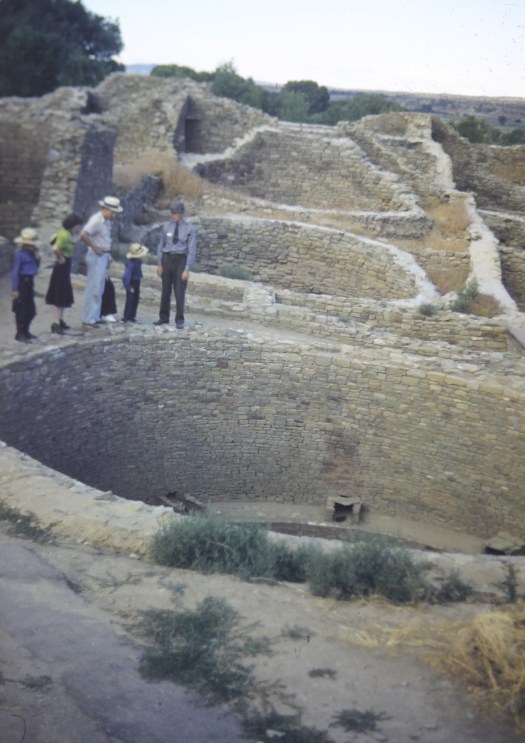
Adelaide and Ripley Bullen and their sons, visiting Aztec ruins in New Mexico, 1941
Adelaide Kendall Bullen came into the Peabody’s orbit through her husband, Ripley Bullen. Ripley worked as a student assistant at the Peabody while pursuing graduate studies at Harvard in anthropology. Meanwhile Adelaide began undergraduate studies at Radcliffe College in her early thirties, and after receiving her A.B., also pursued graduate studies in anthropology at Harvard. Together they began working on excavations, including the Lucy Foster site, the nineteenth century Andover home site of an emancipated African American woman. They also lived on campus and both of their sons graduated from Phillips Academy: Dana Ripley Bullen II (Class of 1949) and Pierce Kendall Bullen (Class of 1952). In the Peabody’s annual reports from that time, Ripley’s excavation projects in the area are briefly mentioned, but Adelaide’s involvement with them is not acknowledged. She is only mentioned in 1942 as helping select and arrange “material on the Navaho and Iroquois Indians” for an exhibit at the Andover Public Library. After leaving Massachusetts in 1948 Adelaide and Ripley expanded their work to involve avocational archaeologists in Florida and the Caribbean and continued to publish extensively; they maintained connections with their Peabody colleagues and Ripley was an earlier adopter of radiocarbon dating. To learn more about Adelaide, see pages 148-162 in Grit-Tempered, Early Women Archaeologists in the Southeastern United States (1999).
A number of women participated in Peabody-sponsored surveys and excavations, sometimes contributing to the project publication as well. These women include Elsie Clews Parsons, Anna O. Shepard and Madeleine Appleton Kidder at the Pecos Pueblo, New Mexico excavations directed by Alfred V. Kidder, 1915-1929; Lucy Raup in the Yukon surveys, co-directed by Fred Johnson and Hugh Raup, of 1944 and 1948; Eva Hunt and Antoinette Nelken-Terner at the Tehuacán Valley, Mexico, excavations directed by Richard “Scotty” MacNeish, 1960-1965; and Antoinette Nelken-Terner again in the Ayacucho, Peru, excavations directed by MacNeish, 1969-1975. There may be many that I have missed – if so please name them in the comments below.
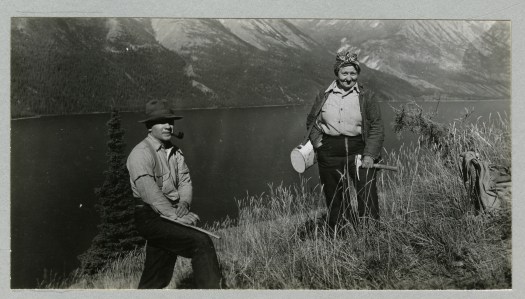
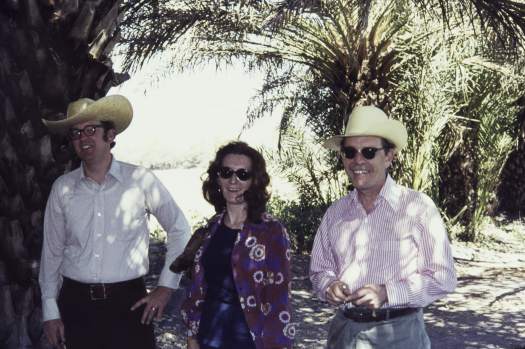
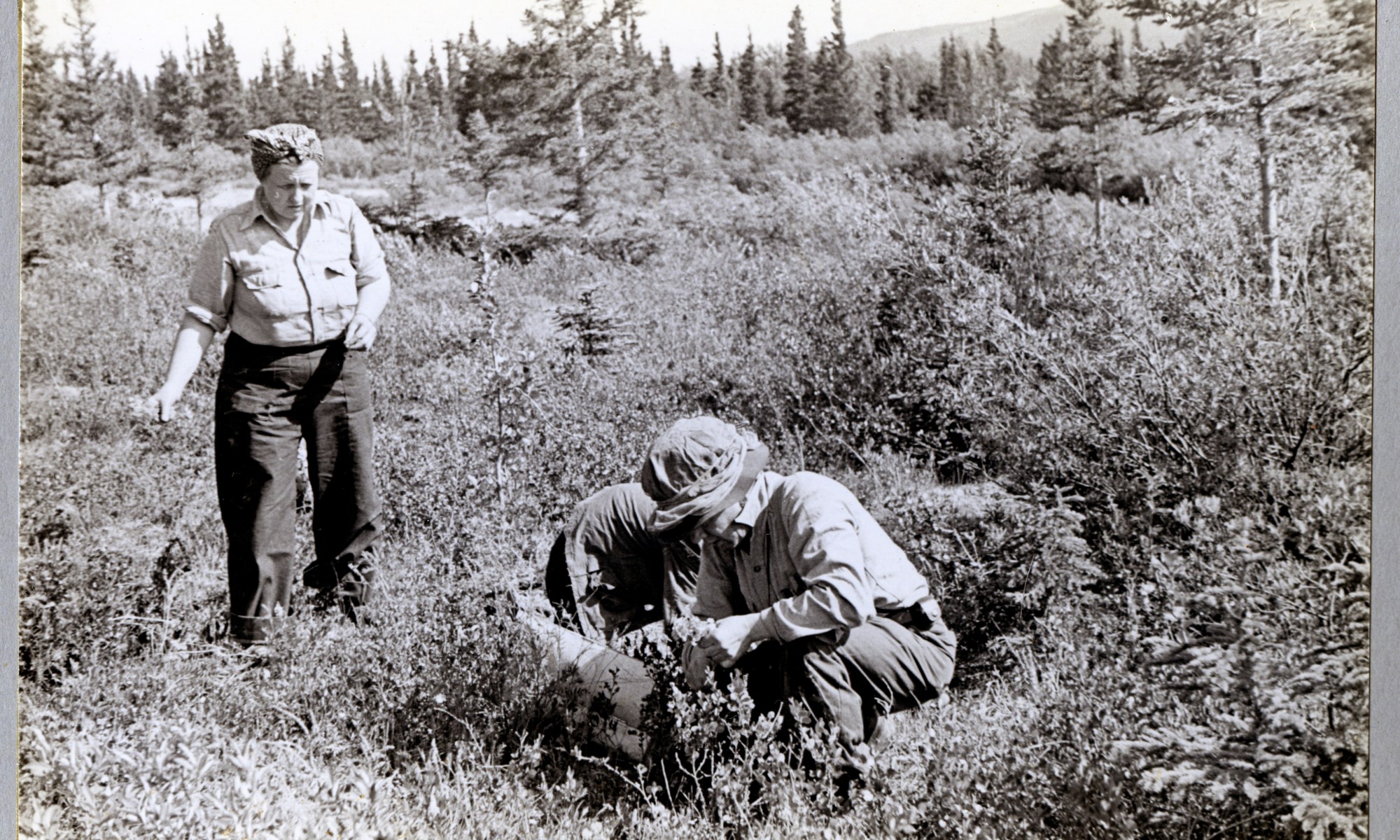
Lucy and Hugh Raup on the southeast slope of Big Arm, Kluane Lake, Andover-Harvard Yukon Expedition 1944. Photograph by J.H.H. Sticht.Ed Sisson, Antoinette Nelken-Terner and Scotty MacNeish at Penefiel near El Riego Cave, February 5, 1973. Photograph taken by Ray Potvin.
The first woman to hold a permanent professional position at the Peabody above the administrative assistant level was Curator Jane C. Wheeler, PhD (1977-1982). (Mary Ellen Conaway worked on new exhibits at the Peabody, 1970-1974, but is not listed among permanent staff.) During her time at the Peabody, Wheeler conducted research in Peru and Bolivia, published extensively, and taught courses to Phillips Academy students as well as conducting a field school at the Andover Town Dump.
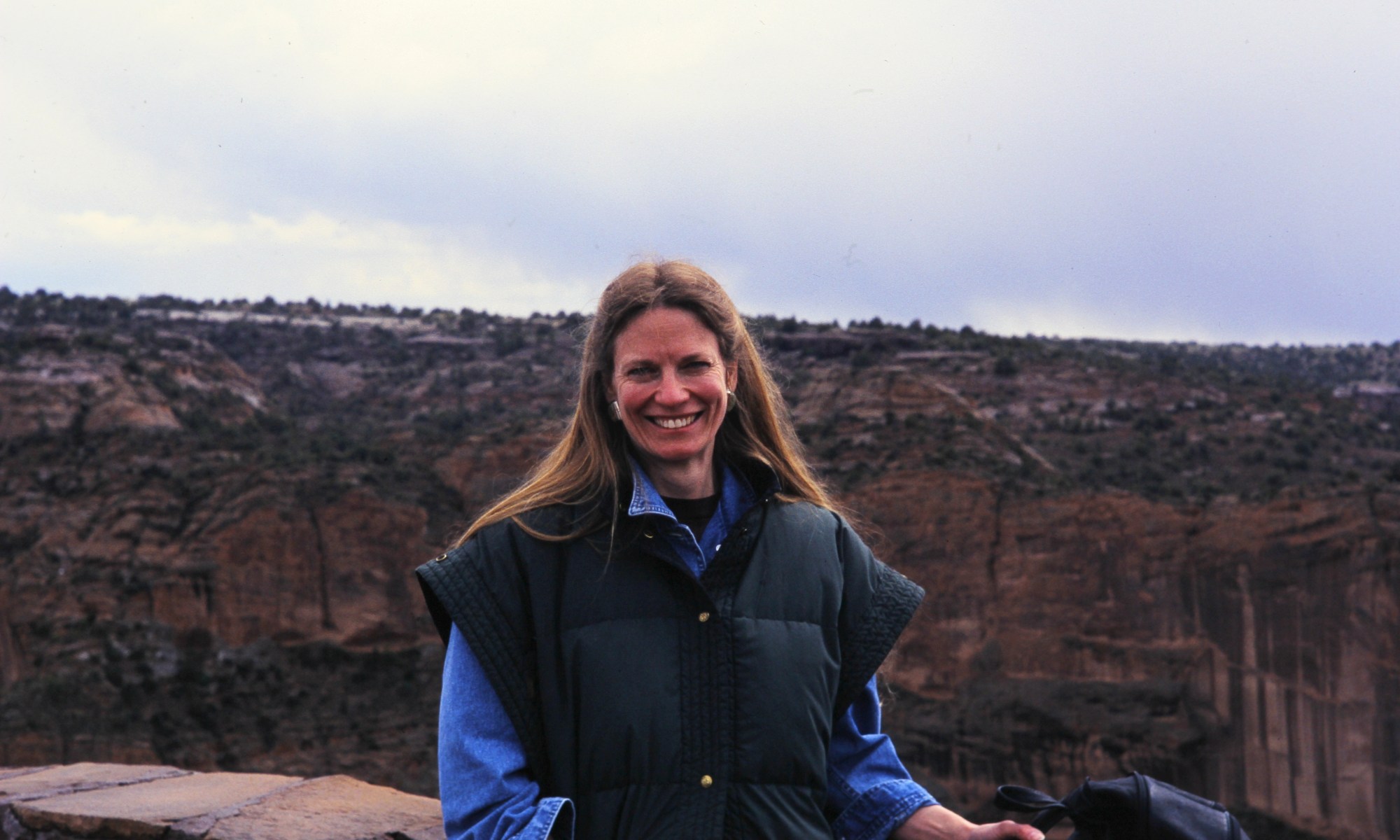
One hundred years after the Peabody’s founding, Malinda Stafford Blustain became its first female director. She began here as the Collections Manager (1992-1997), then became Curator (1997-2001), Interim Director (2001-2004) and Director (2004-2012). Blustain helped raise support for the museum and oversaw it through a crisis period in the early 2000s. She refocused efforts on integrating the museum into Phillips Academy’s curriculum, developing collections management programs, and ensuring NAGPRA compliance. These priorities continue to guide the Peabody’s work today.
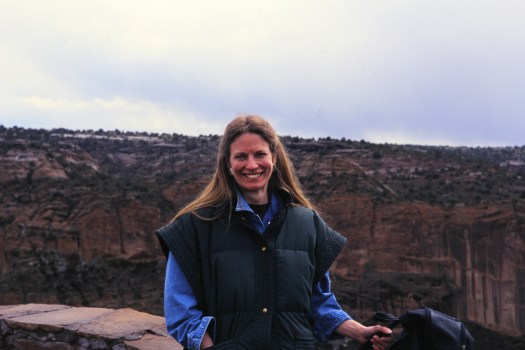
Malinda Stafford Blustain in New Mexico, circa 2002
Other women in the 1990s, such as Leah Rosenmeier, contributed significantly to the Peabody – this post thanks all of these women and pays tribute to their work here.
When I joined the staff of the Robert S. Peabody Museum of Archaeology in July 2012 there was major project underway. At the 2011 annual meeting of the Society for American Archaeology, then Peabody director Malinda Stafford Blustain had organized a symposium on the history of our venerable institution. Presentations were made by archaeologists, as well as Phillips Academy faculty members, administrators, and alumni, and covered everything from the scientific contributions and the ups and downs of the Peabody to personal recollections. The major theme of that symposium was conveyed in its title, “Rising from the Ashes: Glory, Trouble, and Renaissance at the Robert S. Peabody Museum of Archaeology.” In 2002 financial issues and lack of connections with our parent institution, Phillips Academy, came to a head and resulted in a potential shuttering of the Peabody. That didn’t happen, and the 2011 SAA symposium was a celebration and reflection on what can be described as a very unusual place: an archaeology museum situated at a storied New England prep school.
Participants in the 2011 symposium “Rising from the Ashes” at the 2011 Society for American Archaeology annual meeting, Sacramento, California.
Malinda had done the Herculean task of procuring drafts of each symposium presentation and recruited Jane Libby, close friend and colleague of former Peabody director Richard “Scotty” MacNeish, to help with editing. The plan was to edit, design, and print the volume in-house. Linda S. Cordell, Peabody Advisory Committee member and contributor to the volume, had insisted on peer review; reviewers had been identified and were submitting notes to Blustain and Libby. When I joined the team it became clear that there were several challenges. Some of the contributions needed lots of editing, some were very long, there were over 100 photographs planned for inclusion, and, most notably, we possessed no means to warehouse, market, or fulfil orders. In September 2012 Linda Cordell and I discussed the project and I also spoke with Lynn Baca, then editor at the School for Advanced Research in Santa Fe and John Strand, editor for the American Alliance of Museums. We all agreed that the project had lots of merit, but that there were any number of obstacles to overcome. Institutional histories can be tricky to publish, as they often have a limited audience. Our lack of distribution and fulfillment created problems, as did questions of storage. As a part of Phillips Academy, we have no way to set up a bank account or receive payments. It was clear that we needed a publishing partner and that we needed to do some serious editing.
Peabody publications from the 1920s through the 1970s.
Our own history provided a clue. In the 1920s Alfred V. Kidder established a relationship with the Yale University Press. Yale published Kidder’s An Introduction to the Study of Southwestern Archaeology in 1924 (and it has remained in print since that time). Other volumes in Kidder’s Southwest project also were published by Yale, including studies of Pecos Pueblo artifacts, pottery, and volumes prepared by Carl Guthe, Elsie Clews Parsons, and Earnest Hooten. Warren Moorehead used the Yale press connection to bring out his volumes on Etowah and sites in Arkansas and neighboring areas. Some of these Yale titles are still in print, while others are hard to find, even on Internet book searches. The “blue book” series, developed in the 1930s by the Peabody’s Doug Byers and Frederick Johnson, suffered from many of the same problems that we were facing with the new volume: lack of distribution, marketing, and fulfillment logistics. Despite producing some significant work, most of the printed “blue books” are still stored here in the Peabody attic. We’ve had the bulk of this series digitized and made available via InternetArchive. Scotty MacNeish avoided these issues by partnering with academic presses at the University of Texas and the University of Michigan, which brought out his five-volume Tehuacan and three-volume Ayacucho studies in the 1960s through 1980s. This was clearly the solution!
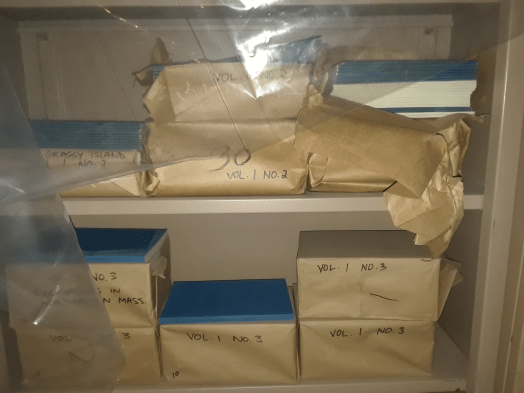
Copies of Peabody “blue books,” so-called because of their blue paper covers, still housed in the attic. Many institutions had similar publication series–and similar challenges.
By the end of 2012 I hired writer and editor Sharon Magnuson to help work on the project. She continued to work on editing through the end of 2016. We were able to return substantive review comments to authors, along with copy-edited versions created by Sharon. In 2013 I had conversation with the kind folks at Harvard’s Peabody Museum Press, who were publishing David L. Browman and Stephen Williams fabulous Anthropology at Harvard: A Biographical History, 1790-1940. There were some discussions about publishing our volume as a companion piece and I prepared a prospectus. Time and other commitments didn’t allow that relationship to go forward, but conversations with Harvard’s Joan O’Donnell helped me think through some of the challenges. One idea that Sharon Magnuson and I tackled was to make some of the personal reflection chapters into much shorter essays or sidebars. This helped focus these pieces, and significantly shortened our page and image count. Sharon’s great editorial eye also helped identity a few other issues, including one massive bibliography that had one chapter tipping the scales at over 80 pages! We put it on a diet.
By September 2015 I felt that the book was in pretty good shape and I was on the hunt for a publisher. Early efforts were a bit discouraging and I was prepared to revisit in-house publishing. Marshall Cloyd, Phillips Academy Class of 1958 and long-time member of the Peabody Advisory Committee gave me a pep talk and encouraged me to keep trying. Archaeologist David Hurst Thomas of the American Museum of Natural History was kind enough to help me brainstorm ideas about presses that might be interested. It was clear that we needed an academic press that was publishing histories of archaeology and anthropology. I ultimately sent out at least twenty inquiries. I got a lot of rejections! I did, however, have interest from presses at the University of New Mexico and the University of Nebraska. Editor Matthew Bokovoy at Nebraska thought the book might fit nicely in their Critical Histories of Anthropology series. I supplied the manuscript and waited for reviewer comments and a decision from Matt and series editors Regna Darnell and Stephen Murray.
On July 5, 2016 we had two sets of review comments and positive feedback from the press. I prepared a response to reader’s comments, which was due August 1, 2016. The folks at Nebraska got it—we had an interesting story to tell, one that was often central to the history of American archaeology, but one that also was little known. It was summer 2016 and it was clear that we still had a lot of work to do. The editors and the twenty contributors alike had lots of constructive comments to address. We needed to cut back on the figures—we agreed that fifty-five was the right number—and we needed to find a way to reintegrate those sidebars that we had created into the regular chapter structure. By September 2016 we had an agreement with Nebraska and were working away on a final draft, which we submitted in January 2017.
Despite the joy surrounding the completion of the manuscript, we must remember the people that we lost during this journey. Linda S. Cordell (1943-2013), who wrote about Alfred Kidder’s contributions at Pecos Pueblo and pushed for a peer-reviewed volume, died March 29, 2013. Gene Winter (1927-2014), long-time Peabody volunteer and honorary curator, passed on February 24, 2014. Gene brought his tremendous knowledge of New England archaeology and institutional history to the volume and I am so grateful that I was able to sit with him and work on revisions to his co-authored chapter. Most recently the world of archaeology lost another bright light in Brian Robinson (1953-2016). Brian passed on October 27, 2016. He and I had had many discussions about Maine archaeology and our decision to affiliate and repatriate funerary objects from the Nevin site to the Wabanaki tribes. The last conversation we had was about his chapter and some final notes from the copyeditor. Linda, Gene, and Brian were kind, generous, and knowledgeable people who made time for the Robert S. Peabody Museum, shared our values and vision, and helped to make us better. You will be missed.
Over the course of 2017 we got to know many people at the University of Nebraska Press. We worked closely with copyeditor Sally Antrobus, as well as production editor Joeth Zucco, who both brought a lot to the volume. Heather Stauffer answered lots of questions and helped keep us on track. I was happy for the opportunity to meet editor Matthew Bokovoy in early December 2017 at the American Anthropological Association annual meeting in Washington DC and share just how professional, encouraging, and kind he and his entire staff had been during the publication process.
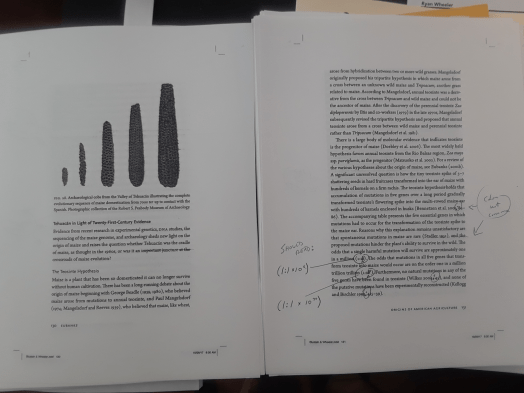
Pages from the galley proofs were marked up and returned to the press–this was the last time we saw the book before publication! These pages are from Mary Eubanks’ chapter on Scotty MacNeish and the search for the origins of corn domestication.
Marla Taylor, Peabody curator of collections, Irene Gates, archivist, and Lesley Shahbazian, staff assistant, all contributed to the volume, helping to find, re-find, and re-re-find photographs, providing proper citations for archival materials, and helping to obtain permissions. Their help is greatly appreciated!
One final person deserves a special mention. Dr. Peter Hetzler, Phillips Academy Class of 1972, and member of the Academy’s Board of Trustees and the Peabody Advisory Committee, provided much-needed support for publication of the volume. Archaeologist Jimmy Griffin once used the term “archaeological angel.” I can think of no better way to describe Peter!
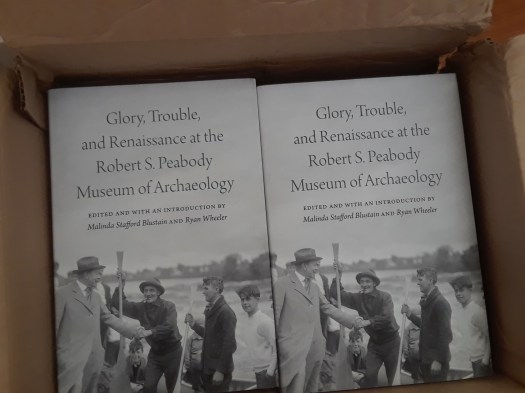
Copies of Glory, Trouble, and Renaissance at the Robert S. Peabody Museum of Archaeology arrived in early March 2018!
Copies of the published book arrived at my office on March 5, 2018. It’s a beautiful book with some amazing stories. Glory, Trouble, and Renaissance at the Robert S. Peabody Museum of Archaeology is a testament to what people did here, from Alfred V. Kidder and Warren K. Moorehead to today’s museum professionals, educators, and students. If you’d like a copy they are available directly from the University of Nebraska Press and on Amazon!
The collections staff at the Peabody keep telling me that I can’t have a cat. Which I guess was fair, until I found out that all this time they have been hiding a jaguar in our basement!
A few weeks ago I was approached by Elizabeth Aureden, instructor in music, to design an interactive class for her Music 410 course, The Musical Brain. While looking through our collections for musical instruments, I learned from collections assistant Samantha Hixson that she had just found and catalogued some effigy rattles.
The objects were made of clay and painted a variety of colors, and some still rattled.
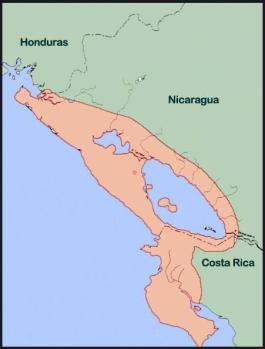
This new find seemed very promising and so I wanted to learn more about them. Research indicated that these objects were from the Nicoya Peninsula of Costa Rica and most likely date from AD 1000 – 1350.
Map showing the Nicoya cultural region. By Rodtico21 (Own work)[CC BY-SA 3.0 https://creativecommons.org/licenses/by-sa/3.0The parts we have are clearly broken and part of a much larger artifact. These are the remnants of the tripod legs of a rattle effigy vessel. Each of the three legs would have contained three clay balls and had openings on the side for the sound. When shaken a rhythmic sound can be heard.
Image of a complete vessel. Notice the holes in the side of the legs. By Daderot (Own work) [CC0], via Wikimedia CommonsThat’s pretty neat! But the story became even cooler as I found more information about this style of pottery.
The bowls were used to add a percussive sound to a ceremony. And the sound it made was not an accidental rattling sound, but rather a deliberate and meaningful one. When the bowl is shaken or moved about, and the clay balls rattle together, they create a deep, rumble. This sound is mimicking the low growl of an actual jaguar!!!!! Researchers have even noted that when the bowl is tilted and moving forward – like a jaguar lunging at prey – the sound is more prominent.
If your interest is now piqued about other objects from the Nicoya Peninsula, check out Dr. Rebecca Stone’s book, The Jaguar Within.
So next time you are at the Peabody be on the lookout, because you never know what other predatory animals might be lurking!!!
Scary lion from the 1995 movie Jumanji. Sometimes the Peabody seems like it’s playing its own version of the game Jumanji, with all the random artifacts that mysteriously present themselves to staff members.
Archaeologists are known as a creative and frugal bunch, and this is evident in the many ingenious ways that we have found to store artifacts and samples from recovery in the field to processing in the lab to long term storage on the museum shelf. Prior to the plastic bag, soil samples were housed in everything from feed sacks to paper bags. Glass food and condiment jars were a great way to keep charcoal samples, especially if you didn’t have a ready supply of tin foil. Metal, and then plastic, 35mm film canisters were highly prized for retaining tiny objects, like beads (the slightly opaque Fuji film canisters allowed a peek at the contents, unlike the black and gray Kodak canisters).
A selection of cigar boxes once used to house Peabody Institute collections. Note the site information and catalog numbers visible on some boxes.
Nothing, however, is more ubiquitous for storing artifacts than the classic cigar box. These sturdy wood or cardboard boxes with a built-in hinged lid were highly prized by generations of kids for storing marbles, coins, arrowheads, and other treasures. Perhaps it’s not surprising that as adults these boxes remained as the go-to storage solution. The Canadian Museum of History has a great interactive website about cigar boxes that explores the significance, history, art, and general usefulness of these containers. Much has been written too about cigar box guitars, which apparently go back to at least the 1840s through 1860s when cigars were first being stored and marketed in wooden boxes—see, for example, http://cigarboxguitars.com/about/history.
Food or sauce jars used to store soil samples from Richard “Scotty” MacNeish’s Tehuacan Archaeological-Botanical Project, 1960s.
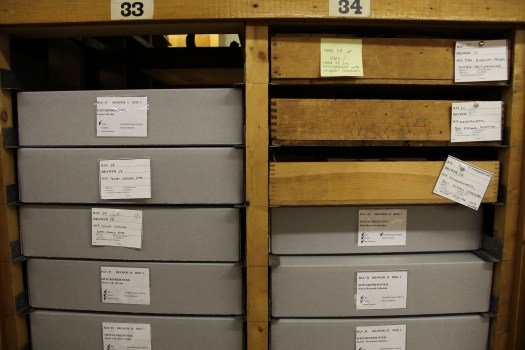
The collections of the Peabody Institute are no exception, and vast numbers of stone points, tools, and pottery fragments were once kept in legions of cigar boxes. Most, if not all, our artifacts have been rehoused in cardboard boxes and now we are working on a massive rehousing and cataloging endeavor that will improve our intellectual and physical control over our collections (museum-speak translated as “we will have a better idea what we have and where it is”). Our current strategic plan, developed in 2014 and 2015 identifies this as one of our most important objectives, and one we plan to accomplish in the next few years.
Side by side comparison of new archival storage cartons and older wooden drawers. Peabody collections personnel are transferring the collections to the new boxes with the help of students and volunteers.
There are, however, still a small collection of cigar boxes and other biscuit, cereal, and medicine boxes and tins that were once used to house objects and photographs. Handwritten labels, pasted over the decorative and distinctive cigar box art, identify sites and catalog numbers. A small collection of these boxes has been retained.
A groovy Zodiac shoe box from the late 1970s or early 1980s once housed a small, woven bag donated by Dorothy Byers. Note the two part accession/catalog number and other notes written on the lid.
A recent effort to address a backlog of objects awaiting cataloging turned up a groovy mid-twentieth century shoebox that contained a woven bag, apparently given to the Peabody by Dorothy Byers, widow of former director Douglas Byers (1903-1978). Byers worked at the Peabody from 1933 until his retirement in 1968, and served as director from 1938 through 1968. Zodiac was a brand of Encore Show Corp. and first debuted in the late 1970s and has had a recent revival. The woven bag—unfortunately bearing little information—has been rehoused and is now in storage. The shoe box is in my office.
The Peabody’s cataloging and rehousing project is made possible through a grant from the Abbot Academy Fund, continuing Abbot’s tradition of boldness, innovation, and caring, and the generous support of the Oak River Foundation, and Barbara and Les’ 68 Callahan. For information on how you can contribute to this project, please contact Peabody Institute director Ryan Wheeler at rwheeler@andover.edu or 978.749.4490.
Out of all the artifacts that I have worked with over the course of my career, one of my favorite types has always been historic ceramics. There are so many different ceramic types and beautiful decorative patterns that it’s easy to see why ceramics can often become collector’s items. Transferware has always been particularly interesting to me. Maybe it’s because there is such a wide array of images and scenery that can be depicted on this type of ceramic.
One of my previous jobs dealt heavily with colonial and antebellum artifacts, so transfer printed ceramic fragments would come through the lab on a regular basis. One of my favorite things to do there was to identify the specific patterns on the fragments as best I could. In order to do that I had many resources, including a Powerpoint with typologies found at the site and access to the Transferware Collectors Club website.
Last week, I decided to inventory a drawer which has historic ceramics in it. I rarely see historic ceramics here, so I figured it would be a good way to keep them fresh in my mind. When it came time to catalog the ceramics, I organized them in my workspace by colors, and then further broke these groups into design patterns.
Organizing ceramics!
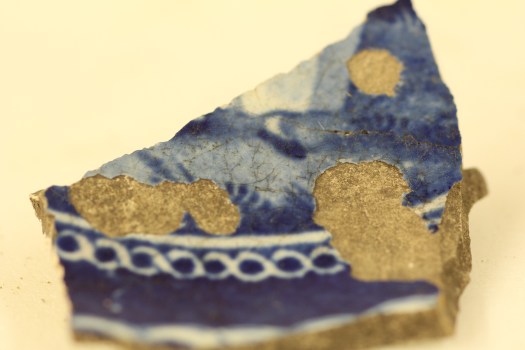
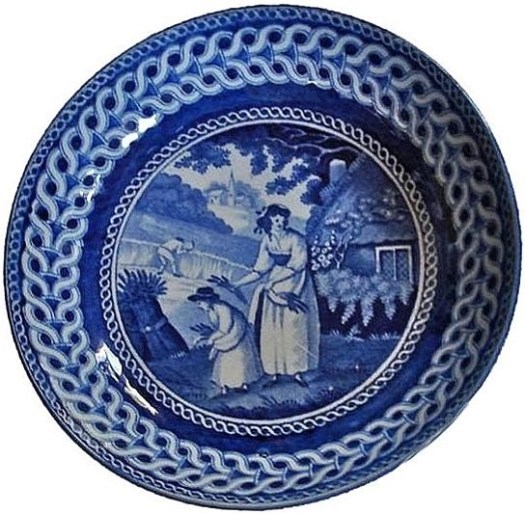
I had kept the aforementioned Powerpoint on a flash drive in case I ever ran into historic ceramics again. It was open on my computer while I was going through this particular drawer and it proved to be a valuable resource once again. I had a few fragments of transfer printed ceramics in front of me and noticed that even though they were tiny sherds, I was able to see that they contained images of grain, a foot, and a window with some shrubs.
The foot of a gleanerCeramic fragment with a window and shrubsCeramic fragment with gathered wheat
Going through the Powerpoint, I immediately recognized that these match up with a transfer pattern that is known as “Gleaners.” The rim pattern also was a dead giveaway, but that didn’t make it any less exciting to see that from a few tiny pieces of ceramic, I could get a vision of what the entire vessel once looked like!
An entire vessel with the “Gleaners” pattern.
Finding fragments of transfer printed ceramic is always exciting and can be like having pieces of a puzzle that you need to put together. Many antique transfer printing patterns are still used and reproduced to this day. If you have any in your possession, or know anyone else who does, I’d encourage you to look it up online and see what you can learn about something you might have once thought was just a cool decorative piece.
The Inventory Specialist position is supported by a generous grant from the Oak River Foundation of Peoria, Ill. to improve the intellectual and physical control of the institute’s collections. We hope this gift will inspire others to support our work to better catalog, document, and make accessible the Peabody’s world-class collections of objects, photographs, and archival materials. If you would like information on how you can help please contact Peabody director Ryan Wheeler at rwheeler@andover.edu or 978 749 4493.
Since November, I’ve been focused on better organizing and rehousing the Peabody’s photographic collections (a rough extent estimate: 10,000 prints, 35,000 slides, 230 rolls of film, 500 glass plate negatives and 1,500 lantern slides). These consist of excavation, ethnographic and museum object photographs. Some were created during the course of the Peabody’s activities; others were donated to the museum. There are some wonderful images here, many unknown to Peabody staff members even. In keeping with the archives project’s mission to make the Peabody’s archival collections more accessible, contract librarian Mary Beth Clack has begun cataloging photographs in our Past Perfect collections management database. For many photographs, some type of bibliographic record such as a catalog card or an index already exists, so adding a record to the database is a question of transcribing and consistently formatting existing information. Work duty students and I have been scanning photographs so that a digital image can then be attached to the catalog records, which are then easily published online via our Past Perfect web portal. In addition to the benefits of making these publically available, cataloging them in the database makes them infinitely more findable for staff members.
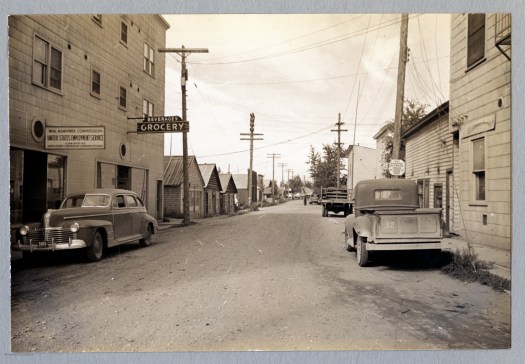
L-28-28. Fairbanks, Alaska. Snapshots of Chena Slough, streets and houses. 7/30/44
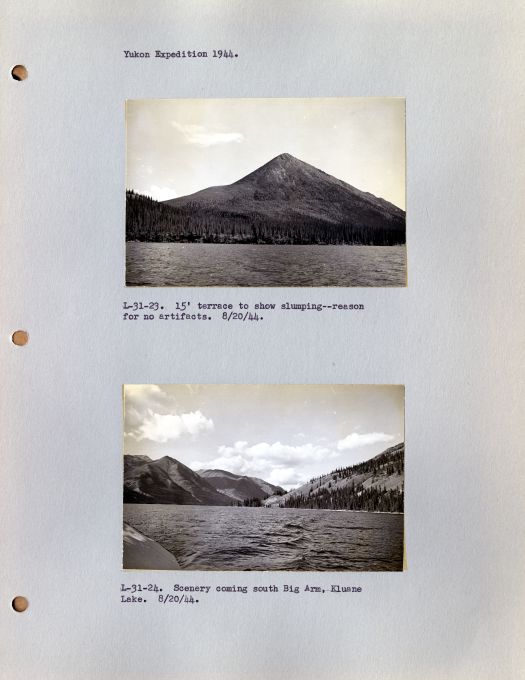
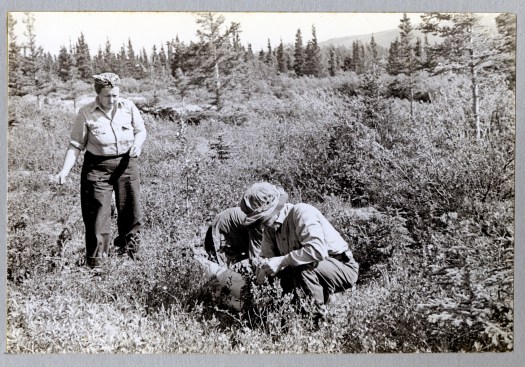
Mary Beth is currently working on the 1944 and 1948 Andover-Harvard Yukon Expedition print photographs. These approximately 1,500 images document the archaeological and geobotanical expeditions carried out jointly by the Peabody and Harvard University (and funded by additional sources, including the Wenner-Gren Foundation) in parts of the Shakwak and Dezadeash Valleys, in southwestern Yukon. The photographs, taken by Fred Johnson, Hugh Miller Raup and John H.H. Sticht, are mounted on stiff paper, typically two to a page, with typewritten captions below each image. Many of them, in addition to being important documentation of the expeditions, are very beautiful. Included here a few examples. The first batch of records have just been published online, and more will be added soon: please browse them here.
Example of an Andover-Harvard Yukon Expedition photographs page, with images from 1944.L-25-5. Collecting Primulas on muskeg between beaches west of Mile 1020-21. Near Pine Creek Camp. Alaska Highway. 6/23/44.
The Temporary Archivist position is supported by a generous grant from the Oak River Foundation of Peoria, Ill. to improve the intellectual and physical control of the institute’s collections. We hope this gift will inspire others to support our work to better catalog, document, and make accessible the Peabody’s world-class collections of objects, photographs, and archival materials. If you would like information on how you can help please contact Peabody director Ryan Wheeler at rwheeler@andover.eduor 978 749 4493.