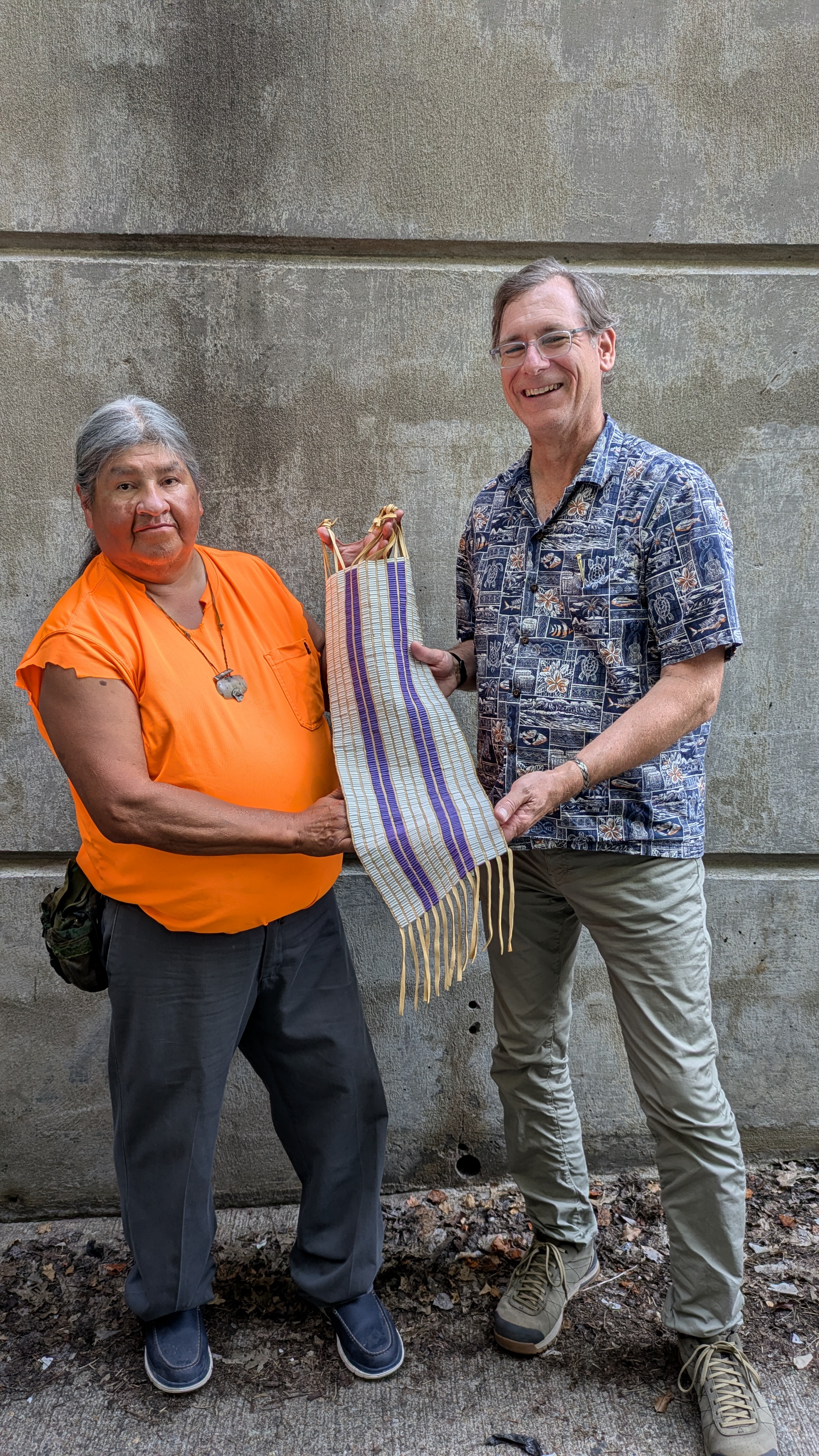
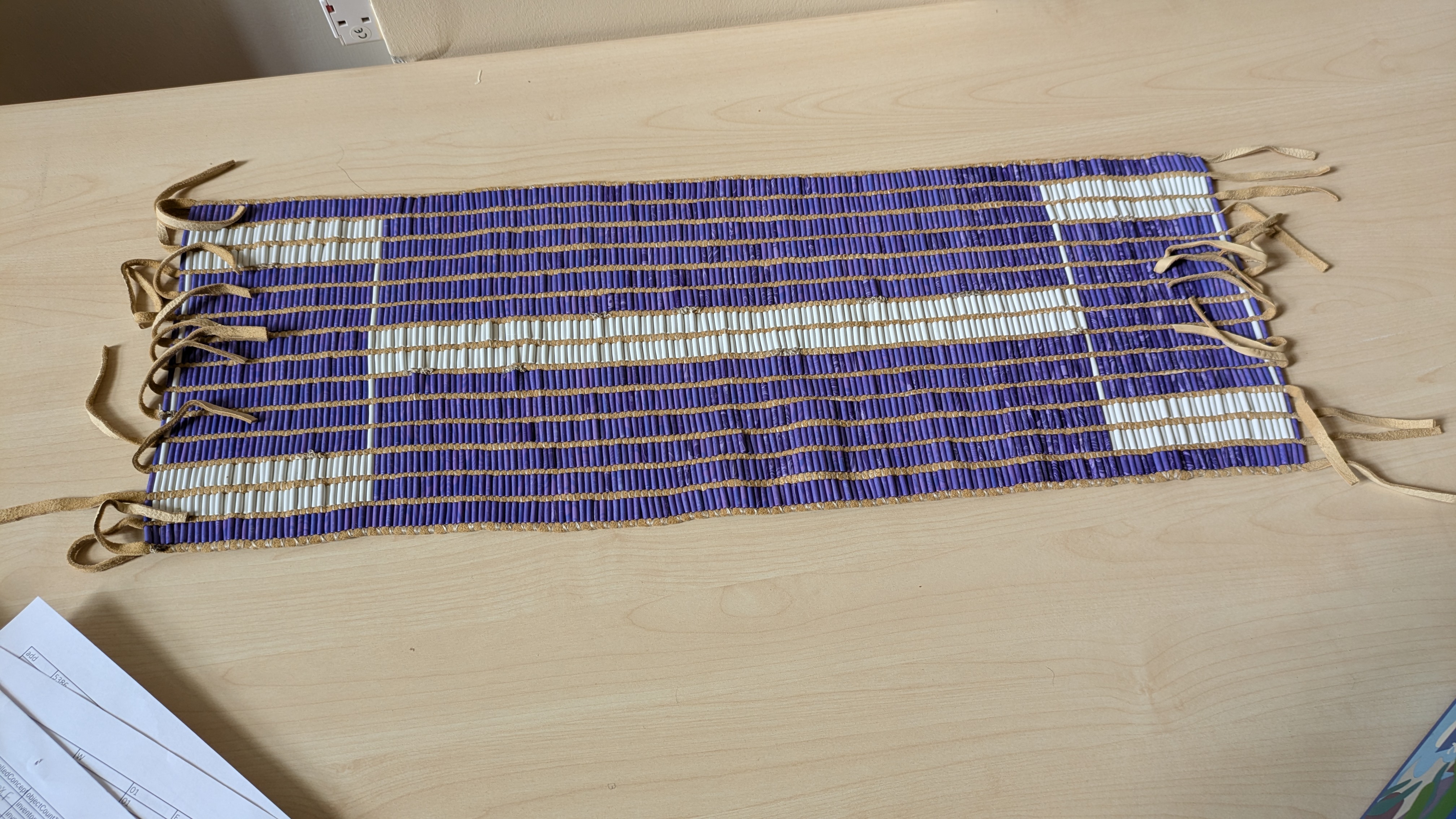
Earlier this year the Peabody Institute was fortunate to add two impressive wampum belt replicas to its collection of contemporary Native American art.
Tony Gonyea, Faith Keeper, Onondaga Nation presents Gaswéñdah, a two row wampum belt replica to Peabody director Ryan Wheeler.
Tony Gonyea, Faith Keeper of the Onondaga Nation, is well known for crafting modern wampum belt replicas, melding traditional designs and techniques with modern materials. A 2014 article by Wendy Gonyea on the Onondaga Nation’s website tells us that Tony’s oñgwehoñwe name is Wah’hasoñhdah, “He’s adding on.” Tony explains that to create a belt, “It takes hours upon hours into the evening. Working a little at a time, but when a belt is finished the end product is amazing. It feels nearly as powerful as the original.”
Tony Gonyea’s friendship belt replica.
Both belts have already made appearances in community programs and classes, and we anticipate that Tony’s belts will remain popular with Peabody Institute visitors.
Over the past month I have had the good fortune to represent the Peabody Institute at two professional conferences. Learning from others in a shared space can be really energizing and informative. I also really enjoy attending conferences and getting to connect with colleagues that I usually only see in a tiny Zoom window on my computer screen.
First, I attended the New England Museum Association (NEMA) Annual Conference in Newport, Rhode Island. NEMA is a great conference that brings together people in the area to discuss a wide range of museum-related topics. This year, I noticed more sessions that focused on telling LGBTQ+ stories, exploring ‘hidden histories,’ and how institutions can support emerging professionals.
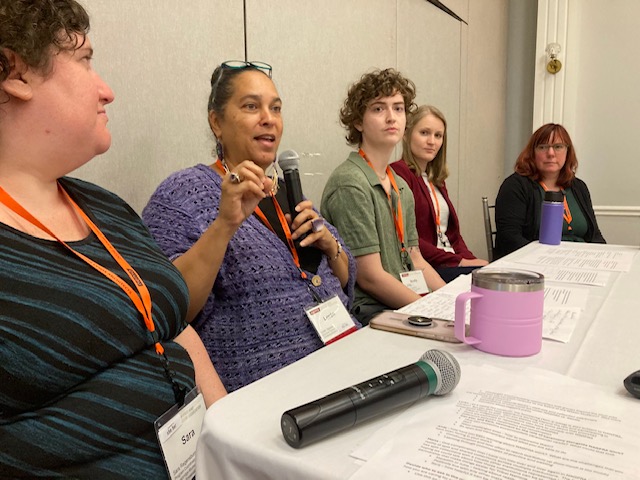
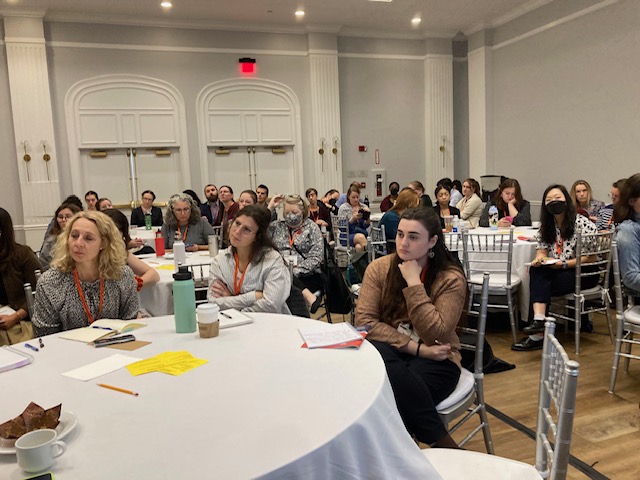
I was the facilitator for a panel titled Implementing NAGPRA: A Conversation with NAGPRA Practitioners. The panel was composed of individuals who are part of the Northeast NAGPRA Community of Practice and was a conversation to demystify the repatriation process, learn from colleagues, and identify opportunities for collaboration. The session was well attended and we had a fabulous conversation amongst ourselves and with the audience.
NEMA Session Panel SpeakersNEMA Session Audience
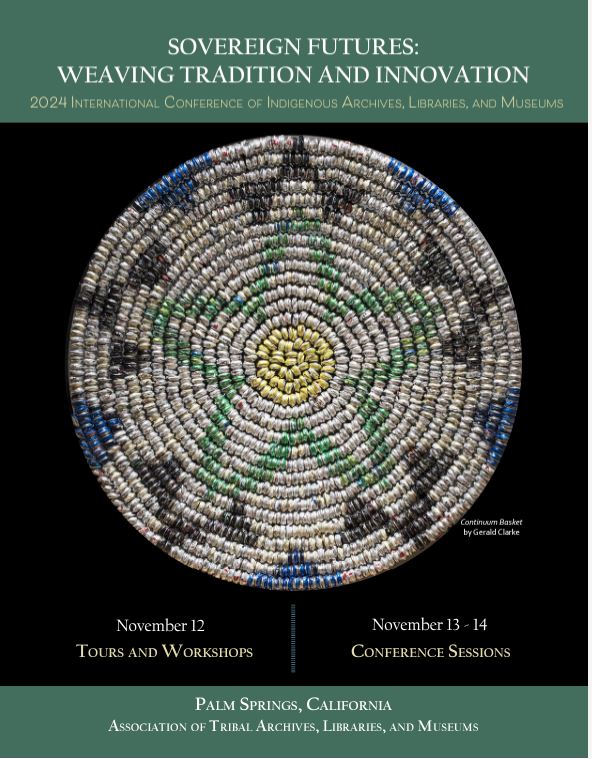
After a short (but long) day in Newport, I traveled the following week to Palm Springs, California for the Association of Tribal Archives, Libraries, and Museums (ATALM) Annual Conference. I love ATALM. It is a conference full of helpful information on everything from repatriation to pesticide management in collections to archival management. I appreciate that so many of the conversations really center on uplifting Indigenous voices and perspectives in all aspects of museum and cultural heritage work. It is a space that is invigorating and inspiring to me as a professional.
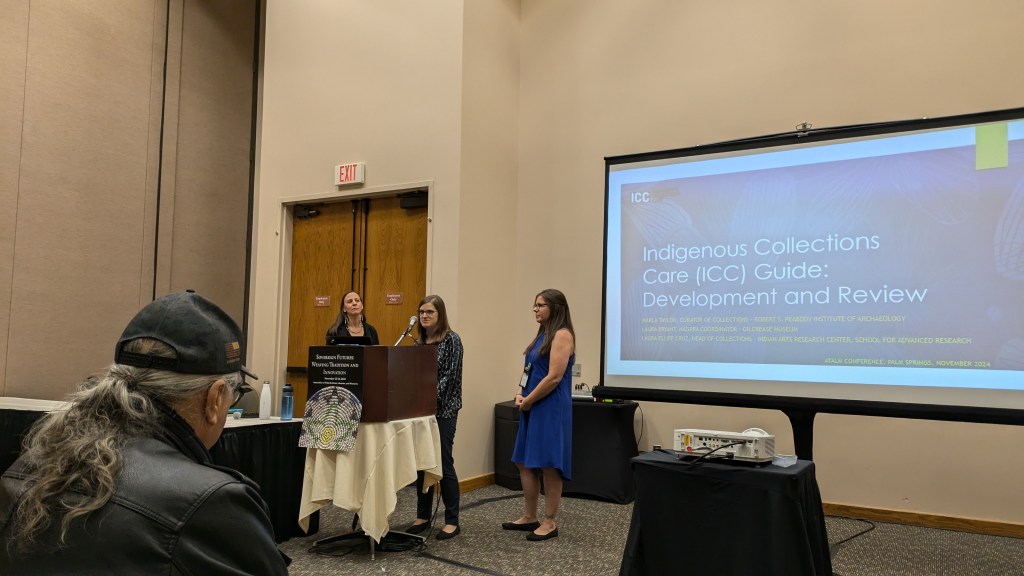
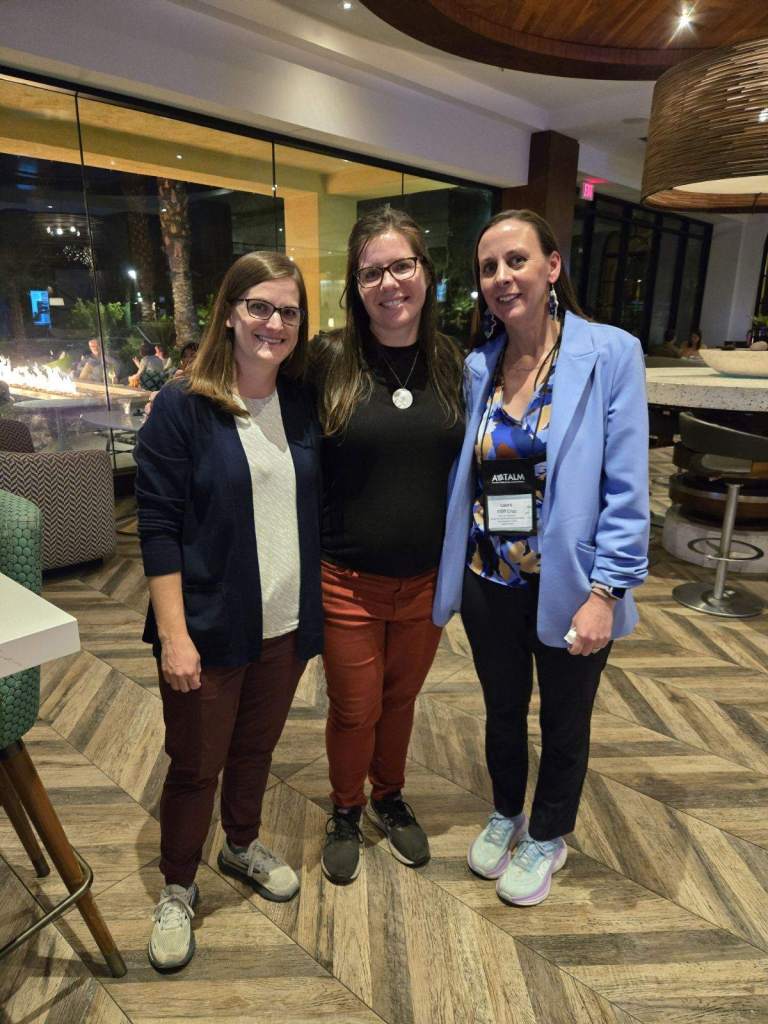
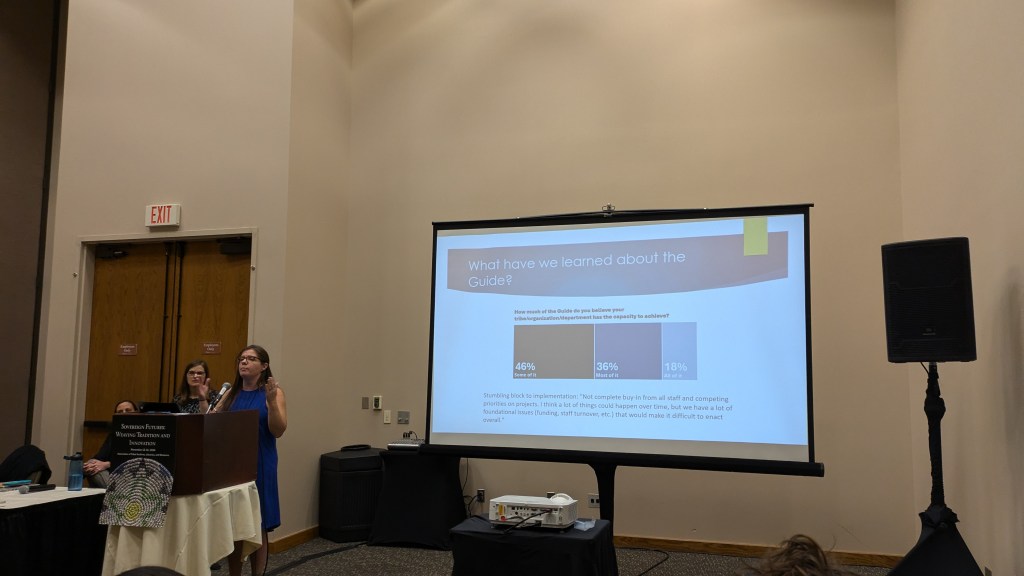
I was part of a session at ATALM to share information about the review process for the development of the ICC Guide. That session was well attended and we received lots of supportive feedback.
The fall season tends to be super hectic with all the conference travel, but it is a great way to connect with the larger profession.
Presenting at ATALMMy co-presenters and IPresenting at ATALM
Two months ago, I wrote about the process of moving the collection in advance of renovations to our building’s basement and moving it back after renovations were complete. In this blog, I thought I could briefly cover how we organized the collections when we moved back in.
Before embarking on any large-scale collections-based project it is a good idea to know what comprises the collection. As noted in the moving blog, the seeds of the renovation started with the 2017-2021 inventory and rehousing project. Understanding the size, weight, and material of the collection was instrumental for us to plan where it would all go. It also helped us select the appropriate type of furniture to best suit the items’ individual storage needs.
Quantify the collection
We worked with a design team from the storage furniture company we contracted to help us make the most of the space we had available. The designers needed to know how much space was required to house the items we steward. Thinking of the future, the figures we gave them included room for growth. We hoped we wouldn’t be at capacity as soon as the renovation was completed.
The dimensions for items held in standard sized boxes was straightforward. We provided more detailed dimensions of the large items and boxes. Shelving for these items would need to be more strictly planned to accommodate individual item and box dimensions.
Capacity, layout and review
The building renovation contractors provided the storage furniture design team with precise room dimensions that included height restrictions required by lighting, HVAC, electrical, and fire suppression systems.
Based on our needs and the space available, the design team gave us a series of shelving layouts. We double checked the dimensions of shelving- length, depth and shelf heights- to ensure that the collections could fit. The design team and our collections team went through several drafts before we came to a finalized layout.
Organization
Once we knew the basement’s storage capacity, we set about creating an organizing principle for the collection. Collections in each space were organized by region. Unboxed items were organized first by type, followed by region. Space on fixed shelves was reserved for items at risk of rolling off mobile shelving.
Future
We’ve been living with the renovation for several months now and are very happy with the results. We have contemplated making a change to the organizational structure of the standard-sized archival boxes. In the future we may organize collections by site or collection area within their broader region. Understanding the scope of this project will require data manipulation to better understand. It may mean moving items between boxes, in which case we’d have to weigh the benefits against the resources required to see an organizational schema such as this carried out.
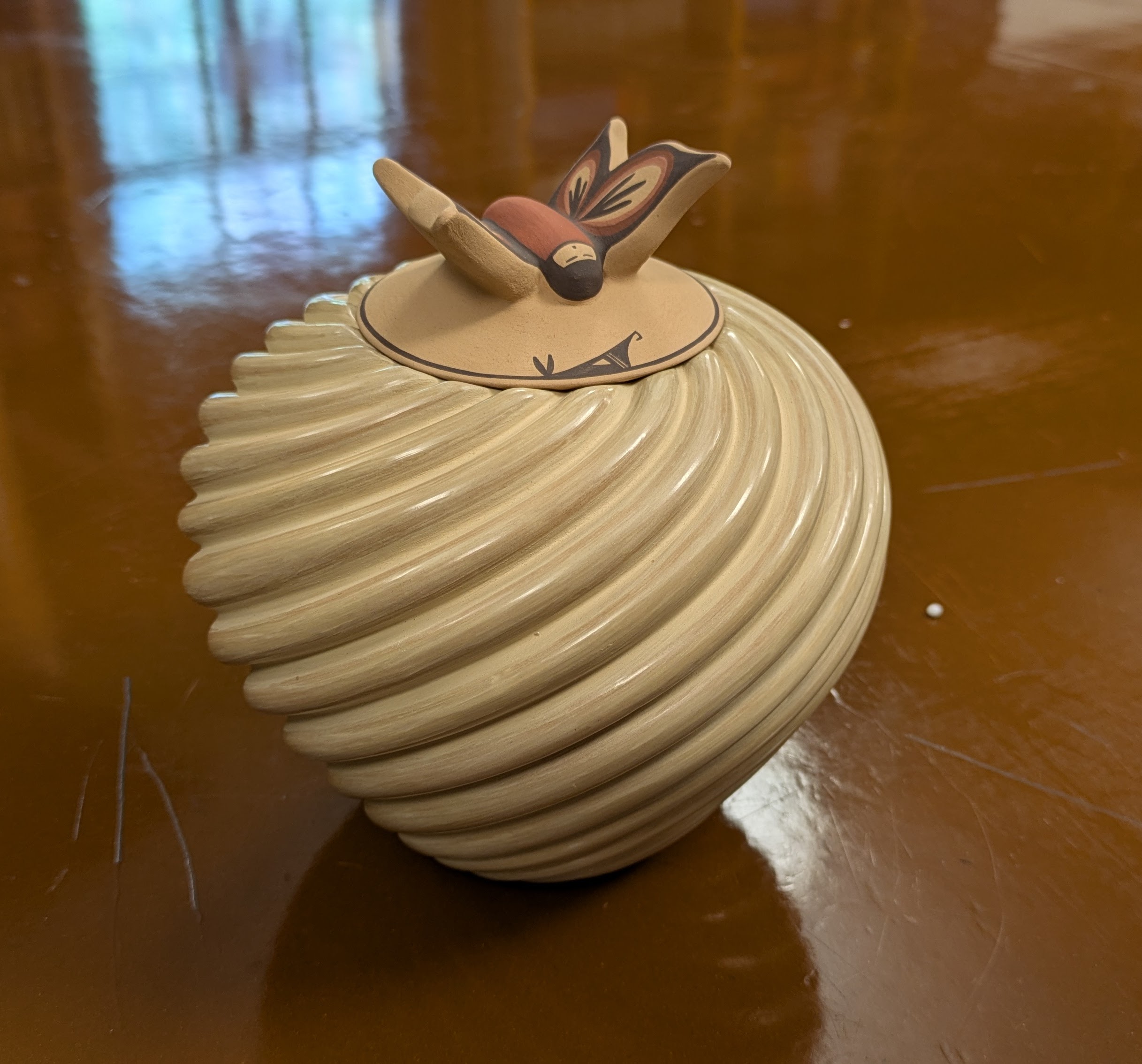
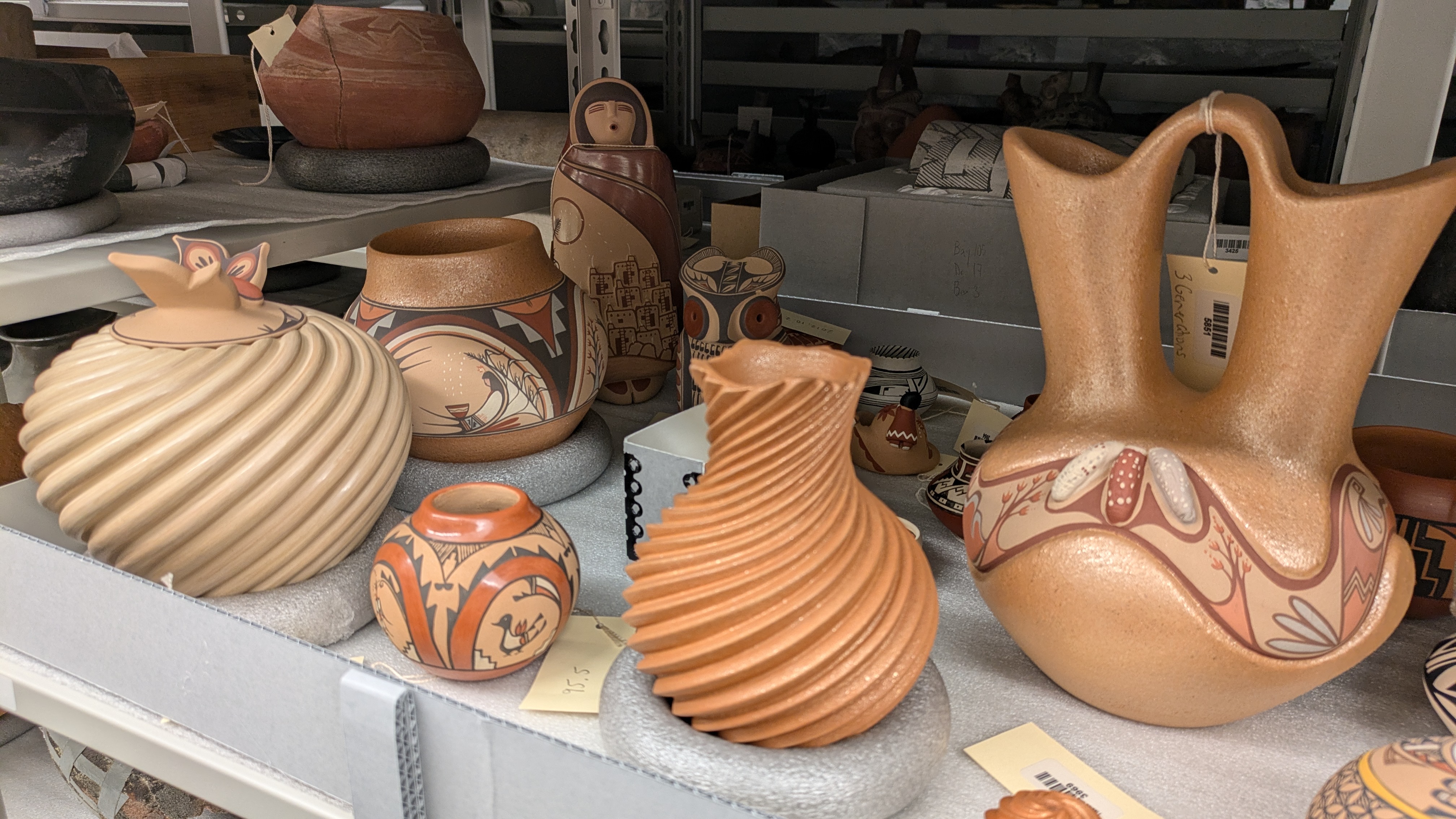
Mia Toya’s melon swirl vessel with distinctive butterfly lid. I particularly like the creamy slip, which sets this piece apart from others in the Peabody collections.
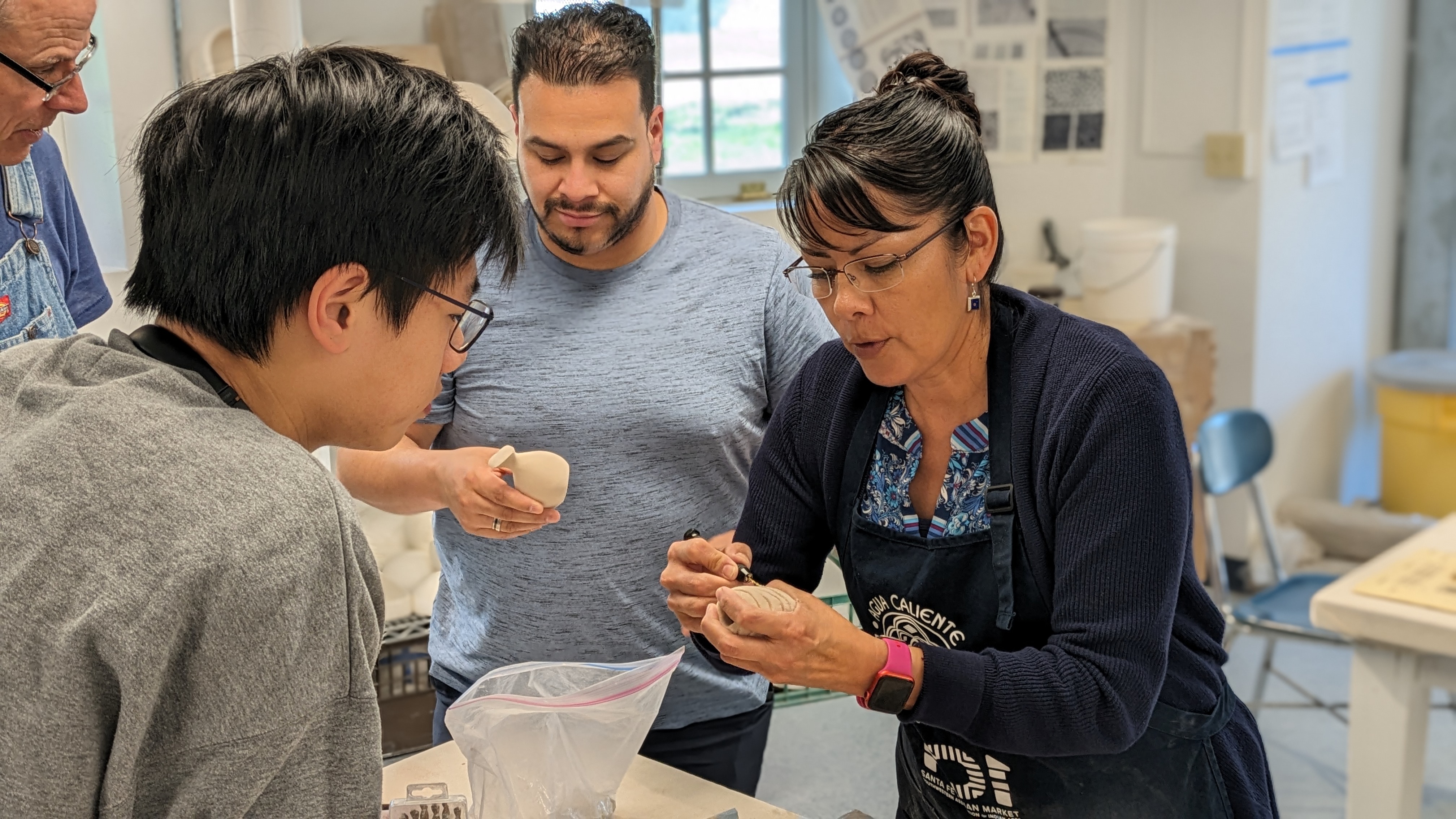
Early this fall–just after Santa Fe Indian Market–we were fortunate to add to the Peabody Institute collections this lovely melon swirl vessel by Mia Toya (Pueblo of Jemez). Mia and her family have a long relationship with the Peabody and Phillips Academy, regularly coming to campus to conduct week-long workshops on Pueblo pottery making with students in Thayer Zaeder’s studio ceramics classes.
Mia helps a student perfect their piece in Thayer Zaeder’s campus ceramics studio, May 2024.
Mia is a member of the Corn Clan and was inspired to continue the long lived tradition of working with clay from many members of her family who are well known artists, including her mom Maxine, grandmother Marie G. Romero, aunt Laura Gachupin, and her sister Dominique. Mia began working with clay at the age of 14 and continues to add her unique style of art to this day, constructing pieces using hand coiling methods, stone polished slips, and figural elements like her distinctive butterfly lids.
Mia’s piece (far left) joins other Toya Family creations in the Peabody Institute collections, including collaborations between Dominique and Maxine Toya, Maxine’s storyteller and owl figures, Dominique’s distinctive micaceous swirl vessels, and a piece by Mia’s grandmother Marie G. Romero (second from the left).
Watching Mia work with students, its not surprising that in addition to being an accomplished artist, she’s also an educator. Mia teaches second grade at Jemez Day School. A Bureau of Indian Education social media post from 2016 includes a quote from Mia, reflecting on becoming a National Board Certified teacher, “I always knew I wanted to teach in this school–to serve the kids in my community and be one of their role models. Being a National Board Certified teacher helps me give my best to my students, community, and Tribe every day.”
What do, parfleche, ceramics, paintings, and basketry all have in common? They are all currently on display at the Addison Gallery of American Art here at Phillips Academy as part of the Kay WalkingStick/Hudson River School exhibition.
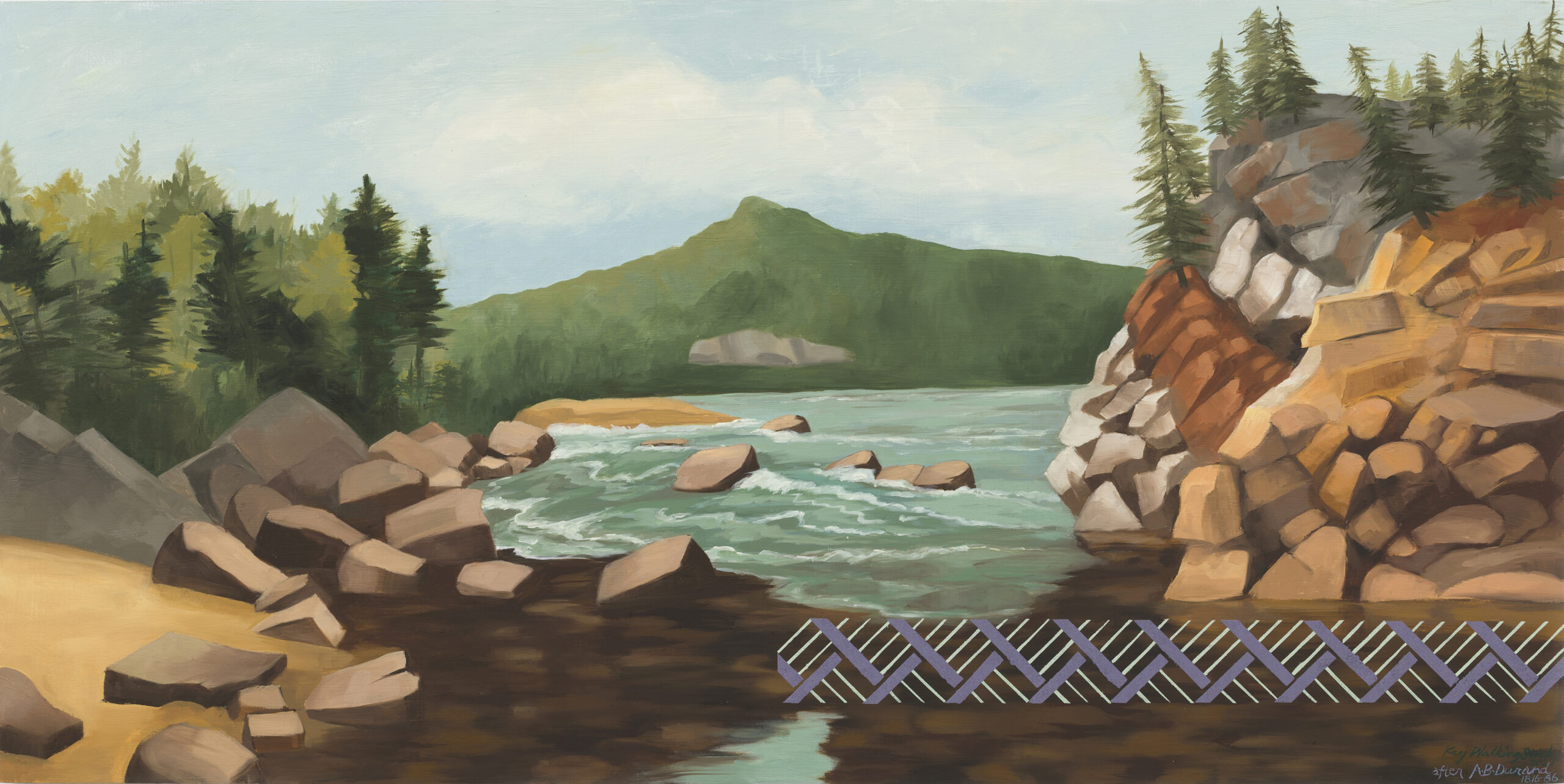
Kay WalkingStick (Cherokee) is a contemporary artist and educator known for her landscape paintings. This exhibition originated at the New-York Historical Society and has been joined by over a dozen pieces from the Addison’s permanent collection as well as three from the Peabody Institute.
In another wonderful collaboration with the Addison Gallery, the Peabody loaned two Mohican culture baskets and a vessel made by Wampanoag artist Ramona Peters to be placed in dialogue with Kay’s work. The items were thoughtfully selected and contribute to an intentional conversation between traditional painting techniques and Indigenous art.
We really appreciate the opportunity to collaborate with the Addison and highlight pieces from the Peabody Institute. Check it out if you are in the area!
Kay WalkingStick, Durand’s Homage to the Mohawks, 2021. Oil on panel. Colby College Museum of Art, Waterville, Maine; The Lunder Collection. Photo by JSP Art Photography. Copyright Kay WalkingStick
The change in season brings a time for storytelling and passing down traditions. The winter months are a prime time for sharing scary stories due to colder weather keeping people inside and gathered together.
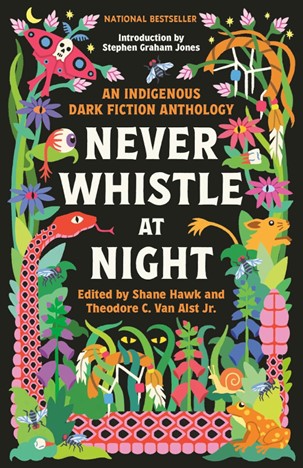
In honor of Indigenous Peoples’ Day (October 14) and upcoming National Native American Heritage Month (November), we’re highlighting some folklore inspired by the Indigenous dark fiction anthology, Never Whistle at Night. This book is comprised of 26 short stories that explore aspects of Indigenous horror, beliefs, traditions, and folklore. These stories are told by a variety of Indigenous authors (see complete list below), edited by Shane Hawk(Cheyenne & Arapaho Tribes of Oklahoma) and Theodore C. Van Alst Jr. (Mackinac Bands of Chippewa and Ottawa Indians), and introduced by Stephen Graham Jones (Blackfeet Nation).
Carson Faust(Edisto Natchez-Kusso Tribe of South Carolina)
Kelli Jo Ford(Cherokee Nation of Oklahoma)
Kate Hart(Chickasaw/Choctaw in Arkansas)
Shane Hawk(Cheyenne & Arapaho Tribes of Oklahoma)
Brandon Hobson(Cherokee Nation Tribe of Oklahoma)
Darcie Little Badger(Lipan Apache Tribe of Texas)
Conley Lyons(Comanche)
Nick Medina(Tunica-Biloxi Tribe of Louisiana)
Tiffany Morris(Mi’kmaw)
Tommy Orange(Cheyenne and Arapaho Tribes of Oklahoma)
Mona Susan Power (Standing Rock Sioux Tribe)
Marcie R. Rendon (White Earth Band of the Minnesota Chippewa Tribe)
Waubgeshig Rice (Wasauksing First Nation)
Rebecca Roanhorse (Navajo Nation)
Andrea L. Rogers (Cherokee Nation)
Morgan Talty (Penobscot Indian Nation)
D.H. Trujillo (Pueblo)
Theodore C. Van Alst Jr. (Mackinac Bands of Chippewa and Ottawa Indians)
Richard Van Camp (Dene Nation)
David Heska Wanbli Weiden (Lakota)
Royce Young Wolf (Hiraacá, Nu’eta, and Sosore, ancestral Apsáalooke and Nʉmʉnʉʉ)
Mathilda Zeller (Inuit)
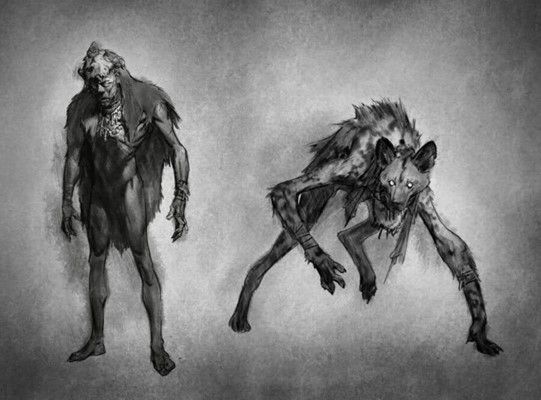
The title of the anthology refers to a belief common in many Indigenous cultures that whistling at night can attract malevolent entities. The act of night whistling is forbidden by many Native American cultures due to a shape-shifting entity, known as a “Skinwalker” or “Stekini” that responds to the call, causing harm to those who encounter it.
Skinwalker – Image courtesy of DoubleOurEfforts/reddit
Native cultures use storytelling to pass down knowledge and history, including folklore. Scary stories often carry deeper meanings, serving as lessons and warnings. Some of my favorite stories from this book were: Kushtuka, Quantum, Snakes are Born in the Dark, Before I Go, and Dead Owls.
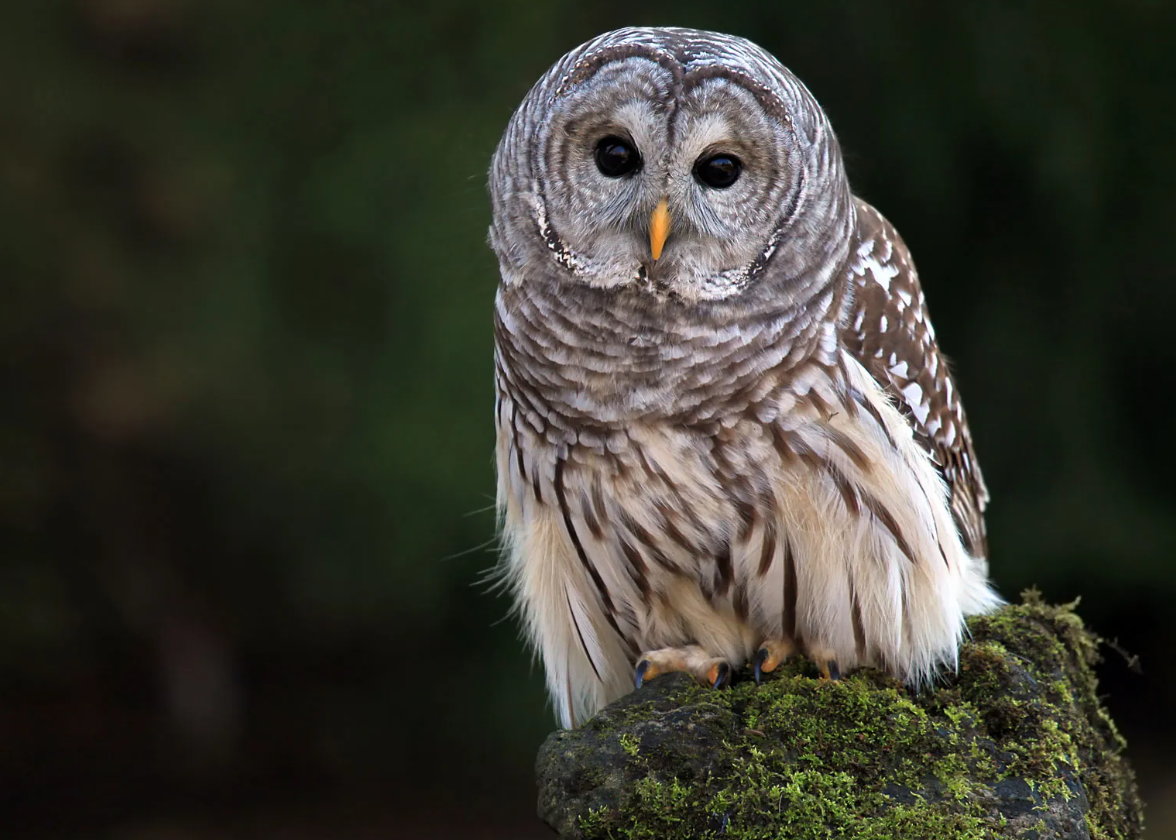
Several stories in the book share a common subject – the owl. Interpretations of owls can be found across different Native American tribes, with some viewing owls more negatively than others. There are several items in the Peabody collection that highlight the owl form, their meanings varying significantly between different Indigenous cultures and locations. Here are just a few for you to explore!
Owls are often associated with death and the spirit world, seen as messengers or harbingers of bad luck reflected in their nocturnal habits. Seeing an owl, particularly during the day can be a sign of death or misfortune. Some tribes consider owls as spirits of the deceased or that they might not be real birds at all, but shapeshifters. The sound of an owl’s hoot is seen as a call to the spirit world or a way to connect with ancestors.
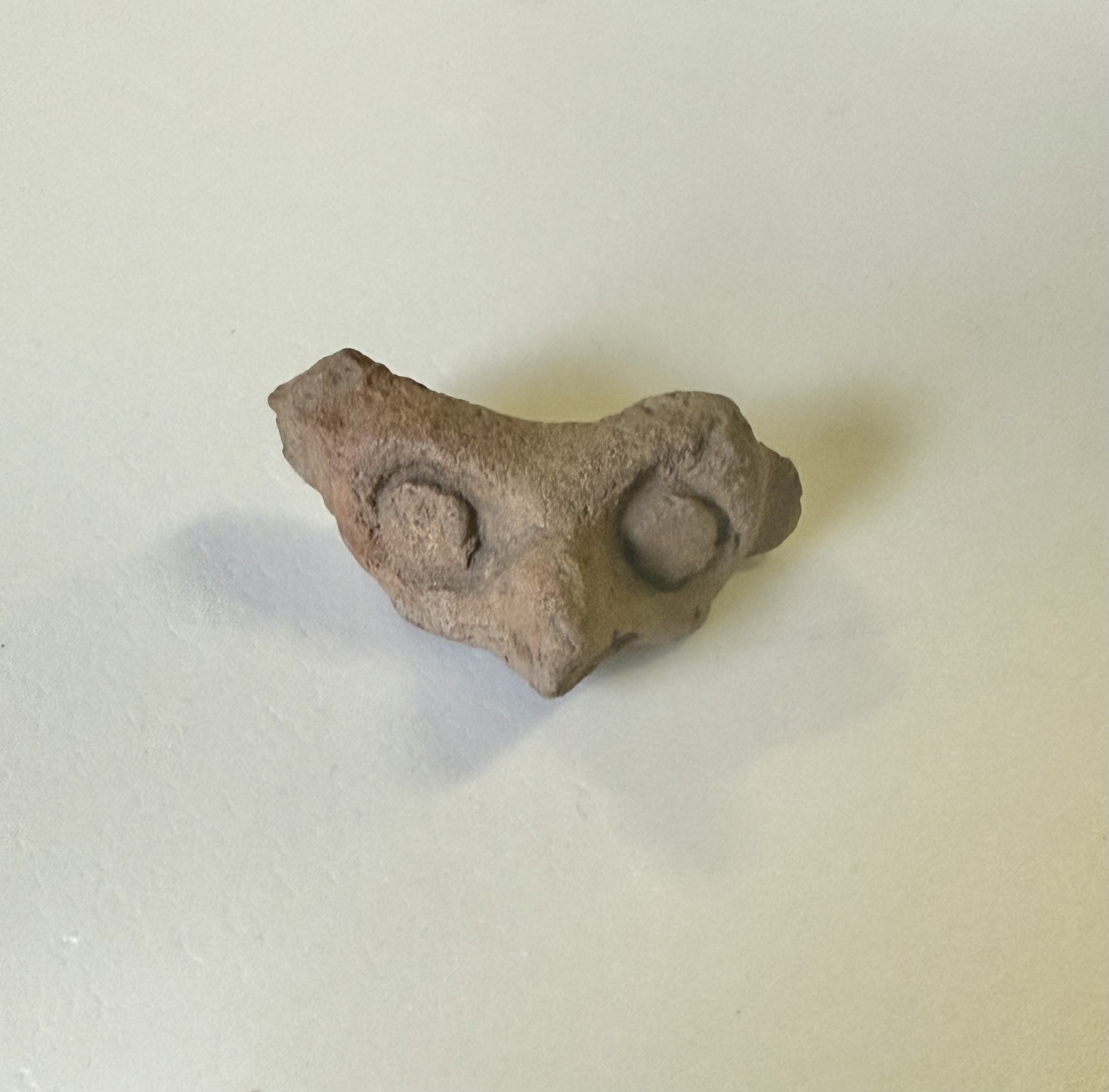
Owl Effigy (2018.2.1266) – Fragment of an owl effigy from the Valley of Mexico. Warren K. Moorehead compared this item to clay effigies from the Etowah village site in his 1932 book Etowah Papers: Exploration of the Etowah Site in Georgia.
Owl Effigy (2018.2.1266), Peabody Collections
Folklore of the Valley of Mexico believe in a witch known as “La Lechuza” who shapeshifts in the form of an owl that preys on people who are disobedient, unbaptized, or who harm others. Check out this episode on La Lechuza from the podcast, History Uncovered.
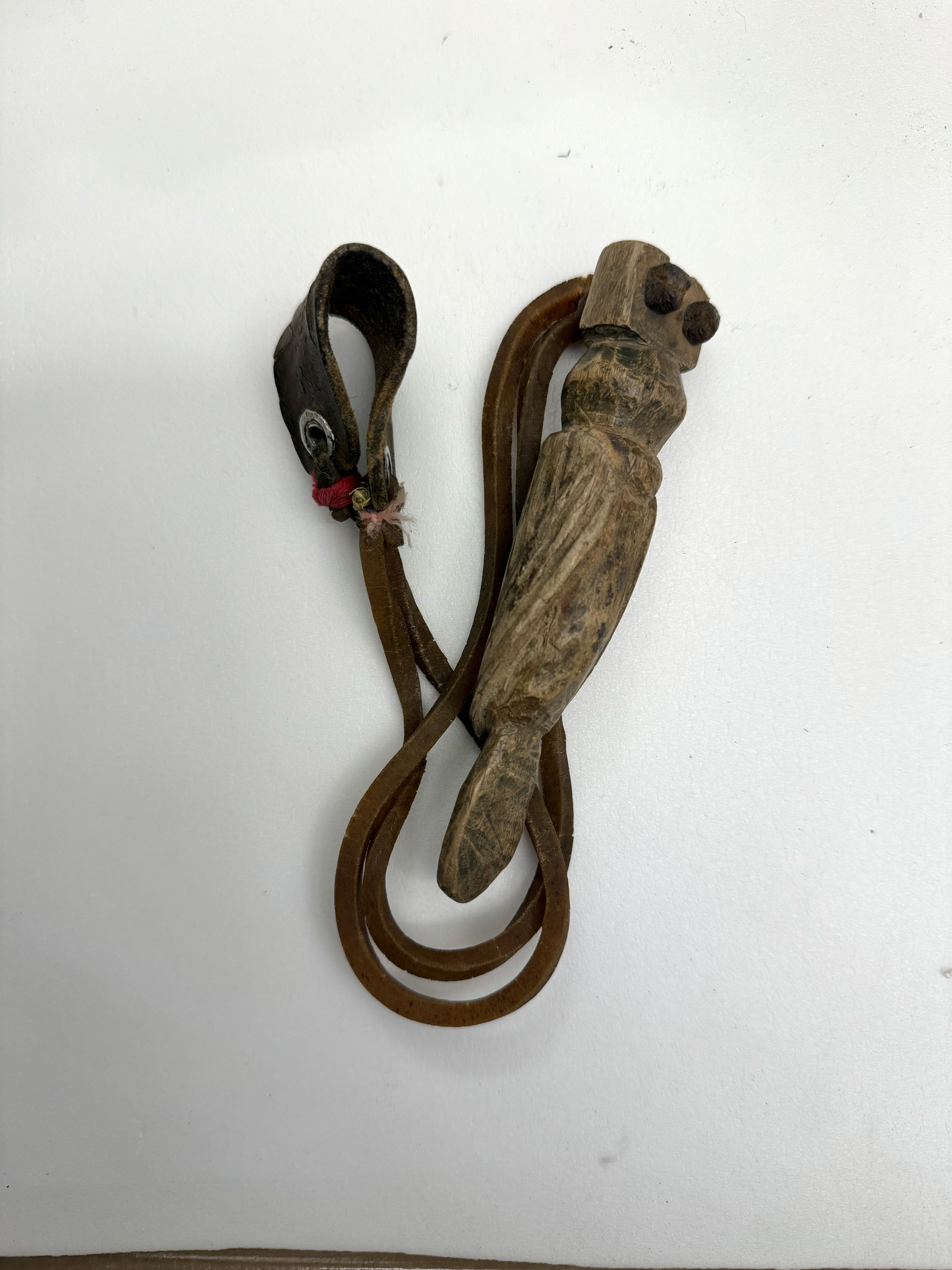
Owl Effigy Slingshot (97.1.53) – From the Ixil Maya community in Chajul, El Quiché, Guatemala. Used by men and boys to hunt birds, though it is common to hunt with a blowgun.
Other tribal beliefs revere owls as symbols of wisdom and intuition, as well as carriers of ancient knowledge and protection.
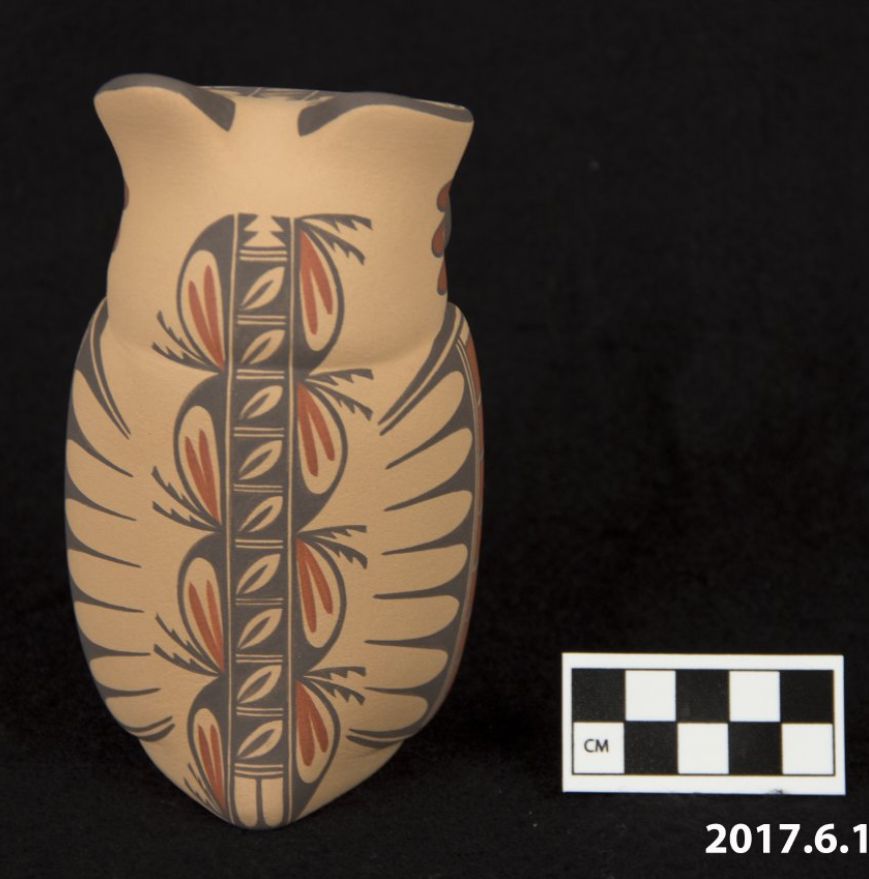
Ceramic Owl Figurine (2017.6.1) – Ceramic piece by Maxine Toya from the Pueblo of Jemez, New Mexico. In Pueblo culture, owls are seen as protectors. The ceramic owl design is built by stacking and smoothing hand coils of clay. The piece is both carved and painted, the feathers on the front being carved into the clay. Painted designs are intricate using symbols of rain, clouds, and feathers. These designs are all matte and painted with clay slips with only the eyes being polished.
Maxine Toya is well known for her figurative pottery (the first piece of pottery Maxine created was an owl!) Maxine is one of several pottery artists from the Pueblo of Jemez that visit Phillips Academy campus each spring to work with students in ceramic classes. You can read more about these visits here and here!
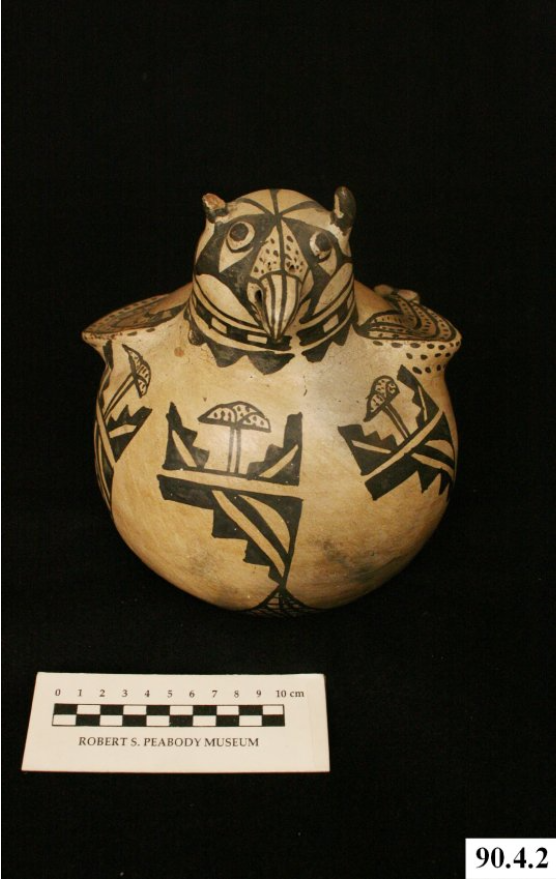
Ceramic Owl Effigy Jar (90.4.2) – Globular body in black on white design with vessel opening located at owl beak. Owl facial features at neck, wings at sides and tail at back. The globular shape is the most recognizable characteristic of pottery from Cochiti Pueblo, New Mexico.
Ceramic Owl Effigy Jar (90.4.2), Peabody Collections
Owls are featured in Cochiti Pueblo pottery, often associated with the god of death and spirit of fertility, Skeleton Man.
Exciting News! – Never Whistle at Night, Part II: Back for Blood is currently accepting submissions from emerging Indigenous writers. This is the second book in the Never Whistle at Night series.
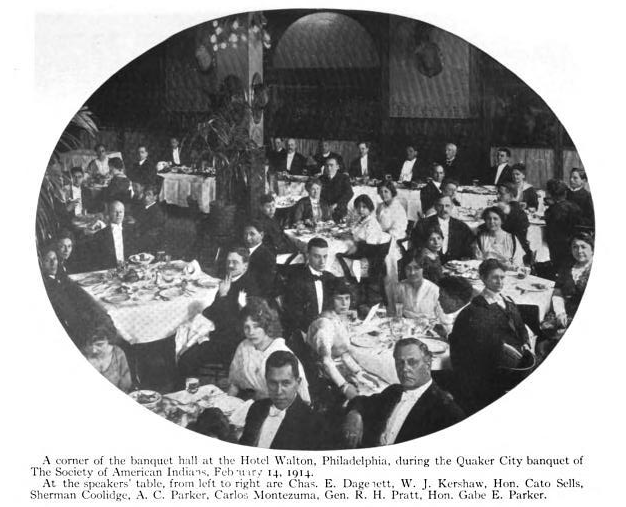
The Society of American Indians, Philadelphia, Pennsylvania, February 14, 1914. The Quarterly Journal of the Society of American Indians, Volume 2, 1914.
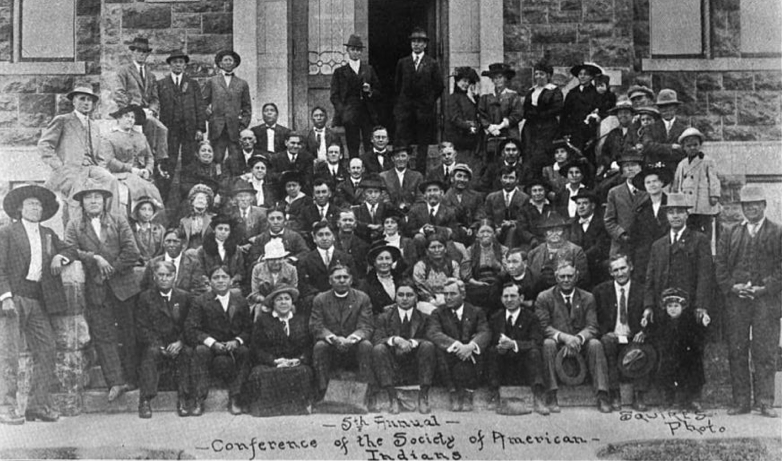
On the weekend before Columbus Day in Columbus, Ohio, 1911, a group of Native American leaders and activists joined together to attend what became the first annual meeting of the Society of American Indians, or SAI. For the next thirteen years, this pioneering Pan-Indian organization was a center for Native American political advocacy, lobbying Congress and the then-Office (now Bureau) of Indian Affairs; offering legal assistance to Native individuals and tribes; publishing a quarterly journal; and corresponding extensively with Native Americans, “Friends of the Indian” reformers, political allies, and critics across the country.
Members of the SAI were a veritable “who’s who” of early twentieth century Native history, representing activists, clergy, entertainers, professionals, speakers, and writers, from communities both on- and off-reservation. To namedrop just a few, these included (but were by no means limited to): attorney Marie Louise Bottineau Baldwin (Métis/Turtle Mountain Chippewa/French); musician and writer Gertrude Simmons Bonnin (Yankton Dakota); educator Henry Roe Cloud (Winnebago); Episcopal priest Sherman Coolidge (Arapaho); civil servant Charles Dagenett (Peoria); painter and illustrator Angel De Cora (Winnebago); Episcopal priest Philip Joseph Deloria (Yankton Dakota); physician Charles Eastman (Dakota); author and linguist Laura Cornelius Kellogg (Oneida); ethnologist Francis La Flesche (Omaha); physician Carlos Montezuma (Yavapai Apache); writer, editor, and journalist John M. Oskison (Cherokee); archaeologist Arthur C. Parker (Seneca); lawyer Thomas Sloan (Osage); and advocate Henry Standing Bear (Lakota).
Without sharing a singular vision of Native American identity, tribal self-determination, or what the place of Native Americans should be within US society, these individuals committed themselves to a shared purpose, striving firstly “To promote the good citizenship of the Indians of this country, to help in all progressive movements to this end, and to emulate the sturdy characteristics of the North American Indian, especially his honesty and patriotism.” Seeking to benefit the freedom and development of all Native Americans, the two primary platforms on which the SAI stood were U.S. birthright citizenship for Native Americans and tribal access to the U.S. Court of Claims, addressing the two major issues at the forefront of public debates on the “Indian problem” at the time – the ambiguity of Native American legal status and the Office of Indian Affair’s mismanagement of Native lands and resources.
The investment of people’s time and unpaid labor in the work of the Society and its journal was extraordinary but ultimately unsustainable, and the SAI dissolved in 1923. Disappointingly, it had achieved neither of its major goals. Congress passed the Indian Citizenship Act in 1924, granting birthright citizenship to Native Americans but maintaining their wardship status. The Indian Claims Commission took over twenty more years to come, in 1946, allowing tribes to bring claims against the US government through judicial arbitration, not a court, and successful claims could result only in monetary compensation, not regained lands. The SAI also could not succeed in delivering a unified expression of Native American opinion to the government and public – probably the most unrealistic aim of all.
Despite its “failures,” the Society of American Indians was the first organization of its kind, created by Native Americans to amplify a Native American voice across the country during a time when people’s lives were under siege and they battled to have their voices heard on multiple issues. It may not have lasted long, but the SAI left a legacy of political, legal, and intellectual activism, setting the course for the many Native professional organizations to follow, and standing as part of an ever-present, ongoing continuum of Native Americans advocating for their best interests; joining in the debate as to what that might look like or how to get there; and striving to build better, stronger, and healthier relationships with the rest of the nation.
Maybe consensus is less important than joining in the conversation. Whether you are celebrating Columbus Day, commemorating Indigenous Peoples’ Day, or just slogging through another Monday – that door is always open.
The Society of American Indians, 5th Annual Conference, on the steps of Engineering Hall, Kansas University, October 1, 1915. The Quarterly Journal of the Society of American Indians, Volume 3, 1915.
In January 2024 renovations to our collection housing were completed, finalizing a process that started in March 2023. To accommodate the demolition of existing shelving and installation of new condensing metal shelving, the collection was moved out of the basement in early 2023. With the project completed and several months of living with the move behind us, this seems like a good time for a brief recap. Perhaps some of our planning can help other institutions that have a collection move on the horizon.
During initial planning for the renovation, we faced two scenarios for moving the collection. The first was to move the collection offsite. The second, involved keeping the collection onsite within portions of the building that were not renovated. We needed to make viable plans for both options while decisions about construction phases and timelines were being made.
We identified several challenges to moving the collection offsite. Some of the largest hurdles included the high cost of offsite storage, the massive time commitment required for packing the collection for an offsite move and conducting a post-move inventory and condition reporting of the collection. A second round of inventory and condition reporting would need to be done after the collection was moved back into the building.
Keeping the collection onsite raised other concerns. Temporary housing would need to be big enough to house the collection. We would only be allowed in the building during designated windows when it was safe for us to enter, therefore the temporary housing area would need to be locked and monitored by cameras. The space would need to be environmentally controlled to the best of our ability. We also contemplated whether construction could lead to a catastrophic accident that would damage the building and collection.
The benefits and challenges of each scenario were taken into consideration within the larger framework of the construction plan. Ultimately, it was decided to keep the collection onsite in temporary housing. Although it came with some complications, it resulted in huge savings and a greater degree of control over the moving process when compared to moving the collection off-site.
Inventory and rehouse
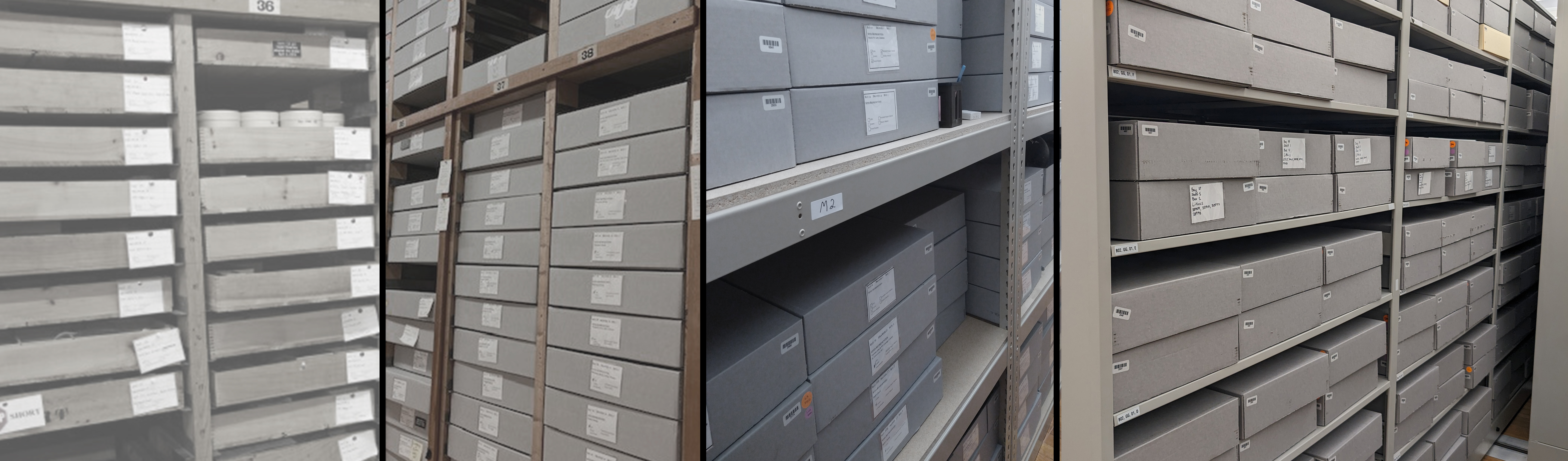
The move started with an inventory and rehousing project that was carried out between 2017 and 2021. The project has been covered in previous blog posts. To summarize, Peabody staff conducted a 100% inventory of collections housed in aging wooden drawers in our basement. The inventory collected basic information; a description, count and provenience. Once inventoried, the items were rehoused in archival boxes with lids. While the wooden storage bays didn’t allow for stacking, future storage could take advantage of the ability to stack boxes.
The archival boxes were about half the size of the wooden drawers. Boxes were therefore much lighter and in most cases two boxes existed where previously there was one drawer.
Barcode and Weigh
During the planning onsite and offsite moves, we identified the first floor as the likeliest location for temporary housing if we were moving the collection inside the building. We knew the collection was heavy, but in the basement the collective weight of the collection was never a concern. Now, the ability of the building to hold the weight of the collection boxes was an important question that needed to be answered.
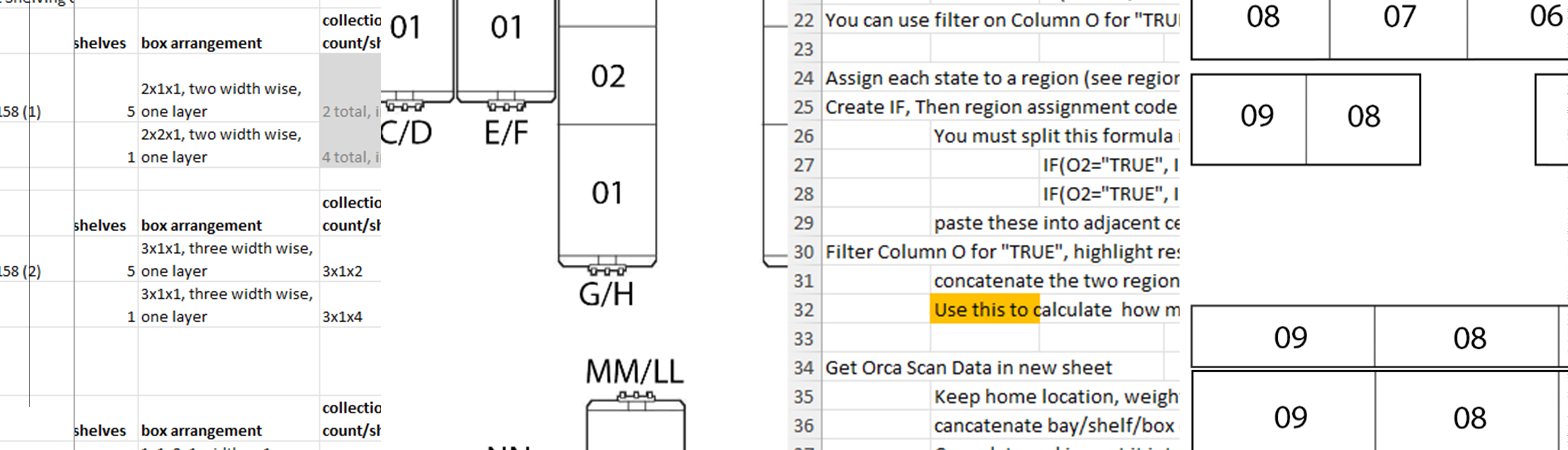
Equally important was how we would maintain physical control (i.e. knowing where everything in the collection is) over the collection boxes and their contents. This portion of the collection comprises nearly 3,000 boxes containing roughly 500,000 items. It was necessary to come up with an efficient way of tracking each item’s movement. Updating records at the item level within our existing database would take an incredible amount of time. Our database at the time supported barcodes at the item level, a process that would be no different than updating each item individually. We decided to assign barcodes to each box and track the box locations using a separate barcode tracking program (Orca Scan).
Over the summer of 2020, with the help of two great interns the collection was weighed and barcoded. The barcode data included the original location within the wooden storage (home location), weight, how many spaces the box would occupy in temporary housing, and any additional notes.
Results
Armed with the weight data, we were able to organize the collection so that the weight was equally distributed over the entirety of the first floor. This information also helped us organize the collection in the newly renovated basement. Now, heavy boxes are located on shelves at waist height, making for safer lifting. Lighter boxes are housed on higher and lower shelves.
Tracking box locations with barcodes worked well for the most part and was a net positive over tracking individual item locations. A 5% inventory of barcodes after the move resulted in no errors. However, errors have been found in the system since we moved the collection back into the basement. These have resulted from location errors entered into the database, as well as errors and inconsistencies entered into Orca Scan. I would recommend checking for inconsistencies in the original location data before making the move.
Using the barcode program in addition to the database to find items on the fly was time consuming, but not unreasonable. Tracking movement has been more challenging. Some movements were simple, like moving a box from one location to another. Other moves involved unpacking dense boxes and giving the removed items their own barcodes or emptying an entire box, deleting the barcode, and giving each unpacked item a new barcode. Processing so much data has required the use of formulas in Excel, and it is hard to find and analyze errors when looking at 115,000 item records.
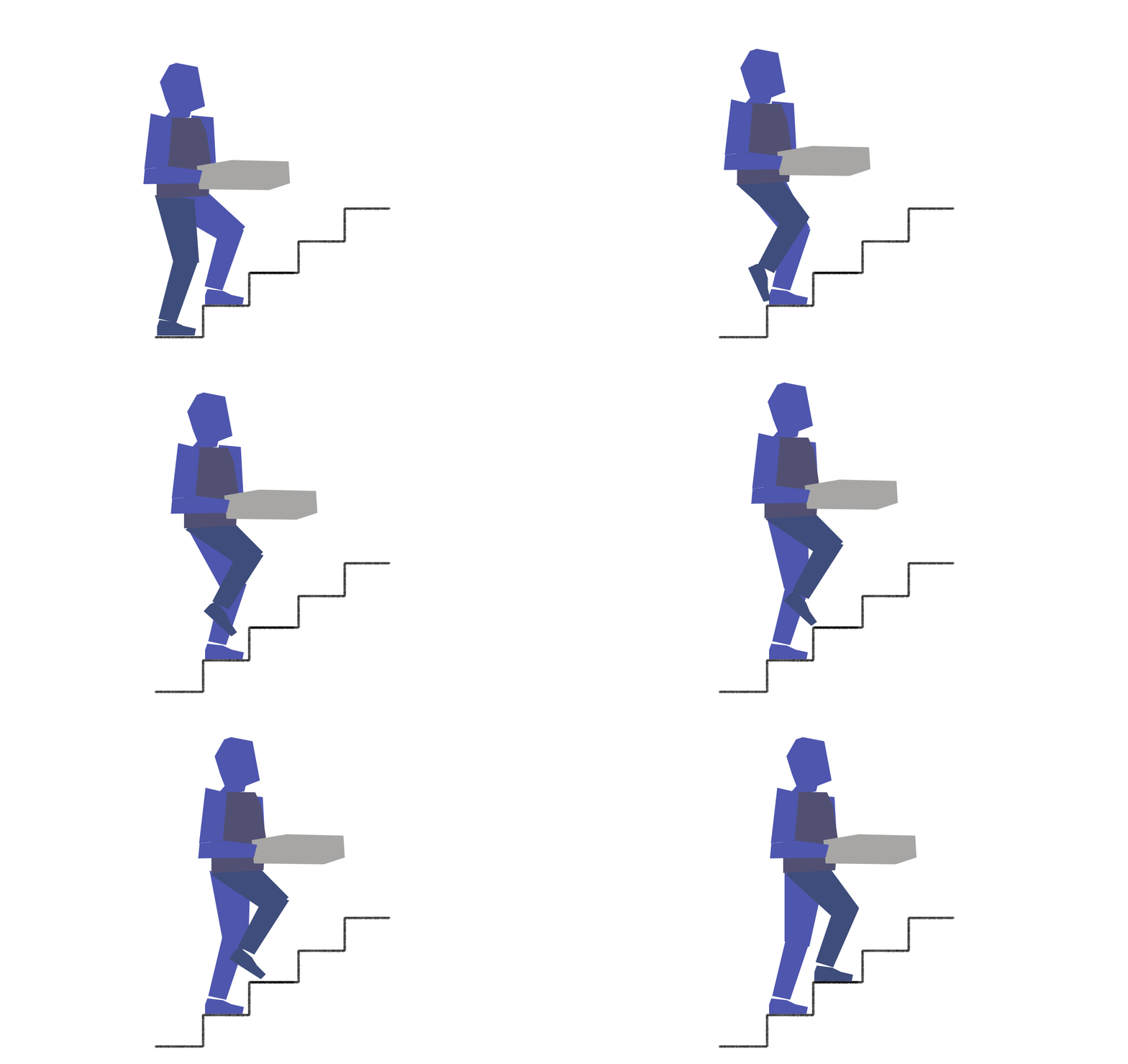
That wraps up this brief summary of our experience moving the collection. It was the culmination of years of planning and months of preparing and implementing. I’m happy to report that 600,000 items moved one or more times up and down one or two flights of stairs resulted in nothing being damaged. Hopefully some of the issues we encountered can help inform other institutions researching a move.
Hi, all. My name is Lainie Schultz, and I am the brand-new Curator of Education here at the Robert S. Peabody Institute of Archaeology. I come to this position from the George Peabody Museum of Anthropology (aka the Peabody Museum of Archaeology and Ethnology, or PMAE), where I was previously the Head of Teaching and Learning. It is also where my career in museums began, as an undergrad looking for a federal work-study position. At the time I just thought it would be a relatively painless way to make some money, but it turned out I genuinely cared about museums and the relationships they build with descendant communities. Who would have guessed?
This led me to graduate school in anthropology, and a few more museum stops along the way. In between stints at the PMAE I was introduced to the culture of morning and afternoon tea in the Repatriation Unit of the National Museum of Australia (sometimes the tea is coffee); was thrown into the world of First Nations humor during consultation visits at the Museum of Anthropology at the University of British Columbia (do you know how to pronounce Kwakwaka’wakw? Gitxaała? just bragging…); learned to throw a returning boomerang at Muru Mittigar Aboriginal Cultural and Education Centre (key word “throw.” darned thing never returned); pretended along with the Cultural Collections and Community Engagement section of the Australian Museum that our already well-worn office demountables were only “temporary” (humor came in handy there, too); marveled like the nerd I am at the Berndt Museum of Anthropology’s catalogue records (THEY ARE. SO. COMPLETE.); and stayed with family I didn’t know I had before while at Bunjilaka Aboriginal Cultural Centre (that had nothing to do with the cultural center, but it really meant a lot to me).
I don’t know what new experiences the RSPI will be throwing at me, but I am ready for it all.
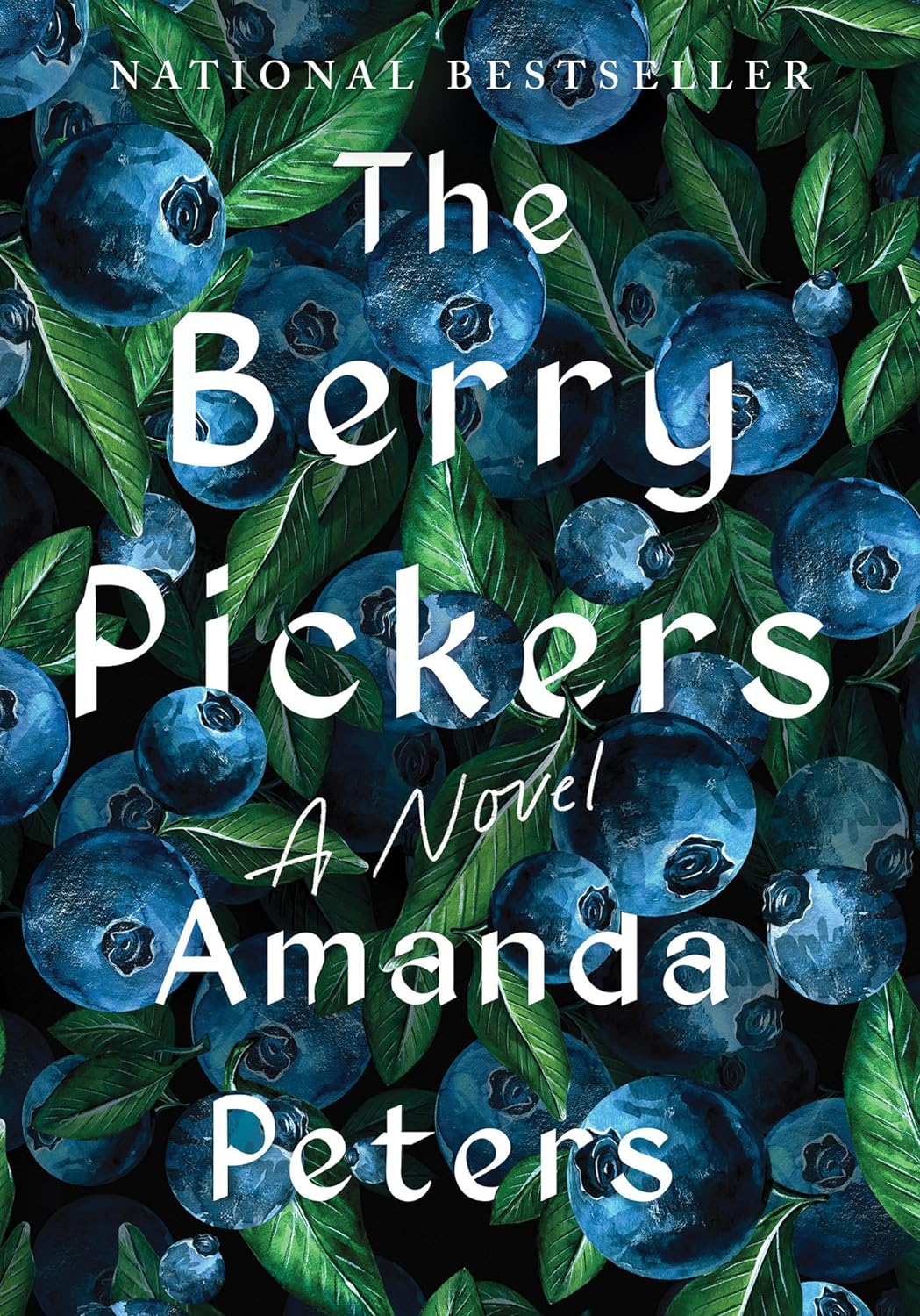
A four-year-old Mi’kmaq girl goes missing from the blueberry fields of Maine, sparking a tragic mystery that haunts the survivors, unravels a community, and remains unsolved for nearly fifty years.
The Berry Pickers is a heartbreaking, riveting tale of Indigenous family separation. We follow an Indigenous Mi’kmaq family in Nova Scotia who travels every summer to Maine to pick blueberries as migrant workers. In the summer of 1962, 4-year-old Ruthie, the youngest of the family’s five children, disappears from the fields. The last to see her is the second youngest, 6-year-old Joe, who takes the loss especially hard and carries his guilt in the years to come.
The book is told through two alternating character perspectives – one being Ruthie’s brother Joe and the second being a young girl named Norma. Growing up in Maine as the only child of affluent and overprotective parents, Norma, struggles to find the truth behind her recurring dreams and visions (that seem more like memories than imagination). As time and secrets unfold, these two storylines ultimately converge.
This is a treasure of a book – filled with loss and sadness yet manages to be hopeful as well. Amanda Peters (Mi’kmaq, Glooscap First Nation) has a lot of empathy for her characters and gently invites readers to examine the affects of intergenerational trauma, racist residential institutions, and the specific ways Indigenous families were treated – in a deeply personal way.
This story is both powerful and moving. Although told quietly, it did not take away from its impact.
Next on my list to read is Amanda Peter’s newest book, Waiting for the Long Night Moon: Stories. This is her debut collection of short fiction that describes Indigenous experiences across time and space – from contact with European settlers, to the forced removal of Indigenous children, to the present-day fight for the right to clean water.
The book will be available August 2024 in Canada and January 2024 in the U.S.


 The Peabody