The Dirt on Soil Analysis

Contributed by Emma Cook

My latest work for the Peabody Inventory and Rehousing Project has led me to Tehuacán, where I have been cataloguing glass jars that contain soil samples. These jars are a part of the Tehuacán Archaeological-Botanical Project by Richard “Scotty” MacNeish during the early 1960s. The samples were collected for testing and analysis purposes from the project area. When archaeologists excavate a site, they dig through soil layers formed by the activities of past people. What archaeologists recover from these layers provides clues about what happened at that site from features or artifacts. However, the actual soil is another very important clue for archaeologists, as it can help date sites and tell a lot about the environment of the site during the time the soil layers were formed.

Soil blog_pic2
Jars of Soil Samples from the Tehuacán Archaeological-Botanical Project, 1960s

Giving an accurate description of soils help archaeologists better understand what happened in the past at a site. The color and texture of soil can reveal the age of an archaeological site, as well as how the site was used. For example, a circular stain in the soil may reveal a post-hole deposit, indicating that there was once a wooden post that had decayed, leaving a soil discoloration in the ground. Depending on the site, these post-holes could represent a structure or palisade. In addition, studying soil fertility can help archaeologists understand ancient agricultural systems.

Soil blog_pic3
MacNeish (left) and a field assistant analyzing stratigraphy at the Gladstone site on Kluane Lake in the Yukon.

Archaeologists use the Munsell Color Chart to help them describe the colors of the soil layers in a standardized way. This system was developed by Albert H. Munsell at what is now MassArt in 1905. Archaeologists compare the soil color in their excavation units to the color chips of the Munsell Chart – similar to the color squares found in hardware stores for paint. Where a color may be brown to one person, it may be gray to another – so it is important that archaeologists use this chart so they can standardize their descriptions.

Munsell Color Chart
Munsell Color Chart

To describe soil textures, archaeologists and geomorphologists use a soil triangle to help them determine what type of soil they are examining in the field. There are three types of soil components: sand, silt, and clay. Most soils have a combination of these three components and each of these components vary in sizes – sand particles being the largest and clay particles being the smallest. Similar to how the Munsell Color Chart describes soil color the same way, the soil triangle helps archaeologists describe soil texture consistently.

Soil blog_pic5
Soil Triangle – Courtesy of the United States Department of Agriculture

Another way archaeologists analyze their site is through soil stratigraphy. This is the different types of strata, or layers of soil that archaeologists examine to map out the archaeological site over time. Stratigraphy can be used to determine which soil was associated with human occupation and which layers are sterile, meaning the soil is not associated with human occupation and does not contain any archaeological material. Layers that include artifacts and features represent a place where people lived and worked, as archaeologists can see the objects left behind by human activity. Sterile layers such as subsoil, flood sediment, and bedrock are not as distinct, but provide information on a site’s activity or inactivity.

Soil blog_pic6
Archaeologists mapping out the stratigraphy at Purron Cave, TC 272, in the Tehuacán Valley.

The jars of soil samples were most likely examined after excavation and retained for further analysis. Presently, these soil samples have been rehoused and cataloguing for each of these jars is complete. To learn more about Richard “Scotty” MacNeish and the Tehuacán Archaeological-Botanical Project, visit the Peabody’s online archival collections. The MacNeish archives are available for research, separated into two collections – the Richard S. MacNeish Papers and the Richard S. MacNeish Records.


Further Readings

Birkeland, Peter W. 1974. Pedology, Weathering, and Geomorphological Research, New York: Oxford University Press.

Limbrey, Susan. 1975. Soil Science and Archaeology. London and New York: Academic Press.

Solecki, R. 1951. Notes on Soil Analysis and Archaeology. American Antiquity, 16(3), 254-256.

More Than a Number: Cataloguing the Peabody Collection

Contributed by Emma Cook

My name is Emma Cook, I am the Administrative Assistant at the Robert S. Peabody Institute of Archaeology. I have a background in archaeology, history, and museum studies with undergraduate and graduate degrees from the University of Georgia and Tufts University. Aside from my administration duties, I work with the Peabody’s collections. Recently I’ve been involved in the Inventory and Rehousing Project and I am working with collections on the first floor South Alcove, located in one of our gallery/classroom spaces.

The Robert S. Peabody Institute of Archaeology collection comprises nearly 600,000 artifacts, photographs, and archives. Some of these materials are displayed and used for teaching, while many reside in our collection storage. What is unique about much of our collection space is its original storage. The bays and drawers in which many of these artifacts inhabit are almost as old as the Peabody itself, the bays being first built in the early 1920s. However, below the surface of these pine wood bays and drawers are a collection of uncatalogued objects that have hardly come to light (literally), with some still stored in the tin foil and paper bags they were placed in upon archaeological excavation many years ago.

The antiquated charm of these wooden bays is not enough to meet the need of accessible storage for our collections and the goal is to replace them with new custom-built shelves. In preparation of this storage renovation, objects need to be identified, catalogued, and rehoused. This work is completed through our Inventory and Rehousing Project.

Blog_1
First Floor, South Alcove – where my cataloguing work began

I began my work simply inventorying the objects in each drawer of each bay in the alcove. Some of these objects were already identified, numbered, and recorded in Past Perfect – a museum software that is the standard for cataloguing museum collections. Through this software, the Peabody collection is documented and made accessible online. My job was to make sure these objects were accounted for and in the right place, as well as properly rehoused and organized within the drawers. Sounds pretty easy right? Well, eventually things changed as I came across several drawers and bays containing objects with old numbers or no numbers at all. This is where my cataloguing efforts began.

Cataloguing is the process of recording details about an object into a collection catalog or database that documents the information of each object as well as its location in storage. Through this process each object receives a unique number. This number is physically attached to the object and appears in records related to the object in Past Perfect. In museums and archives, objects or materials in a collection are normally catalogued in what is called a collection catalog. In the past, this was traditionally done using a card index, but in the present-day it is normally implemented using a computerized database – for the Peabody this is Past Perfect. Some of the objects I came across with “old numbers” were either connected to the Peabody’s past card index cataloguing system or the Peabody’s original numbering system (i.e. 1,2,3,…. 78,049).

Blog_4
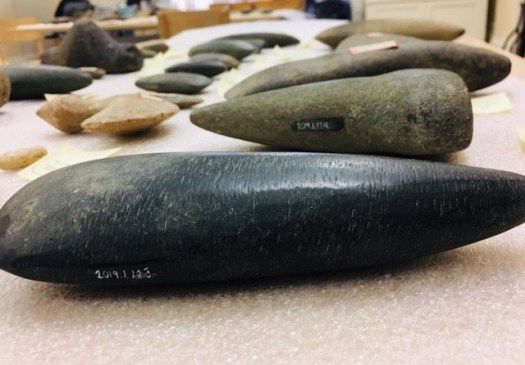
Lithic objects with affixed labels and old numbers

Each object was given a new number associated with the Peabody’s present catalog numbering sequence (i.e. 2019.1.123). This numbering sequence is a three-part number, making it both simple and expandable. The first part of the sequence is the year in which the object was accessioned or catalogued (i.e. 2019). The second part of the sequence is given to objects in chronological order based on when they were first accessioned (i.e. 2019.1). The third part of the sequence gives a single object a number in chronological order (i.e. 2019.1.1). Objects that had an affixed label had the new number written on the label. Objects without labels had their numbers painted on with ink. A solution called B72 is applied to the object before the ink in order to protect the original surface of each object. This solution is not harmful to the object and can be easily removed if a mistake is made or the object needs a different number.

Blog_5
Lithic objects with new numbers painted on their surface using ink and the B72 solution

The cataloguing process is not an easy one, nor is inventorying and rehousing a collection. The process may be slow and tedious, but it does have its rewards. By using a great deal of care, time, and effort, rehoused and identified objects can be used for teaching and research. Not only can collection staff have full access to the collection, they can provide a safe and accessible place for these materials in storage. The cataloguing process may seem like a trivial task, but it just goes to show – it’s more than a number.

For more information and reading on the Inventory and Rehousing Project, see the following blogs below:

Transcribing the Collection – January 2019

A New Face in the Basement – January 2019

Ceramic Inventory Complete – December 2018

Collections Reboxing Project Update – April 2018

A Day in the Life of Boxing Boxes – November 2017

Shelving to the Rescue – September 2016

Boxes and Boxes and Boxes – August 2016

Summer Work Duty Students Begin Rehousing Inventory – August 2016