Beyond Work Duty

Contributed by Peabody Student Volunteer, Anthony Chung Yin Woo

In the fall term of tenth grade, I first joined the Peabody as a work duty student before returning as a student volunteer during my upper senior year. Working at the Peabody has given me an in depth behind the scenes look into running a museum, exposing me to the challenges in caring for a collection. When participating in preparation works for the building renovation project last winter, I learned about some of the technical complexities that museum workers have to go through in order to responsibly safeguard the collection. Having had the great opportunity to attend the Peabody Board of Advisors meeting in the fall as a student representative, I was also exposed to some of the administrative complexities behind museum work.

A complete revamp of the basement area meant that we had to come up with creative solutions when it came to temporarily rehousing the collection within museum premises. Armed with a tape measure and a rough floor plan, we navigated all protruding columns and bulky built in radiators in the southern first floor gallery to mark up the approximate location for a separated temporary storage space with individual climate monitoring, while maintaining the required three foot hallway for access to the fire exit located at the back of the building. Additionally, previously underutilized spaces had to be optimized to fit in more durable, weather resistant objects, allowing me to foray into the expansive attic as I removed sawhorses and large glass tubes from the basement.

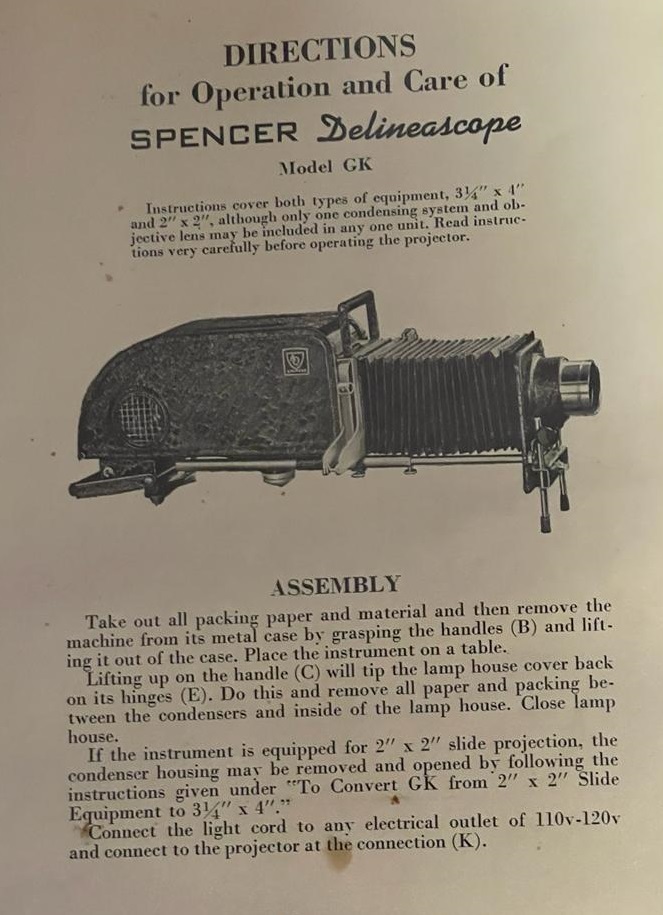
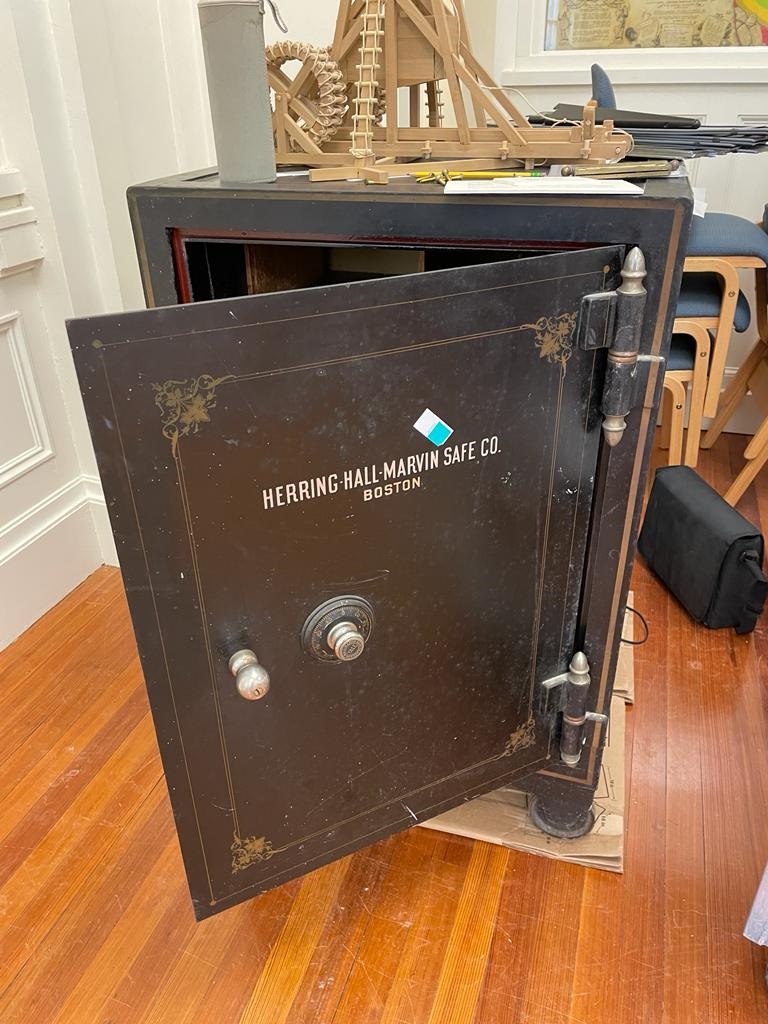
In spite of the physically and mentally draining task of completely clearing out the basement, moments of excitement rewarded me throughout the process. Under the empty wooden bays, for example, I found tiny matchboxes from the 1940s, cool items which alluded to the museum’s own history. A Spencer Delineascope, manufactured by Bell and Howell found in the basement, spoke to the great advancements made in projection technology since the 1930s, as the bulky object was moved slowly up the stairs. Only when it was removed from the little room under the stairs to the basement was when I could truly appreciate the size of the museum’s safe and its obsolescence in a time when the entire collection was kept behind locked doors.

Direction Booklet for the Peabody’s Delineascope
The Peabody’s old safe.

Learning about the 3D printed replicas of the intricate molding on the gallery ceilings also made me appreciate the museum as a historically significant space itself, allowing me to understand that preserving the space’s spirit through attention to detail was crucial even as the building is physically altered to facilitate better learning in the future through greater accessibility.

Attending the Peabody Advisory Committee meeting allowed me to better contextualize my work as a volunteer as I watched experts across disciplines partake in the collaborative process of museum governance. It was especially interesting for me to hear about the cross-institutional connections brought by Hopi artist Ramson Lomatewama, and I was particularly happy to share my experience at the communal fused-glass making workshop, which was enthusiastically attended by both faculty members and students. Going through items on the agenda, such as the adoption of a new mission statement, as well as the advisory board’s renaming (form the Peabody Advisory Committee to Peabody Board of Advisors), while less captivating than the discussion on the Peabody’s educational program and future student engagement opportunities, were nevertheless just as relevant to the student experience. As I look forward to returning to the updated building on Main Street in the winter, both as a student volunteer and as a member of this year’s Human Origins cohort, I am constantly reminded of the care demonstrated by the Peabody’s staff as well as the Peabody Board of Advisors towards the collection, the museum, and the greater community as a whole, manifested in the meticulous attention to word choice in the advisory board’s mission statement drafting process.

My fused glass piece before kiln firing.

Summer School

Contributed by Nick Andrusin

I already did 6 years of school, what’s one more class! This summer I had the opportunity to do some professional development with the Peabody, and I was more than happy to take advantage of the chance to learn something new. Museum Study LLC is a service that offers online courses and virtual lectures on a variety of museum related topics, from collections management to administration.

Museum Study online professional development – Home

After some painful humming and hawing (I was informed I can only do one at a time…Marla…) I decided on Foundations of Community Engagement, taught by the awesome Dr. Shannyn Palmer.

Museum Study Instructor Shannyn Palmer

My background is in public history, and part of my role at the Peabody is engaging with the community, so it was a good fit. The class lasted for the month of July and was virtual. Each week involved multiple readings on how different museums have incorporated community engagement, how it’s been done successfully (or unsuccessfully in a few cases), and the philosophy behind ethical engagement with museum communities. We would have questions and assignments to fill out, and then we would meet once a week virtually to discuss what we learned. The class was small, but the conversations were interesting, with participants from a variety of museums.

Just what is community engagement? Well, not to use a circular definition, but it’s how a museum engages with its communities. How much, what methods, which groups specifically, etc. The particulars will vary from project to project, but it all centers on connecting, collaborating, and co-creating with the group. Not just having them sign off on the project but allowing them the opportunity to be meaningfully involved in the planning and/or execution. Again, depending on the specific context of the exhibit or project. A big aspect of the class was the idea that this is not a perfect science and there is no one size fits all solution. It’s something that needs to be practiced and adapted to different situations. If a museum is doing an exhibit on a specific local community for example, that community should be involved from the outset, and at multiple levels of the project. Otherwise, what little involvement they do have may be tokenistic and the exhibit could be inauthentic or potentially offensive.

As largely public institutions, museums live and breathe on how well they engage their communities. Therefore, this engagement being ethical and non-tokenistic is a big deal. Between the modern-day ramifications of white supremacy and colonization, as well as the Covid-19 pandemic, museums are at a bit of an impasse. Questions about whom museums serve and what they should and shouldn’t do are becoming more common. Their roles are evolving as they determine their purpose. Ethical community engagement is the right way to ensure the museum is not failing the groups and individuals served.

The Peabody is an interesting museum in this case, because we haven’t created exhibits for the last couple of decades. Therefore, our community doesn’t really include your typical idea of museum visitors. However, the students and faculty of Phillips Academy absolutely fit the definition of our community. As well as the Native communities we work with during repatriation. Ergo when the Peabody does community engagement, we seek to collaborate with these groups in balanced and effective ways.

Overall, it was an interesting class with a great professor! I am very grateful to the Peabody for the chance at some professional development!  This was just a taste of what it offered; one blog is far too short to go into detail on everything. If I piqued your curiosity, you will just have to check out the class for yourself….

Map Quest

The Peabody has recently acquired several examples of Indigenous art, with the goal of enriching our education collection. Raven Makes Gallery is an art gallery based in Sisters, Oregon, dedicated seeking to “work directly with artists to bring American Indian, or Native American, First Nations and Alaska Native art to the unique setting of Central Oregon and cultivate a deeper awareness about fine artists and their communities.”

The Gallery features original pieces made primarily by Indigenous artists from North America, but also has pieces that come from Indigenous people all over the world. It’s an amazing gallery and their website is definitely worth poking around for those who are interested.

Native American Art Gallery – Raven Makes Gallery

Super cool stuff, right? Here’s where we come in. This year the gallery presented “The Homeland Collection, year three.” It was a collection of 88 antique maps (think like, nineteenth century settler maps) that served as a canvas for 22 Indigenous artists from all over the world to incorporate into their own work. The Peabody purchased two of these pieces!

The Homelands Collection, 3rd Ed, Raven Makes Gallery Exhibit– Homelands Collection

The maps are a powerful visual representation of re-indigenization/decolonization in artwork. Maps are interesting to look at, but there are questions: what is the reason they are made, who are they made for, who are they made by? Maps like those in the Raven Makes Gallery collection may have been designed with settlers and land prospectors in mind. The maps were used to impose colonizer culture and world views on Indigenous people. The illustrated borders would have had little to no input by Native communities, on land that they were the stewards of to begin with. So, this project has been an opportunity to shift the narrative. Turning tools of colonization into a representation of decolonization. Flipping it on its head! A physical reminder that Native people have been here for at least tens of thousands of years before these maps were “needed.”

The Peabody has a large collection of items from Alaska and the Southwest, so these two pieces made the most sense to grab. We are excited to have the opportunity to support Native artists and strengthen our education collection! We hope to use these to create interesting conversations about the creation and usage of maps in our history!

The first is Isuqwiq Pisuraa (Hunting Seals) II by Heather Johnston (Alutiiq). The map is an 1827 depiction of south-western Alaska by Philippe Vandermaelen, showing the routes of artic explorers in the late 1700s.

The second piece is Kachinas’ Territory by Wilmer Kay (Hopi). The map is an 1862 depiction of the Southwest made during the Civil War by A.J. Johnson.

Here’s the Dirt on Andover Summer’s Dig This! 2023

Contributed by Mikala Hardie

This summer, 23 young archaeologists set out to investigate one of the first buildings constructed by Samuel Phillips Jr. after he founded Phillips Academy. During the first week of the Andover Summer program, the students of the Lower School’s Dig This course were introduced to the story of the Mansion House and the mysterious fire that destroyed it in 1887. According to primary accounts, the fire seemed to have started in two different places in the house. This account was made even more suspicious by sources that said the caretakers, Mr. and Mrs. Carter, had their bags packed the day of the fire and walked away with insurance money. With this interesting piece of information, the students were excited to uncover more clues about the Mansion House and the people who inhabited it. The students worked in groups of 3 to 4 at six excavation units. These units were spread across the site in areas that, using past excavation results and Ground Penetrating Radar maps, had a good chance of finding evidence of the Mansion House.

Figure 1. Commemorative Plaque of the Mansion House

The first day of excavations was met with enthusiasm, apprehension, and later exhaustion as the students realized how much work goes into opening a unit. Nonetheless, we persevered and by the end of the first week of excavations many groups had already finished Level 1. Some had even found glass and metal artifacts which, of course, created healthy competition between groups and motivated the students as they continued in the second week of excavations.

Figure 2. Two students working in Excavation Unit 1

During the second week, things got interesting. The students working in Excavation Unit 5 came across an 1802 “Draped Bust” Liberty penny which caused a ripple of excitement for both the students and the instructors. This coin gave an important terminus post quem (TPQ) for the level and showed the students how old the artifacts we were finding really were.

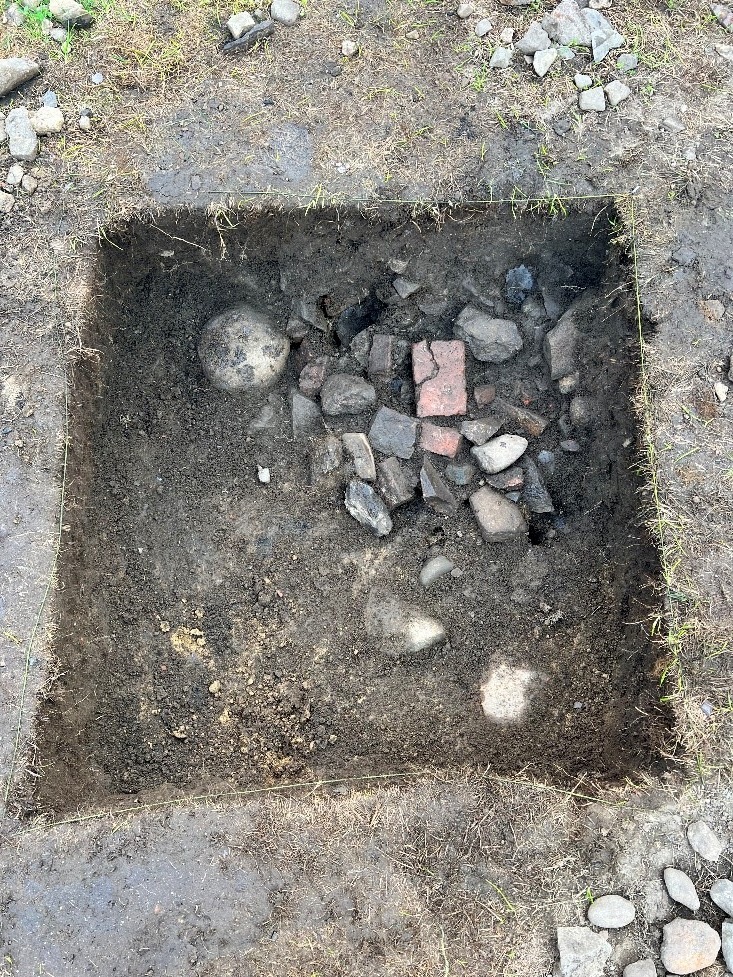
Additionally, in Excavation Unit 2 Level 2, a brick feature began to reveal itself in the northeast corner. This unit was placed near a 2018 excavation unit that uncovered part of a chimney, so it is likely these features were related and Unit 2 uncovered another part of the chimney which helps in understanding how large the chimneys would have been and the layout of the Mansion House. The images below show the brick feature when it began to be discovered in Level 2 and the brick feature in Level 3 before backfilling.

The third and final week of excavations supported the archaeological adage that you always find the most interesting stuff right before you’re going to leave a project. This week, two new features were discovered. One was in Excavation Unit 6, which was intended to find one of the foundational walls of the structure. This feature also included a brick, though it is unclear if it relates to another chimney of the house. There was also a large stone and some smaller stones found near it, though, likely not enough to constitute a foundational wall of the building.

Figure 5. Students working in Excavation Unit 6

That being said, one of the biggest finds of the project included a huge rectangular stone with other large stones overlapping it. This feature was found in Excavation Unit 1 which was placed north of Excavation Unit 2 in the hopes of uncovering part of the foundation of the house. Given the size of the stone and the overlapping rock around it, it is pretty likely that this feature relates to the foundation or a wall of the Mansion House. On the last day of excavations this unit surprised us further by containing a large amount of metal artifacts in the southwest corner of the unit. A fork, a hinge, a handle, and a plethora of other artifacts were uncovered in the last level of this unit. We probably could have found more in the next level if we didn’t have to backfill the next day. This unit is definitely one to revisit in future years!

Figure 6. Stone feature in Excavation Unit 1 Level 3.

While neither unit contained a feature, Excavation Unit 3 and Excavation Unit 4 contained a lot of charcoal and mortar. Excavation Unit 3 specifically had extremely dark, somewhat ashy soil which was likely due to the fire. Ideally future Dig This! classes will uncover more of this ashy, dark soil and the data can be compiled to give a better understanding of how the fire destroyed the mansion house.

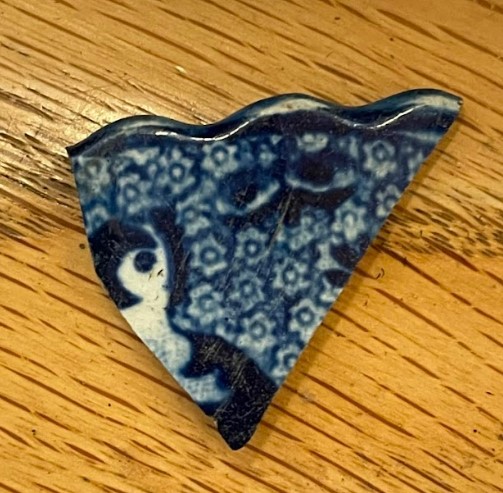
During the last week of the course, the students were busy washing their artifacts and picking a few to display at their end of the year exhibition. These artifacts included a locking mechanism, large nails, blue transfer print ceramics, a marble, a hinge, and a fork! All of the artifacts found during this summer’s course were transferred to the Peabody Institute to be cataloged and analyzed with the rest of the Mansion House artifacts.

Overall, the students had a great summer excavating the Mansion House and learning how to be archaeologists by following proper archaeological methods and recording techniques. I look forward to seeing what next summer’s Dig This class will find!

Peabody Volunteer Spotlight: Meet Mike

Contributed by Mike Agostino

Hello, my name is Mike Agostino and I am a volunteer here at the Peabody Institute of Archeology. I am a recently retired scientist from the field of bioinformatics. My work in this field, for over 30 years, concerned the analysis of gene and protein sequences. I love the field so much that I am presently an instructor on the subject for the Harvard Extension School. I am also writing the second edition of a textbook I published on this topic more than 12 years ago.

Peabody volunteer, Mike, analyzes various projectile points in the Peabody collection.

As a resident of Andover, I frequently went past the Peabody and often wondered what treasures it held. When a good friend, Richard Davis, said he volunteered here and told me about the work, I immediately wanted to join him. To say this is a dream come true is not an exaggeration. I have always been interested in archaeology and spent many years looking down on the ground for the artifacts people said were all around us. But I never found any! To work with and learn about dozens, if not hundreds of specimens each day is amazing. As I hold these objects in my hands, I try to imagine their history: was it careful fabrication by an adult expert, or was it made during a learning period of a youngster? Was it used to bring home a meal, build a boat or dwelling, or for the creation of clothes? Did it come from local stone, or did it travel many miles to be found at a new locale? My imagination is further enhanced or tempered by the kind and knowledgeable staff of the Peabody who are training and patiently helping me identify what is in my hand. I have only been at the Peabody for less than two years and there is so much to learn!

After years as a scientist, I feel right at home with my principal responsibilities: the careful handling, description, cataloging, and storage of the specimens. Attention to detail is absolutely required and very satisfying. We record their identities, or best guesses because many are just fragments. The intact specimens are something to behold. Some arrowheads or axes are impossibly beautiful, and the precision of shaping and symmetry with such a hard material is just astounding. The skills of the people, past and present, are just amazing.

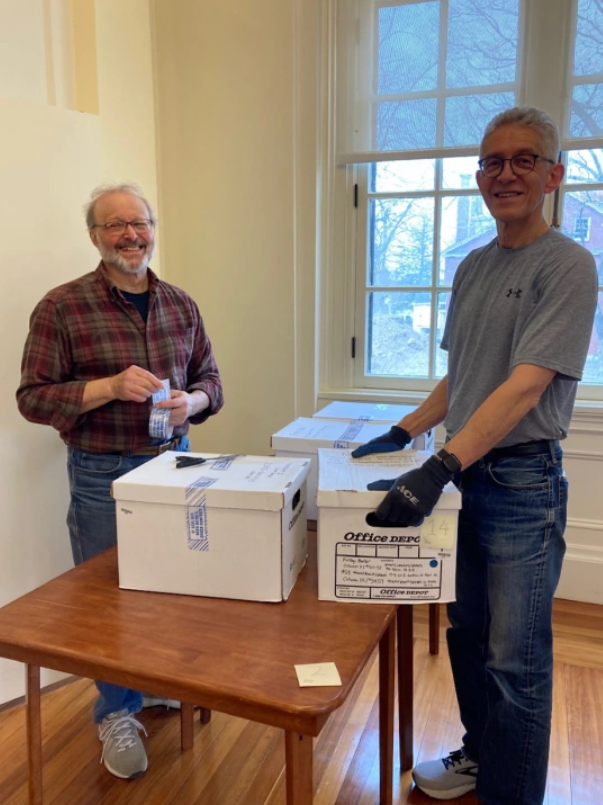
Peabody volunteers, Richard (left) and Mike (right), moving boxes for the Peabody’s building project.

I have also helped with activities associated with the huge renovation project of the building (for pictures and updates, see the blog postings by Marla Taylor). I am impressed with how everyone has remained calm considering hundreds of boxes, and specimens too large for boxes, had to be carefully moved up one or two floors from the basement to temporary locations elsewhere in the building. With the absence of an elevator, I helped move many boxes up the stairs out of harm’s way. My smart watch said I went up 80 flights of stairs one day! And I am only there one day a week, so the staff had a monumental challenge. We are now waiting for the renovations to be completed and then we will return the specimens to a much-improved setting. Even with the new elevator, reshelving hundreds of boxes won’t be easy, but I am looking forward to the project and the “new” institute.

Summer Session Selections

Contributed by Nick Andrusin

We may be down (the road, on Abbot campus) but were not out! As everyone on campus has probably seen there is a big ol’ fence surrounding the Peabody Institute, concealing dirt mountains, front loaders, and a bunch of contractors. This has been going on since April, boy time flies! Despite being out of the building for the last several months (and for several months to follow) we are still here and still part of teaching and learning at Phillips Academy, albeit in a more restricted fashion. Most recently, our director Ryan Wheeler and I helped out the Andover Summer Session with a few different classes. Supplementing the classes with knowledge and items from our collection to enhance the learning of the summer students. 

One class was Ella Houlihan’s Intro to Bio class. The students were learning about human evolution, and the Peabody has just the collection to help teach this topic. We brought over about 15 skull casts from all over the hominid family tree and tasked the students to develop their own traits, categories, and potential connections. From there we went over what scientist use to group skulls and layout the human family tree. Pointing out that it’s all rather complicated and even the professionals do not agree.

Students analyze various skull casts in a class activity

We also helped teach a couple classes in Dr. Tessa Hite’s class Mapping our World: The Art and Science Behind Maps. We went over the basic history of Andover, how it moved from Indigenous proprietorship to English ownership. To tie into that we covered concepts of colonization and decolonization, how one culture or society can impose themselves onto another and how efforts are undertaken to amend this. From there we had the students use maps to compare European versus Native American town names (think Mattapoisett vs Andover) and then research the original Indigenous place names. This was done to prompt questions such as “What does, or doesn’t this map tell us” Or “why does it feel empty with Native based town names?” This was done to get the students thinking about the reasoning behind the way the maps are set up and used.

The Peabody is more than happy to help in classes whenever we have an opportunity! Even with more restricted access to the collection, we can get creative and pull something together, as long as you don’t mind the dust!

Blog showcase: A small blog about blogs

Contributed by Nick Andrusin

One cool thing about the Peabody is the varied types of experiences and interests of the people working here. It’s what makes the blog so interesting! For years now, Peabody employees have been making regular blog posts on whatever topic they can think of. From interesting insights into the museum world, to personal interests of the writer, there is always something to look forward to every month. 

With new blog posts coming out on such a regular basis, it can be easy to forget that there is quite an accumulation of interesting articles on the Peabody’s website. One can read posts going back to the fall of 2015! While helping to archive the blog, I’ve been reading a lot of fascinating pages, making notes of ones that I found particularly interesting. Creating this was the logical next step, a look back, a spotlight on blogs past. My own blog about blogs!  

Note: I am limiting my self to five entries, but this list could easily be three times longer! 

Vikings – The Peabody (andover.edu) 

Ever since reading The Age of Vikings by Anders Winroth I’ve had a big interest in medieval Scandinavian history. The Vikings and their contemporaries have such a fascinating history, and maintain a strong footprint in popular culture. So imagine my surprise when I found a blog about Viking material at the Peabody!…well, sort of. You should look for yourself! 

Corn – The Peabody (andover.edu) 

In teaching a few different classes at the Peabody, the concept of corn comes up quite a bit. Especially since it was a focus of former director Richard “Scotty” MacNeish. When one student asked about why corn spread so far and wide, I recall answering in a jovial way “well you see, humans LOVE corn, and will take any opportunity to grow it!” This blog post is a fascinating dive into the history of this staple crop. 

Women of the Peabody – The Peabody (andover.edu) 

At a glance, the history of archeology (and similar fields) seems very frontloaded with men. However, it’s not hard to find plenty of women heavily involved. Maybe not quite as visible, but just as important, if not more so. This blog post goes into the history of women involved with the Peabody! 

FBI Collection – Origin and Update – The Peabody (andover.edu) 

Due to the nature of museums, strange tales often go hand and hand with their history, and the Peabody is not lacking in this department. This blog post discusses an interesting one, a theft in the 80s that struck multiple New England museums! If you are interested in a mini crime drama, complete with information on its resolution, this one is worth a look.  

Never Alone: Video Games and the Teaching of Culture – The Peabody (andover.edu) 

I’m a person who would consider themselves an avid “gamer,” as well as one with a background in public history (basically, historical engagement outside of a classroom). Therefore, when I see a game, or a blog post in this case, that combines my two interests, there is no way I am not going to talk about it! This post talks about the game “Never Alone,” developed by Upper One Games and originally released in late 2014. The game was about an Iñupiat girl who goes on an adventure with a fox, based on a traditional Iñupiat tale. The game was made in cooperation with Cook Inlet tribal council, and features…well I don’t want to spoil the post too much! Take a look for yourself! 

How things have changed: The ongoing relationship between the Peabody Institute and The Phillipian

Contributed by Adam Way

This blog is the culmination of work done by Independent Researcher/Volunteer Adam Way to explore how the Peabody Institute has been portrayed by Phillips Academy students in The Phillipian over the years. Adam shared two previous blog posts about his work (Combing Through the Phillipian and Combing Through The Phillipian: End of an Era) and recently completed the project. His final blog is a summary of what he learned.

 The relationship between The Phillipian and the Peabody Institute has existed since the Institute’s founding back in 1901, and while the strength of that relationship has waxed and waned, it has persisted nonetheless. During my time combing through over a century’s worth of The Phillipian issues, I have noticed a few substantial changes, mainly the amount of coverage that the Peabody Institute received, the type of coverage, and the student’s view of Peabody.

The first major difference that appears when looking through The Phillipian archives is that the number of times that the Peabody is addressed/mentioned decreases drastically towards the present. In 1910, the Peabody Institute, then the Department of Archaeology, was mentioned 153 times throughout the year, with the following years yielding similar results. A significant amount of the times that the Peabody Institute was mentioned in these early years can be attributed to the existence of extracurriculars that took place within the building. Events such as meetings of the Banjo or Drama clubs and other such student activities that took place in the Peabody make up a large portion of mentions, while the rest is composed of articles detailing the academic work and scholarship being conducted by the Institute.

April 15, 1916

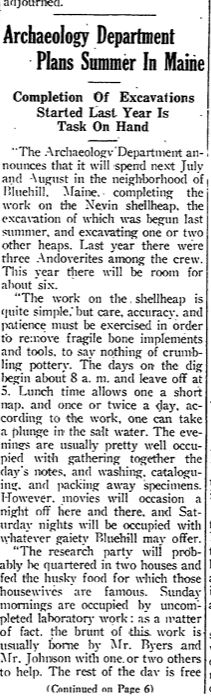
The constant high volume of mentions during the early years of the Peabody Institute, unfortunately, do not last forever. It appears that the turning point was, more or less, when Warren K. Moorehead retired from his position as director and was replaced by Douglas Byers. While the overall number of yearly mentions had been on a steady decline since the beginning of the century, the number had remained relatively consistent and the articles were primarily focused on academic work and lectures at the Peabody Institute. This changed when Byers and curator Fred Johnson took over, as it appears that these two did not have as close of a relationship with the The Phillipian as Moorehead did. This trend continued, and arguably was exacerbated under Richard “Scotty” MacNeish. I believe that this divide can be attributed to a shift in focus from teaching in the classroom to fieldwork, as all three of these former directors placed a heavy emphasis on fieldwork, while there was a lack of a consistent archaeology and/or anthropology class during this period (with other factors playing into that decision like student interest). Luckily, in the time since MacNeish, the Peabody Institute has regained a stronger, and more frequent, presence in the The Phillipian.

April 3, 1937

The next major change that I noticed while conducting this research, was that the type of coverage that the Peabody received changed over the years. Initially, I noticed this change through the club announcements. As time went on, the number of clubs using the Peabody, or at least publishing that they were in The Phillipian, was declining. Nothing about this appeared to be out of the ordinary as clubs moved to other buildings and Peabody House was constructed for the purpose of holding social events and clubs. The part that seemed strange to me was when members of the Peabody staff and faculty would leave without a single mention of their departure and only a brief mention when their replacement had been found, as was the case with Dick Drennan in 1977. However, as time progressed, the type of coverage in this area also shifted. Not only was there an article detailing the departure of the previous director, Malinda Stafford Blustain, but there was a subsequent article about the hiring of her replacement, Ryan Wheeler. It appears that the relationship between the The Phillipian and the Peabody Institute is steadily returning to its former strength.

The last major change that I have noticed is the waxing and waning of student interest in the Peabody Institute over the years. As with the other two variables that changed over time, student interest seemed to peek early on before dropping drastically as time progressed. After Moorehead’s departure and the subsequent drop in attention received from The Phillipian, the Peabody became increasingly referred to as a “hidden gem” and “unused asset.” There were even pieces written as a joke that say a student died of boredom due to their visit to the Peabody. Pieces like these are written in good fun, however, it does highlight the disparity between how involved students once were and how involved they are now. As with the other two changes that I noticed, this too is changing for the better in recent years. While there are still joke articles, there are fewer instances where the Peabody is labeled as an “unused asset.” There appears to have been a positive reception of student travel programs in the recent past as well as current lectures and other programs offered by the Peabody Institute.

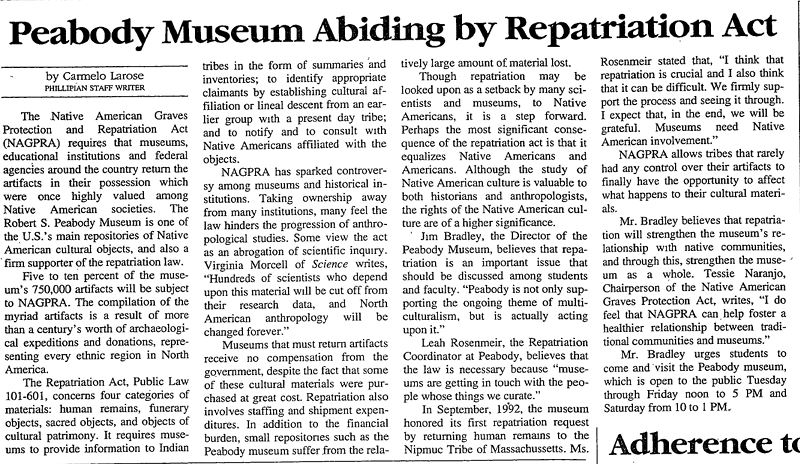
October 7, 1994

While my time combing through The Phillipian has come to a close, I am glad to see that the Robert S. Peabody Institute of Archaeology is making a resurgence within the paper. The records showed that the institution has been through some difficult times and yet has prevailed and is strengthening its place within the Academy and student life.

Nick at the Museum

Contributed by Nick Andrusin

Hi! My name is Nicholas Andrusin (or just Nick), and I am the new Temporary Educator/Collections Assistant at the Robert S. Peabody Institute of Archaeology! I began in early November, and I am so excited to be a part of the Peabody and work with the staff! In this position I will be helping with the ongoing renovation project and teaching lessons. 

Before moving to North Reading , MA in August 2022 I was living in Rochester, NY, where I earned a master’s degree in history at SUNY Brockport with a focus on public history. There I spent time as an intern at the Rochester Museum and Science Center where I helped them with their own storage renovation project. As well as helping the Rochester city historian create their Stonewall: 50 Years Out exhibit for the 50th anniversary of the Stonewall riots.   

This position at the Peabody feels made for me! So far, I have been helping with a variety of collections related projects. From cataloging, to getting measurements of storage space, to rehousing objects into proper storages containers for the eventual move, they are exactly the kinds of tasks I love doing. In addition, I have also been helping to teach lessons to Phillips Academy students! From Tarps, which simulate a basic archaeological dig, to lectures on the Taíno people, the group who discovered Christopher Columbus. It has been a pleasure to flex my teaching muscles!  

(that’s me in the gray hoodie!)  

Museums have always been of huge interest to me, and I am fortunate enough to have had a small hand in helping several of them over the years, the Peabody being the most recent and exciting! I am so thankful and delighted to be a part of this team, and I cannot wait to see what the future holds. 

Ethnographic Photographs – Greater Understanding

Contributed by Deirdre Hutchison

My name is Deirdre Hutchison, and I am currently studying for my B.A. in history at UMass Lowell. As part of a semester internship, I had the opportunity to research the provenance of several unidentified Native American photographs held by the Robert S. Peabody Institute of Archaeology. My first blog outlined initial findings and potential areas of investigation. To summarize that blog, the photos, mounted on board, illustrate a 1905 event at the 101 Ranch in Oklahoma.

As I navigated various connections, photographer James B. Kent became a more prominent fixture of my research. Kent was a regular photographer at the 101 Ranch, and the Millers tapped him to design and compile the souvenir booklet for “Oklahoma’s Gala Day” at the ranch on June 11, 1905. –. Kent, it seems, was an integral part of photography at the 101 Ranch, ultimately becoming the head of the moving pictures department by 1927.

101 Magazine/The 101 Ranch Official Souvenir. BLISS, OKLA. 5127.1000. Tulsa: Gilcrease Museum, https://collections.gilcrease.org/object/51271000 (08/03/2017)

The 101 Ranch souvenir booklet is discussed by Michael Wallis in his book The Real Wild West. According to Wallis, it contains multiple images taken by Kent – including the picture of Geronimo skinning a buffalo held by the Peabody (discussed in my previous blog). The booklet also contains one of the most famous images of Geronimo, “Geronimo in an Automobile.” . Working with the archival staff at the Gilcrease Museum in Tulsa, I hope to view the images to confirm Kent’s pictures and perhaps discern other possible photo matches.

Isolating Kent’s work is relevant because he was not the only photographer working at the famous extravaganza on June 11, 1905. The Millers masterfully orchestrated spectacle – 65,000 people attended – could not be supported by just one photographer. Multiple photographers were present capturing various promotional images at the behest of the brothers. This is immediately evident in the Library of Congress photo of “Geronimo Skinning a Buffalo” that identifies O. Drum as the photographer. The strikingly similar images of the Peabody and the Library of Congress differ in only small ways. It seems a bank of photographers captured the same scene, each image similar, but slightly different: a person with a head facing a different direction, an extra person, women bending, or a western-clad gentleman caught talking with those being prepped for the publicity shoot.

Another name that kept popping up in my research and commonly associated with a broad range of images, including Kent’s, was the publisher H. H. Clarke. Not only did Clarke produce black and white photographs, but he also manufactured color versions for global distribution, and several of his postcards bear the notation Made in Germany. Clarke’s color versions are considered unique as he employed a hand-coloring technique rather than standard lithography. Other examples of this work are at the Cherokee Strip Museum (Cheryl DeJager, Cherokee Strip Museum, personal communication).

Although Clarke published images by Kent and other photographers, establishing a direct link between them is difficult. However, sifting through metadata across several institutions, I discovered interesting connections that explore the publishing and manufacture of images onto postcards. For example, in the early twentieth century, professional and amateur photographers could sell their negatives directly to distributors such as Clarke or major publishing houses such as The Albertype Company. The Library of Congress cites Albertype and Clarke for one of two images listed of Geronimo in a car.

Clarke published three photos I initially matched with the Library of Congress. However, with only a thumbnail view available, I could not say with conviction they were identical to the Peabody images. After corresponding with the Prints and Photographs Division at the Library of Congress, enlarged views are now accessible online which allowed me to confirm that two photos were identical to those at the Peabody, but a discrepancy arose with the third. A close inspection reveals small but salient differences between the image at the Peabody and the one at the Library of Congress. For example, in the Peabody image, women are standing over the buffalo, but in the Library of Congress, they are bending over. Furthermore, in the Peabody image, a man stands to the buffalo’s left with his back to the camera, notable for his western-style suit, boots, and derby hat. Kent was known for always wearing his signature derby hat, leading me to speculate he was directing the people for the staged photograph and was caught on camera by another photographer.

When I started this project, I naively thought I would find solid evidence pertaining to Warren Moorehead’s acquisition of the images. As the museum’s first curator and renowned Native American expert, I thought, how could there not be a connection? Yet, every avenue of research proved fruitless with Moorehead. The narrative unfolded around the Miller Brothers, James “Bennie” Kent, and H. H. Clarke. The interconnectedness of these people provided many answers; the photographs were staged publicity images, taken at the 101 Ranch and predominantly early 1900s. Unraveling this fascinating story has been immensely rewarding, yet it seemed unlikely I would find any correlation between the images and their arrival at the museum.

Despite this disappointment, potential connections with the Peabody Institute and theories of acquisition emerged when reviewing my data, though initially not with Moorehead. Ernest Whitworth Marland was in business with the Millers and became Governor of Oklahoma. Frank Phillips of Phillips Oil was also involved with the Millers and the 101 Ranch. Both men were natives of Pennsylvania, as was Robert S. Peabody. Each man was wealthy, prominent, and quite conceivably moved in the same upper echelons of society. It is possible either of these could have passed photographs to Moorehead or the Peabody. Considering the student body of Phillips Academy, any alum could have given the images as a donation to their alma mater. Equally so, any faculty member may have been gifted the photos. All of these are plausible scenarios. However, another tenuous link emerged, excitedly leading me back to Moorehead. The collections description for the three Library of Congress images mentioned earlier notes that they are mounted photographs, as are the ones at the Peabody.

Another facet that piqued my interest was the descriptions accompanying records at the National Archives. “Geronimo in a Car” is cited as taken on June 11, 1905, at the Millers’ Oklahoma Gala Day, along with other images; all are 8×10 or larger, just like the Peabody images. Although far from compelling, there are commonalities.

What I found most compelling with the National Archives photo of “Geronimo in a Car” was that it states a copy was sent to the Office of the Commissioner of Indian Affairs. The Office of Indian Affairs later became the Bureau of Indian Affairs. Moorehead was appointed to the board of commissioners for the Bureau of Indian Affairs by President Roosevelt in 1908.

Geronimo Driving a Car. Oklahoma Gala Day, June 11, 1905. Wall Street Journal

As an emerging historian, I like to focus on facts. Unfortunately, facts can be notoriously distorted by time, memory, and absent material evidence. However, the absence of proof does not equate to the absence of the action. Although I had discounted Moorehead as the conduit, I have circled back and believe he is a strong acquisition candidate based on my latest discoveries. That particular mystery may never be solved, but it does not detract from the powerful narrative of Native American presence and treatment in mainstream society in the early twentieth century. 

Further Reading

Bordewich, Fergus M. “Fierce Echoes from the Frontier.” Wall Street Journal, April 19, 2013, sec. Life and Style. https://www.wsj.com/articles/SB1000142412788732334630457842 6634203336120

Collings, Ellsworth, and Alma Miller England. The 101 Ranch. Norman: University Of Oklahoma Press, 1987.

Wallis, Michael. The Real Wild West: The 101 Ranch and the Creation of the American West. New York: St. Martin’s Press, 1999.