We were delighted that Dominique, Maxine, and Mia Toya were able to visit this fall and spend a week making traditional Pueblo pottery with students in Thayer Zaeder’s ceramics classes. By our reckoning, this is the fifth year that the Toyas have visited PA. Each visit brings lots of excitement in Thayer’s classes, as well as raw materials from New Mexico, including hand-dug clay, polishing stones, micaceous slip, and fuel for the open air firing.
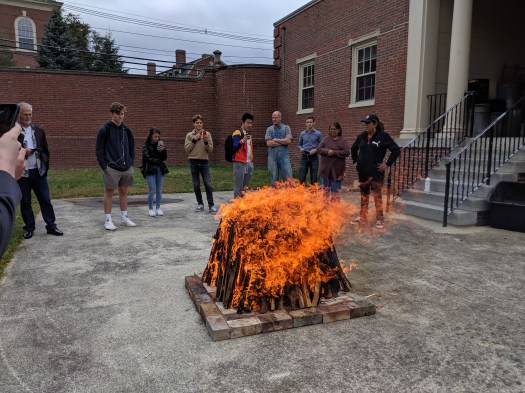
PA students look on during an open air firing. Maxine and Dominique Toya are on the far right.
Dominique, Maxine, and Mia are talented artists and educators from the Pueblo of Jemez, also known as Walatowa. Dominique is known for her micaceous spiral vessels, Maxine makes beautiful hand painted figurines of owls and town criers, and Mia makes vessels adorned with butterflies on their lids. All of their pieces are made and fired using the traditional techniques of Pueblo pottery making and include their own distinctive innovations. Collectively they have won numerous distinctions and regularly show their pieces at the Santa Fe Indian Art Market and other juried venues. They also are terrific educators with a passion for sharing Pueblo pottery making.
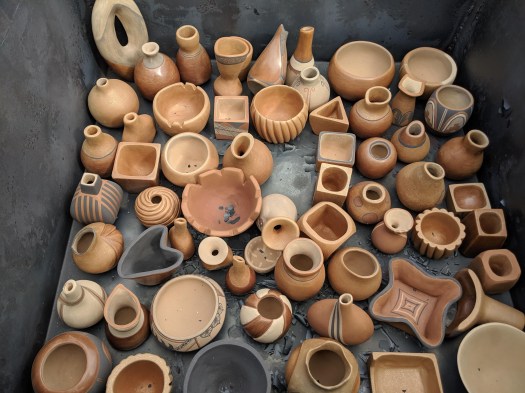
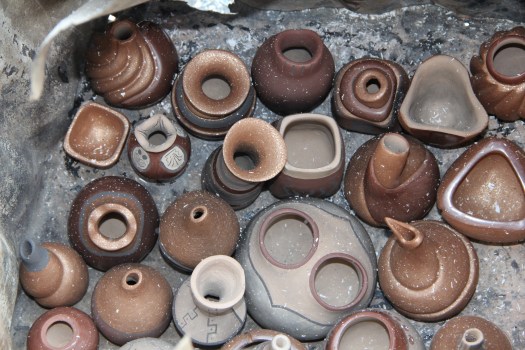
Student work emerges after the firing. Many of the pieces incorporate techniques like fine line painting, polishing, as well as a mix of traditional and innovative forms.
The Peabody and PA have a long history with the Pueblo of Jemez. From 1915 through 1929 the Peabody sponsored Alfred V. Kidder’s excavations at Pecos Pueblo, one of the ancestral communities of Jemez. In the 1990s Peabody personnel were involved in repatriation of ancestors and funerary objects from Pecos and began the Pecos Pathways program, a forerunner of today’s Learning in the World programs.
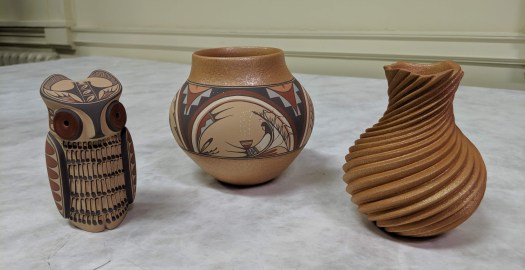
Owl figurine made by Maxine Toya (left); collaborative pottery, Dominique and Maxine Toya (center); micaceous swirl bottle by Dominique Toya.
We are very fortunate that several donors and members of the Peabody Advisory Committee have helped us acquire some of the Toyas’ stunning pieces and provide underwriting for their visits. We are so grateful for the time that the Toyas have dedicated to working with PA students and faculty!
One of the early topics covered in the interdisciplinary course Human Origins is science vs. pseudoscience. Students watched a short video by Craig Foster, who talks about his experience attending a Bigfoot research conference. Archaeology has long contended with claims for ancient aliens, lost continents, and cryptids, like Bigfoot, Yeti, and the Abominable Snowman. While seemingly fun and harmless diversions, these things can muddy thinking about what science is and how it is done, and contribute to misperceptions about the accomplishments of indigenous people. The nineteenth century Moundbuilder Myth suggested that the ancient earthen monuments of the Ohio Valley had not been built by the ancestors of contemporary Native Americans, but rather by a mysterious lost race. This was used to justify the United States’s expansion westward, as exhibited in the doctrine called Manifest Destiny. If Native people were not responsible for creating the Ohio Valley monuments it called into question their rightful occupation of this territory and empowered American expansion.
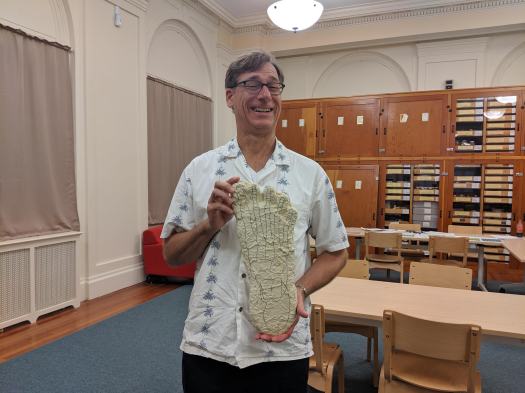
Peabody director Ryan Wheeler with the supposed cast of Bigfoot. The late Dr. Grover Krantz has marked the position of the foot bones. This copy was obtained from BonesClones, though there are many casts available for sale.
Paranormal and cryptid researchers often use technology and techniques that approximate science. They represent an investigation of the unknown and the possible. During class we discussed perceptions of science and philosopher Karl Poppers’s recognition that falsifiability is the hallmark of scientific investigation. The classic example is Arthur Eddington’s check of Einstein’s theory of relativity. Einstein had noted that it should be possible to observe the gravitational deflection or bending of starlight during as eclipse; if the starlight wasn’t deflected, it meant that his postulates had been proven false. Eddington made a series of photographs during the 1919 eclipse that demonstrated that the Sun did, in fact deflect starlight. Ancient aliens, Bigfoot, and Lost Tribes can never be subject to real scientific investigation like this because the claims can never be tested and proved false.
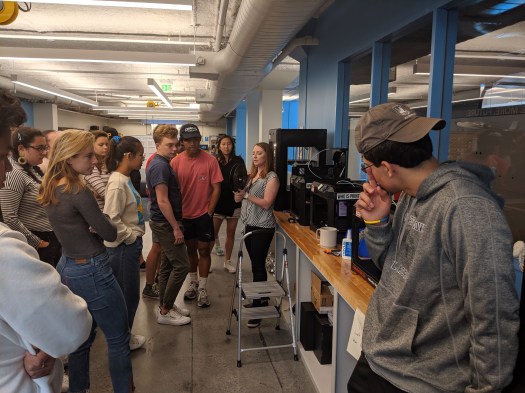
Students in Human Origins are printing 3D versions of fossil hominins this term. Here they are learning about the equipment from Claudia Wessner, Oliver Wendell Holmes Library Makerspace guru.
We revisited Foster’s video and his thoughts on the Bigfoot adherents. Why do people believe these outrageous claims? For one, it has to do with context. If you spend time with other Bigfoot believers it reinforces your own thinking. We also discussed belief as a continuum. Some people don’t believe in cryptids or aliens, but are willing to consider the possibility of ghosts. Foster also notes that we are all susceptible to pseudoscientific claims and that the people who believe are perfectly rational and pleasant individuals who will remain unconvinced by arguments or contradictory evidence.
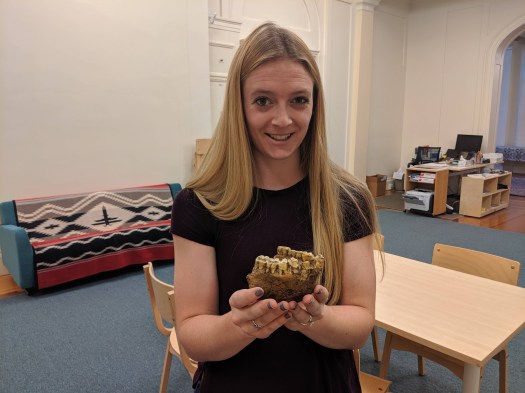
Peabody administrative assistant Emma Cook with our cast of the Gigantopithecus blacki mandible.
During class we also examined a cast of a jaw of Gigantopithecus blacki, a very large primate known from around 9 million years ago in parts of Asia; paleontologists believe Gigantopithecus became extinct around 100,000 years ago. Gigantopithecus is often offered as the real creature behind cryptids like Bigfoot and Yeti. As the claim goes, perhaps the large ape has persisted in remote areas into modern times. Relatively harmless thinking, right? But if we accept claims like this, we are effectively denying Darwin’s theory of evolution. And if we believe that evolution isn’t operating it opens the door for a host of other, more insidious thinking, especially ideas about race.
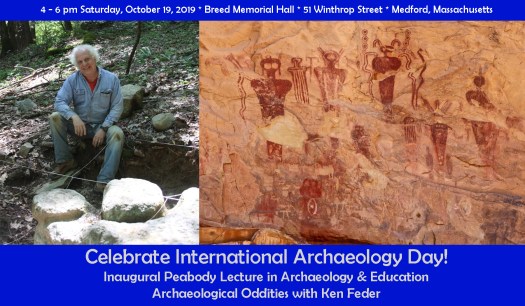
If you want to learn more about archaeology, science, and pseudoscience please attend our inaugural Peabody Lecture in Archaeology & Education, featuring archaeologist and author Ken Feder. Feder will talk about his newest book, Archaeological Oddities: A Field Guide to Claims of Lost Civilizations, Ancient Visitors, and other Strange Sites in North America. Ken will sign copies of the book after his talk. 4-6pm, Saturday, October 19, 2019, Breed Memorial Hall, Tufts University, 51 Winthrop Street, Medford MA. The event is free and open to the public, but we ask that you RSVP: https://events.attend.com/f/1383789424#/reg/0/
My name is Ryan Collins, and I am an Archaeological Anthropologist specializing in Ancient Maya Culture. I recently earned a Ph.D. in Anthropology from Brandeis University where I also instruct courses (as well as at Northeastern University and Lesley Art + Design) in Archaeology, Anthropology, Latin America, and Material Culture Studies.
I am also fortunate enough to have two roles with the Robert S. Peabody Institute of Archaeology. First, I am the Transcription Project Associate, working through the museum’s original bound ledgers to create a digital inventory. While there are several subjects of interest that I want to explore from the Ledger Transcription Project (including the stories of somewhat mysterious artifacts), the subject of this post will focus on my role as the Lead Archaeologist with Mansion House Excavations happening on Phillips Academy’s Campus during the Summer Session with the Lower School Institute. The Mansion House excavations happen in collaboration with the Robert S. Peabody Institute of Archaeology which houses recovered artifacts as well as materials that once belonged in the late 18th-century building.
The Mansion House at Phillips Academy Andover is a site of significant historical importance in the local community. Built during the Revolutionary War in 1782 (though fully completed in 1785) it was home to Phillips Academy Andover’s founder, Judge Samuel “Esquire” Phillips Jr., and his family until 1812. During this time Judge Phillips, his wife Phoebe Phillips, and their family were known to cultivate a warm and inviting atmosphere to the students of the academy while also hosting notable political figures of the day like President George Washington.
Mansion House in the 1880s
With the decline of Phoebe Phillips’ health in 1812, the Trustees of Phillips Academy purchased Mansion House converting it into an Inn and Tavern. As an Inn and Tavern, Mansion House became a central meeting place for students and faculty of the academy as well as for residents in Andover. Over the years Mansion House hosted notable guests including Emerson, Webster, President Andrew Jackson, and Mark Twain among many others. Although, when looking through the guest ledger on the date of his stay, Mark Twain’s signature is absent having mysteriously been cut out.
Signed guest ledger from the Mansion House
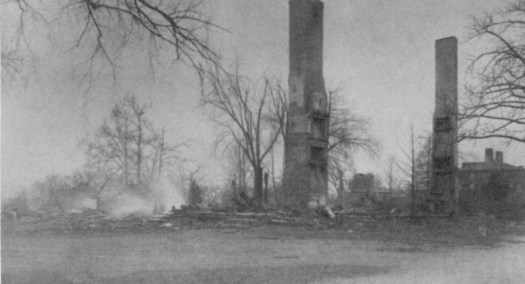
The history of Mansion House and its guests is enough to capture the attention of archaeologists. However, beneath Mansion House’s rich past is an enduring mystery – who burned it down? On the very early morning of November 29th, 1887, around 2:00 am the tenants were awoken by thick smoke coming from a fire in the rear base of the house near a pile of woodchips. A second fire was discovered shortly after in a third-floor room at the front of the house. Despite the best efforts of the local fire brigade and a galvanized town, Mansion House could not be saved. As chronicled by the Andover Townsman on December 2nd, 1887, Mansion House did not collapse, but it “slowly melted” into its foundations.
Mansion House ruins after the fire
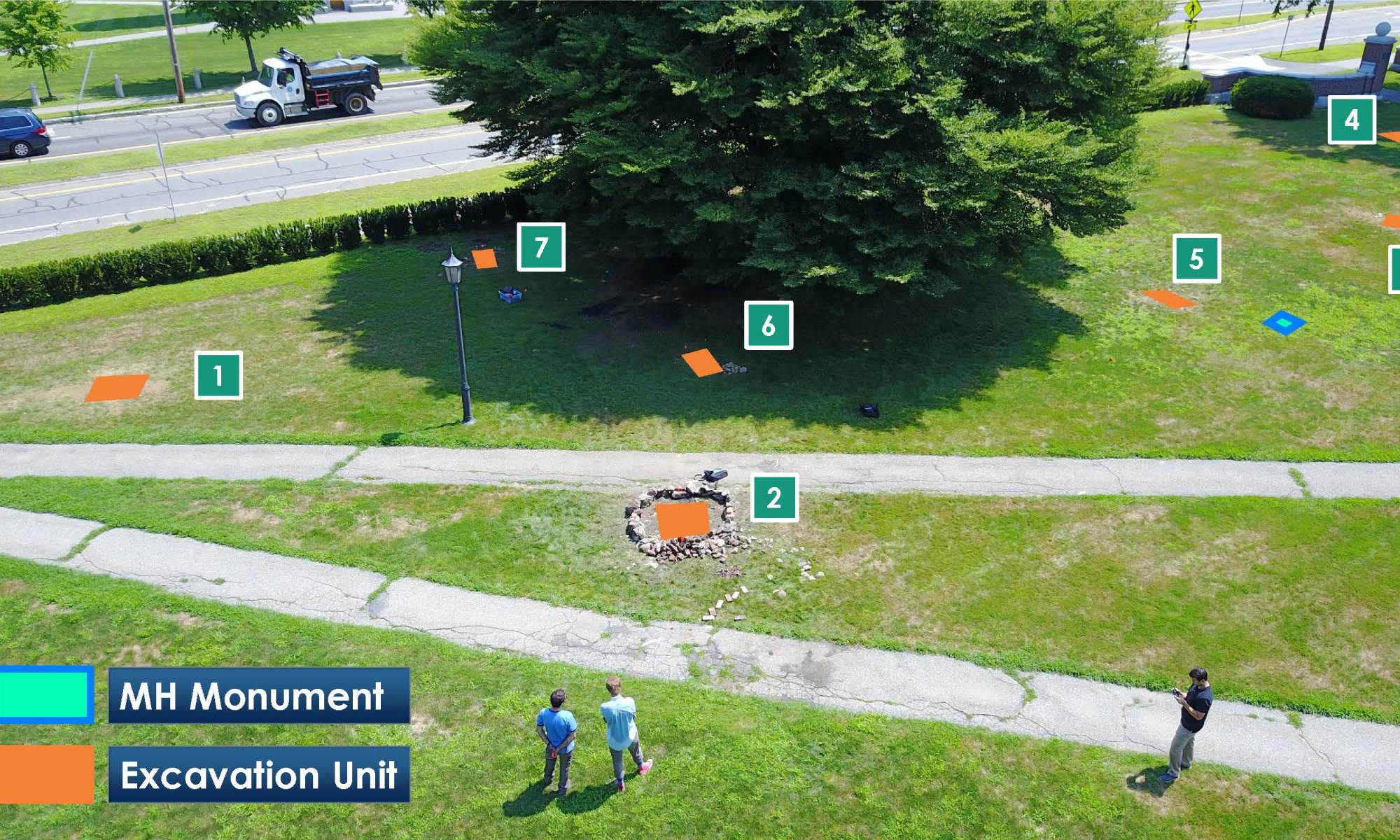
Most sites and buildings that archaeologists explore are little more than skeletons of their former selves. This reality puts limits on the archaeological record (often refuse in this context) and on the questions that archaeologists can ask about a site to broad notions of process or change over time. With Mansion House, a question of this variety would be: How did Mansion House change over time? What traditions are evident in the material remains of the site? However, because Mansion House burned into its foundations, we have access to an event, a specific moment in time. In this way, the materials students recover from Mansion House will help then share different informed stories about the site, its residents, and life in the 18th and 19th centuries. (IMAGE 4)
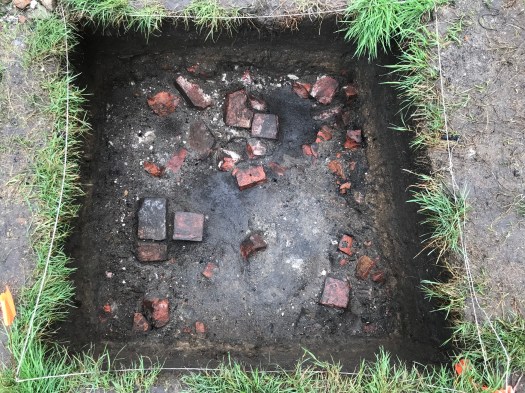
Summer Session excavation unit
In 2018, our excavations confirmed the location of Mansion House by finding one of its (at least) 6 chimneys and the remains of an iron furnace. This finding not only establishes a more precise understanding of where Mansion House’s foundations are currently situated but it allows us to explore the material remains that have sat untouched for 132 years. With luck, this year’s investigations will allow us to understand even more about life in Mansion House during its final days. While the mysteries around the long-ago fire are unlikely to be solved, more insight will undoubtedly be learned about Phillips Academy and the local Andover community. Excavations at Mansion House will reopen in July of 2019.
In 1901 Robert S. Peabody lamented the lack of instruction in archaeology at his high school alma mater Phillips Academy, a prestigious New England boarding school. To rectify the situation, he used family funds and artifacts amassed by his personal curator Warren K. Moorehead to establish a Department of Archaeology at the school. A building was constructed and Moorehead and Peabody’s son, Charles, set about teaching classes. The pattern established by Moorehead and Peabody, however, was disrupted in 1914 when the school refocused the program exclusively on research. Classes were offered periodically over the next decades, and some students were inspired to follow their high school passions to lifetime careers in our field. Successive administrators at the institution, ultimately called the Robert S. Peabody Institute of Archaeology, struggled to find a place for archaeology in the high school curriculum due to a variety of factors. Cyclical trends in teaching archaeology at Phillips Academy and long term struggles to integrate archaeology into the high school classroom mirror nationwide patterns, providing a case study that can inform the broader initiative to harness the excitement and interdisciplinary aspect of archaeology, and to encourage stewardship of archaeological resources. The experience of the educators at Phillips Academy, however, suggests that these goals may be at odds with one another and require a delicate balancing act to achieve sustained results.
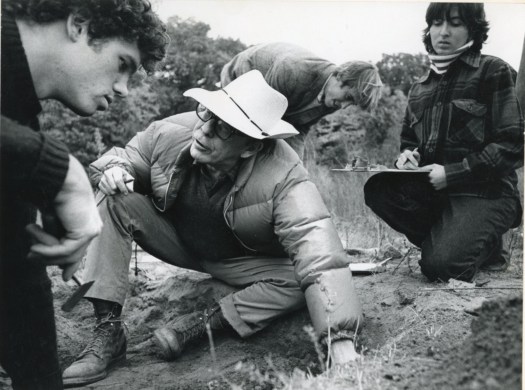
Peabody director Richard “Scotty” MacNeish instructing Phillips Academy students at the Andover town dump, 1970s.
Human Origins at Phillips Academy began in 2007 and represented one of the early collaborations between faculty and the Peabody. In its initial incarnation the course was led by Jerry Hagler, science faculty, and co-taught by personnel at the Peabody. The content was strongly interdisciplinary, mirroring the reality of archaeology and anthropology, which draw heavily on science, history, historiography, psychology, and other fields. Three years ago I began leading the course solo, but have endeavored to maintain the strong interdisciplinary flavor. The course is now among those offered by the Academy’s new Department of Interdisciplinary Studies. The course description states:
This interdisciplinary science course uses insights drawn from history, art, archaeology, and other disciplines to chart the human journey from hominid to the first civilizations that forecast the modern world. Hands-on laboratory exercises emphasize use of Peabody Institute of Archaeology collections and challenge students to apply ancient techniques to solve daily problems of survival.
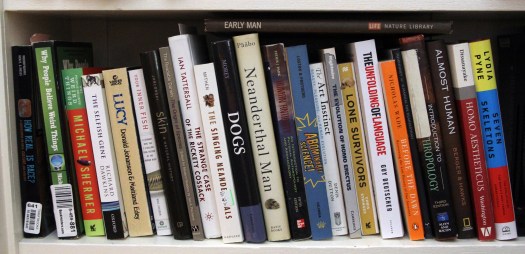
The Human Origins bookshelf. These are some of the texts from which class readings are drawn.
In the fast paced world of human evolution, I’ve found it imperative to focus on some of the big questions and issues, rather than on the details, as new finds and discoveries rewrite our evolutionary history nearly monthly. In June 2017 a new discovery in Morocco pushed back the antiquity of modern humans (us!) by nearly 100,000 years and called into question the predominant view that our earliest ancestors first appeared in eastern and southern Africa. We also only have 10 weeks to cover some 7 million years of human evolution, so judicious pruning of the syllabus is necessary.
On the first day of class some students are surprised to learn that we will spend a great deal of time talking about race. When you understand that the scientists who first studied fossil humans were also the scientists that were interested in human diversity this connection becomes clearer. We encounter ideas like polygenesis, which suggests that so-called races today had different evolutionary origins and trajectories. Despite the widespread adherence to the “Out of Africa” hypothesis, polygenism casts a long shadow and continues to crop up in new guises.
Casts of Bigfoot or Sasquatch footprint impressions, Washington State, cast and reconstructed by Dr. Grover Krantz, Professor of Anthropology at Washington State University. Casts from Bone Clones Inc.
Early in the term we tackle pseudoscience and read a chapter from Michael Shermer’s 1997 book Why People Believe Weird Things. We get to talk about Big Foot. It was with great reluctance that I dropped a reading from Daniel Loxton and Donald R. Prothero’s 2013 book Abominable Science: Origins of the Yeti, Nessie, and Other Famous Cryptids. They review every piece of evidence for the existence of these creatures (and more!), pointing out over and over that scientific inquiry requires falsifiability beyond all else. The importance of falsifiability in science will remain central, but the Loxton and Prothero readings were just too long!
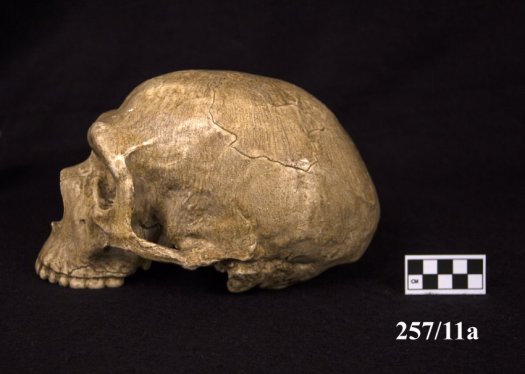
The Peabody’s vintage plaster cast of a Neanderthal from La Chapelle-aux-Saints, France.
We also spend some time talking about Neanderthals, and the incredible shifts in our understanding of one of our closest human relatives. As much as possible I try to have students read things written by the scientists on the front line of human origins research, including Svante Pääbo, who less than ten years ago reconstructed the Neanderthal genome and demonstrated that many of us carry a little Neanderthal DNA, the product of interbreeding between what most scientists had though two separate species. The recent discovery of an individual from 90,000 years ago that had a Neanderthal mother and a Denisovan father will no doubt be front and center in our discussion. Denisovans are another recently discovered fossil human group that overlapped geographically and temporally with Neanderthals in eastern Europe and Asia. Students presenting on Neanderthals in the popular imagination will explore everything from the GEICO caveman to the Flintstones.
Students try their hand at flint knapping in Human Origins, fall 2017.
During our extended periods we will explore a variety of early technologies, from flint knapping to fire making. In order to contextualize these early technologies, students will read some of Richard Dawkins’ 1976 book The Selfish Gene, where he introduces the concept of the “meme.” Many are surprised to find that the term meme, now embedded in the culture of social media, originated with Dawkins as he wrestled with ways to model the origins and transmission of ideas. We discuss innovation versus transmission, and how both are necessary for an idea to persist and spread. Fire and stone tool making are particularly good examples, sparking discussion of the earliest evidence for each and if they were independently invented over and over (and how one might tell).
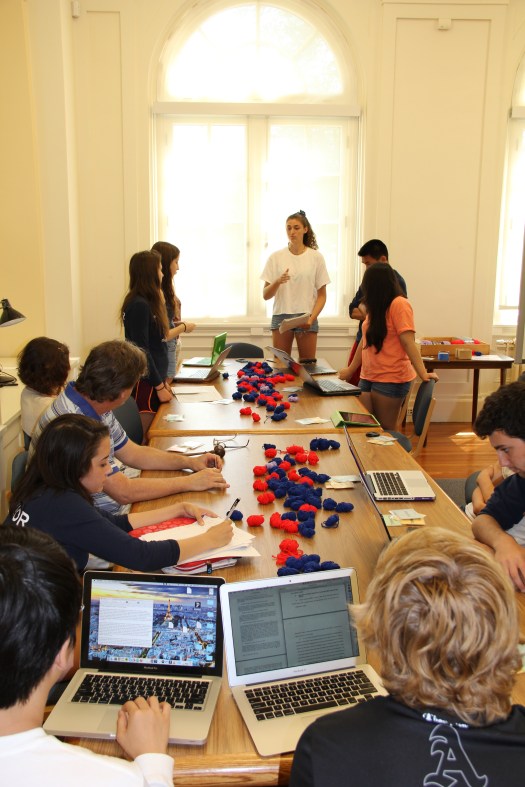
Students apply the Giles & Elliot discriminant functions to models of human skulls, a basic forensic technique that is often used to distinguish “race.” We explore why it works, its limitations, and the problems with scientific explorations of race and human diversity.
We revisit race again with an entire week dedicated to readings and discussion of the problematical origin of the concept, and how it melds physical traits with cultural ones. We delve into paleontologist Stephen J. Gould’s campaign against the idea of race as a biological or scientific concept, and how scientists have continued to study race despite Gould’s protests. The focus here is on creating a context for future discussions of race—the cultural construct—versus biological diversity. We’ll tackle the complexities of forensic methods used to distinguish race, why these work so well, and how physical anthropologists struggle with ideas about race. Other lab days visit the Peabody’s collection of fossil human cranial casts, how to read the story of human evolution in one skeleton, and a special trip to the campus Makerspace where we will 3D print a fossil of Homo naledi, a recently discovered fossil human species from South Africa that overlaps with modern humans in space and time and blends ancient and modern characteristics.
The NAGPRA debate unfolds in Human Origins, spring 2015. The class is divided into teams, each representing one of the parties in the case of Spirit Cave Man, a 10,600-year old individual found in Nevada. Materials from the Fallon Paiute-Shoshone tribe’s legal battle for the remains are used as primary source material.
The term will finish with some time dedicated to the Native American Graves Protection & Repatriation Act (NAGPRA), explored through a classroom debate and using the legal documents from the Spirit Cave Man case. The Peabody has been deeply involved in NAGPRA since its implementation in 1990 and it seems appropriate to share this work with students and investigate the arguments on all sides of the repatriation debate.
Stay tuned for updates from this fall’s Human Origins course. Let’s see how new discoveries in the field and lab change our conversations in the classroom!
To the uninformed, the Peabody Institute of Archaeology is just a building on the Phillips Academy campus that houses old artifacts and sherds of pottery from long ago archaeological expeditions. They would be very mistaken! The Peabody provides incredible academic enrichment opportunities to the student body across all disciplines.
In a unique approach to education, the Peabody collections are used to demonstrate the practical applications of history, language, mathematics, science and sociology. This year celebrates the fifth year the Peabody has arranged for pottery artists from the Pueblo of Jemez to come to campus to work with students.
In collaboration with Thayer Zaeder’s ceramics classes the potters spent the week working with 48 students teaching the ancient techniques of transforming clay into pottery. I had the rare opportunity to not only observe these artists work with the students, but to actually work with them myself. Maxine, Dominique and Mia worked with students individually on both shape and decorative painting to create unique pieces of art.
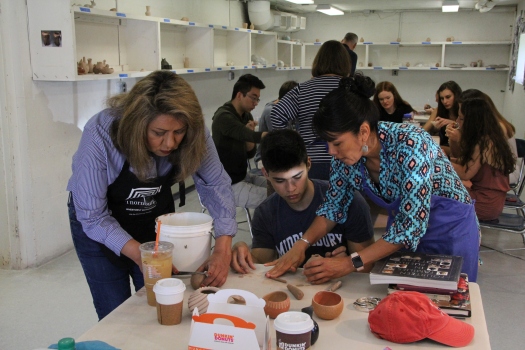
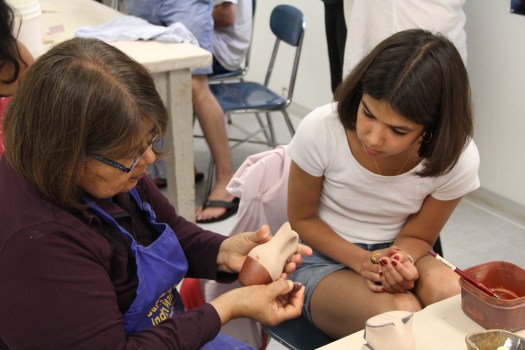
Dominique Toya (left) and Mia Toya (right) work with a student.
Glazing is not used in Pueblo pottery. Any glossy surfaces are achieved by polishing the area with smooth stones. The process is delicate and time consuming and if you mess up, as one student found out, the Potters would show you how to fix the problem – sand it all off and start again!
Maxine Toya demonstrates how to polish the red slip.
Dominique, Mia and their mother, Maxine Toya come from a multi-generational family tradition of Pueblo Potters. Each is known for their unique style, Dominique for her mellon designs, Mia for her signature butterfly designs and Maxine for her animals and figures. Their work is highly collectible and sought after. Nancy Youngblood, another prominent Pueblo potter, has joined them the last three years. These four ladies are the “Super Stars” in the Native American world of ceramic art.
Maxine Toya working on one of her famous owls.
Mia Toya talks about her butterfly swirl jar, in process.
Dominique Toya begins the spiral ribs on a miniature swirl pot.
Mia’s friend Ward Weppa helps sand the ribs on her butterfly swirl bowl.
Maxine Toya’s completed owl figurine–all the fine line painting is done with Maxine’s masterful hand-eye coordination!
Dominique Toya’s distinctive swirl vessels with micaceous slip, collection of the Robert S. Peabody Institute of Archaeology.
When speaking with the Potters, one theme stood out. They love bringing the ancient methods to this generation to instill a knowledge of their culture and heritage. They each spoke of how polite the Andover students were as well as the appreciation shown to them by each student for the opportunity to learn this ancient art form.
Students look on as Dominique tends the fire.
The culmination of each of their visits is the “firing.” They still use the ancient method of firing the pottery outdoors, which usually draws a large crowd. A huge bonfire is built to bake all the pieces the classes have created. The end result brings pride and a sense of accomplishment to both students and teachers alike.
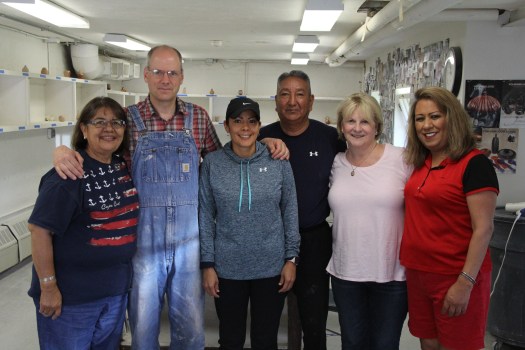
From left to right: Maxine Toya, Thayer Zaeder, Mia Toya, Ward Weppa, Barbara Callahan, and Dominique Toya.Vessels as they emerge from the fire.
*Guest contributor Barbara Callahan is Secretary of the Peabody Advisory Committee. She and her husband Les Callahan (Phillips Academy Class of 1968) provided the generous support for the Pueblo Potters program in 2017 and 2018.
In the last two weeks, we have had three major Nor’easters here in New England. Fortunately, it has been while students are on break and has not slowed down the creation of new lessons for spring term.
“A man never lies in his garbage heap” – Franz Boas.
Last term I was approached by Emma Frey, faculty in history, to create a single period activity that would introduce her 9th graders to the concept of reading objects as text and use them to tell a story. As Emma and I talked and brainstormed, we decided on an existing lesson that I had created years ago for our Archaeology Explorers and how we could flesh it out so that it better met Emma’s class goals and objectives. The activity is a garbology lesson called Trash Talks!
Two bags of clean trash that students will analyze.
In the activity students are divided into three groups and are given a bag of clean trash. While working together to sort and identify the trash, each group also compiles a biography of the person(s) who created the trash. They will be asked to make observations and inferences about the trash and what it might reflect about a person, such as their gender, age, activities, etc.
An example of how students might mark down artifacts in their trash bags to better understand what they show about the life of someone.
While the trash is “modern” the principles that students use to analyze the trash are the same as the ones that archaeologists use to study cultures of the past.
I am very excited to run this lesson with students and to see how they interpret the trash!
The past five years have been a busy time for museums- most notably in the image department. Following a number of high profile controversies, a lot of people–audiences, and museum professionals alike–asked what role museums play in our society? Here are a couple of recent articles dealing with this subject head on.
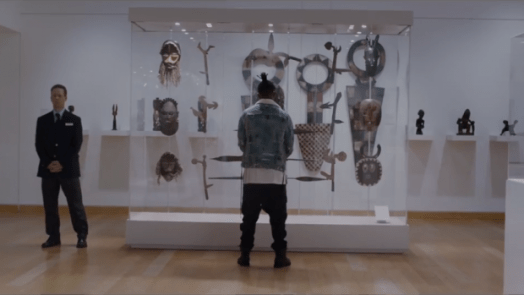
Killmonger in the Museum (Photo courtesy of article)
Last month saw the release of Marvel’s newest blockbuster, Black Panther. Besides being a fantastic movie, this film offers a unique chance to open dialogues on a large scale about many topics- least of which are museums as mechanisms of colonialism. This article discusses how and why museum professionals especially should look at their roles in this and the effects they have on the audiences we try to reach. The piece ends by laying out suggestions for how museums can move forward incorporating and working towards more diverse and open dialogues between communities.
Gover and Bunch at Symposium (Photo courtesy of Smithsonian Magazine)
This article opens with the quote, “history matters because it has contemporary consequences,” and it just gets better from there. Directors Kevin Gover (National Museum of the American Indian) and Lonnie Bunch (National Museum of African American History and Culture) participated in a day long symposium titled, “Mascots, Myths, Monuments and Memory,” in which they talked about confronting the historic and continued racist ideologies that are entrenched in contemporary American society and the role of museums. They specifically discuss the example of the concurrent rise of confederate statues and racist mascots.
Chronicling a series of high profile controversies, this article looks at the combination of factors that have led to these, as well as the changes they are bringing to museums and their operation. It also discusses why museums have become ground zero for explosive cultural encounters stating, “We’re in a time when these issues are real, these controversies are part of public space and public discourse, and museums are going to become the places where these issues get played out.”
Students using NK360 (photo courtesy of Smithsonian Insider)
This article showcases the role museums have within their respective walls and how they are branching out to have far reaching impacts in classrooms all over the nation. Similar to classes taught at the Peabody by Curator of Education, Lindsay Randall, this article follows the creation and implementation of National Museum of the American Indian’s newest initiative, Native Knowledge 360. NK360 is a “long-term initiative to integrate the Native American experience into social studies, language arts and other curriculum in kindergarten through 12th-grade classrooms across the country.” This program works with the inclusion and cooperation of Native communities and educators as well as provides educational materials for teachers.
The collections staff at the Peabody keep telling me that I can’t have a cat. Which I guess was fair, until I found out that all this time they have been hiding a jaguar in our basement!
A few weeks ago I was approached by Elizabeth Aureden, instructor in music, to design an interactive class for her Music 410 course, The Musical Brain. While looking through our collections for musical instruments, I learned from collections assistant Samantha Hixson that she had just found and catalogued some effigy rattles.
The objects were made of clay and painted a variety of colors, and some still rattled.
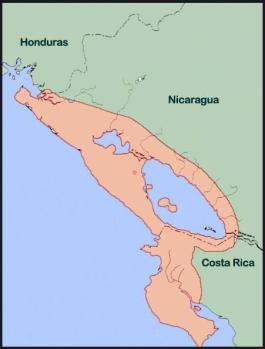
This new find seemed very promising and so I wanted to learn more about them. Research indicated that these objects were from the Nicoya Peninsula of Costa Rica and most likely date from AD 1000 – 1350.
Map showing the Nicoya cultural region. By Rodtico21 (Own work)[CC BY-SA 3.0 https://creativecommons.org/licenses/by-sa/3.0The parts we have are clearly broken and part of a much larger artifact. These are the remnants of the tripod legs of a rattle effigy vessel. Each of the three legs would have contained three clay balls and had openings on the side for the sound. When shaken a rhythmic sound can be heard.
Image of a complete vessel. Notice the holes in the side of the legs. By Daderot (Own work) [CC0], via Wikimedia CommonsThat’s pretty neat! But the story became even cooler as I found more information about this style of pottery.
The bowls were used to add a percussive sound to a ceremony. And the sound it made was not an accidental rattling sound, but rather a deliberate and meaningful one. When the bowl is shaken or moved about, and the clay balls rattle together, they create a deep, rumble. This sound is mimicking the low growl of an actual jaguar!!!!! Researchers have even noted that when the bowl is tilted and moving forward – like a jaguar lunging at prey – the sound is more prominent.
If your interest is now piqued about other objects from the Nicoya Peninsula, check out Dr. Rebecca Stone’s book, The Jaguar Within.
So next time you are at the Peabody be on the lookout, because you never know what other predatory animals might be lurking!!!
Scary lion from the 1995 movie Jumanji. Sometimes the Peabody seems like it’s playing its own version of the game Jumanji, with all the random artifacts that mysteriously present themselves to staff members.
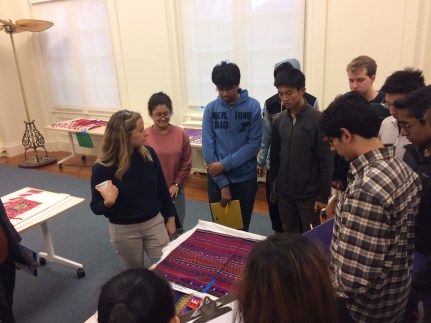
During Fall Term I worked with Meg Bednarcik and Nick Zufelt – both Instructors in Mathematics, Statistics, and Computer Science – to create a class that would focus on the computer science concepts of looping and parameters.
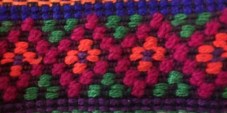
We decided to utilize the extensive Guatemalan textile collection at the Peabody, as they are brightly colored and engaging and most have repeating, or looping, motifs. We also liked the idea of incorporating clothing made and worn exclusively by indigenous women into a subject where they are woefully underrepresented.
Eighteen huipils (wee-peels) were pulled for the class, with the images of another twelve scanned. A huipil is a traditional Maya women’s shirt.
The first activity was a matching game to show students how huipils had silent information encoded into them about the wearer’s home community. Each village has its own distinctive design. The students were given twelve cards with images of other huipils in our collection and asked to match them to huipils that were laid out in the room. The following images are from three villages, highlighting how the differences between villages, as well as the variation within a particular village.
Huipil from San Mateo
Huipil from San Mateo
Huipils from San Mateo
Huipil from San Ildefonso
Huipil from San Ildefonso
Huipils from San Ildefonso
Huipil from Almolongo
Huipil from Almolongo
Huipils from Almolongo
Students participating in the village sorting game.
Then students worked with either Meg or Nick to find designs that had looping designs, or nested loops. Then they worked on creating parameters for the designs they had found.
Meg Bednarcik points out looping patterns to her students.
The third activity was asking students to identify certain motifs that are common in Maya imagery. Some, such as a deer, were more literal then others, such as the feathered water serpent or portals.
And as you learn in the write up bellow by Meg, this class served as the starting point for a term long project the students will be working on:
My AP CS A students ventured to the Peabody Institute to learn of Guatemalan huipils and the stories these women’s clothes tell of personal identity. The students will complete follow-up assignments to program their own design defining their personal identity here at the academy and beyond utilizing programming concepts learned in class such as objects and repetitions. Though many students were shocked to be at the Peabody for a CS class, they left reflecting on the many ways these programming ideas apply to other aspects of our world. I am eager to continue to utilize these resources at our fingertips to allow students the space to ponder their place in our interconnected world beyond PA, and consider the beneficial impact their work as computer scientists can have on others outside of the classroom.
~ Meg Bednarcik, Instructor in Mathematics, Statistics, and Computer Science
This has been one of the most interesting and fun classes for me to develop. I really enjoyed working with and learning about part of our collection that is underutilized. But most of all, I have been thoroughly engrossed by the current action Maya women are taking to ensure that their designs are protected and not appropriated. Based on the information I gleaned from my research, I included a huipil from Santiago Sacatepéquez, which is the only community so far that has been able to give legal protection to their woven intellectual property.
To learn more about huipils and their images, visit Guatemala City’s Ixchel Museum of Indigenous Textiles and Clothing website.
Below are symbols found in some of the huipils in the Peabody’s collection:
Serpent motif –geometric designs known as “kumatz’in”. “The Kaqchikel term kumatz means snake, or the feathered serpent.
Deer – Deer held particular significance in Maya mythology and the Dance of the Deer, originating from pre-Conquest times, is still performed at festivals today.
The Double Headed Eagle – The double headed eagle in Maya mythology represents the Great God with two faces, one looking to good and the other to evil, or to heaven and earth. Double-headed birds are motifs frequently used for decorating ceremonial garments. The image to the right outlines the shape of the double headed eagle.
Sky bands – represents the path of the sun with the Xs formed in the “empty” space refers to the end of the solstices.
Offering plate / Portal – “portal” or “door” was the Maya name for the entrance into the “other world” (spirit world). The dot in the center represents the door through which an ancestor can travel.
The Star That Proceeds The Sun – This motif has been a part of Mesoamerican cosmology since Olmec times. It can be seen in celestial bands along with the sun, the moon, and particularly Venus. It is also featured in codices, such as the Popol Vuh.
Bird – At the beginning of the rains, and when maize is sowed, they can be seen in large quantities on the rivers and lakes.
Sun – A sun is embroidered around the neckline. If a woman in the village just became a widow, she would wear her huipil without the sun around the neck, because she would have lost her sun
Lightning – Vertical zigzag lines are associated with rain and lightning.
Lion / Jaguar – The animal has been given a mane, indicating European influence. The cougar or American lion has no mane.


















 The Peabody