Contributed by Lindsay Randall
Stay Woke: Deriving from “stay awake,” to stay woke is to keep informed of what going on around you in times of turmoil and conflict, specifically on occasions when the media is being heavily filtered.
In the past few years, the Peabody Museum has collaborated with members of the Phillips Academy community on projects that not only have benefited the Academy’s students, but also have allowed us as professionals to learn new ways to look at a variety of topics and issues that are beyond our areas of expertise.
For example, recently the Peabody partnered with the Oliver Wendell Holmes Library to create a 50-minute workshop for students that will be part of the school’s programming for Martin Luther King Jr. Day in January. The process we followed in developing this workshop was quite interesting, since the way in which librarians Liza Oldham, Beth Tompkins, and Stephanie Aude view or think about issues is very different from how I approach the same topics. It was exciting to sit together, throw ideas around, and build on one another’s suggestions to create a workshop that will enlighten and engage PA students.
We began our development process by agreeing on the focus of the workshop: digital landscapes (the librarians’ expertise), with a particular emphasis on Native Americans (my expertise). Then we began generating ideas. One was to concentrate on the issue of mascots or native people as costumes. Another was to focus on how Native Americans are represetneted in the media. Next, Stephanie mentioned it would be interesting to investigate how subjects are tagged in blogs or other online resources. From there, Beth started talking about how the Library of Congress tags subjects and mentioned some that she felt were problematic.

Librarians Liza Oldham and Beth Tompkins and I meeting
I then brought up a Google image search activity that I had performed with students regarding how native people are perceived. If you enter “African American,” “Asian American,” or almost any other racial group as a search term in Google, you will receive contemporary photos. If you enter “Native American” as a search term, most of the images you will receive are from the 1800s. This means the manner in which Google generates its images, although unintentional, reinforces the damaging belief that native people only live in the past and do not exist today.

Screen grab of Google image search for “African American“
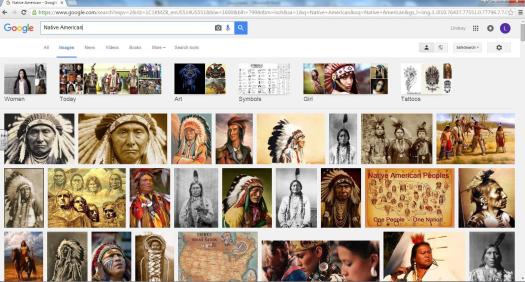
Screen grab of Google image search for “Native American”
After conducting additional Google image searches and looking at some of the search terms or categories in the Library of Congress, we decided to focus the workshop on how digital resources related to Native Americans were categorized and grouped, and compared that to other groups. Approaching race in the United States in this manner seamlessly melded our two areas of focus into a simple yet cutting-edge way to look at race in our society. Such a multifaceted approach and understanding of the complexities of race in the United States and elsewhere is critical for our students to have if they are to become global citizens.
Here is the description of our workshop that the Office of Community and Multicultural Development (CAMD; https://www.andover.edu/StudentLife/CAMD/Pages/default.aspx) will be sharing campus wide in its MLK Jr. Day programming materials:
Stay Woke: Finding Prejudice in the Research Process
Contemporary prejudice is often insidious. It doesn’t announce itself with a clear sign – “Look at this clearly defined racism!” – but rather creeps in, makes itself at home, and becomes such a part of everyday life that it’s hard to see. Understanding the prejudices that are built into the digital and organizational landscapes we use constantly, like Google and libraries, is vital to modern ethical development. Through hands-on activities and discussions, participants will begin to explore the complex issues surrounding this topic and improve their awareness and digital literacy.
We are very excited to run this workshop, and I look forward to sharing more about it and its outcomes with everyone in January!


 Join the Peabody and the Gene Winter Chapter of the Massachusetts Archaeological Society for a night highlighting student work and research. Three groups of students will present their research ranging from historic preservation to 3D printing artifacts to 19th century portrayals of Native Americans.


 The Peabody