Puerto Rican Artifacts at the Peabody

Contributed by Ryan Wheeler

A poorly known collection occupying several drawers at the Peabody Institute sheds a little light on the Taíno, the indigenous people of Puerto Rico and neighboring islands who met Christopher Columbus in 1492.

When Columbus landed in Hispaniola the Taíno population was perhaps in the millions and early records estimate that 85 percent of the population had been lost within a few decades. People lived in family groups, with some villages numbering 3,000 people. Native foods like fish, shellfish, birds, lizards, and other small animals augmented agricultural crops of cassava, yams, and other domesticates. A complex and elaborate religion included the worship of spirits called zemis, and like their neighbors in Mesoamerica, the Taíno played a ball game on a rectangular court that they called Batey. Hereditary chiefs and nobles ruled over commoners and slaves. The Taíno, however, soon succumbed to the Spanish conquest, but most of us recognize a handful of loan words in English that can be traced back to the Caribbean, including barbecue (barbacoa) and canoe (canoa).
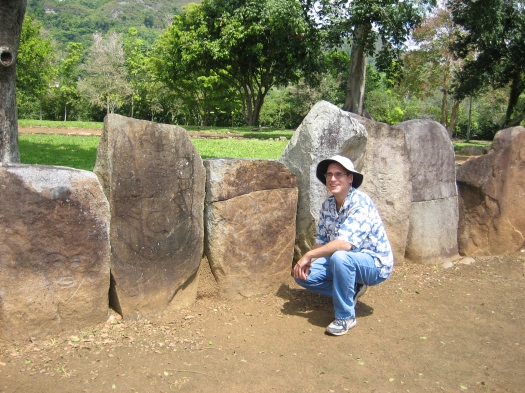
Image of Ryan Wheeler at the Caguana Ceremonial Ball Courts Site in barrio Caguana, Utuado, Puerto Rico, 2006. The reconstructed ball court is lined with engraved stone slabs.
Ryan Wheeler at the Caguana Ceremonial Ball Courts Site in barrio Caguana, Utuado, Puerto Rico, 2006. The reconstructed ball court is lined with engraved stone slabs.

I got interested in the Taíno in 1999 when as an employee of the Florida State Archaeologist’s Office I conducted an investigation of the Miami Circle site in downtown Miami. Miami is a melting pot of people from Latin America and the Caribbean. Among those I met during my time in Miami were a group of folks from Puerto Rico who considered themselves living members of the Taíno tribe. Like most other archaeologist and anthropologists at that time I had learned that the Taíno were extinct—one of the first victims of European conquest and colonization of the Americas. My new friends shared that they had, however, preserved their language and culture, including many old songs which they were working to pass on to future generations. Over the next few years I met more Taíno people and several tribal members participated in my excavations near Lake Okeechobee in 2000.

A 2011 Smithsonian.com article by Robert M. Poole recounts his search for modern day Taíno in New York and Puerto Rico with surprising results. Like my friends in Miami, many Puerto Ricans acknowledged indigenous ancestry. Many of my archaeologist friends were still skeptical, suggesting that cultural practices were based on ethnohistoric accounts left by the Spanish and that language was being recreated based on Julian Granberry’s 2005 book Languages of the pre-Columbian Antilles. By the early 2000s there were several Taíno groups that asserted cultural affiliation, including the Jatibonicu Taino Tribal Nation of Boriken, who were the folks I knew. DNA analysis by Juan C. Martínez-Cruzado—reported in 2003 and 2006—suggests that the archaeologists and anthropologists got it wrong. Based on an island-wide DNA survey, Martinez-Cruzado found that 61 percent of all Puerto Ricans have Amerindian mitochondrial DNA, 27 percent have African and 12 percent Caucasian. Martinez-Cruzado’s study also pointed to evidence for cultural survivals into modern times, including traditional fishing practices.

So, back to the Peabody collections. Preserved in several drawers are petaloid celts, adornos and sherds from ceramic vessels (many depict animals), three-point stones (also called zemis), and a very heavy stone belt (or yoke) that would have been worn during the ball game. Mela Pons Alegria, in an article in Archaeology magazine, explains that the three-pointed stone zemis “are the oldest and most abundant” form of Taíno art, and evolve from simple triangular carvings to elaborate effigy forms. Flat areas hint that these may have been attached to handles or staffs. We have little catalog information, but it appears that the collection was a gift from Eugene M. Verges. A little poking around on genealogical sites shows that Eugene Marcelin Verges II was born in 1889 in Arroyo, Puerto Rico and was a student at Phillips Academy in 1907—he’s listed in the catalog as being from Wellesley, Mass.—he died in 1970. Verges’ father was engaged in the sugar business and it seems likely that the Peabody collections from Puerto Rico were made by the Verges family and gifted to us in the first part of the twentieth century.
A Move Around the Country

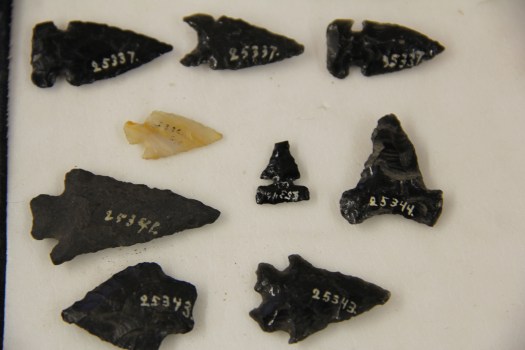
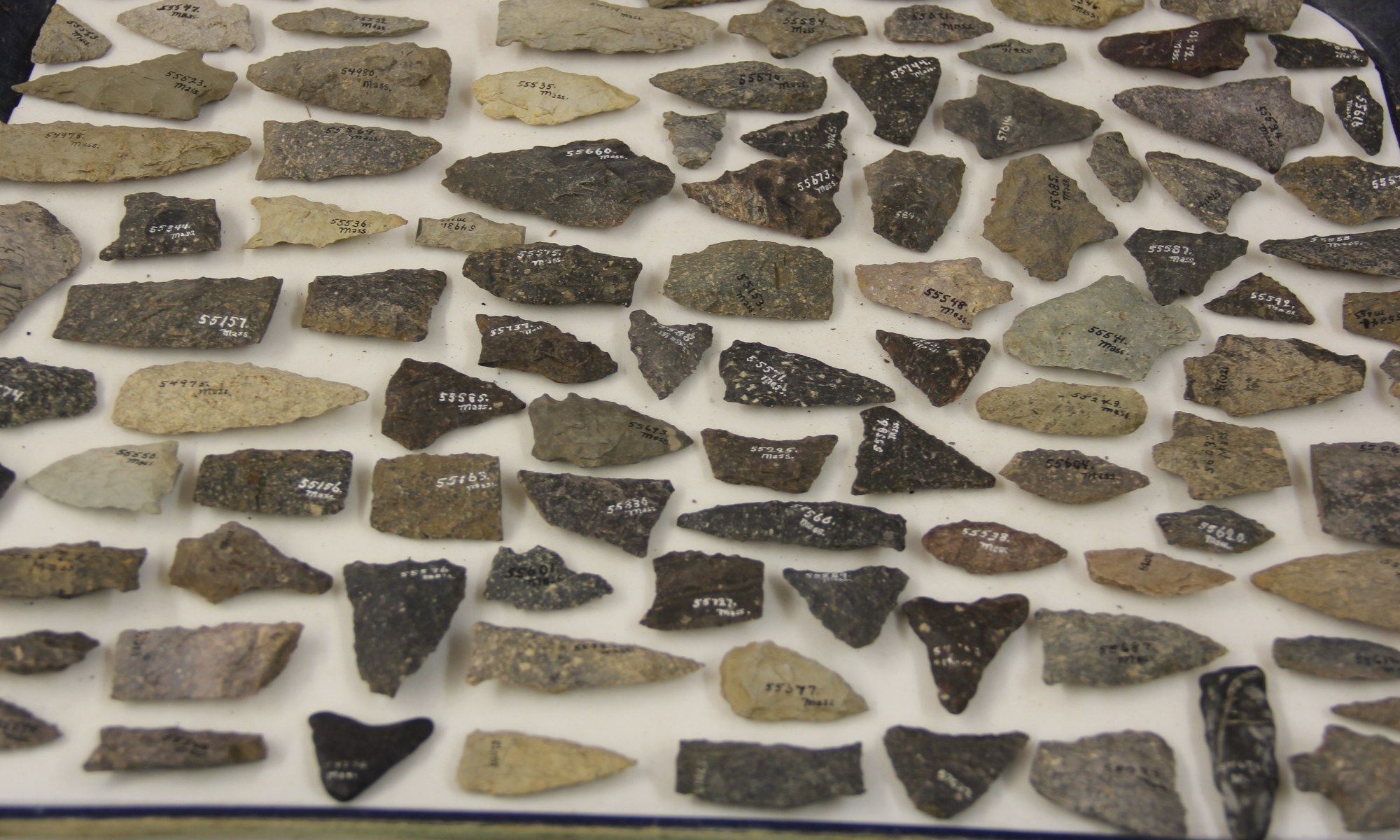
This job is awesome, but sometimes the material I work with can get pretty repetitive. I have been working on cataloging a bay full of artifacts from sites throughout Massachusetts. This allowed me to see what had been discovered throughout the state in which I now live. While there were a few ground stone tools, the vast majority of artifacts I cataloged were modified stone and bifaces. Drawer after drawer, box after box was filled to the brim with fragments of stone that had been worked by someone, but never fully formed into a usable tool such as a projectile point or a blade, and while it is still incredible to see these artifacts and be able to hone my skills identifying worked stone, it started getting very redundant.

IMG_9937
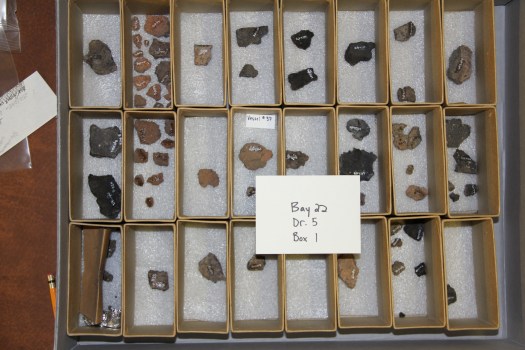
A completed box of modified stone – more layers under the ethofoam

Luckily for me, when I need a change of pace, I can walk over to another bay and choose drawers from almost anywhere in North America. After cataloging hundreds, if not thousands, of modified stone fragments, I decided to take a break from the Northeast and I moved to a bay containing artifacts from Idaho, Kansas and Iowa. So far these drawers have been amazing! While there are still amorphous fragments of modified stone, the number of finished tools far outweighs them. This particular drawer has many finished projectile points.

IMG_9946
Tiny projectile points!

Not only are they finished points, some of them are seriously tiny! A couple haven’t been much bigger than my pinky nail, and I have pretty small hands. It is incredible to see how small they are and think about the craftsmanship that must have gone into making such a tiny specimen. The level of precision and the skill that must have been required to craft these projectile points without them breaking must have been tremendous. Getting to see final products such as these has the power to make counting all the other fragments of modified stone worth it.

The Inventory Specialist position is supported by a generous grant from the Oak River Foundation of Peoria, Ill. to improve the intellectual and physical control of the institute’s collections. We hope this gift will inspire others to support our work to better catalog, document, and make accessible the Peabody’s world-class collections of objects, photographs, and archival materials. If you would like information on how you can help please contact Peabody director Ryan Wheeler at rwheeler@andover.edu or 978 749 4493.

NAGPRA, Repatriation, and the Peabody

In 1990 President George H. W. Bush (Phillips Academy Class of 1942) signed into law the Native American Graves Protection and Repatriation Act (NAGPRA). The passage of NAGPRA signaled a major shift in the relationship between Native Americans and museums, requiring that the latter inventory collections and identify human remains, funerary objects, sacred objects, and objects of cultural patrimony and contact the appropriate tribal groups to arrange repatriation. For tribal peoples this represented major human rights legislation.

Former Peabody director James Bradley and repatriation coordinator Leah Rosenmeier embraced the new law and worked diligently through the 1990s and into the early 2000s to identify NAGPRA collections, to determine tribal affiliations, and to ensure timely repatriation. Much of the focus during this time was on human remains and associated funerary objects. Major consultations include those that involved Alfred V. Kidder’s excavations at Pecos Pueblo in the early twentieth century, Warren Moorehead’s excavations at the Etowah and Little Egypt sites in Georgia, and excavations at sites in Maine.

Today the Peabody continues its commitment to working with tribes and indigenous peoples to ensure that ancestral remains, funerary objects, sacred objects, and objects of cultural patrimony are repatriated in a respectful and timely fashion. Much work has been done and much remains to be done.

The Peabody supports the United Nations Declaration on the Rights of Indigenous Peoples and is committed to the repatriation provisions outlined in that document. The United Nations Declaration on the Rights of Indigenous Peoples explicitly affirms that indigenous people have a right to repatriation of ceremonial objects and human remains.

We look forward to hearing from the representatives of tribes in the United States or indigenous groups abroad to answer questions, to schedule visits to view collections, to receive guidance on care and storage of collections, or to begin the consultation process. We also are happy to discuss NAGPRA and repatriation with staff members from other institutions. Please contact Peabody director Ryan Wheeler (rwheeler@andover.edu or 978 749 4493) to begin a conversation today.

A Day in the Life of Boxing Boxes

Contributed by Rachel Manning

Hi, my name is Rachel and I was hired in August as the Inventory Specialist at the Robert S. Peabody Institute of Archaeology. I am originally from upstate New York although for part of 2016 and the majority of 2017 I did work primarily in Virginia. For my first blog post I wanted to give a brief overview of my daily activities.

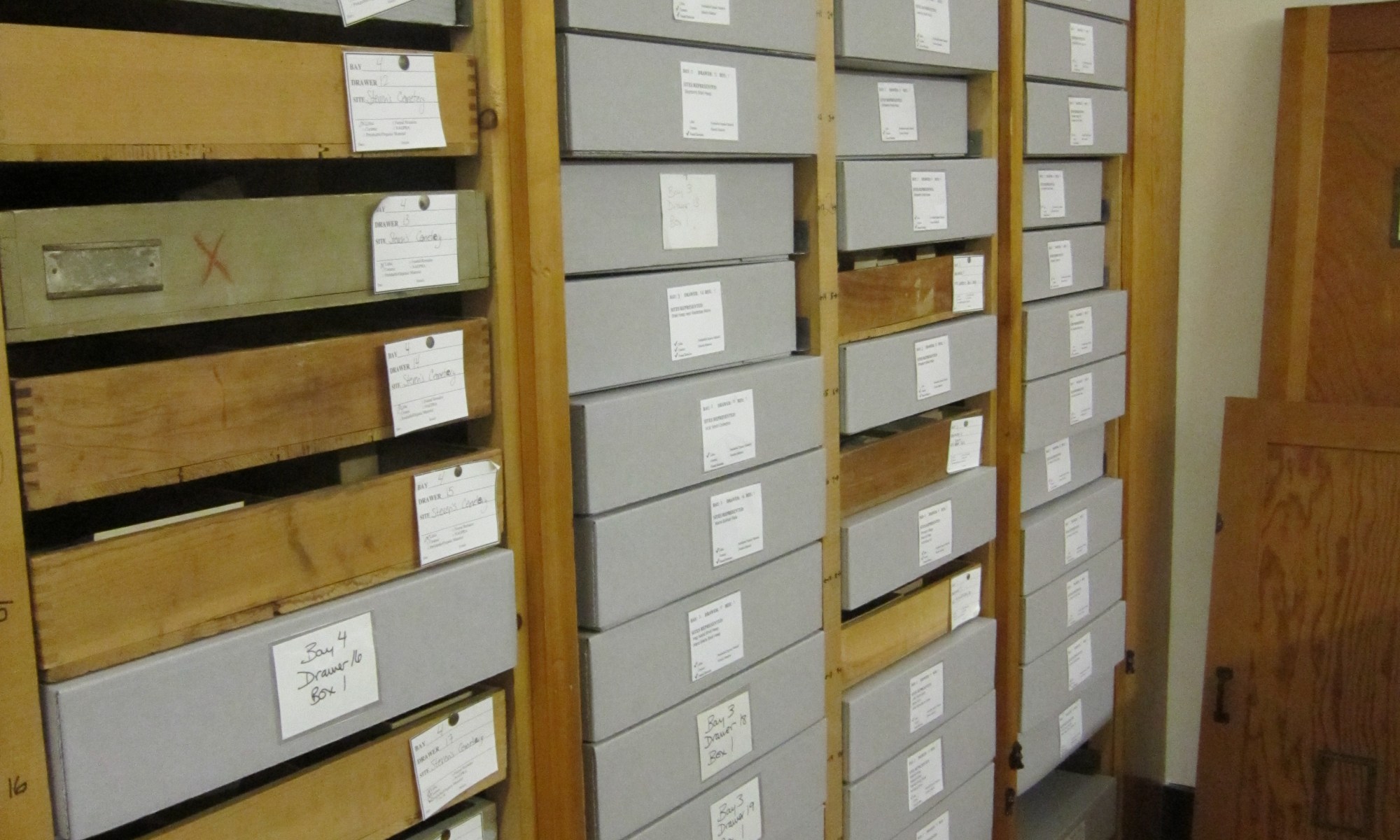
The main goal of the project I was hired to do is to conduct a complete inventory and rehousing of the collections at the Peabody. This is a task that has never been done before. Currently, the majority of the collections are housed in the wooden drawers that were brought into the Peabody in the 1930s. In each drawer, collections objects are housed in tan artifact boxes.

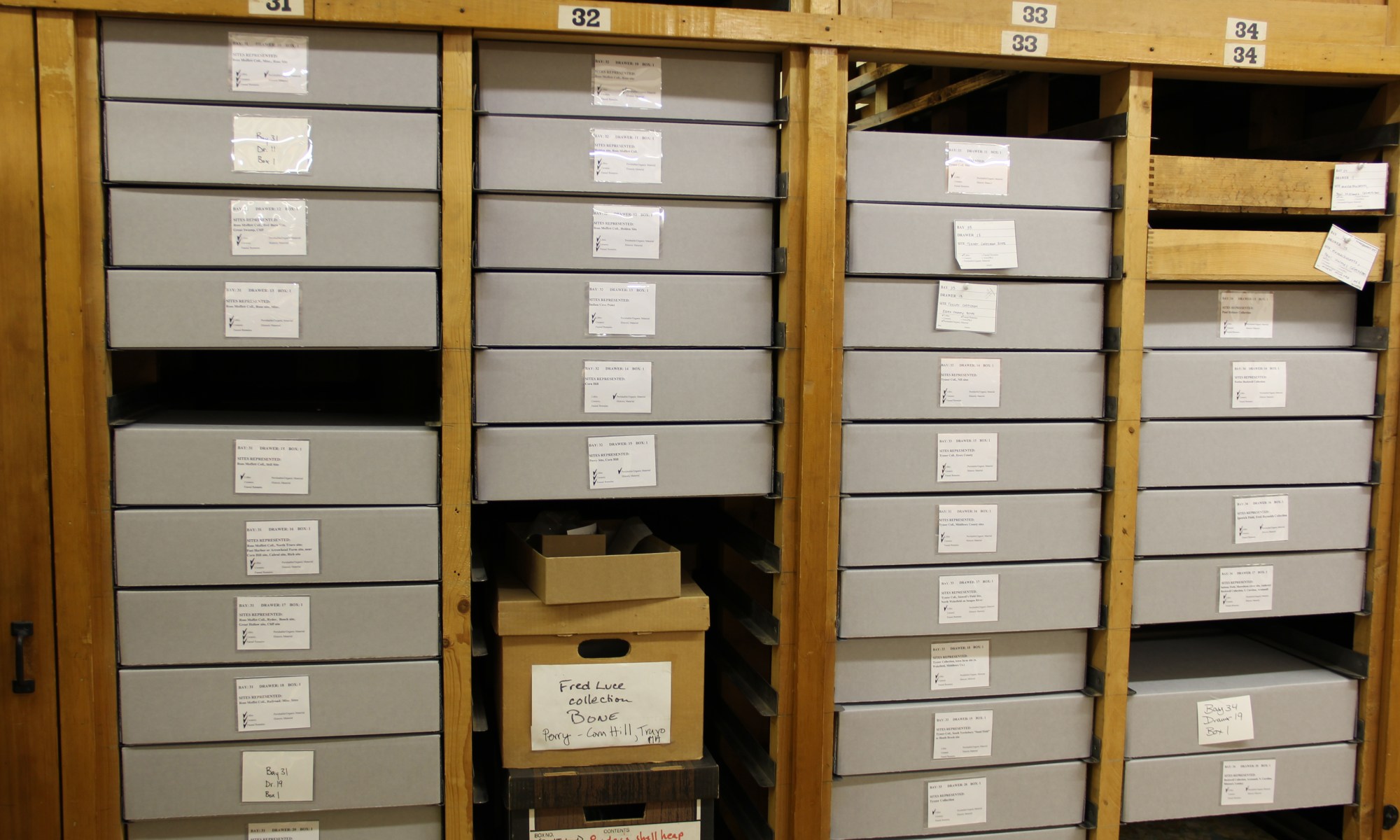
This is an example of what drawers look like before I work on them. All of these brown boxes hold artifacts.

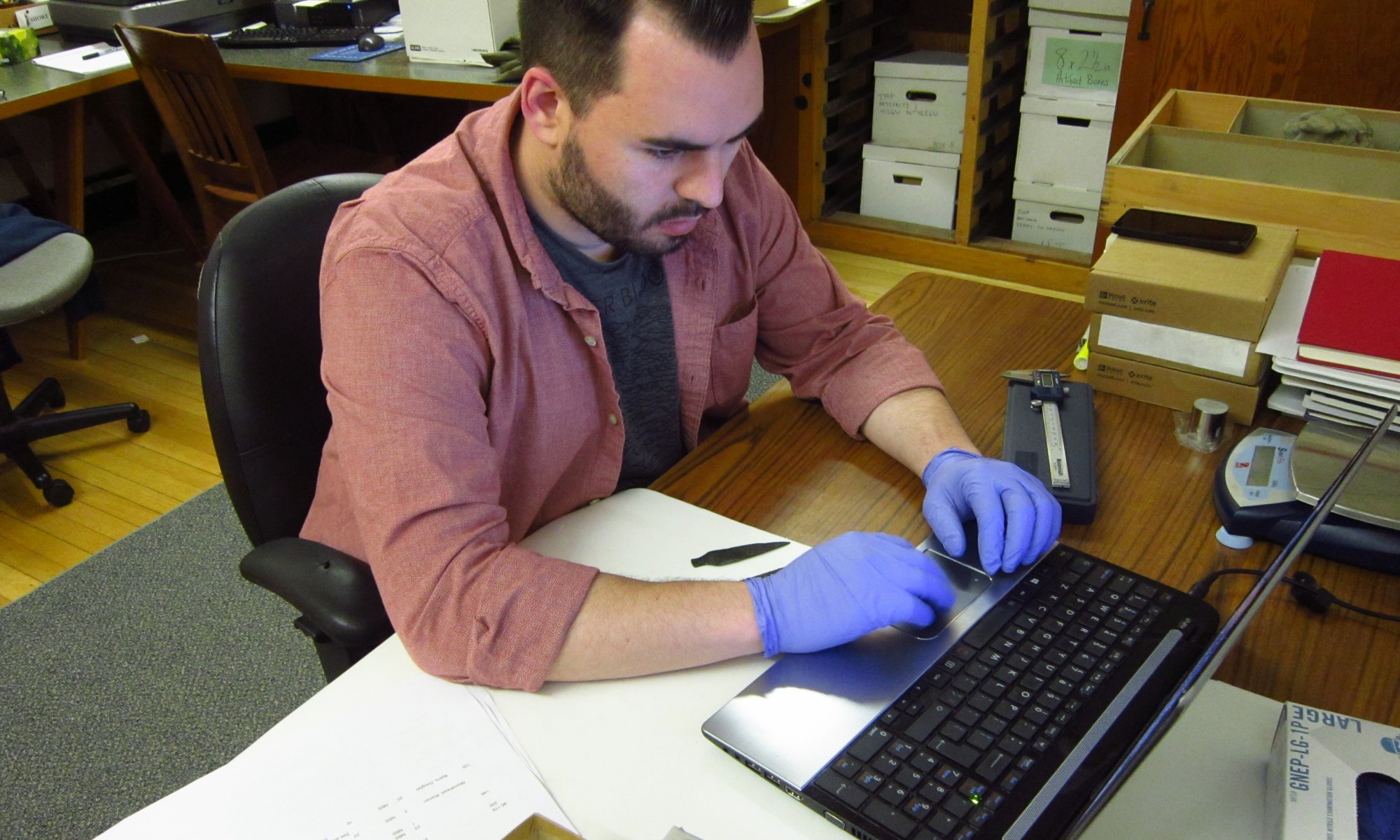
Every day I take the objects out of the tan box and record information about them such as what the object is, what its catalog number is, how many there are and their current location. I then record all of this information into a Microsoft Excel spreadsheet, put the objects back into their tan box and put them into the new gray (or blue, depending on who is asked) archival box. Currently I am working on drawers containing collections from Massachusetts.

These artifacts have been rehoused and placed in a gray archival box rather than the original wooden drawer.

This type of work is something I have done since 2013 when I was a graduate student at SUNY Albany. It is work that I genuinely enjoy doing, which makes getting up in the morning and coming to the Peabody a whole lot easier. It is always amazing to handle various collections. Doing so has helped me to learn so much more than I ever thought I could about material culture from all over the United States. I know working at the Peabody will help push that knowledge even further. It’s such a great experience to be able to work on a collection from Massachusetts one day, then move to a collection from Ohio or Indiana or even the Yukon the next day.

The Inventory Specialist position is supported by a generous grant from the Oak River Foundation of Peoria, Ill. to improve the intellectual and physical control of the institute’s collections. We hope this gift will inspire others to support our work to better catalog, document, and make accessible the Peabody’s world-class collections of objects, photographs, and archival materials. If you would like information on how you can help please contact Peabody director Ryan Wheeler at rwheeler@andover.edu or 978 749 4493.

Canadian researcher visits to examine Strong collection

Dr. Kelvin using the 3D scanner to document a bowl

Contributed by Marla Taylor

Dr. Laura Kelvin, a post-doctoral researcher from Memorial University of Newfoundland, visited the Peabody in October.

Dr. Kelvin is contributing to the Avertok Archaeology Project, a subproject of a larger collaboration between Memorial University and the Nunatsiavut Government representing the Inuit of Labrador – Tradition and Transition.  This community-based archaeology program aims:

  • to locate, excavate and learn more about the original Inuit settlement of Avertok which underlies the present Hopedale community, and other nearby sites,
  • communicate findings to the community and use the research to facilitate knowledge transfer between youth and elders in Hopedale
  • to undertake a ground-penetrating radar survey of the Moravian Cemetery in order to identify the locations of all graves, enabling the community to properly mark and care for the cemetery.

During her visit to the Peabody, Dr. Kelvin examined the William Duncan Strong collection.  Strong was part of the Rawson-MacMillian Sub-Arctic Expedition that the Field Museum in Chicago sent to northeastern Labrador in 1927-1928.  In the early 1930s, Warren K. Moorehead (then Director of the Peabody) orchestrated a trade with the Field Museum to acquire approximately 350 artifacts from this expedition.

A drawer of material from Hopedale, Labrador.

Dr. Kelvin spent a week photographing all of these artifacts – even 3D scanning some! – for inclusion in a developing community archive of archaeological and traditional knowledge of the Hopedale area.  She will record traditional community knowledge of the artifacts and provide local access to the images through the network.  Follow the project on their facebook page!

Dr. Kelvin using the 3D scanner to document a bowl

Back in the Peabody archives

I was so pleased to learn this summer that the Oak River Foundation had decided to fund another year of the archives project at the Peabody! This continuation of the project will allow me to focus on the photographic and map collections, excavation records from the Tehuacán Archaeological-Botanical Project and the Ayacucho Archaeological-Botanical Project, among others. I also hope to begin developing sustainable digitization workflows for some of the archival material, help with reference requests, and continue an oral history project about Scotty MacNeish. I am very happy to be back at the Peabody, continuing this work.

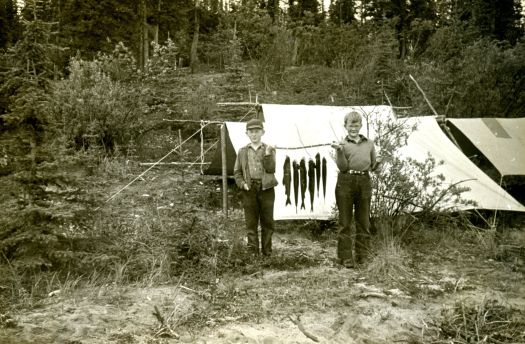
This black and white photograph depicts two sons of Hugh Raup, who participated in the Andover-Harvard Yukon Expedition of 1944.
A photograph from the archives that caught my eye: Karl and David Raup (sons of Hugh Raup) with fish caught in stream. Big Arm, Kluane Lake. 8/21/44. Andover-Harvard Yukon Expedition.

Since starting back up here in early September, I have mostly been working on organizing and inventorying internal museum records like loan, exhibition, and NAGPRA records. These records might not have huge interest for outside researchers (and, as is common for institutions, are typically restricted for 25 years after creation for privacy concerns), but are important for staff members in the course of day-to-day collections management and ongoing repatriation efforts. Now that I am more familiar with the museum’s institutional history, I am finding that I can categorize material more quickly – I don’t have to repeat the learning curve of my first year.

On a personal note, I spent most of the summer between Boston (where I live) and western Massachusetts, where my sister and I own what used to be our grandparents’ house. My French, North African-born grandmother met my American grandfather (from a Scottish family who emigrated to the Boston area in the 1920s) during World War II while he was stationed in Algeria. The house is full of photographs, letters, books, and interesting objects documenting their lives – essentially, my family’s archives. I also spent two weeks working at the Phillips Academy Archives and Special Collections, helping Director of Archives and Special Collections Paige Roberts prepare for an upcoming move of the collections associated with the Oliver Wendell Holmes Library renovation. So, I didn’t stray too far from the work I do here, even while I was away.

The Temporary Archivist position is supported by a generous grant from the Oak River Foundation of Peoria, Ill. to improve the intellectual and physical control of the museum’s collections. We hope this gift will inspire others to support our work to better catalog, document, and make accessible the Peabody’s world-class collections of objects, photographs, and archival materials. If you would like information on how you can help please contact Peabody director Ryan Wheeler at rwheeler@andover.edu or 978 749 4493.

r.ed in residence: r.ed monde visits the Peabody

r.ed holding a sherd that will be part of the upcoming exhibit

Contributed by Marla Taylor

Exhibits and exhibitions are not the focus of the Peabody.  However, once in a while a unique opportunity presents itself.

Visual artist Angela Lorenz (’83, P’14) reached out in early 2017 to suggest a collaboration with the Peabody. Angela’s newest art book, r.ed monde in r.ed engender.ed, explores the world around us through pointy-shapes and r.ed.

After spending decades in a drawer in the artist’s studio, r.ed steps out on a journey of self-identity.  r.ed identifies with pointy-shaped objects and images from around the world – many of which are similar to pieces in the Peabody’s collection.

Angela and I surveyed collection and collaborated to create r.ed in residence: r.ed monde visits the Peabody. This short exhibition will have an opening reception on Saturday, October 21st from 1-4pm.  Angela will discuss r.ed and her work from 1-2pm and be available to talk with visitors. Refreshments will be served and we will have hands-on activities for all ages.

Come by to explore a new way to examine archaeological artifacts through the lens of contemporary art!

The Peabody Collaborates with the Robbins Museum on NAGPRA Inventory

Contributed by Lindsay Randall

Robbins Museum
Robbins Museum

On Monday July 17 the Peabody staff joined volunteers at the Robbins Museum of Archaeology in Middleboro, MA to help with an ongoing collections inventory project. The Robbins Museum is an all-volunteer organization that is currently working on their NAGPRA obligations and repatriation. In addition to Ryan, Marla, Samantha, and Lindsay, others who came out to help were professional archaeologists with ties to the Robbins Museum along with Jim Peters, Massachusetts Commissioner of Indian Affairs and Mashpee Wampanoag tribal member who is also part of the Wampanoag Repatriation Confederacy.

The Robbins and Peabody museums are working together on the repatriation of related collections from the Mansion Inn site, split between the two institutions. The site, located in Wayland MA, was excavated by J. Alfred Mansfield and Leslie Longworth, members of the Massachusetts Archaeological Society (the parent institution of the Robbins Museum) in 1959; Doug Byers and Fred Johnson of the Peabody also became involved with the site at that time. For that reason, both institutions have collections and have decided to work together as the process moves forward.

Throughout the day everyone worked diligently in an effort to create a streamlined checklist that will assist with the transfer of custody of the human remains and associated funerary objects. It was a very eventful and fun day and we look forward to working with the Robbins Museum again on the process!

Oak River Foundation continues support of Peabody collections

A storage bay with a mixture of drawers and boxes

Contributed by Marla Taylor

In 2016, the Peabody Museum received a generous grant of $100,000 from the Oak River Foundation of Peoria, Ill., to support work pertaining to the intellectual and physical control of the museum’s collections.

The grant was spread across two years and initially supported the work of an archivist to whip the Peabody’s 100+ years of archives into shape.  With that funding, Irene Gates was able to share archival collection records online and process over 140 linear feet of material.  She also created three finding aids to the material belonging to prominent directors of the Peabody’s past.

The second year of funding is designated to supporting the work of a temporary inventory specialist – Rachel Manning.  Rachel will be spending her time inventorying drawers of artifacts and rehousing them into archival boxes as part of our larger collections storage project.  While she only began her work in early August, Rachael has already been making steady progress.

Rachel inventories a drawer from Massachusetts.

And we are pleased to announce that the Oak River Foundation has stepped up again and provided additional funding for Irene to return and spend another year in the Peabody archives!  This second year will facilitate processing the remaining 150 linear feet of material as well as addressing the photographic and map collections.

Our deepest appreciation goes to the Oak River Foundation for their continued generosity and support of the Peabody’s goal to improve the intellectual and physical control of the museum’s collections.

We hope this gift will inspire others to support our work to better catalog, document, and make accessible the Peabody’s world-class collections of objects, photographs and archival materials. If you would like information on how you can help please contact Peabody director Ryan Wheeler at rwheeler@andover.edu or 978 749 4493.

Summer time = Research time

The collections team remains busy at the Peabody during the summer time, following an already packed school year. Instead of working with PA students, we spend much of our time working to catalog the collections and hosting outside researchers.

The summer has started off strong with one of the Linda S. Cordell Memorial Research Award recipients , John Andrew Campbell.  John is documenting artifacts from the period of first contact between Native Americans and European settlers along the maritime region of eastern Canada and northern New England.  ”What does that mean?,“ you may ask.

Basically, John is identifying copper, glass beads, and glazed ceramic artifacts that were found intermingled with traditional native tools and artifacts.  The first appearance of these ”foreign” materials indicates that contact between the cultures had been made.  Their use and modification by tribes is the direct result of trade with the European settlers and can be revealing of those early interactions.

The Peabody is John’s first stop for collections research as he begins to build data for his dissertation work at Memorial University in Newfoundland.  He will be visiting for most of June and documenting hundreds of items.

The rest of the summer is chock full of research appointments and we are happy to share our collections to contribute to the field of archaeology!