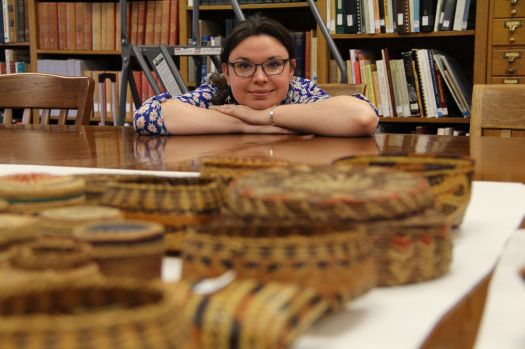
Though the Peabody is small by museum standards we are mighty, especially when it comes to our baskets. With close to 400 baskets, the Peabody collection covers all major geographical regions and tribal communities of North America, and spans over 200 years. Baskets from notable artists like Molly Neptune Parker (Maine) and Clara Darden (Louisiana) help to support and curate these artists’ work, and are examples of continued and evolving traditions within Native communities.
Molly Neptune Parker
Clara Darden
One of my first large projects at the Peabody was to completely catalog, inventory, and rehouse this great collection. The purpose of this was twofold:
First, it was important to consolidate our records regarding these baskets. Museums are full of information, and it’s usually in five different places! By gathering what we know, and putting it all in one place, we not only gain better control over this knowledge, but we make it more accessible to museum staff, researchers, and students. The convenience of this newfound accessibility encourages more use in the classroom and more research by professionals, giving these baskets the attention they deserve.
Secondly, by revamping the basket organization and rehousing, we are better able to care for these objects and their specific needs. Although baskets aren’t usually as fragile as most people fear, they still require some TLC. By creating storage mounts that are custom designed to each basket, we are able to provide more support to the object, especially when it is being moved and shifted around during handling. Within our ethnographic storage, space is at a premium, so another byproduct of the rehousing was the space it opened up. We were able to clear seven shelves!
Basket Elf in natural habitat
Happy baskets, happy collection staff.
To see previous work done with the baskets by Catherine Hunter, check out these previous blogs!
Next Thursday marks the final day at the Peabody for Temporary Archivist, Irene Gates. Irene was hired for a year to tackle the organizational challenge that was the Peabody archives and she has succeeded beyond our expectations.
Irene carried out a full collections survey and created 65 collection level catalog records – 33 of which are now available via our collection online. She wrapped her arms around the archives of previous director (and the man who saved everything) Richard ‘Scotty’ MacNeish and processed 92 linear feet of material. You can see the incredible finding aid for MacNeish’s material here.
In total, Irene has processed 140 linear feet of material, developed 3 finding aids, and written policies and procedures. Her work has directly benefited the accessibility of collections, the efficiency of current museum functions, and our transparency as an institution.
Irene’s quiet and steady presence will be missed around the Peabody and we have been incredibly fortunate to call her colleague and friend over the past year. Wishing her the best of luck in her next adventure!
Irene Gates
The Temporary Archivist position is supported by a generous grant from the Oak River Foundation of Peoria, Ill. to improve the intellectual and physical control of the museum’s collections. We hope this gift will inspire others to support our work to better catalog, document, and make accessible the Peabody’s world-class collections of objects, photographs, and archival materials. If you would like information on how you can help please contact Peabody director Ryan Wheeler at rwheeler@andover.edu or 978 749 4493.
Did you know that the Peabody curates ancient poop?
Coprolites are the fossilized remnants of excrement – animal or human. While it may sound gross, curating these materials is invaluable for the archaeological community. You may be asking yourself ‘what could you possibly learn from poop?!’ and while I understand your incredulity, allow me to share the incredibly fascinating information that you can learn.
A coprolite from an unknown site in Arizona.
Coprolites are the snapshot of one day of one individual’s life thousands of years ago. They can reveal what that person ate – whether or not that food was cooked first, was that food local to the area or the product of trade, what time of year that food would be available. Is there evidence of disease or illness? Did different individuals from the same site have radically different diets? If so, what does that say about social status? Coprolites are also viable sources of ancient DNA!
The Peabody curates only a couple dozen coprolites in the collection. And we are always thrilled when researchers come to get the scoop on the poop!
Most of the Peabody staff recently traveled to Vancouver, British Columbia to take part in the 82nd annual meeting of the Society for American Archaeology (SAA). While at the conference, we each had our own role. In addition to helping to staff the Peabody table in the exhibitor hall, collections assistant Samantha Hixson and I had the privilege of a collections tour at the Museum of Anthropology (MOA) and the Laboratory of Archaeology (LOA) at the University of British Columbia.
The MOA is a unique institution that houses ethnographic objects from around the world, with an emphasis on material from the Pacific Northwest. The vast majority of these pieces are on display in open storage. That means the galleries are essentially storage spaces with thousands of objects presented to the visitor with little interpretative text.
Basketry display at the MOA
Totem poles at the MOA
Display of a fish mask at the MOA
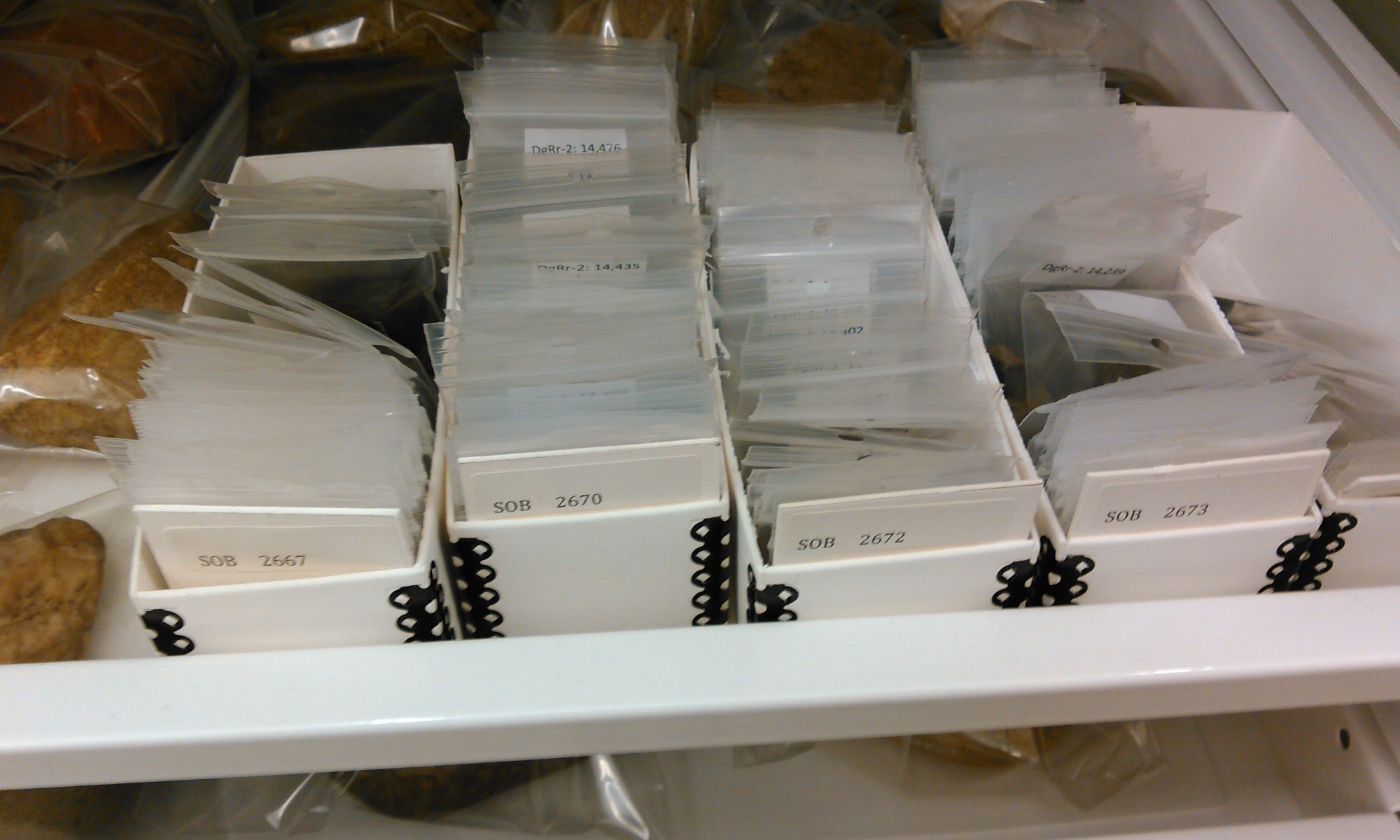
Collections storage at the MOA is impressive and elaborate. Each object has its own individually crafted mount and locations are tracked with barcodes. The Laboratory of Archaeology on the other hand has very little to no exhibition space. They carefully photograph every object for inclusion in their online catalog and individually bag and label each artifact. Their storage is no less impressive as artifacts are arrayed on compacting storage shelves with room for growth. This is the type of collections storage that I aspire to – but we have a long way to go!
Example of individual object storage at the MOA
Example of individual object storage at the LOA
Collections storage at the MOA
Touring the storage spaces at these institutions was incredibly helpful as Samantha and I brainstorm to reimagine collections storage at the Peabody. We are very grateful for the time spent and information shared with us – well worth the trip!
This blog represents the sixth entry in a blog series – Peabody 25 – that will delve into the history of the Peabody Museum through objects in our collection. A new post will be out with each newsletter, so keep your eyes peeled for the Peabody 25 tag!
Overview of Chaco Canyon, New Mexico
At the Robert S. Peabody Museum, it seems as though there is almost no limit to the range of phenomena one can explore. When the topic Chaco Canyon was suggested, I thought looking at trade routes would be interesting. It quickly became clear that what I was about to enter was the world of a great culture which I thought had mysteriously “disappeared” about 800 years ago. What I quickly learned was that these people, the “Ancestral Puebloans,” had not disappeared. Research has shown that the Puebloans had adapted to climate change in the area by dispersing. “Today, twenty Puebloan groups in New Mexico, as well as the Hopi in Arizona, claim Chaco as their ancestral homeland and are tied to this place through oral traditions and clan lineages. A number of Navajo clans are also affiliated with Chacoan sites through their traditional stories.” (National Park Service: https://www.nps.gov/chcu/faqs.htm)
Chaco Canyon, located on a section of the Colorado Plateau in northwest New Mexico, was home to the Chacoan culture which flourished from AD 1000 to 1150. A UNESCO World Heritage Site, the people who lived there were very sophisticated. They used astronomical alignments, geometry, and impressive building techniques, allowing for multi-storied masonry houses. They had a complex road system stretching hundreds of miles, linking Chaco to other communities. One of their buildings, four or five stories high, Pueblo Bonito, contained about 650 rooms.
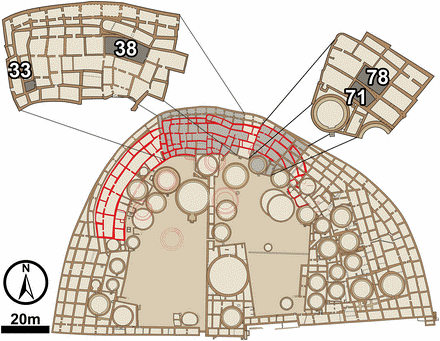
Plan view of Pueblo Bonito with the earliest construction highlighted in red. The locations of the elite burial crypt, room 33, and the three rooms with dated macaw samples are highlighted. From Adam Watson and colleagues’ article on Chaco macaws in Proceedings of the National Academy of Sciences Vol. 112(27): http://www.pnas.org/content/112/27/8238)
The Chacoans traded with people in the Mongollon and Hohokam regions to the south and with people from Mexico and Central America. Long-distance travel by Ancestral Puebloan people was common and among the goods they acquired were turquoise, seashells, copper and chocolate, none of which were found locally. They also traded for scarlet macaws, a bird with a natural habitat 1000 miles to the south.
Scarlet macaw
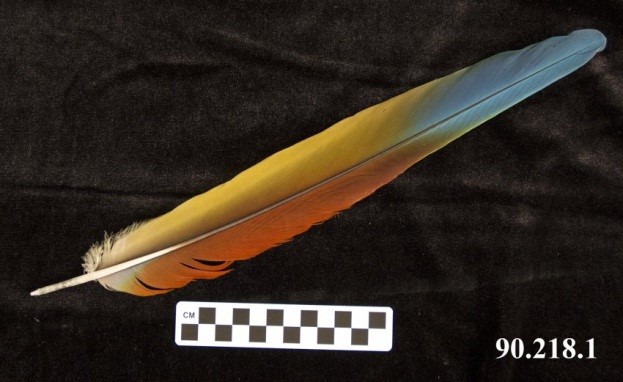
Macaw feather from the Peabody collection
The Robert S. Peabody Museum has several “modern” macaw tail feathers in its collection, one of which is shown below. Preserved feathers from 1000 years ago would be quite rare.
Scarlet macaws measure about thirty-two inches long, of which more than half is a pointed tail. They can live up to seventy-five years and eat mostly fruits, nuts and seeds. We know macaws, essentially large parrots, as intelligent birds that are quick to echo our deepest secrets using speech, a magical quality, especially because macaws have no vocal cords. That parrots are rated among the top five in the animal world for intelligence and cognition should come as no surprise. It is likely that the people of Chaco Canyon would have been awed by such an animal.
Scarlet macaws are native to the gulf coast of Mexico, Central America, and South America. The question to ask is for what purpose macaws were brought back to Pueblo Bonito?
Thirty four macaws were recovered from Pueblo Bonito and other sites in Chaco Canyon. Room 33 (see illustration above) was used as a burial crypt for 200-250 years. Macaws were found in rooms 38, 71, and 78. Archaeologist Adam Watson and his colleagues postulated that scarlet macaws were a powerful cosmological symbol and that their presence from the early tenth century reinforced and stimulated a rising social inequality. Those who possessed the birds had access to key cosmological beings and forces as well as links with far distant cultural groups. There is little doubt that the ability of the birds to speak played into this perception.
What is currently exciting is how recent radiocarbon dating of scarlet macaw skeletons from Chaco Canyon has given further insight into the question of their presence. What has been shown is that, based on acquisition and control of valued items such as chocolate and macaws, an elite class at the top of a social and political hierarchy dominated Chacoan life. (Watson et al. 2015)
What the elites achieved and their importance is amply demonstrated in their “great houses” and the acquisition of “exotic” goods from distant regions (ibid.) Included in these exotic goods were macaws. Feathers from macaws were found on prayer sticks, costumes, and masks. According to Watson and his colleagues,“…the flight of or just the appearance of certain birds or the use of their feathers is believed to motivate the fall of rain or snow, as well as the seasons, the sunshine, and the heat.”
Originally, it was believed that trade in items such as macaws at Chaco dated from around AD 1040. With radiocarbon dating done in 2010 on skeletal remains of the macaws from Pueblo Bonito, the dates of the florescence have been moved back to AD 775-875.
Whether or not the macaws were brought back to Pueblo Bonito in single journeys or in successive stages has been debated extensively. Some have raised the possibility that macaws were also bred locally in Chaco Canyon itself, although the arid region is not a natural habitat for such birds. The discovery of breeding pens, perches, bones, and eggshell fragments has led to speculation about on site breeding, but evidence suggests such macaws did not reach maturity.
“There are no indications that the people of Pueblo Bonito bred scarlet macaws. Only one of the sample birds was of breeding age and none were exceptionally young. There is also no mention of eggshells in any of the excavation notes, although one room where many of the bird remains were found was probably an aviary.” (“Scarlet macaws point to early complexity at Chaco Canyon.” A’ndrea Elyse Messer, 2015: http://news.psu.edu/story/361255/2015/06/22/research/scarlet-macaws-point-early-complexity-chaco-canyon).
One of many phenomena to explore at the Peabody, the scarlet macaw feathers represent a tangible example of extensive trade routes present in the New World prior to European contact.
Curious about the scholarly depth of the Peabody collections? Looking for material from a particular site for your research? Interested in simply browsing through the artifacts?
The site’s new and improved format is more user-friendly and provides easier access to our object records. Enter a key word to search, browse a full list of sites, and click through random images of artifacts.
In addition to a streamlined interface, the updated website also includes information about the archival collections housed at the Peabody. Temporary Archivist Irene Gates’s recent blog post highlights the completion of the first step in processing our archives. Or, explore the archival collections here.
While we do not yet have our full collection online, we add new records regularly – so come back often. I hope that you enjoy exploring the Peabody’s collections as much as I do!
The Peabody Collection Online is made possible in part by a grant from the Abbot Academy Association, continuing Abbot’s tradition of boldness, innovation, and caring.
Collection records for the Peabody’s archival collections are now online, via the museum collections management database’s online portal: take a look.
I am also very happy to announce that the processing work on the MacNeish archives is complete and that this material is now open for research. These archives have been processed as two collections, the Richard S. MacNeish papers and the Richard S. MacNeish records. The papers were donated by MacNeish in 2000, shortly before his death, while the records resulted from his directorship of the Peabody, 1968-1983, and had not left the museum since then. A finding aid with a folder-level inventory can be accessed via the link at the bottom of each collection record. There is parallel content in the two collections, so researchers are advised to consult both.
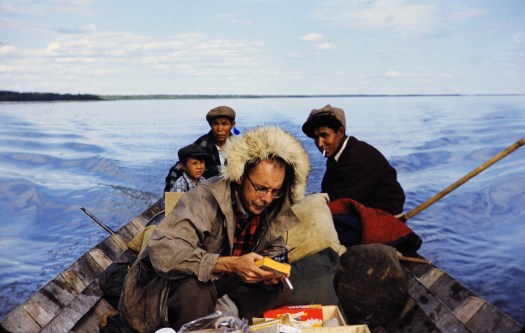
Here is one of my favorite photographs of MacNeish, from his papers – I think it exemplifies what an adventurer he was.
Richard MacNeish in canoe in the MacKenzie River, Canada, during his survey work there in the 1950s
The Temporary Archivist position is supported by a generous grant from the Oak River Foundation of Peoria, Ill. to improve the intellectual and physical control of the museum’s collections. We hope this gift will inspire others to support our work to better catalog, document, and make accessible the Peabody’s world-class collections of objects, photographs, and archival materials. If you would like information on how you can help please contact Peabody director Ryan Wheeler at rwheeler@andover.edu or 978 749 4493.
Last week, the Peabody had the pleasure of hosting Dr. Paulette Steeves as she examined portions of the MacNeish collection. Dr. Steeves is currently a Lecturer of Indigenous archaeology and anthropology and the Interim Director of the certificate program in Native American Studies at UMass Amherst. Her research focuses on the peopling of the Western hemisphere, but not through the traditional Bering Strait theory.
Dr. Steeves uses indigenous theory and methodology to explore sites in the Americas that date back as far as 60,000 years ago. This is actually a big deal and an anti-establishment approach to the subject. Dr. Steeves is looking into the materials collected by Scotty MacNeish during his work in the 1960s in Peru and Mexico for additional evidence. MacNeish was also a proponent of the idea of early colonization and much of his collection has remained unanalyzed for decades.
Dr. Steeves was thrilled to see the collection and to meet MacNeish himself on her visit. We look forward to hosting her again for many research visits to come!
This blog represents the fourth entry in a blog series – Peabody 25 – that will delve into the history of the Peabody Museum through objects in our collection. A new post will be out with each newsletter, so keep your eyes peeled for the Peabody 25 tag!
Contributed by: Lindsay Randall
Peabody curator Warren K. Moorehead, beginning in 1915, excavated in the Castine area of Maine in search of sites related to the Red Paint People. Moorehead believed the Red Paint People to be an ancient culture that was distinct from the more recent Algonquian tribes that still live in Maine today. He recognized a number of unusual artifact types found in Red Paint cemeteries and the liberal use of red ochre in burials, hence the name Red Paint. Ideas about the origins and relationships of the Red Paint or Moorehead Burial Tradition (as it is now called) are changing and often still hotly contested by archaeologists and tribes today. The Abbe Museum in Bar Harbor, Maine presents a timeline of contemporary Wabanaki peoples in Maine, demonstrating continuity of modern American Indians back to the earliest occupation of the state.
Map showing the location of Castine, ME.
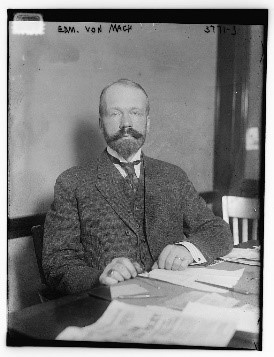
While Moorehead’s Castine investigation did not locate Red Paint site, numerous shell heaps were found. One of the most amazing sites to be excavated was located on the property of Professor Edmund Von Mach. Von Mach was an instructor in art and fine arts at Harvard, Wellesley and other schools in the Boston area and published books on painting and art history. He gained some notoriety during and after World War I for encouraging Americans to support the German cause and his book Official Diplomatic Documents Relating to the Outbreak of the War was withdrawn due to inaccuracies by the publisher.
Portrait of Edmund Von Mach
Von Mach’s politics aside, the shell heap was a very impressive monument, measuring approximately 660 feet long and having a depth between 3 and 5 feet. The vast majority of the shells present were quahog clams, quite common to the area. Given that a total of twenty four hundred artifacts were recovered, combined with the sheer expanse of the heap and its numerous layers, it is believed that the site was a permanent settlement used by tribes about 2,500 years ago.
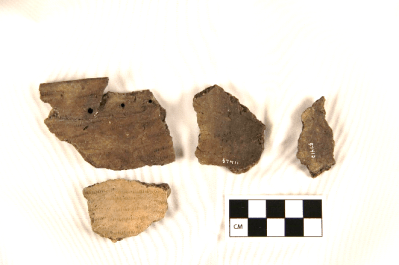
Throughout the summer, several hundred people visited the site to see what unique pieces of the past were being unearthed. Some of the most interesting artifacts discovered were fragments of pottery.
Four pottery pieces from the Von Mach Shell Heap collection at the Peabody Museum.
The pottery is unusual in New England as the soil conditions are very acidic and often deteriorate fragile artifacts. Ceramic specimens are more common in other parts of the country, like the American Southwest.
The only reason that the pottery was not dissolved by the acidic soils surrounding it is that the shells were deposited in the same area. Leaching of calcium carbonate from the shells neutralized the harmful acidic soil. Altering the soil matrix in this manner allows for almost unprecedented preservation of sensitive material.
The pottery helps us to learn about technology and artwork in the community. The introduction and development of ceramics into Maine around 2,700 years ago was very important. It is during this same period that the populations increased and became more sedentary in permanent villages.
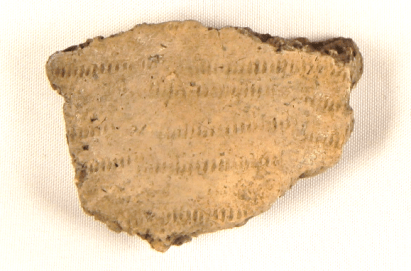
The majority of the pottery pieces in our collections are small and fragile, despite being preserved in the shell heaps. The ceramic pieces also are decorated with stamped and incised lines. This method of decoration not only reflects the aesthetics of the time, but may have helped reduce air bubbles prior to firing.
Close-up of one of the incised pottery fragments
Interestingly, archaeologists are now investigating the language that we use to describe archaeological sites. In her 2014 PhD dissertation at UMass Amherst Katie Kirakosian looks at the terms used by archaeologists like Warren Moorehead and his contemporaries to describe shell-bearing sites like Von Mach’s and how these terms have influenced our thinking about the sites and the people that made them. Kirakosian concludes that use of terms like “shell midden” to describe these sites (and, by extension, their Native constructors) denies their complexity and can result in a narrow and biased narrative.
The bulk of the Peabody’s collection is stored in the basement. It has been challenging over the years to control the temperature and humidity in the basement – an essential factor in maintaining an artifact collection. A small fluctuation of both temperature and humidity is normal and expected as seasons change. However, extreme variation lead to damage – bone can become fragile, ceramics can develop weak-points, and even stone tools can become brittle.
For the past four years, I have been tracking the environment throughout Peabody and noticed these strong fluctuations. By taking readings of the temperature and humidity in all our storage spaces once an hour (through the use of a datalogger), I determined that the influx of outdoor air through these poorly sealed windows is large contributing factor. There is only one way to fix this.
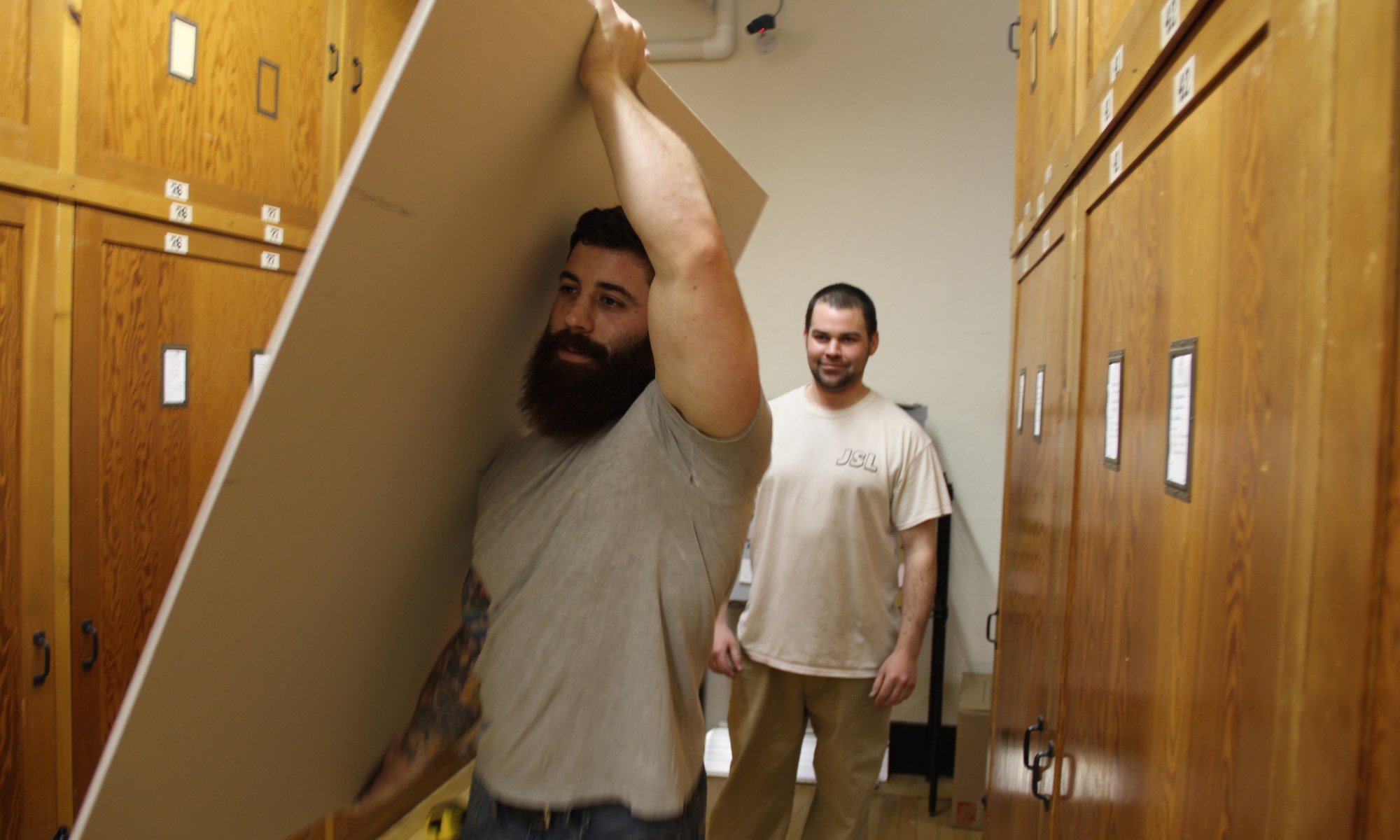
In collaboration with the Office of Physical Plant on campus, we are implementing a plan to mitigate some of this fluctuation. Contractors are working to seal the windows in the basement to stop outside air from sneaking into the storage.
This will stabilize the environment and lead to fewer changes in both temperature and humidity. The first step on the road to environmental control!