Reboxing project – Update

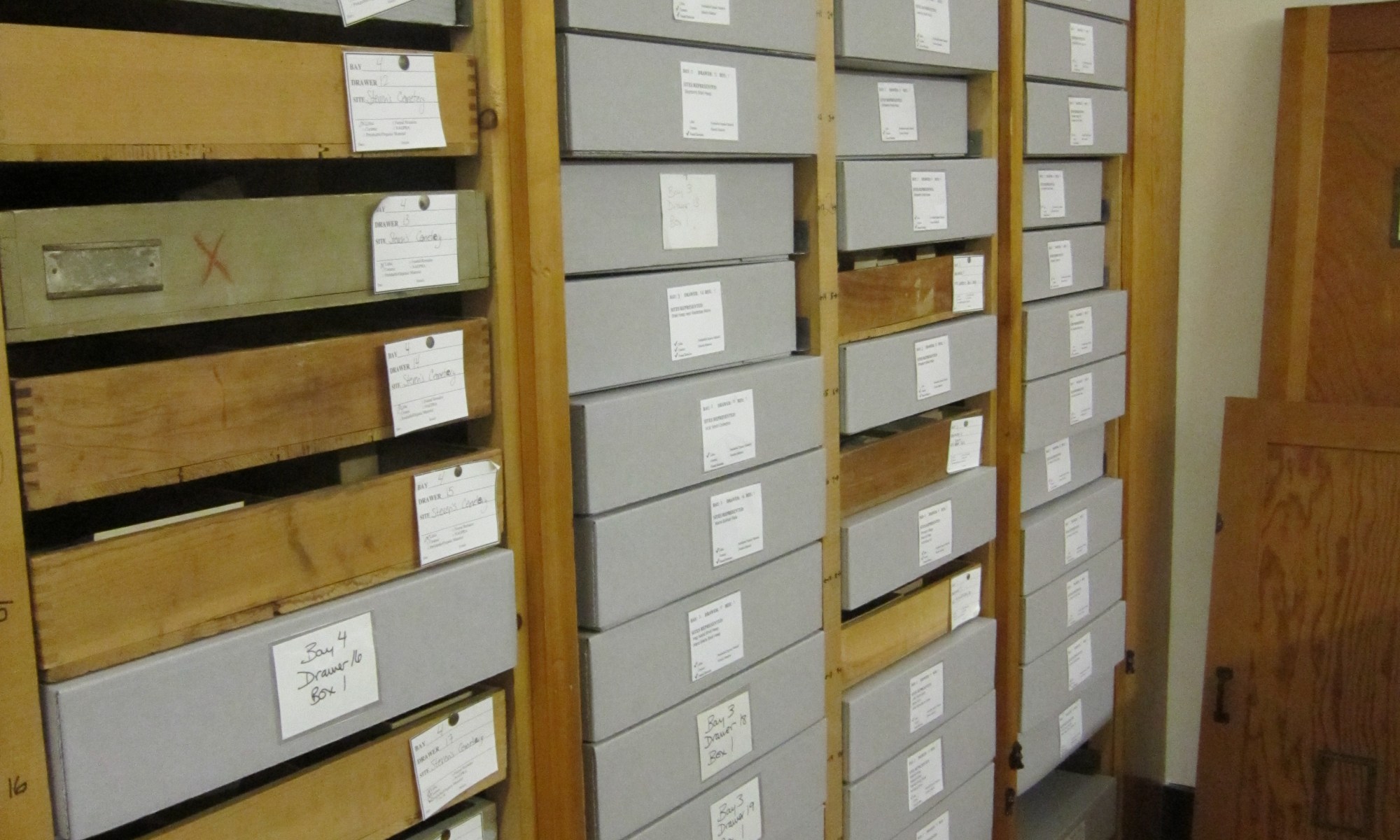
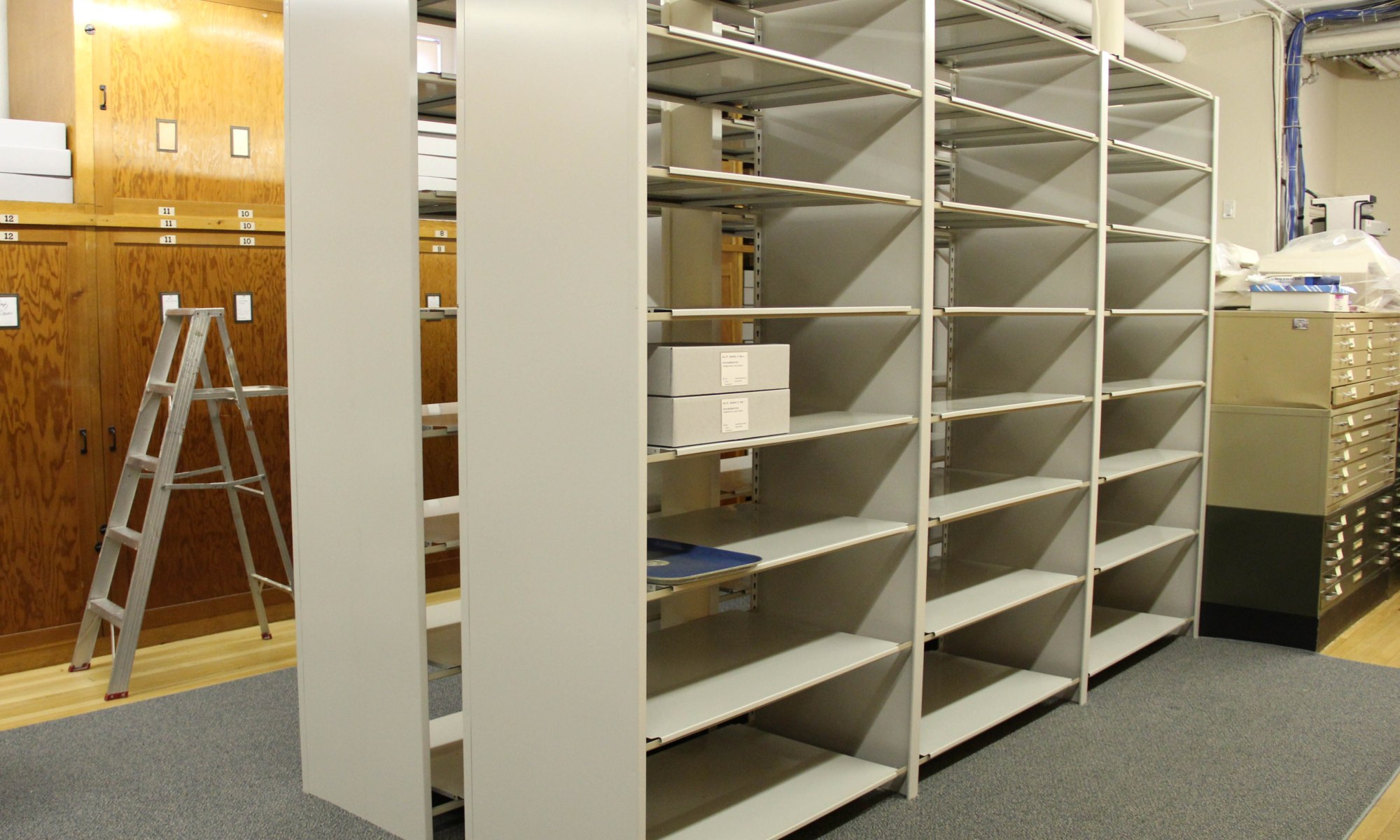
A storage bay with a mixture of drawers and boxes

Contributed by Marla Taylor

About six months in and the reboxing project is beginning to take off.  With the help of students and volunteers, 52 drawers have been converted into 86 boxes.  These first months have been spent ironing-out the kinks in the procedure and strategically identifying areas of the collection on which to focus.

The inventories produced from this project have already helped to identify areas of the collection for further attention and have made some objects available for education use.

I am excited to pick-up the pace over the winter!

Tiny Phillips Academy Museum Harbors Clues to Ancient Origins of Corn

Contributed by Ryan Wheeler

Archaeologist Richard S. MacNeish—known as Scotty—devoted his career to untangling two of the biggest questions of archaeology: when did people begin domesticating plants and how did that act impact and influence the development of civilization? During his tenure at Phillips Academy’s Robert S. Peabody Museum of Archaeology MacNeish led multidisciplinary expeditions to Mexico and Peru to search for the heartland of domesticated maize or corn. Before his death in 2001 MacNeish had searched for the origins of rice cultivation in China, studied early cultures of Belize, and planned to look at wheat domestication in Turkey. Evidence for domestication often could be found in dry caves, where ancient plant remains were preserved. Speaking of his research in China, MacNeish quipped, “I’ve crawled in and out of more caves than a Neanderthal caveman.”

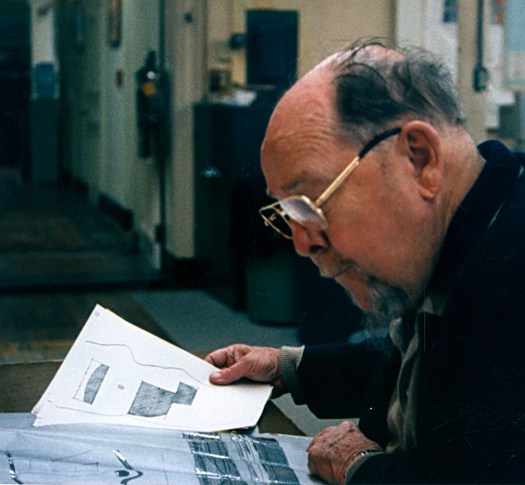
Image of Scotty MacNeish.
Scotty MacNeish reviews excavation profiles.

Despite MacNeish’s indefatigable quest for the origins of the world’s most important crops, answers remained elusive. In Mexico’s Tehuacán Valley, near modern-day Puebla, MacNeish and his team reconstructed ancient environments, devised chronologies, and documented a sequence of corn domestication from tiny, primitive cobs to those that look much like the corn that was growing in the area during the Spanish conquest in the sixteenth century. MacNeish’s suggestion of an early date for corn domestication, however, was met with skepticism, as many archaeologists believed that these crops were developed after significant strides in social organization, urbanism, and the other hallmarks of civilization. A debate ensued, but much of MacNeish’s Tehuacán research was sidelined as other scientists found evidence for even earlier sites of corn domestication in the Mexican lowlands, pushing the dates back to at least 8,700 years ago.

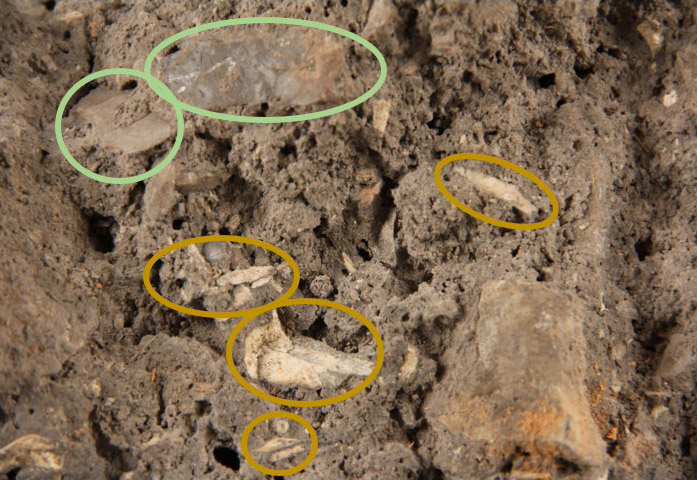
Image of excavators working in Coxcatlan Cave, Tehuacan Valley, Mexico, 1960s.
MacNeish’s 1960s excavations at Coxcatlan Cave, Tehuacán Valley, Mexico.

MacNeish’s collections, preserved since the 1960s at Phillips Academy’s tiny Robert S. Peabody Museum of Archaeology, have continued to attract the interests of scientists. A November 21, 2016 article in the journal Current Biology reconstructs for the first time ever the complete genome of an early domesticated plant, based on a tiny, 5,310 year old cob from MacNeish’s Tehuacán project (Catalog number 90.184.36). The specimen was removed from an old exhibit case several years ago and loaned to the Smithsonian Institution’s Bruce Smith, a co-author of the new study. Statistical analyses of the DNA data indicate that the study specimen, dubbed Tehuacan162, is “a step that links modern maize with its wild ancestor.” Of particular interest were genetic markers for domestication—some of which were already exhibited in this early specimen—while others were not. This challenges previous models for corn domestication that focus on two major steps, countering that the history of domestication is more gradual and complex than currently believed. In conclusion, the study finds that Tehuacan162 is an ancient form of maize that is closely related to the ancestor of all modern maize, yet distinct from teosinte, a wild grass that is the closest living relative to maize.

Today the Robert S. Peabody Museum of Archaeology provides educational programming to the high school students of Phillips Academy, ranging from classes to work behind-the-scenes with our significant collections. Researchers also are encouraged to use the Museum’s holdings and often share their results with students.

The Greek Bird

This blog represents the second entry in a blog new series – Peabody 25 – that will delve into the history of the Peabody Museum through objects in our collection. A new post will be out with each newsletter, so keep your eyes peeled for the Peabody 25 tag!

We don’t know much about the relationship between our institution’s founder Robert Singleton Peabody and his son Charles, the museum’s first director. In fact both men remain a bit of a mystery as they were intensely private and left little in the way of memoirs, notes, or archives. Robert’s rather substantial gift to the Academy, for example, was to remain anonymous until well after his death. For years we assumed that Charles, like Robert, had attended Phillips Academy. We found recently, however, that he stayed a bit closer to home and completed his high school education at the Germantown Academy—a venerable day school not far from the Peabody home in Philadelphia. In one of the few pieces of correspondence that we have between the two Peabodys, Charles exhorts his father to help him secure a position at the new Phillips Academy Department of Archaeology and asserts that he will not be the architect of his own undoing. Charles was on hand for the grand opening of the Archaeology Building in 1903, as he had been appointed the “honorary director.” One object in the Peabody’s collection provides a little window into what may have been a fraught and complicated relationship.

Image of the note from Charles Peabody explaining the origin of the little ceramic bird with Robert Peabody's appended note.

Object 19661 in Robert Peabody’s original collection is a small terracotta bird, perhaps a swan or goose. A handwritten note in pencil on lined paper tells us part of the story. Charles, during his tenure at the American School of Classical Studies at Athens, received the terracotta figurine from the school’s factotum Nikolaki. Charles muses in the note that Nikolaki had “hooked” it from one of the American excavations, perhaps at Argos or Eretria. Excavation reports can be found for both sites. For example, Charles Waldstein excavated at Argos from 1892 to 1895, with some focus on the Sanctuary of Hera. During the same time, Theodore Woolsey Heermance worked at the theatre of Eretria. Some quick poking around suggests that the little figurine, handmade of attic clay and covered with a white slip, is likely a votive offering. Similar offerings, representing an array of animals and birds, have been found at many Greek sites. Waldstein’s report on the Argos excavations mentions a number of terracotta figurines—some human and others animal. These offerings would have been placed in a temple for some set period and then discarded as ritual debris. Many similar examples can be found in auction catalogs and in the extensive collections exhibited at the Met.

Image of the terracotta bird--likely a swan or goose--a typical votive offering from a Greek temple.

The elder and younger Peabodys did have a lot in common, beyond their interest in discretion and privacy. Both were united in a passion for archaeology. Robert’s interests were more antiquarian—during his life he amassed some 38,000 archaeological specimens, principally from North America, while Charles was devoted to the French Paleolithic and dabbled in stratigraphic excavation, when horizontal and vertical control was a new concept. In many ways the two men represented archaeology’s past and future. Robert’s interests as a student had leaned toward the classical and he was named the valedictorian of his class. His correspondence with his curator Warren Moorehead and the administrators of Phillips Academy are filled with Latin and classical references. Charles received his PhD in philology—sort of a combination of classical languages, Biblical studies, and archaeology—from Harvard in 1893. After this he spent some time in Athens at the American School where he picked up the little votive bird. Robert appended his own note—in blue pencil—to Charles’s, indicating that he had received the bird from his son in 1897. Not long after this Charles was becoming established as an instructor in European archaeology at Harvard. With the creation of the Phillips Academy Department of Archaeology in 1901 Charles spent more time in Andover, helping to make decisions about the construction of the archaeology building and ultimately teaching classes as he could. The little votive bird was shipped from Philadelphia to Andover as part of Robert’s burgeoning collections, forming the core of the Museum that we know now. With Robert’s death in 1904, Charles pursued his passion for prehistoric European archaeology, participating in and leading a number of expeditions during his career before ultimately moving to France permanently in 1924.

We can only assume that both men, well versed in classical languages and archaeology, knew exactly what that little ceramic bird was—an offering from a votary to a god.

Baskets Explored

Contributed by Marla Taylor

Thanks to Catherine Hunter, Peabody Museum research associate, our full basketry collection of 329 is inventoried and described.  In September, Catherine turned over 7 binders of material including research into known artists, glossaries, information on weaving techniques, and a basic description of each basket.  This massive project took Catherine nearly a year!

The next phase is to photograph each of these gorgeous baskets and improve their storage and accessibility.  Last week, Marla Taylor, Samantha Hixson, and Catherine took a trip to the Peabody Museum of Archaeology and Ethnology at Harvard University to examine their basketry storage.  The visit was full of inspiration and incredibly helpful as we continue to work on this project.

Keep your eyes peeled for the inclusion of these amazing baskets in our online collection database!

Welcome Samantha!

Contributed by Samantha Hixson

Hello everyone,

My name is Samantha Hixson and I am the new collections assistant here at the Peabody. I come to you from New Mexico where the weather is warm and has left me completely unprepared for New England winters (although Marla and Lindsay promise that they’ll get me through it).

I have previously worked at the Museum of Indian Arts and Culture in Santa Fe, New Mexico as well as the Smithsonian Institution’s National Museum of the American Indian in Washington, DC. It’s these places that got me excited to work within museums, focusing specifically on Native American collections. So you can imagine how excited I was when I was hired to work at the Peabody, it’s the perfect job for me! I’ve also had some other very interesting archaeological/ethnographic experiences, but those are for other posts.

I’ve started getting my feet wet in a couple projects already (with the promise of a lot more to come) and am most excited about the re-housing of the collection as well the Adopt A Drawer program. I think it’s great that these collections are getting new homes and more personal interactions, however brief.

If you’re in the neighborhood of the museum, come stop by; I’d love to meet you!

The new Peabody Collections Assistant, Samantha Hixson

No “Orphaned” Artifacts

This blog represents the first entry in a blog new series – Peabody 25 – that will delve into the history of the Peabody Museum through objects in our collection.  A new post will be out with each newsletter, so keep your eyes peeled for the Peabody 25 tag!

Contributed by Quinn Rosefsky  (Phillips Academy Class of ’59)

Robert Singleton Peabody (1837-1904) grew up in Muskingum County, Ohio—just outside of Zanesville—but attended an eastern boarding school—Phillips Academy—to graduate in 1857. After law school at Harvard he established a lucrative legal practice in Vermont before relocating to the Germantown area of Philadelphia. During much of his life, Robert nurtured an interest in archaeology and Native Americans and worked to amass a personal collection of artifacts. In 1866, Robert’s uncle, George Peabody (known as the father of modern philanthropy) gifted PA with funds to establish a “scientific department” to encourage scientific discourse be incorporated into the curriculum. At the turn of the 20th century, Robert sought to revitalize his uncle’s good intentions by re-establishing a program for the sciences, specifically archaeology.

The archives of the Peabody Museum contain the letters and documents that reveal the evolution of Robert’s intentions. The primary correspondence is between Robert Peabody and Warren K. Moorehead. Moorehead was the man responsible for building, cataloging, and maintaining Robert’s artifact collection and would ultimately become the first curator of the Department of Archaeology at Phillips Academy.

Peabody then wrote in a letter dated March 3, 1898, that he was impressed with Moorehead’s cataloguing of the substantial collection Peabody had amassed (nearly 50,000 artifacts), which were “of sufficient value, to be cared for.” Adding, “I have known too well the fate of those Orphaned collections placed at the Mercy of a cold world…” Although what Peabody then proposed was to establish a department of archaeology, he also wrote that the financial situation at the time was not good. He was likely referring to the Panic of 1893, during which 500 banks closed and 15,000 businesses failed. The ensuing financial depression lasted from 1893 to 1898. Peabody’s conclusion was: “…I will not deliberately, add another to the list of failures…I want to make assurance doubly sure, if I go into it at all.”

Nevertheless, Moorehead’s letter to Peabody on April 4, 1898, continued to press the issue. He had spoken to the wife of Dr. Wilson, a Curator of Anthropology at the Smithsonian Institute, and conveyed her response to Peabody: “…It is fortunate for Andover and the public at large that you conceived the idea of preserving archaeological relics.”

The archives have a gap in the sequence of letters, but it is clear that Robert S. Peabody had been having discussions with Dr. Cecil F. P.  Bancroft (1839-1901), Andover’s fifth headmaster. Bancroft agreed to help push the project forward with the school’s Board of Trustees. By November 11, 1900, planning was well-advanced.

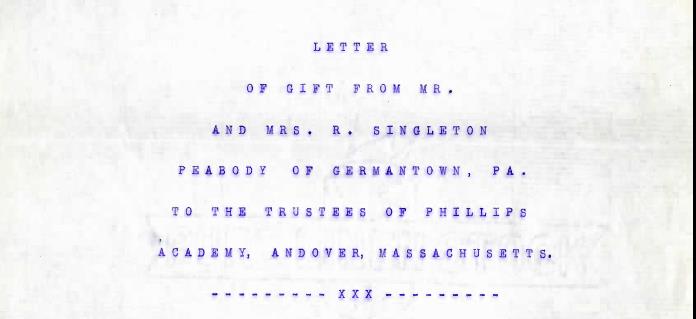
In a letter dated March 6, 1901 from Peabody to the Trustees of Phillips Academy, the amount and purpose of the donation were laid out. Specifically, Peabody wished his collection to have a home for preservation, the establishment of a Department of Archaeology which would be “self-supporting and independent.” Furthermore, this Department should be “disconnected from any other branch of Phillips Academy.” As for the museum itself, “…(it) should be, as far as consistent, tasteful and attractive on its exterior, with good proportions, not too high, and within, light and cheerful as possible, with some simple and tasteful decoration—as tinted walls, etc.” Peabody went on to propose that Moorehead be the first curator because “…Professor Moorehead knows every specimen in the collection, and its history.” Peabody also stipulated, “…that the building/museum be a pleasant place where students might find an agreeable relaxation during the broken events which occur in the lives of the most closely pressed.” In other words, the building would serve not only as a museum but as a social center.

It was no surprise that the amount of the gift to Andover, indicated in a letter dated March 8, 1901 from Peabody to Bancroft, was related to the amount given previously by his uncle in 1866. George Peabody had also dedicated the same amount—$150,000—to aid in founding the Peabody Museum of Archaeology and Ethnology at Harvard and the Yale Peabody Museum of Natural History. To differentiate himself from his uncle, Robert pointed out that his gift would also include a collection of artifacts. These artifacts amounted to one hundred thirty-two boxes containing nearly 50,000 items insured for $35,000 at the time of transportation by rail on July 10, 1901 from Philadelphia to Warren K. Moorehead in Andover. The actual endowment, anonymous by design, included $100,000 for the Peabody Foundation and $50,000 for the building. This amount would grow substantially at Peabody’s death, as he willed the residue and remainder of his estate to Phillips Academy in March, 1902. The total gift amounted to at least $500,000—approximately $12 to $13 million by today’s standards.

What did $50,000 buy in 1901? The future architect for Boston’s Museum of Fine Arts, Guy Lowell, was hired and he submitted plans for the projected museum at Phillips Academy. By the end of October, 1901, ground-breaking began on the site where formerly the First Classroom Building, the Farrar House, and then the Churchill House had been located. The building was completed in less than two years and was dedicated on March 28, 1903, the event was  memorialized in the mid-April 1903 edition of The Phillipian.“The building was tastefully decorated with potted palms and flowers…Mr. Frederick W. Putnam, L.L.D, professor of Ethnology and Archaeology at Harvard, said that students would learn to reason more for themselves, and would depend more upon their own powers than upon text books.”

Shelving to the rescue!

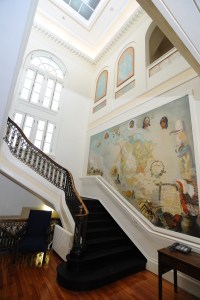
Completed shelving

Contributed by Marla Taylor

As I began working this summer on the reboxing project, it immediately became apparent that the artifacts needed room to grow sooner rather than later.  Moving the objects from the wooden drawers into the boxes revealed just how heavy some of those drawers were – some too heavy to be supported by the new archival boxes.

What I needed was solid temporary shelving to support these materials.  Donnegan Systems, Inc. of Northboro, Massachusetts to the rescue!   Donnegan Systems has been consulting with us periodically to reimagine collections storage once all the artifacts have been boxed.  They saw our need and offered some spare shelving that was taking up space in their warehouse.  Delivered and installed in a single morning, these shelves will facilitate faster progress with the reboxing project.

Reorganizing the archives storage alcove

For the past two weeks, the museum staff (and one volunteer — thank you Quinn Rosefsky!) all pitched in to make the archives storage area neater and more manageable. This physical reorganization had been anticipated and discussed since I began my work here in May. At that time, many materials were still in filing cabinets, with boxes piled on top.

Though most of these cabinets and boxes were labeled, the exact nature of the materials and the period of the museum’s history to which they belonged were not necessarily obvious. Related materials could be spread out among different boxes and cabinets without that intellectual integrity being apparent. If a museum staff member was looking for a specific piece of information in the archives, say when a particular exhibit was on display at the museum, it could be challenging to find it!

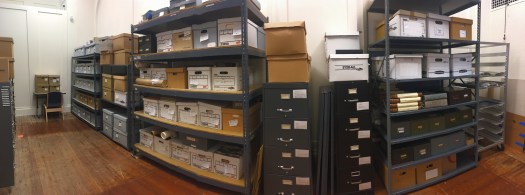
As I reached the end of my collections survey, I began to understand which materials belonged together as collections. I boxed up several collections that were in filing cabinets, carefully labeling them as discrete groups of material: the Warren K. Moorehead records (1890s-1930s), the Douglas S. Byers and Frederick Johnson records (1920s-1960s), the Richard S. MacNeish records (1950s-1980s), the Tehuacan Archaeological-Botanical Project records (1959-1960s) and the Coxcatlan Project records (1960s-1970s). Other record groups such as the museum’s Education Department files were physically grouped together, and consolidated into fewer boxes. Empty filing cabinets were removed, new shelving was set up and boxes were arranged deliberately on the shelves.

Panorama of one side of the rearranged archives storages area.
West wall of the rearranged archives storage area.
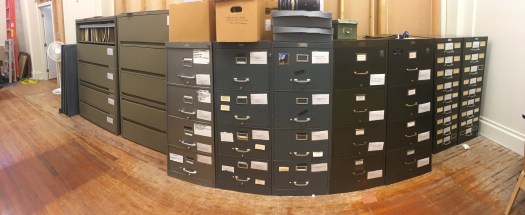
Panorama of the east wall of the rearranged storage area.
East wall of the rearranged archives storage area.

Records that are still being consulted regularly by museum staff such as accession files and site files were left in filing cabinets. Other material, such as the Ayacucho Archaeological-Botanical Project records (1969-1980s), was left in filing cabinets because we don’t have enough shelf space to accommodate more boxes at this time. There are also a few stray boxes that don’t yet have a home. Further tinkering of the space and rehousing of material will likely occur throughout the year. For now, the focus of the archives project will turn to creating inventories for individual collections, so that the material within them is easily findable for museum staff and outside researchers.

The Temporary Archivist position is supported by a generous grant from the Oak River Foundation of Peoria, Ill. to improve the intellectual and physical control of the museum’s collections. We hope this gift will inspire others to support our work to better catalog, document, and make accessible the Peabody’s world-class collections of objects, photographs and archival materials. If you would like information on how you can help please contact Peabody director Ryan Wheeler at rwheeler@andover.edu or 978 749 4493.


Boxes and boxes of boxes

They’re here!

Fifteen-hundred custom archival boxes were delivered on Monday, July 25 to initiate the Peabody’s collections rehousing project.  Unloading the truck and storing the boxes was hard work, but was an important first step toward completely rehousing and inventorying our large collection. The boxes were assembled to our specifications by Hollinger Metal Edge and are archival quality.

These boxes are made possible by a grant from the Abbot Academy Association, continuing Abbot’s tradition of boldness, innovation, and caring. They will be used to replace the old wooden drawers that have supported our collection for decades, and will provide protection and a long-term home for our artifacts.

A special ‘thank you’ goes out to Will Shahbazian and C. Woodrow Randall for their helping hands (and paws).

Summer work duty students begin rehousing inventory

Work duty student inventorying a drawer

Embarking on a full inventory and rehousing of your museum collection is a daunting task.  Transferring approximately 1,700 drawers into 3,000 archival boxes will take years of work.  Fortunately for me, I have access to an invaluable resource – Phillips Academy students.

For a week in July, two Lowers (10th graders) came to the Peabody every day for four hours to fulfill their work duty commitment for the school year.  I gave them a crash course in artifact identification and object handling techniques before they got down to business.  As they worked through the meticulous process of inventorying everything in the collection, they made crucial observations that will improve my workflow.  Together, these two students recorded the contents of twenty-nine drawers!

Work duty student inventorying a drawer

Work duty students will continue to be an essential work force as we move through the collection.  I will share their progress and successes in the months and years to come.

Curator of Collections Marla Taylor and work duty students stand behind the empty boxes