3D Scanning Artifacts: How Does it Work?

Image of 3D scan in the 3D printing software

Contributed by Claudia Wessner, Makerspace Coordinator and Library Experience Designer

Huge progress has been made in the collaborative project between The Nest, the makerspace at Phillips Academy, and the Peabody Museum! From the first day we received the Next Engine 3D Scanner, we had hopes of testing out this new technology in a fun and interesting way. After talking to Marla Taylor, we both thought it was a no brainer to form a collaboration between the museum, the makerspace and a group of work duty students (Alana Gudinas ’16, Jacob Boudreau ’16, Mia LaRocca ’16, and Sarah Schmaier ’16) to further explore the scanning possibilities.

In a previous post, Marla discussed the parameters in which the artifacts were selected. Once we brought the artifacts over to the Nest, we were able to make custom stands for two of the three artifacts so that they would be stable on the scanner. Then we got to work!

So, how does it work?

Before the scanning starts, we set up preferences such as resolution, color mode, and the number of incremental scans, as well as positioning the object in the camera’s field of view. The higher the desired resolution, the longer the scanning process will take.  Most of the objects we scanned took around one hour.

Collage of photos showing the lasers during the scanning process
Lasers scan the artifact

The scanner begins by taking a 2D image of the object then shoots out an array of red laser beams to capture the depth and texture of the object. Next, it completes a series of slow incremental rotations, based on the level of resolution selected, and performs the same 2D/3D rendering for each increment.  The Next Engine software slowly builds the 3D model before your eyes as it layers the data captured by the scanner.
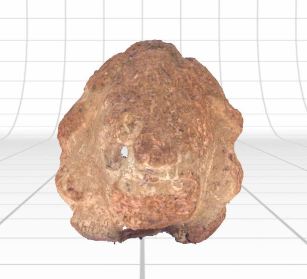
Image of 3D scan of artifact
Fully rendered 3D model from the scan

After the scanning is complete, the 3-dimensional model of the artifact appears in the Next Engine software. Depending on how the artifact is scanned, there may be some holes in the model. This would be where the lasers may not have been able to reach, such as the top or the bottom of the artifact. There are ways to avoid holes by completing several scans of the same object (top, bottom, full 360) and then fusing them together. This is something I am looking forward to experimenting with in the future, but for our initial exploration we did a single scan.

In order to fill the holes in our model, I “polished” it using the Next Engine software. The program will automatically find and select holes in the model. Then you can use a paintbrush tool to select the areas in which you’d like to fill.  This can also take some time and experimentation, especially with very high resolution scans where image rendering can use a lot of computing power.

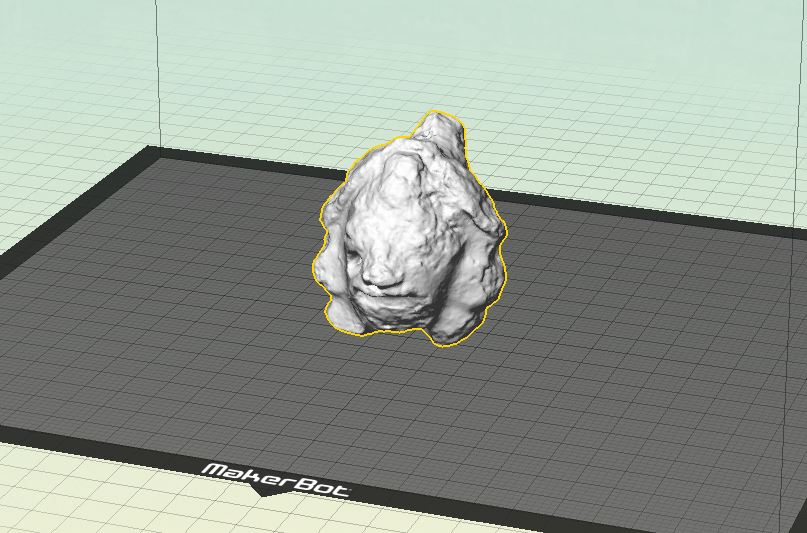
Once the editing of the model is complete, it is ready to prepare for printing by saving it as a .stl file and opening it in the Makerbot Desktop software. In the software you can scale, rotate, and place your object in the desired location on the build plate. You can also preview how long the print will take.  This artifact, which was approximately four inches tall, took about 5 hours to print.
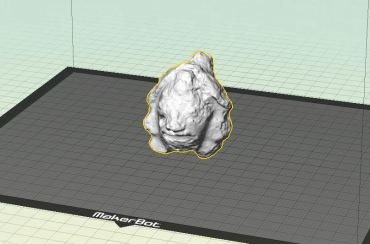
Image of 3D scan in the 3D printing software
The 3D scan is ready to print

The Makerbot 3D printer uses a material called PLA that is stored in a spool in the back of the machine. The PLA is heated in an extruder and lays down very thin layers of material to build the object from the bottom up. Think of it like a glorified glue gun! The makerbot will automatically add “support material” that will support the object as it is printing so that everything stays intact. Once it is finished printing, any support material easily breaks off from the print.

Image of the 3D printed artifact
The 3D printed artifact!

We are so excited about the results of our project! We are looking forward to scanning more artifacts in the Peabody collection and refining our skills with this new technology! Stay tuned!

3D Artifact Collaboration

Contributed by Marla Taylor

An exciting new project is taking shape this winter at the Peabody Museum. Work duty students Alana Gudinas ’16, Jacob Boudreau ’16, Mia LaRocca ’16, and Sarah Schmaier ’16 and I are collaborating with the folks at the Nest, the makerspace at Phillips Academy, to scan three artifacts from the Peabody’s collection and print them as 3D models.

The students were challenged to identify artifacts that were stable enough to be transported to the OWHL, which is where the Nest is located; had interesting textural details; and would not be limited by a 360-degree scan along a single plane (i.e., the top and bottom would not be “seen” by the scanner). The three artifacts they selected are from the Tehuacán Valley of Mexico and were excavated by Richard “Scotty” MacNeish in the 1960s. Two of the objects are whistles—we hope their 3D replicas will be playable!

The first scan has been completed, and more are scheduled. The students will clean and manipulate the scans before they print them.

An exhibition about the process and the implications of 3D scanning and printing technology on cultural heritage preservation will be installed in the OWHL at the end of winter term.

A major thank-you to Claudia Wessner, makerspace coordinator and library experience designer at the OWHL, and the Nest work duty students for all their help!

I will keep you updated as work progresses.

Boxes for Books

Contributed by Marla Taylor

Preserving old books on a budget can be tricky. What is an archaeology museum with dozens of historic books to do?

damaged book

The solution is simple: Utilize archival boxes.

book in box

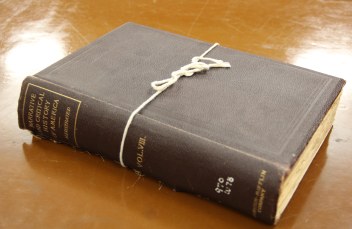
The Peabody recently purchased a small quantity of archival KASEBoxes from ECS Conservation to rehouse about a dozen historic books. Students helped me take detailed measurements of the books so that the boxes could be custom-made. Now, volumes such as Standard History of Essex County, Massachusetts and Warren Moorehead’s annotated copy of Ancient Monuments of the Mississippi Valley are available on the Peabody’s library shelves for use by the Phillips Academy community. These boxes provide a low-cost method of ensuring that fragile, delicate, or rare books are stored properly. Some of these books may eventually be the subject of conservation treatments.

More books are in need of a little TLC, so keep your eyes peeled for new archival boxes on the shelves at the Peabody!

Positive Negatives

Contributed by Marla Taylor

Opening drawers at the Peabody can occasionally lead to a surprise discovery. Recently, approximately 400 acetate negatives were discovered in an “empty” card catalog.

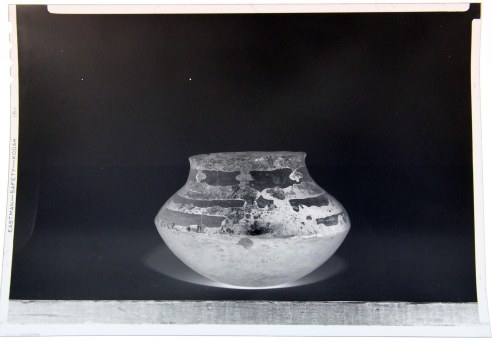
A little investigation revealed that these negatives include the original photographs from Alfred V. Kidder’s The Pottery of Pecos, Volume I. You can see these photos in Kidder’s publication here. The remaining negatives were of photos that Richard “Scotty” MacNeish took during his time at the Peabody, and they range from Canadian artifacts to materials from the Yucatán Peninsula of Mexico.

Acetate film, also known as safety film, was introduced by Kodak in the 1930s. Designed to replace nitrate negatives, which can spontaneously combust, acetate was in use for decades. The acids in the film, however, can deteriorate over time and emit a strong vinegar odor, an issue known as vinegar syndrome. The recently discovered negatives are in the early stages of vinegar syndrome.

IMG_3904
Image of a bowl from Pecos

We are working to preserve these negatives and have already sent approximately one-third of them to the Northeast Document Conservation Center (NEDCC) for digitization. The NEDCC will capture high-resolution images from the negatives and adjust them to create robust image files. The digitization process should be complete by the end of February.

A Day in the Life at the Peabody Museum

Contributed by Bonnie Sousa, Registrar/Senior Collections Manager

When I mention to people outside of the museum world that I am in collections management and registration, some think I work for a collections agency. In fact, museuSousa,Bonniem collections management and registration involves physical and intellectual control of artifact collections and includes such activities as cataloging, inventorying, and storing artifacts; accessioning (the formal process of taking items into the collections); managing loans; answering research and reproduction queries; and working on the museum’s Native American Graves Protection and Repatriation Act (NAGPRA) inventory, to name a few.

And at a small museum like the Peabody, the list of responsibilities grows to include additional activities. Not typically mentioned in job descriptions, but still important in the goal of reaching professional standards, are such unglamorous tasks as emptying dehumidifiers in artifact storage spaces, handling early morning calls from the alarm company regarding power outages at the building, and removing food trash at the end of the day so that insects and other pests are not attracted to the artifacts. To give you a better idea of what’s involved in collections management and registration at the Peabody, here is a list of a few behind the scenes tasks I performed on a typical day recently:

Morning:
Answered e-mail queries—Some of the queries we receive are from textbook publishers asking for CornCobs_MacNeish_Tehuacanpermission to use images from the Peabody’s collections. To date, our most received request is for this image of the evolution of corn from the excavations of Richard “Scotty” MacNeish in the Tehuacán Valley of Mexico. Many college-level, introduction to archaeology textbooks feature this image.

Renewed our loan to the Visitor Center at the Pueblo of Jemez—The Peabody has several ongoing loans to other museums, Native American tribes, a national park, and a public high school. On loan to the Visitor Center at the Pueblo of Jemez are artifacts from their ancestral site, Pecos Pueblo.

Put away artifacts for a Phillips Academy history class on westward expansion – Artifacts from the Peabody are regularly used in classes taught at the Peabody. Our PastPerfect collections management database allows us to create lists that work perfectly for pulling artifacts to ensure that we can locate them and put them back in the right spot.

Afternoon:
Entered catalog records into the Peabody’s database for artifacts from the Mansion Inn, a site in Wayland, Mass. — We recently learned that items from this site must be listed on the museumCatalog Cards’s NAGPRA inventory. Assembling an inventory begins with compiling existing documentation and records and ensuring that all artifacts are entered into the museum’s database. Our next steps will be to contact tribal officials to let them know we hold these collections, and National NAGPRA, a Cultural Resources program of the National Park Service, to update the museum’s inventories. After consulting with tribal officials and submitting drafts to National NAGPRA, a Notice of Inventory Completion will be published in the Federal Register.

Updated storage locations for textile artifacts—I have two volunteers who have been trained to inspect and vacuum textile collections for pest damage as part of a comprehensive pest management program. When textile artifacts have been inspected and vacuumed after undergoing low temperature treatment to eliminate any potential pests, their storage locations must be updated to ensure we can find them in the future.

Backed up our PastPerfect collections management database before heading home—Regular backups of data are important so that recent information added about the artifacts is not lost.

As you can see, one of the most rewarding benefits of working in museum collections is the wide variety of work that needs to be done, and I’ve really only touched the surface here. There is never a dull moment, and the nature of the work keeps me on my toes. I wouldn’t have it any other way.

Oak River Foundation Supports Peabody Collections with $100,000 Grant

Contributed by Ryan Wheeler

The Peabody Museum received a grant of $100,000 from the Oak River Foundation of Peoria, Ill., to support work pertaining to the intellectual and physical control of the museum’s collections.

IMG_9137_edited
A portion of the Peabody’s archive.

The first year of funding will support the work of a museum archivist who will organize the Peabody archives, which contain significant materials related to work by Warren Moorehead, Doug Byers, Fred Johnson, Scotty MacNeish, and others. This project will facilitate digitization of archival collections through our partnership with the Boston Public Library’s Digital Commonwealth, a statewide consortium of libraries, museums, archives, and historical societies from across Massachusetts. Researchers regularly use our archives, and this project will aid in locating materials and making collections more broadly available.

IMG_5590_edited
Students with some of the ceramic figurines from Scotty MacNeish’s excavations in Mexico’s Tehuacán Valley.

The second year of funding will support the process of cataloging the Peabody’s significant object collections related to Scotty MacNeish’s excavations in Mexico, Peru, and the American Southwest, as well as collections from the Northeast. We also hope to substantially increase the number of records in the museum’s database and include all cataloged artifacts in our online catalog, PastPerfect (http://peabody.pastperfect-online.com/40391cgi/mweb.exe?request=random).

The work supported by the Oak River Foundation is just a small part of the overall effort to increase physical and intellectual control of the Peabody’s collections. We hope this gift will inspire others to support work to better catalog, document, and make accessible the Peabody’s world-class collections of objects, photographs, and archival materials. If you would like to support this work, please contact me at 978-749-4493 or rwheeler@andover.edu.

Peabody Student Symposium

IMG_9042_editedJoin the Peabody and the Gene Winter Chapter of the Massachusetts Archaeological Society for a night highlighting student work and research. Three groups of students will present their research ranging from historic preservation to 3D printing artifacts to 19th century portrayals of Native Americans.
Tuesday, February 16, 7:00pm

Robert S. Peabody Museum of Archaeology, corner of Main and Phillips streets, Andover, Mass.

Box Us In! Abbot Academy Association Funds Archival Boxes for Peabody Collections

SampleBoxes2                 SampleBoxes

Contributed by Bonnie Sousa

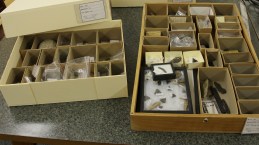
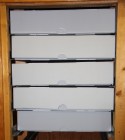
Peabody archaeology collections storage will undergo an ambitious upgrade made possible by a grant from the Abbot Academy Association, continuing Abbot’s tradition of boldness, innovation, and caring. The Peabody Museum received $45,746 to fund 3,000 archival boxes to replace deteriorating wooden drawers where collections are currently housed. Boxes eliminate contamination from wood debris in addition to improving accessibility and portability. Heavy or large artifacts such as stone axes and ceramic vessels will be stored on open shelving.

The project will be split over three years and will use the museum’s existing workforce of Phillips Academy work duty students, college interns, and adult and student volunteers guided by the collections management team of Marla Taylor and Bonnie Sousa. Archival boxes are a first step in a broader collections storage plan to consolidate museum collections and improve environmental conditions.

Storage_Marla&Students

Race and Identity in Indian Country

The end of fall term means the (temporary) end to one of my favorite collaborations – Marcelle Doheny’s Race and Identity in Indian Country course.

During the fall 2015 term, 11 Phillips Academy students explored the complicated relationship between Native Americans, museums and archaeology. Topics included scientific racism, federal Indian policies, museum collection practices, and the Native American Graves Protection and Repatriation Act (NAGPRA).  The culmination of the course was to use the Peabody collection to re-present the stories in our main exhibit gallery with a more inclusive voice.

Curator of education Lindsay Randall and I co-taught the class with Ms. Doheny. We were able to join most of the class discussions and provide perspective from our archaeology and museum experiences. I also enjoyed making the collection accessible to the students as they worked to create their final projects.

Watching the final presentations of the student’s revised exhibitions during assessment week was the perfect culmination to the term. Every group succeeded in reimaging how Native Americans are traditionally presented in an archaeology museum, moving beyond stone tools and ceramic pots. The students highlighted the continuity of native cultures despite the history of racism and dispossession.

I loved being a part of this course and look forward to being involved again next year!

IMG_9612
Final presentations!