The Peabody Museum received a grant of $100,000 from the Oak River Foundation of Peoria, Ill., to support work pertaining to the intellectual and physical control of the museum’s collections.
A portion of the Peabody’s archive.
The first year of funding will support the work of a museum archivist who will organize the Peabody archives, which contain significant materials related to work by Warren Moorehead, Doug Byers, Fred Johnson, Scotty MacNeish, and others. This project will facilitate digitization of archival collections through our partnership with the Boston Public Library’s Digital Commonwealth, a statewide consortium of libraries, museums, archives, and historical societies from across Massachusetts. Researchers regularly use our archives, and this project will aid in locating materials and making collections more broadly available.
Students with some of the ceramic figurines from Scotty MacNeish’s excavations in Mexico’s Tehuacán Valley.
The second year of funding will support the process of cataloging the Peabody’s significant object collections related to Scotty MacNeish’s excavations in Mexico, Peru, and the American Southwest, as well as collections from the Northeast. We also hope to substantially increase the number of records in the museum’s database and include all cataloged artifacts in our online catalog, PastPerfect (http://peabody.pastperfect-online.com/40391cgi/mweb.exe?request=random).
The work supported by the Oak River Foundation is just a small part of the overall effort to increase physical and intellectual control of the Peabody’s collections. We hope this gift will inspire others to support work to better catalog, document, and make accessible the Peabody’s world-class collections of objects, photographs, and archival materials. If you would like to support this work, please contact me at 978-749-4493 or rwheeler@andover.edu.
Join the Peabody and the Gene Winter Chapter of the Massachusetts Archaeological Society for a night highlighting student work and research. Three groups of students will present their research ranging from historic preservation to 3D printing artifacts to 19th century portrayals of Native Americans.
Tuesday, February 16, 7:00pm
Robert S. Peabody Museum of Archaeology, corner of Main and Phillips streets, Andover, Mass.
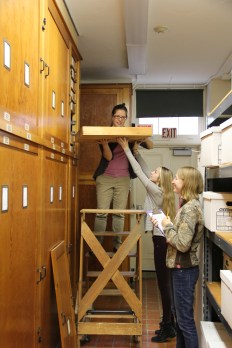
Peabody archaeology collections storage will undergo an ambitious upgrade made possible by a grant from the Abbot Academy Association, continuing Abbot’s tradition of boldness, innovation, and caring. The Peabody Museum received $45,746 to fund 3,000 archival boxes to replace deteriorating wooden drawers where collections are currently housed. Boxes eliminate contamination from wood debris in addition to improving accessibility and portability. Heavy or large artifacts such as stone axes and ceramic vessels will be stored on open shelving.
The project will be split over three years and will use the museum’s existing workforce of Phillips Academy work duty students, college interns, and adult and student volunteers guided by the collections management team of Marla Taylor and Bonnie Sousa. Archival boxes are a first step in a broader collections storage plan to consolidate museum collections and improve environmental conditions.
The Peabody Museum’s annual report for academic year 2014–2015 was published in November and highlights student participation at the museum, including more than 1,200 students who visited for classes, work duty, independent projects, and more! You can read the report in its entirety at http://issuu.com/phillipsacademy/docs/annual_report_2014_2015_final?e=1320520/31019317.
The end of fall term means the (temporary) end to one of my favorite collaborations – Marcelle Doheny’s Race and Identity in Indian Country course.
During the fall 2015 term, 11 Phillips Academy students explored the complicated relationship between Native Americans, museums and archaeology. Topics included scientific racism, federal Indian policies, museum collection practices, and the Native American Graves Protection and Repatriation Act (NAGPRA). The culmination of the course was to use the Peabody collection to re-present the stories in our main exhibit gallery with a more inclusive voice.
Curator of education Lindsay Randall and I co-taught the class with Ms. Doheny. We were able to join most of the class discussions and provide perspective from our archaeology and museum experiences. I also enjoyed making the collection accessible to the students as they worked to create their final projects.
Watching the final presentations of the student’s revised exhibitions during assessment week was the perfect culmination to the term. Every group succeeded in reimaging how Native Americans are traditionally presented in an archaeology museum, moving beyond stone tools and ceramic pots. The students highlighted the continuity of native cultures despite the history of racism and dispossession.
I loved being a part of this course and look forward to being involved again next year!
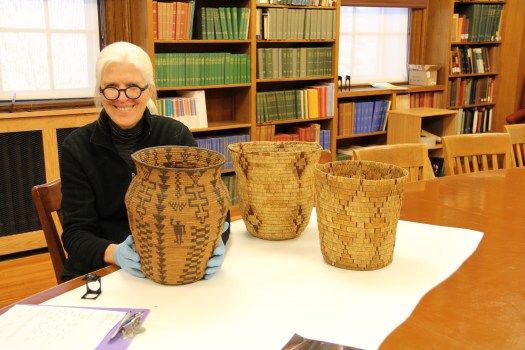
What can be coiled, plaited, twined, or sewn in the form of a tray, bowl, bottle, cone, or trunk using tree barks or splints, river cane, pine needles, or grasses? If you are familiar with this vocabulary, you will know the answer: Native American basketry. What you may not know is that the Peabody Museum houses more than 350 examples of Native American basketry, including fragments of ancient woven sandals, 19th- and 20th-century utilitarian and ceremonial forms, and a few examples by recognized 21st-century artists.
In my current capacity as a volunteer at the Peabody, I am collaborating with the museum’s registrar and senior collections manager, Bonnie Sousa, on conducting a thorough inventory of the Peabody’s Native American basketry collection. For this project, we are attempting to combine for each example a description of forms, techniques, and materials; identification of people/culture and geographic region; and data from museum records. The first 35 examples I examined include plaited ash-splint storage baskets from the Northeast with distinctive stamped and painted designs; twill-plaited trunks and trays from the Southeast made with natural, dyed orange and brown river cane splints; and a variety of trays of coiled grasses and pine needles.
My first volunteer position was in the 1970s at Harvard University’s Peabody Museum following a recommendation by my mentor, Joanne Segal Brandford, who subsequently published the museum’s basket collection. After studying and teaching fiber arts and design at the University of California, Berkeley, Brandford worked as a researcher, curator, teacher, and fiber artist. Why baskets? In the following paragraph, she succinctly describes the foundation for a career of exploration:
Baskets are often linked to domesticity and smallness, the implication being that these qualities preclude significant artwork. I could counter with basket-shrines made for ritual, or I could point to house-sized baskets (used, indeed, as houses) and so I could ‘elevate’ baskets with religious significance or architectural scale. But all such uses/meanings refer to our humanity, and consequently to ourselves and to our families, to life, and to death. What can be more meaningful for an artist working in fiber, than to honor the basket, with its myriad human associations?
BASKETS: Redefining Volume and Meaning (1993). The University of Hawaii, Art Gallery, Honolulu, Hawaii. Pat Hickman, Curator
[AUTHOR BIO]
Catherine K. Hunter is an independent museum consultant whose career began in the Department of Textiles at the Museum of Fine Arts in Boston. She has always been interested in the study of basketry and recently wrote feature articles about contemporary Native American and American artists for the National Basketry Organization.
Jenny Elkus ’92, while perusing our online publications, came across Peabody Museum curator Warren Moorehead’s tribute to museum founder Robert S. Peabody, published in 1906 as the Phillips Academy Department of Archaeology’s Bulletin 3—A Narrative of Explorations in New Mexico, Arizona, Indiana, Etc. together with a Brief History of the Department. What caught her eye was the following passage, which mentions Peabody’s earliest archaeological collections:
“Mr. Peabody spent his boyhood in the valley of the Muskingum and as in that region there are numerous mound-builder and Indian remains, he became interested in archaeology. With his own hands he collected some one or two hundred specimens on his father’s farm. When the collection at Phillips was numbered the records properly began with Mr. Peabody’s personal finds and No. 1 is an interesting hematite celt.”
A celt is a prehistoric stone or metal implement shaped like a chisel or ax head. Hematite is a mineral ranging in color from black to red to brown, often taking on a high polish when tumbled in a rock polisher. The reddish color comes from iron. Hematite was highly prized by Native Americans throughout parts of the eastern United States for making a variety of tools and ornaments, including axes and celts.
Polished hematite pebbles, photograph by Mauro Cateb (Own work) [CC BY-SA 3.0 (http://creativecommons.org/licenses/by-sa/3.0) ], via Wikimedia Commons.Jenny asked if we could provide a photo of the hematite celt—object #1 in the museum’s collection, essentially the founding object. Although many of our collections are well documented and regularly used by students and researchers, others need considerable attention. Unfortunately, the hematite celt fell into the latter category, as Jenny’s seemingly simple request illustrated.
We began our search by checking the original accession ledger and confirming that the first object was indeed a hematite celt collected at Spice Knob, Muskingum County, Ohio, by Robert S. Peabody sometime between 1845 and 1860. A note indicates the celt had a particularly nice polish.
Map of Falls Township in Muskingum County, Ohio, circa 1860. The blue shading indicates Robert S. Peabody’s family farm, labeled Spice Knob, just outside of Zanesville.
We then made a quick check of four or five drawers containing objects from Ohio and found a number of items with low catalog numbers that also came from Spice Knob. Unfortunately, the hematite celt was not among them. Further checking of a drawer-by-drawer inventory made in 2002 failed to locate the celt. With the aid of volunteers we searched drawers more thoroughly, with negative results.
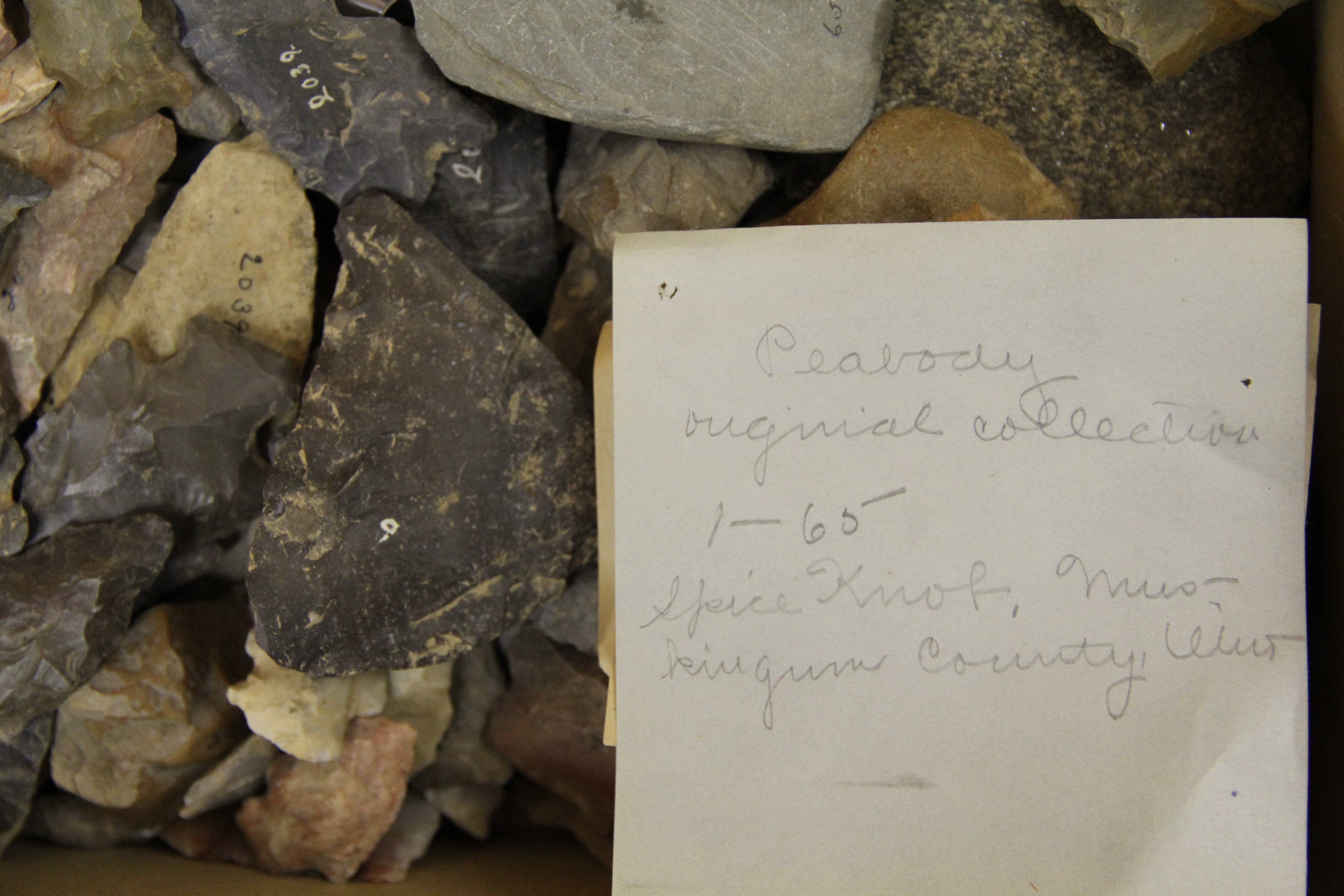
A note in one drawer reads “Peabody original collections 1-65 Spice Knob, Muskingum County, Ohio.” Some of the nearby objects are from this earliest accession.
Consulting another early museum bulletin, Warren Moorehead’s 1912 Hematite Implements of the United States together with Chemical Analysis of Various Hematites, we found a detailed study of the tools and ornaments made from this mineral. Figure 3, opposite page 13, illustrates seven hematite celts from the Andover collection. Catalog numbers are visible on three of the celts, so we knew we could rule them out as being the founding object we were searching for, but they are not visible on the remaining four objects in the figure, which meant it was possible one of them was the object in question. We also checked Moorehead’s other publications, which contain numerous illustrations of artifacts, including hematite celts. However, in the end, no definite candidates were identified.
Figure 3 from Warren Moorehead’s 1912 study of hematite implements. One of the four objects at the bottom may be Robert Peabody’s hematite celt.
So, what happened to Robert Peabody’s hematite celt?
There are several possible explanations. One is that museum personnel recataloged the object in the 1940s after the introduction of a more sophisticated cataloging system that imposed a two-part numbering technique and avoided some of the confusion that might arise from a simple sequential numbering of objects (e.g., 1 through 70,000+, as Moorehead had done).
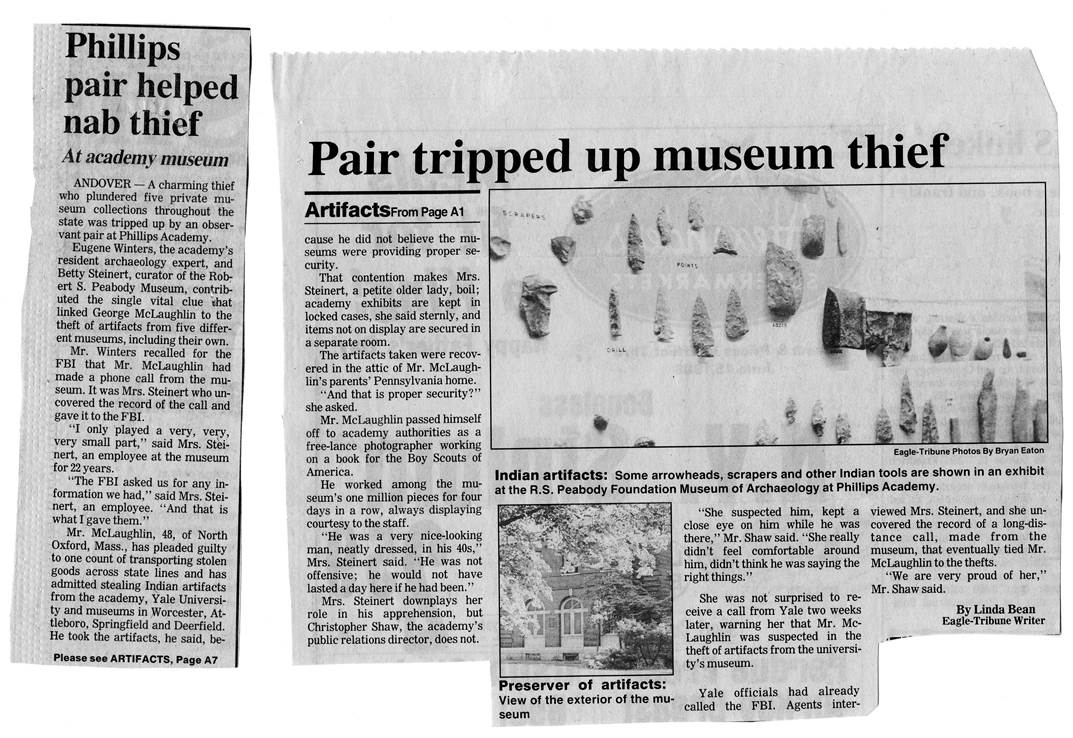
Eagle-Tribune article from 1986 recounts George McLaughlin’s theft of artifacts from the Peabody Museum.
Another possibility is that the celt was stolen. In 1986 a thief named George B. McLaughlin gained access to museum collections across the Northeast, including the Peabody, as well as institutions in Worcester, Attleboro, Springfield, Deerfield, and at Yale University, before the FBI apprehended him. During his spree, McLaughlin amassed thousands of artifacts and removed their catalog numbers. Although many objects were recovered, there was confusion regarding which artifacts belonged to each museum. We currently have drawers of objects returned to us by the FBI.
And so the search for Robert Peabody’s hematite celt continues, illustrating the challenges of locating an object from an older collection that has limited intellectual and physical control. A multiyear effort began in 2013 to gain better intellectual and physical control with the help of Abbot Academy Association grant funding for a new database system. The effort will continue for years to come as collections are cataloged and storage is upgraded.


 Join the Peabody and the Gene Winter Chapter of the Massachusetts Archaeological Society for a night highlighting student work and research. Three groups of students will present their research ranging from historic preservation to 3D printing artifacts to 19th century portrayals of Native Americans.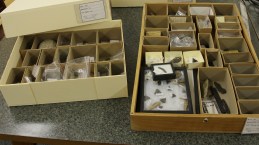


![Polished hematite pebbles, photograph by Mauro Cateb (Own work) [CC BY-SA 3.0 (http://creativecommons.org/licenses/by-sa/3.0)], via Wikimedia Commons.](https://peabody.andover.edu/wp-content/uploads/2015/10/1024px-hematite_pebbles_01.jpg)


 The Peabody