Last fall, the Peabody loaned ten objects to the Addison Gallery of American Art here at Phillips Academy. They spent nearly a year there for the exhibition A Wildness Distant from Ourselves: Art and Ecology in 19th Century America.
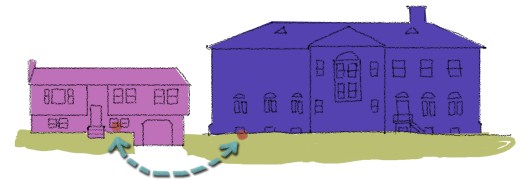
Due to public health concerns related to COVID-19, both the Peabody and the Addison have been closed to visitors since mid-March. But, the behind the scenes work never ends. The Addison regularly exhibits works of art on loan from other institutions and actively loans its own collection to museums around the world. Returning these objects during COVID shutdowns has been a logistical challenge for our friends, and we were happy to coordinate with them to return the materials back across the street to us.
When the objects from the Peabody went to the Addison, a professional fine arts shipping company took care of packing and moving everything. To come home, the Addison staff did the packing themselves – and they are awesome at it!
It is now up to me to put these artifacts back into our storage areas – a job I am happy to do! Typically, we would use many of these in the upcoming school year for classes, but this year is different. Like most other institutions, any of our classes will be taught online.
But I know that I will be happy to see Champ the auk back at home in his case every time I come into the Peabody.
4 months of working in my basement and now, I’m back in the Peabody basement.
After four months of working from home, the Peabody is in its third week of a return to almost normal collections work. The two inventory specialists, Emily and myself, are working alternating weeks at the Peabody in order to continue our inventory work. With one week completed, it feels good to be back working toward our goal of a complete inventory of the collection. While working remotely will be an ongoing reality, I would like to share some of what I have been up to at home thus far.
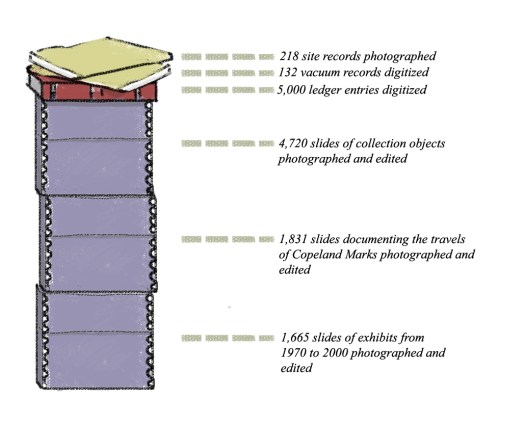
With everything shutting down in March, Marla was quick to come up with projects that could be completed remotely. Her post in April outlined collections materials that were less sensitive and therefore reasonable to take home. I started with photographing site records from Peru and then moved to digitizing vacuum treatment paperwork related to Integrated Pest Management of the collections. We all contributed to finalizing the digitization of the original ledger books, our institution’s version of accession books. Now we have a searchable document with 75,000 records!
Everything I’ve worked on from home
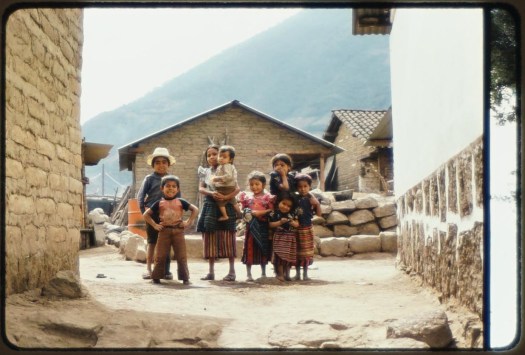
My favorite project has been photographing and editing photographic slides held in the collection. They include images documenting past exhibits and openings at the Robert S. Peabody Museum and photographs of the collections. The most interesting slides by far have been of Copeland Marks’s travels in Guatemala and South Korea. Mr. Marks was a textile collector who focused on the traditional clothing of ethnic Maya people living in the Guatemalan highlands. Some of his textiles became part of our collection at the Peabody. He would later write several cookbooks on cuisine covering locales ranging from the Mediterranean to South America. The slides I was working with document his travels in Guatemala spanning the 1960s through the 1980s. The subjects in the photographs cover everyday life, the dramatic volcanic landscape of the highlands and ceremonial life- all of which have been a great escape from the realities of coronavirus lockdown.
00.3.1585- People of San Pedro La Laguna.
It is anybody’s guess when life will return to normal. For the foreseeable future work at the Peabody will be interspersed with the strange blur of working from home with frustratingly cute interruptions from kids and dirty dishes. Until then I have to thank Marla for keeping us safely working from home during these crazy times.
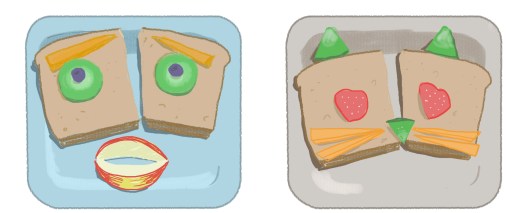
Oh yeah, I can’t forget my other work from home duty- silly lunches for the kids.
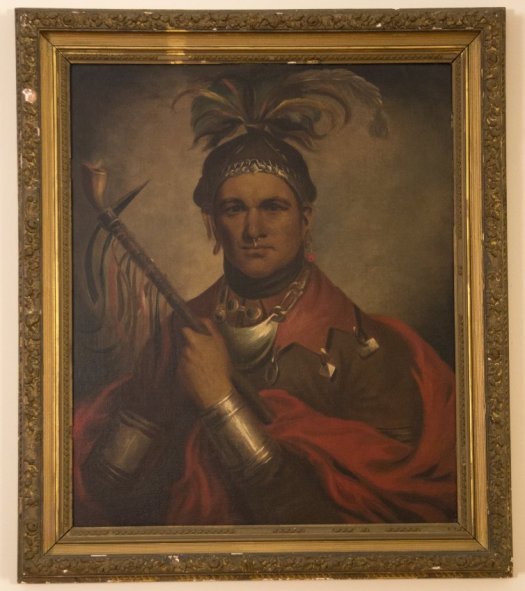
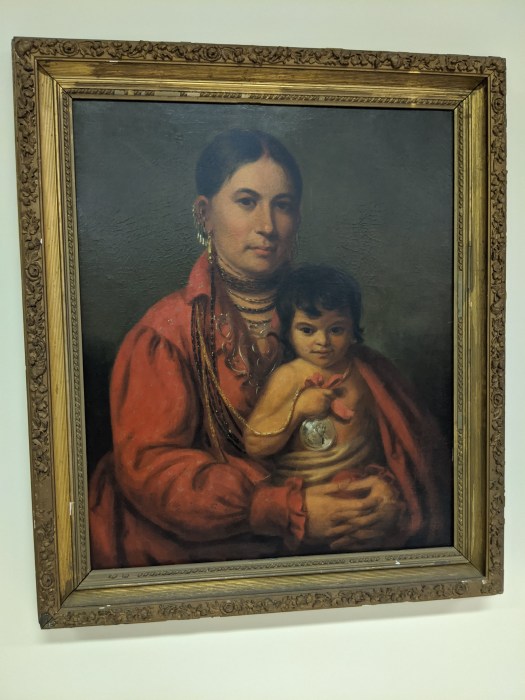
Three distinctive oil paintings attributed to artist Henry Inman (1801-1846) are among the collections of the Robert S. Peabody Institute of Archaeology. These paintings are part of a larger group of portraits created by Inman to produce the hand colored lithographs that appeared in the three volumes of The History of Indian Tribes of North America (1836-1844) by Thomas McKenney and James Hall. Specifically, the Peabody paintings depict Petalesharo (90.181.10), Ki-On-Twog-Ky, or Cornplanter (90.181.11), and Mohongo and Child (90.181.12). The source material for the Inman paintings were original works created principally in Washington DC by portrait painter Charles Bird King (1785-1862). The bulk of the King originals were destroyed in a fire in 1865.
Henry Inman’s portrait of Ki-On-Twog-Ky, or Cornplanter.
Today, original editions of the McKenney and Hall volumes and individual lithographs are valuable and highly sought after, but at the time the project was not a financial success. Many of the Inman portraits (at least 100 or more) were given to the Tilestone and Hollingsworth Paper Company of Milton, MA, who had supplied paper for the book project. The families of Edmund Tilestone and Amor Hollingsworth made a gift of the paintings to the Harvard Peabody Museum of Archaeology and Ethnology in 1882. In the late 1970s and early 1980s the Harvard museum sold many of the Inman paintings in their collection, ultimately retaining twenty-five.
Henry Inman’s portrait of Petalesharo after a recent cleaning.
Comparison with the list of Harvard’s original holdings indicates that the three Inman portraits at the Robert S. Peabody Institute of Archaeology did not come from that source. The frames also are quite different; the paintings at Harvard have simple wood frames, with descriptive plaques affixed, while those at the Robert S. Peabody Institute of Archaeology have ornate frames with gold leaf. In correspondence on file, former museum director Richard S. MacNeish told then director James Bradley that the paintings were part of the original gift from Robert S. Peabody. Stebbins and Renn (2014:288) report that Harvard received 107 of the Inman paintings from the Tilestone and Hollingsworth heirs, but that Inman had originally painted 117 and the whereabouts of the remaining paintings is unclear. It is possible that Robert S. Peabody acquired the three paintings when they were exhibited in Philadelphia.
Phillips Academy students share their independent research on the Henry Inman paintings with members of the Board of Trustees.
The paintings reflect the classical style of portraits painted in the nineteenth century, and do not attempt to portray people in an imagined “primitive” setting as the photographs of Edward S. Curtis do at the end of the century. Clothing and personal items reflect the blend of traditional and Anglo-European attire resulting from varying levels of cultural assimilation. History and Social Sciences instructor Marcelle Doheny uses the paintings in her senior elective, Race and Identity in Indian Country, and they were part of an independent student project in 2015-2016 that examined Anglo-European portrayals of Native Americans.
Henry Inman’s portrait of Mohongo and child in storage at the Peabody.
The biographical notes that accompany the McKenney and Hall publication provide additional details about the lives of these individuals, at least as documented by the editors. Mohongo’s (1809-1836) story is particularly striking, as she was one of a group of Osage persuaded to make a European tour in 1827. While in Europe, she gave birth to twins, but only one survived. The tour organizer, who had brought the Osage to Europe to perform as a Wild West Show, was arrested for debt in Paris, leaving the rest of the party to fend for themselves. Ultimately, the Marquis de Lafayette learned of the situation and arranged for passage back to North America. During the sea voyage more members of the party perished, but Mohongo and her child survived, ultimately arriving in Norfolk, Virginia, where Charles Bird King painted their portrait. We believe that the peace medal worn by Mohongo depicts Andrew Jackson, who was president at the time. Mohongo and her child made their way back to Missouri. The book, An Osage Journey to Europe, 1827-1830: Three French Accounts edited and translated by William Least Heat-Moon and James K. Wallace, documents the episode.
Several exhibits—for example, the Indian Gallery of Henry Inman, which toured museums from 2006 to 2012—have assembled small collections of the extant Inman paintings, but the examples at the Peabody have never been included, likely because curators and art historians have not known about them.
Other Sources
Christie’s East. 1981. American Paintings and Watercolors of the 18th, 19th and 20th Centuries (auction catalog). New York.
Ewers, John C. 1954. Charles Bird King, painter of Indian visitors to the nation’s capital. Annual Report of the Board of Regents of the Smithsonian Institution, 1953. Pp. 463-473. Publication 4149. Government Printing Office, Washington DC.
Gerald Peters Gallery. 2008. Henry Inman, Twenty-four Indian Portraits (catalog). New York.
Gerdts, William H., and Carrie Rebora. 1987. The Art of Henry Inman. National Portrait Gallery, Smithsonian Institution, Washington, DC.
Stebbins, Theodore E., Jr., and Melissa Renn. 2014. American Paintings at Harvard, Volume 1: Paintings, Watercolors, and Pastels by Artists Born before 1826. Harvard Art Museums and Yale University Press, New Haven.
Viola, Herman J. 1976. The Indian Legacy of Charles Bird King. Smithsonian Institution Press and Doubleday & Company, New York.
Viola, Herman J. 1983. Indians of North America: Paintings by Henry Inman from the D. Harold Byrd, Jr. Collection. Buffalo Bill Historical Center, Cody, WY.
Before COVID-19, the Peabody Institute kept our social media presence to Facebook and Twitter. But this seemed like the perfect time to expand to Youtube. This is definitely a new medium for me and I was puzzled for a few days as to how I could contribute to this platform. And then inspiration struck.
Phillips Academy is home to two cultural institutions – the Robert S. Peabody Institute and the Addison Gallery of American Art. Our friends at the Addison created a delightful short stop-motion video about the work of a registrar and shared it on Facebook. I thought it was fabulous. And I also thought, I can do that!
Well, that started a project that took about a week of evening shoots after the kids went to bed, and an additional couple weeks of sound design (maybe I shouldn’t admit that it took that long…). I wrote a short script and then cannibalized my boys’ Legos to recreate the Peabody staff and create sets. I regret not taking a picture of the carnage to our play room to share, but I am relieved that it is all cleaned up now.
Framing and filming the stop-motion required a level of patience and detailed focus that was challenging for me at times but necessary to make the film work. It is hard to remember to account for everyone and everything in the scene, but not to move it too much to ensure it was fluid. It was pretty fun to hide details in the background too.
Adding the voices and music was a whole separate task. I fully credit my husband with the patience to become my sound engineer. He took all the lines, including those contributed by our 5 year old, and music and ensured that everything synced with the video – and made sure we weren’t breaking any copyright laws with the music use…
I think the end result is pretty great. Viewers learn about what the Peabody does every day, from my perspective, and get to escape for about 3 minutes.
In our new normal, museums around the world are finding new and clever ways to engage with people at home. I wanted to share with you some of my favorites.
Our friends at the Addison Gallery of American Art, also here at Phillips Academy, have gotten creative with Legos and stop-motion animation. Registrars: The Movie was the best 2 minutes of my day and I hope it makes you smile too!
Do gerbils appreciate art? I don’t know, but I stumbled across this article about some art lovers who decided to find out. By all accounts, the gerbils had a positive experience with their private tour! And I hope you do too.
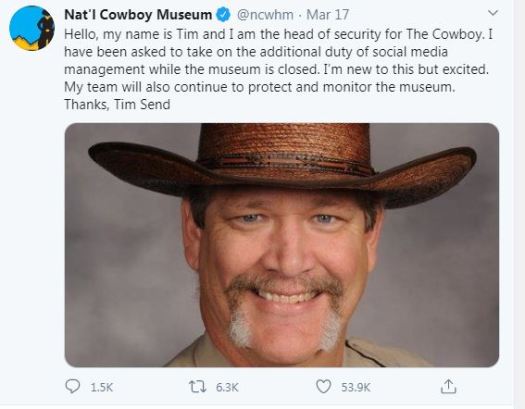
My favorite museum distraction is following the National Cowboy Museum on Twitter. Head of Security, Tim, has taken over their social media and has the best dad jokes around. Wonderfully refreshing and clever, Tim’s tweets bring a smile to my face every day – #HashtagTheCowboy. I can’t wait to find a reason to travel to Oklahoma City, OK and visit.
As the country continues to work from home, the Peabody collections team has gotten creative to keep everyone busy. Typically, our work requires touching and interacting with the objects in our collection as well as collaboration on deciphering difficult numbers or to respond to a research inquiry. I certainly can’t send the artifacts home with our staff, but we have been able to find plenty of remote work.
Boxes of photos and slides ready to go to their temporary homes
First, we attacked a backlog of paperwork relating to our pest management projects. Something that I thought would take months to catch-up on was done in a matter of days!
Second, supplies were split up and everyone signed out a few boxes of photographs to digitize from home. Many of them also created spreadsheets that will make for quick addition to our collections management database when we return. Once again, massive progress is being made on projects that have been sitting on the back-burner too long.
Digitizing slides one sheet at a time
Scanning photos from home
Several of us still share the responsibility of checking on the collections in person regularly and the system has been working wonderfully.
For me, like so many others, working from home has been a balancing act. I am caring for two kids under the age of 5 while my husband works a job that is considered essential. My work is squeezed into nap-time, evenings, early mornings with a cup of coffee, and some weekend time. We are all doing the best we can to support ourselves and our colleagues. I cannot thank the Peabody collections team – Rachel, John, Emily, and Emma – enough for their hard work and continued dedication to our mission.
If you have some time to kill, try checking out our collection online – I hope to have lots of new material uploaded when we return to our regular routine.
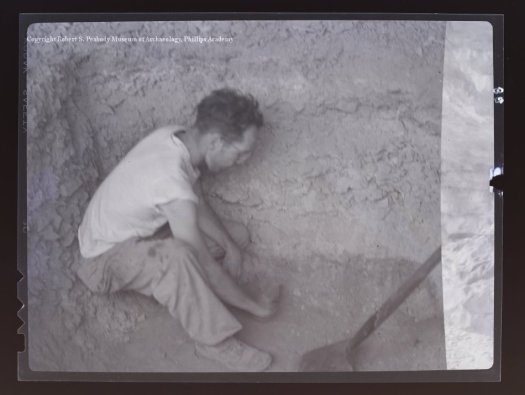
Early in his archaeological career Richard “Scotty” MacNeish, the Peabody’s fifth director, used funds from the Wenner-Gren Foundation to investigate caves and rock shelters in northern Mexico. MacNeish had found that some of these sites contained preserved plant remains, basketry, twine, and other perishable artifacts while a graduate student at the University of Chicago. Early in 1949 his crew chief discovered tiny corn cobs in La Perra Cave in the Sierra de Tamaulipas. The rich biodiversity of this area in northern Mexico, near the Gulf Coast and Texas border, had attracted other scientists interested in the flora and fauna of the so-called cloud forests. Perhaps it is not surprising that the ancient people of the area experimented with plants, including early crops like corn. MacNeish’s work in the Sierra de Tamaulipas pushed corn origins back to 4,500 years ago (about half of the now-acknowledged age).
Scotty MacNeish removes samples from La Perra Cave, Sierra de Tamaulipas, March 1949. Collection of the Robert S. Peabody Institute of Archaeology 2018.0.0741.
The Peabody houses a small type collection of materials from MacNeish’s work in Tamaulipas, including artifacts, photographs, and fieldnotes. Last year we collaborated with the Boston Public Library’s Digital Commonwealth project to digitize the archival records associated with MacNeish’s Tamaulipas project, primarily to facilitate access by Mexican archaeologists working in the region. Those files are available on InternetArchive. We also digitized many of the photos from the project, available via PastPerfect Online. Recently, Peabody staff member Emma Lavoie has been cataloging the artifacts from Tamaulipas. Looking over Emma’s shoulder one day at the many preserved plant remains, I was surprised to see part of an ancient orchid!
Dried pseudobulbs and roots of orchid from Sierra de Tamaulipas. Collection of Robert S. Peabody Museum of Archaeology 2019.6.396.
The Orchidaceae are one of the largest families of flowering plants, known to most of us from the cultivated examples with colorful and fragrant blooms available at grocery stores and garden centers. Commercial growing of orchids as houseplants began in the nineteenth century as the demand for “parlor plants” increased and diverse hybrids were created, many with fantastically shaped and colored blooms. Most of the orchids available for sale are of the genus Phalaenopsis. In the wild there is considerable diversity too, with terrestrial and epiphytic examples and a range of shapes, sizes, colors, and scents. Perhaps the best-known orchid is vanilla, a terrestrial form from Mexico.
We do not know what genus or species the dried pseudobulbs and roots of the Tamaulipas orchid represent. Notes on file show that botanist C. E. Smith, a student of Paul Mangelsdorf at Harvard, identified the orchid. Mangelsdorf worked closely with MacNeish on his early corn project, and Smith pioneered the field of archaeological botany. Quick searches of the literature did not reveal many examples of archaeological specimens of orchids in the Americas. We do know from some of the few preserved screen-fold books made by the Mixtec, Aztec, and their contemporaries that a variety of orchids were used in medicine, some may been collected for their hallucinogenic properties, and others were used to produce a special glue used in featherwork.
Image of Aztec featherwork from Sahagun’s sixteenth century Florentine Codex.
Carlos Ossenbach, in his 2005 study “History of the Orchids in Central America, Part 1: From Prehispanic Times to the Independence of the New Republics,” laments that the destruction of the majority of the screen-fold books by the Spanish also destroyed considerable information on the use of orchids in Mesoamerica. Between 1547 and 1577 Bernardino de Sahagún compiled his History of Things of New Spain (also called the Florentine Codex), which includes considerable information on the use of plants, including orchids, among the Aztec. Here Sahagún documents the use of the Encyclia pastoris orchid for glue making, when he describes how the pseudobulbs of the orchid are cut and soaked in water to produce a sticky substance called tzacutli. The complete codex can be viewed online: https://www.wdl.org/en/item/10096/view/1/35/ Researchers have documented at least twenty-three different orchid species and their use by the Aztec, Maya, and their neighbors, primarily as medicines, adhesives, fixers for pigments, and as ornamental specimens.
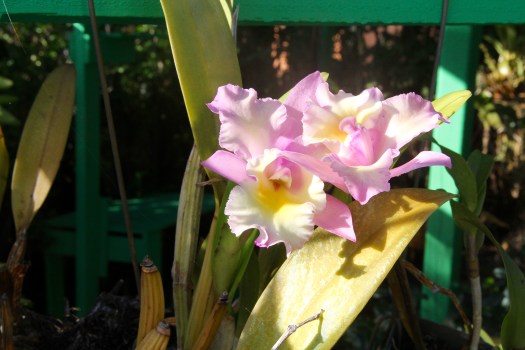
Orchids in Ryan Wheeler’s mom’s shadehouse, Fort Lauderdale, Florida.
The Tamaulipas orchid reminded me of the many terrestrial and aerial orchids that we often encountered at archaeological sites in Florida. Limestone and shelly soils encouraged their growth. It also brought back memories of my work at the Miami Circle site in late 1999. During the fieldwork I stayed with my parents and I was fortunate to accompany my mom on an orchid ramble one Saturday. A bus packed with orchid enthusiasts left Fort Lauderdale and visited at least half a dozen orchid growers in Homestead and Redlands, south of Miami. During the ramble we entered a raffle. I was surprised to receive a call Sunday evening. The gentleman calling informed me I had won a raffle prize and asked if I could collect it after work on Monday. After another intense day at the Miami Circle I navigated my Ford F-150 long-bed pickup through Miami’s crowded streets, onto Florida’s Turnpike, and then onto the Homestead extension. It was dark by the time I found the orchid grower. We entered the massive greenhouse and the grower–the gentleman who had called me the night before–gestured to one of the tables covered with orchids. I assumed I had won one of the orchids. He corrected me in a mellifluous English accent, I had won ALL of the orchids on the bench, approximately 100! He helped me load them into the F-150 and I headed north. My parents were disbelieving upon my return home. After I persuaded them to come outside, however, they acknowledged the enormity of the prize. My dad helped me unload and we struggled to find room in my mom’s orchid shade house. Some are still thriving today, while others were lost to hurricanes.
I’m interested in our Tamaulipas orchid. Could we determine the genus and species? Would that help us better understand why the orchid was in a cave deposit? Maybe as a drug, or for glue making, or as a mind-altering hallucinogen? Perhaps we can connect with a specialist and answer some of these questions!
The Centers for Disease Control and Prevention (CDC) issued guidelines to limit the spread of COVID-19, also known as the coronavirus. One recommendation included in these guidelines was for “social distancing” – a term referring to the conscious effort to reduce close contact between people and hopefully hinder the community transmission of the virus.
While schools, companies, and various workplaces determine the best possible options to both adhere to these guidelines as well as provide the appropriate support to their staff, students, and customers – many have chosen to close their doors. Some institutions and companies have shut down indefinitely, while various schools and universities have moved to remote teaching, where students complete their classes online and stay at home. Universities and colleges all over the country have moved courses to online platforms. Undergrads are being told to move out of their dorms and off campus for the remainder of the semester.
Phillips Academy (PA), a New England boarding school and the Peabody’s parent institution has instituted similar measures, following the directives issued by Massachusetts Governor Charlie Baker.
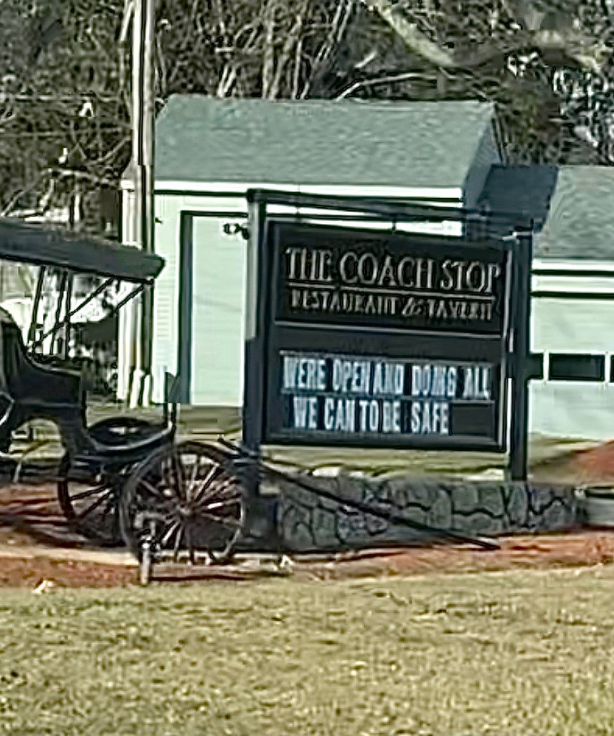
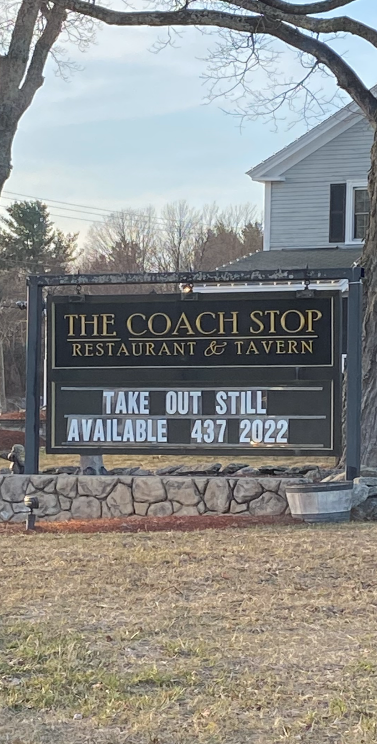
A local restaurant closes their doors in light of “on-site eating” bans over COVID-19
Now many would say they like working from home and actually get more done, but it is not the case for everyone. The Peabody staff are doing what they can to continue their museum work from home. For the Peabody collections team, it is very difficult to continue much of the work they do every day at the institution, as much of the collections and material cannot leave the building. While inventory, rehousing, and cataloguing of the collection is put on hold, our staff is editing object photographs, digitizing documents, transcribing collection ledgers, writing blogs (like this one), and more.
My dog, Rourke, is very happy to have me working from home!
Outside of my remote-work, I am wondering like many others who are stuck at home – what else can I do with the rest of my week? By being at home, we miss out on the daily interactions with our coworkers, colleagues, and classmates. Our experiences with each other fuel our creativity and critical thinking, and are important for much needed collaborative efforts. Through “social distancing” we are recommended to not take part in every day, public activities such as eating out, going to the store, or visiting a museum or historical site with our friends and family.
But don’t let social distancing doom your week and weekend! Museums have found a way to bring some of their collections to their visitors. So worry no more! You can view that Van Gough from the couch!
I was happy to enjoy a little culture and education in my off-time while at home. According to Fast Company, Google Arts & Culture has teamed up with over 500 museums and galleries around the world to bring virtual tours and online exhibits to a global audience.
Some of the museums highlighted by Google Arts & Culture include the British Museum in London, the National Gallery of Art in Washington, D.C., the Musée d’Orsay in Paris, France, the National Museum of Anthropology in Mexico City, Mexico, and various historical parks and sites.
Design of the Musée d’Orsay in 1979 Image courtesy of A.C.T. Architecture and the Musée d’Orsay
The first museum I “visited” was the Musée d’Orsay in Paris, France. As a student, I had visited this museum on a class trip many years ago and I was interested in the exhibits they provided online. This exhibit was a detailed history on the building of the museum titled, From Station to the Renovated Musée d’Orsay. This endeavor was a groundbreaking project for Paris as it was the first time an industrial building had been restored to accommodate a major museum. The virtual exhibit showcases the early building plans and images of the Orsay train station and hotel from the 1900s as well as images of the museum and its galleries after the renovation project in the early 2000s. Explore this virtual exhibit here!
I visited a second virtual exhibition, this time, at the National Gallery of Art in Washington, D.C. The exhibition is called, Fashioning a Nation. This exhibit features drawings from the Index of American Design, a collection of more than 18,000 watercolor pictures of American decorative art objects. This exhibition explores the American fashions from 1740 to 1895, giving insight into the character and quality of American life from the colonial period to the Industrial Revolution. Click here to explore this exhibit!
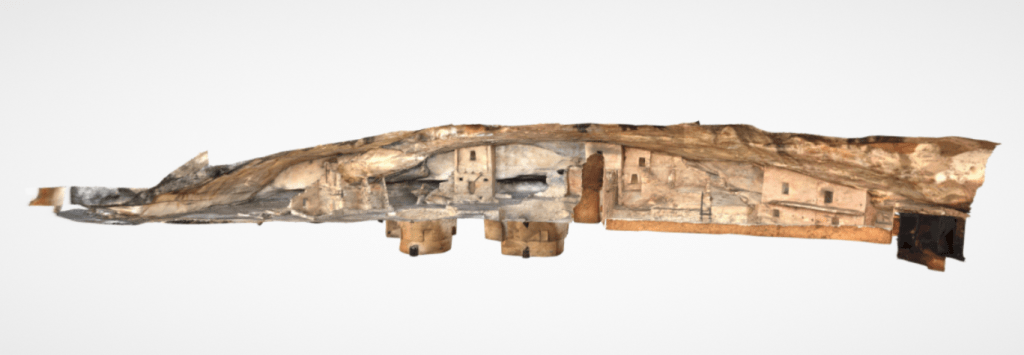
3D model of the Balcony House at Mesa Verde National Park Image courtesy of CyArk and Open Heritage – Google Arts & Culture
If museums aren’t your thing, explore a historic site!Open Heritage – Google Arts & Culture offers iconic locations in 3D, using 3D modeling techniques for you to explore. You can learn about the tools of digital preservation and how people all over the world are preserving our shared history. One site I visited was the Mesa Verde National Park. This site is home to Native American cliff dwellings in southern Colorado that span over 700 years of Native American history (600-1300 CE). An expedition was led by CyArk in February 2017. CyArk is a nonprofit organization that specializes in the digital documentation and preservation of historic sites. The organization documented the Balcony House at Mesa Verde using Light Detection and Ranging (LIDAR) and terrestrial photogrammetry. Combining these two technologies is what creates the 3D model of a site. To explore the 3D model of the Balcony House at Mesa Verde, click here!
Unfortunately, not all popular museums and galleries are included on Google Arts & Culture’s collection website, but some museums are offering virtual tours and online visits on their own websites, such as the Louvre in Paris, France. To see more of Google Arts & Culture’s collection of virtual museums and exhibits, visit their collection website. Explore and enjoy your visit!
My job is pretty amazing. I get to do what I like to do, in an institution I like with many people whose company I enjoy. What else could anyone really ask for when it comes to their career, right? Well, a job wouldn’t be a job without at least one thorn in one’s side, and here, that thorn for me is whatever the heck the people who worked here in the 1940s and 1950s were doing.
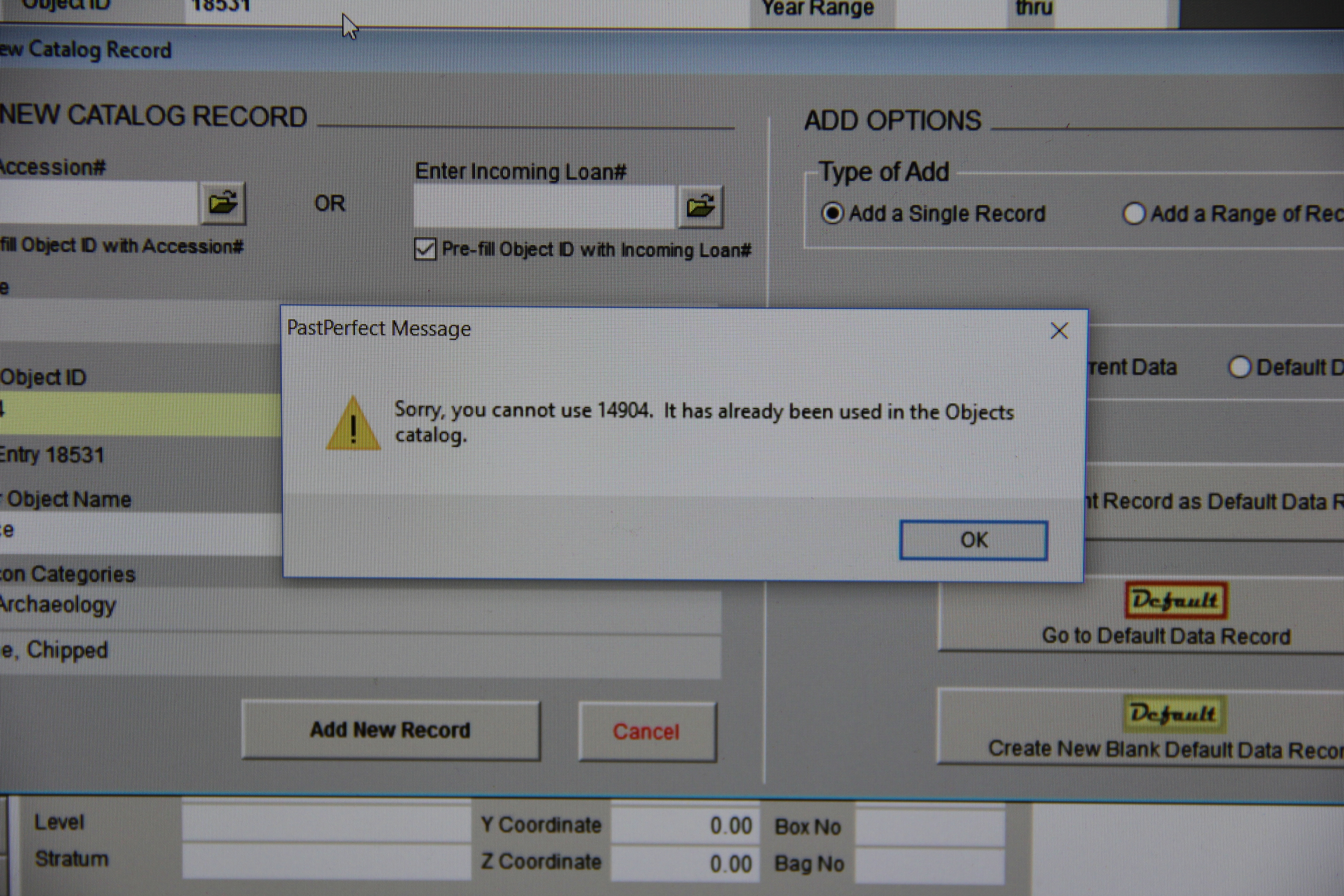
Going through the collections to complete portions of the inventory project is usually pretty straightforward. Pick a drawer, take inventory, put the information in the database, rehouse the artifacts, return the box to its location. Repeat, repeat, repeat. This is all fine and dandy until you are entering the artifact number in the database and this lovely message pops up on the screen.
Lovely
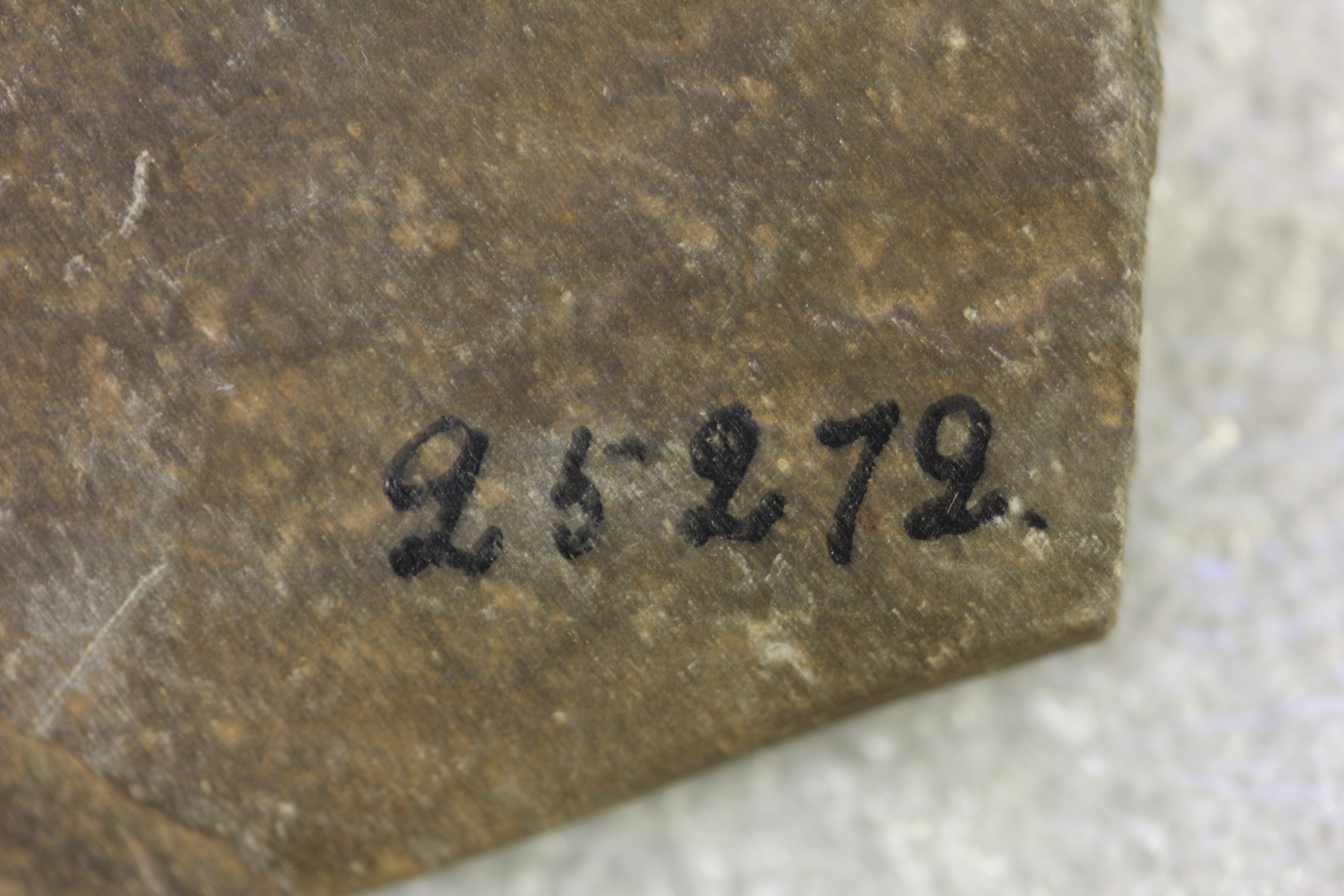
That’s right. Apparently this number already exists elsewhere in the collection. We’re just going to double check it though. After all, some of the numbers written on the artifacts are notoriously difficult to read (here’s a big shout out to whoever thought it was a great idea to loop the hook of a 2 so it looks like a 9. Or a Q. They don’t call them terrible twos for nothing).
What the heck is this? 95279? Q5Q7Q? WHAT IS IT? (It’s 25272).
Next step is to go to the location of where the artifact is in the database, and there it is, plain as day. These two artifacts have the same number and are housed in very different locations from each other. Okay fine, no big deal. We’ll just update the catalog record to say that there’s another artifact with this number in this location. Right? RIGHT?!
No Karen, that’s not right.
Now, there are times when this makes sense. Maybe someone took an object out and forgot where they got it from and just made their best guess when they put it back. However, when it comes to artifacts from Northern Maine, I have absolutely no idea what people were thinking. Some objects with the same number are spread out between four or five different drawers. Typically, it is ceramics that have recieved this inhumane treatment. My best guess is that someone attempted to separate the ceramics out by design motif for analysis. One motif is housed in a box, regardless of what object numbers the sherds have, another motif in a different box, so on and so forth. In a way this would make sense. It would make even more sense if the motifs were ACTUALLY the same. However, more often than not, the design patterns are not really the same at all. A few sherds may have a similar decorative pattern on them, while many sherds look so vastly different that I have to question what they were looking at. This practice makes the inventory process particularly difficult when there are sherds with four different object numbers in a box along with dozens of sherds with no number whatsoever. It therefore becomes impossible to determine which sherd belongs with which object ID number, and as a result, all of the unnumbered sherds are assigned a “found in collections” number.
What I have learned through this process is that we must improve on the housing methods of the past. I shudder to think that someone in the future will go through the collections and question what the heck I was doing and silently curse me under their breath. Extreme organization is a key to happy collections and happy employees/volunteers of the future, and I truly hope that some of the organizational methods that have been implemented during my time here help to achieve this goal.
Nearly $345 million dollars is spent on chocolate for Valentine’s Day each year – that’s about 58 million pounds of chocolate! Holy cacao! Chocolate candy plays such a significant role for this romantic holiday, but did you ever think those very boxes would be used to store artifacts? Currently, I am cataloguing and rehousing artifacts from Tamaulipas, Mexico – a collection from Richard “Scotty” MacNeish’s 1948-1949 Tamaulipas Project. About halfway through the collection I found a sweet surprise – an old chocolate box from Cambridge, MA!
In the Inventory and Rehousing Project, it is common to come across artifacts stored in their original housing material from archaeological recovery in the field. Many of these materials are unique and there is always something new to find! Examples of some of these materials can be found here in an earlier article by Peabody Director, Ryan Wheeler. Like Forrest Gump would say about life being a box of chocolates (pun intended here), the same goes for the Peabody collection – you never know what you’re going to get!
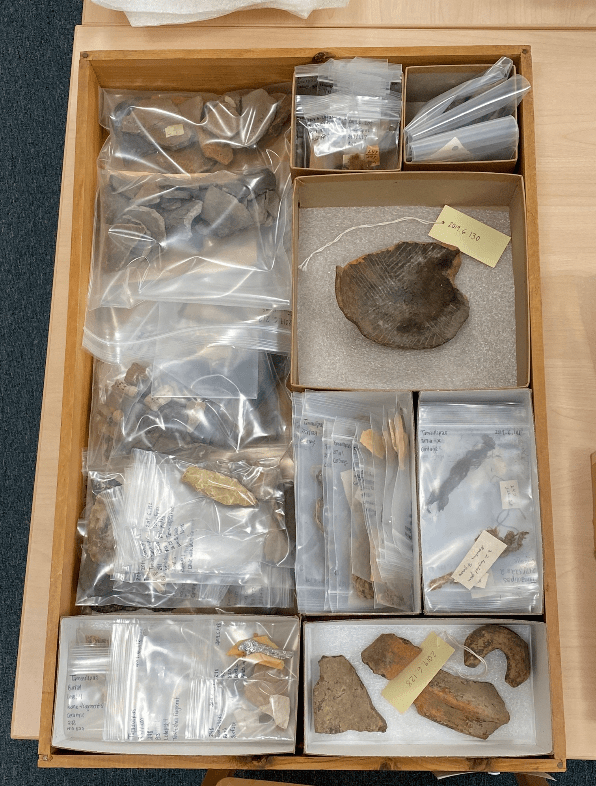
Artifacts before and after rehousing and cataloguing
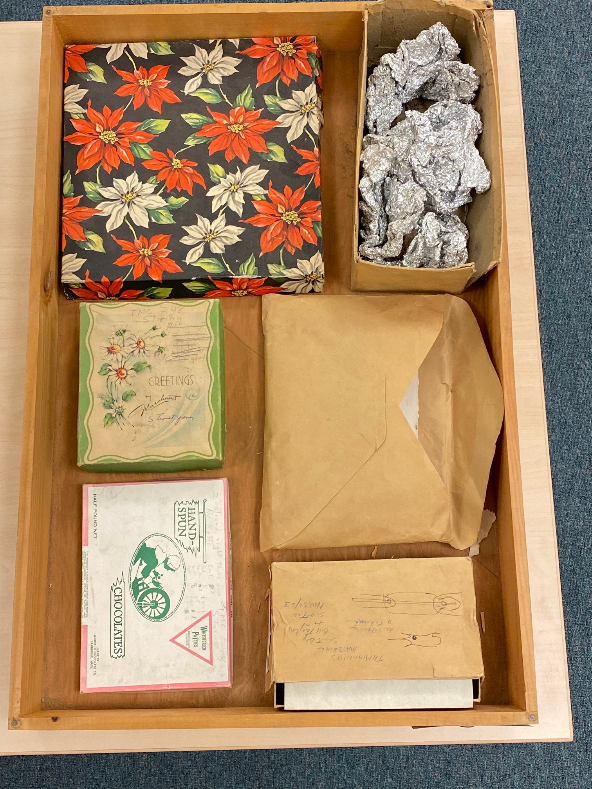
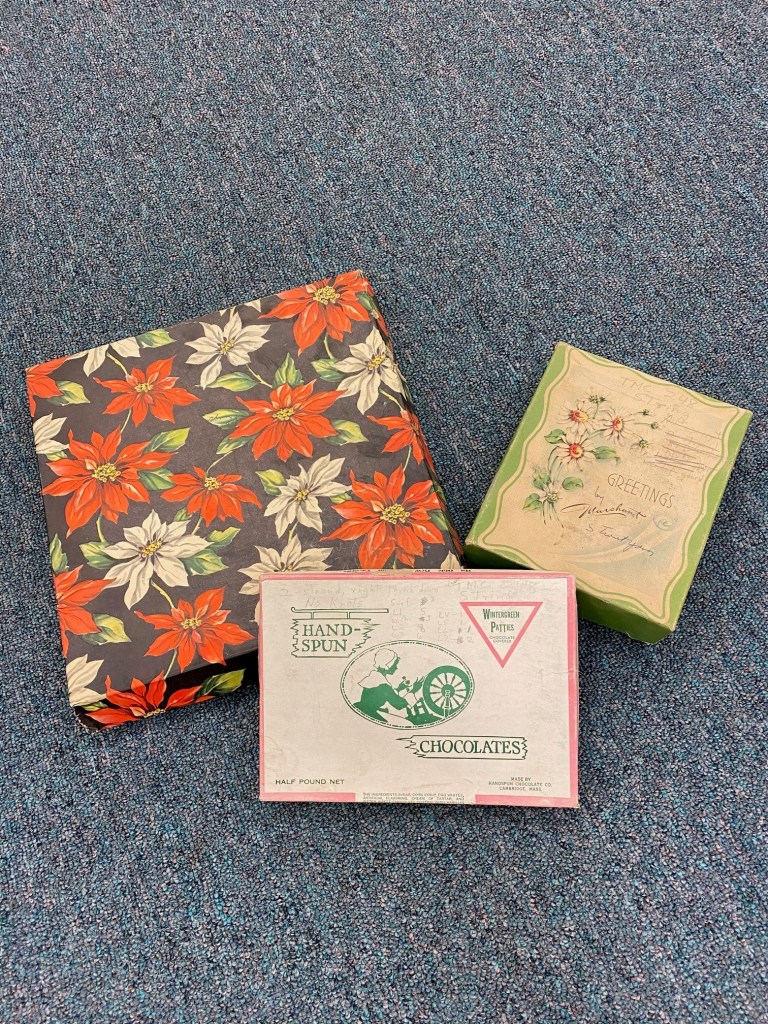
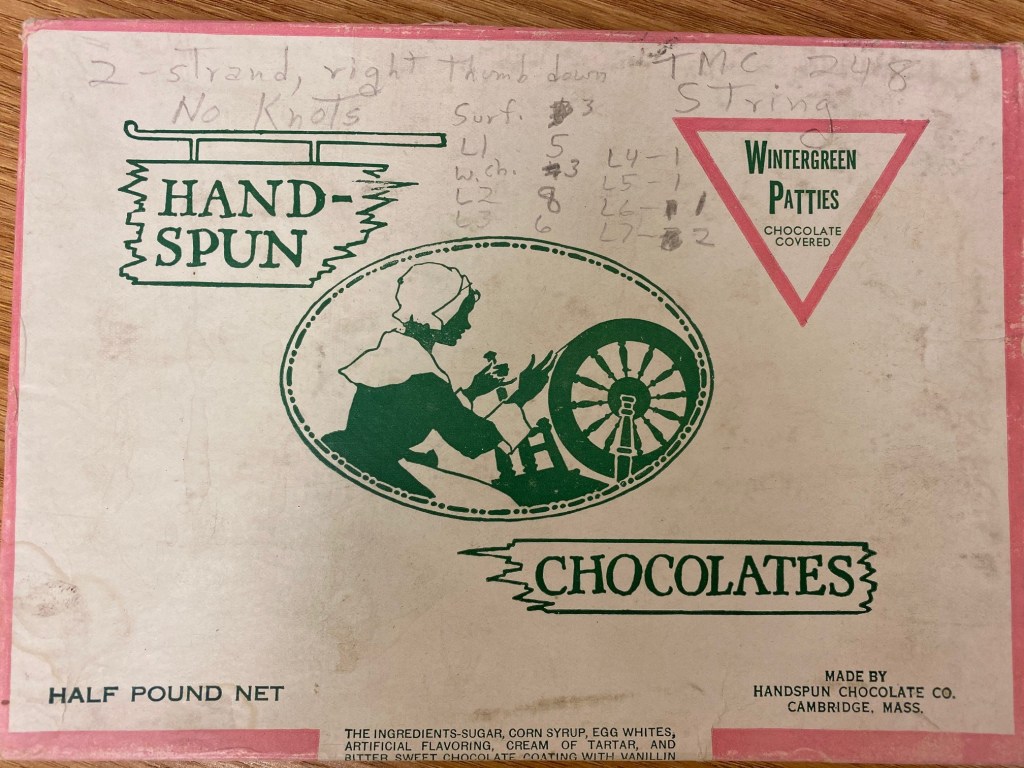
Alongside the chocolate box, I also found a holiday gift box and a greeting card box with artifact information and excavation notes written on the outside cover. The chocolate box was the most intriguing to me, because the product and box were from Massachusetts. Upon looking up the company name on the box, “Handspun Chocolate Co, Cambridge, MA,” I came across Boston’s rich history of chocolate production.
Boxes found holding artifacts in the Peabody Collections.
New England candy was king of the American confectionary industry from colonial times through to the 1950s. In 1764, two men from Dorchester, MA named John Hannon and Dr. James Baker began importing cacao beans into the United States and producing chocolate in Dorchester Lower Mills. These two men were the chocolate meisters of Revolutionary America and are known today as the oldest producers of chocolate in the United States. In 1779, John Hannon had traveled to the West Indies and never returned. As a result, Dr. James Baker became the “King of Cocoa” with the Baker Chocolate Company.
As sugar refineries began to pop up throughout New England, the candy industry reached a new height with Oliver R. Chase’s machine invention of a chalk-like candy, known today as Necco wafers. White chocolate was later created by Frederick Herbert of Hebert Candies in Shrewsbury, MA. Another local creation occurred in 1930 at the Toll House Inn in Whiteman, MA. An accidental invention, Ruth Wakefield added cut up pieces of a semisweet, chocolate bar, in hopes of melting the chocolate into the dough of her baked cookies. The chocolate kept its shape and just like that – the chocolate chip cookie was born! (Fun Fact: The chocolate chip cookie is the official cookie of the State of Massachusetts.) Nestle began selling chocolate chips in 1939.
By the 1940s, candy companies began consolidating into two large companies – Daggett Chocolates and New England Confectionary Company (NECCO). The latter still survives today, but is no longer locally owned. As of 2018, NECCO was the oldest operating candy company, celebrating 153 years of their most popular “sweethearts” candy. However, by July 2018, the company closed and announced their plans to sell everything to the Spangler Candy Company in the fall. Spangler Candy produces Dum Dum lollipops, Necco Wafers, and Circus Peanuts. In 2019, Spangler announced it would not be producing conversation hearts, as there was not enough time to meet the demand of sweethearts for Valentine’s Day. Typically it took NECCO 11 months to produce 8 billion sweethearts just to be sold for 6 weeks out of the year for Valentine’s Day. Although they were gone for 2019, the sweethearts are back for Valentine’s Day 2020! They are in limited supply at select retailers and – believe it or not – many are missing their signature sayings due to equipment printing problems!
The Daggett Chocolate Company is the lesser known of the two candy companies. Fred L. Daggett began his business in 1892 with several factories located around the city of Boston. Daggett later concentrated his production plant in Cambridge in 1925. Daggett Chocolates produced more than 40 brands of chocolate as well as strawberry fillings for their chocolates. The company also made an impact in the soda and ice cream industries, supplying syrups and crushed fruit to manufacturers. As a result, ice cream and candy were connected and Boston became the first place to mix candy into ice cream.
Looking back at the chocolate box I had found in the Peabody collection, I had searched the company name and found that the company was bought out by Daggett Chocolates along with 30 other small chocolate companies by the 1950s.
Chocolate Box, Made by Handspun Chocolate Company in Cambridge, MA
The sugar industry reached its peak in the 1950s. By this time, the Boston metro area boasted over 140 confectionaries and factories, with the main street of Cambridge, MA as the epicenter for production – known as “Confectioners Row.” Some of our favorite candy treats including Necco wafers and sweethearts, Sugar Daddies, Charleston Chews, and Junior Mints were produced on this very street. For over a century, the smell of chocolate could be found along the streets of Boston. Chocolate was in the air – literally.
After the 1950s, the candy industry in Boston took a turn. As more candy companies such as Hershey’s, Nestle, and Mars took to the world stage, smaller brands were left behind. The box chocolate dynasty was reaching an end as candy bars began to take over store shelves. The candy epicenter soon waned and Confectioner’s Row became an ordinary main street. Box chocolate giant, Schrafft’s also closed in Charlestown, MA (that’s right, the building you can see from I-93 entering Boston, bearing the Schrafft’s name in red along with a clock tower, was in fact an old chocolate factory.)
Although Boston is no longer candy land today, you can still find candy makers throughout New England sharing their old-fashioned homemade treats and iconic candy classics. One candy store still in operation today is the Spindler Confections shop in North Cambridge, MA. This shop continues to hand make all of their candy and chocolate on site. They even have a candy museum! Check it out here! As for my sweet find in the Peabody collection – how could a box of chocolates send me down a rabbit hole of Boston’s sweet-toothed past? I was surprised that a simple (and chocolate-less), chocolate box could do so much.
To explore more chocolate history click here, here, and here! Enjoy your sweet finds!














 The Peabody