This summer we have worked on updating our course catalog that we share with the faculty at Andover. All of our programs incorporate the Peabody’s unique artifacts into classes that allow students to explore topics in art, history, science, foreign languages, math, music, and many other subjects. While we offer many classes that support the goals and objectives of faculty through meaningful and engaging experiences for their students, we are also always have to collaborate to create new learning opportunities.
This year we are working with the History Department to create a week long activity for all History 100 students. It is an artifact rich class which will rely heavily on the expertise and assistance of our Curator of Collections, Marla Taylor. The in-depth lesson will focus on the interaction and trade roots of the Moche, Maya, Puebloan, and Hopewell cultures. We cannot wait to get started!
To see what other lessons and activities we offer to the different departments at Phillips Academy, please browse our catalog
As another school year begins, students on the lookout for a quiet place to study in the evening will have a new option. The Peabody is now hosting study hours every Thursday evening from 5pm-9:15pm.
We will also be collaborating with the peer tutoring program on campus to provide a calm space for focused study and learning.
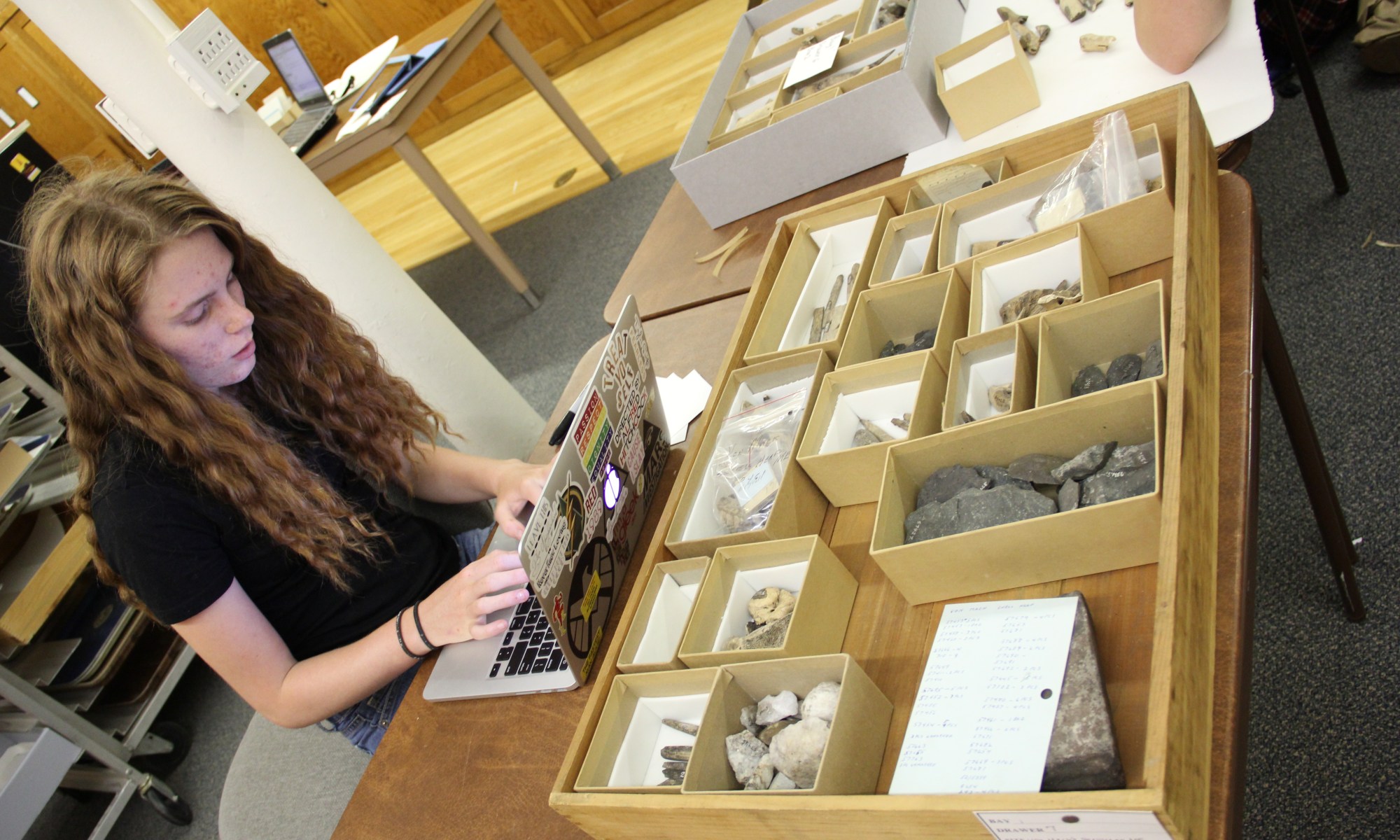
Embarking on a full inventory and rehousing of your museum collection is a daunting task. Transferring approximately 1,700 drawers into 3,000 archival boxes will take years of work. Fortunately for me, I have access to an invaluable resource – Phillips Academy students.
For a week in July, two Lowers (10th graders) came to the Peabody every day for four hours to fulfill their work duty commitment for the school year. I gave them a crash course in artifact identification and object handling techniques before they got down to business. As they worked through the meticulous process of inventorying everything in the collection, they made crucial observations that will improve my workflow. Together, these two students recorded the contents of twenty-nine drawers!
Work duty student inventorying a drawer
Work duty students will continue to be an essential work force as we move through the collection. I will share their progress and successes in the months and years to come.
Curator of Collections Marla Taylor and work duty students stand behind the empty boxes
Warps, warp-face, wefts, weft-face, ikat or jaspe, brocade, coiling, twining, plaiting—these technical terms come from the language of weaving. For students in Therese Zemlin’s art class, an exploration of weaving was motivation for a tour of collections at the Peabody Museum in April and May 2016 with research associate Catherine Hunter. The themes were textiles of Guatemala and Peru, and Native American baskets.
Weaving involves the interlacing of two elements: warp and weft. The loom supports vertical elements or yarns (warps) under tension. Then, weaving is the process of interlacing horizontal elements (wefts) side-to-side perpendicular to the warps. The weaver manipulates the colors and density of the warp or weft, making the potential for new designs endless.
Forty items were selected from the museum’s collection of 400+ 20th century Guatemalan textiles and back-strap looms, and ancient Peruvian textiles. The majority were blouses called huipiles, assembled from several parallel lengths of cloth. Among the Maya distinctive traditional designs have been associated with specific villages. Communities consistently favor bright colors with beautiful sophisticated geometric and zoomorphic designs.
Students examines a vibrant Guatemalan textile on backstrap loom.
From an inventory of 350 19th-20th century Native American baskets, 20 were chosen to represent the cultural preferences of five geographic regions. This tradition is acknowledged as the finest expression of its type, setting the standard for anyone who studies baskets as art. The basic techniques are coiling, twining and plaiting.
Catherine Hunter sharing the vast array of baskets in the Peabody’s collections.
There is remarkable ingenuity in the variety of plants and trees discovered for basketry materials, including ash splints, river cane, pine needles, roots, grasses, and red cedar. Harvesting and processing of materials was a time-consuming community activity with an appreciation of seasonal and sustainable practices.
There is amazing vitality in the forms of baskets including bowls, jars, rectangles, cones, trays, and plaques. Fascinating objects in themselves, it is all the more interesting to know their uses include food gathering, cooking (in water tight baskets), water bottles, seed bottles, pictorial trays illustrating mythology, feather-covered gift baskets, hats, and forms targeting the interest of tourists.
Students investigating the coloring and construction of some of the baskets
Catherine leading an interactive example of weaving techniques
Catherine holding a Navajo basket
Both traditions—Guatemalan weaving and Native American basketry— continue today as a source of cultural pride for communities and as professions for artists.
AUTHOR BIO
Catherine K. Hunter is an independent museum consultant whose career began in the Department of Textiles at the Museum of Fine Arts in Boston. She began an inventory of the Peabody Museum’s basket collection in November 2015 and will complete the project in summer 2016.
Scholars, museum professionals, educators and interested members of the public gathered at Salem State University for a symposium that delved into the history and implications of slavery in New England. Essex Heritage organized this event to be interactive and engaging. In addition to scholars they also invited the participants to explore the topic through breakout sessions and facilitated activities.
Beth Beringer of Essex Heritage invited me to lead one of the activities. During the morning session I lead participants through our History 200 lesson, The Little Spots Allow’d Them. Participants explored how landscapes can and have shaped human behavior using archaeological data from Isaac Royall’s Ten Hills Farm in Medford, Mass. (now the Royall House and Slave Quarters).
Curator of Education Lindsay Randall leads her break out group through the interactive activity
The program then shifted to exploration of the difficult discussions that arise when confronting northern slavery. The experts on this panel had a diverse background as historians, professors, and museum professionals. They focused on meaningful strategies that could be used to engage any audience – classroom, museum goers, or the public – in a substantive manner.
Keynote speaker (and ChuBbs Woodrow Randall enthusiast) Dr. Joanne Pope Melish spoke about the often complex relationship that New England had with the institution of slavery. She focused on the impact that this history has had on the region and its legacy today. Melish was also quick to point out that “rich men did not own slaves. Slaves made men rich” and how we need to shift the typical narratives used when engaging with students in any setting.
There also was a group of museum educators who talked about their unique ways of engaging the public in the history of slavery in New England. Maryann Zujewski from Salem Maritime National Park has been working with Dr. Bethany Jay of Salem State University to reframe their interpretive tours so that they are not simply ADDING black people to history, but that they and other minorities are becoming more integrated in a meaningful and natural manner. Olivia Searcy discussed how she has helped to create the educational programming for the Royall House and Slave Quarters Museum in a manner that has focused on the history of the enslaved people at the site. The Caribbean Connections program from the House of the Seven Gables is a duel language program, described by Ana Nuncio as innovative in its outreach to minority groups in a community which might not otherwise feel welcomed in a museum setting.
At the end of the day participants could self-select into a variety of breakout sessions to dive further into a topic of interest.
This symposium was very important and offered me a great deal of new information and ways of thinking. I am already furiously at work on how to integrate all that I learned into the lessons and activities that I teach. I hope that another symposium of this kind will be offered again and I anxiously await word from my friends at Essex Heritage!
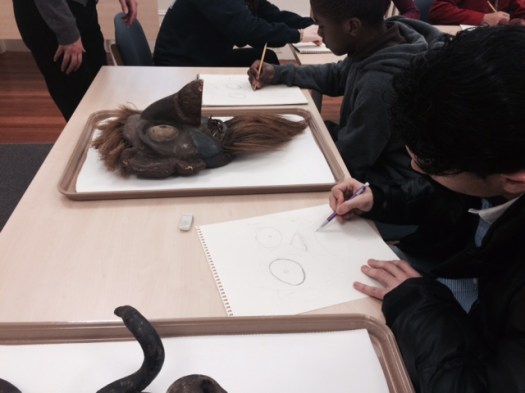
Masks are one of the most visual elements of a culture, often used to transform the wearer during rituals, ceremonies, or other events. The use of masks dates back thousands of years, at least to the Neolithic period some 9,000 years ago or much earlier. Many of our masks are believed to be from Mexico. Two years ago work duty students began researching some of the masks in our collection. While not complete, their work has been invaluable for the classes we teach. Recently the Peabody pulled all the masks from our collection to share with students in Therese Zemlin’s art classes.
Students looking at black horned mask
Entire class working on their drawings
Students sketching Cherokee mask with snake on head
Students drawing masks from Mexico
One class has an assignment to make a 3 dimensional clay gargoyle. By studying the Peabody’s masks students investigate how artist’s created expressions, developed the proportions of facial features, and how human and animal features were melded together. The other class is learning to perceive minute details that are otherwise missed when we assume we understand what we see.
After looking at the masks and talking with me, the students are given time to begin sketching a mask of their choosing. This helps them to focus their attention even more and to gain a more intimate appreciation of the object in front of them, which will in turn aid them with their art projects.
On the third Tuesday of every month, the Massachusetts Archaeological Society – Gene Winter Chapter invites a guest speaker to their meeting at the Peabody Museum. For the past six years, Phillips Academy students have been invited to speak about their experiences with archaeology at one of these meetings.
On February 16th, seven students, in three groups, shared their research and work on a variety of topics.
Youth for Restoration: Preserving Local History
Viraj Kumar’s ’17 interest in local history led him to create a non-profit organization that works to preserve and restore local history in Poughquag, New York. He discussed his experiences working with the community on a 19th century grist mill.
Printing History: 3D Rendering of Artifacts
Four students, Alana Gudinas ’16, Jacob Boudreau ’16, Mia LaRocca ’16, and Sarah Schmaier ‘16, were challenged to scan three artifacts from the Peabody Museum’s collection and print them as 3D models. They discussed the process and highlight some of the implications of this technology for museums and other institutions.
More than Meets the Eye: 19th Century Portrayals of Native Americans
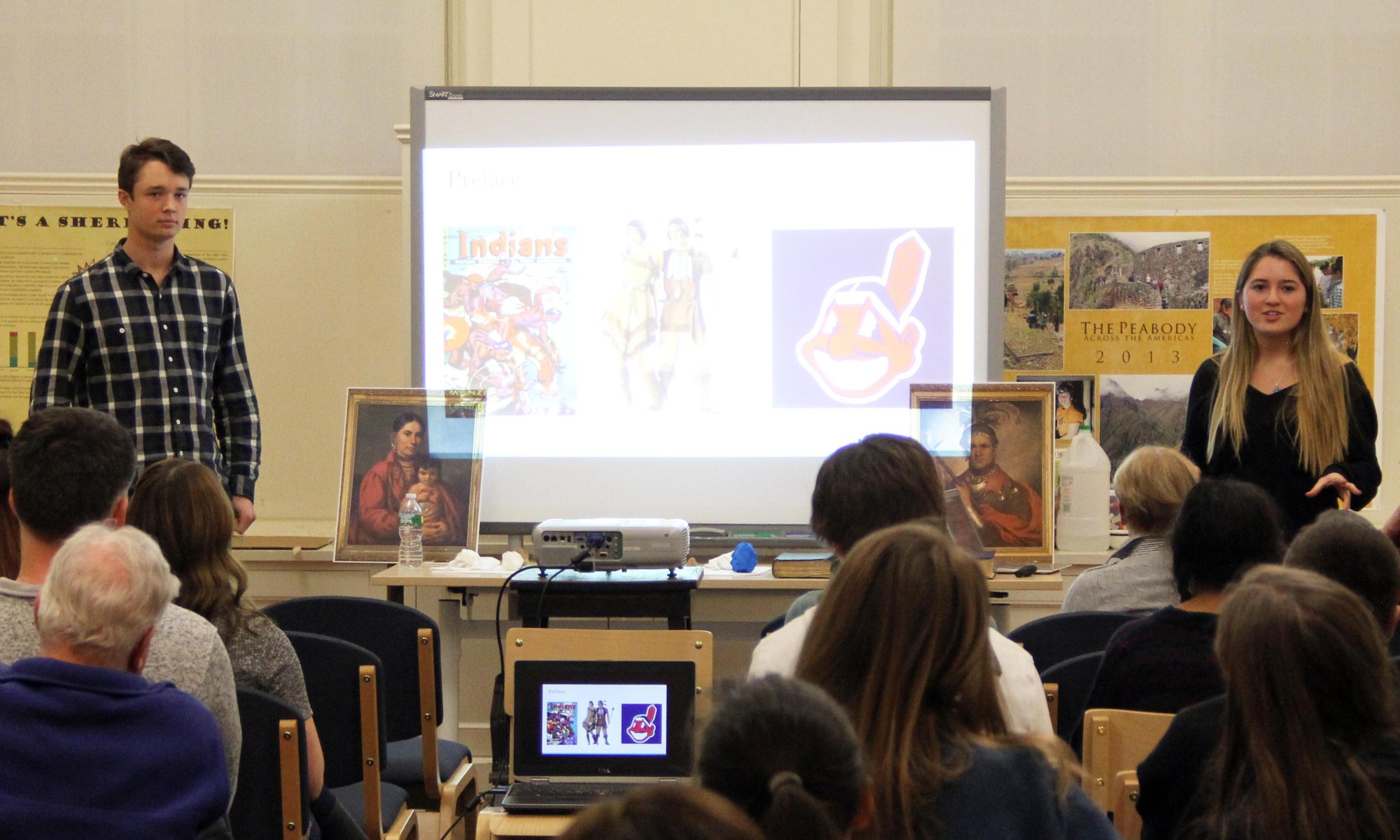
In the 1830s, the first director of the Bureau of Indian Affairs launched an ambitious effort to collect over one hundred portraits of Native Americans. Veronica Nutting ’16 and Alex Armour’16 investigated three of these paintings at the Peabody–how and when they got here, why they’re important, and how they compare to contemporary depictions of Native Americans.
Jacob presents his experience to the MAS
Speaking to an audience of nearly 50 chapter members, professional archaeologists, and members of the PA community, all the presentations were very well received. Congratulations to all the students for their hard work!
Check out this article from the Phillipian to learn even more.
The end of Winter Term has arrived and with it the bitter New England cold, which is fitting given our most popular lesson during this time is our Inuit focused activity, Blubber: It’s What’s for Dinner.
The lesson is part of the History 100 theme related to nomadic people. In the fall 9th graders learn about the Bedouins who travel throughout a desert landscape. During winter term students continue that theme by learning about the Mongols, a nomadic group who live in the Asiatic steppe. Classes examine the Peabody’s arctic collections as a way to support their learning about nomadic societies, giving them a chance to apply concept they have learned in class and applying them to another nomadic culture.
The three extreme environments; desert, temperate grasslands, and the frozen north help to highlight the similarities of the three groups. This allows students to pick out important key aspects that are central to any nomadic group, no matter the landscape they inhabit.
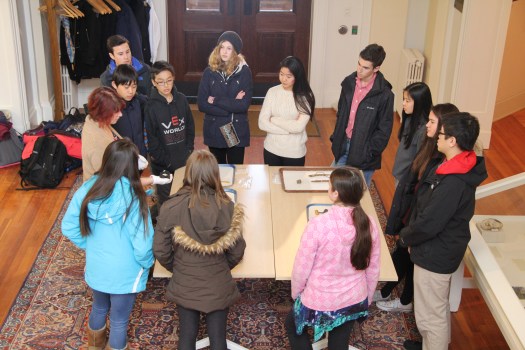
Students move between four stations that are set up around the Peabody and work in groups to determine answers to the following questions:
What is each object? How was it used?
What is the object made from?
Why are the objects grouped together?
As class begins we review what it means to be nomadic and how that might be reflected in material culture. An initial activity emphasizes that everything a nomadic person carries has a purpose and the heavier an item, the more important it might be.
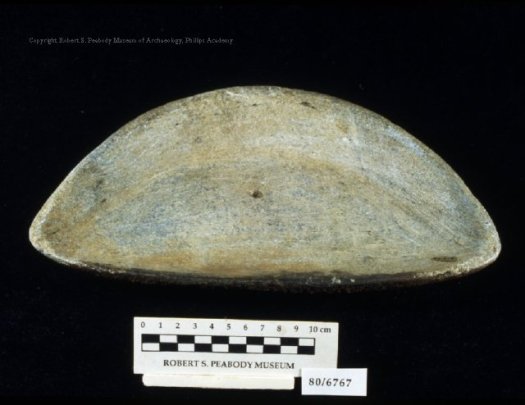
This is illustrated by the object depicted below. Students quickly determine that it is made from stone, which automatically demonstrates its importance. The shape suggests that it was made to hold something, similar to a bowl. They know that whatever it held had to be extremely important. Some students notice that each bowl has some black markings around the rim. It is usually this revelation that helps students to work towards the correct assumption – the bowl held fire, which in the arctic is central to survival.
This stone blubber lamp was collected by William Duncan Strong in Hopedale, Labrador Canada. You can see charring along the edge as well as a hole in the center to hold the wick.
This is one of my favorite lessons to do because it gets students to look at objects as cultural markers and to understand how they can be “read” for information about the people who made and used them.
The class is also a source of enjoyment because of how deeply engaged students get, particularly when I give them frustrating answers. “Yes but no” or “no, but close” are two of the phrases I often tell students when they share with me their hypotheses about the objects.
To many students these answers are a challenge. However, the most enjoyable moment is when the entire group rushes across the room to conspiratorially whisper their new answers to me – least their classmates hear – and jump around in joy to find out they are, in fact, correct.
Best. Part. Of. Teaching. EVER.
Lindsay Randall revealing to the entire class the names and uses of objects at one of the stations.
Contributed by Claudia Wessner, Makerspace Coordinator and Library Experience Designer
Huge progress has been made in the collaborative project between The Nest, the makerspace at Phillips Academy, and the Peabody Museum! From the first day we received the Next Engine 3D Scanner, we had hopes of testing out this new technology in a fun and interesting way. After talking to Marla Taylor, we both thought it was a no brainer to form a collaboration between the museum, the makerspace and a group of work duty students (Alana Gudinas ’16, Jacob Boudreau ’16, Mia LaRocca ’16, and Sarah Schmaier ’16) to further explore the scanning possibilities.
In a previous post, Marla discussed the parameters in which the artifacts were selected. Once we brought the artifacts over to the Nest, we were able to make custom stands for two of the three artifacts so that they would be stable on the scanner. Then we got to work!
So, how does it work?
Before the scanning starts, we set up preferences such as resolution, color mode, and the number of incremental scans, as well as positioning the object in the camera’s field of view. The higher the desired resolution, the longer the scanning process will take. Most of the objects we scanned took around one hour.
Lasers scan the artifact
The scanner begins by taking a 2D image of the object then shoots out an array of red laser beams to capture the depth and texture of the object. Next, it completes a series of slow incremental rotations, based on the level of resolution selected, and performs the same 2D/3D rendering for each increment. The Next Engine software slowly builds the 3D model before your eyes as it layers the data captured by the scanner.
Fully rendered 3D model from the scan
After the scanning is complete, the 3-dimensional model of the artifact appears in the Next Engine software. Depending on how the artifact is scanned, there may be some holes in the model. This would be where the lasers may not have been able to reach, such as the top or the bottom of the artifact. There are ways to avoid holes by completing several scans of the same object (top, bottom, full 360) and then fusing them together. This is something I am looking forward to experimenting with in the future, but for our initial exploration we did a single scan.
In order to fill the holes in our model, I “polished” it using the Next Engine software. The program will automatically find and select holes in the model. Then you can use a paintbrush tool to select the areas in which you’d like to fill. This can also take some time and experimentation, especially with very high resolution scans where image rendering can use a lot of computing power.
Scan with the ‘holes’
The ‘holes’ have been digitally filled in
Once the editing of the model is complete, it is ready to prepare for printing by saving it as a .stl file and opening it in the Makerbot Desktop software. In the software you can scale, rotate, and place your object in the desired location on the build plate. You can also preview how long the print will take. This artifact, which was approximately four inches tall, took about 5 hours to print.
The 3D scan is ready to print
The Makerbot 3D printer uses a material called PLA that is stored in a spool in the back of the machine. The PLA is heated in an extruder and lays down very thin layers of material to build the object from the bottom up. Think of it like a glorified glue gun! The makerbot will automatically add “support material” that will support the object as it is printing so that everything stays intact. Once it is finished printing, any support material easily breaks off from the print.
The 3D printed artifact!
We are so excited about the results of our project! We are looking forward to scanning more artifacts in the Peabody collection and refining our skills with this new technology! Stay tuned!
The Peabody Museum has begun the collaborative process of reexamining our relationship with the Pueblo of Jemez. The Peabody’s involvement with the Jemez dates back 100 years—to the period from 1915 through 1929 when Alfred V. Kidder and his colleagues conducted excavations and ethnographic studies of the Pecos and Jemez pueblos. Consultations under the Native American Graves Protection and Repatriation Act (NAGPRA) in the 1990s rekindled the relationship and launched the Pecos Pathways expeditionary learning program at Phillips Academy. Pecos Pathways has been the centerpiece of the Andover-Jemez relationship since 1998, but we’ve seen a host of other collaborative efforts since then, including the recent visits by potters Dominique and Maxine Toya and their friends.
Dominique Toya works with PA students in Mr. S. Thayer Zaeder’s ceramics class.
The goal of this critical assessment is to ensure that the partnership is maintained in a coherent and consistent manner, despite the changing needs and desires of the partners through time. We want to focus on sustaining and growing the relationship and enhancing its impact through the exchange of knowledge, resources, and individuals from each community. Initially we are working with the Education Department at Jemez, but we will expand the conversations to include other members of the tribe, such as those in the Department of Natural Resources who oversee all tribal archaeological work.
We recently began conversations with Janice Tosa, research associate and student program outreach manager for Jemez Pueblo, and Leander Loretto, student outreach coordinator for Jemez Pueblo, about how we might modify and expand our joint educational offering. A main focus in the conversations has been on creating programming that supports and advances our learning objectives in a more tangible manner, while also being sustainable. Looking at unique and creative ways in which adult members of each community can be engaged and utilized is another area that we are exploring.
We look forward to working with our friends at Jemez Pueblo on this exciting project!
Above Clockwise: Janice Tosa shows off her love of the Boston Red Sox’s; Leander Loretto screens for artifacts on the Mashentucket Pequot Reservation; A Pecos Pathways group prepares to hike up San Diego Mesa.